𝗙𝗨𝗟𝗟 𝗦𝗧𝗢𝗥𝗬 The HOA President Brought a Sheriff’s Convoy to My 11,400-Acre Ranch and Demanded I Remove Every Cow
𝗙𝗨𝗟𝗟 𝗦𝗧𝗢𝗥𝗬
The first night, I sat at that table until midnight, turning through the notebook and realizing just how much I didn’t know.
Eleven thousand four hundred acres sounded like wealth.
But the ranch wasn’t a giant pile of money waiting to be spent.
It was living land that demanded attention.
A damaged fence could scatter cattle across miles of countryside.
A broken water pump could threaten an entire pasture.
A drought could destroy months of planning.
One careless decision could cost more than a year’s worth of repairs.
There were roads to maintain, grazing rotations to understand, and property boundaries stretching farther than I could imagine walking.
And there was the herd.
Hundreds of animals that had no idea their owner had died.
They still needed grass.
They still needed water.
They still needed someone to watch over them.
I began each morning before sunrise.
I’d make coffee in Grandpa’s old percolator, spread the ranch maps across the kitchen table, and decide which section to inspect.
The property was divided into enormous grazing pastures separated by fences, creeks, wooded ridges, and old service roads.
Some sections were relatively flat.
Others climbed into low hills where the grass grew thin and the wind never seemed to stop.
The cattle were thriving.
That was the first relief I’d felt since the funeral.
Grandpa had arranged the grazing schedule carefully, moving different groups through the pastures so no single section became overworked. Water tanks were filled. Gates were secured. The animals looked healthy and well-fed.
He had kept everything running almost until the end.
Every time I discovered another carefully maintained section, I felt equal parts gratitude and shame.
Gratitude because he’d left me something extraordinary.
Shame because I hadn’t understood how much work it had taken.
On the fourth morning, I found an old boundary marker near the eastern pasture.
It was a weathered stone post, partially buried beneath decades of grass.
The numbers carved into its surface had faded, but they were still visible.
I remembered my grandfather showing it to me when I was twelve.
He had climbed out of his truck, pointed toward the marker, and told me to pay attention.
“That rock matters more than most people know.”
I asked why.
“Because that’s where our land ends.”
I looked across the fence.
“And what’s over there?”
“Somebody else’s property.”
“Who owns it?”
“Doesn’t matter. We respect their side, and they respect ours.”
He had paused.
“At least, that’s how it’s supposed to work.”
I didn’t think much about those words until I inherited the ranch.
The eastern boundary was now bordered by a residential development called Silvercrest Estates.
The neighborhood hadn’t existed when I was a child.
Back then, the adjoining property had been mostly open ground with a few scattered houses.
Now large homes stood along landscaped streets, and decorative stone walls marked the subdivision’s entrances.
Some of the houses overlooked my pastures.
From their back decks, residents could watch the cattle grazing beyond the boundary fence.
Personally, I thought it was a wonderful view.
But apparently, not everyone agreed.
I learned that on the fifth morning.
A white envelope was wedged into the ranch’s main gate.
It carried an embossed Silvercrest Estates Homeowners Association logo.
Inside was a formal notice titled “Agricultural Compliance Concern.”
The letter informed me that livestock activity on the ranch had generated complaints from nearby residents.
It referred to community appearance standards, environmental quality, and neighborhood compatibility.
Then it instructed me to contact the HOA immediately to arrange corrective action.
I read it twice.
There was no specific explanation of what the cattle had done wrong.
No identification of damaged property.
No report of animals escaping.
No actual allegation that they had crossed the boundary.
Just a general declaration that the herd was somehow inconsistent with the surrounding neighborhood.
At the bottom was a signature.
Karen.
President, Silvercrest Estates Homeowners Association.
I folded the paper and slipped it into my shirt pocket.
My first thought was that someone had made an administrative mistake.
Maybe the HOA sent the same notices to every nearby property.
Maybe somebody hadn’t realized the ranch was independent.
Surely no reasonable person expected an established cattle operation to remove its herd because neighbors disliked the view.
I went back to work.
The next day, another notice arrived.
This one was more aggressive.
It stated that the HOA considered my continued livestock operations a violation of its governing standards.
It warned that failure to comply could result in formal enforcement measures.
I stood beside the mailbox and read that sentence several times.
Formal enforcement measures.
Against eleven thousand four hundred acres of private ranchland.
I looked toward the cattle grazing beyond the fence.
Then I looked at the neatly printed letter.
“Well,” I muttered, “Grandpa would’ve enjoyed this.”
But I wasn’t laughing.
I had been responsible for the ranch less than a week, and already somebody was demanding that I change the fundamental purpose of the property.
I considered calling the HOA.
Then I stopped.
The letter contained no explanation of why Silvercrest believed its rules applied to the ranch.
I wasn’t going to acknowledge an authority nobody had established.
Instead, I placed both notices in a folder on the kitchen table.
I planned to review the property records that evening.
I never got the chance.
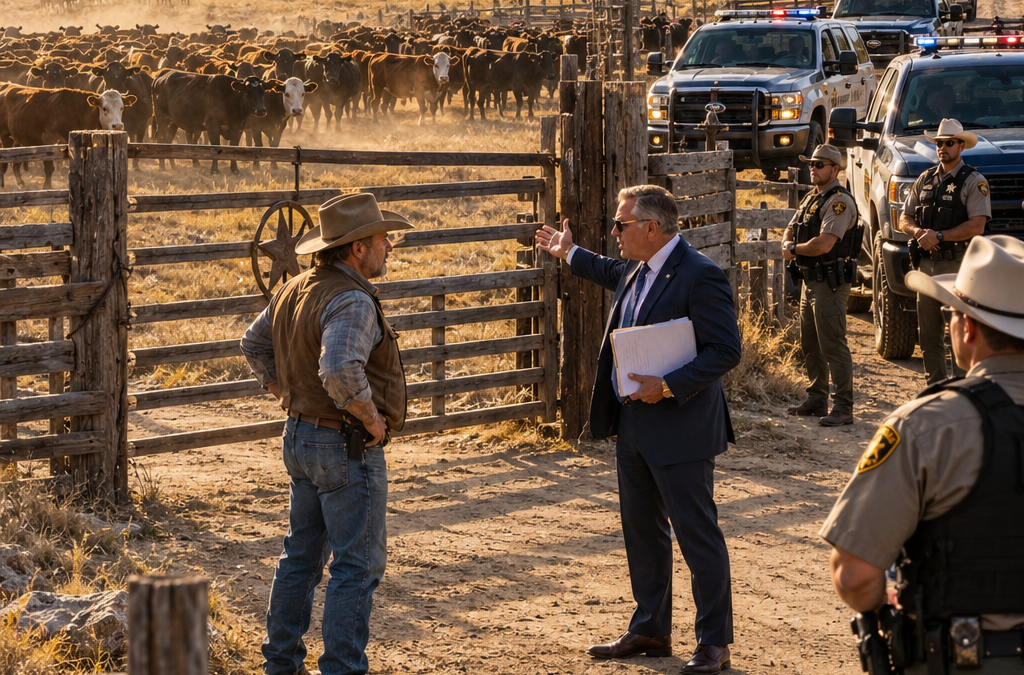
Because shortly after noon, while I was checking the cattle pens near the main ranch road, I heard engines approaching.
At first, I thought it might be a delivery.
Then I saw the vehicles.
A white sheriff’s SUV came first.
Behind it was a marked patrol vehicle.
Then another county vehicle.
Following the convoy was a black luxury SUV with polished chrome wheels.
The vehicles rolled down the gravel road, throwing dust into the hot afternoon air.
I stopped beside the cattle gate.
The sheriff’s SUV pulled to a halt.
The others stopped behind it.
Then the door of the black SUV opened.
A man climbed out wearing the kind of suit that looked completely absurd on a working ranch.
He straightened his jacket, checked his cuffs, and surveyed the pasture as though inspecting a property he intended to purchase.
I had never seen him before.
But I knew immediately who he was.
Karen.
He held a thick black leather folder beneath one arm.
He walked toward me without introducing himself.
“Michael?”
“That’s me.”
“I’m Karen, president of Silvercrest Estates.”
I nodded.
“I got your letters.”
“Then you’re aware of the problem.”
I glanced toward the cattle.
“What problem?”
His expression tightened.
“The livestock.”
I waited.
He pointed toward the pasture.
“Those animals need to be removed.”
For a moment, I thought I’d heard him incorrectly.
“Removed where?”
“Off this property.”
I stared at him.
“All of them?”
“Every animal operating in violation of community regulations.”
I looked past him toward the sheriff’s vehicles.
Then back at his face.
“You’re serious.”
“Completely.”
I could feel the first edge of anger.
But mostly, I was confused.
I had owned the ranch for barely a week.
The cattle had lived here long before I inherited it.
Nothing about the operation had changed.
Yet this stranger was standing at my gate demanding that I remove the entire herd.
“Karen, this is a cattle ranch.”
“I’m aware.”
“Cattle belong on cattle ranches.”
He gave me an impatient look.
“Michael, I’m not interested in debating agricultural terminology.”
“Then what exactly are we debating?”
“Your obligation to comply with community standards.”
I looked toward the nearest sheriff’s deputy.
He was standing beside his vehicle, watching the exchange.
“Did you bring law enforcement because my cows are eating grass?”
Karen’s eyes narrowed.
“I brought law enforcement because you’ve ignored official notices.”
“I’ve had those notices for about forty-eight hours.”
“And you’ve done nothing.”
“What would you like me to do?”
“Remove the herd.”
I stared at him.
Behind the fence, several cattle lifted their heads.
One large black cow watched the group gathered near the gate.
The absurdity of the moment would have been funny if the stakes weren’t so enormous.
“Karen,” I said, “do you have any idea how much land we’re standing on?”
“Eleven thousand four hundred acres. I’m familiar with the property.”
“Then you understand these animals aren’t sitting in somebody’s backyard.”
He adjusted his watch.
“The size of the parcel doesn’t exempt it from applicable regulations.”
“Which regulations?”
“Our livestock restrictions.”
“Your HOA’s livestock restrictions?”
“Correct.”
I glanced toward the subdivision rooftops in the distance.
“Those rules apply to your neighborhood.”
“They apply to properties under our jurisdiction.”
I nodded slowly.
“Then show me where my ranch became part of your jurisdiction.”
Karen’s expression changed.
It was subtle.
His chin rose slightly.
His shoulders squared.
He looked like a man who had been challenged in front of an audience and considered that challenge personally offensive.
“Michael, I suggest you lower your tone.”
My eyebrows rose.
“My tone?”
“You’re being unnecessarily confrontational.”
“You brought the sheriff to my cattle pen and ordered me to remove my herd.”
He smiled thinly.
“Because you forced the association to take action.”
I took a slow breath.
Before I could answer, the driver of the lead sheriff’s vehicle approached.
He was a broad-shouldered man in his late fifties, with a sun-weathered face, gray hair beneath his hat, and reading glasses tucked into his shirt pocket.
“Sheriff Miller,” he said, extending his hand.
I shook it.
“Michael.”
“I understand you’re the new owner.”
“Yes, sir.”
“Sorry about your grandfather. I knew him a little.”
That caught me off guard.
“Thank you.”
“He was a good man.”
I swallowed.
“He was.”
Miller glanced toward Karen.
“Now, let’s see if we can understand what’s happening here.”
Karen immediately stepped forward.
“Sheriff, as I explained on the phone, the HOA has received multiple complaints regarding livestock activity on property subject to community regulation.”
Miller nodded.
“I heard that.”
“The owner has refused to comply with our notices.”
“I understand.”
“And the board expects the animals to be removed immediately.”
The sheriff looked at me.
“Michael, have any of these cattle gotten loose?”
“No, sir.”
“Any reports of them damaging neighboring property?”
“None that I’m aware of.”
“Any issue with them being on the roadway?”
“No.”
He looked at the herd.
“Water and feed all right?”
“Yes, sir. They’re grazing exactly where they’re supposed to.”
Miller turned back toward Karen.
“What exactly are the complaints?”
Karen opened his folder.
“Noise. Odor. Visual disruption. General incompatibility with residential standards.”
I stared at him.
“Visual disruption?”
He didn’t look at me.
“Residents have paid considerable sums for their homes.”
I looked toward the distant rooftops.
“And?”
“They expect an attractive, controlled environment.”
I glanced at the pasture.
“The cattle were here before their houses.”
Karen’s smile disappeared.
“That doesn’t mean the surrounding area cannot evolve.”
“Evolution doesn’t mean you get to remove my animals.”
He raised one hand.
“Michael, your emotional attachment to the ranch is understandable, but it doesn’t override lawful governance.”
Something in my chest tightened.
Emotional attachment.
As though my grandfather’s lifetime of work were some sentimental inconvenience.
I looked at the sheriff.
“Sir, has anybody actually checked the deed?”
Miller paused.
“Not yet.”
“Then before anybody talks about removing livestock, I’d like somebody to establish who owns the land.”
Karen gave a dismissive laugh.
“Ownership isn’t in dispute.”
I turned toward him.
“Then why are we having this conversation?”
“Because ownership and regulatory authority are separate issues.”
“Sometimes,” Miller said.
Karen looked relieved.
“Exactly.”
“But we still need to establish what authority your association has over this property.”
Karen’s smile faded again.
Miller continued.
“Do you have a recorded declaration, annexation agreement, or other document legally subjecting this ranch to your HOA?”
Karen opened the folder.
“We have our governing rules.”
“That’s not exactly what I asked.”
“The ranch lies adjacent to Silvercrest Estates.”
“Adjacent isn’t the same as included.”
Karen looked irritated.
“The HOA has historically exercised authority over certain areas surrounding the development.”
I stepped forward.
“What areas?”
“The eastern agricultural boundary.”
“That’s my land.”
“That’s precisely the disputed issue.”
I stared at him.
A moment earlier, he’d insisted ownership wasn’t in dispute.
Now he was claiming the property boundary itself was uncertain.
“Karen, are you saying the HOA owns part of this ranch?”
He stiffened.
“I’m saying there are longstanding agreements.”
“What agreements?”
“Historical development agreements.”
“Signed by whom?”
“Previous parties.”
“My grandfather?”
Karen didn’t answer.
I stepped closer.
“Did my grandfather sign something giving you authority over his cattle?”
His eyes shifted toward the sheriff.
“Those records may be held by the association.”
“Then why didn’t you bring them?”
His expression hardened.
“I didn’t expect to conduct a full legal review in a pasture.”
“Then you shouldn’t have brought the sheriff here demanding immediate removal.”
For the first time, the deputy standing behind Miller appeared uncomfortable.
He glanced at his sheriff.
Miller lifted a hand.
“All right. Let’s keep this productive.”
He looked at Karen.
“Do you have documentation proving the HOA controls this property?”
Karen tapped his folder.
“I have the relevant community regulations.”
“That establishes what the HOA requires of its members. It doesn’t establish that Michael is one.”
Karen inhaled sharply.
“Sheriff, we’ve invested substantial resources in maintaining the surrounding area.”
“That may be true.”
“We’ve improved access roads, managed landscaping, and protected property values.”
“None of which automatically makes this ranch part of the association.”
Karen looked at me with open irritation.
“Michael, perhaps you’d like to explain why your family never cooperated with the development.”
I felt heat rise into my face.
“My grandfather cooperated with anybody who respected his property.”
“That’s not how the records describe it.”
“What records?”
Karen hesitated.
Then he closed his folder.
“This conversation is becoming unproductive.”
I looked at Sheriff Miller.
“Can I get the original deed from the house?”
Miller nodded.
“That would be helpful.”
Karen immediately objected.
“Sheriff, an old deed won’t necessarily reflect subsequent agreements.”
“Maybe not,” Miller said. “But it’s a good place to start.”
I pointed toward the house.
“Give me a few minutes.”
Karen crossed his arms.
“We can’t delay enforcement indefinitely.”
Miller turned toward him.
“Nobody is removing livestock until we’ve established a lawful basis to do so.”
The tone of his voice was calm.
But there was no mistaking the authority behind it.
Karen pressed his lips together.
I turned and hurried toward my truck.
As I walked away, I heard Karen begin speaking again.
“The board has been patient for years. These agricultural operations are incompatible with the community’s long-term vision.”
I stopped for half a second.
Then kept walking.
Long-term vision.
I knew exactly what my grandfather would have said about that.
A man’s vision didn’t become somebody else’s obligation just because he put it in a binder.
The ranch house was only a short drive from the cattle pens.
But that afternoon, the trip felt much longer.
I kept replaying Karen’s words.
Remove the herd.
Immediately.
Every animal.
I knew enough about ranching to understand what such an order would mean.
You couldn’t simply move hundreds of cattle like furniture.
It required transport arrangements, handling facilities, planning, labor, and money.
Moving them without a proper destination would disrupt grazing, stress the animals, and potentially destroy the operation my grandfather had left behind.
And if an official order actually forced me to clear the pastures, I had no idea how I would recover.
I wasn’t an experienced ranch owner with a network of backup properties.
I was a man who had inherited an enormous responsibility seven days earlier.
My grandfather had trusted me with everything.
Now I was driving toward his house because a stranger in an expensive suit thought his neighborhood rules mattered more than generations of land ownership.
I parked beside the porch and climbed the steps.
Inside, the house was silent.
Grandpa’s boots still stood by the back door.
I looked at them.
For a moment, the grief hit harder than it had at the funeral.
I wanted him there.
Not because I expected him to fight my battles.
Because he would have known exactly which drawer to open.
He would have known which document mattered.
He would have looked Karen in the eye without raising his voice and asked the one question that ended the entire argument.
I stood in the kitchen, struggling to steady my breathing.
Then I remembered the cabinet.
My grandfather kept it in the small office behind the living room.
Heavy oak.
Three drawers.
A steel lock installed sometime before I was born.
When I was little, he called it the family’s paper vault.
I always thought he was joking.
Now I hurried down the hallway and stopped in front of it.
The cabinet was locked.
I reached into my pocket for the ring of keys the attorney had given me.
There were more than a dozen.
I tried the first.
Nothing.
The second turned halfway and stopped.
The third didn’t fit.
Outside, a truck passed along the distant county road.
I could hear the faint rumble through the open window.
I pictured Karen standing beside Sheriff Miller, demanding that the cattle be removed before I returned.
I tried another key.
Then another.
Finally, a small brass key slid into the lock.
It turned with a heavy click.
I pulled open the top drawer.
Inside were hanging folders arranged with almost obsessive care.
Taxes.
Insurance.
Water rights.
Livestock.
Equipment.
Boundary surveys.
And one thick brown folder labeled in my grandfather’s unmistakable handwriting:
ORIGINAL RANCH DEED — KEEP SAFE.
I stood there staring at it.
Grandpa had underlined the words twice.
I pulled out the folder and carried it to his desk.
The first document was old enough that the paper had turned yellow around the edges.
It described the original ranch parcel and the chain of ownership leading through my family.
Behind it were subsequent legal descriptions, boundary confirmations, and recorded surveys documenting the full property.
The paperwork was dense.
Metes and bounds.
Section numbers.
Township references.
Recorded instruments.
Coordinates.
Descriptions of creeks, ridges, and boundary monuments.
It wasn’t easy reading.
But even I could understand the central fact.
The land described in those documents included the pastures where the cattle were grazing.
Every one of them.
I unfolded a large survey.
The ranch boundary ran across the northern ridge, followed the western creek, curved around the southern grazing lands, and returned along the eastern line separating the ranch from neighboring property.
Silvercrest Estates sat outside that boundary.
The subdivision wasn’t inside the ranch.
The ranch wasn’t inside the subdivision.
They were separate properties.
I looked through the documents again.
Then I found something else.
An older survey contained a handwritten note from my grandfather.
Eastern boundary confirmed. No subdivision transfer.
I ran my thumb over the words.
He had known.
Maybe not about Karen specifically.
Maybe not about this exact confrontation.
But he had known that land near a growing development could become the subject of disputes.
He had prepared for the possibility.
I gathered the original deed, the boundary surveys, and the relevant recorded confirmations.
Then I paused beside his desk.
There was a photograph of Grandpa standing in front of the main barn when he was younger.
One hand rested on the wooden fence.
Behind him, cattle grazed in the same open pasture Karen now wanted emptied.
I studied the photograph.
“I could really use your help right now,” I whispered.
The room remained quiet.
But the folder was in my hands.
And that was the help he’d left me.
When I returned to the cattle pens, the situation had gotten worse.
Karen was standing beside Sheriff Miller, speaking with sharp gestures.
One deputy had moved closer to the gate.
The black SUV sat nearby with its engine running.
Several cattle had gathered along the interior fence, watching the unfamiliar vehicles.
I parked and climbed out.
Karen turned immediately.
“There he is.”
I walked toward them holding the folder.
Miller looked at my hands.
“Find it?”
“Yes, sir.”
Karen scoffed.
“Wonderful. Another collection of ancient paperwork.”
I stopped.
“Funny. You wanted old agreements until I found some.”
His expression hardened.
“Those documents may have been superseded.”
“Then show me what superseded them.”
Miller stepped forward.
“Let’s see what you’ve got, Michael.”
I opened the folder and carefully unfolded the original deed.
The sheriff adjusted his glasses.
He held the document beneath the shade of his hat and began reading.
Karen continued talking.
“Sheriff, I want to emphasize that the HOA is not disputing every historic ownership claim. We’re addressing current use restrictions affecting a property within the community’s planning influence.”
Miller held up one hand.
“Give me a minute.”
Karen stopped.
The deputy beside him leaned closer to the document.
I stood silently.
The wind brushed dust across the gravel.
Behind the fence, a calf called out.
Miller traced one section of the legal description with his finger.
Then he looked toward the pasture.
“Michael, this northern boundary runs along the ridge behind those trees?”
“Yes, sir.”
“And the eastern boundary follows the old survey line?”
“That’s right.”
“Where’s the original marker?”
“Several hundred yards east of here. There’s a stone post near the fence.”
He nodded.
“And the southern line?”
“Past the lower creek and up toward the old service road.”
Miller looked down again.
He turned the page.
Then he asked, “Do you have a survey showing the whole tract?”
I handed him the large folded map.
He spread it across the hood of his SUV.
One deputy held the corners.
The other moved closer.
Karen remained on the opposite side, visibly impatient.
Miller studied the survey.
Then he compared it with the deed.
I watched his finger move along the lines.
Every few seconds, he looked toward the surrounding land.
The ranch stretched in every direction.
Open pasture.
Low hills.
Cattle.
Fences.
Barns.
All of it documented in the old records.
Finally, Miller spoke.
“This appears to cover the entire area where the cattle are located.”
I felt my shoulders loosen.
Karen immediately interrupted.
“That can’t be the complete story.”
Miller looked at him.
“What do you mean?”
“There must be an exception.”
“Do you have evidence of one?”
“The HOA’s development records.”
“Let’s see them.”
Karen opened his leather folder with quick, irritated movements.
He removed several pages and placed them beside the ranch survey.
One was a map of Silvercrest Estates.
Another listed community restrictions.
A third described common areas and neighborhood maintenance obligations.
Miller read them.
Then he looked at the ranch deed.
Then back at the HOA documents.
I watched his expression become more serious.
“Karen,” he said, “this map shows Silvercrest Estates.”
“Correct.”
“And this is the association’s property description?”
“Yes.”
Miller pointed to the eastern boundary.
“That line is outside Michael’s ranch.”
Karen leaned forward.
“Only if you rely on the historical survey.”
Miller looked at him.
“What other recorded boundary survey do you have?”
Karen paused.
“The development plan includes surrounding influence areas.”
“Influence areas?”
“Land affected by the community’s operations and infrastructure.”
The sheriff frowned.
“That’s not the same as land owned or governed by the association.”
Karen straightened.
“The distinction is more complicated than that.”
“Then explain it.”
Karen looked toward the deputies.
Then toward me.
“The surrounding development has invested substantial money in the local road network, drainage improvements, and community services.”
Miller waited.
Karen continued.
“Those investments create obligations on neighboring landowners.”
I almost laughed.
“Obligations to do what?”
“To maintain compatible land uses.”
“By getting rid of cattle?”
“By respecting the community’s standards.”
I shook my head.
“Karen, you’re talking about a ranch that existed before your neighborhood.”
He pointed toward me.
“That doesn’t give you unlimited freedom.”
“No,” I said. “But it does mean I don’t have to ask your permission to raise cattle on my own land.”
His face reddened.
“You are refusing to understand the larger issue.”
“Then make it simple.”
I pointed toward the deed.
“Show the sheriff where my grandfather signed away the right to use this property as a ranch.”
Karen’s jaw tightened.
“I don’t have that specific document with me.”
“Do you know that it exists?”
He hesitated.
“There were historical understandings.”
“With whom?”
“Previous development representatives.”
“Did they own my grandfather’s land?”
“That’s not the point.”
“It’s exactly the point.”
Sheriff Miller stepped between us.
“All right.”
He looked at Karen.
“I’m going to ask you a direct question.”
Karen folded his arms.
“Go ahead.”
“Do you have a recorded deed, easement, restrictive covenant, annexation agreement, or court order establishing HOA authority over this ranch or its cattle operations?”
Karen stared at him.
The silence stretched.
Behind us, the cattle moved slowly through the grass.
A gust of wind lifted the edge of the HOA map.
One deputy pressed it down.
Finally, Karen answered.
“Our board has consistently interpreted the development documents as giving us authority.”
Miller nodded once.
“That’s not what I asked.”
Karen’s face tightened.
“We have legal counsel.”
“Then legal counsel can produce the document.”
“You don’t understand how these communities operate.”
Miller removed his glasses.
“Karen, I’ve handled property complaints in this county for a long time. I understand the difference between an association’s rules and recorded property rights.”
He tapped the old deed.
“This shows Michael’s ownership.”
Then he tapped Karen’s map.
“This shows your subdivision.”
He looked up.
“They’re not the same property.”
Karen’s expression changed.
It wasn’t disbelief anymore.
It was anger.
The kind that comes when a man realizes he can no longer control the direction of a conversation.
“Are you telling me the HOA has no authority here?”
“I’m telling you that you haven’t established any.”
Karen pointed toward the herd.
“Then what about the complaints?”
Miller looked at the cattle.
“What about them?”
“The noise.”
“Is there a violation of a county noise ordinance?”
Karen paused.
“The odors.”
“Any documented violation of applicable county health or environmental regulations?”
No answer.
“The visual impact.”
Miller stared at him.
“Karen, cattle being visible from somebody’s backyard isn’t a criminal offense.”
One of the deputies looked down.
I suspected he was trying not to smile.
Karen saw it.
His face went a deeper shade of red.
“This is unbelievable.”
I stepped toward the sheriff.
“Sir, I need to understand something.”
Miller turned to me.
“Go ahead.”
“These animals are on the land described in my deed.”
“That’s what the records you’ve shown me indicate.”
“And nobody has produced documentation saying the HOA controls the ranch.”
“Correct.”
“Then is there any lawful basis for forcing me to remove the herd because of these HOA complaints?”
Miller studied me for a moment.
Then he answered.
“No.”
The word was simple.
But it felt enormous.
I hadn’t realized how tightly I’d been holding my breath.
Miller continued.
“Based on what we’ve been shown, your cattle are on your property. We have no basis to order their removal merely because the neighboring HOA objects to them.”
I looked toward the pasture.
The cattle were still grazing.
They didn’t know how close I’d come to having their entire existence turned into an argument about neighborhood standards.
Karen stepped forward.
“Sheriff, surely you aren’t dismissing the entire association’s concerns.”
“I’m telling you law enforcement won’t remove cattle from private ranchland without lawful grounds.”
“But the HOA—”
“Does not get to invent jurisdiction.”
Karen stopped.
The sheriff’s voice was still measured.
But the patience had gone out of it.
He looked at the expensive folder in Karen’s hands.
“Your organization can enforce valid rules where those rules lawfully apply. You cannot enforce them on property simply because you think the owner should cooperate.”
Karen stood rigidly beside the SUV.
Then he glanced toward the main road.
And suddenly, he tried a different argument.
“The roads.”
Miller frowned.
“What about them?”
“The HOA has invested in nearby roads.”
I watched Karen carefully.
His voice had regained some of its confidence.
“Silvercrest maintains infrastructure used by this broader area. The association has funded improvements that benefit access around the ranch.”
I looked toward the road.
“That road doesn’t belong to your HOA.”
Karen ignored me.
“We have a legitimate expectation of access across certain portions of the property.”
My stomach tightened.
“Access across my ranch?”
He looked at me.
“Yes.”
“For what?”
“Community connectivity.”
I stared at him.
Those words had a familiar ring.
I’d heard developers use them when they wanted private land to become a shortcut.
“Karen, are you talking about crossing my pastures?”
“The HOA has long considered improved access essential to the neighborhood.”
“That wasn’t my question.”
He folded his arms.
“You cannot expect a growing community to remain isolated because one landowner refuses to cooperate.”
I took a step toward him.
“My cattle are behind fences. My gates are locked when they need to be. You’re the one who came here demanding access.”
He lifted his chin.
“Community investments deserve consideration.”
Miller interrupted.
“Karen, do you have a recorded easement across Michael’s property?”
Karen stopped.
“We have paid for road improvements.”
“That’s not an easement.”
“We have historical expectations.”
“That’s not an easement either.”
“The association has made financial commitments.”
Miller shook his head.
“Spending money on nearby roads doesn’t automatically give you rights over somebody else’s ranch.”
Karen’s face hardened.
“Then who protects our investments?”
“The same property laws that protect Michael’s investments.”
For a moment, I saw something flash across Karen’s face.
Not confusion.
Calculation.
He had arrived with one argument.
The cattle were violating HOA rules.
That had failed.
Now he was trying to turn road investments into access rights.
And that was failing too.
I finally understood what bothered me about his entire approach.
He hadn’t come to learn whether the ranch was subject to HOA rules.
He had come assuming the answer was yes.
Every time someone asked for proof, he changed the argument.
The cattle were a nuisance.
The land fell within a community influence area.
There were old agreements.
The roads had been improved.
The neighborhood expected access.
None of those claims answered the one question that mattered.
Who had given Silvercrest Estates the legal authority to control my grandfather’s land?
Karen still hadn’t produced a single document.
Miller looked at him again.
“If your association believes it has a legitimate civil claim, your attorney can pursue it through the proper process.”
Karen straightened.
“So you’re refusing to enforce our rules?”
“I’m refusing to enforce rules that you haven’t shown apply here.”
“You’re taking Michael’s side.”
“No. I’m following the documents and the law.”
Karen pointed toward the cattle.
“These animals are affecting our community.”
Miller looked at the herd.
“They’re grazing on private land.”
“You make it sound so simple.”
“In this respect, it is.”
Karen shook his head.
“This county is going to regret allowing people to ignore community standards.”
Miller’s expression didn’t change.
“Karen, if you’ve got an actual violation of county law, bring us evidence. If you’ve got a lawful property interest, bring the recorded documents. But don’t call my deputies out to remove livestock based on the assumption that an HOA controls every piece of land near its neighborhood.”
Karen opened his mouth.
Then closed it.
The sheriff turned toward me.
“Michael, do you have any questions before we wrap this up?”
I looked at the deed in his hands.
“Just one.”
“Go ahead.”
“Can my herd stay?”
Miller looked down at the document once more.
Then he met my eyes.
“Yes. The cattle are on your property.”
I swallowed.
He handed the deed back carefully.
“Keep these records somewhere safe.”
“I will.”
“And make sure you have certified copies.”
“I’ll arrange that.”
Miller nodded.
“Good. If there’s a legitimate boundary dispute later, a surveyor or court may have to resolve it. But nothing presented here authorizes us to remove your cattle.”
I took the folder.
“Thank you, Sheriff.”
He shook my hand.
“Your grandfather was a careful man.”
I looked down at the old paper.
“He was.”
“Looks like he wanted you to know exactly what he was leaving.”
My throat tightened.
“Yes, sir.”
Miller stepped back.
Then he turned toward Karen.
“I expect any future complaint from the association to be supported by actual evidence.”
Karen stared at him.
The sheriff waited.
Finally, Karen gave a stiff nod.
“Understood.”
But the way he said it told me he understood very little.
He understood that he’d lost the argument.
I wasn’t sure he understood why.
The deputies began returning to their vehicles.
One of them gave me a friendly nod as he passed.
“Nice-looking herd.”
“Thanks.”
“Looks like you’ve got plenty of work ahead.”
I looked across the pasture.
“More than I know what to do with.”
He smiled.
“Welcome to ranch ownership.”
I almost laughed.
For the first time all afternoon, the sound felt natural.
The engines started.
The sheriff’s SUV turned around slowly on the gravel road.
Then the patrol vehicle followed.
Dust rose behind them as they headed toward the main gate.
Karen stood beside his black SUV.
He hadn’t moved.
His expensive shoes were covered in a fine layer of pale dust.
His suit jacket hung open.
The thick leather folder rested against his leg.
He looked strangely smaller now.
Not physically.
But the authority he’d carried into my pasture seemed to have drained out of him.
I walked toward the cattle gate.
He called after me.
“Michael.”
I stopped.
“What?”
“This isn’t over.”
I turned.
Karen’s face was tight.
“The HOA still has concerns.”
I stared at him for several seconds.
Then I answered.
“You’re allowed to have concerns.”
He seemed surprised.
I continued.
“You’re allowed to complain. You’re allowed to disagree with how I run this place. You’re even allowed to think the ranch would look prettier without cattle.”
His jaw tightened.
“But none of that makes you the owner.”
Karen looked toward the pasture.
“The community has expectations.”
“And this land has boundaries.”
He shook his head.
“You don’t understand how much pressure I’m under.”
I watched him.
“Pressure from whom?”
“The board. Residents. People who expect me to protect their investments.”
I nodded slowly.
“Then protect what actually belongs to them.”
He looked back at me.
“That’s a very narrow way of thinking.”
“No,” I said. “It’s the only way people can live beside each other without one deciding he owns the other.”
For the first time, Karen didn’t have a quick answer.
I could see him searching for one.
Some new rule.
Some clever phrase.
Some reason why his preferences should matter more than the old deed in my hand.
But there was nothing left.
The sheriff had asked the questions.
The documents had supplied the answers.
Karen’s folder had failed to establish what he’d claimed.
I opened the cattle gate, stepped through, and closed it behind me.
Karen remained outside the fence.
Exactly where he belonged.
I walked into the pasture.
The nearest cattle lifted their heads.
A few moved away.
Others returned to grazing.
The afternoon sun was dropping toward the western hills, and long shadows stretched across the grass.
Behind me, I heard the black SUV’s door slam.
The engine started.
Gravel crunched beneath the tires.
Then Karen drove away.
I kept walking.
There was something almost surreal about the way the ranch returned to normal.
An hour earlier, three county vehicles had arrived.
The HOA president had demanded the removal of the entire herd.
I’d been standing at the gate trying to understand whether someone could actually force me to clear thousands of acres because a neighboring subdivision disliked cattle.
Now the vehicles were gone.
The pasture was quiet.
The animals continued eating.
Nothing had changed about the land.
But everything had changed about the way I saw it.
I stopped near a watering tank.
A large brown cow stood beneath the shade of a cottonwood, chewing slowly.
She looked at me with the calm indifference of an animal that had never heard of a homeowners association.
I rested one hand on the fence.
“Well,” I said, “you had an interesting afternoon.”
She kept chewing.
I smiled.
Then the smile faded.
Because I knew the sheriff’s decision had settled only the immediate confrontation.
Karen had arrived with police vehicles, paperwork, and a demand that could have devastated the ranch.
He’d been wrong.
But wrong people could still cause expensive problems.
I wasn’t going to spend the next several years answering the same accusation every time a new HOA president decided the cattle spoiled somebody’s view.
I needed something stronger than my own familiarity with the property.
I needed the boundaries verified and marked so clearly that nobody could plausibly claim confusion.
That evening, I spread the old deed and surveys across my grandfather’s kitchen table.
I studied them until the light outside disappeared.
The legal descriptions were detailed, but the physical ranch was enormous.
Some boundary markers were old.
Others were difficult to locate.
Certain fence lines had been repaired and replaced so many times that even Grandpa’s notes contained references to posts that no longer existed.
I realized that inheriting land wasn’t the same as fully understanding it.
My grandfather had known every corner.
He’d spent decades walking, riding, and driving across the property.
He could describe a boundary by the shape of a creek bend or the position of a stone marker that looked identical to every other stone.
I had to learn those details for myself.
And I couldn’t afford to guess.
The next morning, I called a licensed property surveyor.
His name was Thomas Reed.
He had worked in the county for more than twenty-five years and knew the old ranch subdivisions well.
When I told him the acreage, he whistled.
“Eleven thousand four hundred?”
“That’s right.”
“That’s a lot of boundary.”
“I know.”
“What prompted the survey?”
I looked toward the kitchen window.
“The HOA next door brought the sheriff out and tried to make me remove my cattle.”
There was a pause.
Then Thomas said, “They did what?”
I explained the confrontation.
The letters.
The claims about old agreements.
The alleged authority over the eastern pasture.
The demands involving the herd.
And the sheriff’s review of the deed.
Thomas listened without interrupting.
When I finished, he asked one question.
“Did anybody produce a recorded instrument connecting your ranch to the HOA?”
“No.”
“Then getting the boundaries professionally confirmed is a sensible next step.”
“That’s what I thought.”
He asked about the available records.
I told him my grandfather had preserved the original deed, later surveys, and boundary confirmations.
“Bring me everything,” Thomas said. “The older the records, the more useful some of them may be.”
“Even if they’re decades old?”
“Especially if they’re part of the recorded chain of title.”
I glanced toward Grandpa’s filing cabinet.
“Then you’re going to like my grandfather.”
Thomas chuckled.
“Sounds like the kind of man surveyors appreciate.”
For the first time since inheriting the ranch, I felt as though I was making a decision Grandpa would have approved of without hesitation.
I wasn’t fighting Karen.
I was protecting the ranch.
The survey began several days later.
Thomas arrived with a small crew, surveying equipment, maps, and a pickup loaded with markers.
We met at the main gate.
He examined the original property description.
Then he looked across the rolling pastures.
“This place is beautiful.”
“Grandpa thought so.”
“He was right.”
We spent the first morning reviewing the eastern boundary.
Thomas compared the recorded survey information with existing monuments.
Some markers were easy to locate.
Others required careful searching through tall grass, brush, and years of accumulated soil.
At one corner, we found a weathered stone post almost completely concealed beneath weeds.
Thomas knelt beside it.
He brushed away the dirt.
Then he examined the markings.
“Look at that.”
I crouched beside him.
The old numbers were faint.
But unmistakable.
I remembered standing at that very spot with Grandpa when I was twelve.
I could almost hear his voice.
That rock matters more than most people know.
Thomas studied the measurements.
Then he compared them with the recorded survey.
“Looks consistent.”
I exhaled.
We continued.
The boundary stretched along pasture edges, across uneven ground, and toward the distant ridge.
Over the following days, Thomas and his crew worked systematically.
They verified corners.
Checked distances.
Compared older monuments with modern measurements.
Documented the legal descriptions.
And identified locations where additional permanent markers would make the boundary easier to recognize.
I accompanied them whenever ranch work allowed.
It was exhausting.
The property was so large that some days we drove for hours between sections.
We crossed dry creek beds.
Climbed rocky slopes.
Passed old watering stations.
And walked through grass tall enough to brush against our knees.
But I needed to see it.
Every acre.
Every boundary.
Every place my grandfather had spent his life protecting.
The survey work also taught me how much responsibility he’d carried without complaint.
A ranch that size couldn’t be protected by emotion alone.
It required records.
Maintenance.
Planning.
And an understanding of where your rights ended and another person’s began.
When Thomas finally completed the boundary verification, he met me at the ranch house with a large map.
We spread it across the kitchen table.
He pointed to the eastern section.
“This is the boundary separating the ranch from Silvercrest Estates.”
I leaned closer.
The line was clear.
“Any overlap?”
“None indicated by the recorded boundaries and monuments we verified.”
I nodded.
He moved his finger toward the northern edge.
“And these corners have been confirmed against the legal description.”
I followed the line across the page.
The ranch looked enormous even on paper.
Eleven thousand four hundred acres of pasture, hills, creeks, roads, and fences.
Grandpa had carried all of it in his head.
Now I had a professionally verified map showing exactly what he had left me.
Thomas pointed to several small symbols.
“These indicate the monument locations we’ve documented. The additional markers should make the boundaries easier to identify.”
I looked up.
“So if someone claims the HOA controls part of the ranch?”
“You’ll have a current survey to accompany the recorded deed. Any specific legal claim would still need to be evaluated on its merits, but nobody can reasonably say you haven’t documented your boundary.”
I leaned back.
That was exactly what I wanted.
Not a weapon.
Not leverage.
Clarity.
Before he left, Thomas stood beside the porch and looked across the pasture.
“Your grandfather must have worked hard to keep this place together.”
I smiled faintly.
“Every day of his life.”
Thomas nodded.
“Then I think he’d be glad you had this done.”
I looked toward the old barn.
“I hope so.”
After the survey, I began putting up private-property signs at the main entrances.
Nothing dramatic.
No threats.
No aggressive messages.
Just clear, visible signs stating that the ranch was private property and that access required permission.
I installed them at the principal gates and along the main ranch roads where visitors might otherwise become confused.
I also kept copies of the survey, deed, and relevant legal records in a separate folder.
One set stayed in the house.
Another was stored securely elsewhere.
Grandpa would have insisted on that.
The work took time.
There were posts to install.
Gates to inspect.
Old signs to replace.
And miles of boundary to become familiar with.
But every marker gave me a little more peace.
I wasn’t changing the nature of the ranch.
I wasn’t trying to intimidate the neighbors.
I was making something visible that had always been true.
The land belonged to my family.
And now it belonged to me.
One afternoon, while checking a newly installed sign near the eastern entrance, I noticed a black SUV parked on the road beyond the boundary.
I recognized it immediately.
Karen.
He stood beside the vehicle in a pale blue dress shirt, dark trousers, and polished brown shoes.
Even without his suit jacket, he looked as though he’d come straight from a corporate meeting.
His silver-streaked hair was immaculate.
A pair of expensive sunglasses rested in one hand.
He was staring at the new boundary markers.
I climbed out of my truck.
“Afternoon, Karen.”
He looked toward me.
“Michael.”
I closed the door.
“Something I can help you with?”
He gestured toward the sign.
“You’re making quite a statement.”
I looked at it.
PRIVATE PROPERTY.
NO UNAUTHORIZED ACCESS.
“Seems straightforward.”
His mouth tightened.
“Some residents are concerned about the atmosphere these signs create.”
I stared at him.
“The atmosphere?”
“Yes.”
I glanced toward the nearby fence.
Beyond it, cattle grazed quietly beneath the afternoon sun.
“Karen, it’s a working ranch.”
“I understand that.”
“Then you understand why private-property signs are normal.”
He folded his sunglasses.
“There’s no need to be defensive.”
I almost smiled.
This was the same man who’d arrived with sheriff’s vehicles and demanded the removal of an entire herd.
Now he was telling me not to be defensive.
“The signs identify the property boundary,” I said.
“They also send a message to the community.”
“What message?”
“That you don’t welcome cooperation.”
I looked at him for a moment.
“Karen, cooperation requires two sides respecting each other’s rights.”
He shifted his weight.
“The HOA has always tried to maintain a positive relationship with neighboring property owners.”
I couldn’t help myself.
“By bringing the sheriff to remove their livestock?”
His face tightened.
“That situation was unfortunate.”
“Unfortunate?”
“There was a misunderstanding regarding the association’s authority.”
I nodded slowly.
“That’s one way to describe it.”
He glanced toward the boundary markers.
“I understand you’ve hired a surveyor.”
“Yes.”
“Was that really necessary?”
“After what happened? Absolutely.”
He looked irritated.
“The association never intended to create a major legal dispute.”
“You demanded that I remove my cattle.”
“We were responding to resident concerns.”
“You brought deputies.”
“We believed enforcement assistance was appropriate.”
“And the sheriff told you the cattle were on my property.”
Karen looked away.
For several seconds, neither of us spoke.
Then he asked, “Do you intend to continue operating the ranch exactly as your grandfather did?”
I looked across the pasture.
“I intend to keep it a ranch.”
His expression darkened slightly.
“Even as the surrounding community continues growing?”
“Yes.”
“Even if residents continue complaining?”
“If there’s a legitimate issue, I’ll listen. But I’m not getting rid of my herd because someone doesn’t like seeing cows.”
He shook his head.
“That’s a very inflexible position.”
I considered his words.
Then I said, “My grandfather taught me that being a good neighbor doesn’t mean surrendering your property.”
Karen watched me.
“He also taught me that your rights end where somebody else’s begin.”
I pointed toward the new boundary marker.
“That’s where your HOA’s land ends.”
Then I pointed behind me.
“And this is where my ranch begins.”
Karen’s jaw tightened.
He looked at the marker again.
There was nothing dramatic about it.
Just a permanent point established through professional surveying and supported by recorded documents.
But I could see how much it bothered him.
The marker didn’t care about his title.
It didn’t care about his clothing, his watch, or how many residents had complained.
It simply identified a boundary.
And that boundary was something Karen couldn’t change by issuing instructions.
After a long silence, he said, “I suppose the survey makes your position clear.”
“It does.”
He slipped his sunglasses back on.
“Well. I hope there won’t be any further difficulties.”
I met his eyes.
“Neither do I.”
He returned to his SUV.
I watched him open the driver’s door.
Then he paused.
“Michael.”
“Yes?”
“I never expected this to become such a confrontation.”
I thought about the sheriff’s vehicles.
The order to remove the herd.
The old deed spread across the patrol SUV.
The way Karen had kept changing his argument each time the documents contradicted him.
“Karen,” I said, “you arrived here expecting the sheriff to make me obey you.”
He said nothing.
“You never expected anyone to ask whether you had the right.”
His expression stiffened.
For a moment, I thought he would argue again.
Instead, he climbed into the SUV.
The engine started.
He drove away without another word.
I stood beside the gate watching the black vehicle disappear around the bend.
Then I looked down at the boundary marker.
For the first time, I didn’t feel angry.
I felt finished.
The confrontation was over.
The sheriff had confirmed there was no basis to remove my herd under the HOA’s complaint.
The records showed that the ranch and the subdivision were separate properties.
The new survey supported the boundaries my grandfather had preserved for generations.
And the signs made it clear that entry onto the ranch required permission.
There was nothing left for Karen to demand.
I climbed into the truck and drove toward the western pasture.
The road rose gently over a hill before dropping into a broad valley.
From the top, I could see cattle scattered across the grass in every direction.
Some stood near the water tanks.
Others rested beneath the trees.
A few calves stayed close to their mothers.
The herd was doing exactly what it had always done.
Grazing.
Growing.
Living on land that had supported cattle long before Silvercrest Estates existed.
I stopped the truck.
For a while, I simply watched.
The afternoon light turned the grass gold.
A breeze moved through the pasture.
In the distance, the old barns stood against the hills, weathered and familiar.
I remembered riding through this same valley with Grandpa when I was a boy.
He used to drive slowly, keeping one hand on the wheel and the other resting on the open window.
Sometimes we’d go ten minutes without speaking.
Then he’d point toward a section of fence or a watering station and explain why it mattered.
He never made ranching sound romantic.
He talked about work.
Responsibility.
And consequences.
“If you don’t check the gate,” he’d say, “the cattle won’t care why you forgot.”
Or:
“If you let a fence fall down, the land on the other side won’t magically become yours.”
I used to laugh at those lessons.
Now I understood their weight.
He’d spent decades protecting something that could be damaged by neglect as easily as by greed.
And when he died, he left that responsibility to me.
I hadn’t expected it.
I hadn’t felt ready.
For the first several days, I’d looked across the eleven thousand four hundred acres and seen a thousand ways I might fail.
I worried about the cattle.
The fences.
The water.
The bills.
The work.
Then Karen appeared and forced me to confront something I hadn’t considered.
Some people would look at the land and see opportunity.
Not an opportunity to preserve it.
An opportunity to control it.
They would see open pasture and imagine roads.
They would see cattle and imagine something more attractive to wealthy homeowners.
They would see generations of private ownership and call it an obstacle to progress.
And they would expect the owner to step aside.
My grandfather had understood that danger long before I did.
That was why he kept every deed.
Every survey.
Every recorded boundary.
Every piece of paper that established where his responsibilities began and ended.
He didn’t save those documents because he expected to win an argument someday.
He saved them because property rights are only as secure as a person’s willingness to understand and protect them.
I looked down at my hands.
There were fresh scratches across my knuckles from repairing a gate.
Dirt beneath my fingernails.
A blister forming near my thumb.
A week earlier, those marks would have made me wonder whether I was cut out for ranch life.
Now they felt like evidence that I was beginning to belong here.
Not because of what I’d inherited.
Because of what I was willing to do with it.
I stepped out of the truck and walked toward the nearest fence.
A calf raised its head.
Its mother stood nearby, chewing steadily.
The animals barely noticed me.
They were comfortable.
Fed.
Safe.
Exactly as my grandfather had left them.
I rested my arms on the top rail.
“You’re staying right here,” I said quietly.
The cow blinked.
I smiled.
“I think Grandpa would’ve wanted that.”
That evening, I returned to the house just before sunset.
I parked beside the barn, washed my hands at the outdoor faucet, and went inside.
The kitchen was quiet.
Grandpa’s hat still hung on its hook.
His boots remained beside the door.
The old filing cabinet stood in the office.
I opened it and placed the original deed back inside its folder.
Then I added the new survey.
The older papers were yellowed and fragile.
The newer pages were crisp and bright.
Different generations of documents.
All telling the same story.
I ran my fingers over the folder’s handwritten label.
ORIGINAL RANCH DEED — KEEP SAFE.
I smiled.
“You were right, Grandpa.”
I locked the cabinet.
Then I returned to the porch.
The sky had turned orange above the western hills.
The air smelled of dry grass and distant cattle.
A few birds called from the cottonwood trees.
Far beyond the barns, the herd moved slowly through the fading light.
I sat in Grandpa’s old wooden chair.
It creaked beneath me.
For a long time, I watched the sun disappear behind the ridge.
I thought about Karen arriving with his polished shoes and expensive folder.
I thought about the sheriff unfolding my grandfather’s deed across the hood of a patrol vehicle.
I thought about the silence when the HOA’s documents failed to establish authority over a single acre of the ranch.
And I thought about how close I’d come to letting fear make my decisions.
Because I had been afraid.
I could admit that now.
When Karen ordered the herd removed, I’d pictured the ranch empty.
The pastures silent.
The cattle gone.
The old barns standing beside fields that no longer served the purpose my grandfather had given them.
I had imagined explaining to myself, years later, why I’d allowed a man with no ownership rights to pressure me into surrendering the operation.
That possibility had frightened me more than Karen himself.
But the sheriff hadn’t accepted an HOA president’s confidence as proof.
He had asked for documents.
And my grandfather had made sure I possessed them.
That was the part I kept returning to.
The confrontation hadn’t ended because I shouted louder.
I hadn’t threatened Karen.
I hadn’t tried to embarrass him in front of the deputies.
I hadn’t needed to prove that I was more important than the man standing beside the black SUV.
I had simply produced the records.
Karen had brought community rules.
I had brought the deed.
Karen had claimed old agreements.
I had asked to see them.
Karen had demanded authority.
The sheriff had asked where that authority came from.
And when the documents were compared, the truth was clear.
My cattle were on my property.
The HOA governed a neighboring development.
Money spent on nearby roads did not automatically create access rights across the ranch.
And nobody had established a lawful reason to remove the herd.
It should never have required three sheriff’s vehicles to establish something so simple.
But I was grateful the question had finally been answered.
A few days later, I received confirmation that the certified copies of the updated survey were ready.
I collected them and placed one beside the original deed.
I also made sure the ranch’s entrance signs were visible and the main gates properly maintained.
By then, the work felt routine.
The new markers stretched along miles of property boundary.
Some stood near open pasture.
Others marked corners close to wooded areas or old ranch roads.
Each one represented a small piece of certainty.
I no longer had to rely entirely on childhood memories when explaining where the property ended.
I could show the recorded deed.
The survey.
The markers.
And the lines drawn across the land long before the neighboring development had been built.
The ranch finally had the clarity I wanted.
Karen’s attempt to remove the herd had accomplished nothing.
The cattle remained.
The pastures remained.
The ranch remained independent.
And the HOA’s complaints had not changed a single line of the recorded property boundary.
One Sunday morning, I took my grandfather’s old truck out to the western ridge.
The engine rattled in the familiar way it always had, and the bench seat still smelled faintly of worn leather.
I drove slowly along the pasture road until I reached the hill where Grandpa used to stop whenever he wanted to look across the property.
From there, the land seemed endless.
Eleven thousand four hundred acres.
Not a number on a legal document.
Not a blank area on a developer’s map.
A living place.
Grass moving in the wind.
Cattle scattered across the valley.
Water glinting in distant troughs.
Barn roofs catching the early sunlight.
Fences tracing the boundaries between one pasture and another.
I climbed out of the truck and stood beside the open door.
For the first time since the inheritance, I didn’t feel overwhelmed by the size of the ranch.
I felt humbled by it.
There was still so much I didn’t know.
So many repairs waiting.
So many mistakes I would probably make before I learned how to manage everything properly.
But I wasn’t running from that responsibility anymore.
I had accepted it.
And I finally understood something my grandfather had tried to teach me for years.
Owning land wasn’t about standing on a hill and declaring that everything you could see belonged to you.
That was Karen’s mistake.
Ownership wasn’t the same as control over other people.
It meant knowing your responsibilities.
Respecting boundaries.
Doing the work.
Protecting what had been entrusted to you without reaching for what belonged to someone else.
I looked toward the far eastern edge of the ranch.
Beyond the property line, Silvercrest Estates sat beneath the morning sky.
The houses were quiet.
The roads were clean.
The lawns were neatly maintained.
I had no problem with any of it.
Those families had their homes.
I had mine.
They could live by the rules they’d agreed to.
I would live by the responsibilities I’d inherited.
The boundary between us was clear.
And that was enough.
I rested one hand on the truck door.
Then I looked across the pasture and spoke the words I’d wanted to say since the day the attorney told me the ranch was mine.
“I’ll take care of it, Grandpa.”
The wind moved gently through the grass.
Somewhere below, cattle shifted near a watering station.
The old truck ticked softly as its engine cooled.
I stayed on the ridge until the sun climbed higher.
Then I got back behind the wheel.
There were water tanks to inspect.
A section of southern fence needed another look.
And the herd would need to move into the next pasture before the end of the week.
Real ranch work.
The kind Grandpa had spent his whole life doing.
I started the engine and headed down the hill.
Behind me, the ridge disappeared into the distance.
Ahead of me, the pasture road stretched toward the barns.
And for the first time, I felt something I hadn’t felt since inheriting the property.
I felt at home.
Karen had arrived with sheriff’s vehicles, a folder full of demands, and the certainty that he could use his HOA position to control eleven thousand four hundred acres he didn’t own.
He left without removing a single cow.
The sheriff had read the deed, compared the records, and confirmed that the animals belonged exactly where they were.
Afterward, I had the boundaries professionally verified, installed permanent markers, and secured the ranch entrances against any future confusion.
Nothing had been taken.
Nothing had been surrendered.
The herd continued grazing on the same land where my grandfather had raised cattle for decades.
And I continued learning how to care for the ranch he’d trusted me to protect.
That afternoon, when I reached the main pasture, I stopped beside the cattle gate and looked across the fields one more time.
The grass rippled beneath the wind.
The animals moved slowly through the sunlight.
The barns stood beyond them, weathered but strong.
I opened the gate, drove through, and closed it carefully behind me.
Then I went back to work.
Because the truth had been there all along, written into the recorded boundaries of eleven thousand four hundred acres.
Karen had brought the sheriff to my ranch expecting me to lose everything.
But the old deed my grandfather kept locked away had already answered the only question that mattered.
The land was ours.
The cattle belonged there.
And I intended to keep it that way.








