𝗙𝗨𝗟𝗟 𝗦𝗧𝗢𝗥𝗬 The HOA President Broke Into My Backyard to Prove I Was Violating Rules I Never Agreed To—Then My Cameras Caught Everything
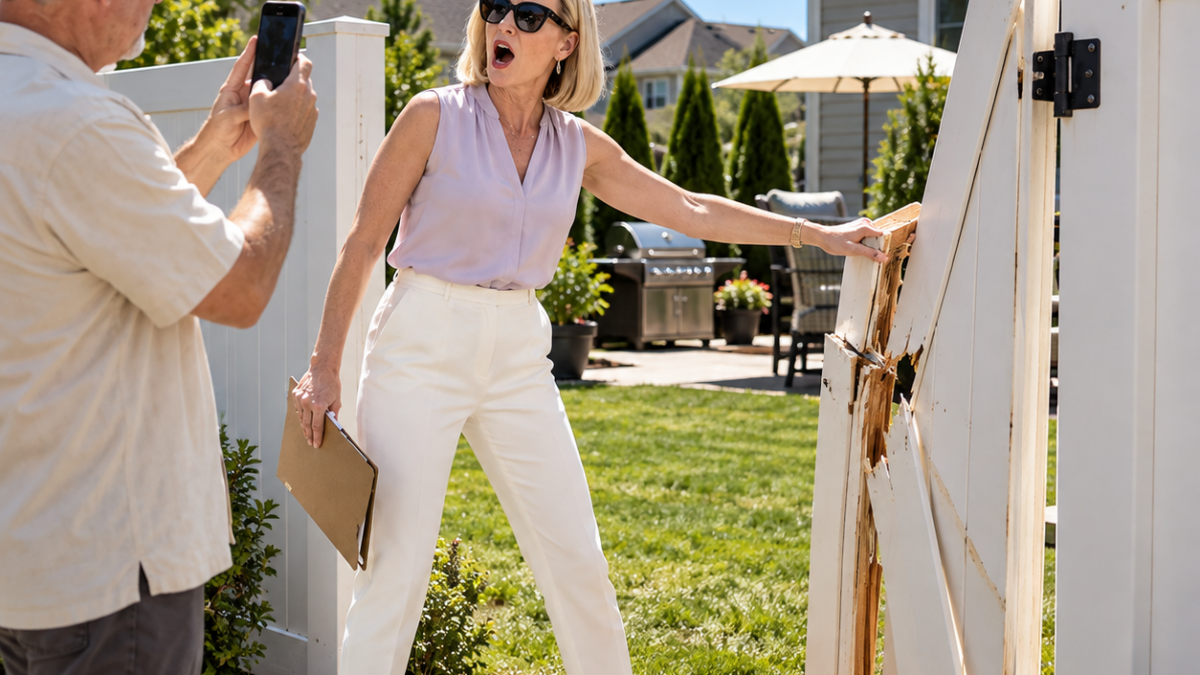
𝗙𝗨𝗟𝗟 𝗦𝗧𝗢𝗥𝗬
I laughed.
Then I called Becca.
She had somehow already gotten my number.
“Hi, Becca.”
“Yes?”
“This is the guy at—”
“I know who this is.”
Of course she did.
“The photographs need to stop.”
“Excuse me?”
“I’m not in your HOA.”
“We’ve discussed this.”
“Yes. You keep being wrong.”
Silence.
Then:
“Every property in this development is subject to association standards.”
“My property predates your development.”
“The community encompasses your property.”
“Geographically.”
“Exactly.”
“That doesn’t create legal membership.”
Becca sighed.
“You really need to review your closing documents.”
“I have.”
“Then you misunderstood them.”
“My title attorney didn’t.”
That quieted her for one second.
Then:
“We have association maps.”
“I have a deed.”
“You benefit from living here.”
“That’s irrelevant.”
“It’s not.”
“I don’t use HOA services.”
“You benefit from the appearance and value of the neighborhood.”
“I didn’t sign a contract agreeing to pay for that.”
She became sharper.
“You’re being difficult.”
“No. I’m asking you to stop contacting me about rules that do not apply.”
“That isn’t your decision.”
“It actually is.”
I ended the call.
Then I blocked her number.
That stopped the calls.
So she emailed me.
I still have no idea how she got the address.
The emails looked increasingly official.
Subject lines like:
NOTICE OF NONCOMPLIANCE
ARCHITECTURAL CONCERN
CORRECTIVE ACTION REQUIRED
She complained that my lawn was approximately a quarter inch over the HOA limit.
A quarter inch.
I actually went outside with a ruler because I wanted to understand how insane we had become.
Then I realized what I was doing and went back inside.
She emailed about my recycling bin.
The hose.
A porch bulb.
The wreath.
My work van.
The fence.
Each time, I replied once:
This property is not part of your HOA. Please cease contacting me regarding HOA compliance.
Becca would answer with some version of:
Every home in this neighborhood is part of the association, sir. I suggest you reread your closing documents.
It became almost ritualistic.
Then she involved the police.
The first time was a Saturday night.
Two friends were over.
We were sitting in the backyard around a small fire pit.
Nothing crazy.
A few beers.
Conversation.
The fire was controlled.
There was a hose nearby.
Around nine-thirty, someone knocked.
Police officer.
I opened the gate.
“Evening.”
“Evening.”
He looked past me toward the fire pit.
“We received a complaint about an unsafe open fire.”
I actually laughed.
“Of course you did.”
He raised an eyebrow.
I walked him back.
Small fire.
Contained pit.
Two adults sitting nearby.
Garden hose ten feet away.
The officer looked at it.
Then at me.
“Do you have water nearby?”
I pointed.
“Right there.”
“All right.”
He shrugged.
“Enjoy your night.”
“That’s it?”
“That’s it.”
He walked away.
One friend said:
“Who reported you?”
I already knew.
A week or two later, police arrived again.
This time the complaint involved an “unregistered commercial vehicle” on my property.
It was a work van belonging to my employer.
Registered.
Insured.
Parked in my driveway overnight because I had an early installation the next morning.
The responding officer looked tired before I finished explaining.
He walked around the van.
Checked the plate.
Then asked:
“Who keeps calling on you?”
I pointed vaguely toward the HOA development.
“The architectural committee lady.”
He closed his eyes for half a second.
That reaction told me Becca was not new to law enforcement.
“She’s been contacting you regularly?”
“Notes, emails, photos, now apparently police calls.”
He sighed.
“Keep records.”
“Already doing it.”
“Good.”
Then he left.
I should have taken the escalation more seriously.
Instead, I treated Becca like an annoying software bug.
Persistent.
Irritating.
Probably solvable with enough documentation.
Then she chose the fence.
The wooden privacy fence had been there when I bought the house.
It wasn’t beautiful.
The boards were weathered gray.
Some sections leaned slightly.
One or two panels were older than the rest.
But it worked.
Six feet high in most places.
Enough to give me privacy.
Enough to keep the backyard separate from the sidewalk and neighboring lots.
About two months after moving in, Becca emailed a long notice.
The fence, according to her, violated three HOA standards.
Wrong height.
Wrong wood color.
Wrong material treatment.
I supposedly had until the end of the month to replace it.
After that, fines.
I didn’t reply.
Not even the standard line.
I blocked her email.
Several days later, I came home and found a cardboard sign zip-tied to the front gate.
PROPERTY UNDER REVIEW
I stared at it.
Then cut the zip ties.
Threw it away.
Went inside.
The next afternoon, Becca knocked.
I only opened the door a few inches.
“Can I help you?”
Her expression was severe.
“I’ve been informed by counsel that your fence is illegally constructed.”
“Whose counsel?”
“The association’s attorney.”
“Good for him.”
She blinked.
“We require access for an inspection.”
“No.”
Her mouth tightened.
“You cannot deny an authorized architectural inspection.”
“I’m not part of your association.”
“We are past that argument.”
“No, we’re not.”
“You are required to provide access.”
“No.”
“If you refuse, the HOA will take action.”
“Take whatever action your lawyer thinks is legal.”
Becca leaned closer.
“You don’t get to opt out of a community.”
That line stuck with me.
Not because it was clever.
Because she believed it.
I looked at her.
“I didn’t opt out.”
She frowned.
“I was never in.”
Then I shut the door.
That night, I emailed my closing attorney.
The same man who had reviewed the title.
I forwarded the HOA emails.
Photographs.
Fence notice.
Property-under-review sign.
Everything.
I asked one simple question.
Am I missing something?
He called the next morning.
“No.”
“That’s reassuring.”
“Your property is not part of that HOA.”
“I know.”
“No covenant.”
“I know.”
“No declaration.”
“I know.”
“No dues.”
“I know.”
“Then why are you letting this woman make you crazy?”
I laughed.
“I’m trying not to.”
He became more serious.
“Keep every communication.”
“I am.”
“Photograph anything left on your property.”
“Okay.”
“And install cameras.”
I paused.
“I have a doorbell camera.”
“Backyard?”
“No.”
“Side gate?”
“No.”
“Add them.”
“Do you think that’s necessary?”
“In my experience, people who refuse to accept documentary boundaries sometimes start testing physical ones.”
That sentence stayed with me.
That weekend, I bought cameras.
Nothing elaborate.
One on the rear of the house aimed toward the patio and backyard.
One on the garage corner covering the side yard and gate.
Both had night vision and motion alerts.
Then I added a smaller camera inside the gate, partly concealed and aimed along the fence.
It felt ridiculous.
I remember standing on a ladder tightening the mount and thinking:
I’m building a surveillance system because of a woman in a pink visor.
I almost talked myself out of the third camera.
I’m glad I didn’t.
The following week, I was at work.
Midday meeting.
Conference room.
Someone was discussing a deployment schedule when my phone vibrated.
Motion notification.
Side-yard camera.
I ignored it.
Probably delivery.
Another vibration.
Then another.
Three alerts.
I looked at the screen.
Side yard.
Side yard.
Backyard.
That got my attention.
I excused myself.
Walked into the hallway.
Opened the app.
And almost dropped the phone.
Becca was walking up my driveway.
Pink sun hat this time instead of the visor.
White fitted jacket.
Large tote bag.
She looked around once.
Then walked directly to the side gate.
My first thought was:
Maybe she’s going to leave another stupid sign.
Then she tried the latch.
Locked.
From inside.
As always.
She pulled again.
Stopped.
Looked toward the street.
Then reached into the tote bag.
She removed something metal.
At first, I couldn’t identify it on the phone screen.
Then she lifted it.
Small pry bar.
I whispered:
“No way.”
Becca walked along the fence.
Slowly.
Examining panels.
She reached one of the older sections where the boards and nails were weathered.
She tested it with her hand.
Then inserted the pry bar.
My stomach tightened.
She pushed.
Nothing.
Adjusted.
Pushed again.
The panel shifted.
Another movement.
One nail pulled.
Then another.
The entire section popped loose.
Becca caught it.
Lowered it awkwardly.
Leaned it aside.
Then she bent down.
Stepped through the opening.
Into my backyard.
I couldn’t breathe for a second.
The rear camera triggered.
Different angle.
There she was.
Inside.
On my property.
Becca straightened her jacket as if she had simply entered through an unlocked gate.
Then pulled a notepad from her tote.
She walked to the deck.
Photographed it.
Wrote something.
Walked to the air-conditioning unit.
Photograph.
Note.
Back door.
Photograph.
Fence interior.
Photograph.
She pulled out a tape measure.
Actually measured the fence height.
I stared at the phone.
The sheer confidence was almost more disturbing than the break-in.
She wasn’t rushing.
She wasn’t acting like someone who knew she was doing something criminal.
Becca behaved like an inspector.
Twelve minutes.
Approximately twelve full minutes walking around my private backyard.
Taking photographs.
Measuring.
Documenting.
She even looked through part of the patio area.
Then returned to the opening.
Squeezed through.
Tried to lift the panel back into place.
Failed.
Tried again.
One corner slipped.
She finally left it leaning against the fence.
Put the pry bar back into the tote.
Then walked away.
Like she’d gone for a pleasant afternoon stroll.
I stood in my office hallway staring at my phone.
My hands tingled.
Heart pounding.
I had imagined harassment.
Fake fines.
Maybe another police complaint.
I hadn’t imagined Becca physically prying apart my fence.
I sat on a bench.
Watched the footage again.
Maybe because part of me couldn’t believe it.
Pry bar.
Panel.
Entry.
Measurements.
Exit.
I watched it a third time.
Then walked back into the conference room.
My boss looked at me.
“You okay?”
“Family emergency.”
Not technically family.
Didn’t matter.
“I need to go.”
“Go.”
The drive home was strange.
I went through anger.
Then anxiety.
Then a weird rush of relief.
That sounds terrible.
But my lawyer had told me to keep evidence.
For two months, Becca had lived in ambiguity.
She could say she was only trying to enforce rules.
Only trying to help.
Only sending notices.
Only contacting police because she believed violations existed.
Now?
No ambiguity.
A pry bar is remarkably clarifying.
When I got home, the fence panel still leaned where she’d left it.
I didn’t touch anything.
Photographs first.
Wide shots.
Close shots.
Damaged nails.
Wood.
Ground.
Footprints in dirt.
Gate.
Panel.
Then video.
I documented everything before moving a single object.
After that, I went inside.
Downloaded every camera clip.
Doorbell.
Side yard.
Rear yard.
Hidden camera.
Different angles.
Timestamps.
I created a folder.
Backups.
Then emailed everything to my lawyer.
Subject:
She actually did it.
He called in less than twenty minutes.
I answered.
For several seconds, all I heard was laughter.
Not mocking me.
Pure disbelief.
“You’re laughing?”
“I’m sorry.”
He tried stopping.
Failed.
“She used a pry bar?”
“Yes.”
“On camera?”
“Three cameras.”
More laughter.
“She measured the fence?”
“Yes.”
“Inside your backyard?”
“Yes.”
He took a breath.
“Okay.”
His voice shifted immediately into attorney mode.
“Don’t repair anything yet.”
“I haven’t.”
“Good.”
“Police?”
“Immediately.”
“Call?”
“No.”
He became firm.
“Go in person.”
“Why?”
“Bring footage.”
“Okay.”
“USB drive.”
“Okay.”
“And don’t say HOA dispute first.”
“What do I say?”
“Trespassing. Property damage. Forced entry.”
I nodded even though he couldn’t see me.
“Criminal mischief.”
“Got it.”
“Then explain the HOA history.”
I went to the police station that afternoon.
The officer at the desk listened while I explained.
House.
HOA.
Not a member.
Harassment.
Fence.
At first, I could see confusion.
He seemed to assume this was a civil disagreement between HOA members.
“You’re saying she entered to perform an inspection?”
“She was never authorized to inspect anything.”
“But she’s on the HOA?”
“Yes.”
“And your house is—”
“Not in it.”
That took another explanation.
Then I plugged in the USB.
“Watch this.”
The video changed his expression instantly.
Becca walking up.
Gate.
Pry bar.
Fence.
He leaned closer.
Then called another officer.
“Come look at this.”
They watched her pry the panel off.
Then played it again.
The second officer shook his head.
“What is wrong with people?”
I almost laughed.
Finally, somebody else had said it.
The report became serious.
They documented trespass.
Damage.
The forced fence entry.
Took copies of footage.
Asked questions.
How long had the harassment happened?
Had she been told to stay off the property?
Yes.
Repeatedly.
Any previous incidents?
Not physical entry.
Any threats?
HOA legal threats.
They told me an officer would contact Becca.
I went home.
Made a sandwich.
Sat at my kitchen table.
Tried to behave like a normal person.
Several days later, someone knocked.
I checked the doorbell camera.
Becca.
Of course.
But she wasn’t alone.
A man stood behind her.
Polo shirt.
Khakis.
Uncomfortable expression.
I opened the door.
Not fully.
Becca’s face looked like it could have ignited gasoline.
She skipped hello.
“I know what you’ve done.”
I leaned against the door.
“You’re going to need to narrow that down.”
Her eyes flashed.
“You recorded me.”
I stared.
“Yes.”
“Illegally.”
Behind her, the man shifted.
Becca continued.
“You have been spying on HOA officials in the course of official duties.”
I actually looked over my shoulder for a second, as if someone might be filming a comedy.
“What official duty?”
“Property inspection.”
“You broke into my yard.”
“I did not break in.”
“You removed a fence panel with a pry bar.”
Her face changed.
Tiny reaction.
Then:
“That fence is noncompliant.”
I laughed.
“You can’t be serious.”
“You are violating state surveillance laws.”
The man behind her cleared his throat.
“I’m the vice president of the board.”
“Okay.”
He extended a hand cautiously.
I shook it.
Becca jumped back in.
“Our attorney has been informed.”
I looked at the vice president.
“Have you watched the footage?”
He hesitated.
That answer told me everything.
“Have you?”
Becca interrupted.
“The evidence is under review.”
I kept looking at him.
“Did she tell you she pried off a fence panel?”
His eyebrows moved.
Becca snapped:
“That is a gross characterization.”
“Did she tell you?”
The vice president looked at her.
Then back at me.
“No.”
Interesting.
Becca raised her clipboard.
“You should retain counsel.”
“I already have one.”
That quieted her briefly.
“Good.”
She recovered.
“Then he’ll understand the consequences of unlawful recording.”
“Anything else?”
“You should expect formal action.”
I closed the door.
No argument.
No speech.
Just shut it.
Then called my lawyer.
Several days later, the letter arrived.
Actual law firm.
Two towns over.
Professional letterhead.
Multiple pages.
I stood in my kitchen reading it.
The HOA accused me of unlawful surveillance.
Invasion of privacy.
Harassment of a board official.
Improper recording.
They demanded I remove all exterior cameras.
And then came the part that almost made me laugh again.
Three-thousand-dollar fine.
Payable to the HOA.
For damage to “community standing” and associated misconduct.
I read it twice.
Even knowing it was ridiculous, my stomach tightened.
That’s what legal letters do.
Official formatting.
Deadlines.
Threats.
Fourteen days.
Potential lawsuit.
Costs.
Remedies.
Words designed to make you imagine worst-case scenarios.
I called my attorney.
Read it aloud.
He laughed again.
Not reassuring at first.
“You’re enjoying this too much.”
“I’m sorry.”
“Am I in trouble?”
“No.”
“You’re sure?”
“Very.”
“What about recording laws?”
“Your exterior cameras record your property.”
“Part of the sidewalk appears in the background.”
“That’s fine.”
“What about privacy?”
“She broke into your backyard.”
“Exactly.”
He stopped laughing.
“This letter is nonsense.”
“Then why send it?”
“Because intimidation sometimes works.”
He drafted a response the next day.
Simple.
Clean.
No dramatic insults.
Point one:
I was not a member of the HOA and had no contract with it.
Point two:
The cameras were located on my property and lawfully recorded my property.
Point three:
Becca was currently the subject of a police investigation involving unauthorized entry and property damage, documented by video.
Then the warning.
If they sued, we would counterclaim.
Trespass.
Property damage.
Harassment.
Defamation where applicable.
Legal fees.
And the footage would become part of the public court record.
My lawyer sent it certified.
Then we waited.
Around that time, one of my neighbors stopped by.
He lived two houses down.
HVAC installer.
Friendly guy.
He had introduced himself shortly after I moved in.
“I heard you’ve been having fun with Becca.”
“That’s one word.”
He laughed.
Then his expression became serious.
“You know the board’s freaking out?”
“No.”
“Half of them are furious with her.”
“Why?”
“Because this isn’t the first problem.”
That got my attention.
He told me Becca had been aggressive for years.
Disputes.
Threats.
Arguments.
Apparently another neighbor had sued over something involving her before.
That case settled quietly.
The board had warned her.
Told her to stop escalating situations.
She hadn’t.
“And now?”
He shrugged.
“Police report plus your lawyer’s letter?”
He smiled.
“They’re nervous.”
“Good.”
“Don’t celebrate.”
“Why?”
“Becca thinks you’re bluffing.”
I closed my eyes.
“Of course she does.”
“She’s telling the board the police thing is a misunderstanding.”
“There’s video.”
“I know.”
“She pried my fence apart.”
“I know.”
“How is that a misunderstanding?”
My neighbor laughed.
“You’re asking the wrong person.”
Then came the truly insane part.
The board voted.
Whether to proceed with the lawsuit.
Five to four.
They chose yes.
Barely.
But yes.
About three weeks later, I was officially served.
The HOA sued me.
Unlawful surveillance.
Harassment.
Improper cameras.
They demanded fines.
Removal of cameras.
Various relief.
I called my lawyer.
“I thought you said they’d back down.”
“I thought they’d have adult supervision.”
“Apparently not.”
“Relax.”
“I am not relaxed.”
“This is still a bad case.”
“For them?”
“Very.”
He filed our counterclaim.
Trespass.
Property damage.
Damages connected to the fence.
A request for a restraining order against Becca.
Other related claims.
And, separately, the criminal complaint from the police report was already moving through the prosecutor’s office.
That part wasn’t controlled by me.
Then my attorney attached the camera footage to our filing.
Apparently the HOA’s own lawyer hadn’t seen it.
I still don’t know exactly what Becca told him.
Maybe she described entering an unlocked yard.
Maybe she omitted the pry bar.
Maybe she claimed the fence was already loose.
Whatever story he had received collapsed when he watched the footage.
My lawyer called me.
“You’re going to like this.”
“What?”
“The HOA attorney requested an emergency call.”
“Why?”
“He finally watched the video.”
I smiled.
“What did he say?”
“Mostly things attorneys say when they suddenly realize their client has been creative with the truth.”
“He wants out?”
“He wants settlement.”
The first proposal was simple.
HOA drops its suit.
I drop counterclaim.
Everybody stays quiet.
No public discussion.
Done.
I said:
“No.”
My lawyer agreed.
“The criminal matter isn’t ours to drop anyway.”
“Exactly.”
“The prosecutor decides that.”
“What do we want?”
“Fence repair.”
“Obviously.”
“Legal fees.”
“Yes.”
“And Becca off the board.”
That one mattered.
Because if we ended everything without removing the person who had caused it, what stopped her from doing it again?
To me.
Or somebody else.
The HOA could have accepted.
They didn’t.
The board voted again.
Again close.
Again stupid.
They tried to continue the surveillance claim while negotiating pieces of the trespass issue.
I never fully understood the logic.
My lawyer said it was about saving face.
Nobody wanted to admit the entire lawsuit existed because Becca had broken into a non-member’s backyard and then convinced the board the cameras were the problem.
The next two months moved slowly.
Most of it happened through attorneys.
Emails.
Filings.
Calls.
Motions.
Documents.
I gave one short statement.
Nothing dramatic.
Becca, from what I heard, had been instructed repeatedly not to contact me.
No emails.
No porch visits.
No driving by.
She mostly obeyed two of those.
The driving was another story.
Almost every day, she drove slowly past my house.
Sometimes once.
Sometimes more.
My side camera captured her.
Every time.
I saved those clips too.
Not because passing on a public street was necessarily illegal.
Because documentation had become my religion.
Meanwhile, the HOA started burning money.
Their lawyer billed for everything.
Phone calls.
Research.
Filings.
Motions.
Settlement discussions.
Arguments about arguments.
By the end, my attorney estimated the association had spent tens of thousands of dollars pursuing a case they had almost no chance of winning.
That part bothered me.
Not because I felt sorry for the board.
I felt sorry for ordinary homeowners.
Their dues were paying for Becca’s refusal to accept one basic fact.
My house wasn’t in the HOA.
The association tried several legal theories.
First:
Even if I wasn’t technically a member, I benefited from neighborhood services and therefore should be subject to association standards.
The judge rejected it.
Membership and property covenants don’t materialize because you like nearby landscaping.
Then:
My cameras captured portions of the public sidewalk.
Therefore unlawful surveillance.
My attorney responded with applicable law and cases.
Recording public areas incidentally from cameras placed on your own property isn’t magically illegal.
Rejected.
Another argument involved privacy.
Again:
Becca had entered my fenced backyard by physically prying apart a panel.
Her expectation of privacy while committing that act on my property wasn’t exactly persuasive.
Eventually, the HOA’s lawyer requested a settlement conference.
By then, I think he wanted the case dead more than I did.
The settlement was almost embarrassingly favorable.
The HOA dropped all claims against me.
Completely.
They paid to repair the damaged fence panel.
Around two hundred dollars.
They covered my legal fees.
That mattered far more than the fence cost.
Most importantly, they issued a written statement signed by the board.
It formally acknowledged that my property was not part of the HOA.
No dues.
No rules.
No architectural control.
No future HOA contact regarding supposed violations.
That piece of paper was what I’d wanted from the beginning.
Simple recognition of reality.
Becca’s consequences came separately.
On the criminal side, the case produced a small fine.
Community service.
And a no-contact order involving me.
She also had to step down from the board.
The day I learned she had signed the resignation documents, I sat at my kitchen table and read the email twice.
Then a third time.
I won’t pretend I was noble.
It felt fantastic.
Not because an older woman lost a volunteer position.
Because that position was the weapon she’d used for months.
The clipboard.
The rules.
The invented authority.
The calls.
The threats.
The break-in.
Finally, she couldn’t invoke the board anymore.
The aftermath was exactly what I had wanted from the beginning.
Quiet.
No letters.
No emails.
No photographs with red arrows.
No notes about my hose.
No complaints about wreaths.
No police showing up to inspect my fire pit.
No one measuring my fence.
No one prying pieces off it.
Silence.
Becca moved away about two months after the case ended.
My HVAC neighbor told me her husband had wanted to move for years.
Apparently this was the final push.
I don’t know whether that’s true.
I never spoke to them.
One day, there was a moving truck.
Then there wasn’t.
Becca disappeared from the neighborhood.
I didn’t ask where she went.
I still don’t care.
The HOA changed too.
That surprised me.
I assumed the new board would resent me for costing them money.
Instead, they became almost comically polite.
Several weeks after everything ended, someone knocked.
I checked the camera automatically.
Habit.
Man around my age.
Casual clothes.
No clipboard.
I opened the door.
“Hi.”
“Hey.”
He introduced himself.
New HOA president.
My body almost tensed automatically.
Then he smiled.
“Don’t worry. I’m not here about your lawn.”
I laughed.
“Good opening.”
He held up both hands.
“I know your property isn’t part of the association.”
“Best sentence I’ve heard all month.”
“We’re updating our records.”
“Excellent.”
“I only came because we’re putting together an email list for neighborhood social events.”
I waited.
“No membership stuff.”
“Okay.”
“No rules.”
“Okay.”
“There’s a block party next month. We figured you’re still a neighbor even if you’re not HOA.”
That word.
Neighbor.
Not member.
Not violator.
Not noncompliant owner.
Neighbor.
I said:
“I’ll think about it.”
“No pressure.”
Then he smiled and walked away.
I stood at the door for a second after he left.
That tiny interaction showed me how unnecessary the entire conflict had been.
The HOA could have treated me that way from day one.
“You’re outside the association? Fine.”
Done.
We could still wave.
Still attend a barbecue.
Still watch each other’s houses.
Still live beside each other like normal adults.
Becca couldn’t accept that.
She treated community as ownership.
Proximity as jurisdiction.
Disagreement as defiance.
My refusal to obey wasn’t just inconvenient to her.
It challenged her entire view of authority.
I’ve thought about that phrase she said at my door many times.
“You don’t get to opt out of a community.”
It sounds almost reasonable until you realize what she meant.
She didn’t mean community as neighbors helping each other.
She meant her rules.
Her control.
Her permission.
And that’s exactly what I’d never agreed to.
You absolutely can live near people without giving them authority over your private property.
You can be friendly without surrendering your deed.
You can care about a neighborhood without asking a committee what color your mailbox should be.
Becca had confused forced compliance with belonging.
Maybe because she’d spent years inside an organization where people accepted her rules.
Most HOA homeowners had voluntarily purchased property subject to covenants.
They had agreed to something.
I hadn’t.
Becca couldn’t tolerate the exception.
My house sat there as proof that her authority had a boundary.
And she hated boundaries.
That’s why the fence became so symbolic.
At first, I thought she cared about height.
Color.
Material.
Architectural consistency.
Looking back, I don’t think that was the real issue.
The fence physically represented something she couldn’t control.
My side.
Her side.
Private.
Association.
She sent notices.
I ignored them.
She demanded inspection.
I refused.
Then she literally removed a section and stepped through.
You couldn’t create a more perfect metaphor if you tried.
The cameras simply made it impossible for her to rewrite what happened.
Without them, imagine the argument.
She might have said:
“The panel was already loose.”
Or:
“I entered through an opening.”
Or:
“I believed I had permission.”
Or:
“I was only there briefly.”
Or:
“I never damaged anything.”
My word against hers.
HOA president versus new guy who’d been refusing rules.
Maybe police would still believe me.
Maybe not.
Maybe civil court becomes messy.
Maybe her attorney builds a different story.
Instead, video.
Timestamp.
Angle one.
Angle two.
Angle three.
Becca with a pry bar.
There is something beautiful about evidence that doesn’t care about confidence.
Becca could outtalk people.
She could sound official.
She could wear the jacket.
Carry the clipboard.
Quote sections.
Threaten lawyers.
But she couldn’t argue with sixteen seconds of video showing a pry bar sliding behind a fence panel.
That was why my attorney laughed.
Not because the situation wasn’t serious.
Because Becca had finally made the case simple.
She’d spent months creating complexity.
Maps.
Rules.
Jurisdiction arguments.
Community standards.
Then she reduced everything to:
Woman knowingly enters property after being told no.
Damages fence.
Caught on camera.
Simple.
I also learned how dangerous it is to assume an official-looking demand has actual authority.
The HOA’s legal letter scared me.
I’m comfortable admitting that.
Three-thousand-dollar fine.
Fourteen-day deadline.
Threat of suit.
Even knowing my title was clean, I felt sick reading it.
Imagine someone without a lawyer.
Imagine an elderly homeowner.
A young couple living paycheck to paycheck.
Someone who thinks:
Maybe I should just pay so this goes away.
That’s how bad authority survives.
Not because everybody believes it.
Because fighting is expensive.
Time-consuming.
Stressful.
Becca counted on that.
She almost got the board to spend tens of thousands proving a point that couldn’t legally be proved.
And those costs didn’t come from her personal bank account at first.
They came from homeowners.
That’s another reason I insisted she step down.
If the person who caused the disaster stayed in charge, what lesson would anybody learn?
The board eventually learned.
Expensively.
I sometimes saw association residents after the case.
Some were embarrassed.
A woman walking her dog stopped me once.
“I didn’t know what Becca was doing.”
“I figured.”
“Not everyone supported the lawsuit.”
“I know.”
“It was five-four.”
“I heard.”
She sighed.
“She made it sound like you were filming children.”
I stared.
“Seriously?”
“That’s how she presented the camera issue.”
That made sense.
Not morally.
Strategically.
Becca needed the cameras to sound sinister.
She couldn’t say:
“Our neighbor installed cameras because I kept harassing him, then those cameras recorded me prying open his fence.”
So instead:
Surveillance.
Privacy.
Children.
Community safety.
Big emotional words.
The woman looked uncomfortable.
“I voted against continuing it at the homeowners meeting.”
“Thanks.”
“We should’ve stopped earlier.”
“Probably.”
Then she walked away.
I didn’t hate the HOA.
That’s the funny part.
People assumed I did.
I hated what Becca did with it.
An HOA can mow shared areas.
Manage a pool.
Handle private roads.
Organize events.
Enforce actual covenants against people who genuinely agreed to them.
Fine.
Not my lifestyle.
But fine.
The problem begins when the people running it forget where the authority comes from.
It doesn’t come from the clipboard.
It comes from contracts.
Recorded covenants.
Actual rules.
Legal limits.
Consent.
Becca believed the title created power.
The title didn’t.
That’s why losing it destroyed her whole performance.
After she moved, I repaired the fence.
The HOA paid the bill.
Two hundred dollars.
The contractor replaced the damaged section.
He asked what happened.
“Someone broke in.”
“Thief?”
“HOA.”
He stopped working.
“What?”
“Long story.”
He laughed.
“That’s a new one.”
I upgraded the fence eventually.
Not because Becca was right.
Because after everything, I wanted something sturdier.
I chose the height.
Color.
Material.
Didn’t submit anything to an architectural committee.
Didn’t ask permission.
Didn’t wait for approval.
The new fence went up beautifully.
Nobody complained.
I kept the cameras.
Absolutely.
The hidden one inside the gate is still there.
Most days it records nothing interesting.
Birds.
Delivery people.
Me carrying groceries.
Occasionally a squirrel that seems convinced it owns my yard.
I’m fine with boring footage.
Boring is underrated.
I also kept every file from the case.
Digital backups.
HOA notices.
Emails.
Legal letters.
Settlement document.
Police report.
Camera footage.
Sometimes I think about deleting the videos.
Then decide not to.
Not because I watch them.
I don’t.
I keep them because they remind me how quickly a situation can change when you stop relying on memory and start documenting facts.
My lawyer told me from the beginning:
Keep records.
He was right.
That habit protected me.
The funniest part is that Becca helped create most of the documentation herself.
She emailed.
Left written notices.
Printed photographs.
Sent letters.
Placed signs.
Then appeared on multiple cameras.
Then the HOA sent a formal legal threat.
Every escalation added another page.
Another timestamp.
Another piece of evidence.
People like Becca often believe documentation strengthens authority.
It can.
It can also preserve stupidity forever.
I’m engaged now.
My fiancée moved in later.
By then, the whole thing was mostly over.
One night, I told her the full story.
She thought I was exaggerating.
Then I showed her the video.
Becca.
Sun hat.
Tote bag.
Pry bar.
My fiancée stared at the screen.
“She really did that.”
“Yes.”
“Why?”
“Fence inspection.”
She looked at me.
“No.”
“According to her.”
We watched Becca squeeze through the opening.
My fiancée paused the video.
“She looks so calm.”
Exactly.
That’s what had bothered me most.
Not rage.
Not impulsiveness.
She believed she had the right.
My fiancée asked:
“What would’ve happened without the cameras?”
I thought about it.
“Probably a much longer fight.”
Then she said:
“Your lawyer is the smartest person in this story.”
“Unfortunately, yes.”
We laughed.
The house feels completely different now.
Not physically.
Same rooms.
Same yard.
Same driveway.
But when I first moved in, I was constantly checking for another note.
Another email.
Another complaint.
For a while, every knock made me expect pink visor and clipboard.
After Becca left, that feeling disappeared.
I mow when the grass looks like it needs mowing.
Sometimes probably too late for HOA standards.
My recycling bin occasionally stays visible after collection day.
My garden hose has survived scandalously in plain sight.
I use whatever porch bulb I want.
And I still put up the same autumn wreath.
Partly because I like it.
Partly because now it makes me laugh.
Nobody has measured my fence since Becca.
Nobody has photographed my air-conditioning unit.
Nobody has called police about my work van.
The neighborhood hasn’t collapsed.
Home values somehow survived.
I even attended one of those social gatherings eventually.
The new president waved.
Someone handed me food.
Nobody asked me to join.
Nobody mentioned rules.
It felt like what Becca had claimed she wanted.
Community.
Except this time, nobody was forcing it.
That distinction matters.
The whole experience changed the way I think about boundaries.
I used to assume boundaries were self-enforcing.
You say no.
Someone stops.
You show a deed.
Argument over.
You lock a gate.
People stay outside.
Most people do.
That’s why locks and rules work most of the time.
But there are people who interpret boundaries as negotiations.
A no is the beginning of persuasion.
A legal document is an obstacle.
A lock is a challenge.
Becca was that person.
Every time I gave her a clear boundary, she pushed one step farther.
Not in HOA.
She sent rules anyway.
Stop contacting me.
More emails.
No authority over the yard.
Photographs.
Stop involving me.
Police reports.
No fence inspection.
Property-under-review sign.
Do not come onto my property.
Pry bar.
By the time she entered the backyard, there was nowhere left to escalate without becoming obviously criminal.
And she still tried to make me the offender.
That’s what fascinates me.
She was caught.
Video.
Police report.
Broken fence.
And her next move was not apology.
It was:
You filmed me illegally.
She needed the story to preserve one idea.
She could not be wrong.
If she broke into my yard, the cameras had to be illegal.
If the HOA had no authority, my property had to somehow benefit enough to become subject to it.
If the fence wasn’t governed by their standards, their visual concerns had to create jurisdiction.
Anything except:
I overstepped.
Those three words could have saved the HOA tens of thousands of dollars.
They could have saved Becca her board seat.
Possibly her criminal consequences.
Maybe even prevented her move.
Instead, every time reality offered her an exit, she doubled down.
That is why the ending felt satisfying.
Not because I crushed anyone.
I didn’t want that.
The settlement wasn’t some huge payday.
My fence cost around two hundred dollars.
My legal fees were covered.
The important victory was administrative.
Written acknowledgment.
Leave me alone.
That’s what I wanted from the beginning.
I bought my first house because I wanted independence.
A door I owned.
A yard I owned.
A place where nobody could tell me I had the wrong wreath.
The irony was that my first months as a homeowner involved more unsolicited supervision than any apartment I’d ever rented.
Then one cheap set of cameras changed the entire balance.
Not because cameras create rights.
The deed already gave me those.
They created proof.
That’s sometimes what rights need.
I still think about my attorney’s phone call after seeing the footage.
His laughter.
At the time, I was annoyed.
Now I understand.
For weeks, I’d been telling him:
She’s harassing me.
She’s ignoring the deed.
She’s escalating.
He believed me.
But harassment disputes are messy.
Then suddenly Becca appeared in high-definition video holding a pry bar.
The case practically introduced itself.
Months later, after the settlement, I asked my lawyer:
“Did you know it would end that way?”
“No.”
“You sounded pretty confident.”
“I knew their legal theory was weak.”
“But Becca?”
He laughed.
“I didn’t expect her to physically dismantle your fence.”
“Fair.”
“Clients rarely deliver evidence that good.”
“I’ll tell her you said thanks.”
“Please don’t.”
I laughed.
Then he added something I still remember.
“People who believe they are entitled to cross legal boundaries often eventually cross physical ones.”
That sentence summarized Becca better than anything else.
She crossed legal boundaries first.
Then social ones.
Then physical.
The camera simply captured the moment all three became visible at once.
Today, when someone asks me about HOAs, I don’t automatically say they’re evil.
That’s too easy.
I say:
Read your documents.
Know what you signed.
Know what you didn’t.
Keep records.
And if someone insists they have authority over your property, make them show where it comes from.
Don’t accept:
“Everyone around here knows.”
Don’t accept:
“That’s how we’ve always done it.”
Don’t accept:
“The board says.”
Ask for the recorded document.
The covenant.
The agreement.
The law.
Authority that can’t survive paperwork probably isn’t authority.
Becca had a clipboard.
I had a deed.
The deed won.
But only after she spent months pretending the clipboard mattered more.
The last time I ever saw her in person was not dramatic.
No shouting.
No final confrontation.
She was walking toward a car while movers were working around her house.
I happened to be outside.
She saw me.
Stopped.
For half a second, I wondered if she’d come over.
She didn’t.
Neither did I.
We looked at each other across the street.
Then she got into the car.
That was enough.
No victory speech.
No sarcastic wave.
No “I told you so.”
By then, the court papers had already said everything.
She drove away.
The neighborhood became quiet.
My fence stayed standing.
My cameras stayed on.
My house remained exactly what it had been from the first day I bought it.
Independent.
Months of fake fines, police complaints, legal threats, and one pry bar hadn’t changed that.
The part that still makes me smile is the thing Becca never accepted until the very end.
I hadn’t found a loophole.
I hadn’t exploited a technicality.
I hadn’t somehow “opted out.”
I simply never belonged to her HOA in the first place.
And once she climbed through the hole she had pried into my fence, she finally gave me all the evidence I needed to make sure she never forgot it again.
𝗧𝗛𝗘 𝗘𝗡𝗗
The HOA President Broke Into My Backyard to Prove I Was Violating Rules I Never Agreed To—Then My Cameras Caught Everything
I had already told the HOA president more times than I could count that my house was not part of her association.
She ignored my deed, ignored my lawyer, called the police on me twice, and finally decided the only way to prove I was breaking her rules was to pry open my backyard fence and inspect my property herself.
What she did not know was that I had installed cameras three days earlier.
I was thirty-five when I bought my first house.
Nothing about the place was extravagant.
It was a modest two-story home with an older wooden privacy fence, a small back patio, enough grass to pretend I enjoyed lawn care, and a driveway just wide enough for two vehicles.
To me, it was perfect.
I work in IT.
My job is technical, quiet, and predictable most of the time.
I don’t need a huge amount of excitement in my personal life.
Back then I lived alone.
I’m engaged now, but at the time it was just me, a laptop, too many cables in boxes I kept telling myself I would organize, and the first house I had ever owned.
I wanted peace.
That mattered because buying the place had taken years.
Saving.
Watching interest rates.
Touring houses.
Losing offers.
Finding places that looked good online and terrible in person.
Then I found this one.
The house sat at the outer edge of a newer residential development.
Most of the surrounding homes had been built as part of one planned neighborhood.
Matching entry signs.
Similar setbacks.
Landscaping that looked like it had been selected from the same catalog.
And an HOA.
My house was different.
It had been there before the development existed.
That detail came up almost immediately during the purchase.
My real estate agent sat down with me and said:
“I want to go through the title situation one more time.”
I laughed.
“We’ve already done it twice.”
“I’m serious.”
“Okay.”
She spread the paperwork out.
“The neighborhood around you is governed by an HOA.”
“I know.”
“Your house is not.”
“I know.”
“I need you to understand that because it can confuse people.”
“How?”
“Your lot predates the development.”
She pointed to the title information.
“When the developer acquired the surrounding land, this parcel was already separately deeded.”
“Right.”
“It was never annexed into the HOA.”
“Right.”
“There is no recorded covenant attached to your title.”
I nodded.
“No association declaration, no dues obligation, nothing.”
“Exactly.”
I remember smiling.
“Sounds ideal.”
She laughed.
“It probably is.”
Probably.
My closing attorney checked everything too.
Clean deed.
No HOA covenant.
No mandatory membership.
No obligation to request architectural approval.
No dues.
No fines.
No association authority over my house, yard, fence, driveway, mailbox, landscaping, or anything else.
The only connection between me and the HOA was geography.
Their neighborhood surrounded most of mine.
That was it.
I assumed everybody involved understood the same facts.
That assumption lasted about one week.
It was a Saturday morning.
I had barely finished coffee when someone knocked.
I opened the door.
Standing there was a woman in her late fifties.
Perfectly blow-dried blonde hair.
Large sunglasses pushed up like a headband.
Bright pink visor.
White fitted jacket despite the warm weather.
Gold buttons.
White pants.
A clipboard tucked against one arm.
She had one of those carefully maintained appearances that communicated organization before she said a word.
She was attractive for her age, glamorous in a way that made her stand out from the usual neighbors walking dogs in shorts and T-shirts.
Everything about her seemed deliberate.
The posture.
The makeup.
The smile.
Even the way she held the clipboard.
“Good morning.”
“Morning.”
“I’m Becca.”
She extended her hand.
“I head the architectural committee.”
I shook it.
“Okay.”
“Welcome to the neighborhood.”
“Thanks.”
She smiled brightly.
Then immediately held out a stapled stack of paper.
“These are the community rules.”
I looked down at them.
“All right.”
“You’ll want to familiarize yourself with them.”
“Sure.”
“There are quite a few requirements about exterior appearance.”
“Okay.”
“Paint.”
She tapped the pages.
“Landscaping. Waste bins. Seasonal decorations. Parking. Fencing.”
“Got it.”
“You’ll find the approved-color palette in the back.”
I smiled politely.
“Thanks.”
And that was all I said.
I took the packet because arguing on my doorstep over something that didn’t apply to me seemed unnecessary.
Becca nodded as though she had completed an official inspection.
“Welcome again.”
“Thanks.”
Then she walked away.
I shut the door.
Dropped the packet on a counter.
Forgot about it.
Two days later, someone knocked again.
Becca.
Same clipboard.
Different white jacket.
This one was tighter through the waist and cut low enough that I briefly wondered whether she had somewhere formal to be afterward.
Her expression wasn’t welcoming anymore.
“Yes?”
She pointed toward my driveway.
“You have a commercial vehicle parked there.”
I looked.
A contractor’s truck sat beside my car.
“My dishwasher guy.”
“How long has he been here?”
I stared at her.
“I don’t know. An hour?”
Becca made a note.
“Commercial vehicles are not permitted to remain in driveways beyond reasonable loading and unloading periods.”
I waited.
She looked at me.
“He needs to move.”
“He’s installing my dishwasher.”
“He can park on the street.”
I glanced past her.
Cars lined both sides of the street.
“Where?”
She turned.
Looked.
There wasn’t a space anywhere nearby.
Becca returned her attention to me.
“That’s not really my concern.”
“It becomes your concern when you’re telling him to move.”
Her mouth tightened.
“Rules are rules.”
“Not my rules.”
“What?”
I leaned slightly against the door.
“My property isn’t part of the HOA.”
Becca blinked.
Then gave a short laugh.
“Every home in the neighborhood is part of the association.”
“Mine isn’t.”
“That’s not correct.”
“It is.”
She studied me.
“You may want to read your closing documents.”
“I did.”
She tapped the clipboard.
“I’ll note that we’ve discussed this.”
“Note whatever you’d like.”
Her eyes narrowed slightly.
Then she turned and left.
That night, mostly out of curiosity, I read the packet.
It was extensive.
Approved exterior paint colors.
Fence standards.
Grass height.
Mailbox design.
Holiday decorations.
Parking restrictions.
Rules for basketball hoops.
Trash bins.
Roof materials.
Porch furniture.
I reached a section about approved exterior light temperatures.
Apparently, even lightbulbs had opinions attached to them.
None of it applied to me.
I dropped the packet in recycling.
My mistake was believing the paperwork would eventually catch up to reality.
Becca apparently saw reality as negotiable.
Over the next several weeks, the campaign began.
At first, it was almost funny.
Notes in my mailbox.
Typed lists.
Red highlighter.
One had three bullet points.
Lawn exceeds preferred height.
Recycling receptacle visible outside approved window.
Exterior lighting inconsistent with neighborhood temperature standard.
I stood at my mailbox reading it twice.
Then looked toward my porch light.
Wrong temperature.
I didn’t even know what temperature it was.
Warm?
Cool?
Emotionally unavailable?
I threw the note away.
Another appeared days later.
This one included photographs.
Photographs of my yard.
Someone had printed them and drawn arrows.
The first arrow pointed to a garden hose.
My garden hose.
Apparently it was visible from the street.
Another arrow indicated the edge of my garbage bin.
Another highlighted a patch of grass.
Then there was my front door wreath.
Becca had circled it in red.
Underneath:
Seasonally inappropriate decorative item.
It was October.
The wreath was from the autumn aisle of a home store.
Brown leaves.
Orange accents.
Tiny fake berries.
There was almost nothing more seasonally appropriate unless I’d nailed an actual pumpkin to the door.
I laughed.
Then I called Becca.
She had somehow already gotten my number.
“Hi, Becca.”
“Yes?”
“This is the guy at—”
“I know who this is.”
Of course she did.
“The photographs need to stop.”
“Excuse me?”
“I’m not in your HOA.”
“We’ve discussed this.”
“Yes. You keep being wrong.”
Silence.
Then:
“Every property in this development is subject to association standards.”
“My property predates your development.”
“The community encompasses your property.”
“Geographically.”
“Exactly.”
“That doesn’t create legal membership.”
Becca sighed.
“You really need to review your closing documents.”
“I have.”
“Then you misunderstood them.”
“My title attorney didn’t.”
That quieted her for one second.
Then:
“We have association maps.”
“I have a deed.”
“You benefit from living here.”
“That’s irrelevant.”
“It’s not.”
“I don’t use HOA services.”
“You benefit from the appearance and value of the neighborhood.”
“I didn’t sign a contract agreeing to pay for that.”
She became sharper.
“You’re being difficult.”
“No. I’m asking you to stop contacting me about rules that do not apply.”
“That isn’t your decision.”
“It actually is.”
I ended the call.
Then I blocked her number.
That stopped the calls.
So she emailed me.
I still have no idea how she got the address.
The emails looked increasingly official.
Subject lines like:
NOTICE OF NONCOMPLIANCE
ARCHITECTURAL CONCERN
CORRECTIVE ACTION REQUIRED
She complained that my lawn was approximately a quarter inch over the HOA limit.
A quarter inch.
I actually went outside with a ruler because I wanted to understand how insane we had become.
Then I realized what I was doing and went back inside.
She emailed about my recycling bin.
The hose.
A porch bulb.
The wreath.
My work van.
The fence.
Each time, I replied once:
This property is not part of your HOA. Please cease contacting me regarding HOA compliance.
Becca would answer with some version of:
Every home in this neighborhood is part of the association, sir. I suggest you reread your closing documents.
It became almost ritualistic.
Then she involved the police.
The first time was a Saturday night.
Two friends were over.
We were sitting in the backyard around a small fire pit.
Nothing crazy.
A few beers.
Conversation.
The fire was controlled.
There was a hose nearby.
Around nine-thirty, someone knocked.
Police officer.
I opened the gate.
“Evening.”
“Evening.”
He looked past me toward the fire pit.
“We received a complaint about an unsafe open fire.”
I actually laughed.
“Of course you did.”
He raised an eyebrow.
I walked him back.
Small fire.
Contained pit.
Two adults sitting nearby.
Garden hose ten feet away.
The officer looked at it.
Then at me.
“Do you have water nearby?”
I pointed.
“Right there.”
“All right.”
He shrugged.
“Enjoy your night.”
“That’s it?”
“That’s it.”
He walked away.
One friend said:
“Who reported you?”
I already knew.
A week or two later, police arrived again.
This time the complaint involved an “unregistered commercial vehicle” on my property.
It was a work van belonging to my employer.
Registered.
Insured.
Parked in my driveway overnight because I had an early installation the next morning.
The responding officer looked tired before I finished explaining.
He walked around the van.
Checked the plate.
Then asked:
“Who keeps calling on you?”
I pointed vaguely toward the HOA development.
“The architectural committee lady.”
He closed his eyes for half a second.
That reaction told me Becca was not new to law enforcement.
“She’s been contacting you regularly?”
“Notes, emails, photos, now apparently police calls.”
He sighed.
“Keep records.”
“Already doing it.”
“Good.”
Then he left.
I should have taken the escalation more seriously.
Instead, I treated Becca like an annoying software bug.
Persistent.
Irritating.
Probably solvable with enough documentation.
Then she chose the fence.
The wooden privacy fence had been there when I bought the house.
It wasn’t beautiful.
The boards were weathered gray.
Some sections leaned slightly.
One or two panels were older than the rest.
But it worked.
Six feet high in most places.
Enough to give me privacy.
Enough to keep the backyard separate from the sidewalk and neighboring lots.
About two months after moving in, Becca emailed a long notice.
The fence, according to her, violated three HOA standards.
Wrong height.
Wrong wood color.
Wrong material treatment.
I supposedly had until the end of the month to replace it.
After that, fines.
I didn’t reply.
Not even the standard line.
I blocked her email.
Several days later, I came home and found a cardboard sign zip-tied to the front gate.
PROPERTY UNDER REVIEW
I stared at it.
Then cut the zip ties.
Threw it away.
Went inside.
The next afternoon, Becca knocked.
I only opened the door a few inches.
“Can I help you?”
Her expression was severe.
“I’ve been informed by counsel that your fence is illegally constructed.”
“Whose counsel?”
“The association’s attorney.”
“Good for him.”
She blinked.
“We require access for an inspection.”
“No.”
Her mouth tightened.
“You cannot deny an authorized architectural inspection.”
“I’m not part of your association.”
“We are past that argument.”
“No, we’re not.”
“You are required to provide access.”
“No.”
“If you refuse, the HOA will take action.”
“Take whatever action your lawyer thinks is legal.”
Becca leaned closer.
“You don’t get to opt out of a community.”
That line stuck with me.
Not because it was clever.
Because she believed it.
I looked at her.
“I didn’t opt out.”
She frowned.
“I was never in.”
Then I shut the door.
That night, I emailed my closing attorney.
The same man who had reviewed the title.
I forwarded the HOA emails.
Photographs.
Fence notice.
Property-under-review sign.
Everything.
I asked one simple question.
Am I missing something?
He called the next morning.
“No.”
“That’s reassuring.”
“Your property is not part of that HOA.”
“I know.”
“No covenant.”
“I know.”
“No declaration.”
“I know.”
“No dues.”
“I know.”
“Then why are you letting this woman make you crazy?”
I laughed.
“I’m trying not to.”
He became more serious.
“Keep every communication.”
“I am.”
“Photograph anything left on your property.”
“Okay.”
“And install cameras.”
I paused.
“I have a doorbell camera.”
“Backyard?”
“No.”
“Side gate?”
“No.”
“Add them.”
“Do you think that’s necessary?”
“In my experience, people who refuse to accept documentary boundaries sometimes start testing physical ones.”
That sentence stayed with me.
That weekend, I bought cameras.
Nothing elaborate.
One on the rear of the house aimed toward the patio and backyard.
One on the garage corner covering the side yard and gate.
Both had night vision and motion alerts.
Then I added a smaller camera inside the gate, partly concealed and aimed along the fence.
It felt ridiculous.
I remember standing on a ladder tightening the mount and thinking:
I’m building a surveillance system because of a woman in a pink visor.
I almost talked myself out of the third camera.
I’m glad I didn’t.
The following week, I was at work.
Midday meeting.
Conference room.
Someone was discussing a deployment schedule when my phone vibrated.
Motion notification.
Side-yard camera.
I ignored it.
Probably delivery.
Another vibration.
Then another.
Three alerts.
I looked at the screen.
Side yard.
Side yard.
Backyard.
That got my attention.
I excused myself.
Walked into the hallway.
Opened the app.
And almost dropped the phone.
Becca was walking up my driveway.
Pink sun hat this time instead of the visor.
White fitted jacket.
Large tote bag.
She looked around once.
Then walked directly to the side gate.
My first thought was:
Maybe she’s going to leave another stupid sign.
Then she tried the latch.
Locked.
From inside.
As always.
She pulled again.
Stopped.
Looked toward the street.
Then reached into the tote bag.
She removed something metal.
At first, I couldn’t identify it on the phone screen.
Then she lifted it.
Small pry bar.
I whispered:
“No way.”
Becca walked along the fence.
Slowly.
Examining panels.
She reached one of the older sections where the boards and nails were weathered.
She tested it with her hand.
Then inserted the pry bar.
My stomach tightened.
She pushed.
Nothing.
Adjusted.
Pushed again.
The panel shifted.
Another movement.
One nail pulled.
Then another.
The entire section popped loose.
Becca caught it.
Lowered it awkwardly.
Leaned it aside.
Then she bent down.
Stepped through the opening.
Into my backyard.
I couldn’t breathe for a second.
The rear camera triggered.
Different angle.
There she was.
Inside.
On my property.
Becca straightened her jacket as if she had simply entered through an unlocked gate.
Then pulled a notepad from her tote.
She walked to the deck.
Photographed it.
Wrote something.
Walked to the air-conditioning unit.
Photograph.
Note.
Back door.
Photograph.
Fence interior.
Photograph.
She pulled out a tape measure.
Actually measured the fence height.
I stared at the phone.
The sheer confidence was almost more disturbing than the break-in.
She wasn’t rushing.
She wasn’t acting like someone who knew she was doing something criminal.
Becca behaved like an inspector.
Twelve minutes.
Approximately twelve full minutes walking around my private backyard.
Taking photographs.
Measuring.
Documenting.
She even looked through part of the patio area.
Then returned to the opening.
Squeezed through.
Tried to lift the panel back into place.
Failed.
Tried again.
One corner slipped.
She finally left it leaning against the fence.
Put the pry bar back into the tote.
Then walked away.
Like she’d gone for a pleasant afternoon stroll.
I stood in my office hallway staring at my phone.
My hands tingled.
Heart pounding.
I had imagined harassment.
Fake fines.
Maybe another police complaint.
I hadn’t imagined Becca physically prying apart my fence.
I sat on a bench.
Watched the footage again.
Maybe because part of me couldn’t believe it.
Pry bar.
Panel.
Entry.
Measurements.
Exit.
I watched it a third time.
Then walked back into the conference room.
My boss looked at me.
“You okay?”
“Family emergency.”
Not technically family.
Didn’t matter.
“I need to go.”
“Go.”
The drive home was strange.
I went through anger.
Then anxiety.
Then a weird rush of relief.
That sounds terrible.
But my lawyer had told me to keep evidence.
For two months, Becca had lived in ambiguity.
She could say she was only trying to enforce rules.
Only trying to help.
Only sending notices.
Only contacting police because she believed violations existed.
Now?
No ambiguity.
A pry bar is remarkably clarifying.
When I got home, the fence panel still leaned where she’d left it.
I didn’t touch anything.
Photographs first.
Wide shots.
Close shots.
Damaged nails.
Wood.
Ground.
Footprints in dirt.
Gate.
Panel.
Then video.
I documented everything before moving a single object.
After that, I went inside.
Downloaded every camera clip.
Doorbell.
Side yard.
Rear yard.
Hidden camera.
Different angles.
Timestamps.
I created a folder.
Backups.
Then emailed everything to my lawyer.
Subject:
She actually did it.
He called in less than twenty minutes.
I answered.
For several seconds, all I heard was laughter.
Not mocking me.
Pure disbelief.
“You’re laughing?”
“I’m sorry.”
He tried stopping.
Failed.
“She used a pry bar?”
“Yes.”
“On camera?”
“Three cameras.”
More laughter.
“She measured the fence?”
“Yes.”
“Inside your backyard?”
“Yes.”
He took a breath.
“Okay.”
His voice shifted immediately into attorney mode.
“Don’t repair anything yet.”
“I haven’t.”
“Good.”
“Police?”
“Immediately.”
“Call?”
“No.”
He became firm.
“Go in person.”
“Why?”
“Bring footage.”
“Okay.”
“USB drive.”
“Okay.”
“And don’t say HOA dispute first.”
“What do I say?”
“Trespassing. Property damage. Forced entry.”
I nodded even though he couldn’t see me.
“Criminal mischief.”
“Got it.”
“Then explain the HOA history.”
I went to the police station that afternoon.
The officer at the desk listened while I explained.
House.
HOA.
Not a member.
Harassment.
Fence.
At first, I could see confusion.
He seemed to assume this was a civil disagreement between HOA members.
“You’re saying she entered to perform an inspection?”
“She was never authorized to inspect anything.”
“But she’s on the HOA?”
“Yes.”
“And your house is—”
“Not in it.”
That took another explanation.
Then I plugged in the USB.
“Watch this.”
The video changed his expression instantly.
Becca walking up.
Gate.
Pry bar.
Fence.
He leaned closer.
Then called another officer.
“Come look at this.”
They watched her pry the panel off.
Then played it again.
The second officer shook his head.
“What is wrong with people?”
I almost laughed.
Finally, somebody else had said it.
The report became serious.
They documented trespass.
Damage.
The forced fence entry.
Took copies of footage.
Asked questions.
How long had the harassment happened?
Had she been told to stay off the property?
Yes.
Repeatedly.
Any previous incidents?
Not physical entry.
Any threats?
HOA legal threats.
They told me an officer would contact Becca.
I went home.
Made a sandwich.
Sat at my kitchen table.
Tried to behave like a normal person.
Several days later, someone knocked.
I checked the doorbell camera.
Becca.
Of course.
But she wasn’t alone.
A man stood behind her.
Polo shirt.
Khakis.
Uncomfortable expression.
I opened the door.
Not fully.
Becca’s face looked like it could have ignited gasoline.
She skipped hello.
“I know what you’ve done.”
I leaned against the door.
“You’re going to need to narrow that down.”
Her eyes flashed.
“You recorded me.”
I stared.
“Yes.”
“Illegally.”
Behind her, the man shifted.
Becca continued.
“You have been spying on HOA officials in the course of official duties.”
I actually looked over my shoulder for a second, as if someone might be filming a comedy.
“What official duty?”
“Property inspection.”
“You broke into my yard.”
“I did not break in.”
“You removed a fence panel with a pry bar.”
Her face changed.
Tiny reaction.
Then:
“That fence is noncompliant.”
I laughed.
“You can’t be serious.”
“You are violating state surveillance laws.”
The man behind her cleared his throat.
“I’m the vice president of the board.”
“Okay.”
He extended a hand cautiously.
I shook it.
Becca jumped back in.
“Our attorney has been informed.”
I looked at the vice president.
“Have you watched the footage?”
He hesitated.
That answer told me everything.
“Have you?”
Becca interrupted.
“The evidence is under review.”
I kept looking at him.
“Did she tell you she pried off a fence panel?”
His eyebrows moved.
Becca snapped:
“That is a gross characterization.”
“Did she tell you?”
The vice president looked at her.
Then back at me.
“No.”
Interesting.
Becca raised her clipboard.
“You should retain counsel.”
“I already have one.”
That quieted her briefly.
“Good.”
She recovered.
“Then he’ll understand the consequences of unlawful recording.”
“Anything else?”
“You should expect formal action.”
I closed the door.
No argument.
No speech.
Just shut it.
Then called my lawyer.
Several days later, the letter arrived.
Actual law firm.
Two towns over.
Professional letterhead.
Multiple pages.
I stood in my kitchen reading it.
The HOA accused me of unlawful surveillance.
Invasion of privacy.
Harassment of a board official.
Improper recording.
They demanded I remove all exterior cameras.
And then came the part that almost made me laugh again.
Three-thousand-dollar fine.
Payable to the HOA.
For damage to “community standing” and associated misconduct.
I read it twice.
Even knowing it was ridiculous, my stomach tightened.
That’s what legal letters do.
Official formatting.
Deadlines.
Threats.
Fourteen days.
Potential lawsuit.
Costs.
Remedies.
Words designed to make you imagine worst-case scenarios.
I called my attorney.
Read it aloud.
He laughed again.
Not reassuring at first.
“You’re enjoying this too much.”
“I’m sorry.”
“Am I in trouble?”
“No.”
“You’re sure?”
“Very.”
“What about recording laws?”
“Your exterior cameras record your property.”
“Part of the sidewalk appears in the background.”
“That’s fine.”
“What about privacy?”
“She broke into your backyard.”
“Exactly.”
He stopped laughing.
“This letter is nonsense.”
“Then why send it?”
“Because intimidation sometimes works.”
He drafted a response the next day.
Simple.
Clean.
No dramatic insults.
Point one:
I was not a member of the HOA and had no contract with it.
Point two:
The cameras were located on my property and lawfully recorded my property.
Point three:
Becca was currently the subject of a police investigation involving unauthorized entry and property damage, documented by video.
Then the warning.
If they sued, we would counterclaim.
Trespass.
Property damage.
Harassment.
Defamation where applicable.
Legal fees.
And the footage would become part of the public court record.
My lawyer sent it certified.
Then we waited.
Around that time, one of my neighbors stopped by.
He lived two houses down.
HVAC installer.
Friendly guy.
He had introduced himself shortly after I moved in.
“I heard you’ve been having fun with Becca.”
“That’s one word.”
He laughed.
Then his expression became serious.
“You know the board’s freaking out?”
“No.”
“Half of them are furious with her.”
“Why?”
“Because this isn’t the first problem.”
That got my attention.
He told me Becca had been aggressive for years.
Disputes.
Threats.
Arguments.
Apparently another neighbor had sued over something involving her before.
That case settled quietly.
The board had warned her.
Told her to stop escalating situations.
She hadn’t.
“And now?”
He shrugged.
“Police report plus your lawyer’s letter?”
He smiled.
“They’re nervous.”
“Good.”
“Don’t celebrate.”
“Why?”
“Becca thinks you’re bluffing.”
I closed my eyes.
“Of course she does.”
“She’s telling the board the police thing is a misunderstanding.”
“There’s video.”
“I know.”
“She pried my fence apart.”
“I know.”
“How is that a misunderstanding?”
My neighbor laughed.
“You’re asking the wrong person.”
Then came the truly insane part.
The board voted.
Whether to proceed with the lawsuit.
Five to four.
They chose yes.
Barely.
But yes.
About three weeks later, I was officially served.
The HOA sued me.
Unlawful surveillance.
Harassment.
Improper cameras.
They demanded fines.
Removal of cameras.
Various relief.
I called my lawyer.
“I thought you said they’d back down.”
“I thought they’d have adult supervision.”
“Apparently not.”
“Relax.”
“I am not relaxed.”
“This is still a bad case.”
“For them?”
“Very.”
He filed our counterclaim.
Trespass.
Property damage.
Damages connected to the fence.
A request for a restraining order against Becca.
Other related claims.
And, separately, the criminal complaint from the police report was already moving through the prosecutor’s office.
That part wasn’t controlled by me.
Then my attorney attached the camera footage to our filing.
Apparently the HOA’s own lawyer hadn’t seen it.
I still don’t know exactly what Becca told him.
Maybe she described entering an unlocked yard.
Maybe she omitted the pry bar.
Maybe she claimed the fence was already loose.
Whatever story he had received collapsed when he watched the footage.
My lawyer called me.
“You’re going to like this.”
“What?”
“The HOA attorney requested an emergency call.”
“Why?”
“He finally watched the video.”
I smiled.
“What did he say?”
“Mostly things attorneys say when they suddenly realize their client has been creative with the truth.”
“He wants out?”
“He wants settlement.”
The first proposal was simple.
HOA drops its suit.
I drop counterclaim.
Everybody stays quiet.
No public discussion.
Done.
I said:
“No.”
My lawyer agreed.
“The criminal matter isn’t ours to drop anyway.”
“Exactly.”
“The prosecutor decides that.”
“What do we want?”
“Fence repair.”
“Obviously.”
“Legal fees.”
“Yes.”
“And Becca off the board.”
That one mattered.
Because if we ended everything without removing the person who had caused it, what stopped her from doing it again?
To me.
Or somebody else.
The HOA could have accepted.
They didn’t.
The board voted again.
Again close.
Again stupid.
They tried to continue the surveillance claim while negotiating pieces of the trespass issue.
I never fully understood the logic.
My lawyer said it was about saving face.
Nobody wanted to admit the entire lawsuit existed because Becca had broken into a non-member’s backyard and then convinced the board the cameras were the problem.
The next two months moved slowly.
Most of it happened through attorneys.
Emails.
Filings.
Calls.
Motions.
Documents.
I gave one short statement.
Nothing dramatic.
Becca, from what I heard, had been instructed repeatedly not to contact me.
No emails.
No porch visits.
No driving by.
She mostly obeyed two of those.
The driving was another story.
Almost every day, she drove slowly past my house.
Sometimes once.
Sometimes more.
My side camera captured her.
Every time.
I saved those clips too.
Not because passing on a public street was necessarily illegal.
Because documentation had become my religion.
Meanwhile, the HOA started burning money.
Their lawyer billed for everything.
Phone calls.
Research.
Filings.
Motions.
Settlement discussions.
Arguments about arguments.
By the end, my attorney estimated the association had spent tens of thousands of dollars pursuing a case they had almost no chance of winning.
That part bothered me.
Not because I felt sorry for the board.
I felt sorry for ordinary homeowners.
Their dues were paying for Becca’s refusal to accept one basic fact.
My house wasn’t in the HOA.
The association tried several legal theories.
First:
Even if I wasn’t technically a member, I benefited from neighborhood services and therefore should be subject to association standards.
The judge rejected it.
Membership and property covenants don’t materialize because you like nearby landscaping.
Then:
My cameras captured portions of the public sidewalk.
Therefore unlawful surveillance.
My attorney responded with applicable law and cases.
Recording public areas incidentally from cameras placed on your own property isn’t magically illegal.
Rejected.
Another argument involved privacy.
Again:
Becca had entered my fenced backyard by physically prying apart a panel.
Her expectation of privacy while committing that act on my property wasn’t exactly persuasive.
Eventually, the HOA’s lawyer requested a settlement conference.
By then, I think he wanted the case dead more than I did.
The settlement was almost embarrassingly favorable.
The HOA dropped all claims against me.
Completely.
They paid to repair the damaged fence panel.
Around two hundred dollars.
They covered my legal fees.
That mattered far more than the fence cost.
Most importantly, they issued a written statement signed by the board.
It formally acknowledged that my property was not part of the HOA.
No dues.
No rules.
No architectural control.
No future HOA contact regarding supposed violations.
That piece of paper was what I’d wanted from the beginning.
Simple recognition of reality.
Becca’s consequences came separately.
On the criminal side, the case produced a small fine.
Community service.
And a no-contact order involving me.
She also had to step down from the board.
The day I learned she had signed the resignation documents, I sat at my kitchen table and read the email twice.
Then a third time.
I won’t pretend I was noble.
It felt fantastic.
Not because an older woman lost a volunteer position.
Because that position was the weapon she’d used for months.
The clipboard.
The rules.
The invented authority.
The calls.
The threats.
The break-in.
Finally, she couldn’t invoke the board anymore.
The aftermath was exactly what I had wanted from the beginning.
Quiet.
No letters.
No emails.
No photographs with red arrows.
No notes about my hose.
No complaints about wreaths.
No police showing up to inspect my fire pit.
No one measuring my fence.
No one prying pieces off it.
Silence.
Becca moved away about two months after the case ended.
My HVAC neighbor told me her husband had wanted to move for years.
Apparently this was the final push.
I don’t know whether that’s true.
I never spoke to them.
One day, there was a moving truck.
Then there wasn’t.
Becca disappeared from the neighborhood.
I didn’t ask where she went.
I still don’t care.
The HOA changed too.
That surprised me.
I assumed the new board would resent me for costing them money.
Instead, they became almost comically polite.
Several weeks after everything ended, someone knocked.
I checked the camera automatically.
Habit.
Man around my age.
Casual clothes.
No clipboard.
I opened the door.
“Hi.”
“Hey.”
He introduced himself.
New HOA president.
My body almost tensed automatically.
Then he smiled.
“Don’t worry. I’m not here about your lawn.”
I laughed.
“Good opening.”
He held up both hands.
“I know your property isn’t part of the association.”
“Best sentence I’ve heard all month.”
“We’re updating our records.”
“Excellent.”
“I only came because we’re putting together an email list for neighborhood social events.”
I waited.
“No membership stuff.”
“Okay.”
“No rules.”
“Okay.”
“There’s a block party next month. We figured you’re still a neighbor even if you’re not HOA.”
That word.
Neighbor.
Not member.
Not violator.
Not noncompliant owner.
Neighbor.
I said:
“I’ll think about it.”
“No pressure.”
Then he smiled and walked away.
I stood at the door for a second after he left.
That tiny interaction showed me how unnecessary the entire conflict had been.
The HOA could have treated me that way from day one.
“You’re outside the association? Fine.”
Done.
We could still wave.
Still attend a barbecue.
Still watch each other’s houses.
Still live beside each other like normal adults.
Becca couldn’t accept that.
She treated community as ownership.
Proximity as jurisdiction.
Disagreement as defiance.
My refusal to obey wasn’t just inconvenient to her.
It challenged her entire view of authority.
I’ve thought about that phrase she said at my door many times.
“You don’t get to opt out of a community.”
It sounds almost reasonable until you realize what she meant.
She didn’t mean community as neighbors helping each other.
She meant her rules.
Her control.
Her permission.
And that’s exactly what I’d never agreed to.
You absolutely can live near people without giving them authority over your private property.
You can be friendly without surrendering your deed.
You can care about a neighborhood without asking a committee what color your mailbox should be.
Becca had confused forced compliance with belonging.
Maybe because she’d spent years inside an organization where people accepted her rules.
Most HOA homeowners had voluntarily purchased property subject to covenants.
They had agreed to something.
I hadn’t.
Becca couldn’t tolerate the exception.
My house sat there as proof that her authority had a boundary.
And she hated boundaries.
That’s why the fence became so symbolic.
At first, I thought she cared about height.
Color.
Material.
Architectural consistency.
Looking back, I don’t think that was the real issue.
The fence physically represented something she couldn’t control.
My side.
Her side.
Private.
Association.
She sent notices.
I ignored them.
She demanded inspection.
I refused.
Then she literally removed a section and stepped through.
You couldn’t create a more perfect metaphor if you tried.
The cameras simply made it impossible for her to rewrite what happened.
Without them, imagine the argument.
She might have said:
“The panel was already loose.”
Or:
“I entered through an opening.”
Or:
“I believed I had permission.”
Or:
“I was only there briefly.”
Or:
“I never damaged anything.”
My word against hers.
HOA president versus new guy who’d been refusing rules.
Maybe police would still believe me.
Maybe not.
Maybe civil court becomes messy.
Maybe her attorney builds a different story.
Instead, video.
Timestamp.
Angle one.
Angle two.
Angle three.
Becca with a pry bar.
There is something beautiful about evidence that doesn’t care about confidence.
Becca could outtalk people.
She could sound official.
She could wear the jacket.
Carry the clipboard.
Quote sections.
Threaten lawyers.
But she couldn’t argue with sixteen seconds of video showing a pry bar sliding behind a fence panel.
That was why my attorney laughed.
Not because the situation wasn’t serious.
Because Becca had finally made the case simple.
She’d spent months creating complexity.
Maps.
Rules.
Jurisdiction arguments.
Community standards.
Then she reduced everything to:
Woman knowingly enters property after being told no.
Damages fence.
Caught on camera.
Simple.
I also learned how dangerous it is to assume an official-looking demand has actual authority.
The HOA’s legal letter scared me.
I’m comfortable admitting that.
Three-thousand-dollar fine.
Fourteen-day deadline.
Threat of suit.
Even knowing my title was clean, I felt sick reading it.
Imagine someone without a lawyer.
Imagine an elderly homeowner.
A young couple living paycheck to paycheck.
Someone who thinks:
Maybe I should just pay so this goes away.
That’s how bad authority survives.
Not because everybody believes it.
Because fighting is expensive.
Time-consuming.
Stressful.
Becca counted on that.
She almost got the board to spend tens of thousands proving a point that couldn’t legally be proved.
And those costs didn’t come from her personal bank account at first.
They came from homeowners.
That’s another reason I insisted she step down.
If the person who caused the disaster stayed in charge, what lesson would anybody learn?
The board eventually learned.
Expensively.
I sometimes saw association residents after the case.
Some were embarrassed.
A woman walking her dog stopped me once.
“I didn’t know what Becca was doing.”
“I figured.”
“Not everyone supported the lawsuit.”
“I know.”
“It was five-four.”
“I heard.”
She sighed.
“She made it sound like you were filming children.”
I stared.
“Seriously?”
“That’s how she presented the camera issue.”
That made sense.
Not morally.
Strategically.
Becca needed the cameras to sound sinister.
She couldn’t say:
“Our neighbor installed cameras because I kept harassing him, then those cameras recorded me prying open his fence.”
So instead:
Surveillance.
Privacy.
Children.
Community safety.
Big emotional words.
The woman looked uncomfortable.
“I voted against continuing it at the homeowners meeting.”
“Thanks.”
“We should’ve stopped earlier.”
“Probably.”
Then she walked away.
I didn’t hate the HOA.
That’s the funny part.
People assumed I did.
I hated what Becca did with it.
An HOA can mow shared areas.
Manage a pool.
Handle private roads.
Organize events.
Enforce actual covenants against people who genuinely agreed to them.
Fine.
Not my lifestyle.
But fine.
The problem begins when the people running it forget where the authority comes from.
It doesn’t come from the clipboard.
It comes from contracts.
Recorded covenants.
Actual rules.
Legal limits.
Consent.
Becca believed the title created power.
The title didn’t.
That’s why losing it destroyed her whole performance.
After she moved, I repaired the fence.
The HOA paid the bill.
Two hundred dollars.
The contractor replaced the damaged section.
He asked what happened.
“Someone broke in.”
“Thief?”
“HOA.”
He stopped working.
“What?”
“Long story.”
He laughed.
“That’s a new one.”
I upgraded the fence eventually.
Not because Becca was right.
Because after everything, I wanted something sturdier.
I chose the height.
Color.
Material.
Didn’t submit anything to an architectural committee.
Didn’t ask permission.
Didn’t wait for approval.
The new fence went up beautifully.
Nobody complained.
I kept the cameras.
Absolutely.
The hidden one inside the gate is still there.
Most days it records nothing interesting.
Birds.
Delivery people.
Me carrying groceries.
Occasionally a squirrel that seems convinced it owns my yard.
I’m fine with boring footage.
Boring is underrated.
I also kept every file from the case.
Digital backups.
HOA notices.
Emails.
Legal letters.
Settlement document.
Police report.
Camera footage.
Sometimes I think about deleting the videos.
Then decide not to.
Not because I watch them.
I don’t.
I keep them because they remind me how quickly a situation can change when you stop relying on memory and start documenting facts.
My lawyer told me from the beginning:
Keep records.
He was right.
That habit protected me.
The funniest part is that Becca helped create most of the documentation herself.
She emailed.
Left written notices.
Printed photographs.
Sent letters.
Placed signs.
Then appeared on multiple cameras.
Then the HOA sent a formal legal threat.
Every escalation added another page.
Another timestamp.
Another piece of evidence.
People like Becca often believe documentation strengthens authority.
It can.
It can also preserve stupidity forever.
I’m engaged now.
My fiancée moved in later.
By then, the whole thing was mostly over.
One night, I told her the full story.
She thought I was exaggerating.
Then I showed her the video.
Becca.
Sun hat.
Tote bag.
Pry bar.
My fiancée stared at the screen.
“She really did that.”
“Yes.”
“Why?”
“Fence inspection.”
She looked at me.
“No.”
“According to her.”
We watched Becca squeeze through the opening.
My fiancée paused the video.
“She looks so calm.”
Exactly.
That’s what had bothered me most.
Not rage.
Not impulsiveness.
She believed she had the right.
My fiancée asked:
“What would’ve happened without the cameras?”
I thought about it.
“Probably a much longer fight.”
Then she said:
“Your lawyer is the smartest person in this story.”
“Unfortunately, yes.”
We laughed.
The house feels completely different now.
Not physically.
Same rooms.
Same yard.
Same driveway.
But when I first moved in, I was constantly checking for another note.
Another email.
Another complaint.
For a while, every knock made me expect pink visor and clipboard.
After Becca left, that feeling disappeared.
I mow when the grass looks like it needs mowing.
Sometimes probably too late for HOA standards.
My recycling bin occasionally stays visible after collection day.
My garden hose has survived scandalously in plain sight.
I use whatever porch bulb I want.
And I still put up the same autumn wreath.
Partly because I like it.
Partly because now it makes me laugh.
Nobody has measured my fence since Becca.
Nobody has photographed my air-conditioning unit.
Nobody has called police about my work van.
The neighborhood hasn’t collapsed.
Home values somehow survived.
I even attended one of those social gatherings eventually.
The new president waved.
Someone handed me food.
Nobody asked me to join.
Nobody mentioned rules.
It felt like what Becca had claimed she wanted.
Community.
Except this time, nobody was forcing it.
That distinction matters.
The whole experience changed the way I think about boundaries.
I used to assume boundaries were self-enforcing.
You say no.
Someone stops.
You show a deed.
Argument over.
You lock a gate.
People stay outside.
Most people do.
That’s why locks and rules work most of the time.
But there are people who interpret boundaries as negotiations.
A no is the beginning of persuasion.
A legal document is an obstacle.
A lock is a challenge.
Becca was that person.
Every time I gave her a clear boundary, she pushed one step farther.
Not in HOA.
She sent rules anyway.
Stop contacting me.
More emails.
No authority over the yard.
Photographs.
Stop involving me.
Police reports.
No fence inspection.
Property-under-review sign.
Do not come onto my property.
Pry bar.
By the time she entered the backyard, there was nowhere left to escalate without becoming obviously criminal.
And she still tried to make me the offender.
That’s what fascinates me.
She was caught.
Video.
Police report.
Broken fence.
And her next move was not apology.
It was:
You filmed me illegally.
She needed the story to preserve one idea.
She could not be wrong.
If she broke into my yard, the cameras had to be illegal.
If the HOA had no authority, my property had to somehow benefit enough to become subject to it.
If the fence wasn’t governed by their standards, their visual concerns had to create jurisdiction.
Anything except:
I overstepped.
Those three words could have saved the HOA tens of thousands of dollars.
They could have saved Becca her board seat.
Possibly her criminal consequences.
Maybe even prevented her move.
Instead, every time reality offered her an exit, she doubled down.
That is why the ending felt satisfying.
Not because I crushed anyone.
I didn’t want that.
The settlement wasn’t some huge payday.
My fence cost around two hundred dollars.
My legal fees were covered.
The important victory was administrative.
Written acknowledgment.
Leave me alone.
That’s what I wanted from the beginning.
I bought my first house because I wanted independence.
A door I owned.
A yard I owned.
A place where nobody could tell me I had the wrong wreath.
The irony was that my first months as a homeowner involved more unsolicited supervision than any apartment I’d ever rented.
Then one cheap set of cameras changed the entire balance.
Not because cameras create rights.
The deed already gave me those.
They created proof.
That’s sometimes what rights need.
I still think about my attorney’s phone call after seeing the footage.
His laughter.
At the time, I was annoyed.
Now I understand.
For weeks, I’d been telling him:
She’s harassing me.
She’s ignoring the deed.
She’s escalating.
He believed me.
But harassment disputes are messy.
Then suddenly Becca appeared in high-definition video holding a pry bar.
The case practically introduced itself.
Months later, after the settlement, I asked my lawyer:
“Did you know it would end that way?”
“No.”
“You sounded pretty confident.”
“I knew their legal theory was weak.”
“But Becca?”
He laughed.
“I didn’t expect her to physically dismantle your fence.”
“Fair.”
“Clients rarely deliver evidence that good.”
“I’ll tell her you said thanks.”
“Please don’t.”
I laughed.
Then he added something I still remember.
“People who believe they are entitled to cross legal boundaries often eventually cross physical ones.”
That sentence summarized Becca better than anything else.
She crossed legal boundaries first.
Then social ones.
Then physical.
The camera simply captured the moment all three became visible at once.
Today, when someone asks me about HOAs, I don’t automatically say they’re evil.
That’s too easy.
I say:
Read your documents.
Know what you signed.
Know what you didn’t.
Keep records.
And if someone insists they have authority over your property, make them show where it comes from.
Don’t accept:
“Everyone around here knows.”
Don’t accept:
“That’s how we’ve always done it.”
Don’t accept:
“The board says.”
Ask for the recorded document.
The covenant.
The agreement.
The law.
Authority that can’t survive paperwork probably isn’t authority.
Becca had a clipboard.
I had a deed.
The deed won.
But only after she spent months pretending the clipboard mattered more.
The last time I ever saw her in person was not dramatic.
No shouting.
No final confrontation.
She was walking toward a car while movers were working around her house.
I happened to be outside.
She saw me.
Stopped.
For half a second, I wondered if she’d come over.
She didn’t.
Neither did I.
We looked at each other across the street.
Then she got into the car.
That was enough.
No victory speech.
No sarcastic wave.
No “I told you so.”
By then, the court papers had already said everything.
She drove away.
The neighborhood became quiet.
My fence stayed standing.
My cameras stayed on.
My house remained exactly what it had been from the first day I bought it.
Independent.
Months of fake fines, police complaints, legal threats, and one pry bar hadn’t changed that.
The part that still makes me smile is the thing Becca never accepted until the very end.
I hadn’t found a loophole.
I hadn’t exploited a technicality.
I hadn’t somehow “opted out.”
I simply never belonged to her HOA in the first place.
And once she climbed through the hole she had pried into my fence, she finally gave me all the evidence I needed to make sure she never forgot it again.








