𝗙𝗨𝗟𝗟 𝗦𝗧𝗢𝗥𝗬 The HOA President Blocked My Driveway With His Family’s Truck, So I Had It Towed to the One Place He Couldn’t Ignore
𝗙𝗨𝗟𝗟 𝗦𝗧𝗢𝗥𝗬
Sunglasses folded on the table. Watch glinting. Fingers steepled.
When public comments opened, I raised my hand.
He looked at me as if he had been expecting it.
“Mr. Alvarez.”
“I have a question about the wreath citation.”
A few residents shifted in their chairs.
“I’m happy to clarify,” Dorian said.
“The decoration rule says holiday decorations must be removed within fourteen days after the applicable holiday. It doesn’t define a plain wreath as a holiday decoration.”
Dorian smiled.
“The board has interpretive authority.”
“Is that written somewhere?”
His smile stayed.
“The board’s authority is clear.”
“That’s not the same thing.”
The room went quiet.
Small quiet.
Dangerous quiet.
The kind that says people have seen this road before and know where it ends.
Dorian leaned back.
“Mr. Alvarez, I understand you are new. Willow Creek has expectations that may be unfamiliar to you.”
“I’m asking where the rule is.”
“And I am explaining that community standards require reasonable interpretation.”
“Reasonable by whom?”
His smile faded.
“By the board.”
Meaning him.
I sat down because I had made my point and because I could feel twenty pairs of eyes telling me to stop before he remembered my address.
After the meeting, a woman approached me near the parking lot.
She was in her forties, with dark hair pulled back, sharp eyes, and a soft voice that made her warnings land harder.
“Greg Alvarez?”
“Yes.”
“I’m Priya Desai. I live two streets over.”
“Nice to meet you.”
She glanced toward the clubhouse doors.
“You need to be careful.”
“About what?”
“Dorian doesn’t forget faces that ask questions.”
I gave a half laugh.
“He’s an HOA president, not a crime boss.”
Priya did not smile.
“He waits. Then he strikes when you’re not looking.”
I should have listened harder.
Two weeks later, the lien threat arrived.
It came by certified mail in a stiff white envelope.
I opened it at my kitchen counter.
The claimed balance was $1,100.
Grass violation.
Trash-bin violation.
Wreath violation.
Late fees.
Administrative review fees.
Compliance processing fees.
Then the sentence that made my throat go dry.
Failure to cure outstanding violations may result in lien action against the property.
A lien.
On my house.
Over grass, trash cans, and a Christmas wreath.
I laughed out loud at first.
The sound came out too hard, too sharp.
Then disbelief curdled into cold fury.
I had bought that house with retirement money, savings, and the proceeds from selling the home I had lived in during my marriage. It was not just property. It was the quiet I had earned after decades of fixing everyone else’s emergencies.
And Dorian Puit was threatening to encumber it with paperwork because I asked him to show me a rule.
That night, I started a folder.
Every letter.
Every photo.
Every email.
Every timestamp.
Every charge.
I labeled it simply:
PUIT — HOA.
Something told me Dorian’s paper trail was not as clean as his shirts.
The first real twist came from the most unlikely place.
My mailman.
His name was Leo, and he had been delivering in Willow Creek longer than Dorian had been president. One afternoon, he knocked on my door looking embarrassed.
“Mr. Alvarez, this got mixed into your mail.”
He handed me a folded HOA newsletter.
Not the glossy resident newsletter.
This one was plain, marked for board distribution.
“Sorry about that,” he said.
“No problem.”
He walked away before I looked down.
The newsletter listed board-only updates, including a section on special assessment funds.
I read it once.
Then again.
Forty thousand dollars collected from residents for landscaping upgrades.
I frowned.
Landscaping upgrades?
No one had voted on a special assessment.
At least not at any meeting I attended, and not in any notice I received.
The newsletter referenced payments to a vendor called Puit Consulting LLC.
Puit.
Dorian’s name.
I sat down at the kitchen table with the newsletter in front of me.
Forty thousand dollars.
Landscaping upgrades.
No visible upgrades.
A consulting company with the HOA president’s name on it.
I searched state business records.
Puit Consulting LLC had been registered eighteen months earlier.
Registered agent: Dorian Puit.
I stared at the screen.
There it was.
Not suspicion.
Not gossip.
Documentation.
Dorian was paying himself through a shell company using resident dues while fining people over inches of grass.
The purpose became clear in one ugly piece.
The fines kept everyone distracted and compliant.
If residents were afraid of notices, liens, and late fees, they were less likely to ask where the larger money went.
I sat with that folder for three nights.
I barely slept.
Rage kept waking me up, but so did fear.
What if nobody believed me?
What if Dorian turned the unpaid fines against me?
What if I became the difficult resident, the guy with violations, the man everyone avoided because he caused trouble?
That was how people like Dorian survived.
They made the victim look messy before anyone examined the crime.
So I got quieter.
I smiled when Dorian drove by.
I waved during his inspections.
I said good morning like a man who had learned his lesson.
And I documented everything.
Methodically.
Like a building inspection.
Foundation.
Framing.
Wiring.
Defect.
Photograph.
Date.
Signature.
Then came the truck.
A massive rusted Ford contractor pickup appeared across the mouth of my driveway on a Monday morning.
Not near my driveway.
Across it.
At an angle that blocked my car completely.
It had faded company lettering on the door, a dented rear bumper, mud-caked tires, and a ladder rack loaded with scrap lumber.
At first, I assumed someone had parked there briefly.
Maybe a contractor working nearby.
I waited twenty minutes.
No one came.
I walked outside and looked up and down the street.
The house behind the truck had been vacant for months.
No crew.
No noise.
No equipment.
Just the truck.
I called the HOA office.
Dorian’s assistant, Melanie, answered.
“Willow Creek HOA.”
“This is Greg Alvarez. There’s a contractor truck blocking my driveway.”
“What address?”
I gave it to her.
A pause.
“Oh, that vehicle is associated with contracted work.”
“What contracted work? The house is vacant.”
“Trucks on private contracted work are exempt from towing regulations.”
I looked out the window at the truck.
“Where is that exemption written?”
“That is the association’s policy.”
“I’m asking where it exists in the bylaws.”
“Mr. Alvarez, I’m not going to debate policy.”
“I can’t leave my driveway.”
“Perhaps you can park on the street temporarily.”
“My car is trapped behind the truck.”
A pause.
“I’ll note your concern.”
She hung up.
Not “We’ll fix it.”
Not “We’ll contact the owner.”
She would note my concern.
For six days, that truck sat there.
Six brutal days.
I could not back out of my own driveway.
I had to ask a neighbor to take me to the grocery store.
I canceled a doctor’s appointment.
I missed a lunch with my daughter because I refused to pay for a rideshare just to escape my own property.
Every morning, I photographed the truck.
Every evening, I sent another written complaint.
Every response from the HOA said the same thing in different language.
Exempt.
Contracted work.
Private vendor.
Temporary situation.
No towing authorized.
On the fourth day, I checked the actual bylaws.
Dorian himself had drafted the most recent parking amendment, buried in an appendix nobody probably opened after the Tuesday meeting where it passed.
There was no contractor-truck exemption.
No private-work exception.
No board-president override.
No provision allowing a vendor vehicle to block a homeowner’s driveway for six days.
He had been bluffing.
Banking on nobody reading the fine print.
Then Priya knocked on my door.
She looked at the truck, then at me.
“You know who owns it?”
“No.”
“Dorian’s brother-in-law.”
I stared.
“What?”
“His brother-in-law runs Puit Ridge Repairs. That truck is registered to the company.”
I felt my jaw tighten.
Another Puit family business.
Another vendor.
Another drain on a budget residents were not allowed to question.
“How did you find that out?”
Priya lifted one eyebrow.
“I told you. He waits. I learned to check.”
That was the second twist.
The truck was not random.
It was another piece of the same machine.
Dorian’s family business parked across my driveway, protected by a fake exemption, while Dorian threatened my house with fake fines.
Something inside me went still.
I called the county tow service myself.
Texas law did not care what Dorian’s assistant thought.
A vehicle blocking driveway access was a straightforward violation.
The tow driver arrived within the hour.
His name was Ray, a broad man with mirrored sunglasses, chewing gum like it owed him money.
He stepped out, looked at the truck, looked at my driveway, then looked at me.
“How long’s it been blocking you?”
“Six days.”
Ray stopped chewing for half a second.
“Six days?”
“HOA said it was exempt.”
He laughed.
“That right?”
“Apparently.”
He walked around the Ford, checked the position, took photos, and filled out paperwork.
“No exemption for blocking a driveway.”
“That’s what I thought.”
He hooked the truck clean.
Metal clicked.
Chains tightened.
The front end lifted.
I filmed every second.
Melanie appeared in the HOA office window across the small greenbelt, phone pressed to her ear.
“Where do you want it dropped?” Ray asked, clipboard in hand.
I had thought about that answer all morning.
“HOA main office,” I said. “Front parking spot. Right under the sign that says Reserved for Board President.”
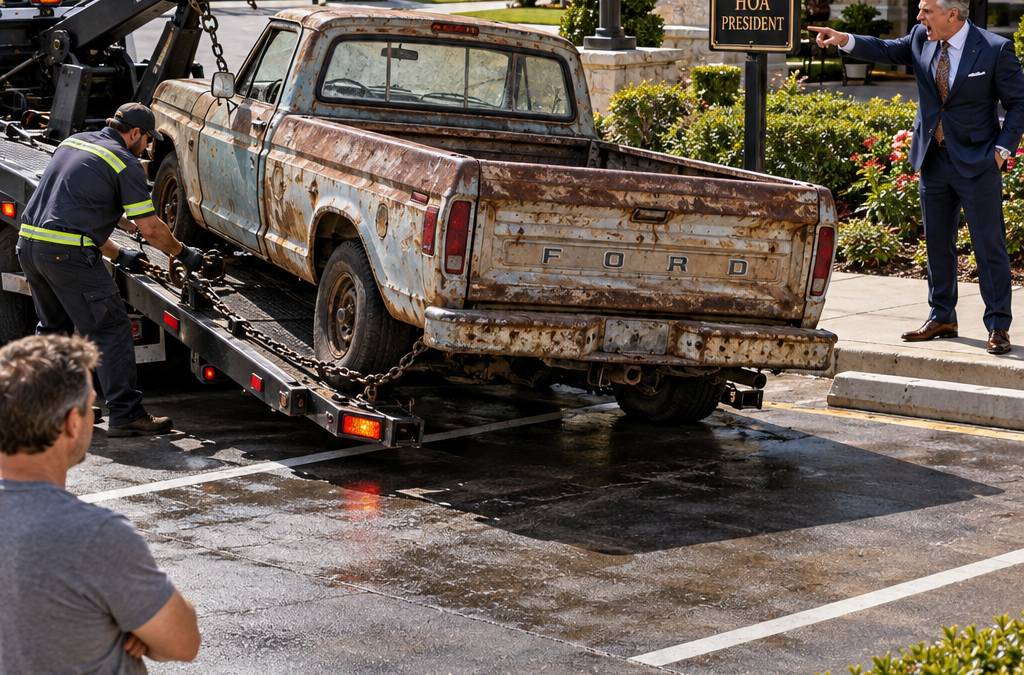
Ray’s mouth spread into a grin.
“Yes, sir.”
He towed it slowly.
Not because he had to.
Because he understood theater.
The rusted Ford swung down Marigold Lane, front wheels raised, back tires rolling behind the tow truck like a defeated animal.
Neighbors stepped onto porches.
Phones came out.
By the time we reached the HOA office, half the cul-de-sac had followed at a distance.
Ray backed the Ford into the reserved board-president parking space with beautiful precision.
The truck settled beneath the sign.
RESERVED — HOA PRESIDENT.
That was when Dorian came storming out.
He wore a navy blazer despite the heat, sunglasses on his head, clipboard in one hand, phone in the other.
“What do you think you’re doing?” he shouted.
I held up the printed bylaws.
“Clearing my driveway.”
“You have no authority to tow contracted property.”
“No, Ray has tow authority. I have six days of photographs and the law on my side.”
Dorian turned to Ray.
“You will release that vehicle immediately.”
Ray did not even look impressed.
“You the registered owner?”
“No, but I am the HOA president.”
“Not what I asked.”
A neighbor laughed from the sidewalk.
Dorian’s face tightened.
“That vehicle is working under association authority.”
I flipped open the bylaws.
“Show me the contractor exemption.”
He stepped closer.
“Greg, you are escalating a matter you do not understand.”
“I understand exactly enough.”
I pointed to the highlighted parking rules.
“No vehicle may obstruct private driveway access. No exemption clause. No contractor override. No board-president exception. This is the document you personally filed.”
Phones were recording all around us.
Dorian realized it.
For a second, the polished mask slipped.
His eyes moved from phone to phone, calculating.
“You’re making yourself liable,” he said.
“No,” I said. “I’m making you visible.”
The words landed harder than I expected.
Dorian looked at me with pure hatred then.
Not irritation.
Not annoyance.
Hatred.
Because men like him can handle anger. They can handle shouting. They can even handle insults.
What they cannot handle is exposure.
That afternoon, I mailed copies of everything to the state HOA regulatory oversight division.
The misdirected newsletter.
Puit Consulting LLC records.
The illegal lien threat.
The fake contractor exemption.
Photos of the blocked driveway.
The tow receipt.
The family vendor connection.
Priya helped me assemble the complaint.
She had worked in compliance before moving to Willow Creek, and she knew how to make a regulator keep reading.
“Lead with the money,” she said.
“I thought the driveway was the strongest part.”
“The driveway is the story. The money is the jurisdiction.”
She was right.
Within days, an investigator called.
His name was Malcolm Reyes, and he had the calm, thorough tone of a man who had learned not to sound surprised until the paperwork finished surprising him.
“Mr. Alvarez,” he said, “I’m reviewing your complaint regarding Willow Creek Estates and Puit Consulting LLC.”
“Yes.”
“I need to ask you about special assessments.”
“I never voted on one.”
“Were residents notified of landscaping upgrades?”
“No.”
“Were upgrades performed?”
“Not that I can see.”
“Do you have additional records of fines connected to Mr. Puit’s office?”
I looked at the folder on my table.
“Yes.”
“How many?”
“A lot.”
“That would be helpful.”
Dorian had spent months hoping nobody in Willow Creek would ask the right questions.
Now an investigator was asking all of them.
Turns out I was not his only target.
Four other families had quietly settled fines rather than fight.
The Carsons paid $2,300 after a fence dispute.
The Mehtas paid $1,700 over driveway oil stains that had existed before they bought the house.
Mrs. Russell, a widow on a fixed income, paid nearly $4,000 to stop lien action over landscaping violations after her husband died.
And the Bennett family had taken out a personal loan to cover accumulated HOA charges because they were terrified of losing the house they had spent decades paying for.
One by one, they came forward.
Folders in hand.
Receipts.
Photos.
Letters.
Emails.
Timestamps matching mine.
A pattern too obvious for Dorian’s polished excuses to explain away.
The emergency HOA meeting that followed was standing room only.
Residents packed the clubhouse shoulder to shoulder.
The air smelled like coffee, carpet cleaner, and anger.
Dorian arrived late.
Of course he did.
Men like him never enter a room until they believe the room has waited long enough to remember who matters.
He wore a charcoal blazer, a white shirt open at the collar, and that same glossy confidence that had carried him through years of intimidation.
He took his seat at the front.
“I understand emotions are high,” he began.
Priya whispered beside me, “Translation: he knows he’s cornered.”
Dorian lifted one hand.
“This board has always acted in the best interest of Willow Creek.”
Someone scoffed.
He continued.
“Recent accusations have been inflated by residents who failed to comply with community standards and now seek to avoid accountability.”
I stood.
Dorian looked annoyed.
“Mr. Alvarez, this is not public comment.”
“It is now.”
A few people clapped.
I held up the board-only newsletter.
“This document lists forty thousand dollars in special assessment funds for landscaping upgrades residents never approved.”
Dorian’s jaw tightened.
I held up the state record.
“This company, Puit Consulting LLC, received payments from that assessment. You registered it eighteen months ago.”
Murmurs spread across the room.
Dorian leaned forward.
“That is a consulting vendor retained for administrative efficiency.”
Priya stood beside me.
“Then where are the contracts?”
The room turned.
Dorian looked at her.
“Priya, I suggest you sit down.”
She smiled.
“I suggest you answer.”
A board member named Carol Simmons stared at the paperwork in front of her as if it had begun moving on its own.
Another board member, Jamal Price, looked pale.
Residents started calling out.
“Where did the money go?”
“Why didn’t we vote?”
“Why was my fine routed through consulting?”
“Why was Greg’s driveway blocked?”
Dorian raised his voice.
“Order.”
No one quieted.
“Order,” he snapped.
Still nothing.
The sound in the room rose.
For the first time, Dorian’s control was not working.
His mask cracked under the pressure of questions he could not dodge.
The board voted seven to zero to suspend him immediately.
Seven to zero.
Even the members who had spent years nodding along with him raised their hands.
They also voted to freeze all Puit Consulting contracts pending a full independent audit of three years of dues and assessment payments.
Dorian stood.
“This board has no authority to take that action without counsel.”
Jamal looked at him.
“We have counsel.”
A woman in a dark suit stood from the back row.
Dorian stared at her.
For once, he had no answer ready.
He tried one last move.
“This is defamatory,” he said. “Every resident participating in this smear campaign should expect legal consequences.”
That bluff lasted less than twenty-four hours.
The moment his own attorney reviewed the shell-company records, the fake assessment language, and the blocked-driveway documentation, the threats stopped.
Within a month, the county prosecutor’s office opened a formal fraud inquiry.
Embezzlement of HOA funds.
Improper assessment handling.
Possible false filings.
Real charges.
Real exposure.
Real uncomfortable prison time under state law.
My lien evaporated instantly.
The board sent a written apology and asked me to accept it quietly to limit harm to the neighborhood’s reputation.
I read that line twice.
Quietly.
That was what let Dorian operate for years.
Quietly.
People paid quietly.
People complained quietly.
People left quietly.
People were afraid quietly.
I was done with quiet.
I posted the whole story on the community forum.
Documents included.
Newsletter.
Business records.
Bylaw excerpts.
Photos of the blocked driveway.
Tow receipt.
Lien threat.
Meeting vote.
Everything.
Not because I wanted attention.
Because sunlight works best when you open the blinds all the way.
Word spread fast.
Local news picked it up.
HOA President Faces Fraud Inquiry After Resident Fights Back.
They called me a persistent homeowner.
That made Dave from two streets over laugh for five full minutes.
“Persistent,” he said. “That’s what we’re calling it now?”
“I’ll take it.”
Dorian resigned before the formal removal vote finished.
He packed boxes from the HOA office he had ruled like a throne for nearly six years.
I watched from the sidewalk as he carried out the last one.
No sunglasses this time.
No clipboard.
No golf cart.
Just a man in an expensive shirt holding office supplies while residents watched him leave.
He glanced at me once.
I expected him to say something.
A threat.
An insult.
A warning.
He said nothing.
Maybe he finally understood that words were dangerous once people started recording them.
Willow Creek elected a new board that spring.
Real transparency this time.
Meeting minutes posted online.
Budgets open for any resident to review.
Vendor contracts disclosed before approval.
Family connections prohibited unless publicly declared and voted on by residents.
Fines reviewed by committee instead of one man with a clipboard.
Lien threats requiring legal review and documented board approval.
No more mystery assessments.
No more fake exemptions.
No more contractor trucks blocking driveways under invented authority.
The first new board meeting was boring.
Gloriously boring.
They discussed irrigation repairs, gate maintenance, reserve planning, and whether the entrance flowers should be drought-resistant.
Nobody shouted.
Nobody threatened lawsuits.
Nobody measured grass from a golf cart.
Priya sat beside me and whispered, “This is what functioning government sounds like.”
“Boring?”
“Exactly.”
The families who had paid improper fines began getting refunds after the audit confirmed what we already knew.
Mrs. Russell cried when she received her check.
Not because it fixed everything.
Because the refund meant the official record finally admitted what she had felt for months.
She had been bullied.
The Bennett family paid down the personal loan they never should have needed.
The Carsons used their refund to repair the same fence Dorian had fined them over.
The Mehtas framed their reversal letter and hung it in their garage as a joke.
I kept my folder.
I still have it.
It sits in a file cabinet beside my old work manuals and tax records.
Sometimes people ask why I do not throw it away now that Dorian is gone.
The answer is simple.
I have fixed enough buildings to know damage returns when maintenance stops.
A community is no different.
You keep the records because accountability is not a mood.
It is a habit.
These days, my driveway stays clear.
My grass stays trimmed, though not always to Dorian’s imaginary standard.
My mornings are quiet again.
The live oak throws shade across the walkway.
The gate opens when it should.
Neighbors wave without checking over their shoulders.
The HOA office parking space no longer says reserved for president. The new board removed the sign and replaced it with two visitor spaces.
A small change.
A symbolic one.
But every time I pass it, I remember the rusted Ford pickup sitting there, exactly where Dorian never wanted it to be.
A problem he created, delivered back to his doorstep.
People like Dorian Puit believe neighborhoods belong to the person most willing to control them.
They are wrong.
A neighborhood belongs to the people who live there.
The ones who pay the dues, cut the grass, raise families, retire, grieve, plant flowers, argue about pool hours, and lend ladders across fences.
Dorian used fines to make people feel alone.
Then the truck blocked my driveway for six days, and his mistake became visible enough for everyone to gather around it.
The tow hook clicked shut.
The Ford moved.
The paperwork followed.
And the kingdom he built on fear finally had to explain itself under fluorescent lights, in front of residents holding phones, folders, and proof.
That is how it ended.
Not with shouting.
Not with revenge.
With a tow receipt, a misdirected newsletter, and a neighborhood that finally stopped being quiet.
𝗧𝗛𝗘 𝗘𝗡𝗗
The HOA President Blocked My Driveway With His Family’s Truck, So I Had It Towed to the One Place He Couldn’t Ignore
The tow hook clicked shut around the rusted Ford pickup that had trapped me in my own driveway for six brutal days. By sundown, that truck would be sitting in the HOA’s front parking space, directly beneath the sign reserved for the man who thought he owned the whole neighborhood.
My name is Greg Alvarez, and three months before that tow truck arrived, I believed Willow Creek Estates would be the quietest chapter of my life.
That was why I bought the house.
I was fifty-eight, divorced, semi-retired, and tired in a way that had nothing to do with sleep. For thirty years, I had worked commercial building maintenance across Texas. Hospitals, office parks, distribution centers, apartment complexes. If a roof leaked, a chiller failed, a transformer popped, or a loading dock door jammed halfway open, somebody called me.
I knew how buildings failed.
Slowly at first.
Then all at once.
A crack in concrete became water intrusion. A missing seal became mold behind drywall. A little electrical heat behind a panel became smoke at two in the morning. Small things, ignored long enough, became expensive things.
People were not so different.
That was something I learned at Willow Creek.
The house I bought sat at the end of Marigold Lane, inside a gated community outside Austin. It was not huge, but it had a wide driveway, a live oak in the front yard, and a back patio that faced a line of cedar trees. The first time I toured it, the street was so quiet I could hear wind moving through dry grass beyond the fence.
I stood in the driveway and thought, This is it.
No more apartment parking lots.
No more upstairs neighbors.
No more maintenance calls waking me up at 3:00 a.m.
Just a little peace.
The real estate agent mentioned the HOA with a cautious smile.
“Willow Creek is very well managed.”
I should have heard the warning hiding in those words.
At closing, I signed the usual HOA documents. Landscaping standards. Exterior paint rules. Trash collection times. Fence restrictions. Parking guidelines. Nothing unusual. Annoying, maybe, but not alarming.
I had lived long enough to know every neighborhood had someone who loved rules more than people.
Willow Creek had Dorian Puit.
He was fifty years old, maybe a little older, and looked like he had been manufactured in a boardroom for the sole purpose of intimidating homeowners. Tall, lean, silver hair slicked back so perfectly the Texas humidity seemed afraid of touching it. Expensive sunglasses. Pressed polo shirts. Loafers polished like mirrors. A watch that flashed whenever he pointed.
And he pointed often.
Dorian had been HOA president for nearly six years, and he carried himself less like an elected volunteer and more like a private ruler inspecting inherited land.
Every morning, he drove through the cul-de-sac in a dark green golf cart with the HOA seal on the front. Clipboard on the passenger seat. Phone in hand. Sunglasses perched high on his head when he wanted people to see his eyes, lowered when he wanted them to feel watched.
People in the neighborhood called him the Mayor.
Not affectionately.
The first time I met him, I was unloading boxes from my truck.
He rolled to a stop at the foot of my driveway and looked over the house before looking at me.
“Mr. Alvarez,” he said.
“That’s me.”
“Dorian Puit. HOA president.”
I wiped my hand on my jeans and offered it.
He shook it briefly, like he was granting a permit.
“Welcome to Willow Creek Estates.”
“Thank you. Beautiful neighborhood.”
“It is,” he said. “Because we protect it.”
There was something about the word protect.
The way he said it made the houses sound less like homes and more like assets under armed guard.
“I’m sure I’ll settle in fine,” I said.
“We hope so.”
His eyes moved toward my lawn.
“You’ll want to watch the grass near the sidewalk. It’s coming up a little high.”
I looked over.
The grass looked normal.
A little uneven from the previous owner, maybe, but not wild.
“I’ll handle it this weekend.”
Dorian smiled.
“I prefer issues corrected before weekends. Standards don’t wait for convenience.”
That was the first warning.
I missed it.
Two days later, I found a fine notice stapled to a photograph of my lawn.
Grass height exceeds community standard by approximately two inches.
Fine: $50.
The picture had clearly been taken from Dorian’s golf cart at sunrise.
I laughed when I read it.
A real laugh.
Fifty dollars felt ridiculous, but not worth a battle. I had just moved in. I wanted to start smoothly. I paid the fine online, mowed the yard, and told myself every gated community had a man like Dorian.
That was my first mistake.
Dorian was not finished.
He was only warming up.
The next notice came a week later.
Trash bins visible one hour before the designated placement window.
Fine: $75.
I checked the rules. Trash bins were supposed to be placed at the curb after 6:00 p.m. I had put mine out at 5:10 because I was leaving for dinner with my daughter and did not want to forget.
Forty-nine minutes early.
Dorian rounded it to one hour and fined me.
The third violation was for a wreath.
A simple cedar wreath my daughter had given me the previous Christmas. I hung it on the front door because the house still felt too empty, and she said it made the place look less like I was “waiting for a witness protection identity.”
Dorian cited me for seasonal decoration noncompliance.
Apparently, evergreen wreaths displayed outside approved holiday windows disrupted visual consistency.
I stared at the notice and muttered, “It’s a wreath, Dorian. Not an invading army.”
I did not pay that one right away.
Instead, I attended the next HOA meeting.
The clubhouse looked like every suburban clubhouse trying hard to seem more important than it was. Beige walls, fake plants, framed aerial photo of Willow Creek, and a conference table where the board sat like a panel of judges.
Dorian sat at the center.
Of course he did.
Sunglasses folded on the table. Watch glinting. Fingers steepled.
When public comments opened, I raised my hand.
He looked at me as if he had been expecting it.
“Mr. Alvarez.”
“I have a question about the wreath citation.”
A few residents shifted in their chairs.
“I’m happy to clarify,” Dorian said.
“The decoration rule says holiday decorations must be removed within fourteen days after the applicable holiday. It doesn’t define a plain wreath as a holiday decoration.”
Dorian smiled.
“The board has interpretive authority.”
“Is that written somewhere?”
His smile stayed.
“The board’s authority is clear.”
“That’s not the same thing.”
The room went quiet.
Small quiet.
Dangerous quiet.
The kind that says people have seen this road before and know where it ends.
Dorian leaned back.
“Mr. Alvarez, I understand you are new. Willow Creek has expectations that may be unfamiliar to you.”
“I’m asking where the rule is.”
“And I am explaining that community standards require reasonable interpretation.”
“Reasonable by whom?”
His smile faded.
“By the board.”
Meaning him.
I sat down because I had made my point and because I could feel twenty pairs of eyes telling me to stop before he remembered my address.
After the meeting, a woman approached me near the parking lot.
She was in her forties, with dark hair pulled back, sharp eyes, and a soft voice that made her warnings land harder.
“Greg Alvarez?”
“Yes.”
“I’m Priya Desai. I live two streets over.”
“Nice to meet you.”
She glanced toward the clubhouse doors.
“You need to be careful.”
“About what?”
“Dorian doesn’t forget faces that ask questions.”
I gave a half laugh.
“He’s an HOA president, not a crime boss.”
Priya did not smile.
“He waits. Then he strikes when you’re not looking.”
I should have listened harder.
Two weeks later, the lien threat arrived.
It came by certified mail in a stiff white envelope.
I opened it at my kitchen counter.
The claimed balance was $1,100.
Grass violation.
Trash-bin violation.
Wreath violation.
Late fees.
Administrative review fees.
Compliance processing fees.
Then the sentence that made my throat go dry.
Failure to cure outstanding violations may result in lien action against the property.
A lien.
On my house.
Over grass, trash cans, and a Christmas wreath.
I laughed out loud at first.
The sound came out too hard, too sharp.
Then disbelief curdled into cold fury.
I had bought that house with retirement money, savings, and the proceeds from selling the home I had lived in during my marriage. It was not just property. It was the quiet I had earned after decades of fixing everyone else’s emergencies.
And Dorian Puit was threatening to encumber it with paperwork because I asked him to show me a rule.
That night, I started a folder.
Every letter.
Every photo.
Every email.
Every timestamp.
Every charge.
I labeled it simply:
PUIT — HOA.
Something told me Dorian’s paper trail was not as clean as his shirts.
The first real twist came from the most unlikely place.
My mailman.
His name was Leo, and he had been delivering in Willow Creek longer than Dorian had been president. One afternoon, he knocked on my door looking embarrassed.
“Mr. Alvarez, this got mixed into your mail.”
He handed me a folded HOA newsletter.
Not the glossy resident newsletter.
This one was plain, marked for board distribution.
“Sorry about that,” he said.
“No problem.”
He walked away before I looked down.
The newsletter listed board-only updates, including a section on special assessment funds.
I read it once.
Then again.
Forty thousand dollars collected from residents for landscaping upgrades.
I frowned.
Landscaping upgrades?
No one had voted on a special assessment.
At least not at any meeting I attended, and not in any notice I received.
The newsletter referenced payments to a vendor called Puit Consulting LLC.
Puit.
Dorian’s name.
I sat down at the kitchen table with the newsletter in front of me.
Forty thousand dollars.
Landscaping upgrades.
No visible upgrades.
A consulting company with the HOA president’s name on it.
I searched state business records.
Puit Consulting LLC had been registered eighteen months earlier.
Registered agent: Dorian Puit.
I stared at the screen.
There it was.
Not suspicion.
Not gossip.
Documentation.
Dorian was paying himself through a shell company using resident dues while fining people over inches of grass.
The purpose became clear in one ugly piece.
The fines kept everyone distracted and compliant.
If residents were afraid of notices, liens, and late fees, they were less likely to ask where the larger money went.
I sat with that folder for three nights.
I barely slept.
Rage kept waking me up, but so did fear.
What if nobody believed me?
What if Dorian turned the unpaid fines against me?
What if I became the difficult resident, the guy with violations, the man everyone avoided because he caused trouble?
That was how people like Dorian survived.
They made the victim look messy before anyone examined the crime.
So I got quieter.
I smiled when Dorian drove by.
I waved during his inspections.
I said good morning like a man who had learned his lesson.
And I documented everything.
Methodically.
Like a building inspection.
Foundation.
Framing.
Wiring.
Defect.
Photograph.
Date.
Signature.
Then came the truck.
A massive rusted Ford contractor pickup appeared across the mouth of my driveway on a Monday morning.
Not near my driveway.
Across it.
At an angle that blocked my car completely.
It had faded company lettering on the door, a dented rear bumper, mud-caked tires, and a ladder rack loaded with scrap lumber.
At first, I assumed someone had parked there briefly.
Maybe a contractor working nearby.
I waited twenty minutes.
No one came.
I walked outside and looked up and down the street.
The house behind the truck had been vacant for months.
No crew.
No noise.
No equipment.
Just the truck.
I called the HOA office.
Dorian’s assistant, Melanie, answered.
“Willow Creek HOA.”
“This is Greg Alvarez. There’s a contractor truck blocking my driveway.”
“What address?”
I gave it to her.
A pause.
“Oh, that vehicle is associated with contracted work.”
“What contracted work? The house is vacant.”
“Trucks on private contracted work are exempt from towing regulations.”
I looked out the window at the truck.
“Where is that exemption written?”
“That is the association’s policy.”
“I’m asking where it exists in the bylaws.”
“Mr. Alvarez, I’m not going to debate policy.”
“I can’t leave my driveway.”
“Perhaps you can park on the street temporarily.”
“My car is trapped behind the truck.”
A pause.
“I’ll note your concern.”
She hung up.
Not “We’ll fix it.”
Not “We’ll contact the owner.”
She would note my concern.
For six days, that truck sat there.
Six brutal days.
I could not back out of my own driveway.
I had to ask a neighbor to take me to the grocery store.
I canceled a doctor’s appointment.
I missed a lunch with my daughter because I refused to pay for a rideshare just to escape my own property.
Every morning, I photographed the truck.
Every evening, I sent another written complaint.
Every response from the HOA said the same thing in different language.
Exempt.
Contracted work.
Private vendor.
Temporary situation.
No towing authorized.
On the fourth day, I checked the actual bylaws.
Dorian himself had drafted the most recent parking amendment, buried in an appendix nobody probably opened after the Tuesday meeting where it passed.
There was no contractor-truck exemption.
No private-work exception.
No board-president override.
No provision allowing a vendor vehicle to block a homeowner’s driveway for six days.
He had been bluffing.
Banking on nobody reading the fine print.
Then Priya knocked on my door.
She looked at the truck, then at me.
“You know who owns it?”
“No.”
“Dorian’s brother-in-law.”
I stared.
“What?”
“His brother-in-law runs Puit Ridge Repairs. That truck is registered to the company.”
I felt my jaw tighten.
Another Puit family business.
Another vendor.
Another drain on a budget residents were not allowed to question.
“How did you find that out?”
Priya lifted one eyebrow.
“I told you. He waits. I learned to check.”
That was the second twist.
The truck was not random.
It was another piece of the same machine.
Dorian’s family business parked across my driveway, protected by a fake exemption, while Dorian threatened my house with fake fines.
Something inside me went still.
I called the county tow service myself.
Texas law did not care what Dorian’s assistant thought.
A vehicle blocking driveway access was a straightforward violation.
The tow driver arrived within the hour.
His name was Ray, a broad man with mirrored sunglasses, chewing gum like it owed him money.
He stepped out, looked at the truck, looked at my driveway, then looked at me.
“How long’s it been blocking you?”
“Six days.”
Ray stopped chewing for half a second.
“Six days?”
“HOA said it was exempt.”
He laughed.
“That right?”
“Apparently.”
He walked around the Ford, checked the position, took photos, and filled out paperwork.
“No exemption for blocking a driveway.”
“That’s what I thought.”
He hooked the truck clean.
Metal clicked.
Chains tightened.
The front end lifted.
I filmed every second.
Melanie appeared in the HOA office window across the small greenbelt, phone pressed to her ear.
“Where do you want it dropped?” Ray asked, clipboard in hand.
I had thought about that answer all morning.
“HOA main office,” I said. “Front parking spot. Right under the sign that says Reserved for Board President.”
Ray’s mouth spread into a grin.
“Yes, sir.”
He towed it slowly.
Not because he had to.
Because he understood theater.
The rusted Ford swung down Marigold Lane, front wheels raised, back tires rolling behind the tow truck like a defeated animal.
Neighbors stepped onto porches.
Phones came out.
By the time we reached the HOA office, half the cul-de-sac had followed at a distance.
Ray backed the Ford into the reserved board-president parking space with beautiful precision.
The truck settled beneath the sign.
RESERVED — HOA PRESIDENT.
That was when Dorian came storming out.
He wore a navy blazer despite the heat, sunglasses on his head, clipboard in one hand, phone in the other.
“What do you think you’re doing?” he shouted.
I held up the printed bylaws.
“Clearing my driveway.”
“You have no authority to tow contracted property.”
“No, Ray has tow authority. I have six days of photographs and the law on my side.”
Dorian turned to Ray.
“You will release that vehicle immediately.”
Ray did not even look impressed.
“You the registered owner?”
“No, but I am the HOA president.”
“Not what I asked.”
A neighbor laughed from the sidewalk.
Dorian’s face tightened.
“That vehicle is working under association authority.”
I flipped open the bylaws.
“Show me the contractor exemption.”
He stepped closer.
“Greg, you are escalating a matter you do not understand.”
“I understand exactly enough.”
I pointed to the highlighted parking rules.
“No vehicle may obstruct private driveway access. No exemption clause. No contractor override. No board-president exception. This is the document you personally filed.”
Phones were recording all around us.
Dorian realized it.
For a second, the polished mask slipped.
His eyes moved from phone to phone, calculating.
“You’re making yourself liable,” he said.
“No,” I said. “I’m making you visible.”
The words landed harder than I expected.
Dorian looked at me with pure hatred then.
Not irritation.
Not annoyance.
Hatred.
Because men like him can handle anger. They can handle shouting. They can even handle insults.
What they cannot handle is exposure.
That afternoon, I mailed copies of everything to the state HOA regulatory oversight division.
The misdirected newsletter.
Puit Consulting LLC records.
The illegal lien threat.
The fake contractor exemption.
Photos of the blocked driveway.
The tow receipt.
The family vendor connection.
Priya helped me assemble the complaint.
She had worked in compliance before moving to Willow Creek, and she knew how to make a regulator keep reading.
“Lead with the money,” she said.
“I thought the driveway was the strongest part.”
“The driveway is the story. The money is the jurisdiction.”
She was right.
Within days, an investigator called.
His name was Malcolm Reyes, and he had the calm, thorough tone of a man who had learned not to sound surprised until the paperwork finished surprising him.
“Mr. Alvarez,” he said, “I’m reviewing your complaint regarding Willow Creek Estates and Puit Consulting LLC.”
“Yes.”
“I need to ask you about special assessments.”
“I never voted on one.”
“Were residents notified of landscaping upgrades?”
“No.”
“Were upgrades performed?”
“Not that I can see.”
“Do you have additional records of fines connected to Mr. Puit’s office?”
I looked at the folder on my table.
“Yes.”
“How many?”
“A lot.”
“That would be helpful.”
Dorian had spent months hoping nobody in Willow Creek would ask the right questions.
Now an investigator was asking all of them.
Turns out I was not his only target.
Four other families had quietly settled fines rather than fight.
The Carsons paid $2,300 after a fence dispute.
The Mehtas paid $1,700 over driveway oil stains that had existed before they bought the house.
Mrs. Russell, a widow on a fixed income, paid nearly $4,000 to stop lien action over landscaping violations after her husband died.
And the Bennett family had taken out a personal loan to cover accumulated HOA charges because they were terrified of losing the house they had spent decades paying for.
One by one, they came forward.
Folders in hand.
Receipts.
Photos.
Letters.
Emails.
Timestamps matching mine.
A pattern too obvious for Dorian’s polished excuses to explain away.
The emergency HOA meeting that followed was standing room only.
Residents packed the clubhouse shoulder to shoulder.
The air smelled like coffee, carpet cleaner, and anger.
Dorian arrived late.
Of course he did.
Men like him never enter a room until they believe the room has waited long enough to remember who matters.
He wore a charcoal blazer, a white shirt open at the collar, and that same glossy confidence that had carried him through years of intimidation.
He took his seat at the front.
“I understand emotions are high,” he began.
Priya whispered beside me, “Translation: he knows he’s cornered.”
Dorian lifted one hand.
“This board has always acted in the best interest of Willow Creek.”
Someone scoffed.
He continued.
“Recent accusations have been inflated by residents who failed to comply with community standards and now seek to avoid accountability.”
I stood.
Dorian looked annoyed.
“Mr. Alvarez, this is not public comment.”
“It is now.”
A few people clapped.
I held up the board-only newsletter.
“This document lists forty thousand dollars in special assessment funds for landscaping upgrades residents never approved.”
Dorian’s jaw tightened.
I held up the state record.
“This company, Puit Consulting LLC, received payments from that assessment. You registered it eighteen months ago.”
Murmurs spread across the room.
Dorian leaned forward.
“That is a consulting vendor retained for administrative efficiency.”
Priya stood beside me.
“Then where are the contracts?”
The room turned.
Dorian looked at her.
“Priya, I suggest you sit down.”
She smiled.
“I suggest you answer.”
A board member named Carol Simmons stared at the paperwork in front of her as if it had begun moving on its own.
Another board member, Jamal Price, looked pale.
Residents started calling out.
“Where did the money go?”
“Why didn’t we vote?”
“Why was my fine routed through consulting?”
“Why was Greg’s driveway blocked?”
Dorian raised his voice.
“Order.”
No one quieted.
“Order,” he snapped.
Still nothing.
The sound in the room rose.
For the first time, Dorian’s control was not working.
His mask cracked under the pressure of questions he could not dodge.
The board voted seven to zero to suspend him immediately.
Seven to zero.
Even the members who had spent years nodding along with him raised their hands.
They also voted to freeze all Puit Consulting contracts pending a full independent audit of three years of dues and assessment payments.
Dorian stood.
“This board has no authority to take that action without counsel.”
Jamal looked at him.
“We have counsel.”
A woman in a dark suit stood from the back row.
Dorian stared at her.
For once, he had no answer ready.
He tried one last move.
“This is defamatory,” he said. “Every resident participating in this smear campaign should expect legal consequences.”
That bluff lasted less than twenty-four hours.
The moment his own attorney reviewed the shell-company records, the fake assessment language, and the blocked-driveway documentation, the threats stopped.
Within a month, the county prosecutor’s office opened a formal fraud inquiry.
Embezzlement of HOA funds.
Improper assessment handling.
Possible false filings.
Real charges.
Real exposure.
Real uncomfortable prison time under state law.
My lien evaporated instantly.
The board sent a written apology and asked me to accept it quietly to limit harm to the neighborhood’s reputation.
I read that line twice.
Quietly.
That was what let Dorian operate for years.
Quietly.
People paid quietly.
People complained quietly.
People left quietly.
People were afraid quietly.
I was done with quiet.
I posted the whole story on the community forum.
Documents included.
Newsletter.
Business records.
Bylaw excerpts.
Photos of the blocked driveway.
Tow receipt.
Lien threat.
Meeting vote.
Everything.
Not because I wanted attention.
Because sunlight works best when you open the blinds all the way.
Word spread fast.
Local news picked it up.
HOA President Faces Fraud Inquiry After Resident Fights Back.
They called me a persistent homeowner.
That made Dave from two streets over laugh for five full minutes.
“Persistent,” he said. “That’s what we’re calling it now?”
“I’ll take it.”
Dorian resigned before the formal removal vote finished.
He packed boxes from the HOA office he had ruled like a throne for nearly six years.
I watched from the sidewalk as he carried out the last one.
No sunglasses this time.
No clipboard.
No golf cart.
Just a man in an expensive shirt holding office supplies while residents watched him leave.
He glanced at me once.
I expected him to say something.
A threat.
An insult.
A warning.
He said nothing.
Maybe he finally understood that words were dangerous once people started recording them.
Willow Creek elected a new board that spring.
Real transparency this time.
Meeting minutes posted online.
Budgets open for any resident to review.
Vendor contracts disclosed before approval.
Family connections prohibited unless publicly declared and voted on by residents.
Fines reviewed by committee instead of one man with a clipboard.
Lien threats requiring legal review and documented board approval.
No more mystery assessments.
No more fake exemptions.
No more contractor trucks blocking driveways under invented authority.
The first new board meeting was boring.
Gloriously boring.
They discussed irrigation repairs, gate maintenance, reserve planning, and whether the entrance flowers should be drought-resistant.
Nobody shouted.
Nobody threatened lawsuits.
Nobody measured grass from a golf cart.
Priya sat beside me and whispered, “This is what functioning government sounds like.”
“Boring?”
“Exactly.”
The families who had paid improper fines began getting refunds after the audit confirmed what we already knew.
Mrs. Russell cried when she received her check.
Not because it fixed everything.
Because the refund meant the official record finally admitted what she had felt for months.
She had been bullied.
The Bennett family paid down the personal loan they never should have needed.
The Carsons used their refund to repair the same fence Dorian had fined them over.
The Mehtas framed their reversal letter and hung it in their garage as a joke.
I kept my folder.
I still have it.
It sits in a file cabinet beside my old work manuals and tax records.
Sometimes people ask why I do not throw it away now that Dorian is gone.
The answer is simple.
I have fixed enough buildings to know damage returns when maintenance stops.
A community is no different.
You keep the records because accountability is not a mood.
It is a habit.
These days, my driveway stays clear.
My grass stays trimmed, though not always to Dorian’s imaginary standard.
My mornings are quiet again.
The live oak throws shade across the walkway.
The gate opens when it should.
Neighbors wave without checking over their shoulders.
The HOA office parking space no longer says reserved for president. The new board removed the sign and replaced it with two visitor spaces.
A small change.
A symbolic one.
But every time I pass it, I remember the rusted Ford pickup sitting there, exactly where Dorian never wanted it to be.
A problem he created, delivered back to his doorstep.
People like Dorian Puit believe neighborhoods belong to the person most willing to control them.
They are wrong.
A neighborhood belongs to the people who live there.
The ones who pay the dues, cut the grass, raise families, retire, grieve, plant flowers, argue about pool hours, and lend ladders across fences.
Dorian used fines to make people feel alone.
Then the truck blocked my driveway for six days, and his mistake became visible enough for everyone to gather around it.
The tow hook clicked shut.
The Ford moved.
The paperwork followed.
And the kingdom he built on fear finally had to explain itself under fluorescent lights, in front of residents holding phones, folders, and proof.
That is how it ended.
Not with shouting.
Not with revenge.
With a tow receipt, a misdirected newsletter, and a neighborhood that finally stopped being quiet.








