𝗙𝗨𝗟𝗟 𝗦𝗧𝗢𝗥𝗬 The HOA President Blocked My Ambulance Over a Parking Permit While My Heart Was Failing, and She Refused to Let Anyone Save Me.
𝗙𝗨𝗟𝗟 𝗦𝗧𝗢𝗥𝗬
Then my neighbor Doug explained how things worked.
Doug was a retired contractor who had lived in Maple Ridge for twelve years. He had a gravelly voice, permanently sunburned forearms, and the dry humor of a man who had run out of patience for nonsense.
We were standing beside my fence one afternoon when Karen drove past in her white golf cart.
She slowed just enough to look at my front lawn.
Doug watched her disappear.
“There goes the sheriff of nothing.”
I laughed.
“The what?”
“The sheriff of nothing. She’s got a badge nobody issued and authority nobody should’ve given her.”
“She seems strict.”
Doug snorted.
“Strict is making sure the pool gate stays locked. Karen’s something else.”
“How so?”
He glanced down the street.
“You’ll figure it out.”
I should have asked more questions.
Instead, I told myself that every neighborhood had at least one dramatic personality.
I was busy keeping the bakery alive.
My business was small, and although I loved it, the finances were unforgiving.
Butter prices had gone up.
Flour deliveries cost more than they used to.
Wedding cake orders were unpredictable.
One canceled event could wipe out the profit from an entire week’s smaller sales.
Most evenings, I went home with flour in my hair, aching feet, and a list of expenses I needed to pay before anything else.
I didn’t have the time or emotional energy to fight over community politics.
My strategy was simple.
Pay the small fines.
Keep my head down.
Focus on the bakery.
For approximately four months, that strategy seemed to work.
Then Karen noticed my vegetable garden.
It wasn’t much.
Sixty square feet of tomatoes, basil, and a few pepper plants.
I’d built two modest raised beds and kept the area neat. The tomatoes were tied to wooden supports, the basil grew in orderly clusters, and I trimmed everything regularly.
I loved that garden.
Fresh basil went into savory pastries at the bakery. Tomatoes became ingredients for seasonal specials. The peppers mostly ended up in my own kitchen because I enjoyed the small satisfaction of cooking something I’d grown myself.
One afternoon, I came home to find Karen standing beside my side gate.
She held her clipboard against her hip.
The red lace dress was unmistakable.
“Angel,” she called. “We need to discuss your landscaping.”
I stopped.
“What’s wrong with it?”
She gestured toward the garden.
“Vegetable cultivation isn’t consistent with our uniform neighborhood aesthetics.”
I thought she was joking.
“Vegetable cultivation?”
“Tomatoes. Peppers. Herbs. It’s becoming rather agricultural.”
“It’s a garden, Karen.”
“Exactly.”
I stared at her.
“The bylaws allow personal food gardens.”
Her smile didn’t move.
“The board interprets aesthetics differently now.”
I went inside, retrieved the governing documents, and returned with the relevant page.
“Right here,” I said, pointing to the paragraph. “Personal food gardens under one hundred square feet are permitted.”
She looked at it.
“My garden is sixty.”
“That’s your measurement.”
“You can measure it yourself.”
“Angel, you’re missing the larger issue.”
“What’s the larger issue?”
“Community character.”
I felt my patience thinning.
“What does that mean?”
“It means the board has discretion to determine whether a feature is visually appropriate.”
“Then why does the rule specifically allow gardens under one hundred square feet?”
Karen’s blue eyes cooled.
“Because homeowners are expected to exercise good judgment.”
“I have.”
“That’s your opinion.”
I took a breath.
“Karen, there is nothing in these rules that prohibits my garden.”
She smiled again.
“Well, the board disagrees.”
Three days later, I received a one-hundred-fifty-dollar fine.
I stared at the notice for a long time.
One hundred fifty dollars.
For vegetables explicitly permitted under the bylaws.
That money could have bought ingredients for dozens of bakery orders.
It could have paid part of my electricity bill.
It could have gone toward repairing the aging mixer I’d been trying to replace.
Instead, Karen expected me to hand it over because she disliked the sight of tomatoes.
I called her office.
She answered cheerfully.
“Maple Ridge Estates.”
“Karen, the garden citation is invalid.”
“Hello to you too, Angel.”
“I’m serious. The rule is clear.”
“And the board’s decision is clear.”
“Then I want to appeal.”
“You’re welcome to use the established procedure.”
“Good. I will.”
Her voice softened into something almost mocking.
“You might find that learning to cooperate is easier than constantly challenging the people trying to help you.”
I gripped the phone.
“I’m not asking for special treatment.”
“Of course not.”
“I’m asking you to follow your own rules.”
A pause.
Then she said, “I’ll make a note of your attitude.”
The call ended.
I stood there holding my phone, suddenly aware that something had changed.
Before that conversation, I had been dealing with annoying fines.
Now I was dealing with someone who seemed personally offended by the idea that her authority could be questioned.
I started keeping a folder.
Every citation.
Every email.
Every date.
Every photograph.
Every rule Karen claimed I’d violated.
I printed the garden provision and placed it beside the fine.
I didn’t know what I would eventually do with the documents.
I only knew that if Karen was willing to ignore something written so clearly, I needed a record of what was happening.
Two weeks later, another notice arrived.
This one concerned my porch swing.
According to the HOA, it constituted visual clutter inconsistent with neighborhood character.
I read the sentence twice.
Then I stepped outside.
The swing moved gently in the afternoon breeze.
Its cushions were clean.
The wood was polished.
It didn’t block the walkway or interfere with anyone else’s property.
I’d owned it for three years.
Not one neighbor had ever complained.
I had saved for a year to buy that swing, and it was one of the few things I possessed that made my house feel unmistakably like home.
I called Karen.
“You’re fining me for my porch swing?”
“It’s an exterior furnishing issue.”
“It’s a swing.”
“It creates visual clutter.”
“It’s on my porch.”
“Which is visible from the street.”
“So are my windows. Should I remove those too?”
Her voice hardened.
“Sarcasm isn’t helpful, Angel.”
“Neither is inventing violations.”
“I suggest you choose your next words carefully.”
I nearly hung up.
Instead, I took a slow breath.
“I want a formal appeal.”
“Very well.”
The hearing lasted eleven minutes.
Three board members sat behind a folding table in the clubhouse.
All three had been personally appointed by Karen.
She sat near the center, smiling as though the decision had already been made.
I presented photographs of the swing and sections of the bylaws.
One board member glanced at the photographs.
Another checked his watch.
The third asked whether I had considered simply removing the swing to preserve community harmony.
I looked at him.
“Is there a rule prohibiting it?”
He shifted in his chair.
“The board has authority to interpret appearance standards.”
“Does that authority include creating new rules after a homeowner has already complied?”
Karen interrupted.
“Angel, this hearing is not an opportunity to challenge the board’s general authority.”
“Then what is it?”
“An opportunity to present your appeal.”
“That’s what I’m doing.”
Her smile disappeared.
The board voted against me.
Three to zero.
I walked outside feeling as though I’d just participated in a ceremony designed to humiliate me.
Karen followed me into the parking lot.
Her heels clicked sharply against the pavement.
“You should really learn to work with the system, Angel.”
I turned.
“Is that what you call this?”
She tilted her head.
“I’m trying to give you friendly advice.”
“Then here’s some friendly advice in return.”
Her eyebrows rose.
“If you want people to respect the rules, start respecting them yourself.”
The expression on her face changed.
Only slightly.
But enough.
I could see the anger behind her smile.
“Careful,” she said.
I forced myself to smile.
“I’m learning a lot about the system, actually.”
She didn’t seem to recognize the warning in that sentence.
To be fair, I barely recognized it myself.
I wasn’t planning a lawsuit.
I wasn’t imagining criminal investigations.
I was simply starting to understand that compliance wouldn’t protect me.
Karen wanted obedience.
And she would keep increasing the price until she got it.
Doug was waiting near the edge of the parking lot.
He watched Karen walk away, then approached me.
“She denied your appeal?”
“All three of them did.”
He shook his head.
“Same old game.”
I looked at him.
“What game?”
He hesitated.
Then glanced toward the clubhouse doors.
“Angel, you remember the Hendersons?”
“No.”
“They lived on Willow Lane. Two years ago.”
I shook my head.
“Before my time.”
Doug’s expression darkened.
“Karen fined those people into foreclosure.”
I stared at him.
“What?”
“Violation after violation. Grass. Mailbox. Fence. Garbage cans. Every time they tried to catch up, something else appeared.”
“That can’t be legal.”
“Maybe not. But fighting costs money.”
“What happened?”
“They got behind. The association filed a lien. Things got ugly. Eventually they lost the house.”
I felt a chill.
“That’s awful.”
Doug looked toward the street.
“That’s not the worst part.”
I waited.
“Karen bought the house.”
I blinked.
“Karen?”
“Through a company.”
“At a foreclosure sale?”
“After the foreclosure notice went up, there was a cash offer. About forty percent below market value. They were drowning in debt and desperate to get out.”
My mouth went dry.
“You’re saying she personally benefited from pushing them out?”
Doug rubbed his jaw.
“I’m saying the house ended up with a company connected to her. Nobody ever proved wrongdoing.”
I looked toward the clubhouse.
The doors had closed behind Karen.
All those laminated regulations.
The fines.
The impossible appeals.
The threats about property values.
Suddenly, they looked different.
Not like the habits of a controlling volunteer.
Like tools.
“What was the company’s name?” I asked.
Doug thought for a moment.
“Ridgeline Holdings. Something like that.”
I went home and opened my laptop.
Instead of preparing the next day’s bakery orders, I searched county property records.
I found the Hendersons’ old address.
Then the transfer.
Then the current owner.
Ridgeline Holdings LLC.
I searched the company’s registration information.
When the registered agent’s address appeared, I went completely still.
It matched Karen Whitfield’s home address.
I checked it three times.
Same street.
Same house number.
Same zip code.
I leaned back and stared at the screen.
Doug hadn’t been exaggerating.
A company connected to Karen owned the house that the Hendersons had lost after years of HOA penalties.
That didn’t prove the fines had been fraudulent.
It didn’t prove she’d engineered the sale.
But it established something I couldn’t ignore.
Karen had a financial connection to a property acquired after a family had been pressured by the same association she controlled.
I printed the records and added them to my folder.
Then I sat in my kitchen long after midnight.
I wanted to tell everyone.
I wanted to walk into the next board meeting and demand answers.
But one suspicious transaction wasn’t enough.
Karen would dismiss it as coincidence.
She’d call me bitter.
She’d say I was spreading rumors because I disliked following the rules.
And given how eagerly some neighbors supported her, people might believe it.
I needed more evidence.
So I kept watching.
Over the following month, Karen issued more fines.
A garden hose visible from the street.
A welcome mat that didn’t match the approved appearance standards.
A trash bin left outside four hours beyond the permitted collection window.
The penalties totaled approximately four hundred dollars in thirty days.
Four hundred dollars.
For a hose, a mat, and a garbage bin.
I paid every fine she sent.
Not because I agreed.
Because I feared what would happen if I fell behind.
I had seen what happened to the Hendersons.
At the bakery, I began calculating everything differently.
Four hundred dollars was several days of ingredient purchases.
It was money I’d planned to set aside for the next equipment repair.
It was a cushion against a slow week.
And Karen was taking it from me through a process she controlled.
One evening, I sat on the porch swing staring at the street.
I considered selling the house.
The thought had been growing quietly for weeks.
I could leave Maple Ridge.
Find somewhere without an HOA.
Move the swing.
Replant the tomatoes.
Start over.
Then I remembered Doug describing the Hendersons.
The fear in his voice.
The way he’d looked toward the clubhouse before mentioning Karen.
I imagined moving away and learning later that another family had lost its home.
Maybe a retired couple.
Maybe a single parent.
Maybe someone who couldn’t afford the fines or didn’t know where to look for help.
I couldn’t prove Karen was running a scheme.
But I couldn’t keep pretending the possibility didn’t exist.
I stayed.
And I started attending every board meeting.
I took notes.
Where permitted, I recorded audio.
I asked for the specific bylaw supporting each proposed rule change.
I requested explanations for enforcement decisions.
I paid attention to who spoke, who voted, and who remained silent.
Karen noticed immediately.
At first, she responded with theatrical patience.
“Oh, Angel has another question.”
Then with open irritation.
“We’ve already discussed this.”
Then with hostility.
“You’re becoming disruptive to this community, Angel.”
She said those words in front of nearly thirty residents.
A few people actually applauded.
I stood there with my notebook in my hands, feeling heat rise into my face.
I hadn’t shouted.
I hadn’t insulted anyone.
I’d asked which provision authorized a new landscaping restriction.
And people were clapping because Karen had humiliated me.
That hurt more than I expected.
It wasn’t simply that they disagreed with me.
They seemed relieved that someone else was being punished.
I understood then how Karen maintained her power.
She didn’t need everyone to like her.
She needed people to believe that challenging her was dangerous.
As long as the fines landed on someone else’s doorstep, staying quiet felt safer.
I went home that night and cried.
Not for very long.
Just a few minutes, sitting on the edge of my bed, exhausted by the feeling that I’d somehow become an outsider in my own neighborhood.
Then I washed my face, opened my laptop, and added the meeting notes to my folder.
If Karen wanted to call me disruptive, I was going to make sure there was a written record of exactly what I’d said.
My cousin Marisol was the next person I called.
Marisol worked as a paralegal and had always been the practical one in our family.
She could listen to a complicated situation for ten minutes, identify the important facts, and tell you which documents were missing.
When I explained the fines, the board hearings, and the Henderson property, she became very quiet.
“Angel, have you requested the HOA’s financial records?”
“No.”
“Do that.”
“Why?”
“Because if Karen is using association enforcement to benefit a company connected to her, there may be a financial trail.”
“You think she’s committing fraud?”
“I think there’s enough here to ask questions. But don’t start making accusations you can’t support.”
I rubbed my forehead.
“I’m trying not to.”
“Good. Request the records in writing. Certified mail. Return receipt.”
“Which records?”
“Financial statements, vendor transactions, legal expenses, foreclosure-related records, and board approvals. Ask for what homeowners are legally entitled to inspect.”
I wrote everything down.
“And Angel?”
“Yeah?”
“Keep every response.”
The next morning, I mailed my first formal records request.
I paid for certified delivery and kept the receipt.
The request disappeared into silence.
Thirty days passed without the records.
Then Karen finally replied.
She claimed the documents were unavailable because the association was updating its filing system.
I stared at the letter.
A filing system update.
An association capable of issuing fines within days somehow couldn’t produce its own financial records in a month.
Marisol helped me prepare a second request, citing the applicable state disclosure requirements and the ten-business-day deadline that governed the records we were seeking.
This time, Karen’s response arrived quickly.
It was furious.
She accused me of harassing volunteers and burdening the association with unnecessary paperwork.
The attached violation notice contained two spelling mistakes.
I noticed both.
For some reason, that gave me a small burst of satisfaction.
Karen was rattled.
Not enough to stop.
But enough to make mistakes.
I added the letter to my folder.
By then, I was documenting so much that I sometimes felt paranoid.
I photographed envelopes before opening them.
I saved voicemails.
I checked timestamps.
I kept duplicate copies of important documents.
I hated what the experience was turning me into.
But the more carefully I watched, the more inconsistencies I found.
Then came the Tuesday morning that changed everything.
I arrived at the bakery shortly after five.
We had a wedding cake due for afternoon delivery, and I wanted to finish the final layer of buttercream before the kitchen became crowded.
Beth was already there.
She worked with me most weekdays and knew my moods better than almost anybody.
“You look terrible,” she said when I came through the door.
“Good morning to you too.”
“I’m serious. Did you sleep?”
“A little.”
“How little?”
I set down my bag.
“Enough.”
She gave me a skeptical look.
“You’ve been saying that for weeks.”
I didn’t answer.
My chest had felt tight since the night before, but I assumed it was stress.
I had been working long hours, worrying about money, and fighting with an HOA president who seemed determined to make every ordinary part of my life difficult.
I told myself I needed rest.
Maybe less caffeine.
Maybe a weekend without legal documents.
Beth handed me an apron.
“You should take a day off.”
“After the wedding order.”
“You said that last week.”
“I meant it this time.”
She rolled her eyes.
We laughed.
That was the last normal conversation I remember from that morning.
I was smoothing icing along the side of the wedding cake when the first sharp pain struck.
It felt like a sudden pressure deep in my chest.
I stopped moving.
The metal spatula remained suspended in my hand.
Beth looked up.
“Angel?”
“I’m okay.”
I wasn’t.
The pressure increased.
I put the spatula down.
A strange dizziness moved through me.
The kitchen seemed to tilt.
“Angel?”
I reached for the counter.
My left arm tingled.
Then went partially numb.
I tried to take a deep breath.
The air wouldn’t go in properly.
Beth rushed toward me.
“What’s wrong?”
“My chest.”
“Sit down.”
I tried.
My knees weakened.
Beth caught my elbow.
“Angel, look at me.”
I looked at her.
The fear on her face frightened me more than the pain.
“Call 911,” I whispered.
She grabbed her phone immediately.
The dispatcher asked questions while Beth helped me toward the rear entrance where the air was cooler.
I remember the smell of baking bread.
The hum of the refrigerator.
The cold metal door handle against my palm.
Then I stumbled outside.
The bakery’s loading zone opened onto the shared access lane bordering Maple Ridge property.
There was a narrow strip of grass beside the pavement.
I sank onto it because I couldn’t remain standing.
Beth knelt beside me.
“They’re coming,” she said.
I tried to answer.
All that came out was a shallow gasp.
The dispatcher instructed her to stay with me and report any change in my breathing.
Beth repeated the instructions, her voice trembling.
Then we heard the siren.
For one brief moment, I thought everything would be all right.
Help was close.
People who knew what to do were coming.
Then the siren slowed.
And stopped.
I turned my head.
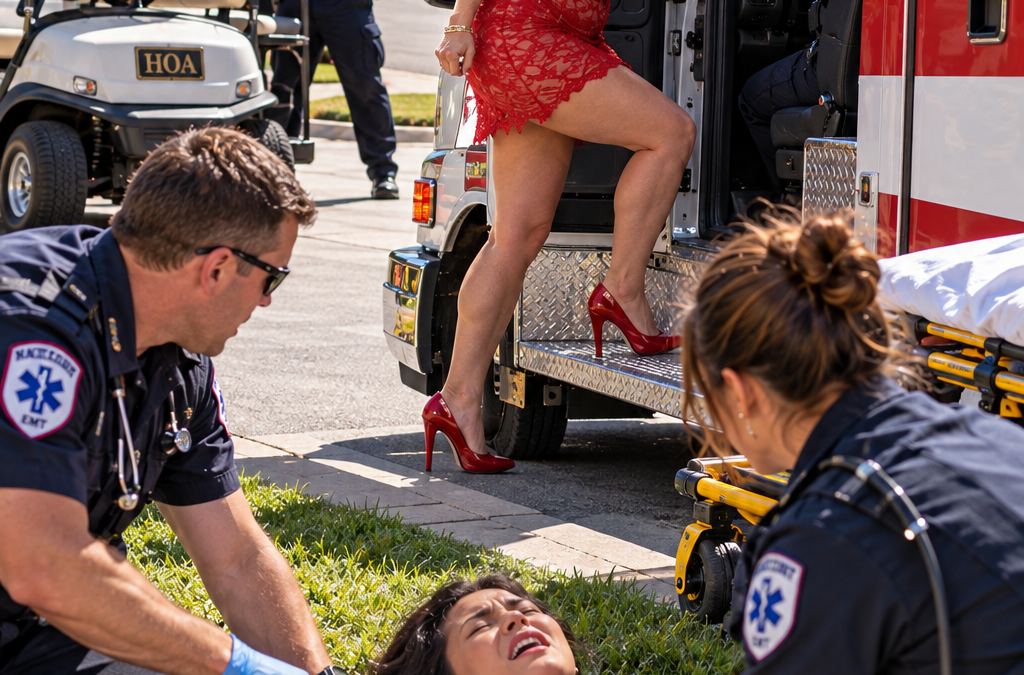
At the entrance to the access lane, Karen Whitfield had parked her golf cart directly in the ambulance’s path.
She was wearing her red lace dress and holding up one hand like a crossing guard.
Her other hand held her phone.
She was filming.
I heard the ambulance driver shout something.
Karen shouted back.
“This is HOA-controlled property!”
Beth stared toward the entrance.
“No,” she whispered.
Then louder.
“No, no, no.”
She stood and waved both arms.
“Over here! Please! She’s over here!”
The ambulance doors opened.
Two paramedics stepped out.
The lead paramedic was a woman named Priya.
She moved toward Karen with the brisk, controlled urgency of someone trained to make decisions under pressure.
“Ma’am, move the golf cart immediately. We have a medical emergency.”
Karen planted one hand on her hip.
“This is an unauthorized use of HOA-adjacent parking.”
Priya stared at her.
“What?”
“Emergency vehicles require temporary access authorization when using our restricted lane.”
“Ma’am, someone has called 911. Move your vehicle.”
“I’m the association president.”
“I don’t care who you are. We need access to our patient.”
Karen lifted her phone.
“I’m documenting this violation.”
Beth screamed from beside me.
“She’s having chest pain! Please hurry!”
Priya turned toward us.
I saw her expression change.
She understood.
“Move the cart now!” she ordered.
Karen stepped closer to the ambulance.
“Not until someone signs the proper temporary permit.”
For one terrible second, I thought I’d misheard her.
A permit.
She wanted a permit.
My heart was beating erratically.
My chest felt as though it were being crushed.
And Karen Whitfield was demanding paperwork.
I tried to inhale.
The pain deepened.
My vision began narrowing at the edges.
Beth dropped beside me again.
“Angel, stay with me.”
I could hear her speaking to dispatch.
“She’s getting worse. They’re right here, but some woman won’t let them through.”
The dispatcher was saying something I couldn’t understand.
Far away, Priya was shouting.
Karen shouted back.
Ninety seconds passed.
Then two minutes.
I remember thinking that time didn’t feel like time anymore.
Every second became a physical sensation.
A heartbeat.
A failed breath.
A flash of fear.
I looked at Beth.
Her eyes were wet.
“I’m scared,” I whispered.
She took my hand.
“I know. But they’re coming. They’re coming.”
Then Karen did something so reckless that even the paramedics seemed momentarily stunned.
While the crew was attempting to get past her obstruction, she climbed into the idling ambulance.
She intended to move it to what she considered a compliant parking location.
I heard an engine change pitch.
Someone yelled.
The ambulance lurched forward approximately six feet.
Beth screamed.
Priya’s partner rushed to the driver’s door, pulled it open, and dragged Karen out of the seat.
“Do not touch this vehicle!” he shouted.
Karen stumbled backward.
“Get your hands off me!”
“You cannot operate an emergency vehicle!”
“I’m the HOA president!”
Priya looked at her with disbelief.
“This is a medical emergency!”
Karen straightened her dress.
“Then you should have followed the community access procedures.”
I heard those words clearly.
Even now, years later, I remember how calmly she said them.
As though the ambulance were a delivery truck parked in the wrong place.
As though my life were a minor inconvenience.
Then the pain surged again.
The sky seemed to spin.
I remember Beth’s face leaning over mine.
I remember hearing footsteps.
A paramedic kneeling beside me.
A blood pressure cuff tightening.
A voice asking my name.
“Angel,” I managed.
“Angel, I’m Priya. We’re going to help you.”
I wanted to ask whether I was dying.
Instead, I whispered, “Please.”
Priya squeezed my hand.
“We’ve got you.”
They moved quickly after that.
The stretcher.
The monitor.
The oxygen.
The ambulance doors closing.
Everything blurred into fragmented images.
But one thought remained painfully clear.
Karen had cost us almost four minutes.
Four minutes during which trained professionals were standing within sight of me while a woman argued about parking permits.
I don’t remember much of the ambulance ride.
I remember Priya speaking into a radio.
I remember the monitor beeping.
I remember someone telling me to keep my eyes open.
And I remember being terrified that I would never see my bakery again.
Never sit on my porch swing.
Never water my tomatoes.
Never hear Beth complain about how much frosting I used.
All those small things I’d spent my life working to enjoy suddenly seemed impossibly precious.
At the hospital, doctors moved fast.
Tests.
Monitoring.
Medication.
Questions I struggled to answer.
Eventually, after hours that felt disconnected from reality, an emergency physician explained what had happened.
I’d suffered a severe stress-induced cardiac episode.
It wasn’t a full heart attack, but the strain on my cardiovascular system had been serious.
The doctor looked at me with an expression that made my stomach tighten.
“Angel, I’m going to be very clear with you.”
I nodded.
“The delay in receiving emergency care increased your risk substantially.”
I swallowed.
“How much?”
“With the condition you were experiencing, another few minutes could have made the outcome very different.”
I stared at him.
“Different how?”
He held my gaze.
“Potentially fatal.”
The room went quiet.
I looked down at the hospital blanket.
Four minutes.
Karen had turned four minutes of my life into an argument over a parking permit.
I felt tears running down my face before I realized I was crying.
The doctor handed me a tissue.
“You’re stable now. But you need rest, follow-up care, and to avoid unnecessary stress while you recover.”
I almost laughed at that last instruction.
Avoid stress.
How?
I lived under the authority of a woman who had nearly prevented an ambulance from reaching me.
I took a breath.
“Doctor, could you document what you just told me?”
He nodded.
“Of course.”
“I mean the medical risk. The delay.”
“We’ll include the relevant findings in your records.”
“Please make sure it’s clear.”
He studied me.
“Is there a reason you’re asking?”
I hesitated.
Then said, “Someone deliberately blocked the ambulance.”
His expression changed.
He glanced toward the chart.
“Then those records may be important.”
He was right.
I didn’t understand yet just how important.
Beth came to the hospital later that afternoon.
She looked exhausted.
Her eyes were swollen.
She hugged me carefully, avoiding the monitoring equipment.
“You scared the hell out of me.”
“I’m sorry.”
“Don’t you dare apologize.”
I smiled weakly.
She sat beside the bed.
For a few minutes, neither of us spoke.
Then I asked, “What happened after they took me?”
Beth’s expression darkened.
“The police came.”
“Karen?”
“Yes.”
“What did she say?”
“That the ambulance had been parked illegally.”
I closed my eyes.
“Of course she did.”
Beth leaned forward.
“Angel, I recorded it.”
I opened my eyes.
“What?”
“Almost all of it. I was on the phone with dispatch, and then I started recording because I couldn’t believe what she was doing.”
She showed me her phone.
I watched the video.
Karen standing beside her golf cart.
Priya demanding access.
Karen arguing.
The ambulance doors opening.
The moment Karen climbed into the driver’s seat.
The vehicle jumping forward.
The paramedic pulling her out.
I watched my coworker scream for help while I lay barely visible on the grass in the background.
My hands started trembling.
Beth stopped the playback.
“Hey. You don’t have to watch it.”
I shook my head.
“No. I needed to see.”
She put the phone down.
“Angel, she could have killed you.”
I stared at the blanket.
For weeks, I’d been telling myself Karen was just a bully.
An arrogant woman with too much authority.
Somebody who enjoyed writing fines and controlling appearances.
But what happened that morning wasn’t petty.
It wasn’t ridiculous.
It wasn’t merely annoying.
It had nearly cost me my life.
I looked at Beth.
“She can’t get away with this.”
Beth’s jaw tightened.
“No,” she said. “She can’t.”
By the following morning, the video had spread far beyond Maple Ridge.
Beth had shared it to document what happened, and the clip traveled through neighborhood groups, local pages, and social media.
More than two hundred thousand views.
The caption described an HOA president attempting to move an ambulance during a medical emergency.
My phone filled with notifications.
Strangers expressed outrage.
Some sent messages of support.
Others asked whether the woman in the video had been arrested.
Neighbors who had barely acknowledged me at board meetings suddenly wanted to know how I was feeling.
I had to turn my phone off.
I wasn’t ready to become a public story.
I was still lying in a hospital bed trying to understand how close I’d come to dying.
Then Marisol sent me a screenshot.
Karen had posted a statement in the Maple Ridge community Facebook group.
It claimed she had been protecting property standards and ensuring proper use of association-controlled access areas.
She described the circulating video as misleading.
Then she accused unnamed “drama seekers” of twisting an ordinary enforcement incident into a public controversy.
I read the statement twice.
Drama seekers.
I was the person lying on the grass struggling to breathe.
And Karen was portraying herself as the victim of an unfair publicity campaign.
I felt a wave of anger so intense that the monitor beside my bed seemed suddenly too loud.
I put the phone down.
The nurse came in a moment later.
“Everything okay?”
I looked at her.
“No.”
She glanced at the monitor.
“Try to stay calm.”
I almost laughed.
Karen had managed to raise my stress level from miles away.
Even after nearly killing me, she was still demanding control over the story.
Then the police report arrived.
The reported conduct was far more serious than an HOA disagreement.
Investigators were examining Karen’s unauthorized operation of the ambulance, possible attempted theft of an emergency vehicle, obstruction of emergency medical services, and reckless endangerment.
The potential charges included felonies.
I stared at the report.
For months, Karen had treated her HOA title as though it placed her above everyone else.
Now her actions were being evaluated by people who didn’t answer to her board.
I called Marisol.
“It’s time,” I said.
“For what?”
“Everything.”
She was quiet.
“The fines. The Hendersons. Ridgeline Holdings. All of it.”
“Angel—”
“I’m done pretending these are separate incidents.”
I looked at Beth’s video paused on my phone.
“She tried to move an ambulance while I was dying. I don’t want another person to find out what she’ll do when someone refuses to obey her.”
Marisol took a breath.
“Okay.”
“We need help.”
“I know an attorney. His name is Robert Chin. He handles HOA abuse and property disputes.”
“Call him.”
“I will.”
“And Marisol?”
“Yeah?”
“Tell him I kept everything.”
Robert Chin had the quiet, steady manner of someone who had spent years listening to people describe situations that sounded unbelievable until the documents landed on his desk.
He didn’t interrupt while I explained the HOA fines.
He didn’t laugh when I described the vegetable garden.
He didn’t roll his eyes when I mentioned the porch swing.
And when I reached the ambulance incident, he stopped taking notes.
“She actually got behind the wheel?”
Beth nodded from the chair beside me.
“I recorded it.”
Robert watched the full video without saying a word.
When the ambulance lurched forward, his expression changed.
He replayed that section.
Then he placed the phone carefully on his desk.
“Angel, this isn’t just a bad HOA president.”
I swallowed.
“What is it?”
He looked toward the folder I’d brought.
“This appears to be a pattern of financial predation, and now there’s a serious criminal incident connected to the same person.”
He opened the Ridgeline Holdings records.
“Who found these?”
“I did. After Doug told me about the Hendersons.”
Robert studied the ownership information.
“Interesting.”
I leaned forward.
“What does that mean?”
“It means we need to determine whether other properties followed a similar path.”
He explained that suspicious timing alone wouldn’t prove fraud.
A homeowner selling under financial distress wasn’t automatically evidence of criminal activity.
But repeated fines, questionable enforcement, and property acquisitions by a company connected to the HOA president could create a significant pattern.
Especially if the penalties were deliberately manufactured.
“And the ambulance?” I asked.
“That’s already beyond an HOA matter. We’re going to make sure investigators have Beth’s complete recording, the paramedics’ statements, and your medical documentation.”
For the first time since the hospital, I felt something besides fear.
Not victory.
Not even confidence.
Just the relief of hearing a professional describe Karen’s behavior as something that could be investigated rather than something I was expected to tolerate.
We submitted the evidence through the appropriate channels.
The police received Beth’s original video, witness information, and the emergency medical records documenting the nearly four-minute delay.
Robert began preparing the civil case.
Marisol organized my HOA documents into a detailed timeline.
And Karen, apparently convinced she could still talk her way out of everything, doubled down publicly.
She claimed the ambulance had been parked improperly.
She insisted she had merely enforced community guidelines.
She repeated that emergency vehicles should respect community access rules.
A local television station requested an interview.
Karen agreed.
I watched the broadcast from my living room, wrapped in a blanket, still recovering from the cardiac episode.
The reporter stood beside her near the Maple Ridge clubhouse.
Karen wore her familiar red lace dress, her hair perfectly styled and her makeup carefully applied. She smiled directly into the camera as though the interview were an opportunity to promote her leadership.
“I have every right to regulate vehicle access in this community,” she declared.
The reporter asked whether that authority extended to emergency medical vehicles responding to a life-threatening call.
Karen lifted her chin.
“Rules exist for a reason.”
“Even when a patient is experiencing cardiac distress?”
“The community cannot function if everyone decides their personal circumstances exempt them from established procedures.”
I sat forward.
Personal circumstances.
She was talking about my failing heart as though it were an inconvenient excuse for parking illegally.
The reporter pressed further.
“Do you regret delaying the ambulance?”
Karen hesitated.
Then said, “I regret that certain individuals have turned a routine enforcement matter into an attack on my reputation.”
I turned off the television.
I couldn’t listen anymore.
The interview spread almost as quickly as Beth’s video.
People weren’t merely angry that Karen had obstructed an ambulance.
They were stunned that she still appeared to believe she was right.
I received more messages from strangers than I could read.
But the messages that mattered most came from Maple Ridge residents.
At the next HOA meeting, three homeowners approached me after most people had left.
One was an older woman who kept glancing toward the clubhouse door.
“We have fine records too,” she whispered.
Another nodded.
“We’ve wanted to challenge her for years.”
“Then why didn’t you?” I asked gently.
The first woman looked embarrassed.
“Because we watched what happened to people who did.”
The third homeowner held a folded envelope.
“She threatened my family with collection proceedings after we questioned a landscaping charge.”
I looked at the envelope.
“Do you still have the letters?”
She nodded.
“All of them.”
I gave her Robert’s contact information.
“Please talk to him.”
She looked uncertain.
“Will it actually help?”
I thought about my hospital bed.
About Priya fighting to reach me.
About Karen sitting behind the ambulance wheel.
“I don’t know exactly what happens next,” I said. “But I know we’re not dealing with this alone anymore.”
Doug approached me afterward carrying a thick manila envelope.
He didn’t smile.
“Figured it was time.”
I took it.
“What’s this?”
“My fine history.”
I opened the envelope.
There were years of violation notices.
Grass measurements.
Mailbox angles.
Decorative restrictions.
Late fees.
Administrative penalties.
Six years of paperwork.
Almost nine thousand dollars.
I stared at the total.
“Doug.”
He shrugged.
“That’s what keeping your head down cost me.”
“Why didn’t you tell anyone?”
He looked tired.
“Who was going to listen?”
I wanted to answer.
But I couldn’t.
Because four months earlier, I might not have listened either.
I might have told him the same thing I’d once told myself.
Pay the fines.
Avoid trouble.
Move on.
Robert reviewed Doug’s records and the additional homeowner complaints.
The pattern was expanding.
My experience wasn’t an isolated disagreement.
It was one part of a long series of enforcement actions that appeared concentrated on people Karen disliked or considered vulnerable.
Robert explained that the evidence strengthened the possibility of a larger civil action on behalf of affected homeowners.
Not just over individual fines.
Over selective enforcement, financial harm, abuse of authority, and potentially coordinated property acquisitions.
Karen sensed the shift.
Her next Facebook post was no longer confident.
It was wounded.
She described the stress of thankless community service.
She claimed people didn’t understand the sacrifices required to maintain property values.
She complained that volunteers were constantly attacked by selfish homeowners.
I read it twice.
Then looked at the hospital discharge papers beside my computer.
She was asking for sympathy because people had criticized her.
I had spent days being medically monitored after she blocked an ambulance.
And she wanted the neighborhood to feel sorry for her.
That same week, the board attempted to hold an emergency session about the controversy.
Half the members didn’t show up.
The empty chairs were almost more revealing than the meeting itself.
People who had once supported Karen automatically were beginning to calculate what continued loyalty might cost them.
Then Sandra called me.
She was a board member I’d seen at several meetings, usually sitting quietly while Karen dominated the discussion.
“I’d like to speak privately,” she said.
We met at my house the following afternoon.
Sandra sat on the edge of the couch, twisting her hands together.
“I should have said something years ago.”
I waited.
“I knew she was targeting people.”
“Why didn’t you stop her?”
Sandra looked at me.
“Because she threatened my family.”
She explained that her husband owned a small business.
After Sandra questioned an HOA decision, Karen had reported his company to the city over a technical permit issue.
The resulting inspection had caused delays, expenses, and considerable stress.
“Was there a violation?” I asked.
“A minor paperwork issue that was corrected. But that wasn’t the point.”
“What was the point?”
Sandra looked directly at me.
“She wanted me to understand that she could reach outside the HOA.”
I felt my stomach tighten.
Karen hadn’t merely used association fines against people.
She had apparently weaponized outside agencies when the HOA’s authority wasn’t enough.
“Do you have documentation?” I asked.
Sandra nodded.
“I kept the notices.”
I handed her Robert’s number.
“Then please call him.”
She hesitated.
“Do you think she can still hurt us?”
I thought about how little I trusted Karen’s judgment.
“Yes,” I said. “But I think she’s a lot more dangerous when everyone stays silent.”
Sandra lowered her eyes.
Then nodded.
Robert submitted a formal request for the association’s financial and legal records.
This time, the request came from an attorney prepared to enforce it.
Karen immediately hired counsel.
Her lawyer argued that many of the requested materials were proprietary board documents and shouldn’t be released to ordinary residents.
Robert challenged that position.
The dispute reached a judge.
Within a week, the court rejected the attempt to shield financial information homeowners were legally entitled to inspect.
I remember Robert calling afterward.
“The association has been ordered to produce the records.”
“All of them?”
“The responsive records covered by the order.”
“Do you think Karen will cooperate?”
“She may not have much choice.”
The documents began arriving in boxes.
Literal cardboard boxes.
Bank statements.
Invoices.
Legal bills.
Board correspondence.
Property files.
Handwritten notes.
Karen had insisted for years that Maple Ridge kept extensive paper records for security reasons.
Now those records were sitting on my kitchen table.
Marisol came over after work.
We ordered takeout, opened our laptops, and began sorting.
The first night, we organized documents by date.
The second, we compared fine schedules with collection records.
By the third, we were exhausted.
Highlighters lay scattered beside cold coffee mugs.
My eyes burned.
Marisol rubbed her forehead.
“Angel, look at this.”
She had opened a spreadsheet listing properties associated with repeated enforcement actions.
Several addresses were highlighted.
The Henderson house was one of them.
I leaned closer.
“What am I looking at?”
“Look at the dates.”
The records showed escalating fines against certain homeowners shortly before their properties were listed or sold under financial pressure.
Marisol opened another file.
“Now look at the buyers.”
Ridgeline Holdings LLC.
I felt my pulse quicken.
Another property.
Same company.
Then another.
Then a fourth.
Four families.
Four homes that changed hands after periods of aggressive HOA enforcement.
All four properties ultimately connected to Ridgeline Holdings.
I sat back.
For several seconds, I couldn’t speak.
The Hendersons hadn’t been an isolated case.
They were part of a pattern spanning approximately five years.
The files suggested Karen had repeatedly used association penalties to make financially vulnerable homeowners desperate enough to sell.
Then a company connected to her acquired their properties at reduced prices.
I thought about the twenty-five-dollar mailbox fine.
The garden citation.
The porch swing.
The repeated inspections.
What if those weren’t merely punishments?
What if they were the first steps in a process designed to break people financially?
I looked at Marisol.
“She was trying to do this to me.”
Marisol didn’t answer immediately.
Then she said, “We need Robert to review everything before we decide exactly what it proves.”
I pointed toward the spreadsheet.
“But look at it.”
“I see it.”
“Four families.”
“I know.”
My voice started shaking.
“Four families lost their homes.”
Marisol reached across the table and held my hand.
“Angel, this is why you kept the records.”
I looked around my kitchen.
Boxes everywhere.
Stacks of fines.
Proof of years of financial pressure.
And I realized that the story Karen had told about herself was beginning to collapse.
She hadn’t built her authority simply because she loved tidy lawns.
She’d built a system that could turn ordinary homeowners into desperate sellers.
Robert examined the documents the next morning.
His expression grew darker with every page.
Finally, he looked up.
“Angel, this is no longer just a civil HOA dispute.”
“What do you think it is?”
“Potential organized fraud involving property acquisitions and selective enforcement.”
I stared at him.
“Can we prove it?”
“We have a substantial pattern. Now investigators need to verify ownership, intent, and the financial connections.”
He closed the file.
“It’s time to take everything to the district attorney.”
We delivered the evidence in organized folders.
The ambulance video.
The medical records.
The paramedics’ statements.
The individual fine histories.
The board correspondence.
The shell company records.
The four property transfers.
Robert explained the suspected connection between enforcement pressure and acquisition timing.
The detective assigned to the case was Officer Reyes.
She smiled when we introduced ourselves.
“No relation, I assume?”
I managed a small laugh.
“Not unless our family tree has a very surprising branch.”
The joke lasted only a moment.
Then she opened the documents and became serious.
She asked precise questions.
Who had verified the property transfers?
Which records were originals?
Had the homeowners been contacted?
Could the association demonstrate that the fines were valid?
Were there communications linking Karen to the purchases?
Robert answered what he could.
Marisol identified the sources.
I explained the enforcement history and the ambulance incident.
Officer Reyes made notes.
Then she said, “Give us two weeks.”
“Two weeks?” I repeated.
“We need to verify the company’s ownership and interview the affected families before taking the next step.”
I understood.
But two weeks felt impossibly long.
Karen was still in Maple Ridge.
Still posting accusations.
Still capable of issuing fines.
Still convinced she’d done nothing wrong.
I returned to the bakery.
I kept working.
The routine helped.
Flour.
Butter.
Sugar.
Oven temperatures.
Wedding orders.
Customers who wanted birthday cakes and didn’t know anything about HOA fraud.
For a few hours every day, I could focus on something that made sense.
A recipe either worked or it didn’t.
If I made a mistake, I corrected it.
There were no imaginary committees deciding that chocolate frosting had suddenly become a violation of community character.
Beth noticed I was sleeping better.
“You’re not checking your phone every five minutes.”
“Only every ten.”
She laughed.
“Progress.”
Then another fine arrived.
Karen accused me of creating excessive pedestrian traffic on the sidewalk outside the bakery.
Apparently, people had been stopping by to express support after seeing the news coverage.
Now their presence was a community disturbance.
I read the notice standing beside the pastry case.
Then I laughed so hard Beth came running from the kitchen.
“What happened?”
I handed her the paper.
She read it.
Then looked at me.
“She fined you because people are walking?”
“Apparently.”
Beth shook her head.
“She’s losing it.”
I thought about Karen’s increasingly angry Facebook posts.
The missed board meeting.
The financial records now in investigators’ hands.
“Yes,” I said. “And desperate people make mistakes.”
The following Monday, Karen attempted to resign as HOA president.
Her statement cited personal health concerns.
It was brief, vague, and strangely polite.
Robert wasn’t impressed.
“Resigning doesn’t erase criminal liability,” he told me.
“Do you think she’s trying to escape the investigation?”
“I think she understands her position has become dangerous.”
The remaining board members surprised everyone.
Instead of allowing Karen to quietly disappear from leadership before the financial review concluded, they insisted that her resignation be handled through the ongoing internal investigation and proper procedures.
Sandra was appointed acting president.
Her first major action was authorizing full cooperation with law enforcement.
For the first time in years, the association’s records were being made available without Karen deciding what everyone was allowed to see.
Karen responded online with furious accusations.
She claimed disgruntled rule breakers had coordinated a smear campaign against her.
She insisted that the entire investigation was punishment for enforcing community standards.
She accused neighbors of betrayal.
The posts were saved.
Screenshots entered the investigative file.
Karen seemed unable to understand that every angry public statement could create additional evidence of how she treated the people she claimed to serve.
Then Officer Reyes called.
I was closing the bakery when my phone rang.
“Angel, this is Detective Reyes.”
I stopped moving.
“Yes?”
“We’ve confirmed the connection between Ridgeline Holdings and four separate victim families.”
I gripped the counter.
“All four?”
“Yes.”
“What happens now?”
“We’re moving forward with the evidence for charging decisions.”
I closed my eyes.
For months, I’d imagined that Karen would eventually be forced to answer questions she couldn’t dismiss.
Now that possibility was becoming real.
The ambulance incident resulted in formal criminal charges.
Attempted grand theft involving the emergency vehicle.
Obstruction of emergency medical services.
Reckless endangerment.
Separately, the district attorney’s fraud unit opened a formal investigation into the Ridgeline Holdings property acquisitions and their connection to selective HOA enforcement.
Karen’s attorney insisted the allegations were baseless.
Karen herself appeared at another board meeting, even though Sandra was now leading the association.
The room was crowded.
She arrived wearing the same red lace dress and carrying a folder of prepared statements.
Her expression was rigid.
She demanded an opportunity to address the accusations.
Sandra remained calm.
Then she read the filed criminal charges aloud.
One by one.
The room went silent.
Karen stared at her.
“Those are allegations.”
Sandra nodded.
“Yes. And the association is obligated to cooperate with the proceedings.”
“You are destroying my reputation!”
Sandra looked up.
“No, Karen. We’re reviewing what happened under your leadership.”
Someone at the back let out a disbelieving laugh.
I think it was Doug.
Karen turned toward the audience.
“None of you understand what I’ve sacrificed for this community!”
Her voice cracked on the word sacrificed.
I looked at the neighbors around me.
Some had been fined into debt.
Some had been frightened into silence.
Four families had lost their homes.
And Karen was talking about her sacrifice.
It was almost unbearable.
But the investigation revealed one more detail that complicated my understanding of her.
Marisol found an old foreclosure record from another state.
Years before Karen moved to Maple Ridge, she had lost a home of her own.
When Marisol showed me the document, I stared at it for a long time.
“So she knew what it felt like.”
Marisol nodded.
“Apparently.”
I thought about the Hendersons.
About Doug’s nine thousand dollars in fines.
About the other families.
Karen knew the fear of losing a house.
She knew what foreclosure notices did to a person’s sleep, finances, and sense of security.
And instead of developing compassion, she’d apparently built a system that exploited that same fear in others.
I couldn’t know every thought that motivated her.
But the pattern suggested a ruthless determination never to be financially powerless again.
She had found a way to make other people’s vulnerability profitable.
Understanding that history didn’t make me pity her.
It made her choices harder to forgive.
Her attorney attempted to have the ambulance charges dismissed.
The argument was that the four-minute delay had caused no permanent injury and that Karen had acted from a mistaken belief about the access lane.
My cardiologist submitted a sworn statement.
It described the medical risk created by delayed treatment during severe cardiac distress.
The statement was clinical.
Measured.
Unambiguous.
It explained that the absence of permanent injury did not mean the delay had been harmless.
The judge denied the motion.
The charges remained.
Robert then filed the civil action on behalf of affected residents, including Doug, Sandra’s husband, the four displaced families, and me.
The claims sought compensation for selective enforcement, fraud, financial damage, emotional distress, and the harm directly connected to my medical emergency.
The local news covered the developing case again.
This time, the reporter interviewed the Hendersons.
They had moved two states away.
They were still paying debts left over from losing their house.
I watched the interview at home.
Mrs. Henderson sat beside her husband, holding a tissue.
Her voice trembled.
“We thought it was our fault.”
She looked down.
“We thought we just weren’t good enough homeowners.”
I felt my chest tighten.
She continued.
“We kept trying to fix whatever they said was wrong. But every time we fixed something, another letter came.”
Her husband put an arm around her.
“We didn’t understand why it never stopped.”
I had to pause the video.
I knew that feeling.
The exhaustion of trying to comply with rules that kept changing.
The shame of wondering whether you were somehow failing at something as basic as owning a home.
The loneliness of watching neighbors stay silent because they were afraid of becoming the next target.
Mrs. Henderson hadn’t merely lost a house.
She had lost confidence in herself.
Karen’s scheme had made decent people believe they deserved what was happening to them.
I sat there staring at the paused screen.
Then I made myself a promise.
If this reached court, I wanted Karen to hear exactly what she’d done.
Not from a Facebook post.
Not from a reporter.
From the people who had lived through it.
The next major breakthrough came during discovery in the civil case.
Internal correspondence revealed communications between Karen and a real estate agent regarding properties targeted for potential acquisition.
One email discussed increasing inspection frequency on a particular street to accelerate “listing readiness” for two households.
I read the phrase several times.
Listing readiness.
Such clean, professional language.
As though forcing a family toward financial distress were simply another business strategy.
Robert placed the email beside the relevant fine schedules.
The dates aligned.
Increased inspections.
Additional penalties.
Financial pressure.
Then property listings.
The pattern was no longer supported only by circumstantial timing.
There was written communication suggesting deliberate coordination.
When I saw the email, I felt sick.
I thought about the garden citation.
The swing.
The hose.
The welcome mat.
If Karen had succeeded in making my bakery financially unstable, how long would it have taken before she offered me an opportunity to sell?
How long before Ridgeline Holdings appeared with a cash offer framed as a way out of the trouble she had helped create?
I didn’t know.
But I was grateful I’d never had to find out.
Karen’s defense began pursuing a plea agreement as the evidence accumulated.
The prosecutors insisted that any meaningful resolution address accountability, the victim families, restitution, and a truthful acknowledgment of the scheme.
Karen refused to admit wrongdoing.
She told her attorney she’d rather fight the allegations before a jury than confess to something she insisted she hadn’t done.
I remember Robert telling me.
“She’s going to trial.”
I looked at him.
“After all this?”
“Yes.”
“Does she really believe she can explain the ambulance video?”
“That’s what her defense will attempt.”
“And the property records?”
“They’ll have to address those too.”
I looked down at my hands.
Part of me wished she would accept responsibility.
Not because I wanted to make things easier for her.
Because a full trial meant reliving everything.
My medical emergency.
The ambulance.
The fear.
The Hendersons’ losses.
The months of intimidation.
I had spent so long fighting to be heard that I hadn’t considered how painful it might be when everyone finally listened.
The trial was scheduled approximately eight weeks later.
Meanwhile, Maple Ridge held a special election.
Sandra ran unopposed and became the new board president.
Her first official priority was restructuring the enforcement system.
The fine schedule was rewritten.
An independent appeals board was created with rotating, randomly selected members.
Board members could no longer treat routine complaints as opportunities to punish personal enemies.
Residents received clearer explanations of their rights.
And the existing rules were reviewed to identify penalties that had never been properly authorized.
My garden was declared compliant.
My porch swing was compliant.
My mailbox was compliant.
Every disputed feature Karen had used against me was reviewed.
None of them had justified the punishment she’d imposed.
I stood beside my garden after receiving the decision.
Sixty square feet.
Tomatoes.
Basil.
Peppers.
The same plants I’d grown from the beginning.
It had taken a criminal case and a major financial investigation to establish what the bylaws had already said.
I didn’t know whether to laugh or cry.
So I watered the tomatoes.
The bakery became my refuge during the weeks before trial.
I baked bread before sunrise.
Decorated birthday cakes.
Filled pastry boxes.
Talked to customers about ordinary things.
Beth joked that we should create a cake flavor called The Ambulance Chaser.
I stared at her.
Then burst out laughing.
“Absolutely not.”
“It could be a bestseller.”
“Beth.”
“Maybe red velvet?”
I threw a clean dish towel at her.
We laughed for several minutes.
We never made the cake.
But the joke reminded me that I could still laugh.
Doug started a tradition of bringing mailbox-shaped cookies from my bakery to board meetings.
He would present one to whoever was presiding.
“Officially approved mailbox,” he’d announce.
Sandra would roll her eyes.
The room would laugh.
It was silly.
But after years of fear, silliness felt like freedom.
Two weeks before trial, Karen made one final attempt to silence me.
She filed a defamation countersuit over the viral ambulance video.
The accusation was that the recording and public discussion had damaged her reputation.
Robert read the filing in his office.
Then slowly removed his glasses.
“Unbelievable.”
I felt panic rising.
“Can she do this?”
“She can file a complaint. That doesn’t mean she has a valid claim.”
“What if she wins?”
He looked at me.
“Angel, we have the unedited video, witness statements, and the paramedics’ testimony. Truth is a complete defense to the factual allegations she’s challenging.”
I rubbed my forehead.
“She just won’t stop.”
“No,” Robert said. “But this attempt can be answered.”
The countersuit was dismissed within nine days.
The judge specifically noted the apparent bad-faith character of the filing.
When Robert told me, I sat quietly for a moment.
Then asked, “Is that really the last one?”
He gave me a tired smile.
“I can’t promise she’ll stop trying. But this one is over.”
I went home and placed the dismissal beside the original mailbox citation.
The folder was enormous now.
Sometimes I wondered whether I’d ever be able to close it for good.
The criminal trial began on a gray Tuesday morning.
Rain hung low over the courthouse.
I arrived with Beth on one side and Marisol on the other.
My hands were cold despite the warm building.
I had seen Karen at board meetings.
On my driveway.
Outside my bakery.
On television.
But seeing her seated in a courtroom felt different.
There was no clipboard in her hand.
No HOA seal behind her.
No loyal committee waiting to agree.
She wore a conservative jacket over the familiar red lace dress, as though she couldn’t quite surrender the appearance that had become part of her identity.
Her hair was carefully styled.
Her expression was controlled.
But when she glanced toward me, I noticed something I’d never seen before.
Uncertainty.
The prosecution opened with Beth’s video.
Full length.
Unedited.
The courtroom lights dimmed.
The recording filled the screen.
I saw myself on the grass.
Saw Beth kneeling beside me.
Heard the dispatcher through her phone.
Heard Karen arguing about authorization.
Then the ambulance lurched forward.
Six feet.
The movement seemed more violent on the courtroom screen than it had on Beth’s phone.
Someone in the gallery inhaled sharply.
I gripped the edge of my seat.
My chest felt tight again.
For an instant, I was back on the grass.
Unable to breathe.
Unable to understand why help had stopped so close to me.
Beth touched my hand.
“I’m here,” she whispered.
I nodded.
But I couldn’t look away.
The video ended.
The silence afterward was almost unbearable.
Priya, the lead paramedic, testified next.
She described receiving the emergency call, approaching the access lane, and encountering Karen’s golf cart.
She explained the medical urgency.
The symptoms reported by dispatch.
The need to reach the patient immediately.
Then the obstruction.
The demands for a permit.
The argument.
Karen entering the ambulance.
The vehicle moving.
“How significant was the delay?” the prosecutor asked.
Priya looked toward the jury.
“In a cardiac emergency, minutes are not just numbers.”
She paused.
“They can mean the difference between recovery and tragedy.”
My eyes filled.
She continued describing the incident in the steady voice of someone who had spent years working under pressure.
But when she reached the moment Karen took the driver’s seat, her expression hardened.
“An emergency vehicle is not something a civilian can decide to reposition because of a parking disagreement.”
The prosecutor asked whether Karen’s claim of HOA authority had changed the medical necessity of reaching me.
“No,” Priya said firmly.
“Did the patient require immediate attention?”
“Yes.”
“Did the defendant’s actions interfere with your ability to provide that attention?”
“Yes.”
There was no hesitation.
My cardiologist testified afterward.
He explained the severe stress-induced cardiac episode and the dangers of prolonged untreated cardiac distress.
He did not exaggerate.
He did not claim I’d suffered a full heart attack.
He explained the actual diagnosis, the medical findings, and the increased risk created by delayed treatment.
The defense tried to minimize the delay.
Four minutes, they suggested, was relatively brief.
No permanent cardiac damage had been established.
The doctor remained calm.
“A favorable eventual outcome does not mean the preceding delay was safe.”
I watched one juror write that down.
Karen’s attorney attempted to argue that she had misunderstood the jurisdiction over the shared loading area.
She believed, the defense said, that the ambulance was improperly using restricted HOA property.
The argument seemed almost reasonable when presented in abstract language.
A dispute over access.
Confusion about boundaries.
An overzealous volunteer misunderstanding her authority.
Then the prosecutor returned to the video.
Karen wasn’t merely confused.
She had been told repeatedly that a patient needed emergency care.
She had been asked to move.
She had been warned.
And she had chosen to obstruct the ambulance anyway.
The distinction mattered.
A mistake can be corrected.
Karen had been given repeated opportunities to correct hers.
Instead, she escalated.
When she testified, she tried to present herself as a dedicated community volunteer unfairly punished for doing her job.
She spoke about property values.
Community standards.
Responsibility.
The importance of consistent enforcement.
Then came the question that had haunted me since the hospital.
“Did you believe your authority over a parking area superseded a paramedic’s judgment during a medical emergency?”
Karen hesitated.
I watched her face.
For one brief moment, I thought she might finally admit she’d been wrong.
She could have said she’d panicked.
That she’d made a terrible mistake.
That she was sorry.
Instead, she lifted her chin.
“I believe the rules needed to be followed.”
My stomach dropped.
Even now.
Even under oath.
Even after seeing the video of me lying on the ground struggling to breathe.
She still couldn’t say that saving a life mattered more than her parking rules.
I looked toward Beth.
Her eyes were full of tears.
Marisol’s jaw was clenched.
Karen’s answer settled over the courtroom like something heavy and poisonous.
Not a single word of regret.
The proceedings also examined the broader evidence surrounding Karen’s conduct, including the property-acquisition scheme under investigation.
The Ridgeline Holdings documents were presented property by property.
The fine histories were compared.
The acquisition dates were examined.
The correspondence about increasing inspections to accelerate listing readiness was read aloud.
I watched two jurors exchange startled looks.
The language was chilling because it was so ordinary.
Inspection frequency.
Listing readiness.
Property opportunities.
Terms that made the deliberate pressure placed on families sound like routine business planning.
Mrs. Henderson testified by video link.
She looked older than in the photographs I’d seen from her years at Maple Ridge.
Her husband sat beside her.
When she began speaking, her voice was steady.
Then she described the final months in their house.
The repeated fines.
The letters.
The collection notices.
The fear.
“I called the HOA office eleven times,” she said.
Her voice broke.
“Eleven times, and nobody would explain what we were supposed to do differently.”
She wiped her face.
“We kept trying. We really did.”
The prosecutor asked what the financial pressure had meant for her family.
She looked downward.
“We were afraid all the time.”
A long silence followed.
Then she whispered, “We thought it was our fault.”
I began crying.
Quietly.
I couldn’t help it.
Mrs. Henderson had been living with that shame for years.
Karen had taken something much larger than money from her.
She had made her believe she’d failed to protect her family.
I looked at Karen.
She sat nearly motionless beside her attorney.
Her face revealed little.
And for the first time, I wondered whether she truly understood the difference between exercising power and inflicting harm.
On the fourth day, Karen testified again against the obvious discomfort of her defense team.
She returned to the same arguments.
She had protected community standards.
She had worked hard.
She had made difficult decisions.
Homeowners were often unreasonable.
People misunderstood her intentions.
The prosecutor pressed her about the property acquisitions.
“Did increasing property values for the community ever financially benefit you personally?”
Karen remained silent.
I watched the clock.
The pause stretched.
Five seconds.
Seven.
Nearly ten.
Then she answered.
“Not directly.”
The records told a different story.
Ridgeline Holdings.
Four acquired properties.
The registered connections.
The correspondence.
The timing.
Her answer hung in the air as the prosecution returned to the documents.
And I understood something.
Karen wasn’t unable to admit the truth because the evidence was confusing.
She was refusing because the truth required her to see herself as something other than the victim.
She would rather contradict a paper trail than surrender the belief that she had been entitled to everything she’d done.
Closing arguments occupied much of the fifth day.
I listened to the defense describe misunderstandings, volunteer responsibilities, and the absence of permanent medical injury.
Then the prosecutor spoke about choices.
Karen had been warned.
She had been told a patient needed help.
She had witnessed the urgency.
She had chosen to put her interpretation of property rules above emergency care.
And the evidence of her broader conduct showed a willingness to use authority against people who lacked the resources to challenge her.
The prosecutor ended with a sentence I will never forget.
“She didn’t just break rules. She broke people.”
The jury began deliberating.
Six hours passed.
I barely remember them.
We sat.
Walked.
Bought coffee nobody drank.
Beth tried to make conversation.
Doug sent a message asking for updates.
Marisol stayed beside me.
At one point, I went into the courthouse restroom and stared at myself in the mirror.
I looked exhausted.
Older than thirty-four.
I thought about the woman I’d been six months earlier.
The woman who thought paying a twenty-five-dollar mailbox fine was the sensible way to preserve peace.
That woman couldn’t have imagined this courtroom.
These charges.
The property records.
The families who had lost their homes.
Or the ambulance video that had turned her medical emergency into evidence.
I washed my hands.
Took a breath.
And returned to the gallery.
When the jury came back, Beth grabbed my hand.
The verdict was read.
Guilty.
Attempted grand theft of an emergency vehicle.
Guilty.
Obstruction of emergency medical services.
Guilty.
Reckless endangerment.
I heard the words.
But it took several seconds for them to become real.
Beth’s fingers tightened around mine.
Marisol lowered her head.
I looked toward Karen.
For once, she didn’t interrupt.
Didn’t argue.
Didn’t announce that she was the HOA president.
She sat in silence while the court recorded the jury’s decision.
There were no cheers.
No applause.
Nothing theatrical.
Just a collective exhale from people who had been holding their breath for months.
I thought I’d feel triumphant.
Instead, I felt exhausted.
And deeply, almost painfully relieved.
Three weeks later, Karen was sentenced to eighteen months.
The judgment included mandatory restitution and a lifetime prohibition on serving on an HOA board in the state.
The judge emphasized the calculated and unrepentant nature of her conduct, particularly the decision to interfere with emergency medical care despite repeated warnings.
I listened without smiling.
A prison sentence couldn’t give me back the four minutes I’d spent terrified on the grass.
It couldn’t erase the sleepless nights or the fear that lingered whenever I heard a siren.
But it meant Karen could no longer hide behind her title.
Her actions had consequences beyond a neighborhood meeting.
And for the first time, those consequences were enforceable by people she couldn’t intimidate.
The civil case moved toward settlement shortly afterward.
Assets connected to Ridgeline Holdings, including the four properties, were placed into a court-ordered restitution arrangement.
The proceeds and recovered funds helped compensate the displaced families for their financial losses.
The Hendersons received restitution covering the harm they had suffered.
Other affected homeowners obtained relief through the settlement process.
I received compensation for medical expenses, lost wages, and the emotional toll directly connected to the ambulance incident.
The financial recovery mattered.
My bakery had suffered while I was hospitalized.
The legal battle had drained money and attention from the business.
I needed that stability back.
But the settlement check didn’t feel like the most important part.
The most important part was knowing Karen’s acquisition scheme had been stopped.
Ridgeline Holdings was dismantled.
The four properties were no longer part of the system she’d used to profit from homeowners in distress.
And the families she’d targeted could begin rebuilding without wondering when another letter would arrive.
At the next Maple Ridge meeting, Sandra handed out the new appeal policy.
One page.
Clear language.
Specific procedures.
Independent review.
Documented decisions.
A prohibition against retaliatory enforcement.
No mysterious interpretations of unwritten standards.
No private penalties issued because somebody had offended the president.
Doug accepted his copy, studied it, and smiled.
Then he placed a mailbox-shaped cookie on the table.
“Official board business,” he announced.
Sandra laughed.
“For once, Doug, I’m not even going to ask.”
The room laughed with her.
It was a small sound.
But it mattered.
For years, people had attended those meetings afraid of saying the wrong thing.
Now they were laughing together.
Maple Ridge was starting to feel like a neighborhood again.
The vegetable garden remained exactly where it had always been.
Sixty square feet.
Tomatoes.
Basil.
One pepper plant that produced far more than I could use.
My porch swing still hung from its original chains.
Nobody called it visual clutter.
Nobody inspected the mailbox at dawn.
Nobody measured my garden with a ruler while pretending to protect community character.
And nobody fined Doug for bringing cookies.
A few months later, Priya stopped by the bakery.
She wasn’t in uniform.
She ordered coffee and a cinnamon pastry.
I recognized her immediately.
For a moment, I couldn’t speak.
Then I came around the counter and hugged her.
“Thank you,” I whispered.
She hugged me back.
“You’re welcome.”
We sat at a small table near the window.
She told me the case had prompted broader discussions within emergency medical services about access procedures and how crews should respond when private-property representatives obstruct emergency vehicles.
Her department had pushed for clearer protocols, and the discussion had reached agencies beyond our area.
“Something good came out of it,” she said.
I looked down at my coffee.
“I wish it hadn’t taken what happened to me.”
“So do I.”
She paused.
“How are you feeling?”
“Better.”
“Really?”
I considered lying.
Then shook my head.
“Physically, much better. But sometimes I still hear the siren stop.”
Priya nodded.
“That kind of fear can stay with you.”
“I keep thinking about those four minutes.”
She looked at me gently.
“Then remember what happened after them too.”
I raised my eyes.
“You got care. You recovered. You helped stop someone who was hurting people.”
I swallowed.
“I didn’t do it alone.”
“No,” she said. “You didn’t.”
After she left, I stood behind the counter for a long time.
I thought about the paramedics.
Beth.
Marisol.
Robert.
Doug.
Sandra.
Officer Reyes.
The Hendersons.
All the people who had stepped forward when it would have been easier to remain silent.
Karen had maintained her power by isolating people.
The thing that finally defeated her was those people finding one another.
Sandra later asked me to join the new independent appeals board.
My first reaction was to laugh.
“After everything I’ve been through, you want me to spend more time dealing with HOA fines?”
She smiled.
“Exactly.”
I considered it.
Then agreed on one condition.
“No fine should ever feel personal.”
Sandra held out her hand.
“Agreed.”
We worked on making the rules understandable.
Plain English.
Clear standards.
Actual opportunities to correct minor issues.
Independent review when disputes occurred.
I wasn’t interested in creating a different group of people with the power to intimidate homeowners.
I wanted the association to become something I could trust even when I disagreed with its decisions.
The Hendersons visited Maple Ridge once after the settlement.
They had traveled from two states away.
I met them outside their former house.
They stood on the sidewalk looking at the windows, the porch, and the front lawn.
Mrs. Henderson held her husband’s hand.
For several minutes, nobody spoke.
Then she looked at me.
“We didn’t want to go inside.”
“You don’t have to.”
She nodded.
“We just wanted to see it.”
I waited.
She looked toward the house one last time.
“To see that it stopped.”
I understood.
They weren’t there to reclaim the building.
They wanted proof that the system that had taken it from them no longer existed.
I put my arm gently around her shoulders.
“It’s stopped.”
She closed her eyes.
Then nodded.
My bakery grew busier after the trial.
The publicity brought curious customers, including people who wanted to meet the woman from the ambulance video.
I found the attention strange.
I had never wanted to become famous for nearly dying.
But I tried to use the interest constructively.
When people asked about the HOA case, I talked about keeping records, requesting financial transparency, understanding homeowner rights, and recognizing when an authority figure was using procedures to intimidate rather than govern.
I didn’t want people to remember only the ambulance.
I wanted them to remember the years of smaller abuses that made the ambulance incident possible.
Because Karen hadn’t suddenly become dangerous that Tuesday morning.
She had spent years practicing the same behavior on a smaller scale.
She had learned that people backed down.
That fines worked.
That board members stayed quiet.
That paperwork could frighten families.
And when she faced an emergency she couldn’t control, she still believed everyone else had to obey her.
The reckless decision in the ambulance lane was the extreme expression of a habit the neighborhood had tolerated for years.
That realization changed how I understood the entire ordeal.
I used to think the biggest danger in Maple Ridge was Karen herself.
Now I understood that the silence around her had helped her grow more powerful.
People had been afraid for good reasons.
Some had faced genuine retaliation.
Some had lost money.
Some had lost homes.
I didn’t blame them for protecting themselves.
But I also knew that a community couldn’t remain healthy when every resident believed someone else would eventually speak up.
After the restitution fund completed its final distributions, Sandra announced the figures at a board meeting.
The room applauded quietly.
Not for me.
Not for any single person.
For the fact that the process was finally complete.
The money had been accounted for.
The affected families had received compensation.
The association had functioning oversight.
The legal and financial machinery Karen had used against us had been dismantled.
There were things restitution couldn’t restore.
The Hendersons had spent two years believing they’d failed.
Doug couldn’t recover six years of anxiety.
Sandra’s family had endured retaliation.
I’d lost a version of easy, uncomplicated neighborhood life that I once believed would be waiting for me at Maple Ridge.
And no settlement could erase the memory of lying on the grass while an ambulance stood blocked a few yards away.
Sometimes, when I heard a siren, my chest tightened.
Sometimes I dreamed about the driver’s door opening and Karen climbing inside.
But the memories became less frequent.
I learned to sit on my porch swing again without checking my phone every few minutes.
I learned to leave my gardening tools outside while I worked without wondering whether a camera was pointed at them.
I learned that a neighborhood meeting could end with ordinary conversation rather than humiliation.
And slowly, I remembered how to feel safe in my own home.
My mother visited one evening and sat beside me on the porch.
The swing creaked gently under our weight.
She looked toward the garden.
“Do you regret any of it?”
I turned.
“What do you mean?”
“Keeping the records. Challenging Karen. Going through the trial.”
I considered the question.
I thought about the legal bills before restitution arrived.
The sleep I’d lost.
The friendships that had quietly faded when neighbors chose sides.
The strain on my health.
The afternoons when I wished I’d simply sold the house and disappeared.
Then I thought about Mrs. Henderson.
Doug.
Sandra.
The other displaced families.
And the ambulance video that Beth still kept saved, although neither of us wanted to watch it again.
“No,” I said.
My mother nodded.
“Even knowing what it would cost?”
I looked at the garden.
“Even then.”
Because the alternative was accepting that a person like Karen could use rules to destroy lives and face no consequences.
I couldn’t accept that anymore.
Doug once suggested the neighborhood should put up a plaque near the access lane.
He wanted it to read something like:
An ambulance was briefly stolen here, and everything changed.
Sandra actually considered the joke for half a second.
Then decided an attempted emergency-vehicle theft wasn’t exactly the message Maple Ridge needed on its welcome signs.
We laughed about that for weeks.
Laughter returned slowly after the case.
But it returned.
So did ordinary kindness.
I placed a small, unmarked jar beside the bakery register.
Spare change went into it for small welcome treats and supplies for new neighbors who might need a hand settling in.
No sign.
No announcement.
Just a quiet reminder that a community could greet newcomers with generosity instead of a list of punishments.
Karen was serving her sentence.
Ridgeline Holdings was gone.
The four families affected by the property scheme were rebuilding their lives.
Some had remained nearby.
Others had started over elsewhere.
All had finally received recognition that what happened to them wasn’t their fault.
And Maple Ridge had something it hadn’t possessed when I moved there.
Accountability.
One evening, I finished watering the garden just as the sun began disappearing behind the houses.
The tomatoes were heavy on their vines.
The basil smelled sharp and sweet.
The pepper plant had produced another stubborn little harvest.
I stood beside the raised beds, remembering the one-hundred-fifty-dollar fine Karen had imposed because she claimed my vegetables damaged community character.
Sixty square feet.
Exactly what the bylaws allowed.
It never needed to become a battlefield.
Karen had made it one.
I turned off the hose, walked to the porch, and settled onto my swing.
The familiar chain creaked.
A soft breeze moved through the trees.
Far away, a car passed along the main road.
I took a slow breath.
Then another.
No pain.
No sirens.
No woman shouting about permits.
Just air filling my lungs.
I sat there for a long time, thinking about those four minutes and the years of smaller cruelties that had led to them.
Justice hadn’t erased what happened.
It hadn’t made every frightened memory disappear.
It hadn’t returned the Hendersons’ lost years or given me back the peace I’d felt before meeting Karen.
But it had stopped the harm from continuing.
And it had ensured that the next homeowner who questioned an unreasonable fine wouldn’t face the same machinery of punishment.
Karen once told me I needed to learn how to work with the system.
In the end, I did.
I learned how to document.
How to request records.
How to ask questions.
How to find people willing to listen.
And how to make the system answer to the people it was supposed to protect.
I never wanted to become a hero.
I was a thirty-four-year-old baker who wanted a quiet house, a small garden, and enough time in the evenings to enjoy her porch swing.
I didn’t set out to expose a five-year property scheme.
I didn’t set out to challenge an HOA president in court.
And I certainly didn’t imagine that surviving a medical emergency would depend on whether someone could stop Karen Whitfield from driving an ambulance.
But when the moment came, I had a folder.
Beth had a video.
Doug had six years of records.
Marisol knew where to look.
Robert knew how to bring the evidence before a court.
And the people Karen had spent years frightening finally stood together.
I looked at the garden one last time before going inside.
The tomatoes were still growing.
The basil was healthy.
The porch swing was exactly where it belonged.
For years, Karen had used her authority to make ordinary people afraid of losing what they’d worked for.
Now the neighborhood belonged to those ordinary people again.
And as I stood up from the swing, breathing easily in the evening air, I realized something that mattered more than any verdict or settlement.
I hadn’t merely survived Karen Whitfield.
I had survived the worst four minutes of my life.
And nobody would ever again need her permission to save mine.








