𝗙𝗨𝗟𝗟 𝗦𝗧𝗢𝗥𝗬 The HOA President Accused Me of Stealing a $12,000 Generator Before Anyone Checked the Serial Number
𝗙𝗨𝗟𝗟 𝗦𝗧𝗢𝗥𝗬
She walked closer.
I held up one hand.
“Stay off the pad.”
Her face tightened.
“Why?”
“Because it’s newly installed and I don’t want anyone tripping over the conduit.”
For half a second, she seemed surprised by how normal my answer was.
Then she recovered.
“I know exactly what you’re doing.”
I almost asked her to explain it.
She did that anyway.
“The HOA paid almost twenty thousand dollars for a commercial standby unit last year. It was kept in our equipment lot. This morning I discovered it missing.”
“And?”
“And here it is.”
“No.”
“You expect me to believe you happened to buy the same generator?”
“Yes.”
She laughed.
Not because anything was funny.
Because she had already decided disbelief was evidence.
Then she pulled out her phone.
“What are you doing?”
“Calling the sheriff.”
“Go ahead.”
That answer irritated her.
People who weaponize authority often expect the threat of it to do more work than the authority itself.
I leaned against my truck.
She called 911.
I could hear enough of the conversation to understand what she was doing.
“Yes, I need officers immediately.”
Pause.
“I found the stolen property.”
Pause.
“Yes, the man who took it is here.”
I looked at her.
She had been on my property less than two minutes.
We had never met.
She had not asked for a receipt.
Had not checked a serial number.
Had not even looked at the installation date stamped on the delivery paperwork still sitting on my passenger seat.
But to the dispatcher, I was already the man who took it.
That is how dangerous certainty becomes when attached to a phone call.
I did not interrupt her.
Did not speak into the call.
Did not demand that she leave.
I had handled enough scenes to know what would happen next.
Deputies would arrive with a theft complaint.
Vivian would try to speak first.
She would speak quickly.
She would sound outraged.
If I got angry, all that did was give her version emotional reinforcement.
So I waited.
Fifteen minutes later, two county cruisers came up the drive.
Deputy Frank Dolby stepped out first.
Mid-fifties.
Gray at the sides.
The kind of officer who moved like he had learned decades ago that running to conclusions only makes paperwork longer.
His partner, Marcus Reed, looked younger.
Maybe twenty-eight.
Both approached calmly.
Vivian did exactly what I expected.
She started talking before Dolby could ask a question.
“That unit belongs to Briar Ridge. We reported it missing. He took it. I’ve seen the model, I’ve seen the casing, it’s the same generator. I want it impounded immediately.”
Dolby raised one hand.
“Ma’am.”
She kept going.
“We have community property rights and—”
“Ma’am.”
She finally stopped.
“Before anybody starts using the word arrest, I need to know what actually happened.”
Vivian pointed at me.
“He’s standing beside stolen property.”
Dolby looked at me.
“Sir?”
“My name is Grant Mercer.”
“Mr. Mercer, you want to tell me your side?”
“Yes.”
I opened my truck.
Reached into the glove compartment.
Vivian said:
“He’s getting something.”
Reed shifted slightly.
I stopped.
“Delivery paperwork.”
Dolby nodded.
“Go ahead.”
I pulled out the invoice packet.
Handed it over.
Purchase date.
Supplier name.
Payment confirmation.
Model.
Serial number.
Delivery date.
My address.
Dolby read.
Then handed it to Reed.
“Check the unit.”
Reed walked toward the generator.
He crouched beside the identification plate.
Used his flashlight even though the sun was out.
Read the serial number.
Then read the invoice.
Again.
He stood.
“Match.”
Vivian folded her arms.
“Paperwork can be forged.”
Dolby looked at her.
“Do you have the serial number for your HOA’s unit?”
She hesitated.
“I don’t have it with me.”
“Photograph?”
“No.”
“Inventory document?”
“Our property manager has all that.”
“Did you file a theft report?”
“This morning.”
“When did you first notice the generator missing?”
“This morning.”
“You said it disappeared two nights ago.”
“That’s when it must have happened.”
Dolby watched her carefully.
“How do you know?”
She opened her mouth.
Stopped.
“I know our property.”
“That wasn’t my question.”
Her face reddened.
Then she pointed at my generator again.
“I want that unit held until this is sorted out.”
Dolby shook his head.
“Not with a matching purchase invoice and serial number unless you have something more.”
“I want his property searched.”
“No.”
“Excuse me?”
“You haven’t provided probable cause for a search.”
Vivian stared at him.
“You don’t understand how serious this is.”
“I understand exactly what you’re alleging.”
“He stole from the HOA.”
Dolby looked toward me.
Then back at her.
“You haven’t shown that.”
That should have ended it.
It didn’t.
Vivian stepped closer.
“If you let him keep stolen property, I’m going to file a complaint.”
I had heard enough.
Not because I needed to dominate the situation.
Because there was now a legitimate reason for the deputies to know who I was.
I opened the truck again.
Removed my credentials wallet.
Flipped it open.
“Deputy.”
Dolby looked.
“I’m a United States Marshal.”
Vivian went completely silent.
Dolby’s posture changed.
Not dramatically.
Professional recognition.
He looked at the credentials.
Then at me.
“Active?”
“Yes.”
“Understood.”
He nodded once.
“Appreciate you keeping this calm.”
“No problem.”
Reed looked from my badge to Vivian.
She seemed smaller somehow.
Not physically.
The certainty had drained from her.
I closed the wallet.
I did not say:
Do you know who I am?
I did not ask for special treatment.
I did not need any.
The invoice had already proved the relevant fact.
The badge only told them there was even more reason to handle the situation carefully and transparently.
Dolby turned back to Vivian.
“Let’s start over.”
She looked at him.
“Where exactly was your generator stored?”
“Briar Ridge maintenance lot.”
“Locked?”
“Yes.”
“Who has access?”
“The board.”
“All board members?”
“No.”
“Who has keys?”
She hesitated.
“Our property manager.”
“Name?”
Another pause.
“Kurt Cross.”
Dolby wrote.
“Relation?”
Vivian’s answer came out quieter.
“My husband.”
Reed looked up.
Dolby did not react.
“Anyone else?”
“Maintenance contractors.”
“Which contractors?”
“I’d have to check.”
“Camera system?”
“It was supposed to be working.”
“Supposed to be?”
“I don’t know.”
“Who manages it?”
“Kurt.”
A pattern was forming.
You could feel it.
Then something happened so perfectly timed that I would have thought it was written badly if I saw it in a movie.
A flatbed tow truck came down the county road behind my property.
Mounted crane.
Company logo on the door.
Large object under a dark tarp.
Reed turned his head.
Watched it.
Then said:
“Frank.”
Dolby looked.
“That flatbed.”
“What about it?”
“I’ve seen it at Briar Ridge.”
Vivian’s face changed.
Reed pointed.
“Same company listed for equipment-lot maintenance.”
Dolby reached for his radio.
“What’s the company?”
Reed read the logo.
“Cross County Recovery.”
Vivian said quickly:
“That’s normal.”
Dolby looked at her.
“What is?”
“They service the property.”
“Your husband driving?”
“I can’t see.”
The truck continued.
Not toward Briar Ridge.
Away.
Dolby radioed dispatch.
“Unit in the area of County Road 14, be advised, possible equipment-theft investigation. Stop flatbed, Cross County Recovery, eastbound. Verify driver and cargo. Do not search without lawful basis; hold for contact.”
Vivian stared at him.
“Why are you stopping them?”
“Because we’re investigating your stolen generator.”
“I told you where it is.”
She pointed at mine.
Dolby glanced at the serial number.
“No, ma’am. You told us where you thought it was.”
That distinction mattered.
A minute passed.
Then another.
Nobody spoke.
My generator sat behind us looking exactly as guilty as a refrigerator.
The radio crackled.
Another deputy.
“Unit stopped near Miller Junction.”
Dolby lifted his radio.
“Copy. Driver?”
Pause.
“Kurt Cross.”
Vivian closed her eyes.
Just for a second.
Dolby asked:
“Cargo?”
“We’ve got one large industrial generator under tarp.”
Reed looked at Vivian.
Her skin had gone pale.
Dolby said:
“Any visible identifiers?”
The radio crackled again.
“Faded property tag on handle. Looks like Briar Ridge HOA.”
Silence.
Not normal silence.
The kind that follows a fact no one can rearrange.
Vivian whispered:
“No.”
Dolby looked at her.
“Ma’am?”
“That’s impossible.”
He spoke into the radio.
“Hold driver. Get serial number and confirm destination.”
We waited.
My background trained me to watch hands and faces.
Vivian’s left hand had begun trembling.
She tucked it under her right arm.
“Maybe he’s taking it for maintenance.”
Dolby asked:
“Did you authorize that?”
“No.”
“Did the board?”
“I don’t know.”
“You just called 911 to report it stolen.”
“I thought—”
“What repair shop does he use?”
She did not answer.
The radio came alive again.
“Destination paperwork in cab references Mason Scrap and Metal, Easton County.”
Reed exhaled.
Vivian looked like someone had removed all the air around her.
Mason Scrap was not a repair shop.
Everybody in the county knew what it was.
Industrial scrap buyer.
Dolby asked:
“Did you know your husband was taking the generator to a scrapyard?”
“No.”
Her voice shook.
“I didn’t know.”
He studied her.
“Then why did you accuse Mr. Mercer?”
She looked at my generator.
Then at me.
“I saw it.”
“That isn’t an answer.”
“It looked like ours.”
“You didn’t check the serial number.”
“I panicked.”
“You didn’t check your own property records.”
“I said I panicked.”
“You didn’t ask your husband.”
“He wasn’t answering.”
That was the first detail that made some sense.
Vivian had gone to the storage lot that morning.
Generator gone.
Called Kurt.
No answer.
Then, according to her, she drove through the area looking for signs of theft.
She saw my newly delivered unit from the road.
Same general size.
Similar housing.
And built a conclusion in seconds.
But panic did not explain everything.
Calling police was one thing.
Calling me a thief before asking one question was another.
Demanding a search after the serial numbers matched was something else entirely.
I said:
“Vivian.”
She looked at me.
“Panic doesn’t give you the right to threaten a stranger with arrest on his own property.”
Her mouth opened.
Nothing came out.
Dolby did not interrupt.
Neither did Reed.
Finally, she said:
“I didn’t know.”
I nodded.
“That’s why you check before you accuse.”
The radio interrupted.
Kurt was being detained.
The generator had been verified as Briar Ridge property.
He initially claimed it was being moved for maintenance.
That story lasted less than ten minutes.
The flatbed route, scrapyard paperwork, missing authorization, and HOA property tag made it hard to sustain.
Then officers found text messages.
Financial messages.
Contact with the scrap buyer.
And eventually the reason.
Gambling debt.
Kurt had accumulated more than $60,000 in private gambling losses.
Sports betting.
Online accounts.
Cash advances.
He had hidden most of it from Vivian.
He managed the HOA’s maintenance operations.
He knew what equipment sat unused.
The generator had been purchased after a major hurricane scare and was meant to serve the clubhouse as an emergency backup.
It was valuable.
Portable enough to move with the right truck.
Kurt believed he could sell it as industrial surplus for fast cash.
Then cover the absence before anyone noticed.
Maybe tell the board it had been sent for repair.
Maybe claim replacement parts were delayed.
He never expected Vivian to discover it that morning.
And Vivian, instead of slowing down, created her own disaster.
She saw my generator.
Assumed.
Called 911.
Almost converted her husband’s crime into my problem.
A deputy eventually brought Kurt back in a patrol vehicle.
Not because the scene required him there.
Because investigators wanted Vivian to identify property-management records and the truck.
The stolen generator followed on the flatbed as evidence.
I stood near my garage when the cruiser arrived.
Kurt sat in the back.
He looked through the window.
Then saw Vivian.
His face collapsed.
She walked toward the car.
“Kurt?”
He looked away.
“Kurt!”
Dolby stopped her.
“Ma’am, give us space.”
“He’s my husband.”
“I understand.”
“What did you do?”
Kurt would not look at her.
“What did you do?”
Finally, he said:
“I’m sorry.”
Vivian stopped moving.
There are apologies that answer questions better than confessions.
She understood.
“You took it.”
Kurt lowered his head.
“Why?”
Nothing.
“Kurt, why?”
Dolby stepped in.
“Mrs. Cross, we’re not going to conduct an interview through a cruiser window.”
She turned toward him.
“Is he under arrest?”
“He’s being detained while we investigate grand theft and attempted disposal of association property.”
She looked toward the flatbed.
The HOA property tag was visible beneath the raised tarp.
Then toward my generator.
The two units were not even identical once they sat within twenty yards of each other.
Same manufacturer.
Similar design.
Different output package.
Different paint wear.
Mine brand-new.
Theirs used.
She had seen what she wanted to see because she needed the uncertainty to end.
That is one of the most dangerous things about panic.
It does not merely make people afraid.
It makes them hungry for certainty.
Any certainty.
Even the wrong one.
Vivian came back toward me.
For the first time that morning, she no longer looked like an HOA president.
She looked like a woman whose husband had just been caught stealing from people who trusted him.
“I am sorry.”
It was barely audible.
I said nothing.
She continued.
“I really thought—”
“I know what you thought.”
“I saw the generator and—”
“You called me a thief.”
She looked down.
“I was wrong.”
“Yes.”
“I didn’t know what Kurt was doing.”
“I believe you.”
Her head came up.
That surprised her.
“You do?”
“I believe you didn’t know.”
I paused.
“That doesn’t make what you did okay.”
She nodded.
No argument.
“I understand.”
Deputy Dolby finished taking information.
He gave me a case number.
Asked whether I wanted documentation of Vivian’s false accusation.
I thought about it.
She had made the report based on a reckless assumption.
But there was no evidence she knew her claim was false when she called.
No reason to turn an already destroyed morning into a revenge project.
“I want the incident report accurate.”
“Understood.”
“That’s enough.”
Vivian heard that.
She looked at me.
I did not look back.
By noon, my yard was quiet again.
The cruisers left.
Kurt left in custody.
The HOA generator left under evidence control.
Vivian drove away alone.
The concrete pad remained.
My new generator remained.
The installation crew returned after lunch.
One electrician looked around.
“Heard something happened.”
“Small misunderstanding.”
“Three sheriff cars is small?”
“Depends on your career.”
He stared at me.
Then went back to wiring.
By five, the transfer switch was installed.
We ran the first test.
Utility power disconnected.
Three-second delay.
Generator started.
Transfer.
House lights remained on.
Well pump worked.
Furnace blower worked.
Exactly what twelve thousand dollars was supposed to buy.
Reliability.
That evening, I stood behind the garage listening to the engine hum.
For the first time all day, nothing felt complicated.
A machine doing what it had been designed to do.
I envied it.
Meanwhile, Briar Ridge exploded.
The HOA board learned about Kurt’s arrest from the sheriff’s office.
Then learned their president had accused an unrelated property owner of theft before checking basic records.
The emergency meeting happened that night.
I did not attend.
I was not a member.
That distinction suddenly seemed very important to everyone.
A neighbor named Dennis Harper lived inside Briar Ridge but had known me for years.
He called around eight.
“You famous yet?”
“Trying not to be.”
“Clubhouse is packed.”
“I’m sorry.”
“No, you’re not.”
“You’re right.”
He lowered his voice.
“They’re losing their minds.”
“About Kurt?”
“That too.”
“What else?”
“Vivian.”
I said nothing.
Dennis continued.
“People are asking why she called the sheriff before calling the board.”
“Reasonable question.”
“Also why her husband had unilateral access to the equipment lot.”
“Better question.”
“Also why nobody knew he had been moving equipment.”
“Best question.”
Apparently, Vivian tried to explain.
She told the board she had acted to protect HOA property.
Someone asked whether protecting HOA property included accusing nonmembers based on visual similarity.
Another homeowner asked why no inventory audit existed.
The treasurer asked when the generator had last been physically inspected.
Nobody knew.
Then someone asked the question that really damaged her.
“Did you call your husband before calling 911?”
Vivian admitted she had.
No answer.
Then she found my unit.
Then she called police.
That sequence looked terrible.
Not corrupt.
But reckless.
Briar Ridge residents had spent years listening to Vivian lecture them about procedures.
Parking procedures.
Architectural procedures.
Pool procedures.
Landscaping procedures.
Enforcement procedures.
When her own emergency happened, she skipped all of them.
The board scheduled a formal removal vote.
Vivian resigned before it happened.
A week after the incident.
Short email.
Personal circumstances.
Best interests of the community.
No details.
Dennis forwarded it to me.
I read it once.
Deleted it.
Some people mistake resignation for punishment.
It wasn’t the part that mattered to me.
What mattered was that the board started auditing itself.
They discovered Kurt had too much unsupervised control over equipment.
Keys.
Maintenance contracts.
Storage access.
Vendor relationships.
He had been trusted because he was married to the president and had managed the property for years.
Trust had become procedure.
That is never good.
The board changed access rules.
Two-person sign-out for major equipment.
Inventory photographs.
Quarterly physical verification.
External review for disposal of association assets.
Again, boring things.
Good systems are boring until you need them.
Kurt’s case moved forward.
Grand theft.
Attempted sale of stolen property.
Eventually, he pleaded guilty.
Restitution.
Probation.
Counseling requirements tied to his gambling problem.
He avoided prison under the plea arrangement.
I heard all of that through public records and neighborhood gossip.
I did not follow his case closely.
He had not stolen from me.
My involvement ended the moment the serial number on my invoice matched the generator behind my garage.
But Vivian remained in my thoughts longer.
Not because I hated her.
Because the accusation bothered me.
I had spent twenty-six years arresting people.
Serving warrants.
Finding fugitives.
Transporting prisoners.
Working cases where one bad assumption could get somebody hurt.
I had watched young deputies arrive at scenes and fall in love with the first story they heard.
That is dangerous.
The first story is often just the first story.
Vivian had behaved like the worst version of that mistake.
She began with a conclusion.
Then treated every fact as something that should bend around it.
Generator looks similar.
Therefore stolen.
Invoice exists.
Could be forged.
Serial numbers match.
Could be altered.
Owner remains calm.
Suspicious.
Badge appears.
Special treatment.
If Dolby and Reed had been weaker officers, Vivian’s certainty might have created real problems.
Maybe my generator gets temporarily seized.
Maybe I get treated like a suspect until ownership is confirmed.
Maybe my neighbors watch deputies searching my property.
Maybe I spend weeks cleaning up a reputation damaged in twenty minutes.
That is why I respected Dolby afterward.
He never let the loudest person set the investigative order.
Start with property.
Serial number.
Receipt.
Access.
Timeline.
Evidence.
That is policing.
Everything else is theater.
A few weeks later, Dolby came by off duty.
Jeans.
Baseball cap.
No cruiser.
I was changing oil on the generator.
He walked around back.
“You really maintain this thing every month?”
“Manual says monthly exercise and inspection.”
“Manual probably assumes normal people.”
“Normal people freeze when the power goes out.”
He laughed.
Then held out his hand.
I shook it.
“Wanted to say something.”
“Okay.”
“Wish more people handled accusations the way you did.”
I smiled.
“Most people haven’t had twenty-six years of practice.”
“Still.”
He looked toward the generator.
“If you’d come out swinging, that whole morning gets harder.”
“I know.”
“Reed learned something too.”
“What’s that?”
“Check serials before listening to speeches.”
“Good lesson.”
Dolby smiled.
Then became serious.
“Vivian wrote an apology to the department.”
“She did?”
“Yeah.”
“Why?”
“Probably advised by counsel.”
“That sounds right.”
“She admitted she let panic get ahead of facts.”
I waited.
“Did she send you one?”
“No.”
He looked surprised.
“That bother you?”
I thought about it.
“No.”
“Really?”
“I don’t need paper from her to know what happened.”
That was true.
An apology is useful when it repairs a relationship.
Vivian and I never had one.
We lived near each other.
That was all.
I did not need her remorse to validate my ownership.
My invoice did that.
The next Briar Ridge president was elected a month later.
Her name was Caroline Moss.
Retired accountant.
Dennis described her as “aggressively boring.”
That sounded promising.
Apparently, one of her first statements at a board meeting was:
“We will verify facts before contacting law enforcement.”
I almost wished I had been there.
Winter came.
The first major storm rolled through in January.
Freezing rain.
Wind.
Power lines down across half the county.
At 1:17 in the morning, utility power failed.
I woke when the house went silent.
Then three seconds later:
Click.
Crank.
Low diesel-like rumble from the propane engine.
Transfer.
Lights returned.
Furnace restarted.
Well pump available.
I stood in the hallway listening.
Worth every dollar.
By morning, most surrounding homes were dark.
I made coffee.
Checked fuel.
Generator running perfectly.
Briar Ridge’s clubhouse was dark.
Their recovered generator had been tied up in evidence for months, then returned, then delayed during reinstallation because the board needed new contracts and electrical inspection.
Nobody’s fault, exactly.
Just bureaucracy.
The irony was difficult to miss.
The woman who accused me of stealing the thing that would keep her clubhouse running had spent so much time creating chaos around the real generator that hers still wasn’t operating when the next outage came.
Dennis texted me a photograph.
Dark clubhouse.
Caption:
ANY CHANCE YOU STOLE OUR ELECTRICITY TOO?
I laughed.
Did not reply.
Then he sent:
TOO SOON?
I wrote:
YES.
Thirty seconds later:
FAIR.
I never gloated.
That mattered to me.
People kept telling me I should.
A neighbor named Paul came over during the outage to charge two phones.
He looked toward the generator.
“Man, if I were you, I’d point floodlights toward Briar Ridge.”
“Why?”
“Just so Vivian could see them.”
“She’s not president anymore.”
“Still lives there.”
“Not my problem.”
He laughed.
“You’re no fun.”
“No.”
But the truth was, I had spent my career watching people confuse victory with humiliation.
Humiliation creates another fight.
Resolution ends one.
I wanted quiet.
The generator gave me that.
Over the following year, the story turned into a local joke.
People called me Generator Grant.
I hated that.
Reed apparently used the incident during training.
Not my identity.
The investigative sequence.
Complainant arrives with certainty.
Property owner has documentation.
Serial number resolves first theory.
New information redirects investigation.
Do not anchor on first accusation.
That pleased me more than I expected.
Good training usually comes from bad days.
At some point, a deputy who never met me might remember that story while standing in someone else’s driveway.
Maybe he checks a serial number before deciding who the thief is.
Then the whole unpleasant Tuesday becomes useful.
I kept the original invoice in my glove compartment.
Even after scanning it.
Even after putting a copy in the house file.
The paper became soft at the folds.
One day my daughter saw it.
“You know you don’t need that anymore.”
“I know.”
“You have three copies.”
“Four.”
She stared.
“Why?”
“Because proof is cheap when you already have it.”
“That’s not an answer.”
I looked at the invoice.
“Maybe I like being reminded.”
“Of Vivian?”
“No.”
“Then what?”
“That evidence doesn’t have to be dramatic.”
She waited.
I held up the paper.
“This stopped an accusation faster than any argument I could’ve made.”
My daughter smiled.
“You sound retired.”
“What does that mean?”
“You’ve started turning receipts into philosophy.”
“Get off my porch.”
She laughed.
Eventually, I saw Vivian again.
Grocery store parking lot.
She was loading bags into her car.
No red blazer.
Gray sweatshirt.
Hair pulled back.
For a moment, I considered taking another row to avoid her.
Then she saw me.
“Grant.”
“Vivian.”
She looked uncomfortable.
“I heard the generator worked during the storm.”
“It did.”
“Good.”
I nodded.
She closed her trunk.
“Kurt and I separated.”
I had not known.
“I’m sorry.”
“Don’t be.”
She looked toward the store.
“I keep thinking about that morning.”
I waited.
“I should have asked.”
“Yes.”
“Or checked records.”
“Yes.”
“I don’t know why I didn’t.”
That was the most interesting thing she had ever said to me.
Not because she lacked reasons.
Because she finally admitted she did not fully understand herself.
I said:
“You were scared.”
She nodded.
“And embarrassed.”
Another nod.
“You had a missing asset.”
“Yes.”
“You needed the answer quickly.”
She looked at me.
“And I made you the answer.”
“Exactly.”
Her eyes dropped.
“I almost got you arrested.”
“Probably not.”
“You know what I mean.”
“I do.”
She took a breath.
“Why weren’t you angrier?”
I laughed once.
“I was angry.”
“You didn’t look it.”
“That’s not the same thing.”
She studied me.
“Was it because you’re a marshal?”
“Partly.”
“What did that teach you?”
I thought about the fugitives.
Warrants.
Interviews.
Scenes where one person screamed and another shook.
Then I said:
“Anger can be true and still make you look wrong.”
Vivian looked at me.
“That’s a terrible system.”
“Sometimes.”
“But?”
“But facts still need room to work.”
She nodded slowly.
“I am sorry.”
This time, directly.
No board.
No lawyer.
No audience.
“Thank you.”
She seemed relieved.
That was enough.
I never saw a reason to punish her beyond that.
People ask whether I thought she was protecting Kurt.
No.
If I believed she knew, I would say so.
Everything about that morning suggested she was genuinely shocked.
Her mistake was not conspiracy.
It was certainty without investigation.
That can be just as damaging in a different way.
She had trained herself through years of HOA leadership to believe that speaking first and firmly often produced compliance.
Most neighborhood disputes probably rewarded that habit.
A resident parks wrong.
Vivian sends a letter.
Trash can stays out.
Vivian speaks sharply.
Someone installs something without approval.
Vivian threatens a fine.
People give in.
Then the generator disappeared.
She applied the same method to a criminal accusation.
That is where small habits become dangerous.
A homeowners association violation can be corrected later.
An accusation of grand theft can change a person’s life before facts catch up.
Power should make you slower.
Not faster.
The higher the consequence, the more careful the conclusion.
That was something federal service taught me repeatedly.
You do not kick a door because someone sounds convincing.
You establish identity.
Address.
Warrant.
Risk.
Authority.
Then act.
Because once you act, some consequences cannot be reversed cleanly.
My generator is older now.
Still reliable.
Every month, I inspect it.
Oil.
Battery.
Fuel.
Transfer switch.
Exercise cycle.
I write the date in a maintenance notebook.
People laugh at that too.
Let them.
During the next two outages, the house stayed lit.
The well ran.
Freezers stayed cold.
One winter night, an elderly neighbor came over because her oxygen concentrator needed power.
We ran an extension through the mudroom until her family could move her somewhere safer.
That alone justified the twelve thousand dollars.
Later, she tried to pay me twenty dollars for propane.
I refused.
“Then take cookies.”
“I’ll take cookies.”
You learn your priorities with age.
The story of Vivian became smaller.
That is what I wanted.
At first, every neighbor asked about it.
Then only people who had just heard the story.
Then nobody.
Briar Ridge changed presidents again several years later.
Their generator remained in service.
Kurt finished probation and moved out of county.
Vivian sold the house eventually.
I heard she went closer to family.
I hope she found peace.
I mean that.
Not because what she did was acceptable.
Because carrying hatred after the danger is gone is just another way to let someone keep occupying your property.
My property is quiet now.
Trees.
Garage.
Workshop.
Gravel.
Generator humming once a week during its exercise cycle.
No red blazer.
No cruisers.
No raised voices.
Sometimes I stand beside that machine with a cup of coffee while it runs its test.
The sound takes me back to that Tuesday.
Vivian pointing.
Dolby reading the invoice.
Reed crouched beside the serial plate.
The flatbed disappearing down the road.
The radio crackling.
Kurt’s name.
Everything turning in real time.
People remember the badge when I tell the story.
They think that’s the satisfying part.
It wasn’t.
The badge didn’t prove the generator was mine.
The invoice did.
The serial number did.
The delivery record did.
The badge explained why I stayed calm.
It did not create the truth.
That distinction matters to me.
If I had been a retired teacher, the invoice should have been enough.
If I had been a plumber, enough.
Unemployed, enough.
No badge, enough.
Evidence should not become more true because the person holding it has authority.
Dolby understood that.
He checked the receipt before he knew who I was.
That is why I respected him.
Vivian saw authority as something that could force reality to move faster.
Dolby saw it as a responsibility to slow things down until reality became clear.
I know which kind I trust.
The original invoice is still in my glove box.
Purchase date.
Serial number.
Delivery confirmation.
Creased down the middle.
A little oil smudge near the corner.
Every time I see it, I remember how close a loud accusation came to becoming a false official story.
Then I remember how little it took to stop it.
Not shouting.
Not influence.
Not power.
One serial number checked against one piece of paper.
That was the entire foundation.
Months after the incident, Reed stopped me outside a hardware store.
He was off duty.
“You know your generator story still comes up at training.”
“Unfortunately.”
“It’s useful.”
“Good.”
He smiled.
“New deputies get told not to let volume become probable cause.”
“That’s a decent rule.”
“Also check the serial.”
“Better rule.”
He laughed.
Then said:
“That day changed how I look at complainants.”
I raised an eyebrow.
“Hopefully not by distrusting everyone.”
“No.”
He shook his head.
“By not borrowing their certainty.”
That was exactly right.
Do not borrow someone else’s certainty.
I wish more people understood how valuable that principle is.
Not just police.
Managers.
Parents.
HOA boards.
Neighbors.
Anyone being asked to decide who is right before all the facts arrive.
Vivian borrowed her own fear and called it certainty.
For twenty minutes, she believed those were the same thing.
Then a flatbed rolled past.
After that, the truth did what truth often does.
It arrived without caring who had spoken first.
When the next storm knocked out half the county, my generator started three seconds after the utility failed.
The house lights blinked once.
Then held steady.
I stood in the kitchen listening to rain hammer the roof.
Outside was darkness.
Inside was warm light.
My daughter called.
“You still have power?”
“Yes.”
“Of course you do.”
“You mocking preparedness?”
“I’m mocking the man who owns enough flashlights to open a store.”
“Flashlights don’t run the well.”
“Love you, Dad.”
“Love you too.”
I hung up.
Poured coffee.
Walked to the window.
Far beyond the trees, the sky above Briar Ridge was dark.
I thought about Vivian for maybe five seconds.
Then stopped.
There was no pleasure in their inconvenience.
Just another reminder that the machine behind my garage had always been exactly what I said it was.
Mine.
Purchased honestly.
Installed legally.
Maintained carefully.
No theft.
No secret.
No drama.
Just a generator.
That is how I prefer to remember the story.
Not as the day an HOA president got humiliated.
Not as the day a U.S. Marshal revealed his badge.
Not even as the day a thief was caught driving toward a scrapyard.
I remember it as the morning evidence arrived before anger had time to ruin anything.
Vivian had a red blazer.
A title.
A loud voice.
A theory.
I had a receipt.
Only one of those things had a serial number on it.
That made all the difference.
𝗧𝗛𝗘 𝗘𝗡𝗗
The HOA President Accused Me of Stealing a $12,000 Generator Before Anyone Checked the Serial Number
The HOA president came onto my property shouting that I had stolen a generator from her community, and before I could finish one sentence, she was already telling 911 she had caught the thief red-handed.
She was so certain she knew what had happened that she never stopped to ask where her own generator actually was—or who had access to it.
My name is Grant Mercer.
By the time Vivian Cross came tearing up my gravel driveway in a red blazer, I had spent twenty-six years working in federal law enforcement.
Most of that time was with the United States Marshals Service.
You learn a few things after that long.
You learn not to confuse confidence with truth.
You learn that frightened people talk fast.
Guilty people sometimes talk faster.
Innocent people can sound guilty when they are angry.
And the loudest person in the room is often the one most desperate to decide what everyone else should believe before the evidence gets there.
That Tuesday morning, I had no idea I was about to watch all of those lessons unfold in my own backyard.
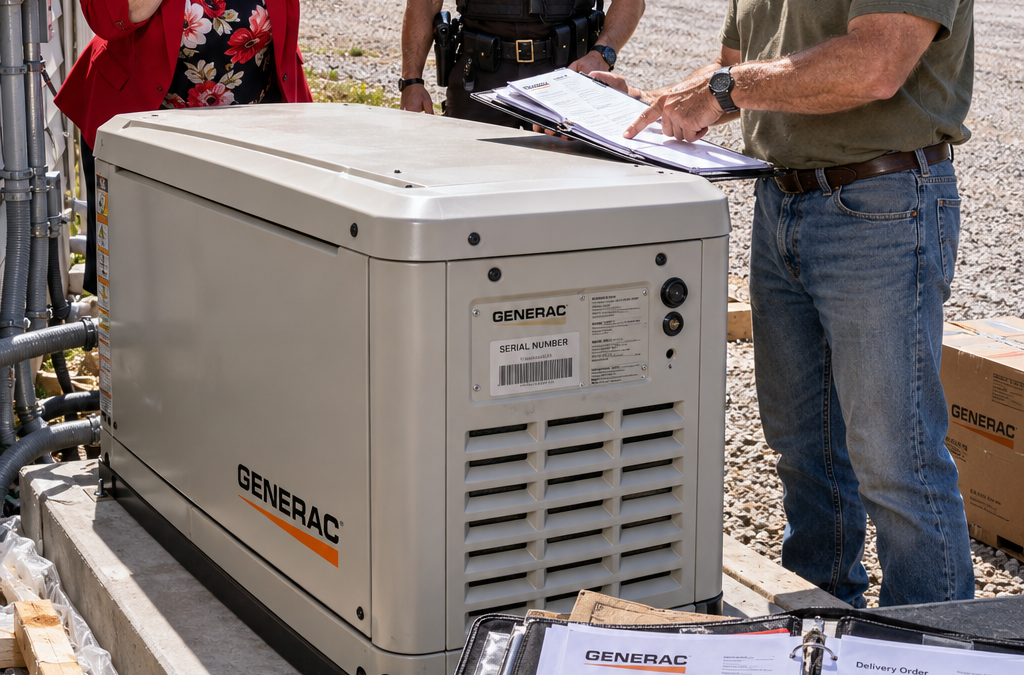
The generator had arrived at nine-thirteen.
I remember the exact time because I had been waiting for it for nearly four months.
Twelve thousand dollars.
That is not an impulse purchase.
Not for me.
I had saved for it after the previous winter.
We had two serious outages that year.
The first lasted eighteen hours.
The second lasted almost three days.
Three days sounds manageable until you live through it in January.
No heat except for the fireplace.
No well pump.
No refrigerator.
No hot water.
Battery-powered lights dying one by one.
By the second night, I was carrying buckets from a neighbor’s hand pump just so I could flush toilets.
I had spent most of my career planning for things that go wrong.
Then retirement taught me that people become strangely optimistic around their own homes.
You tell yourself the power company will fix it.
The storm will pass.
The refrigerator will stay cold.
The pipes won’t freeze.
Until they do.
So I bought the generator.
A large standby unit.
Automatic transfer switch.
Propane system.
Enough capacity to run the house, well pump, refrigerator, freezer, heating system, and the detached workshop without pretending I lived in a power plant.
I hired a licensed electrician.
Pulled the permits.
Had a concrete pad poured behind the garage.
Ordered the unit from a commercial supplier two counties away.
Every receipt went into a file.
Purchase contract.
Serial number.
Delivery order.
Installation invoice.
Warranty paperwork.
That is how I have always operated.
Some people think recordkeeping is paranoia.
Usually those people have never been asked to prove something under pressure.
The driver lowered the generator onto the pad with a small crane.
We checked the packaging.
No visible damage.
I signed the delivery receipt.
He left.
For about twenty minutes, everything was exactly the kind of boring I had paid twelve thousand dollars to achieve.
I was kneeling beside the unit, checking fuel connections, when I heard tires moving too fast over gravel.
Not the delivery truck.
A car.
I stood.
A white crossover came around the side of the house and stopped harder than necessary.
The driver’s door opened before the vehicle had fully settled.
Red blazer.
Black pants.
Large sunglasses.
Vivian Cross.
I did not know her name yet.
She stepped out pointing at the generator.
“You stole it!”
No hello.
No question.
No hesitation.
I stared at her.
“Excuse me?”
“You heard me.”
She was already moving toward the pad.
“That generator belongs to the HOA.”
I looked behind me.
Then back at her.
“This one?”
“Don’t play stupid.”
I had been retired long enough that people rarely spoke to me that way anymore.
I did not miss it.
“Ma’am, who are you?”
She pulled off her sunglasses.
“Vivian Cross.”
That did not help.
“President of Briar Ridge Homeowners Association.”
Briar Ridge was two streets over.
Large subdivision.
Clubhouse.
Pool.
Stone entrance.
Roughly one hundred homes.
My property sat outside its recorded boundary.
Always had.
I paid no dues.
Signed no covenants.
Used no amenities.
Vivian continued.
“Our backup generator disappeared from the storage lot two nights ago.”
“Okay.”
“And suddenly you have one sitting right here.”
“Yes.”
“The same model.”
“Maybe.”
“Don’t insult me.”
“I’m not.”
She walked closer.
I held up one hand.
“Stay off the pad.”
Her face tightened.
“Why?”
“Because it’s newly installed and I don’t want anyone tripping over the conduit.”
For half a second, she seemed surprised by how normal my answer was.
Then she recovered.
“I know exactly what you’re doing.”
I almost asked her to explain it.
She did that anyway.
“The HOA paid almost twenty thousand dollars for a commercial standby unit last year. It was kept in our equipment lot. This morning I discovered it missing.”
“And?”
“And here it is.”
“No.”
“You expect me to believe you happened to buy the same generator?”
“Yes.”
She laughed.
Not because anything was funny.
Because she had already decided disbelief was evidence.
Then she pulled out her phone.
“What are you doing?”
“Calling the sheriff.”
“Go ahead.”
That answer irritated her.
People who weaponize authority often expect the threat of it to do more work than the authority itself.
I leaned against my truck.
She called 911.
I could hear enough of the conversation to understand what she was doing.
“Yes, I need officers immediately.”
Pause.
“I found the stolen property.”
Pause.
“Yes, the man who took it is here.”
I looked at her.
She had been on my property less than two minutes.
We had never met.
She had not asked for a receipt.
Had not checked a serial number.
Had not even looked at the installation date stamped on the delivery paperwork still sitting on my passenger seat.
But to the dispatcher, I was already the man who took it.
That is how dangerous certainty becomes when attached to a phone call.
I did not interrupt her.
Did not speak into the call.
Did not demand that she leave.
I had handled enough scenes to know what would happen next.
Deputies would arrive with a theft complaint.
Vivian would try to speak first.
She would speak quickly.
She would sound outraged.
If I got angry, all that did was give her version emotional reinforcement.
So I waited.
Fifteen minutes later, two county cruisers came up the drive.
Deputy Frank Dolby stepped out first.
Mid-fifties.
Gray at the sides.
The kind of officer who moved like he had learned decades ago that running to conclusions only makes paperwork longer.
His partner, Marcus Reed, looked younger.
Maybe twenty-eight.
Both approached calmly.
Vivian did exactly what I expected.
She started talking before Dolby could ask a question.
“That unit belongs to Briar Ridge. We reported it missing. He took it. I’ve seen the model, I’ve seen the casing, it’s the same generator. I want it impounded immediately.”
Dolby raised one hand.
“Ma’am.”
She kept going.
“We have community property rights and—”
“Ma’am.”
She finally stopped.
“Before anybody starts using the word arrest, I need to know what actually happened.”
Vivian pointed at me.
“He’s standing beside stolen property.”
Dolby looked at me.
“Sir?”
“My name is Grant Mercer.”
“Mr. Mercer, you want to tell me your side?”
“Yes.”
I opened my truck.
Reached into the glove compartment.
Vivian said:
“He’s getting something.”
Reed shifted slightly.
I stopped.
“Delivery paperwork.”
Dolby nodded.
“Go ahead.”
I pulled out the invoice packet.
Handed it over.
Purchase date.
Supplier name.
Payment confirmation.
Model.
Serial number.
Delivery date.
My address.
Dolby read.
Then handed it to Reed.
“Check the unit.”
Reed walked toward the generator.
He crouched beside the identification plate.
Used his flashlight even though the sun was out.
Read the serial number.
Then read the invoice.
Again.
He stood.
“Match.”
Vivian folded her arms.
“Paperwork can be forged.”
Dolby looked at her.
“Do you have the serial number for your HOA’s unit?”
She hesitated.
“I don’t have it with me.”
“Photograph?”
“No.”
“Inventory document?”
“Our property manager has all that.”
“Did you file a theft report?”
“This morning.”
“When did you first notice the generator missing?”
“This morning.”
“You said it disappeared two nights ago.”
“That’s when it must have happened.”
Dolby watched her carefully.
“How do you know?”
She opened her mouth.
Stopped.
“I know our property.”
“That wasn’t my question.”
Her face reddened.
Then she pointed at my generator again.
“I want that unit held until this is sorted out.”
Dolby shook his head.
“Not with a matching purchase invoice and serial number unless you have something more.”
“I want his property searched.”
“No.”
“Excuse me?”
“You haven’t provided probable cause for a search.”
Vivian stared at him.
“You don’t understand how serious this is.”
“I understand exactly what you’re alleging.”
“He stole from the HOA.”
Dolby looked toward me.
Then back at her.
“You haven’t shown that.”
That should have ended it.
It didn’t.
Vivian stepped closer.
“If you let him keep stolen property, I’m going to file a complaint.”
I had heard enough.
Not because I needed to dominate the situation.
Because there was now a legitimate reason for the deputies to know who I was.
I opened the truck again.
Removed my credentials wallet.
Flipped it open.
“Deputy.”
Dolby looked.
“I’m a United States Marshal.”
Vivian went completely silent.
Dolby’s posture changed.
Not dramatically.
Professional recognition.
He looked at the credentials.
Then at me.
“Active?”
“Yes.”
“Understood.”
He nodded once.
“Appreciate you keeping this calm.”
“No problem.”
Reed looked from my badge to Vivian.
She seemed smaller somehow.
Not physically.
The certainty had drained from her.
I closed the wallet.
I did not say:
Do you know who I am?
I did not ask for special treatment.
I did not need any.
The invoice had already proved the relevant fact.
The badge only told them there was even more reason to handle the situation carefully and transparently.
Dolby turned back to Vivian.
“Let’s start over.”
She looked at him.
“Where exactly was your generator stored?”
“Briar Ridge maintenance lot.”
“Locked?”
“Yes.”
“Who has access?”
“The board.”
“All board members?”
“No.”
“Who has keys?”
She hesitated.
“Our property manager.”
“Name?”
Another pause.
“Kurt Cross.”
Dolby wrote.
“Relation?”
Vivian’s answer came out quieter.
“My husband.”
Reed looked up.
Dolby did not react.
“Anyone else?”
“Maintenance contractors.”
“Which contractors?”
“I’d have to check.”
“Camera system?”
“It was supposed to be working.”
“Supposed to be?”
“I don’t know.”
“Who manages it?”
“Kurt.”
A pattern was forming.
You could feel it.
Then something happened so perfectly timed that I would have thought it was written badly if I saw it in a movie.
A flatbed tow truck came down the county road behind my property.
Mounted crane.
Company logo on the door.
Large object under a dark tarp.
Reed turned his head.
Watched it.
Then said:
“Frank.”
Dolby looked.
“That flatbed.”
“What about it?”
“I’ve seen it at Briar Ridge.”
Vivian’s face changed.
Reed pointed.
“Same company listed for equipment-lot maintenance.”
Dolby reached for his radio.
“What’s the company?”
Reed read the logo.
“Cross County Recovery.”
Vivian said quickly:
“That’s normal.”
Dolby looked at her.
“What is?”
“They service the property.”
“Your husband driving?”
“I can’t see.”
The truck continued.
Not toward Briar Ridge.
Away.
Dolby radioed dispatch.
“Unit in the area of County Road 14, be advised, possible equipment-theft investigation. Stop flatbed, Cross County Recovery, eastbound. Verify driver and cargo. Do not search without lawful basis; hold for contact.”
Vivian stared at him.
“Why are you stopping them?”
“Because we’re investigating your stolen generator.”
“I told you where it is.”
She pointed at mine.
Dolby glanced at the serial number.
“No, ma’am. You told us where you thought it was.”
That distinction mattered.
A minute passed.
Then another.
Nobody spoke.
My generator sat behind us looking exactly as guilty as a refrigerator.
The radio crackled.
Another deputy.
“Unit stopped near Miller Junction.”
Dolby lifted his radio.
“Copy. Driver?”
Pause.
“Kurt Cross.”
Vivian closed her eyes.
Just for a second.
Dolby asked:
“Cargo?”
“We’ve got one large industrial generator under tarp.”
Reed looked at Vivian.
Her skin had gone pale.
Dolby said:
“Any visible identifiers?”
The radio crackled again.
“Faded property tag on handle. Looks like Briar Ridge HOA.”
Silence.
Not normal silence.
The kind that follows a fact no one can rearrange.
Vivian whispered:
“No.”
Dolby looked at her.
“Ma’am?”
“That’s impossible.”
He spoke into the radio.
“Hold driver. Get serial number and confirm destination.”
We waited.
My background trained me to watch hands and faces.
Vivian’s left hand had begun trembling.
She tucked it under her right arm.
“Maybe he’s taking it for maintenance.”
Dolby asked:
“Did you authorize that?”
“No.”
“Did the board?”
“I don’t know.”
“You just called 911 to report it stolen.”
“I thought—”
“What repair shop does he use?”
She did not answer.
The radio came alive again.
“Destination paperwork in cab references Mason Scrap and Metal, Easton County.”
Reed exhaled.
Vivian looked like someone had removed all the air around her.
Mason Scrap was not a repair shop.
Everybody in the county knew what it was.
Industrial scrap buyer.
Dolby asked:
“Did you know your husband was taking the generator to a scrapyard?”
“No.”
Her voice shook.
“I didn’t know.”
He studied her.
“Then why did you accuse Mr. Mercer?”
She looked at my generator.
Then at me.
“I saw it.”
“That isn’t an answer.”
“It looked like ours.”
“You didn’t check the serial number.”
“I panicked.”
“You didn’t check your own property records.”
“I said I panicked.”
“You didn’t ask your husband.”
“He wasn’t answering.”
That was the first detail that made some sense.
Vivian had gone to the storage lot that morning.
Generator gone.
Called Kurt.
No answer.
Then, according to her, she drove through the area looking for signs of theft.
She saw my newly delivered unit from the road.
Same general size.
Similar housing.
And built a conclusion in seconds.
But panic did not explain everything.
Calling police was one thing.
Calling me a thief before asking one question was another.
Demanding a search after the serial numbers matched was something else entirely.
I said:
“Vivian.”
She looked at me.
“Panic doesn’t give you the right to threaten a stranger with arrest on his own property.”
Her mouth opened.
Nothing came out.
Dolby did not interrupt.
Neither did Reed.
Finally, she said:
“I didn’t know.”
I nodded.
“That’s why you check before you accuse.”
The radio interrupted.
Kurt was being detained.
The generator had been verified as Briar Ridge property.
He initially claimed it was being moved for maintenance.
That story lasted less than ten minutes.
The flatbed route, scrapyard paperwork, missing authorization, and HOA property tag made it hard to sustain.
Then officers found text messages.
Financial messages.
Contact with the scrap buyer.
And eventually the reason.
Gambling debt.
Kurt had accumulated more than $60,000 in private gambling losses.
Sports betting.
Online accounts.
Cash advances.
He had hidden most of it from Vivian.
He managed the HOA’s maintenance operations.
He knew what equipment sat unused.
The generator had been purchased after a major hurricane scare and was meant to serve the clubhouse as an emergency backup.
It was valuable.
Portable enough to move with the right truck.
Kurt believed he could sell it as industrial surplus for fast cash.
Then cover the absence before anyone noticed.
Maybe tell the board it had been sent for repair.
Maybe claim replacement parts were delayed.
He never expected Vivian to discover it that morning.
And Vivian, instead of slowing down, created her own disaster.
She saw my generator.
Assumed.
Called 911.
Almost converted her husband’s crime into my problem.
A deputy eventually brought Kurt back in a patrol vehicle.
Not because the scene required him there.
Because investigators wanted Vivian to identify property-management records and the truck.
The stolen generator followed on the flatbed as evidence.
I stood near my garage when the cruiser arrived.
Kurt sat in the back.
He looked through the window.
Then saw Vivian.
His face collapsed.
She walked toward the car.
“Kurt?”
He looked away.
“Kurt!”
Dolby stopped her.
“Ma’am, give us space.”
“He’s my husband.”
“I understand.”
“What did you do?”
Kurt would not look at her.
“What did you do?”
Finally, he said:
“I’m sorry.”
Vivian stopped moving.
There are apologies that answer questions better than confessions.
She understood.
“You took it.”
Kurt lowered his head.
“Why?”
Nothing.
“Kurt, why?”
Dolby stepped in.
“Mrs. Cross, we’re not going to conduct an interview through a cruiser window.”
She turned toward him.
“Is he under arrest?”
“He’s being detained while we investigate grand theft and attempted disposal of association property.”
She looked toward the flatbed.
The HOA property tag was visible beneath the raised tarp.
Then toward my generator.
The two units were not even identical once they sat within twenty yards of each other.
Same manufacturer.
Similar design.
Different output package.
Different paint wear.
Mine brand-new.
Theirs used.
She had seen what she wanted to see because she needed the uncertainty to end.
That is one of the most dangerous things about panic.
It does not merely make people afraid.
It makes them hungry for certainty.
Any certainty.
Even the wrong one.
Vivian came back toward me.
For the first time that morning, she no longer looked like an HOA president.
She looked like a woman whose husband had just been caught stealing from people who trusted him.
“I am sorry.”
It was barely audible.
I said nothing.
She continued.
“I really thought—”
“I know what you thought.”
“I saw the generator and—”
“You called me a thief.”
She looked down.
“I was wrong.”
“Yes.”
“I didn’t know what Kurt was doing.”
“I believe you.”
Her head came up.
That surprised her.
“You do?”
“I believe you didn’t know.”
I paused.
“That doesn’t make what you did okay.”
She nodded.
No argument.
“I understand.”
Deputy Dolby finished taking information.
He gave me a case number.
Asked whether I wanted documentation of Vivian’s false accusation.
I thought about it.
She had made the report based on a reckless assumption.
But there was no evidence she knew her claim was false when she called.
No reason to turn an already destroyed morning into a revenge project.
“I want the incident report accurate.”
“Understood.”
“That’s enough.”
Vivian heard that.
She looked at me.
I did not look back.
By noon, my yard was quiet again.
The cruisers left.
Kurt left in custody.
The HOA generator left under evidence control.
Vivian drove away alone.
The concrete pad remained.
My new generator remained.
The installation crew returned after lunch.
One electrician looked around.
“Heard something happened.”
“Small misunderstanding.”
“Three sheriff cars is small?”
“Depends on your career.”
He stared at me.
Then went back to wiring.
By five, the transfer switch was installed.
We ran the first test.
Utility power disconnected.
Three-second delay.
Generator started.
Transfer.
House lights remained on.
Well pump worked.
Furnace blower worked.
Exactly what twelve thousand dollars was supposed to buy.
Reliability.
That evening, I stood behind the garage listening to the engine hum.
For the first time all day, nothing felt complicated.
A machine doing what it had been designed to do.
I envied it.
Meanwhile, Briar Ridge exploded.
The HOA board learned about Kurt’s arrest from the sheriff’s office.
Then learned their president had accused an unrelated property owner of theft before checking basic records.
The emergency meeting happened that night.
I did not attend.
I was not a member.
That distinction suddenly seemed very important to everyone.
A neighbor named Dennis Harper lived inside Briar Ridge but had known me for years.
He called around eight.
“You famous yet?”
“Trying not to be.”
“Clubhouse is packed.”
“I’m sorry.”
“No, you’re not.”
“You’re right.”
He lowered his voice.
“They’re losing their minds.”
“About Kurt?”
“That too.”
“What else?”
“Vivian.”
I said nothing.
Dennis continued.
“People are asking why she called the sheriff before calling the board.”
“Reasonable question.”
“Also why her husband had unilateral access to the equipment lot.”
“Better question.”
“Also why nobody knew he had been moving equipment.”
“Best question.”
Apparently, Vivian tried to explain.
She told the board she had acted to protect HOA property.
Someone asked whether protecting HOA property included accusing nonmembers based on visual similarity.
Another homeowner asked why no inventory audit existed.
The treasurer asked when the generator had last been physically inspected.
Nobody knew.
Then someone asked the question that really damaged her.
“Did you call your husband before calling 911?”
Vivian admitted she had.
No answer.
Then she found my unit.
Then she called police.
That sequence looked terrible.
Not corrupt.
But reckless.
Briar Ridge residents had spent years listening to Vivian lecture them about procedures.
Parking procedures.
Architectural procedures.
Pool procedures.
Landscaping procedures.
Enforcement procedures.
When her own emergency happened, she skipped all of them.
The board scheduled a formal removal vote.
Vivian resigned before it happened.
A week after the incident.
Short email.
Personal circumstances.
Best interests of the community.
No details.
Dennis forwarded it to me.
I read it once.
Deleted it.
Some people mistake resignation for punishment.
It wasn’t the part that mattered to me.
What mattered was that the board started auditing itself.
They discovered Kurt had too much unsupervised control over equipment.
Keys.
Maintenance contracts.
Storage access.
Vendor relationships.
He had been trusted because he was married to the president and had managed the property for years.
Trust had become procedure.
That is never good.
The board changed access rules.
Two-person sign-out for major equipment.
Inventory photographs.
Quarterly physical verification.
External review for disposal of association assets.
Again, boring things.
Good systems are boring until you need them.
Kurt’s case moved forward.
Grand theft.
Attempted sale of stolen property.
Eventually, he pleaded guilty.
Restitution.
Probation.
Counseling requirements tied to his gambling problem.
He avoided prison under the plea arrangement.
I heard all of that through public records and neighborhood gossip.
I did not follow his case closely.
He had not stolen from me.
My involvement ended the moment the serial number on my invoice matched the generator behind my garage.
But Vivian remained in my thoughts longer.
Not because I hated her.
Because the accusation bothered me.
I had spent twenty-six years arresting people.
Serving warrants.
Finding fugitives.
Transporting prisoners.
Working cases where one bad assumption could get somebody hurt.
I had watched young deputies arrive at scenes and fall in love with the first story they heard.
That is dangerous.
The first story is often just the first story.
Vivian had behaved like the worst version of that mistake.
She began with a conclusion.
Then treated every fact as something that should bend around it.
Generator looks similar.
Therefore stolen.
Invoice exists.
Could be forged.
Serial numbers match.
Could be altered.
Owner remains calm.
Suspicious.
Badge appears.
Special treatment.
If Dolby and Reed had been weaker officers, Vivian’s certainty might have created real problems.
Maybe my generator gets temporarily seized.
Maybe I get treated like a suspect until ownership is confirmed.
Maybe my neighbors watch deputies searching my property.
Maybe I spend weeks cleaning up a reputation damaged in twenty minutes.
That is why I respected Dolby afterward.
He never let the loudest person set the investigative order.
Start with property.
Serial number.
Receipt.
Access.
Timeline.
Evidence.
That is policing.
Everything else is theater.
A few weeks later, Dolby came by off duty.
Jeans.
Baseball cap.
No cruiser.
I was changing oil on the generator.
He walked around back.
“You really maintain this thing every month?”
“Manual says monthly exercise and inspection.”
“Manual probably assumes normal people.”
“Normal people freeze when the power goes out.”
He laughed.
Then held out his hand.
I shook it.
“Wanted to say something.”
“Okay.”
“Wish more people handled accusations the way you did.”
I smiled.
“Most people haven’t had twenty-six years of practice.”
“Still.”
He looked toward the generator.
“If you’d come out swinging, that whole morning gets harder.”
“I know.”
“Reed learned something too.”
“What’s that?”
“Check serials before listening to speeches.”
“Good lesson.”
Dolby smiled.
Then became serious.
“Vivian wrote an apology to the department.”
“She did?”
“Yeah.”
“Why?”
“Probably advised by counsel.”
“That sounds right.”
“She admitted she let panic get ahead of facts.”
I waited.
“Did she send you one?”
“No.”
He looked surprised.
“That bother you?”
I thought about it.
“No.”
“Really?”
“I don’t need paper from her to know what happened.”
That was true.
An apology is useful when it repairs a relationship.
Vivian and I never had one.
We lived near each other.
That was all.
I did not need her remorse to validate my ownership.
My invoice did that.
The next Briar Ridge president was elected a month later.
Her name was Caroline Moss.
Retired accountant.
Dennis described her as “aggressively boring.”
That sounded promising.
Apparently, one of her first statements at a board meeting was:
“We will verify facts before contacting law enforcement.”
I almost wished I had been there.
Winter came.
The first major storm rolled through in January.
Freezing rain.
Wind.
Power lines down across half the county.
At 1:17 in the morning, utility power failed.
I woke when the house went silent.
Then three seconds later:
Click.
Crank.
Low diesel-like rumble from the propane engine.
Transfer.
Lights returned.
Furnace restarted.
Well pump available.
I stood in the hallway listening.
Worth every dollar.
By morning, most surrounding homes were dark.
I made coffee.
Checked fuel.
Generator running perfectly.
Briar Ridge’s clubhouse was dark.
Their recovered generator had been tied up in evidence for months, then returned, then delayed during reinstallation because the board needed new contracts and electrical inspection.
Nobody’s fault, exactly.
Just bureaucracy.
The irony was difficult to miss.
The woman who accused me of stealing the thing that would keep her clubhouse running had spent so much time creating chaos around the real generator that hers still wasn’t operating when the next outage came.
Dennis texted me a photograph.
Dark clubhouse.
Caption:
ANY CHANCE YOU STOLE OUR ELECTRICITY TOO?
I laughed.
Did not reply.
Then he sent:
TOO SOON?
I wrote:
YES.
Thirty seconds later:
FAIR.
I never gloated.
That mattered to me.
People kept telling me I should.
A neighbor named Paul came over during the outage to charge two phones.
He looked toward the generator.
“Man, if I were you, I’d point floodlights toward Briar Ridge.”
“Why?”
“Just so Vivian could see them.”
“She’s not president anymore.”
“Still lives there.”
“Not my problem.”
He laughed.
“You’re no fun.”
“No.”
But the truth was, I had spent my career watching people confuse victory with humiliation.
Humiliation creates another fight.
Resolution ends one.
I wanted quiet.
The generator gave me that.
Over the following year, the story turned into a local joke.
People called me Generator Grant.
I hated that.
Reed apparently used the incident during training.
Not my identity.
The investigative sequence.
Complainant arrives with certainty.
Property owner has documentation.
Serial number resolves first theory.
New information redirects investigation.
Do not anchor on first accusation.
That pleased me more than I expected.
Good training usually comes from bad days.
At some point, a deputy who never met me might remember that story while standing in someone else’s driveway.
Maybe he checks a serial number before deciding who the thief is.
Then the whole unpleasant Tuesday becomes useful.
I kept the original invoice in my glove compartment.
Even after scanning it.
Even after putting a copy in the house file.
The paper became soft at the folds.
One day my daughter saw it.
“You know you don’t need that anymore.”
“I know.”
“You have three copies.”
“Four.”
She stared.
“Why?”
“Because proof is cheap when you already have it.”
“That’s not an answer.”
I looked at the invoice.
“Maybe I like being reminded.”
“Of Vivian?”
“No.”
“Then what?”
“That evidence doesn’t have to be dramatic.”
She waited.
I held up the paper.
“This stopped an accusation faster than any argument I could’ve made.”
My daughter smiled.
“You sound retired.”
“What does that mean?”
“You’ve started turning receipts into philosophy.”
“Get off my porch.”
She laughed.
Eventually, I saw Vivian again.
Grocery store parking lot.
She was loading bags into her car.
No red blazer.
Gray sweatshirt.
Hair pulled back.
For a moment, I considered taking another row to avoid her.
Then she saw me.
“Grant.”
“Vivian.”
She looked uncomfortable.
“I heard the generator worked during the storm.”
“It did.”
“Good.”
I nodded.
She closed her trunk.
“Kurt and I separated.”
I had not known.
“I’m sorry.”
“Don’t be.”
She looked toward the store.
“I keep thinking about that morning.”
I waited.
“I should have asked.”
“Yes.”
“Or checked records.”
“Yes.”
“I don’t know why I didn’t.”
That was the most interesting thing she had ever said to me.
Not because she lacked reasons.
Because she finally admitted she did not fully understand herself.
I said:
“You were scared.”
She nodded.
“And embarrassed.”
Another nod.
“You had a missing asset.”
“Yes.”
“You needed the answer quickly.”
She looked at me.
“And I made you the answer.”
“Exactly.”
Her eyes dropped.
“I almost got you arrested.”
“Probably not.”
“You know what I mean.”
“I do.”
She took a breath.
“Why weren’t you angrier?”
I laughed once.
“I was angry.”
“You didn’t look it.”
“That’s not the same thing.”
She studied me.
“Was it because you’re a marshal?”
“Partly.”
“What did that teach you?”
I thought about the fugitives.
Warrants.
Interviews.
Scenes where one person screamed and another shook.
Then I said:
“Anger can be true and still make you look wrong.”
Vivian looked at me.
“That’s a terrible system.”
“Sometimes.”
“But?”
“But facts still need room to work.”
She nodded slowly.
“I am sorry.”
This time, directly.
No board.
No lawyer.
No audience.
“Thank you.”
She seemed relieved.
That was enough.
I never saw a reason to punish her beyond that.
People ask whether I thought she was protecting Kurt.
No.
If I believed she knew, I would say so.
Everything about that morning suggested she was genuinely shocked.
Her mistake was not conspiracy.
It was certainty without investigation.
That can be just as damaging in a different way.
She had trained herself through years of HOA leadership to believe that speaking first and firmly often produced compliance.
Most neighborhood disputes probably rewarded that habit.
A resident parks wrong.
Vivian sends a letter.
Trash can stays out.
Vivian speaks sharply.
Someone installs something without approval.
Vivian threatens a fine.
People give in.
Then the generator disappeared.
She applied the same method to a criminal accusation.
That is where small habits become dangerous.
A homeowners association violation can be corrected later.
An accusation of grand theft can change a person’s life before facts catch up.
Power should make you slower.
Not faster.
The higher the consequence, the more careful the conclusion.
That was something federal service taught me repeatedly.
You do not kick a door because someone sounds convincing.
You establish identity.
Address.
Warrant.
Risk.
Authority.
Then act.
Because once you act, some consequences cannot be reversed cleanly.
My generator is older now.
Still reliable.
Every month, I inspect it.
Oil.
Battery.
Fuel.
Transfer switch.
Exercise cycle.
I write the date in a maintenance notebook.
People laugh at that too.
Let them.
During the next two outages, the house stayed lit.
The well ran.
Freezers stayed cold.
One winter night, an elderly neighbor came over because her oxygen concentrator needed power.
We ran an extension through the mudroom until her family could move her somewhere safer.
That alone justified the twelve thousand dollars.
Later, she tried to pay me twenty dollars for propane.
I refused.
“Then take cookies.”
“I’ll take cookies.”
You learn your priorities with age.
The story of Vivian became smaller.
That is what I wanted.
At first, every neighbor asked about it.
Then only people who had just heard the story.
Then nobody.
Briar Ridge changed presidents again several years later.
Their generator remained in service.
Kurt finished probation and moved out of county.
Vivian sold the house eventually.
I heard she went closer to family.
I hope she found peace.
I mean that.
Not because what she did was acceptable.
Because carrying hatred after the danger is gone is just another way to let someone keep occupying your property.
My property is quiet now.
Trees.
Garage.
Workshop.
Gravel.
Generator humming once a week during its exercise cycle.
No red blazer.
No cruisers.
No raised voices.
Sometimes I stand beside that machine with a cup of coffee while it runs its test.
The sound takes me back to that Tuesday.
Vivian pointing.
Dolby reading the invoice.
Reed crouched beside the serial plate.
The flatbed disappearing down the road.
The radio crackling.
Kurt’s name.
Everything turning in real time.
People remember the badge when I tell the story.
They think that’s the satisfying part.
It wasn’t.
The badge didn’t prove the generator was mine.
The invoice did.
The serial number did.
The delivery record did.
The badge explained why I stayed calm.
It did not create the truth.
That distinction matters to me.
If I had been a retired teacher, the invoice should have been enough.
If I had been a plumber, enough.
Unemployed, enough.
No badge, enough.
Evidence should not become more true because the person holding it has authority.
Dolby understood that.
He checked the receipt before he knew who I was.
That is why I respected him.
Vivian saw authority as something that could force reality to move faster.
Dolby saw it as a responsibility to slow things down until reality became clear.
I know which kind I trust.
The original invoice is still in my glove box.
Purchase date.
Serial number.
Delivery confirmation.
Creased down the middle.
A little oil smudge near the corner.
Every time I see it, I remember how close a loud accusation came to becoming a false official story.
Then I remember how little it took to stop it.
Not shouting.
Not influence.
Not power.
One serial number checked against one piece of paper.
That was the entire foundation.
Months after the incident, Reed stopped me outside a hardware store.
He was off duty.
“You know your generator story still comes up at training.”
“Unfortunately.”
“It’s useful.”
“Good.”
He smiled.
“New deputies get told not to let volume become probable cause.”
“That’s a decent rule.”
“Also check the serial.”
“Better rule.”
He laughed.
Then said:
“That day changed how I look at complainants.”
I raised an eyebrow.
“Hopefully not by distrusting everyone.”
“No.”
He shook his head.
“By not borrowing their certainty.”
That was exactly right.
Do not borrow someone else’s certainty.
I wish more people understood how valuable that principle is.
Not just police.
Managers.
Parents.
HOA boards.
Neighbors.
Anyone being asked to decide who is right before all the facts arrive.
Vivian borrowed her own fear and called it certainty.
For twenty minutes, she believed those were the same thing.
Then a flatbed rolled past.
After that, the truth did what truth often does.
It arrived without caring who had spoken first.
When the next storm knocked out half the county, my generator started three seconds after the utility failed.
The house lights blinked once.
Then held steady.
I stood in the kitchen listening to rain hammer the roof.
Outside was darkness.
Inside was warm light.
My daughter called.
“You still have power?”
“Yes.”
“Of course you do.”
“You mocking preparedness?”
“I’m mocking the man who owns enough flashlights to open a store.”
“Flashlights don’t run the well.”
“Love you, Dad.”
“Love you too.”
I hung up.
Poured coffee.
Walked to the window.
Far beyond the trees, the sky above Briar Ridge was dark.
I thought about Vivian for maybe five seconds.
Then stopped.
There was no pleasure in their inconvenience.
Just another reminder that the machine behind my garage had always been exactly what I said it was.
Mine.
Purchased honestly.
Installed legally.
Maintained carefully.
No theft.
No secret.
No drama.
Just a generator.
That is how I prefer to remember the story.
Not as the day an HOA president got humiliated.
Not as the day a U.S. Marshal revealed his badge.
Not even as the day a thief was caught driving toward a scrapyard.
I remember it as the morning evidence arrived before anger had time to ruin anything.
Vivian had a red blazer.
A title.
A loud voice.
A theory.
I had a receipt.
Only one of those things had a serial number on it.
That made all the difference.








