𝗙𝗨𝗟𝗟 𝗦𝗧𝗢𝗥𝗬 The HOA President Accused Me of Hiding Alien Contraband Under My Foundation
𝗙𝗨𝗟𝗟 𝗦𝗧𝗢𝗥𝗬
The second time, Paul and I talked near the mailbox about a storm-damaged transformer on Oak Hollow Road. Two days later, I was fined for trash bin placement.
The third time, he waved at me while walking his dog.
That evening, the porch light notice appeared.
At first, I told myself I was being paranoid.
Then Cheryl confirmed it.
“She sees Paul speak to you,” she said one afternoon, standing beside my driveway.
“So?”
“So she hates him.”
“That doesn’t explain why she’s fining me.”
Cheryl looked toward Diane’s house at the top of the street.
“With Diane, everything explains everything if she’s angry enough.”
I started documenting.
Photos of the trash bin.
Photos of the porch light.
Screenshots of the HOA portal showing no 2019 amendment posted.
Copies of every letter.
Dates.
Times.
Notes from conversations.
I saved voicemails too.
Diane left several.
Her voice was always controlled at first, but near the end of each message, something sharp would slip through.
“Preston, this is Diane Wexler. Your continued disregard for Willowbrook standards has been documented. I strongly advise you to reconsider your attitude before enforcement escalates.”
Attitude.
That word appeared more than once.
By month three, the fines totaled $1,200.
Then came the lien threat.
Notice of Intent to File Lien — Outstanding Compliance Balance Must Be Paid Within Thirty Days.
A lien on my home.
Over tomatoes, trash cans, and a porch light.
I sat at my kitchen table with the letter spread in front of me, and for a moment the room seemed to tilt.
I had worked twelve years to afford that house.
Twelve years of overtime calls, storm work, side jobs, and weekends spent in other people’s crawl spaces. I knew what it meant to own a home because I knew exactly how much labor was inside every payment.
Now Diane Wexler was threatening to attach legal debt to it because I had planted vegetables where she could see them.
That night, someone slipped a folder under my front door.
I found it around eleven, after checking the locks.
No note.
Just a thick manila folder.
Inside were HOA financial statements going back three years.
Copies, not originals.
Some pages had handwritten notes in the margins.
Vendor invoices duplicated across quarters.
Landscaping funds drained despite no visible improvements.
Reserve account transfers with vague labels.
And Diane’s signature approving every discrepancy.
At the bottom of the stack was a sticky note.
You are not the first. — C
Cheryl.
The next morning, I knocked on her door.
She opened it wearing a robe and holding coffee.
“I wondered how long it would take you.”
I held up the folder.
“You quit the board?”
“Two years ago.”
“Because of this?”
“Because I asked about this.”
She let me inside.
Her kitchen table was already covered with more papers.
“I copied what I could before Diane locked me out of the records.”
I sat down slowly.
“Why give it to me now?”
“Because she threatened a lien against your house.”
“And that changed things?”
Cheryl’s eyes hardened.
“No. You changed things. You started keeping records. Most people just pay.”
I looked at the statements.
The numbers didn’t add up.
I wasn’t an accountant, but I knew enough to see money leaving places it shouldn’t.
Landscaping funds vanished into vendor invoices with names I had never seen on actual trucks.
The same invoice number appeared twice in different quarters.
One payment had been labeled “seasonal drainage beautification,” whatever that meant.
Another was for “common-area security enhancements.”
“That camera she installed facing your backyard?” Cheryl asked.
I looked up.
“She installed what?”
Cheryl pointed toward the window.
“On the utility post behind the common strip.”
I went outside later and saw it.
A small black camera mounted high on a post at the edge of the common area, angled directly toward my backyard.
Diane had disguised it as a security upgrade.
It wasn’t facing the trail.
It wasn’t watching the street.
It was watching me.
That was when the tomato fines stopped seeming petty.
They were smoke.
Distraction.
A way to keep residents nervous enough to miss the larger fire.
I hired a lawyer three days later.
Her name was Renata Cole, and she specialized in HOA abuse cases.
Renata had the most dangerous kind of calm I had ever seen. She listened without interrupting, asked precise questions, and sorted my paperwork into stacks so clean they made my own folders look like chaos.
When she reached Cheryl’s financial statements, her expression changed.
“How did you get these?”
“Former board member.”
“Will she testify?”
“Yes,” Cheryl said from the chair beside me.
Renata looked at her.
“Good.”
Then she turned back to me.
“Diane Wexler has done this before.”
I stared at her.
“What do you mean?”
Renata opened her laptop and pulled up a file from another county.
“Previous HOA. Different subdivision. Complaints over selective enforcement, missing funds, improper fines. She resigned before the board could complete the internal review.”
I felt cold.
“She moved here after that?”
“Yes.”
“And became president again?”
“Apparently.”
Cheryl muttered, “Of course she did.”
Renata closed the file.
“She isn’t new to this. She’s repeating a playbook.”
That sentence stayed with me.
A playbook.
Not chaos.
Not random grudges.
A method.
Fine the residents.
Scare them.
Hide the records.
Control the meetings.
Move the money.
Resign if cornered.
Start over somewhere new.
I thought about all the neighbors who whispered warnings while looking over their shoulders.
They had not been dramatic.
They had been survivors.
Renata filed a formal records request for meeting minutes, financial statements, vendor contracts, enforcement records, amendments, surveillance policies, and banking documentation.
Diane responded through the HOA email.
Meeting records are temporarily unavailable for review due to ongoing administrative organization.
Temporarily unavailable.
Conveniently unavailable.
Almost as convenient as a camera pointed at my backyard.
Then came the alien excavation equipment.
It was a Tuesday afternoon.
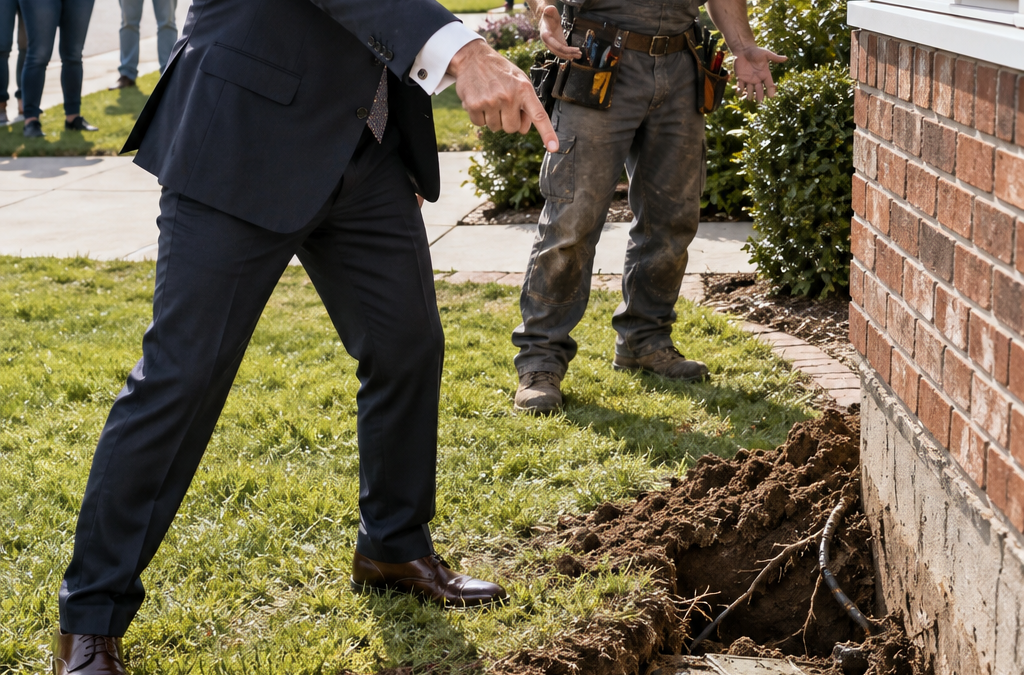
I had come home early from a job replacing outdoor outlets at a dental office. I pulled into my driveway and saw Diane crouched beside my foundation with a hand trowel.
For a second, I just sat in my truck.
She was digging.
On my property.
Near my crawl space vent.
Her white pants were smudged with dirt, her visor sat crooked, and her clipboard lay on the grass beside her.
I got out slowly.
“Diane.”
She jumped, then straightened.
“Mr. Hale.”
“What are you doing?”
She brushed dirt from her gloves.
“Investigating a resident tip.”
“You’re digging beside my foundation.”
“There are concerns.”
“What concerns?”
Her eyes narrowed.
“Unauthorized subsurface equipment.”
I stared at her.
“What?”
“Do not play games with me.”
“I’m not. I have no idea what that means.”
She pointed toward the shallow hole she had started.
“There are credible reports of illegal excavation activity beneath this structure.”
I blinked.
“Are you accusing me of digging a tunnel?”
“I’m accusing you of harboring unapproved underground material.”
“Underground material.”
“Potentially extraterrestrial in origin.”
For a moment, the whole world seemed to pause.
A bird chirped in the tree above us.
Somewhere down the street, a lawn mower started.
I looked at Diane Wexler, HOA president, standing on my lawn with a hand trowel, accusing me of hiding alien contraband under my foundation.
“Diane,” I said slowly, “get off my property.”
“This is an HOA compliance inspection.”
“This is trespassing.”
“You don’t get to decide that.”
“Yes. I do. It’s my property.”
She smiled in a way that made me wonder whether this was insanity or performance.
Later, I learned she had told two board members I was hiding illegal structures under the house. She used the alien story in whispers, not official minutes, as a way to make me sound unstable before I could accuse her of anything.
But she didn’t know about my doorbell camera.
It captured everything.
The trespass.
The digging.
Her words.
Potentially extraterrestrial in origin.
When Renata saw the footage, she grinned.
“Exhibit A.”
“That’s your favorite thing?”
“It is now.”
Meanwhile, the lien threat became real.
Diane filed it.
My mortgage company called two days later.
The woman on the phone sounded confused.
“Mr. Hale, we’re seeing an encumbrance recorded against the property related to your homeowners association.”
I gripped the counter.
“I’m disputing it.”
“I understand. We just need documentation for our records.”
Documentation.
A word that had once sounded harmless now made my pulse jump.
Not aliens.
Not ghosts.
Not any of Diane’s theatrical nonsense.
Paperwork scared me.
The kind of paperwork that attaches itself to a house and forces innocent people to prove reality.
Renata filed immediately to challenge the lien.
She also attached the trespass footage, the missing amendment evidence, and Cheryl’s financial records to a formal complaint with the state HOA oversight board.
Then Diane’s dog dug up her rose garden.
That part still makes me laugh, even now.
Diane had a golden retriever named Bentley, a cheerful animal who seemed to be the only living creature in Willowbrook that did not fear her.
One afternoon, Bentley escaped her backyard while Diane was entertaining two board members on her patio. He sprinted straight to the front flower bed and began digging with heroic determination.
Diane ran after him in designer sandals, shrieking, “Bentley, no! Stop contaminating the area!”
Cheryl and I were standing near my driveway when it happened.
Bentley emerged with half a muddy chew toy and what looked like an old sprinkler cap.
Diane screamed, “Drop the evidence!”
Cheryl snorted so hard she nearly dropped her coffee.
For two full minutes, Diane chased that golden retriever across the cul-de-sac while Bentley wagged his tail and carried the “evidence” proudly in his mouth.
Neighbors came to windows.
Paul Wexler laughed openly from his porch.
Diane looked like she might combust.
It was the funniest moment in the entire nightmare.
Then Renata uncovered the real account.
The fines Diane collected from residents like me had not gone into landscaping.
They had not gone into maintenance.
They had not gone into reserves.
A portion had been routed into a personal account under her maiden name.
Cheryl had preserved enough bank records to show the pattern, and Renata’s subpoena filled in the missing pieces.
The numbers were ugly.
Repeated deposits.
Transfers after violation cycles.
Payments connected to Diane’s vacations, clothing purchases, and designer handbags.
Suddenly, every tomato fine and trash-bin notice became something darker.
Diane had not merely abused authority.
She had monetized fear.
We filed the complaint formally with the state HOA oversight board.
Renata attached bank records, violation letters, my lien notice, the doorbell footage, missing meeting minutes, and Cheryl’s sworn statement.
Diane felt the pressure.
So she did what desperate people do.
She doubled down publicly.
She called an emergency meeting.
The clubhouse was packed.
Neighbors who had been silent for years showed up holding folders, envelopes, old notices, and receipts.
Diane stood at the front wearing a red blazer and the pale, furious expression of a woman trying to look righteous while the floor cracked beneath her.
She opened with a statement.
“Recent defamatory accusations have been circulated by a disgruntled homeowner.”
Every head turned toward me.
I sat beside Renata and Cheryl.
Diane continued.
“These false claims are part of an attempt to smear my legacy of service to Willowbrook Estates.”
Renata leaned toward me.
“Legacy,” she whispered. “Always a mistake.”
Diane accused me of fabricating documents.
She accused Cheryl of stealing association records.
She accused Paul of conspiring against her because of personal bitterness.
She accused “outside legal actors” of manipulating residents.
Then she made the mistake of asking if anyone had questions.
Renata stood.
The room went still.
“I have a few.”
Diane stiffened.
“This is a homeowners meeting.”
“My client is a homeowner.”
Renata walked to the front with a folder.
“Diane, did you authorize fines against Mr. Hale for visible vegetable plantings?”
“That matter is documented.”
“Yes or no?”
“Yes.”
“Did you threaten a lien against his property?”
“The association followed procedure.”
“Did you file that lien?”
Diane’s lips pressed together.
“Yes.”
Renata nodded.
Then she placed a bank record on the table.
“Did the fines collected from Mr. Hale and other residents go into the HOA landscaping account?”
Diane’s face shifted.
“The association maintains multiple accounts.”
“Did they go into the landscaping account?”
“I don’t have those figures memorized.”
Renata turned toward the residents.
“I do.”
She began reading.
Dates.
Amounts.
Fine deposits.
Transfers.
Account numbers partially redacted.
Personal payments.
A flight.
A hotel in Cancun.
Luxury handbag purchases.
Every number landed like a hammer.
Gasps moved through the room.
Mrs. Caldwell from Pine Court stood up and said, “That was my fence fine.”
Another man said, “I paid that amount.”
Cheryl’s hands were folded tightly in her lap, but she was smiling.
Diane’s face went white.
Then red.
“This is out of context.”
Renata looked at her.
“Money either went where you said it went, or it didn’t.”
“You don’t understand HOA accounting.”
“I understand enough to subpoena bank records.”
That sentence finished the room.
Diane grabbed the edge of the table.
“You had no right.”
Renata smiled slightly.
“The court disagreed.”
A board member named Martin stood.
He looked shaken.
“Diane, is this true?”
She turned on him.
“Sit down.”
He didn’t.
For the first time, someone on the board openly refused her.
“No.”
The room went silent.
Martin looked at the other board members.
“I move that Diane Wexler be removed immediately as HOA president pending investigation into financial misconduct, improper liens, and abuse of enforcement authority.”
Another board member seconded before Diane could speak.
The vote was unanimous.
Every hand went up.
Even the ones that trembled.
Diane stood frozen at the front of the clubhouse while the title she had used as armor disappeared in front of everyone she had tried to control.
“You’ll regret this,” she said.
Cheryl answered from the front row.
“No, Diane. We already did.”
The state auditor’s office opened a criminal investigation into misappropriation of HOA funds.
The lien against my home was voided.
The fines were reversed.
The surveillance camera pointed at my backyard was removed the next morning by a licensed contractor who looked deeply uncomfortable when I asked if he had found any alien equipment.
He did not laugh until he realized I was joking.
Diane was assessed a $10,000 civil penalty through the oversight process, and fraud charges followed as investigators traced the money.
Reporters showed up two weeks later.
Local news loves three things: stolen money, suburban outrage, and bizarre sound bites.
“Extraterrestrial contraband under the foundation” gave them all three.
The clip of Diane being escorted off association property aired that evening.
She wore oversized sunglasses and tried to cover her face with a folder.
It did not work.
Neighbors watched from sidewalks as the woman who once ruled Willowbrook with fines and fear was removed from the place she had treated like her personal kingdom.
My tomatoes came back that spring.
I planted them in the same raised bed.
Visible from the street.
Nobody said a word.
Cheryl brought over a small wooden sign she had painted herself.
It read:
EXTRATERRESTRIAL APPROVED PRODUCE
I laughed for a full minute when I saw it.
We planted it at the corner of the bed.
Paul Wexler walked by later and stopped.
“That’s excellent,” he said.
“Do you think she’ll see it?”
He smiled.
“God willing.”
Willowbrook changed after Diane.
Not instantly.
Fear has roots.
People still hesitated before speaking at meetings. Some still paid close attention to the mail. A few kept folders of every notice, just in case another Diane ever appeared.
But the new board posted meeting minutes.
The financial reports were made public.
Fines had to cite real rules.
Liens required attorney review and full board approval.
And no one could install a camera facing a resident’s backyard under the phrase “security upgrade” without a vote, a map, and a very suspicious room full of homeowners asking questions.
Cheryl joined the finance committee.
That was probably the best thing that ever happened to Willowbrook.
She had no patience for vague invoices, missing receipts, or anyone using the phrase “administrative flexibility.”
Renata told me later that Diane’s downfall had not been the alien accusation, though everyone loved repeating it.
It had been the paperwork.
The same thing Diane used to frighten people became the thing that trapped her.
The fine notices.
The lien.
The missing minutes.
The bank transfers.
The duplicate invoices.
The voicemails.
The doorbell footage.
The records Cheryl saved when no one else was paying attention.
Every piece mattered.
Diane thought fear would keep people silent.
She forgot that some scared people organize.
One evening, months after the investigation began, I stood in my yard watering the tomatoes.
The plants were taller now, full of yellow flowers and tiny green fruit.
Cheryl walked over with her beagle.
“How’s the alien crop?”
“Thriving.”
“Any strange activity under the foundation?”
“Only a bad junction box in the crawl space.”
“Cover it up. The truth is out there.”
I laughed.
For the first time since moving to Willowbrook, the laughter felt easy.
Diane’s house eventually went on the market.
She had lost her title, her control, her reputation, and possibly her freedom depending on how the criminal case played out.
I watched the real estate sign go up from my porch.
I thought I would feel triumphant.
Mostly, I felt tired.
But it was a clean kind of tired.
The kind you feel after heavy work is finally done.
I had moved to Willowbrook looking for peace.
Diane gave me tomatoes, trash bins, fake amendments, an illegal lien, a backyard camera, a trespasser with a trowel, and a conspiracy theory about alien contraband.
Somehow, through all of that, I got the peace anyway.
Not the brochure kind.
Something better.
Peace with eyes open.
Peace with records.
Peace with neighbors who no longer whispered warnings but spoke plainly.
Peace earned by refusing to let a tyrant with a clipboard define reality.
Every morning now, I check the tomatoes before work.
Sometimes I pick one, rinse it at the outdoor spigot, and eat it right there beside the raised bed.
They taste like summer.
They taste like stubbornness.
They taste like the kind of justice that takes longer than you want but arrives with paperwork strong enough to break a kingdom.
Diane Wexler once stood on my lawn screaming about extraterrestrial contraband under my foundation.
She was wrong about the aliens.
But she was right about one thing.
Something had been buried in Willowbrook.
Not under my house.
Under years of fines, fear, missing records, and polite suburban silence.
And once we dug it up, Diane lost everything she had built on top of it.
𝗧𝗛𝗘 𝗘𝗡𝗗
The HOA President Accused Me of Hiding Alien Contraband Under My Foundation
Diane Wexler stood on my lawn screaming that I had buried extraterrestrial contraband beneath my foundation, and every neighbor on Willowbrook Lane had stopped pretending not to watch. What she didn’t know was that the real thing hidden under all her madness was a paper trail that was about to destroy her.
My name is Preston Hale, and six months earlier, I was just a quiet electrician looking for a quiet house.
That was all I wanted.
No drama.
No neighborhood politics.
No front-yard wars over mulch color or mailbox height.
I had spent twenty-two years crawling through attics, rewiring old breaker panels, replacing storm-damaged service lines, and answering emergency calls from people who only noticed electricity when it failed. By the time I turned forty-six, I wanted a place where I could come home, take off my boots, water a few tomato plants, and hear nothing louder than cicadas.
Willowbrook Estates looked like that kind of place.
The brochure promised community.
It promised tree-lined streets, peaceful sidewalks, responsible property standards, and neighbors who cared about maintaining a beautiful place to live.
It did not mention paranoia.
It did not mention forged rules.
And it definitely did not mention the HOA president accusing residents of hiding alien excavation equipment under their homes.
My house sat near the end of a curved street with maple trees on both sides. It was small but sturdy, built in the late eighties, with a brick front, a two-car garage, and a backyard just large enough for a grill, a workbench, and the raised garden bed I had wanted for years.
That garden bed was my first mistake.
It was nothing dramatic. Six feet long, three feet wide, plain cedar boards, filled with good soil. I planted tomatoes because my father had grown them every summer when I was a kid. Big red slicers, cherry tomatoes for salads, and a few yellow ones because I liked how they looked when the sun hit them.
The bed sat near the side yard, technically visible from the street if someone slowed down and leaned forward like a detective inspecting a crime scene.
Diane Wexler noticed within an hour.
I had just finished watering when her golf cart stopped in front of my house.
Diane was in her mid-fifties, slim, sharp-faced, and always dressed like she was attending a luncheon where everyone else had disappointed her. She wore white capri pants, a floral blouse, oversized sunglasses, and a straw visor that made her look less like a community volunteer and more like a resort manager preparing to evict someone from the pool.
She carried a clipboard.
Of course she did.
“Mr. Hale,” she called.
I turned off the hose.
“Yes?”
“I’m Diane Wexler, president of the Willowbrook Estates Homeowners Association.”
“Nice to meet you.”
Her eyes dropped to the garden bed.
“Those tomatoes are visible from the street.”
I glanced at them.
“They are.”
“That’s a violation.”
I laughed because I honestly thought she was joking.
She wasn’t.
Her mouth tightened.
“Raised vegetable beds are prohibited in visible zones because they disrupt uniform landscaping aesthetics.”
I wiped my hands on my jeans.
“I read the packet before I moved in. I didn’t see that.”
“It’s covered under general landscaping harmony.”
That phrase should have warned me.
General landscaping harmony.
It sounded like nothing because it meant anything.
“They’re tomatoes,” I said.
“They’re nonconforming plantings.”
“People have flowers, shrubs, birdbaths, ceramic frogs.”
“Those are ornamental.”
“So are tomatoes if you like sandwiches.”
Her face did not move.
“You have until Friday to remove the bed.”
I looked at the little plants, barely eight inches tall.
“You’re serious?”
“Completely.”
“Diane, I just moved in.”
“Then it’s better to learn early.”
She wrote something on her clipboard, gave me one last thin smile, and drove away.
Three days later, the certified letter arrived.
Visible Vegetable Structure Violation — Fine: $150.
I stood at my kitchen counter holding the letter, staring through the window at the tomatoes.
One hundred fifty dollars.
For vegetables.
I paid the fine and pulled the plants.
That was my first mistake.
I told myself it was practical. I was new. I didn’t want trouble. I could grow tomatoes in buckets behind the garage where nobody could see them.
That evening, I carried the torn-out plants to the compost bin and felt ridiculous for being angry.
They were tomatoes.
But something about pulling them up under threat made the house feel less like mine.
The neighbors warned me after that.
Not loudly.
Nobody warned anyone loudly in Willowbrook.
A man named Frank from across the street told me while pretending to check his mailbox.
“Don’t push Diane.”
I looked up.
“I’m not pushing anyone.”
“You planted tomatoes.”
“That’s pushing?”
“With her, yes.”
Another neighbor, Cheryl Barnes, approached me two days later while walking her beagle.
Cheryl was in her early sixties, blunt, watchful, and had the tired patience of someone who had survived too many board meetings.
“She’ll test you now,” Cheryl said.
“Over tomatoes?”
“Over obedience.”
I almost smiled.
She didn’t.
“Diane doesn’t enforce rules,” Cheryl said. “She enforces fear.”
I wanted to dismiss that as neighborhood gossip.
Then the second fine arrived.
Improper Trash Bin Placement — Container Positioned Eleven Inches from Curb Marker. Fine: $75.
Eleven inches.
I measured the distance three times because I couldn’t believe a human being had done it first.
The next week, another notice came.
My porch light bulb was too warm-toned under a 2019 exterior illumination amendment I had never seen, never signed, and could not find anywhere in the homeowner portal.
I started noticing the pattern.
Every fine came on days when I had spoken to Diane’s ex-husband.
His name was Paul Wexler, and he lived two houses down from me.
He was quiet, polite, and seemed permanently embarrassed by the fact that everyone knew he had once been married to Diane. The first time I met him, he helped me carry an old workbench into my garage. The next morning, Diane fined me for tomatoes.
The second time, Paul and I talked near the mailbox about a storm-damaged transformer on Oak Hollow Road. Two days later, I was fined for trash bin placement.
The third time, he waved at me while walking his dog.
That evening, the porch light notice appeared.
At first, I told myself I was being paranoid.
Then Cheryl confirmed it.
“She sees Paul speak to you,” she said one afternoon, standing beside my driveway.
“So?”
“So she hates him.”
“That doesn’t explain why she’s fining me.”
Cheryl looked toward Diane’s house at the top of the street.
“With Diane, everything explains everything if she’s angry enough.”
I started documenting.
Photos of the trash bin.
Photos of the porch light.
Screenshots of the HOA portal showing no 2019 amendment posted.
Copies of every letter.
Dates.
Times.
Notes from conversations.
I saved voicemails too.
Diane left several.
Her voice was always controlled at first, but near the end of each message, something sharp would slip through.
“Preston, this is Diane Wexler. Your continued disregard for Willowbrook standards has been documented. I strongly advise you to reconsider your attitude before enforcement escalates.”
Attitude.
That word appeared more than once.
By month three, the fines totaled $1,200.
Then came the lien threat.
Notice of Intent to File Lien — Outstanding Compliance Balance Must Be Paid Within Thirty Days.
A lien on my home.
Over tomatoes, trash cans, and a porch light.
I sat at my kitchen table with the letter spread in front of me, and for a moment the room seemed to tilt.
I had worked twelve years to afford that house.
Twelve years of overtime calls, storm work, side jobs, and weekends spent in other people’s crawl spaces. I knew what it meant to own a home because I knew exactly how much labor was inside every payment.
Now Diane Wexler was threatening to attach legal debt to it because I had planted vegetables where she could see them.
That night, someone slipped a folder under my front door.
I found it around eleven, after checking the locks.
No note.
Just a thick manila folder.
Inside were HOA financial statements going back three years.
Copies, not originals.
Some pages had handwritten notes in the margins.
Vendor invoices duplicated across quarters.
Landscaping funds drained despite no visible improvements.
Reserve account transfers with vague labels.
And Diane’s signature approving every discrepancy.
At the bottom of the stack was a sticky note.
You are not the first. — C
Cheryl.
The next morning, I knocked on her door.
She opened it wearing a robe and holding coffee.
“I wondered how long it would take you.”
I held up the folder.
“You quit the board?”
“Two years ago.”
“Because of this?”
“Because I asked about this.”
She let me inside.
Her kitchen table was already covered with more papers.
“I copied what I could before Diane locked me out of the records.”
I sat down slowly.
“Why give it to me now?”
“Because she threatened a lien against your house.”
“And that changed things?”
Cheryl’s eyes hardened.
“No. You changed things. You started keeping records. Most people just pay.”
I looked at the statements.
The numbers didn’t add up.
I wasn’t an accountant, but I knew enough to see money leaving places it shouldn’t.
Landscaping funds vanished into vendor invoices with names I had never seen on actual trucks.
The same invoice number appeared twice in different quarters.
One payment had been labeled “seasonal drainage beautification,” whatever that meant.
Another was for “common-area security enhancements.”
“That camera she installed facing your backyard?” Cheryl asked.
I looked up.
“She installed what?”
Cheryl pointed toward the window.
“On the utility post behind the common strip.”
I went outside later and saw it.
A small black camera mounted high on a post at the edge of the common area, angled directly toward my backyard.
Diane had disguised it as a security upgrade.
It wasn’t facing the trail.
It wasn’t watching the street.
It was watching me.
That was when the tomato fines stopped seeming petty.
They were smoke.
Distraction.
A way to keep residents nervous enough to miss the larger fire.
I hired a lawyer three days later.
Her name was Renata Cole, and she specialized in HOA abuse cases.
Renata had the most dangerous kind of calm I had ever seen. She listened without interrupting, asked precise questions, and sorted my paperwork into stacks so clean they made my own folders look like chaos.
When she reached Cheryl’s financial statements, her expression changed.
“How did you get these?”
“Former board member.”
“Will she testify?”
“Yes,” Cheryl said from the chair beside me.
Renata looked at her.
“Good.”
Then she turned back to me.
“Diane Wexler has done this before.”
I stared at her.
“What do you mean?”
Renata opened her laptop and pulled up a file from another county.
“Previous HOA. Different subdivision. Complaints over selective enforcement, missing funds, improper fines. She resigned before the board could complete the internal review.”
I felt cold.
“She moved here after that?”
“Yes.”
“And became president again?”
“Apparently.”
Cheryl muttered, “Of course she did.”
Renata closed the file.
“She isn’t new to this. She’s repeating a playbook.”
That sentence stayed with me.
A playbook.
Not chaos.
Not random grudges.
A method.
Fine the residents.
Scare them.
Hide the records.
Control the meetings.
Move the money.
Resign if cornered.
Start over somewhere new.
I thought about all the neighbors who whispered warnings while looking over their shoulders.
They had not been dramatic.
They had been survivors.
Renata filed a formal records request for meeting minutes, financial statements, vendor contracts, enforcement records, amendments, surveillance policies, and banking documentation.
Diane responded through the HOA email.
Meeting records are temporarily unavailable for review due to ongoing administrative organization.
Temporarily unavailable.
Conveniently unavailable.
Almost as convenient as a camera pointed at my backyard.
Then came the alien excavation equipment.
It was a Tuesday afternoon.
I had come home early from a job replacing outdoor outlets at a dental office. I pulled into my driveway and saw Diane crouched beside my foundation with a hand trowel.
For a second, I just sat in my truck.
She was digging.
On my property.
Near my crawl space vent.
Her white pants were smudged with dirt, her visor sat crooked, and her clipboard lay on the grass beside her.
I got out slowly.
“Diane.”
She jumped, then straightened.
“Mr. Hale.”
“What are you doing?”
She brushed dirt from her gloves.
“Investigating a resident tip.”
“You’re digging beside my foundation.”
“There are concerns.”
“What concerns?”
Her eyes narrowed.
“Unauthorized subsurface equipment.”
I stared at her.
“What?”
“Do not play games with me.”
“I’m not. I have no idea what that means.”
She pointed toward the shallow hole she had started.
“There are credible reports of illegal excavation activity beneath this structure.”
I blinked.
“Are you accusing me of digging a tunnel?”
“I’m accusing you of harboring unapproved underground material.”
“Underground material.”
“Potentially extraterrestrial in origin.”
For a moment, the whole world seemed to pause.
A bird chirped in the tree above us.
Somewhere down the street, a lawn mower started.
I looked at Diane Wexler, HOA president, standing on my lawn with a hand trowel, accusing me of hiding alien contraband under my foundation.
“Diane,” I said slowly, “get off my property.”
“This is an HOA compliance inspection.”
“This is trespassing.”
“You don’t get to decide that.”
“Yes. I do. It’s my property.”
She smiled in a way that made me wonder whether this was insanity or performance.
Later, I learned she had told two board members I was hiding illegal structures under the house. She used the alien story in whispers, not official minutes, as a way to make me sound unstable before I could accuse her of anything.
But she didn’t know about my doorbell camera.
It captured everything.
The trespass.
The digging.
Her words.
Potentially extraterrestrial in origin.
When Renata saw the footage, she grinned.
“Exhibit A.”
“That’s your favorite thing?”
“It is now.”
Meanwhile, the lien threat became real.
Diane filed it.
My mortgage company called two days later.
The woman on the phone sounded confused.
“Mr. Hale, we’re seeing an encumbrance recorded against the property related to your homeowners association.”
I gripped the counter.
“I’m disputing it.”
“I understand. We just need documentation for our records.”
Documentation.
A word that had once sounded harmless now made my pulse jump.
Not aliens.
Not ghosts.
Not any of Diane’s theatrical nonsense.
Paperwork scared me.
The kind of paperwork that attaches itself to a house and forces innocent people to prove reality.
Renata filed immediately to challenge the lien.
She also attached the trespass footage, the missing amendment evidence, and Cheryl’s financial records to a formal complaint with the state HOA oversight board.
Then Diane’s dog dug up her rose garden.
That part still makes me laugh, even now.
Diane had a golden retriever named Bentley, a cheerful animal who seemed to be the only living creature in Willowbrook that did not fear her.
One afternoon, Bentley escaped her backyard while Diane was entertaining two board members on her patio. He sprinted straight to the front flower bed and began digging with heroic determination.
Diane ran after him in designer sandals, shrieking, “Bentley, no! Stop contaminating the area!”
Cheryl and I were standing near my driveway when it happened.
Bentley emerged with half a muddy chew toy and what looked like an old sprinkler cap.
Diane screamed, “Drop the evidence!”
Cheryl snorted so hard she nearly dropped her coffee.
For two full minutes, Diane chased that golden retriever across the cul-de-sac while Bentley wagged his tail and carried the “evidence” proudly in his mouth.
Neighbors came to windows.
Paul Wexler laughed openly from his porch.
Diane looked like she might combust.
It was the funniest moment in the entire nightmare.
Then Renata uncovered the real account.
The fines Diane collected from residents like me had not gone into landscaping.
They had not gone into maintenance.
They had not gone into reserves.
A portion had been routed into a personal account under her maiden name.
Cheryl had preserved enough bank records to show the pattern, and Renata’s subpoena filled in the missing pieces.
The numbers were ugly.
Repeated deposits.
Transfers after violation cycles.
Payments connected to Diane’s vacations, clothing purchases, and designer handbags.
Suddenly, every tomato fine and trash-bin notice became something darker.
Diane had not merely abused authority.
She had monetized fear.
We filed the complaint formally with the state HOA oversight board.
Renata attached bank records, violation letters, my lien notice, the doorbell footage, missing meeting minutes, and Cheryl’s sworn statement.
Diane felt the pressure.
So she did what desperate people do.
She doubled down publicly.
She called an emergency meeting.
The clubhouse was packed.
Neighbors who had been silent for years showed up holding folders, envelopes, old notices, and receipts.
Diane stood at the front wearing a red blazer and the pale, furious expression of a woman trying to look righteous while the floor cracked beneath her.
She opened with a statement.
“Recent defamatory accusations have been circulated by a disgruntled homeowner.”
Every head turned toward me.
I sat beside Renata and Cheryl.
Diane continued.
“These false claims are part of an attempt to smear my legacy of service to Willowbrook Estates.”
Renata leaned toward me.
“Legacy,” she whispered. “Always a mistake.”
Diane accused me of fabricating documents.
She accused Cheryl of stealing association records.
She accused Paul of conspiring against her because of personal bitterness.
She accused “outside legal actors” of manipulating residents.
Then she made the mistake of asking if anyone had questions.
Renata stood.
The room went still.
“I have a few.”
Diane stiffened.
“This is a homeowners meeting.”
“My client is a homeowner.”
Renata walked to the front with a folder.
“Diane, did you authorize fines against Mr. Hale for visible vegetable plantings?”
“That matter is documented.”
“Yes or no?”
“Yes.”
“Did you threaten a lien against his property?”
“The association followed procedure.”
“Did you file that lien?”
Diane’s lips pressed together.
“Yes.”
Renata nodded.
Then she placed a bank record on the table.
“Did the fines collected from Mr. Hale and other residents go into the HOA landscaping account?”
Diane’s face shifted.
“The association maintains multiple accounts.”
“Did they go into the landscaping account?”
“I don’t have those figures memorized.”
Renata turned toward the residents.
“I do.”
She began reading.
Dates.
Amounts.
Fine deposits.
Transfers.
Account numbers partially redacted.
Personal payments.
A flight.
A hotel in Cancun.
Luxury handbag purchases.
Every number landed like a hammer.
Gasps moved through the room.
Mrs. Caldwell from Pine Court stood up and said, “That was my fence fine.”
Another man said, “I paid that amount.”
Cheryl’s hands were folded tightly in her lap, but she was smiling.
Diane’s face went white.
Then red.
“This is out of context.”
Renata looked at her.
“Money either went where you said it went, or it didn’t.”
“You don’t understand HOA accounting.”
“I understand enough to subpoena bank records.”
That sentence finished the room.
Diane grabbed the edge of the table.
“You had no right.”
Renata smiled slightly.
“The court disagreed.”
A board member named Martin stood.
He looked shaken.
“Diane, is this true?”
She turned on him.
“Sit down.”
He didn’t.
For the first time, someone on the board openly refused her.
“No.”
The room went silent.
Martin looked at the other board members.
“I move that Diane Wexler be removed immediately as HOA president pending investigation into financial misconduct, improper liens, and abuse of enforcement authority.”
Another board member seconded before Diane could speak.
The vote was unanimous.
Every hand went up.
Even the ones that trembled.
Diane stood frozen at the front of the clubhouse while the title she had used as armor disappeared in front of everyone she had tried to control.
“You’ll regret this,” she said.
Cheryl answered from the front row.
“No, Diane. We already did.”
The state auditor’s office opened a criminal investigation into misappropriation of HOA funds.
The lien against my home was voided.
The fines were reversed.
The surveillance camera pointed at my backyard was removed the next morning by a licensed contractor who looked deeply uncomfortable when I asked if he had found any alien equipment.
He did not laugh until he realized I was joking.
Diane was assessed a $10,000 civil penalty through the oversight process, and fraud charges followed as investigators traced the money.
Reporters showed up two weeks later.
Local news loves three things: stolen money, suburban outrage, and bizarre sound bites.
“Extraterrestrial contraband under the foundation” gave them all three.
The clip of Diane being escorted off association property aired that evening.
She wore oversized sunglasses and tried to cover her face with a folder.
It did not work.
Neighbors watched from sidewalks as the woman who once ruled Willowbrook with fines and fear was removed from the place she had treated like her personal kingdom.
My tomatoes came back that spring.
I planted them in the same raised bed.
Visible from the street.
Nobody said a word.
Cheryl brought over a small wooden sign she had painted herself.
It read:
EXTRATERRESTRIAL APPROVED PRODUCE
I laughed for a full minute when I saw it.
We planted it at the corner of the bed.
Paul Wexler walked by later and stopped.
“That’s excellent,” he said.
“Do you think she’ll see it?”
He smiled.
“God willing.”
Willowbrook changed after Diane.
Not instantly.
Fear has roots.
People still hesitated before speaking at meetings. Some still paid close attention to the mail. A few kept folders of every notice, just in case another Diane ever appeared.
But the new board posted meeting minutes.
The financial reports were made public.
Fines had to cite real rules.
Liens required attorney review and full board approval.
And no one could install a camera facing a resident’s backyard under the phrase “security upgrade” without a vote, a map, and a very suspicious room full of homeowners asking questions.
Cheryl joined the finance committee.
That was probably the best thing that ever happened to Willowbrook.
She had no patience for vague invoices, missing receipts, or anyone using the phrase “administrative flexibility.”
Renata told me later that Diane’s downfall had not been the alien accusation, though everyone loved repeating it.
It had been the paperwork.
The same thing Diane used to frighten people became the thing that trapped her.
The fine notices.
The lien.
The missing minutes.
The bank transfers.
The duplicate invoices.
The voicemails.
The doorbell footage.
The records Cheryl saved when no one else was paying attention.
Every piece mattered.
Diane thought fear would keep people silent.
She forgot that some scared people organize.
One evening, months after the investigation began, I stood in my yard watering the tomatoes.
The plants were taller now, full of yellow flowers and tiny green fruit.
Cheryl walked over with her beagle.
“How’s the alien crop?”
“Thriving.”
“Any strange activity under the foundation?”
“Only a bad junction box in the crawl space.”
“Cover it up. The truth is out there.”
I laughed.
For the first time since moving to Willowbrook, the laughter felt easy.
Diane’s house eventually went on the market.
She had lost her title, her control, her reputation, and possibly her freedom depending on how the criminal case played out.
I watched the real estate sign go up from my porch.
I thought I would feel triumphant.
Mostly, I felt tired.
But it was a clean kind of tired.
The kind you feel after heavy work is finally done.
I had moved to Willowbrook looking for peace.
Diane gave me tomatoes, trash bins, fake amendments, an illegal lien, a backyard camera, a trespasser with a trowel, and a conspiracy theory about alien contraband.
Somehow, through all of that, I got the peace anyway.
Not the brochure kind.
Something better.
Peace with eyes open.
Peace with records.
Peace with neighbors who no longer whispered warnings but spoke plainly.
Peace earned by refusing to let a tyrant with a clipboard define reality.
Every morning now, I check the tomatoes before work.
Sometimes I pick one, rinse it at the outdoor spigot, and eat it right there beside the raised bed.
They taste like summer.
They taste like stubbornness.
They taste like the kind of justice that takes longer than you want but arrives with paperwork strong enough to break a kingdom.
Diane Wexler once stood on my lawn screaming about extraterrestrial contraband under my foundation.
She was wrong about the aliens.
But she was right about one thing.
Something had been buried in Willowbrook.
Not under my house.
Under years of fines, fear, missing records, and polite suburban silence.
And once we dug it up, Diane lost everything she had built on top of it.








