𝗙𝗨𝗟𝗟 𝗦𝗧𝗢𝗥𝗬 The HOA Planted a “Community Property” Sign in My Front Yard, Never Realizing I Had Helped Write the Rule They Forgot to Follow
𝗙𝗨𝗟𝗟 𝗦𝗧𝗢𝗥𝗬
Then life got busy.
My company expanded.
I started traveling.
My father got sick.
My younger sister went through a divorce.
There were years when I felt like every spare hour already belonged to someone else.
The HOA kept sending packets.
I kept opening them.
Then I started skimming them.
Then some went straight into a drawer.
I told myself the association was mature enough to run without people like me watching every vote.
That was my first mistake.
By the time Petra Cowell became president, almost none of the original board members were involved anymore.
Some had moved.
Some had retired.
Two had died.
One rented out his house and relocated across the country.
The neighborhood had grown from twelve homes to more than one hundred and sixty.
The entrance had stone pillars now.
Decorative lighting.
Seasonal flower beds.
A clubhouse.
Three committees I couldn’t remember authorizing.
The HOA had become an organization rather than a group of neighbors.
And organizations develop appetites.
Petra Cowell understood that better than anyone.
She moved into Crest Haven about six years before she became president.
She was a retired city planner.
That fact mattered.
Petra knew the language of municipal authority.
She knew how to say something ordinary in a way that made it sound inevitable.
She didn’t say she wanted shrubs removed.
She said existing plant massing was inconsistent with the visual hierarchy of the corridor.
She didn’t say someone’s driveway looked messy.
She said the property failed to support neighborhood design coherence.
She didn’t call a fence ugly.
She called it incompatible with the established streetscape vocabulary.
People laughed at her at first.
Then they started getting fines.
Petra became chair of the architectural committee.
Then vice president.
Then president.
By the time she took control, the HOA had shifted from maintaining shared assets to trying to improve what she called the “Crest Haven visual experience.”
That included almost everything visible from a street.
Mismatched shutters.
Basketball hoops.
Cars parked at the curb overnight.
Garden hoses.
Holiday lights installed too early.
Holiday lights removed too late.
Planters that were too large.
Planters that were too colorful.
One family received a warning because their hedges were “visually irregular.”
Another homeowner was fined because his mailbox post had weathered unevenly.
Petra wasn’t cruel in the obvious sense.
She never shouted.
Never insulted anyone directly.
She smiled.
She quoted policy.
She used phrases like “shared expectations.”
That made her harder to fight.
A bully can be confronted.
A bureaucrat makes you fill out a form.
I kept my property clean.
My lawn was maintained.
My house hadn’t changed much in years.
My mailbox matched.
My driveway stayed clear.
I told myself if I gave Petra no reason to notice me, she wouldn’t.
I was wrong.
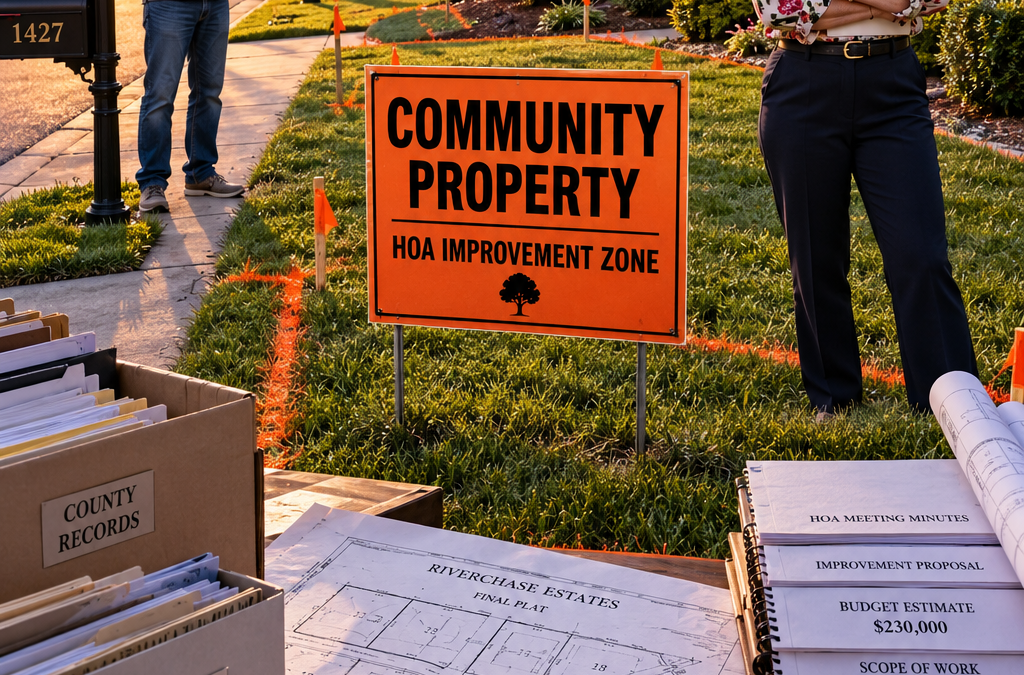
The sign appeared on a Tuesday morning in April.
Bright orange.
About four feet wide.
Driven into the ground near the edge of my lawn.
COMMUNITY PROPERTY
CREST HAVEN STREETSCAPE IMPROVEMENT ZONE
AUTHORIZED HOA PROJECT AREA
NO PRIVATE ALTERATIONS
I stood in my driveway reading it while holding a cup of coffee.
At first, I thought someone had made a mistake.
My lot extended all the way to the curb except for the ordinary public right-of-way associated with the street.
There was no HOA-owned strip through my front yard.
No shared landscaping easement.
No common parcel.
I knew that because I’d reviewed the original plat years earlier.
I walked to the sign.
Pulled one metal stake halfway out.
Then stopped.
Something about the wording bothered me.
Community property.
Not construction notice.
Not landscaping work.
Community property.
They weren’t asking for temporary access.
They were claiming ownership or control.
I left the sign where it was.
By Wednesday morning, a surveyor was standing in my yard.
Tripod.
Measuring rod.
Orange flags.
He had already marked two points near my driveway when I stepped outside.
“Morning.”
He glanced at me.
“Morning.”
“What are you doing?”
“Survey work.”
“I can see that.”
He adjusted the instrument.
“Who hired you?”
“Crest Haven association.”
“For what?”
“You’ll need to speak with the board.”
“This is my property.”
He reached into his vest and handed me a business card.
His name was Logan Pierce.
Licensed surveyor.
A company from two counties over.
“What’s being surveyed?”
“I’m contracted to stake the improvement corridor.”
“What improvement corridor?”
He hesitated.
Then pointed toward the orange sign.
“That.”
“That sign showed up yesterday.”
He looked uncomfortable.
“I’m just working from the plans I was given.”
“Plans based on what boundary?”
Again, hesitation.
“Ten feet from the current street edge.”
“Across private lots?”
“I don’t make the legal determination.”
“Then who does?”
“Board counsel, I assume.”
I stared at him.
He lowered his eyes to his equipment.
“I really do need to keep moving.”
That dismissal irritated me more than it should have.
Not because Logan was rude.
He wasn’t.
Because it was suddenly obvious that decisions had already been made.
My property was in motion.
Surveyed.
Staked.
Scheduled.
And somehow I was the last person being told.
I called the number on Logan’s card.
Voicemail.
I called the HOA management office.
A receptionist transferred me to a general mailbox.
I left a message.
I sent an email.
Auto-response.
“Your inquiry has been received and will be reviewed within five to seven business days.”
Five to seven business days.
There were stakes in my yard.
I tried Petra directly.
No answer.
The next board meeting was Thursday night.
I attended.
I hadn’t been inside the clubhouse meeting room in almost two years.
The space felt different.
New projector.
New board table.
Name plates.
Printed agendas arranged in neat stacks.
About twenty residents sat in folding chairs.
I took one in the back.
Petra sat in the middle of the board table.
Gray blazer.
White blouse.
Short silver hair.
Reading glasses resting low on her nose.
She worked through the agenda efficiently.
Pool maintenance.
Reserve study.
Tree replacement.
Parking enforcement.
Then came capital improvements.
Petra clicked the remote.
A rendering appeared on the screen.
Crest Haven Circle Streetscape Renewal.
Decorative pavers.
Low landscape walls.
Integrated irrigation.
LED path lighting.
New ornamental grasses.
Continuous planting beds extending along the fronts of fourteen properties.
Estimated project cost:
$230,000.
I stared at the rendering.
One of those properties was mine.
My lawn had been digitally transformed into a public landscaping strip.
I raised my hand.
Petra saw me.
“Darien.”
“What is this?”
She smiled politely.
“The streetscape project.”
“I gathered that.”
A few people turned.
“Why is ten feet of my property shown as part of it?”
Petra folded her hands.
“All affected parcels were notified.”
“I wasn’t.”
“You were.”
“I received nothing.”
She looked down at a folder.
“Certified notice was sent to your address on January eighteenth.”
“I never signed for a certified letter.”
“That is not required for notice under the revised bylaws.”
My jaw tightened.
“You didn’t answer my question. Why is my property included?”
She clicked to another slide.
A diagram showed a highlighted strip running across several lots.
“Fourteen months ago, the association approved a bylaw amendment allowing the first ten feet of designated frontage parcels to be classified as a shared aesthetic corridor where necessary for continuity of community improvements.”
I stared at the screen.
“Classified by who?”
“The board, subject to notice.”
“You’re calling privately deeded land community property?”
“No.”
“Your sign does.”
“The sign is operational language for the contractor.”
“The sign says community property.”
Petra gave the smallest shrug.
“I can review the wording.”
“You can remove the sign.”
“The project has already been approved.”
“By the property owners?”
“By the association.”
“You don’t own my front yard.”
There was a pause.
Everyone in the room was listening now.
Petra maintained that calm expression.
“Darien, you helped form this HOA. You understand that association governance requires residents to accept certain collective decisions.”
I almost laughed.
“I understand exactly what I helped form.”
“Then you should also understand that the amendment went through the required voting process.”
“I never saw it.”
“You were notified.”
“I wasn’t.”
She tilted her head.
“We have the certified-mail record.”
“I did not receive the letter.”
“That’s not our problem.”
The room changed.
Not dramatically.
But I saw two people look at each other.
Petra seemed to realize the sentence had come out harsher than intended.
She softened her voice.
“What I mean is, the association complied with its notice obligation. We cannot be responsible when a resident fails to collect certified correspondence.”
I felt heat rise into my face.
“When does work begin?”
“Nine days.”
“You’re planning to excavate my yard in nine days.”
“Within the designated corridor.”
“Which is my yard.”
“Which is subject to the amended classification.”
I looked at the board members.
None met my eyes.
That told me something.
Either they believed Petra completely, or they had never considered the legal mechanics of what they had approved.
I stood.
“Send me everything.”
Petra frowned.
“Everything?”
“The amendment. Vote minutes. Notice records. Surveys. Contractor plans. Legal opinion. Every document supporting your claim that the HOA can reclassify my land.”
“Some materials may be privileged.”
“Then send what isn’t.”
She smiled again.
“Submit a records request.”
I stared at her.
“Fine.”
Then I left.
At home, I pulled out two years of mail.
I keep more paper than most people.
Old habit.
Boxes organized by year.
Tax documents.
Insurance.
HOA packets.
Utility notices.
I went through everything.
One envelope at a time.
Nothing.
Then I found the little postal notice card.
Pink and white.
CERTIFIED MAIL ATTEMPTED.
It had been buried beneath grocery coupons and advertising flyers.
January nineteenth.
I remembered seeing it.
Vaguely.
At the time, I had assumed it was something unimportant because the sender line was poorly printed and looked promotional.
I never went to the post office.
A second delivery attempt had been made.
Then the letter was returned after fifteen days.
I sat at the kitchen table holding that card.
Petra was right about one thing.
They had sent notice.
Technically, I had been notified under the HOA’s procedure.
Technically, I had failed to collect it.
I felt stupid.
Not defeated.
Stupid.
I had helped write an association designed to prevent surprises, then ignored the very notice system I had helped create.
For a few minutes, anger turned inward.
I should have watched.
I should have gone to meetings.
I should have read every amendment.
Then I stopped.
Because missing a letter didn’t make ten feet of my property belong to someone else.
That question was bigger.
I logged into the HOA portal.
Downloaded the amendment.
Printed it.
Read it once.
Then again.
The language was careful.
Frontage parcels identified as necessary to “continuous neighborhood design” could be designated as shared aesthetic corridors following proper notice and board approval.
Owners retained fee title.
The HOA received broad improvement rights.
That was bad.
But it wasn’t necessarily enough.
Something was missing.
I could feel it.
I just couldn’t identify what.
So I called my cousin Ranada.
Ranada had been a municipal land-use attorney for twenty-two years.
She had worked in three states.
Zoning disputes.
Subdivision approvals.
Planning commissions.
Easements.
Annexations.
Development agreements.
She was the family member everyone avoided arguing with at Thanksgiving because she never raised her voice and somehow made you feel cross-examined while passing mashed potatoes.
She answered around nine.
“Darien.”
“I have a property problem.”
“How expensive?”
“Potentially two hundred thirty thousand dollars.”
“That sounds more interesting than your usual calls.”
I explained everything.
The sign.
The surveyor.
The amendment.
The certified notice.
The project.
Petra.
Ranada interrupted only twice.
Once to ask whether the HOA claimed title or use rights.
Once to ask whether the street was public or private.
Then I read the amendment word for word.
When I finished, she said nothing.
“Still there?”
“Yes.”
“What?”
“Read the section defining corridor activation.”
I found it.
Read it.
She interrupted.
“Again. Slower.”
I did.
Another silence.
Then:
“They forgot something.”
I sat up.
“What?”
“Maybe.”
“Ranada.”
“Don’t get excited until we verify.”
“What did they forget?”
“The plat.”
I looked toward the file boxes stacked against my wall.
“What about it?”
“If they’re converting a strip of individual residential lots into a formally shared-use improvement corridor, your state’s subdivision statutes may require the change to be reflected by recorded plat amendment or other county-recognized land instrument.”
“They amended the bylaws.”
“Bylaws govern the association.”
She paused.
“They do not necessarily modify the recorded geometry or legally recognized use designation of land.”
I stood without realizing it.
“So the vote isn’t enough?”
“Depends on state law, declaration language, and what exactly they’re claiming.”
She continued.
“But if this is what you say it is, there should be a county filing.”
“I haven’t seen one.”
“Then stop talking and look.”
I did.
County recorder online database.
Subdivision records.
Crest Haven.
Original plat.
Phase amendments.
Utility easements.
Drainage corrections.
Nothing resembling a shared aesthetic corridor.
I called Ranada back forty minutes later.
“No filing.”
“Search by association name.”
“I did.”
“Developer entity.”
“Nothing.”
“Parcel numbers.”
“Nothing.”
She became very quiet.
Then said, “Now we verify with the assessor.”
The next morning, I drove downtown.
Not because I had to.
Most records were online.
But I wanted paper.
The assessor’s office smelled like old carpet and printer toner.
A woman named Elise Monroe helped me.
I gave her my parcel number.
Asked whether any recorded document affected the front ten feet.
She searched.
“No.”
“Any amendment converting it to shared use?”
“No.”
“Any revised subdivision plat in the last eighteen months?”
She looked again.
“Not for this section.”
I showed her the HOA document.
Her eyebrows rose.
“Where did this come from?”
“My HOA.”
She read the relevant paragraph.
“This isn’t recorded.”
“I know.”
“Have they started work?”
“Survey stakes are already in.”
She looked at me over the paper.
“Do they have permits?”
“That’s my next question.”
She copied the document.
“Leave this with me.”
I went next to county building and development.
Filed a written inquiry.
Property boundary.
Project permit.
Subdivision consistency.
I did not accuse Petra of anything.
That mattered.
I simply asked whether construction could legally proceed across private parcels based on an unrecorded HOA bylaw amendment.
Then I went home.
I did not call Petra.
Did not email the board.
Did not post anything online.
The old Darien—the man who attended every early HOA meeting—would have confronted them immediately.
But eleven years of operations work had taught me something.
If a process is about to fail on its own, don’t rescue the people who designed it badly.
Let the process reach the checkpoint.
The contractor arrived nine days later.
Seven-thirty in the morning.
Two trucks.
Mini excavator.
Pallets of pavers.
Stacks of irrigation pipe.
A trailer carrying compact construction equipment.
Workers set cones along the curb.
By eight, Petra was walking the street.
Clipboard in hand.
Reflective safety vest over a navy shirt.
She looked happier than I had ever seen her.
She pointed toward my yard.
The survey flags marked a line ten feet back from the curb.
I stood on my porch with coffee.
Petra noticed me.
She crossed the street.
“Morning, Darien.”
“Petra.”
“We’ll try to minimize disruption.”
“Appreciated.”
She seemed surprised.
“I know you had concerns.”
“I still do.”
“The board’s position hasn’t changed.”
“Neither has mine.”
She looked toward the sign.
“You haven’t removed it.”
“No.”
“Good.”
I almost smiled.
“You starting excavation today?”
“Initial prep.”
“All fourteen lots?”
“Yes.”
“Interesting.”
Her eyes narrowed.
“What does that mean?”
“Nothing.”
I took a sip of coffee.
“Hope it goes smoothly.”
She stared at me.
She knew something was wrong.
People who depend on resistance become nervous when resistance disappears.
“Have you hired counsel?”
“No.”
That was technically true.
Ranada had advised me as family, not formally represented me.
“Then what are you planning?”
“To drink my coffee.”
I turned toward the door.
Petra called after me.
“Darien.”
I looked back.
“This project was approved properly.”
“If you say so.”
Her jaw tightened.
I went inside.
Day one consisted mostly of staging.
Workers marked utilities.
Removed small sections of sod near the common entrance.
Set material piles.
Nothing significant happened on my property.
That evening, one of my neighbors, Thomas Keene, came over.
His lot was included too.
“You fighting this?”
“Maybe.”
He looked toward the orange sign.
“My wife wants me to let it go.”
“What do you want?”
He sighed.
“I don’t care about the plants. I care that nobody asked.”
“Did you get the certified notice?”
“Yeah. I signed for it.”
“And?”
“I thought it was another landscaping vote. Didn’t understand they meant my actual lawn.”
I nodded.
“That’s the problem.”
Thomas lowered his voice.
“I heard you know something.”
“Who told you that?”
“Petra asked if I’d heard from you.”
That made me smile.
“Then Petra knows I know something.”
“What?”
“Go home, Thomas.”
He stared at me.
“You are annoying.”
“I’ve been told.”
“What happens tomorrow?”
“I genuinely don’t know.”
I did know something was coming.
I just didn’t know how quickly.
At eight-thirteen the next morning, a white county vehicle parked near the contractor’s trailer.
A building inspector got out.
At eight-twenty, a second county vehicle arrived.
Another inspector.
At eight-thirty-one, a dark sedan pulled in.
Elise Monroe stepped out.
Gray blazer.
Leather folder.
County assessor’s office.
I watched through the front window.
Petra walked toward them.
Even from fifty yards away, I could see the confidence in her posture.
Then the first inspector showed her a document.
Her shoulders changed.
The contractor superintendent joined them.
More papers.
Pointing toward stakes.
Pointing toward plans.
Elise opened the folder.
The conversation lasted about fifteen minutes.
Then the superintendent waved both hands over his head.
Workers stopped.
The excavator shut down.
By eight-fifty-five, not a single machine was moving.
At nine-oh-three, one inspector attached a bright notice to the contractor’s temporary board.
WORK SUSPENDED PENDING PROPERTY AND PLAT VERIFICATION.
Forty minutes.
That’s how long it took.
$230,000.
Fourteen lots.
Months of planning.
Stopped in forty minutes.
I was on the porch when Petra came toward my house.
She walked quickly.
No clipboard.
No safety vest.
Her face was composed.
Her hands weren’t.
I could see them shaking.
She came up the walkway.
“You called them.”
“I filed an inquiry.”
“You called the county.”
“Yes.”
“Why didn’t you come to the board first?”
I looked at her.
“I did.”
She stopped.
“You told me it wasn’t your problem.”
Her mouth tightened.
“This is different.”
“Is it?”
“You’ve caused a project shutdown.”
“No.”
I took a sip of coffee.
“The county caused a project shutdown.”
“Because of your complaint.”
“Inquiry.”
“Don’t play games.”
“I’m not.”
She stepped closer.
“You know exactly what you’ve done.”
“Asked whether the HOA had recorded the land-use change.”
Her face went still.
There.
That was the moment she knew.
I continued.
“They hadn’t.”
Petra stared at me.
“The bylaws were amended.”
“Yes.”
“The membership approved the amendment.”
“Yes.”
“The board acted within its authority.”
“Maybe inside the HOA.”
I pointed toward my yard.
“But this is land.”
She said nothing.
“Remember the original plat?”
“I am familiar with it.”
“Then you know the first ten feet of this lot never became common area.”
“We aren’t claiming ownership.”
“Your sign literally says community property.”
“Operational wording.”
“Your contractor was preparing to excavate private parcels under a corridor classification that doesn’t appear anywhere in county land records.”
“The county can update the record.”
“After the fact?”
“Administrative corrections happen.”
“Maybe.”
I nodded toward the silent excavator.
“Apparently not while the project is active.”
Her hands tightened.
“You have just cost this neighborhood two hundred thirty thousand dollars.”
“No.”
My voice stayed quiet.
“Your board did that when it skipped the filing.”
“We didn’t skip anything.”
“Then show the inspector the recorded plat amendment.”
She said nothing.
That was enough.
I opened the front door.
“Darien.”
I looked back.
“You’re enjoying this.”
“No.”
And I meant it.
“I would have preferred you never put the sign in my yard.”
Then I went inside.
The project didn’t resume that day.
Or the next.
The county requested documentation.
Recorded land instruments.
Owner acknowledgments where required.
Updated plat.
Permit corrections.
The HOA provided what it had.
It wasn’t enough.
The worst problem wasn’t the construction delay.
It was the grant.
I hadn’t known about that part initially.
The $230,000 project wasn’t being paid entirely from HOA reserves.
A municipal neighborhood-improvement grant covered most of it.
The grant had conditions.
Construction had to begin during a defined window.
A certain percentage of work had to be completed by a milestone date.
The county shutdown froze everything before that milestone.
Petra tried to get an extension.
Denied.
She argued the delay was administrative.
The grant office said eligibility required proper project authorization before commencement.
She tried again.
Denied.
By the end of the month, the funding expired.
Gone.
Not postponed.
Not transferred.
Gone.
I didn’t freeze a bank account.
I didn’t touch the HOA’s money.
But one unanswered filing question froze the project long enough to kill the funding behind it.
That was what I had meant when I thought about stopping every dollar.
Not revenge.
Procedure.
The same weapon Petra had pointed at me.
Only this time, procedure was being applied correctly.
The neighborhood exploded.
Some residents blamed Petra.
Some blamed the board.
A few blamed me.
One man knocked on my door and said his property value would suffer because I had killed the improvement.
I asked him whether he’d be comfortable giving ten feet of his backyard to the HOA without a recorded agreement.
He said that was different.
I asked how.
He left.
Thomas Keene came over with beer.
“You cost us two hundred thirty grand.”
“I didn’t.”
“I know.”
He handed me one bottle.
“But saying it that way is funnier.”
We sat on my porch.
The orange sign was gone.
Contractor removed it after the stop-work order.
Thomas looked at the empty patch.
“You really helped write the original bylaws?”
“Yes.”
“Why’d you stop paying attention?”
“Life.”
“Good answer.”
“Bad excuse.”
He nodded.
“Fair.”
Then he asked, “Did you know this would happen?”
“No.”
“Come on.”
“I knew the county would have a problem with the plat.”
“The grant?”
“Had no idea.”
He whistled.
“Petra must hate you.”
“I think Petra hates missing paperwork more.”
Three board members resigned within a week.
Not because the project failed alone.
Because the failure forced residents to examine everything.
Meeting records.
Amendments.
Budget decisions.
Legal expenses.
It turned out Petra had centralized more authority than most people realized.
She had pushed projects through quickly.
Used committees as informal approval channels.
Relied heavily on management-company templates.
Nothing criminal.
Nothing spectacular.
Just bad governance disguised as efficiency.
That was almost worse.
A dramatic scandal is easy to reject.
Bad process can survive for years because every individual shortcut looks harmless.
Petra did not resign immediately.
She stayed president another two months.
I think that surprised everyone.
It didn’t surprise me.
People like Petra don’t walk away while they still believe they can restore order.
She called special meetings.
Hired outside counsel.
Attempted to salvage portions of the project.
Proposed a new vote.
But the neighborhood had changed.
People started reading.
That was fatal to her style of leadership.
Residents who had never attended meetings began showing up.
They asked why the amendment had not triggered a plat review.
They asked who authorized the contractor before county confirmation.
They asked why certified notices had been treated as consent.
They asked why the project plans labeled private property as HOA-controlled space.
Petra answered every question.
Carefully.
Technically.
But the answers no longer carried the same authority.
Once people realize the expert can be wrong, expertise stops being a shield.
The decisive meeting came in June.
The clubhouse was standing-room only.
Petra sat at the front.
I sat in the third row.
I had no intention of speaking.
Then she put my name on the screen.
Under a slide titled:
CAUSES OF PROJECT FAILURE.
Item three:
Owner-initiated county challenge.
A murmur went through the room.
I leaned back.
Thomas whispered beside me.
“She really did it.”
Petra explained the timeline.
Grant award.
Design.
Bidding.
Owner notification.
Construction mobilization.
Then:
“On the second day of construction, one affected owner filed a challenge that triggered county review.”
I raised my hand.
She saw me.
For a moment, I thought she would ignore it.
Then:
“Darien.”
I stood.
“Was the plat amendment recorded before construction?”
Petra’s expression hardened.
“We have discussed this.”
“I’m asking yes or no.”
“This is not a hearing.”
“Then don’t put my name in your explanation.”
Applause.
Petra waited until it stopped.
“The association relied on counsel’s interpretation that the recorded declaration and approved amendment were sufficient.”
“Was the plat amendment recorded?”
“No.”
There it was.
I nodded.
“Thank you.”
I started to sit.
Petra said, “But that omission could have been cured.”
I remained standing.
“Before construction?”
“Potentially.”
“But it wasn’t.”
“No.”
“And the county stopped work because the project’s land basis hadn’t been properly recorded.”
“Among other technical concerns.”
“Then I didn’t cause the problem.”
“You triggered the review.”
“I asked the county if your paperwork was complete.”
“Knowing it might halt construction.”
“Yes.”
The room went quiet.
I looked directly at her.
“Because you were preparing to dig up my property.”
Her face tightened.
“I had nine days.”
No one moved.
“Nine days from the meeting where you told me the front ten feet of land I legally owned had been reclassified.”
Petra tried to interrupt.
I continued.
“You told me I had been notified. Technically, you were right.”
I looked around the room.
“I missed the certified letter. That’s on me.”
That surprised people.
“But missing a letter doesn’t make an unrecorded land-use change valid.”
I turned back to Petra.
“You had fourteen months after that amendment passed.”
Silence.
“Fourteen months to check the plat.”
More silence.
“You had engineers.”
“You had counsel.”
“You hired a surveyor.”
“You hired a contractor.”
“You applied for a $230,000 grant.”
“You designed pavers.”
“Lighting.”
“Irrigation.”
“Planting beds.”
“You printed orange signs declaring private yards community property.”
I paused.
“But nobody walked into the county office and asked whether the legal land record matched the project.”
Petra looked down at her papers.
I said, “That’s not my failure.”
Then I sat.
No applause at first.
Then someone in the back started.
Others joined.
I didn’t feel triumphant.
I felt tired.
That was when I finally understood that this had never really been about ten feet of lawn.
It was about whether process existed to protect people or merely control them.
We had created the HOA years ago because twelve homeowners believed clear rules would keep common obligations fair.
Somewhere along the way, the rules had become tools for forcing compliance instead.
The board called a special election six weeks later.
Petra announced she would not seek another term.
Her resignation statement was professional.
She cited “increasingly adversarial community dynamics” and said she believed new leadership might be more effective.
No apology.
I didn’t expect one.
Three new board members were elected.
Thomas became treasurer, which I found hilarious because he hated spreadsheets.
A woman named Nina Patel became president.
Nina had lived in Crest Haven for twelve years.
Quiet.
Practical.
Civil engineer.
She called me two days after the election.
“Darien?”
“Yes.”
“This is Nina.”
“I know.”
“Do you have time to meet?”
“About what?”
“The original bylaws.”
I laughed.
“I’m not coming back on the board.”
“I didn’t ask you to.”
“You were going to.”
“I was going to ask if you’d sit in for three meetings.”
“No vote.”
“No title.”
“No committee.”
“Three meetings.”
“Maybe four.”
“Nina.”
“Three.”
I agreed.
The first meeting felt strange.
I sat at the same side of the room where, eighteen years earlier, twelve homeowners had argued over snow removal and mailbox standards.
Nina had the original bylaws printed in front of her.
So did the new board.
They had questions.
Lots of them.
Why did original language require recorded instruments for certain property actions?
Because Carl Bennett kept saying if it touches land, record it.
Why were owner-notice standards so specific?
Because we wanted people to know before the association interfered with private use.
Why were committee powers originally narrow?
Because committees were supposed to recommend, not govern.
Why had later boards expanded some powers?
Because nobody was watching.
That last answer made the room quiet.
Nina leaned back.
“You include yourself in that?”
“Absolutely.”
She seemed surprised.
“I let this place become something I wouldn’t have voted for.”
Thomas looked at me.
“You didn’t put the sign in your own yard.”
“No.”
“But I stopped attending while rules changed.”
I shrugged.
“Responsibility doesn’t have to be equal to be real.”
That became the principle of the new board.
Not blame.
Responsibility.
They hired independent counsel to review the governing documents.
They created a public online archive of amendments.
No more burying changes inside meeting packets.
Any proposal touching private property required a plain-language summary mailed separately.
Certified notices were still used where appropriate, but ordinary email and portal notices were added too.
Most importantly, any change affecting easements, common-use rights, subdivision geometry, or private-property interests required county verification before board approval became operational.
That last policy didn’t create new law.
It created discipline.
The failed streetscape project never returned in its original form.
A year later, the HOA approved a much smaller improvement.
Only common land.
Entrance median.
Existing HOA-owned strips.
No private front yards.
Cost:
$61,000.
No grant.
No legal fight.
No orange signs.
I voted for it.
That surprised some people.
Petra probably would have thought it proved I’d been unreasonable all along.
It proved the opposite.
I wasn’t against improvement.
I was against taking shortcuts through other people’s property.
There’s a difference.
My front yard remained exactly the same.
The same maple near the sidewalk.
Same walkway.
Same grass.
Same narrow flower bed beneath the front window.
The place where the sign had stood took a few weeks to recover.
Two little holes from the stakes.
A rectangle of flattened grass.
For a while, every morning when I walked out to get the newspaper, my eyes went there automatically.
Community Property.
I could still see the words.
One Saturday, Nina stopped while walking her dog.
She noticed me looking at the spot.
“You miss the sign?”
“Terribly.”
“We could make you another one.”
“I’ll pass.”
She smiled.
Then became serious.
“Can I ask you something?”
“Sure.”
“Why didn’t you warn Petra after you found the plat problem?”
I thought about it.
There were easy answers.
Because she was arrogant.
Because she deserved it.
Because she had told me it wasn’t her problem.
All were partly true.
None was complete.
“Because warning her would have made me responsible for fixing her process.”
Nina frowned slightly.
I continued.
“She had already hired a surveyor. Awarded a contract. Planned construction. Applied for grant money. Staked private yards.”
I pointed toward the street.
“If I had called and said, ‘Hey, you forgot the plat,’ she could have filed whatever she needed, delayed a week, then continued.”
“Maybe.”
“And nobody would have asked why a board was redesignating private property in the first place.”
Nina nodded slowly.
“So you wanted the system to stop it.”
“I wanted the system to examine it.”
“That’s a very lawyer answer for someone who isn’t a lawyer.”
“My cousin is.”
“That explains it.”
She started walking again.
Then turned.
“For what it’s worth, I’m glad you did.”
I watched her go.
I was too.
Not because of the money.
People in the neighborhood kept saying I cost the HOA $230,000.
That wasn’t true.
The grant never became HOA money.
The association lost an opportunity because its project wasn’t ready for the legal scrutiny it should have survived before construction.
But the number became part of the story anyway.
Two hundred thirty thousand dollars.
It sounded dramatic.
What mattered more was ten feet.
Ten feet of lawn.
A tiny distance.
You could cross it in three steps.
But property disputes are rarely about square footage.
They’re about authority.
About whether someone else can point at something you own and say, “We’ve decided how this works now.”
Petra believed a vote converted control into legitimacy.
I believed legitimacy required process.
The county agreed with me.
A few months after she left office, I saw Petra at the grocery store.
Frozen foods aisle.
She had a basket on one arm.
I was comparing two brands of coffee.
We noticed each other at the same time.
For a second, both of us considered pretending we hadn’t.
Then Petra said, “Darien.”
“Petra.”
She looked almost exactly the same.
Gray hair.
Perfect posture.
Controlled expression.
But without the HOA table in front of her, she seemed smaller somehow.
Not weak.
Just ordinary.
“I heard you are advising the new board.”
“Sitting in occasionally.”
She nodded.
“They’re undoing much of what we accomplished.”
“Some of it.”
“You don’t think the neighborhood needed modernization?”
“I think it needed better governance.”
Her jaw tightened.
“That wasn’t my question.”
“No.”
She waited.
I put the coffee into my cart.
“The entrance improvements were fine.”
“The streetscape would’ve been beautiful.”
“Probably.”
That surprised her.
“Then why destroy it?”
I leaned against the cart.
“Do you still think I destroyed it?”
“You knew what would happen when you contacted the county.”
“I knew they might stop work.”
“You knew the grant had deadlines.”
“I didn’t.”
She studied my face as if checking whether I was lying.
I wasn’t.
Then she said, “You could have come to me privately.”
“I did.”
“No. After you found the filing issue.”
“Why?”
“So we could fix it.”
There was the whole conflict in one sentence.
Fix it.
Meaning preserve the project.
Preserve the board’s decision.
Preserve the plan.
Never reconsider whether the plan should have existed.
“Petra, when I came to the meeting, I asked why my land was being used.”
“You had missed the notice.”
“I know.”
“You had a chance to object.”
“Did I?”
She stopped.
“The amendment was already approved.”
“You could have appealed.”
“To the board you controlled.”
“I didn’t control the board.”
“Fine.”
I nodded.
“To the board that had already approved the project.”
She looked away.
I softened my voice.
“You know what bothered me most?”
“The sign?”
“Partly.”
She waited.
“You said it wasn’t your problem.”
Her expression shifted.
Very slightly.
“I don’t remember saying that.”
“I do.”
“I was probably referring to the notice requirement.”
“You were.”
I looked at her.
“But that’s the difference between how you saw the neighborhood and how we created it.”
She crossed her arms.
“How so?”
“When we formed the HOA, the whole point was that another homeowner’s problem should matter if the association caused it.”
She stared at me.
“Rules weren’t supposed to be shields.”
“They were supposed to make things predictable.”
“Exactly.”
“And you made them unpredictable.”
“I disagree.”
“I know.”
We stood there beside frozen vegetables while a store employee pushed a cart behind us.
It was almost absurd.
Then Petra said something I didn’t expect.
“I should have recorded the plat.”
I smiled slightly.
“Yes.”
“I still believe the project was good.”
“I know.”
“I still think you handled it aggressively.”
“I know.”
She looked at me.
“But I should have recorded the plat.”
That was as close to an apology as Petra Cowell was likely to come.
“Yes,” I said again.
She nodded.
Then moved away.
I never spoke to her about the project again.
Years later, when people ask me what happened, they usually expect me to tell it as a victory story.
Homeowner defeats HOA.
Man discovers technicality.
$230,000 project collapses.
President resigns.
That’s accurate.
But it misses the part that matters.
Petra wasn’t wrong because she wanted nicer landscaping.
She was wrong because she began believing good intentions gave her ownership over process.
And I wasn’t right because I found a loophole.
There was no loophole.
There was a requirement.
A boring one.
Recorded plat.
County acknowledgment.
Paperwork most people would never read.
That’s the thing about property rights.
They aren’t usually protected by dramatic speeches.
They’re protected by dull documents.
Stamped pages.
Legal descriptions.
Recorded instruments.
Dates.
Signatures.
People complain that bureaucracy is tedious.
It is.
But sometimes tedium is the wall between your front yard and somebody else’s ambition.
The original Crest Haven bylaws are still in my office.
First draft.
Final version.
Meeting notes.
Carl Bennett’s handwriting in the margin of one page.
IF IT TOUCHES LAND, RECORD IT.
I framed that page after the whole ordeal.
Thomas saw it one afternoon and laughed.
“You framed HOA bylaws?”
“One page.”
“That’s worse.”
“It’s historically important.”
“It’s deeply weird.”
“You’re treasurer of an HOA.”
He stopped laughing.
“Fair.”
The neighborhood is different now.
Better in some ways.
Still ridiculous in others.
We argue about pool hours.
People complain about dogs.
Someone is always angry about parking.
Last year, two residents nearly started a civil war over pickleball noise.
That’s community life.
But nobody on the board assumes a vote alone makes them sovereign.
They ask.
They verify.
They record.
Sometimes meetings take longer because of it.
Good.
Power should be inconvenient.
Especially when it reaches across a property line.
I still live in the same house.
The maple tree in front is much larger now.
Its roots have lifted part of the walkway, which I keep meaning to repair.
The HOA hasn’t cited me yet.
If they do, I’ll probably deserve it.
Every Tuesday morning, I roll my trash bins to the curb.
Every Wednesday, I pull them back.
I mow.
Trim the hedges.
Replace flowers when they die.
Ordinary things.
Sometimes I stand near the place where that orange sign once sat.
No marker remains.
No plaque.
No evidence.
Just grass.
Ten feet of grass.
And every time I think about how close I came to waking up one morning to excavators cutting through it, I remember something my father used to say.
“People rarely take everything at once.”
He meant money.
Time.
Respect.
Anything valuable.
“They take a little, then wait to see if you notice.”
Ten feet wasn’t much.
Not on a map.
But if I had allowed ten feet to become “community property” because the board found paperwork inconvenient, what would the next board have learned?
That notice was enough.
That a bylaw could substitute for land records.
That private ownership was flexible if a project sounded beneficial.
That residents who missed a letter had forfeited more than a deadline.
That was worth stopping.
Even if the price looked outrageous on paper.
Petra thought I wanted revenge.
Some neighbors did too.
They were wrong.
If I had wanted revenge, I would have tried to embarrass her.
I didn’t.
I filed an inquiry.
The county did the rest.
That’s what I meant when I told Nina I wanted the system to examine the project.
Systems are boring until you need one.
Then boring becomes beautiful.
The next generation of Crest Haven homeowners probably won’t know my name.
They won’t know Petra’s.
They won’t know there was once a $230,000 streetscape plan.
They won’t know an orange sign stood in my yard.
They may never read the original bylaws.
That’s fine.
If we’ve done our job correctly, they shouldn’t need to know the story.
They’ll simply live in a neighborhood where the HOA checks the deed before it touches private land.
Where shared areas are actually recorded as shared.
Where notices are clear.
Where one board president cannot turn a design preference into a property right.
That’s enough.
I helped build Crest Haven once when I was thirty-two.
I thought that meant writing rules.
I was wrong.
Building something means maintaining it.
Watching it.
Correcting it when it drifts.
Sometimes rebuilding parts of it when people forget why they existed.
Eleven years of stepping back taught me that.
One orange sign reminded me.
The sign said community property.
The deed said otherwise.
The county record said otherwise.
And in the end, that was the only language that mattered.
My yard stayed mine.
The project disappeared.
The board changed.
The neighborhood learned to read the documents it voted on.
And every morning, when I step outside and cross those same ten feet of grass on the way to the mailbox, there is no sign telling me who owns it.
There doesn’t need to be.
The record already does.
𝗧𝗛𝗘 𝗘𝗡𝗗
The HOA Planted a “Community Property” Sign in My Front Yard, Never Realizing I Had Helped Write the Rule They Forgot to Follow
The orange sign appeared in my front yard before sunrise, declaring ten feet of land I had owned for nearly two decades an “HOA Improvement Zone” as though a piece of plastic and two metal stakes could rewrite my deed.
What Petra Cowell didn’t know was that I had spent eleven years keeping every plat, amendment, meeting packet, and county filing connected to Crest Haven Circle—and when I finally opened those boxes, I found the one mistake that could stop every dollar of her $230,000 project.
My name is Darien Wolf, and I bought my house on Crest Haven Circle back when Crest Haven wasn’t really a neighborhood yet.
It was an idea.
Twelve houses.
A half-finished road.
Stacks of lumber.
Bare dirt.
Orange survey flags snapping in the wind.
Young maple trees held upright by stakes because their roots hadn’t yet figured out where home was.
When I signed the papers on my lot, the nearest grocery store was twelve minutes away, and half the streetlights hadn’t been connected.
There was no stone monument at the entrance.
No annual landscaping contract.
No architectural committee.
No HOA.
Just twelve homeowners who had all taken the same gamble that the empty land around us would eventually become something worth living in.
I was thirty-two then.
Single.
Working as an operations analyst for a logistics company.
The house wasn’t fancy, but it was mine.
Three bedrooms.
Brick front.
A little office overlooking the backyard.
A narrow porch.
And a front lawn larger than most of the houses being built farther into the development today.
Back then, I knew every person on Crest Haven Circle by name.
If somebody’s sprinkler line broke, three people came outside.
If a storm knocked down a branch, someone already had a chainsaw running before you found your gloves.
We argued about mailboxes and drainage and where the developer ought to put the entrance sign, but most of those arguments ended with somebody handing somebody else a beer.
The HOA began almost by accident.
Our developer wanted to turn over certain shared maintenance responsibilities.
Entrance landscaping.
A drainage basin.
Two strips of open space.
Snow removal on a private spur road.
Nobody trusted the developer to keep paying forever, so we formed an association.
I was one of the original twelve homeowners who sat around folding tables in a sales office and argued over the first bylaws.
I still remember the smell of printer toner and bad coffee.
We weren’t lawyers.
We weren’t trying to control anybody.
Most of us were simply afraid that if we wrote the rules badly, some future board would become exactly what people hated about HOAs.
So we tried to build guardrails.
We limited board authority.
We required notice.
We required recorded documents for anything affecting title, easements, shared areas, or property boundaries.
One of the men in those meetings, Carl Bennett, had spent years in commercial real estate.
He kept saying the same thing.
“If it touches land, record it.”
Someone would ask whether a vote was enough.
Carl would shake his head.
“If it touches land, record it.”
Eventually it became a joke.
But we wrote the principle into the governing structure.
Changes involving common-use designations or private-property interests needed more than a board vote.
They needed proper documentation.
County recording where required.
Plat consistency.
Notice.
Acknowledgment.
We didn’t want a future board casually redrawing lines because somebody had an idea for prettier landscaping.
Funny how carefully people can build a fence around power and still underestimate how determined someone else might be to climb over it.
For the first four years, I attended almost every HOA meeting.
I served one term as secretary.
I reviewed budgets.
I helped rewrite the landscaping contract.
I once spent three hours arguing that residents should be allowed to park work trucks overnight if those trucks were their primary vehicles.
Then life got busy.
My company expanded.
I started traveling.
My father got sick.
My younger sister went through a divorce.
There were years when I felt like every spare hour already belonged to someone else.
The HOA kept sending packets.
I kept opening them.
Then I started skimming them.
Then some went straight into a drawer.
I told myself the association was mature enough to run without people like me watching every vote.
That was my first mistake.
By the time Petra Cowell became president, almost none of the original board members were involved anymore.
Some had moved.
Some had retired.
Two had died.
One rented out his house and relocated across the country.
The neighborhood had grown from twelve homes to more than one hundred and sixty.
The entrance had stone pillars now.
Decorative lighting.
Seasonal flower beds.
A clubhouse.
Three committees I couldn’t remember authorizing.
The HOA had become an organization rather than a group of neighbors.
And organizations develop appetites.
Petra Cowell understood that better than anyone.
She moved into Crest Haven about six years before she became president.
She was a retired city planner.
That fact mattered.
Petra knew the language of municipal authority.
She knew how to say something ordinary in a way that made it sound inevitable.
She didn’t say she wanted shrubs removed.
She said existing plant massing was inconsistent with the visual hierarchy of the corridor.
She didn’t say someone’s driveway looked messy.
She said the property failed to support neighborhood design coherence.
She didn’t call a fence ugly.
She called it incompatible with the established streetscape vocabulary.
People laughed at her at first.
Then they started getting fines.
Petra became chair of the architectural committee.
Then vice president.
Then president.
By the time she took control, the HOA had shifted from maintaining shared assets to trying to improve what she called the “Crest Haven visual experience.”
That included almost everything visible from a street.
Mismatched shutters.
Basketball hoops.
Cars parked at the curb overnight.
Garden hoses.
Holiday lights installed too early.
Holiday lights removed too late.
Planters that were too large.
Planters that were too colorful.
One family received a warning because their hedges were “visually irregular.”
Another homeowner was fined because his mailbox post had weathered unevenly.
Petra wasn’t cruel in the obvious sense.
She never shouted.
Never insulted anyone directly.
She smiled.
She quoted policy.
She used phrases like “shared expectations.”
That made her harder to fight.
A bully can be confronted.
A bureaucrat makes you fill out a form.
I kept my property clean.
My lawn was maintained.
My house hadn’t changed much in years.
My mailbox matched.
My driveway stayed clear.
I told myself if I gave Petra no reason to notice me, she wouldn’t.
I was wrong.
The sign appeared on a Tuesday morning in April.
Bright orange.
About four feet wide.
Driven into the ground near the edge of my lawn.
COMMUNITY PROPERTY
CREST HAVEN STREETSCAPE IMPROVEMENT ZONE
AUTHORIZED HOA PROJECT AREA
NO PRIVATE ALTERATIONS
I stood in my driveway reading it while holding a cup of coffee.
At first, I thought someone had made a mistake.
My lot extended all the way to the curb except for the ordinary public right-of-way associated with the street.
There was no HOA-owned strip through my front yard.
No shared landscaping easement.
No common parcel.
I knew that because I’d reviewed the original plat years earlier.
I walked to the sign.
Pulled one metal stake halfway out.
Then stopped.
Something about the wording bothered me.
Community property.
Not construction notice.
Not landscaping work.
Community property.
They weren’t asking for temporary access.
They were claiming ownership or control.
I left the sign where it was.
By Wednesday morning, a surveyor was standing in my yard.
Tripod.
Measuring rod.
Orange flags.
He had already marked two points near my driveway when I stepped outside.
“Morning.”
He glanced at me.
“Morning.”
“What are you doing?”
“Survey work.”
“I can see that.”
He adjusted the instrument.
“Who hired you?”
“Crest Haven association.”
“For what?”
“You’ll need to speak with the board.”
“This is my property.”
He reached into his vest and handed me a business card.
His name was Logan Pierce.
Licensed surveyor.
A company from two counties over.
“What’s being surveyed?”
“I’m contracted to stake the improvement corridor.”
“What improvement corridor?”
He hesitated.
Then pointed toward the orange sign.
“That.”
“That sign showed up yesterday.”
He looked uncomfortable.
“I’m just working from the plans I was given.”
“Plans based on what boundary?”
Again, hesitation.
“Ten feet from the current street edge.”
“Across private lots?”
“I don’t make the legal determination.”
“Then who does?”
“Board counsel, I assume.”
I stared at him.
He lowered his eyes to his equipment.
“I really do need to keep moving.”
That dismissal irritated me more than it should have.
Not because Logan was rude.
He wasn’t.
Because it was suddenly obvious that decisions had already been made.
My property was in motion.
Surveyed.
Staked.
Scheduled.
And somehow I was the last person being told.
I called the number on Logan’s card.
Voicemail.
I called the HOA management office.
A receptionist transferred me to a general mailbox.
I left a message.
I sent an email.
Auto-response.
“Your inquiry has been received and will be reviewed within five to seven business days.”
Five to seven business days.
There were stakes in my yard.
I tried Petra directly.
No answer.
The next board meeting was Thursday night.
I attended.
I hadn’t been inside the clubhouse meeting room in almost two years.
The space felt different.
New projector.
New board table.
Name plates.
Printed agendas arranged in neat stacks.
About twenty residents sat in folding chairs.
I took one in the back.
Petra sat in the middle of the board table.
Gray blazer.
White blouse.
Short silver hair.
Reading glasses resting low on her nose.
She worked through the agenda efficiently.
Pool maintenance.
Reserve study.
Tree replacement.
Parking enforcement.
Then came capital improvements.
Petra clicked the remote.
A rendering appeared on the screen.
Crest Haven Circle Streetscape Renewal.
Decorative pavers.
Low landscape walls.
Integrated irrigation.
LED path lighting.
New ornamental grasses.
Continuous planting beds extending along the fronts of fourteen properties.
Estimated project cost:
$230,000.
I stared at the rendering.
One of those properties was mine.
My lawn had been digitally transformed into a public landscaping strip.
I raised my hand.
Petra saw me.
“Darien.”
“What is this?”
She smiled politely.
“The streetscape project.”
“I gathered that.”
A few people turned.
“Why is ten feet of my property shown as part of it?”
Petra folded her hands.
“All affected parcels were notified.”
“I wasn’t.”
“You were.”
“I received nothing.”
She looked down at a folder.
“Certified notice was sent to your address on January eighteenth.”
“I never signed for a certified letter.”
“That is not required for notice under the revised bylaws.”
My jaw tightened.
“You didn’t answer my question. Why is my property included?”
She clicked to another slide.
A diagram showed a highlighted strip running across several lots.
“Fourteen months ago, the association approved a bylaw amendment allowing the first ten feet of designated frontage parcels to be classified as a shared aesthetic corridor where necessary for continuity of community improvements.”
I stared at the screen.
“Classified by who?”
“The board, subject to notice.”
“You’re calling privately deeded land community property?”
“No.”
“Your sign does.”
“The sign is operational language for the contractor.”
“The sign says community property.”
Petra gave the smallest shrug.
“I can review the wording.”
“You can remove the sign.”
“The project has already been approved.”
“By the property owners?”
“By the association.”
“You don’t own my front yard.”
There was a pause.
Everyone in the room was listening now.
Petra maintained that calm expression.
“Darien, you helped form this HOA. You understand that association governance requires residents to accept certain collective decisions.”
I almost laughed.
“I understand exactly what I helped form.”
“Then you should also understand that the amendment went through the required voting process.”
“I never saw it.”
“You were notified.”
“I wasn’t.”
She tilted her head.
“We have the certified-mail record.”
“I did not receive the letter.”
“That’s not our problem.”
The room changed.
Not dramatically.
But I saw two people look at each other.
Petra seemed to realize the sentence had come out harsher than intended.
She softened her voice.
“What I mean is, the association complied with its notice obligation. We cannot be responsible when a resident fails to collect certified correspondence.”
I felt heat rise into my face.
“When does work begin?”
“Nine days.”
“You’re planning to excavate my yard in nine days.”
“Within the designated corridor.”
“Which is my yard.”
“Which is subject to the amended classification.”
I looked at the board members.
None met my eyes.
That told me something.
Either they believed Petra completely, or they had never considered the legal mechanics of what they had approved.
I stood.
“Send me everything.”
Petra frowned.
“Everything?”
“The amendment. Vote minutes. Notice records. Surveys. Contractor plans. Legal opinion. Every document supporting your claim that the HOA can reclassify my land.”
“Some materials may be privileged.”
“Then send what isn’t.”
She smiled again.
“Submit a records request.”
I stared at her.
“Fine.”
Then I left.
At home, I pulled out two years of mail.
I keep more paper than most people.
Old habit.
Boxes organized by year.
Tax documents.
Insurance.
HOA packets.
Utility notices.
I went through everything.
One envelope at a time.
Nothing.
Then I found the little postal notice card.
Pink and white.
CERTIFIED MAIL ATTEMPTED.
It had been buried beneath grocery coupons and advertising flyers.
January nineteenth.
I remembered seeing it.
Vaguely.
At the time, I had assumed it was something unimportant because the sender line was poorly printed and looked promotional.
I never went to the post office.
A second delivery attempt had been made.
Then the letter was returned after fifteen days.
I sat at the kitchen table holding that card.
Petra was right about one thing.
They had sent notice.
Technically, I had been notified under the HOA’s procedure.
Technically, I had failed to collect it.
I felt stupid.
Not defeated.
Stupid.
I had helped write an association designed to prevent surprises, then ignored the very notice system I had helped create.
For a few minutes, anger turned inward.
I should have watched.
I should have gone to meetings.
I should have read every amendment.
Then I stopped.
Because missing a letter didn’t make ten feet of my property belong to someone else.
That question was bigger.
I logged into the HOA portal.
Downloaded the amendment.
Printed it.
Read it once.
Then again.
The language was careful.
Frontage parcels identified as necessary to “continuous neighborhood design” could be designated as shared aesthetic corridors following proper notice and board approval.
Owners retained fee title.
The HOA received broad improvement rights.
That was bad.
But it wasn’t necessarily enough.
Something was missing.
I could feel it.
I just couldn’t identify what.
So I called my cousin Ranada.
Ranada had been a municipal land-use attorney for twenty-two years.
She had worked in three states.
Zoning disputes.
Subdivision approvals.
Planning commissions.
Easements.
Annexations.
Development agreements.
She was the family member everyone avoided arguing with at Thanksgiving because she never raised her voice and somehow made you feel cross-examined while passing mashed potatoes.
She answered around nine.
“Darien.”
“I have a property problem.”
“How expensive?”
“Potentially two hundred thirty thousand dollars.”
“That sounds more interesting than your usual calls.”
I explained everything.
The sign.
The surveyor.
The amendment.
The certified notice.
The project.
Petra.
Ranada interrupted only twice.
Once to ask whether the HOA claimed title or use rights.
Once to ask whether the street was public or private.
Then I read the amendment word for word.
When I finished, she said nothing.
“Still there?”
“Yes.”
“What?”
“Read the section defining corridor activation.”
I found it.
Read it.
She interrupted.
“Again. Slower.”
I did.
Another silence.
Then:
“They forgot something.”
I sat up.
“What?”
“Maybe.”
“Ranada.”
“Don’t get excited until we verify.”
“What did they forget?”
“The plat.”
I looked toward the file boxes stacked against my wall.
“What about it?”
“If they’re converting a strip of individual residential lots into a formally shared-use improvement corridor, your state’s subdivision statutes may require the change to be reflected by recorded plat amendment or other county-recognized land instrument.”
“They amended the bylaws.”
“Bylaws govern the association.”
She paused.
“They do not necessarily modify the recorded geometry or legally recognized use designation of land.”
I stood without realizing it.
“So the vote isn’t enough?”
“Depends on state law, declaration language, and what exactly they’re claiming.”
She continued.
“But if this is what you say it is, there should be a county filing.”
“I haven’t seen one.”
“Then stop talking and look.”
I did.
County recorder online database.
Subdivision records.
Crest Haven.
Original plat.
Phase amendments.
Utility easements.
Drainage corrections.
Nothing resembling a shared aesthetic corridor.
I called Ranada back forty minutes later.
“No filing.”
“Search by association name.”
“I did.”
“Developer entity.”
“Nothing.”
“Parcel numbers.”
“Nothing.”
She became very quiet.
Then said, “Now we verify with the assessor.”
The next morning, I drove downtown.
Not because I had to.
Most records were online.
But I wanted paper.
The assessor’s office smelled like old carpet and printer toner.
A woman named Elise Monroe helped me.
I gave her my parcel number.
Asked whether any recorded document affected the front ten feet.
She searched.
“No.”
“Any amendment converting it to shared use?”
“No.”
“Any revised subdivision plat in the last eighteen months?”
She looked again.
“Not for this section.”
I showed her the HOA document.
Her eyebrows rose.
“Where did this come from?”
“My HOA.”
She read the relevant paragraph.
“This isn’t recorded.”
“I know.”
“Have they started work?”
“Survey stakes are already in.”
She looked at me over the paper.
“Do they have permits?”
“That’s my next question.”
She copied the document.
“Leave this with me.”
I went next to county building and development.
Filed a written inquiry.
Property boundary.
Project permit.
Subdivision consistency.
I did not accuse Petra of anything.
That mattered.
I simply asked whether construction could legally proceed across private parcels based on an unrecorded HOA bylaw amendment.
Then I went home.
I did not call Petra.
Did not email the board.
Did not post anything online.
The old Darien—the man who attended every early HOA meeting—would have confronted them immediately.
But eleven years of operations work had taught me something.
If a process is about to fail on its own, don’t rescue the people who designed it badly.
Let the process reach the checkpoint.
The contractor arrived nine days later.
Seven-thirty in the morning.
Two trucks.
Mini excavator.
Pallets of pavers.
Stacks of irrigation pipe.
A trailer carrying compact construction equipment.
Workers set cones along the curb.
By eight, Petra was walking the street.
Clipboard in hand.
Reflective safety vest over a navy shirt.
She looked happier than I had ever seen her.
She pointed toward my yard.
The survey flags marked a line ten feet back from the curb.
I stood on my porch with coffee.
Petra noticed me.
She crossed the street.
“Morning, Darien.”
“Petra.”
“We’ll try to minimize disruption.”
“Appreciated.”
She seemed surprised.
“I know you had concerns.”
“I still do.”
“The board’s position hasn’t changed.”
“Neither has mine.”
She looked toward the sign.
“You haven’t removed it.”
“No.”
“Good.”
I almost smiled.
“You starting excavation today?”
“Initial prep.”
“All fourteen lots?”
“Yes.”
“Interesting.”
Her eyes narrowed.
“What does that mean?”
“Nothing.”
I took a sip of coffee.
“Hope it goes smoothly.”
She stared at me.
She knew something was wrong.
People who depend on resistance become nervous when resistance disappears.
“Have you hired counsel?”
“No.”
That was technically true.
Ranada had advised me as family, not formally represented me.
“Then what are you planning?”
“To drink my coffee.”
I turned toward the door.
Petra called after me.
“Darien.”
I looked back.
“This project was approved properly.”
“If you say so.”
Her jaw tightened.
I went inside.
Day one consisted mostly of staging.
Workers marked utilities.
Removed small sections of sod near the common entrance.
Set material piles.
Nothing significant happened on my property.
That evening, one of my neighbors, Thomas Keene, came over.
His lot was included too.
“You fighting this?”
“Maybe.”
He looked toward the orange sign.
“My wife wants me to let it go.”
“What do you want?”
He sighed.
“I don’t care about the plants. I care that nobody asked.”
“Did you get the certified notice?”
“Yeah. I signed for it.”
“And?”
“I thought it was another landscaping vote. Didn’t understand they meant my actual lawn.”
I nodded.
“That’s the problem.”
Thomas lowered his voice.
“I heard you know something.”
“Who told you that?”
“Petra asked if I’d heard from you.”
That made me smile.
“Then Petra knows I know something.”
“What?”
“Go home, Thomas.”
He stared at me.
“You are annoying.”
“I’ve been told.”
“What happens tomorrow?”
“I genuinely don’t know.”
I did know something was coming.
I just didn’t know how quickly.
At eight-thirteen the next morning, a white county vehicle parked near the contractor’s trailer.
A building inspector got out.
At eight-twenty, a second county vehicle arrived.
Another inspector.
At eight-thirty-one, a dark sedan pulled in.
Elise Monroe stepped out.
Gray blazer.
Leather folder.
County assessor’s office.
I watched through the front window.
Petra walked toward them.
Even from fifty yards away, I could see the confidence in her posture.
Then the first inspector showed her a document.
Her shoulders changed.
The contractor superintendent joined them.
More papers.
Pointing toward stakes.
Pointing toward plans.
Elise opened the folder.
The conversation lasted about fifteen minutes.
Then the superintendent waved both hands over his head.
Workers stopped.
The excavator shut down.
By eight-fifty-five, not a single machine was moving.
At nine-oh-three, one inspector attached a bright notice to the contractor’s temporary board.
WORK SUSPENDED PENDING PROPERTY AND PLAT VERIFICATION.
Forty minutes.
That’s how long it took.
$230,000.
Fourteen lots.
Months of planning.
Stopped in forty minutes.
I was on the porch when Petra came toward my house.
She walked quickly.
No clipboard.
No safety vest.
Her face was composed.
Her hands weren’t.
I could see them shaking.
She came up the walkway.
“You called them.”
“I filed an inquiry.”
“You called the county.”
“Yes.”
“Why didn’t you come to the board first?”
I looked at her.
“I did.”
She stopped.
“You told me it wasn’t your problem.”
Her mouth tightened.
“This is different.”
“Is it?”
“You’ve caused a project shutdown.”
“No.”
I took a sip of coffee.
“The county caused a project shutdown.”
“Because of your complaint.”
“Inquiry.”
“Don’t play games.”
“I’m not.”
She stepped closer.
“You know exactly what you’ve done.”
“Asked whether the HOA had recorded the land-use change.”
Her face went still.
There.
That was the moment she knew.
I continued.
“They hadn’t.”
Petra stared at me.
“The bylaws were amended.”
“Yes.”
“The membership approved the amendment.”
“Yes.”
“The board acted within its authority.”
“Maybe inside the HOA.”
I pointed toward my yard.
“But this is land.”
She said nothing.
“Remember the original plat?”
“I am familiar with it.”
“Then you know the first ten feet of this lot never became common area.”
“We aren’t claiming ownership.”
“Your sign literally says community property.”
“Operational wording.”
“Your contractor was preparing to excavate private parcels under a corridor classification that doesn’t appear anywhere in county land records.”
“The county can update the record.”
“After the fact?”
“Administrative corrections happen.”
“Maybe.”
I nodded toward the silent excavator.
“Apparently not while the project is active.”
Her hands tightened.
“You have just cost this neighborhood two hundred thirty thousand dollars.”
“No.”
My voice stayed quiet.
“Your board did that when it skipped the filing.”
“We didn’t skip anything.”
“Then show the inspector the recorded plat amendment.”
She said nothing.
That was enough.
I opened the front door.
“Darien.”
I looked back.
“You’re enjoying this.”
“No.”
And I meant it.
“I would have preferred you never put the sign in my yard.”
Then I went inside.
The project didn’t resume that day.
Or the next.
The county requested documentation.
Recorded land instruments.
Owner acknowledgments where required.
Updated plat.
Permit corrections.
The HOA provided what it had.
It wasn’t enough.
The worst problem wasn’t the construction delay.
It was the grant.
I hadn’t known about that part initially.
The $230,000 project wasn’t being paid entirely from HOA reserves.
A municipal neighborhood-improvement grant covered most of it.
The grant had conditions.
Construction had to begin during a defined window.
A certain percentage of work had to be completed by a milestone date.
The county shutdown froze everything before that milestone.
Petra tried to get an extension.
Denied.
She argued the delay was administrative.
The grant office said eligibility required proper project authorization before commencement.
She tried again.
Denied.
By the end of the month, the funding expired.
Gone.
Not postponed.
Not transferred.
Gone.
I didn’t freeze a bank account.
I didn’t touch the HOA’s money.
But one unanswered filing question froze the project long enough to kill the funding behind it.
That was what I had meant when I thought about stopping every dollar.
Not revenge.
Procedure.
The same weapon Petra had pointed at me.
Only this time, procedure was being applied correctly.
The neighborhood exploded.
Some residents blamed Petra.
Some blamed the board.
A few blamed me.
One man knocked on my door and said his property value would suffer because I had killed the improvement.
I asked him whether he’d be comfortable giving ten feet of his backyard to the HOA without a recorded agreement.
He said that was different.
I asked how.
He left.
Thomas Keene came over with beer.
“You cost us two hundred thirty grand.”
“I didn’t.”
“I know.”
He handed me one bottle.
“But saying it that way is funnier.”
We sat on my porch.
The orange sign was gone.
Contractor removed it after the stop-work order.
Thomas looked at the empty patch.
“You really helped write the original bylaws?”
“Yes.”
“Why’d you stop paying attention?”
“Life.”
“Good answer.”
“Bad excuse.”
He nodded.
“Fair.”
Then he asked, “Did you know this would happen?”
“No.”
“Come on.”
“I knew the county would have a problem with the plat.”
“The grant?”
“Had no idea.”
He whistled.
“Petra must hate you.”
“I think Petra hates missing paperwork more.”
Three board members resigned within a week.
Not because the project failed alone.
Because the failure forced residents to examine everything.
Meeting records.
Amendments.
Budget decisions.
Legal expenses.
It turned out Petra had centralized more authority than most people realized.
She had pushed projects through quickly.
Used committees as informal approval channels.
Relied heavily on management-company templates.
Nothing criminal.
Nothing spectacular.
Just bad governance disguised as efficiency.
That was almost worse.
A dramatic scandal is easy to reject.
Bad process can survive for years because every individual shortcut looks harmless.
Petra did not resign immediately.
She stayed president another two months.
I think that surprised everyone.
It didn’t surprise me.
People like Petra don’t walk away while they still believe they can restore order.
She called special meetings.
Hired outside counsel.
Attempted to salvage portions of the project.
Proposed a new vote.
But the neighborhood had changed.
People started reading.
That was fatal to her style of leadership.
Residents who had never attended meetings began showing up.
They asked why the amendment had not triggered a plat review.
They asked who authorized the contractor before county confirmation.
They asked why certified notices had been treated as consent.
They asked why the project plans labeled private property as HOA-controlled space.
Petra answered every question.
Carefully.
Technically.
But the answers no longer carried the same authority.
Once people realize the expert can be wrong, expertise stops being a shield.
The decisive meeting came in June.
The clubhouse was standing-room only.
Petra sat at the front.
I sat in the third row.
I had no intention of speaking.
Then she put my name on the screen.
Under a slide titled:
CAUSES OF PROJECT FAILURE.
Item three:
Owner-initiated county challenge.
A murmur went through the room.
I leaned back.
Thomas whispered beside me.
“She really did it.”
Petra explained the timeline.
Grant award.
Design.
Bidding.
Owner notification.
Construction mobilization.
Then:
“On the second day of construction, one affected owner filed a challenge that triggered county review.”
I raised my hand.
She saw me.
For a moment, I thought she would ignore it.
Then:
“Darien.”
I stood.
“Was the plat amendment recorded before construction?”
Petra’s expression hardened.
“We have discussed this.”
“I’m asking yes or no.”
“This is not a hearing.”
“Then don’t put my name in your explanation.”
Applause.
Petra waited until it stopped.
“The association relied on counsel’s interpretation that the recorded declaration and approved amendment were sufficient.”
“Was the plat amendment recorded?”
“No.”
There it was.
I nodded.
“Thank you.”
I started to sit.
Petra said, “But that omission could have been cured.”
I remained standing.
“Before construction?”
“Potentially.”
“But it wasn’t.”
“No.”
“And the county stopped work because the project’s land basis hadn’t been properly recorded.”
“Among other technical concerns.”
“Then I didn’t cause the problem.”
“You triggered the review.”
“I asked the county if your paperwork was complete.”
“Knowing it might halt construction.”
“Yes.”
The room went quiet.
I looked directly at her.
“Because you were preparing to dig up my property.”
Her face tightened.
“I had nine days.”
No one moved.
“Nine days from the meeting where you told me the front ten feet of land I legally owned had been reclassified.”
Petra tried to interrupt.
I continued.
“You told me I had been notified. Technically, you were right.”
I looked around the room.
“I missed the certified letter. That’s on me.”
That surprised people.
“But missing a letter doesn’t make an unrecorded land-use change valid.”
I turned back to Petra.
“You had fourteen months after that amendment passed.”
Silence.
“Fourteen months to check the plat.”
More silence.
“You had engineers.”
“You had counsel.”
“You hired a surveyor.”
“You hired a contractor.”
“You applied for a $230,000 grant.”
“You designed pavers.”
“Lighting.”
“Irrigation.”
“Planting beds.”
“You printed orange signs declaring private yards community property.”
I paused.
“But nobody walked into the county office and asked whether the legal land record matched the project.”
Petra looked down at her papers.
I said, “That’s not my failure.”
Then I sat.
No applause at first.
Then someone in the back started.
Others joined.
I didn’t feel triumphant.
I felt tired.
That was when I finally understood that this had never really been about ten feet of lawn.
It was about whether process existed to protect people or merely control them.
We had created the HOA years ago because twelve homeowners believed clear rules would keep common obligations fair.
Somewhere along the way, the rules had become tools for forcing compliance instead.
The board called a special election six weeks later.
Petra announced she would not seek another term.
Her resignation statement was professional.
She cited “increasingly adversarial community dynamics” and said she believed new leadership might be more effective.
No apology.
I didn’t expect one.
Three new board members were elected.
Thomas became treasurer, which I found hilarious because he hated spreadsheets.
A woman named Nina Patel became president.
Nina had lived in Crest Haven for twelve years.
Quiet.
Practical.
Civil engineer.
She called me two days after the election.
“Darien?”
“Yes.”
“This is Nina.”
“I know.”
“Do you have time to meet?”
“About what?”
“The original bylaws.”
I laughed.
“I’m not coming back on the board.”
“I didn’t ask you to.”
“You were going to.”
“I was going to ask if you’d sit in for three meetings.”
“No vote.”
“No title.”
“No committee.”
“Three meetings.”
“Maybe four.”
“Nina.”
“Three.”
I agreed.
The first meeting felt strange.
I sat at the same side of the room where, eighteen years earlier, twelve homeowners had argued over snow removal and mailbox standards.
Nina had the original bylaws printed in front of her.
So did the new board.
They had questions.
Lots of them.
Why did original language require recorded instruments for certain property actions?
Because Carl Bennett kept saying if it touches land, record it.
Why were owner-notice standards so specific?
Because we wanted people to know before the association interfered with private use.
Why were committee powers originally narrow?
Because committees were supposed to recommend, not govern.
Why had later boards expanded some powers?
Because nobody was watching.
That last answer made the room quiet.
Nina leaned back.
“You include yourself in that?”
“Absolutely.”
She seemed surprised.
“I let this place become something I wouldn’t have voted for.”
Thomas looked at me.
“You didn’t put the sign in your own yard.”
“No.”
“But I stopped attending while rules changed.”
I shrugged.
“Responsibility doesn’t have to be equal to be real.”
That became the principle of the new board.
Not blame.
Responsibility.
They hired independent counsel to review the governing documents.
They created a public online archive of amendments.
No more burying changes inside meeting packets.
Any proposal touching private property required a plain-language summary mailed separately.
Certified notices were still used where appropriate, but ordinary email and portal notices were added too.
Most importantly, any change affecting easements, common-use rights, subdivision geometry, or private-property interests required county verification before board approval became operational.
That last policy didn’t create new law.
It created discipline.
The failed streetscape project never returned in its original form.
A year later, the HOA approved a much smaller improvement.
Only common land.
Entrance median.
Existing HOA-owned strips.
No private front yards.
Cost:
$61,000.
No grant.
No legal fight.
No orange signs.
I voted for it.
That surprised some people.
Petra probably would have thought it proved I’d been unreasonable all along.
It proved the opposite.
I wasn’t against improvement.
I was against taking shortcuts through other people’s property.
There’s a difference.
My front yard remained exactly the same.
The same maple near the sidewalk.
Same walkway.
Same grass.
Same narrow flower bed beneath the front window.
The place where the sign had stood took a few weeks to recover.
Two little holes from the stakes.
A rectangle of flattened grass.
For a while, every morning when I walked out to get the newspaper, my eyes went there automatically.
Community Property.
I could still see the words.
One Saturday, Nina stopped while walking her dog.
She noticed me looking at the spot.
“You miss the sign?”
“Terribly.”
“We could make you another one.”
“I’ll pass.”
She smiled.
Then became serious.
“Can I ask you something?”
“Sure.”
“Why didn’t you warn Petra after you found the plat problem?”
I thought about it.
There were easy answers.
Because she was arrogant.
Because she deserved it.
Because she had told me it wasn’t her problem.
All were partly true.
None was complete.
“Because warning her would have made me responsible for fixing her process.”
Nina frowned slightly.
I continued.
“She had already hired a surveyor. Awarded a contract. Planned construction. Applied for grant money. Staked private yards.”
I pointed toward the street.
“If I had called and said, ‘Hey, you forgot the plat,’ she could have filed whatever she needed, delayed a week, then continued.”
“Maybe.”
“And nobody would have asked why a board was redesignating private property in the first place.”
Nina nodded slowly.
“So you wanted the system to stop it.”
“I wanted the system to examine it.”
“That’s a very lawyer answer for someone who isn’t a lawyer.”
“My cousin is.”
“That explains it.”
She started walking again.
Then turned.
“For what it’s worth, I’m glad you did.”
I watched her go.
I was too.
Not because of the money.
People in the neighborhood kept saying I cost the HOA $230,000.
That wasn’t true.
The grant never became HOA money.
The association lost an opportunity because its project wasn’t ready for the legal scrutiny it should have survived before construction.
But the number became part of the story anyway.
Two hundred thirty thousand dollars.
It sounded dramatic.
What mattered more was ten feet.
Ten feet of lawn.
A tiny distance.
You could cross it in three steps.
But property disputes are rarely about square footage.
They’re about authority.
About whether someone else can point at something you own and say, “We’ve decided how this works now.”
Petra believed a vote converted control into legitimacy.
I believed legitimacy required process.
The county agreed with me.
A few months after she left office, I saw Petra at the grocery store.
Frozen foods aisle.
She had a basket on one arm.
I was comparing two brands of coffee.
We noticed each other at the same time.
For a second, both of us considered pretending we hadn’t.
Then Petra said, “Darien.”
“Petra.”
She looked almost exactly the same.
Gray hair.
Perfect posture.
Controlled expression.
But without the HOA table in front of her, she seemed smaller somehow.
Not weak.
Just ordinary.
“I heard you are advising the new board.”
“Sitting in occasionally.”
She nodded.
“They’re undoing much of what we accomplished.”
“Some of it.”
“You don’t think the neighborhood needed modernization?”
“I think it needed better governance.”
Her jaw tightened.
“That wasn’t my question.”
“No.”
She waited.
I put the coffee into my cart.
“The entrance improvements were fine.”
“The streetscape would’ve been beautiful.”
“Probably.”
That surprised her.
“Then why destroy it?”
I leaned against the cart.
“Do you still think I destroyed it?”
“You knew what would happen when you contacted the county.”
“I knew they might stop work.”
“You knew the grant had deadlines.”
“I didn’t.”
She studied my face as if checking whether I was lying.
I wasn’t.
Then she said, “You could have come to me privately.”
“I did.”
“No. After you found the filing issue.”
“Why?”
“So we could fix it.”
There was the whole conflict in one sentence.
Fix it.
Meaning preserve the project.
Preserve the board’s decision.
Preserve the plan.
Never reconsider whether the plan should have existed.
“Petra, when I came to the meeting, I asked why my land was being used.”
“You had missed the notice.”
“I know.”
“You had a chance to object.”
“Did I?”
She stopped.
“The amendment was already approved.”
“You could have appealed.”
“To the board you controlled.”
“I didn’t control the board.”
“Fine.”
I nodded.
“To the board that had already approved the project.”
She looked away.
I softened my voice.
“You know what bothered me most?”
“The sign?”
“Partly.”
She waited.
“You said it wasn’t your problem.”
Her expression shifted.
Very slightly.
“I don’t remember saying that.”
“I do.”
“I was probably referring to the notice requirement.”
“You were.”
I looked at her.
“But that’s the difference between how you saw the neighborhood and how we created it.”
She crossed her arms.
“How so?”
“When we formed the HOA, the whole point was that another homeowner’s problem should matter if the association caused it.”
She stared at me.
“Rules weren’t supposed to be shields.”
“They were supposed to make things predictable.”
“Exactly.”
“And you made them unpredictable.”
“I disagree.”
“I know.”
We stood there beside frozen vegetables while a store employee pushed a cart behind us.
It was almost absurd.
Then Petra said something I didn’t expect.
“I should have recorded the plat.”
I smiled slightly.
“Yes.”
“I still believe the project was good.”
“I know.”
“I still think you handled it aggressively.”
“I know.”
She looked at me.
“But I should have recorded the plat.”
That was as close to an apology as Petra Cowell was likely to come.
“Yes,” I said again.
She nodded.
Then moved away.
I never spoke to her about the project again.
Years later, when people ask me what happened, they usually expect me to tell it as a victory story.
Homeowner defeats HOA.
Man discovers technicality.
$230,000 project collapses.
President resigns.
That’s accurate.
But it misses the part that matters.
Petra wasn’t wrong because she wanted nicer landscaping.
She was wrong because she began believing good intentions gave her ownership over process.
And I wasn’t right because I found a loophole.
There was no loophole.
There was a requirement.
A boring one.
Recorded plat.
County acknowledgment.
Paperwork most people would never read.
That’s the thing about property rights.
They aren’t usually protected by dramatic speeches.
They’re protected by dull documents.
Stamped pages.
Legal descriptions.
Recorded instruments.
Dates.
Signatures.
People complain that bureaucracy is tedious.
It is.
But sometimes tedium is the wall between your front yard and somebody else’s ambition.
The original Crest Haven bylaws are still in my office.
First draft.
Final version.
Meeting notes.
Carl Bennett’s handwriting in the margin of one page.
IF IT TOUCHES LAND, RECORD IT.
I framed that page after the whole ordeal.
Thomas saw it one afternoon and laughed.
“You framed HOA bylaws?”
“One page.”
“That’s worse.”
“It’s historically important.”
“It’s deeply weird.”
“You’re treasurer of an HOA.”
He stopped laughing.
“Fair.”
The neighborhood is different now.
Better in some ways.
Still ridiculous in others.
We argue about pool hours.
People complain about dogs.
Someone is always angry about parking.
Last year, two residents nearly started a civil war over pickleball noise.
That’s community life.
But nobody on the board assumes a vote alone makes them sovereign.
They ask.
They verify.
They record.
Sometimes meetings take longer because of it.
Good.
Power should be inconvenient.
Especially when it reaches across a property line.
I still live in the same house.
The maple tree in front is much larger now.
Its roots have lifted part of the walkway, which I keep meaning to repair.
The HOA hasn’t cited me yet.
If they do, I’ll probably deserve it.
Every Tuesday morning, I roll my trash bins to the curb.
Every Wednesday, I pull them back.
I mow.
Trim the hedges.
Replace flowers when they die.
Ordinary things.
Sometimes I stand near the place where that orange sign once sat.
No marker remains.
No plaque.
No evidence.
Just grass.
Ten feet of grass.
And every time I think about how close I came to waking up one morning to excavators cutting through it, I remember something my father used to say.
“People rarely take everything at once.”
He meant money.
Time.
Respect.
Anything valuable.
“They take a little, then wait to see if you notice.”
Ten feet wasn’t much.
Not on a map.
But if I had allowed ten feet to become “community property” because the board found paperwork inconvenient, what would the next board have learned?
That notice was enough.
That a bylaw could substitute for land records.
That private ownership was flexible if a project sounded beneficial.
That residents who missed a letter had forfeited more than a deadline.
That was worth stopping.
Even if the price looked outrageous on paper.
Petra thought I wanted revenge.
Some neighbors did too.
They were wrong.
If I had wanted revenge, I would have tried to embarrass her.
I didn’t.
I filed an inquiry.
The county did the rest.
That’s what I meant when I told Nina I wanted the system to examine the project.
Systems are boring until you need one.
Then boring becomes beautiful.
The next generation of Crest Haven homeowners probably won’t know my name.
They won’t know Petra’s.
They won’t know there was once a $230,000 streetscape plan.
They won’t know an orange sign stood in my yard.
They may never read the original bylaws.
That’s fine.
If we’ve done our job correctly, they shouldn’t need to know the story.
They’ll simply live in a neighborhood where the HOA checks the deed before it touches private land.
Where shared areas are actually recorded as shared.
Where notices are clear.
Where one board president cannot turn a design preference into a property right.
That’s enough.
I helped build Crest Haven once when I was thirty-two.
I thought that meant writing rules.
I was wrong.
Building something means maintaining it.
Watching it.
Correcting it when it drifts.
Sometimes rebuilding parts of it when people forget why they existed.
Eleven years of stepping back taught me that.
One orange sign reminded me.
The sign said community property.
The deed said otherwise.
The county record said otherwise.
And in the end, that was the only language that mattered.
My yard stayed mine.
The project disappeared.
The board changed.
The neighborhood learned to read the documents it voted on.
And every morning, when I step outside and cross those same ten feet of grass on the way to the mailbox, there is no sign telling me who owns it.
There doesn’t need to be.
The record already does.








