𝗙𝗨𝗟𝗟 𝗦𝗧𝗢𝗥𝗬 The HOA Locked My Irrigation Gate to Save Their Lawns—Then the Canal District Asked Who Gave Them Permission
𝗣𝗔𝗥𝗧 𝟮
Her eyes narrowed.
“I admitted no wrongdoing.”
“You admitted enough.”
She turned to leave.
I called after her.
“My water turn is tomorrow morning.”
She stopped but didn’t turn around.
“Then I suggest you make other arrangements.”
“There are no other arrangements.”
“That sounds like a farm-management problem.”
Then she climbed back into her white SUV and drove away, leaving dust behind her and a chain on my gate.
For the rest of that day, I watched the field more than I worked it.
I tried not to.
There were always jobs to do on a farm. Equipment to check. Fertilizer records to update. Drip lines to inspect. A broken hinge on the storage shed. A pump motor that had been making a sound I didn’t like.
But my eyes kept going back to the east field.
Melons don’t scream when they need water.
Tomatoes don’t protest.
Alfalfa doesn’t file complaints.
They simply begin to fail.
Slowly at first.
Then all at once.
And across the canal, the HOA sprinklers ran like nothing was wrong.
At noon, I drove along the canal road to see where the water was moving. The flow that should have reached my delivery channel had been held back and partially directed through a private lateral feeding the HOA landscaping project near the entrance.
Not a farm.
Not a food crop.
Grass.
Fresh ornamental grass, shrubs, and decorative trees wrapped around a stone sign that said BRIAR CREEK ESTATES in letters big enough to be seen from the highway.
That was what Karen had chosen over a scheduled agricultural delivery.
I called her.
She answered on the second ring.
“Caleb.”
“Your sprinklers are running.”
“Yes.”
“While my canal is dry.”
“Temporary allocation.”
“By whose authority?”
“The HOA’s.”
“Karen, you’re going to cause crop damage.”
“Don’t threaten me with theatrics.”
“This isn’t theater.”
“You always say that when you want sympathy.”
I closed my eyes.
“Listen to me. My delivery is on the district roster for tomorrow morning. If that gate remains locked, I will call the canal district.”
A pause.
Then she laughed softly.
“Do what you feel you must.”
“You think they approved this?”
“I think the HOA has invested heavily in water infrastructure and has every right to protect that investment.”
“That’s not an answer.”
“It is the only answer you’re getting.”
She hung up.
That evening, I pulled out every irrigation document my family had saved.
My grandfather’s original delivery records.
My father’s updated canal agreement.
District rosters.
Gate numbers.
Annual notices.
Maintenance letters.
Assessment receipts.
Water-turn schedules.
I spread everything across the kitchen table under the yellow light while my wife, Elena, stood beside me with two cups of coffee neither of us drank.
“There,” she said, pointing.
Gate 14C.
My parcel number.
Delivery window.
Duration.
Responsible district.
No HOA name.
No Briar Creek.
No landscaping exception.
No “community lawn priority.”
Nothing.
I found the newest schedule.
My next turn began at 5:30 the following morning.
Water was to be released through Gate 14C for the assigned duration.
Official roster.
Printed.
Timestamped.
Mailed by the canal district.
I sat back.
Elena looked at my face.
“What?”
“They didn’t just misunderstand.”
She nodded slowly.
“They knew?”
“They knew enough not to call the district.”
That was the detail that bothered me most.
If Karen truly believed the HOA had authority, why hadn’t anyone contacted the canal district?
Why put a chain on the gate overnight?
Why not notify me through the district?
Why use an HOA sticker instead of an official lockout tag?
Because she wanted the result before anyone with actual authority could say no.
At 4:47 the next morning, before the sun cleared the eastern trees, I called the canal district dispatch line.
A man named Raymond answered.
“North Valley Canal District.”
“This is Caleb Turner, parcel 2187, Gate 14C.”
“What can I do for you?”
“My gate has been locked.”
A pause.
“Locked by who?”
“The Briar Creek HOA.”
Silence.
Not confusion.
The kind of silence that tells you the person on the other end has just heard something very bad.
Raymond spoke more carefully.
“Did you say the homeowners association locked a district control gate?”
“Yes.”
“Do you have a district notice?”
“No.”
“County notice?”
“No.”
“Emergency maintenance tag?”
“No.”
“Is the district plate still visible?”
“Yes.”
“Is water scheduled to you this morning?”
“According to the roster, yes. 5:30.”
I heard typing.
“Stand by.”
I stood in my kitchen with the phone pressed to my ear while Elena watched me.
Then Raymond came back.
“Mr. Turner, your delivery schedule has not been changed.”
“I know.”
“Do not cut the chain yourself unless directed. We’re sending a field officer.”
“How soon?”
“Within the hour.”
I looked out toward the dark line of the canal.
“Good.”
Raymond’s voice hardened slightly.
“And Mr. Turner?”
“Yes?”
“Take photographs.”
“I already have.”
“Take more.”
The field officer arrived just after sunrise.
His name was Officer Grant Wells.
He drove a white district truck with the seal on the door and a toolbox mounted behind the cab. He was in his fifties, sun-darkened, blunt, and moved like someone who had spent decades around gates, water, and people trying to get more than their share of both.
He stepped out, nodded to me, and went straight to the control plate.
“14C.”
He checked the roster on a tablet.
Then the lock.
Then the chain.
Then the dry canal bed downstream from the gate.
“Who placed it?”
“The HOA.”
He looked at me.
“Who specifically?”
“Karen Whitfield. HOA president.”
As if summoned by her own name, Karen’s white SUV appeared on the road.
She arrived with the same folder as the day before, this time accompanied by a man in khakis and a polo shirt with the logo of the development company that had built Briar Creek’s newest phase.
The developer representative.
Of course.
Karen stepped out like she intended to take command before anyone else could speak.
“Officer, I’m glad you’re here. There’s been unnecessary confusion.”
Officer Wells turned toward her.
“Did you order this gate locked?”
Karen blinked.
Not the opening she wanted.
“The HOA temporarily secured the gate to protect community water needs.”
“Did you order it?”
She hesitated.
“As president, I authorized temporary access control.”
Officer Wells wrote something on his pad.
Karen’s confidence flickered.
“This is being blown out of proportion.”
He pointed toward the lock.
“Do you have district authorization?”
“The HOA has invested in connected landscaping infrastructure.”
“That wasn’t my question.”
Her smile tightened.
“We were advised that because the water passes through our frontage—”
“Did the canal district authorize you to lock Gate 14C?”
Karen looked toward the developer representative.
He cleared his throat.
“We believed there was flexibility in the schedule.”
Officer Wells turned to him.
“Who are you?”
“Adam Cole. Briar Creek Development Group.”
“Did your company lock the gate?”
“No.”
“Did you instruct the HOA to lock it?”
Adam glanced at Karen.
“We discussed the need for uninterrupted water during establishment of the new lawn and planting areas.”
Wells stared at him.
“That also wasn’t my question.”
I could have hugged the man.
Karen jumped in.
“The landscaping project was approved. Residents are paying significant dues. We cannot have brand-new lawns dying because Mr. Turner refuses to cooperate.”
Officer Wells looked toward my field.
Then toward the HOA lawns, still damp and green.
“His farm is on today’s delivery roster.”
Karen waved one hand.
“The roster is outdated.”
“No.”
The word was immediate.
Flat.
Official.
“The roster is current.”
She faltered.
“I mean it doesn’t reflect current community needs.”
“Community needs don’t modify district delivery schedules.”
“The HOA has a water investment.”
“Payment does not rewrite irrigation records.”
Karen’s face hardened.
“You seem determined to take his side.”
Officer Wells looked at her.
“I’m taking the side of the schedule.”
That sentence hung in the air.
The schedule.
Not emotion.
Not status.
Not dues.
Not Karen’s folder.
The schedule.
Officer Wells opened the gate box and examined the control mechanism.
“This is district infrastructure.”
“I understand that,” Karen said sharply.
“I’m not sure you do.”
Her eyes flashed.
“Excuse me?”
He pointed at the chain.
“Private parties don’t lock district control gates.”
“This is not private interference. It’s community management.”
“It’s unauthorized interference.”
The developer representative shifted.
“Officer, perhaps we can find a cooperative solution here.”
“We already have one.”
He tapped the tablet.
“Turner’s scheduled delivery begins now.”
Karen’s voice rose.
“If you release that water, our new landscaping loses establishment flow.”
“Then your plan was built on water you weren’t scheduled to receive.”
Adam said quickly, “We were told there would be shared availability.”
“By whom?”
He looked at Karen again.
She looked away.
Officer Wells noticed.
“Mr. Cole, did the district approve a change to Gate 14C?”
“Not formally.”
“Informally?”
“We had discussions about regional capacity.”
“With who at the district?”
Adam said nothing.
Wells nodded slowly.
“That’s what I thought.”
Karen stepped closer.
“Our residents pay taxes too.”
“So does Mr. Turner.”
“They pay dues.”
“To the HOA, not the canal district delivery roster.”
“They deserve beautiful common areas.”
“And his crops deserve the water assigned to them.”
She laughed bitterly.
“Crops. Always crops. You people act like decorative landscaping doesn’t matter.”
I stepped forward.
“Not more than food.”
She turned on me.
“Don’t pretend this is noble. This is about you refusing to adapt.”
“My family has used this gate for decades.”
“And the community has grown.”
“That doesn’t erase my water turn.”
“The world changes, Caleb.”
“Then file for a change properly.”
Officer Wells looked at Karen.
“He’s right.”
Karen’s face went red.
Wells continued.
“If the HOA wants a change in delivery, lateral use, or allocation priority, it files through the district. It doesn’t place a lock on a control gate overnight.”
“The lock was temporary.”
“It was unauthorized.”
“We planned to remove it.”
“When?”
She didn’t answer.
I knew the answer.
After their lawns were safe.
After my turn was lost.
After damage was done.
After the schedule no longer mattered because the day had passed.
Officer Wells walked to his truck and returned with bolt cutters.
Karen stepped in front of him.
“You cannot simply destroy HOA property.”
He stopped.
Very slowly, he looked at the chain.
Then at her.
“Ma’am, if this chain is on district infrastructure without authorization, it is not staying.”
“We will file a county complaint.”
“You’re free to.”
“Our attorney will hear about this.”
“I’m sure.”
He lifted the bolt cutters.
“Move away from the gate.”
Karen didn’t move.
For one wild second, I thought she might physically block him.
Adam touched her elbow.
“Karen.”
She yanked her arm away.
“This is outrageous.”
Officer Wells did not argue.
He just waited.
Karen finally stepped aside.
The bolt cutters snapped through the chain with a metallic crack that echoed down the dry canal.
That sound was better than music.
The lock fell into the dirt.
Karen flinched as if someone had slapped her.
Officer Wells removed the chain, checked the mechanism, and opened Gate 14C according to the delivery setting.
At first, there was only a low rush behind the structure.
Then water came.
A narrow push.
Then a steady sheet.
Then the canal bed filled and moved.
The dry channel darkened.
Water slid through the delivery route toward my fields, exactly where it was supposed to go, exactly when the roster said it should.
I stood there watching it.
Not celebrating.
Not yet.
Just breathing.
Because farmers learn not to relax until water actually reaches the rows.
Karen stood beside the green HOA lawn, furious and silent.
Officer Wells monitored the flow.
“Delivery restored.”
I nodded.
“Thank you.”
He looked at me.
“Keep records of crop stress and any losses from delay.”
“I will.”
Karen immediately said, “There won’t be losses.”
Wells turned.
“That isn’t your determination.”
She shut her mouth.
Adam tried again.
“Officer, what is the proper process for adjusting future flow to the Briar Creek landscaping project?”
“There is an application procedure. Engineering review. Delivery compatibility. Water rights verification. Scheduling.”
Karen crossed her arms.
“That takes months.”
“Then you should have started months ago.”
I almost smiled.
Officer Wells wasn’t dramatic.
He didn’t need to be.
Every sentence was a shovel of dirt thrown over Karen’s argument.
The developer representative looked genuinely worried now.
Their project had assumed water it didn’t have.
That meant redesign.
Storage.
Separate source.
Different timing.
Maybe expensive changes to the landscaping plan.
Karen had promised lush entrances and green lawns without securing the water schedule to support them.
Now the problem was visible.
Green grass on one side.
Dry farm on the other.
District officer in the middle.
No amount of HOA bluster could hide it.
By midmorning, water had reached the field head. My crew opened the farm distribution checks, and the flow began entering the rows.
The soil absorbed it greedily.
The plants didn’t recover instantly, but the worst had been stopped.
Elena came down from the house with coffee and stood beside me.
“Is it moving?”
“Yes.”
She watched the water spread.
“Good.”
Across the canal, Karen was still arguing with Adam and Officer Wells.
Elena shook her head.
“She really thought lawns came first.”
“She thought approval came from herself.”
“Same thing to her.”
That afternoon, the HOA held an emergency board meeting.
I attended.
So did Officer Wells.
That alone changed the room.
Karen hated outsiders in her meetings unless she controlled them.
She stood at the front in her red lace dress and blazer, face tight, eyes bright with anger.
“This morning’s incident has been mischaracterized,” she began.
Of course.
Karen never made mistakes.
Events were mischaracterized.
Documents were misunderstood.
Authority was misinterpreted.
Other people were emotional.
She clicked a remote, and a slide appeared showing the Briar Creek entrance landscaping.
Fresh turf.
New shrubs.
A rendering with cheerful families walking past the green entrance.
“The HOA has invested heavily in a beautification project that benefits every resident.”
A few people nodded.
Then she clicked again.
A photo of my canal gate appeared, carefully cropped so the broken unauthorized chain wasn’t visible.
“Unfortunately, Mr. Turner has taken a hostile position against community improvements.”
I stood.
Officer Wells looked at me but said nothing.
Karen smiled.
“Mr. Turner, you’ll have your opportunity after the presentation.”
“No.”
The room went silent.
Her smile froze.
“No?”
“No. You’re not going to accuse me of blocking community improvements when your lock was cut off my scheduled irrigation gate this morning.”
Murmurs moved through the room.
Karen snapped, “You are out of order.”
Officer Wells stood.
“I can clarify the district’s position.”
Karen’s mouth closed so quickly it was almost satisfying.
He walked to the front.
No slideshow.
No drama.
Just his tablet.
“Gate 14C is part of the North Valley Canal District irrigation system. The scheduled recipient for this morning’s delivery was Turner Farm. The delivery schedule had not been changed. The HOA had no recorded authorization to lock, obstruct, or control the gate.”
Silence.
A board member named Paula leaned forward.
“Karen, is that true?”
Karen’s smile returned, thinner now.
“The district is taking a narrow view.”
Officer Wells said, “We’re taking the recorded view.”
Another board member asked, “Did the HOA request a formal change?”
Karen hesitated.
“We were in development discussions.”
Adam, the developer representative, sat near the wall looking increasingly trapped.
Paula looked at him.
“Mr. Cole?”
He cleared his throat.
“Briar Creek Development Group believed the HOA was coordinating water availability.”
“With the district?”
“Through community channels.”
Officer Wells said, “Not through district approval.”
The residents started whispering.
One man stood.
“Are you saying our new landscaping was built without confirmed water?”
Karen pointed toward him.
“Sit down, Glen.”
He did not.
“Are you?”
Her face flushed.
“The project was approved based on reasonable assumptions.”
Officer Wells said, “Assumptions are not water rights.”
I wished someone had engraved that sentence into the clubhouse wall.
Another resident asked, “Could the HOA be fined?”
Wells answered carefully.
“Unauthorized interference with district infrastructure can result in enforcement action depending on circumstances.”
The room changed.
Now it wasn’t an abstract farm dispute.
Now residents understood Karen’s stunt might cost them money.
That was when her support started slipping.
Karen tried to regain control.
“Let’s not allow one farmer’s exaggerations to distract from the fact that our community deserves modern landscaping.”
Elena stood.
She rarely spoke in public.
When she did, people listened.
“His name is Caleb. Not one farmer.”
Karen blinked.
Elena continued.
“And that water grows crops. Not decorations.”
A few residents murmured approval.
Karen’s eyes sharpened.
“Mrs. Turner, this is an HOA meeting.”
“Then stop using HOA meetings to justify what you did on our canal gate.”
Paula looked at Karen.
“Why wasn’t the board told the farm had a scheduled water turn this morning?”
Karen’s lips parted.
No answer.
“Why wasn’t the district contacted?”
Still nothing.
“Why did the HOA put its own lock on the gate?”
Karen finally snapped.
“Because if we wait for every farmer, contractor, and bureaucrat to bless basic community improvements, nothing gets done.”
There it was.
The truth.
Not misunderstanding.
Impatience.
Entitlement.
She had decided that process was inconvenient, so she replaced it with force.
Officer Wells closed his tablet.
“Process is how water conflicts don’t become damage claims.”
The meeting ended with the board voting to suspend the landscaping water plan until it could be redesigned lawfully.
Karen voted no.
She lost.
Barely.
But she lost.
Adam stayed after to speak with Officer Wells about applications, storage tanks, possible off-cycle delivery, and alternative landscape design.
Suddenly everyone understood that green lawns required more than Karen’s confidence.
Over the next week, the developer redesigned the entrance plan.
Less turf.
More drought-tolerant landscaping.
Separate irrigation storage.
A proper application to the district for supplemental decorative use.
The HOA could still maintain its lawns.
But not by taking my scheduled turn.
The canal district restored and reaffirmed the original delivery roster.
Gate 14C remained under district control.
A district lock replaced the broken HOA chain.
Official.
Logged.
Accessible by authorized personnel.
My farm received its water at the time recorded.
Exactly as it should have.
Karen avoided the canal after that.
At least when I was there.
But I heard she told residents the situation had been “politicized.”
She claimed the farm had resisted modernization.
She said the district had been inflexible.
She called the chain “a temporary coordination tool.”
That was my favorite.
A temporary coordination tool.
I kept the broken lock.
Officer Wells released it back as evidence once photographs were complete.
It sits now in my shop beside old irrigation parts, cracked pipe fittings, and a bent shovel my father used to carry.
Sometimes I pick it up just to feel the weight of Karen’s mistake.
It is heavier than it looks.
A lock always is when someone uses it to take something that isn’t theirs.
The crops recovered enough.
Not perfectly.
The missed timing stressed the edges of the field, and I documented everything like Wells told me. Photos. Soil moisture readings. Yield comparisons. Notes.
But the field survived.
The farm kept going.
Water came when the schedule said it would.
And Briar Creek’s lawns, ironically, survived too after the developer stopped pretending they could drink from my turn.
That was the absurd part.
Nobody had to lose.
Not if Karen had followed the proper process.
The HOA could have designed landscaping around available water.
The developer could have applied for additional rights or storage.
The district could have advised them.
I could have coordinated.
But Karen did not want coordination.
She wanted control.
She wanted to stand at a locked gate and tell me my crops were less important than her entrance monument.
She wanted to treat water like another HOA amenity, like a clubhouse key or pool reservation.
But irrigation water is not controlled by the loudest person near the canal.
It follows records.
Schedules.
Rights.
Gates.
Measurements.
Law.
The whole dispute started with a chain and a demand.
The answer was written long before Karen arrived in her white SUV.
Gate 14C.
Turner Farm.
5:30 a.m.
Scheduled delivery.
Karen mistook convenience for entitlement.
She mistook HOA approval for legal authority.
She mistook green lawns for necessity.
And when the canal district officer arrived, all her polished confidence ran into one simple fact:
Her name was nowhere on the water roster.
The next time my delivery came, I stood by the canal before sunrise.
No chain.
No HOA sticker.
No Karen.
Just the gate, the number plate, and the low sound of water building behind steel.
At exactly the scheduled time, the control opened.
Water entered the channel and moved toward my fields.
I watched it flow under the pink morning sky.
Slow, steady, official.
The way it had for years.
The way it should have all along.
Karen’s lock lasted one day.
The schedule stood unchanged.
𝗧𝗛𝗘 𝗘𝗡𝗗
The HOA Locked My Irrigation Gate to Save Their Lawns—Then the Canal District Asked Who Gave Them Permission
By sunrise, the edge of my east field already looked wrong.
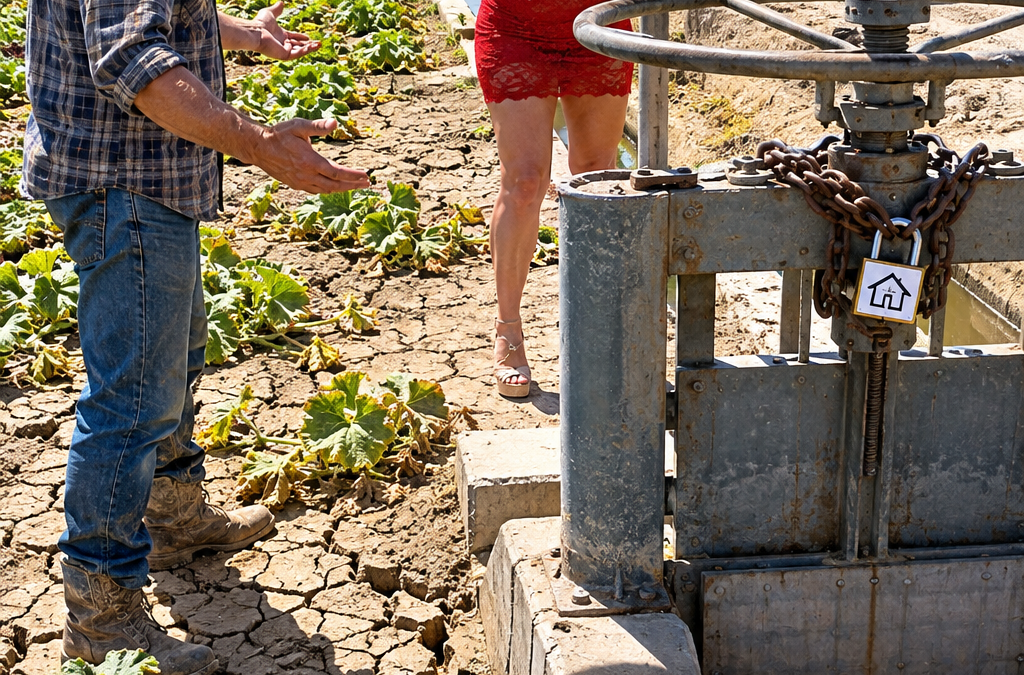
The soil had cracked in thin gray lines between the rows, the kind of lines a farmer notices before anyone else would even think to worry. The leaves on the young melon vines had started to curl at the edges, not dead yet, not even close, but warning me in the quiet language crops use when water is late.
I stood beside Gate 14C with my boots in the dry canal bed and stared at the heavy chain wrapped around the control wheel.
The lock was new.
The chain was new.
And the little white sticker pressed against the metal lock body told me exactly who thought they had the right to put it there.
BRIAR CREEK HOMEOWNERS ASSOCIATION.
I didn’t move for several seconds.
The irrigation canal ran along the edge of my property, just where my grandfather had helped dig and reinforce the original delivery line decades earlier. It wasn’t ornamental. It wasn’t some decorative water feature put there to make the neighborhood look pretty on a brochure.
It was how my farm stayed alive.
The water was scheduled, measured, recorded, and released through an official district control gate. Gate 14C served my agricultural parcel under a roster that had existed long before Briar Creek Estates was ever built.
Every turn had a time.
Every delivery had a duration.
Every gate had a number.
That was how canal water worked. Nobody serious touched it without authorization.
Yet there it was.
Locked.
Not by the canal district.
Not by the county.
Not by any water official.
By the HOA.
I heard tires crunching behind me.
I turned.
Karen Whitfield’s white SUV rolled to a stop near the canal road, glossy and spotless despite the dust. She stepped out wearing wedge heels, a fitted red lace dress under a pale blazer, sunglasses tucked into her blonde hair, and the kind of satisfied expression people wear when they arrive expecting obedience.
She had a folder tucked under one arm.
Of course she did.
Karen never trespassed without stationery.
“Good morning, Caleb,” she said.
My name is Caleb Turner.
My family has farmed that land for three generations, and by the time Karen Whitfield arrived at my irrigation gate with her fake little HOA notice, I had spent almost forty years learning that water does not care about arrogance.
Crops either get it on time or they suffer.
Karen did not understand that.
Worse, she did not care.
She walked toward me as if the canal bank were a sidewalk inside her subdivision.
“Who locked my gate?” I asked.
She smiled.
“The association temporarily secured it.”
I looked back at the chain.
“Temporarily secured.”
“Correct.”
“Karen, this is an irrigation control gate.”
“I’m aware.”
“No. You’re not.”
Her smile cooled.
“I don’t appreciate your tone.”
“I don’t appreciate finding an HOA lock on district equipment.”
She opened her folder and pulled out a printed notice with the Briar Creek logo across the top.
“This gate has been interfering with the HOA’s landscaping schedule.”
I stared at her.
For a moment, I thought I had misunderstood.
“Your landscaping schedule.”
“Yes.”
“You locked an agricultural irrigation gate because of lawn watering.”
She lifted her chin.
“Community landscaping is not merely lawn watering. It protects property values for one hundred eighty-six homes.”
“My crops protect my livelihood.”
“And the HOA protects the community.”
She said it like that ended the argument.
That was Karen’s favorite trick.
Take a phrase like community, standards, safety, or property values and say it loudly enough that people forgot to ask whether it had anything to do with the law.
I pointed at the notice.
“Did the canal district authorize this?”
“The HOA has authority over water use affecting Briar Creek.”
“No, it doesn’t.”
“We have infrastructure connected to this canal.”
“That doesn’t give you control over Gate 14C.”
“The gate controls water that passes our frontage.”
“It controls my scheduled delivery.”
She sighed.
“Caleb, I know farmers like to act as if the entire valley revolves around their needs.”
My jaw tightened.
“But Briar Creek residents pay substantial dues. They expect maintained green spaces. We are installing new landscaping near the entrance, and your water schedule has become inconvenient.”
“Inconvenient.”
“Yes.”
“To grass.”
“To the community.”
I stepped closer.
“Unlock it.”
“No.”
“Unlock the gate, Karen.”
“The HOA has approved a temporary hold.”
“Show me the canal district order.”
She tapped the notice.
“This is the order.”
“That is HOA letterhead.”
“It is official.”
“Official to whom?”
Her face hardened.
“You’re making this difficult because you enjoy acting like your farm is above the neighborhood.”
“My farm isn’t above the neighborhood. It existed before the neighborhood.”
“That argument gets very old.”
“So does your habit of claiming things you don’t own.”
She looked toward the fields behind me.
“Your crops will survive a minor adjustment.”
I felt something cold move through my chest.
That was the moment I understood this wasn’t a misunderstanding.
She knew the gate mattered.
She simply believed her lawns mattered more.
“Minor adjustment?” I said.
She shrugged.
“One delayed delivery.”
“My water turn is scheduled.”
“The HOA needs uninterrupted flow for a community landscaping project.”
“The HOA can apply through the canal district like everyone else.”
“We don’t need permission to use water adjacent to our own community.”
“Yes, you do.”
She smiled again.
“That is your opinion.”
“No. That’s how water rights work.”
Karen stepped close enough that I could smell her perfume over the canal mud.
“Listen carefully. The gate stays locked until the HOA’s project is complete. If you remove that chain, we will treat it as interference with community infrastructure.”
I almost laughed.
She had put her lock on district equipment and was threatening me for interfering.
“Who told you to do this?”
“The board.”
“Which board member reviewed the irrigation schedule?”
“The board reviewed all relevant considerations.”
“That means nobody.”
Her cheeks flushed.
“Do not embarrass yourself, Caleb.”
I looked past her.
Across the canal, the HOA lawns were bright green.
Sprinklers ticked in perfect little arcs across the grass near the new Briar Creek entrance monument. The ornamental beds were dark with moisture. New shrubs stood glossy and fresh under the morning sun.
Behind me, my field was already thirsty.
The contrast was almost insulting.
The water was not missing.
It had simply been redirected toward something prettier.
I took out my phone and photographed the lock, the sticker, the dry canal bed, the control plate reading 14C, and Karen standing beside it with her folder.
She rolled her eyes.
“Document all you want.”
“I plan to.”
“Good. Then document that the HOA notified you.”
“I’ll document that the HOA admitted locking the gate.”
Her eyes narrowed.
“I admitted no wrongdoing.”
“You admitted enough.”
She turned to leave.
I called after her.
“My water turn is tomorrow morning.”
She stopped but didn’t turn around.
“Then I suggest you make other arrangements.”
“There are no other arrangements.”
“That sounds like a farm-management problem.”
Then she climbed back into her white SUV and drove away, leaving dust behind her and a chain on my gate.
For the rest of that day, I watched the field more than I worked it.
I tried not to.
There were always jobs to do on a farm. Equipment to check. Fertilizer records to update. Drip lines to inspect. A broken hinge on the storage shed. A pump motor that had been making a sound I didn’t like.
But my eyes kept going back to the east field.
Melons don’t scream when they need water.
Tomatoes don’t protest.
Alfalfa doesn’t file complaints.
They simply begin to fail.
Slowly at first.
Then all at once.
And across the canal, the HOA sprinklers ran like nothing was wrong.
At noon, I drove along the canal road to see where the water was moving. The flow that should have reached my delivery channel had been held back and partially directed through a private lateral feeding the HOA landscaping project near the entrance.
Not a farm.
Not a food crop.
Grass.
Fresh ornamental grass, shrubs, and decorative trees wrapped around a stone sign that said BRIAR CREEK ESTATES in letters big enough to be seen from the highway.
That was what Karen had chosen over a scheduled agricultural delivery.
I called her.
She answered on the second ring.
“Caleb.”
“Your sprinklers are running.”
“Yes.”
“While my canal is dry.”
“Temporary allocation.”
“By whose authority?”
“The HOA’s.”
“Karen, you’re going to cause crop damage.”
“Don’t threaten me with theatrics.”
“This isn’t theater.”
“You always say that when you want sympathy.”
I closed my eyes.
“Listen to me. My delivery is on the district roster for tomorrow morning. If that gate remains locked, I will call the canal district.”
A pause.
Then she laughed softly.
“Do what you feel you must.”
“You think they approved this?”
“I think the HOA has invested heavily in water infrastructure and has every right to protect that investment.”
“That’s not an answer.”
“It is the only answer you’re getting.”
She hung up.
That evening, I pulled out every irrigation document my family had saved.
My grandfather’s original delivery records.
My father’s updated canal agreement.
District rosters.
Gate numbers.
Annual notices.
Maintenance letters.
Assessment receipts.
Water-turn schedules.
I spread everything across the kitchen table under the yellow light while my wife, Elena, stood beside me with two cups of coffee neither of us drank.
“There,” she said, pointing.
Gate 14C.
My parcel number.
Delivery window.
Duration.
Responsible district.
No HOA name.
No Briar Creek.
No landscaping exception.
No “community lawn priority.”
Nothing.
I found the newest schedule.
My next turn began at 5:30 the following morning.
Water was to be released through Gate 14C for the assigned duration.
Official roster.
Printed.
Timestamped.
Mailed by the canal district.
I sat back.
Elena looked at my face.
“What?”
“They didn’t just misunderstand.”
She nodded slowly.
“They knew?”
“They knew enough not to call the district.”
That was the detail that bothered me most.
If Karen truly believed the HOA had authority, why hadn’t anyone contacted the canal district?
Why put a chain on the gate overnight?
Why not notify me through the district?
Why use an HOA sticker instead of an official lockout tag?
Because she wanted the result before anyone with actual authority could say no.
At 4:47 the next morning, before the sun cleared the eastern trees, I called the canal district dispatch line.
A man named Raymond answered.
“North Valley Canal District.”
“This is Caleb Turner, parcel 2187, Gate 14C.”
“What can I do for you?”
“My gate has been locked.”
A pause.
“Locked by who?”
“The Briar Creek HOA.”
Silence.
Not confusion.
The kind of silence that tells you the person on the other end has just heard something very bad.
Raymond spoke more carefully.
“Did you say the homeowners association locked a district control gate?”
“Yes.”
“Do you have a district notice?”
“No.”
“County notice?”
“No.”
“Emergency maintenance tag?”
“No.”
“Is the district plate still visible?”
“Yes.”
“Is water scheduled to you this morning?”
“According to the roster, yes. 5:30.”
I heard typing.
“Stand by.”
I stood in my kitchen with the phone pressed to my ear while Elena watched me.
Then Raymond came back.
“Mr. Turner, your delivery schedule has not been changed.”
“I know.”
“Do not cut the chain yourself unless directed. We’re sending a field officer.”
“How soon?”
“Within the hour.”
I looked out toward the dark line of the canal.
“Good.”
Raymond’s voice hardened slightly.
“And Mr. Turner?”
“Yes?”
“Take photographs.”
“I already have.”
“Take more.”
The field officer arrived just after sunrise.
His name was Officer Grant Wells.
He drove a white district truck with the seal on the door and a toolbox mounted behind the cab. He was in his fifties, sun-darkened, blunt, and moved like someone who had spent decades around gates, water, and people trying to get more than their share of both.
He stepped out, nodded to me, and went straight to the control plate.
“14C.”
He checked the roster on a tablet.
Then the lock.
Then the chain.
Then the dry canal bed downstream from the gate.
“Who placed it?”
“The HOA.”
He looked at me.
“Who specifically?”
“Karen Whitfield. HOA president.”
As if summoned by her own name, Karen’s white SUV appeared on the road.
She arrived with the same folder as the day before, this time accompanied by a man in khakis and a polo shirt with the logo of the development company that had built Briar Creek’s newest phase.
The developer representative.
Of course.
Karen stepped out like she intended to take command before anyone else could speak.
“Officer, I’m glad you’re here. There’s been unnecessary confusion.”
Officer Wells turned toward her.
“Did you order this gate locked?”
Karen blinked.
Not the opening she wanted.
“The HOA temporarily secured the gate to protect community water needs.”
“Did you order it?”
She hesitated.
“As president, I authorized temporary access control.”
Officer Wells wrote something on his pad.
Karen’s confidence flickered.
“This is being blown out of proportion.”
He pointed toward the lock.
“Do you have district authorization?”
“The HOA has invested in connected landscaping infrastructure.”
“That wasn’t my question.”
Her smile tightened.
“We were advised that because the water passes through our frontage—”
“Did the canal district authorize you to lock Gate 14C?”
Karen looked toward the developer representative.
He cleared his throat.
“We believed there was flexibility in the schedule.”
Officer Wells turned to him.
“Who are you?”
“Adam Cole. Briar Creek Development Group.”
“Did your company lock the gate?”
“No.”
“Did you instruct the HOA to lock it?”
Adam glanced at Karen.
“We discussed the need for uninterrupted water during establishment of the new lawn and planting areas.”
Wells stared at him.
“That also wasn’t my question.”
I could have hugged the man.
Karen jumped in.
“The landscaping project was approved. Residents are paying significant dues. We cannot have brand-new lawns dying because Mr. Turner refuses to cooperate.”
Officer Wells looked toward my field.
Then toward the HOA lawns, still damp and green.
“His farm is on today’s delivery roster.”
Karen waved one hand.
“The roster is outdated.”
“No.”
The word was immediate.
Flat.
Official.
“The roster is current.”
She faltered.
“I mean it doesn’t reflect current community needs.”
“Community needs don’t modify district delivery schedules.”
“The HOA has a water investment.”
“Payment does not rewrite irrigation records.”
Karen’s face hardened.
“You seem determined to take his side.”
Officer Wells looked at her.
“I’m taking the side of the schedule.”
That sentence hung in the air.
The schedule.
Not emotion.
Not status.
Not dues.
Not Karen’s folder.
The schedule.
Officer Wells opened the gate box and examined the control mechanism.
“This is district infrastructure.”
“I understand that,” Karen said sharply.
“I’m not sure you do.”
Her eyes flashed.
“Excuse me?”
He pointed at the chain.
“Private parties don’t lock district control gates.”
“This is not private interference. It’s community management.”
“It’s unauthorized interference.”
The developer representative shifted.
“Officer, perhaps we can find a cooperative solution here.”
“We already have one.”
He tapped the tablet.
“Turner’s scheduled delivery begins now.”
Karen’s voice rose.
“If you release that water, our new landscaping loses establishment flow.”
“Then your plan was built on water you weren’t scheduled to receive.”
Adam said quickly, “We were told there would be shared availability.”
“By whom?”
He looked at Karen again.
She looked away.
Officer Wells noticed.
“Mr. Cole, did the district approve a change to Gate 14C?”
“Not formally.”
“Informally?”
“We had discussions about regional capacity.”
“With who at the district?”
Adam said nothing.
Wells nodded slowly.
“That’s what I thought.”
Karen stepped closer.
“Our residents pay taxes too.”
“So does Mr. Turner.”
“They pay dues.”
“To the HOA, not the canal district delivery roster.”
“They deserve beautiful common areas.”
“And his crops deserve the water assigned to them.”
She laughed bitterly.
“Crops. Always crops. You people act like decorative landscaping doesn’t matter.”
I stepped forward.
“Not more than food.”
She turned on me.
“Don’t pretend this is noble. This is about you refusing to adapt.”
“My family has used this gate for decades.”
“And the community has grown.”
“That doesn’t erase my water turn.”
“The world changes, Caleb.”
“Then file for a change properly.”
Officer Wells looked at Karen.
“He’s right.”
Karen’s face went red.
Wells continued.
“If the HOA wants a change in delivery, lateral use, or allocation priority, it files through the district. It doesn’t place a lock on a control gate overnight.”
“The lock was temporary.”
“It was unauthorized.”
“We planned to remove it.”
“When?”
She didn’t answer.
I knew the answer.
After their lawns were safe.
After my turn was lost.
After damage was done.
After the schedule no longer mattered because the day had passed.
Officer Wells walked to his truck and returned with bolt cutters.
Karen stepped in front of him.
“You cannot simply destroy HOA property.”
He stopped.
Very slowly, he looked at the chain.
Then at her.
“Ma’am, if this chain is on district infrastructure without authorization, it is not staying.”
“We will file a county complaint.”
“You’re free to.”
“Our attorney will hear about this.”
“I’m sure.”
He lifted the bolt cutters.
“Move away from the gate.”
Karen didn’t move.
For one wild second, I thought she might physically block him.
Adam touched her elbow.
“Karen.”
She yanked her arm away.
“This is outrageous.”
Officer Wells did not argue.
He just waited.
Karen finally stepped aside.
The bolt cutters snapped through the chain with a metallic crack that echoed down the dry canal.
That sound was better than music.
The lock fell into the dirt.
Karen flinched as if someone had slapped her.
Officer Wells removed the chain, checked the mechanism, and opened Gate 14C according to the delivery setting.
At first, there was only a low rush behind the structure.
Then water came.
A narrow push.
Then a steady sheet.
Then the canal bed filled and moved.
The dry channel darkened.
Water slid through the delivery route toward my fields, exactly where it was supposed to go, exactly when the roster said it should.
I stood there watching it.
Not celebrating.
Not yet.
Just breathing.
Because farmers learn not to relax until water actually reaches the rows.
Karen stood beside the green HOA lawn, furious and silent.
Officer Wells monitored the flow.
“Delivery restored.”
I nodded.
“Thank you.”
He looked at me.
“Keep records of crop stress and any losses from delay.”
“I will.”
Karen immediately said, “There won’t be losses.”
Wells turned.
“That isn’t your determination.”
She shut her mouth.
Adam tried again.
“Officer, what is the proper process for adjusting future flow to the Briar Creek landscaping project?”
“There is an application procedure. Engineering review. Delivery compatibility. Water rights verification. Scheduling.”
Karen crossed her arms.
“That takes months.”
“Then you should have started months ago.”
I almost smiled.
Officer Wells wasn’t dramatic.
He didn’t need to be.
Every sentence was a shovel of dirt thrown over Karen’s argument.
The developer representative looked genuinely worried now.
Their project had assumed water it didn’t have.
That meant redesign.
Storage.
Separate source.
Different timing.
Maybe expensive changes to the landscaping plan.
Karen had promised lush entrances and green lawns without securing the water schedule to support them.
Now the problem was visible.
Green grass on one side.
Dry farm on the other.
District officer in the middle.
No amount of HOA bluster could hide it.
By midmorning, water had reached the field head. My crew opened the farm distribution checks, and the flow began entering the rows.
The soil absorbed it greedily.
The plants didn’t recover instantly, but the worst had been stopped.
Elena came down from the house with coffee and stood beside me.
“Is it moving?”
“Yes.”
She watched the water spread.
“Good.”
Across the canal, Karen was still arguing with Adam and Officer Wells.
Elena shook her head.
“She really thought lawns came first.”
“She thought approval came from herself.”
“Same thing to her.”
That afternoon, the HOA held an emergency board meeting.
I attended.
So did Officer Wells.
That alone changed the room.
Karen hated outsiders in her meetings unless she controlled them.
She stood at the front in her red lace dress and blazer, face tight, eyes bright with anger.
“This morning’s incident has been mischaracterized,” she began.
Of course.
Karen never made mistakes.
Events were mischaracterized.
Documents were misunderstood.
Authority was misinterpreted.
Other people were emotional.
She clicked a remote, and a slide appeared showing the Briar Creek entrance landscaping.
Fresh turf.
New shrubs.
A rendering with cheerful families walking past the green entrance.
“The HOA has invested heavily in a beautification project that benefits every resident.”
A few people nodded.
Then she clicked again.
A photo of my canal gate appeared, carefully cropped so the broken unauthorized chain wasn’t visible.
“Unfortunately, Mr. Turner has taken a hostile position against community improvements.”
I stood.
Officer Wells looked at me but said nothing.
Karen smiled.
“Mr. Turner, you’ll have your opportunity after the presentation.”
“No.”
The room went silent.
Her smile froze.
“No?”
“No. You’re not going to accuse me of blocking community improvements when your lock was cut off my scheduled irrigation gate this morning.”
Murmurs moved through the room.
Karen snapped, “You are out of order.”
Officer Wells stood.
“I can clarify the district’s position.”
Karen’s mouth closed so quickly it was almost satisfying.
He walked to the front.
No slideshow.
No drama.
Just his tablet.
“Gate 14C is part of the North Valley Canal District irrigation system. The scheduled recipient for this morning’s delivery was Turner Farm. The delivery schedule had not been changed. The HOA had no recorded authorization to lock, obstruct, or control the gate.”
Silence.
A board member named Paula leaned forward.
“Karen, is that true?”
Karen’s smile returned, thinner now.
“The district is taking a narrow view.”
Officer Wells said, “We’re taking the recorded view.”
Another board member asked, “Did the HOA request a formal change?”
Karen hesitated.
“We were in development discussions.”
Adam, the developer representative, sat near the wall looking increasingly trapped.
Paula looked at him.
“Mr. Cole?”
He cleared his throat.
“Briar Creek Development Group believed the HOA was coordinating water availability.”
“With the district?”
“Through community channels.”
Officer Wells said, “Not through district approval.”
The residents started whispering.
One man stood.
“Are you saying our new landscaping was built without confirmed water?”
Karen pointed toward him.
“Sit down, Glen.”
He did not.
“Are you?”
Her face flushed.
“The project was approved based on reasonable assumptions.”
Officer Wells said, “Assumptions are not water rights.”
I wished someone had engraved that sentence into the clubhouse wall.
Another resident asked, “Could the HOA be fined?”
Wells answered carefully.
“Unauthorized interference with district infrastructure can result in enforcement action depending on circumstances.”
The room changed.
Now it wasn’t an abstract farm dispute.
Now residents understood Karen’s stunt might cost them money.
That was when her support started slipping.
Karen tried to regain control.
“Let’s not allow one farmer’s exaggerations to distract from the fact that our community deserves modern landscaping.”
Elena stood.
She rarely spoke in public.
When she did, people listened.
“His name is Caleb. Not one farmer.”
Karen blinked.
Elena continued.
“And that water grows crops. Not decorations.”
A few residents murmured approval.
Karen’s eyes sharpened.
“Mrs. Turner, this is an HOA meeting.”
“Then stop using HOA meetings to justify what you did on our canal gate.”
Paula looked at Karen.
“Why wasn’t the board told the farm had a scheduled water turn this morning?”
Karen’s lips parted.
No answer.
“Why wasn’t the district contacted?”
Still nothing.
“Why did the HOA put its own lock on the gate?”
Karen finally snapped.
“Because if we wait for every farmer, contractor, and bureaucrat to bless basic community improvements, nothing gets done.”
There it was.
The truth.
Not misunderstanding.
Impatience.
Entitlement.
She had decided that process was inconvenient, so she replaced it with force.
Officer Wells closed his tablet.
“Process is how water conflicts don’t become damage claims.”
The meeting ended with the board voting to suspend the landscaping water plan until it could be redesigned lawfully.
Karen voted no.
She lost.
Barely.
But she lost.
Adam stayed after to speak with Officer Wells about applications, storage tanks, possible off-cycle delivery, and alternative landscape design.
Suddenly everyone understood that green lawns required more than Karen’s confidence.
Over the next week, the developer redesigned the entrance plan.
Less turf.
More drought-tolerant landscaping.
Separate irrigation storage.
A proper application to the district for supplemental decorative use.
The HOA could still maintain its lawns.
But not by taking my scheduled turn.
The canal district restored and reaffirmed the original delivery roster.
Gate 14C remained under district control.
A district lock replaced the broken HOA chain.
Official.
Logged.
Accessible by authorized personnel.
My farm received its water at the time recorded.
Exactly as it should have.
Karen avoided the canal after that.
At least when I was there.
But I heard she told residents the situation had been “politicized.”
She claimed the farm had resisted modernization.
She said the district had been inflexible.
She called the chain “a temporary coordination tool.”
That was my favorite.
A temporary coordination tool.
I kept the broken lock.
Officer Wells released it back as evidence once photographs were complete.
It sits now in my shop beside old irrigation parts, cracked pipe fittings, and a bent shovel my father used to carry.
Sometimes I pick it up just to feel the weight of Karen’s mistake.
It is heavier than it looks.
A lock always is when someone uses it to take something that isn’t theirs.
The crops recovered enough.
Not perfectly.
The missed timing stressed the edges of the field, and I documented everything like Wells told me. Photos. Soil moisture readings. Yield comparisons. Notes.
But the field survived.
The farm kept going.
Water came when the schedule said it would.
And Briar Creek’s lawns, ironically, survived too after the developer stopped pretending they could drink from my turn.
That was the absurd part.
Nobody had to lose.
Not if Karen had followed the proper process.
The HOA could have designed landscaping around available water.
The developer could have applied for additional rights or storage.
The district could have advised them.
I could have coordinated.
But Karen did not want coordination.
She wanted control.
She wanted to stand at a locked gate and tell me my crops were less important than her entrance monument.
She wanted to treat water like another HOA amenity, like a clubhouse key or pool reservation.
But irrigation water is not controlled by the loudest person near the canal.
It follows records.
Schedules.
Rights.
Gates.
Measurements.
Law.
The whole dispute started with a chain and a demand.
The answer was written long before Karen arrived in her white SUV.
Gate 14C.
Turner Farm.
5:30 a.m.
Scheduled delivery.
Karen mistook convenience for entitlement.
She mistook HOA approval for legal authority.
She mistook green lawns for necessity.
And when the canal district officer arrived, all her polished confidence ran into one simple fact:
Her name was nowhere on the water roster.
The next time my delivery came, I stood by the canal before sunrise.
No chain.
No HOA sticker.
No Karen.
Just the gate, the number plate, and the low sound of water building behind steel.
At exactly the scheduled time, the control opened.
Water entered the channel and moved toward my fields.
I watched it flow under the pink morning sky.
Slow, steady, official.
The way it had for years.
The way it should have all along.
Karen’s lock lasted one day.
The schedule stood unchanged.








