𝗙𝗨𝗟𝗟 𝗦𝗧𝗢𝗥𝗬 The HOA Locked a Gate Across My Private Bridge and Never Asked What I Was Legally Allowed to Do With the Bridge Itself
𝗙𝗨𝗟𝗟 𝗦𝗧𝗢𝗥𝗬
That phrase.
She said it like repetition could turn it into law.
I opened my survey.
“Here.”
She barely looked.
“The bridge is here.”
I pointed.
“Boundary is here.”
Then farther back.
“HOA land begins over there.”
Susan glanced at the map.
“We have community maps too.”
“Good.”
“Those maps identify this as a functional access point.”
“Functional is not ownership.”
Eric stepped in.
“The gate isn’t preventing you from using the bridge.”
I looked at the lock.
“I don’t have a key.”
“We can issue one.”
I actually laughed.
“You installed a lock on my bridge and you’re offering to issue me a key.”
Neither of them smiled.
Susan said, “You’re making this sound more dramatic than it is.”
“No.”
I folded the survey.
“You entered private property, installed permanent hardware, and locked access to a structure I own.”
“Residents need safe access.”
“Then build access on your property.”
“This is already established.”
“Usage isn’t ownership.”
Susan’s eyes narrowed.
“The board voted.”
I said, “You can vote to put a gate on the clubhouse.”
She stiffened.
“You can vote to paint your signs blue.”
Eric looked away.
“You can vote on things you control.”
I pointed at the bridge.
“You don’t get to vote my property into yours.”
Susan crossed her arms.
“The gate stays.”
That was the moment I stopped treating the situation as a misunderstanding.
If she had said:
We made a mistake.
Or:
Let’s verify the title.
Or even:
Give us a few days.
I probably would have remained annoyed but cooperative.
Instead, she had seen the survey and decided the board vote mattered more.
That changed everything.
I didn’t argue again.
I simply said:
“Fine.”
Susan seemed surprised.
“Fine?”
“Yes.”
“I’ll handle it properly.”
I walked away.
Eric called after me.
“What does that mean?”
“It means I’m going to document everything.”
That evening, I started a file.
Photographs first.
Gate.
Lock.
Post locations.
Sign.
Bridge entrance.
Boundary markers.
Approach.
Then copies of the property survey.
Original purchase documents.
Maintenance receipts.
Insurance records.
Anything showing the bridge had always been treated as part of my property.
The next morning, I called a licensed bridge inspector.
Not because I doubted ownership.
Because if this turned into a dispute about safety, condition, or access, I wanted the structure documented independently.
His name was Martin.
He came out two days later.
I showed him the gate.
He raised his eyebrows.
“New?”
“Very.”
“Your gate?”
“No.”
He looked at me.
“That sounds like a story.”
“It is becoming one.”
We inspected everything.
Deck.
Support members.
Fasteners.
Abutments.
Drainage.
Creek flow.
Approach surfaces.
Guardrails.
Martin took photographs and measurements.
He reviewed old repair invoices.
Then he asked for title and property information relating to the structure.
I gave him what I had.
His final report confirmed the bridge had been privately maintained and located within the property described in my survey.
More importantly, he found nothing indicating the HOA had taken responsibility for the structure.
No transfer.
No maintenance agreement.
No association inspection history.
Nothing.
The HOA’s gate was attached to privately controlled infrastructure.
I took the next step.
County records office.
The clerk helped me pull historical deeds.
Subdivision maps.
Recorded easements.
Development plats.
I expected something complicated to appear.
Some old access agreement.
A shared-maintenance clause.
A forgotten easement.
Nothing did.
The older deeds were clearer than I expected.
The bridge had existed as part of the property before the surrounding HOA development was created.
The development came later.
Its boundary formed around neighboring land.
My parcel remained separate.
I asked the clerk:
“Any easement giving the HOA control over the bridge?”
She checked again.
“Not that I’m seeing.”
“What about general access?”
“There are roadway easements elsewhere.”
“Here?”
“No.”
“Anything allowing gates?”
She almost smiled.
“No.”
I ordered certified copies.
Then I hired a surveyor.
I wanted the line physically marked.
Not interpreted.
Not argued.
Marked.
He spent most of a day setting points.
When he finished, he placed bright markers where the recorded boundary crossed near the approach.
The result was almost embarrassing in its clarity.
The HOA gate was not close to the line.
Not straddling it.
Not sitting in a gray strip.
It was inside my property.
So was the entire bridge.
Both approaches.
The creek section beneath it.
Everything.
I called Susan.
“I have the survey.”
“We’ve already reviewed our maps.”
“No.”
“A licensed surveyor physically marked the boundary.”
Silence.
I continued.
“The gate is on my land.”
“We disagree.”
“Then come look.”
She did.
Eric came again.
This time, the boundary stakes were visible.
I gave them certified copies of the county records.
Susan skimmed.
Eric read more carefully.
I watched his expression.
He understood.
Susan didn’t want to.
“The board has already voted to retain the gate.”
I stared at her.
“Susan, your board vote cannot move a property line.”
“We’re not moving a property line.”
“You’re exercising control beyond it.”
“The bridge serves community residents.”
“Because I allowed people to use it.”
“You never objected.”
“That is not a deed.”
“It establishes historical use.”
“Historical use is something you should discuss with an attorney if you think it gives you rights.”
Her eyes narrowed.
“Are you threatening litigation?”
“No.”
I surprised myself when I said it.
“I would actually prefer not to litigate.”
Eric looked relieved.
Susan did too.
Then I added:
“But the gate needs to come off.”
She shook her head.
“No.”
Eric said quietly, “Susan.”
She looked at him.
“The board voted.”
I almost admired her consistency.
I folded my copy of the survey.
“All right.”
She stared at me.
“What are you going to do?”
“I’ll decide.”
A week later, the HOA called an emergency meeting.
Bridge access.
That was the agenda item.
I attended.
The room was full.
Not completely packed, but far more residents than usually appeared for HOA business.
Susan sat at the front.
Eric beside her.
Several board members.
Susan opened with a presentation.
Safety concerns.
Resident access.
Children.
Liability.
Controlled use.
The gate, according to her, was a reasonable neighborhood safety improvement.
She showed photographs.
One included the bridge.
My bridge.
She referred to it repeatedly as the neighborhood crossing.
Then public comment opened.
I stood.
Carried my folder to the front.
Placed the certified survey on the table.
Then the old deed.
Then the bridge-inspection report.
Then the current survey map.
I didn’t begin with anger.
I said:
“The bridge is privately owned.”
The room quieted.
I continued.
“The land under it is privately owned.”
I pointed.
“The northern approach is private.”
Another point.
“The southern approach is private.”
Then:
“There is no recorded HOA easement granting control over the structure.”
Susan interrupted.
“Residents have used the bridge for many years.”
“I know.”
“You never prohibited it.”
“Correct.”
“So the neighborhood has relied on that access.”
“I allowed it.”
Someone in the back asked:
“What’s the difference?”
I turned.
“The difference is whether using something gives you ownership of it.”
The man nodded slowly.
I continued.
“If your neighbor lets you cut across his driveway for ten years, that doesn’t automatically make his driveway HOA property.”
Susan said, “This is more complicated than that.”
“Maybe.”
I pointed to the records.
“But ownership isn’t.”
I gave each board member a copy.
“I’m not asking anyone to believe my memory.”
I looked around the room.
“These documents show the boundary.”
Then I showed the survey markers.
The bridge predating the development.
The absence of an HOA easement.
The maintenance history.
Everything.
One board member asked Eric:
“Did management verify ownership before installing the gate?”
Eric looked uncomfortable.
“We relied on the access map and board direction.”
“Did you pull the deed?”
“No.”
Another board member looked at Susan.
“Did we?”
She stiffened.
“We were addressing safety.”
“That wasn’t the question.”
The room changed.
Not dramatically.
Just enough.
People started realizing the HOA had spent money installing a lock on something it did not own.
Susan tried to bring the conversation back.
“The question now is continued access.”
I answered:
“No.”
She looked at me.
“What?”
“The first question is whether you had authority to install the gate.”
She pressed her lips together.
“The gate can be removed if necessary.”
That was new.
I noticed.
So did Eric.
But then Susan continued:
“The bridge itself still functions as community infrastructure.”
There it was again.
I said:
“No.”
A resident asked:
“Are you closing it?”
I looked toward the room.
“I haven’t decided.”
That created immediate reaction.
People whispered.
One woman said:
“We use that route every morning.”
Another:
“My kids bike through there.”
I understood.
I had never wanted to inconvenience them.
I said:
“For years I allowed access because people were respectful.”
I looked at Susan.
“Then the HOA installed a locked gate on my property without asking.”
Silence.
Susan asked:
“So what exactly do you want?”
I thought about that.
At first, I had wanted the gate removed.
Now I wanted clarity.
Permanent clarity.
“I want the HOA to stop treating private property as community property simply because people are accustomed to using it.”
She said:
“We can draft an access agreement.”
“Maybe.”
“You’re willing to negotiate?”
“Maybe.”
Then I said something that made her expression change.
“Or I may remove the bridge.”
The room went silent.
Susan laughed once.
Not because it was funny.
Because she thought I was bluffing.
“You’re not going to remove a bridge.”
I looked at her.
“Why not?”
“Because people use it.”
“That’s not an ownership answer.”
“You can’t simply destroy infrastructure.”
“Privately owned infrastructure?”
“There are permits.”
“I know.”
“Environmental restrictions.”
“I know.”
“Engineering requirements.”
“I know.”
She stared.
That was when she understood I had already considered it.
I did not make the decision that night.
Despite what some neighbors later assumed, I didn’t walk into the meeting planning to punish everyone by tearing the bridge down.
I went home.
I thought about an access agreement.
I thought about licensing continued use.
I thought about removing only the gate.
I thought about putting my own controlled gate in its place.
Every option had consequences.
The problem was trust.
Before Susan installed the gate, informal access worked because nobody pretended it belonged to them.
Now the HOA had shown that informal use could become a basis for institutional control.
If I reopened the bridge casually, what happened in five years?
Ten?
Another board?
Another claim?
Another safety project?
Another vote about property they did not own?
I wanted the ambiguity gone.
Completely.
So I called a licensed structural contractor.
His company specialized in bridge repairs and removals.
I sent him the inspection report.
Survey.
Property records.
Photographs.
Then I asked:
“What would it take to dismantle the bridge legally?”
He paused.
“Remove it?”
“Yes.”
“Entirely?”
“Yes.”
“Why?”
“Ownership dispute.”
“That sounds fun.”
“It isn’t.”
He came out.
Walked the site.
Measured.
Studied the creek.
Reviewed access.
Then explained the process.
Permits.
Environmental precautions.
Equipment staging.
Crane.
Excavator.
Temporary erosion protection.
Sequenced dismantling.
Waste handling.
Site stabilization.
Nothing about it would be quick in the legal-planning sense.
But once permitted and scheduled, the physical removal could be done efficiently.
I said:
“I don’t want anything dropped into the creek.”
“Nothing will be.”
“No damage downstream.”
“We’ll isolate the work area.”
“No unnecessary clearing.”
“We’ll keep the footprint tight.”
“Document everything.”
He smiled.
“You have a theme.”
“Yes.”
Permits were filed.
Engineering plans submitted.
Environmental requirements reviewed.
The contractor designed the dismantling sequence.
I informed the appropriate authorities where required.
I did not ask the HOA for permission.
It was not their bridge.
I also did not notify Susan of the exact work schedule.
That was intentional.
I had no interest in having a crowd appear halfway through structural removal.
The contractor scheduled the major dismantling work overnight.
Lower traffic.
Fewer pedestrians.
Controlled access.
Safer staging.
Every step was checked.
Then checked again.
The night the crew arrived, I stood near the creek wearing a reflective vest and watched work lights illuminate the bridge.
It looked different under construction lighting.
Older.
Smaller.
I had crossed it for years.
Walked over it after storms.
Driven equipment across.
Watched neighbors ride bicycles over it.
Now a crane sat nearby.
Rigging hung above the deck.
The contractor walked over.
“You sure?”
That question mattered.
He wasn’t asking legally.
Everything was approved.
He was asking personally.
I looked at the bridge.
Then at the black iron gate the HOA had installed.
“Yes.”
He nodded.
Work started with the gate.
Workers unbolted and removed it.
The same gate Susan had insisted would remain.
It came off in minutes.
Then they moved to the bridge.
Bolts.
Connections.
Sections.
Rigging.
Every piece handled deliberately.
No smashing.
No reckless demolition.
The first deck section lifted into the air.
For a moment, it hung above the creek beneath floodlights.
Then the crane swung it toward the staging area.
I felt something unexpected.
Sadness.
I had been so focused on the dispute that I had forgotten the bridge itself had never wronged me.
It had done exactly what a bridge is supposed to do.
Connected two sides.
For years.
The problem was people.
Not wood.
Not steel.
Not concrete.
Piece by piece, the structure disappeared.
Deck first.
Then supports.
Then remaining components.
The excavator stabilized sections while the crane lifted.
Creek protection remained in place.
Workers monitored the banks.
Hours passed.
By two in the morning, more open space existed than bridge.
By four, only parts of the lower structure remained.
Before sunrise, it was gone.
The crossing had disappeared.
The creek flowed beneath empty air.
The contractor cleaned the site.
Removed temporary materials.
Secured the approaches.
Installed barriers where necessary to prevent someone accidentally walking toward an open crossing.
Everything photographed.
Everything documented.
I stood there as the sky turned gray.
For the first time in years, the creek looked almost like it must have looked before the bridge existed.
Quiet.
Open.
No gate.
No shortcut.
No argument.
Susan arrived shortly after sunrise.
Eric was with her.
I don’t know who called.
Maybe a resident saw the equipment leaving.
Maybe somebody from the board drove past.
Her SUV stopped near the boundary.
She got out quickly.
Then stopped.
Eric stepped out more slowly.
They both stared at the empty crossing.
Susan walked toward me.
“What happened?”
I looked at the creek.
“I removed the bridge.”
“You did what?”
“You’re looking at it.”
“You cannot be serious.”
“I hired a licensed contractor.”
She looked around wildly.
“Where is the bridge?”
“Dismantled.”
“This is insane.”
“No.”
I had the folder ready.
Of course I did.
I handed her the permit copies.
Engineering plan.
Contractor information.
Inspection report.
Environmental compliance documents.
Susan flipped through them too quickly to read.
“You did this overnight?”
“The work occurred overnight.”
“You never told the HOA.”
“I wasn’t required to obtain HOA permission to remove privately owned infrastructure on property outside HOA ownership.”
Eric took the documents.
Unlike Susan, he actually read.
His face became pale.
“All permitted?”
“Yes.”
Susan said:
“You’ve cut off neighborhood access.”
“I removed my bridge.”
“Residents relied on it.”
“They relied on permission.”
“You’re punishing an entire neighborhood because of a gate.”
That accusation stung because part of me had asked the same question.
I kept my voice calm.
“No.”
“You absolutely are.”
“No.”
I pointed toward the survey stakes.
“I removed the thing you kept claiming the HOA could control.”
“You could have negotiated.”
“I tried to get you to remove the gate.”
“We were willing to discuss that.”
“After installing it.”
She stared at me.
I continued.
“You had years of access.”
“You never objected.”
“Exactly.”
“Then why now?”
“Because you converted courtesy into control.”
She went quiet.
Eric looked toward the creek.
Then said:
“Susan.”
She turned.
He spoke quietly.
“He has the permits.”
That was the first moment she seemed to understand the physical reality.
There was nothing left to lock.
The gate could not remain because the bridge no longer existed.
There was no structure for the HOA to control.
No argument about keys.
No argument about safety signs.
No argument about voting.
Only a creek and two disconnected banks.
Susan looked at me.
“This isn’t over.”
I answered:
“The ownership question is.”
She walked back to her SUV.
The HOA called another emergency meeting that afternoon.
That one was packed.
Far more residents than the first.
People were angry.
I understood why.
Their shortcut had disappeared.
Some had used it for years.
Maybe every day.
They had not installed the gate.
They had not reviewed deeds.
Most had no idea a property dispute existed until access vanished.
Susan opened the meeting.
Her version began with the removal.
Not the gate.
She talked about sudden loss of neighborhood access.
Safety concerns.
Disruption.
Inconvenience.
Emergency planning.
Then one resident asked:
“Why was he allowed to remove it?”
Susan hesitated.
Eric answered.
“Because he owned it.”
The room quieted.
Susan looked at him.
He continued.
“The bridge was outside the association’s ownership.”
That was the first time I heard management say it publicly.
Another resident asked:
“Then why did we put a gate on it?”
No one answered immediately.
Susan said:
“The board acted based on longstanding use and safety concerns.”
Someone else:
“Did we have an easement?”
Eric said:
“No recorded control easement was located.”
The mood changed.
Not in my favor exactly.
Toward reality.
I stood when public comment opened.
“I know many of you are angry.”
A man near the front said:
“You removed something we all use.”
“Yes.”
“You couldn’t have just taken the gate down?”
“I could have.”
“Then why didn’t you?”
Fair question.
I took a breath.
“Because the gate showed me that informal access was no longer being treated as informal.”
I looked around.
“For years, I let residents use the bridge.”
“No toll.”
“No permit.”
“No gate.”
“No problem.”
I pointed toward Susan.
“Then the HOA installed permanent hardware and claimed authority over it.”
Susan interrupted.
“We were protecting residents.”
I looked at her.
“On my property.”
The room went quiet again.
I continued.
“I checked the records before doing anything.”
I held up the deed.
“Bridge is mine.”
Survey.
“Land is mine.”
County record.
“No HOA easement giving control.”
Inspection report.
“Privately maintained.”
Then the permits.
“Removal approved and completed lawfully.”
A woman asked:
“So there’s no way to put it back?”
“There is.”
People turned.
I clarified.
“The HOA can build a new bridge or access route on property it owns.”
Susan said:
“At enormous cost.”
“Yes.”
“You know what that will do to assessments.”
I looked at her.
“That is not a reason to take someone else’s infrastructure.”
Several residents nodded.
Not all.
Some were still angry.
That was fine.
They had a right to be inconvenienced.
They did not have a right to rewrite my deed because of it.
I said:
“I did not remove the bridge because I hate my neighbors.”
I looked toward an older couple I recognized from years of crossing.
“I removed it because the ownership line had stopped being respected.”
Then:
“If the HOA wants permanent neighborhood access, it should own or legally secure that access.”
One board member asked:
“Would you consider selling an easement?”
I thought about it.
“Not for the old crossing.”
“Why?”
“I want that part of my property private now.”
That answer upset some people.
But it was honest.
I had reached the point where I wanted the creek back.
No gate.
No traffic.
No future debate.
Susan said:
“You created this.”
That was the first time I got angry during the meeting.
I didn’t raise my voice.
But I answered immediately.
“No.”
She stopped.
“You installed a gate on a bridge you did not own.”
“You were given the ownership records.”
“You refused to remove it.”
“You told me residents would keep using the bridge regardless.”
I pointed toward the board.
“You created a situation where the only permanent way to end your claim was to remove the structure you were claiming.”
Susan’s face hardened.
“That is an absurd justification.”
“Maybe.”
I sat down.
“But the bridge is still gone.”
There was nothing left to debate that evening.
Eventually, the board did what it should have done before ever touching my property.
It hired professionals.
Engineers.
Surveyors.
Land-use consultants.
They reviewed HOA-controlled parcels.
Existing road connections.
Possible bridge sites.
Drainage.
Creek crossings.
The solution was more expensive than continuing to use mine.
Of course it was.
Unauthorized convenience is often cheaper than lawful infrastructure.
That does not make it legal.
A new access plan emerged.
Entirely on HOA property.
No dependence on my land.
No ambiguous historical use.
No informal shortcut.
The engineering took time.
Residents complained.
Assessments were discussed.
But the ownership issue was finally settled.
Nobody asked whether the HOA controlled my bridge anymore.
There was no bridge.
For me, the change was strange at first.
I had spent years hearing occasional tires.
Footsteps.
Bicycle tires.
Voices.
After removal, the lower property became quiet.
Really quiet.
The creek sounded louder because there was nothing else competing with it.
Wildlife began moving through the area differently.
I saw deer near the old approach.
Once, I watched a heron stand where one support had been.
I didn’t realize how much neighborhood traffic had changed the feel of the property until it stopped.
For the first time in years, the lower section felt private.
Not hostile.
Private.
There is a difference.
I didn’t put up giant signs.
Didn’t patrol with a camera.
Didn’t celebrate that residents had to take a longer route.
I simply stopped having strangers crossing that part of the property.
A month after removal, Eric came by alone.
No Susan.
He called first.
That mattered.
We met near the creek.
He stood where the old approach ended.
“Looks different.”
“Yes.”
“I should have checked the records.”
I looked at him.
He continued.
“Before installing the gate.”
“Yes.”
“I relied on the board.”
“I know.”
“That isn’t an excuse.”
“No.”
He nodded.
I appreciated that he didn’t ask me to make him feel better.
After a while, he said:
“We found meeting notes from years ago.”
“What kind?”
“Residents asked whether the association could formalize access.”
“And?”
“Board counsel at the time said we’d need an easement from the owner.”
I stared at him.
“When?”
“Before Susan was president.”
“Did she know?”
“I don’t know.”
He looked genuinely uncomfortable.
“I just thought you should know.”
That information bothered me.
Not because it changed anything.
Because the issue had been recognized before.
Someone had understood the difference.
Then years passed.
Institutional memory disappeared.
Use continued.
People forgot permission mattered.
That is how assumptions harden into false rights.
Not always through conspiracy.
Sometimes through laziness.
Convenience.
Turnover.
No one opening the old file.
I said:
“Keep that note.”
“We are.”
“Good.”
The new access route eventually began construction.
The HOA sent residents regular updates.
Survey maps.
Engineering drawings.
Timelines.
Costs.
I saw more documentation about that new route than I had ever seen about the gate.
Good.
That was how it should be.
One evening, a neighbor named David stopped me near my mailbox.
He had been angry at the emergency meeting.
I remembered.
“I owe you an apology,” he said.
“For what?”
“I called you selfish.”
“I remember.”
He looked embarrassed.
“My wife and I used that bridge every morning.”
“I know.”
“I thought you’d just decided to take it away.”
“I understand.”
“Then I saw the records online.”
The HOA had posted documents after the dispute.
Survey.
Property map.
Summary.
“Different story.”
“Same story,” I said. “You just had more of it.”
He nodded.
“That too.”
Then:
“Still wish the bridge was there.”
I smiled.
“So do I sometimes.”
That surprised him.
“You do?”
“Of course.”
“I thought you hated it.”
“I hated the dispute.”
I looked toward the creek.
“The bridge was useful.”
“Then why—”
“You can miss something and still know removing it was the right choice.”
He nodded slowly.
That was true.
There were mornings when I looked toward the empty crossing and remembered how easy it had been to drive over.
There were days when hauling equipment around the longer route annoyed me.
I had inconvenienced myself too.
That fact often got lost when people assumed I had removed the bridge purely out of spite.
Spite rarely survives inconvenience.
If I wanted only to punish the HOA, I would have chosen something that didn’t make my own life harder.
I removed the bridge because I wanted the legal relationship around that piece of property reset to zero.
No structure.
No crossing.
No user habit.
No gate.
No argument.
Zero.
From zero, everything would have to be rebuilt properly if anyone ever wanted access again.
Nothing was rebuilt there.
I liked that.
Susan remained HOA president for a while.
We saw each other.
We spoke rarely.
Her tone changed.
Mine probably did too.
The conflict had removed any illusion that we trusted each other’s assumptions.
Communication became formal.
Written.
Precise.
That was not friendly.
It was effective.
Once, several months later, she emailed asking whether an HOA maintenance crew could enter a strip near my property to inspect drainage.
The email included a map.
Date.
Purpose.
Duration.
Insurance information.
I read it.
Then smiled.
Permission requested.
I approved it.
No argument.
The crew arrived.
Did the work.
Left.
That simple transaction proved the whole point.
I was not against cooperation.
I was against entitlement.
Had Susan treated the bridge the same way from the beginning, there would probably still be a bridge there.
Ask.
Document.
Agree.
Respect.
Instead, she installed a gate.
The new HOA access route eventually opened.
Residents had a permanent path that did not cross my parcel.
It cost more.
Took longer.
Required real engineering.
But it belonged where it belonged.
The board controlled it because the board actually had rights there.
They could install gates.
Signs.
Rules.
Hours.
Whatever valid authority allowed.
I never objected.
That was theirs.
The creek crossing was mine.
That was the entire argument reduced to one sentence.
Yours there.
Mine here.
People make property disputes sound philosophical.
Usually they’re geographic.
A line.
The trouble begins when somebody decides the line is optional.
Months after the new route opened, I walked down to the creek at sunrise.
The old bridge site had changed.
Grass covered the disturbed areas.
The banks had stabilized.
Some of the signs of removal had disappeared.
Water moved cleanly through the channel.
I stood on one side where the approach used to begin.
For years, my instinct had been to walk forward.
Now there was nowhere to go.
Just creek.
I thought about the morning I found the iron gate.
If Susan had not installed it, I might never have pulled old deeds.
Never hired the surveyor.
Never investigated easements.
Never questioned the informal use.
The bridge might have remained open another twenty years.
Maybe fifty.
The HOA’s attempt to formalize control destroyed the exact convenience it wanted to preserve.
That irony wasn’t satisfying anymore.
Mostly, it seemed unnecessary.
None of it had to happen.
The HOA wanted safer access?
Ask.
We could have talked about liability.
Insurance.
Hours.
Keys.
Maintenance contributions.
Maybe an easement.
Maybe not.
But there were possibilities.
Susan skipped all of them.
She treated use as ownership and board approval as permission.
Those were the two mistakes that mattered.
Years of use did not make the structure theirs.
A board vote did not let them modify private property.
Once those mistakes entered the record, trust disappeared.
People sometimes ask whether I would build another bridge.
Maybe.
Someday.
For my own use.
If I do, it will be designed differently.
Smaller.
Private.
Probably gated from the beginning.
My gate.
My lock.
My decision.
Not because I want to be hostile.
Because clarity is easier to preserve than recover.
That is what the whole dispute taught me.
Ambiguity feels friendly while everyone behaves.
Then someone overreaches.
Suddenly every unwritten assumption becomes expensive.
The licensed inspector cost money.
Survey cost money.
County records.
Contractor.
Permits.
Engineering.
Removal.
All because nobody asked one basic question before installing a gate:
Who owns the bridge?
The answer was available the entire time.
Recorded.
Clear.
Boring.
Had anyone checked, the black iron gate would never have been installed.
The HOA eventually changed procedure.
Any modification affecting property near association boundaries required ownership verification first.
Survey review where necessary.
Written owner consent when work crossed private land.
Again, obvious rules.
Rules people often create only after discovering the cost of not having them.
Eric sent me the updated procedure.
I replied:
Looks reasonable.
He responded:
Wish we’d had it earlier.
So did I.
I never became friends with Susan.
That wasn’t necessary.
She stopped treating my property as available.
That was enough.
Once, a year later, we crossed paths at a neighborhood meeting.
Someone brought up the old bridge dispute while discussing access planning.
Susan said:
“We learned some hard lessons about verifying title before taking action.”
I looked at her.
She did not look away.
That was probably the closest thing to an apology I would ever hear.
I accepted it silently.
No need to reopen everything.
I had no interest in spending the rest of my life being the man whose identity revolved around a bridge dispute.
The bridge was gone.
The line was respected.
Move on.
That is what I did.
The lower part of the property became my favorite section.
Not because nobody else could use it.
Because quiet returned.
Sometimes I would sit near the creek in the evening.
No traffic.
No bicycle bells.
No gate clanging.
Water over stones.
Wind.
Birds.
The absence felt larger than the bridge ever had.
I had forgotten what the land sounded like before the neighborhood got used to crossing it.
Susan once said residents needed safer access through the area.
She wasn’t entirely wrong.
They did need access.
The mistake was assuming their need created a right to mine.
Need can justify asking.
It doesn’t erase ownership.
That principle applies far beyond bridges.
Roads.
Driveways.
Parking areas.
Water.
Paths.
Fields.
People see something useful and begin describing it by function.
Community road.
Neighborhood path.
Shared bridge.
Then the language slowly hides the ownership underneath.
That is what happened here.
Susan called it neighborhood access so often that eventually she seemed to believe the label mattered more than the deed.
I called it what it was.
My bridge.
Not because I needed to sound possessive.
Because accuracy mattered.
The HOA eventually owned its new route.
I never called that mine.
Boundaries work both ways.
Respect is reciprocal.
The final contractor file from the bridge removal sits in my office beside the survey.
Permits.
Engineering notes.
Photographs.
Completion report.
Everything.
One photo shows the bridge just before removal.
Another shows the crane lifting the first deck section.
The final image was taken just after sunrise.
Creek open.
No structure.
Empty approaches.
Whenever I see it, I remember Susan arriving with Eric and stopping at the property line.
She had spent weeks insisting the gate would remain.
By sunrise, the gate had nowhere to stand.
That was never the outcome I imagined when I first found the lock.
I expected a letter.
Maybe a meeting.
Maybe lawyers.
Instead, I discovered something simpler.
I didn’t have to convince the HOA to respect control over a bridge that no longer existed.
I only had to make sure every action I took was unquestionably mine to take.
That is why I documented first.
Inspected first.
Checked the deed first.
Surveyed first.
Permitted first.
The removal came last.
That order mattered.
Had I cut their gate immediately in anger, the argument could have become about property damage.
Had I demolished the bridge without permits, the argument could have become environmental compliance.
Had I blocked residents recklessly, the issue could have become safety.
I didn’t give Susan those arguments.
By the time the crew arrived, every significant question had already been answered.
Who owned it?
Me.
Where was it?
Inside my parcel.
Was there an HOA control easement?
No.
Could it be removed legally?
Yes, under the approved process.
Were environmental protections required?
Yes, and followed.
What was left?
Nothing but disappointment.
Disappointment is not ownership.
The HOA had confused the two for too long.
I sometimes wonder what my property would look like today if I had simply accepted the gate.
Maybe the bridge would still stand.
Maybe I would have a key.
Maybe residents would cross under HOA rules.
Then the next board would treat it even more firmly as community infrastructure.
Twenty years later, somebody might look at the gate, the rules, the history of use, and assume the association had always controlled it.
That’s how assumptions become inheritance.
I wanted to stop that chain.
I did.
The cleanest property disputes are the ones future owners never have to inherit.
When I eventually sell this place, the next owner will not wonder whether the HOA controls a bridge.
There isn’t one.
The survey is clear.
The boundary is marked.
The record is clean.
The new HOA access route stays on HOA land.
Everyone knows.
That is worth something.
More than convenience, perhaps.
Certainly more than one gate.
The strangest thing is that I don’t think Susan ever intended the dispute to become enormous.
She probably saw the gate as a small administrative improvement.
A safety measure.
Something practical.
That makes the story more instructive, not less.
Serious property violations do not always begin with malicious plans.
Sometimes they begin with somebody being too certain that asking permission is unnecessary.
“We’ve always used it.”
“The board approved it.”
“It’s for safety.”
“Residents need it.”
Each statement can be true and still not answer the ownership question.
That missing question became the whole case.
Who owns it?
The deed did not hesitate.
Neither did the survey.
People did.
Paper didn’t.
That is why, when someone tells me they’re dealing with a similar dispute, I never tell them to start by shouting.
I tell them to start with records.
Pull the deed.
Find the survey.
Check recorded easements.
Mark the boundary.
Photograph the condition.
Hire the right professional.
Understand your rights before deciding how to use them.
Anger is fast.
Documentation is slow.
Documentation usually wins more useful arguments.
The creek still runs where the bridge stood.
In spring, water rises.
In summer, it becomes shallow enough to see stones beneath the surface.
In fall, leaves gather against the banks.
Winter puts ice along the edges.
The landscape changed back faster than I expected.
Sometimes I stand there and can barely remember exactly where the support posts were.
That’s fine.
I do not need a monument.
The absence is enough.
Susan wanted a gate because she believed a gate would make control visible.
In the end, removing the bridge made ownership visible instead.
No sign required.
No argument required.
No lock required.
Just open water between two banks and a boundary everyone finally understood.
The HOA installed a gate because it thought years of use had made my bridge part of its neighborhood.
By the time the board finally checked the records carefully, I had already learned the one thing Susan never considered.
If the structure truly belonged to me, then keeping it was my choice too.
And once I understood that, I stopped arguing over who controlled the gate.
I removed the thing the gate was supposed to control.
𝗧𝗛𝗘 𝗘𝗡𝗗
The HOA Locked a Gate Across My Private Bridge and Never Asked What I Was Legally Allowed to Do With the Bridge Itself
I stood at the entrance to my own bridge staring at a brand-new iron gate the HOA had installed without warning, without permission, and without owning a single inch of the ground beneath it.
Susan Whitmore thought years of neighborhood use gave her the right to lock my property and decide who could cross it, but by the time she finally understood what the deed actually said, I had already chosen a solution she had never considered.
The bridge had been part of my property for years.
Long before I ever had a reason to argue about it.
Long before Susan Whitmore decided it was somehow part of the HOA’s “neighborhood access system.”
To me, it had always been simple.
The creek ran through the lower edge of my land.
A narrow private bridge crossed it.
The bridge connected one side of my property to the other and also provided a convenient route toward the road used by the development nearby.
I maintained it.
I repaired the decking when boards weathered.
I checked the drainage after heavy storms.
I paid when one of the side rails needed reinforcing.
No committee had ever sent me a check.
No HOA crew had ever shown up to inspect the supports.
No association had ever carried insurance on the structure.
It was mine.
That fact was so ordinary that I rarely thought about it.
The neighborhood around me had come later.
The bridge was already there before the surrounding development was built.
That mattered more than anyone realized.
Over the years, people living in the newer subdivision began using it from time to time.
At first, I didn’t object.
A few walkers crossed.
Then bicycles.
Occasionally a resident used it as a shortcut.
Nobody damaged anything.
Nobody claimed ownership.
I considered it one of those informal arrangements that happens when people live near each other long enough.
If somebody passed respectfully, I didn’t care.
I had never posted a guard.
Never installed a toll.
Never made the bridge into a point of conflict.
I believed neighborliness worked best when people did not turn every small convenience into a legal argument.
That attitude probably helped create the problem later.
People get used to permission.
Then they forget it was permission.
Eventually, they start treating continued tolerance as a right.
The morning I found the gate, I had gone down toward the creek because we had experienced heavy rain the night before.
Whenever the water rose quickly, I checked the supports.
Branches sometimes caught under the lower side.
Debris could shift.
I wanted to make sure nothing had collected against the structure.
I came around the bend.
Stopped.
At first, the gate looked so out of place that my mind didn’t process it.
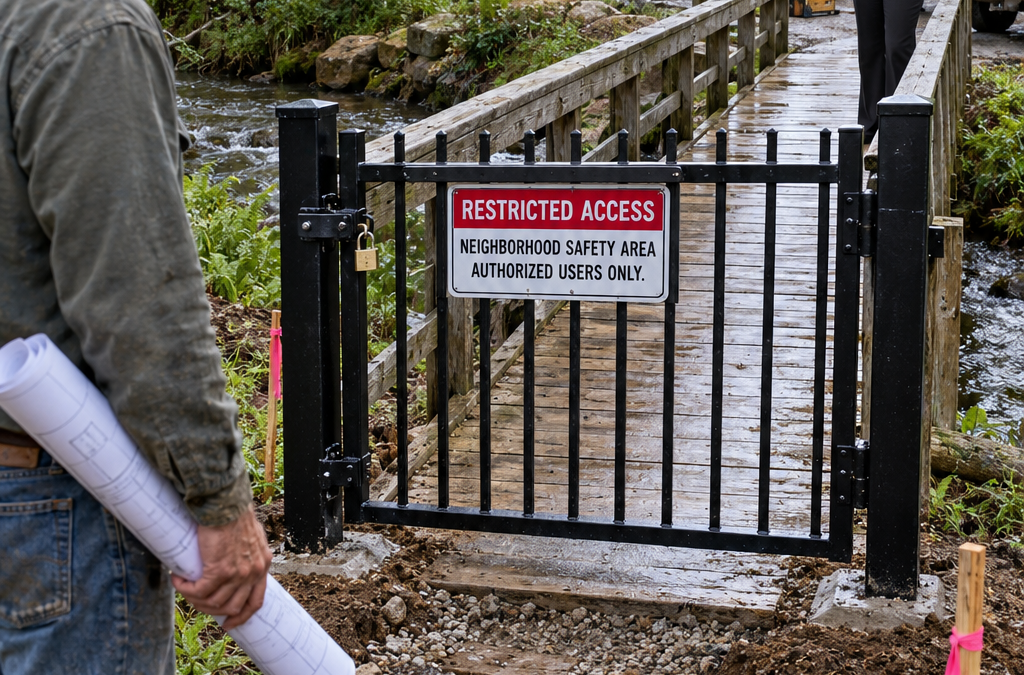
Black iron.
New.
Heavy.
Mounted across the entrance to the bridge.
Padlock hanging from the center.
A small rectangular sign had been bolted to it.
RESTRICTED ACCESS
NEIGHBORHOOD SAFETY AREA
AUTHORIZED USERS ONLY
I stood there for several seconds.
Then I walked closer.
The posts had been set beside the bridge approach.
Fresh disturbed soil around the bases.
Tool marks.
New hardware.
Nobody had called me.
Nobody had emailed me.
Nobody had knocked on my door.
There had been no request.
No notice.
No meeting involving me.
Someone had simply entered my property and installed a gate across my bridge.
I touched the lock.
Brand new.
Still clean.
I remember feeling less angry than confused.
There are moments when something is so obviously wrong that your first reaction is not rage.
It is disbelief.
I walked around the side.
Checked the approach.
Looked at the post locations.
Both clearly inside the boundary.
Then I went back to the house and pulled out my survey.
I already knew what it showed.
Still, I checked.
Bridge.
Both approaches.
Creek section.
Entire structure.
Inside my parcel.
No ambiguity.
The HOA-owned property ended well before the bridge itself.
There was no shared strip.
No common area crossing.
No recorded portion belonging to the association.
I called the HOA office.
Eric answered.
Eric was the association’s property manager.
He had worked there a few years.
Usually calm.
Usually careful.
“Good morning.”
“Eric, who installed a gate across my bridge?”
Silence.
Not long.
Just long enough to tell me he knew exactly what I meant.
“That would be part of the access-control project.”
“Whose access-control project?”
“The HOA board approved new safety measures.”
“On my bridge?”
“The bridge is part of the neighborhood access route.”
“No. The bridge is on my parcel.”
“The board reviewed the issue.”
“That isn’t what I asked.”
Another pause.
I could hear papers moving.
“Mr. Whitmore—”
“Susan is coming out this afternoon.”
“Good.”
I said it more sharply than I intended.
“Tell her to bring whatever document she believes gives the HOA authority to install something on my property.”
Eric’s tone became defensive.
“The gate was approved.”
“By whom?”
“The board.”
“The board can approve anything it wants on HOA property.”
I looked out my window toward the creek.
“But this isn’t HOA property.”
Susan arrived around three.
Eric came with her.
Susan Whitmore had been HOA president for nearly four years.
She dressed like every conversation might become a board meeting at any moment.
That afternoon, she wore a dark green coat and carried a folder beneath one arm.
Eric had a tablet.
They met me near the bridge.
Susan looked at the gate as if she were proud of it.
“I’m glad you called.”
“I didn’t call because I was impressed.”
Her expression tightened.
“The board has been addressing safety concerns.”
“What safety concerns?”
“Uncontrolled crossing.”
“Across my bridge.”
“The bridge serves residents.”
“That doesn’t answer ownership.”
She gave a small sigh.
“The neighborhood has used this route for years.”
“Yes.”
“And there have been concerns about unauthorized vehicles, children crossing without supervision, and general liability.”
“Your liability?”
“Community liability.”
I looked at her.
“On privately owned infrastructure?”
She shifted slightly.
“The bridge functions as part of the neighborhood access system.”
That phrase.
She said it like repetition could turn it into law.
I opened my survey.
“Here.”
She barely looked.
“The bridge is here.”
I pointed.
“Boundary is here.”
Then farther back.
“HOA land begins over there.”
Susan glanced at the map.
“We have community maps too.”
“Good.”
“Those maps identify this as a functional access point.”
“Functional is not ownership.”
Eric stepped in.
“The gate isn’t preventing you from using the bridge.”
I looked at the lock.
“I don’t have a key.”
“We can issue one.”
I actually laughed.
“You installed a lock on my bridge and you’re offering to issue me a key.”
Neither of them smiled.
Susan said, “You’re making this sound more dramatic than it is.”
“No.”
I folded the survey.
“You entered private property, installed permanent hardware, and locked access to a structure I own.”
“Residents need safe access.”
“Then build access on your property.”
“This is already established.”
“Usage isn’t ownership.”
Susan’s eyes narrowed.
“The board voted.”
I said, “You can vote to put a gate on the clubhouse.”
She stiffened.
“You can vote to paint your signs blue.”
Eric looked away.
“You can vote on things you control.”
I pointed at the bridge.
“You don’t get to vote my property into yours.”
Susan crossed her arms.
“The gate stays.”
That was the moment I stopped treating the situation as a misunderstanding.
If she had said:
We made a mistake.
Or:
Let’s verify the title.
Or even:
Give us a few days.
I probably would have remained annoyed but cooperative.
Instead, she had seen the survey and decided the board vote mattered more.
That changed everything.
I didn’t argue again.
I simply said:
“Fine.”
Susan seemed surprised.
“Fine?”
“Yes.”
“I’ll handle it properly.”
I walked away.
Eric called after me.
“What does that mean?”
“It means I’m going to document everything.”
That evening, I started a file.
Photographs first.
Gate.
Lock.
Post locations.
Sign.
Bridge entrance.
Boundary markers.
Approach.
Then copies of the property survey.
Original purchase documents.
Maintenance receipts.
Insurance records.
Anything showing the bridge had always been treated as part of my property.
The next morning, I called a licensed bridge inspector.
Not because I doubted ownership.
Because if this turned into a dispute about safety, condition, or access, I wanted the structure documented independently.
His name was Martin.
He came out two days later.
I showed him the gate.
He raised his eyebrows.
“New?”
“Very.”
“Your gate?”
“No.”
He looked at me.
“That sounds like a story.”
“It is becoming one.”
We inspected everything.
Deck.
Support members.
Fasteners.
Abutments.
Drainage.
Creek flow.
Approach surfaces.
Guardrails.
Martin took photographs and measurements.
He reviewed old repair invoices.
Then he asked for title and property information relating to the structure.
I gave him what I had.
His final report confirmed the bridge had been privately maintained and located within the property described in my survey.
More importantly, he found nothing indicating the HOA had taken responsibility for the structure.
No transfer.
No maintenance agreement.
No association inspection history.
Nothing.
The HOA’s gate was attached to privately controlled infrastructure.
I took the next step.
County records office.
The clerk helped me pull historical deeds.
Subdivision maps.
Recorded easements.
Development plats.
I expected something complicated to appear.
Some old access agreement.
A shared-maintenance clause.
A forgotten easement.
Nothing did.
The older deeds were clearer than I expected.
The bridge had existed as part of the property before the surrounding HOA development was created.
The development came later.
Its boundary formed around neighboring land.
My parcel remained separate.
I asked the clerk:
“Any easement giving the HOA control over the bridge?”
She checked again.
“Not that I’m seeing.”
“What about general access?”
“There are roadway easements elsewhere.”
“Here?”
“No.”
“Anything allowing gates?”
She almost smiled.
“No.”
I ordered certified copies.
Then I hired a surveyor.
I wanted the line physically marked.
Not interpreted.
Not argued.
Marked.
He spent most of a day setting points.
When he finished, he placed bright markers where the recorded boundary crossed near the approach.
The result was almost embarrassing in its clarity.
The HOA gate was not close to the line.
Not straddling it.
Not sitting in a gray strip.
It was inside my property.
So was the entire bridge.
Both approaches.
The creek section beneath it.
Everything.
I called Susan.
“I have the survey.”
“We’ve already reviewed our maps.”
“No.”
“A licensed surveyor physically marked the boundary.”
Silence.
I continued.
“The gate is on my land.”
“We disagree.”
“Then come look.”
She did.
Eric came again.
This time, the boundary stakes were visible.
I gave them certified copies of the county records.
Susan skimmed.
Eric read more carefully.
I watched his expression.
He understood.
Susan didn’t want to.
“The board has already voted to retain the gate.”
I stared at her.
“Susan, your board vote cannot move a property line.”
“We’re not moving a property line.”
“You’re exercising control beyond it.”
“The bridge serves community residents.”
“Because I allowed people to use it.”
“You never objected.”
“That is not a deed.”
“It establishes historical use.”
“Historical use is something you should discuss with an attorney if you think it gives you rights.”
Her eyes narrowed.
“Are you threatening litigation?”
“No.”
I surprised myself when I said it.
“I would actually prefer not to litigate.”
Eric looked relieved.
Susan did too.
Then I added:
“But the gate needs to come off.”
She shook her head.
“No.”
Eric said quietly, “Susan.”
She looked at him.
“The board voted.”
I almost admired her consistency.
I folded my copy of the survey.
“All right.”
She stared at me.
“What are you going to do?”
“I’ll decide.”
A week later, the HOA called an emergency meeting.
Bridge access.
That was the agenda item.
I attended.
The room was full.
Not completely packed, but far more residents than usually appeared for HOA business.
Susan sat at the front.
Eric beside her.
Several board members.
Susan opened with a presentation.
Safety concerns.
Resident access.
Children.
Liability.
Controlled use.
The gate, according to her, was a reasonable neighborhood safety improvement.
She showed photographs.
One included the bridge.
My bridge.
She referred to it repeatedly as the neighborhood crossing.
Then public comment opened.
I stood.
Carried my folder to the front.
Placed the certified survey on the table.
Then the old deed.
Then the bridge-inspection report.
Then the current survey map.
I didn’t begin with anger.
I said:
“The bridge is privately owned.”
The room quieted.
I continued.
“The land under it is privately owned.”
I pointed.
“The northern approach is private.”
Another point.
“The southern approach is private.”
Then:
“There is no recorded HOA easement granting control over the structure.”
Susan interrupted.
“Residents have used the bridge for many years.”
“I know.”
“You never prohibited it.”
“Correct.”
“So the neighborhood has relied on that access.”
“I allowed it.”
Someone in the back asked:
“What’s the difference?”
I turned.
“The difference is whether using something gives you ownership of it.”
The man nodded slowly.
I continued.
“If your neighbor lets you cut across his driveway for ten years, that doesn’t automatically make his driveway HOA property.”
Susan said, “This is more complicated than that.”
“Maybe.”
I pointed to the records.
“But ownership isn’t.”
I gave each board member a copy.
“I’m not asking anyone to believe my memory.”
I looked around the room.
“These documents show the boundary.”
Then I showed the survey markers.
The bridge predating the development.
The absence of an HOA easement.
The maintenance history.
Everything.
One board member asked Eric:
“Did management verify ownership before installing the gate?”
Eric looked uncomfortable.
“We relied on the access map and board direction.”
“Did you pull the deed?”
“No.”
Another board member looked at Susan.
“Did we?”
She stiffened.
“We were addressing safety.”
“That wasn’t the question.”
The room changed.
Not dramatically.
Just enough.
People started realizing the HOA had spent money installing a lock on something it did not own.
Susan tried to bring the conversation back.
“The question now is continued access.”
I answered:
“No.”
She looked at me.
“What?”
“The first question is whether you had authority to install the gate.”
She pressed her lips together.
“The gate can be removed if necessary.”
That was new.
I noticed.
So did Eric.
But then Susan continued:
“The bridge itself still functions as community infrastructure.”
There it was again.
I said:
“No.”
A resident asked:
“Are you closing it?”
I looked toward the room.
“I haven’t decided.”
That created immediate reaction.
People whispered.
One woman said:
“We use that route every morning.”
Another:
“My kids bike through there.”
I understood.
I had never wanted to inconvenience them.
I said:
“For years I allowed access because people were respectful.”
I looked at Susan.
“Then the HOA installed a locked gate on my property without asking.”
Silence.
Susan asked:
“So what exactly do you want?”
I thought about that.
At first, I had wanted the gate removed.
Now I wanted clarity.
Permanent clarity.
“I want the HOA to stop treating private property as community property simply because people are accustomed to using it.”
She said:
“We can draft an access agreement.”
“Maybe.”
“You’re willing to negotiate?”
“Maybe.”
Then I said something that made her expression change.
“Or I may remove the bridge.”
The room went silent.
Susan laughed once.
Not because it was funny.
Because she thought I was bluffing.
“You’re not going to remove a bridge.”
I looked at her.
“Why not?”
“Because people use it.”
“That’s not an ownership answer.”
“You can’t simply destroy infrastructure.”
“Privately owned infrastructure?”
“There are permits.”
“I know.”
“Environmental restrictions.”
“I know.”
“Engineering requirements.”
“I know.”
She stared.
That was when she understood I had already considered it.
I did not make the decision that night.
Despite what some neighbors later assumed, I didn’t walk into the meeting planning to punish everyone by tearing the bridge down.
I went home.
I thought about an access agreement.
I thought about licensing continued use.
I thought about removing only the gate.
I thought about putting my own controlled gate in its place.
Every option had consequences.
The problem was trust.
Before Susan installed the gate, informal access worked because nobody pretended it belonged to them.
Now the HOA had shown that informal use could become a basis for institutional control.
If I reopened the bridge casually, what happened in five years?
Ten?
Another board?
Another claim?
Another safety project?
Another vote about property they did not own?
I wanted the ambiguity gone.
Completely.
So I called a licensed structural contractor.
His company specialized in bridge repairs and removals.
I sent him the inspection report.
Survey.
Property records.
Photographs.
Then I asked:
“What would it take to dismantle the bridge legally?”
He paused.
“Remove it?”
“Yes.”
“Entirely?”
“Yes.”
“Why?”
“Ownership dispute.”
“That sounds fun.”
“It isn’t.”
He came out.
Walked the site.
Measured.
Studied the creek.
Reviewed access.
Then explained the process.
Permits.
Environmental precautions.
Equipment staging.
Crane.
Excavator.
Temporary erosion protection.
Sequenced dismantling.
Waste handling.
Site stabilization.
Nothing about it would be quick in the legal-planning sense.
But once permitted and scheduled, the physical removal could be done efficiently.
I said:
“I don’t want anything dropped into the creek.”
“Nothing will be.”
“No damage downstream.”
“We’ll isolate the work area.”
“No unnecessary clearing.”
“We’ll keep the footprint tight.”
“Document everything.”
He smiled.
“You have a theme.”
“Yes.”
Permits were filed.
Engineering plans submitted.
Environmental requirements reviewed.
The contractor designed the dismantling sequence.
I informed the appropriate authorities where required.
I did not ask the HOA for permission.
It was not their bridge.
I also did not notify Susan of the exact work schedule.
That was intentional.
I had no interest in having a crowd appear halfway through structural removal.
The contractor scheduled the major dismantling work overnight.
Lower traffic.
Fewer pedestrians.
Controlled access.
Safer staging.
Every step was checked.
Then checked again.
The night the crew arrived, I stood near the creek wearing a reflective vest and watched work lights illuminate the bridge.
It looked different under construction lighting.
Older.
Smaller.
I had crossed it for years.
Walked over it after storms.
Driven equipment across.
Watched neighbors ride bicycles over it.
Now a crane sat nearby.
Rigging hung above the deck.
The contractor walked over.
“You sure?”
That question mattered.
He wasn’t asking legally.
Everything was approved.
He was asking personally.
I looked at the bridge.
Then at the black iron gate the HOA had installed.
“Yes.”
He nodded.
Work started with the gate.
Workers unbolted and removed it.
The same gate Susan had insisted would remain.
It came off in minutes.
Then they moved to the bridge.
Bolts.
Connections.
Sections.
Rigging.
Every piece handled deliberately.
No smashing.
No reckless demolition.
The first deck section lifted into the air.
For a moment, it hung above the creek beneath floodlights.
Then the crane swung it toward the staging area.
I felt something unexpected.
Sadness.
I had been so focused on the dispute that I had forgotten the bridge itself had never wronged me.
It had done exactly what a bridge is supposed to do.
Connected two sides.
For years.
The problem was people.
Not wood.
Not steel.
Not concrete.
Piece by piece, the structure disappeared.
Deck first.
Then supports.
Then remaining components.
The excavator stabilized sections while the crane lifted.
Creek protection remained in place.
Workers monitored the banks.
Hours passed.
By two in the morning, more open space existed than bridge.
By four, only parts of the lower structure remained.
Before sunrise, it was gone.
The crossing had disappeared.
The creek flowed beneath empty air.
The contractor cleaned the site.
Removed temporary materials.
Secured the approaches.
Installed barriers where necessary to prevent someone accidentally walking toward an open crossing.
Everything photographed.
Everything documented.
I stood there as the sky turned gray.
For the first time in years, the creek looked almost like it must have looked before the bridge existed.
Quiet.
Open.
No gate.
No shortcut.
No argument.
Susan arrived shortly after sunrise.
Eric was with her.
I don’t know who called.
Maybe a resident saw the equipment leaving.
Maybe somebody from the board drove past.
Her SUV stopped near the boundary.
She got out quickly.
Then stopped.
Eric stepped out more slowly.
They both stared at the empty crossing.
Susan walked toward me.
“What happened?”
I looked at the creek.
“I removed the bridge.”
“You did what?”
“You’re looking at it.”
“You cannot be serious.”
“I hired a licensed contractor.”
She looked around wildly.
“Where is the bridge?”
“Dismantled.”
“This is insane.”
“No.”
I had the folder ready.
Of course I did.
I handed her the permit copies.
Engineering plan.
Contractor information.
Inspection report.
Environmental compliance documents.
Susan flipped through them too quickly to read.
“You did this overnight?”
“The work occurred overnight.”
“You never told the HOA.”
“I wasn’t required to obtain HOA permission to remove privately owned infrastructure on property outside HOA ownership.”
Eric took the documents.
Unlike Susan, he actually read.
His face became pale.
“All permitted?”
“Yes.”
Susan said:
“You’ve cut off neighborhood access.”
“I removed my bridge.”
“Residents relied on it.”
“They relied on permission.”
“You’re punishing an entire neighborhood because of a gate.”
That accusation stung because part of me had asked the same question.
I kept my voice calm.
“No.”
“You absolutely are.”
“No.”
I pointed toward the survey stakes.
“I removed the thing you kept claiming the HOA could control.”
“You could have negotiated.”
“I tried to get you to remove the gate.”
“We were willing to discuss that.”
“After installing it.”
She stared at me.
I continued.
“You had years of access.”
“You never objected.”
“Exactly.”
“Then why now?”
“Because you converted courtesy into control.”
She went quiet.
Eric looked toward the creek.
Then said:
“Susan.”
She turned.
He spoke quietly.
“He has the permits.”
That was the first moment she seemed to understand the physical reality.
There was nothing left to lock.
The gate could not remain because the bridge no longer existed.
There was no structure for the HOA to control.
No argument about keys.
No argument about safety signs.
No argument about voting.
Only a creek and two disconnected banks.
Susan looked at me.
“This isn’t over.”
I answered:
“The ownership question is.”
She walked back to her SUV.
The HOA called another emergency meeting that afternoon.
That one was packed.
Far more residents than the first.
People were angry.
I understood why.
Their shortcut had disappeared.
Some had used it for years.
Maybe every day.
They had not installed the gate.
They had not reviewed deeds.
Most had no idea a property dispute existed until access vanished.
Susan opened the meeting.
Her version began with the removal.
Not the gate.
She talked about sudden loss of neighborhood access.
Safety concerns.
Disruption.
Inconvenience.
Emergency planning.
Then one resident asked:
“Why was he allowed to remove it?”
Susan hesitated.
Eric answered.
“Because he owned it.”
The room quieted.
Susan looked at him.
He continued.
“The bridge was outside the association’s ownership.”
That was the first time I heard management say it publicly.
Another resident asked:
“Then why did we put a gate on it?”
No one answered immediately.
Susan said:
“The board acted based on longstanding use and safety concerns.”
Someone else:
“Did we have an easement?”
Eric said:
“No recorded control easement was located.”
The mood changed.
Not in my favor exactly.
Toward reality.
I stood when public comment opened.
“I know many of you are angry.”
A man near the front said:
“You removed something we all use.”
“Yes.”
“You couldn’t have just taken the gate down?”
“I could have.”
“Then why didn’t you?”
Fair question.
I took a breath.
“Because the gate showed me that informal access was no longer being treated as informal.”
I looked around.
“For years, I let residents use the bridge.”
“No toll.”
“No permit.”
“No gate.”
“No problem.”
I pointed toward Susan.
“Then the HOA installed permanent hardware and claimed authority over it.”
Susan interrupted.
“We were protecting residents.”
I looked at her.
“On my property.”
The room went quiet again.
I continued.
“I checked the records before doing anything.”
I held up the deed.
“Bridge is mine.”
Survey.
“Land is mine.”
County record.
“No HOA easement giving control.”
Inspection report.
“Privately maintained.”
Then the permits.
“Removal approved and completed lawfully.”
A woman asked:
“So there’s no way to put it back?”
“There is.”
People turned.
I clarified.
“The HOA can build a new bridge or access route on property it owns.”
Susan said:
“At enormous cost.”
“Yes.”
“You know what that will do to assessments.”
I looked at her.
“That is not a reason to take someone else’s infrastructure.”
Several residents nodded.
Not all.
Some were still angry.
That was fine.
They had a right to be inconvenienced.
They did not have a right to rewrite my deed because of it.
I said:
“I did not remove the bridge because I hate my neighbors.”
I looked toward an older couple I recognized from years of crossing.
“I removed it because the ownership line had stopped being respected.”
Then:
“If the HOA wants permanent neighborhood access, it should own or legally secure that access.”
One board member asked:
“Would you consider selling an easement?”
I thought about it.
“Not for the old crossing.”
“Why?”
“I want that part of my property private now.”
That answer upset some people.
But it was honest.
I had reached the point where I wanted the creek back.
No gate.
No traffic.
No future debate.
Susan said:
“You created this.”
That was the first time I got angry during the meeting.
I didn’t raise my voice.
But I answered immediately.
“No.”
She stopped.
“You installed a gate on a bridge you did not own.”
“You were given the ownership records.”
“You refused to remove it.”
“You told me residents would keep using the bridge regardless.”
I pointed toward the board.
“You created a situation where the only permanent way to end your claim was to remove the structure you were claiming.”
Susan’s face hardened.
“That is an absurd justification.”
“Maybe.”
I sat down.
“But the bridge is still gone.”
There was nothing left to debate that evening.
Eventually, the board did what it should have done before ever touching my property.
It hired professionals.
Engineers.
Surveyors.
Land-use consultants.
They reviewed HOA-controlled parcels.
Existing road connections.
Possible bridge sites.
Drainage.
Creek crossings.
The solution was more expensive than continuing to use mine.
Of course it was.
Unauthorized convenience is often cheaper than lawful infrastructure.
That does not make it legal.
A new access plan emerged.
Entirely on HOA property.
No dependence on my land.
No ambiguous historical use.
No informal shortcut.
The engineering took time.
Residents complained.
Assessments were discussed.
But the ownership issue was finally settled.
Nobody asked whether the HOA controlled my bridge anymore.
There was no bridge.
For me, the change was strange at first.
I had spent years hearing occasional tires.
Footsteps.
Bicycle tires.
Voices.
After removal, the lower property became quiet.
Really quiet.
The creek sounded louder because there was nothing else competing with it.
Wildlife began moving through the area differently.
I saw deer near the old approach.
Once, I watched a heron stand where one support had been.
I didn’t realize how much neighborhood traffic had changed the feel of the property until it stopped.
For the first time in years, the lower section felt private.
Not hostile.
Private.
There is a difference.
I didn’t put up giant signs.
Didn’t patrol with a camera.
Didn’t celebrate that residents had to take a longer route.
I simply stopped having strangers crossing that part of the property.
A month after removal, Eric came by alone.
No Susan.
He called first.
That mattered.
We met near the creek.
He stood where the old approach ended.
“Looks different.”
“Yes.”
“I should have checked the records.”
I looked at him.
He continued.
“Before installing the gate.”
“Yes.”
“I relied on the board.”
“I know.”
“That isn’t an excuse.”
“No.”
He nodded.
I appreciated that he didn’t ask me to make him feel better.
After a while, he said:
“We found meeting notes from years ago.”
“What kind?”
“Residents asked whether the association could formalize access.”
“And?”
“Board counsel at the time said we’d need an easement from the owner.”
I stared at him.
“When?”
“Before Susan was president.”
“Did she know?”
“I don’t know.”
He looked genuinely uncomfortable.
“I just thought you should know.”
That information bothered me.
Not because it changed anything.
Because the issue had been recognized before.
Someone had understood the difference.
Then years passed.
Institutional memory disappeared.
Use continued.
People forgot permission mattered.
That is how assumptions harden into false rights.
Not always through conspiracy.
Sometimes through laziness.
Convenience.
Turnover.
No one opening the old file.
I said:
“Keep that note.”
“We are.”
“Good.”
The new access route eventually began construction.
The HOA sent residents regular updates.
Survey maps.
Engineering drawings.
Timelines.
Costs.
I saw more documentation about that new route than I had ever seen about the gate.
Good.
That was how it should be.
One evening, a neighbor named David stopped me near my mailbox.
He had been angry at the emergency meeting.
I remembered.
“I owe you an apology,” he said.
“For what?”
“I called you selfish.”
“I remember.”
He looked embarrassed.
“My wife and I used that bridge every morning.”
“I know.”
“I thought you’d just decided to take it away.”
“I understand.”
“Then I saw the records online.”
The HOA had posted documents after the dispute.
Survey.
Property map.
Summary.
“Different story.”
“Same story,” I said. “You just had more of it.”
He nodded.
“That too.”
Then:
“Still wish the bridge was there.”
I smiled.
“So do I sometimes.”
That surprised him.
“You do?”
“Of course.”
“I thought you hated it.”
“I hated the dispute.”
I looked toward the creek.
“The bridge was useful.”
“Then why—”
“You can miss something and still know removing it was the right choice.”
He nodded slowly.
That was true.
There were mornings when I looked toward the empty crossing and remembered how easy it had been to drive over.
There were days when hauling equipment around the longer route annoyed me.
I had inconvenienced myself too.
That fact often got lost when people assumed I had removed the bridge purely out of spite.
Spite rarely survives inconvenience.
If I wanted only to punish the HOA, I would have chosen something that didn’t make my own life harder.
I removed the bridge because I wanted the legal relationship around that piece of property reset to zero.
No structure.
No crossing.
No user habit.
No gate.
No argument.
Zero.
From zero, everything would have to be rebuilt properly if anyone ever wanted access again.
Nothing was rebuilt there.
I liked that.
Susan remained HOA president for a while.
We saw each other.
We spoke rarely.
Her tone changed.
Mine probably did too.
The conflict had removed any illusion that we trusted each other’s assumptions.
Communication became formal.
Written.
Precise.
That was not friendly.
It was effective.
Once, several months later, she emailed asking whether an HOA maintenance crew could enter a strip near my property to inspect drainage.
The email included a map.
Date.
Purpose.
Duration.
Insurance information.
I read it.
Then smiled.
Permission requested.
I approved it.
No argument.
The crew arrived.
Did the work.
Left.
That simple transaction proved the whole point.
I was not against cooperation.
I was against entitlement.
Had Susan treated the bridge the same way from the beginning, there would probably still be a bridge there.
Ask.
Document.
Agree.
Respect.
Instead, she installed a gate.
The new HOA access route eventually opened.
Residents had a permanent path that did not cross my parcel.
It cost more.
Took longer.
Required real engineering.
But it belonged where it belonged.
The board controlled it because the board actually had rights there.
They could install gates.
Signs.
Rules.
Hours.
Whatever valid authority allowed.
I never objected.
That was theirs.
The creek crossing was mine.
That was the entire argument reduced to one sentence.
Yours there.
Mine here.
People make property disputes sound philosophical.
Usually they’re geographic.
A line.
The trouble begins when somebody decides the line is optional.
Months after the new route opened, I walked down to the creek at sunrise.
The old bridge site had changed.
Grass covered the disturbed areas.
The banks had stabilized.
Some of the signs of removal had disappeared.
Water moved cleanly through the channel.
I stood on one side where the approach used to begin.
For years, my instinct had been to walk forward.
Now there was nowhere to go.
Just creek.
I thought about the morning I found the iron gate.
If Susan had not installed it, I might never have pulled old deeds.
Never hired the surveyor.
Never investigated easements.
Never questioned the informal use.
The bridge might have remained open another twenty years.
Maybe fifty.
The HOA’s attempt to formalize control destroyed the exact convenience it wanted to preserve.
That irony wasn’t satisfying anymore.
Mostly, it seemed unnecessary.
None of it had to happen.
The HOA wanted safer access?
Ask.
We could have talked about liability.
Insurance.
Hours.
Keys.
Maintenance contributions.
Maybe an easement.
Maybe not.
But there were possibilities.
Susan skipped all of them.
She treated use as ownership and board approval as permission.
Those were the two mistakes that mattered.
Years of use did not make the structure theirs.
A board vote did not let them modify private property.
Once those mistakes entered the record, trust disappeared.
People sometimes ask whether I would build another bridge.
Maybe.
Someday.
For my own use.
If I do, it will be designed differently.
Smaller.
Private.
Probably gated from the beginning.
My gate.
My lock.
My decision.
Not because I want to be hostile.
Because clarity is easier to preserve than recover.
That is what the whole dispute taught me.
Ambiguity feels friendly while everyone behaves.
Then someone overreaches.
Suddenly every unwritten assumption becomes expensive.
The licensed inspector cost money.
Survey cost money.
County records.
Contractor.
Permits.
Engineering.
Removal.
All because nobody asked one basic question before installing a gate:
Who owns the bridge?
The answer was available the entire time.
Recorded.
Clear.
Boring.
Had anyone checked, the black iron gate would never have been installed.
The HOA eventually changed procedure.
Any modification affecting property near association boundaries required ownership verification first.
Survey review where necessary.
Written owner consent when work crossed private land.
Again, obvious rules.
Rules people often create only after discovering the cost of not having them.
Eric sent me the updated procedure.
I replied:
Looks reasonable.
He responded:
Wish we’d had it earlier.
So did I.
I never became friends with Susan.
That wasn’t necessary.
She stopped treating my property as available.
That was enough.
Once, a year later, we crossed paths at a neighborhood meeting.
Someone brought up the old bridge dispute while discussing access planning.
Susan said:
“We learned some hard lessons about verifying title before taking action.”
I looked at her.
She did not look away.
That was probably the closest thing to an apology I would ever hear.
I accepted it silently.
No need to reopen everything.
I had no interest in spending the rest of my life being the man whose identity revolved around a bridge dispute.
The bridge was gone.
The line was respected.
Move on.
That is what I did.
The lower part of the property became my favorite section.
Not because nobody else could use it.
Because quiet returned.
Sometimes I would sit near the creek in the evening.
No traffic.
No bicycle bells.
No gate clanging.
Water over stones.
Wind.
Birds.
The absence felt larger than the bridge ever had.
I had forgotten what the land sounded like before the neighborhood got used to crossing it.
Susan once said residents needed safer access through the area.
She wasn’t entirely wrong.
They did need access.
The mistake was assuming their need created a right to mine.
Need can justify asking.
It doesn’t erase ownership.
That principle applies far beyond bridges.
Roads.
Driveways.
Parking areas.
Water.
Paths.
Fields.
People see something useful and begin describing it by function.
Community road.
Neighborhood path.
Shared bridge.
Then the language slowly hides the ownership underneath.
That is what happened here.
Susan called it neighborhood access so often that eventually she seemed to believe the label mattered more than the deed.
I called it what it was.
My bridge.
Not because I needed to sound possessive.
Because accuracy mattered.
The HOA eventually owned its new route.
I never called that mine.
Boundaries work both ways.
Respect is reciprocal.
The final contractor file from the bridge removal sits in my office beside the survey.
Permits.
Engineering notes.
Photographs.
Completion report.
Everything.
One photo shows the bridge just before removal.
Another shows the crane lifting the first deck section.
The final image was taken just after sunrise.
Creek open.
No structure.
Empty approaches.
Whenever I see it, I remember Susan arriving with Eric and stopping at the property line.
She had spent weeks insisting the gate would remain.
By sunrise, the gate had nowhere to stand.
That was never the outcome I imagined when I first found the lock.
I expected a letter.
Maybe a meeting.
Maybe lawyers.
Instead, I discovered something simpler.
I didn’t have to convince the HOA to respect control over a bridge that no longer existed.
I only had to make sure every action I took was unquestionably mine to take.
That is why I documented first.
Inspected first.
Checked the deed first.
Surveyed first.
Permitted first.
The removal came last.
That order mattered.
Had I cut their gate immediately in anger, the argument could have become about property damage.
Had I demolished the bridge without permits, the argument could have become environmental compliance.
Had I blocked residents recklessly, the issue could have become safety.
I didn’t give Susan those arguments.
By the time the crew arrived, every significant question had already been answered.
Who owned it?
Me.
Where was it?
Inside my parcel.
Was there an HOA control easement?
No.
Could it be removed legally?
Yes, under the approved process.
Were environmental protections required?
Yes, and followed.
What was left?
Nothing but disappointment.
Disappointment is not ownership.
The HOA had confused the two for too long.
I sometimes wonder what my property would look like today if I had simply accepted the gate.
Maybe the bridge would still stand.
Maybe I would have a key.
Maybe residents would cross under HOA rules.
Then the next board would treat it even more firmly as community infrastructure.
Twenty years later, somebody might look at the gate, the rules, the history of use, and assume the association had always controlled it.
That’s how assumptions become inheritance.
I wanted to stop that chain.
I did.
The cleanest property disputes are the ones future owners never have to inherit.
When I eventually sell this place, the next owner will not wonder whether the HOA controls a bridge.
There isn’t one.
The survey is clear.
The boundary is marked.
The record is clean.
The new HOA access route stays on HOA land.
Everyone knows.
That is worth something.
More than convenience, perhaps.
Certainly more than one gate.
The strangest thing is that I don’t think Susan ever intended the dispute to become enormous.
She probably saw the gate as a small administrative improvement.
A safety measure.
Something practical.
That makes the story more instructive, not less.
Serious property violations do not always begin with malicious plans.
Sometimes they begin with somebody being too certain that asking permission is unnecessary.
“We’ve always used it.”
“The board approved it.”
“It’s for safety.”
“Residents need it.”
Each statement can be true and still not answer the ownership question.
That missing question became the whole case.
Who owns it?
The deed did not hesitate.
Neither did the survey.
People did.
Paper didn’t.
That is why, when someone tells me they’re dealing with a similar dispute, I never tell them to start by shouting.
I tell them to start with records.
Pull the deed.
Find the survey.
Check recorded easements.
Mark the boundary.
Photograph the condition.
Hire the right professional.
Understand your rights before deciding how to use them.
Anger is fast.
Documentation is slow.
Documentation usually wins more useful arguments.
The creek still runs where the bridge stood.
In spring, water rises.
In summer, it becomes shallow enough to see stones beneath the surface.
In fall, leaves gather against the banks.
Winter puts ice along the edges.
The landscape changed back faster than I expected.
Sometimes I stand there and can barely remember exactly where the support posts were.
That’s fine.
I do not need a monument.
The absence is enough.
Susan wanted a gate because she believed a gate would make control visible.
In the end, removing the bridge made ownership visible instead.
No sign required.
No argument required.
No lock required.
Just open water between two banks and a boundary everyone finally understood.
The HOA installed a gate because it thought years of use had made my bridge part of its neighborhood.
By the time the board finally checked the records carefully, I had already learned the one thing Susan never considered.
If the structure truly belonged to me, then keeping it was my choice too.
And once I understood that, I stopped arguing over who controlled the gate.
I removed the thing the gate was supposed to control.








