𝗙𝗨𝗟𝗟 𝗦𝗧𝗢𝗥𝗬 The HOA Kept Dumping Its Snow on My Land Until I Used Every Load to Mark the One Line Linda Refused to Respect
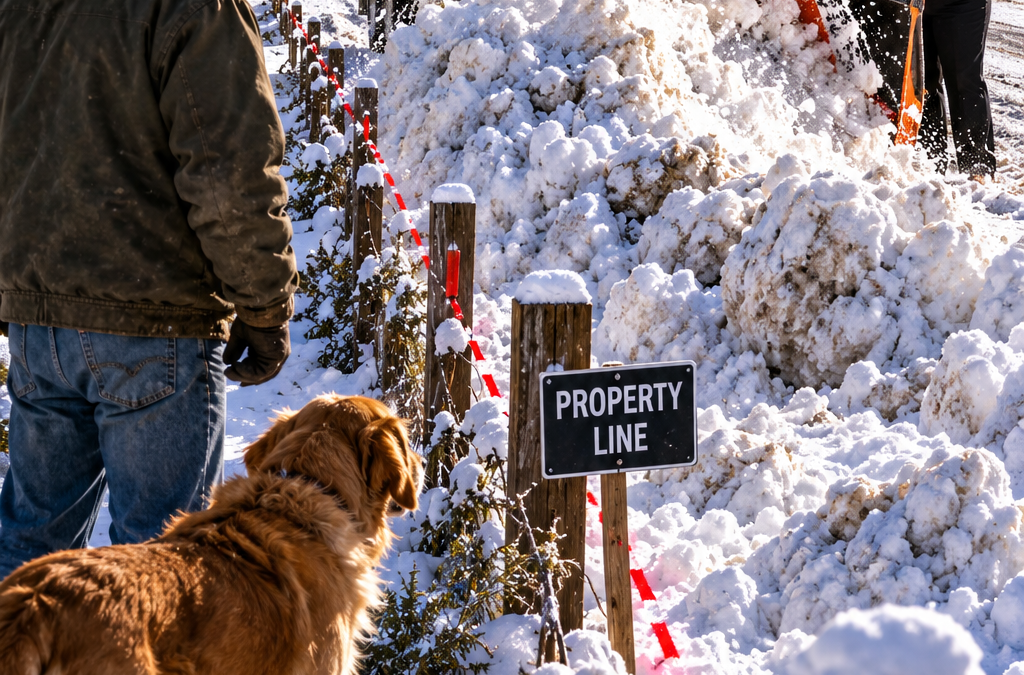
𝗙𝗨𝗟𝗟 𝗦𝗧𝗢𝗥𝗬
I wanted it to be an accident.
Snow removal isn’t precise.
Drivers work long hours.
Visibility is poor.
A blade can push farther than intended.
One mistake didn’t interest me enough to start an argument.
So I measured roughly where the pile sat, took a couple photographs, and went back to clearing the walkway.
That afternoon, I got my answer.
I heard the diesel engine first.
A deep mechanical rumble coming around the bend.
I was in the garage putting tools away.
I stepped outside.
The HOA plow came down the road with a full blade.
Gray snow rolled in front of it.
The driver slowed beside my property.
Then angled the blade.
The truck pushed.
The entire load slid off the roadway.
Across the shoulder.
Across the boundary.
Onto my land.
I stood there staring.
Then I saw Linda.
She was near the roadside in a bright winter coat, one hand raised, directing the driver.
She pointed farther toward my fence.
The truck backed up.
Came forward again.
Another push.
That ended my theory about an accident.
I walked toward them.
“Hey.”
The driver stopped.
Linda turned.
“What are you doing?”
She looked genuinely surprised that I was asking.
“Clearing the road.”
“Onto my property.”
“We need somewhere to stack it.”
I looked at the pile.
“This is not HOA land.”
“It is the most practical location.”
“That wasn’t my question.”
She sighed.
“The road has to be maintained.”
“I agree.”
“So the snow has to go somewhere.”
“Also agree.”
“Then what’s the problem?”
I pointed down.
“The property line.”
She gave the line a glance.
There was no painted stripe on the ground, obviously.
But we knew where it was.
Fence.
Survey markers.
The lot map was not complicated.
“You have plenty of room.”
I almost laughed.
“That doesn’t make it yours.”
“Nobody is taking your land.”
“You are putting several tons of snow on it.”
“Temporarily.”
“Did you ask?”
Linda looked irritated.
“This is a community maintenance issue.”
“Still not permission.”
“Homeowners are expected to cooperate with winter operations.”
“I cooperate.”
“You’re not cooperating right now.”
“No. I’m telling you to stop dumping snow across my boundary.”
Her expression hardened.
“Where exactly would you like us to put it?”
“Somewhere the HOA owns.”
She folded her arms.
“That’s not realistic.”
I looked toward the truck.
The driver seemed uncomfortable.
This was not his fight.
He had been told where to push.
I said, “I’m not blaming him.”
Then to Linda:
“But no more loads onto my property.”
She shook her head.
“You’re making snow removal unnecessarily difficult.”
“Private ownership is sometimes inconvenient.”
Sarah came outside.
She had her phone.
“What happened?”
“HOA is using the yard as a snow dump.”
Linda immediately said, “That’s an exaggeration.”
Sarah looked at the pile.
Then at the plow.
Then at Linda.
“It doesn’t look exaggerated.”
“We’re maintaining the road.”
Sarah’s voice remained calm.
“On his property.”
“Our property,” I corrected automatically.
She smiled slightly.
“Our property.”
Linda looked from her to me.
“You people are turning basic maintenance into a legal dispute.”
“No,” I said. “We’re asking you to keep HOA snow on HOA-controlled areas.”
Linda turned toward the driver.
“Finish the current pass.”
I stepped forward.
“No.”
She looked at me.
“You don’t direct our contractor.”
“And you don’t direct him onto my land.”
The driver put the truck in neutral.
Good man.
He wanted no part of that sentence.
Linda stared at me for several seconds.
Then said:
“I’ll discuss it with the board.”
“Please do.”
She walked away.
The plow followed.
I thought that might end it.
It didn’t.
The next morning, there was another load.
Not as large.
But fresh.
Sarah noticed first.
She came inside carrying Buddy’s leash.
“They did it again.”
I put down my coffee.
“What?”
“Fresh pile.”
We walked out.
She was right.
New gray snow had been pushed against the existing mound.
Sarah looked at me.
“Okay.”
I knew that tone.
“What?”
“We stop talking.”
I smiled.
“You sound ominous.”
“We document.”
That was one of the reasons I married Sarah.
I get angry.
Sarah gets organized.
Within fifteen minutes, she had created a folder on her phone.
Date.
Time.
Photographs.
Video.
I pulled our survey from the property files.
We located the boundary reference points.
Measured from the known markers.
Then we documented the pile.
Length.
Approximate height.
Distance beyond the boundary.
Distance to the fence.
Remaining usable space beside the driveway.
The pressure against the lower fence section bothered me most.
Snow is heavy.
Especially plowed snow.
Compacted, partially frozen, mixed with ice.
The pile was no longer decorative winter inconvenience.
It was loading against a structure on my property.
Another storm could make it worse.
I called the HOA office.
Linda answered.
“You received my message?”
“Yes.”
“And?”
“The board considers snow placement part of emergency seasonal maintenance.”
“That doesn’t answer whether you have permission to use my land.”
“We do not have alternative storage capacity along that section.”
“Then you have a planning problem.”
“You are part of the community.”
“Yes.”
“That comes with shared responsibilities.”
“Shared responsibility does not mean private land becomes common snow storage.”
She went quiet.
I continued.
“The pile is putting pressure on my fence.”
“We are not responsible for natural snow accumulation.”
“I’m not talking about natural accumulation.”
“Can you prove which snow came from our contractor?”
I almost thanked her.
“What?”
“Nothing.”
“Why are you laughing?”
“Because that’s a useful question.”
I hung up.
Sarah was standing in the doorway.
“What did she say?”
“She wants proof.”
Sarah raised her phone.
“Convenient.”
From that moment forward, we recorded every plow pass we could see.
The next afternoon, the driver returned.
We were ready.
Sarah stood near the porch filming from a wide angle.
I stood farther down the property line.
The truck came around.
Linda was there again.
That surprised me.
She stood along the roadside and pointed directly toward the pile.
The driver pushed.
The blade crossed the shoulder line.
Snow spilled onto our land.
Sarah captured the entire movement.
Road.
Truck.
Blade.
Boundary references.
Pile.
Linda.
Then another load.
I filmed from the opposite angle.
There was no ambiguity.
By the time the truck left, we had more evidence than I ever wanted of snow being dumped on my property.
Sarah lowered her phone.
“Well.”
“Yeah.”
“She really made that easy.”
“She’s consistent.”
Buddy walked over to the snow pile.
He sniffed once.
Lifted a leg against the base.
Sarah laughed.
“Even Buddy has filed a complaint.”
I looked at the wall of dirty snow.
It had grown substantially.
The pile now blocked part of a section I used for equipment access.
The fence bowed slightly inward where the densest part pressed against it.
I measured again.
Sarah wrote everything down.
“What’s the plan?” she asked.
“First, I move this away from the fence.”
“Where?”
I looked along the property boundary.
An idea began forming.
Not immediately.
Just a shape.
Long.
Straight.
Entirely ours.
I looked at the tractor.
Then the snow.
Then the survey stakes.
Sarah noticed.
“What?”
“Nothing.”
“That is not your nothing face.”
“I have an idea.”
“Is it legal?”
“Yes.”
“Is it petty?”
I considered that.
“Possibly.”
She smiled.
“I’m listening.”
I showed her the survey.
The property line ran parallel to that side of the lot for a substantial distance.
If I moved the HOA’s pile inward—not back into the street, not onto common property, not into drainage, not onto anyone else’s land—I could create a clean line of snow entirely inside our boundary.
A wall.
Not a dangerous vertical cliff.
A long, broad, compacted ridge.
Far enough inside the property line that nobody could argue it encroached.
Far enough from the fence to relieve pressure.
Clear of the driveway.
Clear of drainage.
Clear of sidewalks.
Clear of sight lines.
Sarah looked at the map.
Then outside.
“You’re going to build a snow wall.”
“I’m going to manage snow on my property.”
She laughed.
“Oh, you’re going to make Linda furious.”
“I’m not doing anything to Linda.”
“You are building a visible monument to her mistake.”
“I prefer winter storage berm.”
“Snow fortress.”
“No.”
“Fort Brooks.”
“No.”
“Wall of Consequences.”
I looked at her.
“That one’s not terrible.”
We started the next morning.
I used the tractor blade first.
Carefully.
The goal was not to push snow back toward the road.
That would make me exactly as irresponsible as the HOA.
Everything stayed on my side.
I pulled the pile away from the fence.
Then began shaping.
Push.
Back.
Compact.
Repeat.
Sarah marked the safe line with temporary stakes.
I kept several feet inside the legal boundary.
No chance of accidental encroachment.
We measured twice.
Then again.
The wall grew slowly.
At first, it looked ugly.
A displaced pile.
Then the line became cleaner.
Long.
Consistent.
I packed the lower section wider so it would remain stable.
The top stayed rounded.
Nothing dangerously steep.
Nothing overhanging.
Just a substantial snow berm running along the private side of our boundary.
Buddy followed the tractor for a while.
Then became bored and lay near the porch.
Sarah took pictures.
“Documentation?”
“Also because this is hilarious.”
“It is not hilarious.”
“You are sculpting HOA snow.”
“I am responsibly maintaining my property.”
“You practiced that sentence.”
“Maybe.”
After several hours, I stopped.
The wall was impressive.
More importantly, it solved every real problem.
Fence relieved.
Driveway fully open.
Equipment access restored.
Drainage clear.
No snow in the street.
No obstruction.
No HOA property touched.
The entire structure sat inside our survey line.
I climbed down from the tractor.
Sarah stood beside me.
“You know what?”
“What?”
“It looks intentional.”
“That was the idea.”
“It actually looks good.”
“I know.”
She turned.
“Don’t get proud.”
Too late.
Linda arrived about twenty minutes later.
I don’t know who called her.
Probably a neighbor.
Maybe she simply drove by.
Her SUV came around the corner.
Slowed.
Stopped.
She got out.
For several seconds, she stared.
Then:
“What on earth are you doing?”
I leaned against the tractor.
“Snow management.”
Her face tightened.
“You cannot build that.”
“Why?”
“It is a wall.”
“Snow.”
“A snow wall.”
“Yes.”
“Along the neighborhood road.”
“No.”
I pointed.
“Along my property.”
“It is visually disruptive.”
I almost smiled.
“That’s not the same as illegal.”
She stared at me.
“You did this because of me.”
“No.”
“You’re trying to make some kind of statement.”
“I moved snow away from my fence.”
“Into a wall.”
“Yes.”
She stepped closer.
“That needs board approval.”
“For what?”
“Exterior modification.”
“Temporary snow storage?”
“A structure this large—”
“It’s snow.”
“You shaped it deliberately.”
“So does the HOA plow.”
Her mouth tightened.
Neighbors began coming outside.
That was inevitable.
You can’t spend half a day constructing a snow wall with a tractor and expect nobody to notice.
A man from two houses down walked over.
Then a couple from farther around the bend.
One neighbor laughed when he saw it.
“That’s all on your property?”
“Yes.”
Linda answered before I could say more.
“That is precisely what is under review.”
I went inside and returned with the survey.
I had expected this.
Sarah brought our measurement sheet.
We laid the survey across the hood of my truck.
I pointed to the recorded line.
Then the temporary stakes.
“The berm sits entirely inside.”
One neighbor walked along it.
“Looks like he’s several feet back.”
“He is,” Sarah said.
Linda pulled out her phone.
“I am calling the board.”
“Please do.”
That answer irritated her.
About forty minutes later, three board members arrived.
The board president came with a copy of the community map.
That made the situation interesting.
Linda had authority as an HOA officer and committee lead, but she was not the only decision-maker.
She sometimes behaved as if she were.
The president was more cautious.
He looked at the snow wall.
Then at me.
“Walk me through it.”
So I did.
I showed the original pile location.
The fence pressure.
Photos.
Measurements.
Survey.
Current wall position.
Driveway clearance.
Drainage clearance.
Road clearance.
He compared the HOA map to my survey.
Same boundary.
No disagreement.
One board member walked to the end of the berm.
Then back.
“Nothing crosses the line.”
“No.”
“Any easement here?”
“Not where the wall sits.”
The president checked.
“No.”
Linda interrupted.
“You are ignoring the aesthetic impact.”
He looked at her.
“Aesthetic impact is not the same thing as an enforceable violation.”
That sentence almost made Sarah smile.
Linda said, “It’s obviously retaliatory.”
The president looked at me.
“Is it?”
“I had several tons of snow placed on my property without permission.”
I pointed to the fence.
“I needed to relocate it.”
“You chose a wall.”
“I chose a stable berm inside my boundary that keeps my access and drainage clear.”
One board member nodded.
Reasonable.
Then Sarah said:
“You should also see how the snow got here.”
Linda’s face changed.
Sarah opened the video.
She played the first clip.
HOA plow.
Road.
Blade turning.
Snow crossing the boundary.
Linda standing beside it.
Then the second.
Another load.
Same location.
My video from farther down.
Clear.
No editing.
The board president watched both.
Then looked at Linda.
“You directed this?”
Linda crossed her arms.
“I directed the contractor to clear the roadway.”
“Onto his property?”
“There was nowhere else practical.”
I said nothing.
I didn’t need to.
The president looked toward the road.
Then the pile.
Then Linda.
“Was permission requested?”
She hesitated.
“We’ve always expected cooperation during major storms.”
“That isn’t what I asked.”
“No.”
That one word changed the meeting.
The original question was no longer:
Why did I build a snow wall?
The question became:
Why had the HOA been placing snow on private land after the owner explicitly objected?
One board member asked, “How many loads?”
I said, “We documented several. More occurred before we began filming.”
Linda said, “We’re talking about snow, not permanent dumping.”
The president answered:
“Snow can damage fencing, landscaping, and drainage.”
Exactly.
Sarah showed him the earlier photos where the pile pressed against the fence.
He leaned closer.
“Did that happen from the HOA truck?”
“Yes.”
The video supported it.
The board president straightened.
“Contractor needs a different snow-storage plan.”
Linda immediately objected.
“Where?”
“I don’t know yet.”
“We have no capacity.”
“Then we find capacity.”
“This property is the obvious location.”
The president looked at her.
“Obvious does not mean authorized.”
That was almost the exact sentence I had used.
I didn’t smile.
Much.
Linda looked at me.
“This is ridiculous.”
I said, “You told me snow had to go somewhere.”
“Yes.”
“So now it has.”
Several neighbors laughed.
Even one board member looked away.
Linda did not.
The board president ended the discussion.
“The plow will not cross this property boundary again without written permission.”
Then he looked at me.
“Keep the wall clear of the road and easement.”
“It already is.”
“Drainage?”
“Clear.”
“Then from what I’m seeing, there’s no present violation.”
Linda stared at him.
“The neighborhood will look absurd.”
He looked at the snow wall.
“It’s winter.”
That ended it.
The board members left.
Neighbors stayed.
People took pictures.
One called it the Great Wall of Snow.
Sarah liked Winter Fortress better.
I refused to name it.
At least publicly.
That evening, we finished shaping the final section.
The temperature dropped.
The outside layer hardened.
Sunset turned the upper ridge pale orange and pink.
The wall reflected the light toward the cabin.
For the first time since the dispute started, I stopped seeing it as a pile of someone else’s problem.
It looked strangely peaceful.
Sarah stood beside me wearing a knit cap and holding two mugs.
She handed me one.
“Fort Brooks.”
“No.”
“It’s too late.”
“Who named it?”
“I did.”
“You don’t have naming rights.”
“I’m co-owner.”
Fair.
Buddy had finally decided the wall was useful.
He discovered that the packed ridge blocked some of the wind near the lower yard.
He curled up beside it until Sarah made him come inside.
The next morning, Linda returned.
Alone.
That surprised me.
No clipboard.
No board member.
No snowplow.
She parked along the road and walked toward the edge of the property.
I was clearing a light overnight dusting from the walkway.
I stopped.
“Morning.”
“Morning.”
Her tone was different.
Not friendly exactly.
But lower.
She looked at the wall.
“How long did this take?”
“A few hours.”
“All of it?”
“Most.”
She studied the berm.
“You moved that much snow yourself?”
“You delivered most of the raw material.”
Her mouth twitched.
Almost a smile.
Almost.
Then she said, “You really measured everything.”
“Yes.”
“The board president checked it again after he left.”
“I assumed he would.”
“You’re well inside the line.”
“Yes.”
She stared toward the far end.
I waited.
Finally, she said:
“I still think you could’ve handled this differently.”
That irritated me, but I kept my voice level.
“So could you.”
She looked at me.
“You made your point.”
“The wall wasn’t the point.”
“Then what was?”
I leaned the shovel against the porch rail.
“My land doesn’t stop being private because the HOA has a maintenance problem.”
Linda said nothing.
“You needed snow storage.”
“Yes.”
“You could’ve asked.”
“We needed somewhere reliable.”
“You could’ve asked.”
“What if you’d said no?”
“Then you would’ve needed another plan.”
She looked toward the road.
“That is not always simple during a storm.”
“I know.”
“And you would’ve just watched the road become unsafe?”
“No.”
“Then what?”
“I might have said yes.”
That made her look back.
“What?”
“If you’d asked.”
She stared at me.
“I have plenty of land.”
“Then why—”
“Because permission matters.”
Silence.
I continued.
“If you had come to me before the storm and said the road contractor needed temporary storage, I might have agreed on a location.”
“Under conditions.”
“Of course.”
She almost rolled her eyes.
“Away from the fence. Clear of drainage. No gravel mixed into landscaped areas. Remove or manage it if damage occurred.”
“That sounds complicated.”
“No.”
I looked at the wall.
“This was complicated.”
She didn’t argue.
That was unusual.
After a minute, Linda said:
“The contractor has another storage area now.”
“Good.”
“Farther past the clubhouse.”
“Good.”
“It costs more.”
“I figured.”
Another silence.
Then she nodded.
Not apology.
But acknowledgment.
“I’ll make sure they stay off this line.”
“Thank you.”
She walked back to her SUV.
That conversation was the last time Linda and I argued about snow.
The rest of the winter remained heavy.
Three more substantial storms came through.
Each time, I watched the HOA plow.
Not because I expected another violation.
Habit.
The driver reached our section.
Angled his blade toward the HOA-controlled storage area instead.
No snow crossed our line.
Not once.
The wall remained.
Weather changed it.
Sun softened one side.
Wind carved the top.
Another storm added clean snow.
I reshaped sections occasionally.
Not to make a statement.
Because once it existed, it was useful.
It blocked wind.
Helped define the equipment path.
Kept Buddy from wandering too close to the road in deep snow.
Kids walking past sometimes stopped to stare.
One neighbor asked if his children could build a little snow fort at the far end.
I said yes.
Permission.
Funny how easy the word was.
By February, the snow wall had become less controversial and more ridiculous neighborhood landmark.
People referred to it casually.
“Past the snow wall.”
“Turn before the snow wall.”
“Meet us by the snow wall.”
Sarah delighted in that.
“I told you we needed a name.”
“We absolutely did not.”
“Fort Brooks has community recognition.”
“Don’t say community. Linda will assess dues.”
Sarah laughed.
The fence survived.
That mattered most.
Once spring began, the wall shrank.
Slowly.
Dirty ice at the base.
Clean snow disappearing first.
Water ran exactly where our drainage plan allowed.
No flooding.
No erosion.
No damage to the road.
We photographed that too.
By April, the last chunk was gone.
The grass underneath was flattened.
Nothing more.
I repaired one section of fence where the original HOA pile had put pressure against the lower rail.
The board reimbursed the repair after reviewing our photographs.
That was probably the most meaningful official acknowledgment of the whole dispute.
No dramatic letter.
No public apology.
Just a reimbursement line.
Damage caused.
Evidence provided.
Responsibility accepted.
Simple.
At the spring HOA meeting, snow removal appeared on the agenda.
I attended.
Linda was there.
The board president presented the revised winter plan.
Designated storage areas.
No private-property snow placement without written owner permission.
Contractor map.
Emergency overflow procedure.
I read the page twice.
Sarah leaned toward me.
“You realize your wall is now policy.”
“Please never say that again.”
She smiled.
During homeowner comments, an older neighbor stood.
“I’d like to congratulate the board on discovering property lines.”
The room laughed.
Linda did not.
But she didn’t object either.
Progress.
After the meeting, the plow contractor approached me.
Same driver who had pushed the first loads.
“I wanted to say something.”
“Sure.”
“I knew you were mad at me.”
“I wasn’t.”
“I was the one driving.”
“You were following instructions.”
He nodded.
“Still felt wrong after you came out.”
“You stopped when we argued.”
“Yeah.”
He looked embarrassed.
“Linda was telling me it was association-approved storage.”
“I figured.”
“I should’ve asked.”
I shrugged.
“Now you know.”
He smiled.
“I’ve got your line marked on the route map.”
“That sounds useful.”
“Very.”
That was enough.
I never wanted the driver punished.
He hadn’t invented the policy.
He was trying to keep the road open.
The problem had always been the assumption behind the decision.
Your land is convenient.
Therefore we can use it.
That logic appears in more places than snow removal.
Parking.
Drainage.
Construction access.
Utility staging.
Temporary storage.
Signs.
Landscaping.
People become strangely flexible about property boundaries when crossing them solves an immediate problem.
The person who owns the property experiences that flexibility differently.
A year later, another winter came.
Smaller storms.
Nothing like the previous season.
The HOA sent a snow-removal notice in November.
Attached was a map.
Storage locations highlighted.
Private boundaries clearly marked.
At the bottom:
No snow shall be intentionally stored on private parcels without prior written authorization from the owner.
Sarah read it.
Then looked at me.
“You’re famous.”
“I’m not.”
“You caused a sentence.”
“I caused nothing.”
“Your fortress caused a sentence.”
I took the paper from her.
The rule was obvious.
It should never have needed writing.
Yet sometimes obvious principles only become policy after somebody violates them.
That first storm of the new season came overnight.
Maybe eight inches.
I woke before sunrise.
Made coffee.
Looked outside.
The HOA plow was working down the road.
I watched it approach our property.
The driver slowed.
Angled the blade.
Pushed the snow toward the proper storage area.
Never crossed the line.
Then he flashed his headlights at the house.
I laughed.
Sarah came downstairs.
“What?”
“Nothing.”
She looked outside.
“No new fortress?”
“Afraid not.”
“Disappointing.”
Buddy, older and slightly heavier by then, stood at the door.
I let him out.
He stepped into the snow.
Sank.
Immediately turned around.
Some things never change.
The property felt peaceful again.
That was all I had wanted from the beginning.
Not to defeat Linda.
Not to embarrass the HOA.
Not to create a neighborhood attraction out of compacted snow.
I wanted people responsible for shared maintenance to remember that shared responsibility has boundaries.
My property line was one of them.
It did not disappear under six inches of snow.
It did not move because the HOA lacked storage space.
It did not become optional because the solution on my side looked easier than the solution on theirs.
Boundaries do not matter only when respecting them is convenient.
They matter most when crossing them would solve your problem.
That’s the lesson Linda resisted.
And, eventually, the one she understood.
I think about the first conversation sometimes.
Her standing beside the plow.
It’s the easiest place to put it.
That sentence summarized the whole dispute.
She wasn’t trying to steal my land.
She probably wasn’t thinking about ownership at all.
That was the problem.
My property had become empty space inside her logistical calculation.
Road here.
Snow here.
Fence there.
Problem solved.
Except somebody owned the empty space.
Me.
Sarah.
Buddy, according to Buddy.
What made the situation frustrating wasn’t malicious intent.
It was entitlement created by convenience.
Linda saw unused land.
I saw our land.
Same snow.
Different perspective.
The wall forced those perspectives to meet physically.
Every load the HOA had pushed onto our side ended up becoming part of a visible line.
Nobody driving past could pretend the boundary was theoretical anymore.
There it was.
White.
Long.
Impossible to miss.
The HOA had accidentally supplied most of the material.
That irony never stopped amusing Sarah.
“You realize they literally built your boundary for you.”
“They delivered snow.”
“Same thing.”
“No.”
“Emotionally, yes.”
I let her have that one.
Years later, we still live there.
The fence has been replaced since then.
Not because of the snow.
Age.
The new one follows the same surveyed line.
When the contractor installed it, Linda happened to drive past.
She stopped.
Rolled down her window.
“You measured that, right?”
I looked at her.
She smiled.
Actually smiled.
“Couldn’t resist.”
I laughed.
“Twice.”
“Good.”
Then she drove away.
That small exchange told me more than an apology would have.
She remembered.
So did I.
The difference was that neither of us needed to fight about it anymore.
That is the best outcome of a boundary dispute.
Not permanent hostility.
Permanent clarity.
The winter wall existed for a few months.
The lesson lasted longer.
I kept the original photographs.
They sit in the same property folder as the survey.
The first image shows the random gray pile pressing against our fence.
The last shows the finished berm under sunset, smooth and bright, the cabin lights glowing behind it.
If you didn’t know the story, you’d think we built it for fun.
Maybe that is what it eventually became.
But whenever I see those pictures, I remember how the whole thing started.
A snowplow.
Linda pointing.
My land treated as available because nobody expected me to object.
Then Sarah with her phone.
Measurements.
Survey lines.
Documentation.
And one simple decision:
If the snow was going to remain on our property, it would remain there on our terms.
That changed the balance completely.
Linda had expected resistance to look like yelling.
Legal threats.
Maybe someone pushing the snow back into the road.
Instead, we gave her something more difficult to argue with.
Compliance.
Precise, documented, visible compliance with the actual boundary.
The wall never crossed onto HOA land.
Never blocked traffic.
Never interfered with an easement.
Never obstructed drainage.
It simply occupied our property using material the HOA had put there.
That was why the board couldn’t honestly object once it looked at the map.
And once the board saw the videos, the conversation stopped being about appearance altogether.
That was the moment I knew the dispute was over.
Not when Linda stopped arguing.
When the facts became simpler than her explanation.
Your plow crossed this line.
Our wall does not.
One was the problem.
The other wasn’t.
Everything else was noise.
I learned something else that winter.
People often think defending property rights requires being aggressive.
It doesn’t.
Sometimes aggression is the worst choice.
If I had shoved all the snow back into the street, I could have created a hazard.
If I had blocked the plow, I might have interfered with road maintenance.
If I had damaged HOA equipment, I would have turned myself from owner into problem.
So I didn’t.
I documented.
Measured.
Moved what was already mine to manage.
Stayed inside my boundary.
That required more work.
It was also impossible to dismiss.
Sarah deserves most of the credit for that.
When I wanted to call Linda and argue after the second pile appeared, Sarah said:
“No. Photograph first.”
When I wanted to move the snow immediately:
“Measure first.”
When I said the boundary was obvious:
“Survey first.”
That discipline mattered.
By the time the board arrived, we weren’t asking anyone to believe us.
We were showing them.
Photographs.
Video.
Measurements.
Survey.
Current condition.
The burden shifted.
Linda had to explain why the HOA crossed the line.
She couldn’t answer with:
Because it was easier.
Not once people were looking closely.
The phrase private property sounds abstract until somebody needs yours.
Then it becomes practical.
Can they use this corner?
Can they park here?
Can they dump there?
Can they enter?
Can they store?
Maybe.
Sometimes the answer is yes.
But unless a deed, easement, covenant, law, or other valid right already answers the question, the person asking does not get to replace permission with convenience.
That was all I ever tried to explain.
Linda eventually understood.
The board understood sooner.
The contractor understood immediately once the map changed.
And from then on, snow went somewhere else.
Sometimes that somewhere else cost the HOA more money.
That was not my responsibility.
Proper planning often costs more than trespassing.
That doesn’t make trespassing a budget solution.
The funniest thing is that if Linda had asked before the second storm, I probably would have let the HOA use part of the property.
Sarah agrees.
We could have chosen an area.
Set a maximum pile size.
Kept it away from the fence.
Protected drainage.
Had the contractor clean up gravel in spring.
Simple.
I wasn’t opposed to helping neighbors.
I was opposed to being informed after the decision had already been made on my behalf.
That’s a difference Linda didn’t understand until the wall appeared.
Community is not the absence of boundaries.
Healthy community depends on boundaries because cooperation means more when people actually have the right to say no.
Otherwise it isn’t cooperation.
It’s compliance.
I thought about that the last morning the wall existed.
Spring sun had reduced it to a dirty ridge maybe two feet high.
Water dripped steadily.
Buddy stood near the remains sniffing at things that had been buried for months.
Sarah came outside.
“Fort Brooks is dying.”
“Finally.”
“You sound heartless.”
“It’s a snow pile.”
“It stood for something.”
“What?”
“Freedom.”
I laughed.
“Please go inside.”
She smiled.
Then we stood there together watching meltwater run toward the proper drainage channel.
By evening, another section collapsed.
A few days later, only a thin strip remained.
Then nothing.
Grass returned.
Fence visible.
The physical boundary became invisible again.
But unlike the beginning of winter, everyone knew exactly where it was.
Sometimes the most effective boundary marker is the one that doesn’t need to remain.
For one season, ours was made of snow.
That was enough.
𝗧𝗛𝗘 𝗘𝗡𝗗
The HOA Kept Dumping Its Snow on My Land Until I Used Every Load to Mark the One Line Linda Refused to Respect
Linda Brooks stood beside an HOA snowplow and calmly directed the driver to push another full blade of street snow across my property line, as if my land existed simply because the neighborhood needed somewhere convenient to dump its winter problems.
I could have spent the rest of the season arguing with her over every load, but after my wife and I documented exactly where the boundary sat, I decided there was a better use for all that snow.
That winter began hard.
Not gradually.
Not with a picturesque dusting that made the roofs look pretty for an afternoon.
The first real storm came through the valley in December and stayed long enough to erase almost every familiar edge outside our windows.
By the time it moved on, the road had disappeared beneath packed white ridges, the lower branches of the pines sagged under the weight, and my fence posts looked as though somebody had shortened them overnight.
Sarah stood at the kitchen window the morning after the storm with a mug of coffee in both hands.
“That’s a lot of snow.”
I looked outside.
“Technical assessment?”
“Yes.”
“Very professional.”
Buddy, our dog, was sitting near the back door staring at the yard as though winter had personally betrayed him.
Sarah pointed at him.
“He agrees.”
Buddy hated deep snow.
He loved the first inch.
He would run through it, bite at flakes, roll onto his back, and act like the world had been rebuilt entirely for his entertainment.
Anything beyond six inches offended him.
After the first storm, he stepped off the porch, sank nearly to his chest, backed up, and looked at me as though I had failed to maintain basic household standards.
Our property sat near the outer edge of the neighborhood.
That was one reason Sarah and I had bought it.
We had space.
Enough separation from the houses clustered farther down the HOA road.
The back and side boundaries opened toward woods and a wider stretch of private ground rather than another row of patios.
We were still subject to the HOA where the governing documents applied, but our lot had always felt more independent than the properties near the clubhouse.
I liked that.
I liked handling my own driveway.
My own fence.
My own drainage.
My own snow.
I owned a compact tractor with a front blade and a rear snowblower.
Nothing fancy.
Enough for our driveway, walkway, and the section near the detached garage.
When storms came, I dealt with them.
I didn’t expect the HOA to clear my private areas.
I didn’t want them to.
That winter, the association had contracted with a commercial snow service to keep the neighborhood road open.
That made sense.
The main road was association-maintained.
Cars needed access.
Delivery trucks needed access.
Emergency vehicles needed access.
Snow had to be moved somewhere.
That part was obvious.
What was not obvious was why Linda Brooks decided “somewhere” meant my property.
Linda had been involved with the HOA for years.
She had a habit of treating inconvenience as authority.
If the board needed something, Linda often behaved as though the need itself created permission.
Need landscaping access?
Go through somebody’s yard.
Need a contractor staging area?
Use the widest driveway.
Need somewhere to put temporary signs?
Use the closest lawn.
Usually residents went along because the request was minor or because fighting with Linda took more energy than saying yes.
I had learned to ask one question whenever she appeared with that tone.
“Where is that written?”
She hated that question.
The first major storm passed without conflict.
The HOA plow cleared the road.
I cleared our property.
Everything was fine.
Then the second storm hit.
It was heavier.
Wet snow at first.
Then temperatures dropped.
Everything froze.
The plows pushed thick gray piles toward the shoulders.
For two days, wind packed fresh snow into whatever space had been opened the hour before.
By the end, the neighborhood looked less like a collection of houses and more like a maze built out of snowbanks.
The morning after the storm, I walked toward the side fence carrying a shovel.
That’s when I saw the pile.
At first, I assumed it was drift.
Then I got closer.
It was too dense.
Too dirty.
Too compact.
Street snow.
There were chunks of ice.
Bits of gravel.
Sand.
The kind of material that collects along a plow blade after several passes.
The pile stretched along the outer edge of my property.
Large enough that it had already buried the lower fence rails.
I stood there for a while.
Buddy circled it.
Sniffed.
Then looked at me.
“Yeah,” I said. “I don’t know either.”
Sarah came outside wearing boots and one of my coats.
“What are you looking at?”
“This.”
She stopped beside me.
“That wasn’t here yesterday.”
“No.”
“You didn’t put it there?”
“No.”
She looked toward the HOA road.
“You think the plow did?”
“Looks like it.”
“Accident?”
“Maybe.”
I wanted it to be an accident.
Snow removal isn’t precise.
Drivers work long hours.
Visibility is poor.
A blade can push farther than intended.
One mistake didn’t interest me enough to start an argument.
So I measured roughly where the pile sat, took a couple photographs, and went back to clearing the walkway.
That afternoon, I got my answer.
I heard the diesel engine first.
A deep mechanical rumble coming around the bend.
I was in the garage putting tools away.
I stepped outside.
The HOA plow came down the road with a full blade.
Gray snow rolled in front of it.
The driver slowed beside my property.
Then angled the blade.
The truck pushed.
The entire load slid off the roadway.
Across the shoulder.
Across the boundary.
Onto my land.
I stood there staring.
Then I saw Linda.
She was near the roadside in a bright winter coat, one hand raised, directing the driver.
She pointed farther toward my fence.
The truck backed up.
Came forward again.
Another push.
That ended my theory about an accident.
I walked toward them.
“Hey.”
The driver stopped.
Linda turned.
“What are you doing?”
She looked genuinely surprised that I was asking.
“Clearing the road.”
“Onto my property.”
“We need somewhere to stack it.”
I looked at the pile.
“This is not HOA land.”
“It is the most practical location.”
“That wasn’t my question.”
She sighed.
“The road has to be maintained.”
“I agree.”
“So the snow has to go somewhere.”
“Also agree.”
“Then what’s the problem?”
I pointed down.
“The property line.”
She gave the line a glance.
There was no painted stripe on the ground, obviously.
But we knew where it was.
Fence.
Survey markers.
The lot map was not complicated.
“You have plenty of room.”
I almost laughed.
“That doesn’t make it yours.”
“Nobody is taking your land.”
“You are putting several tons of snow on it.”
“Temporarily.”
“Did you ask?”
Linda looked irritated.
“This is a community maintenance issue.”
“Still not permission.”
“Homeowners are expected to cooperate with winter operations.”
“I cooperate.”
“You’re not cooperating right now.”
“No. I’m telling you to stop dumping snow across my boundary.”
Her expression hardened.
“Where exactly would you like us to put it?”
“Somewhere the HOA owns.”
She folded her arms.
“That’s not realistic.”
I looked toward the truck.
The driver seemed uncomfortable.
This was not his fight.
He had been told where to push.
I said, “I’m not blaming him.”
Then to Linda:
“But no more loads onto my property.”
She shook her head.
“You’re making snow removal unnecessarily difficult.”
“Private ownership is sometimes inconvenient.”
Sarah came outside.
She had her phone.
“What happened?”
“HOA is using the yard as a snow dump.”
Linda immediately said, “That’s an exaggeration.”
Sarah looked at the pile.
Then at the plow.
Then at Linda.
“It doesn’t look exaggerated.”
“We’re maintaining the road.”
Sarah’s voice remained calm.
“On his property.”
“Our property,” I corrected automatically.
She smiled slightly.
“Our property.”
Linda looked from her to me.
“You people are turning basic maintenance into a legal dispute.”
“No,” I said. “We’re asking you to keep HOA snow on HOA-controlled areas.”
Linda turned toward the driver.
“Finish the current pass.”
I stepped forward.
“No.”
She looked at me.
“You don’t direct our contractor.”
“And you don’t direct him onto my land.”
The driver put the truck in neutral.
Good man.
He wanted no part of that sentence.
Linda stared at me for several seconds.
Then said:
“I’ll discuss it with the board.”
“Please do.”
She walked away.
The plow followed.
I thought that might end it.
It didn’t.
The next morning, there was another load.
Not as large.
But fresh.
Sarah noticed first.
She came inside carrying Buddy’s leash.
“They did it again.”
I put down my coffee.
“What?”
“Fresh pile.”
We walked out.
She was right.
New gray snow had been pushed against the existing mound.
Sarah looked at me.
“Okay.”
I knew that tone.
“What?”
“We stop talking.”
I smiled.
“You sound ominous.”
“We document.”
That was one of the reasons I married Sarah.
I get angry.
Sarah gets organized.
Within fifteen minutes, she had created a folder on her phone.
Date.
Time.
Photographs.
Video.
I pulled our survey from the property files.
We located the boundary reference points.
Measured from the known markers.
Then we documented the pile.
Length.
Approximate height.
Distance beyond the boundary.
Distance to the fence.
Remaining usable space beside the driveway.
The pressure against the lower fence section bothered me most.
Snow is heavy.
Especially plowed snow.
Compacted, partially frozen, mixed with ice.
The pile was no longer decorative winter inconvenience.
It was loading against a structure on my property.
Another storm could make it worse.
I called the HOA office.
Linda answered.
“You received my message?”
“Yes.”
“And?”
“The board considers snow placement part of emergency seasonal maintenance.”
“That doesn’t answer whether you have permission to use my land.”
“We do not have alternative storage capacity along that section.”
“Then you have a planning problem.”
“You are part of the community.”
“Yes.”
“That comes with shared responsibilities.”
“Shared responsibility does not mean private land becomes common snow storage.”
She went quiet.
I continued.
“The pile is putting pressure on my fence.”
“We are not responsible for natural snow accumulation.”
“I’m not talking about natural accumulation.”
“Can you prove which snow came from our contractor?”
I almost thanked her.
“What?”
“Nothing.”
“Why are you laughing?”
“Because that’s a useful question.”
I hung up.
Sarah was standing in the doorway.
“What did she say?”
“She wants proof.”
Sarah raised her phone.
“Convenient.”
From that moment forward, we recorded every plow pass we could see.
The next afternoon, the driver returned.
We were ready.
Sarah stood near the porch filming from a wide angle.
I stood farther down the property line.
The truck came around.
Linda was there again.
That surprised me.
She stood along the roadside and pointed directly toward the pile.
The driver pushed.
The blade crossed the shoulder line.
Snow spilled onto our land.
Sarah captured the entire movement.
Road.
Truck.
Blade.
Boundary references.
Pile.
Linda.
Then another load.
I filmed from the opposite angle.
There was no ambiguity.
By the time the truck left, we had more evidence than I ever wanted of snow being dumped on my property.
Sarah lowered her phone.
“Well.”
“Yeah.”
“She really made that easy.”
“She’s consistent.”
Buddy walked over to the snow pile.
He sniffed once.
Lifted a leg against the base.
Sarah laughed.
“Even Buddy has filed a complaint.”
I looked at the wall of dirty snow.
It had grown substantially.
The pile now blocked part of a section I used for equipment access.
The fence bowed slightly inward where the densest part pressed against it.
I measured again.
Sarah wrote everything down.
“What’s the plan?” she asked.
“First, I move this away from the fence.”
“Where?”
I looked along the property boundary.
An idea began forming.
Not immediately.
Just a shape.
Long.
Straight.
Entirely ours.
I looked at the tractor.
Then the snow.
Then the survey stakes.
Sarah noticed.
“What?”
“Nothing.”
“That is not your nothing face.”
“I have an idea.”
“Is it legal?”
“Yes.”
“Is it petty?”
I considered that.
“Possibly.”
She smiled.
“I’m listening.”
I showed her the survey.
The property line ran parallel to that side of the lot for a substantial distance.
If I moved the HOA’s pile inward—not back into the street, not onto common property, not into drainage, not onto anyone else’s land—I could create a clean line of snow entirely inside our boundary.
A wall.
Not a dangerous vertical cliff.
A long, broad, compacted ridge.
Far enough inside the property line that nobody could argue it encroached.
Far enough from the fence to relieve pressure.
Clear of the driveway.
Clear of drainage.
Clear of sidewalks.
Clear of sight lines.
Sarah looked at the map.
Then outside.
“You’re going to build a snow wall.”
“I’m going to manage snow on my property.”
She laughed.
“Oh, you’re going to make Linda furious.”
“I’m not doing anything to Linda.”
“You are building a visible monument to her mistake.”
“I prefer winter storage berm.”
“Snow fortress.”
“No.”
“Fort Brooks.”
“No.”
“Wall of Consequences.”
I looked at her.
“That one’s not terrible.”
We started the next morning.
I used the tractor blade first.
Carefully.
The goal was not to push snow back toward the road.
That would make me exactly as irresponsible as the HOA.
Everything stayed on my side.
I pulled the pile away from the fence.
Then began shaping.
Push.
Back.
Compact.
Repeat.
Sarah marked the safe line with temporary stakes.
I kept several feet inside the legal boundary.
No chance of accidental encroachment.
We measured twice.
Then again.
The wall grew slowly.
At first, it looked ugly.
A displaced pile.
Then the line became cleaner.
Long.
Consistent.
I packed the lower section wider so it would remain stable.
The top stayed rounded.
Nothing dangerously steep.
Nothing overhanging.
Just a substantial snow berm running along the private side of our boundary.
Buddy followed the tractor for a while.
Then became bored and lay near the porch.
Sarah took pictures.
“Documentation?”
“Also because this is hilarious.”
“It is not hilarious.”
“You are sculpting HOA snow.”
“I am responsibly maintaining my property.”
“You practiced that sentence.”
“Maybe.”
After several hours, I stopped.
The wall was impressive.
More importantly, it solved every real problem.
Fence relieved.
Driveway fully open.
Equipment access restored.
Drainage clear.
No snow in the street.
No obstruction.
No HOA property touched.
The entire structure sat inside our survey line.
I climbed down from the tractor.
Sarah stood beside me.
“You know what?”
“What?”
“It looks intentional.”
“That was the idea.”
“It actually looks good.”
“I know.”
She turned.
“Don’t get proud.”
Too late.
Linda arrived about twenty minutes later.
I don’t know who called her.
Probably a neighbor.
Maybe she simply drove by.
Her SUV came around the corner.
Slowed.
Stopped.
She got out.
For several seconds, she stared.
Then:
“What on earth are you doing?”
I leaned against the tractor.
“Snow management.”
Her face tightened.
“You cannot build that.”
“Why?”
“It is a wall.”
“Snow.”
“A snow wall.”
“Yes.”
“Along the neighborhood road.”
“No.”
I pointed.
“Along my property.”
“It is visually disruptive.”
I almost smiled.
“That’s not the same as illegal.”
She stared at me.
“You did this because of me.”
“No.”
“You’re trying to make some kind of statement.”
“I moved snow away from my fence.”
“Into a wall.”
“Yes.”
She stepped closer.
“That needs board approval.”
“For what?”
“Exterior modification.”
“Temporary snow storage?”
“A structure this large—”
“It’s snow.”
“You shaped it deliberately.”
“So does the HOA plow.”
Her mouth tightened.
Neighbors began coming outside.
That was inevitable.
You can’t spend half a day constructing a snow wall with a tractor and expect nobody to notice.
A man from two houses down walked over.
Then a couple from farther around the bend.
One neighbor laughed when he saw it.
“That’s all on your property?”
“Yes.”
Linda answered before I could say more.
“That is precisely what is under review.”
I went inside and returned with the survey.
I had expected this.
Sarah brought our measurement sheet.
We laid the survey across the hood of my truck.
I pointed to the recorded line.
Then the temporary stakes.
“The berm sits entirely inside.”
One neighbor walked along it.
“Looks like he’s several feet back.”
“He is,” Sarah said.
Linda pulled out her phone.
“I am calling the board.”
“Please do.”
That answer irritated her.
About forty minutes later, three board members arrived.
The board president came with a copy of the community map.
That made the situation interesting.
Linda had authority as an HOA officer and committee lead, but she was not the only decision-maker.
She sometimes behaved as if she were.
The president was more cautious.
He looked at the snow wall.
Then at me.
“Walk me through it.”
So I did.
I showed the original pile location.
The fence pressure.
Photos.
Measurements.
Survey.
Current wall position.
Driveway clearance.
Drainage clearance.
Road clearance.
He compared the HOA map to my survey.
Same boundary.
No disagreement.
One board member walked to the end of the berm.
Then back.
“Nothing crosses the line.”
“No.”
“Any easement here?”
“Not where the wall sits.”
The president checked.
“No.”
Linda interrupted.
“You are ignoring the aesthetic impact.”
He looked at her.
“Aesthetic impact is not the same thing as an enforceable violation.”
That sentence almost made Sarah smile.
Linda said, “It’s obviously retaliatory.”
The president looked at me.
“Is it?”
“I had several tons of snow placed on my property without permission.”
I pointed to the fence.
“I needed to relocate it.”
“You chose a wall.”
“I chose a stable berm inside my boundary that keeps my access and drainage clear.”
One board member nodded.
Reasonable.
Then Sarah said:
“You should also see how the snow got here.”
Linda’s face changed.
Sarah opened the video.
She played the first clip.
HOA plow.
Road.
Blade turning.
Snow crossing the boundary.
Linda standing beside it.
Then the second.
Another load.
Same location.
My video from farther down.
Clear.
No editing.
The board president watched both.
Then looked at Linda.
“You directed this?”
Linda crossed her arms.
“I directed the contractor to clear the roadway.”
“Onto his property?”
“There was nowhere else practical.”
I said nothing.
I didn’t need to.
The president looked toward the road.
Then the pile.
Then Linda.
“Was permission requested?”
She hesitated.
“We’ve always expected cooperation during major storms.”
“That isn’t what I asked.”
“No.”
That one word changed the meeting.
The original question was no longer:
Why did I build a snow wall?
The question became:
Why had the HOA been placing snow on private land after the owner explicitly objected?
One board member asked, “How many loads?”
I said, “We documented several. More occurred before we began filming.”
Linda said, “We’re talking about snow, not permanent dumping.”
The president answered:
“Snow can damage fencing, landscaping, and drainage.”
Exactly.
Sarah showed him the earlier photos where the pile pressed against the fence.
He leaned closer.
“Did that happen from the HOA truck?”
“Yes.”
The video supported it.
The board president straightened.
“Contractor needs a different snow-storage plan.”
Linda immediately objected.
“Where?”
“I don’t know yet.”
“We have no capacity.”
“Then we find capacity.”
“This property is the obvious location.”
The president looked at her.
“Obvious does not mean authorized.”
That was almost the exact sentence I had used.
I didn’t smile.
Much.
Linda looked at me.
“This is ridiculous.”
I said, “You told me snow had to go somewhere.”
“Yes.”
“So now it has.”
Several neighbors laughed.
Even one board member looked away.
Linda did not.
The board president ended the discussion.
“The plow will not cross this property boundary again without written permission.”
Then he looked at me.
“Keep the wall clear of the road and easement.”
“It already is.”
“Drainage?”
“Clear.”
“Then from what I’m seeing, there’s no present violation.”
Linda stared at him.
“The neighborhood will look absurd.”
He looked at the snow wall.
“It’s winter.”
That ended it.
The board members left.
Neighbors stayed.
People took pictures.
One called it the Great Wall of Snow.
Sarah liked Winter Fortress better.
I refused to name it.
At least publicly.
That evening, we finished shaping the final section.
The temperature dropped.
The outside layer hardened.
Sunset turned the upper ridge pale orange and pink.
The wall reflected the light toward the cabin.
For the first time since the dispute started, I stopped seeing it as a pile of someone else’s problem.
It looked strangely peaceful.
Sarah stood beside me wearing a knit cap and holding two mugs.
She handed me one.
“Fort Brooks.”
“No.”
“It’s too late.”
“Who named it?”
“I did.”
“You don’t have naming rights.”
“I’m co-owner.”
Fair.
Buddy had finally decided the wall was useful.
He discovered that the packed ridge blocked some of the wind near the lower yard.
He curled up beside it until Sarah made him come inside.
The next morning, Linda returned.
Alone.
That surprised me.
No clipboard.
No board member.
No snowplow.
She parked along the road and walked toward the edge of the property.
I was clearing a light overnight dusting from the walkway.
I stopped.
“Morning.”
“Morning.”
Her tone was different.
Not friendly exactly.
But lower.
She looked at the wall.
“How long did this take?”
“A few hours.”
“All of it?”
“Most.”
She studied the berm.
“You moved that much snow yourself?”
“You delivered most of the raw material.”
Her mouth twitched.
Almost a smile.
Almost.
Then she said, “You really measured everything.”
“Yes.”
“The board president checked it again after he left.”
“I assumed he would.”
“You’re well inside the line.”
“Yes.”
She stared toward the far end.
I waited.
Finally, she said:
“I still think you could’ve handled this differently.”
That irritated me, but I kept my voice level.
“So could you.”
She looked at me.
“You made your point.”
“The wall wasn’t the point.”
“Then what was?”
I leaned the shovel against the porch rail.
“My land doesn’t stop being private because the HOA has a maintenance problem.”
Linda said nothing.
“You needed snow storage.”
“Yes.”
“You could’ve asked.”
“We needed somewhere reliable.”
“You could’ve asked.”
“What if you’d said no?”
“Then you would’ve needed another plan.”
She looked toward the road.
“That is not always simple during a storm.”
“I know.”
“And you would’ve just watched the road become unsafe?”
“No.”
“Then what?”
“I might have said yes.”
That made her look back.
“What?”
“If you’d asked.”
She stared at me.
“I have plenty of land.”
“Then why—”
“Because permission matters.”
Silence.
I continued.
“If you had come to me before the storm and said the road contractor needed temporary storage, I might have agreed on a location.”
“Under conditions.”
“Of course.”
She almost rolled her eyes.
“Away from the fence. Clear of drainage. No gravel mixed into landscaped areas. Remove or manage it if damage occurred.”
“That sounds complicated.”
“No.”
I looked at the wall.
“This was complicated.”
She didn’t argue.
That was unusual.
After a minute, Linda said:
“The contractor has another storage area now.”
“Good.”
“Farther past the clubhouse.”
“Good.”
“It costs more.”
“I figured.”
Another silence.
Then she nodded.
Not apology.
But acknowledgment.
“I’ll make sure they stay off this line.”
“Thank you.”
She walked back to her SUV.
That conversation was the last time Linda and I argued about snow.
The rest of the winter remained heavy.
Three more substantial storms came through.
Each time, I watched the HOA plow.
Not because I expected another violation.
Habit.
The driver reached our section.
Angled his blade toward the HOA-controlled storage area instead.
No snow crossed our line.
Not once.
The wall remained.
Weather changed it.
Sun softened one side.
Wind carved the top.
Another storm added clean snow.
I reshaped sections occasionally.
Not to make a statement.
Because once it existed, it was useful.
It blocked wind.
Helped define the equipment path.
Kept Buddy from wandering too close to the road in deep snow.
Kids walking past sometimes stopped to stare.
One neighbor asked if his children could build a little snow fort at the far end.
I said yes.
Permission.
Funny how easy the word was.
By February, the snow wall had become less controversial and more ridiculous neighborhood landmark.
People referred to it casually.
“Past the snow wall.”
“Turn before the snow wall.”
“Meet us by the snow wall.”
Sarah delighted in that.
“I told you we needed a name.”
“We absolutely did not.”
“Fort Brooks has community recognition.”
“Don’t say community. Linda will assess dues.”
Sarah laughed.
The fence survived.
That mattered most.
Once spring began, the wall shrank.
Slowly.
Dirty ice at the base.
Clean snow disappearing first.
Water ran exactly where our drainage plan allowed.
No flooding.
No erosion.
No damage to the road.
We photographed that too.
By April, the last chunk was gone.
The grass underneath was flattened.
Nothing more.
I repaired one section of fence where the original HOA pile had put pressure against the lower rail.
The board reimbursed the repair after reviewing our photographs.
That was probably the most meaningful official acknowledgment of the whole dispute.
No dramatic letter.
No public apology.
Just a reimbursement line.
Damage caused.
Evidence provided.
Responsibility accepted.
Simple.
At the spring HOA meeting, snow removal appeared on the agenda.
I attended.
Linda was there.
The board president presented the revised winter plan.
Designated storage areas.
No private-property snow placement without written owner permission.
Contractor map.
Emergency overflow procedure.
I read the page twice.
Sarah leaned toward me.
“You realize your wall is now policy.”
“Please never say that again.”
She smiled.
During homeowner comments, an older neighbor stood.
“I’d like to congratulate the board on discovering property lines.”
The room laughed.
Linda did not.
But she didn’t object either.
Progress.
After the meeting, the plow contractor approached me.
Same driver who had pushed the first loads.
“I wanted to say something.”
“Sure.”
“I knew you were mad at me.”
“I wasn’t.”
“I was the one driving.”
“You were following instructions.”
He nodded.
“Still felt wrong after you came out.”
“You stopped when we argued.”
“Yeah.”
He looked embarrassed.
“Linda was telling me it was association-approved storage.”
“I figured.”
“I should’ve asked.”
I shrugged.
“Now you know.”
He smiled.
“I’ve got your line marked on the route map.”
“That sounds useful.”
“Very.”
That was enough.
I never wanted the driver punished.
He hadn’t invented the policy.
He was trying to keep the road open.
The problem had always been the assumption behind the decision.
Your land is convenient.
Therefore we can use it.
That logic appears in more places than snow removal.
Parking.
Drainage.
Construction access.
Utility staging.
Temporary storage.
Signs.
Landscaping.
People become strangely flexible about property boundaries when crossing them solves an immediate problem.
The person who owns the property experiences that flexibility differently.
A year later, another winter came.
Smaller storms.
Nothing like the previous season.
The HOA sent a snow-removal notice in November.
Attached was a map.
Storage locations highlighted.
Private boundaries clearly marked.
At the bottom:
No snow shall be intentionally stored on private parcels without prior written authorization from the owner.
Sarah read it.
Then looked at me.
“You’re famous.”
“I’m not.”
“You caused a sentence.”
“I caused nothing.”
“Your fortress caused a sentence.”
I took the paper from her.
The rule was obvious.
It should never have needed writing.
Yet sometimes obvious principles only become policy after somebody violates them.
That first storm of the new season came overnight.
Maybe eight inches.
I woke before sunrise.
Made coffee.
Looked outside.
The HOA plow was working down the road.
I watched it approach our property.
The driver slowed.
Angled the blade.
Pushed the snow toward the proper storage area.
Never crossed the line.
Then he flashed his headlights at the house.
I laughed.
Sarah came downstairs.
“What?”
“Nothing.”
She looked outside.
“No new fortress?”
“Afraid not.”
“Disappointing.”
Buddy, older and slightly heavier by then, stood at the door.
I let him out.
He stepped into the snow.
Sank.
Immediately turned around.
Some things never change.
The property felt peaceful again.
That was all I had wanted from the beginning.
Not to defeat Linda.
Not to embarrass the HOA.
Not to create a neighborhood attraction out of compacted snow.
I wanted people responsible for shared maintenance to remember that shared responsibility has boundaries.
My property line was one of them.
It did not disappear under six inches of snow.
It did not move because the HOA lacked storage space.
It did not become optional because the solution on my side looked easier than the solution on theirs.
Boundaries do not matter only when respecting them is convenient.
They matter most when crossing them would solve your problem.
That’s the lesson Linda resisted.
And, eventually, the one she understood.
I think about the first conversation sometimes.
Her standing beside the plow.
It’s the easiest place to put it.
That sentence summarized the whole dispute.
She wasn’t trying to steal my land.
She probably wasn’t thinking about ownership at all.
That was the problem.
My property had become empty space inside her logistical calculation.
Road here.
Snow here.
Fence there.
Problem solved.
Except somebody owned the empty space.
Me.
Sarah.
Buddy, according to Buddy.
What made the situation frustrating wasn’t malicious intent.
It was entitlement created by convenience.
Linda saw unused land.
I saw our land.
Same snow.
Different perspective.
The wall forced those perspectives to meet physically.
Every load the HOA had pushed onto our side ended up becoming part of a visible line.
Nobody driving past could pretend the boundary was theoretical anymore.
There it was.
White.
Long.
Impossible to miss.
The HOA had accidentally supplied most of the material.
That irony never stopped amusing Sarah.
“You realize they literally built your boundary for you.”
“They delivered snow.”
“Same thing.”
“No.”
“Emotionally, yes.”
I let her have that one.
Years later, we still live there.
The fence has been replaced since then.
Not because of the snow.
Age.
The new one follows the same surveyed line.
When the contractor installed it, Linda happened to drive past.
She stopped.
Rolled down her window.
“You measured that, right?”
I looked at her.
She smiled.
Actually smiled.
“Couldn’t resist.”
I laughed.
“Twice.”
“Good.”
Then she drove away.
That small exchange told me more than an apology would have.
She remembered.
So did I.
The difference was that neither of us needed to fight about it anymore.
That is the best outcome of a boundary dispute.
Not permanent hostility.
Permanent clarity.
The winter wall existed for a few months.
The lesson lasted longer.
I kept the original photographs.
They sit in the same property folder as the survey.
The first image shows the random gray pile pressing against our fence.
The last shows the finished berm under sunset, smooth and bright, the cabin lights glowing behind it.
If you didn’t know the story, you’d think we built it for fun.
Maybe that is what it eventually became.
But whenever I see those pictures, I remember how the whole thing started.
A snowplow.
Linda pointing.
My land treated as available because nobody expected me to object.
Then Sarah with her phone.
Measurements.
Survey lines.
Documentation.
And one simple decision:
If the snow was going to remain on our property, it would remain there on our terms.
That changed the balance completely.
Linda had expected resistance to look like yelling.
Legal threats.
Maybe someone pushing the snow back into the road.
Instead, we gave her something more difficult to argue with.
Compliance.
Precise, documented, visible compliance with the actual boundary.
The wall never crossed onto HOA land.
Never blocked traffic.
Never interfered with an easement.
Never obstructed drainage.
It simply occupied our property using material the HOA had put there.
That was why the board couldn’t honestly object once it looked at the map.
And once the board saw the videos, the conversation stopped being about appearance altogether.
That was the moment I knew the dispute was over.
Not when Linda stopped arguing.
When the facts became simpler than her explanation.
Your plow crossed this line.
Our wall does not.
One was the problem.
The other wasn’t.
Everything else was noise.
I learned something else that winter.
People often think defending property rights requires being aggressive.
It doesn’t.
Sometimes aggression is the worst choice.
If I had shoved all the snow back into the street, I could have created a hazard.
If I had blocked the plow, I might have interfered with road maintenance.
If I had damaged HOA equipment, I would have turned myself from owner into problem.
So I didn’t.
I documented.
Measured.
Moved what was already mine to manage.
Stayed inside my boundary.
That required more work.
It was also impossible to dismiss.
Sarah deserves most of the credit for that.
When I wanted to call Linda and argue after the second pile appeared, Sarah said:
“No. Photograph first.”
When I wanted to move the snow immediately:
“Measure first.”
When I said the boundary was obvious:
“Survey first.”
That discipline mattered.
By the time the board arrived, we weren’t asking anyone to believe us.
We were showing them.
Photographs.
Video.
Measurements.
Survey.
Current condition.
The burden shifted.
Linda had to explain why the HOA crossed the line.
She couldn’t answer with:
Because it was easier.
Not once people were looking closely.
The phrase private property sounds abstract until somebody needs yours.
Then it becomes practical.
Can they use this corner?
Can they park here?
Can they dump there?
Can they enter?
Can they store?
Maybe.
Sometimes the answer is yes.
But unless a deed, easement, covenant, law, or other valid right already answers the question, the person asking does not get to replace permission with convenience.
That was all I ever tried to explain.
Linda eventually understood.
The board understood sooner.
The contractor understood immediately once the map changed.
And from then on, snow went somewhere else.
Sometimes that somewhere else cost the HOA more money.
That was not my responsibility.
Proper planning often costs more than trespassing.
That doesn’t make trespassing a budget solution.
The funniest thing is that if Linda had asked before the second storm, I probably would have let the HOA use part of the property.
Sarah agrees.
We could have chosen an area.
Set a maximum pile size.
Kept it away from the fence.
Protected drainage.
Had the contractor clean up gravel in spring.
Simple.
I wasn’t opposed to helping neighbors.
I was opposed to being informed after the decision had already been made on my behalf.
That’s a difference Linda didn’t understand until the wall appeared.
Community is not the absence of boundaries.
Healthy community depends on boundaries because cooperation means more when people actually have the right to say no.
Otherwise it isn’t cooperation.
It’s compliance.
I thought about that the last morning the wall existed.
Spring sun had reduced it to a dirty ridge maybe two feet high.
Water dripped steadily.
Buddy stood near the remains sniffing at things that had been buried for months.
Sarah came outside.
“Fort Brooks is dying.”
“Finally.”
“You sound heartless.”
“It’s a snow pile.”
“It stood for something.”
“What?”
“Freedom.”
I laughed.
“Please go inside.”
She smiled.
Then we stood there together watching meltwater run toward the proper drainage channel.
By evening, another section collapsed.
A few days later, only a thin strip remained.
Then nothing.
Grass returned.
Fence visible.
The physical boundary became invisible again.
But unlike the beginning of winter, everyone knew exactly where it was.
Sometimes the most effective boundary marker is the one that doesn’t need to remain.
For one season, ours was made of snow.
That was enough.








