𝗙𝗨𝗟𝗟 𝗦𝗧𝗢𝗥𝗬 The HOA Karen Parked Her Luxury SUV Inside My Locked Workshop—Then Accused Me of Stealing It When I Refused to Hand Over My Property
𝗙𝗨𝗟𝗟 𝗦𝗧𝗢𝗥𝗬
The workshop yard had a steel swing gate.
I normally secured it with a heavy padlock whenever I was away.
The larger workshop doors had their own locks.
I walked toward the gate.
Tom followed.
The padlock was still attached.
But one section of chain had been looped differently.
Tom crouched.
“You didn’t leave it like this.”
“No.”
He examined the latch.
“Looks like somebody opened it and put everything back afterward.”
“That’s what I’m thinking.”
Tom stood.
“Check the cameras.”
I had installed security cameras two years earlier after tools disappeared from a nearby property.
One covered the driveway.
One faced the gate.
Another watched the workshop entrance.
I opened the system on my phone.
Scrolled backward.
Found the footage.
At 12:43 that afternoon, Linda’s black SUV appeared on the road.
It stopped beside my gate.
She got out.
Even on the small screen, the red lace dress was unmistakable.
She looked around.
Walked toward the gate.
Then did something that erased any possibility of misunderstanding.
She reached behind one of the fence posts.
Pulled out the spare key I kept concealed in a magnetic box for emergencies.
My stomach tightened.
I hadn’t told her about that key.
But months earlier, during a neighborhood power outage, several residents had used my workshop as a charging point for phones and medical equipment.
I had used the spare key in front of people that night.
Linda had been there.
Apparently she’d remembered exactly where I returned it.
On the camera, she unlocked my gate.
Drove in.
Opened the workshop.
Parked the SUV.
Then walked back outside, secured the gate, and left in another vehicle that had been waiting on the road.
I replayed it.
Once.
Twice.
Tom watched over my shoulder.
“Jack.”
I didn’t answer.
“She thinks this place belongs to her.”
I looked toward the SUV.
The anger was building slowly.
Not explosive.
Cold.
“She’s about to learn otherwise.”
Twenty minutes later, Linda returned.
Not walking.
Not apologizing.
She arrived in the passenger seat of another luxury vehicle and stepped onto my gravel lot like I was the inconvenience.
She was still wearing the red lace dress.
Sunglasses rested on top of her blonde hair.
A large handbag hung from one shoulder.
She looked at me, then toward the locked workshop.
“Open the gate.”
No hello.
No explanation.
No acknowledgment that she’d entered private property.
Just an order.
I folded my arms.
“Why is your SUV inside my building?”
Linda sighed dramatically.
“The HOA road is being resurfaced.”
“And?”
“I needed somewhere protected.”
“So you broke into my workshop?”
Her head snapped toward me.
“Don’t use ridiculous language.”
“What language would you prefer?”
“I used an available structure temporarily.”
I actually laughed.
“My workshop isn’t available.”
“It was empty.”
“No. It wasn’t.”
“The parking bay was empty.”
“Because I wasn’t parking anything there.”
She rolled her eyes.
“Jack, please don’t start.”
“Start what?”
“This territorial nonsense.”
Tom, standing near the tool shed, turned his head slightly.
Linda noticed him.
Her posture changed.
She preferred intimidating people without witnesses.
I pointed toward the workshop.
“You entered my property without permission.”
“The association road is under construction.”
“That has nothing to do with me.”
“It affects all neighboring properties.”
“I am not responsible for parking your SUV.”
“The workshop was the closest secure structure.”
“There are garages inside Briarwood.”
“Mine is full.”
“Sounds like a Linda problem.”
Her lips tightened.
“I wasn’t going to leave a vehicle that expensive exposed to construction debris.”
“Then you should have made arrangements.”
“I did.”
She gestured toward my workshop.
I stared at her.
“You cannot be serious.”
“Why are you making this difficult?”
“Because you parked a vehicle inside a building you don’t own.”
Linda stepped closer.
“You live beside an HOA community. Sometimes cooperation is required.”
“I don’t live in Briarwood.”
“Your property borders us.”
“So does the county road.”
“Don’t be childish.”
“I’ll make this simple.”
I pointed toward the camera.
“You used my emergency key without permission. You opened my gate. You entered my workshop. You parked your vehicle inside. Then you left.”
Her eyes flicked toward the camera.
Just once.
Enough.
“You record everything?”
“It’s my property.”
“That’s creepy.”
“Entering my workshop without permission is creepy.”
She folded her arms beneath her chest.
“The road work made this an emergency.”
“No, Linda. A luxury SUV needing a clean parking place is not an emergency.”
Her face hardened.
“Open the gate.”
“No.”
For the first time, genuine disbelief crossed her face.
“What did you say?”
“I said no.”
“My vehicle is inside.”
“I know.”
“You don’t have the right to keep me from my own property.”
The hypocrisy was almost breathtaking.
I looked toward the workshop.
“Your property is parked inside my property.”
“Exactly. So open it.”
“Not until we document what happened.”
Her voice rose.
“Document?”
“Yes.”
“Jack, this isn’t a legal proceeding.”
“It became one when you entered a locked private building.”
She laughed sharply.
“Do you hear yourself?”
“Perfectly.”
“I made a temporary parking decision.”
“On my land.”
“Adjacent to HOA-controlled infrastructure.”
“Still my land.”
She pointed toward the workshop.
“That building should be available for community overflow when necessary.”
Tom actually laughed.
Linda turned.
“Something funny?”
Tom shrugged.
“Just wondering when Jack donated the workshop.”
“No one said donated.”
“You’re saying the HOA gets to use it.”
“When circumstances require.”
Tom looked at me.
Then back at her.
“Based on what?”
Linda’s jaw tightened.
“Community necessity.”
Tom nodded slowly.
“So nothing.”
Linda ignored him.
She pulled out her phone.
“Fine.”
“What are you doing?”
“Calling the board.”
“Go ahead.”
Her eyes narrowed.
“You might want to reconsider your attitude before they get involved.”
I leaned against the fence.
“Please involve everyone.”
That wasn’t the answer she expected.
Linda turned away and called someone.
She spoke loudly enough for us to hear.
“Yes, I’m at Jack’s workshop.”
Pause.
“No, he refuses to release the vehicle.”
Another pause.
“Exactly.”
She looked at me while speaking.
“He’s intentionally blocking HOA access during the resurfacing project.”
I laughed.
“Tell them how the SUV got inside.”
Linda turned her back.
“He is being extremely aggressive.”
Tom whispered, “You’re terrifying.”
I almost smiled.
Linda finished the call.
“The board president is calling you.”
My phone rang thirty seconds later.
Richard Barnes.
President of Briarwood HOA.
I’d met him twice.
A generally reasonable man who became considerably less reasonable whenever Linda was standing next to him.
“Jack.”
“Richard.”
“Linda tells me you’re refusing access to a vehicle stored at your workshop.”
“Did Linda tell you how she stored it?”
There was a pause.
“She said the road construction created temporary parking complications.”
“She entered my locked property without permission.”
“Let’s not escalate language.”
“There is security footage.”
Silence.
I continued.
“She used a spare key she wasn’t authorized to use, opened my gate, parked inside my building, locked the gate, and left.”
Richard sighed.
“Look, regardless of how it happened, the simplest solution is to let her retrieve the SUV.”
“The simplest solution would have been Linda asking.”
“I agree communication could have been better.”
“Communication?”
I looked at Linda.
She was watching me with a smug smile.
“This wasn’t poor communication.”
“Jack, we’re trying to avoid unnecessary conflict.”
“Then show me the document giving Briarwood access to my workshop.”
Another pause.
“What document?”
“Lease.”
“There’s no lease.”
“Parking agreement.”
“Not that I’m aware of.”
“Recorded access easement.”
“Jack—”
“Anything.”
He sighed again.
“The workshop’s proximity to the subdivision creates some practical considerations.”
“Practical considerations don’t transfer ownership.”
“No one is claiming ownership.”
“Linda just told me the workshop should be available for HOA overflow parking.”
Richard went quiet.
Linda’s smile disappeared.
I continued.
“Is that the board’s position?”
“Not exactly.”
“Then what is the board’s position?”
“This situation needs to be resolved calmly.”
“Great.”
I looked directly at Linda.
“Send me whatever document you believe gives the association parking rights here.”
“Jack, why are you turning this into a property dispute?”
“Because your board representative turned my private building into a parking garage.”
Linda snapped, “I’m not a board representative.”
I looked at her.
“Interesting timing to clarify that.”
Richard heard.
“Let’s all calm down.”
“I am calm.”
“Can you open the gate?”
“After the property issue is documented.”
Linda threw both hands up.
“This is insane.”
I told Richard, “Call me when you find the document.”
Then I ended the call.
Linda stared at me.
“You hung up on the HOA president.”
“Yes.”
“You really have no idea what you’re doing.”
“Neither did you when you parked inside my workshop.”
She stepped closer.
“You’re going to regret embarrassing me.”
There it was.
Not inconveniencing her.
Not delaying her.
Embarrassing her.
That was the real offense.
Linda could tolerate rules being broken.
She couldn’t tolerate losing control in front of witnesses.
I pulled out my phone again.
“Threatening me?”
“I’m warning you.”
“Say it louder.”
She noticed the camera recording.
Her face changed.
“I’m done with this.”
She turned toward the car she’d arrived in.
“I’ll be back.”
“I figured.”
She stopped.
“And that gate better be open.”
“It won’t be.”
Linda drove away furious.
Tom watched the car disappear.
“You know she’s going to call everybody she knows.”
“Good.”
“You serious?”
“Completely.”
I walked inside the workshop.
The SUV sat there silently.
Black paint.
Tinted windows.
Perfectly clean wheels.
The kind of vehicle Linda treated as an extension of her status.
I didn’t touch it.
Didn’t move it.
Didn’t even lean against it.
Instead, I photographed everything.
Vehicle position.
Workshop entrance.
Gate.
Padlock.
Security footage timestamps.
The note.
Then I pulled out my old property file.
My survey was more than fifteen years old but still perfectly readable.
The workshop sat clearly within my parcel.
So did the yard.
So did the gate.
The Briarwood boundary ended near the subdivision entrance.
My property touched the road but wasn’t incorporated into the HOA.
No access easement crossed the workshop.
No parking rights.
No shared-use agreement.
Nothing.
Linda had seen empty space and converted convenience into imaginary authority.
That seemed to be her specialty.
She returned forty minutes later.
This time, she wasn’t alone.
Richard came with her.
Another board member followed.
Linda stepped from her SUV’s replacement ride and pointed toward my gate.
“Open it.”
I held up the survey.
“We’re going to talk first.”
Her face flushed.
“I am not standing in this gravel lot negotiating access to my own vehicle.”
“Then you can leave.”
“Jack.”
Richard stepped between us.
“Can we be adults?”
“I am.”
Linda laughed.
“He’s holding my car hostage.”
“No.”
I looked at Richard.
“I’m documenting unauthorized use of private property.”
Linda shouted, “You cannot imprison a vehicle!”
Tom coughed.
I looked at him.
He was trying not to laugh.
Richard rubbed his forehead.
“Jack, what exactly do you want?”
“An answer.”
“To what?”
“Does Briarwood claim ownership or access rights over this workshop?”
Richard looked toward Linda.
Then the survey.
“I don’t know.”
“Then let’s find out before everybody starts claiming things.”
Linda stepped toward him.
“Richard, this is absurd. Tell him to open the gate.”
Richard looked uncomfortable.
“Linda, if the workshop isn’t subject to our property documents—”
“It serves the subdivision!”
“No,” I said.
“It sits near the subdivision.”
She turned on me.
“You benefit from our road.”
“I use a road.”
“We maintain it.”
“Which still doesn’t make this workshop yours.”
Linda pointed toward my building.
“I parked there for three hours.”
“Without permission.”
“No damage occurred.”
“That’s not the point.”
“Then what is?”
“You decided my boundaries didn’t matter because your SUV needed shade.”
Her face reddened.
“Shade?”
“You said construction debris.”
“Yes.”
“Construction you’re overseeing.”
“Exactly.”
“Then plan parking before construction.”
Linda took another step.
“Open the gate.”
“No.”
Her voice dropped.
“If you make me call the sheriff, I will make sure he understands you’re unlawfully withholding my vehicle.”
I looked at her.
“Please call him.”
Richard said quietly, “Linda.”
But she was already dialing.
“Yes,” she said into the phone. “I need an officer. A property owner is refusing to release my vehicle.”
I leaned against the fence.
Tom crossed his arms.
Richard looked like he wanted to disappear.
The sheriff’s SUV arrived fourteen minutes later.
Deputy Hayes stepped out.
Mid-forties.
Calm.
The expression of a man who had probably already heard a thousand ridiculous property disputes and wasn’t interested in theatrics.
Linda rushed toward him before his door fully closed.
“Thank God.”
Hayes held up one hand.
“Ma’am, slow down.”
“This man has locked my vehicle inside his building and refuses to release it.”
Hayes looked at me.
“Sir?”
“My name’s Jack. I own the parcel and workshop.”
“Is her vehicle inside?”
“Yes.”
“How did it get there?”
“That’s the important part.”
Linda interrupted.
“I parked temporarily because HOA road construction—”
Hayes raised his hand again.
“I’ll get to you.”
Linda looked offended.
I opened the security footage.
“Deputy, I came back and found her SUV inside. She never called or asked permission.”
I showed him the video.
Linda arriving.
Opening the gate.
Using the concealed key.
Driving onto the property.
Opening the workshop.
Parking.
Closing everything afterward.
Hayes watched silently.
Then replayed part of it.
He looked at Linda.
“That’s you?”
She folded her arms.
“Obviously.”
“Did he give you permission to enter?”
“The HOA road was being resurfaced.”
“That wasn’t my question.”
Her face tightened.
“I had an implied right of temporary access.”
Hayes glanced at me.
“Did you give her an implied right?”
“No.”
Linda snapped, “He doesn’t determine HOA access rights.”
Hayes looked back at her.
“Who does?”
“The association.”
“Do you have something showing that?”
Her posture stiffened.
“The workshop is adjacent to Briarwood.”
Hayes waited.
Linda added, “We maintain the nearby roadway.”
“Okay.”
He looked toward the gate.
“Do you have an easement?”
Linda glanced at Richard.
Richard stayed quiet.
“A written parking agreement?” Hayes asked.
Linda’s lips tightened.
“No.”
“Lease?”
“No.”
“Any document saying this building is HOA-controlled property?”
Linda’s voice became smaller.
“The issue is more complicated.”
Hayes nodded.
“Usually is.”
He looked at me.
“Do you have property records?”
I handed him the survey.
He studied it.
Walked toward the gate.
Compared reference points.
Then looked at the workshop.
“Based on this, the building appears to be inside your parcel.”
“Correct.”
Linda interrupted.
“That survey is old.”
I pulled out another folder.
“County parcel record.”
Hayes looked.
Then nodded again.
Linda’s voice rose.
“The road connection creates access authority.”
Deputy Hayes looked at her.
“Ma’am, a road connection isn’t automatically the same thing as a right to park inside somebody else’s building.”
“You’re not understanding HOA law.”
Tom looked toward the ground.
Richard closed his eyes.
Hayes remained remarkably calm.
“Then show me the document.”
Silence.
Linda’s face went red.
“I don’t carry HOA property files in my purse.”
“That’s fine.”
He returned the survey to me.
“But I also can’t simply assume a right exists because you’re telling me it does.”
Linda pointed toward the workshop.
“My vehicle is being held hostage.”
Hayes looked through the window.
“Is it damaged?”
“No.”
“Has he moved it?”
“No.”
“Has he entered it?”
“No.”
“Did you drive it in?”
“Yes.”
“Without asking him?”
Linda hesitated.
“I believed I had authorization.”
“From whom?”
“The HOA.”
Richard finally spoke.
“We don’t have a specific workshop parking agreement that I’m aware of.”
Linda turned on him.
“Richard.”
He continued.
“I’m just stating what I know.”
Her eyes widened.
“You authorized emergency construction accommodations.”
“For subdivision property.”
“This is adjacent.”
“Adjacent isn’t necessarily association property.”
Linda looked betrayed.
That was the first moment she understood the room was no longer hers.
She turned back to Hayes.
“So what? He gets to steal my SUV?”
“No one said that.”
Hayes looked at me.
“You’re not claiming ownership of her vehicle?”
“Absolutely not.”
“You eventually intend to allow removal?”
“Yes.”
“I want everything documented first.”
“What specifically?”
“That neither Linda nor Briarwood has a right to enter or use my workshop without permission.”
Hayes nodded.
“That’s ultimately a civil property issue if they’re claiming access rights.”
He turned to Linda.
“If the HOA believes it has a recorded right, it can establish that through the proper process.”
Linda stared at him.
“So you’re not ordering him to open the gate?”
“No.”
Her mouth fell open.
“Are you serious?”
“Yes.”
“My vehicle is in there!”
“You placed it there.”
“Temporarily!”
“Without clear permission.”
She pointed at me.
“He could damage it.”
I said, “I haven’t touched it.”
Hayes looked at me.
“Keep it that way.”
“I intend to.”
Linda paced two steps.
Then spun back.
“This is unbelievable.”
Hayes’s voice became firmer.
“Ma’am, what’s unbelievable is that you entered private property using a key you weren’t given permission to use.”
“I knew where it was.”
“That doesn’t help your argument.”
Tom turned away because he was smiling.
Linda saw him.
“This isn’t funny!”
“No,” Tom said.
“It’s really not.”
But his face said otherwise.
Hayes took information from everyone.
Incident number.
Names.
Statements.
He explained again that any claimed HOA access right needed documentary support and that he wasn’t there to invent one.
Linda stood beside the gate with her arms crossed, visibly furious.
For the first time since I’d met her, her beauty and confidence did nothing.
Hayes didn’t care about the red dress.
Didn’t care about her committee title.
Didn’t care that she spoke as though every sentence were already a ruling.
He cared about documents.
And Linda didn’t have any.
Before leaving, Hayes looked at me.
“Don’t move or damage the SUV.”
“I won’t.”
Then at Linda.
“And don’t enter the property again without permission.”
Her eyes widened.
“I’m trying to retrieve my car.”
“Coordinate that without trespassing.”
He gave both of us his card.
Then left.
Linda stared after the patrol vehicle.
Her face was almost purple.
Finally, she looked at me.
“You enjoyed that.”
“No.”
“Liar.”
“I enjoyed someone asking you the same question I’ve been asking.”
“What question?”
“Where’s your proof?”
She stepped toward me.
“This isn’t over.”
“It can be.”
“Open the gate.”
“Not yet.”
Her voice dropped into something sharp and poisonous.
“I will make sure every person in Briarwood knows what kind of man you are.”
I shrugged.
“Show them the video.”
Her eyes narrowed.
“You think you’re clever.”
“No.”
I looked through the window at her SUV.
“I think my workshop belongs to me.”
She walked away without another word.
Richard remained.
For a moment, he said nothing.
Then he sighed.
“I didn’t know she’d parked inside.”
“I figured.”
“She told me you’d agreed before the resurfacing started.”
I looked at him.
“Seriously?”
He nodded reluctantly.
“She said you were now refusing access because of a personal disagreement.”
“Did she show you any message from me agreeing?”
“No.”
“Did you ask?”
He looked embarrassed.
“No.”
I leaned against the fence.
“Richard, this is exactly the problem.”
“I know.”
“No. I don’t think you do.”
I pointed toward the workshop.
“She entered a locked building because she believed nobody would question her. Then she called the board and got you to pressure me without showing you a single document.”
Richard rubbed his face.
“I’ll speak to counsel.”
“Good.”
“And we’ll verify the boundary.”
“I already did.”
“I understand.”
He started toward his car.
Then stopped.
“Jack.”
“Yeah?”
“I’m sorry this happened.”
I nodded.
“Get me the answer in writing.”
He looked back at the workshop.
“I will.”
That evening, the HOA’s lawyer called.
His name was Mitchell Grayson.
His tone was much calmer than Linda’s.
“Mr. Carter?”
“Speaking.”
“I’m counsel for Briarwood Estates.”
“I expected someone to call.”
“I’ve reviewed the incident involving Ms. Mercer.”
“Good.”
“First, I want to make clear that it appears there was a misunderstanding.”
I almost laughed.
“A misunderstanding is parking in the wrong driveway.”
He paused.
“Fair.”
“Using my hidden spare key is not a misunderstanding.”
“I understand your position.”
“My security camera understands it too.”
Another pause.
“I’ve seen the footage.”
“Then we’re making progress.”
Mitchell sighed.
“Mr. Carter, nobody wants this dispute to escalate.”
“Neither do I.”
“Then we’d like the SUV released.”
“I’ve already said it will be.”
“What are you waiting for?”
“Written confirmation.”
“Of?”
“That Briarwood does not own my workshop, does not control my gate, and has no documented right to use the building for parking.”
“That seems broader than necessary.”
“It became necessary when your representative claimed the workshop should be available to the HOA.”
“Linda isn’t authorized to create property rights.”
“Exactly.”
He became quiet.
I continued.
“I also want confirmation that her parking the SUV there doesn’t establish any future access claim.”
“It wouldn’t.”
“Put it in writing.”
“This could be resolved with a simple release.”
“Then the letter should be simple too.”
Mitchell was silent for several seconds.
“You’re being very cautious.”
“Somebody entered my locked workshop.”
“Understood.”
“No, counselor.”
I looked toward the building.
“I don’t think your board understood until today.”
His voice softened slightly.
“Probably fair.”
He promised to review the property records.
The call ended.
I checked the workshop again.
The SUV sat exactly where Linda had left it.
For the first time, the entire situation struck me as almost funny.
Linda had wanted somewhere safe.
Her SUV was probably safer than it had ever been.
Locked inside a private building.
Under four cameras.
With a sheriff’s incident report documenting its condition.
She just couldn’t access it whenever she pleased anymore.
That was apparently intolerable.
The next morning, I found three missed calls from Linda.
I didn’t return them.
Then a text.
You have until noon to release my vehicle.
Another ten minutes later.
My attorney is aware of this.
Then:
There will be consequences.
I screenshot everything.
Sent it to Mitchell.
His response arrived within five minutes.
Please direct future communications regarding this matter through counsel.
I smiled.
Linda had finally managed to get her own lawyer to tell her to stop talking.
Around noon, Tom came by.
“Still there?”
I opened the side door.
The SUV gleamed under the lights.
“Still there.”
Tom shook his head.
“Think she’ll ever admit this was stupid?”
“No.”
“Think she’ll stop doing stupid things?”
“Also no.”
He pointed toward the gate.
“What are you going to do after she leaves?”
“I’ve been thinking about that.”
“Better lock?”
“Already ordered.”
“Camera?”
“Already have four.”
“Electric fence?”
I laughed.
“No.”
“Moat?”
“Tempting.”
Instead, I ordered a sign.
Simple.
Black letters.
White background.
Nothing aggressive.
PRIVATE WORKSHOP
NO UNAUTHORIZED VEHICLES
Tom looked at the design.
“Subtle.”
“I considered putting Linda’s name on it.”
“Should’ve.”
“No.”
“Coward.”
I laughed.
By late afternoon, Mitchell emailed me.
Attached was a formal statement from the HOA.
I read it slowly.
Briarwood Estates did not claim ownership of my workshop.
The association had no recorded lease or parking agreement for the building.
No documented easement authorized storage of personal vehicles inside my workshop.
Linda Mercer had not been granted board authority to use the property.
Her actions had not created any ongoing access right.
I read it again.
Then printed two copies.
One went into my property file.
One stayed in the workshop office.
I called Deputy Hayes.
“Got the documentation?”
“Yes.”
“You comfortable releasing the vehicle?”
“Tomorrow morning.”
“Want me there?”
“Yes.”
He paused.
“Probably smart.”
At eight the next morning, Hayes arrived.
Then Richard.
Then Linda.
She climbed out of a friend’s vehicle.
No smile.
No clipboard.
No theatrical entrance.
Still the red lace dress, but without the swagger.
She wouldn’t look at me.
I handed Hayes the letter.
He read it.
Then nodded.
“Looks clear.”
I unlocked the gate.
Opened the workshop bay.
Linda marched toward the SUV.
I said, “Before you leave.”
She stopped.
Her shoulders stiffened.
“What?”
“I want the condition documented.”
“I don’t care.”
“Deputy?”
Hayes walked around the vehicle with me.
No damage.
No new scratches.
Nothing missing.
Linda stood beside the driver’s door looking furious.
When Hayes finished, I handed her the note she’d originally left.
Had to leave my car somewhere safe. Will retrieve later.
She stared at it.
“Keep it.”
“I already have a copy.”
She crushed it in her hand.
Then got inside.
The engine started.
For a moment, she sat there.
Then slowly backed out.
Across the workshop threshold.
Through the gate.
Onto the gravel yard.
I stood beside Tom.
Neither of us said anything.
Linda stopped near the road.
I wondered why.
Then I realized what she was looking at.
The new sign.
It had been installed beside the gate that morning.
PRIVATE WORKSHOP
NO UNAUTHORIZED VEHICLES
Linda stared at it for several seconds.
Her face went red.
Tom whispered, “She likes it.”
I almost laughed.
Linda lowered her window.
“You think you’re very funny.”
“It’s not a joke.”
“You put that there because of me.”
“I put it there because apparently the gate wasn’t clear enough.”
Her jaw tightened.
“I hope you’re happy.”
I thought about the past two days.
The unauthorized entry.
The board call.
The threats.
The sheriff.
The lawyer.
All because Linda couldn’t admit she’d crossed a boundary.
“I’ll be happy when you understand that convenience doesn’t create permission.”
She looked at me with pure contempt.
Then accelerated away.
Dust rose behind the SUV.
Tom stood beside me.
“Think she got the message?”
I looked at the sign.
“Eventually.”
The story should have ended there.
It didn’t.
Because once the rest of Briarwood learned what happened, the board had questions.
A lot of them.
The next HOA meeting was unusually crowded.
I wasn’t technically a member, but Richard invited me because the incident involved association representatives and Linda’s claimed authority.
I almost declined.
Tom changed my mind.
“Go.”
“Why?”
“Because otherwise Linda tells the story.”
He was right.
The clubhouse was packed when I arrived.
Linda sat near the front.
Perfect hair.
Red dress.
Arms crossed.
She looked straight ahead when I entered.
Richard opened the meeting.
The first few agenda items passed quietly.
Budget update.
Road resurfacing.
Pool maintenance.
Then:
“Workshop access incident.”
Linda immediately raised her hand.
“I’d like to clarify several misleading claims.”
Richard nodded.
“Go ahead.”
She stood.
“This entire matter has been exaggerated by a nonmember property owner who appears hostile toward community cooperation.”
I almost smiled.
Nonmember.
Interesting how clearly she understood that word now.
She continued.
“The road construction created an unusual parking situation. I made a reasonable temporary accommodation using nearby secure space.”
Someone asked, “Did Jack give you permission?”
Linda stiffened.
“It was an emergency.”
“What emergency?”
“Construction.”
A neighbor laughed.
Richard said, “Please let her finish.”
Linda continued.
“The workshop has historically served community-adjacent functions.”
I spoke from the back.
“No, it hasn’t.”
She turned.
“Excuse me?”
“You’ve never parked there before.”
“That doesn’t mean—”
“Nobody has.”
Richard looked toward me.
“Jack, you’ll have a chance.”
I nodded.
Linda resumed.
But the confidence was fading.
“The important issue is that my vehicle was then intentionally withheld.”
Richard corrected her.
“The sheriff declined to characterize it that way.”
Linda snapped, “The sheriff doesn’t understand association operations.”
A murmur moved through the room.
Richard rubbed his forehead.
“Linda, we have a letter from counsel confirming the workshop is not association property.”
“I know what the letter says.”
“Then why are we discussing association access?”
“Because the community needs flexibility.”
A woman near the aisle raised her hand.
“Does flexibility mean we can park in Linda’s garage if the pool lot is full?”
Laughter erupted.
Linda’s face flushed.
“That’s completely different.”
“Why?”
“My house is inside the subdivision.”
The woman stared.
“That sounds worse.”
More laughter.
Linda slammed her hand against the table.
“This isn’t funny!”
The room quieted.
She looked around.
“I have spent years serving this neighborhood, and now I’m being humiliated because I tried to protect my personal property from construction damage.”
Richard’s voice was calm.
“The issue isn’t protecting your SUV.”
“The issue is how I was treated.”
“No.”
He looked at her.
“The issue is that you entered private property without permission and then represented to the board that you had a right to use it.”
Linda’s face changed.
“Richard.”
“You told me Jack had agreed to temporary use.”
Silence.
Every head turned.
Linda stared at him.
“I said there was an understanding.”
“There wasn’t.”
“You misunderstood.”
“No.”
His voice became firmer.
“You told me he had permitted the workshop to be used during resurfacing.”
Linda glanced toward me.
Then back at Richard.
“I assumed—”
“That’s the problem.”
Another board member spoke.
“We spent association time and legal money because of your assumption.”
Linda’s jaw tightened.
“Send me the bill.”
Nobody laughed.
Richard continued.
“You also involved HOA security in a private property matter.”
“I needed assistance.”
“For what?”
“If Jack became aggressive.”
I stood.
“Your cameras at the subdivision entrance should show I wasn’t even home when she parked the SUV.”
Several residents murmured.
Linda turned toward me.
“You’ve been trying to make me look like a criminal.”
“No.”
I stayed calm.
“The security footage did that without my help.”
The room went silent.
Linda’s eyes burned.
I continued.
“You opened my locked gate using a key you had no permission to touch.”
“That key was accessible.”
“So is your front door handle.”
Someone laughed.
Linda looked toward the sound.
Nobody identified themselves.
I continued.
“You drove into my building.”
“For temporary parking.”
“You locked my gate afterward.”
“To secure the property!”
“Thank you.”
She blinked.
“Excuse me?”
“That’s probably the only favor you did me.”
A few people laughed again.
Richard held up a hand.
“Let’s keep this productive.”
He turned toward Linda.
“Do you acknowledge now that you had no documented access right?”
Linda looked around the room.
That was the moment.
She could have ended it.
One sentence.
I made a mistake.
Instead, she lifted her chin.
“I acknowledge that counsel has taken a narrower interpretation than I believe serves the community.”
Tom had come with me.
He leaned toward my shoulder.
“That’s Linda for ‘no.'”
I almost smiled.
Richard looked exhausted.
“Counsel didn’t interpret anything creatively. Counsel confirmed the property isn’t ours.”
Linda folded her arms.
“Then perhaps the board should explore acquiring access rights.”
I stared at her.
There it was.
She still couldn’t let go.
Even after everything.
If she couldn’t pretend the right existed, she’d try creating one.
I stood.
“No.”
Linda turned.
“I wasn’t asking you.”
“I own the property.”
“You could negotiate.”
“I won’t.”
“Everybody has a price.”
“Not for this.”
She smiled coldly.
“We’ll see.”
The room reacted immediately.
Not loudly.
But enough.
People looked at one another.
Richard said sharply, “Linda.”
She shrugged.
“What?”
“That sounded like a threat.”
“It was an observation.”
I looked at her.
“That’s what you always call threats.”
Her eyes narrowed.
Richard closed the discussion.
The board voted to formally record that the workshop was outside HOA property and that no representative could enter or use it without explicit owner permission.
The vote was unanimous.
Linda didn’t vote.
She wasn’t technically entitled to.
Another detail that seemed suddenly important.
After the meeting, several residents approached me.
One apologized.
“I thought you’d agreed to let her park there.”
“So did Richard.”
The man shook his head.
“She told everybody you were being vindictive.”
“That sounds right.”
Another homeowner laughed.
“At least your sign looks good.”
“Thank you.”
“I may need one.”
“For what?”
“Linda keeps storing event tables in my shed.”
I stared at him.
Then laughed.
“Get your key back.”
He didn’t laugh.
“I think I actually will.”
That was when I realized the workshop incident wasn’t really about an SUV.
Not entirely.
It was about what Linda had learned she could do.
Take a little space.
Use somebody else’s property.
Claim it benefited the neighborhood.
Wrap the behavior in HOA language.
And count on everyone being too uncomfortable to challenge her.
My workshop simply happened to be the place where somebody finally said no loudly enough for everyone to hear.
The next day, everything went back to normal.
I opened the workshop at seven.
Sunlight came through the high windows.
The SUV was gone.
My workbench was exactly where I’d left it.
The drill press waited for the belt Tom and I had originally planned to replace.
No lawyers.
No board calls.
No deputy.
Just tools.
Concrete.
Dust.
Work.
Tom arrived carrying coffee.
He looked at the empty parking bay.
“Looks weird.”
“What does?”
“No luxury SUV.”
“Give it time.”
He laughed.
“Think Linda’s coming back?”
I looked toward the new sign.
“No.”
“Confident?”
“Completely.”
We replaced the drill press belt.
Finished before lunch.
For the first time in several days, I went hours without thinking about Linda.
That felt better than winning an argument.
Weeks passed.
The road resurfacing finished.
Nobody else needed my workshop.
Funny how that worked.
No emergency overflow parking.
No community necessity.
No access crisis.
Apparently the entire problem had existed because one woman didn’t want dust on her expensive SUV.
I changed the hidden-key location.
Then I removed the hidden key altogether.
Installed a keypad.
Changed the gate lock.
Updated the camera angles.
Not because I lived in fear.
Because boundaries mean very little if you rely entirely on people choosing to respect them.
Linda stopped waving when she passed.
I considered that another improvement.
Occasionally, I saw her SUV near the Briarwood clubhouse.
Always parked perfectly.
Always inside designated spaces.
Apparently she had rediscovered parking rules.
One evening, Richard stopped by.
He remained outside the gate until I walked down.
That small gesture didn’t go unnoticed.
“Got a minute?”
“Sure.”
He held up an envelope.
“Board reimbursement.”
“For what?”
“Legal review expenses directly caused by the access dispute.”
“I didn’t ask for reimbursement.”
“I know.”
He handed it over.
“The board thought it was appropriate.”
I looked at him.
“Linda agree?”
He laughed once.
“No.”
“Didn’t think so.”
Richard became serious.
“Jack, I owe you an apology.”
“You already apologized.”
“Not properly.”
I waited.
“I believed her.”
“Why?”
“Because she sounded certain.”
That answer interested me.
I looked toward Briarwood.
“She always does.”
“Exactly.”
He shook his head.
“That’s not a good enough reason.”
“No.”
“We’re reviewing how committee members communicate with residents and outside property owners.”
“Probably smart.”
He looked toward the workshop.
“She genuinely seemed to believe she had some sort of community right to use it.”
“Convenience can feel a lot like ownership when nobody tells you no.”
Richard smiled slightly.
“That’s a good line.”
“It’s an expensive lesson.”
He nodded.
Then left.
I stood by the gate after his car disappeared.
The new sign was beside me.
PRIVATE WORKSHOP
NO UNAUTHORIZED VEHICLES
Simple.
Almost embarrassingly obvious.
But that was the thing about what happened.
Nothing Linda needed to understand was complicated.
My deed didn’t require interpretation.
The parcel map wasn’t ambiguous.
There was no parking agreement.
No lease.
No easement through the workshop.
No ancient covenant giving Briarwood the right to store vehicles beside my table saw.
The whole conflict existed because Linda believed her convenience mattered more than my consent.
Everything after that was theater.
The board call.
The threats.
The sheriff.
The legal argument.
Her accusation that I was holding the SUV hostage.
Strip away the noise and the issue was almost childish.
She wanted to use something.
It belonged to somebody else.
She never asked.
Then she got angry when the owner objected.
Months later, Tom still brought it up.
We would be working on something and he’d point toward the empty bay.
“Think we should rent that?”
“No.”
“Premium HOA parking.”
“No.”
“Covered. Secure. Sheriff documented.”
“Tom.”
“Could make good money.”
I’d throw a rag at him.
He’d laugh.
Eventually, the whole story became funny.
Not because Linda’s behavior was harmless.
Because she failed so completely.
She entered my workshop expecting obedience.
By the time she drove away, her own HOA lawyer had written a letter confirming she had never possessed the right she claimed.
That letter remains in my property file.
So does the security footage.
So does Deputy Hayes’s incident number.
I don’t keep them because I expect trouble.
I keep them because paperwork has an interesting way of making arrogant people suddenly respect boundaries.
The workshop still looks the same.
Same steel walls.
Same concrete floor.
Same workbench.
More tools than I probably need.
The black SUV left no physical mark.
No oil stain.
No scratch.
Nothing.
But sometimes when I park a project vehicle in that exact spot, I remember Linda standing outside the gate screaming, “Open it.”
I remember how certain she sounded.
As though volume created ownership.
As though an HOA title reached across property lines.
As though being inconvenienced gave her rights.
She learned otherwise.
Not because I shouted louder.
Not because I threatened her.
Because every time she made a claim, I asked the same question.
Show me.
Show me the lease.
Show me the easement.
Show me the parking agreement.
Show me the recorded right.
Show me anything saying my workshop belongs to you.
She couldn’t.
Neither could the board.
Neither could the attorney.
Because it didn’t exist.
That is what finally ended the argument.
Not anger.
Documents.
The next time Linda drove past while I was working outside, she slowed near the gate.
I looked up.
For half a second, I thought she might stop.
She looked toward the sign.
Then toward me.
I raised one hand.
Not waving.
Just acknowledging that I saw her.
She accelerated.
I smiled.
Tom stepped out of the workshop.
“Linda?”
“Yep.”
“Need parking?”
“Apparently not.”
He laughed and went back inside.
I looked once more at the sign.
Then at the workshop.
My workshop.
Exactly where it had always been.
Linda had learned something she should have understood before ever turning into my driveway.
A nearby road doesn’t create ownership.
An HOA map doesn’t erase a deed.
Convenience doesn’t create permission.
And parking an expensive SUV inside somebody else’s building doesn’t make the building yours.
It just leaves your SUV sitting behind a gate until the paperwork catches up with your arrogance.
𝗧𝗛𝗘 𝗘𝗡𝗗
The HOA Karen Parked Her Luxury SUV Inside My Locked Workshop—Then Accused Me of Stealing It When I Refused to Hand Over My Property
I knew something was wrong before I even got out of my truck.
The workshop door was closed.
The padlock was hanging from the latch exactly where I had left it that morning.
But through the narrow side window, I could see the glossy black roof of a vehicle sitting underneath my shop lights.
For several seconds, I just stared.
Then I walked closer.
A black luxury SUV was parked inside my private workshop.
Not beside it.
Not near the driveway.
Inside.
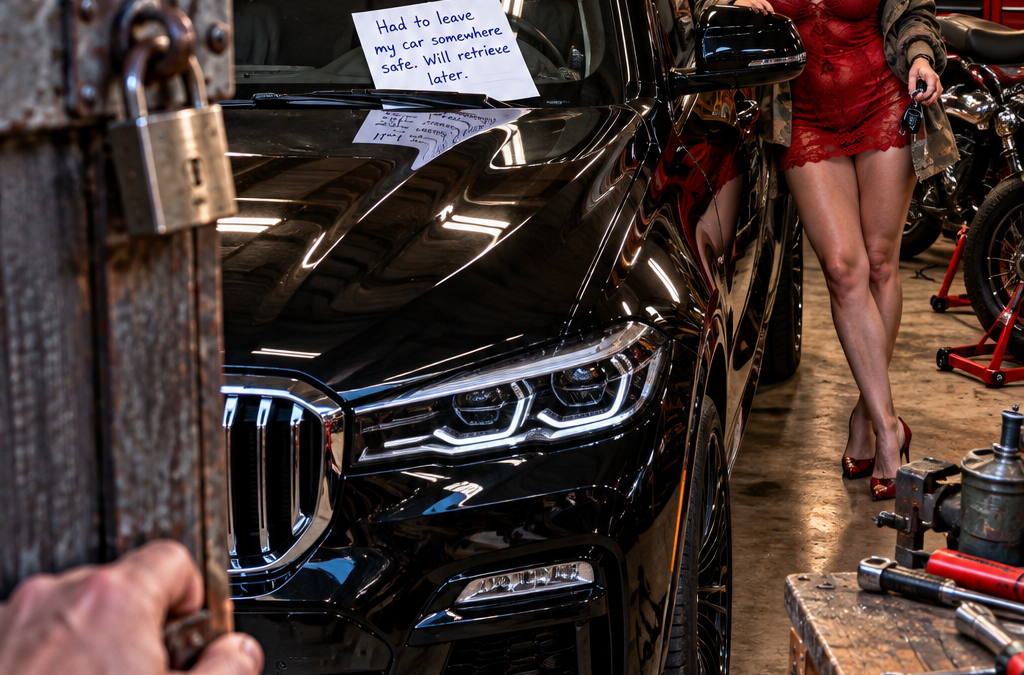
Its front bumper stopped less than three feet from my workbench. The polished hood reflected the fluorescent lights above it, and the entire vehicle looked absurdly expensive surrounded by welding equipment, sawdust, lumber, and my old red tool cabinets.
The doors were locked.
Nobody was around.
A white sheet of paper had been tucked beneath the driver’s-side windshield wiper.
I pulled it out.
There was no name.
No phone number.
No apology.
Just one sentence written in thick blue ink.
Had to leave my car somewhere safe. Will retrieve later.
I read it twice.
Then looked around my workshop.
Somebody had entered my private property while I was gone.
Opened my gate.
Driven into my building.
Parked a sixty-thousand-dollar SUV between my tools.
Then locked everything behind themselves as though my workshop were a public parking garage.
I didn’t need a signature to know who had done it.
Linda Mercer.
My name is Jack, and I’d owned that workshop for nearly nine years.
It sat on a private parcel just beyond the western edge of Briarwood Estates, a polished suburban development filled with stone entrance signs, matching mailboxes, decorative streetlights, and enough HOA rules to regulate the direction grass leaned in the wind.
My property was older.
Much older.
The workshop had been built when most of Briarwood was still open field.
Concrete floor.
Steel frame.
Two large vehicle bays.
A fenced gravel yard.
A small office in the back.
Nothing glamorous.
But it was mine.
I restored motorcycles there.
Built cabinets.
Repaired farm equipment for friends.
Stored tools I’d spent twenty years collecting.
Sometimes Tom, an old friend of mine, came over on weekends and helped me with bigger projects.
The building had one purpose.
My work.
It had never been HOA property.
Never been community storage.
Never been public parking.
And Linda knew that.
That was what made the SUV sitting inside so infuriating.
This wasn’t a misunderstanding.
It was a declaration.
Linda had decided that because my workshop was convenient, she was entitled to use it.
And if you knew Linda Mercer, that logic made perfect sense.
She was forty years old, beautiful, polished, and relentlessly aware of the effect she had on people.
Long blonde hair.
Bright blue eyes.
Expensive makeup.
And the same kind of fitted red lace dress she wore to nearly every HOA function, low-cut and tight enough to make sure she remained the center of attention before she even opened her mouth.
Linda could be flirtatious when she wanted cooperation.
She would touch someone’s arm, lower her voice, smile as though she were letting them in on a secret.
But when charm failed, the other Linda appeared.
Cold.
Arrogant.
Vindictive.
She wasn’t technically the HOA president at that point, but she controlled enough committees and had enough influence with the board that people treated her as though she were.
She ran community events.
Sat on the architectural committee.
Helped review violations.
Was constantly whispering in the president’s ear before meetings.
She loved using the phrase community authority.
Usually when she was trying to make someone’s private decision sound like public business.
Tom called her “the mayor of nowhere.”
I called her a problem I tried to avoid.
Until she parked inside my workshop.
I was still standing beside the SUV when Tom arrived.
He had come over to help me replace the belt on an old drill press.
His truck rolled into the gravel lot.
He climbed out, saw the SUV through the open side door, and stopped.
“Whose is that?”
“You tell me.”
He walked closer.
“That’s Linda’s.”
“I know.”
He circled the vehicle.
“Why is Linda’s car in your workshop?”
“Apparently she needed somewhere safe.”
Tom looked at the note.
Then at me.
“She asked you?”
“No.”
His eyebrows rose.
“She called?”
“No.”
“Texted?”
“No.”
He let out a slow whistle.
“How’d she get in?”
That was the question.
The workshop yard had a steel swing gate.
I normally secured it with a heavy padlock whenever I was away.
The larger workshop doors had their own locks.
I walked toward the gate.
Tom followed.
The padlock was still attached.
But one section of chain had been looped differently.
Tom crouched.
“You didn’t leave it like this.”
“No.”
He examined the latch.
“Looks like somebody opened it and put everything back afterward.”
“That’s what I’m thinking.”
Tom stood.
“Check the cameras.”
I had installed security cameras two years earlier after tools disappeared from a nearby property.
One covered the driveway.
One faced the gate.
Another watched the workshop entrance.
I opened the system on my phone.
Scrolled backward.
Found the footage.
At 12:43 that afternoon, Linda’s black SUV appeared on the road.
It stopped beside my gate.
She got out.
Even on the small screen, the red lace dress was unmistakable.
She looked around.
Walked toward the gate.
Then did something that erased any possibility of misunderstanding.
She reached behind one of the fence posts.
Pulled out the spare key I kept concealed in a magnetic box for emergencies.
My stomach tightened.
I hadn’t told her about that key.
But months earlier, during a neighborhood power outage, several residents had used my workshop as a charging point for phones and medical equipment.
I had used the spare key in front of people that night.
Linda had been there.
Apparently she’d remembered exactly where I returned it.
On the camera, she unlocked my gate.
Drove in.
Opened the workshop.
Parked the SUV.
Then walked back outside, secured the gate, and left in another vehicle that had been waiting on the road.
I replayed it.
Once.
Twice.
Tom watched over my shoulder.
“Jack.”
I didn’t answer.
“She thinks this place belongs to her.”
I looked toward the SUV.
The anger was building slowly.
Not explosive.
Cold.
“She’s about to learn otherwise.”
Twenty minutes later, Linda returned.
Not walking.
Not apologizing.
She arrived in the passenger seat of another luxury vehicle and stepped onto my gravel lot like I was the inconvenience.
She was still wearing the red lace dress.
Sunglasses rested on top of her blonde hair.
A large handbag hung from one shoulder.
She looked at me, then toward the locked workshop.
“Open the gate.”
No hello.
No explanation.
No acknowledgment that she’d entered private property.
Just an order.
I folded my arms.
“Why is your SUV inside my building?”
Linda sighed dramatically.
“The HOA road is being resurfaced.”
“And?”
“I needed somewhere protected.”
“So you broke into my workshop?”
Her head snapped toward me.
“Don’t use ridiculous language.”
“What language would you prefer?”
“I used an available structure temporarily.”
I actually laughed.
“My workshop isn’t available.”
“It was empty.”
“No. It wasn’t.”
“The parking bay was empty.”
“Because I wasn’t parking anything there.”
She rolled her eyes.
“Jack, please don’t start.”
“Start what?”
“This territorial nonsense.”
Tom, standing near the tool shed, turned his head slightly.
Linda noticed him.
Her posture changed.
She preferred intimidating people without witnesses.
I pointed toward the workshop.
“You entered my property without permission.”
“The association road is under construction.”
“That has nothing to do with me.”
“It affects all neighboring properties.”
“I am not responsible for parking your SUV.”
“The workshop was the closest secure structure.”
“There are garages inside Briarwood.”
“Mine is full.”
“Sounds like a Linda problem.”
Her lips tightened.
“I wasn’t going to leave a vehicle that expensive exposed to construction debris.”
“Then you should have made arrangements.”
“I did.”
She gestured toward my workshop.
I stared at her.
“You cannot be serious.”
“Why are you making this difficult?”
“Because you parked a vehicle inside a building you don’t own.”
Linda stepped closer.
“You live beside an HOA community. Sometimes cooperation is required.”
“I don’t live in Briarwood.”
“Your property borders us.”
“So does the county road.”
“Don’t be childish.”
“I’ll make this simple.”
I pointed toward the camera.
“You used my emergency key without permission. You opened my gate. You entered my workshop. You parked your vehicle inside. Then you left.”
Her eyes flicked toward the camera.
Just once.
Enough.
“You record everything?”
“It’s my property.”
“That’s creepy.”
“Entering my workshop without permission is creepy.”
She folded her arms beneath her chest.
“The road work made this an emergency.”
“No, Linda. A luxury SUV needing a clean parking place is not an emergency.”
Her face hardened.
“Open the gate.”
“No.”
For the first time, genuine disbelief crossed her face.
“What did you say?”
“I said no.”
“My vehicle is inside.”
“I know.”
“You don’t have the right to keep me from my own property.”
The hypocrisy was almost breathtaking.
I looked toward the workshop.
“Your property is parked inside my property.”
“Exactly. So open it.”
“Not until we document what happened.”
Her voice rose.
“Document?”
“Yes.”
“Jack, this isn’t a legal proceeding.”
“It became one when you entered a locked private building.”
She laughed sharply.
“Do you hear yourself?”
“Perfectly.”
“I made a temporary parking decision.”
“On my land.”
“Adjacent to HOA-controlled infrastructure.”
“Still my land.”
She pointed toward the workshop.
“That building should be available for community overflow when necessary.”
Tom actually laughed.
Linda turned.
“Something funny?”
Tom shrugged.
“Just wondering when Jack donated the workshop.”
“No one said donated.”
“You’re saying the HOA gets to use it.”
“When circumstances require.”
Tom looked at me.
Then back at her.
“Based on what?”
Linda’s jaw tightened.
“Community necessity.”
Tom nodded slowly.
“So nothing.”
Linda ignored him.
She pulled out her phone.
“Fine.”
“What are you doing?”
“Calling the board.”
“Go ahead.”
Her eyes narrowed.
“You might want to reconsider your attitude before they get involved.”
I leaned against the fence.
“Please involve everyone.”
That wasn’t the answer she expected.
Linda turned away and called someone.
She spoke loudly enough for us to hear.
“Yes, I’m at Jack’s workshop.”
Pause.
“No, he refuses to release the vehicle.”
Another pause.
“Exactly.”
She looked at me while speaking.
“He’s intentionally blocking HOA access during the resurfacing project.”
I laughed.
“Tell them how the SUV got inside.”
Linda turned her back.
“He is being extremely aggressive.”
Tom whispered, “You’re terrifying.”
I almost smiled.
Linda finished the call.
“The board president is calling you.”
My phone rang thirty seconds later.
Richard Barnes.
President of Briarwood HOA.
I’d met him twice.
A generally reasonable man who became considerably less reasonable whenever Linda was standing next to him.
“Jack.”
“Richard.”
“Linda tells me you’re refusing access to a vehicle stored at your workshop.”
“Did Linda tell you how she stored it?”
There was a pause.
“She said the road construction created temporary parking complications.”
“She entered my locked property without permission.”
“Let’s not escalate language.”
“There is security footage.”
Silence.
I continued.
“She used a spare key she wasn’t authorized to use, opened my gate, parked inside my building, locked the gate, and left.”
Richard sighed.
“Look, regardless of how it happened, the simplest solution is to let her retrieve the SUV.”
“The simplest solution would have been Linda asking.”
“I agree communication could have been better.”
“Communication?”
I looked at Linda.
She was watching me with a smug smile.
“This wasn’t poor communication.”
“Jack, we’re trying to avoid unnecessary conflict.”
“Then show me the document giving Briarwood access to my workshop.”
Another pause.
“What document?”
“Lease.”
“There’s no lease.”
“Parking agreement.”
“Not that I’m aware of.”
“Recorded access easement.”
“Jack—”
“Anything.”
He sighed again.
“The workshop’s proximity to the subdivision creates some practical considerations.”
“Practical considerations don’t transfer ownership.”
“No one is claiming ownership.”
“Linda just told me the workshop should be available for HOA overflow parking.”
Richard went quiet.
Linda’s smile disappeared.
I continued.
“Is that the board’s position?”
“Not exactly.”
“Then what is the board’s position?”
“This situation needs to be resolved calmly.”
“Great.”
I looked directly at Linda.
“Send me whatever document you believe gives the association parking rights here.”
“Jack, why are you turning this into a property dispute?”
“Because your board representative turned my private building into a parking garage.”
Linda snapped, “I’m not a board representative.”
I looked at her.
“Interesting timing to clarify that.”
Richard heard.
“Let’s all calm down.”
“I am calm.”
“Can you open the gate?”
“After the property issue is documented.”
Linda threw both hands up.
“This is insane.”
I told Richard, “Call me when you find the document.”
Then I ended the call.
Linda stared at me.
“You hung up on the HOA president.”
“Yes.”
“You really have no idea what you’re doing.”
“Neither did you when you parked inside my workshop.”
She stepped closer.
“You’re going to regret embarrassing me.”
There it was.
Not inconveniencing her.
Not delaying her.
Embarrassing her.
That was the real offense.
Linda could tolerate rules being broken.
She couldn’t tolerate losing control in front of witnesses.
I pulled out my phone again.
“Threatening me?”
“I’m warning you.”
“Say it louder.”
She noticed the camera recording.
Her face changed.
“I’m done with this.”
She turned toward the car she’d arrived in.
“I’ll be back.”
“I figured.”
She stopped.
“And that gate better be open.”
“It won’t be.”
Linda drove away furious.
Tom watched the car disappear.
“You know she’s going to call everybody she knows.”
“Good.”
“You serious?”
“Completely.”
I walked inside the workshop.
The SUV sat there silently.
Black paint.
Tinted windows.
Perfectly clean wheels.
The kind of vehicle Linda treated as an extension of her status.
I didn’t touch it.
Didn’t move it.
Didn’t even lean against it.
Instead, I photographed everything.
Vehicle position.
Workshop entrance.
Gate.
Padlock.
Security footage timestamps.
The note.
Then I pulled out my old property file.
My survey was more than fifteen years old but still perfectly readable.
The workshop sat clearly within my parcel.
So did the yard.
So did the gate.
The Briarwood boundary ended near the subdivision entrance.
My property touched the road but wasn’t incorporated into the HOA.
No access easement crossed the workshop.
No parking rights.
No shared-use agreement.
Nothing.
Linda had seen empty space and converted convenience into imaginary authority.
That seemed to be her specialty.
She returned forty minutes later.
This time, she wasn’t alone.
Richard came with her.
Another board member followed.
Linda stepped from her SUV’s replacement ride and pointed toward my gate.
“Open it.”
I held up the survey.
“We’re going to talk first.”
Her face flushed.
“I am not standing in this gravel lot negotiating access to my own vehicle.”
“Then you can leave.”
“Jack.”
Richard stepped between us.
“Can we be adults?”
“I am.”
Linda laughed.
“He’s holding my car hostage.”
“No.”
I looked at Richard.
“I’m documenting unauthorized use of private property.”
Linda shouted, “You cannot imprison a vehicle!”
Tom coughed.
I looked at him.
He was trying not to laugh.
Richard rubbed his forehead.
“Jack, what exactly do you want?”
“An answer.”
“To what?”
“Does Briarwood claim ownership or access rights over this workshop?”
Richard looked toward Linda.
Then the survey.
“I don’t know.”
“Then let’s find out before everybody starts claiming things.”
Linda stepped toward him.
“Richard, this is absurd. Tell him to open the gate.”
Richard looked uncomfortable.
“Linda, if the workshop isn’t subject to our property documents—”
“It serves the subdivision!”
“No,” I said.
“It sits near the subdivision.”
She turned on me.
“You benefit from our road.”
“I use a road.”
“We maintain it.”
“Which still doesn’t make this workshop yours.”
Linda pointed toward my building.
“I parked there for three hours.”
“Without permission.”
“No damage occurred.”
“That’s not the point.”
“Then what is?”
“You decided my boundaries didn’t matter because your SUV needed shade.”
Her face reddened.
“Shade?”
“You said construction debris.”
“Yes.”
“Construction you’re overseeing.”
“Exactly.”
“Then plan parking before construction.”
Linda took another step.
“Open the gate.”
“No.”
Her voice dropped.
“If you make me call the sheriff, I will make sure he understands you’re unlawfully withholding my vehicle.”
I looked at her.
“Please call him.”
Richard said quietly, “Linda.”
But she was already dialing.
“Yes,” she said into the phone. “I need an officer. A property owner is refusing to release my vehicle.”
I leaned against the fence.
Tom crossed his arms.
Richard looked like he wanted to disappear.
The sheriff’s SUV arrived fourteen minutes later.
Deputy Hayes stepped out.
Mid-forties.
Calm.
The expression of a man who had probably already heard a thousand ridiculous property disputes and wasn’t interested in theatrics.
Linda rushed toward him before his door fully closed.
“Thank God.”
Hayes held up one hand.
“Ma’am, slow down.”
“This man has locked my vehicle inside his building and refuses to release it.”
Hayes looked at me.
“Sir?”
“My name’s Jack. I own the parcel and workshop.”
“Is her vehicle inside?”
“Yes.”
“How did it get there?”
“That’s the important part.”
Linda interrupted.
“I parked temporarily because HOA road construction—”
Hayes raised his hand again.
“I’ll get to you.”
Linda looked offended.
I opened the security footage.
“Deputy, I came back and found her SUV inside. She never called or asked permission.”
I showed him the video.
Linda arriving.
Opening the gate.
Using the concealed key.
Driving onto the property.
Opening the workshop.
Parking.
Closing everything afterward.
Hayes watched silently.
Then replayed part of it.
He looked at Linda.
“That’s you?”
She folded her arms.
“Obviously.”
“Did he give you permission to enter?”
“The HOA road was being resurfaced.”
“That wasn’t my question.”
Her face tightened.
“I had an implied right of temporary access.”
Hayes glanced at me.
“Did you give her an implied right?”
“No.”
Linda snapped, “He doesn’t determine HOA access rights.”
Hayes looked back at her.
“Who does?”
“The association.”
“Do you have something showing that?”
Her posture stiffened.
“The workshop is adjacent to Briarwood.”
Hayes waited.
Linda added, “We maintain the nearby roadway.”
“Okay.”
He looked toward the gate.
“Do you have an easement?”
Linda glanced at Richard.
Richard stayed quiet.
“A written parking agreement?” Hayes asked.
Linda’s lips tightened.
“No.”
“Lease?”
“No.”
“Any document saying this building is HOA-controlled property?”
Linda’s voice became smaller.
“The issue is more complicated.”
Hayes nodded.
“Usually is.”
He looked at me.
“Do you have property records?”
I handed him the survey.
He studied it.
Walked toward the gate.
Compared reference points.
Then looked at the workshop.
“Based on this, the building appears to be inside your parcel.”
“Correct.”
Linda interrupted.
“That survey is old.”
I pulled out another folder.
“County parcel record.”
Hayes looked.
Then nodded again.
Linda’s voice rose.
“The road connection creates access authority.”
Deputy Hayes looked at her.
“Ma’am, a road connection isn’t automatically the same thing as a right to park inside somebody else’s building.”
“You’re not understanding HOA law.”
Tom looked toward the ground.
Richard closed his eyes.
Hayes remained remarkably calm.
“Then show me the document.”
Silence.
Linda’s face went red.
“I don’t carry HOA property files in my purse.”
“That’s fine.”
He returned the survey to me.
“But I also can’t simply assume a right exists because you’re telling me it does.”
Linda pointed toward the workshop.
“My vehicle is being held hostage.”
Hayes looked through the window.
“Is it damaged?”
“No.”
“Has he moved it?”
“No.”
“Has he entered it?”
“No.”
“Did you drive it in?”
“Yes.”
“Without asking him?”
Linda hesitated.
“I believed I had authorization.”
“From whom?”
“The HOA.”
Richard finally spoke.
“We don’t have a specific workshop parking agreement that I’m aware of.”
Linda turned on him.
“Richard.”
He continued.
“I’m just stating what I know.”
Her eyes widened.
“You authorized emergency construction accommodations.”
“For subdivision property.”
“This is adjacent.”
“Adjacent isn’t necessarily association property.”
Linda looked betrayed.
That was the first moment she understood the room was no longer hers.
She turned back to Hayes.
“So what? He gets to steal my SUV?”
“No one said that.”
Hayes looked at me.
“You’re not claiming ownership of her vehicle?”
“Absolutely not.”
“You eventually intend to allow removal?”
“Yes.”
“I want everything documented first.”
“What specifically?”
“That neither Linda nor Briarwood has a right to enter or use my workshop without permission.”
Hayes nodded.
“That’s ultimately a civil property issue if they’re claiming access rights.”
He turned to Linda.
“If the HOA believes it has a recorded right, it can establish that through the proper process.”
Linda stared at him.
“So you’re not ordering him to open the gate?”
“No.”
Her mouth fell open.
“Are you serious?”
“Yes.”
“My vehicle is in there!”
“You placed it there.”
“Temporarily!”
“Without clear permission.”
She pointed at me.
“He could damage it.”
I said, “I haven’t touched it.”
Hayes looked at me.
“Keep it that way.”
“I intend to.”
Linda paced two steps.
Then spun back.
“This is unbelievable.”
Hayes’s voice became firmer.
“Ma’am, what’s unbelievable is that you entered private property using a key you weren’t given permission to use.”
“I knew where it was.”
“That doesn’t help your argument.”
Tom turned away because he was smiling.
Linda saw him.
“This isn’t funny!”
“No,” Tom said.
“It’s really not.”
But his face said otherwise.
Hayes took information from everyone.
Incident number.
Names.
Statements.
He explained again that any claimed HOA access right needed documentary support and that he wasn’t there to invent one.
Linda stood beside the gate with her arms crossed, visibly furious.
For the first time since I’d met her, her beauty and confidence did nothing.
Hayes didn’t care about the red dress.
Didn’t care about her committee title.
Didn’t care that she spoke as though every sentence were already a ruling.
He cared about documents.
And Linda didn’t have any.
Before leaving, Hayes looked at me.
“Don’t move or damage the SUV.”
“I won’t.”
Then at Linda.
“And don’t enter the property again without permission.”
Her eyes widened.
“I’m trying to retrieve my car.”
“Coordinate that without trespassing.”
He gave both of us his card.
Then left.
Linda stared after the patrol vehicle.
Her face was almost purple.
Finally, she looked at me.
“You enjoyed that.”
“No.”
“Liar.”
“I enjoyed someone asking you the same question I’ve been asking.”
“What question?”
“Where’s your proof?”
She stepped toward me.
“This isn’t over.”
“It can be.”
“Open the gate.”
“Not yet.”
Her voice dropped into something sharp and poisonous.
“I will make sure every person in Briarwood knows what kind of man you are.”
I shrugged.
“Show them the video.”
Her eyes narrowed.
“You think you’re clever.”
“No.”
I looked through the window at her SUV.
“I think my workshop belongs to me.”
She walked away without another word.
Richard remained.
For a moment, he said nothing.
Then he sighed.
“I didn’t know she’d parked inside.”
“I figured.”
“She told me you’d agreed before the resurfacing started.”
I looked at him.
“Seriously?”
He nodded reluctantly.
“She said you were now refusing access because of a personal disagreement.”
“Did she show you any message from me agreeing?”
“No.”
“Did you ask?”
He looked embarrassed.
“No.”
I leaned against the fence.
“Richard, this is exactly the problem.”
“I know.”
“No. I don’t think you do.”
I pointed toward the workshop.
“She entered a locked building because she believed nobody would question her. Then she called the board and got you to pressure me without showing you a single document.”
Richard rubbed his face.
“I’ll speak to counsel.”
“Good.”
“And we’ll verify the boundary.”
“I already did.”
“I understand.”
He started toward his car.
Then stopped.
“Jack.”
“Yeah?”
“I’m sorry this happened.”
I nodded.
“Get me the answer in writing.”
He looked back at the workshop.
“I will.”
That evening, the HOA’s lawyer called.
His name was Mitchell Grayson.
His tone was much calmer than Linda’s.
“Mr. Carter?”
“Speaking.”
“I’m counsel for Briarwood Estates.”
“I expected someone to call.”
“I’ve reviewed the incident involving Ms. Mercer.”
“Good.”
“First, I want to make clear that it appears there was a misunderstanding.”
I almost laughed.
“A misunderstanding is parking in the wrong driveway.”
He paused.
“Fair.”
“Using my hidden spare key is not a misunderstanding.”
“I understand your position.”
“My security camera understands it too.”
Another pause.
“I’ve seen the footage.”
“Then we’re making progress.”
Mitchell sighed.
“Mr. Carter, nobody wants this dispute to escalate.”
“Neither do I.”
“Then we’d like the SUV released.”
“I’ve already said it will be.”
“What are you waiting for?”
“Written confirmation.”
“Of?”
“That Briarwood does not own my workshop, does not control my gate, and has no documented right to use the building for parking.”
“That seems broader than necessary.”
“It became necessary when your representative claimed the workshop should be available to the HOA.”
“Linda isn’t authorized to create property rights.”
“Exactly.”
He became quiet.
I continued.
“I also want confirmation that her parking the SUV there doesn’t establish any future access claim.”
“It wouldn’t.”
“Put it in writing.”
“This could be resolved with a simple release.”
“Then the letter should be simple too.”
Mitchell was silent for several seconds.
“You’re being very cautious.”
“Somebody entered my locked workshop.”
“Understood.”
“No, counselor.”
I looked toward the building.
“I don’t think your board understood until today.”
His voice softened slightly.
“Probably fair.”
He promised to review the property records.
The call ended.
I checked the workshop again.
The SUV sat exactly where Linda had left it.
For the first time, the entire situation struck me as almost funny.
Linda had wanted somewhere safe.
Her SUV was probably safer than it had ever been.
Locked inside a private building.
Under four cameras.
With a sheriff’s incident report documenting its condition.
She just couldn’t access it whenever she pleased anymore.
That was apparently intolerable.
The next morning, I found three missed calls from Linda.
I didn’t return them.
Then a text.
You have until noon to release my vehicle.
Another ten minutes later.
My attorney is aware of this.
Then:
There will be consequences.
I screenshot everything.
Sent it to Mitchell.
His response arrived within five minutes.
Please direct future communications regarding this matter through counsel.
I smiled.
Linda had finally managed to get her own lawyer to tell her to stop talking.
Around noon, Tom came by.
“Still there?”
I opened the side door.
The SUV gleamed under the lights.
“Still there.”
Tom shook his head.
“Think she’ll ever admit this was stupid?”
“No.”
“Think she’ll stop doing stupid things?”
“Also no.”
He pointed toward the gate.
“What are you going to do after she leaves?”
“I’ve been thinking about that.”
“Better lock?”
“Already ordered.”
“Camera?”
“Already have four.”
“Electric fence?”
I laughed.
“No.”
“Moat?”
“Tempting.”
Instead, I ordered a sign.
Simple.
Black letters.
White background.
Nothing aggressive.
PRIVATE WORKSHOP
NO UNAUTHORIZED VEHICLES
Tom looked at the design.
“Subtle.”
“I considered putting Linda’s name on it.”
“Should’ve.”
“No.”
“Coward.”
I laughed.
By late afternoon, Mitchell emailed me.
Attached was a formal statement from the HOA.
I read it slowly.
Briarwood Estates did not claim ownership of my workshop.
The association had no recorded lease or parking agreement for the building.
No documented easement authorized storage of personal vehicles inside my workshop.
Linda Mercer had not been granted board authority to use the property.
Her actions had not created any ongoing access right.
I read it again.
Then printed two copies.
One went into my property file.
One stayed in the workshop office.
I called Deputy Hayes.
“Got the documentation?”
“Yes.”
“You comfortable releasing the vehicle?”
“Tomorrow morning.”
“Want me there?”
“Yes.”
He paused.
“Probably smart.”
At eight the next morning, Hayes arrived.
Then Richard.
Then Linda.
She climbed out of a friend’s vehicle.
No smile.
No clipboard.
No theatrical entrance.
Still the red lace dress, but without the swagger.
She wouldn’t look at me.
I handed Hayes the letter.
He read it.
Then nodded.
“Looks clear.”
I unlocked the gate.
Opened the workshop bay.
Linda marched toward the SUV.
I said, “Before you leave.”
She stopped.
Her shoulders stiffened.
“What?”
“I want the condition documented.”
“I don’t care.”
“Deputy?”
Hayes walked around the vehicle with me.
No damage.
No new scratches.
Nothing missing.
Linda stood beside the driver’s door looking furious.
When Hayes finished, I handed her the note she’d originally left.
Had to leave my car somewhere safe. Will retrieve later.
She stared at it.
“Keep it.”
“I already have a copy.”
She crushed it in her hand.
Then got inside.
The engine started.
For a moment, she sat there.
Then slowly backed out.
Across the workshop threshold.
Through the gate.
Onto the gravel yard.
I stood beside Tom.
Neither of us said anything.
Linda stopped near the road.
I wondered why.
Then I realized what she was looking at.
The new sign.
It had been installed beside the gate that morning.
PRIVATE WORKSHOP
NO UNAUTHORIZED VEHICLES
Linda stared at it for several seconds.
Her face went red.
Tom whispered, “She likes it.”
I almost laughed.
Linda lowered her window.
“You think you’re very funny.”
“It’s not a joke.”
“You put that there because of me.”
“I put it there because apparently the gate wasn’t clear enough.”
Her jaw tightened.
“I hope you’re happy.”
I thought about the past two days.
The unauthorized entry.
The board call.
The threats.
The sheriff.
The lawyer.
All because Linda couldn’t admit she’d crossed a boundary.
“I’ll be happy when you understand that convenience doesn’t create permission.”
She looked at me with pure contempt.
Then accelerated away.
Dust rose behind the SUV.
Tom stood beside me.
“Think she got the message?”
I looked at the sign.
“Eventually.”
The story should have ended there.
It didn’t.
Because once the rest of Briarwood learned what happened, the board had questions.
A lot of them.
The next HOA meeting was unusually crowded.
I wasn’t technically a member, but Richard invited me because the incident involved association representatives and Linda’s claimed authority.
I almost declined.
Tom changed my mind.
“Go.”
“Why?”
“Because otherwise Linda tells the story.”
He was right.
The clubhouse was packed when I arrived.
Linda sat near the front.
Perfect hair.
Red dress.
Arms crossed.
She looked straight ahead when I entered.
Richard opened the meeting.
The first few agenda items passed quietly.
Budget update.
Road resurfacing.
Pool maintenance.
Then:
“Workshop access incident.”
Linda immediately raised her hand.
“I’d like to clarify several misleading claims.”
Richard nodded.
“Go ahead.”
She stood.
“This entire matter has been exaggerated by a nonmember property owner who appears hostile toward community cooperation.”
I almost smiled.
Nonmember.
Interesting how clearly she understood that word now.
She continued.
“The road construction created an unusual parking situation. I made a reasonable temporary accommodation using nearby secure space.”
Someone asked, “Did Jack give you permission?”
Linda stiffened.
“It was an emergency.”
“What emergency?”
“Construction.”
A neighbor laughed.
Richard said, “Please let her finish.”
Linda continued.
“The workshop has historically served community-adjacent functions.”
I spoke from the back.
“No, it hasn’t.”
She turned.
“Excuse me?”
“You’ve never parked there before.”
“That doesn’t mean—”
“Nobody has.”
Richard looked toward me.
“Jack, you’ll have a chance.”
I nodded.
Linda resumed.
But the confidence was fading.
“The important issue is that my vehicle was then intentionally withheld.”
Richard corrected her.
“The sheriff declined to characterize it that way.”
Linda snapped, “The sheriff doesn’t understand association operations.”
A murmur moved through the room.
Richard rubbed his forehead.
“Linda, we have a letter from counsel confirming the workshop is not association property.”
“I know what the letter says.”
“Then why are we discussing association access?”
“Because the community needs flexibility.”
A woman near the aisle raised her hand.
“Does flexibility mean we can park in Linda’s garage if the pool lot is full?”
Laughter erupted.
Linda’s face flushed.
“That’s completely different.”
“Why?”
“My house is inside the subdivision.”
The woman stared.
“That sounds worse.”
More laughter.
Linda slammed her hand against the table.
“This isn’t funny!”
The room quieted.
She looked around.
“I have spent years serving this neighborhood, and now I’m being humiliated because I tried to protect my personal property from construction damage.”
Richard’s voice was calm.
“The issue isn’t protecting your SUV.”
“The issue is how I was treated.”
“No.”
He looked at her.
“The issue is that you entered private property without permission and then represented to the board that you had a right to use it.”
Linda’s face changed.
“Richard.”
“You told me Jack had agreed to temporary use.”
Silence.
Every head turned.
Linda stared at him.
“I said there was an understanding.”
“There wasn’t.”
“You misunderstood.”
“No.”
His voice became firmer.
“You told me he had permitted the workshop to be used during resurfacing.”
Linda glanced toward me.
Then back at Richard.
“I assumed—”
“That’s the problem.”
Another board member spoke.
“We spent association time and legal money because of your assumption.”
Linda’s jaw tightened.
“Send me the bill.”
Nobody laughed.
Richard continued.
“You also involved HOA security in a private property matter.”
“I needed assistance.”
“For what?”
“If Jack became aggressive.”
I stood.
“Your cameras at the subdivision entrance should show I wasn’t even home when she parked the SUV.”
Several residents murmured.
Linda turned toward me.
“You’ve been trying to make me look like a criminal.”
“No.”
I stayed calm.
“The security footage did that without my help.”
The room went silent.
Linda’s eyes burned.
I continued.
“You opened my locked gate using a key you had no permission to touch.”
“That key was accessible.”
“So is your front door handle.”
Someone laughed.
Linda looked toward the sound.
Nobody identified themselves.
I continued.
“You drove into my building.”
“For temporary parking.”
“You locked my gate afterward.”
“To secure the property!”
“Thank you.”
She blinked.
“Excuse me?”
“That’s probably the only favor you did me.”
A few people laughed again.
Richard held up a hand.
“Let’s keep this productive.”
He turned toward Linda.
“Do you acknowledge now that you had no documented access right?”
Linda looked around the room.
That was the moment.
She could have ended it.
One sentence.
I made a mistake.
Instead, she lifted her chin.
“I acknowledge that counsel has taken a narrower interpretation than I believe serves the community.”
Tom had come with me.
He leaned toward my shoulder.
“That’s Linda for ‘no.'”
I almost smiled.
Richard looked exhausted.
“Counsel didn’t interpret anything creatively. Counsel confirmed the property isn’t ours.”
Linda folded her arms.
“Then perhaps the board should explore acquiring access rights.”
I stared at her.
There it was.
She still couldn’t let go.
Even after everything.
If she couldn’t pretend the right existed, she’d try creating one.
I stood.
“No.”
Linda turned.
“I wasn’t asking you.”
“I own the property.”
“You could negotiate.”
“I won’t.”
“Everybody has a price.”
“Not for this.”
She smiled coldly.
“We’ll see.”
The room reacted immediately.
Not loudly.
But enough.
People looked at one another.
Richard said sharply, “Linda.”
She shrugged.
“What?”
“That sounded like a threat.”
“It was an observation.”
I looked at her.
“That’s what you always call threats.”
Her eyes narrowed.
Richard closed the discussion.
The board voted to formally record that the workshop was outside HOA property and that no representative could enter or use it without explicit owner permission.
The vote was unanimous.
Linda didn’t vote.
She wasn’t technically entitled to.
Another detail that seemed suddenly important.
After the meeting, several residents approached me.
One apologized.
“I thought you’d agreed to let her park there.”
“So did Richard.”
The man shook his head.
“She told everybody you were being vindictive.”
“That sounds right.”
Another homeowner laughed.
“At least your sign looks good.”
“Thank you.”
“I may need one.”
“For what?”
“Linda keeps storing event tables in my shed.”
I stared at him.
Then laughed.
“Get your key back.”
He didn’t laugh.
“I think I actually will.”
That was when I realized the workshop incident wasn’t really about an SUV.
Not entirely.
It was about what Linda had learned she could do.
Take a little space.
Use somebody else’s property.
Claim it benefited the neighborhood.
Wrap the behavior in HOA language.
And count on everyone being too uncomfortable to challenge her.
My workshop simply happened to be the place where somebody finally said no loudly enough for everyone to hear.
The next day, everything went back to normal.
I opened the workshop at seven.
Sunlight came through the high windows.
The SUV was gone.
My workbench was exactly where I’d left it.
The drill press waited for the belt Tom and I had originally planned to replace.
No lawyers.
No board calls.
No deputy.
Just tools.
Concrete.
Dust.
Work.
Tom arrived carrying coffee.
He looked at the empty parking bay.
“Looks weird.”
“What does?”
“No luxury SUV.”
“Give it time.”
He laughed.
“Think Linda’s coming back?”
I looked toward the new sign.
“No.”
“Confident?”
“Completely.”
We replaced the drill press belt.
Finished before lunch.
For the first time in several days, I went hours without thinking about Linda.
That felt better than winning an argument.
Weeks passed.
The road resurfacing finished.
Nobody else needed my workshop.
Funny how that worked.
No emergency overflow parking.
No community necessity.
No access crisis.
Apparently the entire problem had existed because one woman didn’t want dust on her expensive SUV.
I changed the hidden-key location.
Then I removed the hidden key altogether.
Installed a keypad.
Changed the gate lock.
Updated the camera angles.
Not because I lived in fear.
Because boundaries mean very little if you rely entirely on people choosing to respect them.
Linda stopped waving when she passed.
I considered that another improvement.
Occasionally, I saw her SUV near the Briarwood clubhouse.
Always parked perfectly.
Always inside designated spaces.
Apparently she had rediscovered parking rules.
One evening, Richard stopped by.
He remained outside the gate until I walked down.
That small gesture didn’t go unnoticed.
“Got a minute?”
“Sure.”
He held up an envelope.
“Board reimbursement.”
“For what?”
“Legal review expenses directly caused by the access dispute.”
“I didn’t ask for reimbursement.”
“I know.”
He handed it over.
“The board thought it was appropriate.”
I looked at him.
“Linda agree?”
He laughed once.
“No.”
“Didn’t think so.”
Richard became serious.
“Jack, I owe you an apology.”
“You already apologized.”
“Not properly.”
I waited.
“I believed her.”
“Why?”
“Because she sounded certain.”
That answer interested me.
I looked toward Briarwood.
“She always does.”
“Exactly.”
He shook his head.
“That’s not a good enough reason.”
“No.”
“We’re reviewing how committee members communicate with residents and outside property owners.”
“Probably smart.”
He looked toward the workshop.
“She genuinely seemed to believe she had some sort of community right to use it.”
“Convenience can feel a lot like ownership when nobody tells you no.”
Richard smiled slightly.
“That’s a good line.”
“It’s an expensive lesson.”
He nodded.
Then left.
I stood by the gate after his car disappeared.
The new sign was beside me.
PRIVATE WORKSHOP
NO UNAUTHORIZED VEHICLES
Simple.
Almost embarrassingly obvious.
But that was the thing about what happened.
Nothing Linda needed to understand was complicated.
My deed didn’t require interpretation.
The parcel map wasn’t ambiguous.
There was no parking agreement.
No lease.
No easement through the workshop.
No ancient covenant giving Briarwood the right to store vehicles beside my table saw.
The whole conflict existed because Linda believed her convenience mattered more than my consent.
Everything after that was theater.
The board call.
The threats.
The sheriff.
The legal argument.
Her accusation that I was holding the SUV hostage.
Strip away the noise and the issue was almost childish.
She wanted to use something.
It belonged to somebody else.
She never asked.
Then she got angry when the owner objected.
Months later, Tom still brought it up.
We would be working on something and he’d point toward the empty bay.
“Think we should rent that?”
“No.”
“Premium HOA parking.”
“No.”
“Covered. Secure. Sheriff documented.”
“Tom.”
“Could make good money.”
I’d throw a rag at him.
He’d laugh.
Eventually, the whole story became funny.
Not because Linda’s behavior was harmless.
Because she failed so completely.
She entered my workshop expecting obedience.
By the time she drove away, her own HOA lawyer had written a letter confirming she had never possessed the right she claimed.
That letter remains in my property file.
So does the security footage.
So does Deputy Hayes’s incident number.
I don’t keep them because I expect trouble.
I keep them because paperwork has an interesting way of making arrogant people suddenly respect boundaries.
The workshop still looks the same.
Same steel walls.
Same concrete floor.
Same workbench.
More tools than I probably need.
The black SUV left no physical mark.
No oil stain.
No scratch.
Nothing.
But sometimes when I park a project vehicle in that exact spot, I remember Linda standing outside the gate screaming, “Open it.”
I remember how certain she sounded.
As though volume created ownership.
As though an HOA title reached across property lines.
As though being inconvenienced gave her rights.
She learned otherwise.
Not because I shouted louder.
Not because I threatened her.
Because every time she made a claim, I asked the same question.
Show me.
Show me the lease.
Show me the easement.
Show me the parking agreement.
Show me the recorded right.
Show me anything saying my workshop belongs to you.
She couldn’t.
Neither could the board.
Neither could the attorney.
Because it didn’t exist.
That is what finally ended the argument.
Not anger.
Documents.
The next time Linda drove past while I was working outside, she slowed near the gate.
I looked up.
For half a second, I thought she might stop.
She looked toward the sign.
Then toward me.
I raised one hand.
Not waving.
Just acknowledging that I saw her.
She accelerated.
I smiled.
Tom stepped out of the workshop.
“Linda?”
“Yep.”
“Need parking?”
“Apparently not.”
He laughed and went back inside.
I looked once more at the sign.
Then at the workshop.
My workshop.
Exactly where it had always been.
Linda had learned something she should have understood before ever turning into my driveway.
A nearby road doesn’t create ownership.
An HOA map doesn’t erase a deed.
Convenience doesn’t create permission.
And parking an expensive SUV inside somebody else’s building doesn’t make the building yours.
It just leaves your SUV sitting behind a gate until the paperwork catches up with your arrogance.








