𝗙𝗨𝗟𝗟 𝗦𝗧𝗢𝗥𝗬 The HOA Inspectors Inside My Living Room Were Only the First Sign Someone Had Quietly Put My House Under Their Control
𝗙𝗨𝗟𝗟 𝗦𝗧𝗢𝗥𝗬
That was the end of the conversation.
Or so I thought.
The Tuesday everything changed had already been a miserable day.
We were short-staffed.
I started at six-thirty in the morning.
By seven, I had three patients requiring more attention than one person should reasonably provide.
By noon, I had eaten half a granola bar standing near a supply closet.
By four, my feet hurt.
By the time I finally left, I wanted exactly three things.
Shoes off.
Tea.
Silence.
I pulled into my driveway a little after seven.
Nothing looked wrong.
No strange car in the drive.
No damaged door.
No broken window.
I had forgotten to lock the front door that morning.
That was unusual for me.
I blame exhaustion.
The night before, I had gotten home late, slept badly, and left before sunrise.
When I reached the porch, I put my key into the lock automatically.
It turned without resistance because the door was already unlocked.
I remember thinking, You idiot.
Then I pushed it open.
A man’s voice came from my living room.
“Ma’am, please don’t be alarmed. We’re almost finished in here.”
I stopped in the hallway.
For half a second, my brain refused to make sense of what I was seeing.
A man I had never met stood beside my sofa.
Mid-fifties.
Gray polo shirt.
Khaki pants.
Camera hanging from one hand.
Clipboard tucked against his chest.
Behind him, a younger woman was crouched near the bay window with a tape measure extended toward the garden wall.
There were strangers inside my house.
Not standing at the door.
Inside.
My first thought was burglary.
My second was police.
Then I noticed the logo stitched onto the man’s polo.
RIDGEMONT ESTATES COMMUNITY COMPLIANCE.
I wish I could say I reacted dramatically.
I didn’t.
Years in a hospital had trained that out of me.
When people panic, I become quieter.
I set my bag down.
Looked directly at the man.
And said:
“Who are you, and why are you here?”
He smiled.
That smile stayed with me for weeks.
It wasn’t nervous.
It wasn’t apologetic.
It was the patient smile people use when they believe the person in front of them simply hasn’t caught up yet.
“Terrence Vogel,” he said. “Senior compliance inspector for Ridgemont Estates.”
He shifted the clipboard and offered me a laminated identification card.
I didn’t touch it.
“I asked why you’re in my house.”
“We’re conducting your property compliance assessment.”
“My what?”
“Your initial interior and exterior compliance review.”
The younger woman stood.
She held a small tablet in addition to the tape measure.
I looked from her to Terrence.
“You need to leave.”
Terrence’s smile tightened.
“I understand this may feel unexpected.”
“Unexpected?”
“Yes, ma’am.”
“Two strangers inside my living room feels a little beyond unexpected.”
He set a form on my kitchen counter.
PROPERTY COMPLIANCE ENTRY NOTICE.
Ridgemont Estates logo at the top.
A checklist beneath it.
Exterior condition.
Interior modification.
Window conformity.
Hardscape.
Landscape boundary.
Accessory structures.
The form cited Section 4.7 of something called the Ridgemont Governance Charter.
Terrence tapped near the bottom.
“We’re nearly finished. We just need your acknowledgment signature.”
I looked at him.
Then the paper.
Then back at him.
“I’m not signing anything.”
“That’s your choice.”
“No. You seem confused. I’m not a member of Ridgemont Estates.”
For the first time, the younger woman looked uncomfortable.
Terrence didn’t.
“Actually, ma’am, your parcel falls within Ridgemont’s expanded jurisdiction as of March.”
I stared at him.
“What?”
“Boundary expansion.”
“No.”
“We sent notification.”
“No, you didn’t.”
“Notices were mailed to affected owners.”
“My house is not in your HOA.”
“It is now.”
Something cold moved through me.
I don’t mean metaphorically.
My hands became cold.
My face felt hot.
“What did you just say?”
“As of March, your property is included under Resolution 2026-9.”
He said it effortlessly.
Like a utility billing change.
Like a garbage collection schedule.
I looked around my own living room.
At the sofa I had paid for.
The bookshelf my brother helped me assemble.
The side table where Terrence had apparently placed his camera bag.
My camera bag.
No.
His.
In my house.
My voice came out low.
“Get out.”
“Ma’am, if you’d let me explain—”
“Get out of my house.”
“We are authorized under the expanded—”
“No.”
I walked to the front door.
Opened it fully.
“Both of you. Now.”
The younger woman moved immediately.
Terrence stayed.
“We need to complete the checklist.”
“If you’re still standing inside my house in ten seconds, I’m calling the police.”
His expression changed.
Not fear.
Irritation.
He gathered the form.
“Refusal to cooperate may be noted as noncompliance.”
“Nine.”
He stared at me.
“Eight.”
He picked up his camera bag.
The younger woman was already on the porch.
Terrence walked toward the door.
As he passed me, he said, “You’ll receive written follow-up.”
“Wonderful.”
He stepped outside.
I shut the door.
Deadbolt.
Chain.
Then I checked the back door.
Locked.
Every window.
Locked.
I stood in the middle of the living room for what must have been five minutes.
The house no longer felt like mine.
That is the part people underestimate about unauthorized entry.
Nothing had been stolen.
Nothing broken.
The sofa was still there.
Television still there.
Wallet still inside my bag.
But someone had crossed a boundary I thought was absolute.
They had stood in my rooms.
Photographed my belongings.
Measured my windows.
Touched whatever they had decided was relevant to their inspection.
And they had done it without hesitation because someone had told them they were entitled to.
I called Priscilla.
She answered on the second ring.
“You sound terrible.”
“Two HOA inspectors were inside my house.”
Silence.
“Priscilla?”
“What HOA?”
“Ridgemont.”
The silence deepened.
“What do you mean inside?”
“I mean standing in my living room taking photographs.”
“Did you let them in?”
“No.”
“Was the door unlocked?”
“Yes.”
“Delia.”
“I know.”
“No, I’m not blaming you. I’m asking because I need to understand.”
I sat down.
“They said my property was annexed in March.”
She didn’t respond.
“Resolution 2026-9.”
More silence.
Then she said slowly:
“Open your computer.”
“What?”
“County assessor.”
“I’m exhausted.”
“Delia.”
Something in her voice made me move.
“Do it now.”
I opened my laptop.
Went to the county property portal.
Entered my parcel number.
There was my address.
My name.
Lot dimensions.
Assessment history.
Tax status.
Then, under ASSOCIATED GOVERNANCE / SPECIAL DISTRICT NOTATIONS, a line I had never seen before.
RIDGEMONT ESTATES HOA EXPANDED BOUNDARY — RESOLUTION 2026-9 — EFFECTIVE MARCH 14.
I stopped breathing.
“It’s there.”
Priscilla swore.
Priscilla almost never swore.
“Open the document.”
I clicked.
A scanned resolution loaded.
Five pages.
Signed by Clifton Hargrove, president of Ridgemont Estates Homeowners Association.
Certified by the association secretary.
Recorded with the county clerk.
County administrative approval stamp on the last page.
My parcel number appeared on page three.
I read it once.
Then again.
Then a third time.
“This can’t be legal.”
“Probably isn’t.”
“How did they add my house?”
“Keep reading.”
There were fourteen other parcels.
All outside the original Ridgemont boundary.
All along Copperfield Lane or the western edge near Larksburg Court.
Priscilla’s property was not included.
Her lot sat slightly farther south.
Mine was.
So was Gordon Wells’s.
The Patel family’s.
Mrs. Brennan’s.
A rental property owned by a retired teacher.
Fourteen homes.
The resolution described us as “adjacent properties incorporated for purposes of comprehensive community governance.”
Incorporated.
As if we were empty acreage.
Not people’s homes.
“Did you get a letter?” Priscilla asked.
“I don’t know.”
“What do you mean?”
“Terrence said they mailed something.”
Then I remembered the envelopes.
There had been mail.
Heavy white envelopes from something called Ridgemont Community Administration.
I had assumed they were promotional notices because I wasn’t in Ridgemont.
I recycled at least two without opening them.
My stomach dropped.
“Oh God.”
“What?”
“I probably threw the notices away.”
“That doesn’t mean you agreed.”
“I didn’t even read them.”
“Delia. Listen to me.”
I stopped.
“Receiving mail is not consent.”
I knew that.
Intellectually.
Emotionally, I suddenly felt as if I had made a terrible mistake.
“What do I do?”
“Lawyer.”
“Tonight?”
“Tomorrow morning. And don’t call Ridgemont first.”
“Why?”
“Because you don’t know what they’ve filed.”
She was right.
The next morning, I called Marjorie Osai.
Priscilla gave me her name.
Property rights attorney.
Land-use disputes.
Boundary and title litigation.
Marjorie spoke to me for fifteen minutes before agreeing to see me that afternoon.
I brought everything.
Deed.
Closing papers.
Screenshot of the county assessor entry.
Copy of Resolution 2026-9.
Terrence’s card, which I had taken from the counter before he left.
Photographs of the form he tried to make me sign.
Marjorie read silently.
She was probably in her early fifties, with silver beginning at her temples and the kind of stillness that made you aware when you were talking too much.
When she finished, she looked up.
“Did you sign anything?”
“No.”
“Ever?”
“No.”
“Any Ridgemont covenant?”
“No.”
“Application?”
“No.”
“Annexation consent?”
“No.”
“Petition?”
“No.”
“Did the prior owner?”
“Not according to my closing documents.”
She opened the deed.
“Your title doesn’t show HOA restrictions.”
“Correct.”
“Your lot was clearly outside the original boundary?”
“Yes.”
“Any municipal rezoning you know of?”
“No.”
She turned back to the resolution.
“This is aggressive.”
“Illegal?”
She gave me the lawyer answer.
“Potentially very.”
I didn’t smile.
“What does that mean?”
“It means I want certified copies before I accuse anyone of fraud.”
“Two people were inside my house.”
“I know.”
“They said they had jurisdiction.”
“I know.”
“They had cameras.”
“Delia.”
I stopped.
Her voice softened slightly.
“We’re going to separate what you feel from what we can prove.”
That irritated me.
She could tell.
“I’m not saying your anger isn’t justified. I’m saying anger doesn’t win this. Records do.”
I leaned back.
“Okay.”
“First, we confirm exactly what was filed. Second, we identify what authority they claim allowed annexation. Third, we determine whether county approval was administrative or substantive. Fourth, we figure out why these fourteen properties.”
“Why?”
“Because people rarely manufacture jurisdiction for no reason.”
That sentence changed how I looked at everything.
Until then, I had focused on the invasion.
The inspectors.
The forms.
The photographs.
Marjorie was asking the larger question.
Why would Ridgemont want us?
Within forty-eight hours, she sent the HOA a cease-and-desist letter.
No entry.
No inspections.
No fines.
No enforcement activity against my property pending legal review.
She also notified the county clerk that ownership and jurisdiction were disputed.
Then we began digging.
The first thing we learned was that I wasn’t the only one who had been inspected.
Gordon Wells answered his door voluntarily because he assumed some county ordinance had changed.
Ridgemont inspected his garage and backyard.
Mrs. Brennan had refused entry but received a warning notice.
The Patel family had been out of town when inspectors entered through a side door their college-age son had left unlocked.
The rental property’s tenant had allowed an inspector inside because she thought the landlord authorized it.
Three owners didn’t even know they had been annexed.
Marjorie told me to contact everyone listed in Resolution 2026-9.
So I did.
Thirteen conversations.
Some short.
Some furious.
Some confused.
By the second evening, my dining table was covered in names and phone numbers.
We created a group email.
Then a message thread.
Then a folder for every property.
Everyone had a slightly different experience.
But none of us had signed a notarized consent.
That became important.
Very important.
The motivation took longer.
Ridgemont HOA meeting minutes were technically available to members and affected owners through county records associated with the expansion filing.
Marjorie’s paralegal requested everything from the previous eighteen months.
We received hundreds of pages.
Most were painfully ordinary.
Pool repairs.
Clubhouse roof.
Landscaping bids.
Holiday budget.
Fence complaints.
Then, buried in an executive planning summary, we found Aurelius Properties.
Luxury apartment developer.
The minutes referred to “western corridor redevelopment opportunities.”
Another document discussed a proposed mixed residential-commercial rezoning.
Another mentioned projected association revenue.
Then a land-area chart.
Ridgemont needed a minimum consolidated acreage under coordinated governance before the rezoning application could satisfy the county’s planned-development threshold.
They were short.
Seventeen acres.
I stared at that number.
Then looked at the total acreage of the fourteen annexed parcels.
Just under seventeen and a half.
There it was.
They hadn’t annexed us because of neighborhood continuity.
They needed our land on paper.
Not ownership.
Governance.
Enough unified acreage to tell the county that the entire western corridor could be treated as one coordinated development area.
My home wasn’t a home in their plan.
It was acreage.
Mrs. Brennan’s garden was acreage.
The Patel children’s swing set was acreage.
Gordon’s workshop was acreage.
Fourteen families reduced to a number on a planning table.
I felt sick.
Marjorie kept reading.
“There’s more.”
“What?”
She slid another page toward me.
Aurelius had discussed financial contributions toward infrastructure improvements benefiting Ridgemont.
“What does that mean?”
“Could be legitimate.”
“Could be?”
“Road upgrades. Utility work. Clubhouse expansion. Maybe cash contribution. We need the actual development agreement.”
“So the HOA benefits.”
“Potentially.”
“And we were what?”
“The missing footprint.”
That night I barely slept.
For the next seventy-two hours, the fourteen households organized.
Not elegantly.
Not professionally.
Angrily.
Someone wanted to call television stations immediately.
Someone wanted to block Ridgemont’s entrance with trucks.
Mrs. Brennan suggested suing everyone whose name appeared on the resolution.
Marjorie shut all of that down.
“We do this cleanly.”
We met in Gordon’s garage because his was the only space large enough for everybody.
Fourteen property owners.
Spouses.
Adult children.
Priscilla came even though she wasn’t annexed.
Marjorie stood near a folding table covered in documents.
“Here’s what we know,” she said.
“None of you signed a consent form.”
Everyone shook their heads.
“None of you executed amended covenants.”
No.
“None of you petitioned for HOA membership.”
No.
“Several of you received mail notices, but notice is not consent.”
I felt some of the shame I had been carrying finally loosen.
“Ridgemont filed Resolution 2026-9 and represented these parcels as lawfully incorporated into its governance boundary. County staff recorded that filing.”
Gordon interrupted.
“So the county stole our homes too?”
“No.”
Marjorie was firm.
“Do not overstate this. Recording is not ownership transfer.”
“But they approved it.”
“They processed it. We are investigating whether the underlying filing was legally sufficient.”
Mrs. Brennan crossed her arms.
“And the inspectors?”
“Separate issue.”
“They came onto my property.”
“Document it.”
“They should be arrested.”
“Maybe. But that is not tonight’s question.”
This was why we needed Marjorie.
We were furious.
She was building something.
The next breakthrough came from the county approval file.
The administrative official who signed off on Resolution 2026-9 was Deputy Land Records Administrator Leonard Vale.
On paper, the approval looked routine.
Boundary description reviewed.
Parcel list attached.
Association resolution certified.
No objections noted.
No owner consent forms attached.
That absence was glaring.
Marjorie requested the internal processing memo.
The memo summarized Ridgemont’s filing as a “consensual community boundary adjustment involving contiguous owners.”
Consensual.
That word appeared nowhere in anything we had signed because we had signed nothing.
“Who wrote the summary?” I asked.
“Ridgemont’s filing packet included it.”
“So they told the county we agreed.”
“Essentially.”
“And Vale approved it.”
“Yes.”
Then Priscilla found something else.
She had spent thirty years in the area.
She knew people.
Leonard Vale’s wife, Charlotte, served on Ridgemont’s social committee.
Not the board.
Not an officer.
A volunteer committee.
By itself, that proved very little.
Marjorie made that clear.
“Do not call this corruption.”
“But it’s a conflict.”
“It’s a relationship that should have been disclosed if Vale was handling a contested matter. We don’t yet know whether he knew the owners hadn’t consented.”
“His wife is involved with the HOA.”
“That is evidence of connection. Not fraud.”
I was learning how careful legal language had to be.
Emotion says obvious.
Law asks prove it.
We filed a formal county complaint.
Requested emergency review of Resolution 2026-9.
Asked that all enforcement activity be stayed.
Requested preservation of emails between Ridgemont, Aurelius Properties, and county staff.
Fourteen owners signed.
Not electronically.
Ink.
Every signature.
We wanted no ambiguity about who consented to what.
The county scheduled a review for the following Thursday.
It rained that morning.
Heavy, cold rain that made the courthouse steps shine.
I barely remember driving there.
I remember parking.
I remember seeing Gordon under an umbrella.
The Patels walking together.
Mrs. Brennan wearing a red raincoat.
One by one, all fourteen property owners gathered outside.
Priscilla stood beside me.
“Look at that.”
“What?”
“Four months ago half these people didn’t know each other.”
She was right.
Bureaucracy had done what block parties never managed.
We walked in together.
Marjorie at the front.
The hearing wasn’t in a courtroom.
It was held in a county commission conference room with a long table and rows of chairs.
Ridgemont arrived ten minutes later.
Clifton Hargrove walked in first.
I had seen photographs by then.
Late fifties.
Tall.
Gray hair.
Expensive suit.
The sort of man whose professional headshot looked exactly like he expected it to look.
Two attorneys came with him.
Terrence Vogel was not there.
Neither was Leonard Vale.
Clifton looked at us.
Not surprised.
Not nervous.
Confident.
That bothered me.
People who know they are wrong usually look defensive.
Clifton looked inconvenienced.
The county review officer opened the meeting.
Marjorie summarized our challenge.
Fourteen parcels.
No executed HOA covenants.
No petitions.
No notarized owner consents.
Yet Resolution 2026-9 represented all fourteen as validly annexed.
One of Clifton’s attorneys responded.
He argued that Ridgemont had followed the procedures historically accepted for contiguous boundary adjustments.
He said notices had been mailed.
The county had recorded the resolution.
Administrative approval had been granted.
Therefore, the annexation was valid unless individual owners pursued appeals.
I felt my nails press into my palm.
Appeals.
They wanted us to appeal being placed into something we had never joined.
Clifton finally spoke.
“Ridgemont has acted in good faith throughout.”
Marjorie looked at him.
“Did Ms. Marsh consent?”
“Our position is that owners were provided notice and an opportunity to object.”
“That wasn’t my question.”
One of his attorneys leaned toward him.
Clifton continued.
“The association relied on county procedure.”
“Did Ms. Marsh sign a consent?”
“No individual signature was required under the procedure used.”
Marjorie nodded once.
“Did Gordon Wells sign?”
“No.”
“Mrs. Brennan?”
“No.”
“The Patels?”
“No.”
The room had gone quiet.
Clifton’s attorney interrupted.
“Counsel, we don’t concede that signatures were legally necessary.”
“I understand.”
Marjorie reached into her folder.
This was the document she had been waiting to use.
She placed copies on the table.
State property code.
Title 11.
Section 8.
I had read it so many times by then that I nearly knew the operative language by heart.
A privately owned residential parcel not already subject to a common-interest community could not be incorporated into an HOA’s governing jurisdiction without the written, notarized consent of the record owner.
Not mailed notice.
Not silence.
Not administrative convenience.
Consent.
Written.
Notarized.
Marjorie looked at Clifton’s attorneys.
“Please show me one.”
Neither moved.
“One notarized consent.”
Silence.
The county officer read the statute.
Then looked at the approval packet.
“Where are the owner consents?”
Clifton’s lead lawyer finally said, “We would request a brief recess.”
Granted.
They stepped into the hall.
I sat completely still.
Gordon leaned toward me.
“Is that it?”
Marjorie heard him.
“No celebrating.”
“Why?”
“Because hearings aren’t television.”
Ten minutes passed.
Fifteen.
Twenty.
One of Clifton’s attorneys reentered.
Alone.
He spoke quietly to the county officer.
Then gathered several folders.
“They’re withdrawing their defense of the current filing pending further review.”
I looked toward the door.
“Where’s Clifton?”
Nobody answered.
Ridgemont’s lawyers did not return to argue that the annexation was valid.
That didn’t instantly erase Resolution 2026-9.
Government still had procedures.
But the legal foundation had collapsed in the room.
The county issued an immediate administrative stay.
No HOA enforcement against our parcels.
No inspections.
No fees.
No fines.
No covenant enforcement.
No use of the fourteen parcels in any rezoning or development calculation until the review concluded.
For the first time since Terrence stood in my living room, I breathed normally.
The investigation that followed was wider than I expected.
County counsel reviewed the annexation packet.
The land records department examined how the filing had been accepted.
Emails were preserved.
Ridgemont board minutes were subpoenaed through civil discovery after four owners filed claims over unauthorized inspections.
Aurelius Properties suspended negotiations.
Nobody wanted to touch the redevelopment proposal while the underlying acreage was disputed.
The most damaging document turned out to be the summary Ridgemont had submitted with the resolution.
It repeatedly described the annexation as owner-supported.
But internal HOA emails showed board members knew signed consent had not been collected.
One board member had specifically asked:
Do we need signatures from Copperfield owners?
Clifton’s reply was included in the record.
County recording is sufficient once notice is issued. Do not delay the application.
That sentence spread through our group like electricity.
Marjorie remained cautious.
“It shows knowledge of the missing signatures.”
“Is that fraud?”
“It helps prove misrepresentation. Let investigators use the labels.”
Leonard Vale was placed on administrative leave while the county reviewed his handling of the filing.
Investigators found no evidence that his wife had been paid by Aurelius or that Vale received money.
That mattered.
The truth was bad enough without inventing bribery.
What they did find was that he had processed an unusual annexation involving his wife’s HOA without formally disclosing the relationship or referring the matter to another administrator.
He also approved the filing despite the absence of notarized consents required by statute.
Whether that was incompetence, favoritism, or something more became part of a formal county review.
I learned an important lesson during that period.
Real wrongdoing is often less cinematic than people expect.
No suitcase of cash.
No whispered parking-garage meeting.
Sometimes all it takes is one official deciding not to ask a question because the people filing the paperwork seem respectable.
One missing document ignored.
One summary accepted.
One relationship not disclosed.
And suddenly fourteen homeowners wake up living under an HOA they never joined.
Three weeks after our hearing, Resolution 2026-9 was formally invalidated.
The county corrected all fourteen parcel records.
I logged into the assessor website the morning Marjorie called me.
The notation was gone.
I refreshed twice.
Still gone.
RIDGEMONT ESTATES HOA EXPANDED BOUNDARY no longer appeared beside my property.
I sat at my kitchen table staring at the screen.
That should have been the triumphant moment.
Instead, I started crying.
Quietly.
Not because I had thought I would lose the house.
I hadn’t.
But for weeks, some part of me had felt displaced inside it.
As though paperwork filed by strangers had moved an invisible wall through my living room.
Now the wall was gone.
The Ridgemont-Aurelius project collapsed soon afterward.
Without the fourteen parcels, the proposal fell short of the acreage threshold needed for the specific unified-governance rezoning strategy they had planned.
Aurelius withdrew.
Publicly, the company said it was reassessing development opportunities.
Privately, according to documents obtained later, its attorneys considered the land-control dispute too risky.
Clifton Hargrove resigned as HOA president.
His statement cited personal reasons and the need to focus on family.
No apology.
No mention of Copperfield Lane.
No acknowledgment that inspectors had been entering houses under authority based on an invalid resolution.
I wasn’t surprised.
Terrence Vogel and two other compliance inspectors were named in a civil lawsuit filed by four affected homeowners.
I wasn’t one of the original four.
Marjorie advised me to preserve my claims, and I did.
The litigation over entry practices moved slowly.
Civil cases usually do.
But investigators confirmed that Terrence had entered multiple annexed properties during the period when Ridgemont considered the resolution effective.
Some owners had consented because they were falsely told HOA membership was already binding.
Others hadn’t been home.
Whether each entry legally constituted trespass depended on circumstances.
But one thing became impossible for Ridgemont to argue.
Those homes had never validly joined the HOA.
The authority Terrence had invoked in my living room did not exist.
Months later, I saw him once at a grocery store.
I was in the produce section.
He was near the dairy aisle.
Our eyes met.
He recognized me immediately.
I could tell.
He looked away.
I had imagined that moment before.
In my imagination, I confronted him.
Asked how many houses he’d entered.
Asked whether he had felt powerful measuring windows inside homes that weren’t his business.
Asked whether he ever questioned the paperwork.
But standing there under fluorescent grocery-store lights, I didn’t want anything from him.
Not an explanation.
Not an apology.
I turned my cart and left.
The person I really wanted to understand was Clifton.
Not personally.
Psychologically.
What makes someone look at fourteen homes owned by fourteen unrelated families and decide their signatures are an inconvenience rather than a legal necessity?
The answer, I think, is incremental power.
Ridgemont hadn’t started by trying to absorb Copperfield Lane.
It had spent years managing its own subdivision.
People followed its rules.
Its board approved fences.
Denied paint colors.
Fined residents.
Negotiated contracts.
Then the board began to confuse authority inside Ridgemont with authority generally.
Copperfield was next door.
The western corridor was useful.
A developer had a proposal.
The county process looked navigable.
Someone convinced himself that mailing notice was close enough to obtaining consent.
Then somebody else accepted that assumption.
Then inspectors received updated parcel lists.
Then Terrence walked through my unlocked door.
Nobody had to say, “Let’s steal Delia Marsh’s house.”
Bureaucratic overreach rarely sounds that dramatic while it is happening.
It sounds like:
Streamlining.
Boundary adjustment.
Coordinated governance.
Administrative expansion.
Community continuity.
Planning efficiency.
Words smooth enough that nobody has to picture a tired woman coming home from a hospital and finding strangers photographing her living room.
Priscilla came over the evening the county record was corrected.
She brought cold sparkling wine and a casserole large enough for eight people.
“You know I live alone.”
“Leftovers.”
We sat on my porch.
The rain from earlier that week had finally cleared.
Copperfield Lane was quiet.
For the first time in months, I wasn’t looking at every passing vehicle wondering whether it belonged to Ridgemont.
Priscilla handed me a glass.
“To not being annexed.”
I laughed.
“That’s a strange toast.”
“We’ve had stranger months.”
We sat until almost midnight.
At some point she said:
“I told you years ago they’d love to have this side.”
“You did.”
“I didn’t think they’d just take it.”
“Neither did I.”
She looked toward Larksburg Court.
“People think property theft means somebody forging a deed.”
I nodded.
“Or putting up a fence.”
“Exactly.”
She took a sip.
“Nobody imagines a PDF.”
That line stayed with me.
A PDF.
A resolution.
A county stamp.
A new notation beside a parcel number.
No bulldozer.
No locksmith.
No man with a weapon.
Just paperwork moving quietly enough that the owner might throw the notice away as junk.
That was the part I couldn’t stop thinking about.
I nearly did.
I nearly threw away the warning that my property had supposedly been annexed.
Ridgemont had counted on procedure creating legitimacy.
Once the county website reflected their claim, every later action looked official.
Terrence had a uniform.
An ID card.
A compliance form.
A charter citation.
He wasn’t sneaking.
He walked in because he believed an institution stood behind him.
That made the intrusion more frightening, not less.
A burglar knows he isn’t supposed to be there.
Terrence thought he was entitled.
For a while after everything ended, I became obsessive about locks.
I installed a video doorbell.
Two exterior cameras.
Smart deadbolt.
Window sensors.
I checked the front door twice before bed.
Sometimes three times.
That bothered me.
Ridgemont was gone from my title, but they had changed how I moved inside the house.
One evening I caught myself checking the camera feed while sitting ten feet from the front door.
I put my phone down.
This was not how I wanted to live.
So I made myself rebuild trust slowly.
Not trust in Ridgemont.
Trust in my home.
I repainted the living room.
Same warm cream, but fresh.
I moved the sofa.
Replaced the rug.
Not because Terrence had damaged any of it.
Because I wanted the room to feel like something I chose again rather than the place where I discovered strangers.
I planted hydrangeas beneath the bay window the younger inspector had measured.
Blue.
Ridgemont’s landscape palette, I later learned, discouraged blue flowers near front elevations.
I found that hilarious.
The next spring, they bloomed everywhere.
Mrs. Brennan started calling them my rebellion bushes.
I told her rebellion had nothing to do with it.
I just liked blue.
Maybe both were true.
The fourteen homeowners stayed in touch.
That surprised me.
Crisis creates strange communities.
Gordon hosted a barbecue.
The Patels organized an annual block dinner.
Mrs. Brennan became terrifyingly knowledgeable about county records.
Whenever somebody on Copperfield received an official-looking envelope, there was a good chance three neighbors knew about it by dinner.
Not paranoia.
Awareness.
We had learned the cost of assuming somebody else was paying attention.
The county changed too.
Following its internal review, the land records department adopted new procedures for HOA boundary expansions.
Owner consent verification became mandatory before recording.
Potential staff conflicts had to be disclosed.
Annexations involving privately owned residential parcels required legal review rather than routine administrative processing.
No system becomes perfect because of one scandal.
But ours became harder to abuse.
I appreciated that.
Months later, the county invited affected homeowners to a public meeting about the procedural changes.
I went.
Not because I wanted attention.
Because I wanted officials to see the human side of whatever policy they were writing.
At one point, an administrator used the phrase “affected parcels.”
I raised my hand.
“Can I suggest something?”
He nodded.
“Call us homeowners sometimes.”
The room became quiet.
I continued.
“I understand why government uses parcel numbers. But that’s part of how this happened. Everybody kept talking about fourteen parcels, seventeen acres, a western corridor. Those were houses.”
He listened.
“People lived in them.”
“That’s fair.”
“One of those parcels was my living room.”
He wrote something down.
Maybe it mattered.
Maybe not.
But I needed to say it.
The legal aftermath lasted longer than the public attention.
Clifton’s resignation wasn’t the end.
Ridgemont’s insurer reviewed the board’s conduct.
Members demanded access to financial records related to the Aurelius negotiations.
A special election replaced several board members.
The revised board formally disclaimed any jurisdiction over Copperfield Lane.
They also changed their inspection policy.
No interior inspections without express owner permission, even for actual members, except where governing documents and law clearly authorized emergency access.
I received a copy because our attorney requested it.
I showed Priscilla.
“Imagine that,” she said. “Turns out people don’t like strangers in their houses.”
Ridgemont itself survived.
I was glad.
Not because I suddenly loved HOAs.
Because destroying the entire association would have hurt residents who hadn’t created the problem.
People still needed common-area maintenance.
The pool still needed insurance.
The entrance still needed landscaping.
The mistake belonged to people using an organization badly, not automatically to every homeowner inside it.
That distinction became important to me.
I didn’t want to become the mirror image of Clifton.
He had looked at my property and seen something useful to his plan.
I didn’t want to look at Ridgemont residents and see only enemies.
Some of them contacted us privately.
One woman named Alicia came to my door several weeks after Clifton resigned.
She stayed on the porch.
Didn’t step across the threshold.
I noticed that.
“I’m from Ridgemont.”
“I figured.”
She looked nervous.
“I wanted to apologize.”
“You don’t need to.”
“I voted for Clifton.”
I didn’t know what to say.
She continued.
“He told us the expansion was voluntary.”
That word again.
“He said the western properties wanted access to our amenities and that the developer arrangement would raise values for everybody.”
“None of us asked.”
“I know that now.”
She looked ashamed.
“I didn’t ask either.”
“Ask what?”
“Whether you had agreed.”
I leaned against the doorframe.
“Most people wouldn’t.”
“Maybe we should have.”
We talked for twenty minutes.
She wasn’t evil.
She was busy.
Two kids.
Full-time job.
HOA meeting once a month.
She trusted the president to describe a planning proposal honestly.
That was how systems fail.
Not always because everybody is corrupt.
Sometimes because one person pushes and twelve others don’t have time to verify.
Before she left, Alicia looked at my hydrangeas.
“Those are beautiful.”
“Thank you.”
“Ridgemont would never approve that color.”
“I know.”
She laughed.
So did I.
That conversation did more for me than Clifton resigning.
It reminded me that the line between people inside an HOA and outside one didn’t have to become a battle line.
The legal boundary mattered.
The social boundary didn’t have to.
A year after Terrence entered my house, I came home from another long hospital shift.
Same season.
Same kind of exhaustion.
I parked.
Walked up the porch.
The hydrangeas were beginning to leaf out.
Before unlocking the door, I paused.
For a second I remembered that Tuesday.
Terrence’s voice.
Please don’t be alarmed.
We’re almost finished in here.
I unlocked the door.
Opened it.
The house was quiet.
Exactly as I had left it.
Tea mug in the sink.
Throw blanket on the sofa.
A book facedown on the side table.
My shoes from the morning near the stairs because apparently some habits never improve.
I walked into the living room.
Stopped.
And realized I no longer felt the need to check every room.
That was the moment I knew the house was mine again.
Not legally.
Legally it had always been mine.
Emotionally.
That had taken longer.
I made tea.
Sat in the living room.
Watched evening light move across the wall.
Nobody measuring windows.
Nobody photographing furniture.
Nobody telling me an institution I had never joined had rewritten the rules while I wasn’t looking.
I thought about Resolution 2026-9.
I still keep a copy.
Marjorie asked me once why.
“Evidence?”
“No.”
“Then?”
“Reminder.”
“Of what?”
I wasn’t sure then.
I am now.
It reminds me how little force power sometimes needs.
Ridgemont didn’t arrive with police.
They didn’t chain my door.
They didn’t forge my name onto a deed.
They used an administrative resolution.
A misleading summary.
A county recording process.
Official mail.
Then they relied on momentum.
Once their version appeared in the system, they acted as if debate was over.
Inspectors came.
Forms appeared.
Compliance rules followed.
The machine started moving.
And machines can crush people without anyone inside them feeling cruel.
That is why someone has to stop them.
Not with rage.
Not with threats.
With questions.
Where is my signature?
Where is my consent?
What statute allows this?
Who approved it?
What did you tell the county?
Why are these parcels included?
Who benefits?
Show me the document.
Those questions did more than shouting ever could have.
For years, I believed ownership was simple because I held the deed.
Now I understand that ownership also requires attention.
A right you never examine can still be challenged.
A boundary everyone remembers can still be misrepresented.
An institution can act beyond its authority simply because nobody makes it prove where that authority begins and ends.
Clifton Hargrove thought fourteen homeowners would be administratively convenient.
A few notices.
A recorded resolution.
Maybe some complaints.
Most people are busy.
Most people don’t read county filings.
He was right about that.
I hadn’t read mine until strangers were standing in my living room.
But he made one mistake.
He treated inconvenience as consent.
Silence as agreement.
Paperwork as truth.
They are not the same things.
The county corrected its record.
Ridgemont corrected its boundary.
Aurelius went elsewhere.
Clifton left the board.
The inspectors stopped coming.
My house stayed where it had always been.
West of Larksburg Court.
Outside Ridgemont Estates.
Mine.
Sometimes Priscilla and I still sit on my porch late in the evening.
We talk about work.
Neighborhood gossip.
Her grandchildren.
My patients.
Almost never about the annexation anymore.
One night she pointed toward the bay window.
“Remember when those people measured that?”
“I try not to.”
“Any idea what they thought was wrong?”
“No.”
“Maybe the window was too window-shaped.”
I laughed.
She grinned.
Then we sat quietly.
Cars passed in the distance.
Sprinklers clicked on across the street.
Ordinary sounds.
The sort of peace nobody appreciates until bureaucracy tries to put a price on it.
I looked at the front door.
The smart lock glowed faintly.
I no longer checked it three times.
Once was enough.
That mattered.
Because in the end, the greatest thing Ridgemont nearly took from me wasn’t seventeen acres collectively or even legal independence.
It was certainty.
The certainty that when I crossed my threshold, the rules outside stopped at the door unless I invited them in.
That Tuesday, Terrence crossed that line because a stack of documents told him he could.
He was wrong.
Clifton was wrong.
The county filing was wrong.
And fourteen homeowners eventually forced the record to say so.
I used to think the most frightening words a stranger could say inside your house were something threatening.
Give me your money.
Don’t move.
Stay quiet.
I know differently now.
Sometimes the words are calm.
Professional.
Almost polite.
“Ma’am, please don’t be alarmed. We’re almost finished in here.”
Because the most dangerous kind of overreach is often the kind that arrives holding a clipboard, certain the paperwork has already made your objections irrelevant.
Mine hadn’t.
And after that Tuesday, nobody on Copperfield Lane would ever make the mistake of assuming otherwise again.
𝗧𝗛𝗘 𝗘𝗡𝗗
The HOA Inspectors Inside My Living Room Were Only the First Sign Someone Had Quietly Put My House Under Their Control
I came home after a twelve-hour hospital shift and found two strangers standing in my living room, photographing my furniture as if they had every right to be there.
The card one of them handed me said HOA COMPLIANCE INSPECTOR, which would have been frightening enough if my house had ever belonged to an HOA.
My name is Delia Marsh, and until that Tuesday evening, I thought I understood exactly what I owned.
I had lived on Copperfield Lane for nine years.
Nine years in the same brick house with the deep front porch, the narrow kitchen, the bay window that caught the afternoon sun, and the old maple whose roots had lifted one corner of the walkway enough that I had learned to step around it in the dark.
I bought the house outright after selling a smaller property my mother left me and using almost everything I had saved.
There was no landlord.
No mortgage company.
No association board.
No developer.
The deed had my name on it.
That mattered to me more than I can explain.
I worked as a respiratory therapist at a regional hospital, and hospital work teaches you how quickly control can disappear.
People arrive healthy and leave with diagnoses that divide their lives into before and after.
Families walk into emergency rooms expecting antibiotics and leave learning a parent will need oxygen for the rest of his life.
I spent my working days around uncertainty.
Home was where uncertainty stopped.
I painted every wall myself.
The living room was warm cream because I hated the gray the previous owners had chosen.
I refinished the banister over two long weekends.
I replaced the kitchen cabinet hardware one drawer at a time because I refused to pay a contractor for something I could learn to do.
I knew the scratch in the hallway floor from the first Christmas tree I dragged inside.
I knew which bedroom window stuck in July.
I knew the crack above the upstairs closet that looked terrible but hadn’t changed in seven years.
It was mine.
Not perfect.
Mine.
And most importantly, it was outside Ridgemont Estates.
That fact had influenced my decision to buy it.
Ridgemont Estates sat east of Copperfield Lane.
Large subdivision.
Stone entrance pillars.
Decorative lamps.
Matching mailboxes.
A clubhouse with an artificial pond behind it.
Nice homes, if you liked that kind of thing.
Their HOA had a reputation.
Not criminal.
Not even particularly unusual.
Just aggressive.
Paint colors.
Fence materials.
Vehicle restrictions.
Roofing standards.
Landscaping requirements.
The usual collection of rules that some people appreciate and other people avoid.
I was firmly in the second group.
The original Ridgemont boundary ended at Larksburg Court.
County plats showed the line running almost straight through the center of that road.
Properties east of it fell within Ridgemont.
Properties west did not.
Copperfield Lane was west.
My lot was west.
Not barely.
Not ambiguously.
Cleanly.
When I bought the house, my closing attorney had even pointed that out because an old listing had incorrectly described the property as “near Ridgemont Estates.”
“Near,” he told me, “not in.”
Good.
That was exactly what I wanted.
My neighbor Priscilla Ames had lived two houses down for more than thirty years.
She used to joke that we were the “free side” of Larksburg Court.
She knew which houses had been built first, which ones had changed hands after divorces, whose garage flooded during the storm of 1998, and which developer had tried unsuccessfully to buy three Copperfield properties twenty years earlier.
If Copperfield Lane had an unofficial historian, it was Priscilla.
The first time Ridgemont sent me a landscaping brochure several years ago, I showed it to her.
She laughed.
“Throw it away.”
“They mailed it directly to me.”
“They mail everything to everybody. Makes them feel important.”
“Do they think we’re part of them?”
“They’d love us to be.”
That was the end of the conversation.
Or so I thought.
The Tuesday everything changed had already been a miserable day.
We were short-staffed.
I started at six-thirty in the morning.
By seven, I had three patients requiring more attention than one person should reasonably provide.
By noon, I had eaten half a granola bar standing near a supply closet.
By four, my feet hurt.
By the time I finally left, I wanted exactly three things.
Shoes off.
Tea.
Silence.
I pulled into my driveway a little after seven.
Nothing looked wrong.
No strange car in the drive.
No damaged door.
No broken window.
I had forgotten to lock the front door that morning.
That was unusual for me.
I blame exhaustion.
The night before, I had gotten home late, slept badly, and left before sunrise.
When I reached the porch, I put my key into the lock automatically.
It turned without resistance because the door was already unlocked.
I remember thinking, You idiot.
Then I pushed it open.
A man’s voice came from my living room.
“Ma’am, please don’t be alarmed. We’re almost finished in here.”
I stopped in the hallway.
For half a second, my brain refused to make sense of what I was seeing.
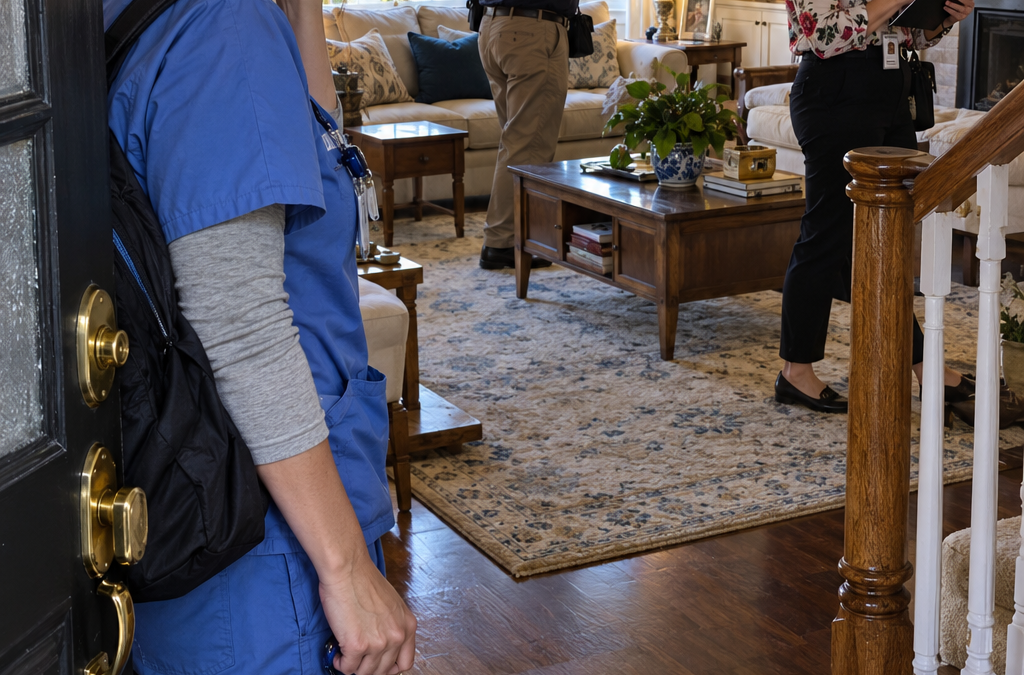
A man I had never met stood beside my sofa.
Mid-fifties.
Gray polo shirt.
Khaki pants.
Camera hanging from one hand.
Clipboard tucked against his chest.
Behind him, a younger woman was crouched near the bay window with a tape measure extended toward the garden wall.
There were strangers inside my house.
Not standing at the door.
Inside.
My first thought was burglary.
My second was police.
Then I noticed the logo stitched onto the man’s polo.
RIDGEMONT ESTATES COMMUNITY COMPLIANCE.
I wish I could say I reacted dramatically.
I didn’t.
Years in a hospital had trained that out of me.
When people panic, I become quieter.
I set my bag down.
Looked directly at the man.
And said:
“Who are you, and why are you here?”
He smiled.
That smile stayed with me for weeks.
It wasn’t nervous.
It wasn’t apologetic.
It was the patient smile people use when they believe the person in front of them simply hasn’t caught up yet.
“Terrence Vogel,” he said. “Senior compliance inspector for Ridgemont Estates.”
He shifted the clipboard and offered me a laminated identification card.
I didn’t touch it.
“I asked why you’re in my house.”
“We’re conducting your property compliance assessment.”
“My what?”
“Your initial interior and exterior compliance review.”
The younger woman stood.
She held a small tablet in addition to the tape measure.
I looked from her to Terrence.
“You need to leave.”
Terrence’s smile tightened.
“I understand this may feel unexpected.”
“Unexpected?”
“Yes, ma’am.”
“Two strangers inside my living room feels a little beyond unexpected.”
He set a form on my kitchen counter.
PROPERTY COMPLIANCE ENTRY NOTICE.
Ridgemont Estates logo at the top.
A checklist beneath it.
Exterior condition.
Interior modification.
Window conformity.
Hardscape.
Landscape boundary.
Accessory structures.
The form cited Section 4.7 of something called the Ridgemont Governance Charter.
Terrence tapped near the bottom.
“We’re nearly finished. We just need your acknowledgment signature.”
I looked at him.
Then the paper.
Then back at him.
“I’m not signing anything.”
“That’s your choice.”
“No. You seem confused. I’m not a member of Ridgemont Estates.”
For the first time, the younger woman looked uncomfortable.
Terrence didn’t.
“Actually, ma’am, your parcel falls within Ridgemont’s expanded jurisdiction as of March.”
I stared at him.
“What?”
“Boundary expansion.”
“No.”
“We sent notification.”
“No, you didn’t.”
“Notices were mailed to affected owners.”
“My house is not in your HOA.”
“It is now.”
Something cold moved through me.
I don’t mean metaphorically.
My hands became cold.
My face felt hot.
“What did you just say?”
“As of March, your property is included under Resolution 2026-9.”
He said it effortlessly.
Like a utility billing change.
Like a garbage collection schedule.
I looked around my own living room.
At the sofa I had paid for.
The bookshelf my brother helped me assemble.
The side table where Terrence had apparently placed his camera bag.
My camera bag.
No.
His.
In my house.
My voice came out low.
“Get out.”
“Ma’am, if you’d let me explain—”
“Get out of my house.”
“We are authorized under the expanded—”
“No.”
I walked to the front door.
Opened it fully.
“Both of you. Now.”
The younger woman moved immediately.
Terrence stayed.
“We need to complete the checklist.”
“If you’re still standing inside my house in ten seconds, I’m calling the police.”
His expression changed.
Not fear.
Irritation.
He gathered the form.
“Refusal to cooperate may be noted as noncompliance.”
“Nine.”
He stared at me.
“Eight.”
He picked up his camera bag.
The younger woman was already on the porch.
Terrence walked toward the door.
As he passed me, he said, “You’ll receive written follow-up.”
“Wonderful.”
He stepped outside.
I shut the door.
Deadbolt.
Chain.
Then I checked the back door.
Locked.
Every window.
Locked.
I stood in the middle of the living room for what must have been five minutes.
The house no longer felt like mine.
That is the part people underestimate about unauthorized entry.
Nothing had been stolen.
Nothing broken.
The sofa was still there.
Television still there.
Wallet still inside my bag.
But someone had crossed a boundary I thought was absolute.
They had stood in my rooms.
Photographed my belongings.
Measured my windows.
Touched whatever they had decided was relevant to their inspection.
And they had done it without hesitation because someone had told them they were entitled to.
I called Priscilla.
She answered on the second ring.
“You sound terrible.”
“Two HOA inspectors were inside my house.”
Silence.
“Priscilla?”
“What HOA?”
“Ridgemont.”
The silence deepened.
“What do you mean inside?”
“I mean standing in my living room taking photographs.”
“Did you let them in?”
“No.”
“Was the door unlocked?”
“Yes.”
“Delia.”
“I know.”
“No, I’m not blaming you. I’m asking because I need to understand.”
I sat down.
“They said my property was annexed in March.”
She didn’t respond.
“Resolution 2026-9.”
More silence.
Then she said slowly:
“Open your computer.”
“What?”
“County assessor.”
“I’m exhausted.”
“Delia.”
Something in her voice made me move.
“Do it now.”
I opened my laptop.
Went to the county property portal.
Entered my parcel number.
There was my address.
My name.
Lot dimensions.
Assessment history.
Tax status.
Then, under ASSOCIATED GOVERNANCE / SPECIAL DISTRICT NOTATIONS, a line I had never seen before.
RIDGEMONT ESTATES HOA EXPANDED BOUNDARY — RESOLUTION 2026-9 — EFFECTIVE MARCH 14.
I stopped breathing.
“It’s there.”
Priscilla swore.
Priscilla almost never swore.
“Open the document.”
I clicked.
A scanned resolution loaded.
Five pages.
Signed by Clifton Hargrove, president of Ridgemont Estates Homeowners Association.
Certified by the association secretary.
Recorded with the county clerk.
County administrative approval stamp on the last page.
My parcel number appeared on page three.
I read it once.
Then again.
Then a third time.
“This can’t be legal.”
“Probably isn’t.”
“How did they add my house?”
“Keep reading.”
There were fourteen other parcels.
All outside the original Ridgemont boundary.
All along Copperfield Lane or the western edge near Larksburg Court.
Priscilla’s property was not included.
Her lot sat slightly farther south.
Mine was.
So was Gordon Wells’s.
The Patel family’s.
Mrs. Brennan’s.
A rental property owned by a retired teacher.
Fourteen homes.
The resolution described us as “adjacent properties incorporated for purposes of comprehensive community governance.”
Incorporated.
As if we were empty acreage.
Not people’s homes.
“Did you get a letter?” Priscilla asked.
“I don’t know.”
“What do you mean?”
“Terrence said they mailed something.”
Then I remembered the envelopes.
There had been mail.
Heavy white envelopes from something called Ridgemont Community Administration.
I had assumed they were promotional notices because I wasn’t in Ridgemont.
I recycled at least two without opening them.
My stomach dropped.
“Oh God.”
“What?”
“I probably threw the notices away.”
“That doesn’t mean you agreed.”
“I didn’t even read them.”
“Delia. Listen to me.”
I stopped.
“Receiving mail is not consent.”
I knew that.
Intellectually.
Emotionally, I suddenly felt as if I had made a terrible mistake.
“What do I do?”
“Lawyer.”
“Tonight?”
“Tomorrow morning. And don’t call Ridgemont first.”
“Why?”
“Because you don’t know what they’ve filed.”
She was right.
The next morning, I called Marjorie Osai.
Priscilla gave me her name.
Property rights attorney.
Land-use disputes.
Boundary and title litigation.
Marjorie spoke to me for fifteen minutes before agreeing to see me that afternoon.
I brought everything.
Deed.
Closing papers.
Screenshot of the county assessor entry.
Copy of Resolution 2026-9.
Terrence’s card, which I had taken from the counter before he left.
Photographs of the form he tried to make me sign.
Marjorie read silently.
She was probably in her early fifties, with silver beginning at her temples and the kind of stillness that made you aware when you were talking too much.
When she finished, she looked up.
“Did you sign anything?”
“No.”
“Ever?”
“No.”
“Any Ridgemont covenant?”
“No.”
“Application?”
“No.”
“Annexation consent?”
“No.”
“Petition?”
“No.”
“Did the prior owner?”
“Not according to my closing documents.”
She opened the deed.
“Your title doesn’t show HOA restrictions.”
“Correct.”
“Your lot was clearly outside the original boundary?”
“Yes.”
“Any municipal rezoning you know of?”
“No.”
She turned back to the resolution.
“This is aggressive.”
“Illegal?”
She gave me the lawyer answer.
“Potentially very.”
I didn’t smile.
“What does that mean?”
“It means I want certified copies before I accuse anyone of fraud.”
“Two people were inside my house.”
“I know.”
“They said they had jurisdiction.”
“I know.”
“They had cameras.”
“Delia.”
I stopped.
Her voice softened slightly.
“We’re going to separate what you feel from what we can prove.”
That irritated me.
She could tell.
“I’m not saying your anger isn’t justified. I’m saying anger doesn’t win this. Records do.”
I leaned back.
“Okay.”
“First, we confirm exactly what was filed. Second, we identify what authority they claim allowed annexation. Third, we determine whether county approval was administrative or substantive. Fourth, we figure out why these fourteen properties.”
“Why?”
“Because people rarely manufacture jurisdiction for no reason.”
That sentence changed how I looked at everything.
Until then, I had focused on the invasion.
The inspectors.
The forms.
The photographs.
Marjorie was asking the larger question.
Why would Ridgemont want us?
Within forty-eight hours, she sent the HOA a cease-and-desist letter.
No entry.
No inspections.
No fines.
No enforcement activity against my property pending legal review.
She also notified the county clerk that ownership and jurisdiction were disputed.
Then we began digging.
The first thing we learned was that I wasn’t the only one who had been inspected.
Gordon Wells answered his door voluntarily because he assumed some county ordinance had changed.
Ridgemont inspected his garage and backyard.
Mrs. Brennan had refused entry but received a warning notice.
The Patel family had been out of town when inspectors entered through a side door their college-age son had left unlocked.
The rental property’s tenant had allowed an inspector inside because she thought the landlord authorized it.
Three owners didn’t even know they had been annexed.
Marjorie told me to contact everyone listed in Resolution 2026-9.
So I did.
Thirteen conversations.
Some short.
Some furious.
Some confused.
By the second evening, my dining table was covered in names and phone numbers.
We created a group email.
Then a message thread.
Then a folder for every property.
Everyone had a slightly different experience.
But none of us had signed a notarized consent.
That became important.
Very important.
The motivation took longer.
Ridgemont HOA meeting minutes were technically available to members and affected owners through county records associated with the expansion filing.
Marjorie’s paralegal requested everything from the previous eighteen months.
We received hundreds of pages.
Most were painfully ordinary.
Pool repairs.
Clubhouse roof.
Landscaping bids.
Holiday budget.
Fence complaints.
Then, buried in an executive planning summary, we found Aurelius Properties.
Luxury apartment developer.
The minutes referred to “western corridor redevelopment opportunities.”
Another document discussed a proposed mixed residential-commercial rezoning.
Another mentioned projected association revenue.
Then a land-area chart.
Ridgemont needed a minimum consolidated acreage under coordinated governance before the rezoning application could satisfy the county’s planned-development threshold.
They were short.
Seventeen acres.
I stared at that number.
Then looked at the total acreage of the fourteen annexed parcels.
Just under seventeen and a half.
There it was.
They hadn’t annexed us because of neighborhood continuity.
They needed our land on paper.
Not ownership.
Governance.
Enough unified acreage to tell the county that the entire western corridor could be treated as one coordinated development area.
My home wasn’t a home in their plan.
It was acreage.
Mrs. Brennan’s garden was acreage.
The Patel children’s swing set was acreage.
Gordon’s workshop was acreage.
Fourteen families reduced to a number on a planning table.
I felt sick.
Marjorie kept reading.
“There’s more.”
“What?”
She slid another page toward me.
Aurelius had discussed financial contributions toward infrastructure improvements benefiting Ridgemont.
“What does that mean?”
“Could be legitimate.”
“Could be?”
“Road upgrades. Utility work. Clubhouse expansion. Maybe cash contribution. We need the actual development agreement.”
“So the HOA benefits.”
“Potentially.”
“And we were what?”
“The missing footprint.”
That night I barely slept.
For the next seventy-two hours, the fourteen households organized.
Not elegantly.
Not professionally.
Angrily.
Someone wanted to call television stations immediately.
Someone wanted to block Ridgemont’s entrance with trucks.
Mrs. Brennan suggested suing everyone whose name appeared on the resolution.
Marjorie shut all of that down.
“We do this cleanly.”
We met in Gordon’s garage because his was the only space large enough for everybody.
Fourteen property owners.
Spouses.
Adult children.
Priscilla came even though she wasn’t annexed.
Marjorie stood near a folding table covered in documents.
“Here’s what we know,” she said.
“None of you signed a consent form.”
Everyone shook their heads.
“None of you executed amended covenants.”
No.
“None of you petitioned for HOA membership.”
No.
“Several of you received mail notices, but notice is not consent.”
I felt some of the shame I had been carrying finally loosen.
“Ridgemont filed Resolution 2026-9 and represented these parcels as lawfully incorporated into its governance boundary. County staff recorded that filing.”
Gordon interrupted.
“So the county stole our homes too?”
“No.”
Marjorie was firm.
“Do not overstate this. Recording is not ownership transfer.”
“But they approved it.”
“They processed it. We are investigating whether the underlying filing was legally sufficient.”
Mrs. Brennan crossed her arms.
“And the inspectors?”
“Separate issue.”
“They came onto my property.”
“Document it.”
“They should be arrested.”
“Maybe. But that is not tonight’s question.”
This was why we needed Marjorie.
We were furious.
She was building something.
The next breakthrough came from the county approval file.
The administrative official who signed off on Resolution 2026-9 was Deputy Land Records Administrator Leonard Vale.
On paper, the approval looked routine.
Boundary description reviewed.
Parcel list attached.
Association resolution certified.
No objections noted.
No owner consent forms attached.
That absence was glaring.
Marjorie requested the internal processing memo.
The memo summarized Ridgemont’s filing as a “consensual community boundary adjustment involving contiguous owners.”
Consensual.
That word appeared nowhere in anything we had signed because we had signed nothing.
“Who wrote the summary?” I asked.
“Ridgemont’s filing packet included it.”
“So they told the county we agreed.”
“Essentially.”
“And Vale approved it.”
“Yes.”
Then Priscilla found something else.
She had spent thirty years in the area.
She knew people.
Leonard Vale’s wife, Charlotte, served on Ridgemont’s social committee.
Not the board.
Not an officer.
A volunteer committee.
By itself, that proved very little.
Marjorie made that clear.
“Do not call this corruption.”
“But it’s a conflict.”
“It’s a relationship that should have been disclosed if Vale was handling a contested matter. We don’t yet know whether he knew the owners hadn’t consented.”
“His wife is involved with the HOA.”
“That is evidence of connection. Not fraud.”
I was learning how careful legal language had to be.
Emotion says obvious.
Law asks prove it.
We filed a formal county complaint.
Requested emergency review of Resolution 2026-9.
Asked that all enforcement activity be stayed.
Requested preservation of emails between Ridgemont, Aurelius Properties, and county staff.
Fourteen owners signed.
Not electronically.
Ink.
Every signature.
We wanted no ambiguity about who consented to what.
The county scheduled a review for the following Thursday.
It rained that morning.
Heavy, cold rain that made the courthouse steps shine.
I barely remember driving there.
I remember parking.
I remember seeing Gordon under an umbrella.
The Patels walking together.
Mrs. Brennan wearing a red raincoat.
One by one, all fourteen property owners gathered outside.
Priscilla stood beside me.
“Look at that.”
“What?”
“Four months ago half these people didn’t know each other.”
She was right.
Bureaucracy had done what block parties never managed.
We walked in together.
Marjorie at the front.
The hearing wasn’t in a courtroom.
It was held in a county commission conference room with a long table and rows of chairs.
Ridgemont arrived ten minutes later.
Clifton Hargrove walked in first.
I had seen photographs by then.
Late fifties.
Tall.
Gray hair.
Expensive suit.
The sort of man whose professional headshot looked exactly like he expected it to look.
Two attorneys came with him.
Terrence Vogel was not there.
Neither was Leonard Vale.
Clifton looked at us.
Not surprised.
Not nervous.
Confident.
That bothered me.
People who know they are wrong usually look defensive.
Clifton looked inconvenienced.
The county review officer opened the meeting.
Marjorie summarized our challenge.
Fourteen parcels.
No executed HOA covenants.
No petitions.
No notarized owner consents.
Yet Resolution 2026-9 represented all fourteen as validly annexed.
One of Clifton’s attorneys responded.
He argued that Ridgemont had followed the procedures historically accepted for contiguous boundary adjustments.
He said notices had been mailed.
The county had recorded the resolution.
Administrative approval had been granted.
Therefore, the annexation was valid unless individual owners pursued appeals.
I felt my nails press into my palm.
Appeals.
They wanted us to appeal being placed into something we had never joined.
Clifton finally spoke.
“Ridgemont has acted in good faith throughout.”
Marjorie looked at him.
“Did Ms. Marsh consent?”
“Our position is that owners were provided notice and an opportunity to object.”
“That wasn’t my question.”
One of his attorneys leaned toward him.
Clifton continued.
“The association relied on county procedure.”
“Did Ms. Marsh sign a consent?”
“No individual signature was required under the procedure used.”
Marjorie nodded once.
“Did Gordon Wells sign?”
“No.”
“Mrs. Brennan?”
“No.”
“The Patels?”
“No.”
The room had gone quiet.
Clifton’s attorney interrupted.
“Counsel, we don’t concede that signatures were legally necessary.”
“I understand.”
Marjorie reached into her folder.
This was the document she had been waiting to use.
She placed copies on the table.
State property code.
Title 11.
Section 8.
I had read it so many times by then that I nearly knew the operative language by heart.
A privately owned residential parcel not already subject to a common-interest community could not be incorporated into an HOA’s governing jurisdiction without the written, notarized consent of the record owner.
Not mailed notice.
Not silence.
Not administrative convenience.
Consent.
Written.
Notarized.
Marjorie looked at Clifton’s attorneys.
“Please show me one.”
Neither moved.
“One notarized consent.”
Silence.
The county officer read the statute.
Then looked at the approval packet.
“Where are the owner consents?”
Clifton’s lead lawyer finally said, “We would request a brief recess.”
Granted.
They stepped into the hall.
I sat completely still.
Gordon leaned toward me.
“Is that it?”
Marjorie heard him.
“No celebrating.”
“Why?”
“Because hearings aren’t television.”
Ten minutes passed.
Fifteen.
Twenty.
One of Clifton’s attorneys reentered.
Alone.
He spoke quietly to the county officer.
Then gathered several folders.
“They’re withdrawing their defense of the current filing pending further review.”
I looked toward the door.
“Where’s Clifton?”
Nobody answered.
Ridgemont’s lawyers did not return to argue that the annexation was valid.
That didn’t instantly erase Resolution 2026-9.
Government still had procedures.
But the legal foundation had collapsed in the room.
The county issued an immediate administrative stay.
No HOA enforcement against our parcels.
No inspections.
No fees.
No fines.
No covenant enforcement.
No use of the fourteen parcels in any rezoning or development calculation until the review concluded.
For the first time since Terrence stood in my living room, I breathed normally.
The investigation that followed was wider than I expected.
County counsel reviewed the annexation packet.
The land records department examined how the filing had been accepted.
Emails were preserved.
Ridgemont board minutes were subpoenaed through civil discovery after four owners filed claims over unauthorized inspections.
Aurelius Properties suspended negotiations.
Nobody wanted to touch the redevelopment proposal while the underlying acreage was disputed.
The most damaging document turned out to be the summary Ridgemont had submitted with the resolution.
It repeatedly described the annexation as owner-supported.
But internal HOA emails showed board members knew signed consent had not been collected.
One board member had specifically asked:
Do we need signatures from Copperfield owners?
Clifton’s reply was included in the record.
County recording is sufficient once notice is issued. Do not delay the application.
That sentence spread through our group like electricity.
Marjorie remained cautious.
“It shows knowledge of the missing signatures.”
“Is that fraud?”
“It helps prove misrepresentation. Let investigators use the labels.”
Leonard Vale was placed on administrative leave while the county reviewed his handling of the filing.
Investigators found no evidence that his wife had been paid by Aurelius or that Vale received money.
That mattered.
The truth was bad enough without inventing bribery.
What they did find was that he had processed an unusual annexation involving his wife’s HOA without formally disclosing the relationship or referring the matter to another administrator.
He also approved the filing despite the absence of notarized consents required by statute.
Whether that was incompetence, favoritism, or something more became part of a formal county review.
I learned an important lesson during that period.
Real wrongdoing is often less cinematic than people expect.
No suitcase of cash.
No whispered parking-garage meeting.
Sometimes all it takes is one official deciding not to ask a question because the people filing the paperwork seem respectable.
One missing document ignored.
One summary accepted.
One relationship not disclosed.
And suddenly fourteen homeowners wake up living under an HOA they never joined.
Three weeks after our hearing, Resolution 2026-9 was formally invalidated.
The county corrected all fourteen parcel records.
I logged into the assessor website the morning Marjorie called me.
The notation was gone.
I refreshed twice.
Still gone.
RIDGEMONT ESTATES HOA EXPANDED BOUNDARY no longer appeared beside my property.
I sat at my kitchen table staring at the screen.
That should have been the triumphant moment.
Instead, I started crying.
Quietly.
Not because I had thought I would lose the house.
I hadn’t.
But for weeks, some part of me had felt displaced inside it.
As though paperwork filed by strangers had moved an invisible wall through my living room.
Now the wall was gone.
The Ridgemont-Aurelius project collapsed soon afterward.
Without the fourteen parcels, the proposal fell short of the acreage threshold needed for the specific unified-governance rezoning strategy they had planned.
Aurelius withdrew.
Publicly, the company said it was reassessing development opportunities.
Privately, according to documents obtained later, its attorneys considered the land-control dispute too risky.
Clifton Hargrove resigned as HOA president.
His statement cited personal reasons and the need to focus on family.
No apology.
No mention of Copperfield Lane.
No acknowledgment that inspectors had been entering houses under authority based on an invalid resolution.
I wasn’t surprised.
Terrence Vogel and two other compliance inspectors were named in a civil lawsuit filed by four affected homeowners.
I wasn’t one of the original four.
Marjorie advised me to preserve my claims, and I did.
The litigation over entry practices moved slowly.
Civil cases usually do.
But investigators confirmed that Terrence had entered multiple annexed properties during the period when Ridgemont considered the resolution effective.
Some owners had consented because they were falsely told HOA membership was already binding.
Others hadn’t been home.
Whether each entry legally constituted trespass depended on circumstances.
But one thing became impossible for Ridgemont to argue.
Those homes had never validly joined the HOA.
The authority Terrence had invoked in my living room did not exist.
Months later, I saw him once at a grocery store.
I was in the produce section.
He was near the dairy aisle.
Our eyes met.
He recognized me immediately.
I could tell.
He looked away.
I had imagined that moment before.
In my imagination, I confronted him.
Asked how many houses he’d entered.
Asked whether he had felt powerful measuring windows inside homes that weren’t his business.
Asked whether he ever questioned the paperwork.
But standing there under fluorescent grocery-store lights, I didn’t want anything from him.
Not an explanation.
Not an apology.
I turned my cart and left.
The person I really wanted to understand was Clifton.
Not personally.
Psychologically.
What makes someone look at fourteen homes owned by fourteen unrelated families and decide their signatures are an inconvenience rather than a legal necessity?
The answer, I think, is incremental power.
Ridgemont hadn’t started by trying to absorb Copperfield Lane.
It had spent years managing its own subdivision.
People followed its rules.
Its board approved fences.
Denied paint colors.
Fined residents.
Negotiated contracts.
Then the board began to confuse authority inside Ridgemont with authority generally.
Copperfield was next door.
The western corridor was useful.
A developer had a proposal.
The county process looked navigable.
Someone convinced himself that mailing notice was close enough to obtaining consent.
Then somebody else accepted that assumption.
Then inspectors received updated parcel lists.
Then Terrence walked through my unlocked door.
Nobody had to say, “Let’s steal Delia Marsh’s house.”
Bureaucratic overreach rarely sounds that dramatic while it is happening.
It sounds like:
Streamlining.
Boundary adjustment.
Coordinated governance.
Administrative expansion.
Community continuity.
Planning efficiency.
Words smooth enough that nobody has to picture a tired woman coming home from a hospital and finding strangers photographing her living room.
Priscilla came over the evening the county record was corrected.
She brought cold sparkling wine and a casserole large enough for eight people.
“You know I live alone.”
“Leftovers.”
We sat on my porch.
The rain from earlier that week had finally cleared.
Copperfield Lane was quiet.
For the first time in months, I wasn’t looking at every passing vehicle wondering whether it belonged to Ridgemont.
Priscilla handed me a glass.
“To not being annexed.”
I laughed.
“That’s a strange toast.”
“We’ve had stranger months.”
We sat until almost midnight.
At some point she said:
“I told you years ago they’d love to have this side.”
“You did.”
“I didn’t think they’d just take it.”
“Neither did I.”
She looked toward Larksburg Court.
“People think property theft means somebody forging a deed.”
I nodded.
“Or putting up a fence.”
“Exactly.”
She took a sip.
“Nobody imagines a PDF.”
That line stayed with me.
A PDF.
A resolution.
A county stamp.
A new notation beside a parcel number.
No bulldozer.
No locksmith.
No man with a weapon.
Just paperwork moving quietly enough that the owner might throw the notice away as junk.
That was the part I couldn’t stop thinking about.
I nearly did.
I nearly threw away the warning that my property had supposedly been annexed.
Ridgemont had counted on procedure creating legitimacy.
Once the county website reflected their claim, every later action looked official.
Terrence had a uniform.
An ID card.
A compliance form.
A charter citation.
He wasn’t sneaking.
He walked in because he believed an institution stood behind him.
That made the intrusion more frightening, not less.
A burglar knows he isn’t supposed to be there.
Terrence thought he was entitled.
For a while after everything ended, I became obsessive about locks.
I installed a video doorbell.
Two exterior cameras.
Smart deadbolt.
Window sensors.
I checked the front door twice before bed.
Sometimes three times.
That bothered me.
Ridgemont was gone from my title, but they had changed how I moved inside the house.
One evening I caught myself checking the camera feed while sitting ten feet from the front door.
I put my phone down.
This was not how I wanted to live.
So I made myself rebuild trust slowly.
Not trust in Ridgemont.
Trust in my home.
I repainted the living room.
Same warm cream, but fresh.
I moved the sofa.
Replaced the rug.
Not because Terrence had damaged any of it.
Because I wanted the room to feel like something I chose again rather than the place where I discovered strangers.
I planted hydrangeas beneath the bay window the younger inspector had measured.
Blue.
Ridgemont’s landscape palette, I later learned, discouraged blue flowers near front elevations.
I found that hilarious.
The next spring, they bloomed everywhere.
Mrs. Brennan started calling them my rebellion bushes.
I told her rebellion had nothing to do with it.
I just liked blue.
Maybe both were true.
The fourteen homeowners stayed in touch.
That surprised me.
Crisis creates strange communities.
Gordon hosted a barbecue.
The Patels organized an annual block dinner.
Mrs. Brennan became terrifyingly knowledgeable about county records.
Whenever somebody on Copperfield received an official-looking envelope, there was a good chance three neighbors knew about it by dinner.
Not paranoia.
Awareness.
We had learned the cost of assuming somebody else was paying attention.
The county changed too.
Following its internal review, the land records department adopted new procedures for HOA boundary expansions.
Owner consent verification became mandatory before recording.
Potential staff conflicts had to be disclosed.
Annexations involving privately owned residential parcels required legal review rather than routine administrative processing.
No system becomes perfect because of one scandal.
But ours became harder to abuse.
I appreciated that.
Months later, the county invited affected homeowners to a public meeting about the procedural changes.
I went.
Not because I wanted attention.
Because I wanted officials to see the human side of whatever policy they were writing.
At one point, an administrator used the phrase “affected parcels.”
I raised my hand.
“Can I suggest something?”
He nodded.
“Call us homeowners sometimes.”
The room became quiet.
I continued.
“I understand why government uses parcel numbers. But that’s part of how this happened. Everybody kept talking about fourteen parcels, seventeen acres, a western corridor. Those were houses.”
He listened.
“People lived in them.”
“That’s fair.”
“One of those parcels was my living room.”
He wrote something down.
Maybe it mattered.
Maybe not.
But I needed to say it.
The legal aftermath lasted longer than the public attention.
Clifton’s resignation wasn’t the end.
Ridgemont’s insurer reviewed the board’s conduct.
Members demanded access to financial records related to the Aurelius negotiations.
A special election replaced several board members.
The revised board formally disclaimed any jurisdiction over Copperfield Lane.
They also changed their inspection policy.
No interior inspections without express owner permission, even for actual members, except where governing documents and law clearly authorized emergency access.
I received a copy because our attorney requested it.
I showed Priscilla.
“Imagine that,” she said. “Turns out people don’t like strangers in their houses.”
Ridgemont itself survived.
I was glad.
Not because I suddenly loved HOAs.
Because destroying the entire association would have hurt residents who hadn’t created the problem.
People still needed common-area maintenance.
The pool still needed insurance.
The entrance still needed landscaping.
The mistake belonged to people using an organization badly, not automatically to every homeowner inside it.
That distinction became important to me.
I didn’t want to become the mirror image of Clifton.
He had looked at my property and seen something useful to his plan.
I didn’t want to look at Ridgemont residents and see only enemies.
Some of them contacted us privately.
One woman named Alicia came to my door several weeks after Clifton resigned.
She stayed on the porch.
Didn’t step across the threshold.
I noticed that.
“I’m from Ridgemont.”
“I figured.”
She looked nervous.
“I wanted to apologize.”
“You don’t need to.”
“I voted for Clifton.”
I didn’t know what to say.
She continued.
“He told us the expansion was voluntary.”
That word again.
“He said the western properties wanted access to our amenities and that the developer arrangement would raise values for everybody.”
“None of us asked.”
“I know that now.”
She looked ashamed.
“I didn’t ask either.”
“Ask what?”
“Whether you had agreed.”
I leaned against the doorframe.
“Most people wouldn’t.”
“Maybe we should have.”
We talked for twenty minutes.
She wasn’t evil.
She was busy.
Two kids.
Full-time job.
HOA meeting once a month.
She trusted the president to describe a planning proposal honestly.
That was how systems fail.
Not always because everybody is corrupt.
Sometimes because one person pushes and twelve others don’t have time to verify.
Before she left, Alicia looked at my hydrangeas.
“Those are beautiful.”
“Thank you.”
“Ridgemont would never approve that color.”
“I know.”
She laughed.
So did I.
That conversation did more for me than Clifton resigning.
It reminded me that the line between people inside an HOA and outside one didn’t have to become a battle line.
The legal boundary mattered.
The social boundary didn’t have to.
A year after Terrence entered my house, I came home from another long hospital shift.
Same season.
Same kind of exhaustion.
I parked.
Walked up the porch.
The hydrangeas were beginning to leaf out.
Before unlocking the door, I paused.
For a second I remembered that Tuesday.
Terrence’s voice.
Please don’t be alarmed.
We’re almost finished in here.
I unlocked the door.
Opened it.
The house was quiet.
Exactly as I had left it.
Tea mug in the sink.
Throw blanket on the sofa.
A book facedown on the side table.
My shoes from the morning near the stairs because apparently some habits never improve.
I walked into the living room.
Stopped.
And realized I no longer felt the need to check every room.
That was the moment I knew the house was mine again.
Not legally.
Legally it had always been mine.
Emotionally.
That had taken longer.
I made tea.
Sat in the living room.
Watched evening light move across the wall.
Nobody measuring windows.
Nobody photographing furniture.
Nobody telling me an institution I had never joined had rewritten the rules while I wasn’t looking.
I thought about Resolution 2026-9.
I still keep a copy.
Marjorie asked me once why.
“Evidence?”
“No.”
“Then?”
“Reminder.”
“Of what?”
I wasn’t sure then.
I am now.
It reminds me how little force power sometimes needs.
Ridgemont didn’t arrive with police.
They didn’t chain my door.
They didn’t forge my name onto a deed.
They used an administrative resolution.
A misleading summary.
A county recording process.
Official mail.
Then they relied on momentum.
Once their version appeared in the system, they acted as if debate was over.
Inspectors came.
Forms appeared.
Compliance rules followed.
The machine started moving.
And machines can crush people without anyone inside them feeling cruel.
That is why someone has to stop them.
Not with rage.
Not with threats.
With questions.
Where is my signature?
Where is my consent?
What statute allows this?
Who approved it?
What did you tell the county?
Why are these parcels included?
Who benefits?
Show me the document.
Those questions did more than shouting ever could have.
For years, I believed ownership was simple because I held the deed.
Now I understand that ownership also requires attention.
A right you never examine can still be challenged.
A boundary everyone remembers can still be misrepresented.
An institution can act beyond its authority simply because nobody makes it prove where that authority begins and ends.
Clifton Hargrove thought fourteen homeowners would be administratively convenient.
A few notices.
A recorded resolution.
Maybe some complaints.
Most people are busy.
Most people don’t read county filings.
He was right about that.
I hadn’t read mine until strangers were standing in my living room.
But he made one mistake.
He treated inconvenience as consent.
Silence as agreement.
Paperwork as truth.
They are not the same things.
The county corrected its record.
Ridgemont corrected its boundary.
Aurelius went elsewhere.
Clifton left the board.
The inspectors stopped coming.
My house stayed where it had always been.
West of Larksburg Court.
Outside Ridgemont Estates.
Mine.
Sometimes Priscilla and I still sit on my porch late in the evening.
We talk about work.
Neighborhood gossip.
Her grandchildren.
My patients.
Almost never about the annexation anymore.
One night she pointed toward the bay window.
“Remember when those people measured that?”
“I try not to.”
“Any idea what they thought was wrong?”
“No.”
“Maybe the window was too window-shaped.”
I laughed.
She grinned.
Then we sat quietly.
Cars passed in the distance.
Sprinklers clicked on across the street.
Ordinary sounds.
The sort of peace nobody appreciates until bureaucracy tries to put a price on it.
I looked at the front door.
The smart lock glowed faintly.
I no longer checked it three times.
Once was enough.
That mattered.
Because in the end, the greatest thing Ridgemont nearly took from me wasn’t seventeen acres collectively or even legal independence.
It was certainty.
The certainty that when I crossed my threshold, the rules outside stopped at the door unless I invited them in.
That Tuesday, Terrence crossed that line because a stack of documents told him he could.
He was wrong.
Clifton was wrong.
The county filing was wrong.
And fourteen homeowners eventually forced the record to say so.
I used to think the most frightening words a stranger could say inside your house were something threatening.
Give me your money.
Don’t move.
Stay quiet.
I know differently now.
Sometimes the words are calm.
Professional.
Almost polite.
“Ma’am, please don’t be alarmed. We’re almost finished in here.”
Because the most dangerous kind of overreach is often the kind that arrives holding a clipboard, certain the paperwork has already made your objections irrelevant.
Mine hadn’t.
And after that Tuesday, nobody on Copperfield Lane would ever make the mistake of assuming otherwise again.








