𝗙𝗨𝗟𝗟 𝗦𝗧𝗢𝗥𝗬 The HOA Gave My Family 30 Days to Leave the Home We’d Owned for Eleven Years, and No One Could Explain Why
𝗙𝗨𝗟𝗟 𝗦𝗧𝗢𝗥𝗬
That’s where Darinda approached us.
She was probably in her late fifties at the time.
Short gray-blond hair.
Thin-framed glasses.
A navy polo with the Maplerest Ridge logo embroidered on the chest.
And a clipboard.
Darinda almost always had a clipboard.
She had lived in the neighborhood for twenty-two years.
She knew which family had installed a shed without approval in 2009.
She knew which residents had planted the wrong species of tree.
She knew which mailbox numbers had once been painted gold before the board forced them back to black.
People joked about her memory.
Eventually, nobody found it funny.
She shook Priya’s hand first.
“These are wonderful.”
Priya smiled.
“Thank you.”
“What are they?”
“Samosas.”
Darinda took another one.
“Delicious.”
Then she looked toward me.
“Raymond Callaway?”
“That’s me.”
“Darinda Fitch. HOA president.”
We shook hands.
“Welcome to Maplerest Ridge.”
“Thanks.”
She handed me a laminated packet.
Not stapled.
Not printed on normal paper.
Laminated.
I remember that because I thought it was excessive.
“Community guidelines,” she said. “We take pride in the neighborhood.”
“I’m sure.”
“I’m sure you’ll fit right in.”
Her smile never really changed.
At the time, I interpreted it as professionalism.
Years later, I would understand that Darinda smiled most when she was deciding what somebody else was going to do.
Six weeks later, our first violation notice arrived.
Eighty-five dollars.
RECYCLING RECEPTACLE RETRIEVAL VIOLATION.
I read it twice.
Then checked the calendar.
The recycling bin had remained beside the curb four hours beyond the approved retrieval window.
I laughed.
Priya didn’t.
“Eighty-five dollars?”
“Apparently.”
“Four hours?”
“Apparently.”
“We both worked late that day.”
“I know.”
“So call them.”
I did.
Darinda answered personally.
“I believe there’s been a misunderstanding,” I said.
“Which property?”
I gave the address.
There was a pause.
“Recycling violation.”
“Right.”
“The bin was left visible.”
“We weren’t home.”
“The guideline doesn’t include a work exception.”
I thought she was joking.
She wasn’t.
“It was four hours.”
“Four hours and seventeen minutes.”
That should have been my warning.
“You timed it?”
“The violation was documented.”
“Darinda, we’ve been here six weeks.”
“I understand.”
“We didn’t know enforcement was that strict.”
“That’s why we provide the guidelines.”
I looked at the laminated packet sitting in a kitchen drawer.
“We’ve been following them.”
“Except for the bin.”
There was no point arguing.
We paid the $85.
The second notice arrived three weeks later.
Sixty dollars.
The violation concerned our front doormat.
It was gray.
Plain.
The word HOME appeared in small white letters.
According to the notice, the mat was “noncompliant with approved entrance décor standards due to inconsistent aesthetic tone.”
Priya stared at me across the kitchen table.
“What does that even mean?”
“I teach history, not aesthetics.”
“Should I call?”
“No.”
“Why?”
“Because she’ll explain it.”
We started laughing.
That was still the stage when Darinda was funny.
We replaced the mat.
A month later, we were cited because our fence needed repainting.
The fence had been painted the previous spring.
The color had been approved in writing.
I found the approval.
Called Darinda.
She said weather exposure had altered the appearance.
I argued.
She offered to waive half the fine if we repainted within fourteen days.
Priya stood behind me while I was on the phone.
When I hung up, she said, “Did she just make us repaint a fence in the same color it already is?”
“Technically, yes.”
“Why?”
“Because apparently sunlight is noncompliant.”
The next year, Biscuit’s dog run became the issue.
Six inches.
That was the problem.
One corner extended six inches beyond what the HOA considered the approved rear-yard perimeter for pet structures.
The dog run was not visible from the street.
It wasn’t visible from either neighbor’s house because of the fence.
Nobody had complained.
Still, we received a notice.
We moved it.
Then came Priya’s wind chime.
Her mother had given it to her as a housewarming gift.
Small brass tubes.
Barely audible unless the wind was strong.
Darinda called it a “potential recurring noise nuisance.”
Priya took that one personally.
“My mother gave me that.”
“I know.”
“She brought it from Delhi.”
“I know.”
“I’m not taking it down.”
“Then we’ll probably get fined.”
“Then let them fine us.”
They did.
One hundred dollars.
We paid.
That part embarrasses me now.
Not paying the money itself.
The way I rationalized it.
I was a teacher.
Priya was running a business while raising two children.
We had homework.
Soccer practice.
Bills.
Parent conferences.
Catering orders.
Life.
Every fight with Darinda required time.
Phone calls.
Letters.
Meetings.
Appeals.
It was easier to pay $60 than spend four evenings arguing about a doormat.
Easier to pay $100 than prepare a formal appeal over a wind chime.
Easier to move a dog run six inches.
That’s what everyone said.
“It’s easier to pay.”
Gerald Morris, our neighbor two houses down, told me that after receiving his third landscaping violation in one year.
“She’s insane,” he said.
“So challenge her.”
He shrugged.
“And spend three hours at a board meeting? No thanks.”
“So you just pay?”
“Fifty bucks for peace.”
It sounded reasonable.
Until fifty became a hundred.
Then three hundred.
Then more.
Within two years, Priya and I had paid more than $4,000 in violations, late processing fees, administrative surcharges, and penalties.
We never missed HOA dues.
Not once.
Priya kept records.
I kept records.
Eventually, I started a folder.
At first it was a normal manila folder.
Then it became a binder.
Then two binders.
Every notice.
Every receipt.
Every email.
Every approval.
Fence paint.
Dog run relocation.
Trash fines.
Doormat.
Wind chime.
Hedge trimming.
One notice claimed our shrubs exceeded the maximum permitted height by approximately one and three-quarter inches.
I took a photograph of myself standing beside them with a tape measure.
Priya didn’t laugh.
By then, she wasn’t sleeping well.
That’s another part people don’t understand about petty harassment.
The individual acts look ridiculous from outside.
A doormat.
A hedge.
A trash bin.
You tell the story at dinner and people laugh.
Then you live with it every month.
You begin checking your driveway before leaving for work.
You measure things.
You look through windows to see whether Darinda is walking down the sidewalk with her clipboard.
Priya once woke me at 1:30 in the morning.
“Raymond.”
“What?”
“Did we bring the trash cans in?”
“Yes.”
“Are you sure?”
“Yes.”
She lay still.
Then said, “I’ll check.”
I reached for her arm.
“Priya.”
“I won’t sleep if I don’t.”
She went downstairs.
That was when I stopped finding any of it funny.
I considered going to a lawyer.
Then I calculated what that would cost.
We had two children.
College accounts that weren’t nearly large enough.
A mortgage.
Medical insurance.
Priya’s business depended on equipment that occasionally broke at the worst possible moment.
So we endured it.
Years passed.
Sasha became twelve.
Tobias turned nine.
Biscuit got heavier and slower.
My students started calling music from my twenties “old.”
And Darinda remained HOA president.
Then the certified letter arrived.
Tuesday morning.
March.
Rain.
Priya was home because a catering client had canceled.
She signed for the envelope at the door.
At first, she assumed it was related to her business.
Then she saw the return address.
MAPLEREST RIDGE HOA PROPERTY RECOVERY BOARD
She called me during second period.
I didn’t answer.
Phones stayed in my desk while I taught.
When the bell rang, I saw six missed calls.
Three from Priya.
Two from our bank.
One from a number I didn’t recognize.
I called Priya first.
“What’s wrong?”
She didn’t answer immediately.
That scared me.
“Priya?”
“Can you come home?”
“What happened?”
“I don’t know.”
“Are the kids okay?”
“Yes.”
“You okay?”
“No.”
My stomach tightened.
“What happened?”
“We got a letter.”
“From who?”
“The HOA.”
I almost sighed.
“Another violation?”
“No.”
Her voice broke.
“Raymond, they say they’re taking the house.”
I remember standing in my classroom looking at a map of Europe on the wall.
For a few seconds, my brain simply stopped.
“What?”
“They say there’s a lien.”
“That’s impossible.”
“I know.”
“How much?”
Another pause.
“Thirty-one thousand four hundred dollars.”
I sat down.
“No.”
“I know.”
“We don’t owe them that.”
“I know.”
“We don’t owe them anything.”
“I know.”
I left school.
I don’t remember most of the drive.
The certified packet sat on the kitchen table.
Priya had placed it beside our binders.
I read it once standing.
Then again sitting.
Then a third time on the kitchen floor because somewhere during the second reading my legs had stopped feeling reliable.
The language was formal.
Cold.
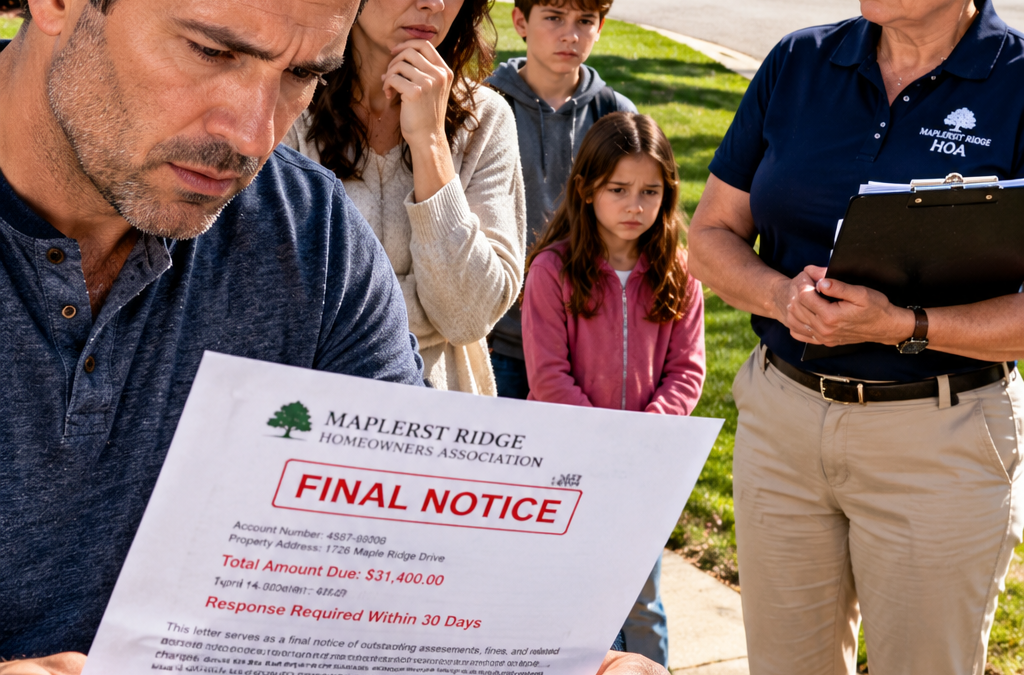
According to the letter, we had accumulated $31,400 in outstanding HOA obligations.
Not just fines.
There were “community remediation assessments.”
Administrative charges.
Legal preparation fees.
Compounded penalties.
Inspection costs.
Interest.
Processing fees.
Several line items had no dates.
Others referred to violations I had never seen.
The letter stated that a lien had been recorded against our home.
If the outstanding balance was not satisfied within thirty days, the Property Recovery Board reserved the right to initiate foreclosure proceedings.
Thirty days.
Our home.
The place Tobias had learned to ride a bicycle.
The stairs where Sasha had sat crying the morning middle school started.
The kitchen where Priya had built a business.
The backyard where Biscuit had dug a hole so deep I joked he was trying to reach China.
Thirty days.
“Check the receipts,” I said.
Priya was already doing it.
We pulled everything.
Bank statements.
HOA payment confirmations.
Checks.
Emails.
We had paid every annual assessment.
Every legitimate due.
Even most of the ridiculous fines.
There was no $31,400 debt.
Not remotely.
I called the HOA office.
No answer.
Called again.
Voicemail.
I emailed Darinda.
Nothing.
Then Priya called our bank.
That was when fear became real.
The lien existed.
Recorded.
Our mortgage lender had received notice.
The bank representative spoke carefully.
“Mr. Callaway, you’ll need to resolve the title issue.”
“We don’t owe the money.”
“I understand that’s your position.”
“It’s not a position. I have receipts.”
“I’m not disputing you.”
“Then remove the lien.”
“The bank didn’t file it.”
I closed my eyes.
“What happens to our mortgage?”
“As long as payments remain current, nothing immediate. But an unresolved superior or contested lien can create complications.”
“What kind?”
“I can’t provide legal advice.”
Of course.
Everyone had advice until advice mattered.
Then everybody told you to call an attorney.
Priya called her sister.
Her sister called an attorney she knew.
He referred us to Brenda Osterberg.
Brenda practiced real estate litigation about thirty minutes from Maplerest Ridge.
She met us the next morning.
Late forties.
Short dark hair.
No patience for unnecessary conversation.
She read the letter.
Then our payment records.
Then the HOA notices.
She stopped at the fence-paint violation.
“They fined you after approving the color?”
“Yes.”
“Why did you pay?”
I felt defensive.
“It was cheaper than fighting.”
Brenda looked over her glasses.
“That’s what these systems rely on.”
Priya leaned forward.
“Can they really take the house?”
Brenda’s expression changed.
She became gentler.
“A recorded HOA lien can be serious.”
“That’s not what I asked.”
“I know.”
Priya’s hands were clasped so tightly her knuckles were pale.
Brenda said, “If the lien was properly created and if the underlying debt is valid, foreclosure remedies may exist under state law.”
“If.”
“That’s an important word.”
“We have receipts.”
“Good.”
“So we’re safe?”
“No.”
The answer hit harder because she didn’t soften it.
“We’re going to challenge the lien immediately. But recorded instruments don’t disappear because they’re wrong. They disappear because somebody voluntarily releases them or a court orders them released.”
“How long?”
“Depends.”
“How long?”
“Potentially months.”
Priya looked away.
“Thirty days,” she whispered.
Brenda nodded.
“We’ll seek emergency relief before then.”
She filed a formal challenge.
Demanded a full accounting.
Requested the board resolution authorizing the lien.
Requested violation histories.
Notices.
Fee schedules.
Assessment records.
Meeting minutes.
Proof of service.
Everything.
The HOA responded through an attorney.
Clifton Morell.
I had never heard the name before.
His first letter was twelve pages.
It answered almost nothing.
Instead, it buried us under language.
The HOA maintained that our account reflected “persistent noncompliance.”
Certain penalties, he claimed, had become “self-executing.”
Additional charges had accrued during periods when we supposedly failed to cure violations.
Community remediation assessments had been levied to recover costs associated with our property.
Brenda read that phrase twice.
“What remediation?”
I shook my head.
“None.”
“Anyone perform work on your property?”
“No.”
“Anyone repair anything?”
“No.”
“HOA contractor?”
“Never.”
She looked toward Priya.
“Any possibility?”
“No.”
Brenda wrote back demanding invoices.
Clifton responded that records were being compiled.
Then delayed.
Then requested an extension.
Meanwhile, the thirty-day clock continued.
Our savings began disappearing.
Retainer.
Filing fees.
Title research.
Court costs.
Additional attorney hours.
Every phone call had weight.
Every envelope made Priya flinch.
The worst part was explaining it to the kids.
We tried not to.
Children know.
They hear voices.
They notice boxes of documents on the table.
They see their parents whisper after midnight.
One night Sasha walked into the kitchen while Priya and I were discussing whether to borrow against her retirement account.
“Are we losing the house?”
Everything stopped.
Priya looked at me.
I looked at Sasha.
“No.”
That was what I said.
Not because I knew.
Because I was her father.
“Then why is Mom crying?”
Priya wiped her face.
“I’m tired.”
Sasha looked at both of us.
She was twelve, not stupid.
“Is it the HOA?”
I pulled out a chair.
She sat.
I explained that there was a disagreement about money.
That we believed the HOA was wrong.
That a lawyer was helping us.
Sasha asked the question I had been avoiding.
“What if they win?”
I looked at her.
“They won’t.”
Again, I didn’t know.
That night, Priya said, “Don’t promise something you can’t guarantee.”
“What was I supposed to say?”
“The truth.”
“The truth is that someone put a fraudulent lien on our house and our lawyer says court could take six months.”
She closed her eyes.
“I’m scared.”
“I know.”
“No, Raymond. I’m really scared.”
I moved closer.
She lowered her voice.
“I built my business here.”
“I know.”
“I know every burner in that kitchen.”
“I know.”
“Tobias has never lived anywhere else he remembers.”
“I know.”
“Sasha finally likes her school.”
“I know.”
“And we’re talking about retirement accounts because Darinda decided we owe thirty-one thousand dollars?”
“I know.”
She looked at me.
“I hate that you keep saying that.”
I stopped.
Then she started crying.
So did I.
There are fights where anger makes you stronger.
This wasn’t one.
This was erosion.
Little by little.
Sleep.
Money.
Confidence.
Home.
Then Darinda came to our front door.
She arrived nine days after the certified letter.
Afternoon.
Clipboard.
Cream-colored blouse.
That same small smile.
Biscuit ran to the door wagging his tail.
He would have welcomed a burglar carrying our television.
I opened the door.
“Raymond.”
“Darinda.”
“I wanted to check in.”
“Why?”
She looked past me.
“Is Priya home?”
“Why?”
“I know this is difficult.”
My hand tightened around the door.
“What is?”
“The transition.”
For a second, I honestly didn’t understand.
“What transition?”
She lowered her voice as though delivering condolences.
“If the financial situation cannot be resolved within the statutory timeline.”
I stared at her.
“You mean us leaving.”
“I’m hoping this can be handled without unnecessary hardship.”
Behind me, Priya entered the hallway.
“What are you doing here?”
Darinda’s expression remained composed.
“I wanted to speak neighbor to neighbor.”
Priya laughed once.
There was nothing humorous in it.
“Now?”
“I’m sorry?”
“For eleven years, you’ve fined us for garbage cans, hedges, a wind chime, a welcome mat, and six inches of dog fencing. Now someone files a thirty-one-thousand-dollar lien against our house and suddenly you’re here as a neighbor?”
Darinda straightened.
“I don’t personally control account enforcement.”
“You’re HOA president.”
“Those matters are reviewed by the Property Recovery Board.”
“What Property Recovery Board?”
Darinda paused.
“It handles serious delinquency.”
“We’ve never missed a payment,” I said.
She looked at me.
“That’s not what the account reflects.”
“I have receipts.”
“Then your attorney can address that through the appropriate process.”
Priya stepped closer.
“Did you authorize the lien?”
Darinda’s eyes moved to her.
“I’m not discussing privileged board matters at your front door.”
“You came to our front door.”
Another pause.
Then Darinda gave us the sentence I will remember for the rest of my life.
“I only hope you’ll make the transition as smooth as possible for the children.”
Priya went white.
I opened the door wider.
“Leave.”
Darinda looked almost offended.
“Raymond—”
“Get off my property.”
She closed her clipboard.
“I was trying to show compassion.”
“Leave.”
She walked down the path.
I watched until she reached the sidewalk.
Then closed the door.
Behind me, Priya whispered, “She thinks we’re going.”
I turned.
Priya looked terrified.
“She thinks they’ve already won.”
That was the first moment I stopped thinking we were dealing with an accounting error.
Something was wrong.
Not mistaken.
Wrong.
Brenda agreed.
“That visit is unusual.”
“Unusual?”
“Extremely.”
“Why would the HOA president discuss moving before there’s even a hearing?”
“Exactly.”
She requested additional discovery voluntarily from Morell.
No meaningful response.
She sent a preservation notice demanding the HOA retain financial records, emails, account histories, and communications regarding our property.
Morell accused her of “unnecessary escalation.”
She smiled when she read that.
“Good.”
“Good?”
“They’re irritated.”
“How does that help?”
“It means we’re pushing somewhere they don’t want us.”
But pushing cost money.
By the third week, we had spent enough that I stopped checking the account daily.
Our mortgage lender wanted updates.
Priya canceled two catering jobs because she couldn’t concentrate.
I missed classes for legal meetings.
My principal was supportive.
Still, substitute coverage gets noticed.
My students knew something was wrong.
One kid stayed after class.
“Mr. Callaway, you okay?”
“I’m fine.”
He gave me exactly the skeptical look I gave students when they claimed the dog ate their essay.
“Sure.”
I almost laughed.
At home, boxes appeared.
It was Priya who started packing.
I found her wrapping framed photographs in newspaper.
“What are you doing?”
She didn’t look up.
“Being practical.”
“We’re not leaving.”
“We might have to temporarily.”
“Brenda said we can seek an injunction.”
“She also said there are no guarantees.”
I picked up a picture of Tobias at five years old holding a soccer trophy upside down.
“Don’t.”
Priya finally looked at me.
“I can’t wait until someone tells us we have forty-eight hours.”
“Nobody is doing that.”
“You don’t know.”
“Priya—”
“I need to feel like I’m doing something.”
That stopped me.
So I helped.
Not because I believed we were leaving.
Because my wife needed control over something.
We packed books.
Winter clothes.
Photo albums.
The things we could live without for a while.
Tobias thought we were cleaning.
Sasha knew better.
Biscuit kept climbing into empty boxes.
We were twenty-six days into the thirty-day deadline when somebody knocked on the back door at seven in the evening.
Not the front.
The back.
That was unusual.
I opened it.
Eunice Pemberton stood on the patio.
She lived across the street.
Retired postal worker.
Sixty-eight.
Quiet.
Eunice had been in Maplerest Ridge sixteen years and knew almost everything that happened because retired postal workers apparently never stop observing delivery patterns.
She was holding a USB drive.
“Raymond.”
“Eunice.”
“Is Priya home?”
“Yeah.”
“Can I come in?”
Something in her voice made me step aside.
Priya came from the kitchen.
Eunice sat at our table.
She looked at the boxes stacked near the stairs.
“Oh, honey.”
Priya folded her arms.
“We’re not gone yet.”
“No.”
Eunice placed the USB drive on the table.
“And maybe you’re not going anywhere.”
I looked at it.
“What is that?”
“I need to explain.”
Eight months earlier, Eunice had been cited because of her garden shed.
The shed had existed for nine years.
Darinda called it an “unapproved structural presence.”
Eunice appealed.
Lost.
Paid.
Then installed security cameras.
“I wasn’t trying to spy on anybody,” she said.
“Why cameras?”
“Because Darinda kept walking past my house.”
She had two cameras facing the street.
A third was angled down the block toward the HOA community office.
The office wasn’t really an office.
It was a converted detached garage beside the old clubhouse.
Eunice’s camera mostly captured the sidewalk, parking area, and exterior entrance.
“What am I looking for?” I asked.
“Two people.”
She told us she had begun noticing Darinda meeting Clifton Morell late at night.
Not board meetings.
Not normal business hours.
Four times over six months.
At first, Eunice thought nothing of it.
Then one night, they sat outside because the office alarm malfunctioned.
Clifton had brought a tablet.
Darinda had files.
They spent almost forty minutes comparing documents under the exterior light.
Eunice’s camera recorded it.
“I enlarged parts,” she said.
She opened a laptop.
The footage played.
There was Darinda.
There was Clifton.
Timestamp: 9:43 p.m.
They stood beside a small table.
Darinda opened a folder.
Clifton held the tablet.
No useful audio.
But the video was clear enough to see headings.
Addresses.
Numbers.
Priya leaned closer.
“Pause.”
Eunice stopped it.
One address looked familiar.
Ours.
My stomach tightened.
“Zoom.”
She did.
The image degraded.
Still readable.
Our street.
Our house number.
Another column showed what looked like market values.
Another had abbreviated mortgage information.
Priya whispered, “Why do they have refinancing data?”
“I don’t know,” Eunice said.
She clicked to another clip.
Different night.
Same two people.
More files.
Seven addresses appeared across several recordings.
Seven properties.
I recognized three.
All were larger homes in Maplerest Ridge.
One had been sold recently after the owners moved unexpectedly.
Another belonged to a family I knew had been fighting HOA fines.
Eunice said, “I started writing them down.”
She opened a notebook.
Seven addresses.
All high-value homes.
All owners who had received escalating violations.
Priya looked at me.
My mouth had gone dry.
“Why didn’t you bring this sooner?”
Eunice’s eyes filled.
“Because I didn’t know what I was looking at.”
She pointed toward the boxes.
“Then I heard about your lien.”
We called Brenda.
She came to our house at 9:20 that night.
No assistant.
No paralegal.
Just Brenda in jeans and a sweatshirt, carrying her laptop.
She watched the footage once.
Then again.
Then requested the original files with metadata.
Eunice provided them.
Brenda compared the addresses.
Her face changed.
She stopped moving entirely.
“What?” I asked.
She didn’t answer immediately.
“Brenda.”
She looked at us.
“This may not be an HOA dispute.”
Priya sat down.
“What is it?”
Brenda looked toward the screen.
“A predatory lien scheme.”
The room became quiet.
She explained slowly.
HOA lien abuse can become extremely dangerous when bad actors deliberately manufacture debt against homeowners.
If liens are inflated enough, owners may become unable to refinance or sell normally.
Legal costs increase.
Banks become nervous.
Families under pressure sometimes accept settlements or distressed sales.
I looked at the seven addresses.
“You’re saying they want our house?”
“I’m saying I want to know who benefits if you lose it.”
She started working that night.
Property records.
Corporate records.
Sale histories.
Business registrations.
Clifton Morell had connections to a property investment company through an entity that did not immediately carry his name.
The relationship was layered.
But it was there.
One of the recently sold Maplerest properties had ultimately transferred through a company connected to the same investment network.
Brenda called a forensic accountant she knew.
By two in the morning, nobody was talking about doormats anymore.
The next morning, Brenda filed for an emergency injunction.
The filing alleged that the lien was likely fraudulent and requested immediate suspension of foreclosure action pending investigation.
She attached our payment history.
The inconsistent fee records.
Eunice’s footage.
Preliminary corporate links.
Then she contacted the county district attorney’s office.
That’s when everything accelerated.
Investigators arrived at Brenda’s office that afternoon.
They wanted original video.
They wanted chain of custody.
They interviewed Eunice.
Then us.
Then two other families on the list.
One family had paid more than $18,000 to resolve an HOA lien.
Another had sold.
The husband told investigators he simply couldn’t afford the legal fight.
He cried while saying it.
Within eleven days of Eunice bringing that USB drive to our kitchen, the court suspended the lien against our property.
I was standing outside my classroom when Brenda called.
“We got it.”
“What?”
“Temporary injunction.”
I leaned against the wall.
“Meaning?”
“No foreclosure action. No collection enforcement. Lien frozen while the investigation proceeds.”
I closed my eyes.
“Are we safe?”
“For now.”
It was the first good answer we’d received in a month.
I called Priya.
She answered immediately.
“Raymond?”
“It’s suspended.”
Silence.
Then a sound somewhere between crying and laughing.
“Say it again.”
“It’s suspended.”
“Can they take the house?”
“Not while the order is in place.”
I heard something drop.
Then Priya said, “I just dropped a spoon.”
I laughed.
She laughed.
For maybe thirty seconds, we sounded like ourselves again.
The investigation expanded.
Forensic accountants examined HOA ledgers.
Investigators subpoenaed records.
Bank accounts.
Emails.
Property instruments.
Corporate registrations.
Clifton’s communications.
Darinda’s private files.
What emerged was worse than Brenda had initially suspected.
The allegations later confirmed by investigators showed a coordinated pattern.
Darinda had been identifying high-value properties.
Some belonged to families she believed were unlikely to fight aggressively.
Busy professionals.
Older residents.
Families with children.
People with equity in their homes.
Violations accumulated.
Many began small.
Aesthetic notices.
Landscaping.
Noise.
Pet structures.
Trash containers.
Once owners began paying, additional administrative fees appeared.
Then remediation assessments.
Penalty calculations.
Legal charges.
In some cases, HOA accounting records were altered or manufactured to create delinquency.
Clifton provided the legal machinery.
Liens followed.
The liens made homeowners desperate.
And when houses moved toward distressed sale or forced foreclosure, investors connected to Clifton stood ready.
Our eleven years of obedience hadn’t protected us.
It had made us ideal.
That realization hurt more than I expected.
I thought about every check we had written.
Every stupid fine.
Every time Priya had taken down something she loved because Darinda objected.
Every time I said, “Just pay it. It’s easier.”
We had taught them we would comply.
Then Darinda decided to see how much compliance she could buy with fear.
Six weeks after the injunction, Brenda called again.
“The lien is being dissolved.”
“Suspended?”
“No.”
“Dissolved?”
“Entirely.”
I sat down.
I was home this time.
Priya stood beside me watching my face.
I put the phone on speaker.
Brenda continued.
“The court found insufficient credible basis to maintain it in light of the evidence. The HOA’s current counsel is not opposing dissolution.”
“Current counsel?”
Priya asked.
“Morell is no longer representing them.”
That mattered.
Two days later, Darinda Fitch was arrested.
Friday afternoon.
Investigators went to the HOA office.
Local news crews were already outside because rumors had been circulating for days.
I did not go.
I watched from our living room.
Darinda came out between two investigators.
No clipboard.
No smile.
She wasn’t handcuffed in front of the cameras at first.
Then the angle changed.
I saw her wrists.
Priya stood beside me.
Neither of us said anything.
I expected satisfaction.
Maybe even joy.
Instead, I felt tired.
This woman had occupied space in our lives for eleven years.
Now strangers were discussing her arrest beneath graphics on television.
It felt unreal.
Clifton Morell surrendered two days later through his attorney.
Charges included wire fraud, conspiracy to commit real estate fraud, and filing fraudulent property instruments.
The precise charges evolved as the case developed, but by then, the central accusation was clear.
This had never been overzealous HOA enforcement.
It was money.
Property.
Leverage.
Homes.
Investigators removed boxes of records from the association office.
News helicopters briefly circled the neighborhood.
Reporters stood beside the same entrance sign Darinda had spent years obsessing over.
The story spread beyond the county.
Then beyond the state.
A national network ran a segment on predatory HOA liens.
Our family did not appear on camera.
That was my decision.
Tobias and Sasha had already lived through enough.
Three of the seven families identified in the scheme had already left their properties or entered settlements.
Those cases were reopened.
One older couple learned that the lien used to pressure their sale had included charges that couldn’t be tied to any legitimate board action.
Another family had paid thousands they did not owe.
Parallel investigations began examining Clifton’s property investment relationships in neighboring counties.
The Maplerest Ridge board collapsed.
Two members resigned immediately.
Another claimed she had signed documents without understanding what Darinda and Clifton were doing.
Maybe that was true.
Maybe it wasn’t.
I had lost patience with people who signed things they didn’t understand.
Residents demanded a special meeting.
I attended.
For eleven years, Priya and I had mostly avoided HOA meetings.
That night, almost every chair was filled.
People stood along the walls.
Darinda’s seat at the front table was empty.
Nobody missed the symbolism.
A temporary board member opened the floor.
The first speaker was a man named Samuel Pierce.
He had lived in Maplerest longer than us.
He held up a stack of violation letters.
“I paid these people nine thousand dollars over eight years.”
His voice shook.
“Nine thousand.”
Nobody interrupted.
“I thought I was irresponsible.”
He looked toward the room.
“They made me feel like I couldn’t maintain my own home.”
A woman behind him started crying.
Another resident stood.
Then another.
Stories spilled out.
Fines.
Threats.
Mysterious administrative charges.
Appeals Darinda had denied.
Fees nobody understood.
The meeting stopped feeling like governance.
It felt like a room full of people realizing they had all been isolated in the same way.
Eunice sat beside Priya.
Quiet.
Still.
The same woman who had knocked on our back door carrying a USB drive.
At one point, someone stood and pointed toward her.
“She’s the reason we’re even seeing this.”
Everyone turned.
Eunice immediately looked horrified.
“No.”
People started applauding.
She shook her head.
“I just had cameras.”
The applause continued.
Eunice leaned toward me.
“I hate this.”
“You earned it.”
“I did not.”
“You watched.”
She looked at me.
“So?”
“So everybody else looked away.”
The residents ultimately voted to dissolve the Maplerest Ridge HOA.
Unanimous among those voting.
Two people abstained.
One said afterward she couldn’t believe it had taken eleven years for the neighborhood to ask why one woman controlled so much.
The common landscaping was transferred to a simple maintenance arrangement.
No architectural enforcement board.
No recovery board.
No violation committee.
No president walking around with a clipboard.
The neighborhood did not collapse.
The lawns remained green.
Property values did not vanish.
Mailboxes did not burst into flames because somebody painted one dark blue.
Civilization survived.
We unpacked our house on a Saturday in June.
That part remains one of my clearest memories.
Tobias carried boxes back upstairs.
At first, he complained.
“Why did we pack all this if we’re staying?”
I looked at Priya.
She smiled.
“Because grown-ups occasionally panic.”
“I thought you said we were organizing.”
“We lied.”
He stared at us.
“That’s messed up.”
“Correct.”
Sasha found the wind chime wrapped inside a towel.
She held it up.
“Can we put this back?”
Priya froze.
It had been stored for years.
Her mother’s wind chime.
The one Darinda called a nuisance.
“Yes,” she said.
Sasha carried it outside.
We hung it beside the front porch.
The wind caught it almost immediately.
Three soft notes.
Priya started crying.
I put my arm around her.
Biscuit escaped through the open back door and ran three full laps around the yard as though he personally had defeated organized real estate fraud.
He was older by then.
His third lap was considerably slower than his first.
Tobias chased him.
Sasha laughed.
For the first time in weeks, our house sounded like home.
Eunice came for dinner.
Priya made samosas.
Naturally.
Brenda came too.
She resisted initially.
Priya informed her that anyone who prevented our house from being stolen was legally required to eat.
Brenda said she was fairly certain no such statute existed.
Priya told her to sit down.
Eunice brought wine.
Tobias asked far too many questions about arrests.
Sasha wanted to know whether Brenda had ever shouted “objection” in court.
Brenda said rarely.
I told Sasha television had lied to her.
For a few hours, the whole thing became small enough to fit around a dinner table.
Later that night, after everyone left, I stood on the porch.
The wind chime moved gently.
The old gray doormat sat by the door.
The same one Darinda had once declared aesthetically unacceptable.
We had kept it in the garage for years.
Priya found it while unpacking.
She put it back without asking anyone.
It still said:
HOME
I looked at that word for a long time.
Home.
A ridiculously simple word for something so complicated.
Legally, a home is property.
Parcel number.
Deed.
Mortgage.
Title.
Equity.
Lien priority.
To a bank, our house was collateral.
To Darinda and Clifton, it had become an asset.
A number on a spreadsheet.
High market value.
Strong equity.
Potential acquisition.
To us, it was the pencil marks on the laundry-room wall showing how tall Tobias had become.
It was curry smell in the curtains after a large catering order.
It was Biscuit’s scratch marks beside the back door.
It was the bedroom where Sasha slept with the hallway light on for six years and then suddenly decided she didn’t need it anymore.
It was where Priya sat beside her mother during her last visit before she died.
It was where we fought.
Apologized.
Celebrated birthdays.
Paid bills.
Got sick.
Recovered.
Lived.
That’s what people like Darinda misunderstand when they reduce a house to leverage.
They see value.
They don’t see memory.
The criminal case took time.
Cases like that always do.
There were motions.
Hearings.
Financial records.
Cooperating witnesses.
Corporate documents.
Some charges were negotiated.
Some defendants blamed others.
I stopped following every detail.
Brenda remained involved because of civil claims and restitution issues.
Eventually, the scheme was established clearly enough that nobody could credibly describe what happened as ordinary HOA enforcement.
Darinda had used the authority residents entrusted to her as part of a system designed to pressure selected homeowners.
Clifton had helped turn manufactured debts into legal threats.
The property investment connection provided the financial incentive.
I never discovered whether Darinda had targeted us from the day we moved in.
I don’t think she did.
That would almost be easier to understand.
I think it evolved.
First, she liked control.
Then she discovered that fines created money.
Then she learned most people paid.
Then Clifton entered the picture.
Maybe he showed her what liens could do.
Maybe she showed him which residents were vulnerable.
At some point, a system for enforcing grass height became a mechanism for identifying houses worth taking.
That’s how corruption often happens.
Not with somebody announcing a criminal plan in a dark room.
A small authority becomes useful.
Then profitable.
Then dangerous.
I went back through my binders after everything ended.
Eleven years of paper.
I spread the notices across our dining table.
The recycling bin.
Doormat.
Fence.
Dog run.
Wind chime.
Hedges.
Driveway.
A decorative planter.
Exterior lighting.
One violation claimed our porch light produced excessive lateral illumination.
I still don’t know what that means.
At first, I felt stupid.
All those warnings.
All those payments.
How had I not seen it?
Brenda eventually stopped me.
“You couldn’t see a scheme you had no reason to imagine.”
“I teach this.”
“What?”
“Systems. Power. Abuse.”
“Raymond.”
“I literally explain to sixteen-year-olds how institutions normalize bad behavior.”
“Do you also explain forensic accounting?”
“No.”
“Organized lien fraud?”
“No.”
“Then stop trying to turn hindsight into evidence that you should have known.”
I looked at her.
“It’s embarrassing.”
“Good people are vulnerable to paperwork because good people assume paperwork is being used honestly.”
That sentence stayed with me.
For years, every HOA letter frightened us because it looked official.
Logo.
Account number.
Violation section.
Deadline.
Signature.
We assumed someone had checked.
We assumed there was a process.
We assumed rules were applied to everyone.
That’s what makes institutional abuse powerful.
It borrows credibility from the institution.
Darinda wasn’t merely Darinda.
She was HOA President Darinda Fitch.
Clifton wasn’t merely Clifton.
He was association counsel.
Their documents looked legitimate because legitimate systems had given them letterhead.
The cameras did something paperwork couldn’t.
They stripped the titles away.
No president.
No lawyer.
Just two people standing outside an office at night comparing properties against financial information.
Once you saw that, every fine looked different.
Every letter.
Every delay.
Every unexplained charge.
It all connected.
Eunice became unexpectedly popular after the scandal.
She hated that.
Residents invited her onto the temporary neighborhood committee.
She refused.
Three times.
“I spent sixteen years avoiding committees,” she told me. “I’m not ruining retirement now.”
She did agree to help design the new security policy for shared spaces.
Mostly because people trusted her cameras.
Marcus—the neighbor, not to be confused with anyone else—joked that she had become Maplerest intelligence services.
Eunice did not find that funny.
Priya did.
Our family changed too.
Not dramatically.
But some things never returned to how they were before.
Priya kept more cash reserves in the business.
I became obsessive about checking property records twice a year.
We froze our credit for a while.
We installed our own cameras.
Not because we expected another conspiracy.
Because once you’ve watched strangers convert your address into a financial target, you start appreciating records.
Tobias mostly recovered quickly.
Kids can be mercifully adaptable.
Sasha remembered more.
For months, anytime certified mail arrived, she asked whether something was wrong.
That hurt.
One Saturday, about a year later, I found her sitting on the porch.
The wind chime moved above her.
“You’re quiet.”
“I’m thinking.”
“Bad habit.”
She smiled.
Then asked, “Were we really going to lose the house?”
I sat beside her.
“Maybe.”
She looked at me.
“You told me we weren’t.”
“I know.”
“You lied.”
“Yes.”
She seemed surprised by the answer.
“I was trying to protect you.”
“Did it work?”
I thought about it.
“Probably not.”
She nodded.
“Okay.”
“I’m sorry.”
She looked toward the yard.
“I was really scared.”
“So was I.”
That caught her attention.
“Dad?”
“Yeah?”
“You’re not supposed to be scared.”
I smiled.
“I’ve got unfortunate news about fathers.”
She laughed.
Then leaned against me.
I didn’t tell her everything.
She didn’t need to know about foreclosure law or investment firms.
But I told her enough.
Sometimes adults with power do things they shouldn’t.
Sometimes official documents can be wrong.
Sometimes being frightened doesn’t mean you’re helpless.
And sometimes the person who changes everything is a quiet woman across the street who decided to save security footage.
The old HOA office eventually became storage for neighborhood maintenance equipment.
The sign came down.
The windows were replaced.
Every time I pass it, I remember Eunice’s video.
Darinda standing under that exterior light.
Clifton holding the tablet.
Our home appearing on a list.
It still makes my stomach tighten.
But the feeling passes faster now.
Darinda doesn’t control what that building means anymore.
Neither does Clifton.
We do.
The neighbors who stayed.
The families who got refunds.
The ones whose cases reopened.
The people who finally talked to each other instead of assuming everyone else’s silence meant everything was fine.
That’s another lesson I wish I had understood earlier.
Isolation protects abusive systems.
Darinda didn’t need every resident to like her.
She needed each of us to believe our problem was individual.
Your hedge.
Your dog run.
Your fence.
Your fine.
Your lien.
Your failure.
Once we compared notes, the story changed.
Seven homes.
Escalating fines.
High property values.
Similar legal threats.
Same lawyer.
Same president.
Same pattern.
The system depended on us not sitting at one table.
The night Eunice brought that USB drive, we finally did.
Priya’s catering business grew after the case ended.
Strangely enough, publicity helped even though we avoided interviews.
People around the county heard she was involved.
Some local families began ordering from her simply to support us.
She hated the idea of being treated like a charity.
Then business became genuinely good enough that it no longer mattered why the first customers came.
Eventually, she rented a small commercial kitchen.
The house kitchen became ours again.
On the first Saturday after she moved the catering equipment out, I made pancakes.
They were terrible.
She ate them anyway.
“This is why I had to protect the kitchen,” she said.
Biscuit died two years later.
Sixteen years old.
We buried him under the maple in the backyard.
The HOA would have had a rule about that.
There was no HOA anymore.
We planted flowers.
Nobody approved them.
Nobody measured them.
Nobody sent a notice.
Tobias joked that Biscuit had finally achieved complete noncompliance.
Priya cried and laughed at the same time.
So did I.
Life kept moving.
That’s the part stories sometimes forget after the dramatic ending.
There is no freeze-frame when the bad person gets arrested.
You still have dishes.
School.
Birthdays.
Taxes.
Grief.
College applications.
A leaking faucet.
The ordinary things you were fighting to keep in the first place.
Darinda and Clifton eventually became names I heard less often.
The legal system handled what remained.
Some restitution was paid.
Some families received settlements.
Some losses could never be completely undone.
A house sold under pressure doesn’t magically become home again because a prosecutor later proves the lien was fraudulent.
That’s important.
We were lucky.
Four days.
That’s how close we were when Eunice knocked.
Four days remained on the original thirty-day deadline.
We had boxes packed.
Legal bills climbing.
A frightened bank.
Children asking questions.
Priya and I were beginning to discuss temporary housing.
If Eunice had waited another week, maybe the injunction still would have saved us.
Maybe Brenda would have found the financial connection anyway.
Maybe.
I don’t like living inside that word.
Instead, I think about what actually happened.
Eunice noticed.
She recorded.
She saved the footage.
Then, when she finally understood what it might mean, she walked across the street.
Sometimes courage looks like a courtroom speech.
Sometimes it looks like a retired postal worker standing at a back door holding a USB drive.
Eleven years after buying our house, Priya and I finally stopped worrying about whether it complied with Maplerest Ridge standards.
We repainted the fence the color we wanted.
Dark cedar.
No application.
No committee.
No approval.
Priya planted yellow flowers along the front walk.
Darinda had once discouraged yellow because it allegedly conflicted with “established neighborhood tones.”
We planted more.
Sasha chose a ridiculous blue ceramic planter for the porch.
Tobias installed a basketball hoop.
Crooked.
I refused to straighten it for three weeks simply because nobody could send me a letter about it.
Then my teacher instincts won and I fixed it.
The gray doormat stayed.
It still says HOME.
The letters are more faded now.
One corner is curling.
Priya suggested replacing it last year.
I said no.
She looked at me.
“You’re emotionally attached to a doormat.”
“It’s historically significant.”
“It’s ugly.”
“Freedom is sometimes ugly.”
She laughed.
So it stays.
Every once in a while, a delivery driver leaves something on it.
A student stops by with a graduation invitation.
A catering customer accidentally comes to the old address.
Our children come home.
And every time the door opens, nobody asks whether the mat matches the neighborhood’s aesthetic tone.
Nobody checks the hedge height.
Nobody times how long the trash can has been at the curb.
Nobody measures Biscuit’s old dog run.
That sounds small.
It isn’t.
For eleven years, Darinda taught us to think of our home as something we occupied with permission.
Permission to paint.
Permission to decorate.
Permission to own a dog.
Permission to make noise.
Permission to exist slightly differently from whoever wrote the handbook.
Then she tried to turn that permission into ownership.
She failed.
Not because we were smarter.
Not because I suddenly became brave.
Not because institutions automatically protect people.
For a while, they didn’t.
She failed because the evidence finally connected the pieces.
Our receipts.
Brenda’s questions.
Eunice’s cameras.
The property records.
The financial trail.
Seven addresses on a list.
One truth supporting another until her paperwork could no longer bury it.
I still teach history.
My students still groan when I tell them systems don’t usually collapse in one dramatic moment.
Now I add something else.
They can also be stopped the same way.
Not always by one heroic act.
Sometimes by accumulation.
One person saves a receipt.
Another records a meeting.
Someone asks why.
Someone else refuses to pay without proof.
A lawyer follows the money.
A neighbor turns on a camera.
Eventually, enough facts gather in one place that power has nowhere left to hide.
I don’t tell my students this story.
Not the whole thing.
It’s too personal.
But sometimes, when we’re talking about institutions, I write one sentence on the board.
Authority without accountability eventually becomes permission in the mind of the person holding it.
Then I ask them what they think it means.
They usually talk about governments.
Police.
Corporations.
Presidents.
Kings.
Sometimes one of them mentions a school principal.
Nobody ever says homeowners association.
I don’t correct them.
Not every lesson needs the entire story.
I know what it means.
It means a woman with a clipboard can become dangerous if everybody decides fighting her is more trouble than obeying.
It means a lawyer can turn paperwork into a weapon if nobody checks what supports it.
It means a lien can look legitimate right up until somebody asks where the debt came from.
It means a family can do everything right and still become a target.
And it means being exhausted is not the same as being wrong.
That last one took me longest to learn.
For years, I thought every payment was peace.
It wasn’t.
It was postponement.
Real peace came much later.
It came on a Saturday in June.
Boxes open.
Children running up and down the stairs.
Biscuit circling the yard.
Samosas on the table.
Eunice laughing despite herself.
Priya standing on the porch beneath her mother’s wind chime.
Three soft notes moving through the air.
And that old gray mat under my feet.
HOME.
Thirty days earlier, a certified letter had told us that word might no longer apply.
Now, years later, the mat is still there.
So are we.
And nobody gets to tell us to remove it.








