𝗙𝗨𝗟𝗟 𝗦𝗧𝗢𝗥𝗬 The HOA Gave Me 30 Days to Pay $50,000 Over a Dam on My Own Land, but They Never Checked What Sat Downstream
𝗙𝗨𝗟𝗟 𝗦𝗧𝗢𝗥𝗬
I saw a place where no one needed anything from me.
“How long has it been listed?”
“Almost nine months.”
“Why?”
“Too much land for some people. Too isolated for others.”
I looked back toward the house.
“That’s why I like it.”
I paid cash.
That mattered later.
No bank.
No mortgage company.
No lender with a claim ahead of mine.
The deed was clean.
The title work did not show any unusual encumbrances on the rear acreage.
The survey clearly described eleven acres, including the creek and the pond area.
Everything west of the eastern creek bank belonged to me.
At closing, my attorney, Philippa Aone, pushed the document folder across her conference table.
Philippa had handled a few real estate matters for people I knew.
She was in her early fifties, wore rectangular glasses low on her nose, and had the kind of patience that ended exactly where foolishness began.
“There is an association,” she said.
“I saw that.”
“Cedar Ridge Property Association.”
“Forty dollars a month.”
“Correct.”
“What do they actually do?”
“Road maintenance on two private lanes, snow coordination, entrance sign, some drainage work.”
“Architectural restrictions?”
“Limited.”
“No matching shutters?”
Philippa gave me a flat look.
“I would not have allowed you to close if matching shutters were hidden in the deed.”
I laughed.
She continued.
“The covenants are old and relatively loose. Your parcel is unusual because most of the development is east and north of you.”
“So the creek is basically the edge.”
“More or less.”
“Any problem with the pond?”
“Not from anything I’ve reviewed.”
That was good enough for me.
And for the first two years, the HOA barely existed in my life.
A statement arrived once a quarter.
I paid it.
The gravel road was plowed when it snowed.
Someone replaced the entrance sign.
That was about it.
The previous owner, a widower named Arthur, had apparently lived there for twenty-two years without receiving more than two association letters.
I thought I had gotten lucky.
I spent my first spring cleaning up the property.
I repaired fencing near the road.
Replaced rotten steps on the back deck.
Cleared deadfall from the woods.
And I worked on the pond.
The old dam needed attention.
Calling what I did “building a dam” would not have been completely accurate, because the original structure had existed for decades.
But I rebuilt enough of it with my own hands that I considered it mine.
I removed loose stone.
Repacked portions of the earthen core.
Added several tons of rock along the downstream face.
Regraded the crest.
And, most importantly, I cut a controlled overflow channel along the northern shoulder so heavy rain could leave the pond without eroding the structure.
I consulted the county before doing any significant work.
The dam was small enough that it did not fall into the category of large regulated impoundments, but I still followed the basic erosion and drainage guidance they gave me.
I spent almost every Saturday that summer on it.
Some evenings I worked until dark.
There is something satisfying about moving stone when nobody is paying you to do it.
No schedule.
No foreman.
No progress meeting.
Just a shovel, a wheelbarrow, and the knowledge that the work would still be there tomorrow if you got tired.
By September, the pond level had stabilized.
The banks stopped washing out.
The overflow channel carried stormwater cleanly.
The next spring, I stocked the pond with bass and bluegill.
I built a small cedar dock off the eastern bank.
Nothing extravagant.
Eight feet wide.
Sixteen feet long.
Enough for two chairs and a fishing rod.
That dock became my favorite place on the property.
Sometimes I sat there for an hour after work without even checking my phone.
My nearest neighbor was Garrett Hale.
He lived about a quarter mile up the road on seven acres.
Garrett was fifty-nine, broad-shouldered, permanently sunburned, and drove an old Ford pickup that sounded as though somebody had filled the exhaust pipe with gravel.
He would slow whenever he saw me near the driveway.
“Still fixing things that weren’t broken?” he once called through the window.
“That’s retirement practice.”
“You’re terrible at it.”
He was right.
Garrett had lived there almost fifteen years and knew more local history than anyone.
According to him, the pond had been there since at least 1987.
“Maybe earlier,” he said. “I remember fishing there when the Sanders family owned that land.”
“So nobody ever complained about it?”
“Who would complain about a pond?”
I later learned the answer to that question.
Denton Marsh.
Denton bought his house on Millbrook Circle about a year after I moved in.
His property was very different from mine.
Millbrook Circle was the polished part of Cedar Ridge.
Large homes.
Finished basements.
Landscaped lawns.
Three-car garages.
The lots were still rural by suburban standards, but close enough together that everyone knew when somebody bought a new grill.
Denton’s house sat near the middle of the circle.
Five bedrooms.
Brick front.
Stone retaining walls.
Perfect grass.
An outdoor kitchen he mentioned within seven minutes of meeting anyone.
I first met him at the annual HOA picnic.
He walked over holding a paper plate and looked at my boots.
“You live on the Mercer tract?”
“That’s me.”
“With the pond.”
“Also me.”
He smiled.
“I’ve been meaning to walk that property.”
I waited.
“Why?”
“Just interested in the history of the development.”
“You a historian?”
“Amateur.”
Garrett, standing beside me, took a drink to hide a smile.
Denton continued.
“I do a lot of research.”
Garrett said, “He bought a metal detector.”
Denton frowned.
“It’s more involved than that.”
“I stand corrected.”
That should have told me what Garrett thought of him.
Denton became HOA president the following January.
The previous president, Claire Henderson, had held the position for eight years and seemed delighted to escape.
Nobody ran against Denton.
That turned out to be unfortunate.
Within six weeks, Cedar Ridge changed.
We started receiving newsletters.
Long ones.
Four pages.
Then six.
Denton created committees.
Architectural review.
Environmental compliance.
Road appearance.
Common-property preservation.
He proposed a new online violation portal.
He put reflective signs at the subdivision entrance announcing speed limits the county had never established.
He began holding board meetings in his three-car garage because, in his words, it provided “an accessible administrative setting.”
Then he charged visitors five dollars to park in his driveway during meetings.
Garrett called me after the first one.
“You’re not going to believe this.”
“What?”
“Denton charged me to attend an HOA meeting.”
“Charged you what?”
“Five bucks.”
“For what?”
“Parking.”
“On HOA property?”
“His driveway.”
I stared at my phone.
“You paid him?”
“I wanted to see how bad it was.”
“And?”
“Worth every penny.”
By March, fourteen homeowners had received new violations.
A decorative flag not on an approved list.
A fence replacement completed without written review.
A fire pit visible from the road.
Nonconforming gravel.
A shed painted “inconsistent with the visual character of the neighborhood.”
One man was warned about stacking split firewood beside his garage.
We lived in rural Virginia.
Everyone had firewood.
Denton seemed to believe the presidency had converted him from neighbor into regulator.
Still, I assumed my eleven wooded acres would keep me outside his attention.
Then a white envelope appeared in my mailbox.
CEDAR RIDGE PROPERTY ASSOCIATION.
FORMAL NOTICE.
I opened it standing at the kitchen counter.
The association had received what it called an anonymous environmental complaint concerning the impoundment structure on my property.
The letter described my pond dam as an “unauthorized alteration affecting a natural watercourse.”
It claimed the structure could impede shared watershed access, alter downstream flow, and expose neighboring properties to flooding liability.
I had sixty days to provide engineering documentation, historical authorization, and board approval.
Otherwise the matter would proceed to formal enforcement review.
I actually laughed.
Not because flooding was funny.
I had spent too many years around drainage work to dismiss water.
I laughed because Denton’s letter treated the dam as though I had secretly poured a concrete wall across the Mississippi during the night.
The structure had existed since the Reagan administration.
I sat down that evening and wrote a response.
I kept it polite.
I explained the age of the dam.
I provided a copy of my purchase survey.
I included aerial photographs showing the pond before I owned the property.
I described the maintenance I had performed and noted that the overflow channel had improved drainage safety rather than reduced it.
I concluded with one sentence:
“If the Association possesses documentation establishing regulatory authority over the portion of my property containing the pond and dam, please provide it for my review.”
I mailed the letter certified.
Then I went back to my life.
Six weeks passed.
No reply.
I assumed somebody on the board had looked at a map and explained reality to Denton.
Then another certified envelope arrived.
This one was thicker.
I signed for it at the post office.
I opened it in my truck.
The first line made my stomach tighten.
NOTICE OF FINAL ENFORCEMENT DETERMINATION.
The Cedar Ridge board had completed its review.
They had concluded that the dam violated Section 4(C) of the subdivision environmental guidelines, which prohibited property owners from obstructing natural waterway flow without prior written approval.
Then came the number.
$50,000.
Not $500.
Not $5,000.
Fifty thousand dollars.
Due within thirty days.
The association reserved the right to record a lien against my property for unpaid assessments and enforcement charges.
The letter warned that continued failure to satisfy the account could result in further collection proceedings, including foreclosure remedies where permitted.
I read it four times.
Then I sat in the truck with the letter across my steering wheel and listened to rain ticking against the windshield.
I had paid cash for that property.
Every acre.
Every tree.
Every stone.
I had spent years building a quiet place where nobody could take much from me because I owed almost nothing to anyone.
Now three people sitting in a garage were claiming they could put a fifty-thousand-dollar debt against it because of a dam older than their organization.
Anger came first.
Then something colder.
Fear.
Not fear that Denton was right.
Fear of what institutional stupidity can cost even when you are right.
Lawyers cost money.
Court takes time.
Liens complicate title.
False claims still have to be answered.
Being correct does not magically protect you from the expense of proving it.
I called Philippa.
She answered on the third ring.
“Nathan.”
“I got an HOA fine.”
“How much?”
“Fifty thousand.”
Silence.
Then, “Say that again.”
“Fifty thousand dollars.”
“What did you do, build an airport?”
“A dam.”
Another pause.
“The pond?”
“Yes.”
“The dam that existed when you bought the property?”
“That one.”
“Email me everything.”
“I already scanned it.”
“Of course you did.”
“I’m sending it now.”
“Do not respond to them.”
“I wasn’t planning to.”
“Do not call Denton.”
“Wasn’t planning that either.”
“Do not threaten anyone.”
“I know how lawyers work, Philippa.”
“No, you know how construction people work. That is exactly why I am telling you not to threaten anyone.”
Forty-eight hours later, she called me back.
Her first words were, “I need you to come to my office.”
That usually meant something interesting.
When I arrived, my survey was spread across her conference table beside a copy of the original subdivision plat.
Philippa tapped the map.
“Show me where the dam is.”
I pointed.
“Here.”
“Overflow?”
“Here.”
“Pond?”
“Mostly west of this line.”
She nodded.
“Now show me the association boundary.”
I leaned closer.
A bold survey line ran along the eastern bank of the creek.
I looked at her.
“No.”
“Yes.”
“The HOA boundary stops there?”
“According to the founding plat, yes.”
“But my house is in the association.”
“Your residence and eastern acreage are included within the subdivision. The western rear tract is not within the mapped enforcement area referenced in the original declaration.”
I followed the boundary with my finger.
The creek divided my property in an unusual way.
My deed covered land on both sides.
But the subdivision map had incorporated only the eastern portion into the covenant-controlled area.
Everything west of the eastern creek bank remained part of my deed without being subjected to the same association jurisdiction.
The pond sat west.
The dam sat west.
The overflow channel sat west.
Philippa folded her arms.
“Denton is attempting to enforce subdivision restrictions on land the subdivision declaration does not cover.”
I stared at the map.
“Not one inch?”
“Based on what I have right now, not one inch of the dam.”
I leaned back.
“Then why did nobody notice this when I bought the place?”
“Because nobody was trying to fine you fifty thousand dollars.”
That was Philippa.
She never wasted words.
I looked again at Denton’s letter.
“So what happens?”
“I respond.”
“Politely?”
“No.”
Her response was ten pages.
She cited the original recorded declaration.
The subdivision boundary exhibit.
My deed.
County survey records.
Prior plats.
She dismantled Denton’s interpretation of Section 4(C) line by line.
She also included legal authority supporting a simple principle: an association cannot enforce private covenants beyond the property legally subjected to those covenants merely because the same owner possesses adjacent land.
At the end, she demanded three things.
Immediate rescission of the $50,000 fine.
Written acknowledgment that the pond and dam lay outside the association’s enforcement boundary.
And confirmation that no lien would be recorded.
She gave them fifteen days.
Denton responded on day eleven.
Not by backing down.
He hired an attorney.
His lawyer, Wesley Grange, sent a letter arguing that even if the dam itself fell outside the subdivision boundary, its impact extended into association property downstream.
Therefore, he claimed, the board possessed an interest in regulating anything materially affecting the community watershed.
When Philippa read that paragraph aloud, she removed her glasses.
“That’s ambitious.”
“Legal?”
“Ambitious.”
“Meaning?”
“Meaning wanting jurisdiction does not create jurisdiction.”
Then she pointed to another folder on her desk.
“However, his watershed argument made me request something I probably would not have requested otherwise.”
“What?”
“The county topographic and drainage analysis.”
I did not understand yet.
Four years before I bought my property, the county had conducted a watershed study after repeated heavy-rain events in the region.
The report was technical.
Contour maps.
Flow calculations.
Soil absorption.
Culvert capacity.
Probable drainage routes.
Exactly the kind of document most people would never read unless they were being paid to.
Philippa sent it to me electronically.
That night, around eleven, my phone rang.
I was already in bed.
“Hello?”
“Nathan.”
It was Philippa.
“You awake?”
“I am now.”
“Open your email.”
I sat up.
“What happened?”
“I sent you page seven.”
I grabbed my laptop.
The image loaded slowly.
A topographic map filled the screen.
Colored lines marked runoff paths.
I recognized my creek immediately.
“What am I looking at?”
“The county modeled a significant upstream release scenario.”
“From where?”
“Your watershed and two smaller tributaries.”
I zoomed in.
A flow arrow moved north-northwest from the creek.
Then another.
Then the modeled path crossed a shallow depression.
Straight toward Millbrook Circle.
I felt something tighten in my chest.
“That’s Denton’s house.”
“Yes.”
“And the properties beside it.”
“Board vice president to the left. Treasurer behind him.”
I stared.
Millbrook Circle had always looked flat from the road.
It was not.
Not really.
The three expensive homes sat in a broad natural bowl.
Subtle.
Maybe three or four feet of elevation difference over several hundred yards.
Enough that nobody would notice while mowing a lawn.
Enough that water would notice immediately.
I traced the line back toward my pond.
“The dam is holding this?”
“Not exactly. Be precise.”
I smiled despite myself.
She continued.
“The dam attenuates flow. It stores upstream volume and releases water gradually through your overflow channel. Without that impoundment, substantially more water moves through the creek during periods of high runoff.”
“Toward Millbrook.”
“According to this model, yes.”
“Do they know?”
“I doubt they’ve ever seen this report.”
I looked at the ceiling.
Philippa said nothing for a few seconds.
Then she spoke.
“Nathan, understand something. This is not permission to flood anybody.”
“I know.”
“If you intentionally release water in a way designed to damage downstream property, that creates a very different legal problem.”
“I understand.”
“But…”
There it was.
“But?”
“The board has formally demanded removal or enforcement concerning what it calls an unauthorized obstruction.”
“They fined me fifty thousand dollars over it.”
“Correct.”
“And the structure is on land outside their jurisdiction.”
“Correct.”
“And I have the legal right to remove a private structure from my own property if I follow county requirements.”
Philippa paused.
“That appears to be the case.”
I got out of bed.
“What are you thinking?”
“You have two broad choices.”
I walked toward the kitchen.
“Go ahead.”
“We challenge the fine formally, seek declaratory relief, and if necessary litigate the boundary and enforcement issue.”
“How long?”
“A year. Eighteen months. Possibly more if they make it painful.”
“And option two?”
“You comply with the concern they themselves created.”
I stopped.
Philippa’s tone remained neutral.
“You remove the dam.”
I said nothing.
“The county requires notification,” she continued. “There will be an environmental impact form. We need to verify erosion controls and removal method. If approval is required, we get it. No shortcuts.”
“And the pond drains.”
“Yes.”
“And the creek returns to its natural flow.”
“Yes.”
I looked out the dark kitchen window.
Beyond the glass, I could barely see moonlight on the pond.
My pond.
The place I had bought the land for.
The dock.
The bass.
The still water.
The mornings.
“You understand what you’re suggesting costs me too.”
“I do.”
“I lose the pond.”
“Yes.”
I leaned against the counter.
For the first time since the $50,000 letter arrived, the situation did not feel funny.
Denton could be humiliated.
The HOA could lose.
The legal point could be proven.
None of that changed the fact that removing the dam meant destroying something I loved.
“I rebuilt half that thing by hand.”
“I know.”
“I spent two summers on that pond.”
“I know.”
Another silence.
Then Philippa said, “You do not need to decide tonight.”
But I already knew.
The more I thought about eighteen months of litigation, the clearer it became.
I did not want to spend the next year paying lawyers to defend a dam against people who insisted it should not exist.
If Denton wanted natural flow, I could give him natural flow.
But I would do it legally.
Carefully.
Documented.
The next morning, I drove to the county environmental office.
I brought the survey.
The dam photographs.
The pond measurements.
The drainage report.
I explained what I intended to remove.
The county engineer reviewed the structure and confirmed that because of its size and classification, removal could proceed after the required notification and erosion-control filing.
I submitted everything.
Then Philippa drafted a letter to Cedar Ridge.
It was beautifully simple.
Because the association had formally classified the dam as an unauthorized obstruction to natural waterway flow, I had elected to remove the structure from my private property.
The county had been notified.
Applicable procedures would be followed.
The HOA was receiving the letter as a courtesy.
The final sentence read:
“Upon removal, the creek will be permitted to resume its unobstructed natural drainage pattern.”
Philippa looked at me before sending it.
“Still want to do this?”
I thought of my pond.
Then the $50,000 letter.
“Send it.”
Denton signed for the certified mail.
Two days later, his attorney called Philippa.
Then another letter arrived.
The HOA objected to removal.
I laughed when I read it.
They had spent months calling the dam dangerous, unauthorized, and environmentally improper.
Now they wanted it preserved.
Wesley Grange filed an emergency request with the county seeking to stop removal pending further review.
The county denied it four days later.
Their written response was almost painfully direct.
The structure was located on privately owned land.
The association had not demonstrated ownership or regulatory authority over it.
The property owner had satisfied the county’s procedural requirements for removal.
No county basis existed for preventing the work.
End of discussion.
Denton called me that evening.
It was the first direct call from him since the dispute started.
I watched his name appear on my screen.
For a moment, I considered ignoring it.
Then I answered.
“Nathan.”
“Denton.”
“We need to discuss the dam.”
“I thought we’ve been doing that for three months.”
“This isn’t funny.”
“I agree.”
His voice tightened.
“I’ve been informed you intend to remove it next week.”
“Correct.”
“The board has concerns.”
“The board’s concern was that the dam obstructed natural water flow.”
“That is an oversimplification.”
“It’s almost a direct quote.”
“You know circumstances have changed.”
“No, Denton. The boundary map hasn’t changed. The county requirements haven’t changed. The dam hasn’t moved.”
“Removing it could create downstream issues.”
I let that sit between us.
“That’s interesting.”
“What is?”
“You fined me fifty thousand dollars because you said the dam created downstream issues.”
“Potential downstream issues.”
“And now removing it creates downstream issues.”
“We need time to evaluate.”
“You gave me thirty days to pay fifty thousand dollars.”
“That isn’t relevant.”
“It feels relevant.”
Denton inhaled slowly.
“Nathan, I am asking you as president of this association not to take action that may affect other homeowners.”
“Then rescind the fine.”
Silence.
“Put in writing that the HOA has no authority over the dam. Withdraw the enforcement action. Confirm no lien. Apologize for threatening my home.”
“I can’t do that unilaterally.”
“You found a way to fine me unilaterally.”
“The board voted.”
“Then call the board.”
Another silence.
Finally he said, “We’ll be in touch.”
He hung up.
They never rescinded anything.
So on a Tuesday morning in late October, I rented a compact excavator.
The weather was cool.
Low clouds moved through the valley.
Leaves covered the ground in red and brown layers.
I stood beside the pond before starting.
It was perfectly still.
A bass broke the surface near the dock.
For several minutes, I did nothing.
I had imagined feeling triumphant.
I didn’t.
I felt sick.
This was not a revenge fantasy to me.
It was my land.
My water.
My mornings.
The dam I had rebuilt one stone at a time.
I climbed onto the excavator.
Started the engine.
And began.
I removed the downstream reinforcement first.
Then portions of the earthen crest.
Slowly.
Carefully.
Exactly according to the removal plan.
The pond level began falling.
By midmorning, Garrett’s truck appeared at the edge of the clearing.
He shut it off and walked down.
He stood beside the excavator without speaking.
I killed the engine.
“What the hell are you doing?”
“HOA said the dam was unauthorized.”
“I know.”
“So I’m removing it.”
Garrett stared at the opening where water was now sliding through.
“They made you?”
“No.”
“Then why?”
“Because they can’t have it both ways.”
He looked toward the creek.
Then upstream.
Then back at me.
“You talk to the county?”
“Yes.”
“Lawyer?”
“Standing over my shoulder spiritually.”
That almost made him smile.
Then his expression changed.
“You know Denton’s yard is basically a bowl, right?”
“I’m aware.”
“How aware?”
I climbed down.
“The county modeled it.”
Garrett gave a low whistle.
“They know?”
“They had the same opportunity to request the survey I did.”
“That’s not what I asked.”
“No.”
He walked to the edge of the draining pond.
Water swirled through the widening breach.
“Nathan.”
“What?”
“I’ve lived here fifteen years. Before Denton’s house was there, that whole stretch used to stay wet after big storms.”
I looked at him.
“How wet?”
“Enough that nobody built anything there.”
That bothered me.
“Why’d they build later?”
“Developer improved drainage. Filled some areas. Put in culverts.”
“Apparently not enough to change the natural grade.”
Garrett stared toward the downstream woods.
“Nope.”
He stayed for another hour.
Then left.
I worked until almost dark.
By then, the dam had become two separated shoulders with a broad opening between them.
Water moved steadily through.
The pond receded from the banks.
Mud appeared around the dock.
Tree roots emerged.
Stones I had never seen became visible.
It felt like watching a room empty after someone died.
The next morning, I continued.
By Thursday evening, the pond was essentially gone.
A winding channel crossed what had been open water.
My dock stood over mud.
The creek followed an old path visible beneath decades of sediment.
I sat on the bank until dark.
I did not feel victorious.
I felt like Denton had managed to take something from me after all.
Then rain began Thursday night.
Not a storm at first.
Just steady autumn rain.
By Friday morning, the creek was higher.
I walked down around seven with coffee.
The current had strengthened.
Without the pond storing runoff, water passed through the property much faster.
That was expected.
The county report had predicted exactly that.
By noon, upstream rainfall increased.
Garrett called me.
“You watching this?”
“I’m standing beside it.”
“Creek at my culvert is higher than I’ve seen it in years.”
“County’s aware of the removal.”
“I’m not blaming you.”
“I know.”
He paused.
“Millbrook may have a problem.”
That was when the triumph some people imagine would have appeared never came.
Instead, I felt nervous.
I had done everything legally.
The county knew.
The HOA knew.
The board had been warned.
But water does not care about paperwork.
It does not pause at a property boundary to decide who deserves what.
It follows gravity.
I called Philippa.
“The creek’s up.”
“How much?”
I told her.
“Any obstruction from your work?”
“No.”
“Erosion failure?”
“No.”
“Did you deviate from the filed removal plan?”
“No.”
“Document everything.”
“I already am.”
“Good.”
By Friday evening, water had left the creek farther downstream.
The natural drainage path ran northwest through the shallow ground behind Millbrook Circle.
Exactly as the county map showed.
Garrett drove by after dark.
He rolled down his window.
“There’s water behind Denton’s house.”
“How much?”
“Ankle deep in the yard.”
I looked toward the trees.
“Any roads closed?”
“Not yet.”
The rain stopped before midnight.
But runoff was still moving downhill.
Saturday morning, I woke at six.
My phone had three missed calls.
One from an unknown number.
One from Garrett.
One from Denton.
I called Garrett first.
He answered immediately.
“How bad?”
“Denton’s basement took water.”
I closed my eyes.
“How much?”
“Don’t know exactly. Word is close to two feet at the low side.”
“Anyone hurt?”
“No.”
“Other houses?”
“Vice president got water in the utility room. Lost a heater and freezer, supposedly. Treasurer has damage behind the house and some basement seepage.”
I sat at the kitchen table.
The $50,000 enforcement letter was still in my file cabinet.
I thought I would feel satisfaction hearing that Denton’s beautiful basement was wet.
Instead, I felt tired.
Maybe that is what revenge really looks like when it leaves your imagination and becomes physical.
Not cinematic.
Not clean.
Just people standing in dirty water wondering how much drywall has to be replaced.
“County people there?”
“Yeah.”
“Good.”
“You’re going to call Denton?”
“He already called me.”
Garrett laughed once.
“Good luck.”
I listened to Denton’s voicemail.
“Call me immediately.”
That was all.
I called.
He answered before the first full ring.
“What did you do?”
No hello.
No Nathan.
“What did I do?”
“You flooded my house.”
“Denton, be careful.”
“My basement is destroyed.”
“I removed a structure from my property after the HOA fined me fifty thousand dollars for obstructing natural flow.”
“You knew this would happen.”
“I knew the county report identified a natural drainage path through Millbrook Circle.”
“So you knew.”
“So did your attorney after Philippa produced the report.”
Silence.
That mattered.
Because during the correspondence over the proposed removal, Philippa had attached the relevant county drainage materials.
The board had not been blind.
They simply had not believed the consequences would become real.
Denton’s voice dropped.
“You did this deliberately.”
“I filed with the county.”
“You knew.”
“I notified your board.”
“You knew.”
“Your attorney sought an injunction and lost.”
“My basement has two feet of water!”
For the first time, he shouted.
I waited.
Then said quietly, “You fined me fifty thousand dollars because you demanded that nature be allowed to flow.”
He said nothing.
“I did not direct water toward your house. I did not build a channel to your property. I did not release a gate. There was no gate. I removed the structure you called an unlawful obstruction.”
“This isn’t over.”
“No.”
I looked through my kitchen window toward the creek.
“It isn’t.”
The call lasted less than a minute.
The HOA called an emergency meeting the following Tuesday.
I did not attend.
Philippa did.
By then, photographs of flooded basements had circulated throughout Cedar Ridge.
So had the original boundary map.
And the $50,000 fine.
And Philippa’s letter warning the association that the dam sat outside its jurisdiction.
People began asking questions Denton did not want to answer.
Why had the board issued such an enormous fine?
Who authorized the foreclosure language?
Had they consulted an engineer before declaring the dam a hazard?
Had anyone reviewed the watershed study?
Why did they object to removal after demanding enforcement against the structure?
How much had the association already spent on legal fees?
Why had Denton ignored a documented boundary problem?
According to Garrett, the meeting was brutal.
He called me afterward.
“You missed a show.”
“How bad?”
“Marianne Keller asked Denton whether he had ever read the founding survey before fining you.”
“And?”
“He said the board relied on historical interpretation.”
I laughed.
Garrett continued.
“Then somebody asked whether historical interpretation was going to pay for three flooded basements.”
“That seems unfair.”
“It was beautiful.”
I could hear voices behind him.
“Where are you?”
“Parking lot.”
“You paid five dollars?”
“They stopped charging.”
That made me laugh harder than anything had in weeks.
Within three weeks, the board voted unanimously to rescind the $50,000 fine.
Not reduce.
Not suspend.
Rescind.
They issued the written boundary acknowledgment Philippa had demanded months earlier.
The letter stated that the association’s covenant-enforcement jurisdiction did not extend to the western portion of my property containing the former pond and dam.
They confirmed no lien would be filed.
The board also suspended all newly created environmental violation procedures pending legal review.
Then they hired an outside firm to review Cedar Ridge’s governing documents.
That review revealed several other places where Denton had been enforcing rules beyond what the covenants actually authorized.
Garrett’s firewood warning disappeared.
The fence violation against another homeowner was withdrawn.
Three architectural penalties were refunded.
People who had been quietly angry for months began speaking.
Denton lasted until Thanksgiving.
His resignation email blamed “increasing hostility toward volunteer community service.”
Garrett printed it and brought me a copy.
“He says hostility.”
“I see that.”
“Does he mean accountability?”
“Probably.”
“Common typo.”
The vice president resigned shortly afterward.
The treasurer remained on the board but did not run again.
Philippa was not finished.
While the HOA wanted the entire episode buried, she filed claims regarding my legal expenses and the board’s persistence after receiving clear notice of the jurisdictional boundary.
There was also the question of whether Denton’s campaign against me had crossed from ordinary bad governance into actionable harassment.
I did not want another year in court.
Neither did the association’s insurer.
We eventually settled for just under $18,000.
The agreement did not contain a dramatic confession.
Settlements rarely do.
No one wrote that Denton Marsh had behaved like an arrogant idiot.
No one formally admitted that the board had threatened my home over land they had no authority to regulate.
What I received was simpler.
Money toward my legal expenses.
Written boundary recognition.
Withdrawal of the fine.
And peace.
The flooding claims were handled separately among the downstream owners, their insurers, and the relevant parties.
I stayed out of those disputes as much as possible.
The county documented that the creek had followed its natural drainage corridor after the lawful removal of the impoundment.
That did not make the damage pleasant.
It did make one thing undeniable.
The dam had been performing a job nobody on Denton’s board understood.
For more than thirty years, that ugly little wall of earth and stone had slowed water before it reached Millbrook Circle.
It had not made the watershed disappear.
It had stored runoff.
Spread the release over time.
Reduced peak flow.
That was basic hydrology.
Denton had looked at it and seen only something he had not personally approved.
That was his problem from the beginning.
He confused control with understanding.
I never rebuilt the dam.
People asked me why.
Even Philippa once asked.
We were having coffee several months after everything settled.
“You could rebuild something permitted,” she said. “Probably a better design.”
“I know.”
“Engineered spillway.”
“Yes.”
“Bring the pond back.”
“I could.”
“Why don’t you?”
I thought about that.
The answer was complicated.
Part of me still missed it.
Especially in the mornings.
I missed seeing mist above the water.
I missed the dock floating over deep green.
I missed feeding bluegill from the edge.
I missed the quiet slap of a bass near sunset.
But rebuilding the pond would have meant turning that whole conflict into a circle.
Fight over dam.
Remove dam.
Flood.
Win.
Rebuild dam.
Somehow, I couldn’t do it.
The creek had changed once released.
The old pond basin began transforming almost immediately.
Grass appeared first.
Then sedges.
Wildflowers grew in places that had been underwater for decades.
The original creek channel became sharper.
Clearer.
Small gravel bars formed.
Frogs moved into shallow pools.
Kingfishers appeared.
In spring, deer began crossing the old pond bed.
One morning Garrett called me.
“You need to come down here.”
“Where?”
“Creek.”
“What happened?”
“Just come.”
I found him standing near the western bank.
He pointed.
At first I saw nothing.
Then a brown head surfaced.
An otter.
Then another.
Then a smaller one.
Three river otters moved through the current near a root mass where the bank had eroded slightly.
One rolled onto its back.
Garrett grinned.
“Family moved in.”
I watched them for almost ten minutes.
“Never saw otters when the pond was here.”
“Maybe they hated HOA regulations.”
“Probably didn’t submit architectural approval for the den.”
Garrett laughed.
We stood beside the creek without saying much.
That was the moment I realized something.
For months, I had been telling myself Denton had taken my pond from me.
Maybe he had.
But the land had not become empty.
It had simply become something different.
The creek moved faster now.
In some places it cut deeper.
In others it widened.
After storms, I could hear it from the house.
Not a gentle pond anymore.
Running water.
Alive.
The dock eventually came down.
That was harder than dismantling the dam in some ways.
I had built it during one of the happiest summers I could remember.
I removed the boards carefully.
Saved most of the cedar.
Later, I used the lumber to build a bench overlooking the creek.
I placed it beneath the same sycamore that once leaned over the pond.
From there I could see the old dam site.
Two stone shoulders still remained on opposite banks.
I left them intentionally.
Not enough to obstruct anything.
Just enough to remember.
Sometimes I think about how close I came to simply paying the fine.
Not because I believed I owed it.
Because $50,000, while painful, might have been cheaper than a long legal battle.
That is how abusive authority survives.
Not by being correct.
By making resistance expensive.
A bad board does not need to win every argument.
It only needs to convince ordinary people that defending themselves will cost more than surrender.
Most people have jobs.
Children.
Mortgages.
Medical bills.
They do not want to spend Wednesday morning searching courthouse records.
They do not want to hire lawyers.
They do not want certified letters arriving at dinner.
So they pay.
They comply.
They move a fence.
Repaint a shed.
Cut down a tree.
Remove a dock.
Sometimes that is reasonable.
Sometimes rules are valid and serve a legitimate purpose.
But sometimes nobody ever checks whether the person giving the order actually has the authority to give it.
Denton counted on that.
He saw an old dam and decided it offended a rule.
Then he found language broad enough to sound official.
Environmental protection.
Watershed access.
Flood liability.
Natural flow.
He wrapped everything in responsible-sounding words.
The irony was that he never studied the watershed he claimed to be protecting.
If he had, he would have understood the dam better than I did when I bought the land.
He would have seen the depression beneath his own home.
He would have seen the arrows on the county map.
He would have understood that drainage is not a theory.
Water goes downhill.
It does not care whether your basement has Italian tile.
It does not care whether you are HOA president.
It does not care whether your garage meetings have agendas.
It finds the lowest point.
Every time.
The strangest part is that I gave Denton several opportunities to stop.
When I sent the original survey.
When Philippa identified the boundary.
When she demanded rescission.
When we notified them of removal.
When their attorney received the watershed report.
When Denton called asking me to delay.
All he had to say was, “We made a mistake.”
That sentence could have saved him his basement.
Maybe his presidency.
Maybe thousands of dollars.
Definitely a lot of humiliation.
But some people cannot retreat once they have turned a disagreement into a test of authority.
Backing down feels like weakness.
So they double down.
Then they double down again.
Until eventually the problem is no longer the original mistake.
It is every decision they made to avoid admitting it.
Months after Denton resigned, I saw him at the hardware store.
I was buying deck screws.
He was standing near plumbing supplies.
For a second, we both pretended not to notice each other.
Then he walked over.
He looked different.
Not broken.
Just smaller somehow.
Maybe because I no longer saw a title when I looked at him.
Just a man.
“Nathan.”
“Denton.”
He glanced at the screws in my hand.
“Building something?”
“Always.”
He nodded.
For several uncomfortable seconds, neither of us spoke.
Then he said, “My basement is finally done.”
“I’m glad.”
He seemed surprised.
Maybe he expected sarcasm.
I meant it.
No matter how much I disliked what he had done, I did not actually enjoy the idea of somebody living in a moldy, gutted house.
“Insurance didn’t cover everything,” he said.
“I heard.”
He looked down the aisle.
“I still think you knew what would happen.”
I could have walked away.
Instead, I answered.
“I knew what the county report showed.”
“Exactly.”
“So did your lawyer before I removed anything.”
His jaw tightened.
“You could have stopped.”
“So could you.”
Silence.
I continued.
“You wanted the dam declared unauthorized.”
“I wanted oversight.”
“No. You wanted obedience.”
He looked at me sharply.
“You think this was personal?”
“It became personal when you threatened a lien on my home after your own founding map showed the structure wasn’t in your jurisdiction.”
“I was acting on advice.”
“Whose?”
He did not answer.
I lowered my voice.
“Denton, you could have called me. You could have come to my property. You could have stood beside the dam and asked why it was there. You could have hired an engineer before issuing a fifty-thousand-dollar fine.”
He looked toward the floor.
“But you didn’t.”
“You think I deserved what happened?”
That question surprised me.
I thought about the answer.
“No.”
He looked up.
“I think you deserved to lose the presidency. I think the fine deserved to disappear. I think the HOA deserved to pay part of my legal costs.”
I paused.
“But I don’t think anybody deserves two feet of dirty water in their basement.”
For the first time since I had known him, Denton had nothing to say.
I picked up my box of screws.
“But that doesn’t mean I caused the geography.”
I walked away.
That conversation gave me more closure than the settlement.
Because for almost a year, Denton had existed in my mind as an antagonist.
The man with the $50,000 letter.
The man threatening my home.
The man who believed his board title placed him above a recorded boundary.
Seeing him beside shelves of PVC fittings reminded me that most people who abuse small amounts of authority are not monsters.
They are ordinary people who become dangerously comfortable being obeyed.
That may be worse in some ways.
Monsters are easy to recognize.
A neighbor with a clipboard is not.
Cedar Ridge is different now.
The board rewrote its enforcement process.
No violation above a modest threshold can be imposed without documented covenant authority and outside legal review.
Homeowners must be given notice and an opportunity to respond before major penalties.
Boundary questions require survey verification.
Any environmental enforcement involving drainage has to include qualified technical review.
Denton would have hated that process.
Which is precisely why it exists.
Garrett still lives up the road.
He still drives the same dying Ford.
It somehow gets louder every year.
Sometimes he stops at the creek and sits on the bench I built from the old dock boards.
Last summer, he brought two beers.
We sat under the sycamore watching the water move between the stones.
“Miss your pond?” he asked.
“Sometimes.”
“You going to rebuild?”
“No.”
“Ever?”
“Probably not.”
He nodded.
“Creek’s nicer anyway.”
“You never said that when I had the pond.”
“Didn’t want to hurt your feelings.”
I laughed.
The otters had disappeared farther upstream by then.
But evidence of them remained.
Tracks in mud.
Scales from fish.
A slide worn into the bank.
The old pond basin had become meadow in places.
Young willows were growing near the channel.
Another ten years and most visitors will never know a pond existed there.
Maybe that is appropriate.
Land remembers differently than people do.
We record arguments.
Letters.
Fines.
Court filings.
Settlements.
Nature records waterlines.
Sediment.
Roots.
New channels.
I still have the $50,000 notice.
It is in the same file with the boundary survey.
I almost threw it away after the settlement.
Philippa told me not to.
“Keep it,” she said.
“Why?”
“Because someday you’re going to forget how ridiculous this was.”
She was wrong.
I have not forgotten.
Sometimes I take that letter out and look at the language.
FORMAL ENFORCEMENT DETERMINATION.
Thirty days.
Fifty thousand dollars.
Lien.
Foreclosure.
Words designed to make a homeowner feel small.
Powerless.
Afraid.
And I was afraid.
That part matters.
People like to tell stories backward once they know the ending.
They imagine I received the letter, smiled, discovered the boundary error, removed the dam, and watched Denton get exactly what he deserved.
That was not how it felt while I was living through it.
I did not know I would win.
I did not know the board would back down.
I did not know whether the county would approve removal.
I did not know what the downstream consequences would actually look like.
I did not know whether an attorney’s bill would eat through my savings before the argument ended.
There were nights I lay awake wondering whether I should simply pay.
There were mornings when I wished I had bought a small house in town instead of eleven acres with a creek.
Being right does not eliminate fear.
Sometimes being right makes the fear worse because you understand how unfair it would be to lose anyway.
What kept me moving was documentation.
The deed.
The survey.
The founding plat.
The county report.
Certified mail receipts.
Photographs.
Dates.
Maps.
Not anger.
Not speeches.
Paper.
Denton had confidence.
I had records.
In the end, records lasted longer.
Three years after the first violation letter, I stood in the creek almost exactly where I had stood the day I decided to buy the property.
The water was cold around my boots.
Sunlight came through the trees.
Where the pond had once spread out behind me, tall grass moved in the wind.
The creek curved around a gravel bar and disappeared beneath the sycamores.
I listened.
No excavators.
No phone ringing.
No certified letters.
Just water.
I realized the feeling I had been chasing when I bought the property had finally returned.
Peace.
Not the same peace.
The pond was gone.
The landscape was changed.
I had changed too.
Peace no longer meant believing nobody would ever challenge what was mine.
That was naïve.
Real peace was knowing exactly where my boundary stood and knowing I was willing to defend it.
Denton had thought the $50,000 fine would force me to surrender.
Instead, it forced me to read the documents he should have read before signing his name.
He thought the dam was the problem.
It turned out the dam had been protecting him.
He thought removing it would restore natural order.
Nature agreed.
And when the creek finally followed the route it had been trying to follow for decades, nobody on the Cedar Ridge board needed another survey to understand the difference between controlling land and understanding it.
I never rebuilt the dam.
I never brought the pond back.
I did not need to.
Every morning now, I can hear the creek from my porch.
It runs exactly where gravity tells it to run.
No board approval.
No monthly meeting.
No violation notice.
Just water moving through eleven acres that are still mine.
𝗧𝗛𝗘 𝗘𝗡𝗗
The HOA Gave Me 30 Days to Pay $50,000 Over a Dam on My Own Land, but They Never Checked What Sat Downstream
The HOA threatened to put a lien on my home over a dam sitting entirely on land they had no authority to regulate.
They were so determined to make me remove it that nobody on the board bothered to ask the one question that mattered: what had that dam been holding back for more than thirty years?
My name is Nathan Mercer, and three years before Denton Marsh threatened to foreclose on my house, I was standing knee-deep in a cold Virginia creek wondering whether I had finally found the place where I could grow old.
I was forty-eight then.
I had spent most of my adult life working around noise.
Construction sites.
Job trailers.
Concrete trucks.
Excavators.
Radios crackling over diesel engines.
Men shouting measurements across open trenches.
I had worked as a project superintendent for a regional commercial contractor for nearly twenty-five years, and while the job had treated me well financially, it had also trained my nervous system to expect urgency.
Everything was urgent.
Schedules were urgent.
Inspections were urgent.
Weather was urgent.
Materials were urgent.
Everybody wanted an answer five minutes before they asked the question.
By the time I started looking for land, I was tired in a way sleep did not fix.
I did not want a subdivision full of matching mailboxes.
I did not want a golf course.
I did not want a clubhouse.
I wanted trees.
Water.
Distance.
Silence.
The property I eventually found sat in western Virginia, where the foothills began climbing toward the Blue Ridge.
Eleven acres.
Mostly wooded.
A narrow gravel driveway disappeared from the county road beneath a tunnel of oak, maple, and tulip poplar.
The house itself was modest—a two-story cedar-sided place built in the early 1990s—but the house was almost incidental.
The land sold me.
Behind it, the terrain sloped gently west through dense woods before dropping toward a creek that crossed the rear portion of the property.
The creek was not large.
Most days, you could walk across it without the water rising above your knees.
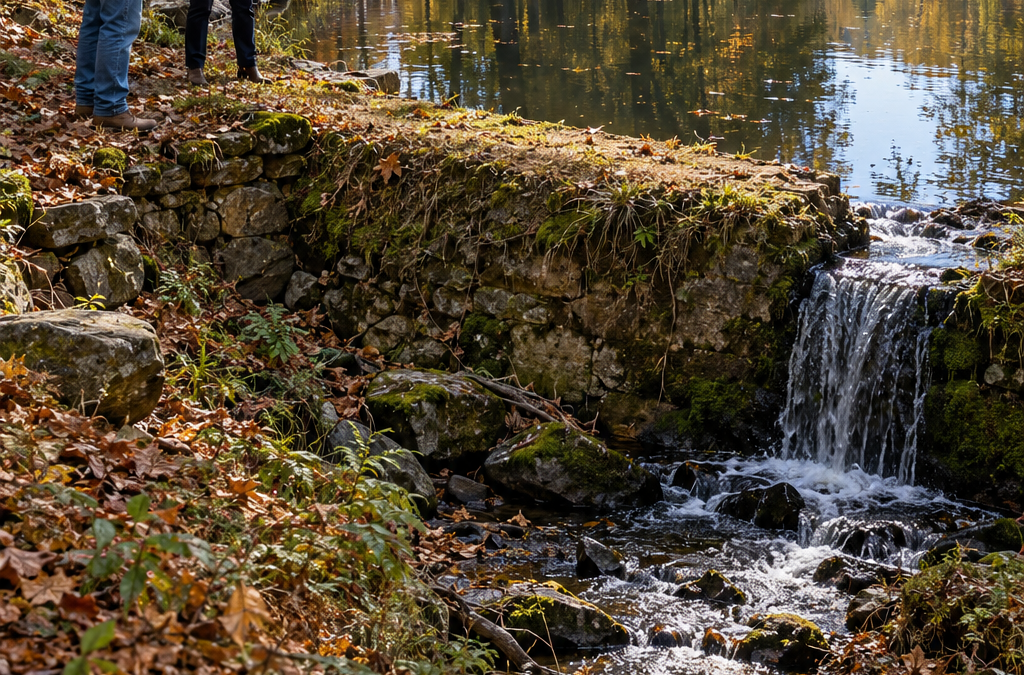
But decades earlier, someone had built a low earthen-and-stone dam across a natural narrowing.
Water backed up behind it, forming a pond a little under half an acre.
The real estate agent called it a pond.
That word did not do it justice.
The first time I saw it, leaves were just beginning to turn.
The water was dark and still.
A fallen sycamore leaned over one corner.
Dragonflies moved above the surface.
A pair of wood ducks lifted from the far bank when we approached.
The dam itself looked old.
Not dangerous.
Just neglected.
It was maybe five feet high at its deepest section, packed earth reinforced with stone.
Roots had worked through parts of it.
The overflow was little more than a shallow channel cut into the bank.
The agent stood beside me while I studied it.
“Previous owner didn’t do much with the pond,” she said.
“How old’s the dam?”
“He thought late eighties.”
“Permitted?”
She shrugged.
“Different world back then.”
I stepped onto the stonework.
Most buyers probably saw maintenance.
Liability.
Mosquitoes.
Tree removal.
Erosion.
I saw mornings.
A dock.
Bass.
A chair under the sycamore.
I saw a place where no one needed anything from me.
“How long has it been listed?”
“Almost nine months.”
“Why?”
“Too much land for some people. Too isolated for others.”
I looked back toward the house.
“That’s why I like it.”
I paid cash.
That mattered later.
No bank.
No mortgage company.
No lender with a claim ahead of mine.
The deed was clean.
The title work did not show any unusual encumbrances on the rear acreage.
The survey clearly described eleven acres, including the creek and the pond area.
Everything west of the eastern creek bank belonged to me.
At closing, my attorney, Philippa Aone, pushed the document folder across her conference table.
Philippa had handled a few real estate matters for people I knew.
She was in her early fifties, wore rectangular glasses low on her nose, and had the kind of patience that ended exactly where foolishness began.
“There is an association,” she said.
“I saw that.”
“Cedar Ridge Property Association.”
“Forty dollars a month.”
“Correct.”
“What do they actually do?”
“Road maintenance on two private lanes, snow coordination, entrance sign, some drainage work.”
“Architectural restrictions?”
“Limited.”
“No matching shutters?”
Philippa gave me a flat look.
“I would not have allowed you to close if matching shutters were hidden in the deed.”
I laughed.
She continued.
“The covenants are old and relatively loose. Your parcel is unusual because most of the development is east and north of you.”
“So the creek is basically the edge.”
“More or less.”
“Any problem with the pond?”
“Not from anything I’ve reviewed.”
That was good enough for me.
And for the first two years, the HOA barely existed in my life.
A statement arrived once a quarter.
I paid it.
The gravel road was plowed when it snowed.
Someone replaced the entrance sign.
That was about it.
The previous owner, a widower named Arthur, had apparently lived there for twenty-two years without receiving more than two association letters.
I thought I had gotten lucky.
I spent my first spring cleaning up the property.
I repaired fencing near the road.
Replaced rotten steps on the back deck.
Cleared deadfall from the woods.
And I worked on the pond.
The old dam needed attention.
Calling what I did “building a dam” would not have been completely accurate, because the original structure had existed for decades.
But I rebuilt enough of it with my own hands that I considered it mine.
I removed loose stone.
Repacked portions of the earthen core.
Added several tons of rock along the downstream face.
Regraded the crest.
And, most importantly, I cut a controlled overflow channel along the northern shoulder so heavy rain could leave the pond without eroding the structure.
I consulted the county before doing any significant work.
The dam was small enough that it did not fall into the category of large regulated impoundments, but I still followed the basic erosion and drainage guidance they gave me.
I spent almost every Saturday that summer on it.
Some evenings I worked until dark.
There is something satisfying about moving stone when nobody is paying you to do it.
No schedule.
No foreman.
No progress meeting.
Just a shovel, a wheelbarrow, and the knowledge that the work would still be there tomorrow if you got tired.
By September, the pond level had stabilized.
The banks stopped washing out.
The overflow channel carried stormwater cleanly.
The next spring, I stocked the pond with bass and bluegill.
I built a small cedar dock off the eastern bank.
Nothing extravagant.
Eight feet wide.
Sixteen feet long.
Enough for two chairs and a fishing rod.
That dock became my favorite place on the property.
Sometimes I sat there for an hour after work without even checking my phone.
My nearest neighbor was Garrett Hale.
He lived about a quarter mile up the road on seven acres.
Garrett was fifty-nine, broad-shouldered, permanently sunburned, and drove an old Ford pickup that sounded as though somebody had filled the exhaust pipe with gravel.
He would slow whenever he saw me near the driveway.
“Still fixing things that weren’t broken?” he once called through the window.
“That’s retirement practice.”
“You’re terrible at it.”
He was right.
Garrett had lived there almost fifteen years and knew more local history than anyone.
According to him, the pond had been there since at least 1987.
“Maybe earlier,” he said. “I remember fishing there when the Sanders family owned that land.”
“So nobody ever complained about it?”
“Who would complain about a pond?”
I later learned the answer to that question.
Denton Marsh.
Denton bought his house on Millbrook Circle about a year after I moved in.
His property was very different from mine.
Millbrook Circle was the polished part of Cedar Ridge.
Large homes.
Finished basements.
Landscaped lawns.
Three-car garages.
The lots were still rural by suburban standards, but close enough together that everyone knew when somebody bought a new grill.
Denton’s house sat near the middle of the circle.
Five bedrooms.
Brick front.
Stone retaining walls.
Perfect grass.
An outdoor kitchen he mentioned within seven minutes of meeting anyone.
I first met him at the annual HOA picnic.
He walked over holding a paper plate and looked at my boots.
“You live on the Mercer tract?”
“That’s me.”
“With the pond.”
“Also me.”
He smiled.
“I’ve been meaning to walk that property.”
I waited.
“Why?”
“Just interested in the history of the development.”
“You a historian?”
“Amateur.”
Garrett, standing beside me, took a drink to hide a smile.
Denton continued.
“I do a lot of research.”
Garrett said, “He bought a metal detector.”
Denton frowned.
“It’s more involved than that.”
“I stand corrected.”
That should have told me what Garrett thought of him.
Denton became HOA president the following January.
The previous president, Claire Henderson, had held the position for eight years and seemed delighted to escape.
Nobody ran against Denton.
That turned out to be unfortunate.
Within six weeks, Cedar Ridge changed.
We started receiving newsletters.
Long ones.
Four pages.
Then six.
Denton created committees.
Architectural review.
Environmental compliance.
Road appearance.
Common-property preservation.
He proposed a new online violation portal.
He put reflective signs at the subdivision entrance announcing speed limits the county had never established.
He began holding board meetings in his three-car garage because, in his words, it provided “an accessible administrative setting.”
Then he charged visitors five dollars to park in his driveway during meetings.
Garrett called me after the first one.
“You’re not going to believe this.”
“What?”
“Denton charged me to attend an HOA meeting.”
“Charged you what?”
“Five bucks.”
“For what?”
“Parking.”
“On HOA property?”
“His driveway.”
I stared at my phone.
“You paid him?”
“I wanted to see how bad it was.”
“And?”
“Worth every penny.”
By March, fourteen homeowners had received new violations.
A decorative flag not on an approved list.
A fence replacement completed without written review.
A fire pit visible from the road.
Nonconforming gravel.
A shed painted “inconsistent with the visual character of the neighborhood.”
One man was warned about stacking split firewood beside his garage.
We lived in rural Virginia.
Everyone had firewood.
Denton seemed to believe the presidency had converted him from neighbor into regulator.
Still, I assumed my eleven wooded acres would keep me outside his attention.
Then a white envelope appeared in my mailbox.
CEDAR RIDGE PROPERTY ASSOCIATION.
FORMAL NOTICE.
I opened it standing at the kitchen counter.
The association had received what it called an anonymous environmental complaint concerning the impoundment structure on my property.
The letter described my pond dam as an “unauthorized alteration affecting a natural watercourse.”
It claimed the structure could impede shared watershed access, alter downstream flow, and expose neighboring properties to flooding liability.
I had sixty days to provide engineering documentation, historical authorization, and board approval.
Otherwise the matter would proceed to formal enforcement review.
I actually laughed.
Not because flooding was funny.
I had spent too many years around drainage work to dismiss water.
I laughed because Denton’s letter treated the dam as though I had secretly poured a concrete wall across the Mississippi during the night.
The structure had existed since the Reagan administration.
I sat down that evening and wrote a response.
I kept it polite.
I explained the age of the dam.
I provided a copy of my purchase survey.
I included aerial photographs showing the pond before I owned the property.
I described the maintenance I had performed and noted that the overflow channel had improved drainage safety rather than reduced it.
I concluded with one sentence:
“If the Association possesses documentation establishing regulatory authority over the portion of my property containing the pond and dam, please provide it for my review.”
I mailed the letter certified.
Then I went back to my life.
Six weeks passed.
No reply.
I assumed somebody on the board had looked at a map and explained reality to Denton.
Then another certified envelope arrived.
This one was thicker.
I signed for it at the post office.
I opened it in my truck.
The first line made my stomach tighten.
NOTICE OF FINAL ENFORCEMENT DETERMINATION.
The Cedar Ridge board had completed its review.
They had concluded that the dam violated Section 4(C) of the subdivision environmental guidelines, which prohibited property owners from obstructing natural waterway flow without prior written approval.
Then came the number.
$50,000.
Not $500.
Not $5,000.
Fifty thousand dollars.
Due within thirty days.
The association reserved the right to record a lien against my property for unpaid assessments and enforcement charges.
The letter warned that continued failure to satisfy the account could result in further collection proceedings, including foreclosure remedies where permitted.
I read it four times.
Then I sat in the truck with the letter across my steering wheel and listened to rain ticking against the windshield.
I had paid cash for that property.
Every acre.
Every tree.
Every stone.
I had spent years building a quiet place where nobody could take much from me because I owed almost nothing to anyone.
Now three people sitting in a garage were claiming they could put a fifty-thousand-dollar debt against it because of a dam older than their organization.
Anger came first.
Then something colder.
Fear.
Not fear that Denton was right.
Fear of what institutional stupidity can cost even when you are right.
Lawyers cost money.
Court takes time.
Liens complicate title.
False claims still have to be answered.
Being correct does not magically protect you from the expense of proving it.
I called Philippa.
She answered on the third ring.
“Nathan.”
“I got an HOA fine.”
“How much?”
“Fifty thousand.”
Silence.
Then, “Say that again.”
“Fifty thousand dollars.”
“What did you do, build an airport?”
“A dam.”
Another pause.
“The pond?”
“Yes.”
“The dam that existed when you bought the property?”
“That one.”
“Email me everything.”
“I already scanned it.”
“Of course you did.”
“I’m sending it now.”
“Do not respond to them.”
“I wasn’t planning to.”
“Do not call Denton.”
“Wasn’t planning that either.”
“Do not threaten anyone.”
“I know how lawyers work, Philippa.”
“No, you know how construction people work. That is exactly why I am telling you not to threaten anyone.”
Forty-eight hours later, she called me back.
Her first words were, “I need you to come to my office.”
That usually meant something interesting.
When I arrived, my survey was spread across her conference table beside a copy of the original subdivision plat.
Philippa tapped the map.
“Show me where the dam is.”
I pointed.
“Here.”
“Overflow?”
“Here.”
“Pond?”
“Mostly west of this line.”
She nodded.
“Now show me the association boundary.”
I leaned closer.
A bold survey line ran along the eastern bank of the creek.
I looked at her.
“No.”
“Yes.”
“The HOA boundary stops there?”
“According to the founding plat, yes.”
“But my house is in the association.”
“Your residence and eastern acreage are included within the subdivision. The western rear tract is not within the mapped enforcement area referenced in the original declaration.”
I followed the boundary with my finger.
The creek divided my property in an unusual way.
My deed covered land on both sides.
But the subdivision map had incorporated only the eastern portion into the covenant-controlled area.
Everything west of the eastern creek bank remained part of my deed without being subjected to the same association jurisdiction.
The pond sat west.
The dam sat west.
The overflow channel sat west.
Philippa folded her arms.
“Denton is attempting to enforce subdivision restrictions on land the subdivision declaration does not cover.”
I stared at the map.
“Not one inch?”
“Based on what I have right now, not one inch of the dam.”
I leaned back.
“Then why did nobody notice this when I bought the place?”
“Because nobody was trying to fine you fifty thousand dollars.”
That was Philippa.
She never wasted words.
I looked again at Denton’s letter.
“So what happens?”
“I respond.”
“Politely?”
“No.”
Her response was ten pages.
She cited the original recorded declaration.
The subdivision boundary exhibit.
My deed.
County survey records.
Prior plats.
She dismantled Denton’s interpretation of Section 4(C) line by line.
She also included legal authority supporting a simple principle: an association cannot enforce private covenants beyond the property legally subjected to those covenants merely because the same owner possesses adjacent land.
At the end, she demanded three things.
Immediate rescission of the $50,000 fine.
Written acknowledgment that the pond and dam lay outside the association’s enforcement boundary.
And confirmation that no lien would be recorded.
She gave them fifteen days.
Denton responded on day eleven.
Not by backing down.
He hired an attorney.
His lawyer, Wesley Grange, sent a letter arguing that even if the dam itself fell outside the subdivision boundary, its impact extended into association property downstream.
Therefore, he claimed, the board possessed an interest in regulating anything materially affecting the community watershed.
When Philippa read that paragraph aloud, she removed her glasses.
“That’s ambitious.”
“Legal?”
“Ambitious.”
“Meaning?”
“Meaning wanting jurisdiction does not create jurisdiction.”
Then she pointed to another folder on her desk.
“However, his watershed argument made me request something I probably would not have requested otherwise.”
“What?”
“The county topographic and drainage analysis.”
I did not understand yet.
Four years before I bought my property, the county had conducted a watershed study after repeated heavy-rain events in the region.
The report was technical.
Contour maps.
Flow calculations.
Soil absorption.
Culvert capacity.
Probable drainage routes.
Exactly the kind of document most people would never read unless they were being paid to.
Philippa sent it to me electronically.
That night, around eleven, my phone rang.
I was already in bed.
“Hello?”
“Nathan.”
It was Philippa.
“You awake?”
“I am now.”
“Open your email.”
I sat up.
“What happened?”
“I sent you page seven.”
I grabbed my laptop.
The image loaded slowly.
A topographic map filled the screen.
Colored lines marked runoff paths.
I recognized my creek immediately.
“What am I looking at?”
“The county modeled a significant upstream release scenario.”
“From where?”
“Your watershed and two smaller tributaries.”
I zoomed in.
A flow arrow moved north-northwest from the creek.
Then another.
Then the modeled path crossed a shallow depression.
Straight toward Millbrook Circle.
I felt something tighten in my chest.
“That’s Denton’s house.”
“Yes.”
“And the properties beside it.”
“Board vice president to the left. Treasurer behind him.”
I stared.
Millbrook Circle had always looked flat from the road.
It was not.
Not really.
The three expensive homes sat in a broad natural bowl.
Subtle.
Maybe three or four feet of elevation difference over several hundred yards.
Enough that nobody would notice while mowing a lawn.
Enough that water would notice immediately.
I traced the line back toward my pond.
“The dam is holding this?”
“Not exactly. Be precise.”
I smiled despite myself.
She continued.
“The dam attenuates flow. It stores upstream volume and releases water gradually through your overflow channel. Without that impoundment, substantially more water moves through the creek during periods of high runoff.”
“Toward Millbrook.”
“According to this model, yes.”
“Do they know?”
“I doubt they’ve ever seen this report.”
I looked at the ceiling.
Philippa said nothing for a few seconds.
Then she spoke.
“Nathan, understand something. This is not permission to flood anybody.”
“I know.”
“If you intentionally release water in a way designed to damage downstream property, that creates a very different legal problem.”
“I understand.”
“But…”
There it was.
“But?”
“The board has formally demanded removal or enforcement concerning what it calls an unauthorized obstruction.”
“They fined me fifty thousand dollars over it.”
“Correct.”
“And the structure is on land outside their jurisdiction.”
“Correct.”
“And I have the legal right to remove a private structure from my own property if I follow county requirements.”
Philippa paused.
“That appears to be the case.”
I got out of bed.
“What are you thinking?”
“You have two broad choices.”
I walked toward the kitchen.
“Go ahead.”
“We challenge the fine formally, seek declaratory relief, and if necessary litigate the boundary and enforcement issue.”
“How long?”
“A year. Eighteen months. Possibly more if they make it painful.”
“And option two?”
“You comply with the concern they themselves created.”
I stopped.
Philippa’s tone remained neutral.
“You remove the dam.”
I said nothing.
“The county requires notification,” she continued. “There will be an environmental impact form. We need to verify erosion controls and removal method. If approval is required, we get it. No shortcuts.”
“And the pond drains.”
“Yes.”
“And the creek returns to its natural flow.”
“Yes.”
I looked out the dark kitchen window.
Beyond the glass, I could barely see moonlight on the pond.
My pond.
The place I had bought the land for.
The dock.
The bass.
The still water.
The mornings.
“You understand what you’re suggesting costs me too.”
“I do.”
“I lose the pond.”
“Yes.”
I leaned against the counter.
For the first time since the $50,000 letter arrived, the situation did not feel funny.
Denton could be humiliated.
The HOA could lose.
The legal point could be proven.
None of that changed the fact that removing the dam meant destroying something I loved.
“I rebuilt half that thing by hand.”
“I know.”
“I spent two summers on that pond.”
“I know.”
Another silence.
Then Philippa said, “You do not need to decide tonight.”
But I already knew.
The more I thought about eighteen months of litigation, the clearer it became.
I did not want to spend the next year paying lawyers to defend a dam against people who insisted it should not exist.
If Denton wanted natural flow, I could give him natural flow.
But I would do it legally.
Carefully.
Documented.
The next morning, I drove to the county environmental office.
I brought the survey.
The dam photographs.
The pond measurements.
The drainage report.
I explained what I intended to remove.
The county engineer reviewed the structure and confirmed that because of its size and classification, removal could proceed after the required notification and erosion-control filing.
I submitted everything.
Then Philippa drafted a letter to Cedar Ridge.
It was beautifully simple.
Because the association had formally classified the dam as an unauthorized obstruction to natural waterway flow, I had elected to remove the structure from my private property.
The county had been notified.
Applicable procedures would be followed.
The HOA was receiving the letter as a courtesy.
The final sentence read:
“Upon removal, the creek will be permitted to resume its unobstructed natural drainage pattern.”
Philippa looked at me before sending it.
“Still want to do this?”
I thought of my pond.
Then the $50,000 letter.
“Send it.”
Denton signed for the certified mail.
Two days later, his attorney called Philippa.
Then another letter arrived.
The HOA objected to removal.
I laughed when I read it.
They had spent months calling the dam dangerous, unauthorized, and environmentally improper.
Now they wanted it preserved.
Wesley Grange filed an emergency request with the county seeking to stop removal pending further review.
The county denied it four days later.
Their written response was almost painfully direct.
The structure was located on privately owned land.
The association had not demonstrated ownership or regulatory authority over it.
The property owner had satisfied the county’s procedural requirements for removal.
No county basis existed for preventing the work.
End of discussion.
Denton called me that evening.
It was the first direct call from him since the dispute started.
I watched his name appear on my screen.
For a moment, I considered ignoring it.
Then I answered.
“Nathan.”
“Denton.”
“We need to discuss the dam.”
“I thought we’ve been doing that for three months.”
“This isn’t funny.”
“I agree.”
His voice tightened.
“I’ve been informed you intend to remove it next week.”
“Correct.”
“The board has concerns.”
“The board’s concern was that the dam obstructed natural water flow.”
“That is an oversimplification.”
“It’s almost a direct quote.”
“You know circumstances have changed.”
“No, Denton. The boundary map hasn’t changed. The county requirements haven’t changed. The dam hasn’t moved.”
“Removing it could create downstream issues.”
I let that sit between us.
“That’s interesting.”
“What is?”
“You fined me fifty thousand dollars because you said the dam created downstream issues.”
“Potential downstream issues.”
“And now removing it creates downstream issues.”
“We need time to evaluate.”
“You gave me thirty days to pay fifty thousand dollars.”
“That isn’t relevant.”
“It feels relevant.”
Denton inhaled slowly.
“Nathan, I am asking you as president of this association not to take action that may affect other homeowners.”
“Then rescind the fine.”
Silence.
“Put in writing that the HOA has no authority over the dam. Withdraw the enforcement action. Confirm no lien. Apologize for threatening my home.”
“I can’t do that unilaterally.”
“You found a way to fine me unilaterally.”
“The board voted.”
“Then call the board.”
Another silence.
Finally he said, “We’ll be in touch.”
He hung up.
They never rescinded anything.
So on a Tuesday morning in late October, I rented a compact excavator.
The weather was cool.
Low clouds moved through the valley.
Leaves covered the ground in red and brown layers.
I stood beside the pond before starting.
It was perfectly still.
A bass broke the surface near the dock.
For several minutes, I did nothing.
I had imagined feeling triumphant.
I didn’t.
I felt sick.
This was not a revenge fantasy to me.
It was my land.
My water.
My mornings.
The dam I had rebuilt one stone at a time.
I climbed onto the excavator.
Started the engine.
And began.
I removed the downstream reinforcement first.
Then portions of the earthen crest.
Slowly.
Carefully.
Exactly according to the removal plan.
The pond level began falling.
By midmorning, Garrett’s truck appeared at the edge of the clearing.
He shut it off and walked down.
He stood beside the excavator without speaking.
I killed the engine.
“What the hell are you doing?”
“HOA said the dam was unauthorized.”
“I know.”
“So I’m removing it.”
Garrett stared at the opening where water was now sliding through.
“They made you?”
“No.”
“Then why?”
“Because they can’t have it both ways.”
He looked toward the creek.
Then upstream.
Then back at me.
“You talk to the county?”
“Yes.”
“Lawyer?”
“Standing over my shoulder spiritually.”
That almost made him smile.
Then his expression changed.
“You know Denton’s yard is basically a bowl, right?”
“I’m aware.”
“How aware?”
I climbed down.
“The county modeled it.”
Garrett gave a low whistle.
“They know?”
“They had the same opportunity to request the survey I did.”
“That’s not what I asked.”
“No.”
He walked to the edge of the draining pond.
Water swirled through the widening breach.
“Nathan.”
“What?”
“I’ve lived here fifteen years. Before Denton’s house was there, that whole stretch used to stay wet after big storms.”
I looked at him.
“How wet?”
“Enough that nobody built anything there.”
That bothered me.
“Why’d they build later?”
“Developer improved drainage. Filled some areas. Put in culverts.”
“Apparently not enough to change the natural grade.”
Garrett stared toward the downstream woods.
“Nope.”
He stayed for another hour.
Then left.
I worked until almost dark.
By then, the dam had become two separated shoulders with a broad opening between them.
Water moved steadily through.
The pond receded from the banks.
Mud appeared around the dock.
Tree roots emerged.
Stones I had never seen became visible.
It felt like watching a room empty after someone died.
The next morning, I continued.
By Thursday evening, the pond was essentially gone.
A winding channel crossed what had been open water.
My dock stood over mud.
The creek followed an old path visible beneath decades of sediment.
I sat on the bank until dark.
I did not feel victorious.
I felt like Denton had managed to take something from me after all.
Then rain began Thursday night.
Not a storm at first.
Just steady autumn rain.
By Friday morning, the creek was higher.
I walked down around seven with coffee.
The current had strengthened.
Without the pond storing runoff, water passed through the property much faster.
That was expected.
The county report had predicted exactly that.
By noon, upstream rainfall increased.
Garrett called me.
“You watching this?”
“I’m standing beside it.”
“Creek at my culvert is higher than I’ve seen it in years.”
“County’s aware of the removal.”
“I’m not blaming you.”
“I know.”
He paused.
“Millbrook may have a problem.”
That was when the triumph some people imagine would have appeared never came.
Instead, I felt nervous.
I had done everything legally.
The county knew.
The HOA knew.
The board had been warned.
But water does not care about paperwork.
It does not pause at a property boundary to decide who deserves what.
It follows gravity.
I called Philippa.
“The creek’s up.”
“How much?”
I told her.
“Any obstruction from your work?”
“No.”
“Erosion failure?”
“No.”
“Did you deviate from the filed removal plan?”
“No.”
“Document everything.”
“I already am.”
“Good.”
By Friday evening, water had left the creek farther downstream.
The natural drainage path ran northwest through the shallow ground behind Millbrook Circle.
Exactly as the county map showed.
Garrett drove by after dark.
He rolled down his window.
“There’s water behind Denton’s house.”
“How much?”
“Ankle deep in the yard.”
I looked toward the trees.
“Any roads closed?”
“Not yet.”
The rain stopped before midnight.
But runoff was still moving downhill.
Saturday morning, I woke at six.
My phone had three missed calls.
One from an unknown number.
One from Garrett.
One from Denton.
I called Garrett first.
He answered immediately.
“How bad?”
“Denton’s basement took water.”
I closed my eyes.
“How much?”
“Don’t know exactly. Word is close to two feet at the low side.”
“Anyone hurt?”
“No.”
“Other houses?”
“Vice president got water in the utility room. Lost a heater and freezer, supposedly. Treasurer has damage behind the house and some basement seepage.”
I sat at the kitchen table.
The $50,000 enforcement letter was still in my file cabinet.
I thought I would feel satisfaction hearing that Denton’s beautiful basement was wet.
Instead, I felt tired.
Maybe that is what revenge really looks like when it leaves your imagination and becomes physical.
Not cinematic.
Not clean.
Just people standing in dirty water wondering how much drywall has to be replaced.
“County people there?”
“Yeah.”
“Good.”
“You’re going to call Denton?”
“He already called me.”
Garrett laughed once.
“Good luck.”
I listened to Denton’s voicemail.
“Call me immediately.”
That was all.
I called.
He answered before the first full ring.
“What did you do?”
No hello.
No Nathan.
“What did I do?”
“You flooded my house.”
“Denton, be careful.”
“My basement is destroyed.”
“I removed a structure from my property after the HOA fined me fifty thousand dollars for obstructing natural flow.”
“You knew this would happen.”
“I knew the county report identified a natural drainage path through Millbrook Circle.”
“So you knew.”
“So did your attorney after Philippa produced the report.”
Silence.
That mattered.
Because during the correspondence over the proposed removal, Philippa had attached the relevant county drainage materials.
The board had not been blind.
They simply had not believed the consequences would become real.
Denton’s voice dropped.
“You did this deliberately.”
“I filed with the county.”
“You knew.”
“I notified your board.”
“You knew.”
“Your attorney sought an injunction and lost.”
“My basement has two feet of water!”
For the first time, he shouted.
I waited.
Then said quietly, “You fined me fifty thousand dollars because you demanded that nature be allowed to flow.”
He said nothing.
“I did not direct water toward your house. I did not build a channel to your property. I did not release a gate. There was no gate. I removed the structure you called an unlawful obstruction.”
“This isn’t over.”
“No.”
I looked through my kitchen window toward the creek.
“It isn’t.”
The call lasted less than a minute.
The HOA called an emergency meeting the following Tuesday.
I did not attend.
Philippa did.
By then, photographs of flooded basements had circulated throughout Cedar Ridge.
So had the original boundary map.
And the $50,000 fine.
And Philippa’s letter warning the association that the dam sat outside its jurisdiction.
People began asking questions Denton did not want to answer.
Why had the board issued such an enormous fine?
Who authorized the foreclosure language?
Had they consulted an engineer before declaring the dam a hazard?
Had anyone reviewed the watershed study?
Why did they object to removal after demanding enforcement against the structure?
How much had the association already spent on legal fees?
Why had Denton ignored a documented boundary problem?
According to Garrett, the meeting was brutal.
He called me afterward.
“You missed a show.”
“How bad?”
“Marianne Keller asked Denton whether he had ever read the founding survey before fining you.”
“And?”
“He said the board relied on historical interpretation.”
I laughed.
Garrett continued.
“Then somebody asked whether historical interpretation was going to pay for three flooded basements.”
“That seems unfair.”
“It was beautiful.”
I could hear voices behind him.
“Where are you?”
“Parking lot.”
“You paid five dollars?”
“They stopped charging.”
That made me laugh harder than anything had in weeks.
Within three weeks, the board voted unanimously to rescind the $50,000 fine.
Not reduce.
Not suspend.
Rescind.
They issued the written boundary acknowledgment Philippa had demanded months earlier.
The letter stated that the association’s covenant-enforcement jurisdiction did not extend to the western portion of my property containing the former pond and dam.
They confirmed no lien would be filed.
The board also suspended all newly created environmental violation procedures pending legal review.
Then they hired an outside firm to review Cedar Ridge’s governing documents.
That review revealed several other places where Denton had been enforcing rules beyond what the covenants actually authorized.
Garrett’s firewood warning disappeared.
The fence violation against another homeowner was withdrawn.
Three architectural penalties were refunded.
People who had been quietly angry for months began speaking.
Denton lasted until Thanksgiving.
His resignation email blamed “increasing hostility toward volunteer community service.”
Garrett printed it and brought me a copy.
“He says hostility.”
“I see that.”
“Does he mean accountability?”
“Probably.”
“Common typo.”
The vice president resigned shortly afterward.
The treasurer remained on the board but did not run again.
Philippa was not finished.
While the HOA wanted the entire episode buried, she filed claims regarding my legal expenses and the board’s persistence after receiving clear notice of the jurisdictional boundary.
There was also the question of whether Denton’s campaign against me had crossed from ordinary bad governance into actionable harassment.
I did not want another year in court.
Neither did the association’s insurer.
We eventually settled for just under $18,000.
The agreement did not contain a dramatic confession.
Settlements rarely do.
No one wrote that Denton Marsh had behaved like an arrogant idiot.
No one formally admitted that the board had threatened my home over land they had no authority to regulate.
What I received was simpler.
Money toward my legal expenses.
Written boundary recognition.
Withdrawal of the fine.
And peace.
The flooding claims were handled separately among the downstream owners, their insurers, and the relevant parties.
I stayed out of those disputes as much as possible.
The county documented that the creek had followed its natural drainage corridor after the lawful removal of the impoundment.
That did not make the damage pleasant.
It did make one thing undeniable.
The dam had been performing a job nobody on Denton’s board understood.
For more than thirty years, that ugly little wall of earth and stone had slowed water before it reached Millbrook Circle.
It had not made the watershed disappear.
It had stored runoff.
Spread the release over time.
Reduced peak flow.
That was basic hydrology.
Denton had looked at it and seen only something he had not personally approved.
That was his problem from the beginning.
He confused control with understanding.
I never rebuilt the dam.
People asked me why.
Even Philippa once asked.
We were having coffee several months after everything settled.
“You could rebuild something permitted,” she said. “Probably a better design.”
“I know.”
“Engineered spillway.”
“Yes.”
“Bring the pond back.”
“I could.”
“Why don’t you?”
I thought about that.
The answer was complicated.
Part of me still missed it.
Especially in the mornings.
I missed seeing mist above the water.
I missed the dock floating over deep green.
I missed feeding bluegill from the edge.
I missed the quiet slap of a bass near sunset.
But rebuilding the pond would have meant turning that whole conflict into a circle.
Fight over dam.
Remove dam.
Flood.
Win.
Rebuild dam.
Somehow, I couldn’t do it.
The creek had changed once released.
The old pond basin began transforming almost immediately.
Grass appeared first.
Then sedges.
Wildflowers grew in places that had been underwater for decades.
The original creek channel became sharper.
Clearer.
Small gravel bars formed.
Frogs moved into shallow pools.
Kingfishers appeared.
In spring, deer began crossing the old pond bed.
One morning Garrett called me.
“You need to come down here.”
“Where?”
“Creek.”
“What happened?”
“Just come.”
I found him standing near the western bank.
He pointed.
At first I saw nothing.
Then a brown head surfaced.
An otter.
Then another.
Then a smaller one.
Three river otters moved through the current near a root mass where the bank had eroded slightly.
One rolled onto its back.
Garrett grinned.
“Family moved in.”
I watched them for almost ten minutes.
“Never saw otters when the pond was here.”
“Maybe they hated HOA regulations.”
“Probably didn’t submit architectural approval for the den.”
Garrett laughed.
We stood beside the creek without saying much.
That was the moment I realized something.
For months, I had been telling myself Denton had taken my pond from me.
Maybe he had.
But the land had not become empty.
It had simply become something different.
The creek moved faster now.
In some places it cut deeper.
In others it widened.
After storms, I could hear it from the house.
Not a gentle pond anymore.
Running water.
Alive.
The dock eventually came down.
That was harder than dismantling the dam in some ways.
I had built it during one of the happiest summers I could remember.
I removed the boards carefully.
Saved most of the cedar.
Later, I used the lumber to build a bench overlooking the creek.
I placed it beneath the same sycamore that once leaned over the pond.
From there I could see the old dam site.
Two stone shoulders still remained on opposite banks.
I left them intentionally.
Not enough to obstruct anything.
Just enough to remember.
Sometimes I think about how close I came to simply paying the fine.
Not because I believed I owed it.
Because $50,000, while painful, might have been cheaper than a long legal battle.
That is how abusive authority survives.
Not by being correct.
By making resistance expensive.
A bad board does not need to win every argument.
It only needs to convince ordinary people that defending themselves will cost more than surrender.
Most people have jobs.
Children.
Mortgages.
Medical bills.
They do not want to spend Wednesday morning searching courthouse records.
They do not want to hire lawyers.
They do not want certified letters arriving at dinner.
So they pay.
They comply.
They move a fence.
Repaint a shed.
Cut down a tree.
Remove a dock.
Sometimes that is reasonable.
Sometimes rules are valid and serve a legitimate purpose.
But sometimes nobody ever checks whether the person giving the order actually has the authority to give it.
Denton counted on that.
He saw an old dam and decided it offended a rule.
Then he found language broad enough to sound official.
Environmental protection.
Watershed access.
Flood liability.
Natural flow.
He wrapped everything in responsible-sounding words.
The irony was that he never studied the watershed he claimed to be protecting.
If he had, he would have understood the dam better than I did when I bought the land.
He would have seen the depression beneath his own home.
He would have seen the arrows on the county map.
He would have understood that drainage is not a theory.
Water goes downhill.
It does not care whether your basement has Italian tile.
It does not care whether you are HOA president.
It does not care whether your garage meetings have agendas.
It finds the lowest point.
Every time.
The strangest part is that I gave Denton several opportunities to stop.
When I sent the original survey.
When Philippa identified the boundary.
When she demanded rescission.
When we notified them of removal.
When their attorney received the watershed report.
When Denton called asking me to delay.
All he had to say was, “We made a mistake.”
That sentence could have saved him his basement.
Maybe his presidency.
Maybe thousands of dollars.
Definitely a lot of humiliation.
But some people cannot retreat once they have turned a disagreement into a test of authority.
Backing down feels like weakness.
So they double down.
Then they double down again.
Until eventually the problem is no longer the original mistake.
It is every decision they made to avoid admitting it.
Months after Denton resigned, I saw him at the hardware store.
I was buying deck screws.
He was standing near plumbing supplies.
For a second, we both pretended not to notice each other.
Then he walked over.
He looked different.
Not broken.
Just smaller somehow.
Maybe because I no longer saw a title when I looked at him.
Just a man.
“Nathan.”
“Denton.”
He glanced at the screws in my hand.
“Building something?”
“Always.”
He nodded.
For several uncomfortable seconds, neither of us spoke.
Then he said, “My basement is finally done.”
“I’m glad.”
He seemed surprised.
Maybe he expected sarcasm.
I meant it.
No matter how much I disliked what he had done, I did not actually enjoy the idea of somebody living in a moldy, gutted house.
“Insurance didn’t cover everything,” he said.
“I heard.”
He looked down the aisle.
“I still think you knew what would happen.”
I could have walked away.
Instead, I answered.
“I knew what the county report showed.”
“Exactly.”
“So did your lawyer before I removed anything.”
His jaw tightened.
“You could have stopped.”
“So could you.”
Silence.
I continued.
“You wanted the dam declared unauthorized.”
“I wanted oversight.”
“No. You wanted obedience.”
He looked at me sharply.
“You think this was personal?”
“It became personal when you threatened a lien on my home after your own founding map showed the structure wasn’t in your jurisdiction.”
“I was acting on advice.”
“Whose?”
He did not answer.
I lowered my voice.
“Denton, you could have called me. You could have come to my property. You could have stood beside the dam and asked why it was there. You could have hired an engineer before issuing a fifty-thousand-dollar fine.”
He looked toward the floor.
“But you didn’t.”
“You think I deserved what happened?”
That question surprised me.
I thought about the answer.
“No.”
He looked up.
“I think you deserved to lose the presidency. I think the fine deserved to disappear. I think the HOA deserved to pay part of my legal costs.”
I paused.
“But I don’t think anybody deserves two feet of dirty water in their basement.”
For the first time since I had known him, Denton had nothing to say.
I picked up my box of screws.
“But that doesn’t mean I caused the geography.”
I walked away.
That conversation gave me more closure than the settlement.
Because for almost a year, Denton had existed in my mind as an antagonist.
The man with the $50,000 letter.
The man threatening my home.
The man who believed his board title placed him above a recorded boundary.
Seeing him beside shelves of PVC fittings reminded me that most people who abuse small amounts of authority are not monsters.
They are ordinary people who become dangerously comfortable being obeyed.
That may be worse in some ways.
Monsters are easy to recognize.
A neighbor with a clipboard is not.
Cedar Ridge is different now.
The board rewrote its enforcement process.
No violation above a modest threshold can be imposed without documented covenant authority and outside legal review.
Homeowners must be given notice and an opportunity to respond before major penalties.
Boundary questions require survey verification.
Any environmental enforcement involving drainage has to include qualified technical review.
Denton would have hated that process.
Which is precisely why it exists.
Garrett still lives up the road.
He still drives the same dying Ford.
It somehow gets louder every year.
Sometimes he stops at the creek and sits on the bench I built from the old dock boards.
Last summer, he brought two beers.
We sat under the sycamore watching the water move between the stones.
“Miss your pond?” he asked.
“Sometimes.”
“You going to rebuild?”
“No.”
“Ever?”
“Probably not.”
He nodded.
“Creek’s nicer anyway.”
“You never said that when I had the pond.”
“Didn’t want to hurt your feelings.”
I laughed.
The otters had disappeared farther upstream by then.
But evidence of them remained.
Tracks in mud.
Scales from fish.
A slide worn into the bank.
The old pond basin had become meadow in places.
Young willows were growing near the channel.
Another ten years and most visitors will never know a pond existed there.
Maybe that is appropriate.
Land remembers differently than people do.
We record arguments.
Letters.
Fines.
Court filings.
Settlements.
Nature records waterlines.
Sediment.
Roots.
New channels.
I still have the $50,000 notice.
It is in the same file with the boundary survey.
I almost threw it away after the settlement.
Philippa told me not to.
“Keep it,” she said.
“Why?”
“Because someday you’re going to forget how ridiculous this was.”
She was wrong.
I have not forgotten.
Sometimes I take that letter out and look at the language.
FORMAL ENFORCEMENT DETERMINATION.
Thirty days.
Fifty thousand dollars.
Lien.
Foreclosure.
Words designed to make a homeowner feel small.
Powerless.
Afraid.
And I was afraid.
That part matters.
People like to tell stories backward once they know the ending.
They imagine I received the letter, smiled, discovered the boundary error, removed the dam, and watched Denton get exactly what he deserved.
That was not how it felt while I was living through it.
I did not know I would win.
I did not know the board would back down.
I did not know whether the county would approve removal.
I did not know what the downstream consequences would actually look like.
I did not know whether an attorney’s bill would eat through my savings before the argument ended.
There were nights I lay awake wondering whether I should simply pay.
There were mornings when I wished I had bought a small house in town instead of eleven acres with a creek.
Being right does not eliminate fear.
Sometimes being right makes the fear worse because you understand how unfair it would be to lose anyway.
What kept me moving was documentation.
The deed.
The survey.
The founding plat.
The county report.
Certified mail receipts.
Photographs.
Dates.
Maps.
Not anger.
Not speeches.
Paper.
Denton had confidence.
I had records.
In the end, records lasted longer.
Three years after the first violation letter, I stood in the creek almost exactly where I had stood the day I decided to buy the property.
The water was cold around my boots.
Sunlight came through the trees.
Where the pond had once spread out behind me, tall grass moved in the wind.
The creek curved around a gravel bar and disappeared beneath the sycamores.
I listened.
No excavators.
No phone ringing.
No certified letters.
Just water.
I realized the feeling I had been chasing when I bought the property had finally returned.
Peace.
Not the same peace.
The pond was gone.
The landscape was changed.
I had changed too.
Peace no longer meant believing nobody would ever challenge what was mine.
That was naïve.
Real peace was knowing exactly where my boundary stood and knowing I was willing to defend it.
Denton had thought the $50,000 fine would force me to surrender.
Instead, it forced me to read the documents he should have read before signing his name.
He thought the dam was the problem.
It turned out the dam had been protecting him.
He thought removing it would restore natural order.
Nature agreed.
And when the creek finally followed the route it had been trying to follow for decades, nobody on the Cedar Ridge board needed another survey to understand the difference between controlling land and understanding it.
I never rebuilt the dam.
I never brought the pond back.
I did not need to.
Every morning now, I can hear the creek from my porch.
It runs exactly where gravity tells it to run.
No board approval.
No monthly meeting.
No violation notice.
Just water moving through eleven acres that are still mine.








