𝗙𝗨𝗟𝗟 𝗦𝗧𝗢𝗥𝗬 The HOA Fined My 94-Year-Old Mother Over a Dead Tree Without Knowing I Had Spent 30 Years Finding Missing Money
𝗙𝗨𝗟𝗟 𝗦𝗧𝗢𝗥𝗬 .
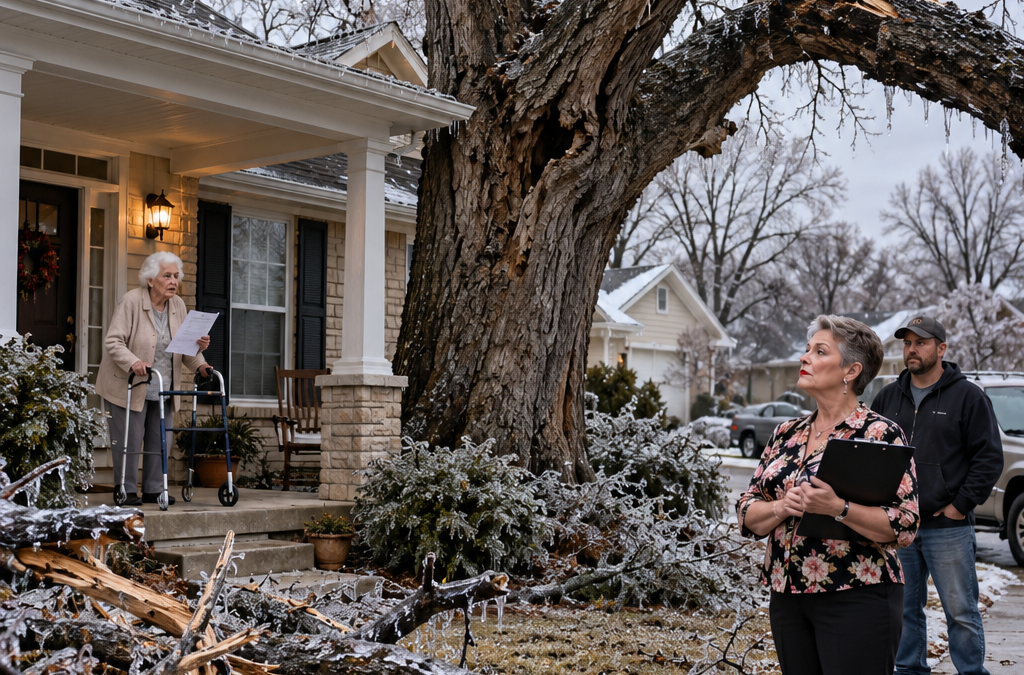
An arborist inspected it and told us the trunk had become unstable.
Leaving it standing wasn’t safe.
I arranged the removal myself.
My mother had watched from the front window while the crew cut it down.
When the stump grinder came in March, she stood on the porch with both hands wrapped around her walker and looked at the empty spot for a long time.
I remembered asking whether she wanted us to plant something new.
“In the spring,” she said.
“It is spring.”
“Then later in the spring.”
That was my mother.
No one rushed Dolores Ashford.
Now an HOA had apparently decided grief, weather, and ninety-four-year-old knees operated on a thirty-day compliance schedule.
“Mom, you did nothing wrong.”
“I know the tree died.”
“It wasn’t something you caused.”
“They say the rule is one tree.”
“I don’t care what they say yet.”
She became quiet again.
“Do I have to pay it?”
That sentence made my jaw tighten.
My mother had been on a fixed income for years.
She wasn’t poor.
My father had left her carefully provided for.
But she treated four hundred dollars the way people from her generation often do.
Four hundred dollars was groceries.
Medication.
A utility bill.
A repair.
It was money with a purpose.
And these people had dropped a fine on her without a phone call, without a warning, without asking whether the missing tree had died in a storm.
They hadn’t even offered time to replant.
“Don’t pay anything,” I said.
“But the letter says—”
“I know what the letter says.”
“I don’t want trouble.”
That hurt.
Because my mother had never been afraid of trouble when she was younger.
Age changes the way institutions look.
A government office that once seemed annoying begins to feel exhausting.
A threatening letter carries more weight when you don’t drive at night and every trip to an office requires planning around pain medication.
People know that.
Some of them exploit it.
“I’ll handle it.”
“Gerald.”
“I mean it. Don’t send them anything.”
“I was going to plant another tree.”
“I know.”
“I just couldn’t do it in winter.”
“I know, Mom.”
“The ground was frozen.”
“I know.”
She sighed.
“Your father loved that oak.”
That was when the fine stopped being funny permanently.
“I remember.”
“I’ll plant another one.”
“We’ll plant one together.”
She made a small sound that meant she didn’t believe she would actually be allowed to help.
“We’ll see.”
I let that go.
The next morning, I called the Cedarbrook management office.
I had expected the situation to take ten minutes.
That assumption now seems almost embarrassing.
A woman named Cheryl answered.
I introduced myself and explained that I was calling on behalf of my mother.
“Her property is fourteen Cedarbrook Lane.”
There was typing.
“Yes, Mr. Ashford. I see the account.”
“I’m calling about the shade-tree violation.”
“Yes.”
“My mother’s oak died after the January ice storm.”
“I understand.”
“Do you?”
A pause.
“Sir?”
“Because she’s ninety-four years old. The tree was removed because it was unsafe. She intends to replace it once weather and scheduling allow. I assume the fine can simply be withdrawn.”
Cheryl didn’t hesitate.
“The violation stands.”
I looked at my notes.
“I’m sorry?”
“The bylaw requires at least one qualifying shade tree in the front-facing portion of the lot.”
“I understand the language. I’m telling you the tree was destroyed by weather.”
“The rule doesn’t contain a weather exception.”
“She’s ninety-four.”
“The rule doesn’t contain an age exception either.”
Her tone was flat.
Not cruel.
Cruel would have almost been easier.
She sounded bored.
As if we were discussing an overdue library book.
“Does Cedarbrook usually fine homeowners before sending a warning?”
“The board has discretion regarding enforcement.”
“So they used discretion to fine a ninety-four-year-old woman four hundred dollars because a tree died in a storm?”
“I don’t make board decisions.”
“Then I’d like to speak to whoever does.”
“I can leave a message for the board president.”
“Please do.”
His name was Randall Puit.
I already knew a little about him.
My mother had lived in Cedarbrook since 1987.
Back then, it wasn’t the kind of neighborhood that needed branding.
It was just Cedarbrook.
Good houses.
Quiet streets.
Children riding bikes until dinner.
Neighbors carrying casseroles to one another after funerals.
People borrowing ladders and forgetting who owned them.
The HOA came later.
So did the kind of people who believed a neighborhood became more respectable when someone measured mailbox colors.
Randall had been president for six years.
I’d seen him from a distance during visits.
Tall.
Always neat.
Always tucked in.
Usually wearing a golf shirt and carrying a clipboard.
One neighbor called him “the mayor.”
Nobody meant it kindly.
I’d heard stories.
A widow fined because her replacement mailbox was one shade too dark.
A veteran cited because a flag displayed near his garage was allegedly half an inch wider than the published standard.
A family warned because children’s bicycles remained visible from the road two afternoons in a row.
Petty things.
I had always considered them annoying but insignificant.
That was before Randall called me.
He phoned that afternoon.
“Mr. Ashford, Randall Puit.”
His voice was smooth.
Warm without being friendly.
“Thanks for calling.”
“Cheryl told me you’re concerned about your mother’s violation.”
“I’m concerned that you fined a ninety-four-year-old woman four hundred dollars because a storm killed her tree.”
He chuckled lightly.
Not because it was funny.
It was the sound people make when they want to lower the emotional temperature without conceding anything.
“I understand why it feels harsh.”
“It is harsh.”
“I appreciate your position. But the rules apply to everyone.”
I said nothing.
He continued.
“Fairness requires consistency, Mr. Ashford. Once a board begins making exceptions, it’s very difficult to enforce community standards objectively.”
“You don’t think an ice storm qualifies as an objective fact?”
“The tree requirement isn’t based on fault.”
“My mother didn’t remove a healthy tree because she disliked it.”
“I understand.”
“Then why fine her?”
“Because the property is currently out of compliance.”
I wrote that phrase down.
Out of compliance.
“How many days passed between removal of the stump and your fine?”
“I don’t have that information in front of me.”
“The stump was removed in March.”
“Then she has had time to replace it.”
“My mother is ninety-four.”
“You’ve mentioned that.”
“And you’re comfortable with this?”
Another slight pause.
“Mr. Ashford, you wouldn’t want us giving one homeowner an exception that other homeowners aren’t entitled to, would you?”
I almost answered immediately.
Instead, I stopped.
Because something about the way he said it bothered me.
It wasn’t the argument.
I’d heard that argument a thousand times in banking.
Policy is policy.
Rules are rules.
Controls must be consistent.
The words were polished.
Practiced.
Randall sounded like a man who had explained away objections before.
Many times.
I had spent thirty years as a forensic accountant for a regional bank.
People imagine forensic accounting means spreadsheets.
It does.
But after enough years, it becomes something closer to behavioral pattern recognition.
Money has patterns.
Fraud has patterns.
So does concealment.
People who have nothing to hide usually answer direct questions directly.
People protecting something else often answer the question they wish you had asked.
Randall was discussing fairness when I was asking about judgment.
That didn’t prove anything.
It simply bothered me.
“I understand your position,” I said.
“I’m glad.”
“I’ll get back to you.”
We ended the call.
I sat at my desk for several minutes.
Then I called my mother.
“How long has Randall been president?”
“Six years, I think.”
“Any problems before now?”
She thought.
“He fined the Parkers for their mailbox.”
“I heard about that.”
“And Howard Benton had trouble over his flag.”
“Anyone else?”
“Gerald, why?”
“I’m curious.”
That was the word I used when I didn’t want her to worry.
Curious.
In my profession, curiosity could become extremely expensive for the wrong person.
I asked whether she still had her HOA documents.
“Somewhere.”
“Don’t look for them. I’ll come Saturday.”
“You don’t have to drive all the way out here for a tree.”
“I’m not coming for the tree.”
She was silent.
“What are you doing?”
“Reading.”
My mother knew me too well.
“Oh, Lord.”
“What?”
“That’s what you used to say before you audited somebody.”
I smiled.
“I’ll see you Saturday.”
Cedarbrook looked almost exactly the way I remembered.
Mature trees lined the road.
Brick houses sat behind well-kept lawns.
Fall flowers filled porch planters.
Nothing about it looked corrupt.
That’s another thing people misunderstand.
Fraud rarely announces itself through ugliness.
Sometimes it hides best behind fresh mulch.
My mother had all her association papers in a plastic storage tub inside the hall closet.
Of course she did.
Thirty-seven years of notices.
Budgets.
Election ballots.
Assessment letters.
Meeting summaries.
My father had saved everything, and after he died my mother had continued the habit because throwing away paperwork felt somehow disrespectful to him.
I spent most of Saturday at her dining table.
By early afternoon, I had several stacks.
Budgets.
Annual statements.
Reserve summaries.
Vendor information.
The first thing I noticed was the fine revenue.
It had increased.
Not dramatically at first.
Then more.
The HOA had moved from collecting relatively small amounts in violation penalties to several times that level under Randall’s board.
That still didn’t mean fraud.
Some boards simply became aggressive.
Then I looked at landscaping.
Expenses had risen sharply.
Insurance costs too.
Management fees were climbing.
Reserve contributions were inconsistent.
“Mom, has the neighborhood added anything major?”
She was watching television from the living room.
“What do you mean?”
“New playground? Big landscaping expansion? Security gate?”
“No.”
“Road work?”
“The roads are county roads.”
“Clubhouse renovation?”
“We don’t have a clubhouse.”
I looked down at the numbers.
“Interesting.”
“What?”
“Nothing yet.”
She gave me the look mothers continue giving sons even after those sons turn sixty-one.
“You’re doing the face.”
“What face?”
“The bank face.”
I smiled.
“Go back to your show.”
“I’m not deaf either.”
“I know.”
By Sunday, I had decided to request records formally.
My mother was the homeowner.
She was a member of the association.
I prepared an authorization allowing me to act on her behalf and submitted a written request for three years of financial statements, the current operating budget, board meeting minutes, vendor contracts where available, and a complete record of fines levied during the previous thirty-six months.
I wasn’t accusing anyone of anything.
Not yet.
I wanted numbers.
Numbers are patient.
People aren’t.
Eleven days passed.
Then a package arrived.
It was incomplete.
Not obviously incomplete.
That distinction matters.
People hiding records rarely send an empty envelope.
They send enough paper to make you tired.
There were summary budgets.
Selected bank totals.
General expense categories.
A handful of minutes.
But two fiscal years lacked transaction detail.
Vendor descriptions were vague.
Fine records were almost entirely redacted.
I called Randall.
No answer.
I sent a second written request.
Certified mail.
This time the response didn’t come from the management office.
It came from a lawyer.
The letter questioned whether I had proper standing.
It referenced bylaw provisions concerning member access.
It suggested that repeated demands for extensive documentation could become burdensome.
Then came the sentence that made me smile.
The association reserves all rights regarding conduct that may constitute harassment or interference with lawful board operations.
Harassment.
For requesting financial records.
I set the letter on my desk.
I had spent three decades dealing with people who believed legal stationery could make uncomfortable questions disappear.
I had been deposed.
Cross-examined.
Threatened with lawsuits.
Called unreasonable by executives whose expense reports later became evidence.
One small-town HOA attorney wasn’t going to frighten me.
But the letter told me something.
The board didn’t want to provide records.
Maybe they were simply defensive.
Maybe they were badly managed.
Maybe Randall enjoyed control.
Or maybe the numbers mattered.
I called the state HOA oversight office and filed a formal complaint.
Then I contacted Patricia Oay.
I knew her by reputation.
Consumer rights.
Homeowner disputes.
Association governance.
The kind of attorney who didn’t become excited by a loud opponent because loud people usually gave her more material.
We met two days later.
Patricia was in her fifties, with short dark hair and the unsettling habit of remaining completely silent after asking a question.
She read the violation notice.
Then the first records request.
Then the attorney’s response.
“Your mother is ninety-four?”
“Yes.”
“And the tree died in the storm?”
“Yes.”
“Do you have the arborist invoice?”
“In my car.”
She looked at me.
“Of course you do.”
“I was an auditor.”
“I can tell.”
She turned to the financial summaries.
“Why did you request three years?”
“I wanted to see trend movement.”
“And?”
“Landscaping rises too quickly. Insurance is high. Reserve drawdowns don’t line up cleanly with visible projects. Fine revenue increases significantly after Randall becomes president.”
“Could be incompetence.”
“Absolutely.”
“Could be legitimate.”
“Absolutely.”
“You think it isn’t.”
“I think they worked too hard to avoid giving me the detail.”
Patricia leaned back.
“That’s not evidence.”
“No.”
“But it’s a good reason to ask again.”
“Exactly.”
She agreed to represent my mother pro bono.
That alone made me feel less alone.
Then something happened neither of us expected.
A woman named Suzanne Weller contacted me.
I received an email at 6:14 one morning.
Subject line:
CEDARBROOK RECORDS.
The message was short.
Mr. Ashford, my name is Suzanne Weller. I served on the Cedarbrook HOA board for two years. I resigned eighteen months ago. I saw your state complaint. If you are serious about reviewing the association’s finances, I have records you need to see.
There was a phone number.
I called at seven.
She answered immediately.
“You work early,” I said.
“I haven’t slept much since sending that email.”
“Why?”
“Because Randall scares people.”
That was the first time anyone said it plainly.
We met that afternoon at a coffee shop thirty minutes away from Cedarbrook.
Suzanne looked exhausted.
She was probably in her late sixties.
She carried a laptop bag and kept checking the door.
“I know that sounds dramatic,” she said.
“What does?”
“Meeting away from the neighborhood.”
“I’ve seen more dramatic.”
She studied me.
“You’re really a forensic accountant?”
“Thirty years.”
“Then you’ll understand what I’m giving you.”
She slid a flash drive across the table.
“What’s on it?”
“Copies.”
“Of?”
“Budget spreadsheets. Bank statements. Invoices. Vendor records. Emails. Things I saved before I resigned.”
“Why did you save them?”
Her mouth tightened.
“Because I knew something was wrong.”
“Why didn’t you report it?”
She looked toward the window.
“I tried asking questions.”
“What happened?”
“Randall made every meeting miserable. He’d interrupt me. He’d say I didn’t understand accounting. Other board members stopped backing me. Then people started implying I was creating conflict.”
“Why resign?”
“My husband was sick.”
Her voice changed.
“I couldn’t fight both things.”
I nodded.
She pushed the flash drive closer.
“I told myself I was done with it. Then I saw your complaint.”
“What made you contact me?”
She looked directly at me.
“The fine.”
“My mother’s?”
“Yes.”
“Why?”
“Because that’s how Randall operates. He finds the people least likely to fight.”
I thought about my mother.
Ninety-four.
Walker.
Fixed income.
Dead tree.
I picked up the flash drive.
“Thank you.”
“Don’t thank me yet.”
I understood what she meant that evening.
The files were extensive.
I started with bank activity.
The HOA collected roughly one hundred eighty thousand dollars annually in dues and fees.
Two hundred homes.
Not a giant operation.
Enough money to require discipline.
The official budgets showed categories for landscaping, insurance, management, administrative expenses, maintenance, and reserves.
I began reconciling vendor payments.
One name appeared repeatedly.
Greenway Premier Services.
At first, nothing about it looked extraordinary.
Landscaping company.
Recurring monthly charges.
Then I graphed the payments.
Year one: approximately $3,200 a month.
Year two: $4,100.
Year three: $5,400.
Most recent year: $6,800.
I calculated the total.
More than $220,000 across four years.
I stared at the number.
Cedarbrook wasn’t a resort.
There were common entrance areas.
A few landscaped medians.
Some shared green space.
Nothing that justified that level of escalation without major scope changes.
I searched the state business registry.
Greenway Premier Services had been formed two months before the HOA began paying it.
I opened the corporate filing.
Registered agent:
Douglas Puit.
I read the name twice.
Then I searched Randall’s publicly available family information.
Brother.
I leaned back and stared at the ceiling.
I remember exactly what I felt.
Not triumph.
Disgust.
A man who had just fined my ninety-four-year-old mother four hundred dollars for a dead tree had sent more than two hundred thousand dollars of homeowner money to a company controlled by his own brother.
I called Patricia.
It was after nine.
She answered anyway.
“Tell me you found something.”
“Greenway Premier Services.”
“What about them?”
“Over two hundred twenty thousand in four years.”
“Okay.”
“Registered agent is Douglas Puit.”
Silence.
Then, “Puit?”
“Randall’s brother.”
Another silence.
“Send everything.”
“It’s coming now.”
I thought that was the story.
It wasn’t.
Once you identify one related-party transaction, you stop looking at expense categories and start looking at relationships.
There was a consulting company receiving management fees.
I couldn’t find meaningful work product.
No reports.
No deliverables.
No clear justification.
Payments totaled forty-four thousand dollars.
Then a fourteen-thousand-dollar community improvement grant.
Approved in a closed-door meeting.
No proper minutes.
No clear project trail.
Then insurance.
That one bothered me.
The HOA’s premium was roughly forty percent higher than comparable coverage I expected for a community of that size and risk profile.
I traced the agency.
Randall’s wife was listed as a licensed broker there.
I sat alone at my desk while my printer fed page after page into the tray.
Landscaping to the brother.
Insurance business connected to the wife.
Consulting payments with no visible consulting.
A grant with poor documentation.
Then the reserve fund.
More than sixty thousand dollars drawn down over eighteen months.
Official descriptions:
Miscellaneous operational costs.
Miscellaneous.
Sixty thousand dollars.
No auditor I have ever respected likes the word miscellaneous.
It’s useful for coffee filters.
Not tens of thousands of dollars.
Patricia and I met the next morning.
I laid out the relationships.
She didn’t interrupt.
When I finished, she tapped the Greenway documents.
“Conflict disclosures?”
“None that I’ve seen.”
“Competitive bids?”
“Not in Suzanne’s files.”
“Board minutes approving vendor increases?”
“Vague.”
“Insurance broker relationship disclosed?”
“Not in what I have.”
She leaned back.
“This is bigger than your mother’s tree.”
“It was always bigger than the tree.”
“No. I mean much bigger.”
“I know.”
“Gerald, if these records are authentic, we’re not dealing with overzealous enforcement.”
“I know.”
“We may be looking at systematic diversion.”
“I know.”
She looked at me.
“You keep saying that.”
“I spent thirty years telling people bad news about money.”
“Does it get easier?”
“No.”
Patricia filed for emergency relief seeking to protect the HOA’s funds while the allegations were investigated.
The state oversight office escalated the matter.
Within weeks, the attorney general’s office became involved.
A forensic audit with subpoena authority was ordered.
A real one.
Not my review from partial records.
Not Suzanne’s copies.
An examination capable of compelling bank data, vendor records, contracts, communications, and related-party information.
That’s when Randall called me personally.
No attorney.
No Cheryl.
No polished letter.
His name appeared on my phone while I was eating lunch.
I answered.
“Gerald.”
His voice was different.
The softness was gone.
“You need to understand something.”
I set down my fork.
“I’m listening.”
“Your mother signed the same governing documents every homeowner signed.”
“All right.”
“The association has authority to enforce those documents.”
“That isn’t really the issue anymore.”
“Whatever you think you’ve found doesn’t change her obligations.”
I let him speak.
That was something I learned during investigations.
Don’t interrupt a frightened person who believes talking can save him.
He continued.
“You’re creating unnecessary financial harm for two hundred families.”
“Am I?”
“Legal costs are increasing. The state’s involvement is disruptive. Vendors are concerned.”
“Which vendors?”
He stopped.
I almost smiled.
“Greenway?”
No answer.
“Randall, I found the invoices.”
Silence.
“I found the bank transfers.”
Still silence.
“I found Douglas’s LLC.”
I could hear him breathing.
“And Patricia Oay filed a civil complaint this morning naming you, three board members, and the management company.”
Nothing.
I looked at the old photograph of my father sitting on the shelf beside my desk.
“I thought you should hear it from me.”
The line stayed quiet for almost ten seconds.
Then Randall hung up.
Three days later, he resigned.
Personal reasons.
That’s what the letter said.
A desire to spend more time with family.
I had read enough resignation letters in my career to know that family gets blamed for many things fear actually causes.
Two other board members resigned within a week.
My mother called after hearing the news.
“Did you do that?”
“No.”
“Gerald.”
“I asked questions.”
“That’s what I mean.”
I laughed.
“Mom, this is going to take time.”
“Am I still fined?”
Technically, yes.
The absurdity of that nearly made me choke.
“Don’t worry about the fine.”
“I’m not worried.”
She paused.
“I just want to know whether I won.”
“You turned this into a competition?”
“It became one when they sent me a bill.”
There she was.
Dolores.
The investigation lasted eight months.
Eight long months.
People expect fraud investigations to feel dramatic.
Mostly, they feel slow.
Requests.
Responses.
Subpoenas.
Interviews.
Reconciliations.
Bank records.
Invoices.
Checks.
Dates.
Vendor relationships.
Repeated transactions.
Emails written years earlier suddenly read by strangers.
The truth accumulates one boring document at a time.
I wasn’t directly controlling the state investigation.
That was important.
I had started the questions.
Patricia handled our civil side.
But once the attorney general became involved, the case belonged to professionals with authority far beyond mine.
Some records remained sealed.
Some findings never became public in full.
But what eventually emerged was enough.
Randall and his brother Douglas had participated in a scheme that diverted approximately $287,000 from homeowner funds over four years.
Two hundred eighty-seven thousand dollars.
I read the figure several times when the findings became public.
The insurance arrangement connected to Randall’s wife had produced more than $31,000 in inflated premiums.
The consulting company that appeared to have performed no meaningful consulting had received $44,000.
The Greenway payments formed a central piece of the investigation.
Transactions had been approved, concealed, categorized, or justified through processes that failed the basic duties homeowners had every right to expect from people managing their money.
Randall was criminally charged with offenses including breach of fiduciary duty, fraud, and misappropriation of funds.
Douglas faced fraud and conspiracy charges.
I expected to feel victorious.
Instead, I thought about Suzanne.
How many meetings had she sat through knowing something was wrong?
How often had she been made to feel difficult simply because she asked where money went?
I thought about the other homeowners.
Some were retired.
Some were young families.
Some probably budgeted carefully every month to pay HOA dues.
They believed landscaping invoices were landscaping invoices.
Insurance premiums were insurance premiums.
Board members were neighbors volunteering their time.
Trust is easy to exploit because most decent people don’t wake up expecting to audit the people living three doors away.
Then I thought about my mother.
Four hundred dollars.
That was the number that started everything.
The civil settlement required restitution.
Homeowners received credits toward future dues.
Several families who had been fined under Randall’s board had their money refunded.
My mother’s four hundred dollars came back.
She called me when the letter arrived.
“They refunded it.”
“I heard.”
“Every dollar.”
“Good.”
“They didn’t include interest.”
I laughed so hard I had to sit down.
“Ninety-four years old and you’re asking for interest?”
“It’s the principle.”
“You sound like Dad.”
“Your father would have asked for postage too.”
She was probably right.
But the part of the story that stays with me most didn’t happen in a courtroom, an attorney’s office, or a bank record.
It happened ten months after that first phone call.
Late October.
Saturday morning.
I pulled into my mother’s driveway with a young red maple secured in the bed of my truck.
About seven feet tall.
Healthy trunk.
Good root ball.
The nursery employee had told me it should establish well if we watered it carefully.
My mother came onto the porch with her walker.
She looked at the tree.
“That’s too big.”
“No, it isn’t.”
“You paid too much.”
“Probably.”
“How much?”
“None of your business.”
“Gerald.”
“Mom.”
She narrowed her eyes.
Age had not weakened that look.
I positioned the maple near the place where the oak had stood.
Not exactly on the same spot.
The old root system still occupied too much ground.
A few feet away.
Close enough.
My mother insisted on coming down the driveway.
I brought out a folding chair.
“You sit.”
“I can help.”
“You supervise.”
“That’s helping.”
“I knew you’d say that.”
I dug.
Georgia soil can be unforgiving when it wants to be.
Every few minutes she corrected me.
“Too narrow.”
“It isn’t.”
“That side needs another inch.”
“Are you measuring from the chair?”
“I have eyes.”
At one point, I stopped and leaned on the shovel.
“Do you want to dig?”
“No.”
“Then trust the professional.”
“You were an accountant.”
“Exactly.”
“What does that have to do with trees?”
“Nothing.”
“Then dig wider.”
I did.
Some battles are not worth winning.
When the hole was ready, I lowered the root ball and rotated the trunk until the strongest side faced the road.
My mother watched quietly.
For the first time that morning, she stopped giving instructions.
“You okay?”
“Yes.”
I filled around the roots.
Packed the soil gently.
Added mulch.
Then watered.
The maple stood upright in the late autumn light.
Small compared to the oak.
Almost fragile.
The old tree had shaded most of the front yard.
This one barely cast enough shadow for a bird.
My mother stared at it.
“What do you think?” I asked.
She didn’t answer immediately.
Then she said, “It’ll be beautiful.”
“In a few years.”
“I may not see it full-grown.”
I hated when she said things like that.
Not because they weren’t true.
Because truth becomes cruel when time gets short.
“You’ll see plenty.”
She looked at me.
“Gerald, I’m ninety-four. We don’t have to pretend.”
I sat in the grass beside her chair.
She placed one hand on my shoulder.
“You did a good thing.”
“It was a tree.”
“You know that’s not what I mean.”
I looked toward the house.
Same brick.
Same windows.
Same front step my father had repaired three times because he refused to hire anyone.
“I almost told you to pay the fine.”
She frowned.
“When?”
“That first night.”
“You didn’t.”
“I know. But for about half a second I thought, four hundred dollars is easier than fighting an HOA.”
She smiled.
“That would have been stupid.”
“Thank you.”
“I’m your mother. I’m allowed to say it.”
“Apparently.”
She looked back at the maple.
Then she said, “They picked the wrong family to push around.”
I laughed.
But she was right.
Not because we were powerful.
We weren’t.
My mother was an elderly widow living in the same house she had occupied for decades.
I was semi-retired.
We didn’t have political connections.
We didn’t control the board.
We didn’t have some secret weapon.
We asked for records.
That was it.
One question.
Show me the numbers.
Systems like Randall’s depend on people not asking.
Not because everyone is lazy.
Life is simply full.
People work.
Raise children.
Care for parents.
Deal with illnesses.
Pay mortgages.
Fix leaking roofs.
Sit in traffic.
Attend funerals.
Try to have dinner with their families.
Most people do not have time to compare vendor incorporation dates against payment schedules.
Fraud benefits from exhaustion.
So does petty authority.
Randall understood that, whether consciously or not.
Fine a homeowner two hundred dollars.
Most pay.
Send a threatening letter.
Most stop asking.
Use a lawyer’s letterhead.
More stop.
Call someone difficult.
Accuse them of harassment.
Eventually, silence begins to look like consent.
But silence isn’t consent.
Sometimes it’s merely the period before someone opens a spreadsheet.
Six weeks after we planted the maple, the new Cedarbrook board contacted me.
Randall was gone.
So were several people who had protected him.
The association was rebuilding its governance procedures.
They asked whether I would serve on a financial oversight committee.
I nearly declined.
I had spent enough time thinking about Cedarbrook finances to last several lifetimes.
Then I looked at my mother’s house.
I remembered Suzanne.
I said yes.
Our first recommendation was simple.
No related-party contract without full disclosure.
Competitive review for significant vendor spending.
Regular reserve reporting.
Detailed minutes for material financial decisions.
Independent review.
Accessible records.
Nothing revolutionary.
Good controls rarely are.
The point isn’t to design a system that assumes everyone is dishonest.
It’s to design one where dishonesty cannot hide comfortably.
Cedarbrook changed.
Not overnight.
People remained angry.
Some homeowners blamed the old board.
Some blamed the management company.
Some blamed one another for not noticing sooner.
I discouraged that whenever anyone asked my opinion.
Residents weren’t auditors.
They had every right to expect fiduciaries to act like fiduciaries.
The responsibility belonged to the people handling the money.
Suzanne returned to one community meeting.
I hadn’t seen her since the investigation became public.
She stood near the back.
Afterward, she approached me.
“You did what I couldn’t.”
I shook my head.
“No.”
“I resigned.”
“Your records started the case.”
“I should have stayed.”
“Your husband was sick.”
“I still think about it.”
“So do I.”
She looked toward the tables where new board members were gathering papers.
“Maybe I should have been louder.”
“Maybe they should have listened when you were quiet.”
That made her cry.
Not hard.
Just enough that she looked away.
I put my hand on her shoulder.
“You saved the documents.”
She nodded.
“That’s why we’re standing here.”
People want dramatic heroes.
Most important things aren’t saved dramatically.
Suzanne saved files.
My mother saved letters.
I kept notes.
Patricia filed motions.
Investigators reconciled accounts.
Someone at the attorney general’s office probably spent nights comparing records most people would find painfully boring.
That’s how the truth came out.
Not through one explosion.
Through accumulation.
The maple grew.
That first winter, I worried the cold might damage it.
My mother accused me of checking on it more often than I checked on her.
“Trees don’t answer phones,” I told her.
“Neither do I when I’m watching my programs.”
Fair point.
The following spring, buds appeared.
Then leaves.
My mother called.
“You need to come see.”
“What happened?”
“The tree.”
“What about it?”
“It’s green.”
“That’s generally what trees do.”
“Don’t get smart.”
I drove over anyway.
She was waiting in the driveway.
The maple had put out its first real canopy.
Still small.
Still young.
But alive.
My mother watered it every morning she felt strong enough.
When she didn’t, a neighbor did.
Not because the HOA required it.
Because that’s what neighborhoods were supposed to be before people confused community with enforcement.
One afternoon, I found her sitting beneath it even though it barely produced shade.
“Comfortable?”
“No.”
“Then why are you sitting here?”
She looked up through the leaves.
“Practicing.”
“For what?”
“When it gets bigger.”
I smiled.
That tree became something none of us planned.
Neighbors started referring to it as Dolores’s maple.
A little girl from across the street painted a picture of it and brought it over.
Howard Benton—the veteran who had once been cited over his flag—helped install a slow-watering bag around the trunk.
The Parkers, whose mailbox had caused its own HOA dispute, brought fertilizer.
Somewhere along the way, a tree that began because of an absurd violation notice became a reminder of what Cedarbrook had once been.
People helping people.
Not boards policing people.
That didn’t mean rules were useless.
I want to be clear about that.
Shared communities need standards.
They need budgets.
They need maintenance.
They need reserves.
Someone has to make decisions about common property.
But authority is a tool.
The quality of the system depends on the character of the people holding it and the controls surrounding them.
Randall made the mistake common to people who remain in minor positions of power too long.
He began to confuse administration with ownership.
The HOA belonged to the homeowners.
He behaved as though the homeowners belonged to the HOA.
Once you believe that, a widow’s tree stops being a hardship and becomes an enforcement opportunity.
A record request becomes harassment.
A financial question becomes insubordination.
A board vote becomes permission to hide things that should never have been hidden.
The $287,000 mattered.
The criminal charges mattered.
The refunds mattered.
But the thing I remember most clearly is still my mother’s voice during that first phone call.
“Do I have to pay it?”
She sounded small.
My mother had never sounded small.
I think that’s why I kept going.
Not because I’m an auditor.
That merely gave me useful skills.
Not because I enjoy confrontation.
I don’t.
I did it because bureaucracies can make decent people feel powerless with frightening ease.
A letter arrives.
Official seal.
Formal language.
Section Seven.
Article C.
Thirty days.
Four hundred dollars.
Twenty-five dollars per day after that.
Most people don’t read those words as an invitation to ask questions.
They read them as authority.
Randall counted on that.
My mother almost did too.
Years later, I still have a copy of the violation notice.
Four hundred dollars.
Shade-tree requirement.
I keep it with the final financial review materials.
On bad days, when oversight meetings get tedious and someone complains that requiring three bids for a large contract is excessive, I sometimes take the notice out.
It reminds me that controls are annoying right up until the day you need them.
My mother doesn’t care about any of that.
She cares about her maple.
It turns brilliant red every autumn now.
Not metaphorically.
Actually red.
The kind of color that makes people slow down when they drive past.
The first year it changed, my mother called me before eight in the morning.
“Come over.”
“Is something wrong?”
“No.”
“Then why are you calling at seven forty-five?”
“The tree is red.”
“I know how fall works.”
“Gerald.”
I drove over.
Of course I did.
She was sitting in her folding chair in the driveway.
A blanket over her knees.
The maple burned red against the pale morning sky.
I parked and walked over.
“Happy?”
“Yes.”
We sat there without speaking for a while.
Eventually she pointed toward the tree.
“Randall wanted four hundred dollars for that.”
“Technically, he wanted four hundred dollars because the other one died.”
“Same difference.”
“No, it isn’t.”
“Don’t start accounting with me.”
I laughed.
Then she reached for my hand.
Her fingers felt smaller than I remembered.
“Your father would have loved this.”
I looked at the tree.
“He’d complain about the leaves.”
She smiled.
“Every single one.”
We sat there until the air warmed.
I thought about how close I had come to telling her to just pay the fine.
Four hundred dollars.
Write a check.
Avoid the stress.
Move on.
That would have been the rational decision if all I considered was time.
Instead, I asked for a budget.
That question led to incomplete records.
Incomplete records led to a lawyer’s threat.
The threat led to a state complaint.
The complaint brought Suzanne.
Suzanne brought the documents.
The documents exposed Greenway.
Greenway led to Douglas.
Douglas led us deeper into the accounts.
Then came the insurance arrangement.
The consulting company.
The reserve withdrawals.
The Attorney General.
The forensic audit.
The resignations.
The criminal charges.
The restitution.
Two hundred eighty-seven thousand dollars in diverted homeowner funds.
All because a ninety-four-year-old woman called her son and said:
“They’re saying I owe them four hundred dollars.”
People sometimes ask whether I think Randall would have been caught eventually if he had simply waived my mother’s fine.
Maybe.
Fraud leaves pressure points.
Money moves.
Relationships surface.
Someone eventually asks a question.
But maybe not.
Suzanne had already resigned.
The board had learned how to resist requests.
Residents were accustomed to aggressive enforcement.
Every month that passed made the questionable transactions look more normal.
That’s how wrongdoing becomes institutionalized.
Not because everyone supports it.
Because people get used to it.
The irregular becomes routine.
The outrageous becomes policy.
The questionable invoice becomes last year’s invoice.
Then someone sends the wrong letter to the wrong person.
Randall thought the letter was about a tree.
It wasn’t.
It was about whether anyone was still willing to look.
I was.
My mother was.
Suzanne was.
Patricia was.
Eventually, the state was.
That was enough.
The new board asked me once whether I believed Cedarbrook could regain the trust residents had lost.
I told them yes.
But not by demanding it.
Trust is not a resolution passed in a meeting.
You earn it transaction by transaction.
Disclose the vendor.
Record the vote.
Answer the question.
Show the invoice.
Explain the reserve withdrawal.
Don’t threaten the homeowner who wants to see the budget.
Don’t mistake discomfort for harassment.
Don’t call consistency “fairness” when consistency is being used to protect something unfair.
And never assume the person asking a simple question won’t understand the answer.
Especially if he’s an auditor.
My mother still lives at fourteen Cedarbrook Lane.
The house is older now.
So is she.
So am I.
Some things have changed.
Randall’s name disappeared from HOA letterhead.
The old management arrangements were reviewed.
The new board posts financial summaries homeowners can actually understand.
Meetings are less theatrical.
Questions are allowed to remain questions instead of being treated as attacks.
The maple is taller than I am.
Its roots have settled deep into the same yard where the oak stood for decades.
Sometimes I miss the oak.
So does my mother.
Replacing a tree doesn’t erase the one that came before.
But that’s not what new growth is for.
The maple isn’t pretending nothing was lost.
It is simply alive where something once died.
Maybe that’s why my mother loves it.
One morning, I arrived early and found her already outside.
Walker beside the chair.
Hose running slowly around the maple.
“You’re supposed to call me if you need help.”
“I needed to water the tree.”
“I can water a tree.”
“So can I.”
I looked at her.
Ninety-four had become ninety-five.
Then ninety-six.
Time kept doing what time does.
She pointed to a new branch.
“See that?”
“Yes.”
“It wasn’t there last year.”
“Trees grow.”
“You make everything sound boring.”
“Occupational hazard.”
She smiled.
Then she looked at me with that same sharp expression she’d had when I was a boy coming home five minutes after curfew.
“You know what I learned from all of this?”
I braced myself.
“What?”
“Never make an accountant angry.”
I laughed.
“That’s your lesson?”
“No.”
Her expression softened.
“The lesson is that people can get away with a lot when everybody assumes somebody else is paying attention.”
That one stayed with me.
Because after thirty years of forensic accounting, hundreds of audits, investigations, depositions, and financial disputes, my ninety-something-year-old mother had reduced the entire profession to one sentence.
Somebody has to pay attention.
That’s it.
Someone has to notice the number that doesn’t fit.
Someone has to ask why the vendor belongs to the president’s brother.
Someone has to wonder why an insurance premium is forty percent too high.
Someone has to question sixty thousand dollars labeled miscellaneous.
Someone has to keep the letter threatening a widow over a dead tree.
Someone has to open the folder.
The people who abuse systems are rarely terrified of rules.
They usually know the rules better than everyone else.
What frightens them is scrutiny.
A person willing to look twice.
Randall Puit spent years believing Cedarbrook belonged to people who would not.
He was wrong.
My mother waters her maple whenever she can.
Its roots go deeper every year.
So does the lesson.
A four-hundred-dollar fine was supposed to remind an old woman who had authority.
Instead, it reminded two hundred homeowners who actually did.
𝗧𝗛𝗘 𝗘𝗡𝗗
The HOA Fined My 94-Year-Old Mother Over a Dead Tree Without Knowing I Had Spent 30 Years Finding Missing Money
My mother had survived war, widowhood, four children, and ninety-four years of life without ever asking anyone to rescue her, but one cold letter from her HOA managed to make her sound uncertain in a way I had never heard before.
They thought they were collecting four hundred dollars from an old woman who would be too tired to fight, and they had no idea that the son she called that night had spent three decades following money people desperately wanted hidden.
My name is Gerald Ashford.
I was sixty-one when Cedarbrook Estates decided to fine my mother because the oak tree in her front yard died.
Four hundred dollars.
For a dead tree.
I wish I could say I laughed when she told me.
I didn’t.
My mother, Dolores Ashford, was ninety-four years old at the time, and confusion was not something I associated with her.
Frailty, maybe.
Age had taken some things.
Her knees were bad. She used a walker on uneven ground. Her hands shook when she was tired. She couldn’t stand at the stove as long as she once could, and she had finally admitted that climbing a ladder to clean gutters was no longer “good exercise.”
But mentally?
Dolores was still Dolores.
This was a woman who had lived through a war as a child, buried my father after fifty-eight years of marriage, raised four children in a house she and my father had paid off dollar by dollar, and once spent three hours arguing with a hospital billing department because they had charged her twice for the same procedure.
She won.
The hospital mailed her a refund.
She framed the check stub for a month before I convinced her that was taking things too far.
So when my phone rang on a Tuesday evening and I heard uncertainty in her voice, I sat up before she even told me what was wrong.
“Gerald?”
“Hey, Mom.”
“I got a letter.”
That was it.
Four words.
But I could hear something underneath them.
“What kind of letter?”
“From the association.”
I leaned back in my chair.
“The HOA?”
“Yes.”
“What do they want?”
She was quiet.
Then she said, “They’re saying I owe them four hundred dollars.”
I frowned.
“For what?”
“I don’t know if I’m reading it right.”
That bothered me more than the amount.
“Read it to me.”
I heard paper moving.
Her reading glasses were probably sitting low on her nose. I could picture her at the kitchen table beneath the brass light fixture my father installed sometime around 1993 and refused to replace because, according to him, “light is light.”
My mother cleared her throat.
“‘Dear Ms. Ashford, this notice is to inform you that your property at fourteen Cedarbrook Lane is in violation of Section Seven, Article C of the Cedarbrook Estates HOA bylaws. Specifically, the requirement that all front-facing lots maintain a minimum of one shade tree.'”
She paused.
“Keep going.”
“‘You have thirty days to cure the violation or remit the fine of four hundred dollars. Failure to do so will result in additional daily fines of twenty-five dollars.'”
I stared at the wall.
“That’s all?”
“There’s a payment address.”
“Mom.”
“Yes?”
“What happened to the oak?”
Another pause.
“It died, Gerald.”
Her voice softened.
“In the ice storm. You know that.”
I closed my eyes.
Of course I knew.
The storm had come through the previous January.
Freezing rain coated half the county.
Power lines went down.
Branches cracked under the weight.
My mother’s oak had probably been seventy years old, maybe more.
It stood in the center of her front yard for as long as I could remember.
My brothers and I had tied a rope swing to one of its lower limbs when we were children.
My father used to rake leaves from beneath it every fall and complain loudly enough for the whole neighborhood to know he considered trees a conspiracy against clean lawns.
After he died, my mother left his old metal lawn chair beneath the oak for almost two years.
She never sat in it.
She just couldn’t make herself move it.
The storm split the tree badly.
An arborist inspected it and told us the trunk had become unstable.
Leaving it standing wasn’t safe.
I arranged the removal myself.
My mother had watched from the front window while the crew cut it down.
When the stump grinder came in March, she stood on the porch with both hands wrapped around her walker and looked at the empty spot for a long time.
I remembered asking whether she wanted us to plant something new.
“In the spring,” she said.
“It is spring.”
“Then later in the spring.”
That was my mother.
No one rushed Dolores Ashford.
Now an HOA had apparently decided grief, weather, and ninety-four-year-old knees operated on a thirty-day compliance schedule.
“Mom, you did nothing wrong.”
“I know the tree died.”
“It wasn’t something you caused.”
“They say the rule is one tree.”
“I don’t care what they say yet.”
She became quiet again.
“Do I have to pay it?”
That sentence made my jaw tighten.
My mother had been on a fixed income for years.
She wasn’t poor.
My father had left her carefully provided for.
But she treated four hundred dollars the way people from her generation often do.
Four hundred dollars was groceries.
Medication.
A utility bill.
A repair.
It was money with a purpose.
And these people had dropped a fine on her without a phone call, without a warning, without asking whether the missing tree had died in a storm.
They hadn’t even offered time to replant.
“Don’t pay anything,” I said.
“But the letter says—”
“I know what the letter says.”
“I don’t want trouble.”
That hurt.
Because my mother had never been afraid of trouble when she was younger.
Age changes the way institutions look.
A government office that once seemed annoying begins to feel exhausting.
A threatening letter carries more weight when you don’t drive at night and every trip to an office requires planning around pain medication.
People know that.
Some of them exploit it.
“I’ll handle it.”
“Gerald.”
“I mean it. Don’t send them anything.”
“I was going to plant another tree.”
“I know.”
“I just couldn’t do it in winter.”
“I know, Mom.”
“The ground was frozen.”
“I know.”
She sighed.
“Your father loved that oak.”
That was when the fine stopped being funny permanently.
“I remember.”
“I’ll plant another one.”
“We’ll plant one together.”
She made a small sound that meant she didn’t believe she would actually be allowed to help.
“We’ll see.”
I let that go.
The next morning, I called the Cedarbrook management office.
I had expected the situation to take ten minutes.
That assumption now seems almost embarrassing.
A woman named Cheryl answered.
I introduced myself and explained that I was calling on behalf of my mother.
“Her property is fourteen Cedarbrook Lane.”
There was typing.
“Yes, Mr. Ashford. I see the account.”
“I’m calling about the shade-tree violation.”
“Yes.”
“My mother’s oak died after the January ice storm.”
“I understand.”
“Do you?”
A pause.
“Sir?”
“Because she’s ninety-four years old. The tree was removed because it was unsafe. She intends to replace it once weather and scheduling allow. I assume the fine can simply be withdrawn.”
Cheryl didn’t hesitate.
“The violation stands.”
I looked at my notes.
“I’m sorry?”
“The bylaw requires at least one qualifying shade tree in the front-facing portion of the lot.”
“I understand the language. I’m telling you the tree was destroyed by weather.”
“The rule doesn’t contain a weather exception.”
“She’s ninety-four.”
“The rule doesn’t contain an age exception either.”
Her tone was flat.
Not cruel.
Cruel would have almost been easier.
She sounded bored.
As if we were discussing an overdue library book.
“Does Cedarbrook usually fine homeowners before sending a warning?”
“The board has discretion regarding enforcement.”
“So they used discretion to fine a ninety-four-year-old woman four hundred dollars because a tree died in a storm?”
“I don’t make board decisions.”
“Then I’d like to speak to whoever does.”
“I can leave a message for the board president.”
“Please do.”
His name was Randall Puit.
I already knew a little about him.
My mother had lived in Cedarbrook since 1987.
Back then, it wasn’t the kind of neighborhood that needed branding.
It was just Cedarbrook.
Good houses.
Quiet streets.
Children riding bikes until dinner.
Neighbors carrying casseroles to one another after funerals.
People borrowing ladders and forgetting who owned them.
The HOA came later.
So did the kind of people who believed a neighborhood became more respectable when someone measured mailbox colors.
Randall had been president for six years.
I’d seen him from a distance during visits.
Tall.
Always neat.
Always tucked in.
Usually wearing a golf shirt and carrying a clipboard.
One neighbor called him “the mayor.”
Nobody meant it kindly.
I’d heard stories.
A widow fined because her replacement mailbox was one shade too dark.
A veteran cited because a flag displayed near his garage was allegedly half an inch wider than the published standard.
A family warned because children’s bicycles remained visible from the road two afternoons in a row.
Petty things.
I had always considered them annoying but insignificant.
That was before Randall called me.
He phoned that afternoon.
“Mr. Ashford, Randall Puit.”
His voice was smooth.
Warm without being friendly.
“Thanks for calling.”
“Cheryl told me you’re concerned about your mother’s violation.”
“I’m concerned that you fined a ninety-four-year-old woman four hundred dollars because a storm killed her tree.”
He chuckled lightly.
Not because it was funny.
It was the sound people make when they want to lower the emotional temperature without conceding anything.
“I understand why it feels harsh.”
“It is harsh.”
“I appreciate your position. But the rules apply to everyone.”
I said nothing.
He continued.
“Fairness requires consistency, Mr. Ashford. Once a board begins making exceptions, it’s very difficult to enforce community standards objectively.”
“You don’t think an ice storm qualifies as an objective fact?”
“The tree requirement isn’t based on fault.”
“My mother didn’t remove a healthy tree because she disliked it.”
“I understand.”
“Then why fine her?”
“Because the property is currently out of compliance.”
I wrote that phrase down.
Out of compliance.
“How many days passed between removal of the stump and your fine?”
“I don’t have that information in front of me.”
“The stump was removed in March.”
“Then she has had time to replace it.”
“My mother is ninety-four.”
“You’ve mentioned that.”
“And you’re comfortable with this?”
Another slight pause.
“Mr. Ashford, you wouldn’t want us giving one homeowner an exception that other homeowners aren’t entitled to, would you?”
I almost answered immediately.
Instead, I stopped.
Because something about the way he said it bothered me.
It wasn’t the argument.
I’d heard that argument a thousand times in banking.
Policy is policy.
Rules are rules.
Controls must be consistent.
The words were polished.
Practiced.
Randall sounded like a man who had explained away objections before.
Many times.
I had spent thirty years as a forensic accountant for a regional bank.
People imagine forensic accounting means spreadsheets.
It does.
But after enough years, it becomes something closer to behavioral pattern recognition.
Money has patterns.
Fraud has patterns.
So does concealment.
People who have nothing to hide usually answer direct questions directly.
People protecting something else often answer the question they wish you had asked.
Randall was discussing fairness when I was asking about judgment.
That didn’t prove anything.
It simply bothered me.
“I understand your position,” I said.
“I’m glad.”
“I’ll get back to you.”
We ended the call.
I sat at my desk for several minutes.
Then I called my mother.
“How long has Randall been president?”
“Six years, I think.”
“Any problems before now?”
She thought.
“He fined the Parkers for their mailbox.”
“I heard about that.”
“And Howard Benton had trouble over his flag.”
“Anyone else?”
“Gerald, why?”
“I’m curious.”
That was the word I used when I didn’t want her to worry.
Curious.
In my profession, curiosity could become extremely expensive for the wrong person.
I asked whether she still had her HOA documents.
“Somewhere.”
“Don’t look for them. I’ll come Saturday.”
“You don’t have to drive all the way out here for a tree.”
“I’m not coming for the tree.”
She was silent.
“What are you doing?”
“Reading.”
My mother knew me too well.
“Oh, Lord.”
“What?”
“That’s what you used to say before you audited somebody.”
I smiled.
“I’ll see you Saturday.”
Cedarbrook looked almost exactly the way I remembered.
Mature trees lined the road.
Brick houses sat behind well-kept lawns.
Fall flowers filled porch planters.
Nothing about it looked corrupt.
That’s another thing people misunderstand.
Fraud rarely announces itself through ugliness.
Sometimes it hides best behind fresh mulch.
My mother had all her association papers in a plastic storage tub inside the hall closet.
Of course she did.
Thirty-seven years of notices.
Budgets.
Election ballots.
Assessment letters.
Meeting summaries.
My father had saved everything, and after he died my mother had continued the habit because throwing away paperwork felt somehow disrespectful to him.
I spent most of Saturday at her dining table.
By early afternoon, I had several stacks.
Budgets.
Annual statements.
Reserve summaries.
Vendor information.
The first thing I noticed was the fine revenue.
It had increased.
Not dramatically at first.
Then more.
The HOA had moved from collecting relatively small amounts in violation penalties to several times that level under Randall’s board.
That still didn’t mean fraud.
Some boards simply became aggressive.
Then I looked at landscaping.
Expenses had risen sharply.
Insurance costs too.
Management fees were climbing.
Reserve contributions were inconsistent.
“Mom, has the neighborhood added anything major?”
She was watching television from the living room.
“What do you mean?”
“New playground? Big landscaping expansion? Security gate?”
“No.”
“Road work?”
“The roads are county roads.”
“Clubhouse renovation?”
“We don’t have a clubhouse.”
I looked down at the numbers.
“Interesting.”
“What?”
“Nothing yet.”
She gave me the look mothers continue giving sons even after those sons turn sixty-one.
“You’re doing the face.”
“What face?”
“The bank face.”
I smiled.
“Go back to your show.”
“I’m not deaf either.”
“I know.”
By Sunday, I had decided to request records formally.
My mother was the homeowner.
She was a member of the association.
I prepared an authorization allowing me to act on her behalf and submitted a written request for three years of financial statements, the current operating budget, board meeting minutes, vendor contracts where available, and a complete record of fines levied during the previous thirty-six months.
I wasn’t accusing anyone of anything.
Not yet.
I wanted numbers.
Numbers are patient.
People aren’t.
Eleven days passed.
Then a package arrived.
It was incomplete.
Not obviously incomplete.
That distinction matters.
People hiding records rarely send an empty envelope.
They send enough paper to make you tired.
There were summary budgets.
Selected bank totals.
General expense categories.
A handful of minutes.
But two fiscal years lacked transaction detail.
Vendor descriptions were vague.
Fine records were almost entirely redacted.
I called Randall.
No answer.
I sent a second written request.
Certified mail.
This time the response didn’t come from the management office.
It came from a lawyer.
The letter questioned whether I had proper standing.
It referenced bylaw provisions concerning member access.
It suggested that repeated demands for extensive documentation could become burdensome.
Then came the sentence that made me smile.
The association reserves all rights regarding conduct that may constitute harassment or interference with lawful board operations.
Harassment.
For requesting financial records.
I set the letter on my desk.
I had spent three decades dealing with people who believed legal stationery could make uncomfortable questions disappear.
I had been deposed.
Cross-examined.
Threatened with lawsuits.
Called unreasonable by executives whose expense reports later became evidence.
One small-town HOA attorney wasn’t going to frighten me.
But the letter told me something.
The board didn’t want to provide records.
Maybe they were simply defensive.
Maybe they were badly managed.
Maybe Randall enjoyed control.
Or maybe the numbers mattered.
I called the state HOA oversight office and filed a formal complaint.
Then I contacted Patricia Oay.
I knew her by reputation.
Consumer rights.
Homeowner disputes.
Association governance.
The kind of attorney who didn’t become excited by a loud opponent because loud people usually gave her more material.
We met two days later.
Patricia was in her fifties, with short dark hair and the unsettling habit of remaining completely silent after asking a question.
She read the violation notice.
Then the first records request.
Then the attorney’s response.
“Your mother is ninety-four?”
“Yes.”
“And the tree died in the storm?”
“Yes.”
“Do you have the arborist invoice?”
“In my car.”
She looked at me.
“Of course you do.”
“I was an auditor.”
“I can tell.”
She turned to the financial summaries.
“Why did you request three years?”
“I wanted to see trend movement.”
“And?”
“Landscaping rises too quickly. Insurance is high. Reserve drawdowns don’t line up cleanly with visible projects. Fine revenue increases significantly after Randall becomes president.”
“Could be incompetence.”
“Absolutely.”
“Could be legitimate.”
“Absolutely.”
“You think it isn’t.”
“I think they worked too hard to avoid giving me the detail.”
Patricia leaned back.
“That’s not evidence.”
“No.”
“But it’s a good reason to ask again.”
“Exactly.”
She agreed to represent my mother pro bono.
That alone made me feel less alone.
Then something happened neither of us expected.
A woman named Suzanne Weller contacted me.
I received an email at 6:14 one morning.
Subject line:
CEDARBROOK RECORDS.
The message was short.
Mr. Ashford, my name is Suzanne Weller. I served on the Cedarbrook HOA board for two years. I resigned eighteen months ago. I saw your state complaint. If you are serious about reviewing the association’s finances, I have records you need to see.
There was a phone number.
I called at seven.
She answered immediately.
“You work early,” I said.
“I haven’t slept much since sending that email.”
“Why?”
“Because Randall scares people.”
That was the first time anyone said it plainly.
We met that afternoon at a coffee shop thirty minutes away from Cedarbrook.
Suzanne looked exhausted.
She was probably in her late sixties.
She carried a laptop bag and kept checking the door.
“I know that sounds dramatic,” she said.
“What does?”
“Meeting away from the neighborhood.”
“I’ve seen more dramatic.”
She studied me.
“You’re really a forensic accountant?”
“Thirty years.”
“Then you’ll understand what I’m giving you.”
She slid a flash drive across the table.
“What’s on it?”
“Copies.”
“Of?”
“Budget spreadsheets. Bank statements. Invoices. Vendor records. Emails. Things I saved before I resigned.”
“Why did you save them?”
Her mouth tightened.
“Because I knew something was wrong.”
“Why didn’t you report it?”
She looked toward the window.
“I tried asking questions.”
“What happened?”
“Randall made every meeting miserable. He’d interrupt me. He’d say I didn’t understand accounting. Other board members stopped backing me. Then people started implying I was creating conflict.”
“Why resign?”
“My husband was sick.”
Her voice changed.
“I couldn’t fight both things.”
I nodded.
She pushed the flash drive closer.
“I told myself I was done with it. Then I saw your complaint.”
“What made you contact me?”
She looked directly at me.
“The fine.”
“My mother’s?”
“Yes.”
“Why?”
“Because that’s how Randall operates. He finds the people least likely to fight.”
I thought about my mother.
Ninety-four.
Walker.
Fixed income.
Dead tree.
I picked up the flash drive.
“Thank you.”
“Don’t thank me yet.”
I understood what she meant that evening.
The files were extensive.
I started with bank activity.
The HOA collected roughly one hundred eighty thousand dollars annually in dues and fees.
Two hundred homes.
Not a giant operation.
Enough money to require discipline.
The official budgets showed categories for landscaping, insurance, management, administrative expenses, maintenance, and reserves.
I began reconciling vendor payments.
One name appeared repeatedly.
Greenway Premier Services.
At first, nothing about it looked extraordinary.
Landscaping company.
Recurring monthly charges.
Then I graphed the payments.
Year one: approximately $3,200 a month.
Year two: $4,100.
Year three: $5,400.
Most recent year: $6,800.
I calculated the total.
More than $220,000 across four years.
I stared at the number.
Cedarbrook wasn’t a resort.
There were common entrance areas.
A few landscaped medians.
Some shared green space.
Nothing that justified that level of escalation without major scope changes.
I searched the state business registry.
Greenway Premier Services had been formed two months before the HOA began paying it.
I opened the corporate filing.
Registered agent:
Douglas Puit.
I read the name twice.
Then I searched Randall’s publicly available family information.
Brother.
I leaned back and stared at the ceiling.
I remember exactly what I felt.
Not triumph.
Disgust.
A man who had just fined my ninety-four-year-old mother four hundred dollars for a dead tree had sent more than two hundred thousand dollars of homeowner money to a company controlled by his own brother.
I called Patricia.
It was after nine.
She answered anyway.
“Tell me you found something.”
“Greenway Premier Services.”
“What about them?”
“Over two hundred twenty thousand in four years.”
“Okay.”
“Registered agent is Douglas Puit.”
Silence.
Then, “Puit?”
“Randall’s brother.”
Another silence.
“Send everything.”
“It’s coming now.”
I thought that was the story.
It wasn’t.
Once you identify one related-party transaction, you stop looking at expense categories and start looking at relationships.
There was a consulting company receiving management fees.
I couldn’t find meaningful work product.
No reports.
No deliverables.
No clear justification.
Payments totaled forty-four thousand dollars.
Then a fourteen-thousand-dollar community improvement grant.
Approved in a closed-door meeting.
No proper minutes.
No clear project trail.
Then insurance.
That one bothered me.
The HOA’s premium was roughly forty percent higher than comparable coverage I expected for a community of that size and risk profile.
I traced the agency.
Randall’s wife was listed as a licensed broker there.
I sat alone at my desk while my printer fed page after page into the tray.
Landscaping to the brother.
Insurance business connected to the wife.
Consulting payments with no visible consulting.
A grant with poor documentation.
Then the reserve fund.
More than sixty thousand dollars drawn down over eighteen months.
Official descriptions:
Miscellaneous operational costs.
Miscellaneous.
Sixty thousand dollars.
No auditor I have ever respected likes the word miscellaneous.
It’s useful for coffee filters.
Not tens of thousands of dollars.
Patricia and I met the next morning.
I laid out the relationships.
She didn’t interrupt.
When I finished, she tapped the Greenway documents.
“Conflict disclosures?”
“None that I’ve seen.”
“Competitive bids?”
“Not in Suzanne’s files.”
“Board minutes approving vendor increases?”
“Vague.”
“Insurance broker relationship disclosed?”
“Not in what I have.”
She leaned back.
“This is bigger than your mother’s tree.”
“It was always bigger than the tree.”
“No. I mean much bigger.”
“I know.”
“Gerald, if these records are authentic, we’re not dealing with overzealous enforcement.”
“I know.”
“We may be looking at systematic diversion.”
“I know.”
She looked at me.
“You keep saying that.”
“I spent thirty years telling people bad news about money.”
“Does it get easier?”
“No.”
Patricia filed for emergency relief seeking to protect the HOA’s funds while the allegations were investigated.
The state oversight office escalated the matter.
Within weeks, the attorney general’s office became involved.
A forensic audit with subpoena authority was ordered.
A real one.
Not my review from partial records.
Not Suzanne’s copies.
An examination capable of compelling bank data, vendor records, contracts, communications, and related-party information.
That’s when Randall called me personally.
No attorney.
No Cheryl.
No polished letter.
His name appeared on my phone while I was eating lunch.
I answered.
“Gerald.”
His voice was different.
The softness was gone.
“You need to understand something.”
I set down my fork.
“I’m listening.”
“Your mother signed the same governing documents every homeowner signed.”
“All right.”
“The association has authority to enforce those documents.”
“That isn’t really the issue anymore.”
“Whatever you think you’ve found doesn’t change her obligations.”
I let him speak.
That was something I learned during investigations.
Don’t interrupt a frightened person who believes talking can save him.
He continued.
“You’re creating unnecessary financial harm for two hundred families.”
“Am I?”
“Legal costs are increasing. The state’s involvement is disruptive. Vendors are concerned.”
“Which vendors?”
He stopped.
I almost smiled.
“Greenway?”
No answer.
“Randall, I found the invoices.”
Silence.
“I found the bank transfers.”
Still silence.
“I found Douglas’s LLC.”
I could hear him breathing.
“And Patricia Oay filed a civil complaint this morning naming you, three board members, and the management company.”
Nothing.
I looked at the old photograph of my father sitting on the shelf beside my desk.
“I thought you should hear it from me.”
The line stayed quiet for almost ten seconds.
Then Randall hung up.
Three days later, he resigned.
Personal reasons.
That’s what the letter said.
A desire to spend more time with family.
I had read enough resignation letters in my career to know that family gets blamed for many things fear actually causes.
Two other board members resigned within a week.
My mother called after hearing the news.
“Did you do that?”
“No.”
“Gerald.”
“I asked questions.”
“That’s what I mean.”
I laughed.
“Mom, this is going to take time.”
“Am I still fined?”
Technically, yes.
The absurdity of that nearly made me choke.
“Don’t worry about the fine.”
“I’m not worried.”
She paused.
“I just want to know whether I won.”
“You turned this into a competition?”
“It became one when they sent me a bill.”
There she was.
Dolores.
The investigation lasted eight months.
Eight long months.
People expect fraud investigations to feel dramatic.
Mostly, they feel slow.
Requests.
Responses.
Subpoenas.
Interviews.
Reconciliations.
Bank records.
Invoices.
Checks.
Dates.
Vendor relationships.
Repeated transactions.
Emails written years earlier suddenly read by strangers.
The truth accumulates one boring document at a time.
I wasn’t directly controlling the state investigation.
That was important.
I had started the questions.
Patricia handled our civil side.
But once the attorney general became involved, the case belonged to professionals with authority far beyond mine.
Some records remained sealed.
Some findings never became public in full.
But what eventually emerged was enough.
Randall and his brother Douglas had participated in a scheme that diverted approximately $287,000 from homeowner funds over four years.
Two hundred eighty-seven thousand dollars.
I read the figure several times when the findings became public.
The insurance arrangement connected to Randall’s wife had produced more than $31,000 in inflated premiums.
The consulting company that appeared to have performed no meaningful consulting had received $44,000.
The Greenway payments formed a central piece of the investigation.
Transactions had been approved, concealed, categorized, or justified through processes that failed the basic duties homeowners had every right to expect from people managing their money.
Randall was criminally charged with offenses including breach of fiduciary duty, fraud, and misappropriation of funds.
Douglas faced fraud and conspiracy charges.
I expected to feel victorious.
Instead, I thought about Suzanne.
How many meetings had she sat through knowing something was wrong?
How often had she been made to feel difficult simply because she asked where money went?
I thought about the other homeowners.
Some were retired.
Some were young families.
Some probably budgeted carefully every month to pay HOA dues.
They believed landscaping invoices were landscaping invoices.
Insurance premiums were insurance premiums.
Board members were neighbors volunteering their time.
Trust is easy to exploit because most decent people don’t wake up expecting to audit the people living three doors away.
Then I thought about my mother.
Four hundred dollars.
That was the number that started everything.
The civil settlement required restitution.
Homeowners received credits toward future dues.
Several families who had been fined under Randall’s board had their money refunded.
My mother’s four hundred dollars came back.
She called me when the letter arrived.
“They refunded it.”
“I heard.”
“Every dollar.”
“Good.”
“They didn’t include interest.”
I laughed so hard I had to sit down.
“Ninety-four years old and you’re asking for interest?”
“It’s the principle.”
“You sound like Dad.”
“Your father would have asked for postage too.”
She was probably right.
But the part of the story that stays with me most didn’t happen in a courtroom, an attorney’s office, or a bank record.
It happened ten months after that first phone call.
Late October.
Saturday morning.
I pulled into my mother’s driveway with a young red maple secured in the bed of my truck.
About seven feet tall.
Healthy trunk.
Good root ball.
The nursery employee had told me it should establish well if we watered it carefully.
My mother came onto the porch with her walker.
She looked at the tree.
“That’s too big.”
“No, it isn’t.”
“You paid too much.”
“Probably.”
“How much?”
“None of your business.”
“Gerald.”
“Mom.”
She narrowed her eyes.
Age had not weakened that look.
I positioned the maple near the place where the oak had stood.
Not exactly on the same spot.
The old root system still occupied too much ground.
A few feet away.
Close enough.
My mother insisted on coming down the driveway.
I brought out a folding chair.
“You sit.”
“I can help.”
“You supervise.”
“That’s helping.”
“I knew you’d say that.”
I dug.
Georgia soil can be unforgiving when it wants to be.
Every few minutes she corrected me.
“Too narrow.”
“It isn’t.”
“That side needs another inch.”
“Are you measuring from the chair?”
“I have eyes.”
At one point, I stopped and leaned on the shovel.
“Do you want to dig?”
“No.”
“Then trust the professional.”
“You were an accountant.”
“Exactly.”
“What does that have to do with trees?”
“Nothing.”
“Then dig wider.”
I did.
Some battles are not worth winning.
When the hole was ready, I lowered the root ball and rotated the trunk until the strongest side faced the road.
My mother watched quietly.
For the first time that morning, she stopped giving instructions.
“You okay?”
“Yes.”
I filled around the roots.
Packed the soil gently.
Added mulch.
Then watered.
The maple stood upright in the late autumn light.
Small compared to the oak.
Almost fragile.
The old tree had shaded most of the front yard.
This one barely cast enough shadow for a bird.
My mother stared at it.
“What do you think?” I asked.
She didn’t answer immediately.
Then she said, “It’ll be beautiful.”
“In a few years.”
“I may not see it full-grown.”
I hated when she said things like that.
Not because they weren’t true.
Because truth becomes cruel when time gets short.
“You’ll see plenty.”
She looked at me.
“Gerald, I’m ninety-four. We don’t have to pretend.”
I sat in the grass beside her chair.
She placed one hand on my shoulder.
“You did a good thing.”
“It was a tree.”
“You know that’s not what I mean.”
I looked toward the house.
Same brick.
Same windows.
Same front step my father had repaired three times because he refused to hire anyone.
“I almost told you to pay the fine.”
She frowned.
“When?”
“That first night.”
“You didn’t.”
“I know. But for about half a second I thought, four hundred dollars is easier than fighting an HOA.”
She smiled.
“That would have been stupid.”
“Thank you.”
“I’m your mother. I’m allowed to say it.”
“Apparently.”
She looked back at the maple.
Then she said, “They picked the wrong family to push around.”
I laughed.
But she was right.
Not because we were powerful.
We weren’t.
My mother was an elderly widow living in the same house she had occupied for decades.
I was semi-retired.
We didn’t have political connections.
We didn’t control the board.
We didn’t have some secret weapon.
We asked for records.
That was it.
One question.
Show me the numbers.
Systems like Randall’s depend on people not asking.
Not because everyone is lazy.
Life is simply full.
People work.
Raise children.
Care for parents.
Deal with illnesses.
Pay mortgages.
Fix leaking roofs.
Sit in traffic.
Attend funerals.
Try to have dinner with their families.
Most people do not have time to compare vendor incorporation dates against payment schedules.
Fraud benefits from exhaustion.
So does petty authority.
Randall understood that, whether consciously or not.
Fine a homeowner two hundred dollars.
Most pay.
Send a threatening letter.
Most stop asking.
Use a lawyer’s letterhead.
More stop.
Call someone difficult.
Accuse them of harassment.
Eventually, silence begins to look like consent.
But silence isn’t consent.
Sometimes it’s merely the period before someone opens a spreadsheet.
Six weeks after we planted the maple, the new Cedarbrook board contacted me.
Randall was gone.
So were several people who had protected him.
The association was rebuilding its governance procedures.
They asked whether I would serve on a financial oversight committee.
I nearly declined.
I had spent enough time thinking about Cedarbrook finances to last several lifetimes.
Then I looked at my mother’s house.
I remembered Suzanne.
I said yes.
Our first recommendation was simple.
No related-party contract without full disclosure.
Competitive review for significant vendor spending.
Regular reserve reporting.
Detailed minutes for material financial decisions.
Independent review.
Accessible records.
Nothing revolutionary.
Good controls rarely are.
The point isn’t to design a system that assumes everyone is dishonest.
It’s to design one where dishonesty cannot hide comfortably.
Cedarbrook changed.
Not overnight.
People remained angry.
Some homeowners blamed the old board.
Some blamed the management company.
Some blamed one another for not noticing sooner.
I discouraged that whenever anyone asked my opinion.
Residents weren’t auditors.
They had every right to expect fiduciaries to act like fiduciaries.
The responsibility belonged to the people handling the money.
Suzanne returned to one community meeting.
I hadn’t seen her since the investigation became public.
She stood near the back.
Afterward, she approached me.
“You did what I couldn’t.”
I shook my head.
“No.”
“I resigned.”
“Your records started the case.”
“I should have stayed.”
“Your husband was sick.”
“I still think about it.”
“So do I.”
She looked toward the tables where new board members were gathering papers.
“Maybe I should have been louder.”
“Maybe they should have listened when you were quiet.”
That made her cry.
Not hard.
Just enough that she looked away.
I put my hand on her shoulder.
“You saved the documents.”
She nodded.
“That’s why we’re standing here.”
People want dramatic heroes.
Most important things aren’t saved dramatically.
Suzanne saved files.
My mother saved letters.
I kept notes.
Patricia filed motions.
Investigators reconciled accounts.
Someone at the attorney general’s office probably spent nights comparing records most people would find painfully boring.
That’s how the truth came out.
Not through one explosion.
Through accumulation.
The maple grew.
That first winter, I worried the cold might damage it.
My mother accused me of checking on it more often than I checked on her.
“Trees don’t answer phones,” I told her.
“Neither do I when I’m watching my programs.”
Fair point.
The following spring, buds appeared.
Then leaves.
My mother called.
“You need to come see.”
“What happened?”
“The tree.”
“What about it?”
“It’s green.”
“That’s generally what trees do.”
“Don’t get smart.”
I drove over anyway.
She was waiting in the driveway.
The maple had put out its first real canopy.
Still small.
Still young.
But alive.
My mother watered it every morning she felt strong enough.
When she didn’t, a neighbor did.
Not because the HOA required it.
Because that’s what neighborhoods were supposed to be before people confused community with enforcement.
One afternoon, I found her sitting beneath it even though it barely produced shade.
“Comfortable?”
“No.”
“Then why are you sitting here?”
She looked up through the leaves.
“Practicing.”
“For what?”
“When it gets bigger.”
I smiled.
That tree became something none of us planned.
Neighbors started referring to it as Dolores’s maple.
A little girl from across the street painted a picture of it and brought it over.
Howard Benton—the veteran who had once been cited over his flag—helped install a slow-watering bag around the trunk.
The Parkers, whose mailbox had caused its own HOA dispute, brought fertilizer.
Somewhere along the way, a tree that began because of an absurd violation notice became a reminder of what Cedarbrook had once been.
People helping people.
Not boards policing people.
That didn’t mean rules were useless.
I want to be clear about that.
Shared communities need standards.
They need budgets.
They need maintenance.
They need reserves.
Someone has to make decisions about common property.
But authority is a tool.
The quality of the system depends on the character of the people holding it and the controls surrounding them.
Randall made the mistake common to people who remain in minor positions of power too long.
He began to confuse administration with ownership.
The HOA belonged to the homeowners.
He behaved as though the homeowners belonged to the HOA.
Once you believe that, a widow’s tree stops being a hardship and becomes an enforcement opportunity.
A record request becomes harassment.
A financial question becomes insubordination.
A board vote becomes permission to hide things that should never have been hidden.
The $287,000 mattered.
The criminal charges mattered.
The refunds mattered.
But the thing I remember most clearly is still my mother’s voice during that first phone call.
“Do I have to pay it?”
She sounded small.
My mother had never sounded small.
I think that’s why I kept going.
Not because I’m an auditor.
That merely gave me useful skills.
Not because I enjoy confrontation.
I don’t.
I did it because bureaucracies can make decent people feel powerless with frightening ease.
A letter arrives.
Official seal.
Formal language.
Section Seven.
Article C.
Thirty days.
Four hundred dollars.
Twenty-five dollars per day after that.
Most people don’t read those words as an invitation to ask questions.
They read them as authority.
Randall counted on that.
My mother almost did too.
Years later, I still have a copy of the violation notice.
Four hundred dollars.
Shade-tree requirement.
I keep it with the final financial review materials.
On bad days, when oversight meetings get tedious and someone complains that requiring three bids for a large contract is excessive, I sometimes take the notice out.
It reminds me that controls are annoying right up until the day you need them.
My mother doesn’t care about any of that.
She cares about her maple.
It turns brilliant red every autumn now.
Not metaphorically.
Actually red.
The kind of color that makes people slow down when they drive past.
The first year it changed, my mother called me before eight in the morning.
“Come over.”
“Is something wrong?”
“No.”
“Then why are you calling at seven forty-five?”
“The tree is red.”
“I know how fall works.”
“Gerald.”
I drove over.
Of course I did.
She was sitting in her folding chair in the driveway.
A blanket over her knees.
The maple burned red against the pale morning sky.
I parked and walked over.
“Happy?”
“Yes.”
We sat there without speaking for a while.
Eventually she pointed toward the tree.
“Randall wanted four hundred dollars for that.”
“Technically, he wanted four hundred dollars because the other one died.”
“Same difference.”
“No, it isn’t.”
“Don’t start accounting with me.”
I laughed.
Then she reached for my hand.
Her fingers felt smaller than I remembered.
“Your father would have loved this.”
I looked at the tree.
“He’d complain about the leaves.”
She smiled.
“Every single one.”
We sat there until the air warmed.
I thought about how close I had come to telling her to just pay the fine.
Four hundred dollars.
Write a check.
Avoid the stress.
Move on.
That would have been the rational decision if all I considered was time.
Instead, I asked for a budget.
That question led to incomplete records.
Incomplete records led to a lawyer’s threat.
The threat led to a state complaint.
The complaint brought Suzanne.
Suzanne brought the documents.
The documents exposed Greenway.
Greenway led to Douglas.
Douglas led us deeper into the accounts.
Then came the insurance arrangement.
The consulting company.
The reserve withdrawals.
The Attorney General.
The forensic audit.
The resignations.
The criminal charges.
The restitution.
Two hundred eighty-seven thousand dollars in diverted homeowner funds.
All because a ninety-four-year-old woman called her son and said:
“They’re saying I owe them four hundred dollars.”
People sometimes ask whether I think Randall would have been caught eventually if he had simply waived my mother’s fine.
Maybe.
Fraud leaves pressure points.
Money moves.
Relationships surface.
Someone eventually asks a question.
But maybe not.
Suzanne had already resigned.
The board had learned how to resist requests.
Residents were accustomed to aggressive enforcement.
Every month that passed made the questionable transactions look more normal.
That’s how wrongdoing becomes institutionalized.
Not because everyone supports it.
Because people get used to it.
The irregular becomes routine.
The outrageous becomes policy.
The questionable invoice becomes last year’s invoice.
Then someone sends the wrong letter to the wrong person.
Randall thought the letter was about a tree.
It wasn’t.
It was about whether anyone was still willing to look.
I was.
My mother was.
Suzanne was.
Patricia was.
Eventually, the state was.
That was enough.
The new board asked me once whether I believed Cedarbrook could regain the trust residents had lost.
I told them yes.
But not by demanding it.
Trust is not a resolution passed in a meeting.
You earn it transaction by transaction.
Disclose the vendor.
Record the vote.
Answer the question.
Show the invoice.
Explain the reserve withdrawal.
Don’t threaten the homeowner who wants to see the budget.
Don’t mistake discomfort for harassment.
Don’t call consistency “fairness” when consistency is being used to protect something unfair.
And never assume the person asking a simple question won’t understand the answer.
Especially if he’s an auditor.
My mother still lives at fourteen Cedarbrook Lane.
The house is older now.
So is she.
So am I.
Some things have changed.
Randall’s name disappeared from HOA letterhead.
The old management arrangements were reviewed.
The new board posts financial summaries homeowners can actually understand.
Meetings are less theatrical.
Questions are allowed to remain questions instead of being treated as attacks.
The maple is taller than I am.
Its roots have settled deep into the same yard where the oak stood for decades.
Sometimes I miss the oak.
So does my mother.
Replacing a tree doesn’t erase the one that came before.
But that’s not what new growth is for.
The maple isn’t pretending nothing was lost.
It is simply alive where something once died.
Maybe that’s why my mother loves it.
One morning, I arrived early and found her already outside.
Walker beside the chair.
Hose running slowly around the maple.
“You’re supposed to call me if you need help.”
“I needed to water the tree.”
“I can water a tree.”
“So can I.”
I looked at her.
Ninety-four had become ninety-five.
Then ninety-six.
Time kept doing what time does.
She pointed to a new branch.
“See that?”
“Yes.”
“It wasn’t there last year.”
“Trees grow.”
“You make everything sound boring.”
“Occupational hazard.”
She smiled.
Then she looked at me with that same sharp expression she’d had when I was a boy coming home five minutes after curfew.
“You know what I learned from all of this?”
I braced myself.
“What?”
“Never make an accountant angry.”
I laughed.
“That’s your lesson?”
“No.”
Her expression softened.
“The lesson is that people can get away with a lot when everybody assumes somebody else is paying attention.”
That one stayed with me.
Because after thirty years of forensic accounting, hundreds of audits, investigations, depositions, and financial disputes, my ninety-something-year-old mother had reduced the entire profession to one sentence.
Somebody has to pay attention.
That’s it.
Someone has to notice the number that doesn’t fit.
Someone has to ask why the vendor belongs to the president’s brother.
Someone has to wonder why an insurance premium is forty percent too high.
Someone has to question sixty thousand dollars labeled miscellaneous.
Someone has to keep the letter threatening a widow over a dead tree.
Someone has to open the folder.
The people who abuse systems are rarely terrified of rules.
They usually know the rules better than everyone else.
What frightens them is scrutiny.
A person willing to look twice.
Randall Puit spent years believing Cedarbrook belonged to people who would not.
He was wrong.
My mother waters her maple whenever she can.
Its roots go deeper every year.
So does the lesson.
A four-hundred-dollar fine was supposed to remind an old woman who had authority.
Instead, it reminded two hundred homeowners who actually did.








