𝗙𝗨𝗟𝗟 𝗦𝗧𝗢𝗥𝗬 The HOA Fined Me $3,400 for My Backyard Workshop, and One Signature on a Three-Year-Old County Letter Changed What I Thought This Was About
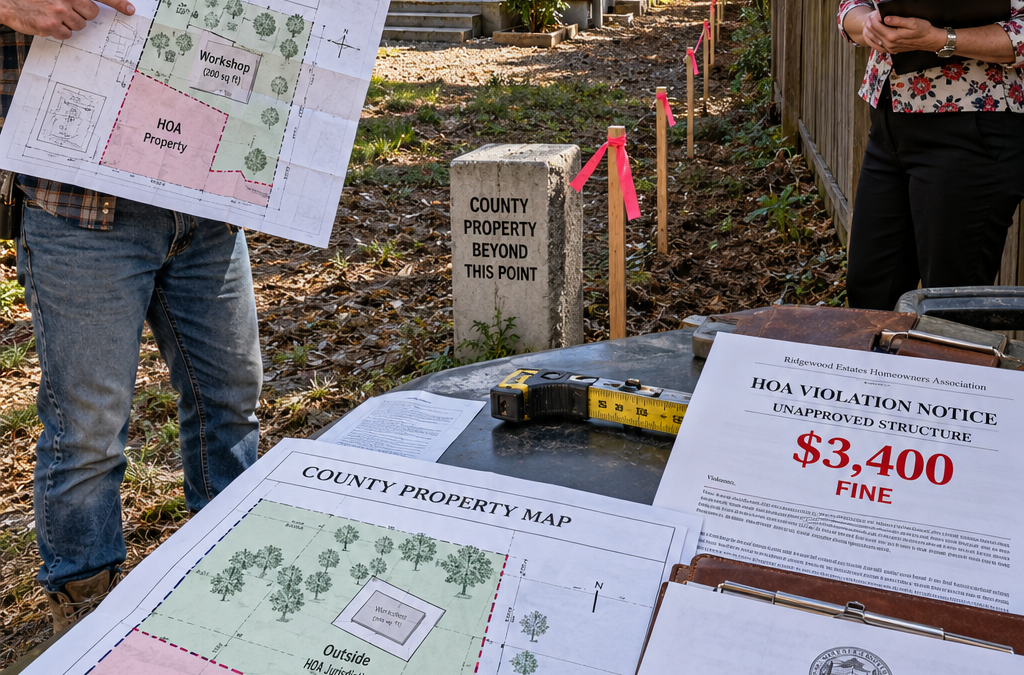
𝗙𝗨𝗟𝗟 𝗦𝗧𝗢𝗥𝗬
The workshop sat in the far rear corner of my property.
A row of mature cedars concealed most of it from the street and neighboring homes.
I painted the wood a muted gray-brown that blended with the trees.
Nobody complained.
Not one letter.
Not one warning.
Not one architectural review request.
Nothing.
Three years passed.
I built shelves inside.
Installed a heavy workbench along the back wall.
Repaired lawn equipment.
Restored an old bench vise that had belonged to my father.
Helped Dante rebuild a carburetor.
Built a cedar chest for my niece.
The workshop became exactly what I wanted.
A quiet place where things made sense.
Machines usually tell you what’s wrong if you’re patient enough.
People are less cooperative.
The trouble began on a Tuesday morning in May.
I was leaving for work when I opened the front door and found a white envelope wedged between the storm door and the frame.
Sycamore Ridge Homeowners Association.
OFFICIAL NOTICE.
There was red printing across the front.
I assumed it was some annual assessment reminder.
I tore it open while standing on the porch.
Then I saw the number.
$3,400.
Printed in bold.
I actually looked behind the first page to make sure I wasn’t reading a total connected to several homeowners.
No.
Marcus Del Rey.
My address.
Fine due: $3,400.
The alleged violation was an “unauthorized accessory structure” under Section 7.4 of the Sycamore Ridge architectural standards.
The letter said the workshop had been constructed without Architectural Review Committee approval.
It further stated that the violation had remained unresolved long enough to justify accumulated penalties.
Payment was required within thirty days.
Failure to pay could result in collection action, including placement of a lien where authorized.
I read the letter three times.
Then I turned around, went back inside, and set my work bag on the kitchen chair.
“Three thousand four hundred dollars?”
I said it aloud even though nobody was there.
The workshop had existed for three years.
Nobody had ever called it unauthorized.
Nobody had ever asked for an architectural application.
How exactly had three years of silence suddenly become $3,400?
I was angry.
But mostly confused.
I made coffee.
That is what I do when something doesn’t make sense.
Coffee first.
Bad decisions later.
While the machine ran, I pulled open the bottom drawer where I kept property documents.
County permit.
Final inspection.
Site plan.
Receipts.
Everything was there.
The structure was legal under county requirements.
But I knew county approval and HOA approval weren’t necessarily the same thing.
An association can have architectural rules stricter than local building codes if those restrictions actually apply to the property.
Had I missed something?
I pulled up the HOA handbook.
Section 7.4 did exist.
It required Architectural Review Committee approval before constructing certain detached accessory structures “within the covenant-controlled property area.”
That phrase caught my attention.
Covenant-controlled property area.
Not simply “on any owner’s lot.”
I read it again.
Something about the wording felt familiar.
Then I called my neighbor Priya Shah.
Priya had lived on Sycamore Ridge almost twenty years.
She knew more about the association than some board members did because she actually read the governing documents.
Whenever the HOA circulated a revised rule, Priya compared it to the original declaration.
Whenever someone claimed “the covenants say” something, she usually knew whether they actually did.
She answered while I was still standing at the kitchen counter.
“Good morning.”
“Depends.”
“What happened?”
“The HOA fined me thirty-four hundred dollars.”
She didn’t respond for a second.
“For what?”
“My workshop.”
“The one behind the cedars?”
“Apparently I’ve been terrorizing the neighborhood with it for three years.”
“Which provision?”
“Seven point four.”
She was quiet.
Then she said, “Don’t pay it.”
“I wasn’t planning to.”
“Yes, you were.”
I looked at the checkbook sitting beside the drawer.
“I was considering paying it under protest.”
“Marcus.”
“What?”
“You always do that.”
“Do what?”
“Pay money because fighting costs energy.”
“Usually that’s cheaper.”
“Not this time.”
“Why?”
She asked, “Do you still have the survey from when you bought the property?”
“Probably.”
“Original deed?”
“Yes.”
“HOA covenant boundary exhibit?”
I frowned.
“I’m sure somewhere.”
“Find all three.”
“Why?”
“Because not every piece of land inside what people call Sycamore Ridge is necessarily inside the recorded covenant.”
“It’s my backyard.”
“That doesn’t answer the question.”
“What are you saying?”
“I’m saying property boundaries and HOA boundaries aren’t always identical.”
I leaned against the counter.
The idea seemed ridiculous.
“The association covers my house.”
“Most of your lot, yes.”
“Then it covers the backyard.”
“Maybe.”
“Priya.”
“Go look.”
I almost ignored her.
I really did.
Part of me wanted to write “PAID UNDER PROTEST” across a check, mail it, and let someone else ruin their blood pressure.
Thirty-four hundred dollars was a lot of money.
But litigation could cost more.
Time mattered too.
I already spent enough of my life dealing with broken things.
The idea of attending board hearings over a workshop made me tired before anything had even happened.
Still, Priya’s confidence bothered me.
So I called my supervisor and said I’d be an hour late.
Then I emptied the property drawer onto the kitchen table.
Closing documents.
Insurance paperwork.
Tax records.
Utility easements.
Mortgage releases.
An old title-policy packet.
Finally, I found the survey.
It was folded into quarters.
I opened it across the table.
My lot was irregular.
The main residential portion formed a broad rectangle, but the rear boundary extended farther than neighboring parcels.
I had known that.
It was one reason I bought the place.
Then I found the HOA covenant exhibit.
At first, the maps looked identical.
Then I saw it.
The recorded covenant boundary did not follow the entire property line.
Along the rear edge was a narrow strip approximately forty feet deep that remained outside the shaded covenant-controlled area.
My land.
But not association-controlled land.
I leaned closer.
The workshop sat almost exactly in the center of that strip.
I grabbed the construction site plan.
The county inspector had marked the workshop location.
I laid the papers side by side.
Property survey.
Covenant exhibit.
Building plan.
Again.
I checked the scale.
Measured.
Looked at the monument references.
The answer didn’t change.
The workshop was mine.
The land was mine.
But that particular forty-foot rear strip had never been subjected to the HOA covenant.
I called Priya.
“You need to come over.”
“Found it?”
“You knew?”
“I suspected.”
“How?”
“Get the coffee ready.”
She arrived fifteen minutes later wearing gardening gloves and carrying her reading glasses.
We spread the documents across the table.
She traced the covenant line with one finger.
Then the property boundary.
Then the workshop location.
“There.”
“I know.”
“How far outside?”
“Depending on which corner you measure, about eighteen to twenty-two feet beyond the covenant boundary.”
She nodded.
“Then Section 7.4 doesn’t reach it.”
I stared at the fine letter.
“Why would they send this?”
Priya removed her glasses.
“Could be incompetence.”
“Three thousand four hundred dollars of incompetence?”
“I’ve seen worse.”
Then she hesitated.
“What?”
“You know who handled the last boundary survey clarification?”
“No.”
“Raymond Holt.”
My stomach tightened slightly.
Raymond Holt had been Sycamore Ridge HOA president for six years.
He was the kind of man who seemed to believe every room became a meeting the moment he entered it.
Late fifties.
Broad shoulders.
Permanent golf shirt.
Voice always one setting louder than necessary.
He loved procedure when procedure helped him.
He hated it when homeowners quoted procedure back.
I had never had a direct conflict with him.
But I had watched him at meetings.
When residents disagreed, Raymond didn’t usually answer the substance of the question.
He challenged whether they understood the issue.
That was his technique.
Make the person asking feel less informed than the board.
“When?” I asked.
“Maybe three years ago.”
“Why was he reviewing boundaries?”
“There was some filing dispute involving the rear lots.”
“Three years ago?”
Priya nodded.
“The same year I built the workshop.”
“Roughly.”
I looked toward the back window.
The top of the workshop roof was barely visible beyond the cedars.
“You think he knew?”
“I’m saying don’t assume he didn’t.”
That afternoon, I stopped thinking about writing a check.
The following morning, I went to the county records office.
I requested everything associated with my parcel and the HOA.
Original subdivision plat.
My deed.
Recorded declaration.
Covenant boundary exhibits.
Amendments.
Survey clarifications.
Correspondence connected to boundary filings.
The clerk looked at my request.
“You in a dispute?”
“Apparently.”
“HOA?”
“How’d you know?”
She smiled.
“Experience.”
It took almost two hours.
Most of the documents confirmed what I already knew.
Then the clerk brought out a thin file from three years earlier.
BOUNDARY CLARIFICATION – SYCAMORE RIDGE ASSOCIATION.
I opened it.
The HOA had requested clarification from the county after questions arose concerning several irregular rear parcels.
The county’s response included a map and written explanation.
Certain strips of privately owned land were outside the recorded covenant-controlled area.
The properties were listed.
Mine was one of them.
Parcel number.
Legal description.
Rear strip dimension.
Clear as daylight.
I kept reading.
The final page contained an acknowledgment that the association had received the clarification.
Signed for the HOA.
Raymond Holt.
I stared at the signature.
Then the date.
Three years earlier.
Four months before Dante and I built the workshop.
The clerk asked, “Everything okay?”
I didn’t answer immediately.
Raymond hadn’t simply had access to the information.
The county had sent it directly to him.
He had acknowledged receipt.
He knew the rear strip was outside HOA jurisdiction.
He knew before my workshop existed.
I took photographs.
Ordered certified copies.
Paid the records fee.
Then sat in my truck outside the county office without starting the engine.
I felt different than I had the day before.
The first violation had made me irritated.
The map had made me curious.
Raymond’s signature made me angry.
Because mistakes happen.
If an administrator had looked at my street address, assumed the whole parcel was subject to the covenant, and issued a bad violation, that could be corrected.
Embarrassing.
Incompetent.
Still fixable.
But if Raymond had received official confirmation of the boundary and then signed a letter threatening me with $3,400 and a potential lien?
That was different.
He wasn’t confused about his authority.
He was testing whether I knew where it ended.
I called Priya.
“You were right.”
There was silence.
“You found Raymond’s paperwork?”
“He signed the county letter.”
“When?”
“Three years ago.”
“Before the shed?”
“Four months before.”
She exhaled slowly.
“Marcus.”
“Yeah.”
“Attorney.”
That Friday, I called Claudette Vance.
Claudette was a property-law specialist whose name I got from a contractor I knew.
Her office was twenty-five minutes away.
I expected our first meeting to last half an hour.
We were there nearly two.
She read the fine.
Then the deed.
Then survey.
Covenant map.
County clarification.
Finally Raymond’s signed acknowledgment.
She read that one twice.
“Did you speak with the HOA after receiving the fine?”
“No.”
“Good.”
“I almost paid it.”
She looked up.
“But you didn’t.”
“No.”
“Also good.”
“Tell me I’m not missing something.”
Claudette tapped the covenant map.
“Your property ownership extends here.”
Her finger moved to the back line.
“The recorded covenant-controlled area stops here.”
Then she placed her finger on the workshop.
“Your building is here.”
“Correct.”
“County permitted?”
I handed her the permit.
“Final inspection?”
Another paper.
She nodded.
“From what you’ve shown me, their architectural authority doesn’t reach the structure.”
“And Raymond knew.”
“That document certainly creates a very serious knowledge problem for him.”
“Knowledge problem?”
“I’m a lawyer. We use boring phrases before we use expensive phrases.”
That was the first time I smiled.
“What happens next?”
“We make the board aware of exactly what they have.”
“They have the county letter.”
“Raymond has it. That doesn’t mean the other directors know.”
I hadn’t considered that.
“You think he’s doing this without telling them?”
“I don’t assume anything.”
She gathered the documents.
“But I do like giving people one clean opportunity to correct themselves.”
The letter went out four days later.
Claudette’s response was surgical.
She identified my deed.
The recorded covenant limits.
The exact location of the workshop.
The county permit.
The inspection.
Then she attached the three-year-old county boundary clarification.
Raymond Holt’s signature appeared on the final page.
She demanded immediate withdrawal of the $3,400 fine.
Rescission of all alleged penalties.
Written confirmation that no lien would be filed.
She also warned that knowingly attempting to collect assessments or impose encumbrances beyond association jurisdiction could expose the association, and potentially individual participants depending on the facts, to legal claims.
I expected an answer within days.
Nothing came.
One week.
Then two.
I began wondering whether silence meant they were quietly deleting the fine.
Then an envelope arrived.
The board refused to withdraw it.
Their letter said the “boundary question remained subject to interpretation.”
I read that line five times.
Subject to interpretation.
County-recorded line.
County clarification.
Signed acknowledgment.
Subject to interpretation.
The board announced that the matter would proceed to a formal HOA hearing.
I sent the letter to Claudette.
She called me almost immediately.
“They want a hearing.”
“I saw.”
“You comfortable going?”
“Are you?”
“I bill by the hour, Marcus. I’m very comfortable going.”
I laughed.
“What do I need to bring?”
“Everything.”
The hearing was scheduled for Thursday evening at the community center on Birwood Lane.
All week, I felt a kind of nervous energy I hadn’t experienced since my twenties.
I knew the documents.
I knew the workshop location.
Still, a threatened lien on your home has a way of making legal certainty feel less certain at three in the morning.
What if the covenant map was somehow superseded?
What if there was an amendment we hadn’t found?
What if the board had some authority I didn’t understand?
I asked Claudette those questions.
Her answer stayed the same.
“If they have another recorded document, they’ll need to produce it.”
Thursday afternoon, I left work early.
I went home.
Showered.
Changed.
Then walked out to the workshop.
I stood inside for several minutes.
Nothing about it looked dangerous enough to cause a legal war.
Work bench.
Pegboard.
Tin roof ticking softly as it cooled.
My father’s restored vise mounted near the window.
A half-finished cabinet Dante and I had been working on.
Three years of ordinary life.
I ran my hand across the workbench.
Then I locked the door and drove to the hearing.
Priya was already there.
“You look like you’re going to court,” she said.
“I feel like I’m going to court.”
“Raymond likes that.”
“What?”
“Making people feel like he’s a judge.”
Claudette arrived carrying a leather case and a cardboard tube containing a full-size certified survey copy.
“Ready?”
“No.”
“Good enough.”
We went inside.
Raymond sat at the board table.
Golf shirt.
Of course.
Beside him were three other directors.
Teresa Vaughn had joined only six months earlier.
She was a pediatric nurse and, from what little I knew, practical.
Next to her sat Leonard Briggs, who handled landscaping matters.
Then Samuel Ortiz, board treasurer.
None looked particularly comfortable.
Raymond did.
The community center had about thirty residents seated behind us.
News travels quickly when an HOA threatens someone with a lien.
The hearing began.
Raymond read the alleged violation.
Unauthorized structure.
No architectural approval.
Accumulated fine: $3,400.
Then he looked at me.
“Mr. Del Rey, you were given an opportunity to submit appropriate documentation years ago.”
That surprised me.
“No, I wasn’t.”
“The structure was constructed without association approval.”
“Because it isn’t inside association jurisdiction.”
He frowned.
“That’s your interpretation.”
Claudette spoke for the first time.
“No, Mr. Holt. That’s the county’s recorded boundary.”
Raymond looked at her.
“And you are?”
“Claudette Vance. Counsel for Mr. Del Rey.”
That changed the room slightly.
Lawyers do that.
Not because they have magic powers.
Because people become more careful about what they say.
Claudette stood.
“May I approach the table?”
Teresa nodded.
Raymond didn’t.
Claudette didn’t seem concerned.
She unrolled the survey.
The paper stretched nearly the length of the board table.
She anchored the corners with document folders.
“This is the certified survey associated with Mr. Del Rey’s property.”
She pointed.
“His ownership boundary is here.”
Then another line.
“The recorded Sycamore Ridge covenant boundary terminates here.”
Her finger moved to the shaded rear strip.
“This approximately forty-foot-wide section remains privately owned by Mr. Del Rey but is outside the recorded covenant burden that grants this board architectural authority.”
Then the workshop footprint.
“The structure is located entirely inside that rear strip.”
Leonard leaned forward.
Samuel did too.
Raymond stayed back.
Claudette placed the county permit beside the map.
“County permit.”
Then the final approval.
“Passed inspection.”
Then she produced the document I had been waiting for.
“And this is a boundary clarification issued by the county three years ago in response to an inquiry submitted by Sycamore Ridge Homeowners Association.”
Raymond shifted.
For the first time that evening, I saw his confidence change.
Just slightly.
Claudette continued.
“The county specifically identified Mr. Del Rey’s rear strip as lying outside the association covenant boundary.”
She turned to the final page.
“And this acknowledgment confirms that the association received that determination.”
She rotated the page toward the board.
At the bottom:
Raymond Holt.
Signature.
Date.
Teresa leaned closer.
She read it.
Then read it again.
Her face changed.
She looked at Raymond.
“Is that your signature?”
Raymond didn’t answer immediately.
Teresa pointed.
“Raymond?”
“Yes.”
The room became silent.
“You signed this?”
“I acknowledged receipt.”
“When?”
“The date is there.”
“Before his shed was built.”
Raymond folded his hands.
“The clarification did not resolve every jurisdictional issue.”
Claudette asked, “Which unresolved jurisdictional issue gives this board architectural authority over land expressly outside the covenant?”
Raymond turned toward her.
“The development functions as a unified community.”
“That wasn’t my question.”
“Residents receive association benefits.”
“Also not my question.”
I almost smiled.
Claudette’s voice never changed.
She pointed to the map.
“Please identify the recorded instrument extending Section 7.4 architectural authority into this strip.”
Raymond stared at the page.
No answer.
“If one exists,” Claudette continued, “we will review it immediately.”
Leonard looked toward Raymond.
“Do we have one?”
Raymond responded, “The association has historically treated entire residential parcels as subject to community standards.”
Claudette nodded.
“Historical treatment does not rewrite recorded boundaries.”
Teresa looked increasingly disturbed.
“Raymond, why wasn’t this letter provided to the rest of us?”
He frowned.
“It was part of older administrative correspondence.”
“That’s not what I asked.”
He looked at her.
She repeated herself.
“Why wasn’t this provided when we were asked to vote on Marcus’s fine?”
Raymond said, “Because I did not consider it dispositive.”
“What did you tell us?”
Nobody moved.
Teresa looked toward the residents.
Then back at Raymond.
“You told us the workshop was unquestionably inside HOA jurisdiction.”
Raymond’s jaw tightened.
“Based on our longstanding interpretation.”
Claudette said, “Yet you had written county confirmation to the contrary.”
Raymond looked directly at me.
“This entire dispute could have been avoided if Mr. Del Rey had simply submitted an architectural application when he built the structure.”
That did it.
For most of the hearing, I had let Claudette speak.
She knew the law.
She knew the strategy.
But I couldn’t sit quietly through that.
“Submit an application for what?”
Raymond looked at me.
“Architectural approval.”
“To a board that doesn’t control the land?”
“Marcus—”
“No.”
My voice was calm.
That surprised me.
“Three years ago, I got a county permit.”
I pointed to the documents.
“I built legally on my own property.”
I pointed toward Raymond’s signature.
“Four months before I built it, you personally signed a county letter confirming that the land was outside this HOA’s boundary.”
He said nothing.
“You never warned me when I built.”
Nothing.
“You never sent an architectural request.”
Nothing.
“You waited three years.”
I picked up the fine notice.
“Then you sent me a bill for thirty-four hundred dollars and threatened my house.”
Raymond shifted in his chair.
“The letter identifies available collection remedies.”
“You threatened a lien.”
“That is standard language.”
“On a fine you knew you had no right to issue.”
Several residents murmured.
Raymond raised his voice.
“That characterization is inaccurate.”
I looked directly at him.
“Then explain your signature.”
He couldn’t.
That was the whole case in one sentence.
Not the shed.
Not the $3,400.
Not the permit.
His signature.
Teresa spoke next.
“Did you know about this boundary issue when you signed the violation notice?”
Raymond looked at her.
“I was aware of the correspondence.”
“That’s not the same answer.”
“It is the answer I’m giving.”
Teresa leaned back.
I watched the moment something changed among the other board members.
Until then, they had been defending an HOA fine.
Now they were wondering whether Raymond had put their names behind something he had known was legally questionable.
People behave differently when another person’s arrogance suddenly becomes their liability.
Claudette understood that.
She closed the folder.
“Let me be clear about my client’s position.”
Nobody interrupted.
“The $3,400 demand must be rescinded.”
She pointed toward the county map.
“No architectural application will be submitted for this workshop because doing so could falsely imply that Mr. Del Rey recognizes HOA jurisdiction over property the recorded covenant does not cover.”
She turned toward the board.
“No lien may be pursued based on this fine.”
Then her eyes stopped on each director.
“And now that every board member in this room has been provided the county documents, any future enforcement action will be evaluated in light of actual notice.”
That sentence landed hard.
Teresa immediately asked for a closed consultation with board counsel.
Raymond objected.
Teresa ignored him.
After twenty minutes, the directors returned.
Raymond’s expression had changed.
Not much.
Enough.
Samuel announced the motion.
Withdraw the $3,400 fine.
Rescind all related violation notices.
Confirm no lien would be filed.
Recognize that no determination was being made beyond the specific workshop and boundary documentation.
Teresa voted yes.
Samuel voted yes.
Leonard voted yes.
A fourth board member who had joined remotely voted yes.
Raymond voted no.
Four to one.
For several seconds after the vote, I felt nothing.
I had imagined relief.
Maybe satisfaction.
Instead, I stared at the county letter lying on the table.
Three years.
He had known for three years.
Claudette touched my arm.
“It’s done.”
I nodded.
But something still bothered me.
Not the money anymore.
The fact that I had almost paid it.
If Priya hadn’t told me to pull the survey, I might have.
I could easily imagine myself writing the check.
Three thousand four hundred dollars.
Painful.
But cheaper than hiring a lawyer, taking time off work, digging through county records, attending a hearing.
That calculation was exactly what bothered me.
How many other homeowners had made the same one?
After the meeting, several residents approached us.
One man asked whether he should check his rear boundary.
Another said he had paid a fence fine years earlier on a strip near the same area.
Teresa came over last.
She looked embarrassed.
“Marcus, I’m sorry.”
“You didn’t know.”
“I voted to approve the fine initially.”
“You were given bad information.”
“Still.”
She glanced toward Raymond, who was packing papers at the board table.
“I should’ve asked to see the boundary.”
“Probably.”
She nodded.
“I will next time.”
That answer was enough for me.
Priya waited by the door.
When I reached her, she smiled.
“You owe me dinner.”
“For what?”
“For preventing you from writing a thirty-four-hundred-dollar check.”
“I would’ve figured it out.”
“You had the checkbook on your table.”
“I was thinking.”
“You were surrendering with stationery.”
I laughed.
“Fine.”
“Steak.”
“Now you’re abusing your authority.”
Two weeks later, Raymond Holt resigned as HOA president.
The official notice said he was stepping away for personal reasons and to focus on family obligations.
Nobody believed that was the full reason.
He remained a homeowner for a while, but he stopped attending meetings.
Teresa became interim president.
One of her first decisions was to order an independent review of recent architectural fines involving irregular parcel boundaries.
That review uncovered several other notices that should never have been issued.
Most were much smaller than mine.
A fence setback.
A storage pad.
A garden structure.
Nothing involving $3,400.
But homeowners received refunds.
That mattered more to me than Raymond’s resignation.
A month after the hearing, I received a certified letter from the HOA.
Formal withdrawal of fine.
Formal confirmation that no lien had been filed.
Written acknowledgment that the workshop sat outside the specific covenant boundary governing architectural review.
And an apology.
I put the letter in the same drawer as the original fine.
Dante came over that weekend.
We sat inside the workshop drinking coffee.
I showed him both letters.
He read the fine first.
Then the withdrawal.
He looked around.
“So this little building almost cost you thirty-four hundred dollars.”
“No.”
“What?”
“This little building almost made me voluntarily give away thirty-four hundred dollars.”
“That’s worse.”
“Much.”
He pointed toward one wall.
“We should put a plaque up.”
“What would it say?”
“Independent Republic of Marcus.”
I laughed.
“No.”
“Embassy?”
“No.”
“Free Shed Territory?”
“Dante.”
He was quiet for ten seconds.
“You’re no fun.”
The workshop stayed exactly where it had always been.
No alteration.
No architectural application.
No relocation.
No negotiated exception.
Nothing.
That was important to me.
Sometimes disputes end with both sides compromising even when one side was right.
Not this one.
There was nothing to compromise.
The boundary existed before the argument.
The HOA’s authority stopped at that line whether Raymond liked it or not.
That realization changed the way I looked at property ownership.
Before the $3,400 fine, I thought owning land meant knowing where the fence stood.
Afterward, I understood that there can be several overlapping maps.
Your property boundary.
Utility easements.
Drainage easements.
Road rights.
Covenant boundaries.
Municipal setbacks.
Restrictions.
Rights-of-way.
The physical land doesn’t change.
The legal authority over different portions of it can.
And if you don’t know where those lines are, someone more confident than you may eventually tell you.
For eleven years, I assumed the HOA controlled everything behind my mailbox because my address was in Sycamore Ridge.
That assumption almost cost me.
Raymond counted on it.
Maybe that’s what still bothers me most.
He didn’t forge the boundary.
He didn’t hide the county record.
He didn’t need to.
He simply relied on the probability that I would never look.
The fine was printed professionally.
Official letterhead.
Red ink.
Section number.
Payment deadline.
Lien language.
Every visual element said authority.
My survey was an old folded sheet of paper buried in a drawer.
One looked powerful.
The other actually was.
That’s a lesson I haven’t forgotten.
About six months after the hearing, I attended an HOA meeting.
I hadn’t planned to become a regular.
Priya convinced me.
“You fought them and now you’re going to stop paying attention?”
“I wasn’t fighting the association.”
“You know what I mean.”
So I went.
Teresa was president by then.
The meeting was less theatrical than Raymond’s meetings.
I considered that an improvement.
A homeowner asked about a proposed fence rule.
Instead of saying the board had broad discretion, Teresa pulled up the recorded covenant provision.
She read it aloud.
Then she said, “If anyone believes this rule exceeds that authority, submit the issue before we vote.”
Simple.
Another resident asked about the rear boundary strips.
Teresa had the county map projected onto the wall.
She explained which areas were outside architectural-control jurisdiction.
No hiding.
No pretending uncertainty created more power.
Priya leaned toward me.
“Look at that.”
“What?”
“Competence.”
“Rare sight.”
She smiled.
Raymond’s chair at the front table was occupied by somebody else.
It looked smaller than I remembered.
That surprised me.
For years, Raymond had filled the room.
Maybe the authority had never been as large as the man made it seem.
I started paying closer attention after that.
Not obsessively.
But enough.
When annual budgets arrived, I read them.
When rules changed, I checked the cited sections.
When someone said, “The HOA can do that,” I asked why.
Sometimes the answer was legitimate.
Most boards do have actual authority over certain things.
Road maintenance.
Common areas.
Recorded architectural controls.
Assessment collection.
The lesson was not that associations have no power.
It was that power is bounded.
By documents.
By statutes.
By procedures.
By property lines.
And healthy leadership understands those boundaries.
Raymond didn’t.
Or worse, he understood them perfectly and believed nobody else would.
Priya and I talked about that one evening on my patio.
She had brought over a container of food because she claimed single men would otherwise eat sandwiches until death.
“You think he really knew the whole time?” I asked.
She looked at me.
“He signed the letter.”
“I know.”
“But?”
“I keep wondering if maybe he forgot.”
Priya took a sip of wine.
“Do you want him to have forgotten?”
“Maybe.”
“Why?”
“Because incompetence is easier to live with than intention.”
She considered that.
“Fair.”
The cedars moved slightly in the evening wind.
The workshop roof was visible between them.
Then she said, “Maybe he didn’t wake up thinking, I’m going to extort Marcus.”
“I never said extort.”
“I’m being dramatic.”
“You usually are.”
“But he knew the boundary existed.”
“Yes.”
“And he issued the fine anyway.”
“Yes.”
“Everything after that is just vocabulary.”
She was right.
I stopped trying to understand Raymond’s motivation.
Maybe he wanted revenue.
Maybe he disliked structures he couldn’t control.
Maybe he believed covenant boundaries were technicalities and the HOA’s idea of community mattered more.
Maybe he simply assumed I would comply.
Motives are slippery.
Documents are easier.
That’s another lesson Claudette taught me.
Months after the dispute, I asked her why she had seemed so calm during the hearing.
“You already knew we’d win?”
She shook her head.
“Lawyers who tell you they know what will happen are selling confidence.”
“Then why weren’t you nervous?”
“I had a deed, a survey, a recorded covenant, a county letter, a permit, an inspection, and the opposing party’s signature.”
She smiled.
“I’ve had worse Thursdays.”
I laughed.
Then she added something I’ve remembered ever since.
“The strongest cases are often the ones where you don’t need a dramatic argument. You just make everyone look at the same paper.”
That’s exactly what happened.
Raymond had spent weeks calling the boundary “subject to interpretation.”
Claudette didn’t fight his personality.
She didn’t accuse him of corruption.
She didn’t shout.
She rolled out the map.
Placed his signature beside it.
And asked him where his authority came from.
He had no answer.
Everything else followed from that.
The $3,400 fine still sits in my filing cabinet.
I kept it.
Not because I’m nostalgic.
Because every time I come across it, I remember how close I came to mailing a check.
That scares me more than the fine itself.
I had the money.
I could have paid it.
I would have been angry for a week.
Then life would have continued.
The HOA would have recorded my payment.
Raymond would have learned that threatening me worked.
Maybe the next fine would have been higher.
Maybe another homeowner would have paid.
Maybe the rear boundary would have gradually become treated as HOA-controlled simply because nobody objected strongly enough.
That’s how bad authority grows.
Not always through giant acts.
Through exhaustion.
People have jobs.
Families.
Bills.
Aging parents.
Children.
Health problems.
Cars that need repairs.
A $200 fine arrives.
Maybe you pay.
Then $500.
Maybe you pay again.
Not because the board is right.
Because your time feels more valuable than the argument.
Organizations understand that.
Some use it responsibly.
Others exploit it.
Raymond expected the inconvenience of resistance to cost me more emotionally than $3,400 cost financially.
He almost guessed correctly.
But the line behind my cedar trees existed whether I checked it or not.
My decision to read the map didn’t create my rights.
It merely reminded me that I had them.
Three years after the hearing, the workshop is still standing.
The tin roof has weathered darker.
I replaced one window.
Added better lighting.
Dante finally convinced me to install a small heater for winter.
The workbench has more scars.
The old vise still sits at the corner.
Whenever someone new visits, they usually don’t even notice the building until we walk behind the cedars.
Last fall, a new neighbor named Eric came over while I was repairing a lawn tractor.
He looked around.
“Nice shop.”
“Thanks.”
“HOA approve it?”
I laughed so hard he looked worried.
“What?”
“Long story.”
He glanced toward the roof.
“Seriously.”
“No.”
His expression changed.
“You’re allowed to have it without approval?”
“Right here, yes.”
“Why?”
I wiped my hands on a rag.
“Different covenant boundary.”
He frowned.
“Same property?”
“Same ownership.”
“But different HOA jurisdiction?”
“Exactly.”
He looked impressed.
“I should probably read my deed.”
“That’s an excellent idea.”
A few weeks later, he told me he had.
That’s probably the best thing that came out of the whole dispute.
Not Raymond resigning.
Not the apology.
Not winning the vote.
People started reading.
They pulled surveys.
Asked questions.
Checked recorded amendments.
One woman discovered an old drainage easement she had never known existed.
Another homeowner realized his rear fence line didn’t match the actual survey monuments.
Neither issue became dramatic.
That’s the point.
Knowledge is most useful before conflict.
I wish I had understood that when I bought the property.
Instead, I spent eleven years assuming the documents in my drawer were paperwork from a transaction already completed.
They weren’t.
A deed isn’t only something you sign at closing.
A survey isn’t just a piece of paper the lender requires.
Those documents tell you where another person’s authority ends.
Sometimes literally.
The cedar trees behind my house are taller now.
They almost completely hide the workshop.
When I’m back there with the door open, I can hear lawn mowers in the distance and kids playing farther up Sycamore Ridge, but I can’t see much beyond the trees.
It’s peaceful.
Exactly what I wanted when Dante first pointed at that corner and told me every man needed a workshop.
Sometimes I think about Raymond’s fine while I’m working.
Not often.
But enough.
I remember the red ink.
The $3,400.
The phrase “unauthorized structure.”
The threatened lien.
And then the county letter.
One signature.
Raymond Holt.
Three years earlier.
The entire dispute lived in the distance between those two documents.
One said he had authority.
The other proved he knew he didn’t.
That was all Claudette needed.
That was all I needed.
I used to think defending yourself required being confrontational.
It doesn’t.
Sometimes the strongest response is quiet.
Open the drawer.
Find the deed.
Unfold the survey.
Go to the county.
Request the record.
Read the provision someone is citing against you.
Ask for the amendment.
Ask for the vote.
Ask for the authority.
Then keep asking until the person making the demand can point to something stronger than their own confidence.
I almost paid $3,400 because the letter looked official.
Raymond almost succeeded because I was tired before the fight even began.
But authority isn’t created by letterhead.
Jurisdiction isn’t expanded by repetition.
And a threatened lien doesn’t become legitimate because someone prints the word “official” above it.
My workshop is still there.
Same corner.
Same property.
Same forty-foot strip.
Nothing moved.
The only thing that changed was that I learned exactly where the line was.
And once I knew that, Raymond Holt could stand on the other side of it with all the red ink, fines, meeting votes, and official titles he wanted.
He still couldn’t cross it.
𝗧𝗛𝗘 𝗘𝗡𝗗
The HOA Fined Me $3,400 for My Backyard Workshop, and One Signature on a Three-Year-Old County Letter Changed What I Thought This Was About
The HOA gave me thirty days to pay $3,400 over a workshop that had stood quietly behind my cedar trees for three years, and the letter threatened a lien against the home I had spent eleven years paying for.
I almost wrote the check just to make them go away, until an old county map showed me that the building wasn’t merely compliant—the board had no jurisdiction over the ground beneath it, and their president had signed a document proving he already knew that.
My name is Marcus Del Rey, and until this happened, I was probably the kind of homeowner every association claims it wants.
I paid my dues on time.
I kept the grass cut.
I didn’t park trailers in the driveway.
I didn’t leave trash cans at the curb for three days.
I didn’t paint my front door fluorescent green, build a twelve-foot fence, raise chickens beside the community pool, or turn my garage into an illegal auto shop.
For eleven years, I lived on Sycamore Ridge without becoming the subject of a single serious dispute.
That wasn’t because I loved homeowners associations.
I simply believed there were more important things in life than arguing over mailbox colors.
I worked as a commercial refrigeration technician, which meant most of my days were spent troubleshooting equipment in warehouses, supermarkets, and restaurant kitchens.
By the time I got home, I had usually spent ten hours listening to compressors, fans, service managers, and people telling me something had “just suddenly stopped working” even though the maintenance log hadn’t been touched in eighteen months.
The last thing I wanted was another argument.
My home was where I went to stop solving other people’s problems.
I bought the property on Sycamore Ridge when I was thirty-five.
The house itself wasn’t anything extraordinary.
Two stories.
Three bedrooms.
Brick front.
Attached garage.
About half an acre, most of it behind the house.
What I liked was the rear of the lot.
There was an old line of cedar trees along the back fence, thick enough that when you stood near the patio, you couldn’t quite see the neighboring development beyond them.
The property felt deeper than it actually was.
Private.
Quiet.
The kind of yard where a man could drink coffee before sunrise and forget that fifty other homes existed around him.
My brother-in-law Dante liked the place immediately.
The first weekend after I moved in, we stood in the backyard with two beers while he looked toward the cedars.
“You know what belongs back there?”
I already knew the answer.
“A boat?”
“A workshop.”
“I don’t need a workshop.”
Dante looked at me as though I had just announced I didn’t need oxygen.
“Every man needs a workshop.”
“For what?”
“Things.”
“What things?”
“Things you don’t want in your garage.”
He had a point.
For years, I used the garage as storage, repair space, tool room, lawn-equipment bay, and occasionally a place for an actual vehicle.
Every time I wanted to work on something, I had to move three other things first.
A mower.
Storage bins.
A ladder.
Christmas decorations.
Two bicycles I hadn’t ridden in years.
So three years before the HOA fine arrived, I finally decided Dante had been right.
I wanted a small workshop.
Nothing elaborate.
Roughly two hundred square feet.
Wood frame.
Simple tin roof.
One entry door.
Two windows.
Enough room for a workbench, tool cabinets, a small vise, and storage.
I had no intention of turning it into living space.
No plumbing.
No bathroom.
No commercial operation.
No customers.
No employees.
Just somewhere to fix things.
The first thing I did was call the county.
I asked whether I needed a permit.
I did.
So I applied.
The county wanted a site plan showing setbacks.
Foundation details.
Framing dimensions.
Roof construction.
Electrical plan because I wanted two outlets and overhead lighting.
I submitted everything.
The permit was approved.
I called for the required inspection after setting the footings.
Passed.
Dante came over the following Saturday.
By seven in the morning, we had lumber stacked across the grass and a radio playing on the patio.
Dante looked at the permit taped inside my kitchen window.
“You actually got paperwork for a shed?”
“It’s two hundred square feet.”
“So?”
“So I’d rather spend forty-five minutes filing paperwork now than four months arguing later.”
That sentence became painfully ironic.
We framed the structure over one long weekend.
Dante complained about my measuring.
I complained about his measuring.
His philosophy was that if something was within an eighth of an inch, it was perfect.
My philosophy was that if you had the tape measure in your hand, you might as well use it correctly.
By Sunday evening, the walls were up.
The metal roofing took another day the following weekend.
I installed the electrical work.
County inspector returned.
He walked around the structure, checked setbacks, looked at the wiring, signed the final approval, and left.
That was the end of it.
Or so I believed.
The workshop sat in the far rear corner of my property.
A row of mature cedars concealed most of it from the street and neighboring homes.
I painted the wood a muted gray-brown that blended with the trees.
Nobody complained.
Not one letter.
Not one warning.
Not one architectural review request.
Nothing.
Three years passed.
I built shelves inside.
Installed a heavy workbench along the back wall.
Repaired lawn equipment.
Restored an old bench vise that had belonged to my father.
Helped Dante rebuild a carburetor.
Built a cedar chest for my niece.
The workshop became exactly what I wanted.
A quiet place where things made sense.
Machines usually tell you what’s wrong if you’re patient enough.
People are less cooperative.
The trouble began on a Tuesday morning in May.
I was leaving for work when I opened the front door and found a white envelope wedged between the storm door and the frame.
Sycamore Ridge Homeowners Association.
OFFICIAL NOTICE.
There was red printing across the front.
I assumed it was some annual assessment reminder.
I tore it open while standing on the porch.
Then I saw the number.
$3,400.
Printed in bold.
I actually looked behind the first page to make sure I wasn’t reading a total connected to several homeowners.
No.
Marcus Del Rey.
My address.
Fine due: $3,400.
The alleged violation was an “unauthorized accessory structure” under Section 7.4 of the Sycamore Ridge architectural standards.
The letter said the workshop had been constructed without Architectural Review Committee approval.
It further stated that the violation had remained unresolved long enough to justify accumulated penalties.
Payment was required within thirty days.
Failure to pay could result in collection action, including placement of a lien where authorized.
I read the letter three times.
Then I turned around, went back inside, and set my work bag on the kitchen chair.
“Three thousand four hundred dollars?”
I said it aloud even though nobody was there.
The workshop had existed for three years.
Nobody had ever called it unauthorized.
Nobody had ever asked for an architectural application.
How exactly had three years of silence suddenly become $3,400?
I was angry.
But mostly confused.
I made coffee.
That is what I do when something doesn’t make sense.
Coffee first.
Bad decisions later.
While the machine ran, I pulled open the bottom drawer where I kept property documents.
County permit.
Final inspection.
Site plan.
Receipts.
Everything was there.
The structure was legal under county requirements.
But I knew county approval and HOA approval weren’t necessarily the same thing.
An association can have architectural rules stricter than local building codes if those restrictions actually apply to the property.
Had I missed something?
I pulled up the HOA handbook.
Section 7.4 did exist.
It required Architectural Review Committee approval before constructing certain detached accessory structures “within the covenant-controlled property area.”
That phrase caught my attention.
Covenant-controlled property area.
Not simply “on any owner’s lot.”
I read it again.
Something about the wording felt familiar.
Then I called my neighbor Priya Shah.
Priya had lived on Sycamore Ridge almost twenty years.
She knew more about the association than some board members did because she actually read the governing documents.
Whenever the HOA circulated a revised rule, Priya compared it to the original declaration.
Whenever someone claimed “the covenants say” something, she usually knew whether they actually did.
She answered while I was still standing at the kitchen counter.
“Good morning.”
“Depends.”
“What happened?”
“The HOA fined me thirty-four hundred dollars.”
She didn’t respond for a second.
“For what?”
“My workshop.”
“The one behind the cedars?”
“Apparently I’ve been terrorizing the neighborhood with it for three years.”
“Which provision?”
“Seven point four.”
She was quiet.
Then she said, “Don’t pay it.”
“I wasn’t planning to.”
“Yes, you were.”
I looked at the checkbook sitting beside the drawer.
“I was considering paying it under protest.”
“Marcus.”
“What?”
“You always do that.”
“Do what?”
“Pay money because fighting costs energy.”
“Usually that’s cheaper.”
“Not this time.”
“Why?”
She asked, “Do you still have the survey from when you bought the property?”
“Probably.”
“Original deed?”
“Yes.”
“HOA covenant boundary exhibit?”
I frowned.
“I’m sure somewhere.”
“Find all three.”
“Why?”
“Because not every piece of land inside what people call Sycamore Ridge is necessarily inside the recorded covenant.”
“It’s my backyard.”
“That doesn’t answer the question.”
“What are you saying?”
“I’m saying property boundaries and HOA boundaries aren’t always identical.”
I leaned against the counter.
The idea seemed ridiculous.
“The association covers my house.”
“Most of your lot, yes.”
“Then it covers the backyard.”
“Maybe.”
“Priya.”
“Go look.”
I almost ignored her.
I really did.
Part of me wanted to write “PAID UNDER PROTEST” across a check, mail it, and let someone else ruin their blood pressure.
Thirty-four hundred dollars was a lot of money.
But litigation could cost more.
Time mattered too.
I already spent enough of my life dealing with broken things.
The idea of attending board hearings over a workshop made me tired before anything had even happened.
Still, Priya’s confidence bothered me.
So I called my supervisor and said I’d be an hour late.
Then I emptied the property drawer onto the kitchen table.
Closing documents.
Insurance paperwork.
Tax records.
Utility easements.
Mortgage releases.
An old title-policy packet.
Finally, I found the survey.
It was folded into quarters.
I opened it across the table.
My lot was irregular.
The main residential portion formed a broad rectangle, but the rear boundary extended farther than neighboring parcels.
I had known that.
It was one reason I bought the place.
Then I found the HOA covenant exhibit.
At first, the maps looked identical.
Then I saw it.
The recorded covenant boundary did not follow the entire property line.
Along the rear edge was a narrow strip approximately forty feet deep that remained outside the shaded covenant-controlled area.
My land.
But not association-controlled land.
I leaned closer.
The workshop sat almost exactly in the center of that strip.
I grabbed the construction site plan.
The county inspector had marked the workshop location.
I laid the papers side by side.
Property survey.
Covenant exhibit.
Building plan.
Again.
I checked the scale.
Measured.
Looked at the monument references.
The answer didn’t change.
The workshop was mine.
The land was mine.
But that particular forty-foot rear strip had never been subjected to the HOA covenant.
I called Priya.
“You need to come over.”
“Found it?”
“You knew?”
“I suspected.”
“How?”
“Get the coffee ready.”
She arrived fifteen minutes later wearing gardening gloves and carrying her reading glasses.
We spread the documents across the table.
She traced the covenant line with one finger.
Then the property boundary.
Then the workshop location.
“There.”
“I know.”
“How far outside?”
“Depending on which corner you measure, about eighteen to twenty-two feet beyond the covenant boundary.”
She nodded.
“Then Section 7.4 doesn’t reach it.”
I stared at the fine letter.
“Why would they send this?”
Priya removed her glasses.
“Could be incompetence.”
“Three thousand four hundred dollars of incompetence?”
“I’ve seen worse.”
Then she hesitated.
“What?”
“You know who handled the last boundary survey clarification?”
“No.”
“Raymond Holt.”
My stomach tightened slightly.
Raymond Holt had been Sycamore Ridge HOA president for six years.
He was the kind of man who seemed to believe every room became a meeting the moment he entered it.
Late fifties.
Broad shoulders.
Permanent golf shirt.
Voice always one setting louder than necessary.
He loved procedure when procedure helped him.
He hated it when homeowners quoted procedure back.
I had never had a direct conflict with him.
But I had watched him at meetings.
When residents disagreed, Raymond didn’t usually answer the substance of the question.
He challenged whether they understood the issue.
That was his technique.
Make the person asking feel less informed than the board.
“When?” I asked.
“Maybe three years ago.”
“Why was he reviewing boundaries?”
“There was some filing dispute involving the rear lots.”
“Three years ago?”
Priya nodded.
“The same year I built the workshop.”
“Roughly.”
I looked toward the back window.
The top of the workshop roof was barely visible beyond the cedars.
“You think he knew?”
“I’m saying don’t assume he didn’t.”
That afternoon, I stopped thinking about writing a check.
The following morning, I went to the county records office.
I requested everything associated with my parcel and the HOA.
Original subdivision plat.
My deed.
Recorded declaration.
Covenant boundary exhibits.
Amendments.
Survey clarifications.
Correspondence connected to boundary filings.
The clerk looked at my request.
“You in a dispute?”
“Apparently.”
“HOA?”
“How’d you know?”
She smiled.
“Experience.”
It took almost two hours.
Most of the documents confirmed what I already knew.
Then the clerk brought out a thin file from three years earlier.
BOUNDARY CLARIFICATION – SYCAMORE RIDGE ASSOCIATION.
I opened it.
The HOA had requested clarification from the county after questions arose concerning several irregular rear parcels.
The county’s response included a map and written explanation.
Certain strips of privately owned land were outside the recorded covenant-controlled area.
The properties were listed.
Mine was one of them.
Parcel number.
Legal description.
Rear strip dimension.
Clear as daylight.
I kept reading.
The final page contained an acknowledgment that the association had received the clarification.
Signed for the HOA.
Raymond Holt.
I stared at the signature.
Then the date.
Three years earlier.
Four months before Dante and I built the workshop.
The clerk asked, “Everything okay?”
I didn’t answer immediately.
Raymond hadn’t simply had access to the information.
The county had sent it directly to him.
He had acknowledged receipt.
He knew the rear strip was outside HOA jurisdiction.
He knew before my workshop existed.
I took photographs.
Ordered certified copies.
Paid the records fee.
Then sat in my truck outside the county office without starting the engine.
I felt different than I had the day before.
The first violation had made me irritated.
The map had made me curious.
Raymond’s signature made me angry.
Because mistakes happen.
If an administrator had looked at my street address, assumed the whole parcel was subject to the covenant, and issued a bad violation, that could be corrected.
Embarrassing.
Incompetent.
Still fixable.
But if Raymond had received official confirmation of the boundary and then signed a letter threatening me with $3,400 and a potential lien?
That was different.
He wasn’t confused about his authority.
He was testing whether I knew where it ended.
I called Priya.
“You were right.”
There was silence.
“You found Raymond’s paperwork?”
“He signed the county letter.”
“When?”
“Three years ago.”
“Before the shed?”
“Four months before.”
She exhaled slowly.
“Marcus.”
“Yeah.”
“Attorney.”
That Friday, I called Claudette Vance.
Claudette was a property-law specialist whose name I got from a contractor I knew.
Her office was twenty-five minutes away.
I expected our first meeting to last half an hour.
We were there nearly two.
She read the fine.
Then the deed.
Then survey.
Covenant map.
County clarification.
Finally Raymond’s signed acknowledgment.
She read that one twice.
“Did you speak with the HOA after receiving the fine?”
“No.”
“Good.”
“I almost paid it.”
She looked up.
“But you didn’t.”
“No.”
“Also good.”
“Tell me I’m not missing something.”
Claudette tapped the covenant map.
“Your property ownership extends here.”
Her finger moved to the back line.
“The recorded covenant-controlled area stops here.”
Then she placed her finger on the workshop.
“Your building is here.”
“Correct.”
“County permitted?”
I handed her the permit.
“Final inspection?”
Another paper.
She nodded.
“From what you’ve shown me, their architectural authority doesn’t reach the structure.”
“And Raymond knew.”
“That document certainly creates a very serious knowledge problem for him.”
“Knowledge problem?”
“I’m a lawyer. We use boring phrases before we use expensive phrases.”
That was the first time I smiled.
“What happens next?”
“We make the board aware of exactly what they have.”
“They have the county letter.”
“Raymond has it. That doesn’t mean the other directors know.”
I hadn’t considered that.
“You think he’s doing this without telling them?”
“I don’t assume anything.”
She gathered the documents.
“But I do like giving people one clean opportunity to correct themselves.”
The letter went out four days later.
Claudette’s response was surgical.
She identified my deed.
The recorded covenant limits.
The exact location of the workshop.
The county permit.
The inspection.
Then she attached the three-year-old county boundary clarification.
Raymond Holt’s signature appeared on the final page.
She demanded immediate withdrawal of the $3,400 fine.
Rescission of all alleged penalties.
Written confirmation that no lien would be filed.
She also warned that knowingly attempting to collect assessments or impose encumbrances beyond association jurisdiction could expose the association, and potentially individual participants depending on the facts, to legal claims.
I expected an answer within days.
Nothing came.
One week.
Then two.
I began wondering whether silence meant they were quietly deleting the fine.
Then an envelope arrived.
The board refused to withdraw it.
Their letter said the “boundary question remained subject to interpretation.”
I read that line five times.
Subject to interpretation.
County-recorded line.
County clarification.
Signed acknowledgment.
Subject to interpretation.
The board announced that the matter would proceed to a formal HOA hearing.
I sent the letter to Claudette.
She called me almost immediately.
“They want a hearing.”
“I saw.”
“You comfortable going?”
“Are you?”
“I bill by the hour, Marcus. I’m very comfortable going.”
I laughed.
“What do I need to bring?”
“Everything.”
The hearing was scheduled for Thursday evening at the community center on Birwood Lane.
All week, I felt a kind of nervous energy I hadn’t experienced since my twenties.
I knew the documents.
I knew the workshop location.
Still, a threatened lien on your home has a way of making legal certainty feel less certain at three in the morning.
What if the covenant map was somehow superseded?
What if there was an amendment we hadn’t found?
What if the board had some authority I didn’t understand?
I asked Claudette those questions.
Her answer stayed the same.
“If they have another recorded document, they’ll need to produce it.”
Thursday afternoon, I left work early.
I went home.
Showered.
Changed.
Then walked out to the workshop.
I stood inside for several minutes.
Nothing about it looked dangerous enough to cause a legal war.
Work bench.
Pegboard.
Tin roof ticking softly as it cooled.
My father’s restored vise mounted near the window.
A half-finished cabinet Dante and I had been working on.
Three years of ordinary life.
I ran my hand across the workbench.
Then I locked the door and drove to the hearing.
Priya was already there.
“You look like you’re going to court,” she said.
“I feel like I’m going to court.”
“Raymond likes that.”
“What?”
“Making people feel like he’s a judge.”
Claudette arrived carrying a leather case and a cardboard tube containing a full-size certified survey copy.
“Ready?”
“No.”
“Good enough.”
We went inside.
Raymond sat at the board table.
Golf shirt.
Of course.
Beside him were three other directors.
Teresa Vaughn had joined only six months earlier.
She was a pediatric nurse and, from what little I knew, practical.
Next to her sat Leonard Briggs, who handled landscaping matters.
Then Samuel Ortiz, board treasurer.
None looked particularly comfortable.
Raymond did.
The community center had about thirty residents seated behind us.
News travels quickly when an HOA threatens someone with a lien.
The hearing began.
Raymond read the alleged violation.
Unauthorized structure.
No architectural approval.
Accumulated fine: $3,400.
Then he looked at me.
“Mr. Del Rey, you were given an opportunity to submit appropriate documentation years ago.”
That surprised me.
“No, I wasn’t.”
“The structure was constructed without association approval.”
“Because it isn’t inside association jurisdiction.”
He frowned.
“That’s your interpretation.”
Claudette spoke for the first time.
“No, Mr. Holt. That’s the county’s recorded boundary.”
Raymond looked at her.
“And you are?”
“Claudette Vance. Counsel for Mr. Del Rey.”
That changed the room slightly.
Lawyers do that.
Not because they have magic powers.
Because people become more careful about what they say.
Claudette stood.
“May I approach the table?”
Teresa nodded.
Raymond didn’t.
Claudette didn’t seem concerned.
She unrolled the survey.
The paper stretched nearly the length of the board table.
She anchored the corners with document folders.
“This is the certified survey associated with Mr. Del Rey’s property.”
She pointed.
“His ownership boundary is here.”
Then another line.
“The recorded Sycamore Ridge covenant boundary terminates here.”
Her finger moved to the shaded rear strip.
“This approximately forty-foot-wide section remains privately owned by Mr. Del Rey but is outside the recorded covenant burden that grants this board architectural authority.”
Then the workshop footprint.
“The structure is located entirely inside that rear strip.”
Leonard leaned forward.
Samuel did too.
Raymond stayed back.
Claudette placed the county permit beside the map.
“County permit.”
Then the final approval.
“Passed inspection.”
Then she produced the document I had been waiting for.
“And this is a boundary clarification issued by the county three years ago in response to an inquiry submitted by Sycamore Ridge Homeowners Association.”
Raymond shifted.
For the first time that evening, I saw his confidence change.
Just slightly.
Claudette continued.
“The county specifically identified Mr. Del Rey’s rear strip as lying outside the association covenant boundary.”
She turned to the final page.
“And this acknowledgment confirms that the association received that determination.”
She rotated the page toward the board.
At the bottom:
Raymond Holt.
Signature.
Date.
Teresa leaned closer.
She read it.
Then read it again.
Her face changed.
She looked at Raymond.
“Is that your signature?”
Raymond didn’t answer immediately.
Teresa pointed.
“Raymond?”
“Yes.”
The room became silent.
“You signed this?”
“I acknowledged receipt.”
“When?”
“The date is there.”
“Before his shed was built.”
Raymond folded his hands.
“The clarification did not resolve every jurisdictional issue.”
Claudette asked, “Which unresolved jurisdictional issue gives this board architectural authority over land expressly outside the covenant?”
Raymond turned toward her.
“The development functions as a unified community.”
“That wasn’t my question.”
“Residents receive association benefits.”
“Also not my question.”
I almost smiled.
Claudette’s voice never changed.
She pointed to the map.
“Please identify the recorded instrument extending Section 7.4 architectural authority into this strip.”
Raymond stared at the page.
No answer.
“If one exists,” Claudette continued, “we will review it immediately.”
Leonard looked toward Raymond.
“Do we have one?”
Raymond responded, “The association has historically treated entire residential parcels as subject to community standards.”
Claudette nodded.
“Historical treatment does not rewrite recorded boundaries.”
Teresa looked increasingly disturbed.
“Raymond, why wasn’t this letter provided to the rest of us?”
He frowned.
“It was part of older administrative correspondence.”
“That’s not what I asked.”
He looked at her.
She repeated herself.
“Why wasn’t this provided when we were asked to vote on Marcus’s fine?”
Raymond said, “Because I did not consider it dispositive.”
“What did you tell us?”
Nobody moved.
Teresa looked toward the residents.
Then back at Raymond.
“You told us the workshop was unquestionably inside HOA jurisdiction.”
Raymond’s jaw tightened.
“Based on our longstanding interpretation.”
Claudette said, “Yet you had written county confirmation to the contrary.”
Raymond looked directly at me.
“This entire dispute could have been avoided if Mr. Del Rey had simply submitted an architectural application when he built the structure.”
That did it.
For most of the hearing, I had let Claudette speak.
She knew the law.
She knew the strategy.
But I couldn’t sit quietly through that.
“Submit an application for what?”
Raymond looked at me.
“Architectural approval.”
“To a board that doesn’t control the land?”
“Marcus—”
“No.”
My voice was calm.
That surprised me.
“Three years ago, I got a county permit.”
I pointed to the documents.
“I built legally on my own property.”
I pointed toward Raymond’s signature.
“Four months before I built it, you personally signed a county letter confirming that the land was outside this HOA’s boundary.”
He said nothing.
“You never warned me when I built.”
Nothing.
“You never sent an architectural request.”
Nothing.
“You waited three years.”
I picked up the fine notice.
“Then you sent me a bill for thirty-four hundred dollars and threatened my house.”
Raymond shifted in his chair.
“The letter identifies available collection remedies.”
“You threatened a lien.”
“That is standard language.”
“On a fine you knew you had no right to issue.”
Several residents murmured.
Raymond raised his voice.
“That characterization is inaccurate.”
I looked directly at him.
“Then explain your signature.”
He couldn’t.
That was the whole case in one sentence.
Not the shed.
Not the $3,400.
Not the permit.
His signature.
Teresa spoke next.
“Did you know about this boundary issue when you signed the violation notice?”
Raymond looked at her.
“I was aware of the correspondence.”
“That’s not the same answer.”
“It is the answer I’m giving.”
Teresa leaned back.
I watched the moment something changed among the other board members.
Until then, they had been defending an HOA fine.
Now they were wondering whether Raymond had put their names behind something he had known was legally questionable.
People behave differently when another person’s arrogance suddenly becomes their liability.
Claudette understood that.
She closed the folder.
“Let me be clear about my client’s position.”
Nobody interrupted.
“The $3,400 demand must be rescinded.”
She pointed toward the county map.
“No architectural application will be submitted for this workshop because doing so could falsely imply that Mr. Del Rey recognizes HOA jurisdiction over property the recorded covenant does not cover.”
She turned toward the board.
“No lien may be pursued based on this fine.”
Then her eyes stopped on each director.
“And now that every board member in this room has been provided the county documents, any future enforcement action will be evaluated in light of actual notice.”
That sentence landed hard.
Teresa immediately asked for a closed consultation with board counsel.
Raymond objected.
Teresa ignored him.
After twenty minutes, the directors returned.
Raymond’s expression had changed.
Not much.
Enough.
Samuel announced the motion.
Withdraw the $3,400 fine.
Rescind all related violation notices.
Confirm no lien would be filed.
Recognize that no determination was being made beyond the specific workshop and boundary documentation.
Teresa voted yes.
Samuel voted yes.
Leonard voted yes.
A fourth board member who had joined remotely voted yes.
Raymond voted no.
Four to one.
For several seconds after the vote, I felt nothing.
I had imagined relief.
Maybe satisfaction.
Instead, I stared at the county letter lying on the table.
Three years.
He had known for three years.
Claudette touched my arm.
“It’s done.”
I nodded.
But something still bothered me.
Not the money anymore.
The fact that I had almost paid it.
If Priya hadn’t told me to pull the survey, I might have.
I could easily imagine myself writing the check.
Three thousand four hundred dollars.
Painful.
But cheaper than hiring a lawyer, taking time off work, digging through county records, attending a hearing.
That calculation was exactly what bothered me.
How many other homeowners had made the same one?
After the meeting, several residents approached us.
One man asked whether he should check his rear boundary.
Another said he had paid a fence fine years earlier on a strip near the same area.
Teresa came over last.
She looked embarrassed.
“Marcus, I’m sorry.”
“You didn’t know.”
“I voted to approve the fine initially.”
“You were given bad information.”
“Still.”
She glanced toward Raymond, who was packing papers at the board table.
“I should’ve asked to see the boundary.”
“Probably.”
She nodded.
“I will next time.”
That answer was enough for me.
Priya waited by the door.
When I reached her, she smiled.
“You owe me dinner.”
“For what?”
“For preventing you from writing a thirty-four-hundred-dollar check.”
“I would’ve figured it out.”
“You had the checkbook on your table.”
“I was thinking.”
“You were surrendering with stationery.”
I laughed.
“Fine.”
“Steak.”
“Now you’re abusing your authority.”
Two weeks later, Raymond Holt resigned as HOA president.
The official notice said he was stepping away for personal reasons and to focus on family obligations.
Nobody believed that was the full reason.
He remained a homeowner for a while, but he stopped attending meetings.
Teresa became interim president.
One of her first decisions was to order an independent review of recent architectural fines involving irregular parcel boundaries.
That review uncovered several other notices that should never have been issued.
Most were much smaller than mine.
A fence setback.
A storage pad.
A garden structure.
Nothing involving $3,400.
But homeowners received refunds.
That mattered more to me than Raymond’s resignation.
A month after the hearing, I received a certified letter from the HOA.
Formal withdrawal of fine.
Formal confirmation that no lien had been filed.
Written acknowledgment that the workshop sat outside the specific covenant boundary governing architectural review.
And an apology.
I put the letter in the same drawer as the original fine.
Dante came over that weekend.
We sat inside the workshop drinking coffee.
I showed him both letters.
He read the fine first.
Then the withdrawal.
He looked around.
“So this little building almost cost you thirty-four hundred dollars.”
“No.”
“What?”
“This little building almost made me voluntarily give away thirty-four hundred dollars.”
“That’s worse.”
“Much.”
He pointed toward one wall.
“We should put a plaque up.”
“What would it say?”
“Independent Republic of Marcus.”
I laughed.
“No.”
“Embassy?”
“No.”
“Free Shed Territory?”
“Dante.”
He was quiet for ten seconds.
“You’re no fun.”
The workshop stayed exactly where it had always been.
No alteration.
No architectural application.
No relocation.
No negotiated exception.
Nothing.
That was important to me.
Sometimes disputes end with both sides compromising even when one side was right.
Not this one.
There was nothing to compromise.
The boundary existed before the argument.
The HOA’s authority stopped at that line whether Raymond liked it or not.
That realization changed the way I looked at property ownership.
Before the $3,400 fine, I thought owning land meant knowing where the fence stood.
Afterward, I understood that there can be several overlapping maps.
Your property boundary.
Utility easements.
Drainage easements.
Road rights.
Covenant boundaries.
Municipal setbacks.
Restrictions.
Rights-of-way.
The physical land doesn’t change.
The legal authority over different portions of it can.
And if you don’t know where those lines are, someone more confident than you may eventually tell you.
For eleven years, I assumed the HOA controlled everything behind my mailbox because my address was in Sycamore Ridge.
That assumption almost cost me.
Raymond counted on it.
Maybe that’s what still bothers me most.
He didn’t forge the boundary.
He didn’t hide the county record.
He didn’t need to.
He simply relied on the probability that I would never look.
The fine was printed professionally.
Official letterhead.
Red ink.
Section number.
Payment deadline.
Lien language.
Every visual element said authority.
My survey was an old folded sheet of paper buried in a drawer.
One looked powerful.
The other actually was.
That’s a lesson I haven’t forgotten.
About six months after the hearing, I attended an HOA meeting.
I hadn’t planned to become a regular.
Priya convinced me.
“You fought them and now you’re going to stop paying attention?”
“I wasn’t fighting the association.”
“You know what I mean.”
So I went.
Teresa was president by then.
The meeting was less theatrical than Raymond’s meetings.
I considered that an improvement.
A homeowner asked about a proposed fence rule.
Instead of saying the board had broad discretion, Teresa pulled up the recorded covenant provision.
She read it aloud.
Then she said, “If anyone believes this rule exceeds that authority, submit the issue before we vote.”
Simple.
Another resident asked about the rear boundary strips.
Teresa had the county map projected onto the wall.
She explained which areas were outside architectural-control jurisdiction.
No hiding.
No pretending uncertainty created more power.
Priya leaned toward me.
“Look at that.”
“What?”
“Competence.”
“Rare sight.”
She smiled.
Raymond’s chair at the front table was occupied by somebody else.
It looked smaller than I remembered.
That surprised me.
For years, Raymond had filled the room.
Maybe the authority had never been as large as the man made it seem.
I started paying closer attention after that.
Not obsessively.
But enough.
When annual budgets arrived, I read them.
When rules changed, I checked the cited sections.
When someone said, “The HOA can do that,” I asked why.
Sometimes the answer was legitimate.
Most boards do have actual authority over certain things.
Road maintenance.
Common areas.
Recorded architectural controls.
Assessment collection.
The lesson was not that associations have no power.
It was that power is bounded.
By documents.
By statutes.
By procedures.
By property lines.
And healthy leadership understands those boundaries.
Raymond didn’t.
Or worse, he understood them perfectly and believed nobody else would.
Priya and I talked about that one evening on my patio.
She had brought over a container of food because she claimed single men would otherwise eat sandwiches until death.
“You think he really knew the whole time?” I asked.
She looked at me.
“He signed the letter.”
“I know.”
“But?”
“I keep wondering if maybe he forgot.”
Priya took a sip of wine.
“Do you want him to have forgotten?”
“Maybe.”
“Why?”
“Because incompetence is easier to live with than intention.”
She considered that.
“Fair.”
The cedars moved slightly in the evening wind.
The workshop roof was visible between them.
Then she said, “Maybe he didn’t wake up thinking, I’m going to extort Marcus.”
“I never said extort.”
“I’m being dramatic.”
“You usually are.”
“But he knew the boundary existed.”
“Yes.”
“And he issued the fine anyway.”
“Yes.”
“Everything after that is just vocabulary.”
She was right.
I stopped trying to understand Raymond’s motivation.
Maybe he wanted revenue.
Maybe he disliked structures he couldn’t control.
Maybe he believed covenant boundaries were technicalities and the HOA’s idea of community mattered more.
Maybe he simply assumed I would comply.
Motives are slippery.
Documents are easier.
That’s another lesson Claudette taught me.
Months after the dispute, I asked her why she had seemed so calm during the hearing.
“You already knew we’d win?”
She shook her head.
“Lawyers who tell you they know what will happen are selling confidence.”
“Then why weren’t you nervous?”
“I had a deed, a survey, a recorded covenant, a county letter, a permit, an inspection, and the opposing party’s signature.”
She smiled.
“I’ve had worse Thursdays.”
I laughed.
Then she added something I’ve remembered ever since.
“The strongest cases are often the ones where you don’t need a dramatic argument. You just make everyone look at the same paper.”
That’s exactly what happened.
Raymond had spent weeks calling the boundary “subject to interpretation.”
Claudette didn’t fight his personality.
She didn’t accuse him of corruption.
She didn’t shout.
She rolled out the map.
Placed his signature beside it.
And asked him where his authority came from.
He had no answer.
Everything else followed from that.
The $3,400 fine still sits in my filing cabinet.
I kept it.
Not because I’m nostalgic.
Because every time I come across it, I remember how close I came to mailing a check.
That scares me more than the fine itself.
I had the money.
I could have paid it.
I would have been angry for a week.
Then life would have continued.
The HOA would have recorded my payment.
Raymond would have learned that threatening me worked.
Maybe the next fine would have been higher.
Maybe another homeowner would have paid.
Maybe the rear boundary would have gradually become treated as HOA-controlled simply because nobody objected strongly enough.
That’s how bad authority grows.
Not always through giant acts.
Through exhaustion.
People have jobs.
Families.
Bills.
Aging parents.
Children.
Health problems.
Cars that need repairs.
A $200 fine arrives.
Maybe you pay.
Then $500.
Maybe you pay again.
Not because the board is right.
Because your time feels more valuable than the argument.
Organizations understand that.
Some use it responsibly.
Others exploit it.
Raymond expected the inconvenience of resistance to cost me more emotionally than $3,400 cost financially.
He almost guessed correctly.
But the line behind my cedar trees existed whether I checked it or not.
My decision to read the map didn’t create my rights.
It merely reminded me that I had them.
Three years after the hearing, the workshop is still standing.
The tin roof has weathered darker.
I replaced one window.
Added better lighting.
Dante finally convinced me to install a small heater for winter.
The workbench has more scars.
The old vise still sits at the corner.
Whenever someone new visits, they usually don’t even notice the building until we walk behind the cedars.
Last fall, a new neighbor named Eric came over while I was repairing a lawn tractor.
He looked around.
“Nice shop.”
“Thanks.”
“HOA approve it?”
I laughed so hard he looked worried.
“What?”
“Long story.”
He glanced toward the roof.
“Seriously.”
“No.”
His expression changed.
“You’re allowed to have it without approval?”
“Right here, yes.”
“Why?”
I wiped my hands on a rag.
“Different covenant boundary.”
He frowned.
“Same property?”
“Same ownership.”
“But different HOA jurisdiction?”
“Exactly.”
He looked impressed.
“I should probably read my deed.”
“That’s an excellent idea.”
A few weeks later, he told me he had.
That’s probably the best thing that came out of the whole dispute.
Not Raymond resigning.
Not the apology.
Not winning the vote.
People started reading.
They pulled surveys.
Asked questions.
Checked recorded amendments.
One woman discovered an old drainage easement she had never known existed.
Another homeowner realized his rear fence line didn’t match the actual survey monuments.
Neither issue became dramatic.
That’s the point.
Knowledge is most useful before conflict.
I wish I had understood that when I bought the property.
Instead, I spent eleven years assuming the documents in my drawer were paperwork from a transaction already completed.
They weren’t.
A deed isn’t only something you sign at closing.
A survey isn’t just a piece of paper the lender requires.
Those documents tell you where another person’s authority ends.
Sometimes literally.
The cedar trees behind my house are taller now.
They almost completely hide the workshop.
When I’m back there with the door open, I can hear lawn mowers in the distance and kids playing farther up Sycamore Ridge, but I can’t see much beyond the trees.
It’s peaceful.
Exactly what I wanted when Dante first pointed at that corner and told me every man needed a workshop.
Sometimes I think about Raymond’s fine while I’m working.
Not often.
But enough.
I remember the red ink.
The $3,400.
The phrase “unauthorized structure.”
The threatened lien.
And then the county letter.
One signature.
Raymond Holt.
Three years earlier.
The entire dispute lived in the distance between those two documents.
One said he had authority.
The other proved he knew he didn’t.
That was all Claudette needed.
That was all I needed.
I used to think defending yourself required being confrontational.
It doesn’t.
Sometimes the strongest response is quiet.
Open the drawer.
Find the deed.
Unfold the survey.
Go to the county.
Request the record.
Read the provision someone is citing against you.
Ask for the amendment.
Ask for the vote.
Ask for the authority.
Then keep asking until the person making the demand can point to something stronger than their own confidence.
I almost paid $3,400 because the letter looked official.
Raymond almost succeeded because I was tired before the fight even began.
But authority isn’t created by letterhead.
Jurisdiction isn’t expanded by repetition.
And a threatened lien doesn’t become legitimate because someone prints the word “official” above it.
My workshop is still there.
Same corner.
Same property.
Same forty-foot strip.
Nothing moved.
The only thing that changed was that I learned exactly where the line was.
And once I knew that, Raymond Holt could stand on the other side of it with all the red ink, fines, meeting votes, and official titles he wanted.
He still couldn’t cross it.








