𝗙𝗨𝗟𝗟 𝗦𝗧𝗢𝗥𝗬 The HOA Fined Me $100,000 for Fishing in My Grandfather’s Lake and Never Asked Who Actually Owned the Water
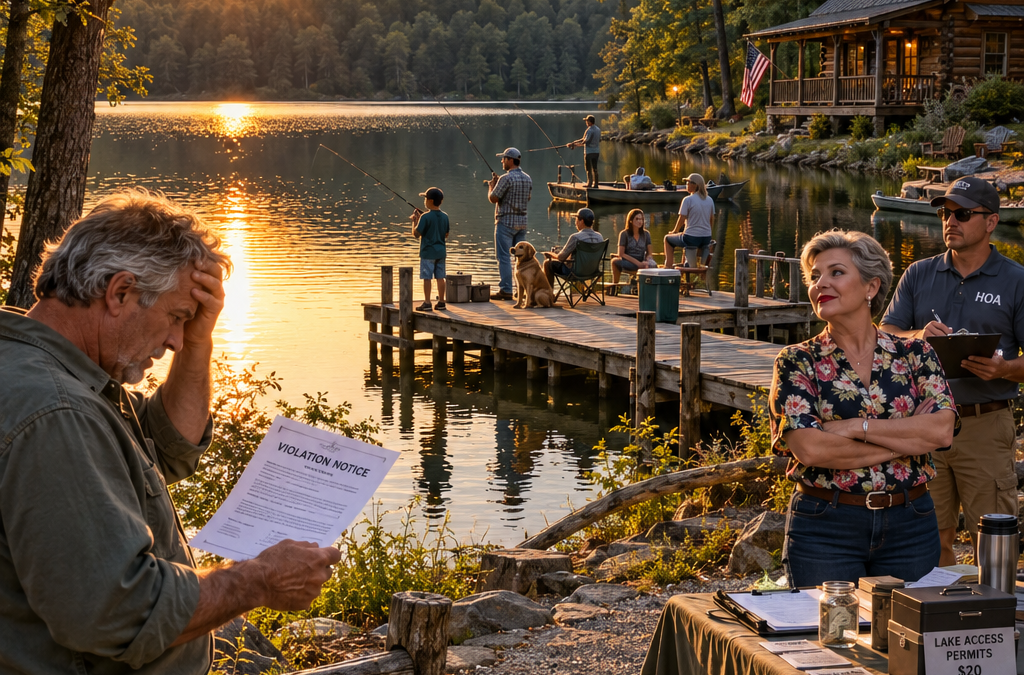
𝗙𝗨𝗟𝗟 𝗦𝗧𝗢𝗥𝗬
I laughed.
“You’re paranoid.”
Walter looked at me over his glasses.
“Give it time.”
The developer negotiated a limited road-maintenance agreement because one section of access crossed infrastructure shared with my grandfather’s property.
Walter agreed to pay a modest share for road maintenance.
Nothing more.
That distinction mattered.
The cabin parcel was not incorporated into the HOA’s residential covenant scheme in the same way as the subdivision homes.
The lake was not dedicated to the HOA.
No easement gave neighborhood residents access to the shoreline.
No recreational covenant granted boating or fishing rights.
No recorded document transferred control.
Walter insisted on that.
I didn’t appreciate how much trouble that insistence would save me until decades later.
Grandfather died eight years before this story began.
He was eighty-eight.
I inherited the cabin, the surrounding land, and the lake through the Reeves Family Trust.
I went up there the first weekend after the estate paperwork was finished.
The place felt wrong without him.
His coat still hung near the door.
There was an old coffee tin full of nails under the workbench.
His fishing hat sat on the wall hook where he always left it.
I walked down to the dock alone that evening.
The lake was completely still.
I remember thinking I had inherited something too large to own.
Not physically large.
Emotionally.
The cabin wasn’t simply real estate.
It held more of my family history than any photo album.
For the next several years, I used the place on weekends.
Sometimes alone.
Sometimes with my sister.
Occasionally with friends.
I fished.
Did repairs.
Kept the shoreline clean.
Replaced two dock sections.
I never blocked neighborhood roads or caused problems.
I even attended a few HOA meetings out of courtesy.
I paid the small road-maintenance assessment that my grandfather had agreed to.
Most residents were friendly.
Some asked whether they could walk near the lake.
Sometimes I said yes.
A father once asked whether he could bring his son to fish from the bank for an afternoon.
I agreed.
It was never about hoarding water.
It was about permission.
My grandfather believed that distinction was everything.
Then Dorothia Vance became HOA president.
Dorothia had lived in Heron Ridge for about six years before being elected.
She was probably in her late fifties.
Tall.
Always perfectly dressed.
She wore expensive outdoor clothes in places that did not require expensive outdoor clothes.
She spoke loudly even when everyone was listening.
And she had the dangerous quality of people who mistake administrative responsibility for personal jurisdiction.
Within six months of her election, Heron Ridge changed.
Violation notices increased.
A homeowner was fined over an unapproved shed stain.
Another got cited because his trailer remained in his driveway overnight.
Someone received three letters about a mailbox number being the wrong shade of bronze.
Dorothia created committees.
Parking committee.
Landscape compliance committee.
Recreation committee.
Community standards review.
Her emails always used phrases like protecting values and preserving neighborhood integrity.
I mostly ignored her.
The cabin wasn’t part of her kingdom.
At least that’s what I thought.
The first notice appeared on my cabin door in late May.
I drove up on Friday afternoon and saw a white envelope taped directly beside the handle.
The HOA logo was printed on the front.
I opened it standing on the porch.
WARNING NUMBER ONE.
Unauthorized recreational use of communal water feature.
I read the phrase twice.
Communal water feature.
Then the cited rule:
Heron Ridge Community Guidelines, Section 7, Paragraph 3.
Recreational use of shared community water amenities requires prior approval and compliance with association permit procedures.
I actually walked down toward the lake with the paper in my hand because I wondered whether they were somehow referring to a retention pond elsewhere in the neighborhood.
Then I reached the dock.
A small laminated sign had been zip-tied to one of my posts.
HERON RIDGE COMMUNITY WATER AREA.
AUTHORIZED USERS ONLY.
I stared at it.
Then cut the zip tie.
I called Dorothia.
She answered quickly.
“Heron Ridge HOA, Dorothia Vance.”
“This is Callum Reeves.”
There was a slight pause.
“Yes, Mr. Reeves.”
“I found a violation notice at my cabin.”
“I’m aware.”
“It says I’m using a communal water feature.”
“Correct.”
“I’m assuming you’re referring to Heron Lake.”
“That is the water feature in question.”
I looked out across the lake.
“It’s private property.”
“That interpretation is disputed.”
I almost laughed.
“By whom?”
“The association.”
“Based on what?”
“The lake has functioned as a shared community amenity for years.”
“No, it hasn’t.”
“Our residents use it.”
“Some residents have used it because I allowed them.”
“Community use has established expectations.”
“Expectations aren’t ownership.”
Dorothia’s voice changed.
Still calm.
Colder.
“Mr. Reeves, the association has reviewed the matter.”
“With a lawyer?”
“The board does not discuss internal legal review with individual residents.”
“I’m not an individual resident under your HOA.”
“You participate in association expenses.”
“I pay for road maintenance.”
“That establishes a relationship.”
“Not ownership of my lake.”
She sighed.
It was the kind of sigh people use when they want you to feel unreasonable.
“We’re trying to create consistent recreational standards.”
“On my property?”
“On a water resource serving the community.”
“It doesn’t serve the community.”
“That’s your opinion.”
“No, Dorothia. That’s my deed.”
There was silence.
Then she said, “If you continue fishing without an association permit, additional enforcement may follow.”
I looked at the rod leaning beside my dock.
“You want me to apply to your board for permission to fish in my own lake?”
“That’s the current requirement.”
I laughed.
I couldn’t help it.
Then I hung up.
That should have been the moment I called an attorney.
Instead, I let it go.
Partly because the whole thing seemed too absurd to become serious.
Partly because I didn’t want to spend money fighting over a piece of paper.
And partly because I underestimated Dorothia.
That was my mistake.
Three weeks later, the second notice arrived.
FINE: $500.
Repeated unauthorized recreational activity.
I read it inside the cabin.
Five hundred dollars.
For fishing.
On my own property.
I should have refused immediately.
Instead, I paid it under protest.
That decision still embarrasses me.
I included a certified letter.
The letter stated that payment did not constitute acceptance of HOA authority.
I wrote that Heron Lake was privately owned by the Reeves Family Trust.
That no HOA easement existed.
That no access agreement granted the association control over fishing.
That I reserved all legal rights.
I kept the certified receipt.
Dorothia never answered.
For two weeks, nothing happened.
Then the third letter came.
It arrived at my primary home on a Tuesday.
The envelope was thicker.
Certified mail.
I signed for it.
Carried it inside.
Opened it at the kitchen table.
The number was printed halfway down the first page.
$100,000.
I thought I had misread it.
One hundred thousand dollars.
The notice cited repeated violations.
Willful noncompliance.
Unauthorized fishing activity.
Damage to a shared water resource.
Interference with environmental controls.
Failure to obtain recreational permits.
There were penalties stacked on penalties.
Administrative fees.
Daily assessments.
Escalation provisions.
I read every page.
Then started over.
$100,000.
“This can’t be real,” I said aloud.
There was nobody else in the room.
I felt cold.
That amount was not annoying.
It was threatening.
A hundred thousand dollars could damage my savings.
Force litigation.
Create a lien fight.
Complicate the trust.
They knew that.
This wasn’t a warning anymore.
This was pressure.
The final paragraph stated that failure to pay could result in collection remedies, including liens or legal action where permitted.
I sat there for a long time.
Then I called an attorney.
His name was Sheldon Marsh.
Sheldon specialized in property law, boundary disputes, easements, and HOA litigation.
A friend had used him years earlier.
I explained the situation.
There was a long pause.
Then he asked, “Who owns the lake bed?”
“The Reeves Family Trust.”
“You sure?”
“Yes.”
“Do you have the deed?”
“Somewhere.”
“Find it.”
“I can.”
“Any easement?”
“Not that I know of.”
“Recorded recreational rights?”
“No.”
“HOA dedication?”
“No.”
“Then don’t pay another cent.”
“What about the hundred thousand?”
“Send me everything.”
I scanned the notices.
The old road agreement.
The protest letter.
The trust documents.
Before Sheldon called back, my phone rang again.
It was a neighbor from Heron Ridge.
I’ll call him Thomas.
That wasn’t his real name.
He had always been decent to me.
Older guy.
Retired machinist.
We had spoken many times near the mailboxes and once repaired a fallen branch across the shared road together.
His voice sounded nervous.
“Callum, you got a minute?”
“Yeah.”
“I heard about the fine.”
“That was fast.”
“Dorothia mentioned enforcement at the board meeting.”
“Of course she did.”
There was silence.
Then Thomas said, “You need to know what’s been happening.”
Something in his tone changed my posture.
“What?”
“They’ve been telling people the lake belongs to the community.”
I closed my eyes.
“I know.”
“No. I mean officially.”
“What does that mean?”
“Welcome packets.”
I didn’t answer.
“When new people move in,” he continued, “the HOA packet lists Heron Lake as a shared recreational amenity.”
My hand tightened around the phone.
“Since when?”
“Couple years, I think.”
“Anything else?”
Another pause.
“We pay a lake fee.”
I stood up.
“What?”
“Thirty dollars a month.”
“For what?”
“Access.”
“Access to my lake?”
“That’s what they say.”
I started walking around the kitchen.
“How many people pay this?”
“Everybody, I think.”
“All eighty-four houses?”
“Far as I know.”
“How long?”
“Two years, maybe more.”
I stopped.
“They’ve been charging residents thirty dollars a month to use the lake?”
“Yeah.”
“Did they tell you who owned it?”
“They said it was a community amenity.”
“Did Dorothia specifically say that?”
“She said it at meetings.”
“Have you used the lake?”
Thomas hesitated.
“Couple times.”
“Because you thought you were paying for access.”
“Yes.”
I wasn’t angry at him.
That surprised me.
Residents had been lied to too.
“Do you have one of those welcome packets?”
“My daughter kept ours from when they revised them.”
“Can you send me a photo?”
“I’ll find it.”
Ten minutes later, he sent six images.
Page twelve.
HERON RIDGE COMMUNITY AMENITIES.
Pool.
Walking trails.
Picnic green.
Heron Lake.
Seasonal recreational use permitted to members in good standing.
I stared at the page.
There was a photograph of my dock.
My grandfather’s dock.
Listed as an HOA amenity.
Below it:
Monthly lake amenity fee: $30 per household.
That’s when the entire dispute changed.
Before that moment, Dorothia had been overreaching.
Now she was monetizing my property.
I called Sheldon again.
“Forget just the fine.”
“What happened?”
“They’re selling access.”
“To the lake?”
“Thirty dollars a month per house.”
“How many houses?”
“Eighty-four.”
“How long?”
“At least two years.”
Sheldon became completely silent.
Then he said, “Send me what you have.”
I did.
Forty-eight hours later, Sheldon had the original deed history.
We met at his office Friday morning.
He laid the documents on a conference table.
“This is unusually clean.”
“Meaning?”
“Your grandfather did good paperwork.”
I smiled despite everything.
“That sounds like him.”
Sheldon pointed to the deed.
“Lake bed included.”
Then the survey.
“Watershed boundary.”
Another document.
“Shoreline property.”
Then the 2003 development records.
“No dedication.”
Another page.
“No easement.”
The original HOA declaration.
“No lake.”
I leaned forward.
“Not even mentioned?”
“Not once.”
“What about the road agreement?”
“Road maintenance only.”
“Can the HOA claim years of use created rights?”
“Not the way they’re doing it.”
“What about residents who’ve been fishing there?”
“Permission matters. Occasional licensed or permissive use doesn’t magically create HOA ownership.”
He leaned back.
“Callum, based on what I’m looking at, the association has no recorded recreational right to Heron Lake.”
“And the fine?”
“Legally indefensible if the facts remain what they appear to be.”
“Can they lien the cabin?”
“They can attempt many stupid things. That doesn’t mean they survive court.”
I exhaled.
That was the first moment in three days I felt like I could breathe.
Then Sheldon pointed to the welcome packet.
“This is what interests me more.”
“The fee.”
“Yes.”
“Is that illegal?”
“I’m not making that conclusion yet.”
“Then what is it?”
“A very serious accounting problem.”
He looked at me.
“They’re charging money for access to private property they don’t control.”
“Can I recover it?”
“Maybe.”
“I don’t care about keeping residents’ money.”
“Good.”
“I care that they’re selling what isn’t theirs.”
“So do I.”
That afternoon, Sheldon sent a formal legal notice to the entire board.
He did not send it only to Dorothia.
That was deliberate.
The letter was fourteen pages.
It established the deed history from 1961 forward.
Identified the Reeves Family Trust.
Quoted the county records.
Explained the lake-bed ownership.
Attached the watershed survey.
Referenced relevant Virginia property law.
Declared the $500 fine and $100,000 assessment void and unenforceable.
Demanded immediate cessation of any claim that Heron Lake was an HOA-controlled amenity.
Then came the part that changed the board’s problem from theoretical to financial.
Provide a full accounting of all lake amenity fees collected during the previous twenty-four months.
Every payment.
Every expenditure.
Every disbursement.
Every account.
Every communication authorizing those charges.
The HOA was given a deadline.
They ignored it.
No formal response.
No accounting.
No lawyer letter.
Nothing.
Instead, Dorothia sent an email.
To all eighty-four homeowners.
Thursday evening.
The subject line:
URGENT COMMUNITY NOTICE – THREAT TO HERON RIDGE AMENITIES.
I received a forwarded copy within minutes.
Dorothia wrote that a private individual was attempting a “hostile property grab.”
Me.
The person whose family had owned the lake for more than forty years before Heron Ridge existed.
She claimed I was trying to strip residents of a resource they had “collectively maintained, funded, and enjoyed.”
She said the board would resist.
She urged unity.
She warned that legal action might become necessary to preserve community rights.
By the time I finished reading, I was angry enough that my hands shook.
I called Sheldon.
“Did you see it?”
“Yes.”
“Hostile property grab?”
“I particularly enjoyed that part.”
“She’s telling them I’m stealing my own lake.”
“I know.”
“What do we do?”
“We stop debating her.”
Friday morning, Sheldon filed for temporary injunctive relief preventing the HOA from imposing additional lake-related fines while the ownership dispute was being adjudicated.
Then we served a formal trespass notice.
That was my decision.
And unlike the first time I paid the $500, I did not hesitate.
Effective immediately, HOA residents and board members were prohibited from entering privately owned Heron Lake property without written permission.
The restriction applied to the dock.
Shoreline.
Private access trails.
Watershed land.
Launch points inside my property boundary.
Any boats stored there had to be removed.
Any fishing access granted under supposed HOA authority ended.
I posted proper signage.
PRIVATE PROPERTY.
NO HOA ACCESS.
WRITTEN PERMISSION REQUIRED.
The next forty-eight hours were chaos.
Not because people resisted.
Because most residents had no idea.
Saturday morning, a family arrived with two kayaks.
I met them near the lake.
The father looked confused.
“We have lake access.”
“Not through the HOA.”
“We pay for it.”
“I know.”
He frowned.
“Thirty dollars every month.”
“I know.”
“Then what are we paying for?”
“That’s a question for your board.”
His wife looked toward the dock.
“You’re saying this is yours?”
“My family’s since 1961.”
She laughed nervously.
“No, seriously.”
I handed her a copy of the survey.
She read it.
Then looked at her husband.
They loaded the kayaks back onto their SUV.
“I’m sorry,” he said.
“You didn’t know.”
“We’ve been coming here for almost a year.”
“I know.”
“Dorothia told us the HOA maintained the lake.”
“They don’t.”
“Then where does the money go?”
That question spread through Heron Ridge faster than anything I could have said.
Within days, residents weren’t primarily angry at me anymore.
They were angry at the board.
Thirty dollars doesn’t sound enormous.
But thirty dollars per household across eighty-four homes is $2,520 every month.
Over twenty-four months:
$60,480.
More than sixty thousand dollars.
Residents started requesting financial reports.
That was when the board treasurer got involved.
His name was Gareth Sinclair.
Gareth was probably the quietest person on the board.
Late sixties.
Retired accountant.
Wore glasses on a cord.
At meetings, he spoke rarely but always had papers arranged in exact stacks.
I barely knew him.
Then he called me.
“Mr. Reeves?”
“Callum is fine.”
“Gareth Sinclair.”
“I know who you are.”
“I’d like to speak privately.”
“About the lake fees?”
A pause.
“Yes.”
We met at a coffee shop outside the development.
Gareth brought a binder.
He looked uncomfortable.
“I’m going to be careful about what I say.”
“Understood.”
“The association has collected a dedicated lake amenity fee.”
“I know.”
“The amounts described by your attorney are substantially correct.”
“Where did the money go?”
His jaw tightened.
“That’s what I’m trying to determine.”
I stared at him.
“You’re the treasurer.”
“I receive reports.”
“That doesn’t answer me.”
“No.”
He removed his glasses.
“I should have asked harder questions.”
That sentence told me enough.
“How much is in the lake reserve?”
He hesitated.
“Under twelve thousand.”
I felt anger rise.
“From sixty thousand?”
“Approximately.”
“Where’s the other forty-eight?”
“I don’t know.”
“Gareth.”
“I don’t know.”
He sounded genuinely sick.
“Some expenditures were labeled maintenance.”
“Maintenance of what?”
“Shore access. Water quality. Recreational infrastructure.”
“My shoreline?”
“Apparently.”
“Did anyone ask me?”
“No.”
“Did anyone actually do forty-eight thousand dollars’ worth of work?”
He looked down.
“Not that I can verify.”
“What did Dorothia tell you?”
“That the recreation committee managed vendor expenses.”
“Who chaired that?”
He didn’t answer.
“Dorothia?”
“Yes.”
We sat silently.
Finally Gareth said, “I’m calling an emergency board session.”
“Good.”
“And I’m hiring an independent forensic accountant.”
“Better.”
He looked at me.
“I owe you an apology.”
“For what?”
“I signed financial reports.”
“You were lied to too.”
“That doesn’t remove responsibility.”
I respected him for saying that.
Within three weeks, the preliminary accounting was bad enough that the board acted.
Emergency meeting.
Full attendance.
Dorothia defended herself.
She said lake-fee expenditures had benefited the community.
She claimed certain records were incomplete.
She argued the recreation committee had broad discretion.
Then Gareth presented the accounting.
The lake fund should have contained far more money.
Several expenditures lacked supporting invoices.
Some vendor descriptions were vague.
Other charges appeared unrelated to the lake altogether.
And there were transfers.
Small enough individually to avoid attention.
Large enough together to matter.
The board voted unanimously to remove Dorothia as president pending full review.
She resigned before they completed the vote on additional sanctions.
That did not end the financial investigation.
It probably made it worse.
The matter was referred to the county attorney.
Residents demanded an independent audit.
The HOA’s insurer became involved.
The management company suddenly became very interested in records preservation.
I never enjoyed that part.
People expected me to.
They assumed watching Dorothia lose control must have felt satisfying.
Mostly it felt sad.
Not for her.
For the neighborhood.
Eighty-four families had been told they were buying something.
They paid.
They trusted.
Some planned weekends around lake access.
Parents taught children to fish there.
People bought kayaks.
They believed it belonged to them because an HOA newsletter said so.
Then one Friday they learned it never had.
I received angry messages at first.
One resident wrote:
We’ve paid for this lake for two years. You can’t suddenly close it.
I replied:
I didn’t charge you.
The HOA did.
Another wrote:
My family has used the lake every summer.
I answered:
You were told you had authority that the HOA did not possess.
Most people calmed down when they saw the records.
Some apologized.
A few did not.
I understood their anger.
They had lost something too.
Even if what they lost had never legally been theirs.
The $100,000 fine disappeared quickly once attorneys became involved.
Officially rescinded.
The $500 I had paid under protest was refunded.
The HOA sent a letter acknowledging that Heron Lake was privately owned and outside its recreational authority absent a valid access agreement.
I framed that letter beside my grandfather’s original survey.
Not because I enjoy HOA memorabilia.
Because I wanted the contrast.
1961:
ownership.
Decades later:
admission.
My grandfather had trusted paper more than promises.
He was right.
But there was still the practical problem.
What should happen to the lake?
I could have kept it closed permanently.
Sheldon told me I had every right.
“No easement,” he said. “No access.”
I thought about it.
For weeks.
Part of me wanted to make the ban permanent.
Not because I hated the residents.
Because I wanted the boundary understood.
Grandfather had protected that water for decades.
Dorothia’s board had treated it like inventory.
Closing it forever would have been simple.
Then one Saturday, I found an envelope under the cabin door.
No HOA logo.
Inside was a letter written by a twelve-year-old boy named Mason.
His family had moved into Heron Ridge the previous year.
He wrote that his dad had taught him to fish on Heron Lake.
He said he understood now that the HOA had not owned it.
He apologized even though he had nothing to apologize for.
Then he wrote:
I hope someday people can fish there again because it’s the first place I caught a bass.
I read that line several times.
I remembered being six.
My grandfather untangling fishing line.
The bluegill.
The dock before sunrise.
The problem had never been children fishing.
Or neighbors paddling.
The problem was entitlement.
So I called Sheldon.
“What would a real access agreement look like?”
He laughed.
“I wondered when you’d ask.”
We negotiated with the new board.
Slowly.
Every term in writing.
Every boundary clear.
No implied HOA ownership.
No permanent recreational easement.
No adverse-use claim.
No right to expand access.
Seasonal permits only.
Residents could apply.
Fishing hours established.
Boat restrictions.
No motorized craft.
No shoreline construction.
No guests without permission.
No commercial use.
No events.
The access fee would no longer go into an HOA discretionary fund.
Instead, it would go into a dedicated maintenance account under the control of the Reeves Family Trust.
Every dollar would be used for the dock, shoreline erosion, trash removal, water-quality testing, insurance, and legitimate lake maintenance.
Annual accounting available to permit holders.
Most importantly, the agreement stated in language so clear nobody could misread it:
Heron Lake remains the exclusive private property of the Reeves Family Trust.
No permit creates ownership.
No permit creates an easement.
No HOA payment creates an interest in the lake.
No past HOA representation establishes any property right.
We recorded the agreement with the county.
Grandfather would have approved of that part.
Maybe not the rest.
Walter wasn’t generous with access.
But I think he would have understood.
The first morning seasonal fishing reopened, I drove to the cabin before sunrise.
Three residents had permits.
Mason and his father were among them.
They waited near the dock instead of walking straight down.
That mattered to me.
His father held up the permit.
“Morning.”
“Morning.”
“We’re good?”
I looked at the paper.
“You are.”
Mason grinned.
“Can I use the end of the dock?”
“That’s where the fish are.”
He ran ahead.
His father stayed behind.
“I want to apologize.”
“You don’t need to.”
“I used the lake for a year without asking.”
“You thought you had permission.”
“Still.”
He looked over the water.
“We trusted the wrong person.”
“That happens.”
He nodded.
Then said, “Thanks for reopening it.”
I watched his son cast from the dock.
“Take care of it.”
“We will.”
That sentence meant more than the fee.
Take care of it.
That was always what my grandfather wanted.
Not control for the sake of control.
Stewardship.
There is a difference.
The forensic accounting took months.
I never learned every detail because portions became part of legal proceedings and settlement discussions.
What became public was enough.
More than sixty thousand dollars in lake amenity fees had been collected.
Less than twelve thousand remained when questions began.
Some expenses could be documented as legitimate community recreation costs.
Others could not.
Several expenditures had been authorized without sufficient board oversight.
Dorothia had concentrated too much control over the program.
The county attorney investigated whether representations about the fund and expenditures crossed into criminal conduct.
I stayed out of that process.
Sheldon advised me to.
“Your case is property,” he said. “Let investigators handle money.”
So I did.
Dorothia eventually moved out of Heron Ridge.
I saw the moving truck one winter morning.
I didn’t speak to her.
There was nothing left to say.
People sometimes imagine stories like this should end with confrontation.
Me standing in her driveway.
Her apologizing.
Me delivering some perfect sentence about justice.
Real life rarely gives you scenes that clean.
Dorothia never apologized to me.
Not personally.
Maybe she believed she had done nothing wrong.
Maybe she believed the lake should have belonged to the community simply because enough people used it.
That mentality bothered me more than the money.
The idea that repeated use becomes entitlement.
That desire becomes jurisdiction.
That a board can vote itself authority over something outside its deed.
People do that more often than they realize.
They use something long enough and begin speaking about it as though access and ownership mean the same thing.
They don’t.
Permission isn’t ownership.
Tradition isn’t ownership.
An HOA newsletter isn’t ownership.
A monthly fee paid to someone who lacks title isn’t ownership.
The deed matters.
The easement matters.
The recorded record matters.
I wish I had remembered that when the first warning arrived.
Instead, I let Dorothia frame the dispute.
She said communal water feature.
I argued.
She said permit.
I argued.
She fined me $500.
I paid.
That was the worst decision I made.
Not because five hundred dollars mattered.
Because payment told her pressure worked.
She saw compliance.
So she escalated.
One hundred thousand dollars.
That number was designed to frighten me into accepting her premise.
Apply for the permit.
Accept HOA jurisdiction.
Stop questioning ownership.
If I had done that, the paper trail might eventually have looked very different.
That is the part people underestimate about small disputes.
Sometimes the money isn’t the objective.
The precedent is.
A permit application could have been used to argue that I recognized their authority.
A payment could be cited as compliance.
A signed community-use form might muddy the ownership record.
Grandfather understood that kind of thing instinctively.
I didn’t.
Not until I had to.
After everything ended, I spent more time at the cabin.
I repaired the west wall.
Replaced the old screen door.
Restored part of the dock.
I found one of Walter’s old tackle boxes beneath a shelf in the storage room.
Inside were rusted hooks, lead sinkers, two wooden lures, and a folded copy of the original lake survey.
Of course.
He had copies everywhere.
I unfolded it on the workbench.
The paper was yellow.
Boundary lines drawn in dark ink.
HERON LAKE.
REEVES PARCEL.
I imagined him standing over the same map sixty years earlier.
He had no idea there would ever be eighty-four houses nearby.
No idea an HOA president would someday call his water a communal feature.
No idea people would pay monthly fees to fish from his shoreline.
But he understood one thing.
Ownership needed records.
He kept them.
That saved me.
The lake changed after the dispute.
Not physically.
Legally.
Socially.
Residents treated it differently.
People asked now.
They waited for permits.
They respected posted areas.
When somebody’s guest wandered toward the shoreline without permission, another resident would usually stop them before I had to.
The HOA stopped advertising the lake as an amenity.
Instead, its website listed:
Private Heron Lake – seasonal access available through separate Reeves Family Trust permit agreement.
Accurate.
Boring.
Perfect.
Gareth stayed on the board for another year.
Then resigned voluntarily.
Before leaving, he came to the cabin.
He had never fished there.
Not once.
I asked him why.
“Never felt like it was mine.”
I smiled.
“You might be the only person who understood that.”
He looked embarrassed.
“I still signed reports I should’ve questioned.”
“You fixed it.”
“Late.”
“Still counts.”
He sat on the dock with me.
We talked about financial controls.
Not exactly lakeside conversation, but Gareth was Gareth.
He told me the board had changed its procedures.
No special-purpose fee could be created without a published budget.
Dedicated accounts required quarterly reporting.
Any recreation fee had to identify the legal basis for the underlying amenity.
Conflict disclosures became mandatory.
Vendor payments needed dual approval.
“Sounds exciting,” I said.
He almost smiled.
“Boring is the goal.”
He was right.
Good governance should be boring.
The problems start when one person becomes exciting.
Visionary.
Powerful.
Indispensable.
Dorothia had convinced people she was improving the neighborhood.
New programs.
More amenities.
More enforcement.
More value.
She was always announcing something.
People mistook activity for competence.
Sometimes the most responsible leader is the one who says:
We don’t own that.
We don’t have authority there.
We need permission.
We need a vote.
We need to show the numbers.
Those sentences rarely impress anyone.
They prevent disasters.
The $100,000 notice is still in my desk.
I kept it.
Sheldon told me I should preserve everything anyway.
Even after the legal issues ended, I couldn’t bring myself to throw it out.
Every now and then I pull it from the folder.
One hundred thousand dollars.
For fishing in my own lake.
It still looks unreal.
The language is even stranger now.
Damage to shared water resource.
Willful unauthorized activity.
Repeated community violations.
The confidence of it is almost impressive.
No deed attached.
No easement.
No title report.
No legal basis.
Just authority expressed loudly enough that they assumed it would become real.
That was Dorothia’s mistake.
She believed certainty could substitute for ownership.
It couldn’t.
A few years after the dispute, I brought my nephew to the cabin.
He was seven.
Almost exactly the age I had been when Walter first took me fishing.
We woke before sunrise.
Walked down to the dock.
Mist on the water.
He talked constantly.
Children have no respect for fishing silence.
I helped him tie a hook.
He asked why there were private-property signs around the shoreline.
“Because people need to know where they’re allowed to go.”
“Why?”
“Because somebody once forgot.”
He accepted that explanation.
Kids don’t need the full story.
His first cast went about eight feet.
Second hit the dock.
Third tangled.
I sat down.
Started working the knot.
For a second, I could see my grandfather’s hands instead of mine.
Old fingers.
Fishing line.
Morning light.
My nephew said, “Are you mad?”
“No.”
“I messed it up.”
“That’s what fishing line does.”
I fixed it.
Handed the rod back.
He cast again.
Twenty minutes later, he caught a bluegill.
Tiny.
Barely bigger than my hand.
His face lit up.
“Can we keep it?”
I looked at the fish.
Then at him.
“Big enough if you’re hungry.”
He stared at me.
“What?”
I laughed.
“Nothing.”
We released it.
That morning reminded me what all of this had really been about.
Not fines.
Not HOAs.
Not Dorothia.
Continuity.
A place existing long enough that one generation can stand where another stood.
A dock board replaced but still part of the same dock.
A cabin repaired but still Walter’s cabin in all the ways that matter.
A lake where a six-year-old boy caught a bluegill and decades later another child did the same.
Ownership is legal.
But stewardship is emotional.
Dorothia understood neither.
She saw the lake and saw an amenity.
A marketing asset.
A fee.
Something to include in a welcome packet.
Something the HOA could claim because it increased property value.
My grandfather saw a place worth protecting.
I see both now.
The law protects ownership.
But documents alone don’t protect meaning.
People do.
That is why I reopened access.
Not because Heron Ridge was entitled to it.
Because entitlement had finally been removed from the equation.
Now anyone who fishes there understands they are a guest.
That changed everything.
Guests ask.
Guests respect.
Guests know access can be lost.
Owners know responsibility comes with saying yes sometimes, not just no.
Most weekends are peaceful again.
I sit on the dock.
Fish.
Watch families on the far bank.
Sometimes Mason is there.
He’s older now.
Better at casting than I am willing to admit.
He once asked me whether the HOA really fined me one hundred thousand dollars.
“Who told you?”
“My dad.”
“Your dad talks too much.”
“So they did?”
“They tried.”
“For fishing?”
“Yep.”
“That’s stupid.”
“Yep.”
He thought for a second.
“Could they fine you now?”
“No.”
“Why?”
I looked across the lake.
“Because now everybody knows whose water they’re standing beside.”
That answer seemed to satisfy him.
It satisfies me too.
The neighborhood never became perfect.
No neighborhood does.
There are still arguments about landscaping.
Parking.
Pool hours.
Trash cans.
Somebody once spent almost an entire meeting arguing that residents should be prohibited from painting front doors black.
I left early.
But Heron Lake never became an HOA issue again.
Every permit is separate.
Every dollar documented.
Every right recorded.
Every boundary understood.
Exactly the way Walter would have wanted.
Sometimes, late in the evening, I sit outside the cabin with his old deed copy in my desk behind me.
The lake turns black after sunset.
You can hear frogs along the reeds.
Occasionally a fish breaks the surface.
That is when I think about the Tuesday the $100,000 notice arrived.
I remember staring at the number.
Thinking:
This will ruin me.
It’s impossible.
I had let a piece of paper make me feel powerless.
That’s what official language can do.
Especially when it comes with threats.
Fine.
Lien.
Enforcement.
Violation.
Authority.
Those words sound heavy.
But they are only as strong as the right behind them.
Dorothia had the words.
My grandfather had the deed.
In the end, that difference was everything.
Heron Ridge residents still fish the lake.
But now they do it honestly.
They know what they are paying for.
They know where the money goes.
They know the shoreline is private.
They know access exists because I chose to grant it, not because an HOA president invented a right in a welcome packet.
And every year when I review the maintenance account, I think about the sixty thousand dollars collected before anyone asked enough questions.
A fee doesn’t become legitimate because people have paid it for years.
A rule doesn’t become legal because it appears in an email.
Authority doesn’t become ownership because a board votes unanimously.
And a lake doesn’t become communal because someone prints the word communal above it.
Walter Reeves bought Heron Lake in 1961.
He built a cabin on its shore with his own hands.
He protected the deed.
He protected the boundary.
He left both to me.
For a while, I almost allowed people who arrived forty years later to convince me that history could be overwritten by an HOA guideline.
It couldn’t.
The lake is still where it has always been.
The cabin is still standing.
The dock still creaks under my feet.
And when I cast a line into the water now, I don’t think about Dorothia Vance.
I think about my grandfather.
About his old hands untangling my line.
About the survey folded inside his tackle box.
About the warning he never needed to say out loud because every document he preserved said it for him.
Know what belongs to you.
Know what you are allowing.
And never confuse someone’s confidence with their right to take it.
𝗧𝗛𝗘 𝗘𝗡𝗗
The HOA Fined Me $100,000 for Fishing in My Grandfather’s Lake and Never Asked Who Actually Owned the Water
The letter on my kitchen table said I owed the HOA one hundred thousand dollars for repeatedly fishing without permission in the lake my grandfather had owned since 1961.
I might have laughed if the number had been smaller, but when I learned the HOA had quietly spent two years charging eighty-four families for access to that same water, the fine stopped looking ridiculous and started looking like evidence.
My name is Callum Reeves, and I am not someone who goes looking for fights.
That matters.
Because when people hear the end of this story, they sometimes assume I must have been waiting for an excuse to take on the HOA.
I wasn’t.
I spent most of my adult life avoiding unnecessary conflict.
If somebody cut me off in traffic, I let them go.
If a neighbor’s dog wandered into my yard, I walked it home.
If somebody parked partly across my driveway, I knocked before calling anyone.
I believed most problems became worse when pride got involved.
My grandfather Walter believed almost the exact opposite.
He used to say, “A man who refuses every fight eventually teaches people they can take from him.”
When I was younger, I thought that was just something an old man said because he had grown up in a harder time.
I understand it differently now.
Heron Lake sits in the hills of western Virginia, hidden behind a low ridge covered in pine, hickory, and oak.
It isn’t enormous.
Depending on rainfall, maybe thirty acres of open water.
Large enough that mist sits above it in October mornings.
Small enough that on a quiet evening, you can hear someone close a dock box from the opposite shore.
The lake existed long before the neighborhood around it.
Long before the HOA.
Long before paved streets, decorative stone entrance signs, mail kiosks, landscaping committees, or community newsletters.
My grandfather bought the property in 1961.
Back then, most of the surrounding area was timberland.
There was an old gravel access track, a few hunting camps, and not much else.
Walter was thirty-six.
He had recently come home from years of working construction across several states and wanted somewhere quiet.
He found a parcel surrounding Heron Lake that had been part of a larger private tract.
The original deed transferred not just shoreline acreage but the lake bed and water rights associated with the parcel.
Grandfather understood exactly what that meant.
He kept the deed.
The survey.
The old plats.
He kept everything.
That first summer, he started building a cabin on the eastern shore.
No contractor.
No crew beyond friends who came up on weekends.
Just Walter.
He poured the footings.
Framed the walls.
Cut rafters.
Built a stone chimney.
When he couldn’t afford enough lumber, he waited.
When weather turned, he covered the structure and came back in spring.
It took two summers before the cabin was finished enough for my grandmother to stop calling it “Walter’s expensive pile of boards.”
By the time I was a kid, it had become the center of our family.
The cabin smelled like cedar, woodsmoke, old fishing gear, and coffee.
The floors sloped slightly toward the fireplace.
One kitchen cabinet never closed unless you lifted it first.
The screen door snapped hard enough to shake the wall.
Nothing matched.
Everything mattered.
My grandfather took me fishing for the first time when I was six.
We sat at the end of the dock before sunrise.
He handed me a spinning rod with too much line on it.
I tangled it almost immediately.
Then again.
Then a third time.
He never got angry.
He just took the line, loosened the knots, and handed the rod back.
When I finally caught a small bluegill, I thought I had done something extraordinary.
Walter examined the fish.
“That’s dinner.”
“It isn’t big enough.”
“It’s big enough if you’re hungry.”
We released it anyway.
Most of my summers happened there.
I learned to swim in Heron Lake.
Learned to paddle a canoe.
Learned where bass stayed in July and where trout gathered when the water cooled.
My grandfather taught me how to repair dock boards, sharpen hooks, clean fish, and sit still.
He believed silence was a skill.
When the land around Heron Lake began changing in the late 1990s, Walter hated it.
A developer bought several hundred acres outside his property boundary.
Roads appeared.
Then houses.
By 2003, the development had a name.
Heron Ridge.
There were eventually eighty-four homes.
Large homes.
Stone fronts.
Matching mailboxes.
Curving roads.
The neighborhood looked expensive without looking wealthy enough to offend anyone.
And of course, there was an HOA.
Heron Ridge Homeowners Association.
Grandfather was immediately suspicious.
“They’ll start with the road,” he told me.
I was in college then.
“What road?”
“The shared access.”
“What about it?”
“They’ll say they’re maintaining it, so they get to decide what happens at the end of it.”
I laughed.
“You’re paranoid.”
Walter looked at me over his glasses.
“Give it time.”
The developer negotiated a limited road-maintenance agreement because one section of access crossed infrastructure shared with my grandfather’s property.
Walter agreed to pay a modest share for road maintenance.
Nothing more.
That distinction mattered.
The cabin parcel was not incorporated into the HOA’s residential covenant scheme in the same way as the subdivision homes.
The lake was not dedicated to the HOA.
No easement gave neighborhood residents access to the shoreline.
No recreational covenant granted boating or fishing rights.
No recorded document transferred control.
Walter insisted on that.
I didn’t appreciate how much trouble that insistence would save me until decades later.
Grandfather died eight years before this story began.
He was eighty-eight.
I inherited the cabin, the surrounding land, and the lake through the Reeves Family Trust.
I went up there the first weekend after the estate paperwork was finished.
The place felt wrong without him.
His coat still hung near the door.
There was an old coffee tin full of nails under the workbench.
His fishing hat sat on the wall hook where he always left it.
I walked down to the dock alone that evening.
The lake was completely still.
I remember thinking I had inherited something too large to own.
Not physically large.
Emotionally.
The cabin wasn’t simply real estate.
It held more of my family history than any photo album.
For the next several years, I used the place on weekends.
Sometimes alone.
Sometimes with my sister.
Occasionally with friends.
I fished.
Did repairs.
Kept the shoreline clean.
Replaced two dock sections.
I never blocked neighborhood roads or caused problems.
I even attended a few HOA meetings out of courtesy.
I paid the small road-maintenance assessment that my grandfather had agreed to.
Most residents were friendly.
Some asked whether they could walk near the lake.
Sometimes I said yes.
A father once asked whether he could bring his son to fish from the bank for an afternoon.
I agreed.
It was never about hoarding water.
It was about permission.
My grandfather believed that distinction was everything.
Then Dorothia Vance became HOA president.
Dorothia had lived in Heron Ridge for about six years before being elected.
She was probably in her late fifties.
Tall.
Always perfectly dressed.
She wore expensive outdoor clothes in places that did not require expensive outdoor clothes.
She spoke loudly even when everyone was listening.
And she had the dangerous quality of people who mistake administrative responsibility for personal jurisdiction.
Within six months of her election, Heron Ridge changed.
Violation notices increased.
A homeowner was fined over an unapproved shed stain.
Another got cited because his trailer remained in his driveway overnight.
Someone received three letters about a mailbox number being the wrong shade of bronze.
Dorothia created committees.
Parking committee.
Landscape compliance committee.
Recreation committee.
Community standards review.
Her emails always used phrases like protecting values and preserving neighborhood integrity.
I mostly ignored her.
The cabin wasn’t part of her kingdom.
At least that’s what I thought.
The first notice appeared on my cabin door in late May.
I drove up on Friday afternoon and saw a white envelope taped directly beside the handle.
The HOA logo was printed on the front.
I opened it standing on the porch.
WARNING NUMBER ONE.
Unauthorized recreational use of communal water feature.
I read the phrase twice.
Communal water feature.
Then the cited rule:
Heron Ridge Community Guidelines, Section 7, Paragraph 3.
Recreational use of shared community water amenities requires prior approval and compliance with association permit procedures.
I actually walked down toward the lake with the paper in my hand because I wondered whether they were somehow referring to a retention pond elsewhere in the neighborhood.
Then I reached the dock.
A small laminated sign had been zip-tied to one of my posts.
HERON RIDGE COMMUNITY WATER AREA.
AUTHORIZED USERS ONLY.
I stared at it.
Then cut the zip tie.
I called Dorothia.
She answered quickly.
“Heron Ridge HOA, Dorothia Vance.”
“This is Callum Reeves.”
There was a slight pause.
“Yes, Mr. Reeves.”
“I found a violation notice at my cabin.”
“I’m aware.”
“It says I’m using a communal water feature.”
“Correct.”
“I’m assuming you’re referring to Heron Lake.”
“That is the water feature in question.”
I looked out across the lake.
“It’s private property.”
“That interpretation is disputed.”
I almost laughed.
“By whom?”
“The association.”
“Based on what?”
“The lake has functioned as a shared community amenity for years.”
“No, it hasn’t.”
“Our residents use it.”
“Some residents have used it because I allowed them.”
“Community use has established expectations.”
“Expectations aren’t ownership.”
Dorothia’s voice changed.
Still calm.
Colder.
“Mr. Reeves, the association has reviewed the matter.”
“With a lawyer?”
“The board does not discuss internal legal review with individual residents.”
“I’m not an individual resident under your HOA.”
“You participate in association expenses.”
“I pay for road maintenance.”
“That establishes a relationship.”
“Not ownership of my lake.”
She sighed.
It was the kind of sigh people use when they want you to feel unreasonable.
“We’re trying to create consistent recreational standards.”
“On my property?”
“On a water resource serving the community.”
“It doesn’t serve the community.”
“That’s your opinion.”
“No, Dorothia. That’s my deed.”
There was silence.
Then she said, “If you continue fishing without an association permit, additional enforcement may follow.”
I looked at the rod leaning beside my dock.
“You want me to apply to your board for permission to fish in my own lake?”
“That’s the current requirement.”
I laughed.
I couldn’t help it.
Then I hung up.
That should have been the moment I called an attorney.
Instead, I let it go.
Partly because the whole thing seemed too absurd to become serious.
Partly because I didn’t want to spend money fighting over a piece of paper.
And partly because I underestimated Dorothia.
That was my mistake.
Three weeks later, the second notice arrived.
FINE: $500.
Repeated unauthorized recreational activity.
I read it inside the cabin.
Five hundred dollars.
For fishing.
On my own property.
I should have refused immediately.
Instead, I paid it under protest.
That decision still embarrasses me.
I included a certified letter.
The letter stated that payment did not constitute acceptance of HOA authority.
I wrote that Heron Lake was privately owned by the Reeves Family Trust.
That no HOA easement existed.
That no access agreement granted the association control over fishing.
That I reserved all legal rights.
I kept the certified receipt.
Dorothia never answered.
For two weeks, nothing happened.
Then the third letter came.
It arrived at my primary home on a Tuesday.
The envelope was thicker.
Certified mail.
I signed for it.
Carried it inside.
Opened it at the kitchen table.
The number was printed halfway down the first page.
$100,000.
I thought I had misread it.
One hundred thousand dollars.
The notice cited repeated violations.
Willful noncompliance.
Unauthorized fishing activity.
Damage to a shared water resource.
Interference with environmental controls.
Failure to obtain recreational permits.
There were penalties stacked on penalties.
Administrative fees.
Daily assessments.
Escalation provisions.
I read every page.
Then started over.
$100,000.
“This can’t be real,” I said aloud.
There was nobody else in the room.
I felt cold.
That amount was not annoying.
It was threatening.
A hundred thousand dollars could damage my savings.
Force litigation.
Create a lien fight.
Complicate the trust.
They knew that.
This wasn’t a warning anymore.
This was pressure.
The final paragraph stated that failure to pay could result in collection remedies, including liens or legal action where permitted.
I sat there for a long time.
Then I called an attorney.
His name was Sheldon Marsh.
Sheldon specialized in property law, boundary disputes, easements, and HOA litigation.
A friend had used him years earlier.
I explained the situation.
There was a long pause.
Then he asked, “Who owns the lake bed?”
“The Reeves Family Trust.”
“You sure?”
“Yes.”
“Do you have the deed?”
“Somewhere.”
“Find it.”
“I can.”
“Any easement?”
“Not that I know of.”
“Recorded recreational rights?”
“No.”
“HOA dedication?”
“No.”
“Then don’t pay another cent.”
“What about the hundred thousand?”
“Send me everything.”
I scanned the notices.
The old road agreement.
The protest letter.
The trust documents.
Before Sheldon called back, my phone rang again.
It was a neighbor from Heron Ridge.
I’ll call him Thomas.
That wasn’t his real name.
He had always been decent to me.
Older guy.
Retired machinist.
We had spoken many times near the mailboxes and once repaired a fallen branch across the shared road together.
His voice sounded nervous.
“Callum, you got a minute?”
“Yeah.”
“I heard about the fine.”
“That was fast.”
“Dorothia mentioned enforcement at the board meeting.”
“Of course she did.”
There was silence.
Then Thomas said, “You need to know what’s been happening.”
Something in his tone changed my posture.
“What?”
“They’ve been telling people the lake belongs to the community.”
I closed my eyes.
“I know.”
“No. I mean officially.”
“What does that mean?”
“Welcome packets.”
I didn’t answer.
“When new people move in,” he continued, “the HOA packet lists Heron Lake as a shared recreational amenity.”
My hand tightened around the phone.
“Since when?”
“Couple years, I think.”
“Anything else?”
Another pause.
“We pay a lake fee.”
I stood up.
“What?”
“Thirty dollars a month.”
“For what?”
“Access.”
“Access to my lake?”
“That’s what they say.”
I started walking around the kitchen.
“How many people pay this?”
“Everybody, I think.”
“All eighty-four houses?”
“Far as I know.”
“How long?”
“Two years, maybe more.”
I stopped.
“They’ve been charging residents thirty dollars a month to use the lake?”
“Yeah.”
“Did they tell you who owned it?”
“They said it was a community amenity.”
“Did Dorothia specifically say that?”
“She said it at meetings.”
“Have you used the lake?”
Thomas hesitated.
“Couple times.”
“Because you thought you were paying for access.”
“Yes.”
I wasn’t angry at him.
That surprised me.
Residents had been lied to too.
“Do you have one of those welcome packets?”
“My daughter kept ours from when they revised them.”
“Can you send me a photo?”
“I’ll find it.”
Ten minutes later, he sent six images.
Page twelve.
HERON RIDGE COMMUNITY AMENITIES.
Pool.
Walking trails.
Picnic green.
Heron Lake.
Seasonal recreational use permitted to members in good standing.
I stared at the page.
There was a photograph of my dock.
My grandfather’s dock.
Listed as an HOA amenity.
Below it:
Monthly lake amenity fee: $30 per household.
That’s when the entire dispute changed.
Before that moment, Dorothia had been overreaching.
Now she was monetizing my property.
I called Sheldon again.
“Forget just the fine.”
“What happened?”
“They’re selling access.”
“To the lake?”
“Thirty dollars a month per house.”
“How many houses?”
“Eighty-four.”
“How long?”
“At least two years.”
Sheldon became completely silent.
Then he said, “Send me what you have.”
I did.
Forty-eight hours later, Sheldon had the original deed history.
We met at his office Friday morning.
He laid the documents on a conference table.
“This is unusually clean.”
“Meaning?”
“Your grandfather did good paperwork.”
I smiled despite everything.
“That sounds like him.”
Sheldon pointed to the deed.
“Lake bed included.”
Then the survey.
“Watershed boundary.”
Another document.
“Shoreline property.”
Then the 2003 development records.
“No dedication.”
Another page.
“No easement.”
The original HOA declaration.
“No lake.”
I leaned forward.
“Not even mentioned?”
“Not once.”
“What about the road agreement?”
“Road maintenance only.”
“Can the HOA claim years of use created rights?”
“Not the way they’re doing it.”
“What about residents who’ve been fishing there?”
“Permission matters. Occasional licensed or permissive use doesn’t magically create HOA ownership.”
He leaned back.
“Callum, based on what I’m looking at, the association has no recorded recreational right to Heron Lake.”
“And the fine?”
“Legally indefensible if the facts remain what they appear to be.”
“Can they lien the cabin?”
“They can attempt many stupid things. That doesn’t mean they survive court.”
I exhaled.
That was the first moment in three days I felt like I could breathe.
Then Sheldon pointed to the welcome packet.
“This is what interests me more.”
“The fee.”
“Yes.”
“Is that illegal?”
“I’m not making that conclusion yet.”
“Then what is it?”
“A very serious accounting problem.”
He looked at me.
“They’re charging money for access to private property they don’t control.”
“Can I recover it?”
“Maybe.”
“I don’t care about keeping residents’ money.”
“Good.”
“I care that they’re selling what isn’t theirs.”
“So do I.”
That afternoon, Sheldon sent a formal legal notice to the entire board.
He did not send it only to Dorothia.
That was deliberate.
The letter was fourteen pages.
It established the deed history from 1961 forward.
Identified the Reeves Family Trust.
Quoted the county records.
Explained the lake-bed ownership.
Attached the watershed survey.
Referenced relevant Virginia property law.
Declared the $500 fine and $100,000 assessment void and unenforceable.
Demanded immediate cessation of any claim that Heron Lake was an HOA-controlled amenity.
Then came the part that changed the board’s problem from theoretical to financial.
Provide a full accounting of all lake amenity fees collected during the previous twenty-four months.
Every payment.
Every expenditure.
Every disbursement.
Every account.
Every communication authorizing those charges.
The HOA was given a deadline.
They ignored it.
No formal response.
No accounting.
No lawyer letter.
Nothing.
Instead, Dorothia sent an email.
To all eighty-four homeowners.
Thursday evening.
The subject line:
URGENT COMMUNITY NOTICE – THREAT TO HERON RIDGE AMENITIES.
I received a forwarded copy within minutes.
Dorothia wrote that a private individual was attempting a “hostile property grab.”
Me.
The person whose family had owned the lake for more than forty years before Heron Ridge existed.
She claimed I was trying to strip residents of a resource they had “collectively maintained, funded, and enjoyed.”
She said the board would resist.
She urged unity.
She warned that legal action might become necessary to preserve community rights.
By the time I finished reading, I was angry enough that my hands shook.
I called Sheldon.
“Did you see it?”
“Yes.”
“Hostile property grab?”
“I particularly enjoyed that part.”
“She’s telling them I’m stealing my own lake.”
“I know.”
“What do we do?”
“We stop debating her.”
Friday morning, Sheldon filed for temporary injunctive relief preventing the HOA from imposing additional lake-related fines while the ownership dispute was being adjudicated.
Then we served a formal trespass notice.
That was my decision.
And unlike the first time I paid the $500, I did not hesitate.
Effective immediately, HOA residents and board members were prohibited from entering privately owned Heron Lake property without written permission.
The restriction applied to the dock.
Shoreline.
Private access trails.
Watershed land.
Launch points inside my property boundary.
Any boats stored there had to be removed.
Any fishing access granted under supposed HOA authority ended.
I posted proper signage.
PRIVATE PROPERTY.
NO HOA ACCESS.
WRITTEN PERMISSION REQUIRED.
The next forty-eight hours were chaos.
Not because people resisted.
Because most residents had no idea.
Saturday morning, a family arrived with two kayaks.
I met them near the lake.
The father looked confused.
“We have lake access.”
“Not through the HOA.”
“We pay for it.”
“I know.”
He frowned.
“Thirty dollars every month.”
“I know.”
“Then what are we paying for?”
“That’s a question for your board.”
His wife looked toward the dock.
“You’re saying this is yours?”
“My family’s since 1961.”
She laughed nervously.
“No, seriously.”
I handed her a copy of the survey.
She read it.
Then looked at her husband.
They loaded the kayaks back onto their SUV.
“I’m sorry,” he said.
“You didn’t know.”
“We’ve been coming here for almost a year.”
“I know.”
“Dorothia told us the HOA maintained the lake.”
“They don’t.”
“Then where does the money go?”
That question spread through Heron Ridge faster than anything I could have said.
Within days, residents weren’t primarily angry at me anymore.
They were angry at the board.
Thirty dollars doesn’t sound enormous.
But thirty dollars per household across eighty-four homes is $2,520 every month.
Over twenty-four months:
$60,480.
More than sixty thousand dollars.
Residents started requesting financial reports.
That was when the board treasurer got involved.
His name was Gareth Sinclair.
Gareth was probably the quietest person on the board.
Late sixties.
Retired accountant.
Wore glasses on a cord.
At meetings, he spoke rarely but always had papers arranged in exact stacks.
I barely knew him.
Then he called me.
“Mr. Reeves?”
“Callum is fine.”
“Gareth Sinclair.”
“I know who you are.”
“I’d like to speak privately.”
“About the lake fees?”
A pause.
“Yes.”
We met at a coffee shop outside the development.
Gareth brought a binder.
He looked uncomfortable.
“I’m going to be careful about what I say.”
“Understood.”
“The association has collected a dedicated lake amenity fee.”
“I know.”
“The amounts described by your attorney are substantially correct.”
“Where did the money go?”
His jaw tightened.
“That’s what I’m trying to determine.”
I stared at him.
“You’re the treasurer.”
“I receive reports.”
“That doesn’t answer me.”
“No.”
He removed his glasses.
“I should have asked harder questions.”
That sentence told me enough.
“How much is in the lake reserve?”
He hesitated.
“Under twelve thousand.”
I felt anger rise.
“From sixty thousand?”
“Approximately.”
“Where’s the other forty-eight?”
“I don’t know.”
“Gareth.”
“I don’t know.”
He sounded genuinely sick.
“Some expenditures were labeled maintenance.”
“Maintenance of what?”
“Shore access. Water quality. Recreational infrastructure.”
“My shoreline?”
“Apparently.”
“Did anyone ask me?”
“No.”
“Did anyone actually do forty-eight thousand dollars’ worth of work?”
He looked down.
“Not that I can verify.”
“What did Dorothia tell you?”
“That the recreation committee managed vendor expenses.”
“Who chaired that?”
He didn’t answer.
“Dorothia?”
“Yes.”
We sat silently.
Finally Gareth said, “I’m calling an emergency board session.”
“Good.”
“And I’m hiring an independent forensic accountant.”
“Better.”
He looked at me.
“I owe you an apology.”
“For what?”
“I signed financial reports.”
“You were lied to too.”
“That doesn’t remove responsibility.”
I respected him for saying that.
Within three weeks, the preliminary accounting was bad enough that the board acted.
Emergency meeting.
Full attendance.
Dorothia defended herself.
She said lake-fee expenditures had benefited the community.
She claimed certain records were incomplete.
She argued the recreation committee had broad discretion.
Then Gareth presented the accounting.
The lake fund should have contained far more money.
Several expenditures lacked supporting invoices.
Some vendor descriptions were vague.
Other charges appeared unrelated to the lake altogether.
And there were transfers.
Small enough individually to avoid attention.
Large enough together to matter.
The board voted unanimously to remove Dorothia as president pending full review.
She resigned before they completed the vote on additional sanctions.
That did not end the financial investigation.
It probably made it worse.
The matter was referred to the county attorney.
Residents demanded an independent audit.
The HOA’s insurer became involved.
The management company suddenly became very interested in records preservation.
I never enjoyed that part.
People expected me to.
They assumed watching Dorothia lose control must have felt satisfying.
Mostly it felt sad.
Not for her.
For the neighborhood.
Eighty-four families had been told they were buying something.
They paid.
They trusted.
Some planned weekends around lake access.
Parents taught children to fish there.
People bought kayaks.
They believed it belonged to them because an HOA newsletter said so.
Then one Friday they learned it never had.
I received angry messages at first.
One resident wrote:
We’ve paid for this lake for two years. You can’t suddenly close it.
I replied:
I didn’t charge you.
The HOA did.
Another wrote:
My family has used the lake every summer.
I answered:
You were told you had authority that the HOA did not possess.
Most people calmed down when they saw the records.
Some apologized.
A few did not.
I understood their anger.
They had lost something too.
Even if what they lost had never legally been theirs.
The $100,000 fine disappeared quickly once attorneys became involved.
Officially rescinded.
The $500 I had paid under protest was refunded.
The HOA sent a letter acknowledging that Heron Lake was privately owned and outside its recreational authority absent a valid access agreement.
I framed that letter beside my grandfather’s original survey.
Not because I enjoy HOA memorabilia.
Because I wanted the contrast.
1961:
ownership.
Decades later:
admission.
My grandfather had trusted paper more than promises.
He was right.
But there was still the practical problem.
What should happen to the lake?
I could have kept it closed permanently.
Sheldon told me I had every right.
“No easement,” he said. “No access.”
I thought about it.
For weeks.
Part of me wanted to make the ban permanent.
Not because I hated the residents.
Because I wanted the boundary understood.
Grandfather had protected that water for decades.
Dorothia’s board had treated it like inventory.
Closing it forever would have been simple.
Then one Saturday, I found an envelope under the cabin door.
No HOA logo.
Inside was a letter written by a twelve-year-old boy named Mason.
His family had moved into Heron Ridge the previous year.
He wrote that his dad had taught him to fish on Heron Lake.
He said he understood now that the HOA had not owned it.
He apologized even though he had nothing to apologize for.
Then he wrote:
I hope someday people can fish there again because it’s the first place I caught a bass.
I read that line several times.
I remembered being six.
My grandfather untangling fishing line.
The bluegill.
The dock before sunrise.
The problem had never been children fishing.
Or neighbors paddling.
The problem was entitlement.
So I called Sheldon.
“What would a real access agreement look like?”
He laughed.
“I wondered when you’d ask.”
We negotiated with the new board.
Slowly.
Every term in writing.
Every boundary clear.
No implied HOA ownership.
No permanent recreational easement.
No adverse-use claim.
No right to expand access.
Seasonal permits only.
Residents could apply.
Fishing hours established.
Boat restrictions.
No motorized craft.
No shoreline construction.
No guests without permission.
No commercial use.
No events.
The access fee would no longer go into an HOA discretionary fund.
Instead, it would go into a dedicated maintenance account under the control of the Reeves Family Trust.
Every dollar would be used for the dock, shoreline erosion, trash removal, water-quality testing, insurance, and legitimate lake maintenance.
Annual accounting available to permit holders.
Most importantly, the agreement stated in language so clear nobody could misread it:
Heron Lake remains the exclusive private property of the Reeves Family Trust.
No permit creates ownership.
No permit creates an easement.
No HOA payment creates an interest in the lake.
No past HOA representation establishes any property right.
We recorded the agreement with the county.
Grandfather would have approved of that part.
Maybe not the rest.
Walter wasn’t generous with access.
But I think he would have understood.
The first morning seasonal fishing reopened, I drove to the cabin before sunrise.
Three residents had permits.
Mason and his father were among them.
They waited near the dock instead of walking straight down.
That mattered to me.
His father held up the permit.
“Morning.”
“Morning.”
“We’re good?”
I looked at the paper.
“You are.”
Mason grinned.
“Can I use the end of the dock?”
“That’s where the fish are.”
He ran ahead.
His father stayed behind.
“I want to apologize.”
“You don’t need to.”
“I used the lake for a year without asking.”
“You thought you had permission.”
“Still.”
He looked over the water.
“We trusted the wrong person.”
“That happens.”
He nodded.
Then said, “Thanks for reopening it.”
I watched his son cast from the dock.
“Take care of it.”
“We will.”
That sentence meant more than the fee.
Take care of it.
That was always what my grandfather wanted.
Not control for the sake of control.
Stewardship.
There is a difference.
The forensic accounting took months.
I never learned every detail because portions became part of legal proceedings and settlement discussions.
What became public was enough.
More than sixty thousand dollars in lake amenity fees had been collected.
Less than twelve thousand remained when questions began.
Some expenses could be documented as legitimate community recreation costs.
Others could not.
Several expenditures had been authorized without sufficient board oversight.
Dorothia had concentrated too much control over the program.
The county attorney investigated whether representations about the fund and expenditures crossed into criminal conduct.
I stayed out of that process.
Sheldon advised me to.
“Your case is property,” he said. “Let investigators handle money.”
So I did.
Dorothia eventually moved out of Heron Ridge.
I saw the moving truck one winter morning.
I didn’t speak to her.
There was nothing left to say.
People sometimes imagine stories like this should end with confrontation.
Me standing in her driveway.
Her apologizing.
Me delivering some perfect sentence about justice.
Real life rarely gives you scenes that clean.
Dorothia never apologized to me.
Not personally.
Maybe she believed she had done nothing wrong.
Maybe she believed the lake should have belonged to the community simply because enough people used it.
That mentality bothered me more than the money.
The idea that repeated use becomes entitlement.
That desire becomes jurisdiction.
That a board can vote itself authority over something outside its deed.
People do that more often than they realize.
They use something long enough and begin speaking about it as though access and ownership mean the same thing.
They don’t.
Permission isn’t ownership.
Tradition isn’t ownership.
An HOA newsletter isn’t ownership.
A monthly fee paid to someone who lacks title isn’t ownership.
The deed matters.
The easement matters.
The recorded record matters.
I wish I had remembered that when the first warning arrived.
Instead, I let Dorothia frame the dispute.
She said communal water feature.
I argued.
She said permit.
I argued.
She fined me $500.
I paid.
That was the worst decision I made.
Not because five hundred dollars mattered.
Because payment told her pressure worked.
She saw compliance.
So she escalated.
One hundred thousand dollars.
That number was designed to frighten me into accepting her premise.
Apply for the permit.
Accept HOA jurisdiction.
Stop questioning ownership.
If I had done that, the paper trail might eventually have looked very different.
That is the part people underestimate about small disputes.
Sometimes the money isn’t the objective.
The precedent is.
A permit application could have been used to argue that I recognized their authority.
A payment could be cited as compliance.
A signed community-use form might muddy the ownership record.
Grandfather understood that kind of thing instinctively.
I didn’t.
Not until I had to.
After everything ended, I spent more time at the cabin.
I repaired the west wall.
Replaced the old screen door.
Restored part of the dock.
I found one of Walter’s old tackle boxes beneath a shelf in the storage room.
Inside were rusted hooks, lead sinkers, two wooden lures, and a folded copy of the original lake survey.
Of course.
He had copies everywhere.
I unfolded it on the workbench.
The paper was yellow.
Boundary lines drawn in dark ink.
HERON LAKE.
REEVES PARCEL.
I imagined him standing over the same map sixty years earlier.
He had no idea there would ever be eighty-four houses nearby.
No idea an HOA president would someday call his water a communal feature.
No idea people would pay monthly fees to fish from his shoreline.
But he understood one thing.
Ownership needed records.
He kept them.
That saved me.
The lake changed after the dispute.
Not physically.
Legally.
Socially.
Residents treated it differently.
People asked now.
They waited for permits.
They respected posted areas.
When somebody’s guest wandered toward the shoreline without permission, another resident would usually stop them before I had to.
The HOA stopped advertising the lake as an amenity.
Instead, its website listed:
Private Heron Lake – seasonal access available through separate Reeves Family Trust permit agreement.
Accurate.
Boring.
Perfect.
Gareth stayed on the board for another year.
Then resigned voluntarily.
Before leaving, he came to the cabin.
He had never fished there.
Not once.
I asked him why.
“Never felt like it was mine.”
I smiled.
“You might be the only person who understood that.”
He looked embarrassed.
“I still signed reports I should’ve questioned.”
“You fixed it.”
“Late.”
“Still counts.”
He sat on the dock with me.
We talked about financial controls.
Not exactly lakeside conversation, but Gareth was Gareth.
He told me the board had changed its procedures.
No special-purpose fee could be created without a published budget.
Dedicated accounts required quarterly reporting.
Any recreation fee had to identify the legal basis for the underlying amenity.
Conflict disclosures became mandatory.
Vendor payments needed dual approval.
“Sounds exciting,” I said.
He almost smiled.
“Boring is the goal.”
He was right.
Good governance should be boring.
The problems start when one person becomes exciting.
Visionary.
Powerful.
Indispensable.
Dorothia had convinced people she was improving the neighborhood.
New programs.
More amenities.
More enforcement.
More value.
She was always announcing something.
People mistook activity for competence.
Sometimes the most responsible leader is the one who says:
We don’t own that.
We don’t have authority there.
We need permission.
We need a vote.
We need to show the numbers.
Those sentences rarely impress anyone.
They prevent disasters.
The $100,000 notice is still in my desk.
I kept it.
Sheldon told me I should preserve everything anyway.
Even after the legal issues ended, I couldn’t bring myself to throw it out.
Every now and then I pull it from the folder.
One hundred thousand dollars.
For fishing in my own lake.
It still looks unreal.
The language is even stranger now.
Damage to shared water resource.
Willful unauthorized activity.
Repeated community violations.
The confidence of it is almost impressive.
No deed attached.
No easement.
No title report.
No legal basis.
Just authority expressed loudly enough that they assumed it would become real.
That was Dorothia’s mistake.
She believed certainty could substitute for ownership.
It couldn’t.
A few years after the dispute, I brought my nephew to the cabin.
He was seven.
Almost exactly the age I had been when Walter first took me fishing.
We woke before sunrise.
Walked down to the dock.
Mist on the water.
He talked constantly.
Children have no respect for fishing silence.
I helped him tie a hook.
He asked why there were private-property signs around the shoreline.
“Because people need to know where they’re allowed to go.”
“Why?”
“Because somebody once forgot.”
He accepted that explanation.
Kids don’t need the full story.
His first cast went about eight feet.
Second hit the dock.
Third tangled.
I sat down.
Started working the knot.
For a second, I could see my grandfather’s hands instead of mine.
Old fingers.
Fishing line.
Morning light.
My nephew said, “Are you mad?”
“No.”
“I messed it up.”
“That’s what fishing line does.”
I fixed it.
Handed the rod back.
He cast again.
Twenty minutes later, he caught a bluegill.
Tiny.
Barely bigger than my hand.
His face lit up.
“Can we keep it?”
I looked at the fish.
Then at him.
“Big enough if you’re hungry.”
He stared at me.
“What?”
I laughed.
“Nothing.”
We released it.
That morning reminded me what all of this had really been about.
Not fines.
Not HOAs.
Not Dorothia.
Continuity.
A place existing long enough that one generation can stand where another stood.
A dock board replaced but still part of the same dock.
A cabin repaired but still Walter’s cabin in all the ways that matter.
A lake where a six-year-old boy caught a bluegill and decades later another child did the same.
Ownership is legal.
But stewardship is emotional.
Dorothia understood neither.
She saw the lake and saw an amenity.
A marketing asset.
A fee.
Something to include in a welcome packet.
Something the HOA could claim because it increased property value.
My grandfather saw a place worth protecting.
I see both now.
The law protects ownership.
But documents alone don’t protect meaning.
People do.
That is why I reopened access.
Not because Heron Ridge was entitled to it.
Because entitlement had finally been removed from the equation.
Now anyone who fishes there understands they are a guest.
That changed everything.
Guests ask.
Guests respect.
Guests know access can be lost.
Owners know responsibility comes with saying yes sometimes, not just no.
Most weekends are peaceful again.
I sit on the dock.
Fish.
Watch families on the far bank.
Sometimes Mason is there.
He’s older now.
Better at casting than I am willing to admit.
He once asked me whether the HOA really fined me one hundred thousand dollars.
“Who told you?”
“My dad.”
“Your dad talks too much.”
“So they did?”
“They tried.”
“For fishing?”
“Yep.”
“That’s stupid.”
“Yep.”
He thought for a second.
“Could they fine you now?”
“No.”
“Why?”
I looked across the lake.
“Because now everybody knows whose water they’re standing beside.”
That answer seemed to satisfy him.
It satisfies me too.
The neighborhood never became perfect.
No neighborhood does.
There are still arguments about landscaping.
Parking.
Pool hours.
Trash cans.
Somebody once spent almost an entire meeting arguing that residents should be prohibited from painting front doors black.
I left early.
But Heron Lake never became an HOA issue again.
Every permit is separate.
Every dollar documented.
Every right recorded.
Every boundary understood.
Exactly the way Walter would have wanted.
Sometimes, late in the evening, I sit outside the cabin with his old deed copy in my desk behind me.
The lake turns black after sunset.
You can hear frogs along the reeds.
Occasionally a fish breaks the surface.
That is when I think about the Tuesday the $100,000 notice arrived.
I remember staring at the number.
Thinking:
This will ruin me.
It’s impossible.
I had let a piece of paper make me feel powerless.
That’s what official language can do.
Especially when it comes with threats.
Fine.
Lien.
Enforcement.
Violation.
Authority.
Those words sound heavy.
But they are only as strong as the right behind them.
Dorothia had the words.
My grandfather had the deed.
In the end, that difference was everything.
Heron Ridge residents still fish the lake.
But now they do it honestly.
They know what they are paying for.
They know where the money goes.
They know the shoreline is private.
They know access exists because I chose to grant it, not because an HOA president invented a right in a welcome packet.
And every year when I review the maintenance account, I think about the sixty thousand dollars collected before anyone asked enough questions.
A fee doesn’t become legitimate because people have paid it for years.
A rule doesn’t become legal because it appears in an email.
Authority doesn’t become ownership because a board votes unanimously.
And a lake doesn’t become communal because someone prints the word communal above it.
Walter Reeves bought Heron Lake in 1961.
He built a cabin on its shore with his own hands.
He protected the deed.
He protected the boundary.
He left both to me.
For a while, I almost allowed people who arrived forty years later to convince me that history could be overwritten by an HOA guideline.
It couldn’t.
The lake is still where it has always been.
The cabin is still standing.
The dock still creaks under my feet.
And when I cast a line into the water now, I don’t think about Dorothia Vance.
I think about my grandfather.
About his old hands untangling my line.
About the survey folded inside his tackle box.
About the warning he never needed to say out loud because every document he preserved said it for him.
Know what belongs to you.
Know what you are allowing.
And never confuse someone’s confidence with their right to take it.








