𝗙𝗨𝗟𝗟 𝗦𝗧𝗢𝗥𝗬 The HOA Filled My Grandfather’s Mountain Lodge With 47 Paying Strangers and Expected Me to Stay Quiet
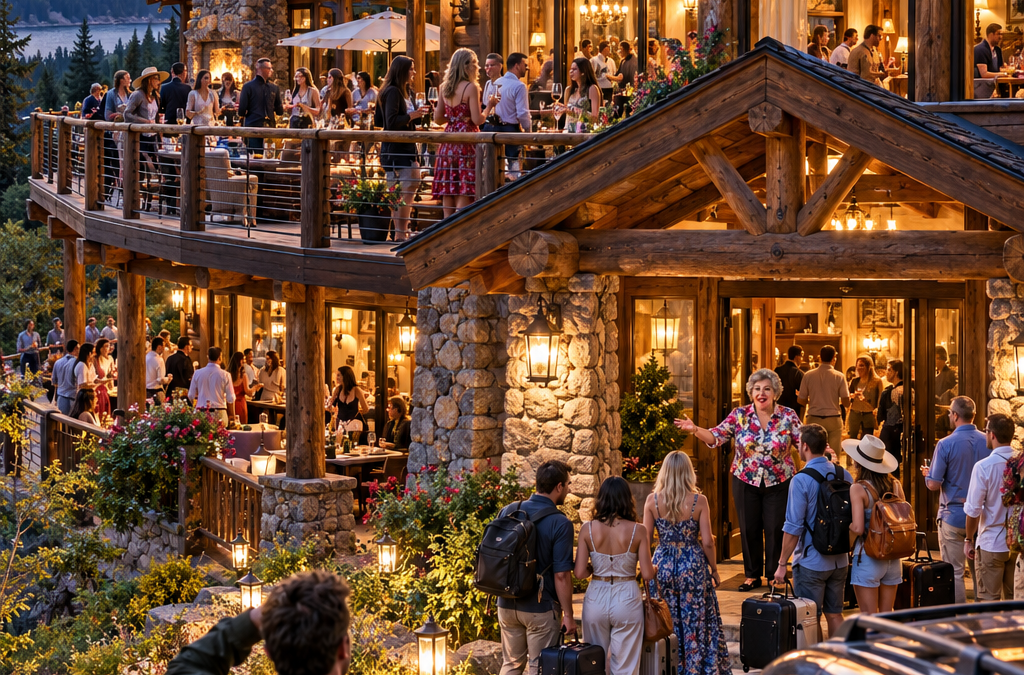
𝗙𝗨𝗟𝗟 𝗦𝗧𝗢𝗥𝗬
Then more cars.
People emerged carrying suitcases, garment bags, coolers, wine boxes, folding tables, and what appeared to be catering equipment.
Someone had set up a portable speaker system near my grandfather’s deck.
Several women were arranging flowers on the outdoor tables.
A man wearing a fleece vest carried two cases of wine through my front door.
Through my front door.
I watched the recording again because my mind refused to accept what my eyes were showing me.
“Gerald.”
“Yeah.”
“Do you know who these people are?”
“I know who one of them is.”
A woman appeared in the frame.
Cream jacket.
Dark slacks.
Clipboard.
Constance Bellard.
She stood beside my grandfather’s front door greeting people.
Smiling.
Shaking hands.
Directing them toward rooms.
For several seconds I couldn’t speak.
There is a peculiar kind of anger that doesn’t feel hot.
It feels cold.
Everything inside you becomes unnaturally quiet because your mind is trying to reconcile the normal appearance of what you’re seeing with the enormous violation underneath it.
I wasn’t looking at burglars.
Burglars would have made more sense.
These people weren’t hiding.
They weren’t breaking windows.
They weren’t running.
They were arriving confidently because somebody had told them they belonged there.
Someone had given them permission to enter my grandfather’s lodge.
“Have you spoken to Constance?” I asked.
“No.”
“Did the HOA send anything about an event?”
“Not that I saw.”
I kept scrolling through footage.
Twenty people.
Thirty.
By evening, I counted forty-seven separate guests.
Forty-seven.
One camera showed people standing around the fire pit with wine glasses.
Another showed a catering employee carrying trays through the kitchen.
Two people walked down the steps toward the creek.
A man leaned against the railing Edmund and I had repaired when I was seventeen.
He set his drink directly on the cedar cap.
Something about that tiny gesture hit me harder than everything else.
I remembered my grandfather sanding that railing.
I remembered him running his hand over the wood.
Checking for splinters.
I remembered him telling me that anything worth keeping required maintenance.
And now strangers were leaning against it because Constance Bellard had apparently decided Ridgerest belonged to the association whenever I wasn’t there.
I called the emergency contact number for the lodge.
No answer.
I called Constance.
Voicemail.
I called again.
Voicemail.
I sent a text.
Constance, there are dozens of people inside my property. Call me immediately.
No response.
I didn’t sleep much that night.
Around midnight, I opened the camera again.
The fire pit was still burning.
People were laughing on the deck.
Lights were on in nearly every bedroom.
Someone had opened the upstairs balcony doors.
I watched two strangers cross the hallway carrying towels from the linen closet.
I had never felt that kind of helplessness in connection with something I owned.
Ridgerest was three hours away.
By the time I arrived, it would be the middle of the night.
Part of me wanted to leave immediately.
Another part knew arriving furious at two in the morning could create exactly the kind of chaos Constance would later use against me.
So I waited.
At 4:50 Friday morning, I got into my car.
The drive into the mountains felt longer than it ever had.
As the highway narrowed, cell service weakened.
Pines closed around the road.
Normally that drive relaxed me.
Not that morning.
Every mile made me angrier.
I kept imagining strangers opening drawers.
Walking through Edmund’s bedroom.
Using the workshop.
Sitting in his chair.
I reached the Pinehaven gate shortly after eight.
The security barrier opened when I entered my code.
At least they hadn’t disabled that.
I drove past Gerald’s house.
He was standing beside his mailbox.
He lifted one hand as I passed.
His expression told me everything.
When I reached the final bend before Ridgerest, I saw cars parked along both sides of my driveway.
My driveway.
There were decorative signs near the entrance.
PINEHAVEN LEADERSHIP WEEKEND.
WELCOME.
I stopped the car.
For a moment, I actually laughed.
Not because anything was funny.
Because the arrogance was difficult to process.
They had printed signs.
I continued forward.
A man wearing a navy polo stepped into the driveway and raised one hand.
I lowered my window.
“Good morning, sir. Can I help you?”
I looked at him.
“Who are you?”
“I’m assisting with the event.”
“What event?”
“The Pinehaven Leadership Weekend.”
“Where?”
He gestured behind him.
“At Ridgerest.”
I stared at the lodge.
My grandfather’s name for the property had apparently become branding for somebody else’s retreat.
“Who authorized this?”
“You’d have to speak with the event coordinator.”
“And who’s that?”
“Ms. Bellard.”
I nodded.
Then I opened the door and stepped out.
The man moved slightly in front of me.
“I’m sorry, sir, but this is a private event.”
I looked at him.
“You’re right.”
He seemed relieved for half a second.
“It is private.”
I pointed toward the lodge.
“And it’s happening on my private property.”
His expression changed.
“I… I’m sorry?”
“I own Ridgerest.”
He glanced toward the building.
Then toward a registration table.
“I was told the property was being administered by Pinehaven.”
“By whom?”
“I don’t know.”
“Then I suggest you find out.”
I could have forced my way inside.
I could have started shouting.
I could have demanded that everyone leave immediately.
Instead, I felt that same cold stillness I had felt while watching the cameras.
I had learned enough from my grandfather to know that when someone makes a claim involving land, the first question isn’t how loudly they make it.
The first question is what document gives them the right.
I returned to my car.
The event assistant watched me as though he expected an explosion.
I gave him none.
I drove roughly half a mile down the private road until I found a turnout.
Then I parked.
Opened my laptop.
Connected through my phone.
And started searching.
I downloaded every email the Pinehaven management company had sent me during the previous year.
Meeting notices.
Violation letters.
Snow removal schedules.
Budget updates.
Architectural committee reminders.
Then I found an email from eight months earlier.
The subject line was almost designed to be ignored.
PROPERTY STATUS ADMINISTRATIVE NOTICE.
It had gone to a secondary email address I used mostly for property-related correspondence.
I opened it.
The message claimed Ridgerest Lodge had been designated an “extended nonoccupancy property” under something called the Dormant Property Administration Clause of the Pinehaven Heights Community Standards.
According to the email, properties considered “underutilized” could be temporarily administered by the association for “community enrichment purposes” when the owner was absent for extended periods.
I read the paragraph three times.
Temporarily administered.
Community enrichment.
Underutilized.
Words chosen to make theft sound civic.
The email said I had thirty days to contest the designation.
That deadline had expired seven months earlier.
I sat there staring through the windshield at the trees.
Then I understood.
This wasn’t improvisation.
Constance hadn’t woken up one morning and decided to use my lodge.
They had created a paper trail.
A bad one.
Possibly an illegal one.
But deliberate.
They had sent notice to an address I rarely checked.
Waited thirty days.
Declared my silence consent.
Then treated private property as an HOA asset.
I searched the original CC&Rs I had received after inheriting the lodge.
No dormant property clause.
I searched every amendment in my files.
Nothing.
I logged into the county recorder database.
The recorded version of Pinehaven’s covenants contained no such clause.
I searched again.
Nothing.
My heart started beating faster.
Not with fear.
Recognition.
This was exactly the kind of moment my grandfather had prepared for.
Records.
Documents.
Proof.
I called my attorney.
Dara Mensah specialized in property rights, land use disputes, easement litigation, and HOA conflicts.
I had hired her two years earlier after an argument over snowplow access.
She answered on the third ring.
“Nolan?”
“Dara, I need you to tell me whether I’m losing my mind.”
“That’s usually expensive.”
“I’m serious.”
“So am I. What’s happening?”
I read her the email.
There was silence.
Then she laughed once.
Short.
Sharp.
“Dara.”
“I’m sorry.”
“What?”
“Read the clause again.”
I did.
Another pause.
“Where is that language recorded?”
“It isn’t.”
“Are you sure?”
“I’m looking at the county record right now.”
“And you never signed an amendment?”
“No.”
“Never voted on one?”
“No.”
“Did Pinehaven amend the declaration through whatever voting procedure is required under the recorded covenants?”
“Not that I can find.”
She became very quiet.
“What are they doing with the property?”
“They’re holding a retreat.”
“What kind?”
“I don’t know yet.”
“Are people paying?”
That stopped me.
“I don’t know.”
“Find out.”
I called Gerald.
He answered immediately.
“You still there?” he asked.
“I’m down the road.”
“Good.”
“Do you know anything about this retreat?”
“Only what I’ve heard.”
“Did people pay?”
Gerald made a low sound.
“That’s what the rumor is.”
“How much?”
“I heard four hundred dollars.”
I closed my eyes.
“Per person?”
“That’s what I heard.”
There were forty-seven guests.
Forty-seven times four hundred.
I typed it into the calculator even though I already knew.
$18,800.
I called Dara again.
“Eighteen thousand eight hundred dollars.”
“What?”
“Forty-seven people. Four hundred each.”
She went silent.
“They’re charging people to stay in your house?”
“Apparently.”
“Nolan.”
Her voice changed.
The humor was gone.
“Do not confront them alone.”
“I want them out.”
“I know.”
“They’re sleeping in my grandfather’s rooms.”
“I understand.”
“No, Dara, I don’t think you do.”
My voice cracked harder than I expected.
I looked away from the road.
“I grew up in that house.”
She waited.
I hated that my eyes were burning.
I hated even more that Constance had reduced something so personal to a revenue line.
“I understand enough,” Dara said quietly. “Which is why I need you not to hand them an argument they can use later.”
“What do I do?”
“Document everything.”
“I already have camera footage.”
“Good. Save copies somewhere they can’t access. Screenshot the event signage. Record the vehicles. Preserve the email. Download the recorded CC&Rs directly from the county so there’s a timestamp.”
I started taking notes.
“Then what?”
“Then you go home.”
I stared at the phone.
“I’m not leaving.”
“Nolan.”
“I’m not leaving while forty-seven strangers sleep in my lodge.”
“Then stay somewhere else in Pinehaven tonight. Gerald’s. A hotel. Your car if necessary. But don’t escalate this today.”
“Why?”
“Because tomorrow is Saturday.”
“So?”
“So their retreat will be fully underway. Maximum attendance. Maximum documentation. Maximum witnesses.”
I understood.
“What are you planning?”
“I’m planning to give Ms. Bellard exactly enough rope to explain herself.”
By Friday afternoon, Dara had obtained the official county record.
No dormant property clause.
Not in the original declaration.
Not in any properly recorded amendment.
Not in any document with legal authority over my land.
At 5:16 p.m., she sent me a draft cease-and-desist letter.
At 6:03, she sent another document.
A civil demand.
Unauthorized commercial use of private property.
Trespass.
Unjust enrichment.
Potential conversion of property rights.
Possible consumer issues involving retreat attendees.
She had also contacted the county sheriff’s office.
“Tomorrow,” she told me, “you are not removing anybody physically. You are asserting control over your property with law enforcement present.”
I stayed at Gerald’s that night.
His wife, Marion, made coffee neither of us needed.
From Gerald’s kitchen table, we watched my security feed.
People ate catered dinner on the deck.
Someone had hung decorative lights from Edmund’s beams.
I saw a guest walk into the small den where my grandfather kept family photographs.
I couldn’t watch anymore.
Gerald closed the laptop.
“He’d have hated this,” I said.
“Edmund hated people moving his tools six inches.”
That almost made me smile.
Then Gerald leaned back.
“Your grandfather didn’t trust that board.”
“The current board?”
“The organization.”
I looked at him.
“You know about the note?”
“No.”
“He left me three words. Keep them out.”
Gerald nodded slowly.
“Sounds like Edmund.”
“What happened between him and Pinehaven?”
Gerald stared at his coffee.
“Before my time, mostly. But I heard things. Arguments about access. People wanting to treat his road like community property. Somebody tried to convince him the creek should become part of a shared recreation zone.”
“He never told me.”
“He wasn’t much for storytelling when the story involved himself.”
That was true.
“What did he do?”
Gerald smiled.
“Probably put everything in writing.”
I slept maybe three hours.
At 8:30 Saturday morning, I drove toward Ridgerest.
I stopped at the bottom of my private road where the lodge wasn’t visible.
Dara called.
“You ready?”
“Yes.”
“Deputy should meet you around eleven thirty.”
“That’s three hours.”
“I know.”
“What do I do until then?”
“Nothing.”
I hated that answer.
At 9:42, I opened the lodge control system.
Years earlier, I had upgraded the property with smart locks after a winter break-in attempt.
The doors could be controlled remotely.
Front entrance.
Side mudroom.
Deck access.
Exterior storage.
Generator shed.
Main gate keypad.
I had never imagined using the system against people already occupying the property.
Dara had been clear.
Do not trap anyone inside.
Do not prevent emergency egress.
But nothing required me to continue allowing reentry after people voluntarily stepped outside.
At 9:47 a.m., after confirming through the cameras that most guests were outside for what appeared to be a group activity, I reset every access code.
Front door.
Side door.
Exterior keypad.
Gate.
Storage.
All of it.
Simultaneously.
For about three minutes, nothing happened.
Then a woman walked toward the lodge carrying a coffee cup.
She entered the old code.
Red light.
She tried again.
Red.
She knocked.
Another guest came over.
He tried his code.
Nothing.
Within minutes, people gathered near the front entrance.
One walked around to the deck door.
Locked.
Another tried the mudroom.
Locked.
At 9:52, my phone vibrated.
Gerald had sent one word.
Beautiful.
I laughed for the first time in two days.
At 10:03, the calls started.
The first came from Raymond Chu, a Pinehaven board member.
I let it ring.
Then Constance.
Voicemail.
Then the HOA management company’s weekend emergency number.
Then Raymond again.
Then a number I didn’t recognize.
Another.
Another.
At 10:17, one woman left a voicemail.
“Hi, this is Patricia Morrow. I’m attending the Pinehaven retreat and I think there’s been some kind of lock malfunction. My medication is inside the lodge, so if someone could please—”
That stopped me.
I called Dara immediately.
“Medication.”
“What?”
“One guest says her medication is inside.”
“Then she gets access to retrieve it.”
“I thought we were locking them out.”
“We’re asserting control, not endangering anyone. Have Gerald meet her if possible. Document it.”
I called Gerald.
He walked over, verified Patricia’s identity, and I temporarily unlocked the front door while she retrieved her medication.
She came back outside.
I locked it again.
That detail mattered to me.
I wasn’t angry at the guests.
Most of them appeared to believe they had legitimately rented access through the HOA.
They were not the people who had taken my lodge.
They were people Constance had sold my lodge to.
At 10:41, Constance left her first voicemail.
“Nolan, this is Constance Bellard. There appears to be a problem with the electronic access system at Ridgerest. Please restore access immediately. The association is conducting an authorized event under the dormant property provision. Interfering with an approved HOA function may constitute a violation of your community obligations.”
Even in voicemail, she sounded as though she were disciplining a child.
At 11:06, she called again.
“Nolan, your refusal to respond is becoming unacceptable. We have attendees whose belongings remain inside. You need to correct this immediately.”
At 11:28, another.
“This will not reflect well on you if legal action becomes necessary.”
I saved every voicemail.
At 11:36, a sheriff’s cruiser pulled into the turnout.
Deputy Samuel Ortega stepped out.
He was a broad-shouldered man in his early forties with the calm expression of someone who had spent years arriving at disputes where everyone believed they were the reasonable party.
“You Garrett?”
“Yes.”
He shook my hand.
“Your attorney spoke with our office.”
I handed him the deed, county record, identification, and Dara’s letter.
He read slowly.
“You own the property outright?”
“Yes.”
“And these people were admitted by the HOA?”
“Without my permission.”
“They claim authority under this clause?”
“Which isn’t recorded anywhere.”
He looked through the documents again.
“I’m not making a legal determination on covenant enforceability standing here.”
“I understand.”
“But if the deed says this is your parcel and nobody can show lawful authority to occupy it, they have a problem.”
“That’s all I need.”
We drove up together.
When Ridgerest came into view, the lawn looked like an evacuation area.
Suitcases everywhere.
Guests standing in small groups.
Coffee cups.
Jackets.
Several people sitting on folding chairs.
One man had apparently decided the crisis wasn’t worth wasting wine and was drinking from a plastic cup near the fire pit.
Then I saw Constance.
She was standing on the deck steps.
Clipboard in hand.
Of course.
The moment I stepped out, she walked directly toward me.
“Nolan.”
“Constance.”
“You are making an extraordinary scene.”
I glanced at the crowd.
“I didn’t invite forty-seven people onto my property.”
“This event is authorized.”
“By whom?”
“The association.”
“That isn’t an answer.”
“The board has authority under Pinehaven’s dormant property clause.”
“No, it doesn’t.”
Her jaw tightened.
“We sent you notice eight months ago.”
“You sent me an email.”
“Which you failed to contest.”
“Silence doesn’t transfer possession of my lodge to you.”
“You had thirty days.”
“Thirty days to object to a rule that doesn’t legally exist?”
Several guests were listening now.
Constance noticed.
She lowered her voice.
“This discussion should happen privately.”
“You made my house public.”
Her expression hardened.
“Nolan, I strongly advise you to stop escalating this.”
That sentence almost impressed me.
Forty-seven strangers.
Catering equipment.
Paid reservations.
My bedrooms.
My kitchen.
My grandfather’s deck.
And somehow I was escalating.
Deputy Ortega stepped closer.
“Ma’am, are you Ms. Bellard?”
Constance looked at him.
“President Bellard. Pinehaven Heights HOA.”
He didn’t react to the title.
“Do you have documentation establishing the association’s right to use this property?”
“Yes.”
“May I see it?”
She opened her clipboard and produced several pages.
I watched Deputy Ortega read them.
He looked at me.
Then at Constance.
“This appears to be an internal policy.”
“It’s a community standard.”
“I’m asking whether you have recorded authority affecting ownership or occupancy rights.”
“The board adopted the clause.”
“When?”
“Approximately nine months ago.”
“Was it recorded with the county?”
She hesitated.
“It was distributed electronically.”
Deputy Ortega looked at her.
“That’s not what I asked.”
Silence.
Dara had warned me not to enjoy this too much.
I failed.
I removed a folder from my car.
“Constance.”
She looked at me.
I handed her three documents.
The first was Dara’s cease-and-desist letter.
The second was a certified copy of the county-recorded CC&Rs showing no dormant property provision.
The third was a civil demand seeking the full $18,800 collected from the event, plus damages, costs, and any additional remedies discovered through accounting.
Constance read the first page.
Her face changed.
Not dramatically.
People like Constance rarely give you the satisfaction of visible panic.
But the color left her cheeks.
“Who is Dara Mensah?”
“My attorney.”
“You hired an attorney over a misunderstanding?”
I stared at her.
“A misunderstanding is somebody parking in the wrong driveway.”
I pointed toward the lodge.
“You sold forty-seven people access to my home.”
“We did not sell your home.”
“How much did they pay?”
Her mouth tightened.
“That isn’t relevant.”
“$400 each?”
No answer.
“Eighteen thousand eight hundred dollars?”
A murmur moved through the guests.
One woman turned toward Constance.
“You said this property belonged to the association.”
Constance looked at her.
“I said it was administered by the association.”
“That’s not what the brochure said.”
Another guest spoke.
“My confirmation email called it an HOA-owned retreat facility.”
Constance’s eyes flicked toward him.
That was the moment I realized the problem was larger than I knew.
Deputy Ortega raised one hand.
“Everybody calm down.”
I looked at Constance.
“You have one hour to organize removal of all personal belongings and event equipment.”
“You cannot order the association off community property.”
“This isn’t community property.”
“Nolan—”
“No.”
I had spent four years listening to her say my name as though it belonged at the top of a violation letter.
Not anymore.
“This lodge belonged to Edmund Garrett before Pinehaven Heights existed. The land beneath us belonged to him before your association had a board, a president, or a decorative gate. You don’t get to rewrite that because I wasn’t here often enough for your liking.”
Her face tightened.
“You benefited from community infrastructure.”
“I paid every road assessment.”
“You agreed to community standards.”
“I agreed to recorded standards.”
“The dormant property policy was properly adopted.”
“Then show me the recorded amendment.”
Silence.
“Show me.”
She couldn’t.
Deputy Ortega stepped between us slightly.
“Ms. Bellard, I think the practical solution is for attendees to retrieve their belongings and leave while the legal questions are handled elsewhere.”
“This is outrageous.”
He shrugged.
“It may be. Courts exist for outrageous things.”
Within minutes, I began letting guests enter in small groups.
No one damaged anything.
No one argued with me.
Most were embarrassed.
Several apologized.
One older man stopped beside me after retrieving his suitcase.
“We were told the lodge belonged to Pinehaven.”
“I know.”
“I wouldn’t have come if I’d known.”
“I believe you.”
He looked toward Constance.
“I’ve lived here twelve years.”
Then he shook his head and walked away.
Another woman showed me the retreat brochure on her phone.
Pinehaven Leadership Weekend.
Two nights at historic Ridgerest Lodge.
Meals included.
Executive planning sessions.
Wine reception.
Leadership development.
Mountain recreation.
Registration: $400.
Historic Ridgerest Lodge.
My grandfather would have thrown the brochure into the fireplace.
By three that afternoon, the last attendee had left.
Catering equipment was gone.
Cars disappeared down the mountain.
Silence returned.
I stood on the deck after Deputy Ortega drove away.
For the first time in forty-eight hours, Ridgerest was empty.
I went inside.
The lodge smelled wrong.
Wine.
Perfume.
Coffee.
Food I hadn’t cooked.
The living room furniture had been rearranged into rows.
Someone had moved my grandfather’s chair.
That nearly broke me.
I dragged it back beside the fireplace.
There was a small scratch on one arm.
I ran my thumb across it.
Ridiculous.
A scratch.
Probably repairable in ten minutes.
But I sat down and stared at it until my vision blurred.
I had thought the worst part would be strangers sleeping in my beds.
It wasn’t.
The worst part was seeing how easily a place full of memories could become inventory to someone who didn’t respect what it meant.
To Constance, Ridgerest had been underutilized.
Dormant.
Available.
To me, every room had a voice.
The kitchen where Edmund taught me how to make coffee when I was twelve.
The mudroom where he wrapped my ankle after I slipped on wet stone.
The lower bedroom where my grandmother spent her final summer.
The fireplace where we burned old newspapers every New Year’s Eve.
The deck where he taught me to stop talking long enough to hear an owl.
Underutilized.
I hated that word more every time I thought about it.
On Monday, Dara filed the civil complaint.
The initial claim was straightforward.
Unauthorized use.
Trespass.
Unjust enrichment.
Accounting.
Damages.
Injunctive relief preventing Pinehaven from using Ridgerest again without express written permission.
We expected resistance.
We got it.
The HOA hired counsel.
Their attorney argued that the board believed it possessed authority under community rules.
Dara asked for the recorded amendment.
They produced meeting minutes.
She asked for the vote required under the CC&Rs.
They produced a board resolution.
She asked for homeowner approval.
They had none.
She asked for county recording information.
None.
Then she asked the question that changed everything.
“If this clause was adopted nine months ago, how many times has it been used?”
The HOA objected.
Dara requested financial records.
They resisted.
She subpoenaed them.
Three weeks later, we sat in her office looking at spreadsheets.
Dara had a pencil between her fingers.
She tapped one line.
“Ridgerest isn’t the first.”
I leaned forward.
“What?”
She turned the laptop toward me.
There were payment records associated with something called Community Enrichment Reserve.
Retreat fees.
Event fees.
Property administration income.
One property belonged to a couple who spent most of the year in Arizona.
Another belonged to an engineer working overseas.
A third was owned by the daughter of a deceased Pinehaven resident who rarely visited.
All three had been classified dormant.
All three had been used for events.
I stared at the totals.
“How many?”
“Including yours? Four properties.”
“They’ve done this four times?”
“At least.”
She scrolled.
Payments totaled more than sixty thousand dollars.
“What is Community Enrichment Reserve?”
“Good question.”
“Is it in the annual budget?”
“No.”
“Meeting minutes?”
“Not that I’ve found.”
“Homeowner reports?”
“No.”
I leaned back.
“So where is the money?”
Dara looked at me.
“That’s another good question.”
The account balance was just over $61,000.
None of it had appeared in the HOA’s ordinary financial disclosures.
None of the affected property owners appeared to have received compensation.
In several records, expenses had been paid directly from the fund for catering, supplies, transportation, and event services.
One vendor appeared repeatedly.
Bellard Community Consulting.
I stared at the name.
“Constance?”
“Possibly.”
Dara kept reading.
The deeper we looked, the worse it became.
The dormant property clause hadn’t been created to solve a community problem.
It appeared to have been created to manufacture access to private properties whose owners were unlikely to notice.
People who lived elsewhere.
People who visited seasonally.
People who trusted Pinehaven enough not to monitor every board meeting.
People like me.
For the first time, I understood the full significance of my grandfather’s warning.
Keep them out.
He hadn’t been talking about random trespassers.
He had been talking about people who believed proximity created entitlement.
People who confused administrative power with ownership.
The first affected homeowner Dara contacted was a woman named Evelyn Roth.
Her parents had owned a small cabin on the northern ridge.
After her father died, Evelyn kept the property but lived in California.
When Dara told her the cabin had hosted two HOA workshops, there was silence on the call.
Then Evelyn said, “My mother’s ashes are in that house.”
No one spoke for several seconds.
She had never authorized anyone to enter.
She had never seen the notice because it had gone to an outdated property-management email.
The second owner, Richard Vale, was working in Germany.
He had security cameras but had disabled them during winter because of unreliable internet service.
His house had hosted a two-day planning session.
The third family was even more furious.
Their property contained personal belongings belonging to their deceased parents.
When they learned strangers had slept there, the daughter cried.
That was when the case stopped feeling like mine.
Ridgerest had opened the door.
But behind it were other people who had been violated quietly enough that they hadn’t even known.
The district attorney’s office became involved three weeks after the financial records surfaced.
I never learned every detail of what investigators examined.
Dara told me not to speculate.
So I didn’t.
What I knew was this.
Investigators requested HOA records.
They interviewed board members.
They examined how the dormant property policy had been created.
They reviewed the undisclosed reserve account.
They asked who had approved events.
Who controlled payments.
Who benefited.
Constance resigned six days after investigators interviewed her.
The resignation email was brief.
She cited “personal reasons” and “the increasingly hostile environment surrounding volunteer community leadership.”
She did not apologize.
Raymond Chu resigned the following week.
Another board member followed.
For the first time in years, Pinehaven held an emergency election.
I attended.
Constance wasn’t there.
Her empty chair at the front of the meeting room looked strangely small.
Without her sitting in it, it was just furniture.
Gerald sat beside me.
When the acting president announced an independent financial review, Gerald leaned toward me.
“Edmund would’ve enjoyed this.”
I shook my head.
“No.”
“You don’t think?”
“He would’ve complained the whole meeting was taking too long.”
Gerald smiled.
“That’s true.”
The dormant property clause was formally revoked.
The new board acknowledged it had never been properly incorporated into the recorded covenants.
A written policy was adopted prohibiting the HOA from accessing privately owned homes without express permission except in genuine emergencies authorized by law.
Financial controls were changed.
Owners received full accounting reports.
The Community Enrichment Reserve was frozen.
Eventually, the money was ordered distributed among the affected property owners according to the amounts associated with the unauthorized events and related damages.
My portion, after legal fees and expenses, came to slightly more than eleven thousand dollars.
People sometimes ask whether that felt like winning.
It didn’t.
Money can reimburse.
It cannot erase.
Eleven thousand dollars didn’t change the fact that strangers had slept in Edmund’s lodge.
It didn’t change the moment I saw Constance standing at his front door holding a clipboard.
It didn’t remove the anger I felt every time I thought about that ridiculous phrase.
Underutilized property.
Still, I knew exactly what I wanted to do with the money.
The following spring, I hired a local mason named Thomas Avery.
Thomas had known my grandfather.
He was seventy-one and still worked three days a week because retirement, according to him, was “an excellent way to become useless.”
Years earlier, Edmund had talked about building a riverstone path from the deck down toward the creek.
He never finished it.
Thomas remembered.
“Your grandfather wanted the stones set flat enough to walk when they were wet,” he told me.
“That sounds like him.”
“He also wanted it to last a hundred years.”
“That definitely sounds like him.”
We spent nearly six weeks building the pathway.
I helped whenever Thomas allowed me to.
We used local stone.
No concrete pavers.
No decorative stamped patterns.
Just rough mountain rock placed carefully into the slope.
Halfway through the project, Thomas stopped beside an old cedar.
“Edmund and I argued right here once.”
“About what?”
“Drainage.”
“Who won?”
Thomas stared at me as though the question were absurd.
“Your grandfather.”
I laughed.
“Of course.”
The path ended near the creek at a flat stone overlooking the water.
On the final afternoon, after Thomas packed his tools, I sat there alone.
The creek sounded exactly as it had when I was ten.
Water moving over stone.
Wind in the firs.
A raven somewhere above the valley.
For a while, I thought about everything Constance had taken.
Then I realized that wasn’t the right way to remember what had happened.
She hadn’t taken Ridgerest.
She had entered it.
Used it.
Disrespected it.
But she hadn’t taken it.
The lodge was still standing.
The land was still mine.
My grandfather’s tools were still in the workshop.
His handwriting was still on old measurements behind the utility panel.
His chair was beside the fireplace.
The railing still carried marks from the summer we rebuilt it together.
And inside my desk was the yellow paper he had left me.
Keep them out.
I finally understood that sentence.
For years, I had interpreted it as fear.
It wasn’t.
It was responsibility.
Edmund understood something I had been too comfortable to learn.
Ownership isn’t only possession.
It’s attention.
It is knowing what your deed says.
Knowing where your boundaries lie.
Knowing which agreements you signed and which ones somebody merely claims you signed.
It is refusing to surrender rights simply because defending them feels inconvenient.
For four years, Constance sent me fines.
I paid them because each individual dispute seemed too small.
Fifty dollars.
Seventy-five.
One hundred.
Another notice.
Another check.
Another form letter.
I believed I was purchasing peace.
What I was really doing was teaching the HOA that I would surrender whenever resistance cost more effort than compliance.
By the time they reached for the lodge itself, they assumed I would react the same way.
Maybe that was the most unsettling part.
Constance didn’t behave like someone knowingly committing some dramatic invasion.
She behaved like someone who had spent years crossing small boundaries without consequence and had eventually forgotten boundaries existed.
That lesson stayed with me.
People rarely begin by taking the thing you care about most.
They start with something small.
Something annoying.
Something you can afford to lose.
A fee.
A rule.
A strip of land.
An access right.
A technical interpretation.
And every time you surrender something simply because fighting seems inconvenient, the next demand becomes easier for them to make.
I still use Ridgerest seasonally.
More often now.
I stopped renting it, even privately.
Not because I distrust everyone.
Because after what happened, I wanted the lodge to become family space again.
My sister brings her children during summer.
They sleep in the same upstairs rooms where we slept when we were young.
Gerald still watches the road.
He claims he doesn’t.
He does.
The security system has been upgraded.
Every exterior entrance now has independent logging.
Every document related to the property has been digitized, backed up, printed, and stored in more locations than any reasonable person would consider necessary.
Dara calls that trauma.
I call it administration.
Pinehaven changed too.
Not perfectly.
No community run by human beings will ever be perfect.
There are still arguments about snow removal, road assessments, exterior paint, parking, and landscaping.
Someone recently spent forty minutes debating whether decorative address signs should be standardized.
I almost missed Constance during that discussion.
Almost.
But the atmosphere is different.
The board publishes records.
Meetings are recorded.
Financial accounts are independently reviewed.
Owners ask questions.
More importantly, the board expects questions.
Authority works differently when the people subject to it understand they are allowed to demand proof.
A year after the retreat incident, I attended the annual meeting.
I hadn’t planned to speak.
Near the end, a new homeowner raised his hand.
He had recently purchased a cabin on the southern slope and was confused about a maintenance assessment.
The treasurer began explaining the charge.
The man interrupted politely.
“Can you show me where that’s authorized?”
Nobody became defensive.
Nobody threatened him with a violation.
The treasurer opened the governing documents and showed him the section.
It was such a small thing.
But I remember sitting there thinking that maybe this was what accountability actually looked like.
Not revenge.
Not humiliation.
Proof.
If authority is legitimate, it should survive being questioned.
After the meeting, I drove back to Ridgerest.
It was October.
The valley had turned gold.
The temperature had dropped enough that I built a fire.
I sat in Edmund’s chair with the old deed envelope on my lap.
For years, I had wondered why he hadn’t written more.
Why only three words?
Why not explain the history?
Why not name the people he feared?
Why not leave instructions?
Then I realized he probably believed he had.
The deed was there.
The records were there.
The boundaries were there.
The evidence was there.
Everything I needed had been left behind.
The note wasn’t the explanation.
It was the reminder.
Keep them out.
I unfolded it once more.
The paper had yellowed.
His handwriting leaned slightly to the right.
Three words.
No punctuation.
I could hear his voice even though he had been gone for years.
I walked outside.
The riverstone path Thomas and I had built was wet from afternoon rain.
I followed it down toward the creek.
From there, I could see the lodge through the trees.
The same heavy beams.
The same deck.
The same chimney Edmund built stone by stone decades earlier.
For one weekend, forty-seven strangers had occupied it because five people sitting around a board table convinced themselves they had the right.
They charged admission.
They printed brochures.
They served wine.
They called it community enrichment.
But the mountain didn’t care what they called it.
Neither did the county records.
Land remembers boundaries even when people pretend not to.
I stood beside the creek until the light began fading behind the ridge.
Then I walked back toward the lodge.
Before going inside, I stopped at the front door.
The same doorway where Constance had once stood smiling and welcoming strangers into a house she never owned.
I rested my hand against the timber frame.
My grandfather had set that beam himself.
There were still shallow tool marks beneath the stain.
For most of my life, I thought inheriting Ridgerest meant Edmund had given me a beautiful place in the mountains.
I know better now.
He gave me something heavier than that.
He gave me custody.
And custody means that when someone arrives with a clipboard, a policy, a title, and enough confidence to make theft sound official, you don’t measure their authority by the certainty in their voice.
You ask for the document.
You read the deed.
You check the record.
And if the record says the property is yours, you stand where your grandfather stood before you.
You protect it.
That evening, I locked the door behind me, walked across the great room, and placed Edmund’s note back inside the deed envelope.
This time, I didn’t wonder who he meant.
I knew.
And I knew something else too.
Ridgerest would never be considered dormant again.
𝗧𝗛𝗘 𝗘𝗡𝗗
The HOA Filled My Grandfather’s Mountain Lodge With 47 Paying Strangers and Expected Me to Stay Quiet
I drove three hours into the Cascade Mountains expecting to find my grandfather’s lodge exactly as I had left it, only to discover forty-seven strangers drinking wine on his deck, sleeping in his beds, and walking through rooms he had built with his own hands.
Standing at the front door welcoming them was the same HOA president who had spent four years fining me over firewood, mailbox paint, and porch lights—and the moment she looked at me as though I were the trespasser, something inside me changed.
My name is Nolan Garrett, and I inherited Ridgerest Lodge when I was twenty-nine years old.
The lodge had belonged to my grandfather, Edmund Garrett, long before it belonged to me.
He bought the land in 1974, twelve acres of steep mountain forest tucked against the eastern slope of the Cascades. There had been almost nothing there at the time except pine, stone, a narrow creek, and an old logging track that barely qualified as a road.
My grandfather saw something different.
He saw a home.
Not the kind built quickly by contractors following a subdivision plan. Edmund believed buildings should have weight to them. Character. Evidence that somebody had cared enough to make them last.
He spent eleven years building Ridgerest.
Not eleven years because he lacked money.
Eleven years because he refused to rush.
He cut and finished much of the timber himself. He hauled riverstone from a legal quarry almost forty miles away because he wanted the fireplace to look as though the mountain had pushed it directly through the floor. He built the wraparound deck in sections, replacing boards whenever he decided the grain wasn’t right.
My grandmother used to joke that Edmund could spend an entire Saturday choosing between two pieces of cedar.
He never laughed at that joke.
He considered choosing wood serious business.
By the time I was old enough to remember summers in the mountains, Ridgerest seemed less like a building than a living member of our family.
The exposed timber beams above the great room were dark with age and smoke from decades of winter fires.
The stone fireplace rose nearly twelve feet to the ceiling.
Old brass hooks beside the mudroom door held fishing jackets, raincoats, and a battered canvas hat my grandfather wore whenever he worked outside.
The western side of the lodge faced a valley that turned gold every October.
In the mornings, clouds sometimes settled below the deck, making the lodge seem as though it were floating above them.
As a kid, I thought everyone had a place like that.
I didn’t understand how rare it was.
Every summer, my parents would drive me up the mountain and leave me with Edmund for several weeks.
He taught me how to split firewood without exhausting myself.
How to recognize weather from the smell of the air.
How to find north when you couldn’t see the sun.
How to sharpen an ax.
How to repair a fence.
How to sit quietly beside another person without feeling compelled to fill the silence.
Grandfather wasn’t sentimental in the way people usually describe sentimental men.
He rarely said he loved me.
He showed it.
If my boots were wet, they would be drying beside the stove when I woke up.
If I mentioned liking a certain fishing lure, another would appear in my tackle box the following summer.
When I was seventeen and angry at practically everything, he never lectured me.
He handed me a hammer and asked me to help repair the lower deck.
We worked six hours without discussing what was bothering me.
Somehow, when we finished, I felt better.
That was Edmund.
He trusted work.
He trusted land.
He trusted written records.
People were another matter.
When he died, I was devastated in a way I wasn’t prepared for.
I had known he was getting older.
Knowing something logically and accepting it emotionally are very different things.
His attorney called me two weeks after the funeral.
I inherited Ridgerest Lodge, the twelve acres beneath it, several storage buildings, mineral rights associated with the parcel, and a thick collection of property documents Edmund had kept in a steel filing cabinet.
Inside the envelope containing the deed was a folded piece of yellow paper.
Three words had been written in my grandfather’s handwriting.
Keep them out.
That was it.
No explanation.
No name.
No context.
Keep them out.
At first, I assumed he meant developers.
The area around Ridgerest had changed dramatically during his lifetime.
What had once been scattered cabins and raw forest had gradually become an organized mountain community called Pinehaven Heights.
Pinehaven had paved roads, decorative entrance gates, landscaped common spaces, private snow removal, and roughly sixty properties.
It also had a homeowners association.
The Pinehaven Heights Homeowners Association had been created after my grandfather purchased his property, but Ridgerest eventually became surrounded by parcels incorporated into the development.
The legal relationship between Edmund’s land and the HOA was complicated.
Ridgerest benefited from certain road maintenance agreements and shared access infrastructure. My grandfather had signed limited participation documents years earlier.
Those documents were the reason the HOA claimed the authority to regulate certain exterior conditions associated with the lodge.
Whether they actually possessed as much authority as they claimed was something I should have investigated immediately.
I didn’t.
I was twenty-nine.
I had a career.
I lived three hours away.
I loved the lodge, but I didn’t want to spend my life fighting over parking signs and architectural guidelines.
So when the HOA sent me a notice claiming the mailbox post needed repainting, I paid the fifty-dollar fine.
When they complained that my firewood was stacked too close to a boundary marker, I moved it and paid seventy-five dollars.
When they informed me that an exterior dock light had remained illuminated after 10:00 p.m., I paid one hundred dollars despite not understanding how a light beside my private creek was damaging anybody’s quality of life.
Each violation seemed too small to justify an argument.
That was my mistake.
Small acts of authority have a way of teaching people how much resistance they should expect.
The HOA president was a woman named Constance Bellard.
Constance was in her late fifties, always perfectly dressed, always carrying a folder, binder, tablet, or clipboard.
She had a controlled voice that somehow made even ordinary conversation sound disciplinary.
I met her for the first time at an annual Pinehaven meeting.
She shook my hand and said, “You must be Edmund’s grandson.”
There was something in the way she said it.
Not warm.
Not nostalgic.
Evaluative.
“That’s right.”
“Your grandfather and this association had a complicated relationship.”
That caught my attention.
“Complicated how?”
Her smile barely moved.
“Edmund valued independence.”
“So do I.”
“I’m sure you do.”
Then she walked away.
I remember standing there watching her speak to another homeowner and thinking about the note tucked inside my desk at home.
Keep them out.
I should have asked more questions.
Instead, life moved forward.
For four years, the fines kept coming.
Mailbox.
Woodpile.
Driveway gravel.
Exterior lighting.
Trash container visibility.
A small aluminum fishing boat that Constance claimed could be seen from the community access road.
One notice cited me because weeds along the northern side of the property exceeded the approved height.
They were mountain wildflowers.
I appealed that one.
My appeal was denied.
The denial letter was signed by Constance Bellard.
By my estimate, I paid nearly three thousand dollars in fines during those four years.
Not enough to ruin me.
Enough to irritate me.
More importantly, enough to establish a pattern.
They issued an accusation.
I paid.
They issued another.
I paid again.
The HOA had learned something dangerous about me.
I preferred peace.
What they didn’t understand was that I preferred peace because I had never been given a reason strong enough to justify war.
That changed on a Thursday evening in September.
I was at home finishing dinner when my phone rang.
The caller was Gerald Fitch, the owner of the property nearest Ridgerest.
Gerald was a retired postal worker in his late sixties who lived in Pinehaven almost year-round.
He had known my grandfather.
Not closely, but well enough that they occasionally helped one another after storms.
Gerald was the kind of neighbor who noticed things without appearing nosy.
If a tree came down across the private road, Gerald knew before the maintenance crew.
If a bear got into somebody’s garbage, Gerald had probably photographed it.
If a strange vehicle entered Pinehaven, Gerald remembered the license plate.
“Nolan,” he said, “you busy?”
“Depends.”
“You might want to check your security cameras.”
I glanced toward my phone charger.
“What happened?”
“Just check them.”
Something about his voice changed the atmosphere in the room.
I opened the security application connected to Ridgerest.
The first camera overlooked the driveway.
I expected to see a bear.
Maybe a fallen limb.
Instead, I saw vehicles.
Three SUVs.
A large passenger van.
Another smaller van parked near the side of the lodge.
People were unloading equipment.
I stared at the screen.
“What am I looking at?”
Gerald didn’t answer immediately.
“Nolan, there have been people coming and going since around noon.”
I pulled up the recorded footage.
At 12:06 p.m., a black SUV came up my driveway.
At 12:14, another.
At 12:21, the passenger van.
Then more cars.
People emerged carrying suitcases, garment bags, coolers, wine boxes, folding tables, and what appeared to be catering equipment.
Someone had set up a portable speaker system near my grandfather’s deck.
Several women were arranging flowers on the outdoor tables.
A man wearing a fleece vest carried two cases of wine through my front door.
Through my front door.
I watched the recording again because my mind refused to accept what my eyes were showing me.
“Gerald.”
“Yeah.”
“Do you know who these people are?”
“I know who one of them is.”
A woman appeared in the frame.
Cream jacket.
Dark slacks.
Clipboard.
Constance Bellard.
She stood beside my grandfather’s front door greeting people.
Smiling.
Shaking hands.
Directing them toward rooms.
For several seconds I couldn’t speak.
There is a peculiar kind of anger that doesn’t feel hot.
It feels cold.
Everything inside you becomes unnaturally quiet because your mind is trying to reconcile the normal appearance of what you’re seeing with the enormous violation underneath it.
I wasn’t looking at burglars.
Burglars would have made more sense.
These people weren’t hiding.
They weren’t breaking windows.
They weren’t running.
They were arriving confidently because somebody had told them they belonged there.
Someone had given them permission to enter my grandfather’s lodge.
“Have you spoken to Constance?” I asked.
“No.”
“Did the HOA send anything about an event?”
“Not that I saw.”
I kept scrolling through footage.
Twenty people.
Thirty.
By evening, I counted forty-seven separate guests.
Forty-seven.
One camera showed people standing around the fire pit with wine glasses.
Another showed a catering employee carrying trays through the kitchen.
Two people walked down the steps toward the creek.
A man leaned against the railing Edmund and I had repaired when I was seventeen.
He set his drink directly on the cedar cap.
Something about that tiny gesture hit me harder than everything else.
I remembered my grandfather sanding that railing.
I remembered him running his hand over the wood.
Checking for splinters.
I remembered him telling me that anything worth keeping required maintenance.
And now strangers were leaning against it because Constance Bellard had apparently decided Ridgerest belonged to the association whenever I wasn’t there.
I called the emergency contact number for the lodge.
No answer.
I called Constance.
Voicemail.
I called again.
Voicemail.
I sent a text.
Constance, there are dozens of people inside my property. Call me immediately.
No response.
I didn’t sleep much that night.
Around midnight, I opened the camera again.
The fire pit was still burning.
People were laughing on the deck.
Lights were on in nearly every bedroom.
Someone had opened the upstairs balcony doors.
I watched two strangers cross the hallway carrying towels from the linen closet.
I had never felt that kind of helplessness in connection with something I owned.
Ridgerest was three hours away.
By the time I arrived, it would be the middle of the night.
Part of me wanted to leave immediately.
Another part knew arriving furious at two in the morning could create exactly the kind of chaos Constance would later use against me.
So I waited.
At 4:50 Friday morning, I got into my car.
The drive into the mountains felt longer than it ever had.
As the highway narrowed, cell service weakened.
Pines closed around the road.
Normally that drive relaxed me.
Not that morning.
Every mile made me angrier.
I kept imagining strangers opening drawers.
Walking through Edmund’s bedroom.
Using the workshop.
Sitting in his chair.
I reached the Pinehaven gate shortly after eight.
The security barrier opened when I entered my code.
At least they hadn’t disabled that.
I drove past Gerald’s house.
He was standing beside his mailbox.
He lifted one hand as I passed.
His expression told me everything.
When I reached the final bend before Ridgerest, I saw cars parked along both sides of my driveway.
My driveway.
There were decorative signs near the entrance.
PINEHAVEN LEADERSHIP WEEKEND.
WELCOME.
I stopped the car.
For a moment, I actually laughed.
Not because anything was funny.
Because the arrogance was difficult to process.
They had printed signs.
I continued forward.
A man wearing a navy polo stepped into the driveway and raised one hand.
I lowered my window.
“Good morning, sir. Can I help you?”
I looked at him.
“Who are you?”
“I’m assisting with the event.”
“What event?”
“The Pinehaven Leadership Weekend.”
“Where?”
He gestured behind him.
“At Ridgerest.”
I stared at the lodge.
My grandfather’s name for the property had apparently become branding for somebody else’s retreat.
“Who authorized this?”
“You’d have to speak with the event coordinator.”
“And who’s that?”
“Ms. Bellard.”
I nodded.
Then I opened the door and stepped out.
The man moved slightly in front of me.
“I’m sorry, sir, but this is a private event.”
I looked at him.
“You’re right.”
He seemed relieved for half a second.
“It is private.”
I pointed toward the lodge.
“And it’s happening on my private property.”
His expression changed.
“I… I’m sorry?”
“I own Ridgerest.”
He glanced toward the building.
Then toward a registration table.
“I was told the property was being administered by Pinehaven.”
“By whom?”
“I don’t know.”
“Then I suggest you find out.”
I could have forced my way inside.
I could have started shouting.
I could have demanded that everyone leave immediately.
Instead, I felt that same cold stillness I had felt while watching the cameras.
I had learned enough from my grandfather to know that when someone makes a claim involving land, the first question isn’t how loudly they make it.
The first question is what document gives them the right.
I returned to my car.
The event assistant watched me as though he expected an explosion.
I gave him none.
I drove roughly half a mile down the private road until I found a turnout.
Then I parked.
Opened my laptop.
Connected through my phone.
And started searching.
I downloaded every email the Pinehaven management company had sent me during the previous year.
Meeting notices.
Violation letters.
Snow removal schedules.
Budget updates.
Architectural committee reminders.
Then I found an email from eight months earlier.
The subject line was almost designed to be ignored.
PROPERTY STATUS ADMINISTRATIVE NOTICE.
It had gone to a secondary email address I used mostly for property-related correspondence.
I opened it.
The message claimed Ridgerest Lodge had been designated an “extended nonoccupancy property” under something called the Dormant Property Administration Clause of the Pinehaven Heights Community Standards.
According to the email, properties considered “underutilized” could be temporarily administered by the association for “community enrichment purposes” when the owner was absent for extended periods.
I read the paragraph three times.
Temporarily administered.
Community enrichment.
Underutilized.
Words chosen to make theft sound civic.
The email said I had thirty days to contest the designation.
That deadline had expired seven months earlier.
I sat there staring through the windshield at the trees.
Then I understood.
This wasn’t improvisation.
Constance hadn’t woken up one morning and decided to use my lodge.
They had created a paper trail.
A bad one.
Possibly an illegal one.
But deliberate.
They had sent notice to an address I rarely checked.
Waited thirty days.
Declared my silence consent.
Then treated private property as an HOA asset.
I searched the original CC&Rs I had received after inheriting the lodge.
No dormant property clause.
I searched every amendment in my files.
Nothing.
I logged into the county recorder database.
The recorded version of Pinehaven’s covenants contained no such clause.
I searched again.
Nothing.
My heart started beating faster.
Not with fear.
Recognition.
This was exactly the kind of moment my grandfather had prepared for.
Records.
Documents.
Proof.
I called my attorney.
Dara Mensah specialized in property rights, land use disputes, easement litigation, and HOA conflicts.
I had hired her two years earlier after an argument over snowplow access.
She answered on the third ring.
“Nolan?”
“Dara, I need you to tell me whether I’m losing my mind.”
“That’s usually expensive.”
“I’m serious.”
“So am I. What’s happening?”
I read her the email.
There was silence.
Then she laughed once.
Short.
Sharp.
“Dara.”
“I’m sorry.”
“What?”
“Read the clause again.”
I did.
Another pause.
“Where is that language recorded?”
“It isn’t.”
“Are you sure?”
“I’m looking at the county record right now.”
“And you never signed an amendment?”
“No.”
“Never voted on one?”
“No.”
“Did Pinehaven amend the declaration through whatever voting procedure is required under the recorded covenants?”
“Not that I can find.”
She became very quiet.
“What are they doing with the property?”
“They’re holding a retreat.”
“What kind?”
“I don’t know yet.”
“Are people paying?”
That stopped me.
“I don’t know.”
“Find out.”
I called Gerald.
He answered immediately.
“You still there?” he asked.
“I’m down the road.”
“Good.”
“Do you know anything about this retreat?”
“Only what I’ve heard.”
“Did people pay?”
Gerald made a low sound.
“That’s what the rumor is.”
“How much?”
“I heard four hundred dollars.”
I closed my eyes.
“Per person?”
“That’s what I heard.”
There were forty-seven guests.
Forty-seven times four hundred.
I typed it into the calculator even though I already knew.
$18,800.
I called Dara again.
“Eighteen thousand eight hundred dollars.”
“What?”
“Forty-seven people. Four hundred each.”
She went silent.
“They’re charging people to stay in your house?”
“Apparently.”
“Nolan.”
Her voice changed.
The humor was gone.
“Do not confront them alone.”
“I want them out.”
“I know.”
“They’re sleeping in my grandfather’s rooms.”
“I understand.”
“No, Dara, I don’t think you do.”
My voice cracked harder than I expected.
I looked away from the road.
“I grew up in that house.”
She waited.
I hated that my eyes were burning.
I hated even more that Constance had reduced something so personal to a revenue line.
“I understand enough,” Dara said quietly. “Which is why I need you not to hand them an argument they can use later.”
“What do I do?”
“Document everything.”
“I already have camera footage.”
“Good. Save copies somewhere they can’t access. Screenshot the event signage. Record the vehicles. Preserve the email. Download the recorded CC&Rs directly from the county so there’s a timestamp.”
I started taking notes.
“Then what?”
“Then you go home.”
I stared at the phone.
“I’m not leaving.”
“Nolan.”
“I’m not leaving while forty-seven strangers sleep in my lodge.”
“Then stay somewhere else in Pinehaven tonight. Gerald’s. A hotel. Your car if necessary. But don’t escalate this today.”
“Why?”
“Because tomorrow is Saturday.”
“So?”
“So their retreat will be fully underway. Maximum attendance. Maximum documentation. Maximum witnesses.”
I understood.
“What are you planning?”
“I’m planning to give Ms. Bellard exactly enough rope to explain herself.”
By Friday afternoon, Dara had obtained the official county record.
No dormant property clause.
Not in the original declaration.
Not in any properly recorded amendment.
Not in any document with legal authority over my land.
At 5:16 p.m., she sent me a draft cease-and-desist letter.
At 6:03, she sent another document.
A civil demand.
Unauthorized commercial use of private property.
Trespass.
Unjust enrichment.
Potential conversion of property rights.
Possible consumer issues involving retreat attendees.
She had also contacted the county sheriff’s office.
“Tomorrow,” she told me, “you are not removing anybody physically. You are asserting control over your property with law enforcement present.”
I stayed at Gerald’s that night.
His wife, Marion, made coffee neither of us needed.
From Gerald’s kitchen table, we watched my security feed.
People ate catered dinner on the deck.
Someone had hung decorative lights from Edmund’s beams.
I saw a guest walk into the small den where my grandfather kept family photographs.
I couldn’t watch anymore.
Gerald closed the laptop.
“He’d have hated this,” I said.
“Edmund hated people moving his tools six inches.”
That almost made me smile.
Then Gerald leaned back.
“Your grandfather didn’t trust that board.”
“The current board?”
“The organization.”
I looked at him.
“You know about the note?”
“No.”
“He left me three words. Keep them out.”
Gerald nodded slowly.
“Sounds like Edmund.”
“What happened between him and Pinehaven?”
Gerald stared at his coffee.
“Before my time, mostly. But I heard things. Arguments about access. People wanting to treat his road like community property. Somebody tried to convince him the creek should become part of a shared recreation zone.”
“He never told me.”
“He wasn’t much for storytelling when the story involved himself.”
That was true.
“What did he do?”
Gerald smiled.
“Probably put everything in writing.”
I slept maybe three hours.
At 8:30 Saturday morning, I drove toward Ridgerest.
I stopped at the bottom of my private road where the lodge wasn’t visible.
Dara called.
“You ready?”
“Yes.”
“Deputy should meet you around eleven thirty.”
“That’s three hours.”
“I know.”
“What do I do until then?”
“Nothing.”
I hated that answer.
At 9:42, I opened the lodge control system.
Years earlier, I had upgraded the property with smart locks after a winter break-in attempt.
The doors could be controlled remotely.
Front entrance.
Side mudroom.
Deck access.
Exterior storage.
Generator shed.
Main gate keypad.
I had never imagined using the system against people already occupying the property.
Dara had been clear.
Do not trap anyone inside.
Do not prevent emergency egress.
But nothing required me to continue allowing reentry after people voluntarily stepped outside.
At 9:47 a.m., after confirming through the cameras that most guests were outside for what appeared to be a group activity, I reset every access code.
Front door.
Side door.
Exterior keypad.
Gate.
Storage.
All of it.
Simultaneously.
For about three minutes, nothing happened.
Then a woman walked toward the lodge carrying a coffee cup.
She entered the old code.
Red light.
She tried again.
Red.
She knocked.
Another guest came over.
He tried his code.
Nothing.
Within minutes, people gathered near the front entrance.
One walked around to the deck door.
Locked.
Another tried the mudroom.
Locked.
At 9:52, my phone vibrated.
Gerald had sent one word.
Beautiful.
I laughed for the first time in two days.
At 10:03, the calls started.
The first came from Raymond Chu, a Pinehaven board member.
I let it ring.
Then Constance.
Voicemail.
Then the HOA management company’s weekend emergency number.
Then Raymond again.
Then a number I didn’t recognize.
Another.
Another.
At 10:17, one woman left a voicemail.
“Hi, this is Patricia Morrow. I’m attending the Pinehaven retreat and I think there’s been some kind of lock malfunction. My medication is inside the lodge, so if someone could please—”
That stopped me.
I called Dara immediately.
“Medication.”
“What?”
“One guest says her medication is inside.”
“Then she gets access to retrieve it.”
“I thought we were locking them out.”
“We’re asserting control, not endangering anyone. Have Gerald meet her if possible. Document it.”
I called Gerald.
He walked over, verified Patricia’s identity, and I temporarily unlocked the front door while she retrieved her medication.
She came back outside.
I locked it again.
That detail mattered to me.
I wasn’t angry at the guests.
Most of them appeared to believe they had legitimately rented access through the HOA.
They were not the people who had taken my lodge.
They were people Constance had sold my lodge to.
At 10:41, Constance left her first voicemail.
“Nolan, this is Constance Bellard. There appears to be a problem with the electronic access system at Ridgerest. Please restore access immediately. The association is conducting an authorized event under the dormant property provision. Interfering with an approved HOA function may constitute a violation of your community obligations.”
Even in voicemail, she sounded as though she were disciplining a child.
At 11:06, she called again.
“Nolan, your refusal to respond is becoming unacceptable. We have attendees whose belongings remain inside. You need to correct this immediately.”
At 11:28, another.
“This will not reflect well on you if legal action becomes necessary.”
I saved every voicemail.
At 11:36, a sheriff’s cruiser pulled into the turnout.
Deputy Samuel Ortega stepped out.
He was a broad-shouldered man in his early forties with the calm expression of someone who had spent years arriving at disputes where everyone believed they were the reasonable party.
“You Garrett?”
“Yes.”
He shook my hand.
“Your attorney spoke with our office.”
I handed him the deed, county record, identification, and Dara’s letter.
He read slowly.
“You own the property outright?”
“Yes.”
“And these people were admitted by the HOA?”
“Without my permission.”
“They claim authority under this clause?”
“Which isn’t recorded anywhere.”
He looked through the documents again.
“I’m not making a legal determination on covenant enforceability standing here.”
“I understand.”
“But if the deed says this is your parcel and nobody can show lawful authority to occupy it, they have a problem.”
“That’s all I need.”
We drove up together.
When Ridgerest came into view, the lawn looked like an evacuation area.
Suitcases everywhere.
Guests standing in small groups.
Coffee cups.
Jackets.
Several people sitting on folding chairs.
One man had apparently decided the crisis wasn’t worth wasting wine and was drinking from a plastic cup near the fire pit.
Then I saw Constance.
She was standing on the deck steps.
Clipboard in hand.
Of course.
The moment I stepped out, she walked directly toward me.
“Nolan.”
“Constance.”
“You are making an extraordinary scene.”
I glanced at the crowd.
“I didn’t invite forty-seven people onto my property.”
“This event is authorized.”
“By whom?”
“The association.”
“That isn’t an answer.”
“The board has authority under Pinehaven’s dormant property clause.”
“No, it doesn’t.”
Her jaw tightened.
“We sent you notice eight months ago.”
“You sent me an email.”
“Which you failed to contest.”
“Silence doesn’t transfer possession of my lodge to you.”
“You had thirty days.”
“Thirty days to object to a rule that doesn’t legally exist?”
Several guests were listening now.
Constance noticed.
She lowered her voice.
“This discussion should happen privately.”
“You made my house public.”
Her expression hardened.
“Nolan, I strongly advise you to stop escalating this.”
That sentence almost impressed me.
Forty-seven strangers.
Catering equipment.
Paid reservations.
My bedrooms.
My kitchen.
My grandfather’s deck.
And somehow I was escalating.
Deputy Ortega stepped closer.
“Ma’am, are you Ms. Bellard?”
Constance looked at him.
“President Bellard. Pinehaven Heights HOA.”
He didn’t react to the title.
“Do you have documentation establishing the association’s right to use this property?”
“Yes.”
“May I see it?”
She opened her clipboard and produced several pages.
I watched Deputy Ortega read them.
He looked at me.
Then at Constance.
“This appears to be an internal policy.”
“It’s a community standard.”
“I’m asking whether you have recorded authority affecting ownership or occupancy rights.”
“The board adopted the clause.”
“When?”
“Approximately nine months ago.”
“Was it recorded with the county?”
She hesitated.
“It was distributed electronically.”
Deputy Ortega looked at her.
“That’s not what I asked.”
Silence.
Dara had warned me not to enjoy this too much.
I failed.
I removed a folder from my car.
“Constance.”
She looked at me.
I handed her three documents.
The first was Dara’s cease-and-desist letter.
The second was a certified copy of the county-recorded CC&Rs showing no dormant property provision.
The third was a civil demand seeking the full $18,800 collected from the event, plus damages, costs, and any additional remedies discovered through accounting.
Constance read the first page.
Her face changed.
Not dramatically.
People like Constance rarely give you the satisfaction of visible panic.
But the color left her cheeks.
“Who is Dara Mensah?”
“My attorney.”
“You hired an attorney over a misunderstanding?”
I stared at her.
“A misunderstanding is somebody parking in the wrong driveway.”
I pointed toward the lodge.
“You sold forty-seven people access to my home.”
“We did not sell your home.”
“How much did they pay?”
Her mouth tightened.
“That isn’t relevant.”
“$400 each?”
No answer.
“Eighteen thousand eight hundred dollars?”
A murmur moved through the guests.
One woman turned toward Constance.
“You said this property belonged to the association.”
Constance looked at her.
“I said it was administered by the association.”
“That’s not what the brochure said.”
Another guest spoke.
“My confirmation email called it an HOA-owned retreat facility.”
Constance’s eyes flicked toward him.
That was the moment I realized the problem was larger than I knew.
Deputy Ortega raised one hand.
“Everybody calm down.”
I looked at Constance.
“You have one hour to organize removal of all personal belongings and event equipment.”
“You cannot order the association off community property.”
“This isn’t community property.”
“Nolan—”
“No.”
I had spent four years listening to her say my name as though it belonged at the top of a violation letter.
Not anymore.
“This lodge belonged to Edmund Garrett before Pinehaven Heights existed. The land beneath us belonged to him before your association had a board, a president, or a decorative gate. You don’t get to rewrite that because I wasn’t here often enough for your liking.”
Her face tightened.
“You benefited from community infrastructure.”
“I paid every road assessment.”
“You agreed to community standards.”
“I agreed to recorded standards.”
“The dormant property policy was properly adopted.”
“Then show me the recorded amendment.”
Silence.
“Show me.”
She couldn’t.
Deputy Ortega stepped between us slightly.
“Ms. Bellard, I think the practical solution is for attendees to retrieve their belongings and leave while the legal questions are handled elsewhere.”
“This is outrageous.”
He shrugged.
“It may be. Courts exist for outrageous things.”
Within minutes, I began letting guests enter in small groups.
No one damaged anything.
No one argued with me.
Most were embarrassed.
Several apologized.
One older man stopped beside me after retrieving his suitcase.
“We were told the lodge belonged to Pinehaven.”
“I know.”
“I wouldn’t have come if I’d known.”
“I believe you.”
He looked toward Constance.
“I’ve lived here twelve years.”
Then he shook his head and walked away.
Another woman showed me the retreat brochure on her phone.
Pinehaven Leadership Weekend.
Two nights at historic Ridgerest Lodge.
Meals included.
Executive planning sessions.
Wine reception.
Leadership development.
Mountain recreation.
Registration: $400.
Historic Ridgerest Lodge.
My grandfather would have thrown the brochure into the fireplace.
By three that afternoon, the last attendee had left.
Catering equipment was gone.
Cars disappeared down the mountain.
Silence returned.
I stood on the deck after Deputy Ortega drove away.
For the first time in forty-eight hours, Ridgerest was empty.
I went inside.
The lodge smelled wrong.
Wine.
Perfume.
Coffee.
Food I hadn’t cooked.
The living room furniture had been rearranged into rows.
Someone had moved my grandfather’s chair.
That nearly broke me.
I dragged it back beside the fireplace.
There was a small scratch on one arm.
I ran my thumb across it.
Ridiculous.
A scratch.
Probably repairable in ten minutes.
But I sat down and stared at it until my vision blurred.
I had thought the worst part would be strangers sleeping in my beds.
It wasn’t.
The worst part was seeing how easily a place full of memories could become inventory to someone who didn’t respect what it meant.
To Constance, Ridgerest had been underutilized.
Dormant.
Available.
To me, every room had a voice.
The kitchen where Edmund taught me how to make coffee when I was twelve.
The mudroom where he wrapped my ankle after I slipped on wet stone.
The lower bedroom where my grandmother spent her final summer.
The fireplace where we burned old newspapers every New Year’s Eve.
The deck where he taught me to stop talking long enough to hear an owl.
Underutilized.
I hated that word more every time I thought about it.
On Monday, Dara filed the civil complaint.
The initial claim was straightforward.
Unauthorized use.
Trespass.
Unjust enrichment.
Accounting.
Damages.
Injunctive relief preventing Pinehaven from using Ridgerest again without express written permission.
We expected resistance.
We got it.
The HOA hired counsel.
Their attorney argued that the board believed it possessed authority under community rules.
Dara asked for the recorded amendment.
They produced meeting minutes.
She asked for the vote required under the CC&Rs.
They produced a board resolution.
She asked for homeowner approval.
They had none.
She asked for county recording information.
None.
Then she asked the question that changed everything.
“If this clause was adopted nine months ago, how many times has it been used?”
The HOA objected.
Dara requested financial records.
They resisted.
She subpoenaed them.
Three weeks later, we sat in her office looking at spreadsheets.
Dara had a pencil between her fingers.
She tapped one line.
“Ridgerest isn’t the first.”
I leaned forward.
“What?”
She turned the laptop toward me.
There were payment records associated with something called Community Enrichment Reserve.
Retreat fees.
Event fees.
Property administration income.
One property belonged to a couple who spent most of the year in Arizona.
Another belonged to an engineer working overseas.
A third was owned by the daughter of a deceased Pinehaven resident who rarely visited.
All three had been classified dormant.
All three had been used for events.
I stared at the totals.
“How many?”
“Including yours? Four properties.”
“They’ve done this four times?”
“At least.”
She scrolled.
Payments totaled more than sixty thousand dollars.
“What is Community Enrichment Reserve?”
“Good question.”
“Is it in the annual budget?”
“No.”
“Meeting minutes?”
“Not that I’ve found.”
“Homeowner reports?”
“No.”
I leaned back.
“So where is the money?”
Dara looked at me.
“That’s another good question.”
The account balance was just over $61,000.
None of it had appeared in the HOA’s ordinary financial disclosures.
None of the affected property owners appeared to have received compensation.
In several records, expenses had been paid directly from the fund for catering, supplies, transportation, and event services.
One vendor appeared repeatedly.
Bellard Community Consulting.
I stared at the name.
“Constance?”
“Possibly.”
Dara kept reading.
The deeper we looked, the worse it became.
The dormant property clause hadn’t been created to solve a community problem.
It appeared to have been created to manufacture access to private properties whose owners were unlikely to notice.
People who lived elsewhere.
People who visited seasonally.
People who trusted Pinehaven enough not to monitor every board meeting.
People like me.
For the first time, I understood the full significance of my grandfather’s warning.
Keep them out.
He hadn’t been talking about random trespassers.
He had been talking about people who believed proximity created entitlement.
People who confused administrative power with ownership.
The first affected homeowner Dara contacted was a woman named Evelyn Roth.
Her parents had owned a small cabin on the northern ridge.
After her father died, Evelyn kept the property but lived in California.
When Dara told her the cabin had hosted two HOA workshops, there was silence on the call.
Then Evelyn said, “My mother’s ashes are in that house.”
No one spoke for several seconds.
She had never authorized anyone to enter.
She had never seen the notice because it had gone to an outdated property-management email.
The second owner, Richard Vale, was working in Germany.
He had security cameras but had disabled them during winter because of unreliable internet service.
His house had hosted a two-day planning session.
The third family was even more furious.
Their property contained personal belongings belonging to their deceased parents.
When they learned strangers had slept there, the daughter cried.
That was when the case stopped feeling like mine.
Ridgerest had opened the door.
But behind it were other people who had been violated quietly enough that they hadn’t even known.
The district attorney’s office became involved three weeks after the financial records surfaced.
I never learned every detail of what investigators examined.
Dara told me not to speculate.
So I didn’t.
What I knew was this.
Investigators requested HOA records.
They interviewed board members.
They examined how the dormant property policy had been created.
They reviewed the undisclosed reserve account.
They asked who had approved events.
Who controlled payments.
Who benefited.
Constance resigned six days after investigators interviewed her.
The resignation email was brief.
She cited “personal reasons” and “the increasingly hostile environment surrounding volunteer community leadership.”
She did not apologize.
Raymond Chu resigned the following week.
Another board member followed.
For the first time in years, Pinehaven held an emergency election.
I attended.
Constance wasn’t there.
Her empty chair at the front of the meeting room looked strangely small.
Without her sitting in it, it was just furniture.
Gerald sat beside me.
When the acting president announced an independent financial review, Gerald leaned toward me.
“Edmund would’ve enjoyed this.”
I shook my head.
“No.”
“You don’t think?”
“He would’ve complained the whole meeting was taking too long.”
Gerald smiled.
“That’s true.”
The dormant property clause was formally revoked.
The new board acknowledged it had never been properly incorporated into the recorded covenants.
A written policy was adopted prohibiting the HOA from accessing privately owned homes without express permission except in genuine emergencies authorized by law.
Financial controls were changed.
Owners received full accounting reports.
The Community Enrichment Reserve was frozen.
Eventually, the money was ordered distributed among the affected property owners according to the amounts associated with the unauthorized events and related damages.
My portion, after legal fees and expenses, came to slightly more than eleven thousand dollars.
People sometimes ask whether that felt like winning.
It didn’t.
Money can reimburse.
It cannot erase.
Eleven thousand dollars didn’t change the fact that strangers had slept in Edmund’s lodge.
It didn’t change the moment I saw Constance standing at his front door holding a clipboard.
It didn’t remove the anger I felt every time I thought about that ridiculous phrase.
Underutilized property.
Still, I knew exactly what I wanted to do with the money.
The following spring, I hired a local mason named Thomas Avery.
Thomas had known my grandfather.
He was seventy-one and still worked three days a week because retirement, according to him, was “an excellent way to become useless.”
Years earlier, Edmund had talked about building a riverstone path from the deck down toward the creek.
He never finished it.
Thomas remembered.
“Your grandfather wanted the stones set flat enough to walk when they were wet,” he told me.
“That sounds like him.”
“He also wanted it to last a hundred years.”
“That definitely sounds like him.”
We spent nearly six weeks building the pathway.
I helped whenever Thomas allowed me to.
We used local stone.
No concrete pavers.
No decorative stamped patterns.
Just rough mountain rock placed carefully into the slope.
Halfway through the project, Thomas stopped beside an old cedar.
“Edmund and I argued right here once.”
“About what?”
“Drainage.”
“Who won?”
Thomas stared at me as though the question were absurd.
“Your grandfather.”
I laughed.
“Of course.”
The path ended near the creek at a flat stone overlooking the water.
On the final afternoon, after Thomas packed his tools, I sat there alone.
The creek sounded exactly as it had when I was ten.
Water moving over stone.
Wind in the firs.
A raven somewhere above the valley.
For a while, I thought about everything Constance had taken.
Then I realized that wasn’t the right way to remember what had happened.
She hadn’t taken Ridgerest.
She had entered it.
Used it.
Disrespected it.
But she hadn’t taken it.
The lodge was still standing.
The land was still mine.
My grandfather’s tools were still in the workshop.
His handwriting was still on old measurements behind the utility panel.
His chair was beside the fireplace.
The railing still carried marks from the summer we rebuilt it together.
And inside my desk was the yellow paper he had left me.
Keep them out.
I finally understood that sentence.
For years, I had interpreted it as fear.
It wasn’t.
It was responsibility.
Edmund understood something I had been too comfortable to learn.
Ownership isn’t only possession.
It’s attention.
It is knowing what your deed says.
Knowing where your boundaries lie.
Knowing which agreements you signed and which ones somebody merely claims you signed.
It is refusing to surrender rights simply because defending them feels inconvenient.
For four years, Constance sent me fines.
I paid them because each individual dispute seemed too small.
Fifty dollars.
Seventy-five.
One hundred.
Another notice.
Another check.
Another form letter.
I believed I was purchasing peace.
What I was really doing was teaching the HOA that I would surrender whenever resistance cost more effort than compliance.
By the time they reached for the lodge itself, they assumed I would react the same way.
Maybe that was the most unsettling part.
Constance didn’t behave like someone knowingly committing some dramatic invasion.
She behaved like someone who had spent years crossing small boundaries without consequence and had eventually forgotten boundaries existed.
That lesson stayed with me.
People rarely begin by taking the thing you care about most.
They start with something small.
Something annoying.
Something you can afford to lose.
A fee.
A rule.
A strip of land.
An access right.
A technical interpretation.
And every time you surrender something simply because fighting seems inconvenient, the next demand becomes easier for them to make.
I still use Ridgerest seasonally.
More often now.
I stopped renting it, even privately.
Not because I distrust everyone.
Because after what happened, I wanted the lodge to become family space again.
My sister brings her children during summer.
They sleep in the same upstairs rooms where we slept when we were young.
Gerald still watches the road.
He claims he doesn’t.
He does.
The security system has been upgraded.
Every exterior entrance now has independent logging.
Every document related to the property has been digitized, backed up, printed, and stored in more locations than any reasonable person would consider necessary.
Dara calls that trauma.
I call it administration.
Pinehaven changed too.
Not perfectly.
No community run by human beings will ever be perfect.
There are still arguments about snow removal, road assessments, exterior paint, parking, and landscaping.
Someone recently spent forty minutes debating whether decorative address signs should be standardized.
I almost missed Constance during that discussion.
Almost.
But the atmosphere is different.
The board publishes records.
Meetings are recorded.
Financial accounts are independently reviewed.
Owners ask questions.
More importantly, the board expects questions.
Authority works differently when the people subject to it understand they are allowed to demand proof.
A year after the retreat incident, I attended the annual meeting.
I hadn’t planned to speak.
Near the end, a new homeowner raised his hand.
He had recently purchased a cabin on the southern slope and was confused about a maintenance assessment.
The treasurer began explaining the charge.
The man interrupted politely.
“Can you show me where that’s authorized?”
Nobody became defensive.
Nobody threatened him with a violation.
The treasurer opened the governing documents and showed him the section.
It was such a small thing.
But I remember sitting there thinking that maybe this was what accountability actually looked like.
Not revenge.
Not humiliation.
Proof.
If authority is legitimate, it should survive being questioned.
After the meeting, I drove back to Ridgerest.
It was October.
The valley had turned gold.
The temperature had dropped enough that I built a fire.
I sat in Edmund’s chair with the old deed envelope on my lap.
For years, I had wondered why he hadn’t written more.
Why only three words?
Why not explain the history?
Why not name the people he feared?
Why not leave instructions?
Then I realized he probably believed he had.
The deed was there.
The records were there.
The boundaries were there.
The evidence was there.
Everything I needed had been left behind.
The note wasn’t the explanation.
It was the reminder.
Keep them out.
I unfolded it once more.
The paper had yellowed.
His handwriting leaned slightly to the right.
Three words.
No punctuation.
I could hear his voice even though he had been gone for years.
I walked outside.
The riverstone path Thomas and I had built was wet from afternoon rain.
I followed it down toward the creek.
From there, I could see the lodge through the trees.
The same heavy beams.
The same deck.
The same chimney Edmund built stone by stone decades earlier.
For one weekend, forty-seven strangers had occupied it because five people sitting around a board table convinced themselves they had the right.
They charged admission.
They printed brochures.
They served wine.
They called it community enrichment.
But the mountain didn’t care what they called it.
Neither did the county records.
Land remembers boundaries even when people pretend not to.
I stood beside the creek until the light began fading behind the ridge.
Then I walked back toward the lodge.
Before going inside, I stopped at the front door.
The same doorway where Constance had once stood smiling and welcoming strangers into a house she never owned.
I rested my hand against the timber frame.
My grandfather had set that beam himself.
There were still shallow tool marks beneath the stain.
For most of my life, I thought inheriting Ridgerest meant Edmund had given me a beautiful place in the mountains.
I know better now.
He gave me something heavier than that.
He gave me custody.
And custody means that when someone arrives with a clipboard, a policy, a title, and enough confidence to make theft sound official, you don’t measure their authority by the certainty in their voice.
You ask for the document.
You read the deed.
You check the record.
And if the record says the property is yours, you stand where your grandfather stood before you.
You protect it.
That evening, I locked the door behind me, walked across the great room, and placed Edmund’s note back inside the deed envelope.
This time, I didn’t wonder who he meant.
I knew.
And I knew something else too.
Ridgerest would never be considered dormant again.








