𝗙𝗨𝗟𝗟 𝗦𝗧𝗢𝗥𝗬 The HOA Fenced Off My Ranch at Dawn and Claimed the Only Road to My Home Was Theirs
𝗣𝗔𝗥𝗧 𝟮
That should have been my first warning.
She glanced toward the gate.
“That’s taller than the approved height.”
I looked at the gate.
“Approved by who?”
“The association.”
“I’m not in the association.”
Her smile returned.
“That’s a complicated question.”
“No, actually. My closing attorney checked.”
“Properties adjacent to Ridgeline Meadows still affect community aesthetics.”
I stared at her.
“The cows don’t care.”
Her jaw tightened.
“I’m trying to be neighborly.”
“So am I.”
I raised the hammer.
“That’s why I’m fixing my fence instead of letting it fall over.”
She looked at the barn.
Then at the mailbox.
Then at my truck.
It wasn’t curiosity.
It was inventory.
“I’ll send you the architectural standards.”
“No need.”
“It’s always better when people cooperate voluntarily.”
That sentence stayed with me.
Not because it sounded threatening at the time.
Because later I understood exactly what she meant.
Diane had been president of Ridgeline Meadows for almost nine years.
The subdivision had started with fewer than thirty homes and grown to nearly a hundred.
Somewhere along the way, Diane stopped acting like an elected volunteer and started behaving like the neighborhood had been issued to her personally.
I learned that from Pete Dawson.
Pete owned the seventy-acre cattle property on the opposite side of the county road.
He was sixty-eight, broad-shouldered, sunburned, and permanently dressed in work shirts that looked older than some marriages.
The first time we spoke, he leaned against my fence and watched Diane’s Mercedes disappear toward the subdivision.
“You meet Her Majesty?”
I laughed.
“That obvious?”
“She tell you something’s the wrong size?”
“Gate.”
Pete nodded.
“Classic Diane.”
“What exactly is her problem?”
He scratched his gray beard.
“Nobody knows anymore.”
Then he smiled.
“Power’s like cheap whiskey. Some folks take one drink and think they can fight God.”
I liked Pete immediately.
A week later, the first official letter arrived.
RIDGELINE MEADOWS COMMUNITY COMPLIANCE NOTICE.
Mailbox color inconsistent with neighborhood standards.
Fine: $125.
My mailbox was black.
Apparently it was the wrong black.
Diane’s letter said approved mailboxes had to be “Satin Ebony.”
Mine was “Flat Black.”
I carried the letter across the road to Pete.
He read it.
Then looked at my mailbox.
Then back at the letter.
“You planning on paying this?”
“Probably.”
He burst out laughing.
“Why?”
“Because I have work to do.”
“That’s what she’s counting on.”
At the time, I thought Pete was being dramatic.
I paid.
Two weeks later, another notice arrived.
Gate height violation.
Two hundred dollars.
I called the HOA office.
Diane answered personally.
“Ridgeline Meadows.”
“Diane, it’s Jake Mercer.”
“Yes, Jake.”
“You sent me another fine.”
“Correct.”
“My property isn’t part of the HOA.”
“We’ve discussed the visual impact.”
“You can’t fine people because you can see their property.”
Her voice cooled.
“The association’s legal authority is broader than you understand.”
“Then send me whatever document gives you authority.”
“I’ll have our office review your request.”
“Good.”
“Meanwhile, payment is due within fifteen days.”
I paid that one too.
I’m not proud of it.
But I had spent years managing construction crews, negotiating permits, dealing with inspectors, solving problems.
My instinct was always the same.
Pick the battles that matter.
I didn’t realize Diane was using each payment as proof that I would back down if the pressure was small enough.
Then the fines multiplied.
A trailer parked beside my barn.
“Unauthorized commercial equipment.”
A pile of fence posts.
“Outdoor storage violation.”
A temporary livestock panel.
“Architectural inconsistency.”
The absurdity almost became funny.
Almost.
Then I received the letter about my driveway.
It arrived on a Thursday.
Unlike the earlier notices, this one came certified.
I opened it at the kitchen counter.
The language was different.
More legal.
More aggressive.
The HOA asserted that my ranch driveway crossed “a community access easement historically maintained for the benefit of Ridgeline Meadows.”
I read that sentence three times.
My driveway connected my ranch directly to the county road.
The subdivision entrance was almost a quarter mile south.
There was no reason for the HOA to use my access.
The letter demanded that I acknowledge the association’s easement rights and stop “exclusive obstruction of shared access.”
I walked outside.
My driveway was empty.
No gate across the road.
No obstruction except my mailbox.
I went back inside and pulled out the closing file.
Deed.
Title commitment.
Survey.
Exceptions.
Recorded encumbrances.
I checked every page.
There was no community access easement.
I pulled the survey larger and traced the driveway.
Still nothing.
I called the title company.
The woman who handled my closing checked the file.
“No HOA easement appears on your title.”
“Could something have been missed?”
“Anything recorded against the parcel should have been identified.”
“Could there be some old unrecorded agreement?”
“Not one that would normally create the kind of property right you’re describing.”
I thanked her.
Then I called the county recorder’s office.
A clerk took the parcel number and promised someone would call me back.
That afternoon, another woman called.
Her tone was cheerful.
Almost bored.
“Mr. Mercer?”
“That’s me.”
“You asked about an easement on parcel 114-27?”
“Yes.”
“I’m looking at the recorded documents.”
I waited.
“There’s no HOA easement filed against that parcel.”
My grip tightened around the phone.
“None?”
“Not that I’m seeing.”
“What about something for Ridgeline Meadows?”
“No.”
“Could it be under an older parcel number?”
“I checked the parent parcel too.”
I paced across the kitchen.
“So if someone says the HOA has a legal easement across my driveway…”
She laughed lightly.
“I’d ask them for the recording number.”
“You think they’re wrong?”
“Either very confused or lying.”
She said it with the casual indifference of somebody who had no idea what those words meant for me.
I thanked her and hung up.
Then I stood in my kitchen staring at Diane’s letter.
For weeks I’d wondered whether I had somehow misunderstood the legal relationship between my property and the subdivision.
Now I knew.
Diane hadn’t found a loophole.
She had invented one.
The smart thing would have been to confront her immediately.
Instead, I did something that surprised even me.
Nothing.
I put the letter into a folder.
Then I started documenting everything.
Every fine.
Every envelope.
Every email.
I downloaded copies of the HOA rules.
I saved voicemails.
When Diane called, I took notes.
When she approached me in person, I followed up with an email summarizing the conversation.
I started attending the public portions of board meetings and recording them where state law permitted.
Diane noticed.
At the first meeting, she stopped mid-sentence when she saw my phone on the table.
“Are you recording this?”
“Yes.”
“Why?”
“Accuracy.”
She stared at me for several seconds.
Then continued.
Afterward, she approached me in the hallway.
“You’re becoming unnecessarily adversarial.”
“I asked for proof of an easement.”
“Our counsel is reviewing it.”
“Give me the recording number.”
Her eyes narrowed.
“You seem very focused on technicalities.”
“Property ownership is usually pretty technical.”
She leaned closer.
“You bought land beside a community. That carries responsibilities.”
“I bought land outside your community.”
“We’ll see.”
Then she walked away.
That same evening, Pete stopped his truck by my fence.
“I hear you’re poking the bear.”
“I hear the bear forged an easement.”
He climbed out.
“What?”
I showed him Diane’s letter and explained what the recorder’s office had said.
Pete read it slowly.
Then handed it back.
“Karen’s done this before, son.”
I frowned.
“Karen?”
He grinned.
“Old habit. Every tyrant with an HOA clipboard becomes Karen eventually.”
Despite myself, I laughed.
Then I asked, “What do you mean she’s done this before?”
Pete’s expression became serious.
“Not exactly the driveway thing. But land pressure.”
“Who?”
“Family named Bellows used to own six acres near the east entrance. Diane buried them in violations over a workshop. Year later, they sold.”
“To who?”
“Some company.”
“What company?”
He shrugged.
“Never cared enough to look.”
I did.
That night.
I couldn’t sleep anyway.
At midnight, I sat at my desk searching old HOA documents online.
Ridgeline Meadows maintained a public archive of meeting summaries going back almost eight years.
Most were boring.
Pool maintenance.
Landscaping bids.
Holiday decorations.
Reserve studies.
Then I found a footnote in a meeting from four years earlier.
“President Halloway proposed identifying underutilized or unclaimed access strips along the community perimeter for potential future development opportunities.”
I read it again.
Unclaimed access strips.
Development opportunities.
My property sat along the northwest perimeter.
The next morning, I drove to the county planning office.
I told the clerk I was researching possible development near Ridgeline Meadows.
She asked for the location.
I pointed at a map.
She searched for a few minutes.
Then her expression changed.
“There’s a pending concept proposal nearby.”
“For what?”
“Residential lots.”
“How many?”
“Looks like twenty-two in the current draft.”
She pulled a folder.
Luxury residential lots.
Private internal road.
Utility extension.
Proposed access corridor to County Road 18.
I traced the line with my finger.
The proposed access ran directly toward my ranch driveway.
My stomach tightened.
“Who filed this?”
The clerk showed me the applicant.
Halloway Land Development LLC.
Registered agent: Gary Halloway.
Diane’s husband.
I sat there staring at the page.
I had met Gary twice.
Quiet man.
Early sixties.
Wore polo shirts.
Mowed his own lawn.
At neighborhood meetings he usually sat near the back and said nothing.
Apparently that quiet man was attached to a development company proposing millions of dollars’ worth of luxury homes.
And the plan needed access through the exact corridor Diane had suddenly decided belonged to the HOA.
I asked for copies.
The clerk printed everything available.
I walked to my truck carrying the folder and sat behind the wheel without starting the engine.
The picture was becoming painfully clear.
This wasn’t about my mailbox.
It wasn’t about my gate.
It wasn’t even about HOA power for its own sake.
Diane needed land.
Or access rights.
My ranch stood between her husband’s development and the most valuable connection to the highway.
If she could establish that my driveway was already subject to HOA control, the development gained a potential route.
If she couldn’t, then she needed me to sell.
And if I refused to sell?
Make ownership painful enough that I changed my mind.
I almost laughed.
Not because it was funny.
Because the scale of it was ridiculous.
The same woman lecturing me over Satin Ebony mailbox paint was quietly trying to assemble a multimillion-dollar development corridor.
When I got home, another certified letter was waiting.
NOTICE OF DELINQUENT ASSESSMENTS AND INTENT TO LIEN.
The total now exceeded several thousand dollars.
The letter warned that continued nonpayment could result in collection proceedings against the property.
My hands went cold.
I knew enough about property law to understand one dangerous truth.
A false claim can still create very real problems if nobody stops it.
I called an attorney the next morning.
Renata Cole.
Real estate litigation.
Land-use disputes.
Title issues.
She had an office twenty minutes away.
I brought everything.
She sat behind a wide desk while I laid out the documents.
The deed.
Survey.
HOA letters.
County recorder confirmation.
Meeting minutes.
Development proposal.
Halloway LLC registration.
Renata read silently.
She was about forty-five, with dark hair cut just above her shoulders and the kind of expression that made unnecessary conversation feel dangerous.
After four minutes, she looked up.
“This is a gift.”
I blinked.
“It doesn’t feel like one.”
She tapped Diane’s easement letter.
“An HOA can’t lien property based on an easement that doesn’t legally exist.”
“That’s what I thought.”
“No. Listen carefully.”
She leaned forward.
“If they knowingly fabricated the property right and then used it to support collection pressure, we’re potentially beyond overreach.”
She tapped the letter again.
“This can become fraud.”
I stared at her.
Renata picked up the development proposal.
“And this gives us motive.”
“What do we do?”
“First, you stop paying them.”
“That’s easy.”
“Second, you stop talking to Diane unless necessary.”
“Even easier.”
“Third, we challenge every asserted lien basis formally.”
She began stacking documents.
“Then we notify the state HOA oversight authority and the county attorney.”
“Criminal?”
“If the evidence supports it, they’ll decide.”
She looked at me.
“Jake, people like this survive because homeowners assume fighting is more expensive than surrendering.”
“I’ve already paid her.”
“Then stop.”
I nodded.
She pointed at me.
“And don’t get emotional at meetings.”
“I don’t.”
“Everyone says that until somebody insults their home.”
I almost smiled.
“Point taken.”
Within days, Renata filed a formal complaint.
She challenged the HOA’s authority over my parcel.
Demanded documentary proof of the supposed easement.
Put them on notice regarding the false lien threats.
Sent copies of the county record search.
And quietly forwarded the development documents to investigators.
Diane responded by escalating.
Of course she did.
First she sent another compliance notice.
Then another.
Then she added legal processing fees.
Then she announced at a board meeting that “certain adjacent landowners” were obstructing community rights.
I sat in the back recording.
Diane looked directly at me while saying it.
“Our residents should understand that one person’s refusal to cooperate can impose costs on an entire neighborhood.”
A board member named Marcus Lee raised his hand slightly.
Marcus was an accountant in his early fifties.
Quiet.
Careful.
Always reading whatever documents sat in front of him.
“What costs?” he asked.
Diane glanced at him.
“Legal costs.”
“How much?”
“We’ll discuss that in executive session.”
Marcus frowned.
“Are those costs coming from reserves?”
Diane’s expression hardened.
“Again, executive session.”
Marcus didn’t argue.
But he wrote something down.
I noticed.
A week later, the fence appeared across my driveway.
Six in the morning.
Chain link.
Steel posts.
Padlock.
Diane standing beside it like she’d won.
After she left, I called Renata.
She was silent for a second.
“She actually fenced it?”
“Yep.”
“Across the only driveway?”
“Yep.”
“Take photographs before touching anything.”
“Already did.”
“Video too.”
“Already running.”
“Good.”
There was a pause.
“Jake, don’t cut the lock.”
“I was considering driving through it.”
“Don’t.”
“Also considering that.”
“Don’t.”
I looked at the fence.
“What am I supposed to do?”
“I’m seeking emergency relief. In the meantime, document every economic loss and access problem.”
“My truck’s inside.”
“Document it.”
“Feed delivery can’t get through.”
“Document it.”
“Renata—”
“I know.”
Her voice softened slightly.
“I know it’s infuriating. But right now Diane is creating evidence for us faster than we could ever collect it.”
I stared at the fence.
“That’s one way to look at it.”
“Look at it that way.”
The feed truck arrived at two.
Couldn’t enter.
I photographed it.
A propane service vehicle arrived the next day.
Couldn’t enter.
I photographed that too.
When I had to climb over the fence to reach my truck, Pete watched from across the road.
He drove over on his ATV.
“This is new.”
“Diane says my driveway belongs to the community.”
Pete looked at the fence.
Then at me.
“Community got cows now?”
“Apparently.”
He laughed.
Then his expression changed.
“You need another access?”
“Temporary maybe.”
He pointed toward his land.
“You can cut across mine if you need to. Gate’s open.”
I looked at him.
“Pete—”
“Don’t make this sentimental.”
He scratched his beard.
“I just don’t like idiots with padlocks.”
That temporary access saved me.
But it wasn’t enough.
Diane’s fence had made one thing obvious.
She believed pressure would eventually break me.
So I decided to remove the one thing she was counting on.
Her future access.
Renata and I had been studying the parcels between my ranch and the proposed development.
That’s when we found parcel 114-31B.
Tiny.
Narrow.
Barely useful by itself.
A leftover strip from an old road alignment abandoned in 1987.
For decades, it had existed in a strange administrative limbo.
No current private owner.
Back taxes accumulated.
The county had authority to dispose of it.
And it sat directly between the Halloway development site and the corridor Diane wanted.
Renata checked the title history.
Then checked it again.
“If you acquire this,” she said, “their conceptual route becomes much harder.”
“How much?”
“The taxes and processing are around six hundred.”
I stared at her.
“Six hundred dollars?”
“For land nobody wanted until now.”
“Can I legally buy it?”
“If the county process is followed, yes.”
I almost laughed.
Diane was threatening my forty-acre ranch to obtain access to a multimillion-dollar development.
And the actual legal choke point might cost less than a decent refrigerator.
I filed the paperwork.
Paid the back taxes.
Completed the transfer.
When the deed recorded, I drove home with a certified copy on the passenger seat.
The fence was still across my driveway.
I parked beside it.
Then I sat there laughing.
Not loudly.
Just enough to release six months of anger.
Diane found out at the next board meeting.
The room was fuller than usual.
Word had spread about my blocked driveway.
Some homeowners clearly supported Diane.
Others looked uncomfortable.
Pete came even though he wasn’t an HOA member.
He sat in the back.
When public comments began, I stood.
Diane sighed dramatically.
“Mr. Mercer.”
“Diane.”
“Please address the board respectfully.”
“I always do.”
A few people smiled.
I held up a folder.
“I wanted to clarify the access issue.”
“Our attorneys are already handling it.”
“I know.”
“Then there’s no need—”
“I bought parcel 114-31B.”
Silence.
Diane stopped moving.
It lasted only a second.
But I saw it.
Her face lost color.
“What?”
“The county strip between the proposed Halloway development tract and County Road 18.”
Gary Halloway, sitting near the wall, suddenly looked up.
Diane recovered quickly.
“I don’t know what you’re talking about.”
“I’m sure you do.”
I placed a copy of the recorded deed on the table.
“The parcel transferred legally last week.”
Marcus leaned forward.
“Why would that matter to the HOA?”
I looked at him.
“It doesn’t.”
Then I looked at Diane.
“But it matters to Halloway Land Development LLC.”
The room changed.
Whispers.
Chairs moving.
Someone behind me said, “Halloway?”
Diane raised her voice.
“This discussion is completely inappropriate.”
Marcus picked up the deed.
“Halloway Land Development?”
He looked at her.
“Is that Gary’s company?”
Diane’s jaw tightened.
“This meeting concerns association business.”
I held up the development proposal.
“Your fake easement is association business.”
She slammed her hand on the table.
“That easement is not fake.”
“Give me the recording number.”
Silence.
“Just one number, Diane.”
She pointed toward me.
“You’ve spent months antagonizing this association.”
“No.”
My voice stayed calm.
“I spent months checking whether anything you said was true.”
Gary stood near the wall.
“This is ridiculous.”
Pete’s gravel voice came from the back.
“Sit down, Gary.”
Half the room turned.
Gary stared at him.
Pete smiled.
“Meeting’s more interesting when you listen.”
Diane reached for her gavel.
Marcus interrupted.
“Wait.”
She looked at him.
He had opened a financial packet.
“I want to ask about legal expenses.”
Diane’s expression changed again.
“Marcus, that’s not relevant.”
“It is if association money was spent pursuing an easement that doesn’t exist.”
“We have counsel’s opinion.”
“Can I see it?”
“Executive session.”
Marcus shook his head.
“No.”
The room quieted.
Diane stared at him.
“What did you say?”
“I said no.”
He lifted several financial reports.
“I’ve been asking about reserve withdrawals for months. Every time, you defer the discussion.”
Diane’s face hardened.
“This is not the appropriate—”
“Forty thousand dollars.”
She stopped.
Marcus looked around the room.
“Approximately forty thousand dollars has moved out of reserves through legal services, consulting, and special project expenses that don’t reconcile with the invoices I’ve been given.”
The room erupted.
Diane struck the gavel.
“Order!”
Marcus raised his voice.
“I asked for source documents three times.”
“Those records are being reviewed.”
“By who?”
“Our treasurer.”
“You are the treasurer.”
Silence.
Pete whistled softly behind me.
Marcus continued.
“I suspected the financial statements weren’t adding up. Now Mr. Mercer is showing us that some of those legal expenses may relate to property rights the HOA never had.”
Diane stood.
“This meeting is adjourned.”
“No,” Marcus said.
Her face flushed.
“You do not have authority to unilaterally—”
“I’m president.”
“You’re one director.”
Another board member spoke.
“Marcus is right.”
Diane looked toward her.
Then another.
“We should finish the meeting.”
For the first time, I saw the thing Diane feared most.
Not me.
Not a lawsuit.
Her own board realizing she wasn’t invincible.
The state investigation moved quickly after that.
Renata had already submitted our documents.
Marcus provided financial records.
Other board members started cooperating.
Homeowners brought old letters.
Old fines.
Old meeting notices.
Once people realized somebody was actually looking, silence collapsed.
The auditor’s preliminary findings landed three weeks later.
Forty thousand dollars in reserve funds had been improperly diverted or used through unauthorized expenditures.
Some had paid attorneys working on access and development issues that had never been properly approved by the board.
Meeting records had been altered.
Supporting documents had been falsified.
And the so-called easement Diane used against my property had no legitimate recorded basis.
One document in the HOA file attempted to describe the access right as if it had existed for decades.
The county couldn’t verify it.
The title history contradicted it.
Investigators treated it as fabricated.
I read the report twice.
Then I called Renata.
“So she really made it up.”
“Looks that way.”
“All of it?”
“Enough that she’s in serious trouble.”
“What happens now?”
“The board will need to act. And the county attorney has the fraud referral.”
The board acted within days.
Emergency meeting.
Standing-room only.
This time Diane didn’t sit confidently at the center.
She looked exhausted.
No pearls.
No perfect blazer.
Just a dark sweater and an expression I almost didn’t recognize.
Anger mixed with fear.
Marcus presented the findings.
He didn’t dramatize them.
Didn’t need to.
Unauthorized reserve expenditures.
Altered minutes.
False property claims.
Undisclosed conflict involving Halloway Land Development.
Use of association resources in a matter benefiting Diane’s family.
When he finished, one homeowner asked the question everyone had been waiting for.
“Did our money pay for Gary’s development?”
Diane snapped.
“No.”
Marcus answered more carefully.
“The records indicate HOA funds were used for legal and administrative activity related to access claims that would have benefited the proposed development.”
Gary stood.
“That’s not the same thing.”
Someone shouted, “Close enough.”
Diane grabbed the microphone.
“This community has benefited enormously from my leadership.”
A woman near the front laughed bitterly.
“You fined me four hundred dollars for my daughter’s basketball hoop.”
Diane ignored her.
“I protected property values.”
Marcus said, “You falsified minutes.”
“That is not proven.”
“The audit says otherwise.”
“I made administrative corrections.”
The room erupted.
Pete leaned toward me.
“Funny how fraud’s always an administrative correction once somebody finds it.”
I smiled despite myself.
The board voted to remove Diane as president.
She tried to challenge the procedure.
Tried to postpone.
Tried to demand legal counsel.
But the directors had already received advice.
The vote proceeded.
She lost.
Within a week, she was off the board entirely.
The white Mercedes disappeared from HOA meetings.
Her name came off the community letterhead.
That ridiculous looping signature that had once appeared beneath every threat was now attached to exhibits in an investigative file.
The county attorney filed charges related to fraud and embezzlement.
The legal process would take time.
Charges weren’t convictions.
Renata reminded me of that every time I got ahead of myself.
But Diane was no longer issuing fines.
No longer threatening my ranch.
No longer controlling the HOA’s money.
Gary’s development company collapsed almost immediately.
Halloway Land Development LLC withdrew its pending proposal and later dissolved while authorities examined its transactions.
The multimillion-dollar luxury-lot plan disappeared from the county planning calendar.
And then, finally, the fence came down.
It happened on a cold morning.
Not dramatic.
No crowd.
No television cameras.
A contractor arrived with bolt cutters and a small crew.
This time they had paperwork from the HOA’s new board.
I stood beside Pete while they removed the padlock.
The metal snapped.
The chain dropped.
Then workers pulled the chain-link section away from my driveway.
Pete handed me a beer.
I looked at it.
“It’s nine-thirty in the morning.”
“Celebration doesn’t own a clock.”
I laughed.
He opened his.
“Guess the Karen finally met a fence she couldn’t build.”
I shook my head.
“You’ve been saving that.”
“Three weeks.”
“Terrible.”
“Worth it.”
When the last fence post came out, I walked down the driveway.
No chain.
No padlock.
No Diane.
Just gravel under my boots.
The new HOA board formally withdrew every claim that my ranch belonged to the association.
The lien notices were canceled.
My disputed fines were refunded.
The board also sent a letter acknowledging that the HOA had no jurisdiction over my property.
I framed that one.
Right beside Diane’s fraudulent easement letter.
People ask why I kept the fake letter.
Seems strange.
Why keep something that caused months of stress?
Because it reminds me how official a lie can look.
Diane’s letter had everything.
Logo.
Legal language.
Dates.
Signature.
References to community authority.
If I hadn’t checked the county records, I might have believed it.
If I hadn’t hired Renata, I might have paid.
If I had been afraid enough, I might have sold.
That was the whole scheme.
Diane didn’t need her claims to survive a courtroom.
She only needed them to frighten people before they reached one.
I thought about that often afterward.
Especially when other homeowners began contacting me.
A retired couple brought over old fines.
A younger family asked Renata to review a parking-related lien threat.
Someone discovered meeting minutes that had been edited after the fact.
Every story was slightly different.
But they all carried the same assumption.
Diane had authority.
Therefore Diane must be right.
The investigation destroyed that illusion.
The new board ordered an independent financial review and changed its procedures.
No single officer could authorize legal spending.
Meeting minutes required verification.
Conflict-of-interest disclosures became mandatory.
Major land or development matters required independent counsel.
Homeowners were given clearer access to financial records.
Marcus became interim president.
He hated the title.
Which was probably why he was decent at it.
The first time he visited my ranch after taking over, he stopped outside the open gate.
Didn’t drive through.
Didn’t walk in.
He called.
“Jake?”
“Yeah?”
“I’m at the road. Can I come onto the property?”
That simple question hit me harder than it should have.
“Yeah, Marcus. Come on in.”
He drove up.
We sat on my porch.
He handed me the final refund documents.
“I’m sorry,” he said.
“You didn’t put the fence up.”
“I sat on the board while Diane got away with too much.”
“Why?”
He looked toward the pasture.
“Same reason everyone did.”
“What reason?”
“We thought the cost of challenging her would be worse than putting up with her.”
I nodded.
“I understand that.”
He looked at me.
“You shouldn’t have had to be the one to prove it.”
“No.”
“But somebody had to.”
He smiled faintly.
“I suppose.”
Then he noticed the framed letters visible through my kitchen window.
“Is that her easement notice?”
“Yep.”
“You framed it?”
“Absolutely.”
“Why?”
I grinned.
“Interior decorating.”
He laughed.
After he left, I walked down toward the road.
Parcel 114-31B wasn’t impressive.
The six-hundred-dollar strip of land that helped destroy Diane’s development plan looked like nothing.
A narrow patch of weeds.
Some gravel.
A drainage ditch.
Anybody driving past would ignore it.
But legally, it mattered.
I kept the access rights.
Not because I planned to build anything.
I didn’t.
I wanted the ranch to stay exactly what it was.
Open pasture.
Barn.
House.
Quiet.
But owning that strip meant nobody could quietly revive the same plan without coming to me.
And this time, they would have to ask.
Months later, I attended one final court proceeding connected to the fraudulent records.
Diane sat at the defense table.
I barely recognized her.
Not because she looked drastically different.
Because she no longer occupied the room the way she used to.
When Diane had walked into HOA meetings, people lowered their voices.
They moved aside.
They measured what they said.
Her authority arrived before she did.
In court, she was just another person sitting beside an attorney.
Her signature appeared on enlarged copies of correspondence.
The fake access notice was marked as evidence.
So were the altered meeting records.
So were financial transactions tied to the reserve accounts.
I sat behind Renata.
At one point Diane looked back.
Our eyes met.
Six months earlier, that look would have tightened my stomach.
Now I felt almost nothing.
She looked away first.
Outside afterward, Renata asked if I was okay.
“Yeah.”
“Really?”
I thought about it.
“Actually, yeah.”
She nodded.
“Good.”
“I expected to feel more.”
“More what?”
“Satisfaction.”
Renata slipped her files into her bag.
“Legal consequences usually feel less cinematic than people expect.”
I laughed.
“That’s disappointing.”
“The ranch still yours?”
“Yep.”
“Driveway open?”
“Yep.”
“Then there’s your ending.”
She was right.
The real victory wasn’t watching Diane lose power.
It wasn’t seeing her development company collapse.
It wasn’t even knowing that the same letterhead she’d used to threaten me had become evidence against her.
It was driving home.
I turned off County Road 18 and pulled through my gate.
No fence.
No chain.
No lock.
My tires crunched across gravel.
The pasture opened on either side.
Cattle lifted their heads as I passed.
The barn caught the orange light from the setting sun.
Everything looked almost exactly as it had the day I bought the place.
But I didn’t feel like the same man.
Before Diane, I thought property ownership meant having a deed.
After Diane, I understood ownership also meant being willing to defend what the deed said.
Rules matter.
Records matter.
Signatures matter.
But none of those things become truth just because somebody prints them on impressive letterhead.
The following spring, Pete helped me replace the gate Diane had once claimed was too tall.
I deliberately made the new one the same height.
He held one end while I tightened the hinge.
“You think Marcus is going to send you a violation?”
“Marcus knows better.”
Pete laughed.
We finished around noon.
Then we sat on the tailgate drinking coffee.
He pointed toward the subdivision.
“Quiet over there.”
“Good.”
“Almost boring.”
“Even better.”
He scratched his beard.
“You know what Diane’s real mistake was?”
I looked at him.
“Which one?”
“Thinking you wanted something from her.”
I considered that.
He continued.
“People like that know how to control folks who want approval.”
He pointed toward my ranch.
“You just wanted to be left alone.”
I nodded.
“Pretty much.”
“Hard person to control.”
The next morning, I woke before sunrise.
Old habit.
I made coffee and walked down the driveway.
Mist sat low over the pasture.
The eastern sky was turning gray.
My gate stood open.
I stopped at the place where Diane’s chain-link fence had once crossed the road.
For months, every time I reached that spot, I had remembered the padlock.
Click.
Such a small sound.
But it had carried everything Diane believed about herself.
That she could decide who had access.
Who belonged.
Who paid.
Who surrendered.
Who moved.
She believed authority meant people eventually had to give her what she wanted.
She was wrong.
I took another sip of coffee.
Across the county road, Pete’s porch light came on.
A truck passed in the distance.
Somewhere behind me, one of the cows called from the pasture.
Nothing dramatic.
Nothing cinematic.
Just morning.
Exactly what I had wanted when I bought forty acres at the edge of Ridgeline Meadows.
I looked toward the open gate.
Diane had tried fines.
False liens.
Fabricated property rights.
A locked fence.
And a multimillion-dollar development scheme hidden behind the language of community interest.
In the end, the ranch stayed mine.
The access stayed mine.
The little six-hundred-dollar parcel stayed mine too.
And Diane’s most impressive piece of paperwork—the letter declaring that her imaginary easement gave her control over my driveway—now sat inside a black frame on the wall beside my desk.
Sometimes people who visit ask about it.
I tell them the truth.
“That’s the most expensive fake easement anyone ever tried to give me.”
Then I usually take them outside.
Because the better evidence isn’t hanging on the wall.
It’s the driveway.
Open.
Unblocked.
Running from the county road all the way to my home.
Every morning now, I stand beside that gate with a cup of coffee and watch the sun come over the hills.
No workers.
No HOA trucks.
No woman with a leather folder.
Nobody waiting to explain why land I owned actually belonged to somebody else.
Just forty acres, an open road, and the quiet I thought I was buying from the beginning.
And nobody has ever tried to fence me in again.
𝗧𝗛𝗘 𝗘𝗡𝗗
The HOA Fenced Off My Ranch at Dawn and Claimed the Only Road to My Home Was Theirs
The sound I remember most is the padlock clicking shut.
Not the drill.
Not the steel posts being driven into the ground.
Not the rattle of chain-link fencing stretching across my driveway.
The padlock.
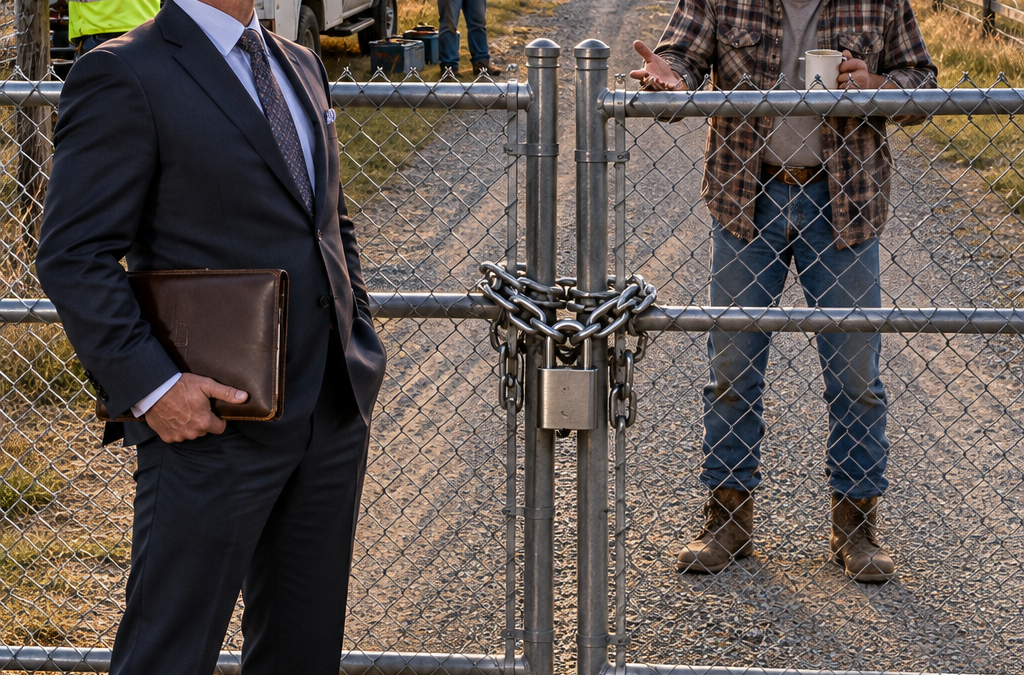
One hard metallic click at six o’clock in the morning, and suddenly the only road connecting my ranch to the county highway had a fence across it.
I stood on the other side in boots, jeans, and an old flannel shirt, holding a mug of coffee that had gone forgotten in my hand.
A man in a reflective vest finished tightening the chain.
Another worker climbed into a white utility truck.
And beside them stood Diane Halloway, president of the Ridgeline Meadows Homeowners Association.
She was dressed like she had come to inspect a country club instead of blockade somebody’s home.
Pressed cream slacks.
A fitted navy jacket.
Blond hair sprayed into perfect shape despite the morning wind.
Gold earrings.
Designer sunglasses even though the sun hadn’t fully cleared the hills.
She was in her late fifties, always polished, always composed, and always carrying the leather folder she seemed to believe had the authority of a court order.
Diane watched me walk toward the fence.
Then she smiled.
“Good morning, Jake.”
I stared at the steel posts.
“What the hell is this?”
Her smile barely changed.
“Language.”
I pointed at the fence.
“You put a fence across my driveway.”
“The association secured disputed common property this morning.”
“My driveway isn’t common property.”
“That’s precisely what is being disputed.”
I looked toward the county road behind me, then back toward my house nearly half a mile beyond the gate.
My truck was parked inside.
My equipment was inside.
Everything I owned was behind that fence.
“You have about thirty seconds to open this.”
Diane tilted her head.
“Threats aren’t going to help you.”
“That’s not a threat.”
I put my coffee on one of the fence posts.
“I’m telling you that you have blocked the legal access to my ranch.”
She opened her folder.
“The board has determined that this access corridor is subject to a community easement.”
“No, it isn’t.”
“Our legal review says otherwise.”
“What legal review?”
“The association isn’t required to provide internal legal communications upon demand.”
I almost laughed.
Six months of dealing with Diane had taught me something.
Whenever she had an actual rule, she quoted it.
Article number.
Section number.
Paragraph number.
Whenever she had nothing, she talked about “internal review.”
I stepped closer to the fence.
“Show me the easement.”
Diane’s expression hardened slightly.
“You’ll receive the appropriate documentation.”
“You put a fence across my driveway before giving me documentation?”
“The property had to be secured.”
“From who?”
She looked directly at me.
“You.”
That was Diane.
She could say something completely insane in a tone so calm that for half a second you wondered whether you were the unreasonable one.
Behind her, the worker carrying the padlock key shifted awkwardly.
I pointed at him.
“Open it.”
He looked at Diane.
She shook her head once.
He looked back at me.
“Sir, we’re just contractors.”
“I understand. That’s why I’m asking the person who hired you.”
Diane closed her folder.
“The fence stays until the access question is resolved.”
“I have livestock feed arriving this afternoon.”
“You’ll need to reschedule.”
“My ranch truck is inside.”
“You can walk to the residence.”
“My emergency access is inside.”
“Then perhaps you should have been more cooperative when the board attempted to resolve this privately.”
There it was.
Not law.
Not safety.
Punishment.
I looked through the chain-link toward my forty acres.
The morning fog was lifting above the pasture.
My barn stood against the eastern ridge.
Beyond it, cattle moved lazily through the grass.
Six months earlier, that view had been the reason I bought the place.
Now I was standing outside my own property while a woman who didn’t own an inch of it told me I needed permission to enter.
I picked up my coffee.
“Diane.”
“Yes?”
“If that fence is still here this afternoon, you’re going to wish you’d never put it up.”
Her mouth tightened.
“Is that another threat?”
“No.”
I looked at the lock.
“It’s advice.”
I walked back toward the road.
What Diane didn’t know was that three days earlier I had already learned her easement didn’t exist.
What she didn’t know was that my attorney was already building a file.
And what neither of us knew yet was that the narrow strip of dirt beneath her new fence was about to expose a scheme far bigger than one ranch driveway.
Six months earlier, none of this seemed possible.
When I bought the property, I thought I’d found exactly what I wanted.
Forty acres.
An old ranch house.
A weathered barn that leaned slightly to the east.
A creek that carried water most of the year.
And enough distance between me and my neighbors that nobody cared whether I started my tractor before breakfast.
I was forty-one and had spent most of my adult life working construction management jobs that kept me moving from one development to another.
Phoenix.
Denver.
Salt Lake City.
Boise.
Every few years, a new apartment.
A new commute.
A new place where I knew the quickest grocery store but couldn’t name the people living next door.
When my father died, something in me changed.
He’d spent years saying he would slow down eventually.
Eventually he’d fish more.
Eventually he’d buy another horse.
Eventually he’d stop working weekends.
Eventually never came.
At his funeral, I looked around and realized I had inherited the same habit.
Work first.
Life later.
So I sold my condo, changed jobs, and started looking for land.
The Ridgeline property sat just outside a planned subdivision called Ridgeline Meadows.
The subdivision itself was new enough to have decorative stone entrance pillars, ornamental streetlights, and lawns so carefully maintained they looked printed.
My ranch wasn’t part of it.
That distinction was clearly stated in the closing documents.
The property predated the development.
My title company confirmed there were no recorded HOA covenants attached to the parcel.
There were utility rights along one edge and an old drainage agreement near the creek.
Nothing unusual.
The driveway ran from my ranch house through the northwest corner of the property and connected directly to County Road 18.
Simple.
At least I thought so.
I met Diane Halloway four days after I moved in.
I was replacing a rotten section of fence near the road when a white Mercedes SUV stopped beside me.
The driver’s window lowered.
A woman looked out.
“Are you the new owner?”
I rested my hammer on the fence post.
“Depends who’s asking.”
Her smile told me she didn’t appreciate the joke.
“Diane Halloway.”
She waited.
I waited.
Finally she added, “President of Ridgeline Meadows.”
“Jake Mercer.”
“I know.”
That should have been my first warning.
She glanced toward the gate.
“That’s taller than the approved height.”
I looked at the gate.
“Approved by who?”
“The association.”
“I’m not in the association.”
Her smile returned.
“That’s a complicated question.”
“No, actually. My closing attorney checked.”
“Properties adjacent to Ridgeline Meadows still affect community aesthetics.”
I stared at her.
“The cows don’t care.”
Her jaw tightened.
“I’m trying to be neighborly.”
“So am I.”
I raised the hammer.
“That’s why I’m fixing my fence instead of letting it fall over.”
She looked at the barn.
Then at the mailbox.
Then at my truck.
It wasn’t curiosity.
It was inventory.
“I’ll send you the architectural standards.”
“No need.”
“It’s always better when people cooperate voluntarily.”
That sentence stayed with me.
Not because it sounded threatening at the time.
Because later I understood exactly what she meant.
Diane had been president of Ridgeline Meadows for almost nine years.
The subdivision had started with fewer than thirty homes and grown to nearly a hundred.
Somewhere along the way, Diane stopped acting like an elected volunteer and started behaving like the neighborhood had been issued to her personally.
I learned that from Pete Dawson.
Pete owned the seventy-acre cattle property on the opposite side of the county road.
He was sixty-eight, broad-shouldered, sunburned, and permanently dressed in work shirts that looked older than some marriages.
The first time we spoke, he leaned against my fence and watched Diane’s Mercedes disappear toward the subdivision.
“You meet Her Majesty?”
I laughed.
“That obvious?”
“She tell you something’s the wrong size?”
“Gate.”
Pete nodded.
“Classic Diane.”
“What exactly is her problem?”
He scratched his gray beard.
“Nobody knows anymore.”
Then he smiled.
“Power’s like cheap whiskey. Some folks take one drink and think they can fight God.”
I liked Pete immediately.
A week later, the first official letter arrived.
RIDGELINE MEADOWS COMMUNITY COMPLIANCE NOTICE.
Mailbox color inconsistent with neighborhood standards.
Fine: $125.
My mailbox was black.
Apparently it was the wrong black.
Diane’s letter said approved mailboxes had to be “Satin Ebony.”
Mine was “Flat Black.”
I carried the letter across the road to Pete.
He read it.
Then looked at my mailbox.
Then back at the letter.
“You planning on paying this?”
“Probably.”
He burst out laughing.
“Why?”
“Because I have work to do.”
“That’s what she’s counting on.”
At the time, I thought Pete was being dramatic.
I paid.
Two weeks later, another notice arrived.
Gate height violation.
Two hundred dollars.
I called the HOA office.
Diane answered personally.
“Ridgeline Meadows.”
“Diane, it’s Jake Mercer.”
“Yes, Jake.”
“You sent me another fine.”
“Correct.”
“My property isn’t part of the HOA.”
“We’ve discussed the visual impact.”
“You can’t fine people because you can see their property.”
Her voice cooled.
“The association’s legal authority is broader than you understand.”
“Then send me whatever document gives you authority.”
“I’ll have our office review your request.”
“Good.”
“Meanwhile, payment is due within fifteen days.”
I paid that one too.
I’m not proud of it.
But I had spent years managing construction crews, negotiating permits, dealing with inspectors, solving problems.
My instinct was always the same.
Pick the battles that matter.
I didn’t realize Diane was using each payment as proof that I would back down if the pressure was small enough.
Then the fines multiplied.
A trailer parked beside my barn.
“Unauthorized commercial equipment.”
A pile of fence posts.
“Outdoor storage violation.”
A temporary livestock panel.
“Architectural inconsistency.”
The absurdity almost became funny.
Almost.
Then I received the letter about my driveway.
It arrived on a Thursday.
Unlike the earlier notices, this one came certified.
I opened it at the kitchen counter.
The language was different.
More legal.
More aggressive.
The HOA asserted that my ranch driveway crossed “a community access easement historically maintained for the benefit of Ridgeline Meadows.”
I read that sentence three times.
My driveway connected my ranch directly to the county road.
The subdivision entrance was almost a quarter mile south.
There was no reason for the HOA to use my access.
The letter demanded that I acknowledge the association’s easement rights and stop “exclusive obstruction of shared access.”
I walked outside.
My driveway was empty.
No gate across the road.
No obstruction except my mailbox.
I went back inside and pulled out the closing file.
Deed.
Title commitment.
Survey.
Exceptions.
Recorded encumbrances.
I checked every page.
There was no community access easement.
I pulled the survey larger and traced the driveway.
Still nothing.
I called the title company.
The woman who handled my closing checked the file.
“No HOA easement appears on your title.”
“Could something have been missed?”
“Anything recorded against the parcel should have been identified.”
“Could there be some old unrecorded agreement?”
“Not one that would normally create the kind of property right you’re describing.”
I thanked her.
Then I called the county recorder’s office.
A clerk took the parcel number and promised someone would call me back.
That afternoon, another woman called.
Her tone was cheerful.
Almost bored.
“Mr. Mercer?”
“That’s me.”
“You asked about an easement on parcel 114-27?”
“Yes.”
“I’m looking at the recorded documents.”
I waited.
“There’s no HOA easement filed against that parcel.”
My grip tightened around the phone.
“None?”
“Not that I’m seeing.”
“What about something for Ridgeline Meadows?”
“No.”
“Could it be under an older parcel number?”
“I checked the parent parcel too.”
I paced across the kitchen.
“So if someone says the HOA has a legal easement across my driveway…”
She laughed lightly.
“I’d ask them for the recording number.”
“You think they’re wrong?”
“Either very confused or lying.”
She said it with the casual indifference of somebody who had no idea what those words meant for me.
I thanked her and hung up.
Then I stood in my kitchen staring at Diane’s letter.
For weeks I’d wondered whether I had somehow misunderstood the legal relationship between my property and the subdivision.
Now I knew.
Diane hadn’t found a loophole.
She had invented one.
The smart thing would have been to confront her immediately.
Instead, I did something that surprised even me.
Nothing.
I put the letter into a folder.
Then I started documenting everything.
Every fine.
Every envelope.
Every email.
I downloaded copies of the HOA rules.
I saved voicemails.
When Diane called, I took notes.
When she approached me in person, I followed up with an email summarizing the conversation.
I started attending the public portions of board meetings and recording them where state law permitted.
Diane noticed.
At the first meeting, she stopped mid-sentence when she saw my phone on the table.
“Are you recording this?”
“Yes.”
“Why?”
“Accuracy.”
She stared at me for several seconds.
Then continued.
Afterward, she approached me in the hallway.
“You’re becoming unnecessarily adversarial.”
“I asked for proof of an easement.”
“Our counsel is reviewing it.”
“Give me the recording number.”
Her eyes narrowed.
“You seem very focused on technicalities.”
“Property ownership is usually pretty technical.”
She leaned closer.
“You bought land beside a community. That carries responsibilities.”
“I bought land outside your community.”
“We’ll see.”
Then she walked away.
That same evening, Pete stopped his truck by my fence.
“I hear you’re poking the bear.”
“I hear the bear forged an easement.”
He climbed out.
“What?”
I showed him Diane’s letter and explained what the recorder’s office had said.
Pete read it slowly.
Then handed it back.
“Karen’s done this before, son.”
I frowned.
“Karen?”
He grinned.
“Old habit. Every tyrant with an HOA clipboard becomes Karen eventually.”
Despite myself, I laughed.
Then I asked, “What do you mean she’s done this before?”
Pete’s expression became serious.
“Not exactly the driveway thing. But land pressure.”
“Who?”
“Family named Bellows used to own six acres near the east entrance. Diane buried them in violations over a workshop. Year later, they sold.”
“To who?”
“Some company.”
“What company?”
He shrugged.
“Never cared enough to look.”
I did.
That night.
I couldn’t sleep anyway.
At midnight, I sat at my desk searching old HOA documents online.
Ridgeline Meadows maintained a public archive of meeting summaries going back almost eight years.
Most were boring.
Pool maintenance.
Landscaping bids.
Holiday decorations.
Reserve studies.
Then I found a footnote in a meeting from four years earlier.
“President Halloway proposed identifying underutilized or unclaimed access strips along the community perimeter for potential future development opportunities.”
I read it again.
Unclaimed access strips.
Development opportunities.
My property sat along the northwest perimeter.
The next morning, I drove to the county planning office.
I told the clerk I was researching possible development near Ridgeline Meadows.
She asked for the location.
I pointed at a map.
She searched for a few minutes.
Then her expression changed.
“There’s a pending concept proposal nearby.”
“For what?”
“Residential lots.”
“How many?”
“Looks like twenty-two in the current draft.”
She pulled a folder.
Luxury residential lots.
Private internal road.
Utility extension.
Proposed access corridor to County Road 18.
I traced the line with my finger.
The proposed access ran directly toward my ranch driveway.
My stomach tightened.
“Who filed this?”
The clerk showed me the applicant.
Halloway Land Development LLC.
Registered agent: Gary Halloway.
Diane’s husband.
I sat there staring at the page.
I had met Gary twice.
Quiet man.
Early sixties.
Wore polo shirts.
Mowed his own lawn.
At neighborhood meetings he usually sat near the back and said nothing.
Apparently that quiet man was attached to a development company proposing millions of dollars’ worth of luxury homes.
And the plan needed access through the exact corridor Diane had suddenly decided belonged to the HOA.
I asked for copies.
The clerk printed everything available.
I walked to my truck carrying the folder and sat behind the wheel without starting the engine.
The picture was becoming painfully clear.
This wasn’t about my mailbox.
It wasn’t about my gate.
It wasn’t even about HOA power for its own sake.
Diane needed land.
Or access rights.
My ranch stood between her husband’s development and the most valuable connection to the highway.
If she could establish that my driveway was already subject to HOA control, the development gained a potential route.
If she couldn’t, then she needed me to sell.
And if I refused to sell?
Make ownership painful enough that I changed my mind.
I almost laughed.
Not because it was funny.
Because the scale of it was ridiculous.
The same woman lecturing me over Satin Ebony mailbox paint was quietly trying to assemble a multimillion-dollar development corridor.
When I got home, another certified letter was waiting.
NOTICE OF DELINQUENT ASSESSMENTS AND INTENT TO LIEN.
The total now exceeded several thousand dollars.
The letter warned that continued nonpayment could result in collection proceedings against the property.
My hands went cold.
I knew enough about property law to understand one dangerous truth.
A false claim can still create very real problems if nobody stops it.
I called an attorney the next morning.
Renata Cole.
Real estate litigation.
Land-use disputes.
Title issues.
She had an office twenty minutes away.
I brought everything.
She sat behind a wide desk while I laid out the documents.
The deed.
Survey.
HOA letters.
County recorder confirmation.
Meeting minutes.
Development proposal.
Halloway LLC registration.
Renata read silently.
She was about forty-five, with dark hair cut just above her shoulders and the kind of expression that made unnecessary conversation feel dangerous.
After four minutes, she looked up.
“This is a gift.”
I blinked.
“It doesn’t feel like one.”
She tapped Diane’s easement letter.
“An HOA can’t lien property based on an easement that doesn’t legally exist.”
“That’s what I thought.”
“No. Listen carefully.”
She leaned forward.
“If they knowingly fabricated the property right and then used it to support collection pressure, we’re potentially beyond overreach.”
She tapped the letter again.
“This can become fraud.”
I stared at her.
Renata picked up the development proposal.
“And this gives us motive.”
“What do we do?”
“First, you stop paying them.”
“That’s easy.”
“Second, you stop talking to Diane unless necessary.”
“Even easier.”
“Third, we challenge every asserted lien basis formally.”
She began stacking documents.
“Then we notify the state HOA oversight authority and the county attorney.”
“Criminal?”
“If the evidence supports it, they’ll decide.”
She looked at me.
“Jake, people like this survive because homeowners assume fighting is more expensive than surrendering.”
“I’ve already paid her.”
“Then stop.”
I nodded.
She pointed at me.
“And don’t get emotional at meetings.”
“I don’t.”
“Everyone says that until somebody insults their home.”
I almost smiled.
“Point taken.”
Within days, Renata filed a formal complaint.
She challenged the HOA’s authority over my parcel.
Demanded documentary proof of the supposed easement.
Put them on notice regarding the false lien threats.
Sent copies of the county record search.
And quietly forwarded the development documents to investigators.
Diane responded by escalating.
Of course she did.
First she sent another compliance notice.
Then another.
Then she added legal processing fees.
Then she announced at a board meeting that “certain adjacent landowners” were obstructing community rights.
I sat in the back recording.
Diane looked directly at me while saying it.
“Our residents should understand that one person’s refusal to cooperate can impose costs on an entire neighborhood.”
A board member named Marcus Lee raised his hand slightly.
Marcus was an accountant in his early fifties.
Quiet.
Careful.
Always reading whatever documents sat in front of him.
“What costs?” he asked.
Diane glanced at him.
“Legal costs.”
“How much?”
“We’ll discuss that in executive session.”
Marcus frowned.
“Are those costs coming from reserves?”
Diane’s expression hardened.
“Again, executive session.”
Marcus didn’t argue.
But he wrote something down.
I noticed.
A week later, the fence appeared across my driveway.
Six in the morning.
Chain link.
Steel posts.
Padlock.
Diane standing beside it like she’d won.
After she left, I called Renata.
She was silent for a second.
“She actually fenced it?”
“Yep.”
“Across the only driveway?”
“Yep.”
“Take photographs before touching anything.”
“Already did.”
“Video too.”
“Already running.”
“Good.”
There was a pause.
“Jake, don’t cut the lock.”
“I was considering driving through it.”
“Don’t.”
“Also considering that.”
“Don’t.”
I looked at the fence.
“What am I supposed to do?”
“I’m seeking emergency relief. In the meantime, document every economic loss and access problem.”
“My truck’s inside.”
“Document it.”
“Feed delivery can’t get through.”
“Document it.”
“Renata—”
“I know.”
Her voice softened slightly.
“I know it’s infuriating. But right now Diane is creating evidence for us faster than we could ever collect it.”
I stared at the fence.
“That’s one way to look at it.”
“Look at it that way.”
The feed truck arrived at two.
Couldn’t enter.
I photographed it.
A propane service vehicle arrived the next day.
Couldn’t enter.
I photographed that too.
When I had to climb over the fence to reach my truck, Pete watched from across the road.
He drove over on his ATV.
“This is new.”
“Diane says my driveway belongs to the community.”
Pete looked at the fence.
Then at me.
“Community got cows now?”
“Apparently.”
He laughed.
Then his expression changed.
“You need another access?”
“Temporary maybe.”
He pointed toward his land.
“You can cut across mine if you need to. Gate’s open.”
I looked at him.
“Pete—”
“Don’t make this sentimental.”
He scratched his beard.
“I just don’t like idiots with padlocks.”
That temporary access saved me.
But it wasn’t enough.
Diane’s fence had made one thing obvious.
She believed pressure would eventually break me.
So I decided to remove the one thing she was counting on.
Her future access.
Renata and I had been studying the parcels between my ranch and the proposed development.
That’s when we found parcel 114-31B.
Tiny.
Narrow.
Barely useful by itself.
A leftover strip from an old road alignment abandoned in 1987.
For decades, it had existed in a strange administrative limbo.
No current private owner.
Back taxes accumulated.
The county had authority to dispose of it.
And it sat directly between the Halloway development site and the corridor Diane wanted.
Renata checked the title history.
Then checked it again.
“If you acquire this,” she said, “their conceptual route becomes much harder.”
“How much?”
“The taxes and processing are around six hundred.”
I stared at her.
“Six hundred dollars?”
“For land nobody wanted until now.”
“Can I legally buy it?”
“If the county process is followed, yes.”
I almost laughed.
Diane was threatening my forty-acre ranch to obtain access to a multimillion-dollar development.
And the actual legal choke point might cost less than a decent refrigerator.
I filed the paperwork.
Paid the back taxes.
Completed the transfer.
When the deed recorded, I drove home with a certified copy on the passenger seat.
The fence was still across my driveway.
I parked beside it.
Then I sat there laughing.
Not loudly.
Just enough to release six months of anger.
Diane found out at the next board meeting.
The room was fuller than usual.
Word had spread about my blocked driveway.
Some homeowners clearly supported Diane.
Others looked uncomfortable.
Pete came even though he wasn’t an HOA member.
He sat in the back.
When public comments began, I stood.
Diane sighed dramatically.
“Mr. Mercer.”
“Diane.”
“Please address the board respectfully.”
“I always do.”
A few people smiled.
I held up a folder.
“I wanted to clarify the access issue.”
“Our attorneys are already handling it.”
“I know.”
“Then there’s no need—”
“I bought parcel 114-31B.”
Silence.
Diane stopped moving.
It lasted only a second.
But I saw it.
Her face lost color.
“What?”
“The county strip between the proposed Halloway development tract and County Road 18.”
Gary Halloway, sitting near the wall, suddenly looked up.
Diane recovered quickly.
“I don’t know what you’re talking about.”
“I’m sure you do.”
I placed a copy of the recorded deed on the table.
“The parcel transferred legally last week.”
Marcus leaned forward.
“Why would that matter to the HOA?”
I looked at him.
“It doesn’t.”
Then I looked at Diane.
“But it matters to Halloway Land Development LLC.”
The room changed.
Whispers.
Chairs moving.
Someone behind me said, “Halloway?”
Diane raised her voice.
“This discussion is completely inappropriate.”
Marcus picked up the deed.
“Halloway Land Development?”
He looked at her.
“Is that Gary’s company?”
Diane’s jaw tightened.
“This meeting concerns association business.”
I held up the development proposal.
“Your fake easement is association business.”
She slammed her hand on the table.
“That easement is not fake.”
“Give me the recording number.”
Silence.
“Just one number, Diane.”
She pointed toward me.
“You’ve spent months antagonizing this association.”
“No.”
My voice stayed calm.
“I spent months checking whether anything you said was true.”
Gary stood near the wall.
“This is ridiculous.”
Pete’s gravel voice came from the back.
“Sit down, Gary.”
Half the room turned.
Gary stared at him.
Pete smiled.
“Meeting’s more interesting when you listen.”
Diane reached for her gavel.
Marcus interrupted.
“Wait.”
She looked at him.
He had opened a financial packet.
“I want to ask about legal expenses.”
Diane’s expression changed again.
“Marcus, that’s not relevant.”
“It is if association money was spent pursuing an easement that doesn’t exist.”
“We have counsel’s opinion.”
“Can I see it?”
“Executive session.”
Marcus shook his head.
“No.”
The room quieted.
Diane stared at him.
“What did you say?”
“I said no.”
He lifted several financial reports.
“I’ve been asking about reserve withdrawals for months. Every time, you defer the discussion.”
Diane’s face hardened.
“This is not the appropriate—”
“Forty thousand dollars.”
She stopped.
Marcus looked around the room.
“Approximately forty thousand dollars has moved out of reserves through legal services, consulting, and special project expenses that don’t reconcile with the invoices I’ve been given.”
The room erupted.
Diane struck the gavel.
“Order!”
Marcus raised his voice.
“I asked for source documents three times.”
“Those records are being reviewed.”
“By who?”
“Our treasurer.”
“You are the treasurer.”
Silence.
Pete whistled softly behind me.
Marcus continued.
“I suspected the financial statements weren’t adding up. Now Mr. Mercer is showing us that some of those legal expenses may relate to property rights the HOA never had.”
Diane stood.
“This meeting is adjourned.”
“No,” Marcus said.
Her face flushed.
“You do not have authority to unilaterally—”
“I’m president.”
“You’re one director.”
Another board member spoke.
“Marcus is right.”
Diane looked toward her.
Then another.
“We should finish the meeting.”
For the first time, I saw the thing Diane feared most.
Not me.
Not a lawsuit.
Her own board realizing she wasn’t invincible.
The state investigation moved quickly after that.
Renata had already submitted our documents.
Marcus provided financial records.
Other board members started cooperating.
Homeowners brought old letters.
Old fines.
Old meeting notices.
Once people realized somebody was actually looking, silence collapsed.
The auditor’s preliminary findings landed three weeks later.
Forty thousand dollars in reserve funds had been improperly diverted or used through unauthorized expenditures.
Some had paid attorneys working on access and development issues that had never been properly approved by the board.
Meeting records had been altered.
Supporting documents had been falsified.
And the so-called easement Diane used against my property had no legitimate recorded basis.
One document in the HOA file attempted to describe the access right as if it had existed for decades.
The county couldn’t verify it.
The title history contradicted it.
Investigators treated it as fabricated.
I read the report twice.
Then I called Renata.
“So she really made it up.”
“Looks that way.”
“All of it?”
“Enough that she’s in serious trouble.”
“What happens now?”
“The board will need to act. And the county attorney has the fraud referral.”
The board acted within days.
Emergency meeting.
Standing-room only.
This time Diane didn’t sit confidently at the center.
She looked exhausted.
No pearls.
No perfect blazer.
Just a dark sweater and an expression I almost didn’t recognize.
Anger mixed with fear.
Marcus presented the findings.
He didn’t dramatize them.
Didn’t need to.
Unauthorized reserve expenditures.
Altered minutes.
False property claims.
Undisclosed conflict involving Halloway Land Development.
Use of association resources in a matter benefiting Diane’s family.
When he finished, one homeowner asked the question everyone had been waiting for.
“Did our money pay for Gary’s development?”
Diane snapped.
“No.”
Marcus answered more carefully.
“The records indicate HOA funds were used for legal and administrative activity related to access claims that would have benefited the proposed development.”
Gary stood.
“That’s not the same thing.”
Someone shouted, “Close enough.”
Diane grabbed the microphone.
“This community has benefited enormously from my leadership.”
A woman near the front laughed bitterly.
“You fined me four hundred dollars for my daughter’s basketball hoop.”
Diane ignored her.
“I protected property values.”
Marcus said, “You falsified minutes.”
“That is not proven.”
“The audit says otherwise.”
“I made administrative corrections.”
The room erupted.
Pete leaned toward me.
“Funny how fraud’s always an administrative correction once somebody finds it.”
I smiled despite myself.
The board voted to remove Diane as president.
She tried to challenge the procedure.
Tried to postpone.
Tried to demand legal counsel.
But the directors had already received advice.
The vote proceeded.
She lost.
Within a week, she was off the board entirely.
The white Mercedes disappeared from HOA meetings.
Her name came off the community letterhead.
That ridiculous looping signature that had once appeared beneath every threat was now attached to exhibits in an investigative file.
The county attorney filed charges related to fraud and embezzlement.
The legal process would take time.
Charges weren’t convictions.
Renata reminded me of that every time I got ahead of myself.
But Diane was no longer issuing fines.
No longer threatening my ranch.
No longer controlling the HOA’s money.
Gary’s development company collapsed almost immediately.
Halloway Land Development LLC withdrew its pending proposal and later dissolved while authorities examined its transactions.
The multimillion-dollar luxury-lot plan disappeared from the county planning calendar.
And then, finally, the fence came down.
It happened on a cold morning.
Not dramatic.
No crowd.
No television cameras.
A contractor arrived with bolt cutters and a small crew.
This time they had paperwork from the HOA’s new board.
I stood beside Pete while they removed the padlock.
The metal snapped.
The chain dropped.
Then workers pulled the chain-link section away from my driveway.
Pete handed me a beer.
I looked at it.
“It’s nine-thirty in the morning.”
“Celebration doesn’t own a clock.”
I laughed.
He opened his.
“Guess the Karen finally met a fence she couldn’t build.”
I shook my head.
“You’ve been saving that.”
“Three weeks.”
“Terrible.”
“Worth it.”
When the last fence post came out, I walked down the driveway.
No chain.
No padlock.
No Diane.
Just gravel under my boots.
The new HOA board formally withdrew every claim that my ranch belonged to the association.
The lien notices were canceled.
My disputed fines were refunded.
The board also sent a letter acknowledging that the HOA had no jurisdiction over my property.
I framed that one.
Right beside Diane’s fraudulent easement letter.
People ask why I kept the fake letter.
Seems strange.
Why keep something that caused months of stress?
Because it reminds me how official a lie can look.
Diane’s letter had everything.
Logo.
Legal language.
Dates.
Signature.
References to community authority.
If I hadn’t checked the county records, I might have believed it.
If I hadn’t hired Renata, I might have paid.
If I had been afraid enough, I might have sold.
That was the whole scheme.
Diane didn’t need her claims to survive a courtroom.
She only needed them to frighten people before they reached one.
I thought about that often afterward.
Especially when other homeowners began contacting me.
A retired couple brought over old fines.
A younger family asked Renata to review a parking-related lien threat.
Someone discovered meeting minutes that had been edited after the fact.
Every story was slightly different.
But they all carried the same assumption.
Diane had authority.
Therefore Diane must be right.
The investigation destroyed that illusion.
The new board ordered an independent financial review and changed its procedures.
No single officer could authorize legal spending.
Meeting minutes required verification.
Conflict-of-interest disclosures became mandatory.
Major land or development matters required independent counsel.
Homeowners were given clearer access to financial records.
Marcus became interim president.
He hated the title.
Which was probably why he was decent at it.
The first time he visited my ranch after taking over, he stopped outside the open gate.
Didn’t drive through.
Didn’t walk in.
He called.
“Jake?”
“Yeah?”
“I’m at the road. Can I come onto the property?”
That simple question hit me harder than it should have.
“Yeah, Marcus. Come on in.”
He drove up.
We sat on my porch.
He handed me the final refund documents.
“I’m sorry,” he said.
“You didn’t put the fence up.”
“I sat on the board while Diane got away with too much.”
“Why?”
He looked toward the pasture.
“Same reason everyone did.”
“What reason?”
“We thought the cost of challenging her would be worse than putting up with her.”
I nodded.
“I understand that.”
He looked at me.
“You shouldn’t have had to be the one to prove it.”
“No.”
“But somebody had to.”
He smiled faintly.
“I suppose.”
Then he noticed the framed letters visible through my kitchen window.
“Is that her easement notice?”
“Yep.”
“You framed it?”
“Absolutely.”
“Why?”
I grinned.
“Interior decorating.”
He laughed.
After he left, I walked down toward the road.
Parcel 114-31B wasn’t impressive.
The six-hundred-dollar strip of land that helped destroy Diane’s development plan looked like nothing.
A narrow patch of weeds.
Some gravel.
A drainage ditch.
Anybody driving past would ignore it.
But legally, it mattered.
I kept the access rights.
Not because I planned to build anything.
I didn’t.
I wanted the ranch to stay exactly what it was.
Open pasture.
Barn.
House.
Quiet.
But owning that strip meant nobody could quietly revive the same plan without coming to me.
And this time, they would have to ask.
Months later, I attended one final court proceeding connected to the fraudulent records.
Diane sat at the defense table.
I barely recognized her.
Not because she looked drastically different.
Because she no longer occupied the room the way she used to.
When Diane had walked into HOA meetings, people lowered their voices.
They moved aside.
They measured what they said.
Her authority arrived before she did.
In court, she was just another person sitting beside an attorney.
Her signature appeared on enlarged copies of correspondence.
The fake access notice was marked as evidence.
So were the altered meeting records.
So were financial transactions tied to the reserve accounts.
I sat behind Renata.
At one point Diane looked back.
Our eyes met.
Six months earlier, that look would have tightened my stomach.
Now I felt almost nothing.
She looked away first.
Outside afterward, Renata asked if I was okay.
“Yeah.”
“Really?”
I thought about it.
“Actually, yeah.”
She nodded.
“Good.”
“I expected to feel more.”
“More what?”
“Satisfaction.”
Renata slipped her files into her bag.
“Legal consequences usually feel less cinematic than people expect.”
I laughed.
“That’s disappointing.”
“The ranch still yours?”
“Yep.”
“Driveway open?”
“Yep.”
“Then there’s your ending.”
She was right.
The real victory wasn’t watching Diane lose power.
It wasn’t seeing her development company collapse.
It wasn’t even knowing that the same letterhead she’d used to threaten me had become evidence against her.
It was driving home.
I turned off County Road 18 and pulled through my gate.
No fence.
No chain.
No lock.
My tires crunched across gravel.
The pasture opened on either side.
Cattle lifted their heads as I passed.
The barn caught the orange light from the setting sun.
Everything looked almost exactly as it had the day I bought the place.
But I didn’t feel like the same man.
Before Diane, I thought property ownership meant having a deed.
After Diane, I understood ownership also meant being willing to defend what the deed said.
Rules matter.
Records matter.
Signatures matter.
But none of those things become truth just because somebody prints them on impressive letterhead.
The following spring, Pete helped me replace the gate Diane had once claimed was too tall.
I deliberately made the new one the same height.
He held one end while I tightened the hinge.
“You think Marcus is going to send you a violation?”
“Marcus knows better.”
Pete laughed.
We finished around noon.
Then we sat on the tailgate drinking coffee.
He pointed toward the subdivision.
“Quiet over there.”
“Good.”
“Almost boring.”
“Even better.”
He scratched his beard.
“You know what Diane’s real mistake was?”
I looked at him.
“Which one?”
“Thinking you wanted something from her.”
I considered that.
He continued.
“People like that know how to control folks who want approval.”
He pointed toward my ranch.
“You just wanted to be left alone.”
I nodded.
“Pretty much.”
“Hard person to control.”
The next morning, I woke before sunrise.
Old habit.
I made coffee and walked down the driveway.
Mist sat low over the pasture.
The eastern sky was turning gray.
My gate stood open.
I stopped at the place where Diane’s chain-link fence had once crossed the road.
For months, every time I reached that spot, I had remembered the padlock.
Click.
Such a small sound.
But it had carried everything Diane believed about herself.
That she could decide who had access.
Who belonged.
Who paid.
Who surrendered.
Who moved.
She believed authority meant people eventually had to give her what she wanted.
She was wrong.
I took another sip of coffee.
Across the county road, Pete’s porch light came on.
A truck passed in the distance.
Somewhere behind me, one of the cows called from the pasture.
Nothing dramatic.
Nothing cinematic.
Just morning.
Exactly what I had wanted when I bought forty acres at the edge of Ridgeline Meadows.
I looked toward the open gate.
Diane had tried fines.
False liens.
Fabricated property rights.
A locked fence.
And a multimillion-dollar development scheme hidden behind the language of community interest.
In the end, the ranch stayed mine.
The access stayed mine.
The little six-hundred-dollar parcel stayed mine too.
And Diane’s most impressive piece of paperwork—the letter declaring that her imaginary easement gave her control over my driveway—now sat inside a black frame on the wall beside my desk.
Sometimes people who visit ask about it.
I tell them the truth.
“That’s the most expensive fake easement anyone ever tried to give me.”
Then I usually take them outside.
Because the better evidence isn’t hanging on the wall.
It’s the driveway.
Open.
Unblocked.
Running from the county road all the way to my home.
Every morning now, I stand beside that gate with a cup of coffee and watch the sun come over the hills.
No workers.
No HOA trucks.
No woman with a leather folder.
Nobody waiting to explain why land I owned actually belonged to somebody else.
Just forty acres, an open road, and the quiet I thought I was buying from the beginning.
And nobody has ever tried to fence me in again.








