𝗙𝗨𝗟𝗟 𝗦𝗧𝗢𝗥𝗬 The HOA Enforcer Sent a Tow Truck to My Driveway Before His Own Paper Trail Turned Against Him
𝗣𝗔𝗥𝗧 𝟮
Alan skimmed the pages.
“Mr. Whitfield handles compliance.”
“I know. That’s the problem.”
“You can appeal through the board.”
“The board is Craig, his wife, and a man who agrees with everything Craig says.”
Alan frowned.
“The board is elected.”
“That doesn’t make the process fair.”
He slid the papers back.
“You’ll need to take it up with them.”
I stared at him.
“You don’t care that inspection records may be falsified?”
His face closed.
“I’m saying our office administers what the board approves.”
“Convenient.”
He did not answer.
I walked out furious.
The system was rigged at every door.
The property manager would not act.
The board was controlled by Craig.
The fines kept coming.
So I found a real estate attorney who specialized in HOA abuse.
Her name was Patricia Lynn.
Her office was downtown, above a credit union, with shelves full of property-code books and a framed photo of her standing outside a courthouse in the rain. She had sharp eyes, a calm voice, and the rare professional gift of making bad news sound manageable.
I put my folder on her conference table.
She read for almost forty minutes without speaking.
That alone impressed me.
Most people skim when a homeowner starts complaining about an HOA.
Patricia did not skim.
She read the violation letters, the lien notice, the timestamps, the travel logs, the meeting notes, and the rejected management-company complaint.
Then she looked up and smiled for the first time.
“This is not a violation dispute anymore.”
My stomach tightened.
“What is it?”
“A paper trail of harassment.”
She tapped the folder.
“And I love paper trails.”
For the first time in weeks, I almost laughed.
“What can we do?”
“We start formally. Demand validation of every fine. Challenge the lien. Notify the board and management company to preserve all records. File a complaint with the state HOA oversight division for selective enforcement and falsified inspection records.”
“Can he retaliate?”
“He already is.”
That was true.
Patricia sent the letters.
Formal.
Precise.
Cold.
The kind of letters that make people stop smiling if they know they are wrong.
Craig did not stop smiling.
Because he did not know the letters had gone out yet.
He doubled down.
That was when the tow truck showed up.
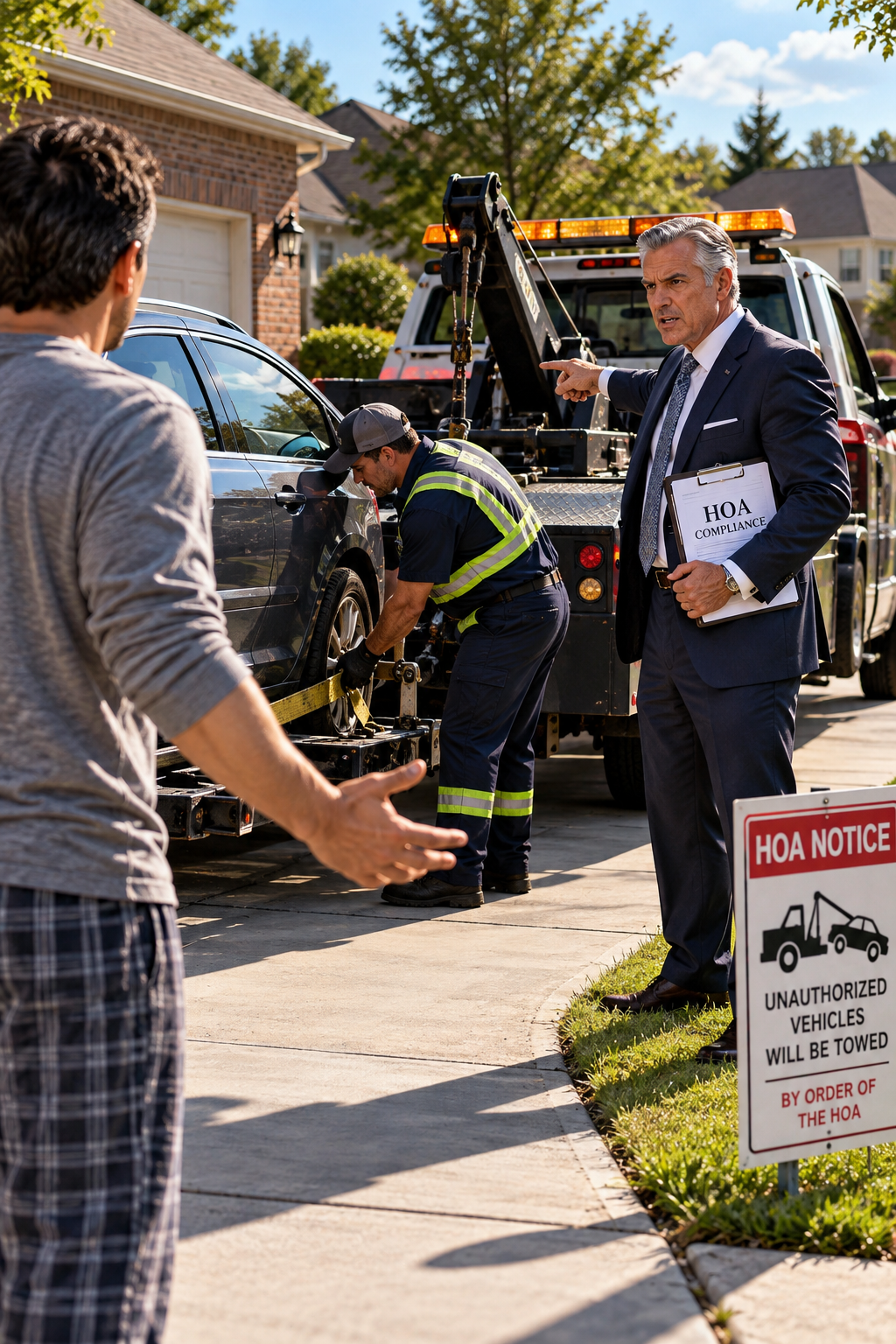
It was 7:12 on a Wednesday morning.
I had just poured coffee when orange lights flashed across the kitchen wall.
I looked through the front window and saw a tow truck backed into my driveway, engine running, chains hanging loose behind it.
Craig stood beside my car wearing a navy golf polo, sunglasses, and white sneakers.
Clipboard in hand.
Grinning.
I walked outside with my coffee still in one hand.
“What the hell is this?”
Craig tapped the clipboard.
“Unauthorized vehicle.”
“My car?”
“Board decision effective immediately.”
“My car is in my driveway.”
“Your parking authorization has been revoked due to unresolved violations.”
I stared at him.
“That is not a thing.”
“It is now.”
The tow operator, a heavyset man with a beard and tired eyes, stood near the truck, looking like he already regretted taking the call.
I pointed to my windshield.
“My permit is right there.”
A valid parking permit sat taped inside the glass, plain as day.
Craig did not even look.
“Permit privileges are conditional.”
“Conditional on what? Letting you make up fines?”
His smile thinned.
“You are in violation. The board has authority.”
I pulled out my phone and started recording.
“Say that again.”
Craig’s eyes flicked to the phone.
“The board has authority to remove unauthorized vehicles.”
The tow operator leaned toward the windshield.
“That’s a valid permit, sir.”
Craig snapped, “I know what the board authorized.”
The driver shook his head.
“I’m not touching this car.”
Craig turned to him.
“What?”
“I said I’m not touching it. Permit’s valid. Vehicle’s on private driveway. I’m not getting sued because you two got HOA drama.”
Craig’s face went red.
“I run this board.”
The sentence came out sharp, loud, and clean.
“I decide what’s authorized here, not some sticker.”
The tow operator looked at me, then at my phone.
“You got that recorded?”
“Yes.”
He nodded.
“Good.”
Then he climbed into his truck and drove away.
Craig stood in my driveway, furious and exposed.
For a moment, neither of us spoke.
Then I said, “You should leave.”
His lips pressed into a thin line.
“This isn’t over.”
“No,” I said. “It really isn’t.”
That single sentence—I run this board. I decide what’s authorized here, not some sticker—became the centerpiece exhibit in Patricia’s motion the following week.
She replayed it twice in her office.
The second time, she actually laughed.
“He just admitted the process is whatever he says it is.”
“On video.”
“On video,” she said. “Beautiful.”
Then Patricia’s investigator found the second twist.
Craig had been quietly diverting HOA reserve funds into a landscaping contract.
His own landscaping contract.
The company was called Whitfield Grounds and Exterior Services.
On paper, it looked like a normal vendor.
At first.
Then the filings showed Craig as an owner through a related entity. Payments from Meadow Crest’s reserve fund flowed to the company under landscaping improvement, compliance remediation, and common-area restoration.
The same kinds of violations Craig kept citing residents for.
Grass.
Edging.
Mailbox posts.
Driveway borders.
Landscaping standards.
Manufactured violations justified board-approved “corrections,” which justified hiring his own company, which got paid from HOA funds.
Suddenly, the half-inch grass, the trash-can timing, the mailbox stain, all of it clicked into a picture much uglier than harassment.
Craig had built himself a machine.
Fine homeowners.
Create a need.
Approve a fix.
Pay his company.
Threaten anyone who asked questions.
Patricia filed an amended complaint with the oversight division and sent a records request for all payments to Whitfield Grounds and related vendors.
That was when other neighbors started coming forward.
Mrs. Okafor brought a folder of fines totaling $3,000.
A couple from Briar Court had paid nearly $1,800 after Craig cited them for landscaping violations, then recommended an “approved vendor” that turned out to be connected to him.
A retired man named Leo had disputed a fine and was suddenly threatened with legal review fees.
By the time the emergency HOA meeting was called, residents were not just angry.
They were organized.
The clubhouse was packed.
Folding chairs filled the room, and people stood along the walls holding folders, envelopes, and printed bank statements. There was a restless sound in the air, like a storm pressing against windows.
Craig sat at the front table beside Vivian and his wife, Marlene, who served as board secretary.
Marlene looked pale.
I noticed that immediately.
Craig looked annoyed.
Not worried.
Annoyed.
Like we had interrupted his dinner.
He opened the meeting by claiming outside misinformation had created unnecessary tension.
That was his phrase.
Outside misinformation.
He said certain residents had misinterpreted enforcement efforts and attacked volunteers who worked hard to preserve property values.
I stood when homeowner comments opened.
My hands shook, but my voice held.
“I have a question about fines over the last year.”
Craig sighed.
“Mr. Ruiz, your account is under legal review.”
“Good,” I said. “Then this should help.”
A few people murmured.
I held up my folder.
“Over the last three months, I received multiple violations based on photos with inaccurate timestamps. Some were dated when I was out of state for work. Some used old images. Some cited conditions that did not exist.”
Craig leaned back.
“That is your interpretation.”
I turned toward the room.
“I also have video of Craig attempting to tow my legally permitted car from my own driveway.”
A ripple moved through the homeowners.
Craig’s jaw tightened.
I played the video on my laptop through the projector.
The tow truck lights.
My permit visible in the windshield.
The driver refusing.
Craig’s face red.
His voice clear.
“I run this board. I decide what’s authorized here, not some sticker.”
The room went silent.
Then people started talking at once.
Craig slammed a hand on the table.
“That recording lacks context.”
Mrs. Okafor stood.
“What context makes that acceptable?”
Applause broke out.
Craig shouted over it.
“This is not a courtroom.”
Patricia stood from the side of the room.
“No. But it may become one.”
That quieted everyone.
Then she presented the vendor records.
Whitfield Grounds and Exterior Services.
Reserve-fund payments.
Related ownership.
Compliance remediation charges.
Landscaping contracts awarded without proper disclosure.
The room changed.
Anger became something heavier.
Betrayal.
People can tolerate petty power longer than they should.
But when they realize their money may have been feeding it, the air shifts.
Craig’s face hardened.
“These allegations are defamatory.”
Then Marlene stood.
His wife.
His own board secretary.
Her hands trembled so badly the papers shook.
“I need to say something.”
Craig turned toward her.
“Marlene, sit down.”
She did not.
“I told him three times this would blow up.”
The room froze.
Craig’s face went blank.
Marlene looked at the homeowners, not at him.
“I told him people were getting upset. I told him the fines were too high. I told him the contracts needed to be disclosed.”
Her voice cracked.
“He said nobody reads the bylaws closely enough to catch it.”
No one breathed.
That was twist number three.
Craig’s own wife produced texts.
She placed them on the table.
Patricia walked them to the projector.
There they were.
Messages from Marlene.
Craig, you can’t keep approving these fines without proper votes.
Craig, the landscaping contract is going to look bad if anyone compares names.
Craig, Daniel is keeping records. This will blow up.
Then Craig’s replies.
Stop worrying.
They never read the bylaws.
Nobody checks the filings.
The board approves what I tell them.
The room erupted.
Someone shouted, “Fraud!”
Someone else demanded Vivian resign too.
A man near the back yelled that he wanted every fine refunded.
Craig stood, chair scraping loudly behind him.
“You people have no idea how much I do for this community.”
Mrs. Okafor stepped forward.
“You did it for yourself.”
That landed harder than any shouted accusation.
Craig looked around the room, and for the first time since I had met him, he did not look powerful.
He looked cornered.
The state oversight division issued its ruling two weeks later.
The lien against my house was void.
The HOA had failed to follow required procedures and relied on unsupported and improperly documented fines.
Every falsified fine had to be reviewed.
Restitution was ordered for affected homeowners.
The matter involving vendor payments and reserve funds was referred to prosecutors for investigation.
Craig resigned that same night.
Not gracefully.
He stood in the clubhouse doorway shouting about witch hunts, ungrateful residents, and how the neighborhood would fall apart without him.
Security walked him to his car.
Marlene did not leave with him.
I do not know what happened between them afterward. That was not my business.
What mattered was that his control ended.
The months that followed were messy.
Audits always are.
The new interim board had to untangle accounts, review old fines, contact residents, freeze vendor payments, and rebuild trust one ugly document at a time.
My lien notice was withdrawn in writing.
The HOA issued an apology.
Not warm.
Not personal.
But written.
Official.
Permanent.
Every illegal fine I had paid was refunded with interest.
Mrs. Okafor received a check large enough to make her cry on her porch.
The couple from Briar Court got back enough to replace the money they had borrowed from family.
Others came forward slowly, embarrassed at first, then angry once they realized they were not alone.
That was the worst part and the best part.
Learning how many people had been targeted.
Learning how many had quietly paid because they thought they were the only ones.
Six months later, I sat at the front table of the clubhouse as a member of the new HOA board.
I still found that strange.
Me.
The guy who had moved in wanting nothing but quiet and a working garage door.
Now I was reviewing budgets, reading bylaws, and asking questions Craig had taught me never to ignore.
We passed new rules quickly.
No fines without a clear covenant citation.
No fine over the threshold without documented board vote.
No vendor contract with a board member, relative, or related company without full disclosure and homeowner review.
No vehicle removal without independent verification and written authorization.
No deletion of homeowner comments from official forums without record.
No liens without outside legal counsel.
No exceptions.
At the end of that first meeting, Mrs. Okafor raised her hand.
“Can I ask one thing?”
“Of course,” I said.
She smiled.
“Is your mailbox still the wrong shade of blue?”
The room laughed.
For once, laughter in that clubhouse did not feel nervous.
“Yes,” I said. “Very wrong.”
“Good,” she said. “Leave it that way.”
I did.
My mailbox still sits out there, proudly two shades off from whatever laminated chart Craig once carried like scripture.
No one has fined it.
No one has measured it.
No one has left a notice tucked under my door.
Sometimes, when I pull into the driveway after work, I look at the spot where that tow truck sat with its lights spinning.
I remember standing there in the morning air with coffee cooling in my hand and my phone recording.
I remember Craig’s face when the tow driver refused.
I remember how close I came to thinking maybe the easiest thing would be to pay again.
That is how people like Craig win.
They make each individual fight seem too small, too annoying, too expensive, too embarrassing.
Half an inch of grass.
A mailbox stain.
Eleven minutes.
A permit sticker.
Four hundred dollars.
They count on you not noticing how small abuses become a system when stacked high enough.
The folder changed that.
Not because paper is powerful by itself.
Because paper remembers what bullies hope everyone else forgets.
Dates.
Times.
Names.
Amounts.
Photos.
Contradictions.
The sentence Craig said in my driveway.
The texts his wife finally had the courage to produce.
The vendor records he thought nobody would read.
Justice did not arrive all at once.
It arrived as a tow driver refusing to be part of a lie.
An attorney who loved paper trails.
Neighbors opening their own folders.
A wife deciding she was done protecting a man’s arrogance.
A state ruling.
A prosecutor’s referral.
A resignation shouted through a clubhouse doorway.
And finally, a quiet evening when I sat on my porch, looked at my wrong-shade mailbox, and realized my house felt like mine again.
That was all I ever wanted.
Not revenge.
Not power.
Not a seat on the board.
Just the simple right to live in the house I bought without a man like Craig Whitfield turning every ordinary day into evidence against me.
The neighborhood is still not perfect.
No neighborhood is.
People still argue about parking.
Someone still leaves trash cans out too long.
Grass still grows half an inch past somebody’s comfort zone.
But now, when rules are enforced, the rule has to exist.
The vote has to happen.
The record has to show it.
And if someone asks where the money is going, nobody gets to punish them for asking.
That is the difference between order and control.
Craig never understood it.
Or maybe he did, and that was why he fought so hard to blur the line.
Either way, his career ended in my driveway the morning he tried to tow a car with a valid permit.
He thought he was removing a vehicle.
He was really giving me the cleanest piece of evidence I could have asked for.
And every time I see my mailbox still standing there, wrong shade and all, I remember exactly what his mistake taught me.
Never ignore the first fine.
Never trust a man who says the rules are whatever he decides.
And never underestimate what one organized folder can do when the right people finally read it.
𝗧𝗛𝗘 𝗘𝗡𝗗
The HOA Enforcer Sent a Tow Truck to My Driveway Before His Own Paper Trail Turned Against Him
The tow truck’s lights were already spinning in my driveway before I even got my coffee cup down. Craig Whitfield stood beside it with a clipboard in his hand, grinning like he had finally found the mistake that would cost me everything.
My name is Daniel Ruiz, and that morning, I had no idea I was about to end the most powerful man on our street.
Three months earlier, I had just closed on my first house.
It was a modest brick rancher in Meadow Crest Estates, a quiet Ohio subdivision with trimmed hedges, matching mailboxes, sidewalks clean enough to look staged, and cul-de-sacs where kids still rode bikes after dinner. The house had three bedrooms, one and a half baths, an aging furnace, and a garage door that rattled every time it opened.
To anyone else, it was ordinary.
To me, it was proof that my life had not ended after the divorce.
I had spent years working overtime, picking up weekend shifts, skipping trips, eating cheap dinners, and saving every spare dollar because I wanted one thing that could not be split, packed into boxes, or argued over at a kitchen table.
A place that was mine.
When I signed the final documents, I sat in my truck outside the title office and just held the keys for a while.
Not crying.
Not exactly.
Just sitting there with my hand closed around the metal, letting the weight of them sink in.
After my divorce, I had moved into a one-bedroom apartment with thin walls and a parking lot view. Every night, I heard my upstairs neighbor walking around like he was training for a marathon in work boots. Every morning, I woke up feeling like my life had shrunk into rented space.
The house in Meadow Crest was supposed to be the opposite.
Quiet.
Stable.
Mine.
The first week, I unpacked slowly.
I set up a folding table in the kitchen because I had not bought a real one yet. I put my tools in the garage, arranged my work boots by the back door, and sat on the front porch at night listening to sprinklers tick across lawns.
That was when Craig Whitfield first introduced himself.
He came walking up my driveway on a Saturday morning wearing a golf polo tucked into khaki pants, white sneakers, and a belt with a silver buckle shaped like a golf club. He was about fifty, maybe a little older, with tanned skin, carefully styled gray hair, and the self-satisfied posture of a man who had never been interrupted enough in life.
He was not technically the HOA president.
That title belonged to Vivian Markham, a woman who appeared at meetings, read announcements, and rarely looked up from her notes. But everyone knew Craig was the real power in Meadow Crest.
He was Vivian’s right hand.
Enforcement chair.
Retired insurance adjuster.
Keeper of rules.
Collector of complaints.
The man who treated the HOA bylaws like scripture and himself like the only priest allowed to interpret them.
He held out his hand.
“Daniel Ruiz?”
“That’s me.”
“Craig Whitfield. HOA compliance.”
“Nice to meet you.”
He shook my hand too firmly, then looked past me at the house.
“Welcome to Meadow Crest.”
“Thanks. Seems like a nice place.”
“It is,” he said. “Because we keep standards high.”
That was the first sentence that should have warned me.
Instead, I nodded like an idiot.
He handed me a folder.
“Updated community guidelines. Parking, lawn care, exterior appearance, trash schedules, architectural standards. Nothing unreasonable.”
“Sure.”
“If you have questions, ask before you do something. Saves everyone trouble.”
He smiled.
The smile did not reach his eyes.
I watched him walk back down the driveway, clipboard tucked under one arm like a badge.
Two days later, my neighbor across the street, Mrs. Okafor, caught me setting empty boxes near the curb.
“You met Craig yet?” she asked.
“Yeah. HOA guy.”
She made a face.
“Watch out for him.”
I laughed.
“Seems intense, but I follow rules.”
“So did we.”
Something in her tone made me pause.
Before I could ask what she meant, her garage door opened, and she gave me a tight little smile.
“Just keep records.”
That was the first warning.
It was not the last.
People warned me quietly after that.
Over fences.
At the mailbox.
While walking dogs.
Never in the open.
Watch out for Craig.
Craig keeps a list.
Don’t ask too many questions at meetings.
Don’t let him onto your property without writing everything down.
I laughed it off because I did not yet understand how fear spreads in a neighborhood that looks peaceful from the street.
Rules were rules.
I mowed my lawn.
I paid my dues.
I parked in my driveway.
What was the worst that could happen?
The worst started in week two.
A violation notice appeared tucked into my front door.
Grass exceeding regulation height by half an inch.
Half an inch.
I stood in the yard with the paper in one hand and a tape measure in the other, actually laughing as I checked the grass near the sidewalk.
It was absurd.
The kind of thing you tell a coworker at lunch because it sounds too petty to be real.
Three days later, a $150 fine landed in my mailbox.
Stamped with the HOA’s official seal.
Signed by Craig Whitfield, Compliance Chair.
I called the management office.
A woman named Denise answered.
“I got a fine for grass height,” I said.
“Yes, Mr. Ruiz. That violation was documented.”
“It says half an inch over.”
“Yes.”
“Isn’t a warning usually first?”
“The board may assess fines immediately for visible property maintenance issues.”
“The board or Craig?”
There was a pause.
“The board delegates compliance review to Mr. Whitfield.”
I looked out at my lawn, which had already been cut.
“Can I appeal?”
“You can submit a written request.”
“How long does that take?”
“Typically thirty to sixty days.”
“And the fine?”
“Due within fourteen.”
I paid it.
Rookie mistake number one.
I thought paying would end the issue.
I did not yet understand that, with Craig, compliance only invited more scrutiny.
Next came the mailbox post.
Improper stain color.
Craig came by holding a laminated chart of approved wood tones, standing at the edge of my driveway like a judge at a livestock competition.
“This is Cedar Brown 4,” he said, tapping the chart. “Yours appears closer to Walnut Brown 6.”
“It’s a mailbox post.”
“It’s an exterior feature visible from the street.”
“It was this color when I bought the house.”
“Previous violations do not become compliant simply because ownership changes.”
I stared at him.
“Do you hear yourself?”
His expression cooled.
“I hear someone explaining standards to a new homeowner.”
Another fine.
Then the trash cans.
Visible eleven minutes past the posted curb window.
Craig attached a photo taken from across the street with a timestamp in the corner.
6:11 p.m.
The approved removal window ended at 6:00 p.m.
I had been on a work call that ran late.
Eleven minutes.
Another fine.
At first, I was angry in the normal way people get angry over small unfair things.
Then I started noticing the timing.
Every fine seemed to arrive after I said something Craig did not like.
At my first HOA meeting, I asked why dues had increased when the common areas looked exactly the same.
Craig looked at me from the front table.
“Reserve requirements change,” he said.
“Do we have a breakdown?”
“It’s in the report.”
“I read the report. It says landscaping and reserve maintenance, but not much detail.”
A few heads turned.
Craig’s jaw tightened.
“Homeowners are welcome to submit written questions.”
“I’m asking now.”
Vivian, the official president, cleared her throat.
“We’ll move on to the next agenda item.”
The next week, I got two violations.
Mailbox stain.
Trash bins.
A month later, I asked why the HOA had hired a new landscaping vendor even though the same bare spots still showed near the entrance sign.
Three days after that, I received a notice for improper driveway edging.
That was when I understood.
I had made one fatal error.
I had asked publicly where our rising HOA dues were actually going.
That question made me Craig’s new full-time hobby.
The fines piled up like snow in a blizzard.
$150.
$250.
$300.
Administrative fees.
Late fees.
Inspection fees.
Processing fees.
I disputed some.
Paid others because I had work, bills, and a house I was still furnishing one paycheck at a time.
Then came the letter that changed everything.
A lien notice.
Threatening foreclosure over $400 in unpaid violations.
Four hundred dollars.
Against my house.
The house I had worked years to buy.
I remember sitting at the kitchen table with that letter flat beneath both hands, reading it three times because my brain refused to accept that the word foreclosure could appear next to a balance smaller than a used refrigerator.
A lien over a mailbox post.
Over eleven minutes.
Over grass.
My hands shook.
Not because I believed Craig could legally take my house overnight.
Because the paper was formal enough to make the threat feel real.
Because legal language has a way of reaching into your chest even when you know something is wrong.
Because I had spent the years after my divorce rebuilding, and now a retired insurance adjuster with a clipboard was making my home feel fragile.
That night, instead of panicking completely, I made a folder.
Everything went into it.
Every notice.
Every envelope.
Every timestamp.
Every fine.
Every photo Craig had attached.
Every email I had sent.
Every response I had received.
I scanned each page and saved digital copies.
Then I started making a timeline.
Date of HOA meeting.
Question I asked.
Violation received.
Amount.
Evidence.
At first, it looked ridiculous.
Then it looked like a pattern.
The first real twist showed up in the photo timestamps.
Craig had submitted images of alleged infractions on days I was not even home.
One fine claimed my trash cans were visible on a Thursday afternoon.
I was in Indianapolis for work from Wednesday morning through Friday night, and my cans had been inside the garage before I left.
Another photo supposedly showed my garage door open past the allowed time.
I had travel logs proving I had not been home.
A third image showed the same grass patch from a date before the alleged inspection period.
I zoomed in and noticed something else.
The shadows were wrong.
A photo labeled Saturday morning had long evening shadows.
Another picture showed fallen leaves from weeks earlier, before I had cleaned the yard.
Craig had been reusing and mislabeling photos.
Maybe staging some.
Maybe falsifying inspection records.
I drove to the HOA’s property management company with printed copies in a neat folder.
A man named Alan met me in a conference room that smelled like coffee and old carpet.
I laid everything out.
“These photos can’t be accurate,” I said. “I was not home on these dates.”
Alan skimmed the pages.
“Mr. Whitfield handles compliance.”
“I know. That’s the problem.”
“You can appeal through the board.”
“The board is Craig, his wife, and a man who agrees with everything Craig says.”
Alan frowned.
“The board is elected.”
“That doesn’t make the process fair.”
He slid the papers back.
“You’ll need to take it up with them.”
I stared at him.
“You don’t care that inspection records may be falsified?”
His face closed.
“I’m saying our office administers what the board approves.”
“Convenient.”
He did not answer.
I walked out furious.
The system was rigged at every door.
The property manager would not act.
The board was controlled by Craig.
The fines kept coming.
So I found a real estate attorney who specialized in HOA abuse.
Her name was Patricia Lynn.
Her office was downtown, above a credit union, with shelves full of property-code books and a framed photo of her standing outside a courthouse in the rain. She had sharp eyes, a calm voice, and the rare professional gift of making bad news sound manageable.
I put my folder on her conference table.
She read for almost forty minutes without speaking.
That alone impressed me.
Most people skim when a homeowner starts complaining about an HOA.
Patricia did not skim.
She read the violation letters, the lien notice, the timestamps, the travel logs, the meeting notes, and the rejected management-company complaint.
Then she looked up and smiled for the first time.
“This is not a violation dispute anymore.”
My stomach tightened.
“What is it?”
“A paper trail of harassment.”
She tapped the folder.
“And I love paper trails.”
For the first time in weeks, I almost laughed.
“What can we do?”
“We start formally. Demand validation of every fine. Challenge the lien. Notify the board and management company to preserve all records. File a complaint with the state HOA oversight division for selective enforcement and falsified inspection records.”
“Can he retaliate?”
“He already is.”
That was true.
Patricia sent the letters.
Formal.
Precise.
Cold.
The kind of letters that make people stop smiling if they know they are wrong.
Craig did not stop smiling.
Because he did not know the letters had gone out yet.
He doubled down.
That was when the tow truck showed up.
It was 7:12 on a Wednesday morning.
I had just poured coffee when orange lights flashed across the kitchen wall.
I looked through the front window and saw a tow truck backed into my driveway, engine running, chains hanging loose behind it.
Craig stood beside my car wearing a navy golf polo, sunglasses, and white sneakers.
Clipboard in hand.
Grinning.
I walked outside with my coffee still in one hand.
“What the hell is this?”
Craig tapped the clipboard.
“Unauthorized vehicle.”
“My car?”
“Board decision effective immediately.”
“My car is in my driveway.”
“Your parking authorization has been revoked due to unresolved violations.”
I stared at him.
“That is not a thing.”
“It is now.”
The tow operator, a heavyset man with a beard and tired eyes, stood near the truck, looking like he already regretted taking the call.
I pointed to my windshield.
“My permit is right there.”
A valid parking permit sat taped inside the glass, plain as day.
Craig did not even look.
“Permit privileges are conditional.”
“Conditional on what? Letting you make up fines?”
His smile thinned.
“You are in violation. The board has authority.”
I pulled out my phone and started recording.
“Say that again.”
Craig’s eyes flicked to the phone.
“The board has authority to remove unauthorized vehicles.”
The tow operator leaned toward the windshield.
“That’s a valid permit, sir.”
Craig snapped, “I know what the board authorized.”
The driver shook his head.
“I’m not touching this car.”
Craig turned to him.
“What?”
“I said I’m not touching it. Permit’s valid. Vehicle’s on private driveway. I’m not getting sued because you two got HOA drama.”
Craig’s face went red.
“I run this board.”
The sentence came out sharp, loud, and clean.
“I decide what’s authorized here, not some sticker.”
The tow operator looked at me, then at my phone.
“You got that recorded?”
“Yes.”
He nodded.
“Good.”
Then he climbed into his truck and drove away.
Craig stood in my driveway, furious and exposed.
For a moment, neither of us spoke.
Then I said, “You should leave.”
His lips pressed into a thin line.
“This isn’t over.”
“No,” I said. “It really isn’t.”
That single sentence—I run this board. I decide what’s authorized here, not some sticker—became the centerpiece exhibit in Patricia’s motion the following week.
She replayed it twice in her office.
The second time, she actually laughed.
“He just admitted the process is whatever he says it is.”
“On video.”
“On video,” she said. “Beautiful.”
Then Patricia’s investigator found the second twist.
Craig had been quietly diverting HOA reserve funds into a landscaping contract.
His own landscaping contract.
The company was called Whitfield Grounds and Exterior Services.
On paper, it looked like a normal vendor.
At first.
Then the filings showed Craig as an owner through a related entity. Payments from Meadow Crest’s reserve fund flowed to the company under landscaping improvement, compliance remediation, and common-area restoration.
The same kinds of violations Craig kept citing residents for.
Grass.
Edging.
Mailbox posts.
Driveway borders.
Landscaping standards.
Manufactured violations justified board-approved “corrections,” which justified hiring his own company, which got paid from HOA funds.
Suddenly, the half-inch grass, the trash-can timing, the mailbox stain, all of it clicked into a picture much uglier than harassment.
Craig had built himself a machine.
Fine homeowners.
Create a need.
Approve a fix.
Pay his company.
Threaten anyone who asked questions.
Patricia filed an amended complaint with the oversight division and sent a records request for all payments to Whitfield Grounds and related vendors.
That was when other neighbors started coming forward.
Mrs. Okafor brought a folder of fines totaling $3,000.
A couple from Briar Court had paid nearly $1,800 after Craig cited them for landscaping violations, then recommended an “approved vendor” that turned out to be connected to him.
A retired man named Leo had disputed a fine and was suddenly threatened with legal review fees.
By the time the emergency HOA meeting was called, residents were not just angry.
They were organized.
The clubhouse was packed.
Folding chairs filled the room, and people stood along the walls holding folders, envelopes, and printed bank statements. There was a restless sound in the air, like a storm pressing against windows.
Craig sat at the front table beside Vivian and his wife, Marlene, who served as board secretary.
Marlene looked pale.
I noticed that immediately.
Craig looked annoyed.
Not worried.
Annoyed.
Like we had interrupted his dinner.
He opened the meeting by claiming outside misinformation had created unnecessary tension.
That was his phrase.
Outside misinformation.
He said certain residents had misinterpreted enforcement efforts and attacked volunteers who worked hard to preserve property values.
I stood when homeowner comments opened.
My hands shook, but my voice held.
“I have a question about fines over the last year.”
Craig sighed.
“Mr. Ruiz, your account is under legal review.”
“Good,” I said. “Then this should help.”
A few people murmured.
I held up my folder.
“Over the last three months, I received multiple violations based on photos with inaccurate timestamps. Some were dated when I was out of state for work. Some used old images. Some cited conditions that did not exist.”
Craig leaned back.
“That is your interpretation.”
I turned toward the room.
“I also have video of Craig attempting to tow my legally permitted car from my own driveway.”
A ripple moved through the homeowners.
Craig’s jaw tightened.
I played the video on my laptop through the projector.
The tow truck lights.
My permit visible in the windshield.
The driver refusing.
Craig’s face red.
His voice clear.
“I run this board. I decide what’s authorized here, not some sticker.”
The room went silent.
Then people started talking at once.
Craig slammed a hand on the table.
“That recording lacks context.”
Mrs. Okafor stood.
“What context makes that acceptable?”
Applause broke out.
Craig shouted over it.
“This is not a courtroom.”
Patricia stood from the side of the room.
“No. But it may become one.”
That quieted everyone.
Then she presented the vendor records.
Whitfield Grounds and Exterior Services.
Reserve-fund payments.
Related ownership.
Compliance remediation charges.
Landscaping contracts awarded without proper disclosure.
The room changed.
Anger became something heavier.
Betrayal.
People can tolerate petty power longer than they should.
But when they realize their money may have been feeding it, the air shifts.
Craig’s face hardened.
“These allegations are defamatory.”
Then Marlene stood.
His wife.
His own board secretary.
Her hands trembled so badly the papers shook.
“I need to say something.”
Craig turned toward her.
“Marlene, sit down.”
She did not.
“I told him three times this would blow up.”
The room froze.
Craig’s face went blank.
Marlene looked at the homeowners, not at him.
“I told him people were getting upset. I told him the fines were too high. I told him the contracts needed to be disclosed.”
Her voice cracked.
“He said nobody reads the bylaws closely enough to catch it.”
No one breathed.
That was twist number three.
Craig’s own wife produced texts.
She placed them on the table.
Patricia walked them to the projector.
There they were.
Messages from Marlene.
Craig, you can’t keep approving these fines without proper votes.
Craig, the landscaping contract is going to look bad if anyone compares names.
Craig, Daniel is keeping records. This will blow up.
Then Craig’s replies.
Stop worrying.
They never read the bylaws.
Nobody checks the filings.
The board approves what I tell them.
The room erupted.
Someone shouted, “Fraud!”
Someone else demanded Vivian resign too.
A man near the back yelled that he wanted every fine refunded.
Craig stood, chair scraping loudly behind him.
“You people have no idea how much I do for this community.”
Mrs. Okafor stepped forward.
“You did it for yourself.”
That landed harder than any shouted accusation.
Craig looked around the room, and for the first time since I had met him, he did not look powerful.
He looked cornered.
The state oversight division issued its ruling two weeks later.
The lien against my house was void.
The HOA had failed to follow required procedures and relied on unsupported and improperly documented fines.
Every falsified fine had to be reviewed.
Restitution was ordered for affected homeowners.
The matter involving vendor payments and reserve funds was referred to prosecutors for investigation.
Craig resigned that same night.
Not gracefully.
He stood in the clubhouse doorway shouting about witch hunts, ungrateful residents, and how the neighborhood would fall apart without him.
Security walked him to his car.
Marlene did not leave with him.
I do not know what happened between them afterward. That was not my business.
What mattered was that his control ended.
The months that followed were messy.
Audits always are.
The new interim board had to untangle accounts, review old fines, contact residents, freeze vendor payments, and rebuild trust one ugly document at a time.
My lien notice was withdrawn in writing.
The HOA issued an apology.
Not warm.
Not personal.
But written.
Official.
Permanent.
Every illegal fine I had paid was refunded with interest.
Mrs. Okafor received a check large enough to make her cry on her porch.
The couple from Briar Court got back enough to replace the money they had borrowed from family.
Others came forward slowly, embarrassed at first, then angry once they realized they were not alone.
That was the worst part and the best part.
Learning how many people had been targeted.
Learning how many had quietly paid because they thought they were the only ones.
Six months later, I sat at the front table of the clubhouse as a member of the new HOA board.
I still found that strange.
Me.
The guy who had moved in wanting nothing but quiet and a working garage door.
Now I was reviewing budgets, reading bylaws, and asking questions Craig had taught me never to ignore.
We passed new rules quickly.
No fines without a clear covenant citation.
No fine over the threshold without documented board vote.
No vendor contract with a board member, relative, or related company without full disclosure and homeowner review.
No vehicle removal without independent verification and written authorization.
No deletion of homeowner comments from official forums without record.
No liens without outside legal counsel.
No exceptions.
At the end of that first meeting, Mrs. Okafor raised her hand.
“Can I ask one thing?”
“Of course,” I said.
She smiled.
“Is your mailbox still the wrong shade of blue?”
The room laughed.
For once, laughter in that clubhouse did not feel nervous.
“Yes,” I said. “Very wrong.”
“Good,” she said. “Leave it that way.”
I did.
My mailbox still sits out there, proudly two shades off from whatever laminated chart Craig once carried like scripture.
No one has fined it.
No one has measured it.
No one has left a notice tucked under my door.
Sometimes, when I pull into the driveway after work, I look at the spot where that tow truck sat with its lights spinning.
I remember standing there in the morning air with coffee cooling in my hand and my phone recording.
I remember Craig’s face when the tow driver refused.
I remember how close I came to thinking maybe the easiest thing would be to pay again.
That is how people like Craig win.
They make each individual fight seem too small, too annoying, too expensive, too embarrassing.
Half an inch of grass.
A mailbox stain.
Eleven minutes.
A permit sticker.
Four hundred dollars.
They count on you not noticing how small abuses become a system when stacked high enough.
The folder changed that.
Not because paper is powerful by itself.
Because paper remembers what bullies hope everyone else forgets.
Dates.
Times.
Names.
Amounts.
Photos.
Contradictions.
The sentence Craig said in my driveway.
The texts his wife finally had the courage to produce.
The vendor records he thought nobody would read.
Justice did not arrive all at once.
It arrived as a tow driver refusing to be part of a lie.
An attorney who loved paper trails.
Neighbors opening their own folders.
A wife deciding she was done protecting a man’s arrogance.
A state ruling.
A prosecutor’s referral.
A resignation shouted through a clubhouse doorway.
And finally, a quiet evening when I sat on my porch, looked at my wrong-shade mailbox, and realized my house felt like mine again.
That was all I ever wanted.
Not revenge.
Not power.
Not a seat on the board.
Just the simple right to live in the house I bought without a man like Craig Whitfield turning every ordinary day into evidence against me.
The neighborhood is still not perfect.
No neighborhood is.
People still argue about parking.
Someone still leaves trash cans out too long.
Grass still grows half an inch past somebody’s comfort zone.
But now, when rules are enforced, the rule has to exist.
The vote has to happen.
The record has to show it.
And if someone asks where the money is going, nobody gets to punish them for asking.
That is the difference between order and control.
Craig never understood it.
Or maybe he did, and that was why he fought so hard to blur the line.
Either way, his career ended in my driveway the morning he tried to tow a car with a valid permit.
He thought he was removing a vehicle.
He was really giving me the cleanest piece of evidence I could have asked for.
And every time I see my mailbox still standing there, wrong shade and all, I remember exactly what his mistake taught me.
Never ignore the first fine.
Never trust a man who says the rules are whatever he decides.
And never underestimate what one organized folder can do when the right people finally read it.








