𝗙𝗨𝗟𝗟 𝗦𝗧𝗢𝗥𝗬 The HOA Dumped Hundreds of Beehives on My Cattle Ranch and Expected Me to Panic
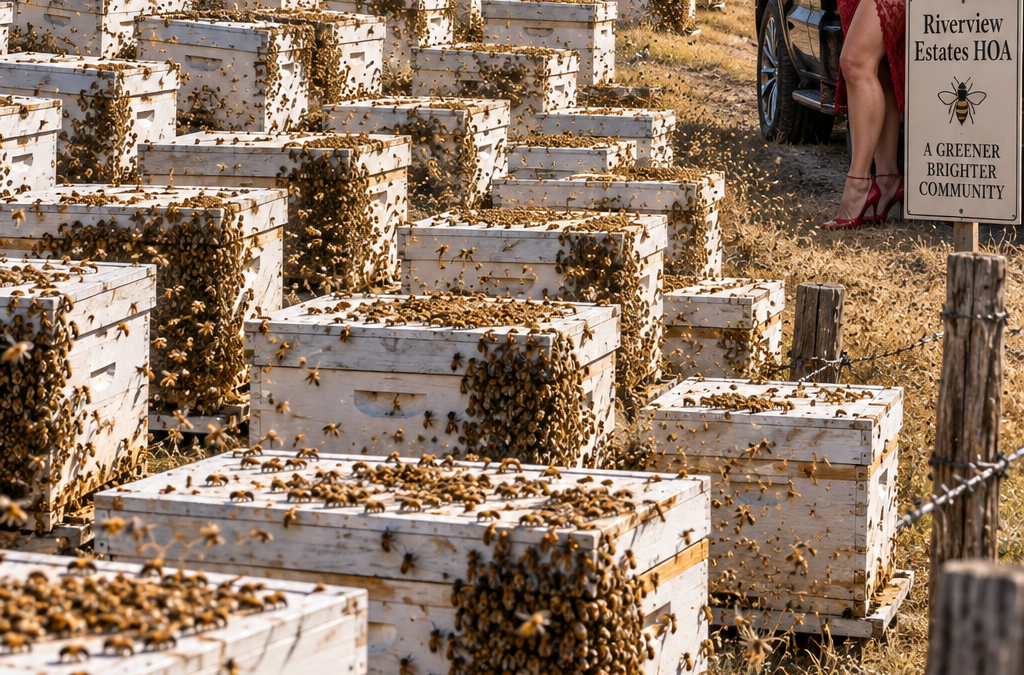
𝗙𝗨𝗟𝗟 𝗦𝗧𝗢𝗥𝗬 .
Most people assume that if someone has gone to the trouble of printing it, somebody must have checked whether it’s legitimate.
Karen handed me three pages.
I read the first paragraph.
Then the second.
The association had approved placement of managed honeybee colonies on “western agricultural buffer land controlled by Riverbend Heights HOA.”
I stopped.
Read it again.
Western agricultural buffer land controlled by Riverbend Heights HOA.
My ranch had never been controlled by Riverbend Heights.
Never.
We had already spent months establishing that fact.
My deed said it.
The recorded subdivision map said it.
The county survey said it.
A court order from our previous dispute said it.
I flipped to the property description.
Parcel number.
Wrong.
Legal description.
Wrong.
Boundary reference.
Wrong.
The document described land east of my fence line.
HOA-controlled open space.
The beehives were sitting hundreds of yards west of that boundary.
On my ranch.
I held the pages up.
“This isn’t my parcel.”
Karen’s eyes narrowed.
“It covers the western agricultural area.”
“No, it doesn’t.”
“That’s how the board interprets it.”
“Parcel numbers aren’t opinions.”
She took the papers from my hand.
“Don’t play games.”
“I’m not.”
I pointed toward the hives.
“You approved a project on HOA land.”
“Yes.”
“The contractor put it on my land.”
“The exact placement was determined operationally.”
“That doesn’t transfer ownership.”
Karen’s face hardened.
“You’ve spent months trying to undermine every community improvement we attempt.”
I stared at her.
“This is my cattle pasture.”
“And it sits beside our homes.”
“You knew that when those homes were built.”
“That does not give you the right to obstruct progress.”
There it was again.
Progress.
Karen loved that word.
She used it whenever she wanted someone else’s property to become something more convenient for her.
I looked toward my cattle.
One cow moved cautiously forward, then turned away when a cloud of bees passed over the grass.
My irritation became concern.
“Who manages the hives?”
Karen hesitated.
“Why?”
“Because I need to know what was put next to my livestock.”
“They are professionally managed colonies.”
“By whom?”
“You’re trying to make this sound dangerous.”
“I didn’t say dangerous.”
I looked directly at her.
“I said I want to know who owns the bees currently sitting on my ranch.”
She shut the folder.
“The board will communicate through official channels.”
I took out my phone and started recording.
Karen’s eyes sharpened.
“What are you doing?”
“Documenting.”
“That’s unnecessary.”
“Three hundred beehives appeared on my pasture.”
“It isn’t three hundred.”
“How many?”
She didn’t answer.
“Exactly.”
I raised the phone.
“State your name and confirm that Riverbend Heights HOA arranged placement of these colonies.”
“You know who I am.”
“Then say it.”
Her face flushed.
“I’m not participating in your little performance.”
“You already are.”
Karen turned toward the SUV.
“Do not interfere with the hives.”
I almost laughed again.
“You trespassed onto my land, placed commercial agricultural equipment on it, and now you’re giving me instructions?”
“They aren’t yours.”
“The land is.”
“If you damage association property—”
“Stop.”
She turned.
I lowered the phone slightly.
“Do not threaten me on my ranch.”
For once, Karen looked uncertain.
Only for a second.
Then the smile returned.
“Leave the bees alone.”
She climbed into the SUV.
David followed.
The second board member hesitated.
Then quietly said, “You should probably call someone who understands apiaries.”
Karen heard him.
“Get in the car, Susan.”
Susan obeyed.
The SUV drove away.
I stood alone with the cattle and hundreds of thousands of bees.
My first instinct was to call a lawyer.
My second was to call someone who actually knew what I was looking at.
I did both.
My property attorney, Martin Ellis, had handled the earlier boundary dispute with Riverbend Heights.
When I explained the situation, he was silent for almost five seconds.
“Hives?”
“Hundreds.”
“On your parcel?”
“Yes.”
“You’re certain?”
“Martin, I can see them from my barn.”
“I mean the survey.”
“Yes. They’re well inside my recorded boundary.”
He sighed.
“Photograph everything.”
“Already doing it.”
“Don’t move anything.”
“Wasn’t planning to.”
“Don’t threaten anybody.”
“I haven’t.”
“Good.”
“What exactly can they claim here?”
“If the document describes HOA property and the hives are physically on yours, the placement itself may be unauthorized regardless of whatever agreement they signed.”
“So I can make them remove them?”
“Probably.”
“Probably?”
“I’d like to know who actually owns the colonies before we start issuing demands.”
That was the first important distinction.
Karen had called them the HOA’s bees.
That didn’t mean they belonged to the HOA.
Most people don’t own hundreds of managed hives casually.
Someone professional had transported them.
Someone maintained them.
Someone expected something from them.
I called a beekeeper named Caleb Monroe.
Caleb had managed commercial colonies across Montana, Wyoming, and the Dakotas for more than twenty years.
He pulled into the ranch that afternoon in a battered pickup covered with bee-company stickers.
He wore work boots, jeans, and a white veil pushed back over an old baseball cap.
He stared across the rows.
“That’s a lot of bees.”
“Karen says they’re helping my ecosystem.”
He glanced at me.
“Who is Karen?”
“Long story.”
He smiled.
“I’ve worked bees twenty-three years. I have time.”
We walked carefully along the edge of the apiary.
Caleb didn’t seem alarmed.
He watched flight patterns.
Checked spacing.
Studied the hive boxes.
Then crouched near one colony.
“Healthy.”
“You can tell from here?”
“Activity’s good.”
He pointed toward the workers.
“Strong traffic.”
“What kind?”
“Probably mixed commercial stock. We’d need records to know exact genetics.”
I looked toward the cattle.
“Could this be a problem for them?”
“Depends.”
That word wasn’t comforting.
“On what?”
“Placement. Water. Temperament of colonies. Livestock movement. Whether somebody thought through the fact that cows and bees are both living things.”
He pointed toward one row.
“This is too close to where your cattle naturally cross.”
“So Karen could get them hurt?”
“I’m not saying that.”
Caleb looked at me seriously.
“Most managed bees aren’t looking to attack cattle. But cattle can knock hives over. Bees defend colonies. You don’t want a curious steer rubbing against boxes during hot weather.”
I felt anger rise again.
“What should I do?”
“Keep livestock separated until we know more.”
That meant moving cattle.
Moving cattle meant work.
New temporary fencing.
Water access.
Pasture rotation changes.
Karen’s environmental improvement was already costing me time.
Caleb kept looking around.
Then something about his expression changed.
“What?”
He didn’t answer immediately.
Instead, he walked several yards into the flowering acreage.
Knee-high clover.
Wild alfalfa.
Goldenrod.
Native asters.
He crouched and examined the growth.
“How much of this do you have?”
“Depends what you count.”
“Flowering forage.”
“A lot.”
“How much of the ranch?”
“Hundreds of acres across different sections.”
He stood.
“And what’s planted beyond the creek?”
“Alfalfa rotation.”
“Any pesticides?”
“Minimal. We manage carefully around cattle.”
He looked back at the apiary.
Then at me.
“You might have a very good bee location.”
I laughed.
“I don’t want a bee location.”
“You may want to reconsider.”
“Caleb, the HOA trespassed and dumped hundreds of hives in my pasture.”
“I understand.”
“I’m calling them to remove everything.”
“You can.”
He nodded.
“But before you do, find out who owns those colonies.”
“Why?”
“Because managed hives are agricultural assets.”
“I already have agricultural assets.”
He pointed toward the cattle.
“Different business.”
I folded my arms.
“I’m listening.”
Caleb looked over the forage again.
“Commercial honey companies move colonies constantly. Pollination contracts. Honey production. Seasonal forage.”
“And?”
“If these colonies perform well here, somebody may have accidentally identified a valuable apiary site.”
I looked toward the rows.
“You’re saying the HOA may have done me a favor.”
Caleb smiled.
“I’m saying don’t be in a hurry to destroy something potentially worth money just because an idiot put it in the wrong place.”
That was the moment my thinking changed.
Until then, the question had been simple.
How do I get Karen’s bees off my ranch?
Now another question existed.
What exactly had she put on my property?
I asked Caleb to inspect the site professionally.
Not as part of the HOA arrangement.
For me.
He returned the following morning with protective gear, equipment, and two assistants.
They worked colony by colony.
Healthy brood.
Strong populations.
Good stores.
No obvious major disease problems.
The bees weren’t abandoned junk.
They were productive commercial colonies.
Caleb later estimated the apiary was larger than Karen had admitted.
“Two hundred eighty-four active colonies.”
I stared at him.
“Two hundred eighty-four?”
“Give or take depending on splits.”
“And somebody accidentally placed them here?”
“I doubt the beekeeper thought it was accidental.”
He pointed toward tags attached to the boxes.
There was a company name.
High Plains Apiary Services.
I called them.
The manager, Luke Hammond, sounded confused when I gave him the ranch address.
“We have permission.”
“From whom?”
“Riverbend Heights HOA.”
“You’re not on Riverbend Heights property.”
A pause.
“What?”
“You’re on Riverbend Ranch.”
Another pause.
Longer.
“We were given coordinates.”
“Wrong coordinates.”
He didn’t argue.
That told me everything.
I emailed him the survey.
Luke called twenty minutes later.
“You’re right.”
“I know.”
“Damn.”
“Who signed the agreement?”
He told me.
Karen Whitmore.
Luke sounded genuinely embarrassed.
“We were told the HOA controlled that western parcel.”
“It doesn’t.”
“Look, we can move them.”
“How quickly?”
“That’s a large operation.”
“I know.”
“We’d need staging time.”
I looked out the window toward the pasture.
“Before you move anything, I have a question.”
“What?”
“Why here?”
Luke hesitated.
“Karen approached us about pollination and what she called ecological enhancement.”
“That sounds like her.”
“But our field guys liked the forage.”
“How much?”
“A lot.”
“Enough for honey production?”
Another pause.
“Possibly.”
“Commercially?”
“Potentially.”
The same answer Caleb had given.
Potentially.
I asked Luke for production estimates.
He said he couldn’t provide detailed projections without more information.
So I hired Caleb to help me gather it.
That decision infuriated Karen.
She arrived the next afternoon.
Red lace dress.
Black SUV.
Clipboard.
Of course.
This time she stayed outside the gate because Martin’s latest letter had apparently reminded the HOA that trespass was still trespass.
I walked down.
She held up a letter.
“You contacted our apiary contractor.”
“Yes.”
“You had no authority.”
I almost laughed.
“They’re sitting on my land.”
“The colonies are part of an HOA initiative.”
“On the wrong parcel.”
“We dispute that characterization.”
“The beekeeper doesn’t.”
Her expression shifted.
“What did you tell them?”
“The truth.”
“You are interfering with a contractual relationship.”
“No.”
I leaned against the fence.
“I’m establishing who owns equipment placed on my ranch without permission.”
Karen stepped closer to the gate.
“You need to stop.”
“No.”
“I am serious.”
“So am I.”
“This project was designed to address deficiencies in your land management.”
“My land management supports cattle.”
“You have neglected pollinator diversity.”
“Since when does the HOA manage pollinator diversity outside its boundary?”
“Don’t be sarcastic.”
“I’m not. I’m genuinely curious when you became director of bees.”
She glared at me.
“You think this is funny.”
“I think it’s unbelievable.”
I took out a copy of the HOA document.
“Your own paperwork identifies another parcel.”
“It identifies the western agricultural buffer.”
“No. It identifies Parcel 16-B.”
I pointed toward the subdivision.
“Parcel 16-B is over there.”
Karen’s lips pressed together.
“You’re exploiting a clerical discrepancy.”
“A property line is not a clerical discrepancy.”
“You always do this.”
“What?”
“Hide behind technicalities.”
I stared at her.
“Ownership is not a technicality.”
A truck approached behind me.
Caleb.
He slowed as he neared the gate.
Karen noticed him.
“Who is that?”
“A beekeeper.”
“We already have one.”
“I have one now.”
Her eyes widened.
“You hired someone to inspect our colonies?”
“The colonies are on my property.”
“They’re not yours.”
“I know.”
I smiled slightly.
“That’s why I’m doing this properly.”
Karen looked toward Caleb’s truck.
“What are you planning?”
“Nothing that concerns the HOA.”
Her face tightened.
“Everything on that apiary concerns the HOA.”
“No.”
I straightened.
“The land concerns me.”
For the first time, Karen seemed genuinely worried.
Not angry.
Worried.
She didn’t know what I was doing.
That loss of control disturbed her more than any argument.
“Do not alter the project.”
“Goodbye, Karen.”
“You’re making a mistake.”
“You made the mistake.”
She stood there for several seconds.
Then returned to her SUV.
Caleb watched her leave.
“That her?”
“Yes.”
He whistled.
“I’ve had mean queens easier to work with.”
I laughed.
That evening, we began running numbers.
Forage acreage.
Bloom cycles.
Water availability.
Potential colony density.
Estimated honey yields.
Seasonal movement.
Infrastructure needs.
Truck access.
Storage.
Extraction partnerships.
The more we studied, the more interesting the ranch became.
The property had an unusual mix of forage.
Wild clover.
Alfalfa.
Native flowers.
Sage.
Late-season blooms.
Elevation shifts.
Clean water access.
The apiary could potentially produce multiple honey profiles depending on season and location.
Caleb began calling contacts.
A regional honey company named Mountain Crown Honey sent two representatives.
I expected casual interest.
They arrived with notebooks, drone imagery, sampling equipment, and the serious expressions of people who had already decided the numbers might matter.
One was their agricultural operations director, Rachel Simmons.
She spent six hours walking the ranch.
Not touring.
Working.
She studied flowers.
Water.
Road access.
Shelter.
Wind exposure.
Distance from large pesticide-intensive crops.
She examined the existing colonies with Caleb.
Near sunset, we sat around my kitchen table.
Rachel opened a folder.
“You have something unusual here.”
I smiled.
“I’ve been hearing that a lot lately.”
“I’m serious.”
“So am I.”
She tapped the map.
“This forage diversity is valuable.”
“For cattle?”
“For bees.”
“I didn’t buy a honey ranch.”
“You may own one anyway.”
Her colleague laughed.
Rachel continued.
“We’ve been looking for long-term production acreage in this region.”
“How long-term?”
“Ten to fifteen years.”
That got my attention.
“What exactly are you proposing?”
“Site rights, infrastructure investment, colony placement, production partnership, and purchase guarantees.”
I leaned back.
“Numbers?”
She gave me preliminary figures.
I thought I’d misunderstood.
“Say that again.”
She did.
Over the full potential term, depending on production thresholds, expansion options, and guaranteed purchase volumes, the economic value could reach eight figures.
I stared at the papers.
“That’s serious.”
“Yes.”
“Based on bees Karen put here because she thought they’d annoy my cattle.”
Rachel looked confused.
“Who is Karen?”
“Long story.”
Caleb smiled.
“Very long.”
Mountain Crown spent another week reviewing everything.
They sampled honey.
They reviewed forage cycles.
They examined access for commercial trucks.
They modeled production.
The cattle operation would remain intact.
That mattered to me.
I wasn’t interested in replacing the ranch.
I was interested in adding something that worked with it.
We developed designated apiary zones away from primary cattle movement.
Fencing around bee areas.
Controlled water sources.
Safe truck access.
Seasonal rotation.
Suddenly, the dangerous-looking mess Karen had dropped into the pasture began becoming something organized.
Legitimate.
Mine to authorize.
That distinction mattered.
I wasn’t stealing the HOA’s project.
The HOA had no project on my ranch.
High Plains owned the colonies.
Mountain Crown wanted commercial production rights.
Riverbend Ranch owned the land.
I negotiated accordingly.
Martin reviewed every page.
“Do not sign anything until we establish that the HOA has no possible claim.”
“They don’t.”
“I know.”
“Then why—”
“Because twelve-million-dollar contracts make people creative.”
I looked at him.
“Twelve?”
He smiled.
“The latest term sheet.”
I picked it up.
The headline potential value was approximately twelve million dollars across the full contract term if production and expansion benchmarks were met.
$12,000,000.
I read it three times.
Not twelve million in cash tomorrow.
Not a lottery ticket.
A long-term commercial agreement with staged obligations and revenue over years.
But still.
Twelve million dollars.
Because the HOA put beehives on the wrong ranch.
I laughed until Martin asked whether I was okay.
“I think Karen might have accidentally created the most profitable violation in HOA history.”
“Don’t tell her that.”
“Oh, I absolutely want to.”
“You absolutely will not.”
He was right.
For about forty-eight hours.
Then Karen found out anyway.
Mountain Crown’s trucks were hard to hide.
They arrived to relocate some colonies into safer zones and install commercial water systems.
Someone inside Riverbend Heights took photographs.
By evening, Karen knew.
The HOA called an emergency meeting.
Susan called me first.
“You need to come.”
“Why?”
“Karen’s losing her mind.”
“That doesn’t narrow it down.”
“She found out about the honey contract.”
I closed my eyes.
“How?”
“Someone saw the trucks.”
“What is she saying?”
“That you stole an HOA business opportunity.”
I laughed.
Susan didn’t.
“She’s trying to pass a resolution claiming the HOA owns revenue generated by the hives.”
That stopped me.
“She’s what?”
“You heard me.”
I called Martin.
He sighed.
“I knew this was coming.”
“You knew?”
“Not specifically this level of nonsense.”
The clubhouse was packed when I arrived.
Karen stood at the front in her red lace dress and black heels, surrounded by board members.
A presentation screen behind her displayed photographs of my ranch.
Mountain Crown trucks.
Hive rows.
Cattle.
One slide actually said:
UNAUTHORIZED COMMERCIAL EXPLOITATION OF HOA POLLINATOR PROJECT
I stared at it.
Then at Martin.
He whispered, “Don’t laugh.”
I failed.
Karen snapped her head toward me.
“You think this is amusing?”
“A little.”
“You have converted an association-funded environmental project into private commercial gain.”
I sat down.
“Your association project was authorized for Parcel 16-B.”
Karen gripped the podium.
“The hives were installed through HOA initiative.”
“On my land.”
“They would not be there without us.”
“That part is true.”
A few people laughed.
Karen’s face reddened.
Martin leaned toward me.
“Behave.”
I raised both hands.
Karen continued.
“The HOA therefore has a legitimate financial interest in any revenue generated.”
I stood.
“No, it doesn’t.”
“You cannot simply appropriate the value of association property.”
“The bees belong to High Plains Apiary Services.”
Silence.
Karen blinked.
“What?”
“The colonies aren’t HOA property.”
She looked toward one of the board members.
“They were retained by us.”
“You contracted for placement.”
I pulled out the original document.
“On land you don’t own.”
I displayed the survey.
“Your agreement identifies Parcel 16-B.”
Then I displayed the ranch deed.
“Riverbend Ranch is Parcel 21-A.”
Karen interrupted.
“That’s a technical distinction.”
“No.”
Martin stood.
“It’s the entire legal distinction.”
Karen glared at him.
“This is an HOA meeting.”
“And you’re discussing my client’s property and contract rights.”
He placed a folder on the table.
“Mountain Crown’s agreement is with Riverbend Ranch and the colony owners. Riverbend Heights HOA is not a party.”
The room became uncomfortable.
Karen looked around.
“You are all missing the point.”
Susan spoke.
“What point?”
“We created the opportunity.”
Susan stared at her.
“Karen, you put bees on somebody else’s ranch.”
“We initiated the concept.”
David rubbed his forehead.
“You used the wrong parcel.”
Karen pointed at me.
“And now he’s making millions from our mistake.”
I looked at her.
There it was.
Not environmental stewardship.
Not pollinator health.
Not community appearance.
Money.
“Karen.”
She glared at me.
“What?”
“I didn’t ask you to put the bees there.”
“You benefited.”
“I asked who authorized them.”
“You refused to cooperate.”
“I documented everything.”
“You manipulated the situation.”
I laughed softly.
“You signed a contract for land you didn’t own.”
Her face went rigid.
“Then I called the actual hive owner, hired professionals, protected my cattle, and negotiated a legitimate agricultural agreement.”
“You exploited HOA resources.”
“The HOA doesn’t own the land.”
I paused.
“Or the bees.”
A man near the back laughed.
Karen slammed her palm against the podium.
“Enough!”
The room went silent.
She was breathing hard.
Her carefully controlled expression had disappeared.
For months, Karen had treated Riverbend Ranch like something she could regulate because it bothered her view.
Now she had discovered that the thing she’d imposed on me had value.
And suddenly she wanted ownership.
“You will suspend this contract immediately.”
“No.”
“Until the board determines its rights.”
“No.”
“You don’t get to say no to everything.”
I stared at her.
“On my property?”
“Yes.”
“I absolutely do.”
The room erupted.
Some laughter.
Some murmuring.
One man actually clapped.
Karen looked around as though betrayed.
Susan leaned toward her microphone.
“I move that the board formally acknowledge Riverbend Ranch is outside HOA jurisdiction and disclaim any financial interest in the commercial agreement.”
Karen turned.
“You cannot be serious.”
“I am.”
David seconded.
Karen stared at both of them.
“If you do this, you’re giving away millions.”
Susan shook her head.
“We can’t give away something we never owned.”
That sentence ended the argument.
The vote passed.
Four to one.
Karen voted against it.
Of course.
She stormed out before the meeting formally ended.
I expected her to disappear.
Instead, she came to the ranch the next morning.
I was standing beside one of the newly relocated apiary zones when her SUV came down the road.
Commercial honey trucks were leaving through the north gate.
Mountain Crown logos on the doors.
Karen parked hard enough to throw gravel.
She stepped out.
Red dress.
Blonde hair.
No folder this time.
That surprised me.
“What are you doing?”
I looked toward the trucks.
“Working.”
“You were told to suspend operations.”
“No. You told me. The board rejected you.”
Her eyes followed the trucks.
“You’ve turned this place into an industrial honey facility.”
“It’s still a cattle ranch.”
“This is outrageous.”
I pointed toward the cattle grazing comfortably beyond the fenced apiary zone.
“They’re fine.”
“This wasn’t supposed to happen.”
That sentence caught my attention.
“What was supposed to happen?”
Karen froze.
I stepped closer.
“You said the bees were supposed to solve a problem.”
“They were intended to improve pollination.”
“Then why are you upset they’re productive?”
She looked away.
That told me more than an answer would have.
I continued.
“You thought this would interfere with my cattle.”
“No.”
“You placed the hives directly across their normal pasture route.”
“That was the contractor’s decision.”
“You told me the ranch was outdated.”
“I never said—”
“Yes, you did.”
I took out my phone.
“I have recordings.”
Her eyes narrowed.
“You’re obsessed with recording me.”
“No.”
I looked at her.
“I learned not to trust you.”
That hit.
Her expression hardened.
“You think twelve million dollars makes you untouchable?”
“The contract doesn’t make me untouchable.”
I stepped toward the apiary.
“My deed does a pretty good job of making this land mine.”
Her face flushed.
“You wouldn’t have this deal without me.”
I smiled.
“You’re right.”
For one second, she seemed surprised.
Then I continued.
“You made a mistake.”
The smile disappeared.
“A very expensive mistake.”
She stood there, breathing hard.
I could see rage fighting with embarrassment.
Finally she said, “You’ll regret humiliating me.”
I lowered my voice.
“Karen, the only person humiliating you is you.”
She turned and walked back to the SUV.
For the first time, I didn’t watch until she left.
I had work to do.
The first major honey harvest happened later that summer.
Caleb insisted I be there.
I didn’t understand why until I saw the extraction numbers.
The colonies had performed above initial projections.
Not every hive equally.
No agricultural operation ever works that way.
But overall production was strong.
Very strong.
Mountain Crown increased its commitment.
More infrastructure.
More scheduled colonies.
More controlled seasonal placement.
The first shipments left Riverbend Ranch under commercial tracking.
Each load was recorded.
Weights.
Batch numbers.
Floral source.
Quality testing.
Destination.
I found myself learning an entirely new agricultural language.
Moisture percentage.
Nectar flow.
Supers.
Brood patterns.
Extraction cycles.
Wintering strength.
Forage maps.
I had spent most of my life thinking bees were something that happened around flowers.
Now I understood why commercial beekeeping was a serious agricultural industry.
The ranch changed.
Not dramatically.
That mattered to me.
Cattle remained the foundation.
The apiaries occupied carefully chosen sections where they didn’t interfere with grazing.
Mountain Crown financed fencing and water infrastructure around hive locations.
Caleb trained my ranch manager and me on safety protocols.
We established emergency procedures.
Veterinary consultations confirmed the livestock-management plan was appropriate.
Everything Karen had failed to consider, we considered.
That was the difference between imposing a project and building an operation.
One afternoon, Susan drove out.
She stopped at the gate.
Waited.
Then called.
“Can I come in?”
I smiled.
“See? That wasn’t difficult.”
She laughed.
I let her through.
We drove out to the apiary.
She stared at the rows.
“I still can’t believe this.”
“Neither can I.”
“How much is the contract actually worth?”
“Depends on performance.”
“Karen says twelve million.”
“The full-term potential is around that.”
Susan whistled.
“That’s insane.”
“Pretty much.”
She looked toward the cattle.
“And the cows?”
“Fine.”
“I thought Karen said the bees would make ranching impossible.”
I turned toward her.
“She said that?”
Susan immediately regretted speaking.
I stared.
“When?”
“At a closed meeting.”
My stomach tightened.
“What exactly did she say?”
Susan looked away.
“She said the apiary would force you to reconsider how much livestock you kept near the subdivision.”
I said nothing.
Susan continued.
“She thought you’d eventually reduce cattle or sell the western pasture.”
The entire picture clicked into place.
The hives weren’t simply environmental stupidity.
Karen had expected them to create pressure.
Maybe not harm.
Maybe she had convinced herself it was harmless.
But she had intentionally used the apiary as leverage against my cattle operation.
I felt cold anger settle in my chest.
“She wanted to make ranching harder.”
Susan nodded reluctantly.
“That’s how it sounded.”
I looked at the rows of productive hives.
The irony was almost too perfect.
Karen had tried to create a problem.
Instead, she had helped reveal another use for the ranch.
“Does the board know?”
“Some do.”
“Put it in writing.”
Susan looked nervous.
“Why?”
“Because I’m tired of Karen rewriting history.”
She did.
Martin added the statement to our file.
We didn’t sue immediately.
We didn’t need to.
The HOA had already disclaimed authority over the apiary contract.
But Karen’s conduct became part of the board’s internal review.
Residents learned she had intentionally supported the project in hopes of pressuring Riverbend Ranch’s livestock operations.
That mattered.
Her support inside Riverbend Heights collapsed.
At the next annual meeting, she lost the presidency.
Badly.
I didn’t attend.
Susan called afterward.
“She lost.”
“How bad?”
“Let’s just say it wasn’t close.”
I smiled.
“Good.”
“You don’t want to know the vote?”
“No.”
That surprised her.
After everything Karen had done, I thought revenge would feel satisfying.
It didn’t.
What satisfied me was watching trucks leave with legal contracts.
Seeing cattle graze calmly.
Reading production reports.
Knowing the ranch had become stronger because somebody tried to weaken it.
Karen eventually stopped visiting.
Maybe she finally understood the gate.
Maybe losing the board took away the audience she needed.
I didn’t care.
Mountain Crown exercised its first expansion option the following spring.
Additional colonies arrived.
This time legally.
Every location mapped.
Every agreement signed.
Every movement coordinated with cattle rotation.
No surprises.
The annual honey production increased.
The company began marketing a premium Montana line sourced partly from Riverbend Ranch.
I laughed when I saw the first jar.
The label showed mountains.
Wildflowers.
A little silhouette of a bee.
Nothing about angry HOA presidents.
Probably better for sales.
Caleb brought a case of jars to the ranch.
I held one up.
“This whole thing started because Karen wanted to ruin my pasture.”
He smiled.
“Bees don’t care about HOA politics.”
“Smart insects.”
“They care about forage.”
I looked toward the fields.
“That we have.”
The economic impact went beyond honey.
Mountain Crown paid for infrastructure.
Seasonal workers came through.
Local trucking companies got contracts.
A nearby extraction facility expanded.
The ranch earned apiary-site revenue and production-related payments without giving up cattle.
Diversification protected us during a difficult beef-price year.
That surprised me most.
What had looked like a bizarre invasion became a legitimate hedge against agricultural volatility.
My accountant called it “the strangest business-origin story he’d ever heard.”
He wasn’t wrong.
The twelve-million-dollar figure eventually became real enough to appear in the final long-term agreement.
Again, not twelve million handed to me in one giant check.
The figure represented the total potential value across the contracted term, production commitments, site rights, expansion milestones, and guaranteed purchase structure.
Still.
Twelve million.
Every time I saw it printed, it looked ridiculous.
I thought about the morning Karen stood beside those unauthorized hives telling me they were solving a problem.
She had been right.
Just not the problem she intended.
They solved a business problem I didn’t know I had.
How to diversify a cattle ranch without destroying what made it a cattle ranch.
Years later, Riverbend Ranch still looks like a ranch.
Barns.
Fences.
Cattle.
Mud.
Hay.
Equipment.
Nobody replaced the pastures with suburban landscaping.
Nobody painted the barns to match Riverbend Heights.
The bees occupy designated sections and move seasonally.
The livestock adapted quickly once the apiary zones were managed properly.
The cattle don’t bunch against the far fence anymore.
They graze.
The bees forage.
Both operations coexist.
Karen had assumed two agricultural uses would conflict because she never understood either one.
She understood control.
Not land.
That’s the lesson that stayed with me.
Private property isn’t simply about saying no.
Sometimes ownership means having the right to say yes—but on your terms.
When Karen brought those hives onto my land, she denied me that choice.
That was the violation.
Not the bees themselves.
Once I regained control of the decision, everything changed.
I could have ordered every colony removed.
Legally, I had strong grounds.
Emotionally, I wanted to.
But anger would have made the decision for me.
Instead, I asked questions.
Who owned the bees?
Were they healthy?
Could they coexist with livestock?
What did the forage support?
Who might buy the honey?
What could the land produce that I had never considered?
The answers were worth millions.
That doesn’t make Karen a genius.
It makes her lucky.
Or unlucky, depending on perspective.
She tried to weaponize something she didn’t understand.
The ranch understood it better than she did.
One late summer morning, I stood near the same ridge where I had first discovered the hives.
Sunlight came over the mountains.
The air smelled like dry grass and clover.
Cattle moved slowly toward water.
Beyond them, bees traveled in long invisible highways between flowers and boxes.
The sound no longer felt threatening.
It had become part of the ranch.
Caleb stood beside me drinking coffee.
“You remember wanting all these gone?”
“Very clearly.”
“You almost made me move two hundred eighty-four colonies.”
“I still might.”
He laughed.
“Not with that contract.”
I smiled.
“No.”
A Mountain Crown truck rolled across the service road.
Caleb watched it.
“Twelve million.”
“Potentially.”
“You always say potentially.”
“My attorney trained me.”
“Smart man.”
We stood quietly.
Then Caleb asked, “You ever thank Karen?”
I nearly choked on my coffee.
“No.”
“You should.”
“Absolutely not.”
“Christmas card?”
“No.”
“Jar of honey?”
I looked at him.
He laughed.
“Fine.”
Later that afternoon, I went into the workshop.
The original HOA apiary document was still in my file cabinet.
I pulled it out.
The wrong parcel number stared back at me.
A bureaucratic mistake.
Three characters and a property description.
That was all it took.
Karen had looked at those papers and seen authority.
I had looked at them and seen the absence of my name.
That distinction changed everything.
I framed a copy.
Not because I liked Karen.
Not because I forgave the trespass.
Because the document reminded me to read every line.
People lose land, money, rights, and opportunities because official-looking paper intimidates them.
I almost reacted emotionally.
I almost ordered the hives removed immediately.
Instead, I read.
I checked.
I documented.
Then I asked better questions.
The first framed notice in my workshop says Riverbend Ranch violated HOA landscaping standards.
The second document says the HOA approved bee placement on land it didn’t own.
Between those two pieces of paper is the entire story of Karen Whitmore’s relationship with my ranch.
She kept confusing influence with ownership.
A view with a right.
A board vote with law.
A project with permission.
And finally, an unauthorized apiary with a business she somehow believed belonged to her.
It never did.
Riverbend Ranch remained mine.
The cattle remained mine.
The decision to keep the bees became mine.
The contract became legitimate because the people who actually owned the relevant assets finally sat down and signed it.
Landowner.
Apiary operator.
Commercial buyer.
No HOA president required.
The funniest part is that Riverbend Heights eventually benefited anyway.
Better forage management reduced weeds along the shared boundary.
Pollination improved neighboring gardens.
Residents started buying Riverbend honey at local markets.
Susan once told me Karen would have called that proof the original program worked.
I laughed.
“She probably would.”
Susan smiled.
“Some people never lose an argument in their own head.”
That sounded exactly like Karen.
But it didn’t matter anymore.
Her term ended.
Her authority stopped at the subdivision line.
And the ranch kept growing.
One evening, I watched a young calf walk near the apiary fence.
It stopped.
Sniffed the air.
Looked toward the hives.
Then calmly turned back toward the herd.
No panic.
No chaos.
Just coexistence.
That tiny moment meant more to me than the contract value.
Because the thing Karen had tried to use against my cattle had become part of a properly managed agricultural system.
Nothing had been destroyed.
Nothing had been surrendered.
The ranch had simply become more capable.
People like Karen imagine power as the ability to force someone else into a worse position.
Real power is different.
Sometimes it’s knowing your deed.
Sometimes it’s calling an expert instead of screaming.
Sometimes it’s refusing to destroy something simply because your enemy put it there.
And sometimes it’s taking the problem someone dumped on your property and turning it into an asset they never understood.
The HOA thought hundreds of beehives would make Riverbend Ranch harder to operate.
Instead, those hives helped open the door to a twelve-million-dollar commercial honey agreement.
The cattle stayed.
The barns stayed.
The fences stayed.
The ranch stayed mine.
And every summer, when the first major honey trucks leave Riverbend Ranch, I remember Karen standing in that pasture in her red lace dress telling me the HOA had solved my problem.
She had no idea.
But for once in her life, she was right.
𝗧𝗛𝗘 𝗘𝗡𝗗
The HOA Dumped Hundreds of Beehives on My Cattle Ranch and Expected Me to Panic
I thought the HOA had finally run out of ways to bother me.
Then I walked over the eastern ridge of my cattle ranch and found hundreds of beehives sitting in my pasture.
Not five.
Not twenty.
Hundreds.
White wooden boxes stretched across the grass in long, unnervingly precise rows, their entrances already alive with movement. Bees drifted above them in clouds, glittering in the Montana morning sunlight as they crossed back and forth between the hives and the flowering acreage beyond the creek.
For several seconds, I just stood there.
The ranch was usually quiet at that hour.
Wind through dry grass.
Cattle shifting lazily near the watering trough.
A tractor cooling beside the equipment shed.
That morning, beneath all of it, I heard something new.
A low, continuous hum.
Thousands upon thousands of wings.
My cattle heard it too.
The herd had bunched together against the far fence.
Several animals refused to cross the pasture.
A few kept circling away from the section where the hives had been placed.
That bothered me more than the bees themselves.
Cattle react to changes long before people do.
If thirty head of livestock suddenly decide one part of their own pasture is somewhere they don’t want to be, you pay attention.
I was still trying to decide whether I was angry or simply confused when I heard an engine behind me.
A black luxury SUV came down the ranch road.
I already knew who it was.
Karen Whitmore stepped out wearing the same red lace dress she’d worn through nearly every argument we’d had since the subdivision next door decided my ranch was somehow part of its business.
Karen was forty, blonde, strikingly beautiful, and so aware of her appearance that it had become part of the way she exercised control. The red dress clung tightly around her full figure, its neckline low enough that it seemed almost absurd against the backdrop of cattle fencing, dust, and work boots.
She wore heels.
On a ranch.
Again.
Two board members climbed out behind her.
Karen looked toward the hives with the satisfaction of someone unveiling a landscaping project.
“Well,” she said, “I see you’ve found them.”
I turned slowly.
“Found what?”
“The apiary.”
I stared at her.
“The what?”
“The HOA’s pollination project.”
She smiled.
“The bees.”
I looked from Karen to the hives.
Then back to her.
“You put these here?”
“The association arranged it.”
“On my ranch.”
“They’re solving a problem.”
I actually laughed.
“What problem?”
“Your land lacks sufficient ecological management.”
I stared at her.
She continued with complete seriousness.
“The board received concerns about declining floral diversity along the western community boundary. Managed pollinators will improve the environment.”
I looked around.
Miles of ranchland.
Wildflowers.
Alfalfa.
Clover.
Cottonwoods.
Native flowering plants.
My cattle were standing half a pasture away because Karen had apparently decided my private ranch needed ecological intervention from a suburban HOA.
“Who authorized you to put hundreds of beehives on my land?”
Her expression tightened.
“The board did.”
“That wasn’t my question.”
“You’ve been informed repeatedly that activities on this parcel impact Riverbend Heights.”
“I asked who authorized the use of my property.”
“The project has been approved.”
“By me?”
“No.”
“Then it hasn’t been approved.”
One board member, David Mercer, glanced away.
Karen folded her arms.
“You don’t own every decision that affects the broader community.”
I stepped toward her.
“I own this land.”
She smiled in that infuriating way she used whenever she believed she was explaining something to a child.
“Ownership isn’t always the only consideration.”
I looked at the nearest line of hives.
Then at my cattle.
Then at Karen.
“Get everybody off my property.”
Her smile vanished.
“You’re overreacting.”
“You brought hundreds of colonies onto a working cattle ranch without permission.”
“They are managed.”
“I don’t care if each bee has a college degree.”
David covered his mouth.
Karen shot him a look.
Then she turned back to me.
“These hives are part of an authorized environmental initiative.”
“Show me the authorization.”
She opened the leather folder she always carried.
Of course she had paperwork.
Karen loved paperwork because she understood something dangerous about human behavior.
People see official-looking paper and become hesitant.
Letterhead.
Signatures.
Stamps.
Board resolutions.
Most people assume that if someone has gone to the trouble of printing it, somebody must have checked whether it’s legitimate.
Karen handed me three pages.
I read the first paragraph.
Then the second.
The association had approved placement of managed honeybee colonies on “western agricultural buffer land controlled by Riverbend Heights HOA.”
I stopped.
Read it again.
Western agricultural buffer land controlled by Riverbend Heights HOA.
My ranch had never been controlled by Riverbend Heights.
Never.
We had already spent months establishing that fact.
My deed said it.
The recorded subdivision map said it.
The county survey said it.
A court order from our previous dispute said it.
I flipped to the property description.
Parcel number.
Wrong.
Legal description.
Wrong.
Boundary reference.
Wrong.
The document described land east of my fence line.
HOA-controlled open space.
The beehives were sitting hundreds of yards west of that boundary.
On my ranch.
I held the pages up.
“This isn’t my parcel.”
Karen’s eyes narrowed.
“It covers the western agricultural area.”
“No, it doesn’t.”
“That’s how the board interprets it.”
“Parcel numbers aren’t opinions.”
She took the papers from my hand.
“Don’t play games.”
“I’m not.”
I pointed toward the hives.
“You approved a project on HOA land.”
“Yes.”
“The contractor put it on my land.”
“The exact placement was determined operationally.”
“That doesn’t transfer ownership.”
Karen’s face hardened.
“You’ve spent months trying to undermine every community improvement we attempt.”
I stared at her.
“This is my cattle pasture.”
“And it sits beside our homes.”
“You knew that when those homes were built.”
“That does not give you the right to obstruct progress.”
There it was again.
Progress.
Karen loved that word.
She used it whenever she wanted someone else’s property to become something more convenient for her.
I looked toward my cattle.
One cow moved cautiously forward, then turned away when a cloud of bees passed over the grass.
My irritation became concern.
“Who manages the hives?”
Karen hesitated.
“Why?”
“Because I need to know what was put next to my livestock.”
“They are professionally managed colonies.”
“By whom?”
“You’re trying to make this sound dangerous.”
“I didn’t say dangerous.”
I looked directly at her.
“I said I want to know who owns the bees currently sitting on my ranch.”
She shut the folder.
“The board will communicate through official channels.”
I took out my phone and started recording.
Karen’s eyes sharpened.
“What are you doing?”
“Documenting.”
“That’s unnecessary.”
“Three hundred beehives appeared on my pasture.”
“It isn’t three hundred.”
“How many?”
She didn’t answer.
“Exactly.”
I raised the phone.
“State your name and confirm that Riverbend Heights HOA arranged placement of these colonies.”
“You know who I am.”
“Then say it.”
Her face flushed.
“I’m not participating in your little performance.”
“You already are.”
Karen turned toward the SUV.
“Do not interfere with the hives.”
I almost laughed again.
“You trespassed onto my land, placed commercial agricultural equipment on it, and now you’re giving me instructions?”
“They aren’t yours.”
“The land is.”
“If you damage association property—”
“Stop.”
She turned.
I lowered the phone slightly.
“Do not threaten me on my ranch.”
For once, Karen looked uncertain.
Only for a second.
Then the smile returned.
“Leave the bees alone.”
She climbed into the SUV.
David followed.
The second board member hesitated.
Then quietly said, “You should probably call someone who understands apiaries.”
Karen heard him.
“Get in the car, Susan.”
Susan obeyed.
The SUV drove away.
I stood alone with the cattle and hundreds of thousands of bees.
My first instinct was to call a lawyer.
My second was to call someone who actually knew what I was looking at.
I did both.
My property attorney, Martin Ellis, had handled the earlier boundary dispute with Riverbend Heights.
When I explained the situation, he was silent for almost five seconds.
“Hives?”
“Hundreds.”
“On your parcel?”
“Yes.”
“You’re certain?”
“Martin, I can see them from my barn.”
“I mean the survey.”
“Yes. They’re well inside my recorded boundary.”
He sighed.
“Photograph everything.”
“Already doing it.”
“Don’t move anything.”
“Wasn’t planning to.”
“Don’t threaten anybody.”
“I haven’t.”
“Good.”
“What exactly can they claim here?”
“If the document describes HOA property and the hives are physically on yours, the placement itself may be unauthorized regardless of whatever agreement they signed.”
“So I can make them remove them?”
“Probably.”
“Probably?”
“I’d like to know who actually owns the colonies before we start issuing demands.”
That was the first important distinction.
Karen had called them the HOA’s bees.
That didn’t mean they belonged to the HOA.
Most people don’t own hundreds of managed hives casually.
Someone professional had transported them.
Someone maintained them.
Someone expected something from them.
I called a beekeeper named Caleb Monroe.
Caleb had managed commercial colonies across Montana, Wyoming, and the Dakotas for more than twenty years.
He pulled into the ranch that afternoon in a battered pickup covered with bee-company stickers.
He wore work boots, jeans, and a white veil pushed back over an old baseball cap.
He stared across the rows.
“That’s a lot of bees.”
“Karen says they’re helping my ecosystem.”
He glanced at me.
“Who is Karen?”
“Long story.”
He smiled.
“I’ve worked bees twenty-three years. I have time.”
We walked carefully along the edge of the apiary.
Caleb didn’t seem alarmed.
He watched flight patterns.
Checked spacing.
Studied the hive boxes.
Then crouched near one colony.
“Healthy.”
“You can tell from here?”
“Activity’s good.”
He pointed toward the workers.
“Strong traffic.”
“What kind?”
“Probably mixed commercial stock. We’d need records to know exact genetics.”
I looked toward the cattle.
“Could this be a problem for them?”
“Depends.”
That word wasn’t comforting.
“On what?”
“Placement. Water. Temperament of colonies. Livestock movement. Whether somebody thought through the fact that cows and bees are both living things.”
He pointed toward one row.
“This is too close to where your cattle naturally cross.”
“So Karen could get them hurt?”
“I’m not saying that.”
Caleb looked at me seriously.
“Most managed bees aren’t looking to attack cattle. But cattle can knock hives over. Bees defend colonies. You don’t want a curious steer rubbing against boxes during hot weather.”
I felt anger rise again.
“What should I do?”
“Keep livestock separated until we know more.”
That meant moving cattle.
Moving cattle meant work.
New temporary fencing.
Water access.
Pasture rotation changes.
Karen’s environmental improvement was already costing me time.
Caleb kept looking around.
Then something about his expression changed.
“What?”
He didn’t answer immediately.
Instead, he walked several yards into the flowering acreage.
Knee-high clover.
Wild alfalfa.
Goldenrod.
Native asters.
He crouched and examined the growth.
“How much of this do you have?”
“Depends what you count.”
“Flowering forage.”
“A lot.”
“How much of the ranch?”
“Hundreds of acres across different sections.”
He stood.
“And what’s planted beyond the creek?”
“Alfalfa rotation.”
“Any pesticides?”
“Minimal. We manage carefully around cattle.”
He looked back at the apiary.
Then at me.
“You might have a very good bee location.”
I laughed.
“I don’t want a bee location.”
“You may want to reconsider.”
“Caleb, the HOA trespassed and dumped hundreds of hives in my pasture.”
“I understand.”
“I’m calling them to remove everything.”
“You can.”
He nodded.
“But before you do, find out who owns those colonies.”
“Why?”
“Because managed hives are agricultural assets.”
“I already have agricultural assets.”
He pointed toward the cattle.
“Different business.”
I folded my arms.
“I’m listening.”
Caleb looked over the forage again.
“Commercial honey companies move colonies constantly. Pollination contracts. Honey production. Seasonal forage.”
“And?”
“If these colonies perform well here, somebody may have accidentally identified a valuable apiary site.”
I looked toward the rows.
“You’re saying the HOA may have done me a favor.”
Caleb smiled.
“I’m saying don’t be in a hurry to destroy something potentially worth money just because an idiot put it in the wrong place.”
That was the moment my thinking changed.
Until then, the question had been simple.
How do I get Karen’s bees off my ranch?
Now another question existed.
What exactly had she put on my property?
I asked Caleb to inspect the site professionally.
Not as part of the HOA arrangement.
For me.
He returned the following morning with protective gear, equipment, and two assistants.
They worked colony by colony.
Healthy brood.
Strong populations.
Good stores.
No obvious major disease problems.
The bees weren’t abandoned junk.
They were productive commercial colonies.
Caleb later estimated the apiary was larger than Karen had admitted.
“Two hundred eighty-four active colonies.”
I stared at him.
“Two hundred eighty-four?”
“Give or take depending on splits.”
“And somebody accidentally placed them here?”
“I doubt the beekeeper thought it was accidental.”
He pointed toward tags attached to the boxes.
There was a company name.
High Plains Apiary Services.
I called them.
The manager, Luke Hammond, sounded confused when I gave him the ranch address.
“We have permission.”
“From whom?”
“Riverbend Heights HOA.”
“You’re not on Riverbend Heights property.”
A pause.
“What?”
“You’re on Riverbend Ranch.”
Another pause.
Longer.
“We were given coordinates.”
“Wrong coordinates.”
He didn’t argue.
That told me everything.
I emailed him the survey.
Luke called twenty minutes later.
“You’re right.”
“I know.”
“Damn.”
“Who signed the agreement?”
He told me.
Karen Whitmore.
Luke sounded genuinely embarrassed.
“We were told the HOA controlled that western parcel.”
“It doesn’t.”
“Look, we can move them.”
“How quickly?”
“That’s a large operation.”
“I know.”
“We’d need staging time.”
I looked out the window toward the pasture.
“Before you move anything, I have a question.”
“What?”
“Why here?”
Luke hesitated.
“Karen approached us about pollination and what she called ecological enhancement.”
“That sounds like her.”
“But our field guys liked the forage.”
“How much?”
“A lot.”
“Enough for honey production?”
Another pause.
“Possibly.”
“Commercially?”
“Potentially.”
The same answer Caleb had given.
Potentially.
I asked Luke for production estimates.
He said he couldn’t provide detailed projections without more information.
So I hired Caleb to help me gather it.
That decision infuriated Karen.
She arrived the next afternoon.
Red lace dress.
Black SUV.
Clipboard.
Of course.
This time she stayed outside the gate because Martin’s latest letter had apparently reminded the HOA that trespass was still trespass.
I walked down.
She held up a letter.
“You contacted our apiary contractor.”
“Yes.”
“You had no authority.”
I almost laughed.
“They’re sitting on my land.”
“The colonies are part of an HOA initiative.”
“On the wrong parcel.”
“We dispute that characterization.”
“The beekeeper doesn’t.”
Her expression shifted.
“What did you tell them?”
“The truth.”
“You are interfering with a contractual relationship.”
“No.”
I leaned against the fence.
“I’m establishing who owns equipment placed on my ranch without permission.”
Karen stepped closer to the gate.
“You need to stop.”
“No.”
“I am serious.”
“So am I.”
“This project was designed to address deficiencies in your land management.”
“My land management supports cattle.”
“You have neglected pollinator diversity.”
“Since when does the HOA manage pollinator diversity outside its boundary?”
“Don’t be sarcastic.”
“I’m not. I’m genuinely curious when you became director of bees.”
She glared at me.
“You think this is funny.”
“I think it’s unbelievable.”
I took out a copy of the HOA document.
“Your own paperwork identifies another parcel.”
“It identifies the western agricultural buffer.”
“No. It identifies Parcel 16-B.”
I pointed toward the subdivision.
“Parcel 16-B is over there.”
Karen’s lips pressed together.
“You’re exploiting a clerical discrepancy.”
“A property line is not a clerical discrepancy.”
“You always do this.”
“What?”
“Hide behind technicalities.”
I stared at her.
“Ownership is not a technicality.”
A truck approached behind me.
Caleb.
He slowed as he neared the gate.
Karen noticed him.
“Who is that?”
“A beekeeper.”
“We already have one.”
“I have one now.”
Her eyes widened.
“You hired someone to inspect our colonies?”
“The colonies are on my property.”
“They’re not yours.”
“I know.”
I smiled slightly.
“That’s why I’m doing this properly.”
Karen looked toward Caleb’s truck.
“What are you planning?”
“Nothing that concerns the HOA.”
Her face tightened.
“Everything on that apiary concerns the HOA.”
“No.”
I straightened.
“The land concerns me.”
For the first time, Karen seemed genuinely worried.
Not angry.
Worried.
She didn’t know what I was doing.
That loss of control disturbed her more than any argument.
“Do not alter the project.”
“Goodbye, Karen.”
“You’re making a mistake.”
“You made the mistake.”
She stood there for several seconds.
Then returned to her SUV.
Caleb watched her leave.
“That her?”
“Yes.”
He whistled.
“I’ve had mean queens easier to work with.”
I laughed.
That evening, we began running numbers.
Forage acreage.
Bloom cycles.
Water availability.
Potential colony density.
Estimated honey yields.
Seasonal movement.
Infrastructure needs.
Truck access.
Storage.
Extraction partnerships.
The more we studied, the more interesting the ranch became.
The property had an unusual mix of forage.
Wild clover.
Alfalfa.
Native flowers.
Sage.
Late-season blooms.
Elevation shifts.
Clean water access.
The apiary could potentially produce multiple honey profiles depending on season and location.
Caleb began calling contacts.
A regional honey company named Mountain Crown Honey sent two representatives.
I expected casual interest.
They arrived with notebooks, drone imagery, sampling equipment, and the serious expressions of people who had already decided the numbers might matter.
One was their agricultural operations director, Rachel Simmons.
She spent six hours walking the ranch.
Not touring.
Working.
She studied flowers.
Water.
Road access.
Shelter.
Wind exposure.
Distance from large pesticide-intensive crops.
She examined the existing colonies with Caleb.
Near sunset, we sat around my kitchen table.
Rachel opened a folder.
“You have something unusual here.”
I smiled.
“I’ve been hearing that a lot lately.”
“I’m serious.”
“So am I.”
She tapped the map.
“This forage diversity is valuable.”
“For cattle?”
“For bees.”
“I didn’t buy a honey ranch.”
“You may own one anyway.”
Her colleague laughed.
Rachel continued.
“We’ve been looking for long-term production acreage in this region.”
“How long-term?”
“Ten to fifteen years.”
That got my attention.
“What exactly are you proposing?”
“Site rights, infrastructure investment, colony placement, production partnership, and purchase guarantees.”
I leaned back.
“Numbers?”
She gave me preliminary figures.
I thought I’d misunderstood.
“Say that again.”
She did.
Over the full potential term, depending on production thresholds, expansion options, and guaranteed purchase volumes, the economic value could reach eight figures.
I stared at the papers.
“That’s serious.”
“Yes.”
“Based on bees Karen put here because she thought they’d annoy my cattle.”
Rachel looked confused.
“Who is Karen?”
“Long story.”
Caleb smiled.
“Very long.”
Mountain Crown spent another week reviewing everything.
They sampled honey.
They reviewed forage cycles.
They examined access for commercial trucks.
They modeled production.
The cattle operation would remain intact.
That mattered to me.
I wasn’t interested in replacing the ranch.
I was interested in adding something that worked with it.
We developed designated apiary zones away from primary cattle movement.
Fencing around bee areas.
Controlled water sources.
Safe truck access.
Seasonal rotation.
Suddenly, the dangerous-looking mess Karen had dropped into the pasture began becoming something organized.
Legitimate.
Mine to authorize.
That distinction mattered.
I wasn’t stealing the HOA’s project.
The HOA had no project on my ranch.
High Plains owned the colonies.
Mountain Crown wanted commercial production rights.
Riverbend Ranch owned the land.
I negotiated accordingly.
Martin reviewed every page.
“Do not sign anything until we establish that the HOA has no possible claim.”
“They don’t.”
“I know.”
“Then why—”
“Because twelve-million-dollar contracts make people creative.”
I looked at him.
“Twelve?”
He smiled.
“The latest term sheet.”
I picked it up.
The headline potential value was approximately twelve million dollars across the full contract term if production and expansion benchmarks were met.
$12,000,000.
I read it three times.
Not twelve million in cash tomorrow.
Not a lottery ticket.
A long-term commercial agreement with staged obligations and revenue over years.
But still.
Twelve million dollars.
Because the HOA put beehives on the wrong ranch.
I laughed until Martin asked whether I was okay.
“I think Karen might have accidentally created the most profitable violation in HOA history.”
“Don’t tell her that.”
“Oh, I absolutely want to.”
“You absolutely will not.”
He was right.
For about forty-eight hours.
Then Karen found out anyway.
Mountain Crown’s trucks were hard to hide.
They arrived to relocate some colonies into safer zones and install commercial water systems.
Someone inside Riverbend Heights took photographs.
By evening, Karen knew.
The HOA called an emergency meeting.
Susan called me first.
“You need to come.”
“Why?”
“Karen’s losing her mind.”
“That doesn’t narrow it down.”
“She found out about the honey contract.”
I closed my eyes.
“How?”
“Someone saw the trucks.”
“What is she saying?”
“That you stole an HOA business opportunity.”
I laughed.
Susan didn’t.
“She’s trying to pass a resolution claiming the HOA owns revenue generated by the hives.”
That stopped me.
“She’s what?”
“You heard me.”
I called Martin.
He sighed.
“I knew this was coming.”
“You knew?”
“Not specifically this level of nonsense.”
The clubhouse was packed when I arrived.
Karen stood at the front in her red lace dress and black heels, surrounded by board members.
A presentation screen behind her displayed photographs of my ranch.
Mountain Crown trucks.
Hive rows.
Cattle.
One slide actually said:
UNAUTHORIZED COMMERCIAL EXPLOITATION OF HOA POLLINATOR PROJECT
I stared at it.
Then at Martin.
He whispered, “Don’t laugh.”
I failed.
Karen snapped her head toward me.
“You think this is amusing?”
“A little.”
“You have converted an association-funded environmental project into private commercial gain.”
I sat down.
“Your association project was authorized for Parcel 16-B.”
Karen gripped the podium.
“The hives were installed through HOA initiative.”
“On my land.”
“They would not be there without us.”
“That part is true.”
A few people laughed.
Karen’s face reddened.
Martin leaned toward me.
“Behave.”
I raised both hands.
Karen continued.
“The HOA therefore has a legitimate financial interest in any revenue generated.”
I stood.
“No, it doesn’t.”
“You cannot simply appropriate the value of association property.”
“The bees belong to High Plains Apiary Services.”
Silence.
Karen blinked.
“What?”
“The colonies aren’t HOA property.”
She looked toward one of the board members.
“They were retained by us.”
“You contracted for placement.”
I pulled out the original document.
“On land you don’t own.”
I displayed the survey.
“Your agreement identifies Parcel 16-B.”
Then I displayed the ranch deed.
“Riverbend Ranch is Parcel 21-A.”
Karen interrupted.
“That’s a technical distinction.”
“No.”
Martin stood.
“It’s the entire legal distinction.”
Karen glared at him.
“This is an HOA meeting.”
“And you’re discussing my client’s property and contract rights.”
He placed a folder on the table.
“Mountain Crown’s agreement is with Riverbend Ranch and the colony owners. Riverbend Heights HOA is not a party.”
The room became uncomfortable.
Karen looked around.
“You are all missing the point.”
Susan spoke.
“What point?”
“We created the opportunity.”
Susan stared at her.
“Karen, you put bees on somebody else’s ranch.”
“We initiated the concept.”
David rubbed his forehead.
“You used the wrong parcel.”
Karen pointed at me.
“And now he’s making millions from our mistake.”
I looked at her.
There it was.
Not environmental stewardship.
Not pollinator health.
Not community appearance.
Money.
“Karen.”
She glared at me.
“What?”
“I didn’t ask you to put the bees there.”
“You benefited.”
“I asked who authorized them.”
“You refused to cooperate.”
“I documented everything.”
“You manipulated the situation.”
I laughed softly.
“You signed a contract for land you didn’t own.”
Her face went rigid.
“Then I called the actual hive owner, hired professionals, protected my cattle, and negotiated a legitimate agricultural agreement.”
“You exploited HOA resources.”
“The HOA doesn’t own the land.”
I paused.
“Or the bees.”
A man near the back laughed.
Karen slammed her palm against the podium.
“Enough!”
The room went silent.
She was breathing hard.
Her carefully controlled expression had disappeared.
For months, Karen had treated Riverbend Ranch like something she could regulate because it bothered her view.
Now she had discovered that the thing she’d imposed on me had value.
And suddenly she wanted ownership.
“You will suspend this contract immediately.”
“No.”
“Until the board determines its rights.”
“No.”
“You don’t get to say no to everything.”
I stared at her.
“On my property?”
“Yes.”
“I absolutely do.”
The room erupted.
Some laughter.
Some murmuring.
One man actually clapped.
Karen looked around as though betrayed.
Susan leaned toward her microphone.
“I move that the board formally acknowledge Riverbend Ranch is outside HOA jurisdiction and disclaim any financial interest in the commercial agreement.”
Karen turned.
“You cannot be serious.”
“I am.”
David seconded.
Karen stared at both of them.
“If you do this, you’re giving away millions.”
Susan shook her head.
“We can’t give away something we never owned.”
That sentence ended the argument.
The vote passed.
Four to one.
Karen voted against it.
Of course.
She stormed out before the meeting formally ended.
I expected her to disappear.
Instead, she came to the ranch the next morning.
I was standing beside one of the newly relocated apiary zones when her SUV came down the road.
Commercial honey trucks were leaving through the north gate.
Mountain Crown logos on the doors.
Karen parked hard enough to throw gravel.
She stepped out.
Red dress.
Blonde hair.
No folder this time.
That surprised me.
“What are you doing?”
I looked toward the trucks.
“Working.”
“You were told to suspend operations.”
“No. You told me. The board rejected you.”
Her eyes followed the trucks.
“You’ve turned this place into an industrial honey facility.”
“It’s still a cattle ranch.”
“This is outrageous.”
I pointed toward the cattle grazing comfortably beyond the fenced apiary zone.
“They’re fine.”
“This wasn’t supposed to happen.”
That sentence caught my attention.
“What was supposed to happen?”
Karen froze.
I stepped closer.
“You said the bees were supposed to solve a problem.”
“They were intended to improve pollination.”
“Then why are you upset they’re productive?”
She looked away.
That told me more than an answer would have.
I continued.
“You thought this would interfere with my cattle.”
“No.”
“You placed the hives directly across their normal pasture route.”
“That was the contractor’s decision.”
“You told me the ranch was outdated.”
“I never said—”
“Yes, you did.”
I took out my phone.
“I have recordings.”
Her eyes narrowed.
“You’re obsessed with recording me.”
“No.”
I looked at her.
“I learned not to trust you.”
That hit.
Her expression hardened.
“You think twelve million dollars makes you untouchable?”
“The contract doesn’t make me untouchable.”
I stepped toward the apiary.
“My deed does a pretty good job of making this land mine.”
Her face flushed.
“You wouldn’t have this deal without me.”
I smiled.
“You’re right.”
For one second, she seemed surprised.
Then I continued.
“You made a mistake.”
The smile disappeared.
“A very expensive mistake.”
She stood there, breathing hard.
I could see rage fighting with embarrassment.
Finally she said, “You’ll regret humiliating me.”
I lowered my voice.
“Karen, the only person humiliating you is you.”
She turned and walked back to the SUV.
For the first time, I didn’t watch until she left.
I had work to do.
The first major honey harvest happened later that summer.
Caleb insisted I be there.
I didn’t understand why until I saw the extraction numbers.
The colonies had performed above initial projections.
Not every hive equally.
No agricultural operation ever works that way.
But overall production was strong.
Very strong.
Mountain Crown increased its commitment.
More infrastructure.
More scheduled colonies.
More controlled seasonal placement.
The first shipments left Riverbend Ranch under commercial tracking.
Each load was recorded.
Weights.
Batch numbers.
Floral source.
Quality testing.
Destination.
I found myself learning an entirely new agricultural language.
Moisture percentage.
Nectar flow.
Supers.
Brood patterns.
Extraction cycles.
Wintering strength.
Forage maps.
I had spent most of my life thinking bees were something that happened around flowers.
Now I understood why commercial beekeeping was a serious agricultural industry.
The ranch changed.
Not dramatically.
That mattered to me.
Cattle remained the foundation.
The apiaries occupied carefully chosen sections where they didn’t interfere with grazing.
Mountain Crown financed fencing and water infrastructure around hive locations.
Caleb trained my ranch manager and me on safety protocols.
We established emergency procedures.
Veterinary consultations confirmed the livestock-management plan was appropriate.
Everything Karen had failed to consider, we considered.
That was the difference between imposing a project and building an operation.
One afternoon, Susan drove out.
She stopped at the gate.
Waited.
Then called.
“Can I come in?”
I smiled.
“See? That wasn’t difficult.”
She laughed.
I let her through.
We drove out to the apiary.
She stared at the rows.
“I still can’t believe this.”
“Neither can I.”
“How much is the contract actually worth?”
“Depends on performance.”
“Karen says twelve million.”
“The full-term potential is around that.”
Susan whistled.
“That’s insane.”
“Pretty much.”
She looked toward the cattle.
“And the cows?”
“Fine.”
“I thought Karen said the bees would make ranching impossible.”
I turned toward her.
“She said that?”
Susan immediately regretted speaking.
I stared.
“When?”
“At a closed meeting.”
My stomach tightened.
“What exactly did she say?”
Susan looked away.
“She said the apiary would force you to reconsider how much livestock you kept near the subdivision.”
I said nothing.
Susan continued.
“She thought you’d eventually reduce cattle or sell the western pasture.”
The entire picture clicked into place.
The hives weren’t simply environmental stupidity.
Karen had expected them to create pressure.
Maybe not harm.
Maybe she had convinced herself it was harmless.
But she had intentionally used the apiary as leverage against my cattle operation.
I felt cold anger settle in my chest.
“She wanted to make ranching harder.”
Susan nodded reluctantly.
“That’s how it sounded.”
I looked at the rows of productive hives.
The irony was almost too perfect.
Karen had tried to create a problem.
Instead, she had helped reveal another use for the ranch.
“Does the board know?”
“Some do.”
“Put it in writing.”
Susan looked nervous.
“Why?”
“Because I’m tired of Karen rewriting history.”
She did.
Martin added the statement to our file.
We didn’t sue immediately.
We didn’t need to.
The HOA had already disclaimed authority over the apiary contract.
But Karen’s conduct became part of the board’s internal review.
Residents learned she had intentionally supported the project in hopes of pressuring Riverbend Ranch’s livestock operations.
That mattered.
Her support inside Riverbend Heights collapsed.
At the next annual meeting, she lost the presidency.
Badly.
I didn’t attend.
Susan called afterward.
“She lost.”
“How bad?”
“Let’s just say it wasn’t close.”
I smiled.
“Good.”
“You don’t want to know the vote?”
“No.”
That surprised her.
After everything Karen had done, I thought revenge would feel satisfying.
It didn’t.
What satisfied me was watching trucks leave with legal contracts.
Seeing cattle graze calmly.
Reading production reports.
Knowing the ranch had become stronger because somebody tried to weaken it.
Karen eventually stopped visiting.
Maybe she finally understood the gate.
Maybe losing the board took away the audience she needed.
I didn’t care.
Mountain Crown exercised its first expansion option the following spring.
Additional colonies arrived.
This time legally.
Every location mapped.
Every agreement signed.
Every movement coordinated with cattle rotation.
No surprises.
The annual honey production increased.
The company began marketing a premium Montana line sourced partly from Riverbend Ranch.
I laughed when I saw the first jar.
The label showed mountains.
Wildflowers.
A little silhouette of a bee.
Nothing about angry HOA presidents.
Probably better for sales.
Caleb brought a case of jars to the ranch.
I held one up.
“This whole thing started because Karen wanted to ruin my pasture.”
He smiled.
“Bees don’t care about HOA politics.”
“Smart insects.”
“They care about forage.”
I looked toward the fields.
“That we have.”
The economic impact went beyond honey.
Mountain Crown paid for infrastructure.
Seasonal workers came through.
Local trucking companies got contracts.
A nearby extraction facility expanded.
The ranch earned apiary-site revenue and production-related payments without giving up cattle.
Diversification protected us during a difficult beef-price year.
That surprised me most.
What had looked like a bizarre invasion became a legitimate hedge against agricultural volatility.
My accountant called it “the strangest business-origin story he’d ever heard.”
He wasn’t wrong.
The twelve-million-dollar figure eventually became real enough to appear in the final long-term agreement.
Again, not twelve million handed to me in one giant check.
The figure represented the total potential value across the contracted term, production commitments, site rights, expansion milestones, and guaranteed purchase structure.
Still.
Twelve million.
Every time I saw it printed, it looked ridiculous.
I thought about the morning Karen stood beside those unauthorized hives telling me they were solving a problem.
She had been right.
Just not the problem she intended.
They solved a business problem I didn’t know I had.
How to diversify a cattle ranch without destroying what made it a cattle ranch.
Years later, Riverbend Ranch still looks like a ranch.
Barns.
Fences.
Cattle.
Mud.
Hay.
Equipment.
Nobody replaced the pastures with suburban landscaping.
Nobody painted the barns to match Riverbend Heights.
The bees occupy designated sections and move seasonally.
The livestock adapted quickly once the apiary zones were managed properly.
The cattle don’t bunch against the far fence anymore.
They graze.
The bees forage.
Both operations coexist.
Karen had assumed two agricultural uses would conflict because she never understood either one.
She understood control.
Not land.
That’s the lesson that stayed with me.
Private property isn’t simply about saying no.
Sometimes ownership means having the right to say yes—but on your terms.
When Karen brought those hives onto my land, she denied me that choice.
That was the violation.
Not the bees themselves.
Once I regained control of the decision, everything changed.
I could have ordered every colony removed.
Legally, I had strong grounds.
Emotionally, I wanted to.
But anger would have made the decision for me.
Instead, I asked questions.
Who owned the bees?
Were they healthy?
Could they coexist with livestock?
What did the forage support?
Who might buy the honey?
What could the land produce that I had never considered?
The answers were worth millions.
That doesn’t make Karen a genius.
It makes her lucky.
Or unlucky, depending on perspective.
She tried to weaponize something she didn’t understand.
The ranch understood it better than she did.
One late summer morning, I stood near the same ridge where I had first discovered the hives.
Sunlight came over the mountains.
The air smelled like dry grass and clover.
Cattle moved slowly toward water.
Beyond them, bees traveled in long invisible highways between flowers and boxes.
The sound no longer felt threatening.
It had become part of the ranch.
Caleb stood beside me drinking coffee.
“You remember wanting all these gone?”
“Very clearly.”
“You almost made me move two hundred eighty-four colonies.”
“I still might.”
He laughed.
“Not with that contract.”
I smiled.
“No.”
A Mountain Crown truck rolled across the service road.
Caleb watched it.
“Twelve million.”
“Potentially.”
“You always say potentially.”
“My attorney trained me.”
“Smart man.”
We stood quietly.
Then Caleb asked, “You ever thank Karen?”
I nearly choked on my coffee.
“No.”
“You should.”
“Absolutely not.”
“Christmas card?”
“No.”
“Jar of honey?”
I looked at him.
He laughed.
“Fine.”
Later that afternoon, I went into the workshop.
The original HOA apiary document was still in my file cabinet.
I pulled it out.
The wrong parcel number stared back at me.
A bureaucratic mistake.
Three characters and a property description.
That was all it took.
Karen had looked at those papers and seen authority.
I had looked at them and seen the absence of my name.
That distinction changed everything.
I framed a copy.
Not because I liked Karen.
Not because I forgave the trespass.
Because the document reminded me to read every line.
People lose land, money, rights, and opportunities because official-looking paper intimidates them.
I almost reacted emotionally.
I almost ordered the hives removed immediately.
Instead, I read.
I checked.
I documented.
Then I asked better questions.
The first framed notice in my workshop says Riverbend Ranch violated HOA landscaping standards.
The second document says the HOA approved bee placement on land it didn’t own.
Between those two pieces of paper is the entire story of Karen Whitmore’s relationship with my ranch.
She kept confusing influence with ownership.
A view with a right.
A board vote with law.
A project with permission.
And finally, an unauthorized apiary with a business she somehow believed belonged to her.
It never did.
Riverbend Ranch remained mine.
The cattle remained mine.
The decision to keep the bees became mine.
The contract became legitimate because the people who actually owned the relevant assets finally sat down and signed it.
Landowner.
Apiary operator.
Commercial buyer.
No HOA president required.
The funniest part is that Riverbend Heights eventually benefited anyway.
Better forage management reduced weeds along the shared boundary.
Pollination improved neighboring gardens.
Residents started buying Riverbend honey at local markets.
Susan once told me Karen would have called that proof the original program worked.
I laughed.
“She probably would.”
Susan smiled.
“Some people never lose an argument in their own head.”
That sounded exactly like Karen.
But it didn’t matter anymore.
Her term ended.
Her authority stopped at the subdivision line.
And the ranch kept growing.
One evening, I watched a young calf walk near the apiary fence.
It stopped.
Sniffed the air.
Looked toward the hives.
Then calmly turned back toward the herd.
No panic.
No chaos.
Just coexistence.
That tiny moment meant more to me than the contract value.
Because the thing Karen had tried to use against my cattle had become part of a properly managed agricultural system.
Nothing had been destroyed.
Nothing had been surrendered.
The ranch had simply become more capable.
People like Karen imagine power as the ability to force someone else into a worse position.
Real power is different.
Sometimes it’s knowing your deed.
Sometimes it’s calling an expert instead of screaming.
Sometimes it’s refusing to destroy something simply because your enemy put it there.
And sometimes it’s taking the problem someone dumped on your property and turning it into an asset they never understood.
The HOA thought hundreds of beehives would make Riverbend Ranch harder to operate.
Instead, those hives helped open the door to a twelve-million-dollar commercial honey agreement.
The cattle stayed.
The barns stayed.
The fences stayed.
The ranch stayed mine.
And every summer, when the first major honey trucks leave Riverbend Ranch, I remember Karen standing in that pasture in her red lace dress telling me the HOA had solved my problem.
She had no idea.
But for once in her life, she was right.








