𝗙𝗨𝗟𝗟 𝗦𝗧𝗢𝗥𝗬 The HOA Dumped Construction Waste Into My Family’s Quarry and Billed Me for Breaking Rules That Never Applied to My Land
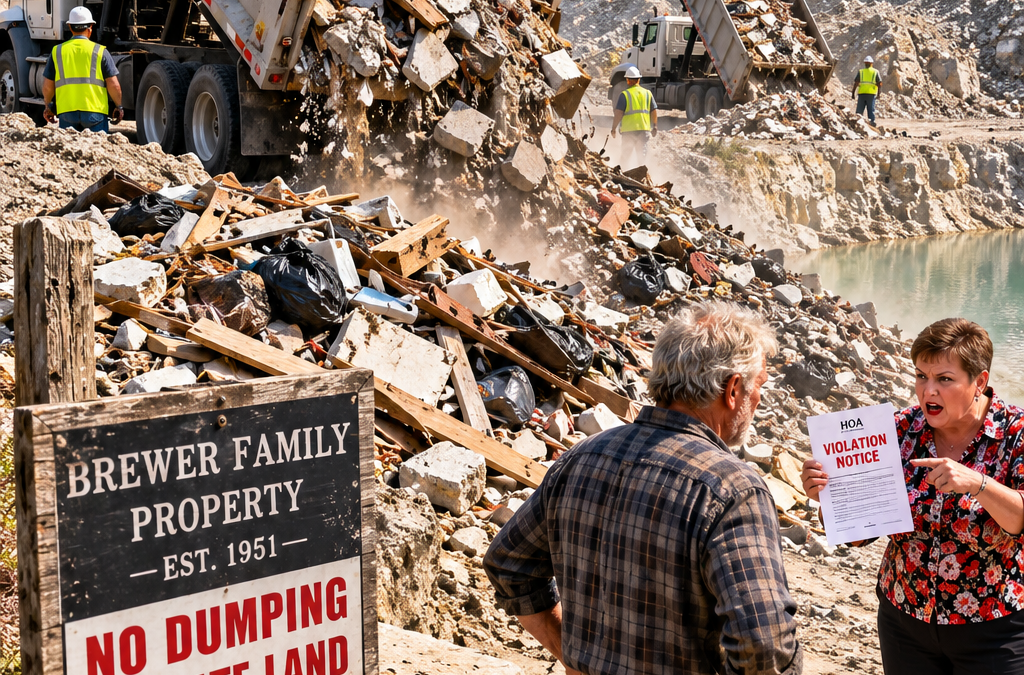
𝗙𝗨𝗟𝗟 𝗦𝗧𝗢𝗥𝗬
I had laughed when I was younger.
By sixty-three, I understood him.
Then the HOA became aggressive.
I don’t know whether it happened gradually or whether one particular board election changed the culture, but the letters started arriving.
The first one concerned the fence around the quarry.
It was a heavy industrial fence, functional and perfectly legal.
The letter informed me that its “unfinished metal appearance” was inconsistent with the architectural standards of Crestfield Meadows and requested that I replace it with approved decorative fencing.
I read the letter twice.
Then I checked the address.
Mine.
I laughed.
Crestfield Meadows was not my subdivision.
My quarry was not subject to their architectural standards.
Their declaration had no authority over my land.
I dropped the letter into the trash beside my desk.
The second letter arrived about three weeks later.
This one concerned noise.
It said my machinery was violating “community peace standards.”
Our operating hours were Monday through Friday from eight in the morning until four in the afternoon.
No weekends unless there was an emergency road contract.
No nighttime blasting.
No early-morning crushing.
The county had inspected us repeatedly over the years.
We were legal.
Again, I threw the letter away.
Then came the third.
That one included a fine.
Two hundred fifty dollars.
I stood at my kitchen counter holding the paper and felt my patience change.
There is something about putting a dollar figure beside nonsense that makes nonsense less amusing.
The violation cited continued noncompliance with Crestfield Meadows aesthetic and peace standards.
Payment due within thirty days.
Further violations subject to escalation.
I called the management company.
A woman answered.
“Good morning, Crestfield Community Management. This is Petra.”
“Petra, my name’s Callum Brewer.”
There was a short pause.
“Mr. Brewer. Yes.”
The way she said my name told me she already knew exactly who I was.
“I’m calling about a violation notice.”
“Of course.”
“I don’t live in Crestfield Meadows.”
“I understand.”
“My property isn’t part of Crestfield Meadows.”
“Yes, sir.”
“Then why am I holding a two-hundred-fifty-dollar HOA fine?”
She gave a little professional sigh.
Not rude exactly.
But practiced.
The sigh of someone explaining something to a person she considered behind the conversation.
“The association recently adopted expanded jurisdiction guidelines for properties within a quarter mile of the development boundary.”
I looked at the phone.
“Expanded what?”
“Jurisdiction guidelines.”
“That’s not a legal term that gives you authority over my property.”
“Our board was advised that adjacent land uses materially affecting residents can fall under neighborhood compliance review.”
“By whom?”
“I’m sorry?”
“Who advised your board?”
“Our legal counsel.”
“All right. Send me the document.”
“Which document?”
“The one giving your HOA legal authority to fine landowners who are not members of your HOA.”
Silence.
“Mr. Brewer, the guidelines were approved by the board.”
“I didn’t ask who approved your guidelines. I asked what recorded covenant, deed restriction, easement, statute, ordinance, agreement, or court order gives Crestfield Meadows authority over Brewer Quarry.”
Her voice cooled.
“I can have someone follow up with you.”
“Please do.”
Nobody ever did.
I kept the letter.
That mattered later.
The two earlier notices had gone into the trash.
After the fine, I created a folder.
I still have that folder.
Brown cardboard.
HOA written across the tab in black marker.
The next thing that happened made the fine look harmless.
It was late October.
Tuesday morning.
Cool enough that I needed a jacket when I left the house.
I drove my old pickup down toward the lower quarry basin because one of the water pumps had been acting strange.
The quarry was mostly inactive at that point.
We still sold stone from existing stockpiles and occasionally extracted on a small scale, but I had slowed operations as I got older.
The lower basin collected rainwater, so I ran pumps to prevent flooding around equipment and access roads.
I was halfway down the ridge road when I heard an engine that wasn’t mine.
Big diesel.
I came around a bend and saw a white dump truck backed toward the lower quarry wall.
For a moment, I assumed it was lost.
Then the hydraulic bed started rising.
I stopped my truck.
The tailgate released.
Construction debris slid out.
Broken drywall.
Chunks of concrete.
Wood scraps.
Plastic.
Insulation.
Packaging.
A section of what looked like damaged cabinetry.
It crashed into the quarry basin in a cloud of pale dust.
I sat behind my steering wheel staring.
I genuinely could not understand what I was seeing.
There are some forms of trespassing so arrogant that your mind first looks for an innocent explanation.
Maybe a contractor thought somebody had rented the site.
Maybe there was confusion about another property.
Maybe someone had been given the wrong address.
Then I saw tire tracks.
Multiple tracks.
The ground near the dumping area was already disturbed.
This wasn’t the first truck.
I got out.
The driver spotted me.
He dropped the bed quickly.
I raised one hand.
“Hold on.”
He started rolling forward.
I walked toward the cab.
“Stop the truck.”
He didn’t.
I pulled out my phone and started recording.
“You’re on private property.”
The truck accelerated.
I stepped aside rather than argue with thirty thousand pounds of diesel and steel.
As it passed, I got a partial plate.
The company markings were small.
Primeline Haul & Disposal.
I photographed the truck leaving.
Then I walked toward the pile.
My boots sank into dust and crushed drywall.
There were bags of insulation.
Broken tile.
Concrete with pieces of rebar.
Splintered lumber.
PVC pipe.
Roofing material.
Buckets.
I smelled adhesive.
Paint.
Something chemical.
That was when anger replaced confusion.
My family had spent seventy years working this quarry without turning it into a dump.
My grandfather had been strict about it.
No used oil dumped in the pit.
No burned trash.
No burying old equipment.
No contractor waste.
He used to say that because we took things out of the earth for a living, we had an obligation not to treat the hole we created as permission to poison it.
Now somebody else had driven onto that same ground and decided the pit looked convenient.
I called the sheriff’s non-emergency line.
Then I photographed everything.
Not just the debris.
The tracks.
The access point.
The condition of the road.
The location relative to survey markers.
The pump.
The ridge.
I put a measuring tape beside several piles.
I photographed the date on my phone screen.
Then I called Rosalyn Fitch.
Rosalyn had been my family’s attorney for years.
She had handled my father’s estate.
She had reviewed the deed transfer to me.
She had helped with quarry leases, county permits, and a boundary disagreement with a timber company.
Rosalyn was about twelve years younger than me, sharp as broken glass, and incapable of pretending stupidity deserved respect.
She answered on the third ring.
“Callum?”
“Somebody is dumping construction waste in the quarry.”
A pause.
“How much?”
“Enough that it isn’t an accident.”
“Are they still there?”
“One truck just left.”
“Photos?”
“About fifty.”
“Video?”
“Yes.”
“Plate?”
“Partial.”
“Company name?”
“Primeline Haul and Disposal.”
Another pause.
“Don’t touch anything.”
“I wasn’t planning to.”
“Call the sheriff.”
“Already did.”
“Good. I’m going to pull corporate records and county permits. Send me every photo.”
I emailed them from my truck.
The deputy arrived about forty minutes later.
He took the report.
Walked the site.
Looked at the debris.
Told me it might become a civil matter depending on who authorized access.
I remember asking, “How does anybody authorize access to my land besides me?”
He gave me the look law enforcement officers sometimes give property owners when they don’t want to speculate.
“That’s what we’ll have to determine.”
Rosalyn determined it before the sheriff’s department did.
Within forty-eight hours, she called me.
“Sit down.”
“I am sitting.”
“Primeline’s biggest local contract this quarter is Crestfield Meadows.”
I didn’t answer.
She continued.
“They’re hauling demolition and construction waste from the clubhouse renovation and common-area project.”
I stared through my kitchen window toward the tree line.
“You’re telling me the HOA hired them.”
“I’m telling you the HOA hired them, and based on what I’ve seen, someone gave Primeline instructions that your quarry was an approved disposal location.”
I said nothing for several seconds.
Then I laughed.
It was the wrong kind of laugh.
“Approved by who?”
“That’s what we’re going to find out.”
I opened the brown folder.
The $250 fine was sitting on top.
“Rosalyn.”
“Yeah?”
“They’ve been sending me violation notices.”
“I remember.”
“They’re fining me for unauthorized land use while dumping construction waste on my property.”
“I know.”
Her voice changed slightly.
I could hear it.
The attorney part of her brain had moved from irritation to interest.
“Don’t call them,” she said.
“I wasn’t going to.”
“Don’t call Primeline either.”
“All right.”
“I’m sending a preservation letter today.”
“To who?”
“Everyone.”
That was when the tone changed.
Rosalyn sent formal notices to the HOA, the management company, Primeline, the clubhouse contractor, and every relevant insurer she could identify.
Preserve emails.
Preserve text messages.
Preserve invoices.
Preserve board minutes.
Preserve contracts.
Preserve disposal instructions.
Preserve GPS logs.
Preserve driver records.
Preserve photographs.
Preserve internal communications.
Then she sent Crestfield Meadows a cease-and-desist letter demanding that all dumping on Brewer property stop immediately.
Their lawyer responded.
Douglas Hearn.
I remember his name because the letter made Rosalyn laugh.
Not because it was funny.
Because lawyers sometimes laugh when opposing counsel gives them evidence they never expected to receive voluntarily.
Douglas wrote that Crestfield Meadows rejected my characterization of events.
He accused me of “obstructing neighborhood improvement initiatives.”
He claimed my quarry had negatively affected neighboring property values for years.
Then he described the use of the lower quarry basin as a “temporary beneficial repurposing of underutilized land.”
Rosalyn called me.
“You’re sitting down?”
“Apparently you lawyers think I stand all day.”
“Listen to this.”
She read the paragraph.
When she reached the words beneficial repurposing of underutilized land, she stopped.
“What?” I asked.
“Nothing.”
“You’re smiling.”
“I’m absolutely smiling.”
“Why?”
“Because he just admitted the use wasn’t accidental.”
I leaned back.
She read it again.
Temporary beneficial repurposing.
Underutilized land.
Not “wrong address.”
Not “driver error.”
Not “unauthorized subcontractor.”
They were asserting a right to use my land.
Rosalyn said, “Callum, keep this letter somewhere safe.”
“It’s already in the folder.”
“Good.”
Then she said, “We’re filing.”
We filed on three primary fronts.
Illegal dumping and environmental violations.
Trespass and unauthorized use of private property.
Negligent and fraudulent misrepresentation tied to the HOA’s claimed authority over surrounding land.
Rosalyn also notified the state environmental agency.
That changed everything.
A private property dispute might be ignored.
Unlicensed construction-waste disposal gets attention.
Investigators visited the quarry.
They sampled material.
They measured disposal volume.
They photographed drainage pathways.
They examined whether debris could leach contaminants into groundwater or the seasonal runoff system.
They asked for every record I had.
I gave them everything.
The folder kept getting thicker.
Meanwhile, the HOA continued acting as though confidence could substitute for law.
Board president Fletcher Owens sent an email through counsel accusing me of trying to “financially exploit an unfortunate misunderstanding.”
That phrase stayed with me.
Unfortunate misunderstanding.
Truckloads of waste had been hauled onto my land.
Somebody had authorized it.
The HOA’s lawyer had defended it in writing.
And somehow I was exploiting the misunderstanding.
Rosalyn responded with one sentence I still remember.
“My client would prefer that your client stop using euphemisms for trespass.”
After that, Douglas became more careful.
The investigation uncovered the contract.
Primeline had been hired to remove waste from a Crestfield Meadows clubhouse renovation.
The original disposal budget was substantial.
Licensed construction-waste facilities charged by volume and material category.
Some loads required longer hauling distances.
Some required separation.
Some cost more.
Then somebody discovered the quarry.
My quarry.
It was nearby.
Private.
Partially screened by woods.
And because the pit itself sat below grade, debris dumped there wasn’t easily visible from public roads.
From Primeline’s perspective, it was cheap.
From the HOA’s perspective, it was convenient.
From my perspective, it was theft.
Discovery began.
For people who have never been involved in civil litigation, discovery is where confidence goes to die.
Public letters are polished.
Board statements are polished.
Lawyers’ responses are polished.
Internal emails are where people tell the truth.
We subpoenaed board communications.
Management-company emails.
Text messages.
Contracts.
Invoices.
Minutes.
We also subpoenaed GPS data from Primeline trucks.
That was one of my favorite pieces of evidence.
The records showed repeated trips to the quarry.
Not one.
Not two.
Multiple loads.
Different days.
Several trucks.
The dumping had been planned.
Then we found the board vote.
Crestfield Meadows had six board members.
Four had voted to approve the Primeline arrangement.
Minutes referenced “alternate disposal efficiencies.”
That was their phrase.
Rosalyn read it to me.
“You ever notice,” she said, “that the worse something is, the more syllables people use to describe it?”
I laughed.
“Alternate disposal efficiencies.”
“Means dumping garbage on your land.”
“That’s what I thought.”
The minutes didn’t identify my property directly.
But emails did.
Fletcher Owens knew exactly where the trucks were going.
So did at least three other board members.
One message included a satellite image.
My quarry was circled.
Someone had written:
BREWER PIT – LOW VISIBILITY / EASY ACCESS.
I stared at the exhibit.
My last name.
Pit.
Low visibility.
Easy access.
As though seventy years of ownership had been reduced to a logistical advantage.
I wasn’t furious because they thought the land was ugly.
I was furious because they thought privacy meant permission.
Then Rosalyn found the email.
The one that changed the entire emotional temperature of the case.
It was part of a chain between Fletcher Owens and Douglas Hearn.
They were discussing the likelihood of me challenging the HOA’s neighboring-property enforcement policy.
Douglas had raised concerns that Crestfield Meadows did not appear to have recorded authority over my land.
That sentence alone was damaging.
Their lawyer had warned them.
Fletcher replied.
The exact wording was longer than what people later repeated, but the important line was simple.
Brewer won’t push back. His kind never does.
Rosalyn called me that evening.
Her voice was different.
“Callum.”
“What happened?”
“I found something.”
I could hear papers moving.
She read the line.
Brewer won’t push back. His kind never does.
I didn’t say anything.
“Callum?”
“I’m here.”
“What do you think he meant by ‘his kind’?”
I looked down at my hands.
They were stained around the nails from machinery grease.
I thought about every meeting I’d attended in work clothes.
Every Crestfield resident who had looked past me at a gas station because they assumed I was somebody’s laborer.
Every board letter that referred to my quarry as blight.
Every time Fletcher had driven past in his luxury SUV while I was repairing a fence or clearing drainage.
“I think he meant people like me.”
Rosalyn was quiet.
“What does that mean?”
“Old quarry man. Dirty truck. Work boots. Doesn’t live behind their gates. Doesn’t talk like them. Doesn’t need their approval.”
She exhaled.
“Maybe.”
“But that’s what he meant.”
“Maybe.”
Her caution was professional.
Mine wasn’t.
I knew what the sentence meant because I’d lived the attitude behind it.
Fletcher didn’t see me as an equal landowner.
He saw me as residue from what existed before Crestfield Meadows.
A man whose property hadn’t caught up with the neighborhood.
A man who could be pressured.
A man who would receive a fine, swear about it in his kitchen, and eventually decide fighting rich people wasn’t worth the trouble.
His kind never does.
I printed the email.
Put it in the folder.
Rosalyn amended the filing to include the bias and discriminatory treatment reflected in the board’s conduct and communications.
The legal theory was more complicated than the sentence itself.
But the practical effect was immediate.
The insurance carrier paid attention.
Very close attention.
Until then, the HOA had treated the dispute as a property case.
Property cases can be priced.
Cleanup costs.
Land restoration.
Lost use.
Attorney fees.
Maybe punitive exposure.
But evidence that board members had knowingly targeted a neighboring landowner they considered unlikely to resist created a different kind of risk.
Especially combined with intentional dumping.
Especially after legal counsel had already questioned the HOA’s authority.
Especially when their own communications showed they knew the quarry was privately owned.
The state environmental agency issued its findings.
Primeline and Crestfield Meadows were hit with citations and penalties totaling nearly four hundred thousand dollars.
The disposal had violated environmental requirements.
The quarry was not licensed as a construction-waste facility.
The material had not been approved.
The site had not been evaluated for that use.
No lawful agreement existed allowing the HOA to use it.
I remember reading the agency letter at my kitchen table.
I expected satisfaction.
Instead, I felt tired.
The quarry had been part of my life for almost sixty years.
When I was five, I rode beside my father on an old loader.
When I was twelve, my grandfather taught me how to grease equipment properly.
When I was seventeen, I spent an entire summer stacking stone until my back hurt every night.
When my father died, I walked the quarry alone the morning after the funeral because it was the only place that felt quiet enough.
Land carries memory differently than houses do.
A house holds rooms.
Land holds time.
Seeing someone use that ground as a dumping shortcut felt personal in a way the HOA never understood.
They thought they had dumped waste into a hole.
I thought they had dumped it into my family’s history.
Settlement discussions started shortly after the environmental findings.
At first, Douglas Hearn was still aggressive.
He argued that Primeline bore primary responsibility.
Primeline argued that it had relied on disposal instructions provided by the HOA.
The HOA argued that the management company handled logistics.
The management company said the board approved the contract.
Everybody pointed at everybody else.
Rosalyn let them.
“That’s good for us,” she said.
“Why?”
“Because people who agree on a lie are dangerous. People who start blaming each other produce evidence.”
She was right.
Primeline produced communications showing Fletcher personally approved the quarry location.
The management company produced an email in which Petra asked whether Brewer Quarry was authorized.
A board member responded:
Fletcher says it’s handled.
That hurt Petra later.
But it helped me.
During one deposition, Rosalyn asked Fletcher whether he had ever spoken with me before approving use of my property.
“No.”
“Did you have a written agreement from Mr. Brewer?”
“No.”
“Did you have an easement?”
“No.”
“Lease?”
“No.”
“License?”
“No.”
“Recorded right of access?”
“No.”
“Did you have any document signed by Mr. Brewer granting permission to dump construction debris on his property?”
“No.”
“Then what exactly did you believe was ‘handled’?”
Douglas objected.
Fletcher still had to answer.
He said the quarry was underutilized and had historically accepted material.
That was false.
Rosalyn placed decades of environmental inspection records in front of him.
No disposal authorization.
No landfill permit.
No history of accepting construction debris.
Then she showed him the letter his own lawyer had sent calling the dumping beneficial repurposing.
“Mr. Owens, if this was an innocent misunderstanding, why did your attorney defend the use rather than deny it?”
Fletcher looked at Douglas.
That was a bad moment for both of them.
The mediation happened months after the first truck entered my quarry.
By then, the case had become expensive.
The HOA’s insurer had lawyers present.
Primeline’s insurer had lawyers present.
The management company’s carrier had representatives.
Rosalyn sat beside me with several binders.
I brought the brown folder.
She looked at it.
“You know we have all of that digitally.”
“I know.”
“Then why’d you bring it?”
“Because they started it.”
She smiled.
“Fair enough.”
The mediator was a retired judge.
He met separately with each side.
The first number offered was insulting.
I don’t remember the exact amount.
Something under a million.
Rosalyn carried it into our room.
I shook my head.
“No.”
She didn’t argue.
The next number went up.
Still no.
They emphasized remediation.
They emphasized that the debris could be removed.
They emphasized that I still owned the quarry.
That one irritated me.
As if returning possession of land they had never owned was compensation.
At one point, an insurance representative said through the mediator that nine million dollars was disproportionate to the market value of the damaged portion of the quarry.
Rosalyn answered before I could.
“This is not a purchase negotiation.”
That became the heart of our position.
I was not selling them what they had done.
They weren’t buying the right to trespass retroactively.
The settlement had to account for cleanup.
Environmental monitoring.
Loss of use.
Attorney fees.
Damage.
Intentional conduct.
The false jurisdiction claims.
The cost of restoring drainage.
The time spent dealing with government agencies.
The risk created by materials placed on the property without inspection.
And the fact that the board had knowingly treated my property rights as optional because they believed I was unlikely to defend them.
Rosalyn used a phrase during mediation that I never forgot.
“Willful disregard for property rights and basic human dignity.”
That sentence traveled through the rooms.
The numbers changed.
Then the insurance company saw the email.
Not just saw it as an exhibit.
Really saw what a jury might see.
Brewer won’t push back. His kind never does.
Rosalyn explained how she planned to put that sentence on a large courtroom display.
One line.
White background.
Black letters.
Then she would ask Fletcher to explain it.
The carrier understood immediately.
A jury would understand it too.
Settlement discussions changed after that.
Douglas stopped writing aggressive letters.
Fletcher stopped giving interviews to other board members.
The HOA suddenly wanted confidentiality.
Rosalyn told them certain regulatory matters couldn’t simply be hidden.
The final number was $9.2 million.
When Rosalyn told me, I thought I had heard wrong.
“Say it again.”
“Nine point two.”
I looked at her.
“For everything?”
“For the global civil settlement structure, subject to final documents and allocation.”
I sat back.
Nine million two hundred thousand dollars.
People hear a number like that and imagine celebration.
I didn’t celebrate.
I thought about my grandfather buying the land in 1951.
I thought about him counting money at the kitchen table.
I thought about my father welding equipment because replacing it was too expensive.
I thought about the first $250 fine from an HOA that never had jurisdiction over one inch of my property.
The contrast was almost absurd.
They had tried to charge me $250.
Now their insurers and associated parties were resolving claims for millions.
But the money wasn’t the condition I cared about most.
I wanted accountability.
The HOA board had six members.
I wanted them gone.
All of them.
The settlement required written resignations.
Every sitting board member.
Including Fletcher Owens.
Effective immediately under the agreed transition terms.
When Rosalyn first proposed it, Douglas called it punitive and unnecessary.
She answered, “Then take it to trial.”
They didn’t.
The resignations stayed.
I signed the settlement documents.
Fletcher signed his resignation.
So did the other five.
The HOA reserve fund took a severe hit through portions of the settlement and associated costs.
Insurance rates exploded.
The board that had spent years telling everybody else how their homes should look suddenly had to explain to residents why association finances were damaged because leadership had approved dumping construction waste on private land.
People were furious.
Not at me.
At them.
That surprised the board.
They had spent so long acting as though the HOA and the neighborhood were the same thing that they forgot homeowners could turn against the board.
Residents demanded records.
Meeting minutes became public battlegrounds.
People asked why attorney warnings had been ignored.
Why Primeline had been told to use my quarry.
Why the HOA had been fining a property it didn’t control.
Why Fletcher wrote what he wrote.
Several homeowners apologized to me.
I appreciated it.
But I never blamed the entire neighborhood.
Most residents had nothing to do with what happened.
Some didn’t even know the quarry dumping existed until the case became public.
That’s another thing power likes to do.
Hide behind groups.
“The community wants.”
“The neighborhood believes.”
“The association decided.”
Usually, if you look closely enough, “the community” turns out to be four people in a meeting room making decisions everybody else hears about later.
Petra Goddard called me two weeks after the settlement became final.
I almost didn’t answer.
But I recognized the management company number.
“Callum?”
Her voice sounded different.
No polished customer-service tone.
No compliance language.
Just tired.
“Yes.”
“This is Petra.”
“I know.”
There was a pause.
“I wanted to tell you I’m sorry.”
I leaned against my workbench.
“For what part?”
She started crying.
I hadn’t expected that.
“For all of it.”
I said nothing.
“I was following instructions.”
I looked out toward the quarry.
Fresh remediation equipment was moving along the lower basin.
“That’s what everybody keeps saying.”
“I didn’t know they were dumping there at first.”
“You knew you were fining me without jurisdiction.”
She went quiet.
“I was told we had authority.”
“And when I asked you for proof?”
She didn’t answer.
I remembered that call perfectly.
Expanded jurisdiction guidelines.
Quarter-mile boundary.
Someone will follow up.
Nobody did.
“I should have asked more questions,” she said.
“Yes.”
“I never thought it would become this.”
“Neither did I.”
“I could lose my job.”
I didn’t know what she wanted from me.
Forgiveness?
A promise?
Some statement that she had merely been caught in the middle?
Maybe she wanted me to tell her she was a good person who had made a mistake.
I wasn’t interested in deciding that for her.
So I told her the truth.
“When someone tells you to send a man a fine for a fence on land you know isn’t inside your HOA, that’s when you ask questions.”
She sniffed.
“I know.”
“No. That’s when you ask them. Not after nine million dollars.”
She was silent.
I continued.
“People think following instructions keeps them separate from the consequences of the instruction. It doesn’t.”
“I’m sorry.”
“I believe you’re sorry.”
That was all I gave her.
We ended the call.
The cleanup took months.
The county and state oversaw portions of the remediation.
Debris had to be removed carefully.
Certain material had to be tested.
Soil was evaluated.
Drainage routes were inspected.
Areas damaged by truck traffic were repaired.
The access point was secured.
Primeline paid heavily for its role.
So did the HOA.
Every time I saw the cleanup crews working, I had mixed feelings.
Part of me hated seeing strangers on the land at all.
Another part was grateful that this time they were there with permission.
That mattered.
Permission.
Such a simple word.
The entire case existed because a group of people convinced themselves it was optional.
When remediation finished, I drove down to the lower basin alone.
It was early morning.
Mist still hung near the bottom of the quarry.
The pump was running.
Water moved through the drainage line exactly as it had before.
The piles of drywall were gone.
The broken concrete was gone.
The insulation was gone.
No dump trucks.
No Primeline tracks.
No fluorescent survey flags from environmental investigators.
Just limestone walls.
Red dirt.
Water.
My land.
I parked and stepped out.
For a while, I stood there listening to the pump.
It made the same rhythmic mechanical sound I’d heard hundreds of times.
I thought about my father.
He used to check pumps the way some men checked cattle.
Every morning.
Same route.
Same inspection.
He’d listen to the motor before touching anything.
“Machines tell you when they’re unhappy,” he’d say.
“You just have to shut up long enough to hear them.”
I smiled.
Then I thought about Fletcher’s email.
His kind never does.
I had spent months trying to understand why that sentence bothered me more than the money.
Eventually, I figured it out.
The dumping was an action.
The email revealed the belief behind the action.
Fletcher didn’t just believe he could use my land.
He believed I was the kind of man whose rights were easier to ignore.
That was worse.
Because people like Fletcher rarely start with truckloads of debris.
They start smaller.
A letter.
A rule.
A fine.
A demand.
They test whether you will comply.
Then they move one step farther.
When nobody pushes back, entitlement starts feeling like authority.
That’s what happened at Crestfield Meadows.
They sent a letter about my fence.
I ignored it.
They sent one about noise.
I ignored it.
They invented jurisdiction.
I asked for proof.
They couldn’t provide it.
Instead of stopping, they escalated.
Somewhere along the line, the board stopped seeing my property line as a boundary and started seeing it as an inconvenience.
They treated my silence as weakness.
They misunderstood both.
I am quiet.
I always have been.
My grandfather was quiet too.
So was my father.
Men who work around machinery tend to learn that not every problem improves when you talk louder.
You watch.
You listen.
You measure.
You repair what needs repairing.
And you keep records.
That last part saved me.
Every letter.
Every photograph.
Every county permit.
Every tax record.
Every environmental inspection.
Every deed.
Every survey.
Every phone note.
Every email.
By the time Fletcher realized I wasn’t going away, Rosalyn had built a wall of paper around him.
He couldn’t talk his way through it.
You can’t explain away GPS logs.
You can’t intimidate a timestamp.
You can’t bully a recorded deed.
You can’t tell a soil sample that your intentions were good.
And you can’t make an email disappear because you regret what it says.
The nine-point-two-million-dollar settlement changed my life financially.
I’m not going to pretend otherwise.
I invested most of it.
Some went into environmental restoration.
Some went into improvements on the quarry.
I established a trust for my grandchildren.
I replaced equipment I’d been keeping alive longer than I should have.
I bought a new truck eventually.
Not a fancy one.
People were disappointed by that.
Rosalyn laughed when she saw it.
“You got nine million dollars and bought another pickup that looks almost exactly like the old one.”
“The cup holders work.”
“Living large, Callum.”
I kept the old truck too.
Gravel stains and all.
Because there was something almost poetic about it.
That truck was part of why Fletcher underestimated me.
He saw an old pickup and assumed poverty.
Dirty boots and assumed ignorance.
A quarry and assumed backwardness.
Age and assumed exhaustion.
Silence and assumed surrender.
He confused appearance with capacity.
That mistake cost him his position.
It cost the board its credibility.
And it cost the people behind the dumping more money than they ever imagined saving by avoiding legitimate disposal fees.
The board never recovered.
A new board was elected.
One of its first formal actions was to rescind every so-called expanded jurisdiction guideline aimed at neighboring properties.
They sent written notices to landowners outside Crestfield Meadows confirming that the HOA claimed no enforcement authority over them.
Mine arrived by certified mail.
I opened it at the kitchen table.
Read it once.
Then put it in the brown folder.
I could have thrown it away.
But some papers deserve to stay.
A few months later, the new board president asked to meet with me.
Her name was Elaine Harper.
She came alone.
No attorney.
No management-company representative.
She wore jeans and carried a notebook.
We sat on my porch.
She apologized on behalf of the association.
I told her she didn’t owe me a personal apology for decisions she hadn’t made.
She said, “Maybe not. But somebody representing the HOA should say it.”
I respected that.
She asked whether there was anything the neighborhood could do to repair the relationship.
I thought about it.
“Know where your property ends.”
She laughed a little, but I wasn’t joking.
“I mean it.”
“I know.”
“Your rules are for your members. My rules are for my land. County rules apply to both of us. That’s enough.”
She nodded.
“Fair.”
We haven’t had problems since.
Crestfield Meadows is still there.
The stone walls still stand.
People still drive golf carts around in the evenings.
Children ride bicycles.
Neighbors walk dogs.
The clubhouse got finished eventually, though I suspect nobody on the new board enjoys discussing where the first loads of renovation debris went.
My quarry is still here too.
Forty-seven acres.
Same ridge.
Same limestone.
Same pump.
Some mornings, I drive out there before sunrise.
At sixty-three, I had started thinking seriously about retirement.
After the lawsuit, everybody assumed I would sell.
Developers called.
Investors called.
One company offered enough money that Rosalyn told me I should at least consider it.
I did.
For about five minutes.
Then I thought about my grandfather buying the land in 1951.
My father handing me the deed.
My own grandchildren climbing around the old equipment.
And Fletcher’s email.
His kind never does.
I declined the offer.
I don’t know what will happen to the quarry after I’m gone.
Maybe one of my children will keep it.
Maybe my grandchildren will.
Maybe someday it will stop being a working quarry entirely and become something else.
But that decision will belong to my family.
Not an HOA board.
Not a management company.
Not a contractor looking for cheap disposal.
Not a developer who thinks an old man’s land is wasted because it isn’t producing the kind of profit he understands.
Mine.
That word isn’t complicated.
People make property law sound mysterious.
Sometimes it is.
Easements can be complex.
Mineral rights can be complex.
Boundary descriptions can be complex.
Environmental law can be complex.
But the principle that started this case wasn’t complicated at all.
You don’t dump your garbage on land you don’t own.
You don’t invent authority over people who never agreed to your rules.
You don’t send someone a bill for violating restrictions that do not apply to them.
And you definitely don’t put in writing that a man won’t defend himself because you think you know “his kind.”
A year after the settlement, I found the original $250 violation notice while cleaning my office.
It had slipped to the bottom of the brown folder.
I sat there holding it.
Two hundred fifty dollars.
Failure to comply with Crestfield Meadows community standards.
I remembered almost throwing it away.
If I had, the case still would have survived.
But I’m glad I kept it.
That fine represented the entire attitude in one page.
Their rules.
Their authority.
Their assumption.
My land.
I framed it.
Not because I’m sentimental.
Because sometimes you need a reminder of how expensive arrogance can become.
The frame hangs in my quarry office now.
Right beside the original 1951 deed copy from when my grandfather bought the property.
On one side, a document showing how my family obtained the land legally.
On the other, a document from people who believed legality was something they could manufacture by sending enough official-looking letters.
Visitors occasionally ask why the HOA notice is framed.
I usually tell them, “That’s the most expensive $250 bill anybody ever sent me.”
Then I go back to work.
Because despite everything, that’s still what matters most to me.
Work.
The quarry didn’t need revenge.
It needed cleaning.
The deed didn’t need anger.
It needed defending.
My family name didn’t need a speech.
It needed someone willing to stand behind it.
And I did.
Not because I had millions.
I didn’t when this began.
Not because I had political influence.
I didn’t.
Not because I enjoyed lawsuits.
I don’t.
I fought because forty-seven acres of land had passed through three generations of my family, and a handful of strangers decided that quiet ownership was the same as weak ownership.
They were wrong.
By the time the last settlement document was signed, the quarry was being restored, the environmental penalties were issued, $9.2 million had been committed to resolving the damage and claims, and every member of the HOA board that approved the scheme had resigned.
But the money was never the part I remembered most.
It was that line.
Brewer won’t push back.
His kind never does.
Fletcher Owens was right about one thing.
There is a kind of man I belong to.
The kind who keeps the deed.
The kind who knows the boundary.
The kind who saves the letter.
The kind who photographs the truck before getting angry.
The kind who calls the lawyer instead of shouting across a fence.
The kind who understands that patience is not surrender and silence is not consent.
My grandfather was that kind of man.
My father was too.
And every morning when I drive my gravel-stained truck down toward the lower ridge and hear that old pump running against the limestone walls, I know exactly what kind of man I am.
The kind who documents everything.
𝗧𝗛𝗘 𝗘𝗡𝗗
The HOA Dumped Construction Waste Into My Family’s Quarry and Billed Me for Breaking Rules That Never Applied to My Land
The first dump truck emptied construction debris into the quarry my family had owned for more than seventy years, and before I could even finish documenting the damage, the HOA sent me a violation notice accusing me of misusing my own property.
They looked at a sixty-three-year-old man in dirty work boots and an old gravel-stained truck and decided I was the kind of person who would lower his head, pay the fine, and disappear quietly.
My name is Callum Brewer.
I was sixty-three years old when the board of Crestfield Meadows learned the difference between a man who doesn’t like conflict and a man who doesn’t know how to fight.
I had never been afraid of conflict.
I simply preferred useful work.
My family had owned forty-seven acres of limestone ground outside the city limits since 1951, when my grandfather bought the property with money he’d saved from construction jobs and military pay.
Back then, there wasn’t much around it.
A few farms.
Two county roads.
Pine woods.
Creek bottoms.
And limestone.
A lot of limestone.
My grandfather saw value where other people saw rough ground.
He spent the first several years clearing access roads by hand and with borrowed machinery. By the time my father was old enough to work beside him, they had opened a small quarry on the lower western side of the property.
It was never one of those enormous industrial pits you see from the interstate.
We didn’t have conveyor towers stretching into the sky.
No fleets of fifty-ton haul trucks.
No corporate logo.
Just a working family quarry.
We sold crushed stone to local contractors.
Road crews bought aggregate from us.
Landscapers bought decorative limestone.
Farmers came for gravel.
For decades, if somebody within twenty miles needed a driveway repaired, a culvert bed reinforced, a foundation packed, or a muddy access road made usable again, there was a decent chance some of that stone came off Brewer land.
It was dirty work.
Loud work.
Honest work.
My grandfather died believing the quarry would stay in the family.
My father made sure it did.
By the time he signed the deed over to me, the forty-seven acres were paid for in full.
No mortgage.
No lien.
No development agreement.
No HOA declaration.
No restrictive covenant tying the property to anybody else’s neighborhood.
Just land.
Our land.
That distinction became important after Crestfield Meadows arrived.
About twelve years before everything happened, a development company bought several hundred acres of farmland around us.
They divided it into residential lots and built what the brochures called a “premier country lifestyle community.”
That meant stone entrance walls.
Decorative streetlights.
A clubhouse.
A pool.
Artificial ponds.
Matching mailboxes.
Curving sidewalks.
And homes large enough that half the roofs seemed to have roofs of their own.
They called it Crestfield Meadows.
I always thought that name was funny because the development replaced most of the actual meadows.
But nobody asked me.
At first, I didn’t care.
People have a right to build houses on land they own.
That’s the same principle I eventually had to teach the HOA.
For the first few years, Crestfield Meadows didn’t bother me.
The homeowners occasionally complained about trucks using the county road, but the quarry had been operating legally long before the subdivision existed.
The county zoning allowed it.
Our hours were permitted.
Our environmental paperwork was current.
Our access road was private.
I kept everything documented because my father had taught me something early.
“If you work land people want,” he once told me, “keep your papers better than they keep theirs.”
I had laughed when I was younger.
By sixty-three, I understood him.
Then the HOA became aggressive.
I don’t know whether it happened gradually or whether one particular board election changed the culture, but the letters started arriving.
The first one concerned the fence around the quarry.
It was a heavy industrial fence, functional and perfectly legal.
The letter informed me that its “unfinished metal appearance” was inconsistent with the architectural standards of Crestfield Meadows and requested that I replace it with approved decorative fencing.
I read the letter twice.
Then I checked the address.
Mine.
I laughed.
Crestfield Meadows was not my subdivision.
My quarry was not subject to their architectural standards.
Their declaration had no authority over my land.
I dropped the letter into the trash beside my desk.
The second letter arrived about three weeks later.
This one concerned noise.
It said my machinery was violating “community peace standards.”
Our operating hours were Monday through Friday from eight in the morning until four in the afternoon.
No weekends unless there was an emergency road contract.
No nighttime blasting.
No early-morning crushing.
The county had inspected us repeatedly over the years.
We were legal.
Again, I threw the letter away.
Then came the third.
That one included a fine.
Two hundred fifty dollars.
I stood at my kitchen counter holding the paper and felt my patience change.
There is something about putting a dollar figure beside nonsense that makes nonsense less amusing.
The violation cited continued noncompliance with Crestfield Meadows aesthetic and peace standards.
Payment due within thirty days.
Further violations subject to escalation.
I called the management company.
A woman answered.
“Good morning, Crestfield Community Management. This is Petra.”
“Petra, my name’s Callum Brewer.”
There was a short pause.
“Mr. Brewer. Yes.”
The way she said my name told me she already knew exactly who I was.
“I’m calling about a violation notice.”
“Of course.”
“I don’t live in Crestfield Meadows.”
“I understand.”
“My property isn’t part of Crestfield Meadows.”
“Yes, sir.”
“Then why am I holding a two-hundred-fifty-dollar HOA fine?”
She gave a little professional sigh.
Not rude exactly.
But practiced.
The sigh of someone explaining something to a person she considered behind the conversation.
“The association recently adopted expanded jurisdiction guidelines for properties within a quarter mile of the development boundary.”
I looked at the phone.
“Expanded what?”
“Jurisdiction guidelines.”
“That’s not a legal term that gives you authority over my property.”
“Our board was advised that adjacent land uses materially affecting residents can fall under neighborhood compliance review.”
“By whom?”
“I’m sorry?”
“Who advised your board?”
“Our legal counsel.”
“All right. Send me the document.”
“Which document?”
“The one giving your HOA legal authority to fine landowners who are not members of your HOA.”
Silence.
“Mr. Brewer, the guidelines were approved by the board.”
“I didn’t ask who approved your guidelines. I asked what recorded covenant, deed restriction, easement, statute, ordinance, agreement, or court order gives Crestfield Meadows authority over Brewer Quarry.”
Her voice cooled.
“I can have someone follow up with you.”
“Please do.”
Nobody ever did.
I kept the letter.
That mattered later.
The two earlier notices had gone into the trash.
After the fine, I created a folder.
I still have that folder.
Brown cardboard.
HOA written across the tab in black marker.
The next thing that happened made the fine look harmless.
It was late October.
Tuesday morning.
Cool enough that I needed a jacket when I left the house.
I drove my old pickup down toward the lower quarry basin because one of the water pumps had been acting strange.
The quarry was mostly inactive at that point.
We still sold stone from existing stockpiles and occasionally extracted on a small scale, but I had slowed operations as I got older.
The lower basin collected rainwater, so I ran pumps to prevent flooding around equipment and access roads.
I was halfway down the ridge road when I heard an engine that wasn’t mine.
Big diesel.
I came around a bend and saw a white dump truck backed toward the lower quarry wall.
For a moment, I assumed it was lost.
Then the hydraulic bed started rising.
I stopped my truck.
The tailgate released.
Construction debris slid out.
Broken drywall.
Chunks of concrete.
Wood scraps.
Plastic.
Insulation.
Packaging.
A section of what looked like damaged cabinetry.
It crashed into the quarry basin in a cloud of pale dust.
I sat behind my steering wheel staring.
I genuinely could not understand what I was seeing.
There are some forms of trespassing so arrogant that your mind first looks for an innocent explanation.
Maybe a contractor thought somebody had rented the site.
Maybe there was confusion about another property.
Maybe someone had been given the wrong address.
Then I saw tire tracks.
Multiple tracks.
The ground near the dumping area was already disturbed.
This wasn’t the first truck.
I got out.
The driver spotted me.
He dropped the bed quickly.
I raised one hand.
“Hold on.”
He started rolling forward.
I walked toward the cab.
“Stop the truck.”
He didn’t.
I pulled out my phone and started recording.
“You’re on private property.”
The truck accelerated.
I stepped aside rather than argue with thirty thousand pounds of diesel and steel.
As it passed, I got a partial plate.
The company markings were small.
Primeline Haul & Disposal.
I photographed the truck leaving.
Then I walked toward the pile.
My boots sank into dust and crushed drywall.
There were bags of insulation.
Broken tile.
Concrete with pieces of rebar.
Splintered lumber.
PVC pipe.
Roofing material.
Buckets.
I smelled adhesive.
Paint.
Something chemical.
That was when anger replaced confusion.
My family had spent seventy years working this quarry without turning it into a dump.
My grandfather had been strict about it.
No used oil dumped in the pit.
No burned trash.
No burying old equipment.
No contractor waste.
He used to say that because we took things out of the earth for a living, we had an obligation not to treat the hole we created as permission to poison it.
Now somebody else had driven onto that same ground and decided the pit looked convenient.
I called the sheriff’s non-emergency line.
Then I photographed everything.
Not just the debris.
The tracks.
The access point.
The condition of the road.
The location relative to survey markers.
The pump.
The ridge.
I put a measuring tape beside several piles.
I photographed the date on my phone screen.
Then I called Rosalyn Fitch.
Rosalyn had been my family’s attorney for years.
She had handled my father’s estate.
She had reviewed the deed transfer to me.
She had helped with quarry leases, county permits, and a boundary disagreement with a timber company.
Rosalyn was about twelve years younger than me, sharp as broken glass, and incapable of pretending stupidity deserved respect.
She answered on the third ring.
“Callum?”
“Somebody is dumping construction waste in the quarry.”
A pause.
“How much?”
“Enough that it isn’t an accident.”
“Are they still there?”
“One truck just left.”
“Photos?”
“About fifty.”
“Video?”
“Yes.”
“Plate?”
“Partial.”
“Company name?”
“Primeline Haul and Disposal.”
Another pause.
“Don’t touch anything.”
“I wasn’t planning to.”
“Call the sheriff.”
“Already did.”
“Good. I’m going to pull corporate records and county permits. Send me every photo.”
I emailed them from my truck.
The deputy arrived about forty minutes later.
He took the report.
Walked the site.
Looked at the debris.
Told me it might become a civil matter depending on who authorized access.
I remember asking, “How does anybody authorize access to my land besides me?”
He gave me the look law enforcement officers sometimes give property owners when they don’t want to speculate.
“That’s what we’ll have to determine.”
Rosalyn determined it before the sheriff’s department did.
Within forty-eight hours, she called me.
“Sit down.”
“I am sitting.”
“Primeline’s biggest local contract this quarter is Crestfield Meadows.”
I didn’t answer.
She continued.
“They’re hauling demolition and construction waste from the clubhouse renovation and common-area project.”
I stared through my kitchen window toward the tree line.
“You’re telling me the HOA hired them.”
“I’m telling you the HOA hired them, and based on what I’ve seen, someone gave Primeline instructions that your quarry was an approved disposal location.”
I said nothing for several seconds.
Then I laughed.
It was the wrong kind of laugh.
“Approved by who?”
“That’s what we’re going to find out.”
I opened the brown folder.
The $250 fine was sitting on top.
“Rosalyn.”
“Yeah?”
“They’ve been sending me violation notices.”
“I remember.”
“They’re fining me for unauthorized land use while dumping construction waste on my property.”
“I know.”
Her voice changed slightly.
I could hear it.
The attorney part of her brain had moved from irritation to interest.
“Don’t call them,” she said.
“I wasn’t going to.”
“Don’t call Primeline either.”
“All right.”
“I’m sending a preservation letter today.”
“To who?”
“Everyone.”
That was when the tone changed.
Rosalyn sent formal notices to the HOA, the management company, Primeline, the clubhouse contractor, and every relevant insurer she could identify.
Preserve emails.
Preserve text messages.
Preserve invoices.
Preserve board minutes.
Preserve contracts.
Preserve disposal instructions.
Preserve GPS logs.
Preserve driver records.
Preserve photographs.
Preserve internal communications.
Then she sent Crestfield Meadows a cease-and-desist letter demanding that all dumping on Brewer property stop immediately.
Their lawyer responded.
Douglas Hearn.
I remember his name because the letter made Rosalyn laugh.
Not because it was funny.
Because lawyers sometimes laugh when opposing counsel gives them evidence they never expected to receive voluntarily.
Douglas wrote that Crestfield Meadows rejected my characterization of events.
He accused me of “obstructing neighborhood improvement initiatives.”
He claimed my quarry had negatively affected neighboring property values for years.
Then he described the use of the lower quarry basin as a “temporary beneficial repurposing of underutilized land.”
Rosalyn called me.
“You’re sitting down?”
“Apparently you lawyers think I stand all day.”
“Listen to this.”
She read the paragraph.
When she reached the words beneficial repurposing of underutilized land, she stopped.
“What?” I asked.
“Nothing.”
“You’re smiling.”
“I’m absolutely smiling.”
“Why?”
“Because he just admitted the use wasn’t accidental.”
I leaned back.
She read it again.
Temporary beneficial repurposing.
Underutilized land.
Not “wrong address.”
Not “driver error.”
Not “unauthorized subcontractor.”
They were asserting a right to use my land.
Rosalyn said, “Callum, keep this letter somewhere safe.”
“It’s already in the folder.”
“Good.”
Then she said, “We’re filing.”
We filed on three primary fronts.
Illegal dumping and environmental violations.
Trespass and unauthorized use of private property.
Negligent and fraudulent misrepresentation tied to the HOA’s claimed authority over surrounding land.
Rosalyn also notified the state environmental agency.
That changed everything.
A private property dispute might be ignored.
Unlicensed construction-waste disposal gets attention.
Investigators visited the quarry.
They sampled material.
They measured disposal volume.
They photographed drainage pathways.
They examined whether debris could leach contaminants into groundwater or the seasonal runoff system.
They asked for every record I had.
I gave them everything.
The folder kept getting thicker.
Meanwhile, the HOA continued acting as though confidence could substitute for law.
Board president Fletcher Owens sent an email through counsel accusing me of trying to “financially exploit an unfortunate misunderstanding.”
That phrase stayed with me.
Unfortunate misunderstanding.
Truckloads of waste had been hauled onto my land.
Somebody had authorized it.
The HOA’s lawyer had defended it in writing.
And somehow I was exploiting the misunderstanding.
Rosalyn responded with one sentence I still remember.
“My client would prefer that your client stop using euphemisms for trespass.”
After that, Douglas became more careful.
The investigation uncovered the contract.
Primeline had been hired to remove waste from a Crestfield Meadows clubhouse renovation.
The original disposal budget was substantial.
Licensed construction-waste facilities charged by volume and material category.
Some loads required longer hauling distances.
Some required separation.
Some cost more.
Then somebody discovered the quarry.
My quarry.
It was nearby.
Private.
Partially screened by woods.
And because the pit itself sat below grade, debris dumped there wasn’t easily visible from public roads.
From Primeline’s perspective, it was cheap.
From the HOA’s perspective, it was convenient.
From my perspective, it was theft.
Discovery began.
For people who have never been involved in civil litigation, discovery is where confidence goes to die.
Public letters are polished.
Board statements are polished.
Lawyers’ responses are polished.
Internal emails are where people tell the truth.
We subpoenaed board communications.
Management-company emails.
Text messages.
Contracts.
Invoices.
Minutes.
We also subpoenaed GPS data from Primeline trucks.
That was one of my favorite pieces of evidence.
The records showed repeated trips to the quarry.
Not one.
Not two.
Multiple loads.
Different days.
Several trucks.
The dumping had been planned.
Then we found the board vote.
Crestfield Meadows had six board members.
Four had voted to approve the Primeline arrangement.
Minutes referenced “alternate disposal efficiencies.”
That was their phrase.
Rosalyn read it to me.
“You ever notice,” she said, “that the worse something is, the more syllables people use to describe it?”
I laughed.
“Alternate disposal efficiencies.”
“Means dumping garbage on your land.”
“That’s what I thought.”
The minutes didn’t identify my property directly.
But emails did.
Fletcher Owens knew exactly where the trucks were going.
So did at least three other board members.
One message included a satellite image.
My quarry was circled.
Someone had written:
BREWER PIT – LOW VISIBILITY / EASY ACCESS.
I stared at the exhibit.
My last name.
Pit.
Low visibility.
Easy access.
As though seventy years of ownership had been reduced to a logistical advantage.
I wasn’t furious because they thought the land was ugly.
I was furious because they thought privacy meant permission.
Then Rosalyn found the email.
The one that changed the entire emotional temperature of the case.
It was part of a chain between Fletcher Owens and Douglas Hearn.
They were discussing the likelihood of me challenging the HOA’s neighboring-property enforcement policy.
Douglas had raised concerns that Crestfield Meadows did not appear to have recorded authority over my land.
That sentence alone was damaging.
Their lawyer had warned them.
Fletcher replied.
The exact wording was longer than what people later repeated, but the important line was simple.
Brewer won’t push back. His kind never does.
Rosalyn called me that evening.
Her voice was different.
“Callum.”
“What happened?”
“I found something.”
I could hear papers moving.
She read the line.
Brewer won’t push back. His kind never does.
I didn’t say anything.
“Callum?”
“I’m here.”
“What do you think he meant by ‘his kind’?”
I looked down at my hands.
They were stained around the nails from machinery grease.
I thought about every meeting I’d attended in work clothes.
Every Crestfield resident who had looked past me at a gas station because they assumed I was somebody’s laborer.
Every board letter that referred to my quarry as blight.
Every time Fletcher had driven past in his luxury SUV while I was repairing a fence or clearing drainage.
“I think he meant people like me.”
Rosalyn was quiet.
“What does that mean?”
“Old quarry man. Dirty truck. Work boots. Doesn’t live behind their gates. Doesn’t talk like them. Doesn’t need their approval.”
She exhaled.
“Maybe.”
“But that’s what he meant.”
“Maybe.”
Her caution was professional.
Mine wasn’t.
I knew what the sentence meant because I’d lived the attitude behind it.
Fletcher didn’t see me as an equal landowner.
He saw me as residue from what existed before Crestfield Meadows.
A man whose property hadn’t caught up with the neighborhood.
A man who could be pressured.
A man who would receive a fine, swear about it in his kitchen, and eventually decide fighting rich people wasn’t worth the trouble.
His kind never does.
I printed the email.
Put it in the folder.
Rosalyn amended the filing to include the bias and discriminatory treatment reflected in the board’s conduct and communications.
The legal theory was more complicated than the sentence itself.
But the practical effect was immediate.
The insurance carrier paid attention.
Very close attention.
Until then, the HOA had treated the dispute as a property case.
Property cases can be priced.
Cleanup costs.
Land restoration.
Lost use.
Attorney fees.
Maybe punitive exposure.
But evidence that board members had knowingly targeted a neighboring landowner they considered unlikely to resist created a different kind of risk.
Especially combined with intentional dumping.
Especially after legal counsel had already questioned the HOA’s authority.
Especially when their own communications showed they knew the quarry was privately owned.
The state environmental agency issued its findings.
Primeline and Crestfield Meadows were hit with citations and penalties totaling nearly four hundred thousand dollars.
The disposal had violated environmental requirements.
The quarry was not licensed as a construction-waste facility.
The material had not been approved.
The site had not been evaluated for that use.
No lawful agreement existed allowing the HOA to use it.
I remember reading the agency letter at my kitchen table.
I expected satisfaction.
Instead, I felt tired.
The quarry had been part of my life for almost sixty years.
When I was five, I rode beside my father on an old loader.
When I was twelve, my grandfather taught me how to grease equipment properly.
When I was seventeen, I spent an entire summer stacking stone until my back hurt every night.
When my father died, I walked the quarry alone the morning after the funeral because it was the only place that felt quiet enough.
Land carries memory differently than houses do.
A house holds rooms.
Land holds time.
Seeing someone use that ground as a dumping shortcut felt personal in a way the HOA never understood.
They thought they had dumped waste into a hole.
I thought they had dumped it into my family’s history.
Settlement discussions started shortly after the environmental findings.
At first, Douglas Hearn was still aggressive.
He argued that Primeline bore primary responsibility.
Primeline argued that it had relied on disposal instructions provided by the HOA.
The HOA argued that the management company handled logistics.
The management company said the board approved the contract.
Everybody pointed at everybody else.
Rosalyn let them.
“That’s good for us,” she said.
“Why?”
“Because people who agree on a lie are dangerous. People who start blaming each other produce evidence.”
She was right.
Primeline produced communications showing Fletcher personally approved the quarry location.
The management company produced an email in which Petra asked whether Brewer Quarry was authorized.
A board member responded:
Fletcher says it’s handled.
That hurt Petra later.
But it helped me.
During one deposition, Rosalyn asked Fletcher whether he had ever spoken with me before approving use of my property.
“No.”
“Did you have a written agreement from Mr. Brewer?”
“No.”
“Did you have an easement?”
“No.”
“Lease?”
“No.”
“License?”
“No.”
“Recorded right of access?”
“No.”
“Did you have any document signed by Mr. Brewer granting permission to dump construction debris on his property?”
“No.”
“Then what exactly did you believe was ‘handled’?”
Douglas objected.
Fletcher still had to answer.
He said the quarry was underutilized and had historically accepted material.
That was false.
Rosalyn placed decades of environmental inspection records in front of him.
No disposal authorization.
No landfill permit.
No history of accepting construction debris.
Then she showed him the letter his own lawyer had sent calling the dumping beneficial repurposing.
“Mr. Owens, if this was an innocent misunderstanding, why did your attorney defend the use rather than deny it?”
Fletcher looked at Douglas.
That was a bad moment for both of them.
The mediation happened months after the first truck entered my quarry.
By then, the case had become expensive.
The HOA’s insurer had lawyers present.
Primeline’s insurer had lawyers present.
The management company’s carrier had representatives.
Rosalyn sat beside me with several binders.
I brought the brown folder.
She looked at it.
“You know we have all of that digitally.”
“I know.”
“Then why’d you bring it?”
“Because they started it.”
She smiled.
“Fair enough.”
The mediator was a retired judge.
He met separately with each side.
The first number offered was insulting.
I don’t remember the exact amount.
Something under a million.
Rosalyn carried it into our room.
I shook my head.
“No.”
She didn’t argue.
The next number went up.
Still no.
They emphasized remediation.
They emphasized that the debris could be removed.
They emphasized that I still owned the quarry.
That one irritated me.
As if returning possession of land they had never owned was compensation.
At one point, an insurance representative said through the mediator that nine million dollars was disproportionate to the market value of the damaged portion of the quarry.
Rosalyn answered before I could.
“This is not a purchase negotiation.”
That became the heart of our position.
I was not selling them what they had done.
They weren’t buying the right to trespass retroactively.
The settlement had to account for cleanup.
Environmental monitoring.
Loss of use.
Attorney fees.
Damage.
Intentional conduct.
The false jurisdiction claims.
The cost of restoring drainage.
The time spent dealing with government agencies.
The risk created by materials placed on the property without inspection.
And the fact that the board had knowingly treated my property rights as optional because they believed I was unlikely to defend them.
Rosalyn used a phrase during mediation that I never forgot.
“Willful disregard for property rights and basic human dignity.”
That sentence traveled through the rooms.
The numbers changed.
Then the insurance company saw the email.
Not just saw it as an exhibit.
Really saw what a jury might see.
Brewer won’t push back. His kind never does.
Rosalyn explained how she planned to put that sentence on a large courtroom display.
One line.
White background.
Black letters.
Then she would ask Fletcher to explain it.
The carrier understood immediately.
A jury would understand it too.
Settlement discussions changed after that.
Douglas stopped writing aggressive letters.
Fletcher stopped giving interviews to other board members.
The HOA suddenly wanted confidentiality.
Rosalyn told them certain regulatory matters couldn’t simply be hidden.
The final number was $9.2 million.
When Rosalyn told me, I thought I had heard wrong.
“Say it again.”
“Nine point two.”
I looked at her.
“For everything?”
“For the global civil settlement structure, subject to final documents and allocation.”
I sat back.
Nine million two hundred thousand dollars.
People hear a number like that and imagine celebration.
I didn’t celebrate.
I thought about my grandfather buying the land in 1951.
I thought about him counting money at the kitchen table.
I thought about my father welding equipment because replacing it was too expensive.
I thought about the first $250 fine from an HOA that never had jurisdiction over one inch of my property.
The contrast was almost absurd.
They had tried to charge me $250.
Now their insurers and associated parties were resolving claims for millions.
But the money wasn’t the condition I cared about most.
I wanted accountability.
The HOA board had six members.
I wanted them gone.
All of them.
The settlement required written resignations.
Every sitting board member.
Including Fletcher Owens.
Effective immediately under the agreed transition terms.
When Rosalyn first proposed it, Douglas called it punitive and unnecessary.
She answered, “Then take it to trial.”
They didn’t.
The resignations stayed.
I signed the settlement documents.
Fletcher signed his resignation.
So did the other five.
The HOA reserve fund took a severe hit through portions of the settlement and associated costs.
Insurance rates exploded.
The board that had spent years telling everybody else how their homes should look suddenly had to explain to residents why association finances were damaged because leadership had approved dumping construction waste on private land.
People were furious.
Not at me.
At them.
That surprised the board.
They had spent so long acting as though the HOA and the neighborhood were the same thing that they forgot homeowners could turn against the board.
Residents demanded records.
Meeting minutes became public battlegrounds.
People asked why attorney warnings had been ignored.
Why Primeline had been told to use my quarry.
Why the HOA had been fining a property it didn’t control.
Why Fletcher wrote what he wrote.
Several homeowners apologized to me.
I appreciated it.
But I never blamed the entire neighborhood.
Most residents had nothing to do with what happened.
Some didn’t even know the quarry dumping existed until the case became public.
That’s another thing power likes to do.
Hide behind groups.
“The community wants.”
“The neighborhood believes.”
“The association decided.”
Usually, if you look closely enough, “the community” turns out to be four people in a meeting room making decisions everybody else hears about later.
Petra Goddard called me two weeks after the settlement became final.
I almost didn’t answer.
But I recognized the management company number.
“Callum?”
Her voice sounded different.
No polished customer-service tone.
No compliance language.
Just tired.
“Yes.”
“This is Petra.”
“I know.”
There was a pause.
“I wanted to tell you I’m sorry.”
I leaned against my workbench.
“For what part?”
She started crying.
I hadn’t expected that.
“For all of it.”
I said nothing.
“I was following instructions.”
I looked out toward the quarry.
Fresh remediation equipment was moving along the lower basin.
“That’s what everybody keeps saying.”
“I didn’t know they were dumping there at first.”
“You knew you were fining me without jurisdiction.”
She went quiet.
“I was told we had authority.”
“And when I asked you for proof?”
She didn’t answer.
I remembered that call perfectly.
Expanded jurisdiction guidelines.
Quarter-mile boundary.
Someone will follow up.
Nobody did.
“I should have asked more questions,” she said.
“Yes.”
“I never thought it would become this.”
“Neither did I.”
“I could lose my job.”
I didn’t know what she wanted from me.
Forgiveness?
A promise?
Some statement that she had merely been caught in the middle?
Maybe she wanted me to tell her she was a good person who had made a mistake.
I wasn’t interested in deciding that for her.
So I told her the truth.
“When someone tells you to send a man a fine for a fence on land you know isn’t inside your HOA, that’s when you ask questions.”
She sniffed.
“I know.”
“No. That’s when you ask them. Not after nine million dollars.”
She was silent.
I continued.
“People think following instructions keeps them separate from the consequences of the instruction. It doesn’t.”
“I’m sorry.”
“I believe you’re sorry.”
That was all I gave her.
We ended the call.
The cleanup took months.
The county and state oversaw portions of the remediation.
Debris had to be removed carefully.
Certain material had to be tested.
Soil was evaluated.
Drainage routes were inspected.
Areas damaged by truck traffic were repaired.
The access point was secured.
Primeline paid heavily for its role.
So did the HOA.
Every time I saw the cleanup crews working, I had mixed feelings.
Part of me hated seeing strangers on the land at all.
Another part was grateful that this time they were there with permission.
That mattered.
Permission.
Such a simple word.
The entire case existed because a group of people convinced themselves it was optional.
When remediation finished, I drove down to the lower basin alone.
It was early morning.
Mist still hung near the bottom of the quarry.
The pump was running.
Water moved through the drainage line exactly as it had before.
The piles of drywall were gone.
The broken concrete was gone.
The insulation was gone.
No dump trucks.
No Primeline tracks.
No fluorescent survey flags from environmental investigators.
Just limestone walls.
Red dirt.
Water.
My land.
I parked and stepped out.
For a while, I stood there listening to the pump.
It made the same rhythmic mechanical sound I’d heard hundreds of times.
I thought about my father.
He used to check pumps the way some men checked cattle.
Every morning.
Same route.
Same inspection.
He’d listen to the motor before touching anything.
“Machines tell you when they’re unhappy,” he’d say.
“You just have to shut up long enough to hear them.”
I smiled.
Then I thought about Fletcher’s email.
His kind never does.
I had spent months trying to understand why that sentence bothered me more than the money.
Eventually, I figured it out.
The dumping was an action.
The email revealed the belief behind the action.
Fletcher didn’t just believe he could use my land.
He believed I was the kind of man whose rights were easier to ignore.
That was worse.
Because people like Fletcher rarely start with truckloads of debris.
They start smaller.
A letter.
A rule.
A fine.
A demand.
They test whether you will comply.
Then they move one step farther.
When nobody pushes back, entitlement starts feeling like authority.
That’s what happened at Crestfield Meadows.
They sent a letter about my fence.
I ignored it.
They sent one about noise.
I ignored it.
They invented jurisdiction.
I asked for proof.
They couldn’t provide it.
Instead of stopping, they escalated.
Somewhere along the line, the board stopped seeing my property line as a boundary and started seeing it as an inconvenience.
They treated my silence as weakness.
They misunderstood both.
I am quiet.
I always have been.
My grandfather was quiet too.
So was my father.
Men who work around machinery tend to learn that not every problem improves when you talk louder.
You watch.
You listen.
You measure.
You repair what needs repairing.
And you keep records.
That last part saved me.
Every letter.
Every photograph.
Every county permit.
Every tax record.
Every environmental inspection.
Every deed.
Every survey.
Every phone note.
Every email.
By the time Fletcher realized I wasn’t going away, Rosalyn had built a wall of paper around him.
He couldn’t talk his way through it.
You can’t explain away GPS logs.
You can’t intimidate a timestamp.
You can’t bully a recorded deed.
You can’t tell a soil sample that your intentions were good.
And you can’t make an email disappear because you regret what it says.
The nine-point-two-million-dollar settlement changed my life financially.
I’m not going to pretend otherwise.
I invested most of it.
Some went into environmental restoration.
Some went into improvements on the quarry.
I established a trust for my grandchildren.
I replaced equipment I’d been keeping alive longer than I should have.
I bought a new truck eventually.
Not a fancy one.
People were disappointed by that.
Rosalyn laughed when she saw it.
“You got nine million dollars and bought another pickup that looks almost exactly like the old one.”
“The cup holders work.”
“Living large, Callum.”
I kept the old truck too.
Gravel stains and all.
Because there was something almost poetic about it.
That truck was part of why Fletcher underestimated me.
He saw an old pickup and assumed poverty.
Dirty boots and assumed ignorance.
A quarry and assumed backwardness.
Age and assumed exhaustion.
Silence and assumed surrender.
He confused appearance with capacity.
That mistake cost him his position.
It cost the board its credibility.
And it cost the people behind the dumping more money than they ever imagined saving by avoiding legitimate disposal fees.
The board never recovered.
A new board was elected.
One of its first formal actions was to rescind every so-called expanded jurisdiction guideline aimed at neighboring properties.
They sent written notices to landowners outside Crestfield Meadows confirming that the HOA claimed no enforcement authority over them.
Mine arrived by certified mail.
I opened it at the kitchen table.
Read it once.
Then put it in the brown folder.
I could have thrown it away.
But some papers deserve to stay.
A few months later, the new board president asked to meet with me.
Her name was Elaine Harper.
She came alone.
No attorney.
No management-company representative.
She wore jeans and carried a notebook.
We sat on my porch.
She apologized on behalf of the association.
I told her she didn’t owe me a personal apology for decisions she hadn’t made.
She said, “Maybe not. But somebody representing the HOA should say it.”
I respected that.
She asked whether there was anything the neighborhood could do to repair the relationship.
I thought about it.
“Know where your property ends.”
She laughed a little, but I wasn’t joking.
“I mean it.”
“I know.”
“Your rules are for your members. My rules are for my land. County rules apply to both of us. That’s enough.”
She nodded.
“Fair.”
We haven’t had problems since.
Crestfield Meadows is still there.
The stone walls still stand.
People still drive golf carts around in the evenings.
Children ride bicycles.
Neighbors walk dogs.
The clubhouse got finished eventually, though I suspect nobody on the new board enjoys discussing where the first loads of renovation debris went.
My quarry is still here too.
Forty-seven acres.
Same ridge.
Same limestone.
Same pump.
Some mornings, I drive out there before sunrise.
At sixty-three, I had started thinking seriously about retirement.
After the lawsuit, everybody assumed I would sell.
Developers called.
Investors called.
One company offered enough money that Rosalyn told me I should at least consider it.
I did.
For about five minutes.
Then I thought about my grandfather buying the land in 1951.
My father handing me the deed.
My own grandchildren climbing around the old equipment.
And Fletcher’s email.
His kind never does.
I declined the offer.
I don’t know what will happen to the quarry after I’m gone.
Maybe one of my children will keep it.
Maybe my grandchildren will.
Maybe someday it will stop being a working quarry entirely and become something else.
But that decision will belong to my family.
Not an HOA board.
Not a management company.
Not a contractor looking for cheap disposal.
Not a developer who thinks an old man’s land is wasted because it isn’t producing the kind of profit he understands.
Mine.
That word isn’t complicated.
People make property law sound mysterious.
Sometimes it is.
Easements can be complex.
Mineral rights can be complex.
Boundary descriptions can be complex.
Environmental law can be complex.
But the principle that started this case wasn’t complicated at all.
You don’t dump your garbage on land you don’t own.
You don’t invent authority over people who never agreed to your rules.
You don’t send someone a bill for violating restrictions that do not apply to them.
And you definitely don’t put in writing that a man won’t defend himself because you think you know “his kind.”
A year after the settlement, I found the original $250 violation notice while cleaning my office.
It had slipped to the bottom of the brown folder.
I sat there holding it.
Two hundred fifty dollars.
Failure to comply with Crestfield Meadows community standards.
I remembered almost throwing it away.
If I had, the case still would have survived.
But I’m glad I kept it.
That fine represented the entire attitude in one page.
Their rules.
Their authority.
Their assumption.
My land.
I framed it.
Not because I’m sentimental.
Because sometimes you need a reminder of how expensive arrogance can become.
The frame hangs in my quarry office now.
Right beside the original 1951 deed copy from when my grandfather bought the property.
On one side, a document showing how my family obtained the land legally.
On the other, a document from people who believed legality was something they could manufacture by sending enough official-looking letters.
Visitors occasionally ask why the HOA notice is framed.
I usually tell them, “That’s the most expensive $250 bill anybody ever sent me.”
Then I go back to work.
Because despite everything, that’s still what matters most to me.
Work.
The quarry didn’t need revenge.
It needed cleaning.
The deed didn’t need anger.
It needed defending.
My family name didn’t need a speech.
It needed someone willing to stand behind it.
And I did.
Not because I had millions.
I didn’t when this began.
Not because I had political influence.
I didn’t.
Not because I enjoyed lawsuits.
I don’t.
I fought because forty-seven acres of land had passed through three generations of my family, and a handful of strangers decided that quiet ownership was the same as weak ownership.
They were wrong.
By the time the last settlement document was signed, the quarry was being restored, the environmental penalties were issued, $9.2 million had been committed to resolving the damage and claims, and every member of the HOA board that approved the scheme had resigned.
But the money was never the part I remembered most.
It was that line.
Brewer won’t push back.
His kind never does.
Fletcher Owens was right about one thing.
There is a kind of man I belong to.
The kind who keeps the deed.
The kind who knows the boundary.
The kind who saves the letter.
The kind who photographs the truck before getting angry.
The kind who calls the lawyer instead of shouting across a fence.
The kind who understands that patience is not surrender and silence is not consent.
My grandfather was that kind of man.
My father was too.
And every morning when I drive my gravel-stained truck down toward the lower ridge and hear that old pump running against the limestone walls, I know exactly what kind of man I am.
The kind who documents everything.








