𝗙𝗨𝗟𝗟 𝗦𝗧𝗢𝗥𝗬 The HOA Drained My Family’s Lake and Built a $14 Million Villa in Its Bed, Then the Water Came Back for What They Stole.
𝗙𝗨𝗟𝗟 𝗦𝗧𝗢𝗥𝗬
Linda spoke about increased property values, prestige buyers, luxury branding, expanded tax advantages, and exclusive architectural partnerships. She made the destruction of a lake sound like a favor.
A neighbor named Daniel asked whether independent hydrologists had reviewed the plan.
Linda cut him off.
“Daniel, we are not here to indulge fear-based obstruction.”
Emily, sitting beside me, squeezed my hand under the table.
She knew that look on my face.
The one that meant I was about to make enemies.
I raised my hand again.
Linda ignored it.
I spoke anyway.
“You’re building in a basin.”
Linda’s eyes flashed.
“We are developing stable reclaimed land.”
“You drained surface water. That doesn’t mean you removed the watershed.”
She stepped toward me, every inch of her posture sharpened.
“Mark, I know you have emotional attachments to that lake. Many of us do. But emotional attachment cannot hold back progress.”
“This isn’t emotion. It’s water.”
A silence settled over the room.
Then Linda laughed.
A soft, cruel laugh.
“Water, as you can see from the approved report, is no longer present.”
She gestured toward the rendering.
People chuckled because it was easier than admitting they were afraid she might be wrong.
I sat down because Emily pulled gently on my sleeve.
But as Linda continued selling her dream villa, I knew the truth.
She had not defeated the lake.
She had only hidden it.
Construction began within weeks.
First came the heavy equipment.
Then the pumps.
Then the drainage trenches.
Then trucks hauling away wet soil and replacing it with fill.
Linda posed for photos in front of the construction site, red dress bright against the gray machinery, smiling like a queen at a conquest.
The HOA newsletter called the project “a triumph of land reclamation.”
I called it stupidity with financing.
I walked the old shoreline almost every day.
At first, nothing dramatic happened.
The basin dried.
The mud cracked.
The reeds died.
The old frogs disappeared.
The silence bothered me most.
A lake has sounds even when nobody is talking near it. Birds. Insects. Water shifting against stone. Wind dragging ripples across the surface.
Once the basin dried, the whole lower valley felt dead.
Emily came with me sometimes.
She had loved the lake too, though differently than I did.
To her, it was where we walked after dinner, where we talked when life felt too heavy inside the house, where we once sat for an hour without speaking after her mother died.
“Maybe they really did engineer it properly,” she said one evening, not because she believed it, but because she wanted me to stop carrying dread in my shoulders.
I looked across the empty basin.
“They engineered against what they could see.”
“And the rest?”
I pointed toward the mountains.
“The rest is still coming.”
Winter turned to spring.
The villa rose like an insult.
Steel beams.
Concrete foundation.
Glass panels shipped from overseas.
Landscaped terraces.
A private pool.
Security gates.
Linda toured potential buyers through the site before the exterior was even finished. She wore hard hats over perfect hair and walked them across the basin like she had personally conquered nature.
Once, from the upper ridge, I watched her point toward the house and laugh with a couple in designer hiking boots.
The man gestured toward the mountains.
The woman took pictures.
Linda spread her arms toward the property like she was presenting a miracle.
I wanted to shout down from the ridge.
Ask her where the water goes.
Ask her what happens when snowmelt pushes through the old channels.
Ask her why every drainage map before her little kingdom existed showed that basin as active.
But I had no proof yet.
Just memory.
Old stories.
A bad feeling.
Linda had renderings, consultants, board votes, and investors.
In Silver Pines, paper signed by rich people always seemed louder than old land.
Then the water spoke.
It started as a line of dampness near the old shoreline.
I noticed it at sunrise.
The air was cold, and the ground near the eastern bank glistened where it should have been dry.
At first, I thought it was dew.
Then I crouched and touched it.
The mud was soft.
Too soft.
I pressed my fingers into a crack in the earth.
Water welled up from beneath.
Slowly.
Quietly.
Patiently.
My heart began to pound.
I followed the damp line along the basin.
There were more.
Tiny streams threading through cracks in the clay.
Seeping upward.
Gathering.
Moving.
Not from rain.
There had been no major storm in weeks.
This was not surface runoff.
This was pressure from below.
I called Emily.
She answered sleepy.
“Mark?”
“Come to the old lake.”
“What happened?”
“The water’s coming back.”
She was there in ten minutes, jacket thrown over pajamas, hair pulled back messily, breath clouding in the morning air.
At first, she did not speak.
She just stared.
The dry lake bed had become veined with silver.
Thin streams ran between cracks, shining in the early light.
Near the villa’s concrete perimeter, water gathered in shallow pools.
Emily whispered, “Oh my God.”
“I told them.”
She crouched beside one of the streams.
“It’s rising from underneath.”
“Yes.”
“Can they stop it?”
I looked toward the villa.
Its glass walls reflected the mountains.
Its foundation sat directly in the path of water that had been moving there longer than any of us had been alive.
“I don’t know.”
Within hours, the trickles became currents.
Water pushed through fissures in the basin floor, found old channels, connected low points, and began moving with purpose.
By noon, shallow water surrounded parts of the villa’s outer concrete border.
By midafternoon, the temporary construction road near the east side was submerged.
Workers in reflective vests stood around pointing, taking photos, calling supervisors.
Then Linda arrived.
Of course she did.
White SUV.
Red lace dress under a winter coat.
Heels completely unsuited for mud.
She stepped out like a woman arriving to discipline the earth itself.
“What is happening here?” she demanded.
One of the site managers approached her.
“We have water intrusion around the lower perimeter.”
Linda turned sharply toward me.
I was standing on the ridge with Emily.
Her eyes narrowed.
“You.”
I walked down slowly.
“Me?”
“You’ve been waiting for this.”
“I warned you about this.”
“This is a temporary weather event.”
Emily looked up at the clear sky.
“Linda, there hasn’t been a major storm.”
Linda ignored her.
“Mountain soil behaves unpredictably during seasonal transitions.”
I pointed toward the basin floor.
“That water is rising through the old channels.”
She laughed coldly.
“Now you’re a hydrologist?”
“No. I’m someone who didn’t build a mansion in a lake.”
Several workers looked away.
Linda stepped close enough that I could smell her perfume over the wet clay.
“You need to be very careful, Mark.”
“There it is.”
“What?”
“The threat.”
Her eyes hardened.
“This project has legal protections, financial partners, and approved engineering.”
“Then call your engineers.”
“We have people handling this.”
“No, Linda. You have people trying not to admit you were wrong.”
Her face flushed.
She turned to the site manager.
“Pump it out.”
He hesitated.
“Mrs. Whitmore, if this is groundwater pressure—”
“I said pump it out.”
He looked trapped.
The pumps ran until dark.
For every gallon they moved, more water appeared.
That evening, I went home and pulled down the old storage box from my father’s office.
He had kept maps of the area because he was that kind of man.
Survey maps.
Drainage sketches.
Reservoir records.
Old county documents folded along weakening seams.
Emily helped me spread them across the dining room table.
We found the first drainage map after midnight.
Then another.
Then the original lake system diagram.
There it was in faded blue ink.
The basin.
The surrounding reservoir connection.
The underground channels.
One thick line ran directly beneath where Linda’s villa now stood.
I stared at it.
Emily placed her hand over her mouth.
“They built over it.”
“Yes.”
“Did they know?”
I did not answer right away.
Because the answer mattered.
Mistakes happen.
Bad assumptions happen.
But ignoring recorded drainage maps while selling a fourteen-million-dollar estate in a lake bed was not a mistake.
It was arrogance sharpened into negligence.
I scanned every map.
Photographed every page.
Then I compared them with the HOA’s construction plan, which I had saved from the project announcement packet.
The villa sat directly over one of the original water channels.
Not near it.
Not adjacent.
Over it.
The next morning, the lower access road had nearly disappeared.
Water covered the gravel from one side to the other, rippling in the wind like the lake was practicing.
Construction crews had set up temporary barriers, but water slid around them.
Residents gathered along the ridge, whispering.
Even the people who had cheered Linda’s project looked frightened now.
A fourteen-million-dollar villa surrounded by rising water no longer looked like prestige.
It looked like evidence.
Linda called an emergency HOA meeting that afternoon.
Not because she wanted transparency.
Because she wanted control before panic spread faster than water.
The clubhouse was packed.
Residents filled every seat and lined the walls.
Linda stood at the front, jaw tight, red lace dress brighter than the anger in the room.
She opened with the same polished tone she always used when lying.
“Residents, I understand there has been concern regarding temporary water accumulation near the Phase Three villa.”
Someone shouted, “Temporary?”
Another resident said, “The road is underwater.”
Linda raised one hand.
“Please. We will not descend into hysteria.”
Daniel stood.
“Why was the lake drained in the first place?”
Linda smiled without warmth.
“That decision was made based on expert recommendations.”
“Which experts?”
“The board reviewed all necessary information.”
I stood.
“No, you didn’t.”
Every head turned.
Linda’s eyes flashed.
“Mark, sit down.”
I walked to the front carrying my father’s maps.
“I have the original drainage records.”
Her face changed.
Only slightly.
But I saw it.
Fear.
I placed the maps on the table.
One by one.
County drainage map.
Reservoir connection diagram.
Old lake basin survey.
HOA construction plan.
Then I laid the two main maps side by side.
“The villa was built directly over an original underground water channel.”
The room went silent.
I pointed to the faded blue line.
“This channel connects the basin to the surrounding reservoir system and mountain runoff path. The lake was never gone. It was delayed.”
A board member leaned forward.
“Linda, did our engineers review these?”
She snapped, “Those documents are outdated.”
I said, “Water doesn’t care how old a map is if the map is right.”
A murmur moved through the room.
Linda slammed her palm on the table.
“This project was approved.”
“By people who ignored the drainage system.”
“You are not qualified to make that accusation.”
“Then bring in engineers and prove me wrong.”
That stopped her.
Because everyone in the room heard the challenge.
Not gossip.
Not emotion.
Not obstruction.
Proof.
Another board member, pale and shaken, asked, “Did we know the old basin connected to the reservoir?”
Linda looked at him.
Then at the room.
Then at the maps.
She said nothing clearly.
That silence was worse than any confession.
A shout came from the back.
“The road is flooding!”
People rushed outside.
I followed.
The water had surged while we were in the meeting.
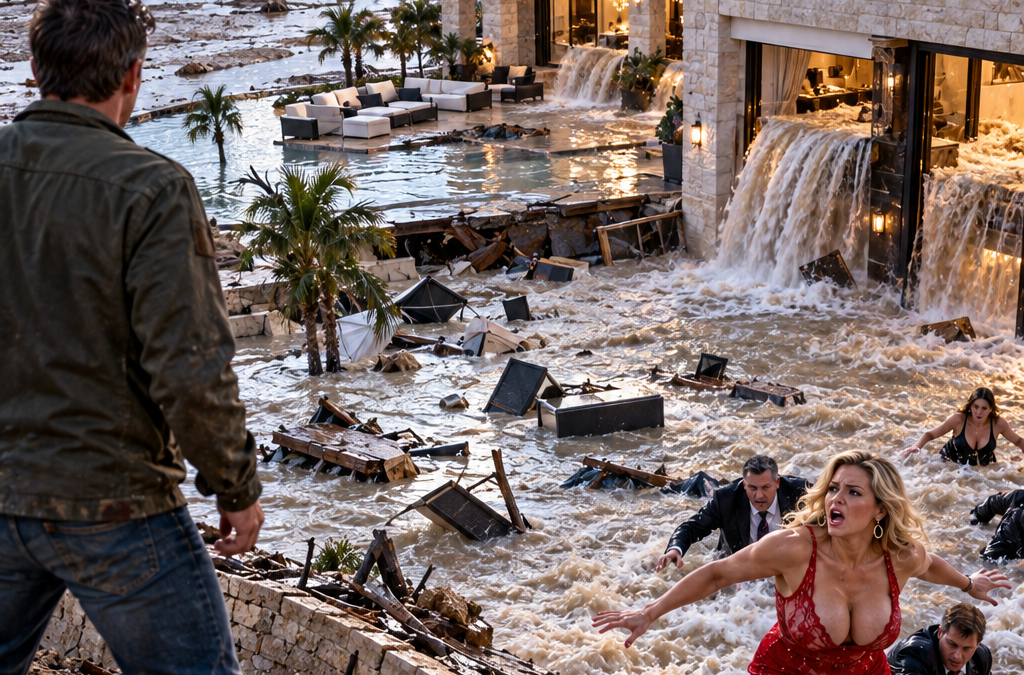
A strong current now cut across the villa’s surrounding road, brown and silver, carrying sticks, mud, and pieces of construction debris.
The road vanished section by section beneath moving water.
The villa, lit from within by expensive fixtures, stood in the basin like a glass palace built on a dare.
Linda stood beside me, breathing hard.
“This can be managed,” she said.
But she did not sound convinced anymore.
Engineers arrived the next morning.
Not the polished consultants from Linda’s presentation.
Real field engineers.
Boots.
Measuring equipment.
Mud on their pants.
They studied the basin, reviewed the old drainage maps, inspected the construction barriers, and walked the villa perimeter while residents watched from the ridge.
By afternoon, their conclusion was clear.
The original drainage system had been altered during construction.
Artificial barriers and fill had blocked the lake’s natural passage.
The villa had effectively been placed in the way of water trying to follow its historical route.
One engineer explained it at the second emergency meeting.
“If the channel remains blocked, water will continue seeking alternative routes around the structure.”
Linda folded her arms.
“So remove the water.”
The engineer looked at her like she had asked him to cancel gravity.
“You cannot simply remove a hydrologic system.”
Her face tightened.
“What are you recommending?”
“Careful reopening of the original passage.”
A board member asked, “Will that save the villa?”
“It may stabilize water levels around it.”
“May?”
“If barriers are removed too aggressively, flooding could worsen. If they remain, pressure continues building. There is no easy solution.”
For the first time since I had known her, Linda had no command that could bend reality.
No fine.
No letter.
No threat.
No “motion carries.”
Just water moving where water had always moved.
Crews began work two days later.
Slowly.
Carefully.
Under engineer supervision, sections of artificial barrier were removed. Temporary channels were cut. Pumps redirected water only where engineers approved.
Residents watched from the ridge as the old lake reappeared in pieces.
Not instantly.
Not dramatically like a dam breaking.
More like memory returning.
Water moved back into the natural route.
The current eased around the villa.
The level stabilized.
Mudflats became shoreline again.
The basin filled in a new shape, not exactly as before, but close enough that birds returned within a week.
The villa survived.
Technically.
But the project did not survive as promised.
The road around it was permanently compromised.
The landscaped grounds were gone.
The private estate now sat surrounded by restored water on three sides.
What had been advertised as an exclusive luxury villa became, in effect, an island built by arrogance.
The buyer backed out.
The developer sued consultants.
The HOA launched an internal investigation.
Linda resigned before they could remove her, though everyone knew resignation was just a softer word for defeat.
At her final meeting, she tried one last performance.
She stood in front of the residents wearing that red lace dress, face pale but chin high.
“This community has chosen fear over vision,” she said.
No one responded.
She looked toward me.
I stood near the back beside Emily.
“You think you won,” Linda said.
I shook my head.
“No.”
Her eyes narrowed.
“The lake did.”
That was the last thing I ever said to her.
Months passed.
The old basin became water again.
Not exactly the same lake I remembered as a child. The shoreline had changed. The villa still stood there, empty and ridiculous, reflected in the water like a monument to human arrogance.
But the water was back.
Reeds began returning near the south edge.
Birds nested along the shallows.
At sunset, the surface turned gold the way it used to.
Emily and I walked there often.
One evening, she slipped her hand into mine and looked across the restored lake.
“Do you ever wish you’d been wrong?”
I thought about that.
“If I’d been wrong, the lake would be gone.”
“And the villa would be fine.”
“Maybe.”
She looked at me.
“You don’t sound convinced.”
I watched water move gently against the rocks.
“Because the lake was never gone. Everyone just stopped listening.”
That was the lesson Silver Pines learned the hard way.
Nature is patient.
Patient enough to disappear beneath cracked ground.
Patient enough to wait under concrete.
Patient enough to let people build over it, brag over it, sell it, and name it progress.
But patience is not surrender.
Linda believed authority meant reality would obey her.
She believed a drained lake was conquered land.
She believed engineering could be reduced to marketing language.
She believed anyone who warned her was sentimental, outdated, or obstructive.
She was wrong about all of it.
The water was not attacking the villa.
It was not punishing anyone.
It was not angry.
It was simply following the path it had always followed.
The HOA had built in the wrong place.
The old maps had told the truth.
The ground had told the truth.
The returning streams had told the truth.
And when the water finally rose high enough for everyone to see, even Linda could not talk over it.
I still keep my father’s drainage maps framed in my study.
Not because I enjoy being right.
Because they remind me that truth does not become false just because powerful people ignore it.
A plan does not erase a watershed.
A vote does not redirect a mountain.
A brochure does not bury a lake.
And a fourteen-million-dollar villa, no matter how beautiful, no matter how expensive, no matter how many people praise it at a meeting, cannot win a fight against water that remembers where it belongs.
The HOA wanted a luxury landmark.
Instead, they built a warning.
And every time I stand on that rocky shoreline, watching sunlight move across the restored water, I think of my grandfather’s words.
Water remembers better than people do.
Now Silver Pines remembers too.
𝗧𝗛𝗘 𝗘𝗡𝗗
The HOA Drained My Family’s Lake and Built a $14 Million Villa in Its Bed, Then the Water Came Back for What They Stole.
I stood on the rocky shoreline at dawn, staring at what used to be my lake.
For most of my life, that sentence would not have made any sense.
A lake was not something that simply stopped being a lake.
It did not vanish because a board voted on it. It did not surrender because a developer drew a clean blue line on a proposal and then erased it. It did not become “available land” because a woman in heels and a red lace dress decided nature was an inconvenience.
But there I was, standing where the reeds used to grow, where my father once taught me to skip stones, where my wife Emily and I had watched summer storms roll across the water, staring at a dry basin that now held a fourteen-million-dollar luxury villa.
Glass walls.
Steel balconies.
A private dock that led to nothing.
A curved driveway.
Imported palm trees that looked absurd against the mountains.
And underneath all that polished concrete and arrogance, I could hear water moving.
Not see it.
Not yet.
Hear it.
A low, restless whisper beneath the cracked ground.
My name is Mark Ellison.
And before the HOA turned our lake into a sales feature, before Linda Whitmore tried to sell rich buyers a fantasy estate built in the wrong place, before engineers stood pale-faced in the mud admitting the old maps had been right all along, that shoreline was quiet.
It belonged to the neighborhood in a way no clubhouse ever could.
Not legally, maybe. Not in the clean language lawyers like to use. But emotionally, historically, honestly.
The lake had been there before the gated entrance.
Before the luxury lots.
Before the HOA.
Before Linda.
It sat in a natural basin below the foothills, fed by seasonal runoff from the mountains and a network of underground channels that most people ignored because they did not understand what they could not see.
In wet years, the lake rose high enough to cover the old stone markers near the north bank.
In dry years, the shoreline pulled back and exposed pale rock and cracked clay.
But it always returned.
My grandfather used to say, “Water remembers better than people do.”
I thought that was just something old men said when they wanted ordinary things to sound wise.
I did not understand how true it was until Linda Whitmore tried to erase a lake.
Linda was the president of the Silver Pines Homeowners Association, though “president” never felt like a big enough word for what she had made herself.
She was forty years old, beautiful, and poisonous.
She had long blonde hair, a body she displayed with calculated precision, and an almost theatrical habit of wearing the same tight red lace dress to meetings, inspections, and confrontations. The dress was low-cut, fitted, expensive-looking, and completely inappropriate for trudging around construction sites, which made it even more obvious that Linda wore it because she wanted every eye in the room on her.
She used beauty the way other people used a gavel.
She leaned close when she wanted compliance.
She smiled when she threatened.
She touched a man’s sleeve when she wanted him to forget the question he had asked.
Then, the moment anyone pushed back, that flirtatious softness disappeared, and what remained was cold, dictatorial contempt.
Linda did not run Silver Pines.
She occupied it.
She treated bylaws like scripture when they served her and scrap paper when they did not. She fined retirees over mailbox numbers. She threatened young families over backyard playsets. She silenced board members by accusing them of “damaging community harmony.” She called herself the guardian of property values, but everyone knew what she really guarded was control.
And the lake was her greatest act of control.
The first time she announced the plan, I thought I had misheard her.
It was at an HOA meeting six months earlier, in the main clubhouse, beneath a chandelier that looked like it had been chosen by someone trying too hard to impress strangers.
Linda stood at the front in her red lace dress, smiling as a rendering appeared on the screen behind her.
There it was.
The lake basin.
Except in the rendering, it was not a lake.
It was a private luxury estate.
A sweeping villa with glass walls, a courtyard, a guest pavilion, and a driveway that curved across land where fish used to move under lily pads.
People gasped.
Some in admiration.
Some in confusion.
I stood slowly.
“Linda,” I said, “that’s the lake bed.”
She smiled at me the way a teacher smiles at a slow student.
“Former lake bed, Mark.”
A few people laughed nervously.
I did not.
“The lake is seasonal.”
“The lake has been permanently drained.”
“No, it hasn’t.”
Her smile tightened.
“Modern engineering has made the area safe and usable.”
I looked around the room.
“Who told you that?”
“Our consultants.”
“Which consultants?”
“The board has reviewed all relevant materials.”
That was how Linda answered questions.
Never directly.
Never with documents.
Only with phrases that sounded official enough to make nervous people stop asking.
I kept standing.
“That basin connects to mountain runoff channels. My father had maps of the old drainage system.”
Linda tilted her head.
“Your father was not an engineer.”
“No, but he knew the land.”
“And the people currently handling this project know development.”
That line got a few nods from residents who saw only the rendering, not the risk.
Linda turned back to the room.
“This villa will elevate Silver Pines. It will prove that our community is not trapped by outdated assumptions about what land can be.”
Outdated assumptions.
That was what she called a lake.
A natural basin.
A drainage system older than every house in Silver Pines.
She clicked to the next slide.
The price appeared in bold.
Projected value: $14 million.
The room changed after that.
Money has a way of making people stop hearing warnings.
Linda spoke about increased property values, prestige buyers, luxury branding, expanded tax advantages, and exclusive architectural partnerships. She made the destruction of a lake sound like a favor.
A neighbor named Daniel asked whether independent hydrologists had reviewed the plan.
Linda cut him off.
“Daniel, we are not here to indulge fear-based obstruction.”
Emily, sitting beside me, squeezed my hand under the table.
She knew that look on my face.
The one that meant I was about to make enemies.
I raised my hand again.
Linda ignored it.
I spoke anyway.
“You’re building in a basin.”
Linda’s eyes flashed.
“We are developing stable reclaimed land.”
“You drained surface water. That doesn’t mean you removed the watershed.”
She stepped toward me, every inch of her posture sharpened.
“Mark, I know you have emotional attachments to that lake. Many of us do. But emotional attachment cannot hold back progress.”
“This isn’t emotion. It’s water.”
A silence settled over the room.
Then Linda laughed.
A soft, cruel laugh.
“Water, as you can see from the approved report, is no longer present.”
She gestured toward the rendering.
People chuckled because it was easier than admitting they were afraid she might be wrong.
I sat down because Emily pulled gently on my sleeve.
But as Linda continued selling her dream villa, I knew the truth.
She had not defeated the lake.
She had only hidden it.
Construction began within weeks.
First came the heavy equipment.
Then the pumps.
Then the drainage trenches.
Then trucks hauling away wet soil and replacing it with fill.
Linda posed for photos in front of the construction site, red dress bright against the gray machinery, smiling like a queen at a conquest.
The HOA newsletter called the project “a triumph of land reclamation.”
I called it stupidity with financing.
I walked the old shoreline almost every day.
At first, nothing dramatic happened.
The basin dried.
The mud cracked.
The reeds died.
The old frogs disappeared.
The silence bothered me most.
A lake has sounds even when nobody is talking near it. Birds. Insects. Water shifting against stone. Wind dragging ripples across the surface.
Once the basin dried, the whole lower valley felt dead.
Emily came with me sometimes.
She had loved the lake too, though differently than I did.
To her, it was where we walked after dinner, where we talked when life felt too heavy inside the house, where we once sat for an hour without speaking after her mother died.
“Maybe they really did engineer it properly,” she said one evening, not because she believed it, but because she wanted me to stop carrying dread in my shoulders.
I looked across the empty basin.
“They engineered against what they could see.”
“And the rest?”
I pointed toward the mountains.
“The rest is still coming.”
Winter turned to spring.
The villa rose like an insult.
Steel beams.
Concrete foundation.
Glass panels shipped from overseas.
Landscaped terraces.
A private pool.
Security gates.
Linda toured potential buyers through the site before the exterior was even finished. She wore hard hats over perfect hair and walked them across the basin like she had personally conquered nature.
Once, from the upper ridge, I watched her point toward the house and laugh with a couple in designer hiking boots.
The man gestured toward the mountains.
The woman took pictures.
Linda spread her arms toward the property like she was presenting a miracle.
I wanted to shout down from the ridge.
Ask her where the water goes.
Ask her what happens when snowmelt pushes through the old channels.
Ask her why every drainage map before her little kingdom existed showed that basin as active.
But I had no proof yet.
Just memory.
Old stories.
A bad feeling.
Linda had renderings, consultants, board votes, and investors.
In Silver Pines, paper signed by rich people always seemed louder than old land.
Then the water spoke.
It started as a line of dampness near the old shoreline.
I noticed it at sunrise.
The air was cold, and the ground near the eastern bank glistened where it should have been dry.
At first, I thought it was dew.
Then I crouched and touched it.
The mud was soft.
Too soft.
I pressed my fingers into a crack in the earth.
Water welled up from beneath.
Slowly.
Quietly.
Patiently.
My heart began to pound.
I followed the damp line along the basin.
There were more.
Tiny streams threading through cracks in the clay.
Seeping upward.
Gathering.
Moving.
Not from rain.
There had been no major storm in weeks.
This was not surface runoff.
This was pressure from below.
I called Emily.
She answered sleepy.
“Mark?”
“Come to the old lake.”
“What happened?”
“The water’s coming back.”
She was there in ten minutes, jacket thrown over pajamas, hair pulled back messily, breath clouding in the morning air.
At first, she did not speak.
She just stared.
The dry lake bed had become veined with silver.
Thin streams ran between cracks, shining in the early light.
Near the villa’s concrete perimeter, water gathered in shallow pools.
Emily whispered, “Oh my God.”
“I told them.”
She crouched beside one of the streams.
“It’s rising from underneath.”
“Yes.”
“Can they stop it?”
I looked toward the villa.
Its glass walls reflected the mountains.
Its foundation sat directly in the path of water that had been moving there longer than any of us had been alive.
“I don’t know.”
Within hours, the trickles became currents.
Water pushed through fissures in the basin floor, found old channels, connected low points, and began moving with purpose.
By noon, shallow water surrounded parts of the villa’s outer concrete border.
By midafternoon, the temporary construction road near the east side was submerged.
Workers in reflective vests stood around pointing, taking photos, calling supervisors.
Then Linda arrived.
Of course she did.
White SUV.
Red lace dress under a winter coat.
Heels completely unsuited for mud.
She stepped out like a woman arriving to discipline the earth itself.
“What is happening here?” she demanded.
One of the site managers approached her.
“We have water intrusion around the lower perimeter.”
Linda turned sharply toward me.
I was standing on the ridge with Emily.
Her eyes narrowed.
“You.”
I walked down slowly.
“Me?”
“You’ve been waiting for this.”
“I warned you about this.”
“This is a temporary weather event.”
Emily looked up at the clear sky.
“Linda, there hasn’t been a major storm.”
Linda ignored her.
“Mountain soil behaves unpredictably during seasonal transitions.”
I pointed toward the basin floor.
“That water is rising through the old channels.”
She laughed coldly.
“Now you’re a hydrologist?”
“No. I’m someone who didn’t build a mansion in a lake.”
Several workers looked away.
Linda stepped close enough that I could smell her perfume over the wet clay.
“You need to be very careful, Mark.”
“There it is.”
“What?”
“The threat.”
Her eyes hardened.
“This project has legal protections, financial partners, and approved engineering.”
“Then call your engineers.”
“We have people handling this.”
“No, Linda. You have people trying not to admit you were wrong.”
Her face flushed.
She turned to the site manager.
“Pump it out.”
He hesitated.
“Mrs. Whitmore, if this is groundwater pressure—”
“I said pump it out.”
He looked trapped.
The pumps ran until dark.
For every gallon they moved, more water appeared.
That evening, I went home and pulled down the old storage box from my father’s office.
He had kept maps of the area because he was that kind of man.
Survey maps.
Drainage sketches.
Reservoir records.
Old county documents folded along weakening seams.
Emily helped me spread them across the dining room table.
We found the first drainage map after midnight.
Then another.
Then the original lake system diagram.
There it was in faded blue ink.
The basin.
The surrounding reservoir connection.
The underground channels.
One thick line ran directly beneath where Linda’s villa now stood.
I stared at it.
Emily placed her hand over her mouth.
“They built over it.”
“Yes.”
“Did they know?”
I did not answer right away.
Because the answer mattered.
Mistakes happen.
Bad assumptions happen.
But ignoring recorded drainage maps while selling a fourteen-million-dollar estate in a lake bed was not a mistake.
It was arrogance sharpened into negligence.
I scanned every map.
Photographed every page.
Then I compared them with the HOA’s construction plan, which I had saved from the project announcement packet.
The villa sat directly over one of the original water channels.
Not near it.
Not adjacent.
Over it.
The next morning, the lower access road had nearly disappeared.
Water covered the gravel from one side to the other, rippling in the wind like the lake was practicing.
Construction crews had set up temporary barriers, but water slid around them.
Residents gathered along the ridge, whispering.
Even the people who had cheered Linda’s project looked frightened now.
A fourteen-million-dollar villa surrounded by rising water no longer looked like prestige.
It looked like evidence.
Linda called an emergency HOA meeting that afternoon.
Not because she wanted transparency.
Because she wanted control before panic spread faster than water.
The clubhouse was packed.
Residents filled every seat and lined the walls.
Linda stood at the front, jaw tight, red lace dress brighter than the anger in the room.
She opened with the same polished tone she always used when lying.
“Residents, I understand there has been concern regarding temporary water accumulation near the Phase Three villa.”
Someone shouted, “Temporary?”
Another resident said, “The road is underwater.”
Linda raised one hand.
“Please. We will not descend into hysteria.”
Daniel stood.
“Why was the lake drained in the first place?”
Linda smiled without warmth.
“That decision was made based on expert recommendations.”
“Which experts?”
“The board reviewed all necessary information.”
I stood.
“No, you didn’t.”
Every head turned.
Linda’s eyes flashed.
“Mark, sit down.”
I walked to the front carrying my father’s maps.
“I have the original drainage records.”
Her face changed.
Only slightly.
But I saw it.
Fear.
I placed the maps on the table.
One by one.
County drainage map.
Reservoir connection diagram.
Old lake basin survey.
HOA construction plan.
Then I laid the two main maps side by side.
“The villa was built directly over an original underground water channel.”
The room went silent.
I pointed to the faded blue line.
“This channel connects the basin to the surrounding reservoir system and mountain runoff path. The lake was never gone. It was delayed.”
A board member leaned forward.
“Linda, did our engineers review these?”
She snapped, “Those documents are outdated.”
I said, “Water doesn’t care how old a map is if the map is right.”
A murmur moved through the room.
Linda slammed her palm on the table.
“This project was approved.”
“By people who ignored the drainage system.”
“You are not qualified to make that accusation.”
“Then bring in engineers and prove me wrong.”
That stopped her.
Because everyone in the room heard the challenge.
Not gossip.
Not emotion.
Not obstruction.
Proof.
Another board member, pale and shaken, asked, “Did we know the old basin connected to the reservoir?”
Linda looked at him.
Then at the room.
Then at the maps.
She said nothing clearly.
That silence was worse than any confession.
A shout came from the back.
“The road is flooding!”
People rushed outside.
I followed.
The water had surged while we were in the meeting.
A strong current now cut across the villa’s surrounding road, brown and silver, carrying sticks, mud, and pieces of construction debris.
The road vanished section by section beneath moving water.
The villa, lit from within by expensive fixtures, stood in the basin like a glass palace built on a dare.
Linda stood beside me, breathing hard.
“This can be managed,” she said.
But she did not sound convinced anymore.
Engineers arrived the next morning.
Not the polished consultants from Linda’s presentation.
Real field engineers.
Boots.
Measuring equipment.
Mud on their pants.
They studied the basin, reviewed the old drainage maps, inspected the construction barriers, and walked the villa perimeter while residents watched from the ridge.
By afternoon, their conclusion was clear.
The original drainage system had been altered during construction.
Artificial barriers and fill had blocked the lake’s natural passage.
The villa had effectively been placed in the way of water trying to follow its historical route.
One engineer explained it at the second emergency meeting.
“If the channel remains blocked, water will continue seeking alternative routes around the structure.”
Linda folded her arms.
“So remove the water.”
The engineer looked at her like she had asked him to cancel gravity.
“You cannot simply remove a hydrologic system.”
Her face tightened.
“What are you recommending?”
“Careful reopening of the original passage.”
A board member asked, “Will that save the villa?”
“It may stabilize water levels around it.”
“May?”
“If barriers are removed too aggressively, flooding could worsen. If they remain, pressure continues building. There is no easy solution.”
For the first time since I had known her, Linda had no command that could bend reality.
No fine.
No letter.
No threat.
No “motion carries.”
Just water moving where water had always moved.
Crews began work two days later.
Slowly.
Carefully.
Under engineer supervision, sections of artificial barrier were removed. Temporary channels were cut. Pumps redirected water only where engineers approved.
Residents watched from the ridge as the old lake reappeared in pieces.
Not instantly.
Not dramatically like a dam breaking.
More like memory returning.
Water moved back into the natural route.
The current eased around the villa.
The level stabilized.
Mudflats became shoreline again.
The basin filled in a new shape, not exactly as before, but close enough that birds returned within a week.
The villa survived.
Technically.
But the project did not survive as promised.
The road around it was permanently compromised.
The landscaped grounds were gone.
The private estate now sat surrounded by restored water on three sides.
What had been advertised as an exclusive luxury villa became, in effect, an island built by arrogance.
The buyer backed out.
The developer sued consultants.
The HOA launched an internal investigation.
Linda resigned before they could remove her, though everyone knew resignation was just a softer word for defeat.
At her final meeting, she tried one last performance.
She stood in front of the residents wearing that red lace dress, face pale but chin high.
“This community has chosen fear over vision,” she said.
No one responded.
She looked toward me.
I stood near the back beside Emily.
“You think you won,” Linda said.
I shook my head.
“No.”
Her eyes narrowed.
“The lake did.”
That was the last thing I ever said to her.
Months passed.
The old basin became water again.
Not exactly the same lake I remembered as a child. The shoreline had changed. The villa still stood there, empty and ridiculous, reflected in the water like a monument to human arrogance.
But the water was back.
Reeds began returning near the south edge.
Birds nested along the shallows.
At sunset, the surface turned gold the way it used to.
Emily and I walked there often.
One evening, she slipped her hand into mine and looked across the restored lake.
“Do you ever wish you’d been wrong?”
I thought about that.
“If I’d been wrong, the lake would be gone.”
“And the villa would be fine.”
“Maybe.”
She looked at me.
“You don’t sound convinced.”
I watched water move gently against the rocks.
“Because the lake was never gone. Everyone just stopped listening.”
That was the lesson Silver Pines learned the hard way.
Nature is patient.
Patient enough to disappear beneath cracked ground.
Patient enough to wait under concrete.
Patient enough to let people build over it, brag over it, sell it, and name it progress.
But patience is not surrender.
Linda believed authority meant reality would obey her.
She believed a drained lake was conquered land.
She believed engineering could be reduced to marketing language.
She believed anyone who warned her was sentimental, outdated, or obstructive.
She was wrong about all of it.
The water was not attacking the villa.
It was not punishing anyone.
It was not angry.
It was simply following the path it had always followed.
The HOA had built in the wrong place.
The old maps had told the truth.
The ground had told the truth.
The returning streams had told the truth.
And when the water finally rose high enough for everyone to see, even Linda could not talk over it.
I still keep my father’s drainage maps framed in my study.
Not because I enjoy being right.
Because they remind me that truth does not become false just because powerful people ignore it.
A plan does not erase a watershed.
A vote does not redirect a mountain.
A brochure does not bury a lake.
And a fourteen-million-dollar villa, no matter how beautiful, no matter how expensive, no matter how many people praise it at a meeting, cannot win a fight against water that remembers where it belongs.
The HOA wanted a luxury landmark.
Instead, they built a warning.
And every time I stand on that rocky shoreline, watching sunlight move across the restored water, I think of my grandfather’s words.
Water remembers better than people do.
Now Silver Pines remembers too.








