𝗙𝗨𝗟𝗟 𝗦𝗧𝗢𝗥𝗬 The HOA Cut Through My Fence After a Judge Ordered Them to Stop—Then Karen Tried to Block Me From My Own Property
𝗙𝗨𝗟𝗟 𝗦𝗧𝗢𝗥𝗬
I waited.
She walked toward the opening.
“You’ve seen the access correction.”
I stared at her.
“The what?”
“The access correction.”
“You mean the fence someone cut apart?”
She smiled faintly.
“That fence was obstructing community access.”
“No.”
“Jack—”
“A judge already addressed this.”
Her face hardened immediately.
“I am not discussing the court matter with you.”
I almost couldn’t believe the sentence.
“You came onto the property involved in that court matter.”
“The HOA is enforcing its governing documents.”
“The governing documents do not overrule the judge.”
“That’s your interpretation.”
“No, Karen. That’s how courts work.”
One of the guards glanced at her.
She noticed.
“Stay out of this.”
He looked away.
I opened the folder and removed the order.
“Here.”
She didn’t take it.
“You were present when this was issued.”
“I’m aware of what the judge said.”
“Good.”
I held the document up.
“Then explain why the fence was cut afterward.”
Karen crossed her arms.
“Because your fence continues to violate community-access requirements.”
“The court already considered the dispute.”
“The HOA has its own rules.”
I looked at her for several seconds.
“And you think your rules are above a court order?”
She exhaled sharply.
“Do not put words in my mouth.”
“I’m not.”
I pointed at the fence.
“You’re putting saw blades through my property.”
Her jaw clenched.
“We have residents who need access through this corridor.”
“This is not a corridor.”
“It has historically functioned as one.”
“No.”
“The board disagrees.”
“Show me.”
Her eyes narrowed.
“What?”
“The authorization.”
“I just told you.”
“No. You told me the board voted.”
“That is authorization.”
“Did the board ask the court for permission to modify the fence after the ruling?”
Karen’s face changed.
A small change.
But enough.
“That isn’t necessary.”
“Then show me where the judge said that.”
“You are deliberately misrepresenting what happened.”
“Am I?”
I held up the order.
“This is the document.”
Karen took one step closer.
“Put that away.”
“No.”
“I said put it away.”
I almost smiled.
She had spent years training people to obey that tone.
I wasn’t one of them anymore.
“I’m documenting everything.”
Her eyes moved to my phone.
“You’ve been photographing our vehicles.”
“Yes.”
“You have no permission to photograph HOA security.”
“They’re standing beside my property entrance.”
“You’re creating a hostile situation.”
“No.”
I looked at the three guards.
“I’m standing beside my truck with paperwork.”
Then back at Karen.
“You brought security.”
That landed badly.
Her face flushed.
“Move closer to the entrance,” she told the guards.
The one who had looked uncomfortable hesitated.
“Ma’am?”
“You heard me.”
They moved.
Not aggressively.
But deliberately.
Two positioned themselves near the cut section.
A third walked toward the road.
I took several steps backward immediately.
I wanted the distance visible.
No one could later claim I had approached them.
Karen pointed toward the open section.
“Temporary barriers.”
One guard pulled folding barricades from the rear of the vehicle.
“What are you doing?” I asked.
“Securing HOA access.”
“To my property?”
“To the community access point.”
“There is no community access point.”
Karen didn’t even look at me.
“Place one there.”
The guards moved the first barrier near the road entrance.
Then another.
Within moments, my own entrance was partially blocked by equipment brought there by the same group that had cut my fence.
I felt anger rise so fast I had to consciously unclench my hands.
“Karen.”
She turned.
“Move those barriers.”
“No.”
“This road is not HOA-controlled.”
“It services the community.”
“It crosses my property.”
“You keep saying that as though repetition makes it more true.”
I pulled out my property map.
“No. This makes it true.”
She laughed.
“A map.”
“The recorded survey.”
“We have our own map.”
“Does your map come with a deed?”
Her smile vanished.
One of the guards looked down.
Karen saw him.
“I told you not to involve yourself.”
He said quietly, “I didn’t say anything.”
“Then don’t.”
That was Karen.
Even silence had to happen under her authority.
I called the county again.
Karen watched me.
“Oh, please.”
I turned slightly away from her.
“The HOA is back. They’ve brought private security. They are placing barriers across the entrance road.”
The dispatcher asked whether anyone had threatened me.
“No.”
“Are you physically blocked from leaving?”
“Not completely yet.”
“Do not confront security personnel.”
“I’m not.”
“Remain on your property if safe.”
“I’m beside my truck.”
“Deputies are being notified.”
Karen heard the word deputies.
Instead of becoming concerned, she smiled.
Actually smiled.
“Good.”
I ended the call.
“Good?”
“Yes.”
She adjusted one sleeve.
“Maybe once county officials explain this to you, you’ll stop wasting everyone’s time.”
“You think they’re coming to explain your HOA rules to me?”
“I think they’re coming to see an unreasonable property owner obstructing legitimate community access.”
I looked at the cut fence.
Then the barriers.
Then the guards.
“You really believe that?”
She stepped closer.
“I have dealt with county officials for years.”
“That wasn’t my question.”
“Your problem, Jack, is that you think one favorable ruling gave you permission to challenge every HOA decision.”
“One favorable ruling?”
I took the court order out again.
“A judge told you to stop interfering with this fence.”
Karen’s mouth hardened.
“You are obsessed with that document.”
“Yes.”
I nodded toward the cut boards.
“Today seems like a pretty good day to be obsessed with it.”
She turned away.
For the next fifteen minutes, nothing happened.
Which somehow made the scene more tense.
The guards stood near the barriers.
Karen made calls beside her SUV.
I stayed near my truck.
Every few minutes I photographed another angle.
Fresh tracks.
Fence line.
Location of the barriers.
Security vehicles.
Time stamps.
Tom stayed on his side of the road watching.
Eventually Karen ended a call and walked back toward me.
“You need to remove your truck.”
“Why?”
“You’re interfering with traffic.”
“No one is trying to pass.”
“That’s because you’re standing here creating a confrontation.”
“My truck is parked on my property.”
“Move it anyway.”
“No.”
Her eyes narrowed.
“I can have it towed.”
“No, you can’t.”
“Try me.”
There was the Karen I knew.
Every disagreement eventually became a threat.
Fine.
Lien.
Tow.
Security.
Whatever sounded frightening enough to make the other person surrender.
I kept my voice low.
“Please put the towing order in writing.”
Her mouth closed.
I waited.
She said nothing.
“Exactly.”
A guard turned his head toward the road.
“Vehicle coming.”
Everyone looked.
A white county vehicle appeared around the bend.
Karen straightened immediately.
It was almost theatrical.
Shoulders back.
Chin up.
Professional smile.
The angry woman threatening to tow my truck vanished.
HOA President Karen had returned.
“Everybody remain calm,” she told the guards.
I nearly laughed.
She had spent twenty minutes escalating the situation.
Now she was instructing everyone else to remain calm because witnesses with government badges had arrived.
The county vehicle stopped near the entrance.
Two deputies stepped out.
One older.
One younger.
The older deputy looked at the barriers first.
Then the fence.
Then the security guards.
Then me.
“Who called?”
“I did.”
Karen stepped forward.
“I’m Karen Whitfield, HOA president. I can explain.”
The deputy held up a hand.
“I’ll speak to everyone.”
Her expression flickered.
He looked at me.
“What do you have?”
I handed him the folder.
“Court order. Property survey. Deed copy. Previous case information.”
He took them.
Karen immediately began talking.
“This homeowner has repeatedly attempted to block designated community access—”
The deputy looked up.
“Ma’am.”
“Yes?”
“Give me a minute to read.”
Karen actually looked offended.
He started with the first page of the court order.
Then the second.
The younger deputy walked toward the broken fence.
He crouched beside the cut post.
“Fresh?”
“This morning,” I said.
“Witness?”
I pointed across the road.
“Neighbor.”
Tom raised one hand.
The deputy nodded.
The older deputy kept reading.
Karen folded her arms.
Her impatience became visible.
Finally she said, “The order does not suspend the HOA’s independent enforcement powers.”
The deputy didn’t look up.
“I’m reading it.”
“You’re not familiar with our governing documents.”
“I’m reading the court’s document.”
“It’s more complicated than that.”
That made him look up.
“A judge’s order is usually something I prefer to read before anyone does more work.”
Karen’s lips tightened.
The deputy turned toward the damaged fence.
“Who ordered this cut?”
Karen took a breath.
“The HOA board authorized corrective work.”
“You?”
“The board.”
“Were you involved in implementing the decision?”
“As president, yes.”
“Did you personally authorize contractors?”
She hesitated.
“Yes.”
“After this order?”
“The order addresses the previous dispute.”
I could see what she was doing.
Trying to create ambiguity.
The same technique she used in HOA meetings.
Never answer directly if the direct answer was dangerous.
The deputy tapped the document.
“Did anyone obtain legal clarification from the court before cutting the fence?”
“Our attorney advised—”
“Did the court clarify that you could cut it?”
Karen’s expression tightened.
“The board believed we were acting within our authority.”
“That’s not the same question.”
Silence.
I watched one of the guards shift his weight.
The deputy noticed the temporary barriers.
“Who placed those?”
Karen answered immediately.
“Security.”
“Why?”
“To preserve community access.”
I spoke.
“They partially block my property entrance.”
Karen turned.
“Do not interrupt.”
The deputy looked between us.
“Ma’am, you don’t control who speaks to me.”
Karen’s face went rigid.
The younger deputy walked over.
“Survey marker appears to put the entrance on his parcel.”
Karen laughed shortly.
“The HOA disputes that.”
The older deputy looked toward her.
“That dispute is exactly why nobody should be changing physical conditions until the court order is reviewed.”
“We cannot allow one resident to paralyze community operations.”
“Nobody is talking about community operations right now.”
He pointed toward the fence.
“We’re talking about physical work performed after a court order.”
Karen’s voice rose.
“The HOA has one hundred forty-seven households to protect. We cannot run every access decision through a judge because one man objects.”
I felt my pulse rise.
But I said nothing.
The deputy did not react to her volume.
“Until this document is reviewed, nobody touches the fence.”
Karen stared at him.
“Excuse me?”
“No further work.”
“We have contractors scheduled.”
“Cancel them.”
“You don’t have authority to suspend HOA enforcement.”
“I’m telling you there will be no additional disturbance here while we determine how this order applies.”
Karen stepped closer.
“I want your supervisor.”
The deputy nodded calmly.
“You’re welcome to request one.”
Her certainty wavered.
The guards saw it.
That mattered.
A minute earlier, Karen had been issuing commands.
Now she was arguing with someone who did not care how long she had been HOA president.
The uncomfortable guard stepped away from the entrance.
Karen noticed.
“Where are you going?”
He pointed toward the barrier.
“He said no further disturbance.”
“I did not tell you to move.”
The deputy did.
“Move the barriers away from the property entrance.”
Karen turned sharply.
“You cannot order my security team.”
The deputy looked at the guards.
“Those barriers are being removed from the disputed entrance until we finish reviewing the situation.”
The guards didn’t argue.
They picked them up.
Karen looked furious.
“Leave them.”
Nobody obeyed her.
That was the first real shift.
For years, Karen’s authority had depended on people acting before asking whether she actually had the power she claimed.
Now everybody was asking.
The barriers went back into the security vehicle.
The guards moved onto the roadside.
I remained where I was.
No celebration.
No smile.
I kept taking photographs.
Because the fence was still cut.
That damage didn’t disappear because the tension had changed.
The older deputy stepped toward me.
“I need copies of these documents.”
“I can email them.”
“Do that.”
He gave me the address.
Karen made another phone call.
This one was clearly to the board.
I could hear pieces.
“…county deputies…”
“…yes, I showed them…”
“No, they’re misunderstanding…”
“…I need somebody from legal…”
Every sentence sounded less confident than the last.
The sun started dropping behind the trees.
Long shadows stretched across the road.
Nobody touched the fence.
Nobody entered my property.
For the first time since I arrived, the scene became still.
Then another county vehicle appeared.
Karen stopped talking mid-sentence.
A second set of officials arrived.
They spoke quietly with the first deputies.
Reviewed the order.
Looked at the survey.
Walked the entrance.
One photographed the fence independently.
Another marked the position of the road relative to visible survey points.
Karen stood beside her SUV waiting.
She hated waiting.
You could see it in the way she tapped one foot.
Finally an official approached her.
“For now, your security personnel need to remain outside this area.”
“What area?”
He pointed.
“The property entrance and disputed boundary.”
Karen stared at him.
“You’re restricting HOA access?”
“We’re preserving the location while the court documents are reviewed.”
“We have residents who use this route.”
“Not tonight.”
Her face reddened.
“You have no idea what disruption this causes.”
He remained calm.
“Then your attorney can raise that through the proper legal process.”
Karen looked toward me.
I said nothing.
That was the part she hated most.
I didn’t need to win the argument.
The argument was no longer between us.
The county was documenting the scene.
The court order was in official hands.
The guards had been moved.
The road entrance was being treated as disputed property instead of whatever Karen decided to call it.
She had wanted confrontation.
What she got was procedure.
And procedure was far more dangerous to her than anger.
The last sunlight caught the broken fence.
I walked over and took one final photograph.
Freshly cut wood.
Splintered boards.
Tire tracks.
Beyond them, county vehicles.
Not HOA vehicles.
Karen saw me.
“You enjoying this?”
I turned.
“Enjoying what?”
“Making a spectacle.”
I looked around.
“You brought three security guards.”
“This could have been handled privately.”
“The last time it was handled privately, we ended up in court.”
“You’re impossible.”
“No.”
I pointed toward the injunction.
“I’m consistent.”
She shook her head.
“You really think this proves something?”
“I think the judge already proved something.”
She stepped toward me.
One deputy looked over.
Karen stopped.
I continued.
“The only question now is why you thought you could ignore it.”
For once, she didn’t answer.
Her phone rang.
She turned away.
The security guards were told to leave soon afterward.
They loaded the last barriers.
The uncomfortable guard approached me briefly before getting into the vehicle.
“Sir.”
I looked at him.
“I didn’t know there was a court order.”
I believed him.
“Okay.”
“We were told this was an HOA access enforcement.”
“I figured.”
He glanced toward Karen.
Then lowered his voice.
“I’m sorry about the fence.”
Karen called his name sharply from across the road.
He left.
Her ability to control the scene was collapsing one person at a time.
By dusk, the county officials had established a clear temporary boundary around the entrance.
No one was authorized to alter the fence.
No further HOA work.
No private security inside the restricted area.
Any additional action would wait for legal review.
The older deputy handed my documents back.
“Keep these with you.”
“I planned to.”
“If anyone returns tonight, don’t engage. Call.”
“I will.”
Karen heard him.
She walked over.
“So he gets to use the road and we don’t?”
The deputy looked at her.
“He’s accessing his property.”
“We dispute that.”
“Then resolve the dispute through the court.”
“We already have board authority.”
“That’s not what I said.”
Her voice sharpened.
“This board will not be bullied by one homeowner.”
The deputy’s expression barely changed.
“No one here is asking the board to be bullied.”
He pointed toward the damaged fence.
“We’re asking everybody to stop cutting things until the legal order is reviewed.”
Tom coughed into his hand.
I’m almost certain he was hiding a laugh.
Karen heard it.
Her eyes snapped toward him.
Tom looked away.
She had spent years making neighbors afraid to laugh at her.
That evening, she discovered something worse than people becoming angry.
They were becoming unimpressed.
Eventually, the county vehicles prepared to leave.
The officials had everything they needed.
Photographs.
Court papers.
Names.
Vehicle details.
Witness information.
The situation had become an official county matter.
Exactly what Karen had believed would never happen.
She stood beside her SUV, arms folded, staring at the damaged opening.
I wondered whether she regretted ordering the work.
Probably not.
Karen wasn’t built for regret.
She was built for justification.
If something went wrong, it was because someone else resisted.
If residents became angry, they misunderstood her.
If an attorney challenged her, they were harassing the board.
If a judge ruled against her, the judge didn’t understand HOA governance.
If county officials showed up, somebody had exaggerated.
There was always an explanation that left Karen innocent and everyone else unreasonable.
That was why the fence mattered.
Not because it was beautiful.
It wasn’t.
It was an ordinary wooden boundary fence.
Boards.
Posts.
Gate.
Nothing worth making a community war over.
But boundaries only become important when someone refuses to recognize them.
The first time Karen challenged that fence, I tried talking.
Then letters.
Then meetings.
Then lawyers.
Finally court.
When the judge ruled, I genuinely believed the dispute had ended.
I underestimated one thing.
Karen did not see losing in court as losing.
She saw it as another obstacle to route around.
Three days after a judge told the HOA to stop, someone cut the fence again.
That was no longer a misunderstanding.
Fresh sawdust doesn’t misunderstand anything.
Neither do tire tracks.
Neither do board-authorized contractors.
Neither do temporary barriers brought by private security.
Those things require decisions.
Someone had decided the court order mattered less than Karen’s authority.
That night, after everyone finally left, I stood beside the broken fence alone.
The road was quiet.
The security vehicles were gone.
Karen’s SUV was gone.
County markings remained near the entrance.
I ran my hand over the freshly cut post.
The wood was rough beneath my palm.
Part of me wanted to repair it immediately.
Put everything back the way it had been.
But the county had told me not to alter the scene yet.
So I left it.
Sometimes protecting property means resisting the urge to fix what someone else broke.
You preserve the damage.
You photograph it.
You document it.
You let the broken thing tell the story.
I went home with the court order on the passenger seat.
That document had looked powerful inside a courtroom.
Official seal.
Case number.
Judge’s signature.
Legal language.
Standing beside the cut fence that morning, it had felt almost useless.
Karen had looked directly at it and essentially said she didn’t care.
For a few hours, that made me wonder what good any order was if someone could simply ignore it.
By sunset, I understood the answer.
A court order doesn’t physically stop a saw.
It doesn’t stand beside your fence twenty-four hours a day.
It doesn’t reach out and grab the hand of somebody determined to violate it.
What it does is establish the line.
And once someone knowingly crosses that line, the question changes.
Before, Karen and I had argued about who was right.
Now the question was why she had acted after the court had already spoken.
That was much harder for her to explain.
Especially when everything was documented.
The next morning, I returned to the entrance.
Nothing had moved overnight.
The county boundary remained.
No HOA vehicles.
No security guards.
No workers.
Tom walked across the road carrying coffee.
“Quiet.”
“Very.”
“First time in a while.”
I nodded.
He looked at the damaged fence.
“What are you going to do?”
“Exactly what they told me.”
“Wait?”
“Document.”
He smiled.
“Karen hates waiting.”
“I know.”
“That might be the worst punishment you could give her.”
I almost laughed.
Across the road, sunlight hit the fresh cut through the fence.
The damage still made me angry.
But the anger felt different.
The day before, Karen had arrived believing force would settle the issue.
Cut the fence.
Bring security.
Block the road.
Declare HOA authority.
Make me retreat.
Instead, every escalation had created another witness.
Another photograph.
Another official record.
Another question she couldn’t answer.
Who authorized the work after the judge ruled?
Did the board obtain permission from the court?
Why were private guards blocking access to property the HOA didn’t control?
Why did Karen refuse to discuss the order she admitted existed?
Those questions belonged to the county now.
Not just me.
That changed everything.
I never needed to outshout Karen.
I never needed to push past her guards.
I never needed to touch the barriers.
All I needed was to stand on my side of the property line, hold onto the documents, and make sure everyone saw exactly who crossed it.
Karen had spent years believing HOA rules were the final word.
That evening, as the county vehicles pulled away and her security guards were ordered outside the boundary, she finally confronted something she had avoided for far too long.
The HOA could make rules.
It could hold meetings.
It could vote.
It could hire security.
It could send contractors.
But once a judge had spoken, Karen did not get to create a second legal system simply because she disliked the first one.
The fence was still broken.
The case was not magically finished.
There would be more paperwork.
More review.
More questions.
But for the first time that day, I looked at the opening in my fence and didn’t see Karen’s victory.
I saw evidence.
And judging by the expression on her face when the county ordered her guards to step away, Karen had finally started seeing it too.
𝗧𝗛𝗘 𝗘𝗡𝗗
The HOA Cut Through My Fence After a Judge Ordered Them to Stop—Then Karen Tried to Block Me From My Own Property
I knew something was wrong before I even shut off the engine.
The gate was hanging open.
Not unlocked.
Not damaged by weather.
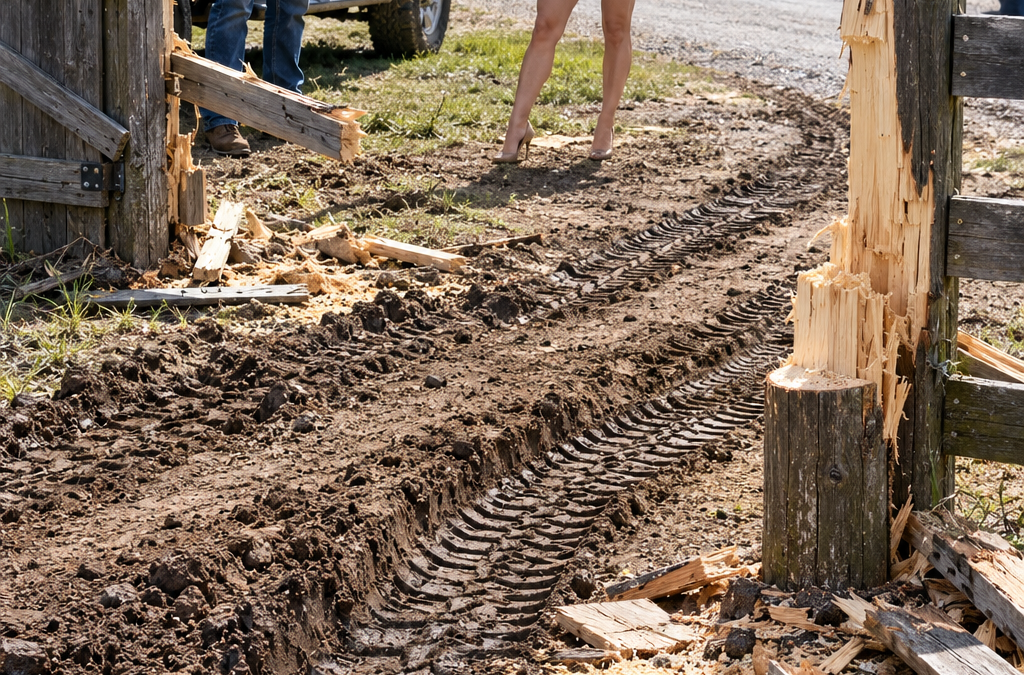
Cut.
A section of the wooden fence along the entrance to my property had been sliced apart again, leaving a jagged opening wide enough for a truck to pass through.
For several seconds, I just sat behind the wheel staring at it.
I had seen that fence damaged before.
That was exactly why a judge had already issued an order telling the HOA to leave it alone.
Not negotiate about it.
Not “review” it.
Not modify it under some new interpretation of community rules.
Leave it alone.
And yet there it was.
Cut open again.
I stepped out of my truck.
My first reaction was confusion.
My second was disbelief.
Then I saw the tire tracks.
Fresh.
Deep.
Two sets entering through the opening, turning across the packed dirt and heading back toward the county road.
I walked closer.
Fresh sawdust still clung to the broken wood.
Sections of the fence lay scattered across the grass.
One post had been cut so cleanly near the bottom that it was obvious someone had used power equipment.
This had not been vandalism.
This had not been somebody backing into the fence by accident.
Someone had come prepared.
I crouched beside one of the broken boards.
The exposed wood was pale and fresh.
Probably cut that morning.
My name is Jack.
And that fence dispute had already cost me months of letters, meetings, legal fees, and hours sitting in a courtroom while Karen Whitfield tried to convince everyone that my private entrance somehow belonged to her HOA.
She had lost.
Not politically.
Not socially.
Legally.
A judge had reviewed the property documents and issued an order addressing the dispute.
I thought that would finally end it.
Apparently Karen thought court orders were just another HOA letter she could ignore when she didn’t like the answer.
“Jack?”
I turned.
My neighbor Tom was walking toward me from across the road.
He looked almost apologetic.
“You just get back?”
“Five minutes ago.”
He looked at the fence.
“I figured.”
“You see who did this?”
Tom hesitated.
That hesitation told me enough.
“Tom.”
“HOA crew.”
My jaw tightened.
“When?”
“Early. Maybe eight.”
“How many?”
“Two trucks. Couple workers.”
“Karen?”
“Not then.”
He pointed toward the tracks.
“They came in, cut that section, moved some equipment through, then left.”
“You said anything?”
“I told them there was a court case.”
“What did they say?”
Tom shook his head.
“One guy told me they had HOA authorization.”
Of course they did.
That phrase had become Karen’s answer to everything.
HOA authorization.
HOA policy.
HOA access.
HOA authority.
She spoke those words as if adding three letters in front of something magically turned private property into community property.
I pulled out my phone.
First photographs.
Wide shots.
Close-ups.
Cut surfaces.
Tracks.
Broken boards.
Fence posts.
Anything I might need later.
Then I opened the truck and pulled out the folder I had learned never to leave home without.
Deed.
Survey.
Property map.
Previous correspondence.
Certified copy of the judge’s order.
I had once thought carrying court documents around in my truck was paranoid.
Karen had cured me of that.
I called the county office.
A woman answered.
I gave her my name and address.
Then the case number.
“There was already a court order involving this fence,” I explained. “I arrived today and found it cut open again.”
She asked me to repeat the case number.
I did.
“You have a copy of the prior ruling?”
“I’m holding it.”
“Do you have photographs of today’s damage?”
“Yes.”
“Do you know who performed the work?”
“A neighbor witnessed HOA contractors here this morning.”
She paused.
“Do not repair anything yet.”
“I wasn’t planning to.”
“Document the condition exactly as you found it.”
“Already doing that.”
“And avoid direct confrontation if anyone returns.”
I almost laughed.
“With Karen?”
“Especially if there is an ongoing dispute.”
That turned out to be excellent advice.
Because before I finished photographing the tire tracks, a black SUV came around the bend.
Behind it were two security vehicles.
I stood beside my truck and watched them approach.
Karen stepped out first.
She was around forty, impeccably dressed as always, wearing a fitted red lace dress beneath a light jacket as though she were arriving at a fundraising dinner instead of a property dispute.
Her hair was perfect.
Makeup perfect.
Expression already hostile.
Three HOA security guards got out behind her.
Not police.
Private security.
Karen loved visual theater.
If she could not make an argument stronger, she made the scene bigger.
She looked at the damaged fence.
Then at me.
“Well.”
I waited.
She walked toward the opening.
“You’ve seen the access correction.”
I stared at her.
“The what?”
“The access correction.”
“You mean the fence someone cut apart?”
She smiled faintly.
“That fence was obstructing community access.”
“No.”
“Jack—”
“A judge already addressed this.”
Her face hardened immediately.
“I am not discussing the court matter with you.”
I almost couldn’t believe the sentence.
“You came onto the property involved in that court matter.”
“The HOA is enforcing its governing documents.”
“The governing documents do not overrule the judge.”
“That’s your interpretation.”
“No, Karen. That’s how courts work.”
One of the guards glanced at her.
She noticed.
“Stay out of this.”
He looked away.
I opened the folder and removed the order.
“Here.”
She didn’t take it.
“You were present when this was issued.”
“I’m aware of what the judge said.”
“Good.”
I held the document up.
“Then explain why the fence was cut afterward.”
Karen crossed her arms.
“Because your fence continues to violate community-access requirements.”
“The court already considered the dispute.”
“The HOA has its own rules.”
I looked at her for several seconds.
“And you think your rules are above a court order?”
She exhaled sharply.
“Do not put words in my mouth.”
“I’m not.”
I pointed at the fence.
“You’re putting saw blades through my property.”
Her jaw clenched.
“We have residents who need access through this corridor.”
“This is not a corridor.”
“It has historically functioned as one.”
“No.”
“The board disagrees.”
“Show me.”
Her eyes narrowed.
“What?”
“The authorization.”
“I just told you.”
“No. You told me the board voted.”
“That is authorization.”
“Did the board ask the court for permission to modify the fence after the ruling?”
Karen’s face changed.
A small change.
But enough.
“That isn’t necessary.”
“Then show me where the judge said that.”
“You are deliberately misrepresenting what happened.”
“Am I?”
I held up the order.
“This is the document.”
Karen took one step closer.
“Put that away.”
“No.”
“I said put it away.”
I almost smiled.
She had spent years training people to obey that tone.
I wasn’t one of them anymore.
“I’m documenting everything.”
Her eyes moved to my phone.
“You’ve been photographing our vehicles.”
“Yes.”
“You have no permission to photograph HOA security.”
“They’re standing beside my property entrance.”
“You’re creating a hostile situation.”
“No.”
I looked at the three guards.
“I’m standing beside my truck with paperwork.”
Then back at Karen.
“You brought security.”
That landed badly.
Her face flushed.
“Move closer to the entrance,” she told the guards.
The one who had looked uncomfortable hesitated.
“Ma’am?”
“You heard me.”
They moved.
Not aggressively.
But deliberately.
Two positioned themselves near the cut section.
A third walked toward the road.
I took several steps backward immediately.
I wanted the distance visible.
No one could later claim I had approached them.
Karen pointed toward the open section.
“Temporary barriers.”
One guard pulled folding barricades from the rear of the vehicle.
“What are you doing?” I asked.
“Securing HOA access.”
“To my property?”
“To the community access point.”
“There is no community access point.”
Karen didn’t even look at me.
“Place one there.”
The guards moved the first barrier near the road entrance.
Then another.
Within moments, my own entrance was partially blocked by equipment brought there by the same group that had cut my fence.
I felt anger rise so fast I had to consciously unclench my hands.
“Karen.”
She turned.
“Move those barriers.”
“No.”
“This road is not HOA-controlled.”
“It services the community.”
“It crosses my property.”
“You keep saying that as though repetition makes it more true.”
I pulled out my property map.
“No. This makes it true.”
She laughed.
“A map.”
“The recorded survey.”
“We have our own map.”
“Does your map come with a deed?”
Her smile vanished.
One of the guards looked down.
Karen saw him.
“I told you not to involve yourself.”
He said quietly, “I didn’t say anything.”
“Then don’t.”
That was Karen.
Even silence had to happen under her authority.
I called the county again.
Karen watched me.
“Oh, please.”
I turned slightly away from her.
“The HOA is back. They’ve brought private security. They are placing barriers across the entrance road.”
The dispatcher asked whether anyone had threatened me.
“No.”
“Are you physically blocked from leaving?”
“Not completely yet.”
“Do not confront security personnel.”
“I’m not.”
“Remain on your property if safe.”
“I’m beside my truck.”
“Deputies are being notified.”
Karen heard the word deputies.
Instead of becoming concerned, she smiled.
Actually smiled.
“Good.”
I ended the call.
“Good?”
“Yes.”
She adjusted one sleeve.
“Maybe once county officials explain this to you, you’ll stop wasting everyone’s time.”
“You think they’re coming to explain your HOA rules to me?”
“I think they’re coming to see an unreasonable property owner obstructing legitimate community access.”
I looked at the cut fence.
Then the barriers.
Then the guards.
“You really believe that?”
She stepped closer.
“I have dealt with county officials for years.”
“That wasn’t my question.”
“Your problem, Jack, is that you think one favorable ruling gave you permission to challenge every HOA decision.”
“One favorable ruling?”
I took the court order out again.
“A judge told you to stop interfering with this fence.”
Karen’s mouth hardened.
“You are obsessed with that document.”
“Yes.”
I nodded toward the cut boards.
“Today seems like a pretty good day to be obsessed with it.”
She turned away.
For the next fifteen minutes, nothing happened.
Which somehow made the scene more tense.
The guards stood near the barriers.
Karen made calls beside her SUV.
I stayed near my truck.
Every few minutes I photographed another angle.
Fresh tracks.
Fence line.
Location of the barriers.
Security vehicles.
Time stamps.
Tom stayed on his side of the road watching.
Eventually Karen ended a call and walked back toward me.
“You need to remove your truck.”
“Why?”
“You’re interfering with traffic.”
“No one is trying to pass.”
“That’s because you’re standing here creating a confrontation.”
“My truck is parked on my property.”
“Move it anyway.”
“No.”
Her eyes narrowed.
“I can have it towed.”
“No, you can’t.”
“Try me.”
There was the Karen I knew.
Every disagreement eventually became a threat.
Fine.
Lien.
Tow.
Security.
Whatever sounded frightening enough to make the other person surrender.
I kept my voice low.
“Please put the towing order in writing.”
Her mouth closed.
I waited.
She said nothing.
“Exactly.”
A guard turned his head toward the road.
“Vehicle coming.”
Everyone looked.
A white county vehicle appeared around the bend.
Karen straightened immediately.
It was almost theatrical.
Shoulders back.
Chin up.
Professional smile.
The angry woman threatening to tow my truck vanished.
HOA President Karen had returned.
“Everybody remain calm,” she told the guards.
I nearly laughed.
She had spent twenty minutes escalating the situation.
Now she was instructing everyone else to remain calm because witnesses with government badges had arrived.
The county vehicle stopped near the entrance.
Two deputies stepped out.
One older.
One younger.
The older deputy looked at the barriers first.
Then the fence.
Then the security guards.
Then me.
“Who called?”
“I did.”
Karen stepped forward.
“I’m Karen Whitfield, HOA president. I can explain.”
The deputy held up a hand.
“I’ll speak to everyone.”
Her expression flickered.
He looked at me.
“What do you have?”
I handed him the folder.
“Court order. Property survey. Deed copy. Previous case information.”
He took them.
Karen immediately began talking.
“This homeowner has repeatedly attempted to block designated community access—”
The deputy looked up.
“Ma’am.”
“Yes?”
“Give me a minute to read.”
Karen actually looked offended.
He started with the first page of the court order.
Then the second.
The younger deputy walked toward the broken fence.
He crouched beside the cut post.
“Fresh?”
“This morning,” I said.
“Witness?”
I pointed across the road.
“Neighbor.”
Tom raised one hand.
The deputy nodded.
The older deputy kept reading.
Karen folded her arms.
Her impatience became visible.
Finally she said, “The order does not suspend the HOA’s independent enforcement powers.”
The deputy didn’t look up.
“I’m reading it.”
“You’re not familiar with our governing documents.”
“I’m reading the court’s document.”
“It’s more complicated than that.”
That made him look up.
“A judge’s order is usually something I prefer to read before anyone does more work.”
Karen’s lips tightened.
The deputy turned toward the damaged fence.
“Who ordered this cut?”
Karen took a breath.
“The HOA board authorized corrective work.”
“You?”
“The board.”
“Were you involved in implementing the decision?”
“As president, yes.”
“Did you personally authorize contractors?”
She hesitated.
“Yes.”
“After this order?”
“The order addresses the previous dispute.”
I could see what she was doing.
Trying to create ambiguity.
The same technique she used in HOA meetings.
Never answer directly if the direct answer was dangerous.
The deputy tapped the document.
“Did anyone obtain legal clarification from the court before cutting the fence?”
“Our attorney advised—”
“Did the court clarify that you could cut it?”
Karen’s expression tightened.
“The board believed we were acting within our authority.”
“That’s not the same question.”
Silence.
I watched one of the guards shift his weight.
The deputy noticed the temporary barriers.
“Who placed those?”
Karen answered immediately.
“Security.”
“Why?”
“To preserve community access.”
I spoke.
“They partially block my property entrance.”
Karen turned.
“Do not interrupt.”
The deputy looked between us.
“Ma’am, you don’t control who speaks to me.”
Karen’s face went rigid.
The younger deputy walked over.
“Survey marker appears to put the entrance on his parcel.”
Karen laughed shortly.
“The HOA disputes that.”
The older deputy looked toward her.
“That dispute is exactly why nobody should be changing physical conditions until the court order is reviewed.”
“We cannot allow one resident to paralyze community operations.”
“Nobody is talking about community operations right now.”
He pointed toward the fence.
“We’re talking about physical work performed after a court order.”
Karen’s voice rose.
“The HOA has one hundred forty-seven households to protect. We cannot run every access decision through a judge because one man objects.”
I felt my pulse rise.
But I said nothing.
The deputy did not react to her volume.
“Until this document is reviewed, nobody touches the fence.”
Karen stared at him.
“Excuse me?”
“No further work.”
“We have contractors scheduled.”
“Cancel them.”
“You don’t have authority to suspend HOA enforcement.”
“I’m telling you there will be no additional disturbance here while we determine how this order applies.”
Karen stepped closer.
“I want your supervisor.”
The deputy nodded calmly.
“You’re welcome to request one.”
Her certainty wavered.
The guards saw it.
That mattered.
A minute earlier, Karen had been issuing commands.
Now she was arguing with someone who did not care how long she had been HOA president.
The uncomfortable guard stepped away from the entrance.
Karen noticed.
“Where are you going?”
He pointed toward the barrier.
“He said no further disturbance.”
“I did not tell you to move.”
The deputy did.
“Move the barriers away from the property entrance.”
Karen turned sharply.
“You cannot order my security team.”
The deputy looked at the guards.
“Those barriers are being removed from the disputed entrance until we finish reviewing the situation.”
The guards didn’t argue.
They picked them up.
Karen looked furious.
“Leave them.”
Nobody obeyed her.
That was the first real shift.
For years, Karen’s authority had depended on people acting before asking whether she actually had the power she claimed.
Now everybody was asking.
The barriers went back into the security vehicle.
The guards moved onto the roadside.
I remained where I was.
No celebration.
No smile.
I kept taking photographs.
Because the fence was still cut.
That damage didn’t disappear because the tension had changed.
The older deputy stepped toward me.
“I need copies of these documents.”
“I can email them.”
“Do that.”
He gave me the address.
Karen made another phone call.
This one was clearly to the board.
I could hear pieces.
“…county deputies…”
“…yes, I showed them…”
“No, they’re misunderstanding…”
“…I need somebody from legal…”
Every sentence sounded less confident than the last.
The sun started dropping behind the trees.
Long shadows stretched across the road.
Nobody touched the fence.
Nobody entered my property.
For the first time since I arrived, the scene became still.
Then another county vehicle appeared.
Karen stopped talking mid-sentence.
A second set of officials arrived.
They spoke quietly with the first deputies.
Reviewed the order.
Looked at the survey.
Walked the entrance.
One photographed the fence independently.
Another marked the position of the road relative to visible survey points.
Karen stood beside her SUV waiting.
She hated waiting.
You could see it in the way she tapped one foot.
Finally an official approached her.
“For now, your security personnel need to remain outside this area.”
“What area?”
He pointed.
“The property entrance and disputed boundary.”
Karen stared at him.
“You’re restricting HOA access?”
“We’re preserving the location while the court documents are reviewed.”
“We have residents who use this route.”
“Not tonight.”
Her face reddened.
“You have no idea what disruption this causes.”
He remained calm.
“Then your attorney can raise that through the proper legal process.”
Karen looked toward me.
I said nothing.
That was the part she hated most.
I didn’t need to win the argument.
The argument was no longer between us.
The county was documenting the scene.
The court order was in official hands.
The guards had been moved.
The road entrance was being treated as disputed property instead of whatever Karen decided to call it.
She had wanted confrontation.
What she got was procedure.
And procedure was far more dangerous to her than anger.
The last sunlight caught the broken fence.
I walked over and took one final photograph.
Freshly cut wood.
Splintered boards.
Tire tracks.
Beyond them, county vehicles.
Not HOA vehicles.
Karen saw me.
“You enjoying this?”
I turned.
“Enjoying what?”
“Making a spectacle.”
I looked around.
“You brought three security guards.”
“This could have been handled privately.”
“The last time it was handled privately, we ended up in court.”
“You’re impossible.”
“No.”
I pointed toward the injunction.
“I’m consistent.”
She shook her head.
“You really think this proves something?”
“I think the judge already proved something.”
She stepped toward me.
One deputy looked over.
Karen stopped.
I continued.
“The only question now is why you thought you could ignore it.”
For once, she didn’t answer.
Her phone rang.
She turned away.
The security guards were told to leave soon afterward.
They loaded the last barriers.
The uncomfortable guard approached me briefly before getting into the vehicle.
“Sir.”
I looked at him.
“I didn’t know there was a court order.”
I believed him.
“Okay.”
“We were told this was an HOA access enforcement.”
“I figured.”
He glanced toward Karen.
Then lowered his voice.
“I’m sorry about the fence.”
Karen called his name sharply from across the road.
He left.
Her ability to control the scene was collapsing one person at a time.
By dusk, the county officials had established a clear temporary boundary around the entrance.
No one was authorized to alter the fence.
No further HOA work.
No private security inside the restricted area.
Any additional action would wait for legal review.
The older deputy handed my documents back.
“Keep these with you.”
“I planned to.”
“If anyone returns tonight, don’t engage. Call.”
“I will.”
Karen heard him.
She walked over.
“So he gets to use the road and we don’t?”
The deputy looked at her.
“He’s accessing his property.”
“We dispute that.”
“Then resolve the dispute through the court.”
“We already have board authority.”
“That’s not what I said.”
Her voice sharpened.
“This board will not be bullied by one homeowner.”
The deputy’s expression barely changed.
“No one here is asking the board to be bullied.”
He pointed toward the damaged fence.
“We’re asking everybody to stop cutting things until the legal order is reviewed.”
Tom coughed into his hand.
I’m almost certain he was hiding a laugh.
Karen heard it.
Her eyes snapped toward him.
Tom looked away.
She had spent years making neighbors afraid to laugh at her.
That evening, she discovered something worse than people becoming angry.
They were becoming unimpressed.
Eventually, the county vehicles prepared to leave.
The officials had everything they needed.
Photographs.
Court papers.
Names.
Vehicle details.
Witness information.
The situation had become an official county matter.
Exactly what Karen had believed would never happen.
She stood beside her SUV, arms folded, staring at the damaged opening.
I wondered whether she regretted ordering the work.
Probably not.
Karen wasn’t built for regret.
She was built for justification.
If something went wrong, it was because someone else resisted.
If residents became angry, they misunderstood her.
If an attorney challenged her, they were harassing the board.
If a judge ruled against her, the judge didn’t understand HOA governance.
If county officials showed up, somebody had exaggerated.
There was always an explanation that left Karen innocent and everyone else unreasonable.
That was why the fence mattered.
Not because it was beautiful.
It wasn’t.
It was an ordinary wooden boundary fence.
Boards.
Posts.
Gate.
Nothing worth making a community war over.
But boundaries only become important when someone refuses to recognize them.
The first time Karen challenged that fence, I tried talking.
Then letters.
Then meetings.
Then lawyers.
Finally court.
When the judge ruled, I genuinely believed the dispute had ended.
I underestimated one thing.
Karen did not see losing in court as losing.
She saw it as another obstacle to route around.
Three days after a judge told the HOA to stop, someone cut the fence again.
That was no longer a misunderstanding.
Fresh sawdust doesn’t misunderstand anything.
Neither do tire tracks.
Neither do board-authorized contractors.
Neither do temporary barriers brought by private security.
Those things require decisions.
Someone had decided the court order mattered less than Karen’s authority.
That night, after everyone finally left, I stood beside the broken fence alone.
The road was quiet.
The security vehicles were gone.
Karen’s SUV was gone.
County markings remained near the entrance.
I ran my hand over the freshly cut post.
The wood was rough beneath my palm.
Part of me wanted to repair it immediately.
Put everything back the way it had been.
But the county had told me not to alter the scene yet.
So I left it.
Sometimes protecting property means resisting the urge to fix what someone else broke.
You preserve the damage.
You photograph it.
You document it.
You let the broken thing tell the story.
I went home with the court order on the passenger seat.
That document had looked powerful inside a courtroom.
Official seal.
Case number.
Judge’s signature.
Legal language.
Standing beside the cut fence that morning, it had felt almost useless.
Karen had looked directly at it and essentially said she didn’t care.
For a few hours, that made me wonder what good any order was if someone could simply ignore it.
By sunset, I understood the answer.
A court order doesn’t physically stop a saw.
It doesn’t stand beside your fence twenty-four hours a day.
It doesn’t reach out and grab the hand of somebody determined to violate it.
What it does is establish the line.
And once someone knowingly crosses that line, the question changes.
Before, Karen and I had argued about who was right.
Now the question was why she had acted after the court had already spoken.
That was much harder for her to explain.
Especially when everything was documented.
The next morning, I returned to the entrance.
Nothing had moved overnight.
The county boundary remained.
No HOA vehicles.
No security guards.
No workers.
Tom walked across the road carrying coffee.
“Quiet.”
“Very.”
“First time in a while.”
I nodded.
He looked at the damaged fence.
“What are you going to do?”
“Exactly what they told me.”
“Wait?”
“Document.”
He smiled.
“Karen hates waiting.”
“I know.”
“That might be the worst punishment you could give her.”
I almost laughed.
Across the road, sunlight hit the fresh cut through the fence.
The damage still made me angry.
But the anger felt different.
The day before, Karen had arrived believing force would settle the issue.
Cut the fence.
Bring security.
Block the road.
Declare HOA authority.
Make me retreat.
Instead, every escalation had created another witness.
Another photograph.
Another official record.
Another question she couldn’t answer.
Who authorized the work after the judge ruled?
Did the board obtain permission from the court?
Why were private guards blocking access to property the HOA didn’t control?
Why did Karen refuse to discuss the order she admitted existed?
Those questions belonged to the county now.
Not just me.
That changed everything.
I never needed to outshout Karen.
I never needed to push past her guards.
I never needed to touch the barriers.
All I needed was to stand on my side of the property line, hold onto the documents, and make sure everyone saw exactly who crossed it.
Karen had spent years believing HOA rules were the final word.
That evening, as the county vehicles pulled away and her security guards were ordered outside the boundary, she finally confronted something she had avoided for far too long.
The HOA could make rules.
It could hold meetings.
It could vote.
It could hire security.
It could send contractors.
But once a judge had spoken, Karen did not get to create a second legal system simply because she disliked the first one.
The fence was still broken.
The case was not magically finished.
There would be more paperwork.
More review.
More questions.
But for the first time that day, I looked at the opening in my fence and didn’t see Karen’s victory.
I saw evidence.
And judging by the expression on her face when the county ordered her guards to step away, Karen had finally started seeing it too.








