𝗙𝗨𝗟𝗟 𝗦𝗧𝗢𝗥𝗬 The HOA Closed My Lake Overnight and Refused to Tell Me What They Had Put in the Water
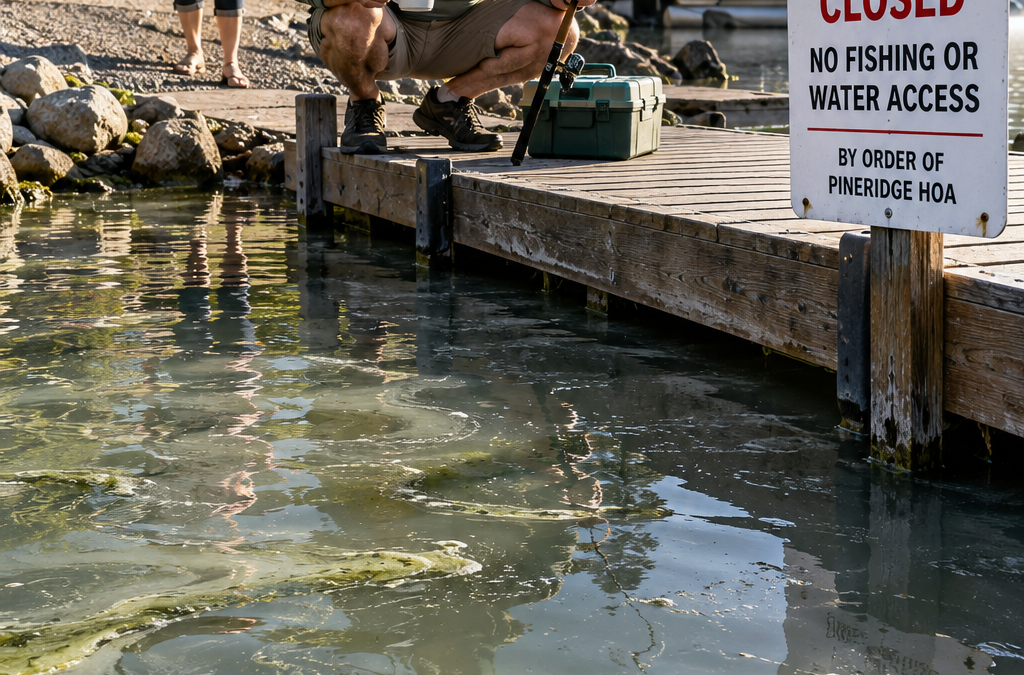
𝗙𝗨𝗟𝗟 𝗦𝗧𝗢𝗥𝗬
She adjusted the folder tucked under her arm.
“Recently.”
“Last night?”
“I don’t know exactly.”
“Who closed the lake?”
“The board.”
“When?”
“Daniel.”
“Was the water tested?”
“You’ll receive information.”
“Was something put in it?”
That made her pause.
Not long.
Enough.
“What makes you ask that?”
I pointed.
“Because yesterday that water was clear.”
She looked toward the lake.
“Conditions change.”
“Not like this overnight.”
“That’s why we’ve closed it.”
“Did you put something in the water?”
Her expression tightened.
“I’m going to ask you one last time to respect the closure.”
“That isn’t an answer.”
“Contact the HOA office Monday.”
“It’s Saturday.”
“Then Monday.”
She turned.
I called after her.
“Karen.”
She stopped.
“If this is a safety problem, people need to know what they’re dealing with.”
“We’re handling it.”
Then she walked away.
That phrase stayed with me.
We’re handling it.
It sounded reassuring if you didn’t think about it.
I thought about it.
Who was we?
What exactly was being handled?
If the lake was dangerous enough to close, why hadn’t residents been notified before they came outside with dogs, children, fishing gear, paddleboards?
Why was the sign the first warning?
And why wouldn’t Karen tell me whether something had been added to the water?
I went back inside.
My wife, Allison, was making breakfast.
She looked at the tackle box still in my hand.
“Back already?”
“Lake’s closed.”
“What?”
“HOA sign.”
“Why?”
“Apparently we’re handling it.”
She gave me a look.
“That’s not an answer.”
“Exactly.”
I showed her the photographs.
Her expression changed.
“That doesn’t look normal.”
“No.”
“Did Karen tell you what happened?”
“No.”
“Did you call anyone else?”
“Not yet.”
Allison put the spatula down.
“Maybe you should.”
I wasn’t ready to involve authorities over strange-looking water based only on instinct.
Not yet.
So I spent the morning walking the shoreline.
Public areas only.
I didn’t cross anyone’s property.
The discoloration wasn’t limited to my dock.
It extended around almost half the lake.
At several places, the water near shore looked cloudy enough that submerged rocks I could normally see were invisible.
I photographed everything.
Time.
Location.
Direction.
Old ranger habit.
Years earlier, before changing careers, I had worked seasonal environmental enforcement.
Not long enough to call myself an expert.
Long enough to know contamination investigations begin with documentation.
Don’t stir things.
Don’t move containers.
Don’t decide what something is before testing.
Record what you see.
Around noon, my neighbor Tom Alvarez came down from his yard.
Tom lived two houses north.
Retired mechanical engineer.
He stopped beside me.
“You seeing this too?”
“Hard not to.”
“I thought maybe runoff.”
“So did I.”
“Didn’t rain.”
“I know.”
He looked toward the southern shore.
“My dog wouldn’t drink it this morning.”
That got my attention.
“Usually does?”
“Every day if I don’t stop him.”
We stood quietly.
Then Tom pointed.
“What’s that?”
Across the lake, near a maintenance access area, several plastic containers sat beside equipment I didn’t recognize.
Blue drums.
White rectangular totes.
A portable pump.
Coiled hose.
That section was normally restricted because the HOA stored maintenance tools there.
I zoomed in with my phone.
“Those there yesterday?”
“No.”
“You sure?”
“I walk past every evening.”
“What kind of pump?”
Tom narrowed his eyes.
“Chemical transfer, maybe.”
“Maybe?”
“Could be water treatment.”
Neither of us liked the answer.
“Did HOA tell you anything?”
“No.”
“Email?”
“No.”
“Text alert?”
“No.”
He shook his head.
“If they’re treating water, why do it without notice?”
Good question.
By one o’clock, I decided it had moved beyond neighbor curiosity.
I called the county non-emergency line.
I explained that there was an unusual overnight change in a community lake, an unexplained HOA closure, and containers near a restricted maintenance area.
I was careful with my words.
I did not say poisoning.
Did not say illegal dumping.
Did not accuse Karen.
I described what I could see.
The dispatcher asked whether anyone had been injured.
No.
Dead wildlife?
None visible.
Strong chemical odor?
No.
She said an officer would come by and determine whether another agency needed notification.
About forty minutes later, Deputy Marcus Hill arrived.
He parked near the community trail and met me by the dock.
Karen appeared almost immediately.
That told me someone had called her.
Maybe she was already watching.
“What’s going on?” she asked.
Deputy Hill looked between us.
“I’m responding to a report about unusual water conditions.”
Karen turned toward me.
“You called the police?”
“I called the county.”
“For this?”
She gestured toward the lake.
“Yes.”
Her mouth tightened.
Deputy Hill interrupted before it became an argument.
“Let’s keep it simple. What happened?”
I explained.
Clear water Friday.
Cloudy Saturday.
No resident notification.
New closure sign.
Containers and pump at the maintenance area.
I showed photographs with timestamps.
Hill scrolled through them.
Then looked at the lake himself.
He walked to the end of the dock.
Stood there for almost a minute.
When he came back, his tone had changed slightly.
“Who authorized the closure?”
Karen lifted her chin.
“The HOA board.”
“Based on what?”
“A maintenance concern.”
“What concern?”
“We’re already addressing it.”
Hill looked at her.
“I’m asking what happened.”
She hesitated.
“We conducted treatment.”
My eyes went to her.
“What treatment?”
Karen ignored me.
Hill asked:
“What was added?”
“I don’t have that information with me.”
“Who does?”
“Our contractor.”
“Name?”
“I’d need to check.”
“You authorized a lake closure without knowing what was put into it?”
Her face hardened.
“I said I don’t have the technical details.”
Hill remained calm.
“Was the county notified before treatment?”
Karen looked uncomfortable.
“I don’t believe notification was required.”
“Was the state environmental office?”
“It was standard maintenance.”
“Then why is the lake closed?”
Karen had no immediate answer.
That was the first time I saw real uncertainty.
Not guilt.
Not yet.
But the confidence was gone.
Hill called someone from his vehicle.
He came back fifteen minutes later.
“County environmental health has been notified. They’re contacting the state water office.”
Karen looked irritated.
“That’s unnecessary.”
Hill said:
“Maybe. They’ll decide.”
That afternoon, the shoreline was restricted more formally.
Not by the HOA.
By the county.
Yellow temporary barrier tape went up at several access points.
Residents came outside.
Questions spread.
Karen tried to tell people it was precautionary.
Nobody seemed reassured anymore.
Because precautionary had become official.
The next morning, environmental specialists arrived.
Two state vehicles.
One county truck.
Protective boots.
Sample bottles.
Meters.
Coolers.
One specialist introduced herself as Dr. Elena Brooks.
Aquatic systems.
Another was an environmental field technician named Marcus Lee.
They didn’t speculate.
I appreciated that.
They took samples from multiple depths.
Near my dock.
Southern shore.
Inlet.
Outflow.
Near the maintenance access.
They photographed containers.
Logged serial numbers.
Tested temperature.
Dissolved oxygen.
pH.
Conductivity.
Turbidity.
They took sediment samples.
Karen stood nearby answering questions.
Or avoiding them.
I watched from behind the restricted line.
Tom joined me.
“What do you think?”
“No idea.”
“You’re lying.”
“I have guesses.”
“Same thing.”
“No.”
He smiled faintly.
Then looked toward the water.
“My granddaughter swims here.”
I knew.
Half the community did in summer.
Suddenly fishing seemed trivial.
That was the moment my perspective shifted.
Until then, part of me had still framed this as my lake routine being disrupted.
My dock.
My fishing.
My irritation with Karen.
Watching technicians collect samples while Tom talked about his granddaughter made that feel small.
The lake touched everybody.
Children.
Pets.
Wildlife.
Irrigation.
Maybe more.
We just didn’t know how much more yet.
Preliminary results came later that afternoon.
Elena gathered several residents who had remained nearby.
She chose her words carefully.
“We’ve confirmed a significant change in water chemistry compared with historical data.”
Someone asked:
“Poison?”
“We are not saying that.”
“Is it safe?”
“For now, avoid direct contact.”
A woman near me gasped.
Elena continued.
“That’s precautionary while we identify the source and determine whether the condition is localized or connected to a larger system.”
Karen stepped forward.
“We already knew there was a temporary maintenance imbalance.”
Elena looked at her.
“What maintenance?”
Karen paused.
“We treated the lake.”
“With what product?”
“I’d need the contractor records.”
“Who ordered the treatment?”
“The board.”
“Which board representative authorized it?”
Silence.
Then Karen said:
“I did.”
That changed the atmosphere.
People looked at her.
Someone behind me asked:
“Why weren’t we told?”
Karen answered:
“It was routine.”
Elena looked toward the cloudy water.
“This isn’t something I’m prepared to call routine.”
Karen’s face tightened.
The investigation shifted immediately toward records.
Invoices.
Maintenance logs.
Contractor agreements.
Emails.
Board authorization.
Treatment schedule.
The HOA office suddenly became more important than the shoreline.
The next morning, we received the first community-wide official notice.
Not from Karen.
From the county.
Avoid lake contact.
Do not fish.
Do not allow pets into water.
Further testing underway.
Residents were furious.
Not because the lake was closed.
Because most of us had learned about the issue after the treatment had already happened.
An emergency HOA meeting was scheduled for Tuesday evening.
Before that meeting, something else emerged.
Tom called me Monday afternoon.
“Come over.”
His tone made me move.
I walked two houses down.
He had printed an email from the HOA’s document portal.
“Look.”
Maintenance calendar.
There was an entry from nearly three weeks earlier.
LAKE TREATMENT — TEMPORARY CLOSURE PREP.
Three weeks.
I read it twice.
“This was planned.”
“Exactly.”
Another document showed sign installation scheduled before the treatment date.
So when Karen told me Saturday morning she didn’t know exactly when the problem started, the closure had already been in preparation.
That didn’t prove misconduct.
It proved concealment.
The board knew some operation was coming.
Residents did not.
I sent the documents to Deputy Hill and Dr. Brooks.
By Tuesday morning, the specialists had uncovered the bigger issue.
Elena asked several of us to attend a briefing at the clubhouse before the emergency meeting.
Karen was there.
Board president Richard Collins.
Two other directors.
County officials.
A representative from the local water authority.
That last person worried me.
Elena projected a diagram.
“Most residents think of the lake as an isolated recreational feature.”
Richard nodded.
“Correct.”
“No.”
She changed slides.
The room went still.
The lake connected through an engineered overflow and recharge channel to part of the neighborhood’s nonpotable water infrastructure.
Landscape irrigation.
Emergency storage.
And under certain conditions, water from that system could interact with additional community infrastructure.
Not directly into kitchen taps under normal operation.
But connected enough that any major change in lake chemistry required professional evaluation.
Tom leaned toward me.
“Did you know?”
“No.”
Karen was pale.
Elena continued.
“This is why treatment protocols matter.”
She displayed the maintenance records.
The HOA had contracted for a water-treatment operation.
The intent, based on the available notes, appeared to be controlling algae and vegetation before an upcoming community event.
But the amount used, timing, mixing conditions, and lack of proper monitoring had created an abnormal chemical change.
The full investigation was still ongoing.
I raised my hand.
“What exactly was added?”
Elena named an aquatic treatment product.
I won’t pretend I understood the chemistry.
What mattered was dosage.
Application conditions.
Water volume calculations.
And communication.
Something had gone wrong in at least one of those areas.
The contractor had apparently relied on information supplied by the HOA.
The HOA had scheduled the closure in advance.
No resident notification had gone out until after the visible water change.
That was the part nobody could explain away.
Richard Collins turned toward Karen.
“Why wasn’t the community informed before the treatment?”
Karen stared at the table.
“We didn’t want people interfering with the process.”
“What does that mean?”
“Residents ignore signs.”
“There weren’t signs before Saturday.”
“We planned to install them.”
“After treatment?”
She said nothing.
Richard’s voice hardened.
“Karen.”
“We expected the lake to clear overnight.”
There it was.
The room went quiet.
She had expected the evidence to disappear.
Not necessarily evidence of a crime.
Evidence that anything unusual had happened at all.
They planned the treatment.
Expected the appearance to normalize.
Then intended to reopen without most residents ever knowing.
Instead, the lake stayed cloudy.
Fish stopped gathering.
Someone put up closure signs.
And I asked questions before the water could return to normal.
The emergency meeting that evening was packed.
Standing room only.
Residents filled the clubhouse hallway.
Nobody cared about mailbox colors.
Nobody cared about landscape violations.
Nobody cared about fishing rules.
For the first time since I’d lived there, the entire community wanted one answer.
What happened to our water?
Dr. Brooks presented.
Not Karen.
Not the board.
That mattered.
She laid out the timeline.
Treatment scheduled.
Closure planning documented.
Application performed.
Visible water change.
No advance resident notification.
Closure signs installed.
Complaint made.
County contacted.
Testing initiated.
Then she explained the infrastructure connection.
The mood changed instantly.
A man near the front stood.
“Are you telling me this water connects to our system?”
“Parts of the community’s nonpotable infrastructure, yes.”
“Could it reach our homes?”
“Under normal configuration, potable household supply is separate. We’re verifying every connection.”
People began talking at once.
Elena raised her hand.
“Please understand: we are not announcing contamination of household drinking water.”
That quieted people.
“We are saying the lake is part of a larger managed system, so changes cannot be treated as a cosmetic pond issue.”
A woman asked:
“Who authorized this?”
Elena looked toward the board.
Richard looked at Karen.
Karen sat stiffly.
Finally she stood.
“I approved the maintenance operation based on contractor guidance.”
Someone shouted:
“Why didn’t you tell us?”
She answered:
“It was considered routine.”
Another voice:
“Then why close the lake?”
Someone else:
“Why were the signs planned before the treatment?”
Karen tried to explain.
Algae complaints.
Shoreline appearance.
Upcoming events.
Community standards.
None of it answered the central question.
Why had residents been kept uninformed?
Then Tom stood.
“Who decided the lake looking pretty was more important than people knowing what was being put in it?”
The room went silent.
Karen looked toward him.
“No one made that decision.”
“You did.”
“I relied on professionals.”
“Then why wouldn’t you tell us who they were Saturday?”
Her face tightened.
“I didn’t have the details.”
“You authorized it.”
The room erupted again.
Richard called for order.
The county water representative explained the response.
Temporary shoreline restriction.
System isolation where possible.
Additional testing.
Monitoring downstream connections.
Professional remediation.
Daily updates.
No swimming.
No fishing.
No pets near the lake.
I looked around.
Neighbors were scared.
That bothered me more than Karen.
The lake had always felt harmless.
Children learned to cast from the dock.
Dogs chased sticks there.
People drank morning coffee beside it.
Once something familiar becomes uncertain, fear spreads faster than facts.
The officials understood that.
For the next two weeks, communication became disciplined.
Daily bulletins.
Test results.
Clear instructions.
No speculation.
No vague “we’re handling it.”
Actual information.
Professional crews worked the shoreline.
Aeration equipment appeared.
Treatment specialists monitored water chemistry.
Sections of the connected system were isolated and evaluated.
The environmental team repeatedly emphasized that the household drinking supply had not been shown to be contaminated.
That mattered.
Residents slowly stopped panicking.
Anger remained.
Mostly directed at the board.
The contractor investigation found that the treatment operation had been authorized using incomplete site information.
The dosage calculations were reviewed.
Maintenance procedures were criticized.
The board’s decision to withhold advance notice came under intense scrutiny.
Karen stepped down from oversight of the lake immediately.
Later, the board removed her from the maintenance committee entirely.
She wasn’t arrested.
There was no dramatic scene.
No handcuffs.
That wasn’t the point.
The important consequence was that she no longer controlled information about the system.
The HOA changed its procedures.
Any future chemical treatment of shared water required independent professional review.
Advance resident notice unless emergency conditions made that impossible.
Published product information.
Documented application logs.
Clear authority.
And coordination with the appropriate water professionals when the lake infrastructure could interact with community systems.
Basic things.
Things we all assumed already existed.
That was the disturbing part.
Sometimes the rules you think protect you are only habits nobody has tested.
Three weeks after the lake closed, the water began looking like itself again.
The cloudiness faded.
Visibility returned near the dock.
Small fish reappeared in the shallows.
The first morning I saw bluegill under the boards again, I stood there longer than necessary.
I hadn’t realized how much their absence bothered me.
Tom came down.
“You see them?”
“Yeah.”
“Good sign?”
“Better than no fish.”
He leaned against the railing.
“My granddaughter keeps asking when she can swim.”
“Tell her to wait for official clearance.”
“I did.”
He smiled.
“Look at you.”
“What?”
“Trusting the official process.”
“Trauma changes a man.”
He laughed.
A week later, Dr. Brooks issued the next update.
Water conditions had stabilized significantly.
Additional testing continued.
Shoreline restrictions could begin easing in phases.
Still no fishing until final biological checks.
I didn’t mind.
By then, fishing was the least important part of the story.
Another two weeks passed.
Then the email came.
LAKE RECREATIONAL ACCESS RESTORED.
I read it twice.
Allison looked over my shoulder.
“You going fishing?”
“Tomorrow.”
“Why not now?”
I looked outside.
Evening light was already fading.
“Because Saturday morning is still Saturday morning.”
She smiled.
The next day, I woke before sunrise.
Made coffee.
Took the same tackle box.
Same rod.
Walked the same path.
The temporary barriers were gone.
The HOA closure sign had been removed.
In its place was a new permanent information board.
LAKE MANAGEMENT AND WATER SYSTEM NOTICE
It explained that the lake was a managed community water resource connected to broader infrastructure.
It listed emergency contact numbers.
Treatment notification procedures.
Testing information.
No unnecessary authority.
No threatening language.
Just facts.
I stood at the dock.
Water clear.
Fish moving.
Mountains reflected on the surface.
For a while, I didn’t cast.
I just watched.
Then I heard footsteps behind me.
Karen.
I knew the sound before I turned.
She stopped several feet away.
No HOA jacket.
No folder.
“Morning.”
“Morning.”
She looked at the lake.
“Looks better.”
“Yeah.”
Silence.
Then:
“I owe you an apology.”
I didn’t answer immediately.
Karen continued.
“I handled that morning badly.”
“Yes.”
“I thought if I gave people partial information, they would interfere.”
“You gave us almost no information.”
“I know.”
“You knew the treatment was planned.”
“Yes.”
“You told me you didn’t know when the issue started.”
She looked down.
“I shouldn’t have said that.”
“No.”
She nodded.
For a moment, neither of us spoke.
Then she said:
“I was trying to prevent panic.”
“By keeping people ignorant.”
“When you say it that way—”
“How else would you say it?”
She sighed.
“Fair.”
That surprised me.
Months earlier, Karen would have argued.
Now she looked tired.
“Do you know what scared me most?” I asked.
“The water?”
“No.”
She looked at me.
“The fact that you believed the HOA had the right to decide what residents were allowed to know.”
Her face changed.
I continued.
“If you’d said Saturday morning, ‘Daniel, we treated the lake last night. Something didn’t react as expected. Don’t touch it until testing is complete,’ I’d have been concerned.”
I pointed toward the water.
“But I wouldn’t have thought you were hiding something.”
“We didn’t know how serious it was.”
“That’s exactly when you tell people you don’t know.”
She nodded.
“I understand that now.”
I looked at her.
I believed her.
Not completely.
But enough.
She turned to leave.
Then stopped.
“For what it’s worth, calling the county was the right thing.”
I laughed.
“That must hurt.”
“It does.”
She almost smiled.
Then walked away.
I finally cast.
The lure landed near the shaded bank.
Perfectly ordinary.
That felt extraordinary.
Over the following months, Pineridge changed more than I expected.
The lake stopped being treated as decoration.
Before the incident, board discussions focused on appearance.
Algae.
Weeds.
Dock paint.
Shoreline landscaping.
Afterward, meetings included hydrology.
Infrastructure.
Water testing.
Environmental monitoring.
Emergency response.
People learned that the lake wasn’t simply the place behind our houses where we fished and watched sunsets.
It performed functions.
Stored water.
Managed runoff.
Connected infrastructure.
Supported wildlife.
Its health affected more than whether a weekend fisherman caught bass.
That understanding changed behavior.
Residents stopped dumping lawn clippings near drainage areas.
Fertilizer use close to the shoreline was restricted.
Storm drains received better labels.
The HOA hired independent water professionals instead of relying entirely on general landscape contractors.
And every planned treatment became public before it happened.
Sometimes inconvenience creates literacy.
Pineridge became much more water-literate after that summer.
I did too.
For years, I thought I knew the lake because I could predict where the fish would be.
I knew almost nothing about what happened beneath the surface.
Dissolved oxygen.
Nutrient load.
Flow paths.
Recharge zones.
System connections.
You can love a place and still misunderstand it.
That’s another reason Karen’s confidence bothered me so much.
She didn’t know either.
The difference was she acted as though authority filled the gap.
It doesn’t.
If anything, authority should make uncertainty more important to admit.
One evening, Dr. Brooks came back for final seasonal testing.
I walked with her.
“Can I ask something?”
“Sure.”
“How bad could it have gotten?”
She thought before answering.
“That’s difficult to quantify.”
“I expected that answer.”
“The biggest risk wasn’t that we had proof of some catastrophic poisoning event.”
“Okay.”
“The risk was unmanaged change in a connected system without adequate communication or monitoring.”
I nodded.
She continued.
“When people make interventions in water systems, you need to understand volume, circulation, temperature, inflow, outflow, ecology, infrastructure connections. A treatment that’s ordinary in one pond can behave differently somewhere else.”
“So the problem wasn’t only what was used.”
“Correct.”
“It was how.”
“And how much. And when. And what people knew. And whether somebody was watching after application.”
I looked across the water.
“So this could’ve remained invisible if it cleared overnight.”
“Possibly.”
“And nobody would’ve known.”
“Possibly.”
That unsettled me.
Not because I wanted more scandal.
Because systems should not depend on visible failure before oversight appears.
The new rules addressed that.
They required documentation whether a treatment worked perfectly or not.
That mattered.
Several residents wanted Karen removed from the board entirely.
I understood the anger.
I didn’t join that effort.
She lost her committee authority.
The board restructured water management.
External review became mandatory.
That was enough for me.
People sometimes mistake accountability for destruction.
They aren’t the same.
The goal should be reducing the chance of repetition.
If Karen had been removed but the system remained unchanged, another confident person could have made the same decision five years later.
Instead, we changed the decision process.
No single board member could authorize lake chemical treatment alone.
No vendor could work without formal site documentation.
Residents got notice.
Records stayed accessible.
That mattered more than whether Karen had a title.
Tom disagreed at first.
We were sitting on my dock one evening.
“You let her off easy.”
“I didn’t let anyone off anything.”
“You’re not pushing to remove her.”
“No.”
“She lied.”
“Yes.”
“She hid it.”
“Yes.”
“So?”
“So the board changed the rules.”
“She should be gone.”
“Maybe.”
He looked at me.
“That’s annoyingly neutral.”
“I’ve been practicing.”
Tom threw a pebble into the water.
“You’re not still angry?”
“Sure.”
“Then why not use it?”
That question stayed with me.
Because anger is useful for noticing a boundary.
It is terrible at designing policy.
“I wanted the lake protected.”
“It is.”
“I wanted disclosure.”
“We have it.”
“I wanted independent review.”
“We have it.”
I shrugged.
“What exactly am I trying to win now?”
Tom thought.
“Fair.”
That was the point.
I had no interest in turning Karen into a permanent enemy after the underlying risk had been addressed.
She had made a serious mistake.
More than one.
She faced consequences.
Then life moved.
That’s allowed.
A year later, I was elected to a small resident advisory group focused on the lake.
Not because I wanted HOA power.
I absolutely did not.
Mostly because everyone assumed the person who had complained first should probably stay involved.
Our first meeting was unbearably dull.
Water sampling schedule.
Drainage map updates.
Budget for aeration.
I loved it.
Dull governance is underrated.
At one point, a contractor proposed an aquatic treatment for invasive vegetation.
The room went quiet.
Someone looked at me.
I laughed.
“Don’t ask me.”
The consultant explained the product.
Dosage.
Risks.
Alternatives.
Monitoring.
A resident asked whether advance notification would go out.
“Seventy-two hours minimum.”
Another asked whether pets needed to stay away.
“Yes, during the treatment window.”
Simple.
Transparent.
Approved.
Three days before application, every resident received an email.
Signs went up.
The work happened.
Water was monitored.
Nothing went wrong.
Nobody panicked.
Nobody called the sheriff.
Nobody stood on a dock demanding answers.
That’s what competence looks like.
Usually boring.
That’s fine.
Years have passed since the cloudy-water morning.
I still fish most weekends.
Not every one.
Age makes mornings slower.
Some Saturdays I just take coffee.
Sit.
Watch.
There is a permanent testing station now near the southern shoreline.
Small.
Unobtrusive.
Data gets logged automatically.
The old restricted maintenance area was reorganized.
Chemical containers can’t simply appear without records.
Residents have access to treatment schedules.
Children still swim after official seasonal clearance.
Dogs still try to drink the water despite signs telling owners not to let them.
Life returned.
The strangest change happened in how I thought about ownership.
I never owned the lake personally.
It was a shared community resource.
But before the incident, I treated it emotionally as “my lake” because it sat behind my house.
Karen treated it as “the HOA’s lake” because she had administrative authority.
Both ways of thinking were incomplete.
The lake belonged to the community structure, but responsibility for it did not belong exclusively to the board.
Residents had a legitimate interest in knowing what was happening to water they lived beside.
Officials had responsibilities.
Professionals had responsibilities.
The board had responsibilities.
Shared resources require shared truth.
That’s what the incident exposed.
When Karen said, “We’re handling it,” she treated information as something authority could ration.
Afterward, we learned the opposite.
Information is part of handling it.
Probably the most important part.
A few years later, a new family moved in three houses over.
The father, Jason, came down to my dock one morning.
“You’re Daniel?”
“Depends who’s asking.”
He laughed.
“Guy who sold us the house said you’re the lake expert.”
“I’m definitely not.”
“He said you’re the reason the HOA tells us every time they put anything in the water.”
“That’s closer.”
He looked out.
“What happened?”
I told him the short version.
Lake changed color.
Closure.
No explanation.
Investigation.
Infrastructure connection.
New procedures.
His eyes widened.
“Was it contaminated?”
“Changed enough that professionals restricted access until they understood it.”
“Anybody hurt?”
“No.”
“Fish die?”
“Not significantly.”
“So you caught it early.”
I shook my head.
“I noticed it early.”
“Same thing.”
“No.”
That distinction matters.
I didn’t solve anything.
I saw something wrong and refused to let uncertainty be dismissed.
Professionals solved it.
That is another lesson people often miss.
You don’t need to know exactly what the problem is before asking for competent help.
Sometimes people stay silent because they fear sounding ignorant.
I didn’t know what was in that water.
I said so.
I didn’t know whether the containers were connected.
I said so.
I didn’t know whether the HOA had broken any rule.
I said so.
What I knew was visible.
Overnight change.
Fish absent.
Closure sign.
No explanation.
Equipment.
Containers.
That’s enough to ask questions.
The mistake would have been pretending I knew more.
Karen did that.
She treated incomplete knowledge as authority.
I treated incomplete knowledge as a reason to investigate.
That difference changed everything.
One autumn morning, I came down to the dock and saw a mild green tint near the western shore.
For about one second, my stomach dropped.
Then I remembered the notification email.
Scheduled vegetation management.
Approved product.
Monitored application.
Temporary discoloration possible.
I laughed at myself.
Transparency transformed the same visual cue from fear into information.
That’s powerful.
The lake looked strange.
But this time I knew why.
I knew who applied it.
I knew what had been used.
I knew when the monitoring results would be published.
I knew whom to call if something looked wrong.
Same community.
Same water.
Different trust.
Trust is not created by telling people not to worry.
It comes from giving them enough truth to understand what they are looking at.
Karen learned that the hard way.
So did the board.
So did I.
My old photographs from that first Saturday are still stored on my phone backup.
Every once in a while, I see one while searching for something else.
Gray-green water.
White closure sign.
Empty dock.
The image still makes me uncomfortable.
Then I look out the window.
The lake is there.
Clear.
Alive.
Managed differently.
Better.
That’s the ending.
Not Karen losing everything.
Not some courtroom victory.
Not a dramatic arrest.
A lake returning to normal under rules designed to make secrecy harder.
Some people find that less satisfying.
I don’t.
The strongest consequences are sometimes structural.
One person’s mistake becomes everybody’s safeguard.
The entire neighborhood knows now that the lake connects to systems most of us never thought about.
Nobody casually approves treatment.
Nobody puts up a closure sign without explaining why.
Nobody tells residents “we’re handling it” and expects the conversation to end.
And nobody has ever again walked down my dock and ordered me away for asking what happened to the water.
The last time Karen and I talked about the incident was probably three years later.
We happened to be standing near the clubhouse after a meeting.
She had stepped off the board by then.
Not dramatically.
Her term ended.
She chose not to run again.
She looked toward the lake.
“Do you still think I was trying to hide something?”
I thought before answering.
“Yes.”
She looked surprised.
“What?”
“Not necessarily something criminal.”
She waited.
“You were trying to hide uncertainty.”
Her face changed.
That hit closer.
I continued.
“You thought if residents knew the treatment hadn’t behaved as expected, they’d panic and blame you.”
She looked down.
“Probably.”
“So you waited.”
“Yes.”
“And the longer you waited, the worse it looked.”
She nodded.
“I thought leadership meant containing the situation.”
“Sometimes it does.”
I looked at her.
“But not by containing the truth.”
She was quiet for a while.
Then:
“I know.”
That was enough.
We walked in opposite directions.
No apology needed anymore.
We’d both already said what mattered.
That evening I went down to the dock.
The lake was calm.
A few fish moved near the pilings.
Mountains reflected in the water.
I cast toward the northern bank.
Waited.
Nothing.
Cast again.
Still nothing.
Third cast, I felt a pull.
Not huge.
Bass.
I brought it in slowly.
Healthy fish.
Clean markings.
I removed the hook.
Held it in the water until it kicked away.
For a moment, I remembered that first morning when nothing moved under the dock.
Then the surface closed.
Quiet again.
I sat down.
Fishing rod across my knees.
The sun moved higher.
And I realized that what had started as a fight over whether I could fish had never really been about fishing.
It was about whether people living beside a shared resource had the right to know what was happening to it.
Whether authority could substitute for explanation.
Whether appearances mattered more than systems beneath them.
Whether a lake could be treated like decoration until something went wrong.
We learned the answer the expensive way.
The lake mattered because everything was connected.
Water.
Wildlife.
Infrastructure.
Homes.
People.
Trust.
You couldn’t change one quietly and assume the others would never notice.
That morning years ago, Karen wanted me to step away from the dock and wait for the HOA to tell me what I needed to know.
I didn’t.
I documented what I saw.
Asked questions.
Called people whose job was to understand what none of us did.
That was all.
Sometimes standing your ground doesn’t mean shouting.
Sometimes it means looking at something familiar, recognizing that it has changed, and refusing to accept a vague answer simply because it comes from someone with a title.
The lake behind my house is quiet again.
That’s how I like it.
But I’ll never mistake quiet for proof that everything is fine.
Not anymore.
Now I know what flows beneath the surface.
And so does everyone else.
𝗧𝗛𝗘 𝗘𝗡𝗗
The HOA Closed My Lake Overnight and Refused to Tell Me What They Had Put in the Water
I walked down to my dock expecting the same clear water I had fished for years and found the lake cloudy, silent, and marked with an HOA closure sign nobody had warned us about.
When Karen appeared and ordered me away without explaining what had happened overnight, I knew the real problem wasn’t that I had lost a place to fish—it was that someone was hiding what had been done to the water.
The lake behind my house had been part of my life for so long that I could usually tell what kind of morning it was before I opened the back door.
Wind from the west made small waves slap against the dock.
A still morning turned the surface into glass.
After rain, runoff from the upper slopes made the eastern shallows slightly darker for a few hours before the sediment settled.
I knew where the bass gathered when the water warmed.
I knew which section of shoreline stayed shaded until almost noon.
I knew the old stump beneath the surface near the northern bank well enough to avoid it without looking.
Most Saturdays, I was at the dock before seven.
Coffee.
Rod.
Tackle box.
No phone unless my wife insisted.
Fishing was never really about catching anything.
It was the one place where nobody needed anything from me.
No emails.
No calls.
No meetings.
No neighborhood complaints.
No HOA newsletters reminding us that garbage cans had to disappear from view by seven in the evening.
Just water.
That Saturday morning should have been ordinary.
It wasn’t.
I noticed the color before I reached the dock.
At first, I thought it was fog.
The lake sometimes held a thin layer of mist after a cold night.
But this wasn’t above the surface.
It was in the water.
A cloudy, gray-green discoloration stretched from the middle of the lake toward the southern shoreline.
Not algae.
Not normal sediment.
Something else.
I stopped walking.
The tackle box hung from my right hand.
Coffee in the left.
The first thing I noticed after the color was the absence of movement.
Usually, small fish gathered around the dock pilings in the morning.
Bluegill.
Minnows.
Occasionally a bass nosing through.
That morning, nothing moved.
No rings on the surface.
No flicker beneath the boards.
Even the birds seemed quieter.
I put my tackle box down.
Walked to the edge.
Crouched.
The water looked almost oily in places, though there wasn’t a visible slick.
I leaned closer.
No obvious smell.
No dead fish floating.
Nothing dramatic enough to explain why every instinct in me was saying something was wrong.
Then I saw the sign.
New.
Bright white.
Mounted on a metal stake near the dock.
TEMPORARILY CLOSED
NO FISHING OR WATER ACCESS
BY ORDER OF PINERIDGE HOA
The association logo sat across the top.
I stared at it.
No date.
No explanation.
No agency name.
No emergency number.
Just closed.
I looked toward the houses on the opposite bank.
Curtains were opening.
Lights coming on.
People were waking up.
As far as I knew, nobody had been told anything.
I took out my phone.
Photographed the sign.
Then the water.
Wide shot.
Close-up.
Another from the end of the dock.
At 7:11, I called the HOA office.
Voicemail.
I called the emergency maintenance number printed in our resident packet.
Another voicemail.
Then I heard footsteps on the gravel path.
Karen Whitmore.
Board member.
She had been on the Pineridge HOA board for four years and had recently taken over the committee responsible for common-area maintenance.
Karen had a way of walking into places as if everyone had already agreed she belonged there.
She wore dark slacks, a windbreaker with the HOA logo, and sunglasses even though the sun was barely over the ridge.
“You’re not supposed to be on the dock.”
No good morning.
No explanation.
I stood.
“What’s wrong with the lake?”
“It’s temporarily closed.”
“I can read.”
“Then you know you need to leave the dock area.”
I looked at the water.
“What happened?”
“We’re handling it.”
“Handling what?”
She folded her arms.
“A water-quality issue.”
“What kind?”
“The HOA has retained people.”
“People?”
“Professionals.”
“For what?”
She exhaled.
“Daniel, I’m not going to stand here and debate this with you.”
My name is Daniel Mercer.
I’d lived in Pineridge for nearly twelve years.
Karen knew that.
She also knew I wasn’t the kind of homeowner who complained every time the pool closed early or a landscaper missed a week.
I rarely attended HOA meetings unless something directly affected my property.
The lake did.
Not because I owned it individually.
The lake was part of the community’s shared property structure, but my backyard touched the western shore and my deed included shoreline access.
Fishing rights were specifically included in the community documents.
I had paid association dues for more than a decade partly to maintain that water.
So when Karen acted as though I had no right even to ask what had happened, irritation turned into suspicion.
“When did the problem start?”
She adjusted the folder tucked under her arm.
“Recently.”
“Last night?”
“I don’t know exactly.”
“Who closed the lake?”
“The board.”
“When?”
“Daniel.”
“Was the water tested?”
“You’ll receive information.”
“Was something put in it?”
That made her pause.
Not long.
Enough.
“What makes you ask that?”
I pointed.
“Because yesterday that water was clear.”
She looked toward the lake.
“Conditions change.”
“Not like this overnight.”
“That’s why we’ve closed it.”
“Did you put something in the water?”
Her expression tightened.
“I’m going to ask you one last time to respect the closure.”
“That isn’t an answer.”
“Contact the HOA office Monday.”
“It’s Saturday.”
“Then Monday.”
She turned.
I called after her.
“Karen.”
She stopped.
“If this is a safety problem, people need to know what they’re dealing with.”
“We’re handling it.”
Then she walked away.
That phrase stayed with me.
We’re handling it.
It sounded reassuring if you didn’t think about it.
I thought about it.
Who was we?
What exactly was being handled?
If the lake was dangerous enough to close, why hadn’t residents been notified before they came outside with dogs, children, fishing gear, paddleboards?
Why was the sign the first warning?
And why wouldn’t Karen tell me whether something had been added to the water?
I went back inside.
My wife, Allison, was making breakfast.
She looked at the tackle box still in my hand.
“Back already?”
“Lake’s closed.”
“What?”
“HOA sign.”
“Why?”
“Apparently we’re handling it.”
She gave me a look.
“That’s not an answer.”
“Exactly.”
I showed her the photographs.
Her expression changed.
“That doesn’t look normal.”
“No.”
“Did Karen tell you what happened?”
“No.”
“Did you call anyone else?”
“Not yet.”
Allison put the spatula down.
“Maybe you should.”
I wasn’t ready to involve authorities over strange-looking water based only on instinct.
Not yet.
So I spent the morning walking the shoreline.
Public areas only.
I didn’t cross anyone’s property.
The discoloration wasn’t limited to my dock.
It extended around almost half the lake.
At several places, the water near shore looked cloudy enough that submerged rocks I could normally see were invisible.
I photographed everything.
Time.
Location.
Direction.
Old ranger habit.
Years earlier, before changing careers, I had worked seasonal environmental enforcement.
Not long enough to call myself an expert.
Long enough to know contamination investigations begin with documentation.
Don’t stir things.
Don’t move containers.
Don’t decide what something is before testing.
Record what you see.
Around noon, my neighbor Tom Alvarez came down from his yard.
Tom lived two houses north.
Retired mechanical engineer.
He stopped beside me.
“You seeing this too?”
“Hard not to.”
“I thought maybe runoff.”
“So did I.”
“Didn’t rain.”
“I know.”
He looked toward the southern shore.
“My dog wouldn’t drink it this morning.”
That got my attention.
“Usually does?”
“Every day if I don’t stop him.”
We stood quietly.
Then Tom pointed.
“What’s that?”
Across the lake, near a maintenance access area, several plastic containers sat beside equipment I didn’t recognize.
Blue drums.
White rectangular totes.
A portable pump.
Coiled hose.
That section was normally restricted because the HOA stored maintenance tools there.
I zoomed in with my phone.
“Those there yesterday?”
“No.”
“You sure?”
“I walk past every evening.”
“What kind of pump?”
Tom narrowed his eyes.
“Chemical transfer, maybe.”
“Maybe?”
“Could be water treatment.”
Neither of us liked the answer.
“Did HOA tell you anything?”
“No.”
“Email?”
“No.”
“Text alert?”
“No.”
He shook his head.
“If they’re treating water, why do it without notice?”
Good question.
By one o’clock, I decided it had moved beyond neighbor curiosity.
I called the county non-emergency line.
I explained that there was an unusual overnight change in a community lake, an unexplained HOA closure, and containers near a restricted maintenance area.
I was careful with my words.
I did not say poisoning.
Did not say illegal dumping.
Did not accuse Karen.
I described what I could see.
The dispatcher asked whether anyone had been injured.
No.
Dead wildlife?
None visible.
Strong chemical odor?
No.
She said an officer would come by and determine whether another agency needed notification.
About forty minutes later, Deputy Marcus Hill arrived.
He parked near the community trail and met me by the dock.
Karen appeared almost immediately.
That told me someone had called her.
Maybe she was already watching.
“What’s going on?” she asked.
Deputy Hill looked between us.
“I’m responding to a report about unusual water conditions.”
Karen turned toward me.
“You called the police?”
“I called the county.”
“For this?”
She gestured toward the lake.
“Yes.”
Her mouth tightened.
Deputy Hill interrupted before it became an argument.
“Let’s keep it simple. What happened?”
I explained.
Clear water Friday.
Cloudy Saturday.
No resident notification.
New closure sign.
Containers and pump at the maintenance area.
I showed photographs with timestamps.
Hill scrolled through them.
Then looked at the lake himself.
He walked to the end of the dock.
Stood there for almost a minute.
When he came back, his tone had changed slightly.
“Who authorized the closure?”
Karen lifted her chin.
“The HOA board.”
“Based on what?”
“A maintenance concern.”
“What concern?”
“We’re already addressing it.”
Hill looked at her.
“I’m asking what happened.”
She hesitated.
“We conducted treatment.”
My eyes went to her.
“What treatment?”
Karen ignored me.
Hill asked:
“What was added?”
“I don’t have that information with me.”
“Who does?”
“Our contractor.”
“Name?”
“I’d need to check.”
“You authorized a lake closure without knowing what was put into it?”
Her face hardened.
“I said I don’t have the technical details.”
Hill remained calm.
“Was the county notified before treatment?”
Karen looked uncomfortable.
“I don’t believe notification was required.”
“Was the state environmental office?”
“It was standard maintenance.”
“Then why is the lake closed?”
Karen had no immediate answer.
That was the first time I saw real uncertainty.
Not guilt.
Not yet.
But the confidence was gone.
Hill called someone from his vehicle.
He came back fifteen minutes later.
“County environmental health has been notified. They’re contacting the state water office.”
Karen looked irritated.
“That’s unnecessary.”
Hill said:
“Maybe. They’ll decide.”
That afternoon, the shoreline was restricted more formally.
Not by the HOA.
By the county.
Yellow temporary barrier tape went up at several access points.
Residents came outside.
Questions spread.
Karen tried to tell people it was precautionary.
Nobody seemed reassured anymore.
Because precautionary had become official.
The next morning, environmental specialists arrived.
Two state vehicles.
One county truck.
Protective boots.
Sample bottles.
Meters.
Coolers.
One specialist introduced herself as Dr. Elena Brooks.
Aquatic systems.
Another was an environmental field technician named Marcus Lee.
They didn’t speculate.
I appreciated that.
They took samples from multiple depths.
Near my dock.
Southern shore.
Inlet.
Outflow.
Near the maintenance access.
They photographed containers.
Logged serial numbers.
Tested temperature.
Dissolved oxygen.
pH.
Conductivity.
Turbidity.
They took sediment samples.
Karen stood nearby answering questions.
Or avoiding them.
I watched from behind the restricted line.
Tom joined me.
“What do you think?”
“No idea.”
“You’re lying.”
“I have guesses.”
“Same thing.”
“No.”
He smiled faintly.
Then looked toward the water.
“My granddaughter swims here.”
I knew.
Half the community did in summer.
Suddenly fishing seemed trivial.
That was the moment my perspective shifted.
Until then, part of me had still framed this as my lake routine being disrupted.
My dock.
My fishing.
My irritation with Karen.
Watching technicians collect samples while Tom talked about his granddaughter made that feel small.
The lake touched everybody.
Children.
Pets.
Wildlife.
Irrigation.
Maybe more.
We just didn’t know how much more yet.
Preliminary results came later that afternoon.
Elena gathered several residents who had remained nearby.
She chose her words carefully.
“We’ve confirmed a significant change in water chemistry compared with historical data.”
Someone asked:
“Poison?”
“We are not saying that.”
“Is it safe?”
“For now, avoid direct contact.”
A woman near me gasped.
Elena continued.
“That’s precautionary while we identify the source and determine whether the condition is localized or connected to a larger system.”
Karen stepped forward.
“We already knew there was a temporary maintenance imbalance.”
Elena looked at her.
“What maintenance?”
Karen paused.
“We treated the lake.”
“With what product?”
“I’d need the contractor records.”
“Who ordered the treatment?”
“The board.”
“Which board representative authorized it?”
Silence.
Then Karen said:
“I did.”
That changed the atmosphere.
People looked at her.
Someone behind me asked:
“Why weren’t we told?”
Karen answered:
“It was routine.”
Elena looked toward the cloudy water.
“This isn’t something I’m prepared to call routine.”
Karen’s face tightened.
The investigation shifted immediately toward records.
Invoices.
Maintenance logs.
Contractor agreements.
Emails.
Board authorization.
Treatment schedule.
The HOA office suddenly became more important than the shoreline.
The next morning, we received the first community-wide official notice.
Not from Karen.
From the county.
Avoid lake contact.
Do not fish.
Do not allow pets into water.
Further testing underway.
Residents were furious.
Not because the lake was closed.
Because most of us had learned about the issue after the treatment had already happened.
An emergency HOA meeting was scheduled for Tuesday evening.
Before that meeting, something else emerged.
Tom called me Monday afternoon.
“Come over.”
His tone made me move.
I walked two houses down.
He had printed an email from the HOA’s document portal.
“Look.”
Maintenance calendar.
There was an entry from nearly three weeks earlier.
LAKE TREATMENT — TEMPORARY CLOSURE PREP.
Three weeks.
I read it twice.
“This was planned.”
“Exactly.”
Another document showed sign installation scheduled before the treatment date.
So when Karen told me Saturday morning she didn’t know exactly when the problem started, the closure had already been in preparation.
That didn’t prove misconduct.
It proved concealment.
The board knew some operation was coming.
Residents did not.
I sent the documents to Deputy Hill and Dr. Brooks.
By Tuesday morning, the specialists had uncovered the bigger issue.
Elena asked several of us to attend a briefing at the clubhouse before the emergency meeting.
Karen was there.
Board president Richard Collins.
Two other directors.
County officials.
A representative from the local water authority.
That last person worried me.
Elena projected a diagram.
“Most residents think of the lake as an isolated recreational feature.”
Richard nodded.
“Correct.”
“No.”
She changed slides.
The room went still.
The lake connected through an engineered overflow and recharge channel to part of the neighborhood’s nonpotable water infrastructure.
Landscape irrigation.
Emergency storage.
And under certain conditions, water from that system could interact with additional community infrastructure.
Not directly into kitchen taps under normal operation.
But connected enough that any major change in lake chemistry required professional evaluation.
Tom leaned toward me.
“Did you know?”
“No.”
Karen was pale.
Elena continued.
“This is why treatment protocols matter.”
She displayed the maintenance records.
The HOA had contracted for a water-treatment operation.
The intent, based on the available notes, appeared to be controlling algae and vegetation before an upcoming community event.
But the amount used, timing, mixing conditions, and lack of proper monitoring had created an abnormal chemical change.
The full investigation was still ongoing.
I raised my hand.
“What exactly was added?”
Elena named an aquatic treatment product.
I won’t pretend I understood the chemistry.
What mattered was dosage.
Application conditions.
Water volume calculations.
And communication.
Something had gone wrong in at least one of those areas.
The contractor had apparently relied on information supplied by the HOA.
The HOA had scheduled the closure in advance.
No resident notification had gone out until after the visible water change.
That was the part nobody could explain away.
Richard Collins turned toward Karen.
“Why wasn’t the community informed before the treatment?”
Karen stared at the table.
“We didn’t want people interfering with the process.”
“What does that mean?”
“Residents ignore signs.”
“There weren’t signs before Saturday.”
“We planned to install them.”
“After treatment?”
She said nothing.
Richard’s voice hardened.
“Karen.”
“We expected the lake to clear overnight.”
There it was.
The room went quiet.
She had expected the evidence to disappear.
Not necessarily evidence of a crime.
Evidence that anything unusual had happened at all.
They planned the treatment.
Expected the appearance to normalize.
Then intended to reopen without most residents ever knowing.
Instead, the lake stayed cloudy.
Fish stopped gathering.
Someone put up closure signs.
And I asked questions before the water could return to normal.
The emergency meeting that evening was packed.
Standing room only.
Residents filled the clubhouse hallway.
Nobody cared about mailbox colors.
Nobody cared about landscape violations.
Nobody cared about fishing rules.
For the first time since I’d lived there, the entire community wanted one answer.
What happened to our water?
Dr. Brooks presented.
Not Karen.
Not the board.
That mattered.
She laid out the timeline.
Treatment scheduled.
Closure planning documented.
Application performed.
Visible water change.
No advance resident notification.
Closure signs installed.
Complaint made.
County contacted.
Testing initiated.
Then she explained the infrastructure connection.
The mood changed instantly.
A man near the front stood.
“Are you telling me this water connects to our system?”
“Parts of the community’s nonpotable infrastructure, yes.”
“Could it reach our homes?”
“Under normal configuration, potable household supply is separate. We’re verifying every connection.”
People began talking at once.
Elena raised her hand.
“Please understand: we are not announcing contamination of household drinking water.”
That quieted people.
“We are saying the lake is part of a larger managed system, so changes cannot be treated as a cosmetic pond issue.”
A woman asked:
“Who authorized this?”
Elena looked toward the board.
Richard looked at Karen.
Karen sat stiffly.
Finally she stood.
“I approved the maintenance operation based on contractor guidance.”
Someone shouted:
“Why didn’t you tell us?”
She answered:
“It was considered routine.”
Another voice:
“Then why close the lake?”
Someone else:
“Why were the signs planned before the treatment?”
Karen tried to explain.
Algae complaints.
Shoreline appearance.
Upcoming events.
Community standards.
None of it answered the central question.
Why had residents been kept uninformed?
Then Tom stood.
“Who decided the lake looking pretty was more important than people knowing what was being put in it?”
The room went silent.
Karen looked toward him.
“No one made that decision.”
“You did.”
“I relied on professionals.”
“Then why wouldn’t you tell us who they were Saturday?”
Her face tightened.
“I didn’t have the details.”
“You authorized it.”
The room erupted again.
Richard called for order.
The county water representative explained the response.
Temporary shoreline restriction.
System isolation where possible.
Additional testing.
Monitoring downstream connections.
Professional remediation.
Daily updates.
No swimming.
No fishing.
No pets near the lake.
I looked around.
Neighbors were scared.
That bothered me more than Karen.
The lake had always felt harmless.
Children learned to cast from the dock.
Dogs chased sticks there.
People drank morning coffee beside it.
Once something familiar becomes uncertain, fear spreads faster than facts.
The officials understood that.
For the next two weeks, communication became disciplined.
Daily bulletins.
Test results.
Clear instructions.
No speculation.
No vague “we’re handling it.”
Actual information.
Professional crews worked the shoreline.
Aeration equipment appeared.
Treatment specialists monitored water chemistry.
Sections of the connected system were isolated and evaluated.
The environmental team repeatedly emphasized that the household drinking supply had not been shown to be contaminated.
That mattered.
Residents slowly stopped panicking.
Anger remained.
Mostly directed at the board.
The contractor investigation found that the treatment operation had been authorized using incomplete site information.
The dosage calculations were reviewed.
Maintenance procedures were criticized.
The board’s decision to withhold advance notice came under intense scrutiny.
Karen stepped down from oversight of the lake immediately.
Later, the board removed her from the maintenance committee entirely.
She wasn’t arrested.
There was no dramatic scene.
No handcuffs.
That wasn’t the point.
The important consequence was that she no longer controlled information about the system.
The HOA changed its procedures.
Any future chemical treatment of shared water required independent professional review.
Advance resident notice unless emergency conditions made that impossible.
Published product information.
Documented application logs.
Clear authority.
And coordination with the appropriate water professionals when the lake infrastructure could interact with community systems.
Basic things.
Things we all assumed already existed.
That was the disturbing part.
Sometimes the rules you think protect you are only habits nobody has tested.
Three weeks after the lake closed, the water began looking like itself again.
The cloudiness faded.
Visibility returned near the dock.
Small fish reappeared in the shallows.
The first morning I saw bluegill under the boards again, I stood there longer than necessary.
I hadn’t realized how much their absence bothered me.
Tom came down.
“You see them?”
“Yeah.”
“Good sign?”
“Better than no fish.”
He leaned against the railing.
“My granddaughter keeps asking when she can swim.”
“Tell her to wait for official clearance.”
“I did.”
He smiled.
“Look at you.”
“What?”
“Trusting the official process.”
“Trauma changes a man.”
He laughed.
A week later, Dr. Brooks issued the next update.
Water conditions had stabilized significantly.
Additional testing continued.
Shoreline restrictions could begin easing in phases.
Still no fishing until final biological checks.
I didn’t mind.
By then, fishing was the least important part of the story.
Another two weeks passed.
Then the email came.
LAKE RECREATIONAL ACCESS RESTORED.
I read it twice.
Allison looked over my shoulder.
“You going fishing?”
“Tomorrow.”
“Why not now?”
I looked outside.
Evening light was already fading.
“Because Saturday morning is still Saturday morning.”
She smiled.
The next day, I woke before sunrise.
Made coffee.
Took the same tackle box.
Same rod.
Walked the same path.
The temporary barriers were gone.
The HOA closure sign had been removed.
In its place was a new permanent information board.
LAKE MANAGEMENT AND WATER SYSTEM NOTICE
It explained that the lake was a managed community water resource connected to broader infrastructure.
It listed emergency contact numbers.
Treatment notification procedures.
Testing information.
No unnecessary authority.
No threatening language.
Just facts.
I stood at the dock.
Water clear.
Fish moving.
Mountains reflected on the surface.
For a while, I didn’t cast.
I just watched.
Then I heard footsteps behind me.
Karen.
I knew the sound before I turned.
She stopped several feet away.
No HOA jacket.
No folder.
“Morning.”
“Morning.”
She looked at the lake.
“Looks better.”
“Yeah.”
Silence.
Then:
“I owe you an apology.”
I didn’t answer immediately.
Karen continued.
“I handled that morning badly.”
“Yes.”
“I thought if I gave people partial information, they would interfere.”
“You gave us almost no information.”
“I know.”
“You knew the treatment was planned.”
“Yes.”
“You told me you didn’t know when the issue started.”
She looked down.
“I shouldn’t have said that.”
“No.”
She nodded.
For a moment, neither of us spoke.
Then she said:
“I was trying to prevent panic.”
“By keeping people ignorant.”
“When you say it that way—”
“How else would you say it?”
She sighed.
“Fair.”
That surprised me.
Months earlier, Karen would have argued.
Now she looked tired.
“Do you know what scared me most?” I asked.
“The water?”
“No.”
She looked at me.
“The fact that you believed the HOA had the right to decide what residents were allowed to know.”
Her face changed.
I continued.
“If you’d said Saturday morning, ‘Daniel, we treated the lake last night. Something didn’t react as expected. Don’t touch it until testing is complete,’ I’d have been concerned.”
I pointed toward the water.
“But I wouldn’t have thought you were hiding something.”
“We didn’t know how serious it was.”
“That’s exactly when you tell people you don’t know.”
She nodded.
“I understand that now.”
I looked at her.
I believed her.
Not completely.
But enough.
She turned to leave.
Then stopped.
“For what it’s worth, calling the county was the right thing.”
I laughed.
“That must hurt.”
“It does.”
She almost smiled.
Then walked away.
I finally cast.
The lure landed near the shaded bank.
Perfectly ordinary.
That felt extraordinary.
Over the following months, Pineridge changed more than I expected.
The lake stopped being treated as decoration.
Before the incident, board discussions focused on appearance.
Algae.
Weeds.
Dock paint.
Shoreline landscaping.
Afterward, meetings included hydrology.
Infrastructure.
Water testing.
Environmental monitoring.
Emergency response.
People learned that the lake wasn’t simply the place behind our houses where we fished and watched sunsets.
It performed functions.
Stored water.
Managed runoff.
Connected infrastructure.
Supported wildlife.
Its health affected more than whether a weekend fisherman caught bass.
That understanding changed behavior.
Residents stopped dumping lawn clippings near drainage areas.
Fertilizer use close to the shoreline was restricted.
Storm drains received better labels.
The HOA hired independent water professionals instead of relying entirely on general landscape contractors.
And every planned treatment became public before it happened.
Sometimes inconvenience creates literacy.
Pineridge became much more water-literate after that summer.
I did too.
For years, I thought I knew the lake because I could predict where the fish would be.
I knew almost nothing about what happened beneath the surface.
Dissolved oxygen.
Nutrient load.
Flow paths.
Recharge zones.
System connections.
You can love a place and still misunderstand it.
That’s another reason Karen’s confidence bothered me so much.
She didn’t know either.
The difference was she acted as though authority filled the gap.
It doesn’t.
If anything, authority should make uncertainty more important to admit.
One evening, Dr. Brooks came back for final seasonal testing.
I walked with her.
“Can I ask something?”
“Sure.”
“How bad could it have gotten?”
She thought before answering.
“That’s difficult to quantify.”
“I expected that answer.”
“The biggest risk wasn’t that we had proof of some catastrophic poisoning event.”
“Okay.”
“The risk was unmanaged change in a connected system without adequate communication or monitoring.”
I nodded.
She continued.
“When people make interventions in water systems, you need to understand volume, circulation, temperature, inflow, outflow, ecology, infrastructure connections. A treatment that’s ordinary in one pond can behave differently somewhere else.”
“So the problem wasn’t only what was used.”
“Correct.”
“It was how.”
“And how much. And when. And what people knew. And whether somebody was watching after application.”
I looked across the water.
“So this could’ve remained invisible if it cleared overnight.”
“Possibly.”
“And nobody would’ve known.”
“Possibly.”
That unsettled me.
Not because I wanted more scandal.
Because systems should not depend on visible failure before oversight appears.
The new rules addressed that.
They required documentation whether a treatment worked perfectly or not.
That mattered.
Several residents wanted Karen removed from the board entirely.
I understood the anger.
I didn’t join that effort.
She lost her committee authority.
The board restructured water management.
External review became mandatory.
That was enough for me.
People sometimes mistake accountability for destruction.
They aren’t the same.
The goal should be reducing the chance of repetition.
If Karen had been removed but the system remained unchanged, another confident person could have made the same decision five years later.
Instead, we changed the decision process.
No single board member could authorize lake chemical treatment alone.
No vendor could work without formal site documentation.
Residents got notice.
Records stayed accessible.
That mattered more than whether Karen had a title.
Tom disagreed at first.
We were sitting on my dock one evening.
“You let her off easy.”
“I didn’t let anyone off anything.”
“You’re not pushing to remove her.”
“No.”
“She lied.”
“Yes.”
“She hid it.”
“Yes.”
“So?”
“So the board changed the rules.”
“She should be gone.”
“Maybe.”
He looked at me.
“That’s annoyingly neutral.”
“I’ve been practicing.”
Tom threw a pebble into the water.
“You’re not still angry?”
“Sure.”
“Then why not use it?”
That question stayed with me.
Because anger is useful for noticing a boundary.
It is terrible at designing policy.
“I wanted the lake protected.”
“It is.”
“I wanted disclosure.”
“We have it.”
“I wanted independent review.”
“We have it.”
I shrugged.
“What exactly am I trying to win now?”
Tom thought.
“Fair.”
That was the point.
I had no interest in turning Karen into a permanent enemy after the underlying risk had been addressed.
She had made a serious mistake.
More than one.
She faced consequences.
Then life moved.
That’s allowed.
A year later, I was elected to a small resident advisory group focused on the lake.
Not because I wanted HOA power.
I absolutely did not.
Mostly because everyone assumed the person who had complained first should probably stay involved.
Our first meeting was unbearably dull.
Water sampling schedule.
Drainage map updates.
Budget for aeration.
I loved it.
Dull governance is underrated.
At one point, a contractor proposed an aquatic treatment for invasive vegetation.
The room went quiet.
Someone looked at me.
I laughed.
“Don’t ask me.”
The consultant explained the product.
Dosage.
Risks.
Alternatives.
Monitoring.
A resident asked whether advance notification would go out.
“Seventy-two hours minimum.”
Another asked whether pets needed to stay away.
“Yes, during the treatment window.”
Simple.
Transparent.
Approved.
Three days before application, every resident received an email.
Signs went up.
The work happened.
Water was monitored.
Nothing went wrong.
Nobody panicked.
Nobody called the sheriff.
Nobody stood on a dock demanding answers.
That’s what competence looks like.
Usually boring.
That’s fine.
Years have passed since the cloudy-water morning.
I still fish most weekends.
Not every one.
Age makes mornings slower.
Some Saturdays I just take coffee.
Sit.
Watch.
There is a permanent testing station now near the southern shoreline.
Small.
Unobtrusive.
Data gets logged automatically.
The old restricted maintenance area was reorganized.
Chemical containers can’t simply appear without records.
Residents have access to treatment schedules.
Children still swim after official seasonal clearance.
Dogs still try to drink the water despite signs telling owners not to let them.
Life returned.
The strangest change happened in how I thought about ownership.
I never owned the lake personally.
It was a shared community resource.
But before the incident, I treated it emotionally as “my lake” because it sat behind my house.
Karen treated it as “the HOA’s lake” because she had administrative authority.
Both ways of thinking were incomplete.
The lake belonged to the community structure, but responsibility for it did not belong exclusively to the board.
Residents had a legitimate interest in knowing what was happening to water they lived beside.
Officials had responsibilities.
Professionals had responsibilities.
The board had responsibilities.
Shared resources require shared truth.
That’s what the incident exposed.
When Karen said, “We’re handling it,” she treated information as something authority could ration.
Afterward, we learned the opposite.
Information is part of handling it.
Probably the most important part.
A few years later, a new family moved in three houses over.
The father, Jason, came down to my dock one morning.
“You’re Daniel?”
“Depends who’s asking.”
He laughed.
“Guy who sold us the house said you’re the lake expert.”
“I’m definitely not.”
“He said you’re the reason the HOA tells us every time they put anything in the water.”
“That’s closer.”
He looked out.
“What happened?”
I told him the short version.
Lake changed color.
Closure.
No explanation.
Investigation.
Infrastructure connection.
New procedures.
His eyes widened.
“Was it contaminated?”
“Changed enough that professionals restricted access until they understood it.”
“Anybody hurt?”
“No.”
“Fish die?”
“Not significantly.”
“So you caught it early.”
I shook my head.
“I noticed it early.”
“Same thing.”
“No.”
That distinction matters.
I didn’t solve anything.
I saw something wrong and refused to let uncertainty be dismissed.
Professionals solved it.
That is another lesson people often miss.
You don’t need to know exactly what the problem is before asking for competent help.
Sometimes people stay silent because they fear sounding ignorant.
I didn’t know what was in that water.
I said so.
I didn’t know whether the containers were connected.
I said so.
I didn’t know whether the HOA had broken any rule.
I said so.
What I knew was visible.
Overnight change.
Fish absent.
Closure sign.
No explanation.
Equipment.
Containers.
That’s enough to ask questions.
The mistake would have been pretending I knew more.
Karen did that.
She treated incomplete knowledge as authority.
I treated incomplete knowledge as a reason to investigate.
That difference changed everything.
One autumn morning, I came down to the dock and saw a mild green tint near the western shore.
For about one second, my stomach dropped.
Then I remembered the notification email.
Scheduled vegetation management.
Approved product.
Monitored application.
Temporary discoloration possible.
I laughed at myself.
Transparency transformed the same visual cue from fear into information.
That’s powerful.
The lake looked strange.
But this time I knew why.
I knew who applied it.
I knew what had been used.
I knew when the monitoring results would be published.
I knew whom to call if something looked wrong.
Same community.
Same water.
Different trust.
Trust is not created by telling people not to worry.
It comes from giving them enough truth to understand what they are looking at.
Karen learned that the hard way.
So did the board.
So did I.
My old photographs from that first Saturday are still stored on my phone backup.
Every once in a while, I see one while searching for something else.
Gray-green water.
White closure sign.
Empty dock.
The image still makes me uncomfortable.
Then I look out the window.
The lake is there.
Clear.
Alive.
Managed differently.
Better.
That’s the ending.
Not Karen losing everything.
Not some courtroom victory.
Not a dramatic arrest.
A lake returning to normal under rules designed to make secrecy harder.
Some people find that less satisfying.
I don’t.
The strongest consequences are sometimes structural.
One person’s mistake becomes everybody’s safeguard.
The entire neighborhood knows now that the lake connects to systems most of us never thought about.
Nobody casually approves treatment.
Nobody puts up a closure sign without explaining why.
Nobody tells residents “we’re handling it” and expects the conversation to end.
And nobody has ever again walked down my dock and ordered me away for asking what happened to the water.
The last time Karen and I talked about the incident was probably three years later.
We happened to be standing near the clubhouse after a meeting.
She had stepped off the board by then.
Not dramatically.
Her term ended.
She chose not to run again.
She looked toward the lake.
“Do you still think I was trying to hide something?”
I thought before answering.
“Yes.”
She looked surprised.
“What?”
“Not necessarily something criminal.”
She waited.
“You were trying to hide uncertainty.”
Her face changed.
That hit closer.
I continued.
“You thought if residents knew the treatment hadn’t behaved as expected, they’d panic and blame you.”
She looked down.
“Probably.”
“So you waited.”
“Yes.”
“And the longer you waited, the worse it looked.”
She nodded.
“I thought leadership meant containing the situation.”
“Sometimes it does.”
I looked at her.
“But not by containing the truth.”
She was quiet for a while.
Then:
“I know.”
That was enough.
We walked in opposite directions.
No apology needed anymore.
We’d both already said what mattered.
That evening I went down to the dock.
The lake was calm.
A few fish moved near the pilings.
Mountains reflected in the water.
I cast toward the northern bank.
Waited.
Nothing.
Cast again.
Still nothing.
Third cast, I felt a pull.
Not huge.
Bass.
I brought it in slowly.
Healthy fish.
Clean markings.
I removed the hook.
Held it in the water until it kicked away.
For a moment, I remembered that first morning when nothing moved under the dock.
Then the surface closed.
Quiet again.
I sat down.
Fishing rod across my knees.
The sun moved higher.
And I realized that what had started as a fight over whether I could fish had never really been about fishing.
It was about whether people living beside a shared resource had the right to know what was happening to it.
Whether authority could substitute for explanation.
Whether appearances mattered more than systems beneath them.
Whether a lake could be treated like decoration until something went wrong.
We learned the answer the expensive way.
The lake mattered because everything was connected.
Water.
Wildlife.
Infrastructure.
Homes.
People.
Trust.
You couldn’t change one quietly and assume the others would never notice.
That morning years ago, Karen wanted me to step away from the dock and wait for the HOA to tell me what I needed to know.
I didn’t.
I documented what I saw.
Asked questions.
Called people whose job was to understand what none of us did.
That was all.
Sometimes standing your ground doesn’t mean shouting.
Sometimes it means looking at something familiar, recognizing that it has changed, and refusing to accept a vague answer simply because it comes from someone with a title.
The lake behind my house is quiet again.
That’s how I like it.
But I’ll never mistake quiet for proof that everything is fine.
Not anymore.
Now I know what flows beneath the surface.
And so does everyone else.








