𝗙𝗨𝗟𝗟 𝗦𝗧𝗢𝗥𝗬 The HOA Claimed My 6,000 Acres Were Part of Their Community, but One County Filing Exposed What They Had Told Regulators Years Earlier
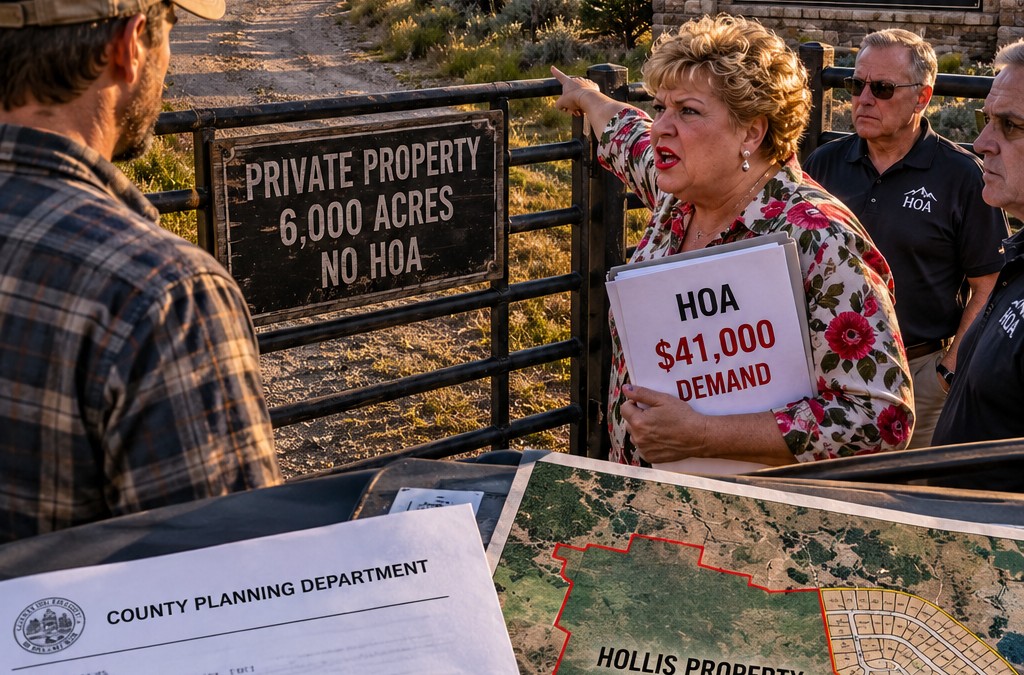
𝗙𝗨𝗟𝗟 𝗦𝗧𝗢𝗥𝗬
There was a satisfaction in building things that did not exist inside software.
If code fails, sometimes the failure is invisible.
If a fence post is crooked, you can see it.
If a roof leaks, rain tells you.
If a road washes out, there is no meeting about whether the washout is actually a washout.
The dirt is gone.
Solve the problem.
For four years, I lived exactly the life I had imagined.
I woke when I wanted.
Worked in the shop.
Maintained water systems.
Read.
Hiked.
Occasionally did consulting work when a project interested me.
I paid my taxes.
Filed required permits.
Kept the property insured.
I had no reason to argue with anyone because there was almost nobody around to argue with.
Then Ridgerest Communities arrived.
The parcel directly east of mine had been owned for years by an investment partnership.
I had assumed it would remain empty.
Then survey crews appeared.
Next came graders.
Water lines.
Utility trenches.
Road cuts.
By the end of the first year, what had been open ground was a construction site.
Eighteen months later, it was a neighborhood.
Two hundred forty homes.
Clubhouse.
Pool.
Entry monument.
Walking paths.
Landscaped medians.
Decorative streetlights.
The developer marketed it as “refined mountain living surrounded by protected rural views.”
I remember reading that phrase on a roadside banner.
Protected rural views.
I laughed.
The “protected rural view” was me.
My land formed most of Ridgerest’s western horizon.
From their premium lots, homeowners looked past their fences and saw six thousand acres of grassland, ridges, timber, and open sky.
I did not resent them for enjoying it.
The land was beautiful.
If I had bought one of those houses, I would have liked the view too.
What I did not know was how heavily Ridgerest was selling that view.
Their promotional photographs repeatedly framed homes against my land.
Brochures called it “adjacent open acreage.”
Listings emphasized the lack of future development to the west.
One agent even called it a “permanent rural buffer.”
I heard that from a homeowner later.
At the time, I ignored it.
The homes were on their side.
My land was on mine.
Then the Ridgerest Homeowners Association became active.
Twelve-member board.
Full-time property manager.
Committees.
Architectural standards.
Landscaping rules.
An attorney on retainer.
I knew all of this because the HOA newsletter occasionally ended up in my mailbox by mistake.
One issue contained three pages on approved exterior paint colors.
I remember standing in my kitchen reading it and thinking I had made the right life decision.
Their rules had nothing to do with me.
At least that was what I believed until a certified letter arrived one Monday morning.
The envelope had a county court marking.
I signed for it at the gate.
At first I assumed it involved taxes or a boundary filing.
Then I opened it.
NOTICE OF CIVIL ACTION.
Ridgerest Homeowners Association v. Garrett Hollis.
I read my own name twice.
There are three words that can make even a person who knows he has done nothing wrong feel physically sick.
You’ve been sued.
The complaint was twenty-six pages.
I read all of it standing at my kitchen island.
Then I sat down and read it again.
Ridgerest claimed that because my property shared a boundary with its development, portions of my land fell inside what it called an “aesthetic impact corridor.”
I had never heard that phrase.
I searched my deed.
Nothing.
Survey.
Nothing.
County documents I had kept from closing.
Nothing.
According to the HOA, development conditions, community standards, and what it described as “reciprocal aesthetic obligations” allowed it to regulate uses of neighboring land visible from premium Ridgerest lots.
That was astonishing enough.
Then I reached their demands.
They wanted the storage structure near my eastern boundary removed because part of the roof could be seen from several Ridgerest homes.
They wanted a vegetative buffer planted along the eastern property line.
Six thousand acres of property.
Miles of fence.
At my expense.
They wanted architectural review over future structures within the supposed corridor.
And they wanted two years of back HOA dues.
I stopped reading.
Then continued.
The total amount they claimed I owed was slightly more than $41,000.
I sat there for a long time.
At first I was angry.
Then I became genuinely confused.
I kept thinking there had to be another Garrett Hollis.
Another parcel.
Another document.
Some annexation provision I had missed.
Because the alternative was too absurd.
An HOA had built next to me and then decided proximity converted me into a member.
I called my attorney.
Dileia Voss had handled a land access issue for me during construction and had reviewed several county matters since.
She answered while I was still looking at the complaint.
“Dileia.”
“Garrett.”
“I’ve been sued.”
“By whom?”
“The HOA next door.”
Silence.
Then, “You don’t belong to an HOA.”
“I know.”
“What are they claiming?”
I read her the relevant section.
She did not interrupt.
When I finished, she was quiet for approximately four seconds.
Then she said, “Did you ever sign anything with Ridgerest?”
“No.”
“Anything with the developer?”
“No.”
“Road agreement?”
“No.”
“Landscape agreement?”
“No.”
“Did you ever attend an HOA meeting?”
“No.”
“Vote?”
“No.”
“Accept access to their clubhouse, pool, roads, snow service, trash service, irrigation system?”
“No.”
“Did they send you anything before this lawsuit claiming your land had been annexed into their covenants?”
“Nothing.”
“Did you receive a declaration amendment?”
“No.”
“Did anyone ask you for consent?”
“No.”
“Good.”
I frowned.
“Good?”
“It means we’re dealing with what appears to be an attempted expansion of private covenant authority onto land they do not own and that was never subjected to the declaration.”
“Can they actually do that?”
“They can file a lawsuit asking for almost anything.”
“That’s not what I asked.”
“No, Garrett. Based on what you’ve told me, they cannot simply convert your land into HOA property because their residents can see it.”
I felt some tension leave my shoulders.
Then she added:
“But don’t relax yet.”
“Why?”
“Because someone spent money drafting this complaint. I want to know what theory they think supports it.”
I drove to her office the next morning with every document I had.
Original deed.
Title policy.
Survey.
County parcel maps.
Construction permits.
Tax records.
Dileia read for nearly two hours.
At one point she looked up.
“Your eastern storage building was permitted?”
“County permit is behind tab six.”
She flipped to it.
“Of course it is.”
“I used to debug systems for a living.”
“I know. Your file organization is offensive.”
She kept reading.
Finally she closed the complaint.
“They have a problem.”
“Only one?”
“The biggest one. They don’t have a legal instrument tying you to their declaration.”
“So we file to dismiss.”
“We will. But first I want their development file.”
“Why?”
“Because they keep using phrases like impact corridor and development compatibility. Those terms probably came from somewhere.”
“County planning?”
“Exactly.”
Ridgerest had gone through an extensive county approval process three years earlier.
Large developments in rural areas required planning review.
Traffic studies.
Water analysis.
Wildlife considerations.
Drainage.
Visual-impact materials.
Public hearing documents.
Dileia requested the complete file.
It was hundreds of pages.
Most of it had nothing to do with me.
Road-width calculations.
Fire access.
Wastewater.
Soils.
Water rights.
Then she found the site impact study.
She called me late in the afternoon.
“Garrett, where are you?”
“In the shop.”
“Sit down.”
“Why do attorneys always say that before something interesting?”
“Because clients sometimes walk into walls.”
I sat.
“What did you find?”
“Ridgerest’s development impact study.”
“Okay.”
“They identified your parcel.”
“Why?”
“As mitigation.”
I said nothing.
She continued.
“When the county raised concerns about visual impact and density, Ridgerest represented that the development would remain buffered on the west by six thousand acres of undeveloped rural land.”
I stood back up.
“You mean my property.”
“Specifically your parcel number.”
“They told the county my land would remain undeveloped?”
“They described it as an existing natural open-space buffer expected to preserve the project’s rural visual character.”
“Expected by whom?”
“Apparently them.”
“Did they ever ask me?”
“You know the answer.”
I did.
Dileia continued.
“They also used photographs taken toward your land.”
I felt my jaw tighten.
“So they told regulators their project would be softened visually because I existed.”
“Yes.”
“And now their HOA is suing me because I’m not maintaining their preferred visual aesthetic.”
“Correct.”
I laughed once.
Not because it was funny.
Because sometimes absurdity has nowhere else to go.
“Can they do that?”
“That inconsistency is going to be very useful.”
“How useful?”
“Potentially case-changing.”
The more we read, the worse Ridgerest’s position looked.
During approval, the developer had repeatedly emphasized that my property was outside the proposed subdivision.
Maps showed the boundary clearly.
Planning staff notes referred to my parcel as “adjacent privately held ranch acreage.”
Another document stated that no off-site control rights were being requested as part of development approval.
That sentence mattered.
No off-site control rights.
Yet three years later, the HOA was asking a court to recognize exactly that.
Control rights over my off-site land.
Dileia filed our response.
It denied every claim.
She attached my deed.
Survey.
Title documents.
And the Ridgerest planning materials.
Then she filed counterclaims.
She was careful about the wording.
She never promised a judge would accept every theory.
But she alleged that the HOA’s attempted interference with my property rights had caused compensable legal harm.
She challenged the representations that implied Ridgerest possessed rights it had never acquired.
And she sought recovery of legal expenses and other damages available under the applicable claims.
She also put the developer’s regulatory representations directly in front of the court.
That changed the atmosphere almost immediately.
I knew because a man named Fletcher Miles contacted me.
He lived in Ridgerest.
One afternoon, a pickup stopped outside my eastern gate.
A man around my age climbed out.
I watched from the shop before walking over.
“Garrett Hollis?”
“Yes.”
“I’m Fletcher.”
He looked back toward the neighborhood.
“I live over there.”
“Okay.”
“I wanted to talk about the lawsuit.”
I folded my arms.
“Are you on the board?”
“No.”
“Attorney?”
“No.”
“Then why are you here?”
He looked embarrassed.
“Because I bought my house because of your land.”
That caught me off guard.
“What?”
“My wife and I bought Lot 187. It’s one of the western lots.”
“I don’t know the lot numbers.”
“Probably better that way.”
He smiled nervously.
“Our realtor told us the open land west of the development was expected to stay rural.”
“Did she say why?”
“She made it sound like some kind of protected buffer.”
I felt anger rising.
“Protected by whom?”
“That’s why I’m here.”
Fletcher took out his phone.
“I found out about the lawsuit at the board meeting. Most people hadn’t heard the details.”
“What did the board say?”
“That you were violating visual standards affecting Ridgerest property values.”
“I don’t have Ridgerest visual standards.”
“I know that now.”
He hesitated.
“I also got a copy of the meeting minutes.”
“How?”
“Homeowners are entitled to them.”
“And?”
“The HOA attorney told the board your counterclaim changed everything.”
I looked at him.
“Those exact words?”
“Close enough.”
He scrolled.
“Here.”
He read:
“Counsel advised that the defendant’s production of county approval materials creates significant litigation exposure not contemplated in the original enforcement strategy.”
I almost smiled.
“Original enforcement strategy.”
“That phrase bothered a lot of people.”
“Why?”
“Because nobody knew there was an enforcement strategy against you.”
Fletcher explained that the board had expected the dispute to end quickly.
A demand letter.
Maybe a settlement.
Maybe I would remove the storage structure.
Plant trees.
Pay some amount.
The lawsuit had been presented internally as straightforward.
Then Dileia produced the county records.
Suddenly the HOA was no longer just accusing me.
It had to explain itself.
I asked Fletcher, “Why are you telling me this?”
He looked toward my land.
“Because I don’t want them turning you into the villain when half the reason I bought there is that this view exists.”
“That’s not my responsibility.”
“I know.”
“And I never promised anyone it would stay this way.”
“I know that now too.”
That answer mattered.
Fletcher was not asking me to maintain his view.
He was admitting he had misunderstood what he bought.
That was more honesty than I had received from the HOA.
“Thank you,” I said.
He nodded.
Then looked toward the storage building the association wanted removed.
“Honestly?”
“What?”
“I can barely see that thing from my roof.”
I laughed.
“Good to know.”
The lawsuit moved into discovery.
That was when Dileia began requesting internal correspondence.
The HOA fought some of it.
Produced some.
Negotiated some.
One email became important.
It was from Ridgerest’s property manager to the board several months before they sued me.
A homeowner on a premium western lot had complained that my storage structure affected his view.
The property manager had responded that my parcel was outside the HOA.
That should have ended it.
Instead, the board discussed whether there was a way to assert what one member called “adjacent aesthetic jurisdiction.”
There was that concept again.
They did not begin with a known right.
They began with a desired outcome.
Then searched for a theory.
Another email showed a board member asking whether I could be encouraged to join the association voluntarily.
Someone responded that voluntary membership would likely require negotiation.
Then the conversation shifted.
Rather than negotiate, they decided to claim the impact corridor already subjected me to certain standards.
When Dileia read that chain, she leaned back.
“This is why people should never write emails when they’re inventing authority.”
I looked at her.
“Is that legal advice?”
“It’s life advice.”
The board’s position became harder to defend.
Their declaration contained no language binding my parcel.
Their recorded maps excluded me.
Their own property manager had initially acknowledged I was outside the HOA.
Their developer had represented to the county that my land was private rural acreage.
And the supposed aesthetic impact corridor was not a property interest recorded against my title.
It was planning language.
Not an easement.
Not a covenant.
Not a contract.
Not ownership.
That distinction became the center of the case.
Ridgerest could care about its visual surroundings.
It could ask.
It could offer to pay for screening.
It could negotiate a conservation easement.
It could purchase land if I wanted to sell.
What it could not do was convert its preference into authority after the fact.
The HOA attorney understood that before some board members did.
Fletcher kept me updated occasionally.
I never asked him for confidential material.
I did not want to turn a neighbor into a spy.
But public meeting information was enough.
At one board meeting, he said the attorney warned them that continued litigation could increase exposure.
Several board members wanted to settle.
Others were furious.
One apparently said backing down would “invite noncompliance.”
When Fletcher told me that, I stared at him.
“Noncompliance with what?”
“That was my question.”
I walked him toward the gate.
“Fletcher, I think that’s the part they don’t understand.”
“What?”
“I can’t be noncompliant with rules that don’t apply to me.”
He nodded.
“I know.”
Three weeks before trial, Dileia called.
“Ridgerest wants mediation.”
I was repairing a hydraulic line on the tractor.
I wiped my hands.
“They blinking?”
“Possibly.”
“Do we have to accept?”
“No.”
“Do you think we should?”
“I think our trial position is strong.”
“That’s not an answer.”
She sighed.
“If we go to trial, I believe we have an excellent chance of defeating their claims.”
“And counterclaims?”
“More complicated. Always more complicated.”
“How long?”
“Trial plus possible post-trial motions. Appeal risk. Months. Potentially longer.”
“What does mediation get me?”
“Certainty, if they accept terms worth accepting.”
I told her I needed a day.
That evening, I walked the eastern fence line.
The sun was low.
Ridgerest looked almost peaceful from my side.
Roofs catching orange light.
Children riding bikes.
Someone grilling.
A dog barking behind a fence.
Two hundred forty houses full of people who had mostly done nothing to me.
That mattered.
It would have been easy to turn the dispute into me versus Ridgerest.
It wasn’t.
I had no problem with the homeowners.
My problem was with an institution that had decided my independence was an inconvenience.
I stood near the storage building.
The structure was plain.
Metal siding.
Brown roof.
Utility.
Nothing special.
The HOA had built a lawsuit around the fact that some resident could see part of it.
I thought about trial.
Part of me wanted it.
I wanted a judge to say publicly that they had no authority.
I wanted the county documents read into the record.
I wanted the board to sit through the consequences of what it had started.
Then I asked myself what I actually wanted.
Not emotionally.
Practically.
I wanted the lawsuit gone.
I wanted permanent clarity.
I wanted my legal fees paid.
And I wanted no future board resurrecting the same argument five years later.
The next morning, I called Dileia.
“Mediate.”
“Conditions?”
“Four.”
“I’m listening.”
“Every claim against me dismissed with prejudice.”
“Good.”
“Written acknowledgment that I am not a member of Ridgerest and owe no dues, fees, assessments, compliance duties, landscaping obligations, architectural review, or anything else.”
“Good.”
“They pay my legal fees.”
“Expected.”
“And I want something recorded with the county.”
She paused.
“What exactly?”
“A document tied to both parcels clarifying that my land is private property outside Ridgerest authority. I don’t want this living only in a settlement agreement hidden in somebody’s office.”
“That may require careful drafting.”
“That’s why I pay you.”
“You’ve become unpleasant.”
“I’ve had good coaching.”
We went to mediation.
The session lasted most of the day.
Ridgerest’s representatives sat in another room.
I rarely saw them directly.
The mediator moved back and forth.
Their first offer was weak.
Dismiss the claims.
Each side pays its own fees.
No recorded document.
I rejected it.
Their second offer included partial legal costs.
Rejected.
At one point the mediator sat across from me and said, “Mr. Hollis, settlements require compromise.”
“I understand.”
“What flexibility do you have?”
“On timing.”
“Anything substantive?”
“No.”
He studied me.
“Why not?”
“Because I didn’t ask to be here.”
He waited.
I continued.
“I owned six thousand acres before Ridgerest existed. They built next door. They sued me because they wanted control over land they never purchased and never subjected to their covenants. Now I’m supposed to compromise my ownership so everyone feels reasonable?”
“That’s not what I’m asking.”
“It feels close.”
The mediator nodded slowly.
“Then tell me what you need.”
“Finality.”
That word guided everything.
By late afternoon, the HOA agreed to dismiss its claims with prejudice.
Then came the written acknowledgment.
Dileia insisted the language be explicit.
I was not and had never been a member of the Ridgerest HOA.
My property was not subject to Ridgerest’s declaration.
No association assessments or dues were owed.
Ridgerest had no architectural review authority over my improvements.
No landscape obligations existed along the shared boundary unless independently required by county law.
No claimed aesthetic corridor created private HOA enforcement rights against my parcel.
Then legal fees.
They resisted.
Dileia did not.
Eventually they agreed to pay them in full.
The hardest issue was the recorded clarification.
Their attorney did not want language that sounded like an admission of wrongdoing.
Dileia did not care what they called it.
She wanted a document recorded with the county establishing the boundary of authority.
We negotiated words for nearly two hours.
Finally, it was done.
My land remained private property.
Outside Ridgerest.
Permanently documented.
No future HOA board could honestly claim confusion.
The settlement was signed on a Tuesday.
I remember that because Tuesday had become the most ordinary day imaginable.
No dramatic weather.
No courtroom.
No reporters.
Just signatures.
Initials.
Notary stamps.
Dileia closed the folder.
“Congratulations.”
“That’s it?”
“That’s usually it.”
“I expected something more dramatic.”
“You bought six thousand acres to avoid drama.”
“Fair.”
I stood.
She handed me a copy of the agreement.
“Garrett.”
“Yeah?”
“Don’t lose this.”
I looked at her.
“I have three digital backups already.”
“Of course you do.”
I drove home.
Parked the truck beside the workshop.
Then walked to the east fence line.
Ridgerest was still there.
Two hundred forty homes.
Perfect streets.
Clubhouse pool.
Landscaping.
Decorative lamps.
From a distance, nothing had changed.
That was almost funny.
For months, lawyers had exchanged letters.
Board members had argued.
Court filings had accumulated.
Thousands of dollars had been spent.
And the physical boundary looked exactly as it had before.
Fence.
Grass.
Open land.
Their side.
My side.
I leaned against a fence post.
Wind moved through the grass behind me.
Six thousand acres stretched west.
I thought about what Ridgerest had really wanted.
It wasn’t my property.
Not literally.
They never asked to buy it.
They did not want to ranch it.
Build on it.
Farm it.
They wanted control over the idea of it.
They had sold their homeowners a landscape.
Open space.
Rural views.
A mountain-western lifestyle.
And my land was part of the picture.
The mistake came when they began believing the picture belonged to them.
They wanted my property to remain exactly rural enough to support their marketing.
But not rural enough to contain a visible storage structure.
They wanted open land.
But curated open land.
They wanted freedom outside their fences as long as that freedom looked the way their covenants preferred.
Nobody ever asked me to participate in that arrangement.
Nobody offered to purchase a conservation easement.
Nobody offered to pay for screening.
Nobody offered me compensation to preserve their view.
Instead, when my choices stopped matching their assumptions, they used the tool they already understood.
Enforcement.
The problem was that enforcement requires authority.
And they had none.
Fletcher texted that evening.
SETTLED?
I answered:
YES.
A few minutes later:
GOOD.
Then another:
YOU SHOULD KNOW ABOUT A THIRD OF THE NEIGHBORHOOD HAD NO IDEA THE HOA EVEN SUED YOU UNTIL LAST MONTH.
I shook my head.
He continued.
ANOTHER THIRD IS FURIOUS ABOUT THE LEGAL FEES.
Then:
THREE BOARD MEMBERS JUST SAID THEY’RE NOT RUNNING AGAIN.
I typed:
SORRY YOU ALL GOT DRAGGED INTO IT.
His response came quickly.
WE DIDN’T GET DRAGGED INTO IT. OUR BOARD DRAGGED US INTO IT.
That was the most accurate description I heard.
I did not post about the settlement.
Did not put up signs.
Did not paint the storage building neon orange.
Did not build something ugly against the fence just because I legally could.
There is a kind of person who thinks winning means humiliating the loser.
I had spent enough years in corporate meetings watching adults behave that way.
I wanted my land back.
Not a victory lap.
So I went into the workshop and finished the storage rack I had started around the time the lawsuit arrived.
Steel frame.
Three levels.
Heavy enough for fencing equipment and spare lumber.
By sunset, it was done.
I stood looking at it longer than necessary.
Four months earlier, I had opened a letter demanding $41,000 because an organization I never joined had decided it could regulate me.
Now there was a recorded document saying exactly the opposite.
The relief did not feel explosive.
It felt quiet.
That was better.
Over the next several months, Ridgerest changed.
Fletcher told me homeowner meetings became much more crowded.
People started reading agendas.
Requesting budgets.
Asking why litigation had been initiated.
The board adopted a policy requiring outside counsel to confirm jurisdiction before major enforcement actions involving property boundaries.
Imagine that.
Check whether you have authority before exercising authority.
Revolutionary.
Several directors lost reelection.
Others resigned.
I never attended.
Not my association.
That was the entire point.
A year later, I was repairing fencing near the eastern ridge when Fletcher walked over.
By then we had become friendly enough that he occasionally crossed through the gate when invited.
He looked across my property.
“You know something funny?”
“Probably.”
“The sales office stopped calling your land permanent open space.”
“Good.”
“Now they say expansive western views.”
“More accurate.”
“They also added language saying neighboring land is privately owned and not controlled by Ridgerest.”
I smiled.
“Very accurate.”
He leaned against the fence.
“Did you ever consider developing this side just to make a point?”
“No.”
“Not even once?”
I thought about it.
“Maybe for ten seconds.”
“What stopped you?”
“I didn’t leave one controlling system just to let another one decide what I do out of spite.”
He nodded.
That answer surprised me too when I said it.
For months, Ridgerest had occupied more space in my mind than it deserved.
Every time I looked east, I saw the lawsuit.
Every certified envelope made my stomach tighten.
Every call from Dileia meant another bill or filing.
It would have been easy to let winning become another kind of captivity.
Build something ugly because they hated it.
Cut trees because they wanted trees.
Turn the property into a weapon.
That still would have meant letting the HOA make my choices.
Just in reverse.
I had bought land to get away from that.
So I kept living the same way.
Some sections stayed open.
Others I improved.
I added another solar array.
Expanded the workshop.
Built a equipment shelter farther south.
Put in a second water tank.
None of it required Ridgerest approval.
Sometimes, before starting work visible from the east, I remembered the lawsuit.
Then I would look at the county-recorded clarification in my office.
Not because I doubted my rights.
Because I appreciated their simplicity.
My land.
My responsibility.
County law where applicable.
No private HOA authority.
That should never have required litigation.
But clarity is often expensive when somebody profits from ambiguity.
Years later, the part that still bothers me most isn’t the money.
I recovered my legal fees.
The $41,000 demand disappeared.
The lawsuit ended.
What bothers me is how normal their assumption seemed to them.
Nobody on that board woke up and said, “Today we’ll try to steal six thousand acres.”
That would have been easy to recognize.
Instead, they told themselves something much more comfortable.
Our homeowners paid a premium for these views.
Our property values depend on the surrounding landscape.
This structure affects the visual character.
The development was approved based on rural surroundings.
Therefore, we should have some say.
Each sentence moved them one step farther from ownership and one step closer to entitlement.
Until eventually they were sending legal papers to a man who had never met most of them, demanding two years of dues for an association he had never joined.
That is how overreach often works.
Not through one enormous lie.
Through a series of small assumptions nobody challenges.
We care about it.
Therefore we have an interest.
We have an interest.
Therefore we deserve input.
We deserve input.
Therefore we have authority.
And once people convince themselves they have authority, resistance starts looking like misconduct.
My storage building was not a violation.
It was proof their control ended somewhere.
That was what really offended them.
There was a fence line they could see but could not cross.
Dileia once described the case perfectly.
We were having coffee after the recorded document was finally indexed by the county.
She said, “They confused dependency with ownership.”
I looked at her.
“Explain.”
“The development depended on your land remaining visually compatible with what they sold. But depending on something does not mean you own it.”
I thought about that.
“They should have bought an easement.”
“Exactly.”
“Or asked.”
“Exactly.”
“Instead they sued.”
“Exactly.”
“Lawyers must love people.”
She smiled.
“Certain people are excellent for business.”
I kept every major document from the case.
The complaint.
Our answer.
The planning study.
The site map showing my parcel outside Ridgerest.
The settlement.
The recorded clarification.
But the page I return to most often is the county planning document.
There is one paragraph where Ridgerest’s consultant explains that western views would remain rural because of the adjacent six-thousand-acre parcel.
My parcel.
They wrote those words before most Ridgerest houses existed.
Before the clubhouse.
Before the HOA board.
Before anyone tried to charge me dues.
They knew exactly what my land was when they needed county approval.
Private.
External.
Undeveloped.
Beyond their project boundary.
Only later, when private ownership became inconvenient, did the story change.
That is why paper matters.
Memory is flexible.
Authority is confident.
Organizations rewrite their own history all the time.
Recorded documents are less cooperative.
Years after the settlement, I still live on the same land.
The nearest town is still eleven miles away.
The sunsets are still better than anything I saw from an office tower.
My solar system has been upgraded twice.
The pond attracts elk in dry months.
The guest cabin gets more use now that my sister has decided isolation is not as terrible as she once believed.
She visited one fall and stood on the porch looking toward Ridgerest.
“So that’s the HOA?”
“Yep.”
“They really tried to make you join?”
“They tried to make me pay.”
“For being next door?”
“More or less.”
She shook her head.
“Do they bother you now?”
“No.”
“Ever?”
“No.”
“What changed?”
I looked toward the eastern fence.
“Now they know where their rules stop.”
That may be the most valuable boundary on any property.
Not the fence itself.
The understanding behind it.
A fence can be climbed.
A line on a map can be misunderstood.
A neighbor can make assumptions.
But once rights are clearly recorded and people understand them, conflict becomes much harder to manufacture.
Ridgerest still exists.
People still mow their lawns.
The pool still opens every summer.
The HOA still has meetings.
They still approve paint colors.
Somebody probably still argues about mailbox designs.
None of it bothers me.
They are free to govern the community their members chose to join.
I am equally free not to belong to it.
That distinction sounds obvious.
It took lawyers, court filings, county records, and months of pressure to enforce.
The storage structure Ridgerest wanted removed is still standing.
I eventually repainted it.
Not because the HOA asked.
Because the old coating had started fading.
I chose dark green.
No committee reviewed the sample.
No board approved it.
No architectural form was filed.
I bought the paint in town on a Thursday and finished the job over the weekend.
Fletcher texted me after seeing it from his property.
LOOKS GOOD.
I replied:
THANKS.
Then he added:
DON’T TELL THE BOARD I APPROVED IT.
I laughed harder than I should have.
Sometimes freedom is not dramatic.
Sometimes it is just painting your own building without asking strangers for permission.
When I left software, I thought freedom meant distance.
Six thousand acres.
No boss.
No office.
No neighbors close enough to care what I did.
The lawsuit taught me something else.
Distance does not protect freedom.
Paper does.
Boundaries do.
The willingness to defend them does.
Because there will always be someone who looks across a line and thinks your independence would be more convenient if it answered to them.
I do not hate Ridgerest.
I do not even hate the board members who sued me.
Most are gone now anyway.
I think they made a mistake people make everywhere.
They assumed proximity created entitlement.
It does not.
Seeing my land did not give them rights over it.
Depending on my open space did not create a contract.
Selling houses because buyers liked my view did not make me responsible for preserving that view.
And calling my property part of an “aesthetic impact corridor” did not transform a planning concept into ownership.
Words can sound powerful.
They are still only words until the law gives them weight.
The HOA had a twelve-member board.
A professional manager.
An attorney.
Two hundred forty homes paying dues.
I had a deed.
For a while, they thought numbers made them stronger.
They were wrong.
The deed was enough.
One evening not long ago, I walked out to the eastern boundary just before dark.
Ridgerest’s streetlights were coming on one by one.
Behind me, six thousand acres were turning black beneath the mountains.
I could hear wind through dry grass.
Nothing else.
The same fence still separated us.
But it felt different than it had during the lawsuit.
Back then, I looked at that fence and saw a line I might have to fight to keep.
Now I saw what it had always been.
A boundary.
Nothing hostile about it.
Nothing dramatic.
Their community ended there.
My land began.
That was all.
And in the end, that simple fact defeated every complicated argument they built around it.
𝗧𝗛𝗘 𝗘𝗡𝗗
The HOA Claimed My 6,000 Acres Were Part of Their Community, but One County Filing Exposed What They Had Told Regulators Years Earlier
The certified letter said an HOA I had never joined was demanding $41,000 and claiming authority over land I had owned free and clear for years.
What they did not know was that three years earlier, while asking the county for permission to build their neighborhood, the developer had already put in writing exactly whose land mine was.
My name is Garrett Hollis.
For fifteen years, I worked as a software engineer for a company large enough that people three levels above me knew my employee number better than they knew my name.
I was good at what I did.
That was part of the problem.
The better I became, the more people assumed I could absorb.
One project became two.
Two became five.
A forty-hour week became sixty.
Then seventy.
Then there were release weekends when eighty did not feel unusual.
I spent my thirties sitting in conference rooms beneath fluorescent lights discussing system failures with people dialing in from three time zones away.
I wrote code at midnight.
Reviewed deployments at two in the morning.
Answered messages during Christmas dinner.
I made good money.
Better than good.
And every year I told myself I was buying freedom.
One more bonus.
One more stock vest.
One more promotion.
Then I would leave.
The problem with postponing freedom is that eventually postponement becomes your life.
By forty-two, I had enough.
I did not quit dramatically.
No speech.
No confrontation.
No angry email.
I finished a major release on a Friday, turned in my badge, shook hands with a manager who called me “Gordon” after fifteen years, and drove home knowing I would never build another life around someone else’s calendar.
My friends assumed I was going to travel.
My sister thought I would buy a condo near Denver.
One former coworker suggested Austin.
I did none of those things.
I bought land.
Not a ranch with a decorative gate and twelve neighboring estates.
Not forty acres in a subdivision marketed as “country living.”
Six thousand acres.
Raw land.
Rough land.
Land so large that the first time I drove the perimeter with the seller, it took most of the afternoon.
It sat in a rural county in the Mountain West, eleven miles from the nearest incorporated town.
There were dry ridges covered in sage.
Cottonwoods along two seasonal draws.
A broad western basin where deer moved before sunrise.
Rock outcrops.
Grassland.
A shallow creek that ran strongly during snowmelt and narrowed to a ribbon in late summer.
No deed restrictions.
No architectural committee.
No community association.
No board.
No covenant telling me whether a shed could be visible from a road.
The title company confirmed it.
My attorney confirmed it.
The county confirmed it.
Six thousand acres under one deed.
Mine.
I paid cash.
That mattered to me.
For the first time in my adult life, nobody had a claim ahead of mine.
No mortgage.
No lender.
No business partner.
No employer.
Just property taxes and whatever responsibilities came with owning more land than any reasonable person needed.
Everyone told me I was insane.
My sister stood in what would eventually become my kitchen, looked through a framed opening where the window had not yet been installed, and said, “Garrett, there isn’t a grocery store for half an hour.”
“That’s part of the appeal.”
“What if you need something?”
“I drive.”
“What if you get lonely?”
“I spent fifteen years in an office with hundreds of people and felt lonely most days.”
She did not have an answer for that.
I built slowly.
The main house came first.
Nothing enormous.
Timber frame.
Metal roof.
Deep porch facing west.
Enough windows that I could see storms coming across the basin.
Then a workshop.
A small guest cabin farther down the slope.
A pond fed seasonally from runoff.
Solar arrays.
Battery storage.
A backup generator.
A well.
Two gravel roads.
A utility shed.
A storage structure near the eastern portion of the property where I kept fencing material, spare pipe, lumber, and equipment.
I did much of the work myself.
What I could not do, I hired locally.
There was a satisfaction in building things that did not exist inside software.
If code fails, sometimes the failure is invisible.
If a fence post is crooked, you can see it.
If a roof leaks, rain tells you.
If a road washes out, there is no meeting about whether the washout is actually a washout.
The dirt is gone.
Solve the problem.
For four years, I lived exactly the life I had imagined.
I woke when I wanted.
Worked in the shop.
Maintained water systems.
Read.
Hiked.
Occasionally did consulting work when a project interested me.
I paid my taxes.
Filed required permits.
Kept the property insured.
I had no reason to argue with anyone because there was almost nobody around to argue with.
Then Ridgerest Communities arrived.
The parcel directly east of mine had been owned for years by an investment partnership.
I had assumed it would remain empty.
Then survey crews appeared.
Next came graders.
Water lines.
Utility trenches.
Road cuts.
By the end of the first year, what had been open ground was a construction site.
Eighteen months later, it was a neighborhood.
Two hundred forty homes.
Clubhouse.
Pool.
Entry monument.
Walking paths.
Landscaped medians.
Decorative streetlights.
The developer marketed it as “refined mountain living surrounded by protected rural views.”
I remember reading that phrase on a roadside banner.
Protected rural views.
I laughed.
The “protected rural view” was me.
My land formed most of Ridgerest’s western horizon.
From their premium lots, homeowners looked past their fences and saw six thousand acres of grassland, ridges, timber, and open sky.
I did not resent them for enjoying it.
The land was beautiful.
If I had bought one of those houses, I would have liked the view too.
What I did not know was how heavily Ridgerest was selling that view.
Their promotional photographs repeatedly framed homes against my land.
Brochures called it “adjacent open acreage.”
Listings emphasized the lack of future development to the west.
One agent even called it a “permanent rural buffer.”
I heard that from a homeowner later.
At the time, I ignored it.
The homes were on their side.
My land was on mine.
Then the Ridgerest Homeowners Association became active.
Twelve-member board.
Full-time property manager.
Committees.
Architectural standards.
Landscaping rules.
An attorney on retainer.
I knew all of this because the HOA newsletter occasionally ended up in my mailbox by mistake.
One issue contained three pages on approved exterior paint colors.
I remember standing in my kitchen reading it and thinking I had made the right life decision.
Their rules had nothing to do with me.
At least that was what I believed until a certified letter arrived one Monday morning.
The envelope had a county court marking.
I signed for it at the gate.
At first I assumed it involved taxes or a boundary filing.
Then I opened it.
NOTICE OF CIVIL ACTION.
Ridgerest Homeowners Association v. Garrett Hollis.
I read my own name twice.
There are three words that can make even a person who knows he has done nothing wrong feel physically sick.
You’ve been sued.
The complaint was twenty-six pages.
I read all of it standing at my kitchen island.
Then I sat down and read it again.
Ridgerest claimed that because my property shared a boundary with its development, portions of my land fell inside what it called an “aesthetic impact corridor.”
I had never heard that phrase.
I searched my deed.
Nothing.
Survey.
Nothing.
County documents I had kept from closing.
Nothing.
According to the HOA, development conditions, community standards, and what it described as “reciprocal aesthetic obligations” allowed it to regulate uses of neighboring land visible from premium Ridgerest lots.
That was astonishing enough.
Then I reached their demands.
They wanted the storage structure near my eastern boundary removed because part of the roof could be seen from several Ridgerest homes.
They wanted a vegetative buffer planted along the eastern property line.
Six thousand acres of property.
Miles of fence.
At my expense.
They wanted architectural review over future structures within the supposed corridor.
And they wanted two years of back HOA dues.
I stopped reading.
Then continued.
The total amount they claimed I owed was slightly more than $41,000.
I sat there for a long time.
At first I was angry.
Then I became genuinely confused.
I kept thinking there had to be another Garrett Hollis.
Another parcel.
Another document.
Some annexation provision I had missed.
Because the alternative was too absurd.
An HOA had built next to me and then decided proximity converted me into a member.
I called my attorney.
Dileia Voss had handled a land access issue for me during construction and had reviewed several county matters since.
She answered while I was still looking at the complaint.
“Dileia.”
“Garrett.”
“I’ve been sued.”
“By whom?”
“The HOA next door.”
Silence.
Then, “You don’t belong to an HOA.”
“I know.”
“What are they claiming?”
I read her the relevant section.
She did not interrupt.
When I finished, she was quiet for approximately four seconds.
Then she said, “Did you ever sign anything with Ridgerest?”
“No.”
“Anything with the developer?”
“No.”
“Road agreement?”
“No.”
“Landscape agreement?”
“No.”
“Did you ever attend an HOA meeting?”
“No.”
“Vote?”
“No.”
“Accept access to their clubhouse, pool, roads, snow service, trash service, irrigation system?”
“No.”
“Did they send you anything before this lawsuit claiming your land had been annexed into their covenants?”
“Nothing.”
“Did you receive a declaration amendment?”
“No.”
“Did anyone ask you for consent?”
“No.”
“Good.”
I frowned.
“Good?”
“It means we’re dealing with what appears to be an attempted expansion of private covenant authority onto land they do not own and that was never subjected to the declaration.”
“Can they actually do that?”
“They can file a lawsuit asking for almost anything.”
“That’s not what I asked.”
“No, Garrett. Based on what you’ve told me, they cannot simply convert your land into HOA property because their residents can see it.”
I felt some tension leave my shoulders.
Then she added:
“But don’t relax yet.”
“Why?”
“Because someone spent money drafting this complaint. I want to know what theory they think supports it.”
I drove to her office the next morning with every document I had.
Original deed.
Title policy.
Survey.
County parcel maps.
Construction permits.
Tax records.
Dileia read for nearly two hours.
At one point she looked up.
“Your eastern storage building was permitted?”
“County permit is behind tab six.”
She flipped to it.
“Of course it is.”
“I used to debug systems for a living.”
“I know. Your file organization is offensive.”
She kept reading.
Finally she closed the complaint.
“They have a problem.”
“Only one?”
“The biggest one. They don’t have a legal instrument tying you to their declaration.”
“So we file to dismiss.”
“We will. But first I want their development file.”
“Why?”
“Because they keep using phrases like impact corridor and development compatibility. Those terms probably came from somewhere.”
“County planning?”
“Exactly.”
Ridgerest had gone through an extensive county approval process three years earlier.
Large developments in rural areas required planning review.
Traffic studies.
Water analysis.
Wildlife considerations.
Drainage.
Visual-impact materials.
Public hearing documents.
Dileia requested the complete file.
It was hundreds of pages.
Most of it had nothing to do with me.
Road-width calculations.
Fire access.
Wastewater.
Soils.
Water rights.
Then she found the site impact study.
She called me late in the afternoon.
“Garrett, where are you?”
“In the shop.”
“Sit down.”
“Why do attorneys always say that before something interesting?”
“Because clients sometimes walk into walls.”
I sat.
“What did you find?”
“Ridgerest’s development impact study.”
“Okay.”
“They identified your parcel.”
“Why?”
“As mitigation.”
I said nothing.
She continued.
“When the county raised concerns about visual impact and density, Ridgerest represented that the development would remain buffered on the west by six thousand acres of undeveloped rural land.”
I stood back up.
“You mean my property.”
“Specifically your parcel number.”
“They told the county my land would remain undeveloped?”
“They described it as an existing natural open-space buffer expected to preserve the project’s rural visual character.”
“Expected by whom?”
“Apparently them.”
“Did they ever ask me?”
“You know the answer.”
I did.
Dileia continued.
“They also used photographs taken toward your land.”
I felt my jaw tighten.
“So they told regulators their project would be softened visually because I existed.”
“Yes.”
“And now their HOA is suing me because I’m not maintaining their preferred visual aesthetic.”
“Correct.”
I laughed once.
Not because it was funny.
Because sometimes absurdity has nowhere else to go.
“Can they do that?”
“That inconsistency is going to be very useful.”
“How useful?”
“Potentially case-changing.”
The more we read, the worse Ridgerest’s position looked.
During approval, the developer had repeatedly emphasized that my property was outside the proposed subdivision.
Maps showed the boundary clearly.
Planning staff notes referred to my parcel as “adjacent privately held ranch acreage.”
Another document stated that no off-site control rights were being requested as part of development approval.
That sentence mattered.
No off-site control rights.
Yet three years later, the HOA was asking a court to recognize exactly that.
Control rights over my off-site land.
Dileia filed our response.
It denied every claim.
She attached my deed.
Survey.
Title documents.
And the Ridgerest planning materials.
Then she filed counterclaims.
She was careful about the wording.
She never promised a judge would accept every theory.
But she alleged that the HOA’s attempted interference with my property rights had caused compensable legal harm.
She challenged the representations that implied Ridgerest possessed rights it had never acquired.
And she sought recovery of legal expenses and other damages available under the applicable claims.
She also put the developer’s regulatory representations directly in front of the court.
That changed the atmosphere almost immediately.
I knew because a man named Fletcher Miles contacted me.
He lived in Ridgerest.
One afternoon, a pickup stopped outside my eastern gate.
A man around my age climbed out.
I watched from the shop before walking over.
“Garrett Hollis?”
“Yes.”
“I’m Fletcher.”
He looked back toward the neighborhood.
“I live over there.”
“Okay.”
“I wanted to talk about the lawsuit.”
I folded my arms.
“Are you on the board?”
“No.”
“Attorney?”
“No.”
“Then why are you here?”
He looked embarrassed.
“Because I bought my house because of your land.”
That caught me off guard.
“What?”
“My wife and I bought Lot 187. It’s one of the western lots.”
“I don’t know the lot numbers.”
“Probably better that way.”
He smiled nervously.
“Our realtor told us the open land west of the development was expected to stay rural.”
“Did she say why?”
“She made it sound like some kind of protected buffer.”
I felt anger rising.
“Protected by whom?”
“That’s why I’m here.”
Fletcher took out his phone.
“I found out about the lawsuit at the board meeting. Most people hadn’t heard the details.”
“What did the board say?”
“That you were violating visual standards affecting Ridgerest property values.”
“I don’t have Ridgerest visual standards.”
“I know that now.”
He hesitated.
“I also got a copy of the meeting minutes.”
“How?”
“Homeowners are entitled to them.”
“And?”
“The HOA attorney told the board your counterclaim changed everything.”
I looked at him.
“Those exact words?”
“Close enough.”
He scrolled.
“Here.”
He read:
“Counsel advised that the defendant’s production of county approval materials creates significant litigation exposure not contemplated in the original enforcement strategy.”
I almost smiled.
“Original enforcement strategy.”
“That phrase bothered a lot of people.”
“Why?”
“Because nobody knew there was an enforcement strategy against you.”
Fletcher explained that the board had expected the dispute to end quickly.
A demand letter.
Maybe a settlement.
Maybe I would remove the storage structure.
Plant trees.
Pay some amount.
The lawsuit had been presented internally as straightforward.
Then Dileia produced the county records.
Suddenly the HOA was no longer just accusing me.
It had to explain itself.
I asked Fletcher, “Why are you telling me this?”
He looked toward my land.
“Because I don’t want them turning you into the villain when half the reason I bought there is that this view exists.”
“That’s not my responsibility.”
“I know.”
“And I never promised anyone it would stay this way.”
“I know that now too.”
That answer mattered.
Fletcher was not asking me to maintain his view.
He was admitting he had misunderstood what he bought.
That was more honesty than I had received from the HOA.
“Thank you,” I said.
He nodded.
Then looked toward the storage building the association wanted removed.
“Honestly?”
“What?”
“I can barely see that thing from my roof.”
I laughed.
“Good to know.”
The lawsuit moved into discovery.
That was when Dileia began requesting internal correspondence.
The HOA fought some of it.
Produced some.
Negotiated some.
One email became important.
It was from Ridgerest’s property manager to the board several months before they sued me.
A homeowner on a premium western lot had complained that my storage structure affected his view.
The property manager had responded that my parcel was outside the HOA.
That should have ended it.
Instead, the board discussed whether there was a way to assert what one member called “adjacent aesthetic jurisdiction.”
There was that concept again.
They did not begin with a known right.
They began with a desired outcome.
Then searched for a theory.
Another email showed a board member asking whether I could be encouraged to join the association voluntarily.
Someone responded that voluntary membership would likely require negotiation.
Then the conversation shifted.
Rather than negotiate, they decided to claim the impact corridor already subjected me to certain standards.
When Dileia read that chain, she leaned back.
“This is why people should never write emails when they’re inventing authority.”
I looked at her.
“Is that legal advice?”
“It’s life advice.”
The board’s position became harder to defend.
Their declaration contained no language binding my parcel.
Their recorded maps excluded me.
Their own property manager had initially acknowledged I was outside the HOA.
Their developer had represented to the county that my land was private rural acreage.
And the supposed aesthetic impact corridor was not a property interest recorded against my title.
It was planning language.
Not an easement.
Not a covenant.
Not a contract.
Not ownership.
That distinction became the center of the case.
Ridgerest could care about its visual surroundings.
It could ask.
It could offer to pay for screening.
It could negotiate a conservation easement.
It could purchase land if I wanted to sell.
What it could not do was convert its preference into authority after the fact.
The HOA attorney understood that before some board members did.
Fletcher kept me updated occasionally.
I never asked him for confidential material.
I did not want to turn a neighbor into a spy.
But public meeting information was enough.
At one board meeting, he said the attorney warned them that continued litigation could increase exposure.
Several board members wanted to settle.
Others were furious.
One apparently said backing down would “invite noncompliance.”
When Fletcher told me that, I stared at him.
“Noncompliance with what?”
“That was my question.”
I walked him toward the gate.
“Fletcher, I think that’s the part they don’t understand.”
“What?”
“I can’t be noncompliant with rules that don’t apply to me.”
He nodded.
“I know.”
Three weeks before trial, Dileia called.
“Ridgerest wants mediation.”
I was repairing a hydraulic line on the tractor.
I wiped my hands.
“They blinking?”
“Possibly.”
“Do we have to accept?”
“No.”
“Do you think we should?”
“I think our trial position is strong.”
“That’s not an answer.”
She sighed.
“If we go to trial, I believe we have an excellent chance of defeating their claims.”
“And counterclaims?”
“More complicated. Always more complicated.”
“How long?”
“Trial plus possible post-trial motions. Appeal risk. Months. Potentially longer.”
“What does mediation get me?”
“Certainty, if they accept terms worth accepting.”
I told her I needed a day.
That evening, I walked the eastern fence line.
The sun was low.
Ridgerest looked almost peaceful from my side.
Roofs catching orange light.
Children riding bikes.
Someone grilling.
A dog barking behind a fence.
Two hundred forty houses full of people who had mostly done nothing to me.
That mattered.
It would have been easy to turn the dispute into me versus Ridgerest.
It wasn’t.
I had no problem with the homeowners.
My problem was with an institution that had decided my independence was an inconvenience.
I stood near the storage building.
The structure was plain.
Metal siding.
Brown roof.
Utility.
Nothing special.
The HOA had built a lawsuit around the fact that some resident could see part of it.
I thought about trial.
Part of me wanted it.
I wanted a judge to say publicly that they had no authority.
I wanted the county documents read into the record.
I wanted the board to sit through the consequences of what it had started.
Then I asked myself what I actually wanted.
Not emotionally.
Practically.
I wanted the lawsuit gone.
I wanted permanent clarity.
I wanted my legal fees paid.
And I wanted no future board resurrecting the same argument five years later.
The next morning, I called Dileia.
“Mediate.”
“Conditions?”
“Four.”
“I’m listening.”
“Every claim against me dismissed with prejudice.”
“Good.”
“Written acknowledgment that I am not a member of Ridgerest and owe no dues, fees, assessments, compliance duties, landscaping obligations, architectural review, or anything else.”
“Good.”
“They pay my legal fees.”
“Expected.”
“And I want something recorded with the county.”
She paused.
“What exactly?”
“A document tied to both parcels clarifying that my land is private property outside Ridgerest authority. I don’t want this living only in a settlement agreement hidden in somebody’s office.”
“That may require careful drafting.”
“That’s why I pay you.”
“You’ve become unpleasant.”
“I’ve had good coaching.”
We went to mediation.
The session lasted most of the day.
Ridgerest’s representatives sat in another room.
I rarely saw them directly.
The mediator moved back and forth.
Their first offer was weak.
Dismiss the claims.
Each side pays its own fees.
No recorded document.
I rejected it.
Their second offer included partial legal costs.
Rejected.
At one point the mediator sat across from me and said, “Mr. Hollis, settlements require compromise.”
“I understand.”
“What flexibility do you have?”
“On timing.”
“Anything substantive?”
“No.”
He studied me.
“Why not?”
“Because I didn’t ask to be here.”
He waited.
I continued.
“I owned six thousand acres before Ridgerest existed. They built next door. They sued me because they wanted control over land they never purchased and never subjected to their covenants. Now I’m supposed to compromise my ownership so everyone feels reasonable?”
“That’s not what I’m asking.”
“It feels close.”
The mediator nodded slowly.
“Then tell me what you need.”
“Finality.”
That word guided everything.
By late afternoon, the HOA agreed to dismiss its claims with prejudice.
Then came the written acknowledgment.
Dileia insisted the language be explicit.
I was not and had never been a member of the Ridgerest HOA.
My property was not subject to Ridgerest’s declaration.
No association assessments or dues were owed.
Ridgerest had no architectural review authority over my improvements.
No landscape obligations existed along the shared boundary unless independently required by county law.
No claimed aesthetic corridor created private HOA enforcement rights against my parcel.
Then legal fees.
They resisted.
Dileia did not.
Eventually they agreed to pay them in full.
The hardest issue was the recorded clarification.
Their attorney did not want language that sounded like an admission of wrongdoing.
Dileia did not care what they called it.
She wanted a document recorded with the county establishing the boundary of authority.
We negotiated words for nearly two hours.
Finally, it was done.
My land remained private property.
Outside Ridgerest.
Permanently documented.
No future HOA board could honestly claim confusion.
The settlement was signed on a Tuesday.
I remember that because Tuesday had become the most ordinary day imaginable.
No dramatic weather.
No courtroom.
No reporters.
Just signatures.
Initials.
Notary stamps.
Dileia closed the folder.
“Congratulations.”
“That’s it?”
“That’s usually it.”
“I expected something more dramatic.”
“You bought six thousand acres to avoid drama.”
“Fair.”
I stood.
She handed me a copy of the agreement.
“Garrett.”
“Yeah?”
“Don’t lose this.”
I looked at her.
“I have three digital backups already.”
“Of course you do.”
I drove home.
Parked the truck beside the workshop.
Then walked to the east fence line.
Ridgerest was still there.
Two hundred forty homes.
Perfect streets.
Clubhouse pool.
Landscaping.
Decorative lamps.
From a distance, nothing had changed.
That was almost funny.
For months, lawyers had exchanged letters.
Board members had argued.
Court filings had accumulated.
Thousands of dollars had been spent.
And the physical boundary looked exactly as it had before.
Fence.
Grass.
Open land.
Their side.
My side.
I leaned against a fence post.
Wind moved through the grass behind me.
Six thousand acres stretched west.
I thought about what Ridgerest had really wanted.
It wasn’t my property.
Not literally.
They never asked to buy it.
They did not want to ranch it.
Build on it.
Farm it.
They wanted control over the idea of it.
They had sold their homeowners a landscape.
Open space.
Rural views.
A mountain-western lifestyle.
And my land was part of the picture.
The mistake came when they began believing the picture belonged to them.
They wanted my property to remain exactly rural enough to support their marketing.
But not rural enough to contain a visible storage structure.
They wanted open land.
But curated open land.
They wanted freedom outside their fences as long as that freedom looked the way their covenants preferred.
Nobody ever asked me to participate in that arrangement.
Nobody offered to purchase a conservation easement.
Nobody offered to pay for screening.
Nobody offered me compensation to preserve their view.
Instead, when my choices stopped matching their assumptions, they used the tool they already understood.
Enforcement.
The problem was that enforcement requires authority.
And they had none.
Fletcher texted that evening.
SETTLED?
I answered:
YES.
A few minutes later:
GOOD.
Then another:
YOU SHOULD KNOW ABOUT A THIRD OF THE NEIGHBORHOOD HAD NO IDEA THE HOA EVEN SUED YOU UNTIL LAST MONTH.
I shook my head.
He continued.
ANOTHER THIRD IS FURIOUS ABOUT THE LEGAL FEES.
Then:
THREE BOARD MEMBERS JUST SAID THEY’RE NOT RUNNING AGAIN.
I typed:
SORRY YOU ALL GOT DRAGGED INTO IT.
His response came quickly.
WE DIDN’T GET DRAGGED INTO IT. OUR BOARD DRAGGED US INTO IT.
That was the most accurate description I heard.
I did not post about the settlement.
Did not put up signs.
Did not paint the storage building neon orange.
Did not build something ugly against the fence just because I legally could.
There is a kind of person who thinks winning means humiliating the loser.
I had spent enough years in corporate meetings watching adults behave that way.
I wanted my land back.
Not a victory lap.
So I went into the workshop and finished the storage rack I had started around the time the lawsuit arrived.
Steel frame.
Three levels.
Heavy enough for fencing equipment and spare lumber.
By sunset, it was done.
I stood looking at it longer than necessary.
Four months earlier, I had opened a letter demanding $41,000 because an organization I never joined had decided it could regulate me.
Now there was a recorded document saying exactly the opposite.
The relief did not feel explosive.
It felt quiet.
That was better.
Over the next several months, Ridgerest changed.
Fletcher told me homeowner meetings became much more crowded.
People started reading agendas.
Requesting budgets.
Asking why litigation had been initiated.
The board adopted a policy requiring outside counsel to confirm jurisdiction before major enforcement actions involving property boundaries.
Imagine that.
Check whether you have authority before exercising authority.
Revolutionary.
Several directors lost reelection.
Others resigned.
I never attended.
Not my association.
That was the entire point.
A year later, I was repairing fencing near the eastern ridge when Fletcher walked over.
By then we had become friendly enough that he occasionally crossed through the gate when invited.
He looked across my property.
“You know something funny?”
“Probably.”
“The sales office stopped calling your land permanent open space.”
“Good.”
“Now they say expansive western views.”
“More accurate.”
“They also added language saying neighboring land is privately owned and not controlled by Ridgerest.”
I smiled.
“Very accurate.”
He leaned against the fence.
“Did you ever consider developing this side just to make a point?”
“No.”
“Not even once?”
I thought about it.
“Maybe for ten seconds.”
“What stopped you?”
“I didn’t leave one controlling system just to let another one decide what I do out of spite.”
He nodded.
That answer surprised me too when I said it.
For months, Ridgerest had occupied more space in my mind than it deserved.
Every time I looked east, I saw the lawsuit.
Every certified envelope made my stomach tighten.
Every call from Dileia meant another bill or filing.
It would have been easy to let winning become another kind of captivity.
Build something ugly because they hated it.
Cut trees because they wanted trees.
Turn the property into a weapon.
That still would have meant letting the HOA make my choices.
Just in reverse.
I had bought land to get away from that.
So I kept living the same way.
Some sections stayed open.
Others I improved.
I added another solar array.
Expanded the workshop.
Built a equipment shelter farther south.
Put in a second water tank.
None of it required Ridgerest approval.
Sometimes, before starting work visible from the east, I remembered the lawsuit.
Then I would look at the county-recorded clarification in my office.
Not because I doubted my rights.
Because I appreciated their simplicity.
My land.
My responsibility.
County law where applicable.
No private HOA authority.
That should never have required litigation.
But clarity is often expensive when somebody profits from ambiguity.
Years later, the part that still bothers me most isn’t the money.
I recovered my legal fees.
The $41,000 demand disappeared.
The lawsuit ended.
What bothers me is how normal their assumption seemed to them.
Nobody on that board woke up and said, “Today we’ll try to steal six thousand acres.”
That would have been easy to recognize.
Instead, they told themselves something much more comfortable.
Our homeowners paid a premium for these views.
Our property values depend on the surrounding landscape.
This structure affects the visual character.
The development was approved based on rural surroundings.
Therefore, we should have some say.
Each sentence moved them one step farther from ownership and one step closer to entitlement.
Until eventually they were sending legal papers to a man who had never met most of them, demanding two years of dues for an association he had never joined.
That is how overreach often works.
Not through one enormous lie.
Through a series of small assumptions nobody challenges.
We care about it.
Therefore we have an interest.
We have an interest.
Therefore we deserve input.
We deserve input.
Therefore we have authority.
And once people convince themselves they have authority, resistance starts looking like misconduct.
My storage building was not a violation.
It was proof their control ended somewhere.
That was what really offended them.
There was a fence line they could see but could not cross.
Dileia once described the case perfectly.
We were having coffee after the recorded document was finally indexed by the county.
She said, “They confused dependency with ownership.”
I looked at her.
“Explain.”
“The development depended on your land remaining visually compatible with what they sold. But depending on something does not mean you own it.”
I thought about that.
“They should have bought an easement.”
“Exactly.”
“Or asked.”
“Exactly.”
“Instead they sued.”
“Exactly.”
“Lawyers must love people.”
She smiled.
“Certain people are excellent for business.”
I kept every major document from the case.
The complaint.
Our answer.
The planning study.
The site map showing my parcel outside Ridgerest.
The settlement.
The recorded clarification.
But the page I return to most often is the county planning document.
There is one paragraph where Ridgerest’s consultant explains that western views would remain rural because of the adjacent six-thousand-acre parcel.
My parcel.
They wrote those words before most Ridgerest houses existed.
Before the clubhouse.
Before the HOA board.
Before anyone tried to charge me dues.
They knew exactly what my land was when they needed county approval.
Private.
External.
Undeveloped.
Beyond their project boundary.
Only later, when private ownership became inconvenient, did the story change.
That is why paper matters.
Memory is flexible.
Authority is confident.
Organizations rewrite their own history all the time.
Recorded documents are less cooperative.
Years after the settlement, I still live on the same land.
The nearest town is still eleven miles away.
The sunsets are still better than anything I saw from an office tower.
My solar system has been upgraded twice.
The pond attracts elk in dry months.
The guest cabin gets more use now that my sister has decided isolation is not as terrible as she once believed.
She visited one fall and stood on the porch looking toward Ridgerest.
“So that’s the HOA?”
“Yep.”
“They really tried to make you join?”
“They tried to make me pay.”
“For being next door?”
“More or less.”
She shook her head.
“Do they bother you now?”
“No.”
“Ever?”
“No.”
“What changed?”
I looked toward the eastern fence.
“Now they know where their rules stop.”
That may be the most valuable boundary on any property.
Not the fence itself.
The understanding behind it.
A fence can be climbed.
A line on a map can be misunderstood.
A neighbor can make assumptions.
But once rights are clearly recorded and people understand them, conflict becomes much harder to manufacture.
Ridgerest still exists.
People still mow their lawns.
The pool still opens every summer.
The HOA still has meetings.
They still approve paint colors.
Somebody probably still argues about mailbox designs.
None of it bothers me.
They are free to govern the community their members chose to join.
I am equally free not to belong to it.
That distinction sounds obvious.
It took lawyers, court filings, county records, and months of pressure to enforce.
The storage structure Ridgerest wanted removed is still standing.
I eventually repainted it.
Not because the HOA asked.
Because the old coating had started fading.
I chose dark green.
No committee reviewed the sample.
No board approved it.
No architectural form was filed.
I bought the paint in town on a Thursday and finished the job over the weekend.
Fletcher texted me after seeing it from his property.
LOOKS GOOD.
I replied:
THANKS.
Then he added:
DON’T TELL THE BOARD I APPROVED IT.
I laughed harder than I should have.
Sometimes freedom is not dramatic.
Sometimes it is just painting your own building without asking strangers for permission.
When I left software, I thought freedom meant distance.
Six thousand acres.
No boss.
No office.
No neighbors close enough to care what I did.
The lawsuit taught me something else.
Distance does not protect freedom.
Paper does.
Boundaries do.
The willingness to defend them does.
Because there will always be someone who looks across a line and thinks your independence would be more convenient if it answered to them.
I do not hate Ridgerest.
I do not even hate the board members who sued me.
Most are gone now anyway.
I think they made a mistake people make everywhere.
They assumed proximity created entitlement.
It does not.
Seeing my land did not give them rights over it.
Depending on my open space did not create a contract.
Selling houses because buyers liked my view did not make me responsible for preserving that view.
And calling my property part of an “aesthetic impact corridor” did not transform a planning concept into ownership.
Words can sound powerful.
They are still only words until the law gives them weight.
The HOA had a twelve-member board.
A professional manager.
An attorney.
Two hundred forty homes paying dues.
I had a deed.
For a while, they thought numbers made them stronger.
They were wrong.
The deed was enough.
One evening not long ago, I walked out to the eastern boundary just before dark.
Ridgerest’s streetlights were coming on one by one.
Behind me, six thousand acres were turning black beneath the mountains.
I could hear wind through dry grass.
Nothing else.
The same fence still separated us.
But it felt different than it had during the lawsuit.
Back then, I looked at that fence and saw a line I might have to fight to keep.
Now I saw what it had always been.
A boundary.
Nothing hostile about it.
Nothing dramatic.
Their community ended there.
My land began.
That was all.
And in the end, that simple fact defeated every complicated argument they built around it.








