𝗙𝗨𝗟𝗟 𝗦𝗧𝗢𝗥𝗬 The HOA Called the Police to Force Me Off the Land Surrounding Their Neighborhood, but They Had Never Checked Who Actually Owned It
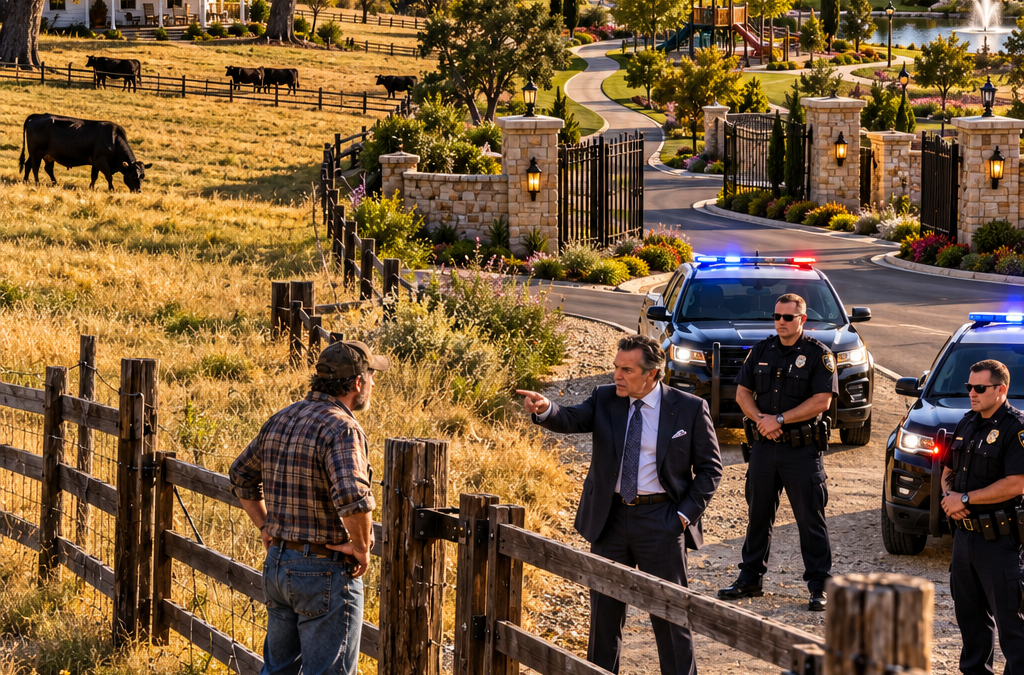
𝗙𝗨𝗟𝗟 𝗦𝗧𝗢𝗥𝗬
There were no decorative walking paths.
No playground.
No homeowners association.
Just farmland, an old fence, and a series of boundary markers my grandfather treated with almost religious respect.
I looked back at the workers.
“Did the HOA tell you how far this community property extends?”
The younger man pointed across the grass.
“All along here. The access road, the field, the recreation area. That’s what we’ve been told.”
I felt something tighten in my chest.
“The recreation area?”
“Yes, sir.”
I turned toward the neighborhood.
Beyond the trees, I could see the open field and part of the walking path.
The realization came slowly.
The HOA wasn’t merely repairing a fence near my land.
It believed that a much larger area belonged to the development.
And apparently, its workers had been operating under that assumption for years.
The older worker finished his call.
“Our supervisor says the property belongs to the association.”
I looked at him.
“Did he check the county records?”
The man seemed uncomfortable.
“I couldn’t tell you.”
I nodded.
“All right. I’m going to verify the boundary before anybody does more work here.”
He glanced at the unfinished fence.
“We’ve got instructions to finish this today.”
“I understand. But the ownership needs to be clarified first.”
The worker hesitated.
Then he nodded.
“We’ll contact the office.”
I thanked him and walked back toward the house.
I didn’t argue with them.
I didn’t shout.
And I certainly didn’t blame the men for following a work order.
But something about the conversation bothered me.
They had answered my question without hesitation.
It belongs to the community.
Not we think it belongs to the community.
Not the HOA told us it might be part of the development.
They spoke as though ownership had already been established.
And they had no idea who actually held the deed.
That afternoon, I went into my study and opened the oldest filing cabinet in the house.
It had belonged to my grandfather.
The drawers were heavy, and the bottom one still stuck unless I lifted it slightly while pulling.
Inside were property documents arranged in thick envelopes.
Some dated back decades.
There were deeds, recorded plats, correspondence from surveyors, property tax records, and handwritten notes identifying old boundary markers.
I carried the relevant folders to my desk.
Then I began reviewing them.
The original legal description covered far more land than the neighborhood residents seemed to realize.
The eastern boundary curved around the edge of the development.
Another section extended beyond the access road.
A long, irregular strip of my estate bordered the open field and part of the recreation area.
I compared the descriptions against the newer survey I had obtained several years earlier.
The boundaries aligned.
I checked the tax parcel information.
Then the deed history.
Then the recorded plat references.
The documents kept leading me back to the same conclusion.
The HOA appeared to be treating several parts of my estate as community property.
I leaned back in my chair.
For a long moment, I stared at the map.
It was one thing for a landscaping crew to mistakenly cross a property line.
It was something entirely different for a homeowners association to believe it owned a road, open field, and recreational space that had never been conveyed to it.
I needed an independent professional to verify the boundaries.
So the next morning, I hired a licensed survey crew.
The lead surveyor was a quiet, methodical man named Thomas.
He arrived with two technicians, field equipment, and copies of the available recorded information.
I met them near the old fence.
Thomas examined my documents before beginning.
“These descriptions are fairly detailed,” he said.
“My grandfather kept good records.”
“I can see that.”
I pointed toward the development.
“The HOA is treating some of this land as community property.”
Thomas looked across the fields.
“How much?”
“That’s what I want you to establish.”
He nodded.
“We’ll locate the recorded boundaries and compare them against the existing features.”
I appreciated his approach.
He didn’t promise me that I was right.
He didn’t make assumptions about the HOA.
He simply began working.
The crew followed the old boundary markers across the property.
Some were easy to locate.
Others required careful measurements.
Several were partially covered by grass or soil.
One older marker stood near a drainage channel that had changed shape over the years.
Thomas checked each location against the recorded information.
I accompanied the crew for part of the morning.
Then I returned to the farmhouse while they continued.
By early afternoon, I could see them working near the open field.
A little later, they moved toward the access road.
Then toward the recreation area.
I watched from the porch.
Every time they stopped to take another measurement, the uneasiness in my stomach grew.
I had originally imagined a narrow strip of misplaced landscaping.
Perhaps a few feet of fencing.
Maybe a corner of an open field.
But the survey crew was examining areas that the HOA had treated as its own for years.
When Thomas returned that afternoon with the completed field measurements and preliminary boundary map, his expression was serious.
“You’re going to want to look at this.”
We spread the map across my dining table.
He pointed to the recorded boundary.
Then to the existing road.
Then the field.
Then the recreation area.
I stared.
“All of that?”
“According to the boundary evidence we’ve located, these areas extend into your property.”
I leaned closer.
The line ran through sections that neighborhood residents had been using for years.
The old access road was inside my parcel.
Much of the open field was inside it.
And a portion of the recreational area crossed the same boundary.
My mouth went dry.
“Are you certain?”
Thomas tapped the map.
“The monuments and recorded descriptions are consistent. We’ll finish the certification and written report, but the boundary location is clear.”
I looked toward the windows.
The neighborhood lay beyond the trees.
For years, the association had been mowing grass, maintaining fences, and discussing improvements on property that belonged to my estate.
They weren’t just misunderstanding a narrow boundary.
They were treating a substantial amount of privately owned land as though it had become theirs by default.
I sat down.
Thomas remained standing beside the table.
“Have you ever given the HOA written permission to use these areas?” he asked.
“No.”
“Any access agreement?”
“Not that I’m aware of.”
“Recorded easement?”
“Nothing in my documents establishes the broad rights they’re claiming.”
He nodded.
“The boundary survey tells us where the land is. Questions about any separate easement, license, or other use rights should also be checked through the title records.”
“I understand.”
I looked at the map again.
The line was unmistakable.
And the more I studied it, the more concerned I became.
The road wasn’t just an occasional maintenance route.
Residents used it to reach one side of the development.
The open field was maintained like a community lawn.
And the recreation area contained equipment that had apparently been installed years earlier.
If the HOA had misunderstood the boundary for that long, correcting it would affect more than a few maintenance workers.
It could affect an entire neighborhood’s access arrangements.
I felt a familiar temptation to do nothing.
To let the association continue using the land.
To avoid becoming the person who brought lawyers, surveys, and property disputes into a community that had grown accustomed to treating those areas as its own.
But I couldn’t ignore what the documents showed.
Ownership carried responsibilities.
If somebody was maintaining, modifying, or building on my property without authorization, I needed to know.
And if residents were using facilities that partly stood on my land, the situation needed to be addressed before someone was injured or another structure was built.
I thanked Thomas and arranged for the completed documentation.
Then I began preparing a letter to the HOA.
I planned to keep it simple.
Explain the survey.
Provide the relevant boundary information.
Request that the association stop treating my land as community property until the records were reviewed.
Offer to meet and discuss any legitimate access needs.
It was a reasonable plan.
I had barely finished the first paragraph when I heard a vehicle coming up the driveway.
I looked outside.
A white SUV had stopped at my front gate.
Linda Brooks stepped out.
I knew Linda by reputation.
She was one of the HOA’s most outspoken representatives and had been involved in several disputes concerning fences, landscaping, and exterior modifications.
She was the sort of person who carried a binder to a casual conversation and spoke as though the contents were more important than the law.
That evening, the binder was tucked firmly beneath her arm.
She was already angry.
I watched her march toward the gate, her shoes striking the gravel with sharp, impatient steps.
She didn’t wave.
She didn’t smile.
She simply began calling toward the house.
“Hello? I need to speak to the owner!”
I sighed.
Then I walked outside.
“Good evening, Linda.”
She barely acknowledged the greeting.
“Are you responsible for interfering with the maintenance crews?”
I stopped several feet from the gate.
“I asked them to pause work while we verified the property boundary.”
Her eyes narrowed.
“You have no right to interfere with community maintenance.”
I looked at the binder.
“That’s interesting.”
“What is?”
“Because the survey shows they were working on my property.”
She gave an incredulous laugh.
“Your property?”
“Yes.”
“Those are HOA common areas.”
“According to what document?”
She shifted the binder beneath her arm.
“Our community records.”
“Can you show me the deed?”
Her expression hardened.
“The association has maintained those areas for years.”
“That doesn’t answer the question.”
“Everyone knows those areas belong to the neighborhood.”
I looked toward the fields.
“Everyone may believe that. It doesn’t necessarily make it true.”
Linda stepped closer.
“You’re interfering with established community property.”
“No. I’m asking you to verify who owns it.”
She opened the binder.
Inside were printed HOA rules, meeting notes, maintenance schedules, and photographs of the landscaping.
She flipped through several pages.
“These areas have always been under association management.”
“Management isn’t the same as ownership.”
She looked offended.
“Are you telling me you know more about our community than the board does?”
“I’m telling you I know what my deed says.”
Linda snapped the binder shut.
“Every property surrounding this development is governed by the association.”
I stared at her.
For a second, I thought she must have misspoken.
“Every property?”
“Yes.”
“Even land outside the subdivision?”
“Properties affecting the community fall under our standards.”
I felt a small, humorless smile form.
“That may be true for your neighborhood.”
She lifted her chin.
“But I’m not in your HOA.”
Her expression turned cold.
“That doesn’t excuse you from cooperating.”
“I’m willing to cooperate with a lawful arrangement. I’m not willing to pretend your association owns land simply because its workers have been maintaining it.”
Linda’s voice rose.
“You cannot just claim community property as your own.”
I looked at her.
“Linda, I’m not claiming it because I want it. I’m showing you records indicating that it already belongs to me.”
“Those records could be wrong.”
“Then let’s compare them with yours.”
She hesitated.
I waited.
“Do you have a recorded deed conveying those areas to the HOA?”
She opened her mouth.
Then closed it.
“I don’t have the complete property archive with me.”
“That’s fine. Bring it, and we’ll review it.”
Her jaw tightened.
“You think this is some kind of game?”
“No.”
“You’re putting the community at risk.”
“By checking a property boundary?”
“By interfering with access and maintenance.”
I took a slow breath.
“I haven’t closed any road. I haven’t removed any equipment. I asked workers to stop making changes while the ownership is clarified.”
Linda pointed toward me.
“If you refuse HOA authority, there will be serious consequences.”
I felt my patience begin to disappear.
“What consequences?”
“Enforcement action.”
“Against someone who isn’t a member?”
“Legal consequences, if necessary.”
I looked at her binder.
“Then you should probably have your legal counsel review the survey.”
She stared at me.
Then she reached into her purse.
“Fine.”
She pulled out her phone.
“If you want to make this difficult, I’ll call the authorities.”
I held her gaze.
“You’re welcome to call whoever you want.”
For a moment, she seemed disappointed that I hadn’t become frightened.
Then she turned away and began dialing.
I walked back toward the farmhouse.
I wasn’t running from the conversation.
I had simply reached the point where arguing with Linda would accomplish nothing.
She had no deed to show me.
No recorded plat.
No document establishing that my land had been transferred to the association.
All she had was certainty.
And certainty wasn’t evidence.
Inside, I returned to the dining table.
The survey lay beside the deed.
I unfolded the older map again.
Then I looked through the window toward Linda.
She was standing beside her SUV, speaking rapidly into the phone.
Her free hand moved through the air.
Even from inside, I could tell she was describing the situation as an emergency.
I wondered what she was saying.
Probably that a neighboring landowner was obstructing HOA property.
That I was interfering with access.
That I refused to follow association rules.
I felt uneasy.
Not because the documents were unclear.
Because people who believed they were right could create serious problems when they involved police officers before checking the facts.
Twenty minutes later, I heard sirens in the distance.
I looked up.
Two police cruisers turned onto the gravel road leading toward my property.
Their emergency lights flashed briefly before the vehicles slowed near the gate.
Linda stood beside the entrance.
She looked satisfied.
Almost triumphant.
As though the arrival of police officers meant her argument had already been won.
I placed the deed and survey into a folder.
Then I walked outside.
The first officer stepped from his cruiser.
He was a middle-aged man with a calm expression and the deliberate movements of someone accustomed to arriving at disputes where everyone claimed to be the injured party.
A younger officer stepped from the second vehicle.
Linda immediately approached them.
“Officers, thank goodness you’re here.”
The first officer raised a hand.
“Ma’am, let’s start with what happened.”
Linda pointed toward me.
“This man is obstructing community property and refusing to recognize the homeowners association’s authority.”
I stopped beside the gate.
The officer looked at me.
“Sir, are you the property owner?”
“Yes.”
Linda interrupted.
“He claims to own land that belongs to our community.”
The officer glanced toward her.
“Ma’am, I’ll hear from both of you.”
Linda folded her arms.
I appreciated that small moment of order.
The officer turned back toward me.
“Can you explain the dispute?”
I nodded.
“The HOA has been sending maintenance crews onto land that my deed and survey identify as part of my estate. I asked the workers to pause while I verified the boundary. I hired a licensed survey crew, and the results support my ownership.”
Linda shook her head.
“That is completely misleading.”
I didn’t respond to her.
Instead, I looked at the officer.
“May I ask you one question?”
He nodded.
“Go ahead.”
“Who owns this land?”
The officer looked toward the fields.
“That’s what we’re trying to establish.”
I opened my folder.
“Then these should help.”
I handed him the deed and the current survey.
The officer studied the first page.
Then he unfolded the survey across the hood of his cruiser.
The younger officer moved closer.
Linda stood nearby with her binder pressed against her chest.
The map was large.
It showed the development, the surrounding parcels, and the recorded boundary of my estate.
I pointed to the line.
“This is my property.”
Then I moved my finger toward the open field.
“This is where the HOA has been working.”
The officer leaned closer.
He traced the boundary.
Then he checked the parcel identification.
“You’re saying these areas are included in your deed?”
“Yes.”
He examined the legal description.
Then the survey.
The younger officer pointed toward the access road.
“That road is inside the same parcel?”
“Correct.”
Linda stepped forward.
“No. That’s the community access road.”
I looked at her.
“Where is the recorded document showing the HOA owns it?”
She raised the binder.
“Our association maintains it.”
The first officer looked up.
“Maintenance doesn’t necessarily establish ownership, ma’am.”
Linda’s expression changed.
“That’s not what I meant.”
“Then what is the association’s recorded property interest?”
She hesitated.
“The road has always been part of our community.”
The officer looked back at the survey.
I could almost see the moment he understood the scale of the disagreement.
This wasn’t a simple argument about a strip of grass.
The property line ran through several areas the HOA had been treating as its own.
And the records I had brought indicated those areas belonged to my estate.
Linda’s confidence began to fade.
She looked from the officer to the map.
Then back at me.
“That survey can’t be right.”
I kept my voice calm.
“It was prepared by a licensed crew using the recorded property information and existing boundary markers.”
She pointed toward the neighborhood.
“Those areas have been maintained by the HOA for years.”
“I know.”
“We’ve paid for landscaping.”
“I know.”
“We’ve made improvements.”
“That’s exactly why the ownership needs to be clarified.”
Linda fell silent.
The officer turned toward her.
“Did the association verify ownership through the county records before claiming these areas?”
She looked uncomfortable.
“I assumed our board had handled that.”
“Do you know whether it was done?”
She didn’t answer.
I watched her.
For the first time since she arrived, Linda looked uncertain.
She had marched up my driveway with a thick binder and a threat of consequences.
Now she was standing beside two police officers trying to explain why the association had been treating private land as community property without showing any deed that supported the claim.
The younger officer checked the available property information.
The first officer contacted the appropriate county records office to verify the parcel details.
We waited.
Linda stood beside her SUV, tapping her fingers against the binder.
I remained near the gate.
The afternoon light was fading.
Birds were moving through the trees beyond the pasture.
For several minutes, nobody said much.
Then the officer received confirmation.
The parcel information matched the ownership records I had provided.
The land was recorded under my name.
The survey was consistent with the property description.
The officer ended the call.
Then he looked at Linda.
“Ma’am, the county ownership information supports the documents the property owner has presented.”
She stared at him.
“What does that mean?”
“It means we have no basis to treat the disputed land as HOA property simply because the association says it is.”
Linda swallowed.
“But we’ve always considered it community property.”
I spoke quietly.
“Considering something yours doesn’t make it yours.”
She turned toward me.
“That’s easy for you to say. You don’t understand how much money the neighborhood has spent maintaining those areas.”
I looked at her.
“I didn’t ask your association to spend that money.”
Her expression hardened.
“You benefited from the improvements.”
“That’s a separate issue. It doesn’t establish ownership.”
The officer raised a hand.
“Both of you, let’s keep this calm.”
I nodded.
Linda looked away.
Then I remembered something.
The survey folded across the cruiser hood showed only part of the picture.
The full estate map was larger.
Much larger.
And if Linda was struggling to accept the ownership of the field and access road, the complete boundary would be an even bigger surprise.
I turned toward the officer.
“I have the complete certified survey inside. Would it be useful to review the entire property?”
He nodded.
“Yes.”
I returned to the house.
The moment I opened the study cabinet, I felt my heart beating faster.
I knew what the documents showed.
But I also knew that presenting them publicly would change my relationship with the neighboring development.
For years, I had allowed people to assume the estate ended near the visible fence.
I had never felt the need to correct every misunderstanding.
Now that silence had become part of the problem.
The HOA had built its expectations around land it hadn’t verified.
And those expectations were turning into demands.
I took the complete survey from the cabinet.
Then I returned to the gate.
The officers helped spread it across the cruiser hood.
Linda moved closer.
The map showed the full estate boundary.
It curved around several sections of the development.
It included the old access road.
The open field.
Part of the recreation area.
And something else that made the younger officer lean forward.
“Is that the playground?”
I looked at the map.
“Yes.”
Linda’s face changed.
“No.”
She pointed toward the recreational area.
“That playground has been there for years.”
“I know.”
“Children use it.”
“I know that too.”
She stared at the boundary line.
It crossed part of the playground area.
Not the entire facility.
But enough to make the issue serious.
The playground had been constructed partly on land recorded as my property.
And as far as I knew, nobody had ever asked my permission.
For a moment, even I felt the weight of what the map meant.
I had been focused on the road and the maintenance crews.
The playground was different.
It was a place where children played after school.
Where parents stood talking beside benches.
Where families gathered on weekends.
I had no desire to turn that into a confrontation.
But ignoring the boundary wouldn’t make the problem disappear.
Linda looked up.
“You can’t seriously expect us to remove a playground.”
I took a breath.
“I haven’t asked anyone to remove anything.”
“Then what do you want?”
“I want the ownership records reviewed and the situation handled properly.”
She stared at me.
I continued.
“I’m not interested in embarrassing your residents. I’m not trying to hurt families. I simply won’t accept the HOA declaring my property belongs to the community because nobody bothered to check.”
The officer nodded.
“That’s a reasonable distinction.”
Linda looked toward the playground beyond the trees.
Her expression was no longer angry.
It was frightened.
I understood why.
The association had spent years making decisions based on an assumption.
If that assumption was wrong, the consequences could extend through its maintenance plans, property management obligations, and access arrangements.
She looked down at her phone.
Then she stepped away.
I could hear her speaking rapidly.
She was calling the board.
Within the hour, several vehicles arrived at my entrance.
The first belonged to a gray-haired board member I recognized from neighborhood events.
The second carried two more association representatives.
Then a black luxury SUV pulled onto the gravel.
I knew that vehicle.
Karen Whitmore.
The HOA president.
Karen was fifty years old, polished to an almost unnatural degree, and possessed the kind of confidence that made every conversation feel like a corporate performance.
His dark hair was combed into a glossy side part.
His tailored navy jacket fit perfectly.
A heavy silver watch gleamed on his wrist.
He stepped out wearing polished leather shoes that looked absurd against the gravel.
Even before he reached the gate, I could see that he was angry.
He walked directly toward Linda.
“What is going on?”
She looked relieved to see him.
“Karen, there’s a problem with the property records.”
He glanced at the police cruisers.
“Why are the officers still here?”
“The owner has presented a survey.”
Karen’s eyes moved toward me.
Then toward the map.
His expression hardened.
“A survey?”
I stepped forward.
“Good evening.”
He barely acknowledged me.
“I understand you’ve been interfering with association property.”
I looked at him.
“That’s what we’re trying to clarify.”
Karen adjusted his watch.
“The HOA has managed these areas for years. We have no intention of allowing a neighboring landowner to disrupt community operations.”
I felt my patience tighten.
“Have you reviewed the deed?”
He smiled thinly.
“I’m familiar with the development.”
“That wasn’t my question.”
His expression changed.
He wasn’t accustomed to being challenged in front of an audience.
“I’ve been president of this association long enough to understand our property responsibilities.”
“Then you should be able to identify the land your association actually owns.”
The gray-haired board member stepped forward.
“May we see the documents?”
“Of course.”
I moved aside.
Karen looked irritated.
“We don’t need to conduct a full title review on the roadside.”
The older man ignored him.
He examined the survey.
Then the deed.
Then the parcel references.
His expression slowly changed.
He traced the boundary with his finger.
“Wait.”
I watched him.
He looked at the access road.
Then the field.
Then the recreation area.
“You’re saying all these areas fall inside your estate?”
“The ownership records and survey show that, yes.”
He leaned closer.
“Even the road?”
“Yes.”
The man looked toward Karen.
“Have we ever reviewed a deed conveying that road to the association?”
Karen frowned.
“We’ve maintained it for years.”
“That wasn’t my question.”
For a moment, the two men stared at each other.
The board member turned back toward the map.
His voice became quieter.
“This is a much larger parcel than I realized.”
I nodded.
“That’s part of the problem.”
One of the other board members pointed toward the road.
“We use this to reach the eastern side of the neighborhood.”
“I know.”
“If it’s private, that creates an access issue.”
“Potentially. That’s why I wanted a proper discussion before anybody made more changes.”
Karen stepped forward.
“This is ridiculous. The road has always been part of our neighborhood operations.”
I looked at him.
“Operations don’t establish ownership.”
He lifted his chin.
“Are you suggesting we have no right to use it?”
“I’m saying you need to identify the legal basis for whatever right you’re claiming.”
His face reddened.
“Do you understand the disruption you’re causing?”
I glanced toward the playground.
“Yes, Karen. I understand the situation is serious. That’s why I hired a licensed surveyor.”
He gestured sharply toward the land.
“You’re acting as though a piece of paper gives you the right to overturn years of community development.”
I stared at him.
“A recorded deed isn’t just a piece of paper.”
“It’s an administrative document.”
“It’s the legal record of ownership.”
Karen looked toward the officers.
“Surely you understand that established community use creates obligations.”
The first officer answered carefully.
“Questions about easements, long-term use, and property rights may need to be resolved through legal review. But we can’t simply assume HOA ownership because an area has been maintained by the association.”
Karen’s expression turned rigid.
“So you’re taking his side?”
“No, sir. We’re explaining that this is a civil property matter requiring proper documentation.”
I looked at the map.
The board members were beginning to understand what I had discovered.
The association wasn’t dealing with an angry neighbor complaining about landscaping.
It was facing a serious question about ownership of land it had used, maintained, and improved for years.
And the deeper the board looked, the more complicated the consequences became.
The gray-haired board member turned toward Linda.
“Where did our original property boundaries come from?”
Linda looked at Karen.
Karen frowned.
“The developer’s documents.”
“Which documents?”
“The original community planning materials.”
The man shook his head.
“Planning materials aren’t necessarily the same as recorded ownership documents.”
Karen’s voice sharpened.
“Are you questioning the board’s records?”
“I’m asking whether we’ve ever verified them.”
Silence.
I watched Karen’s jaw tighten.
For years, he had apparently governed the development under the assumption that the land surrounding the houses belonged to the association.
Now, in front of two police officers and several board members, he was being asked to explain why nobody had confirmed that assumption.
He couldn’t answer.
Linda looked increasingly uncomfortable.
She had been the one who brought the police.
She had threatened enforcement.
She had insisted every surrounding property was governed by the association.
But now her own board members were asking questions she couldn’t resolve.
The older board member looked toward me.
“Do you have any older records showing how this land was originally divided?”
I nodded.
“I do.”
Karen gave an impatient sigh.
“More paperwork.”
I turned toward him.
“Yes, Karen. More paperwork.”
Then I looked at the board member.
“I have an older county-recorded plat. It predates your development by decades.”
The man’s expression became serious.
“May we see it?”
“Absolutely.”
I returned to the house.
This time, I went to the bottom drawer of my grandfather’s filing cabinet.
Inside a large protective envelope was the oldest plat I had preserved.
The paper had yellowed around the edges.
The ink was faded in places.
But the recorded references and boundary descriptions remained legible.
My grandfather had kept it carefully folded for years.
I remembered him showing it to me when I was a teenager.
He had pointed toward the long eastern boundary and explained how the property extended around the low ground near the creek.
At the time, I hadn’t understood why he was so particular about those lines.
Now I did.
I carried the plat outside.
The officers and board members gathered closer as I unfolded it.
Karen remained a few steps away, arms crossed.
I placed the old plat beside the modern survey.
Then I pointed toward the original boundary.
“This was recorded decades before your HOA existed.”
The gray-haired board member leaned forward.
I traced the line.
“The boundary begins here, follows the older field markers, and continues around this section.”
Then I showed him the corresponding line on the current survey.
“The licensed survey crew located the existing monuments and confirmed the same boundary.”
He moved his finger between the two maps.
For several seconds, he said nothing.
Then he looked at Karen.
“These match.”
Karen stepped closer.
The board member continued.
“The original recorded boundary places those areas inside his estate.”
Linda looked at the older plat.
Her expression had gone pale.
Karen adjusted his watch.
“That doesn’t necessarily resolve every historical use question.”
“No,” I said. “But it establishes that the HOA cannot simply treat the land as its own without reviewing the actual rights involved.”
The older board member nodded.
Then he said something I hadn’t expected to hear so clearly.
“We never verified ownership before treating those areas as community property.”
The words hung in the evening air.
Linda stared at him.
Karen’s mouth tightened.
The younger board members looked toward one another.
I felt a strange mixture of relief and exhaustion.
There it was.
The admission I had been trying to reach since the maintenance workers first told me the land belonged to the community.
The HOA had never verified ownership.
It had simply assumed.
And over time, that assumption had become the foundation for maintenance decisions, landscaping projects, recreational improvements, and access arrangements.
Nobody had stopped to ask whether the association actually held title.
The gray-haired man looked at me.
“I’m sorry.”
I wasn’t prepared for the words.
He continued.
“We should have checked the recorded property information before authorizing work.”
I nodded slowly.
“Yes. You should have.”
Karen looked furious.
“We don’t need to apologize before consulting counsel.”
The older board member turned toward him.
“Karen, we’ve just reviewed two consistent property records showing areas we’ve treated as ours are part of this estate.”
“That doesn’t mean we surrender every interest.”
“No one is asking us to surrender a legitimate interest. We’re being asked to identify one.”
Karen stared at him.
The difference between the two men was suddenly obvious.
One was trying to understand the problem.
The other was trying to avoid admitting it existed.
I looked toward the open field.
Then the fence line.
Then the access road.
“Would you like to see the original boundary markers?”
The older board member nodded.
“Yes.”
Karen looked irritated.
But the other board members agreed.
So we walked.
The evening sun was lowering toward the trees as I led the group along the old fence.
The officers accompanied us for part of the walk.
Linda followed with her binder.
Karen came last, his polished shoes crunching against the gravel.
I stopped at the first marker.
It was a small metal monument set into the ground near an old oak tree.
I pointed toward it.
“This is one of the original boundary locations.”
The board members leaned closer.
I showed them the corresponding point on the plat.
Then we continued.
The next marker stood beyond the drainage channel.
Another lay near the edge of the open field.
As we moved along the boundary, the scale of the problem became increasingly obvious.
The HOA’s landscaping extended across the line.
A section of the access road lay inside my estate.
The open field that residents had treated as common property was largely within my boundary.
And near the recreation area, the surveyed line crossed part of the playground grounds.
Linda stopped walking.
She looked toward the swings.
A few children were playing while their parents watched from nearby benches.
Her voice was suddenly quieter.
“What are we supposed to do about that?”
I followed her gaze.
“I don’t know yet.”
She turned toward me.
“You could force us to remove it.”
I looked at her.
“That’s not what I’m here to do.”
Karen stepped forward.
“Then why create this problem at all?”
I turned toward him.
“Because the problem already existed.”
His eyes narrowed.
I continued.
“You built expectations around land you didn’t own. The survey didn’t create that mistake. It revealed it.”
Karen folded his arms.
“You’re enjoying having this leverage.”
The accusation made something tighten inside me.
For years, I had avoided neighborhood politics.
I hadn’t attended their meetings.
I hadn’t complained about every maintenance truck.
I hadn’t made a public issue of the landscaping.
Now Karen was standing on my land, suggesting that I had somehow planned the entire confrontation.
I took a slow breath.
“Do you think I wanted this?”
He said nothing.
I pointed toward the playground.
“Do you think I wanted to discover that part of a children’s recreation area was built across my property line?”
Karen looked away.
“Do you think I wanted to spend money on a survey because your workers were repairing fences on land they didn’t own?”
The older board member watched quietly.
I continued.
“I’ve lived here for years. I haven’t tried to interfere with your neighborhood. I haven’t asked anyone to stop enjoying their homes. I wanted the same courtesy in return.”
My voice tightened.
“But your association came onto my land, started making decisions about it, and then sent Linda to threaten me when I asked a basic question.”
Linda lowered her eyes.
I looked at Karen.
“You don’t get to call that cooperation.”
For a moment, the only sound was the wind moving through the trees.
Then the older board member spoke.
“We need to review the entire situation with counsel.”
I nodded.
“That’s the responsible thing to do.”
He looked toward the access road.
“We also need to understand what rights, if any, exist for continued use while this is sorted out.”
“I’m willing to discuss reasonable arrangements.”
Karen opened his mouth.
I raised one hand.
“But ownership is not negotiable simply because the HOA has been operating under a mistaken assumption.”
The older man nodded.
“Understood.”
I looked around at the group.
“The land belongs to my estate. The records establish that. If the association needs access, we can discuss it properly. If there are improvements crossing the boundary, we can work through those issues.”
I paused.
“But nobody gets to declare my property belongs to the neighborhood and then threaten me for disagreeing.”
Linda said nothing.
Neither did Karen.
For the first time that evening, everyone seemed to understand the actual boundary.
The officers returned with us to the gate.
The first officer looked at the documents one final time.
Then he addressed the group.
“This appears to be a civil property dispute. We have no criminal issue requiring enforcement action at this time.”
Linda looked toward him.
“So you’re not going to make him reopen anything?”
The officer frowned.
“He hasn’t been shown to have unlawfully closed anything. The ownership and access questions need to be handled through the appropriate legal process.”
Karen shifted his weight.
“And the association’s historical rights?”
“Those can be reviewed by counsel and, if necessary, a court. We can’t decide them simply because one side insists they exist.”
The officer looked toward me.
“Keep your documents available and avoid taking actions that could create unnecessary safety problems while the access questions are resolved.”
I nodded.
“That’s my intention.”
He turned toward the board.
“And I suggest everyone stop making assumptions about property ownership until the records have been properly reviewed.”
The older board member nodded.
“Agreed.”
Karen remained silent.
The officers returned to their cruisers.
A few moments later, the vehicles pulled away.
I watched the taillights disappear down the gravel road.
Linda stood beside her SUV.
The thick binder was still beneath her arm.
But she no longer held it like a weapon.
She looked toward the fields.
Then toward the access road.
Then toward the playground.
Her expression had changed completely.
The woman who arrived threatening consequences now seemed to understand how many consequences her association’s assumptions might create.
Karen stood beside his black SUV, speaking quietly with the other board members.
His glossy hair was still perfectly arranged.
His jacket still looked expensive.
But the commanding certainty was gone.
He had arrived expecting the police to enforce his association’s claims.
Instead, he had watched officers confirm that the recorded ownership information supported mine.
And he had heard one of his own board members admit that the HOA had never verified title before treating the surrounding land as community property.
I didn’t feel triumphant.
Not yet.
There were still difficult questions ahead.
The road.
The playground.
The maintenance expenses.
The improvements.
Years of decisions made without checking who owned the ground beneath them.
I knew those problems wouldn’t disappear because a police cruiser drove away.
But at least the argument had finally moved beyond Linda’s binder and Karen’s personal authority.
The records were on the table.
And nobody could pretend they hadn’t seen them.
That night, I returned to the farmhouse exhausted.
I placed the old plat back inside its protective envelope.
Then I sat at the kitchen table with a glass of water.
Outside, the estate was quiet.
Crickets called from the grass.
A light wind moved through the oak trees.
I thought about my grandfather.
He had spent decades maintaining those fields.
He had paid taxes on the land.
He had preserved the documents.
He had marked the boundaries and explained them to me when I was too young to appreciate their importance.
And all those years later, a homeowners association had apparently begun treating parts of the estate as though they were simply unclaimed space waiting to become community property.
I imagined what he would have said.
Probably something short.
Something practical.
Son, don’t let people confuse being comfortable with being entitled.
I smiled faintly.
Then I looked toward the survey.
The boundary line wasn’t complicated.
It had existed before the HOA.
Before the playground.
Before the decorative entrance.
Before Karen became president.
The neighborhood had grown around the estate.
But growth hadn’t transferred ownership.
I went to bed knowing the next few weeks would be difficult.
I was right.
The following morning, the HOA board began reviewing its old records.
I learned about the review through a call from the gray-haired board member, whose name was Thomas Ellis.
He had served on the board for several years and, unlike Karen, seemed interested in understanding what had happened.
“We’ve started examining the maintenance files,” he told me.
“Find anything?”
There was a pause.
“More than we expected.”
I looked toward the window.
“What does that mean?”
“We have years of invoices connected to some of the disputed areas.”
I sat down.
“Landscaping?”
“Landscaping, fence repairs, road grading, recreation maintenance.”
I looked toward the survey.
“Did anyone ever attach a deed or ownership verification to those records?”
“Not that we’ve found.”
I let out a slow breath.
Thomas continued.
“It appears the association treated the areas as common property because they’d been included in maintenance plans for years.”
“And those plans were based on what?”
“That’s what we’re trying to determine.”
I rubbed my forehead.
The situation was becoming more serious than I had hoped.
The HOA had spent residents’ money maintaining and improving land that wasn’t recorded in its ownership.
The amounts could be substantial.
And the board would have to explain how those expenses had been authorized.
I didn’t envy Thomas.
But I also knew that their accounting problem wasn’t mine to solve by surrendering property.
“Look,” I said, “I’m willing to work toward a reasonable arrangement. But I need everything documented.”
“I understand.”
“No more verbal claims.”
“Agreed.”
“No more maintenance crews crossing the boundary without permission.”
“We’re putting those activities on hold while we review the records.”
“And no more threats from Linda or Karen.”
Thomas was quiet for a moment.
Then he said, “I’ll address that with the board.”
I thanked him.
After the call, I walked outside.
The morning was cool.
A thin layer of mist hung over the open field.
From where I stood, I could see the neighborhood beyond the trees.
I knew that residents were beginning to hear about the dispute.
Some would be angry.
Some would be frightened.
Others would be confused.
They had paid HOA dues for years, believing the association maintained property that belonged to the community.
Now they were discovering that part of the land had never been legally acquired.
I didn’t want their frustration directed at me.
But I couldn’t control that.
All I could do was remain consistent.
The records established ownership.
The association needed to respect the boundary.
And any continued use had to be addressed through a proper legal arrangement.
A few days later, the HOA returned.
This time, there were no police cruisers.
No sirens.
No threats.
No angry woman waving a binder.
Thomas Ellis arrived with two other board members and a property attorney representing the association.
Karen came as well.
But the difference in his behavior was striking.
He wore another immaculate jacket and his usual polished shoes.
His hair was perfectly arranged.
Yet he no longer approached the gate as though the entire estate belonged to him.
He waited while Thomas called the house.
I walked outside carrying my folder.
“Good afternoon.”
Thomas nodded.
“Thank you for agreeing to meet.”
I opened the gate.
We gathered on the porch.
The atmosphere was cautious.
Nobody pretended the previous confrontation hadn’t happened.
But for the first time, the board had come with questions rather than demands.
Thomas placed a folder on the table.
“We’ve reviewed the recorded property information and our maintenance records.”
I nodded.
“And?”
“The ownership records support your position regarding the disputed areas.”
Karen shifted in his chair.
The attorney continued.
“We still need to examine any separate access rights or agreements that may apply to particular portions. But the association cannot simply claim ownership of the land based on maintenance history.”
I appreciated the distinction.
I wasn’t asking anyone to ignore legitimate rights that might exist.
I was asking them to stop inventing rights they couldn’t establish.
Thomas opened his folder.
“We’d like to discuss a properly documented arrangement for the access road and the recreation area.”
I looked at him.
“I’m willing to listen.”
Karen leaned forward.
“The community needs continued access.”
I turned toward him.
“Then let’s discuss lawful access.”
His jaw tightened slightly.
But he didn’t interrupt.
Thomas explained that the board wanted to review possible arrangements that would allow residents to continue using necessary areas without creating further confusion about ownership.
The road was the immediate concern.
It connected one side of the development to another access point.
The recreation area raised separate questions.
Part of the playground crossed the surveyed boundary.
The HOA would need to determine how to address the existing equipment, future maintenance, and any appropriate permissions.
I listened carefully.
Then I explained my position.
“I don’t want people stranded. I don’t want children losing a place to play because the association failed to check a map. But I won’t sign anything that pretends the land was always HOA property.”
Thomas nodded.
“Understood.”
“Any agreement must identify the exact areas involved.”
The attorney made a note.
“That makes sense.”
“It needs to explain who is responsible for maintenance, insurance, and any improvements.”
Another note.
“And it needs to preserve my ownership.”
Karen looked irritated.
“You keep emphasizing ownership.”
I turned toward him.
“Because that’s what your association ignored.”
He looked away.
I continued.
“If the community needs access, we can consider reasonable terms. But access is not ownership. A limited permission to use land is not a transfer of title. Those distinctions need to be clear.”
The attorney nodded.
“Agreed.”
For a moment, I felt the tension in the room ease.
The conversation was finally becoming practical.
No one was demanding that I surrender my estate.
No one was threatening enforcement.
The board was beginning to address the actual problem.
Karen remained quiet for most of the meeting.
When he did speak, he returned to the importance of maintaining community expectations.
But the others no longer treated that phrase as an answer to every question.
Thomas repeatedly brought the discussion back to the documents.
The road.
The property line.
The playground.
The maintenance obligations.
The need for proper agreements.
I watched the change with cautious relief.
It wasn’t that everyone suddenly liked me.
They didn’t have to.
It was that the board had started treating property ownership as something that required evidence.
That was enough to make a productive conversation possible.
By the end of the meeting, we had established a clear path forward.
The association would stop making unsupported ownership claims.
Existing work on the disputed areas would remain subject to proper authorization.
The board and its counsel would review the access and recreation issues separately.
Any future use arrangements would be documented rather than assumed.
And I would retain ownership of the land recorded in my deed.
Thomas closed his folder.
“I appreciate your willingness to discuss this.”
I nodded.
“I’ve been willing to discuss it from the beginning.”
He looked uncomfortable.
“I understand.”
Karen stood.
He adjusted his jacket and looked toward the fields.
For a moment, I thought he might finally apologize.
Instead, he said, “This situation has created a great deal of inconvenience for the neighborhood.”
I studied him.
Then I answered calmly.
“Then the next time the association wants to use land outside its recorded ownership, it should check the property records before making plans.”
His expression tightened.
But he said nothing.
The meeting ended without another argument.
Over the following weeks, the association continued reviewing its records and working through the appropriate arrangements.
The immediate disputes were addressed without the forced removal of recreational facilities or any attempt to block residents from essential access.
The board accepted that ownership of the disputed land remained with my estate.
Any continued use would require a properly documented legal basis rather than the old assumption that the HOA owned everything it maintained.
The association also had to confront its internal management problem.
Years of maintenance expenses had been approved for land it didn’t own.
Those costs wouldn’t disappear.
The board needed to understand how the mistake happened and prevent it from happening again.
I didn’t involve myself in every internal discussion.
That was their responsibility.
My responsibility was the estate.
I had fields to maintain, drainage work to finish, and a long fence line that still needed repairs.
I was glad to return to those ordinary tasks.
But I made one final improvement.
I installed a clear private-property sign near the surveyed boundary.
Nothing aggressive.
Nothing designed to humiliate the HOA.
Just a simple, professional sign identifying the entrance to privately owned land.
I placed it where the property line had been verified.
Then I stepped back and looked at it.
For years, I had assumed the boundary was obvious because the records were clear and the old markers remained in place.
But the conflict had taught me that people often see what they expect to see.
The HOA residents saw maintained grass and assumed common ownership.
The maintenance crews saw work orders and assumed authority.
Linda saw a binder full of association rules and assumed those rules extended beyond the development.
Karen saw land surrounding his neighborhood and treated it as territory under his control.
Nobody stopped to ask the simplest question.
Who actually owned it?
The sign wasn’t a victory monument.
It was a reminder.
A visible boundary to accompany the recorded one.
A way to prevent the next contractor or resident from making the same mistake.
That afternoon, I walked along the old fence line one more time.
The sun was beginning to lower.
Long shadows stretched across the fields.
The open land was quiet.
From the distant playground, I could hear children laughing.
I stopped near the boundary marker and listened.
The sound didn’t bother me.
It never had.
I had never wanted to take happiness away from the people living next door.
I simply wanted their association to respect the fact that my estate existed independently of their community.
A few minutes later, a landscaping truck passed along the neighborhood road.
The driver slowed near the private-property sign.
He looked toward the boundary.
Then he continued along the proper route.
I watched him disappear.
Such a small moment.
Nobody argued.
Nobody threatened anyone.
Nobody needed to call the police.
The driver simply recognized the boundary and respected it.
I felt a quiet satisfaction.
That was what the entire dispute should have been about from the beginning.
Not whether Linda could shout louder.
Not whether Karen could invoke his presidency.
Not whether the HOA had spent years mowing the grass.
The land had an owner.
The recorded documents established that ownership.
And any legitimate use by the association needed to be handled through the proper process.
I thought back to the evening Linda arrived at my gate.
She had been so certain.
She told me every property surrounding the development was governed by the association.
She said it as though the words themselves carried legal force.
When I told her I wasn’t in the HOA, she treated my response like an act of rebellion.
Then she called the police.
I could still picture her standing beside the cruisers, looking satisfied as the officers approached.
She expected them to enforce her claims.
Instead, they examined the records.
And the records told a completely different story.
I remembered the officer unfolding the survey across his hood.
The boundary line cutting through the areas Linda had called community property.
The access road.
The open field.
The recreation area.
The playground partially crossing the line.
Then the older county plat.
The document that existed decades before the development.
The document that confirmed what my grandfather had known all along.
The land had never stopped belonging to the estate simply because a neighborhood grew beside it.
I looked toward the farmhouse.
The porch stood beneath the oak trees.
The gravel driveway curved through the field.
The house looked much as it had when I first moved there.
There was no grand entrance.
No enormous sign displaying my name.
No attempt to advertise the size of the property.
I still preferred it that way.
But I no longer assumed quiet ownership would protect itself.
The dispute had taught me that boundaries needed to be understood, documented, and sometimes defended.
Not with threats.
Not with intimidation.
And not by treating neighbors as enemies.
With evidence.
The deed.
The survey.
The recorded plat.
The boundary markers.
The same documents my grandfather had preserved long before Karen became HOA president.
I walked back toward the house.
Near the front gate, I stopped and looked at the private-property sign.
It was plain.
Almost unremarkable.
But it carried a meaning that had taken months of frustration for the association to understand.
The HOA could maintain its own roads.
It could enforce lawful rules within its development.
It could organize events, manage landscaping, and provide recreational facilities for its residents.
Those were legitimate responsibilities.
But it couldn’t expand its authority merely by acting as though neighboring land belonged to it.
It couldn’t turn a mistaken maintenance schedule into a deed.
It couldn’t transform an access route into community ownership simply because residents had grown accustomed to using it.
And it couldn’t make my estate part of its association by repeating that claim loudly enough.
The property line existed independently of Karen’s confidence.
It didn’t change when Linda brought a binder.
It didn’t change when the police arrived.
And it didn’t change when the board discovered how much money it had spent on land it never acquired.
The line had been there all along.
Waiting for somebody to look.
As I reached the porch, I thought about the older board member admitting that the HOA had never verified ownership.
That was the moment the entire conflict changed.
Not because he had surrendered.
Because he had finally acknowledged the real problem.
The association had treated assumption as fact.
And for years, nobody had challenged it.
I respected him for recognizing the mistake.
I wished Karen had been capable of doing the same.
Perhaps someday he would understand that leadership wasn’t about extending control as far as possible.
It was about knowing where that control ended.
I wasn’t holding my breath.
I had lived long enough to know that some people would rather defend a mistake than admit they had made one.
But his personal feelings no longer mattered to the ownership of my land.
The board had the records.
The county had confirmed the ownership information.
The access questions were being handled through the appropriate process.
And the association had stopped treating my property as though it were automatically part of the neighborhood.
That was the resolution I needed.
I sat on the porch steps and looked across the estate.
The fields stretched toward the trees.
A light breeze moved through the grass.
Somewhere in the distance, the old access road disappeared around a bend.
The property was still the same.
The house.
The fences.
The pasture.
The boundary markers.
All of it had been there before the dispute began.
What changed was that the people next door finally understood who owned it.
For years, I had tried to live quietly.
I hadn’t wanted to become involved in HOA politics.
I hadn’t wanted police cruisers at my gate.
I hadn’t wanted to spend money proving boundaries that had been recorded for decades.
But when the association began treating my estate as community property, remaining silent would have allowed the misunderstanding to grow.
Eventually, that could have created even more serious problems.
So I checked the records.
I hired professionals.
I asked questions.
And when Linda threatened me, I didn’t respond with another threat.
I simply showed the officers the documents.
The truth didn’t need to be shouted.
It needed to be examined.
I stayed on the porch until the shadows grew long.
Then I stood and walked inside.
Before closing the door, I looked toward the boundary one final time.
The private-property sign stood near the fence.
The neighborhood lay beyond it.
Its residents could continue enjoying their homes.
Their association could continue managing the property it actually controlled.
And I could continue living on the estate my family had preserved for generations.
Two neighboring properties.
Two different sets of rights and responsibilities.
No need for another confrontation.
Linda Brooks had once told me that everything surrounding the development fell under HOA authority.
I had answered her with the simplest truth I knew.
I’m not in your HOA.
She hadn’t believed me.
So she called the police.
The police checked the records.
The board checked the maps.
And eventually, everyone learned the same lesson.
The HOA had spent years acting as though maintaining land meant owning it.
But ownership wasn’t determined by convenience, confidence, or how many people believed the same story.
It was established by the documents they had never bothered to examine.
I closed the farmhouse door.
The evening was quiet.
And for the first time since the maintenance crews crossed my property line, I knew that quiet no longer depended on the HOA choosing to leave me alone.
It rested on something much more reliable.
The truth was recorded.
The boundary was established.
And the land was still mine.








