𝗙𝗨𝗟𝗟 𝗦𝗧𝗢𝗥𝗬 The HOA Built 96 Homes on My Inherited Land and Its President Threatened to Have Me Arrested for Stepping Onto My Own Property
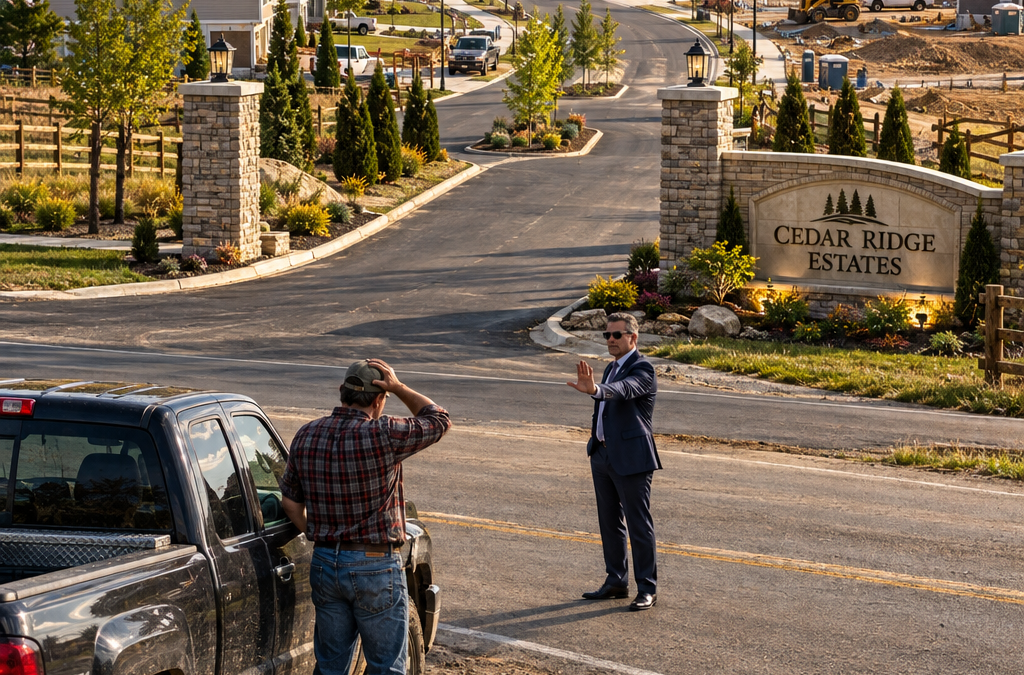
𝗙𝗨𝗟𝗟 𝗦𝗧𝗢𝗥𝗬
The number lodged somewhere in my chest.
I looked down the street.
Ninety-six homes.
Ninety-six pieces of land that someone had apparently decided could be sold.
Ninety-six foundations poured into ground I had never agreed to transfer.
I asked the worker who was supervising the project.
He pointed toward a temporary office trailer.
I thanked him but didn’t approach it.
Not yet.
My first instinct was to demand answers from everyone in sight.
My second was to call the sheriff.
Instead, I returned to my truck and dialed the county records office.
A woman answered.
“County Recorder’s Office. How can I help you?”
“I need to verify ownership of a parcel.”
“Do you have the parcel number?”
“Yes.”
I read it directly from my tax statement.
There was a pause.
Keyboard clicks.
Then she asked, “Could you repeat that?”
I did.
More typing.
“Can I ask your name?”
I told her.
Another pause.
“Sir, our records show that parcel registered to you.”
I stared through the windshield at a row of newly built houses.
“Are you sure?”
“That’s what our system shows.”
“One hundred eighty acres?”
“Yes.”
“Has there been a transfer?”
“Not in the chain I’m looking at.”
“Any subdivision recorded under that parcel?”
“I don’t see one.”
I tightened my grip on the phone.
“Then can you explain why somebody is building nearly a hundred houses on it?”
Silence.
For the first time, she sounded uncertain.
“Excuse me?”
“There’s an entire residential development going up on that property. Streets. Utilities. Foundations. Houses. I’m sitting in front of it.”
“I can’t explain that from here.”
“Could the developer have acquired it without the transfer appearing in your records?”
“I wouldn’t want to speculate. You should obtain certified copies of the recorded documents and speak with a real estate attorney.”
I wrote down her name.
Then I asked her to repeat exactly what the records showed.
She did.
The parcel remained in my name.
The recorded legal description still covered 180 acres.
There was no legitimate recorded conveyance in the chain she had examined.
When I ended the call, I sat quietly for a long time.
Outside, a concrete truck rolled past.
Men shouted to each other.
A nail gun cracked repeatedly from somewhere down the street.
I watched a worker carry a bundle of lumber into one of the houses.
Every sound seemed to confirm that this was real.
The land had not been stolen in secret during the night.
It was being transformed openly, with crews, equipment, permits, and people walking around as though everything had already been settled.
Someone had built an entire operation on an assumption.
And that assumption was my property.
I drove through the entrance again, slowly this time.
At the corner of the main boulevard, a smaller sign identified the road as Willow Crest Drive.
Farther in, another street branched east toward the creek.
Two rows of houses were nearly complete.
A sales banner advertised luxury living, landscaped common areas, and a professionally managed homeowners association.
I stopped near the temporary sales office.
A young employee approached my window.
“Are you here for a tour?”
“No. I’m looking for whoever manages the homeowners association.”
Her smile changed slightly.
“The HOA office is in the temporary administration building near the entrance. Are you a buyer?”
“No.”
“Do you own a home here?”
I looked toward the houses.
“Apparently, I own something much bigger.”
She frowned.
I drove away before she could ask what I meant.
That afternoon, I returned with my property documents.
The HOA office occupied a polished modular building that looked expensive enough to be mistaken for a permanent clubhouse.
Decorative planters stood beside the steps.
The windows were spotless.
Inside, the lobby smelled of fresh paint and artificial citrus.
A large architectural rendering of Cedar Ridge Estates covered one wall.
Ninety-six individual homes were drawn in clean rows.
Walking paths.
Green spaces.
A central boulevard.
A small recreational area.
The entire 180-acre tract had been turned into a marketing illustration.
I stood in front of it, looking at the creek represented by a thin blue line.
My creek.
My grandfather’s creek.
An older receptionist approached.
“May I help you?”
“I need to speak with the HOA president.”
“Do you have an appointment?”
“No.”
“What is this regarding?”
“Ownership of the land beneath this development.”
She blinked.
Before she could answer, a voice came from the hallway.
“Send him in.”
I turned.
The man standing in the doorway looked as though he had stepped out of an advertisement for luxury real estate.
He was about fifty, tall, broad through the shoulders, with carefully styled dark hair touched by silver at the temples.
His navy suit fit perfectly.
A white pocket square rested in his breast pocket.
His shoes gleamed beneath the overhead lights.
A heavy watch flashed on his wrist when he lifted one hand.
His face was clean-shaven, his smile practiced.
There was not a wrinkle in his clothing or a single strand of hair out of place.
This was Hoa Karen.
President of the Cedar Ridge Estates Homeowners Association.
He had a reputation, although I didn’t know it yet.
Residents would later describe him as controlling, vindictive, and obsessed with appearances.
At the time, I knew only that he was looking at me as though I had arrived several minutes late to a meeting he had never agreed to hold.
“You’re the gentleman asking questions about the property?”
“Yes.”
He extended his hand.
His grip was firm.
Too firm.
“Wonderful. I’m Hoa Karen. President of the association. Come inside.”
His office was decorated with framed development renderings and photographs of expensive houses.
A model of the completed neighborhood stood behind his desk.
He motioned toward a chair.
I remained standing.
“I think there’s been a serious mistake,” I said.
He sat down.
“That depends on what you consider serious.”
“You’re constructing homes on land I own.”
He smiled.
Not politely.
Dismissively.
“That’s a fairly dramatic opening statement.”
“It’s also true.”
“Perhaps we should begin with your name.”
I told him.
He leaned back.
“Ah. Yes. I’ve heard of you.”
I felt my stomach tighten.
“You have?”
“Your family owned some property in this area.”
“My family still owns it.”
His smile sharpened.
“Historically, perhaps.”
I placed my folder on his desk.
“I inherited 180 acres. The county records still show me as the owner. Your development appears to occupy the entire parcel.”
He glanced at the folder but made no move to open it.
“Mr. Karen, you’re building ninety-six homes on my land.”
He corrected me with a raised finger.
“First of all, this is a planned residential community, not simply a collection of houses. Second, the community already owns the land.”
“Then show me the transfer.”
He blinked once.
“Excuse me?”
“The deed transferring ownership from me or my predecessor to the developer or HOA. Show it to me.”
“The developer handled all land acquisition matters.”
“Then where is the document?”
“With the developer, presumably.”
“Have you seen it?”
His expression cooled.
“That isn’t relevant.”
“It’s the only thing that’s relevant.”
He straightened in his chair.
I noticed how carefully he controlled his movements.
Even when irritated, he appeared determined to look composed.
“I oversee this community,” he said. “I don’t personally examine every document associated with every transaction.”
“You should examine the one that proves you own the ground.”
He folded his hands.
“Let me explain something to you. Cedar Ridge Estates represents a substantial investment. There are construction contracts, financing arrangements, municipal approvals, and families preparing to move into their new homes. We’re not going to disrupt that process because someone suddenly decides an old family property extends farther than he remembers.”
I felt anger rise in my throat.
“I have the survey.”
“Surveys can be outdated.”
“I have the deed.”
“Deeds can be superseded.”
“Then produce the newer one.”
His jaw tightened.
“You seem to think raising your voice makes your argument stronger.”
I hadn’t raised my voice.
And we both knew it.
“I want the property records,” I said. “That’s all.”
He stood.
The conversation was apparently over.
“I suggest you direct future questions to the developer.”
“Who is the developer’s attorney?”
“That information is available through the appropriate channels.”
“What’s the name of the company?”
He looked at me for a moment.
“Cedar Ridge Development Group.”
“Thank you.”
I picked up my folder.
Before I reached the door, he spoke again.
“One more thing.”
I stopped.
“The grounds inside this community are private.”
I turned back.
“They’re my grounds.”
“According to you.”
“According to the county.”
His smile disappeared.
“If you enter active construction areas without authorization, security will escort you out. If necessary, we’ll contact law enforcement.”
I stared at him.
“You are threatening to have me arrested for walking onto property I own?”
“I’m informing you that we maintain strict access controls.”
He walked around the desk, stopping a few feet from me.
Up close, I could smell expensive cologne.
“Some people see a successful development and decide they deserve a piece of it,” he said quietly. “I hope that’s not what this is.”
For a moment, I couldn’t speak.
He had taken 180 acres of my family’s land, built a neighborhood on it, and was standing there implying I was some kind of opportunist.
I looked at the model behind his desk.
Tiny houses.
Tiny streets.
Tiny plastic trees.
A complete little world created on someone else’s property.
“You might want to verify the documents before another foundation goes in,” I said.
He gave me a thin smile.
“I think we’ll manage.”
I left without another word.
By the time I reached my truck, my hands were shaking.
Not from fear alone.
From the kind of anger that makes your vision narrow.
I wanted to turn around.
I wanted to walk back into that office and force him to look at every page.
Instead, I started the engine and called a real estate attorney.
Her name was Margaret Ellis.
She was in her early forties, direct, meticulous, and known for handling complicated land-title disputes.
When I explained what had happened, she interrupted me exactly once.
“How many homes?”
“Ninety-six planned. Dozens already under construction.”
“On your parcel?”
“That’s what my records show.”
“Have you spoken with the developer?”
“Only the HOA president.”
“What did he say?”
“That the community owns it.”
“Did he produce a deed?”
“No.”
“Did he identify a recording number?”
“No.”
“Did he even tell you when the land supposedly changed hands?”
“No.”
She was silent for a moment.
Then she said, “Bring me everything.”
The following morning, I walked into her office carrying three folders.
The first contained the original deed and probate documents associated with my inheritance.
The second contained tax statements, parcel maps, and correspondence.
The third contained older surveys, notes, and records my grandfather had kept.
Margaret spent nearly two hours examining them.
She did not make dramatic statements.
She did not promise me victory.
She asked questions.
Dates.
Names.
Legal descriptions.
Whether anyone in the family had signed development agreements.
Whether there had been boundary disputes.
Whether my grandfather had granted easements.
Whether I had ever received an offer from Cedar Ridge Development Group.
No.
No.
No.
No.
She examined the deed again.
Then she looked up.
“Based on these documents, I don’t see a transfer.”
“Neither did the county clerk.”
“That doesn’t mean we have the entire picture yet.”
“What else could there be?”
“An unrecorded instrument. A claimed predecessor transaction. A disputed legal description. A mistake in the chain of title. There are several possibilities.”
“Could somebody legally build this much without confirming ownership?”
“Somebody certainly shouldn’t.”
She leaned back.
“But people make extraordinary mistakes when extraordinary amounts of money are involved.”
I looked at the documents spread across her desk.
“What happens if I’m right?”
She hesitated.
“That depends on how far construction has progressed and how many third parties have acquired interests in the property.”
“Meaning?”
“Meaning there may be buyers who paid for houses they believed were being built on land the seller owned. There may be lenders. There may be title insurers. There may be contractors with payment claims. We need to find out who relied on what.”
I rubbed my forehead.
“I don’t want families thrown out of their homes.”
“I understand.”
“But I can’t just hand over 180 acres because someone already started building.”
“Nor should you.”
She closed the folder.
“First, we establish exactly what happened. Then we decide what remedy protects your rights without causing unnecessary harm to people who acted in good faith.”
That was the first sensible thing anyone had said since I drove through the Cedar Ridge entrance.
Over the next several days, Margaret and her staff pulled everything.
Deeds.
Parcel records.
Recorded plats.
Boundary surveys.
Subdivision filings.
Permit applications.
Ownership histories.
The original deed was valid.
The legal description had not changed.
No legitimate transfer from my grandfather or me appeared in the recorded chain.
The boundaries still encompassed the development.
The road alignment, creek, and ridge all matched.
Then Margaret found something that changed the entire case.
Several homes had already been sold.
She called me on a Friday afternoon.
“Are you sitting down?”
“Should I be?”
“At least seven purchasers appear to have closed on homes in the development.”
I stared at the wall.
“Seven?”
“That’s what we’ve confirmed so far.”
“How can somebody sell land they don’t own?”
“That’s one of the questions we’re going to put to the developer.”
“Do those families know?”
“Probably not.”
I closed my eyes.
My grandfather’s land was one thing.
Innocent people losing their homes was another.
I imagined someone signing mortgage documents at a closing table, excited about moving into a new house.
Maybe they had saved for years.
Maybe they had children.
Maybe they had sold another property to afford it.
And now a title dispute threatened everything.
“What do we do?” I asked.
“We can seek immediate judicial relief to stop further construction or transfers. That would be one approach.”
“And the people who already bought?”
“An immediate shutdown could create serious consequences for everyone involved. That doesn’t mean we should do nothing. It means we need to act strategically.”
I thought about Hoa Karen’s polished office.
His expensive suit.
His certainty.
He had spoken about protecting the community while refusing to verify the very document on which that community depended.
“Margaret,” I said, “I want my land back, or I want proper compensation. But I don’t want innocent families paying for the developer’s mistake.”
“I’ll make that clear from the beginning.”
“Can we document everything first?”
“Yes. But we shouldn’t let that become indefinite delay. We need to preserve your rights and put the responsible parties on notice.”
We agreed on a plan.
Margaret would send formal requests for the relevant ownership documents and work with a surveyor to confirm the boundary.
I would document the visible development without entering restricted construction areas or interfering with workers.
Every photograph would be dated.
Every observation recorded.
Every public filing preserved.
I was angry enough to make reckless decisions.
Margaret’s job was to prevent that.
And she was very good at it.
The following Monday, I returned to Cedar Ridge.
I parked on the public road outside the entrance and photographed the development sign.
Then the street signs.
Then the houses visible from public rights-of-way and areas where I was legally permitted to stand.
I documented numbers painted on temporary utility boxes.
I photographed survey markers at the perimeter.
I recorded the position of the creek, the old oak near the eastern boundary, and the remaining cottonwoods.
At the county offices, I requested copies of the construction permits available to the public.
The permits identified the developer.
The approved development plans showed the proposed ninety-six lots.
The planning documents relied on a property description that appeared to trace back to a different ownership source from mine.
Margaret said not to jump to conclusions.
We needed the original instruments.
Still, with every document I collected, the same troubling pattern emerged.
The project existed on paper as though my 180 acres had already become Cedar Ridge Estates.
The only missing piece was proof that anybody had the right to make that happen.
A week later, I received my first letter from the HOA.
It arrived in a thick white envelope bearing the Cedar Ridge logo.
The letter accused me of entering private community property without authorization.
It warned that further visits could result in security intervention and legal action.
At the bottom was Hoa Karen’s signature.
I read it twice.
Then I placed it on Margaret’s desk.
She examined it.
“Interesting.”
“Interesting?”
“He seems more concerned with keeping you away than resolving the ownership question.”
“Can he do that?”
“He can send a letter. Whether the association has authority over the land is another question.”
I sat down.
“Can we respond?”
“We will.”
Her response was short.
Professional.
It stated that I asserted ownership under the recorded deed, disputed the HOA’s claim of exclusive authority, and requested copies of any document supporting its position.
She also warned against interference with boundary evidence.
Three days later, Hoa Karen called me.
His voice was smooth.
Almost friendly.
“I understand you’ve retained counsel.”
“Yes.”
“That seems unnecessarily adversarial.”
“You threatened to have me arrested.”
“I explained our security procedures.”
“On my land.”
He sighed.
“You’re going to make this very difficult, aren’t you?”
“That depends on whether you can show me a valid deed.”
“You’re fixated on that.”
“Because it’s the difference between property ownership and trespassing.”
He let out a humorless laugh.
“Do you understand the economic scale of this project?”
“Do you understand who owns the ground?”
“You’re repeating yourself.”
“Because you keep avoiding the question.”
His tone changed.
“I have ninety-six families, investors, contractors, and an entire municipal approval process relying on this development.”
“Then you should be especially interested in verifying the title.”
“You don’t get to dictate how this community operates.”
I looked through my kitchen window toward the backyard.
My grandfather’s old workbench still stood inside my garage.
I remembered him teaching me to measure twice before cutting a board.
“I don’t want to operate your community,” I said. “I want you to stop pretending my property belongs to you.”
There was a long silence.
Then he said, “I’m going to give you some advice. Walk away while this is still a misunderstanding.”
“And if I don’t?”
“You may discover that fighting a development of this size is much more expensive than you imagine.”
He disconnected.
I sat with the phone in my hand.
For the first time, I understood that this was not simply a paperwork dispute.
Hoa Karen knew enough to realize there was a problem.
But instead of investigating it, he had decided to make me the problem.
That was a much more dangerous situation.
The next escalation came from the neighbors.
I stopped at a grocery store one afternoon and ran into a man who recognized me from the area.
He asked whether I was the person trying to shut down Cedar Ridge.
I told him I wasn’t trying to shut down anyone’s home.
He frowned.
“That’s not what they’re saying.”
“Who’s saying it?”
“The HOA president. Apparently, some guy is claiming he owns the whole neighborhood and wants everybody removed.”
I felt my jaw tighten.
“Did he say that?”
“More or less.”
I explained the deed.
The missing transfer.
The fact that I wanted the title problem resolved without harming buyers.
The man listened.
Then he shook his head.
“Well, that’s different from what they’re telling people.”
That evening, I drove to a small restaurant near town.
At the next table, two people were talking about Cedar Ridge.
One mentioned that the HOA president had warned buyers about an outsider trying to profit from the community.
The word outsider bothered me.
My grandfather had lived in that county for most of his life.
I had grown up there.
I had paid taxes on the property.
And somehow the man who had recently arrived to oversee a new development had convinced people that I was the intruder.
I went home and called Margaret.
“He’s telling people I want to throw them out.”
“Have you said anything publicly?”
“No.”
“Good.”
“Why is that good?”
“Because right now, we’re building a documented case. We don’t need a war of public accusations.”
“He gets to lie about me?”
“He gets to make statements that may eventually be examined. We get to stay factual.”
I paced the kitchen.
“He’s turning families against me.”
“I know.”
“What if they believe him?”
“Some will. Our job is to make sure the actual documents tell the truth.”
I hated how calm she sounded.
I hated even more that she was right.
For the next several weeks, I said very little.
I continued documenting.
Construction accelerated.
Every visit revealed something new.
Roofs appeared where wooden framing had stood days earlier.
Driveways were poured.
Landscapers planted ornamental trees.
A decorative stone wall rose near the entrance.
The unfinished homes along Willow Crest Drive acquired front porches and garage doors.
At first, I had counted twenty-three completed or nearly completed houses.
Then thirty-eight.
Then fifty-one.
The pace frightened me.
It felt as though the developer believed speed could transform a mistake into a legal fact.
Hoa Karen certainly seemed to believe that.
He began appearing around the site whenever I visited.
Sometimes he stood beside the security booth in one of his tailored suits.
Other times he drove slowly past in a black luxury SUV.
Once, he rolled down his window.
“Still taking pictures?”
I lowered my phone.
“Still looking for the deed.”
He smiled.
“You’re going to have an impressive collection of photographs when this is over.”
“That’s the idea.”
His smile vanished for a second.
Then he drove away.
Another time, I found him supervising the installation of decorative fencing near the southern boundary.
Two workers were preparing holes close to an old survey marker.
I stopped outside the construction area.
“That marker needs to remain undisturbed,” I said.
Hoa Karen turned.
He was wearing a charcoal suit, polished brown shoes, and dark sunglasses.
Even at a construction site, he looked prepared for a magazine photograph.
“Good afternoon,” he said. “Still conducting your little investigation?”
“That is a boundary monument.”
He glanced at the metal marker.
“Our contractor knows what he’s doing.”
“Has he seen the original survey?”
“Have you?”
“Yes.”
He removed his sunglasses.
“Let me make something clear. I am responsible for the appearance, security, and orderly operation of Cedar Ridge Estates. I will not have some disgruntled heir wandering around interrupting approved work.”
“I’m not interrupting anything. I’m telling you not to destroy boundary evidence.”
“You’re accusing my contractors of wrongdoing?”
“I’m warning you about a specific marker.”
He stepped closer.
“I don’t respond well to threats.”
“Then stop turning simple requests into confrontations.”
His expression hardened.
The nearby workers had stopped talking.
For several seconds, he stared at me.
Then he turned toward the foreman.
“Work around the marker for now.”
I felt a small release of tension.
He looked back.
“But don’t mistake that for an acknowledgment of your claim.”
“I wouldn’t dream of it.”
His face tightened.
I walked away.
That evening, I sent the photographs to Margaret.
She replied that I had done the right thing by avoiding the work area and documenting the interaction.
Two days later, the surveyor she had retained visited the perimeter with the necessary permissions and records.
His name was Daniel Reeves.
He was a quiet man who wore faded work boots and carried more surveying equipment than seemed necessary.
After completing his field measurements and reviewing the existing monuments, he met us in Margaret’s office.
He spread a large survey drawing across the conference table.
The Cedar Ridge development appeared as a series of carefully plotted streets and lots.
Around it was the boundary of my inherited tract.
I stared.
Every major section of the development fell inside the 180 acres.
The creek matched.
The ridge matched.
The old access corridor matched.
Daniel tapped the drawing.
“There’s no meaningful discrepancy here. The land described in your recorded deed is the land being developed.”
“All ninety-six lots?”
“Based on the approved layout and our boundary work, yes.”
I looked at Margaret.
She didn’t smile.
She asked Daniel several technical questions about the monuments, the description, and the relationship between the recorded parcel map and the new construction plans.
Then she turned to me.
“We have strong evidence of the boundary.”
“Then we can stop them.”
“We can seek relief. But first, I want the developer’s full title basis. Their attorneys have responded to our records request, and they’re claiming a historical conveyance.”
My chest tightened.
“What conveyance?”
“They haven’t produced it yet.”
“Do they have one?”
“We’re about to find out.”
The following week, Margaret sent another formal demand.
She requested the precise deed, recording reference, or other instrument on which Cedar Ridge Development Group based its ownership claim.
She attached the relevant parcel information.
She also notified the developer and HOA that continued construction and sales could increase the consequences of the dispute.
They responded through counsel.
The response was aggressive.
It accused me of making unsupported claims.
It emphasized the project’s permits, financing, and progress.
It warned that efforts to interrupt construction could expose me to damages.
But it still didn’t include a deed transferring my land.
I read the letter at Margaret’s office.
“Why won’t they show us the document?”
She tapped the page.
“That’s what concerns me.”
“Could they be hiding it?”
“Or they may believe something exists that they haven’t actually verified.”
“How does that happen?”
“People rely on other people. A developer relies on a title report. A lender relies on the developer’s representations. A contractor relies on approved plans. A homeowners association relies on the developer. Sometimes everyone assumes someone else checked the foundation of the transaction.”
“And nobody did?”
“We don’t know that yet.”
I stared at the letter.
“But they’re still building.”
“Yes.”
“Knowing there’s a serious claim.”
“Yes.”
“How is that possible?”
Margaret looked at me for a long moment.
“Because people often become more committed to a decision when admitting a mistake would cost them everything.”
That sentence stayed with me.
I thought about it while driving past the development.
While watching trucks pour concrete.
While hearing hammers strike lumber.
While seeing more families arrive to inspect the houses they expected to call home.
And I thought about it when I met the first homeowner.
Her name was Rebecca Miller.
I encountered her near the entrance one Saturday while taking photographs from the public sidewalk.
She appeared to be in her thirties and was carrying a folder filled with house-related paperwork.
A little boy walked beside her.
She stopped when she saw me.
“Are you the man who’s claiming this development is on his property?”
I lowered my camera.
“Yes.”
Her expression changed.
“My husband and I just bought a house here.”
I looked toward the buildings.
“Which one?”
“Number twenty-seven. Willow Crest.”
I could see fear in her face.
“Are you going to make us leave?”
The question struck harder than any threat Hoa Karen had made.
I looked at the boy.
He was holding a small plastic dinosaur.
He couldn’t have been older than six.
“No,” I said.
She stared.
“No?”
“I’m trying to resolve a land-title dispute with the people who developed this property. I don’t want to punish families who bought homes in good faith.”
“But the HOA president said—”
“I know what he said.”
She looked down at her paperwork.
“He told us someone was trying to claim the whole neighborhood and that we shouldn’t speak to you.”
“I’m not asking you to choose sides.”
“But if you own the land—”
“Then the developer has a serious problem to fix. And we need to find a way to protect the people who already bought houses.”
Her eyes filled.
“We sold our old home to move here.”
I nodded.
“My grandfather owned this land for decades. I inherited it. I never sold it. I never signed a development agreement. I found out about these houses when I drove here and saw construction.”
She looked toward the neighborhood.
For several seconds, neither of us spoke.
Then she asked, “Does Mr. Karen know that?”
“Yes.”
“Did he explain it to anybody?”
“Not as far as I know.”
She pressed the folder against her chest.
“My son has already picked out his bedroom.”
I looked at the little boy again.
He was crouched beside the sidewalk, making the dinosaur walk along a crack in the pavement.
I felt something in my chest shift.
Up until then, I had been thinking about my grandfather’s land.
My deed.
My rights.
My inheritance.
Now I was looking at someone else’s future.
And those two things were trapped inside the same mistake.
“I don’t know exactly how this will end,” I told her. “But I’m going to do everything I reasonably can to make sure families like yours aren’t unfairly displaced.”
She nodded slowly.
“Thank you.”
I watched her walk away.
That afternoon, I called Margaret.
I told her about Rebecca and her son.
Margaret listened.
Then she said, “That is exactly why we have to be careful about the remedy.”
“Can we guarantee they won’t lose the house?”
“Not yet.”
“I told her I would try.”
“That’s a promise you can keep.”
For the first time since discovering Cedar Ridge, I was frightened of winning.
Because winning the wrong way could destroy people who had done nothing wrong.
The dispute had become much larger than a property boundary.
It was now about whether the people responsible for the mistake would be forced to correct it, or whether everyone else would be made to suffer.
Hoa Karen made his position clear at the next HOA meeting.
I hadn’t planned to attend.
A resident contacted me and said the board was holding a meeting about the ownership controversy.
It was being advertised as a community-information session.
I asked Margaret whether attending would cause problems.
She advised me to remain calm, avoid discussing litigation strategy, and leave if I was not permitted to stay.
The meeting took place in a temporary clubhouse.
About forty people filled the room.
Some were new homeowners.
Others had purchase contracts pending.
A few wore construction-company badges.
Hoa Karen stood at the front behind a folding table covered with a white cloth.
He wore a midnight-blue suit and a pale silk tie.
His hair was perfectly combed.
His watch caught the light whenever he gestured.
He spoke into a microphone with the confidence of someone who had already decided what everyone needed to believe.
“Cedar Ridge Estates remains secure,” he announced. “Our development has received the necessary approvals, construction is progressing, and our residents should not be distracted by outside parties seeking financial advantage.”
A few people nodded.
I stood near the back wall.
He continued.
“Recently, an individual has made claims involving historical land records. These claims are being addressed by legal counsel.”
A woman raised her hand.
“Is it true the land might not belong to the developer?”
Hoa Karen smiled.
“There’s no reason to believe our community’s ownership is in jeopardy.”
“Have you seen the deed?” another resident asked.
His smile tightened.
“The title has been handled through appropriate professional channels.”
I raised my hand.
He saw me.
For a second, his expression changed.
Then he looked away.
I kept my hand raised.
He continued answering questions.
Finally, someone near the front turned around.
“Isn’t that the man?”
Several heads followed.
Hoa Karen sighed dramatically.
“I see our visitor has decided to join us.”
“I have one question,” I said.
“This meeting is for community members.”
“It’s about land I own.”
A murmur moved through the room.
He gripped the microphone.
“Please don’t make a scene.”
“I’m not making a scene. I’m asking whether you can show the homeowners a deed transferring my parcel to Cedar Ridge Development Group.”
His face reddened slightly.
“The matter is under legal review.”
“Then tell them that.”
He stared.
“Tell them you haven’t produced a recorded deed covering my 180 acres.”
A man in the second row stood up.
“Is that true?”
Hoa Karen lifted a hand.
“Please sit down.”
“Is it true?” the man repeated.
“These accusations are precisely why we discourage direct contact with this individual.”
I felt my pulse hammering.
I wanted to explain everything.
The original deed.
The survey.
The county records.
The construction.
But I could see Margaret in my mind, reminding me not to turn the meeting into a trial.
So I said only one more thing.
“I don’t want any family here losing its home. I want the developer to show the ownership documents and correct whatever went wrong.”
A woman near the aisle looked at me.
“That’s not what we’ve been told.”
I nodded.
“I know.”
Hoa Karen stepped away from the microphone.
“Security.”
Two men near the door straightened.
“Escort this gentleman out. He is disrupting an official association meeting.”
I looked at him.
“You’re answering a deed question with security guards?”
“This meeting is over for you.”
I left voluntarily.
I refused to give him an excuse to create another problem.
But as I walked through the doorway, I heard someone ask, “Why won’t he just show us the deed?”
Hoa Karen’s answer followed me into the parking lot.
“Because legal matters should be handled by professionals, not by disgruntled individuals.”
I stood beside my truck.
For a moment, I wanted to go back.
Then I got in and drove home.
That night, Margaret called.
Apparently, three residents had contacted her office asking whether they should speak with independent legal counsel.
One had already reached out to a title insurer.
Another wanted to know whether mortgage financing could be affected.
The homeowners were beginning to understand that the dispute was real.
And Hoa Karen was losing control of the story.
The next morning, he left a message on my phone.
His voice was cold.
“You have crossed a line. I will not allow you to intimidate residents or undermine this community. Expect formal action if you continue.”
I saved the recording.
Then I forwarded it to Margaret.
She replied with four words.
“Do not call back.”
I didn’t.
Construction continued.
The developer had apparently decided that the best response to a title dispute was to finish the neighborhood as quickly as possible.
More crews arrived.
Utility work expanded.
Temporary barriers came down.
Landscaping trucks moved through the streets.
By late spring, nearly all ninety-six homes had been completed or were approaching completion.
The transformation was almost impossible to comprehend.
Only a few months earlier, I had stood beside the old creek watching grass bend in the wind.
Now there were mailboxes.
Driveways.
Porch lights.
Garage doors.
Fresh sod.
Children’s bicycles leaned against houses where families had already begun moving in.
One evening, I parked near the perimeter and watched a little girl ride a scooter along a sidewalk.
Her father followed several steps behind, carrying a moving box.
She laughed when he pretended he couldn’t catch her.
I watched them for a moment.
Then I looked toward the ridge.
It had belonged to my grandfather.
Now someone had put a streetlight in front of it.
I wasn’t angry at the child.
Or her father.
I was angry at the people who had created a situation where my rights and her family’s security appeared to be competing interests.
That was the cruelty of the mistake.
The people who had done nothing wrong were the ones most exposed.
The people with the expensive offices and legal teams were still insisting they had done everything correctly.
A week later, Margaret received another letter from the developer’s attorneys.
This one proposed a private meeting.
I attended with her.
The meeting took place in a conference room downtown.
Across the table sat two attorneys representing Cedar Ridge Development Group.
Beside them was a senior development executive named Richard Voss.
He wore a gray suit and looked exhausted.
Hoa Karen was also there.
He sat at the end of the table, arms crossed, his immaculate appearance almost aggressive against the plain surroundings.
Richard began.
“We believe this matter can be resolved without litigation.”
Margaret nodded.
“That would require a complete explanation of your client’s claimed title.”
One of the attorneys slid a folder across the table.
“We have documents supporting the project’s ownership history.”
Margaret opened it.
I watched her read.
Her face revealed nothing.
After several minutes, she turned a page.
Then another.
“Where is the instrument transferring our client’s parcel?”
The attorney pointed to an exhibit.
“The historical conveyance is referenced here.”
“That is a reference,” Margaret said. “I asked for the recorded instrument.”
“We’re still gathering the complete documentation.”
I felt anger rise.
“You’ve been building for months.”
Richard shifted in his chair.
“This project has an extensive approval history.”
“That’s not what she asked.”
Hoa Karen leaned forward.
“Are we going to spend the entire afternoon listening to accusations?”
Margaret looked at him.
“We’re going to establish whether your association and the developer have legal authority over my client’s land.”
“I oversee a legitimate community.”
“Then you should welcome clarity.”
His face hardened.
Richard cleared his throat.
“Perhaps we can discuss a practical resolution.”
Margaret closed the folder.
“What are you proposing?”
He slid a second document across the table.
It contained an offer.
A one-time payment.
In exchange, I would execute documents relinquishing any claim to the land and releasing the developer and related entities from liability.
I looked at the figure.
Twenty-five thousand dollars.
For 180 acres occupied by a nearly completed residential development.
I thought I had misread it.
“Twenty-five thousand?”
Richard spoke carefully.
“It’s intended as a goodwill resolution, without admission of liability.”
I stared at him.
“You want me to sign away my entire property for twenty-five thousand dollars?”
Hoa Karen laughed softly.
“Considering the inconvenience of prolonged litigation, it’s a reasonable starting point.”
I looked at him.
“Reasonable?”
He leaned back.
“Your land wasn’t commercially developed before Cedar Ridge. The improvements were made at substantial expense by other parties.”
“Without my permission.”
“That’s your allegation.”
I turned toward Richard.
“Do you understand what you’re asking me to do?”
He avoided my eyes.
Margaret placed one hand on the paper.
“My client will not accept this offer.”
Hoa Karen exhaled.
“Then perhaps he prefers spending years in court.”
I leaned forward.
“No. I prefer someone acknowledging that this development was built on land they never bought.”
He smiled.
“You keep saying that as if repetition makes it legally significant.”
Margaret interrupted.
“Then produce the valid conveyance.”
Silence.
Richard glanced at his attorneys.
One of them began gathering documents.
The meeting ended without an agreement.
As we walked toward the elevators, I turned to Margaret.
“Do they think I’m stupid?”
“They think the pressure may eventually make you settle cheaply.”
“Will it?”
She stopped.
“That’s your decision.”
I looked at the folder in my hands.
Twenty-five thousand dollars.
Less than the value of a single completed house in that neighborhood by an enormous margin.
My grandfather had worked decades to keep that land.
And these people were offering me a payment that would barely cover the consequences of their own actions.
“No,” I said.
Margaret nodded.
“Then we continue.”
That night was the first time I seriously considered walking away anyway.
Not because I believed they were right.
Because I was tired.
I had spent weeks living inside the dispute.
Every phone call made my chest tighten.
Every envelope from Margaret’s office made me nervous.
Every drive past Cedar Ridge felt like watching someone erase a piece of my family’s history.
I had begun sleeping badly.
I woke at three in the morning imagining the houses multiplying across the fields.
I worried about legal expenses.
I worried about residents.
I worried about being blamed for problems I had never created.
Most of all, I worried that the system would somehow decide ninety-six houses mattered more than one lawful deed.
I took my grandfather’s folder from the cabinet.
Inside was the original deed.
The paper had yellowed slightly.
Its edges were soft from years of handling.
I ran my finger over the legal description.
Township.
Range.
Section references.
Bearings.
Distances.
The plain, precise language of ownership.
My grandfather had never been an educated man in the formal sense.
But he understood records.
He understood contracts.
He understood that a promise meant very little if the other person could deny making it.
I remembered sitting beside him at his kitchen table when I was young.
He had been sorting receipts into envelopes.
I asked why he kept so much paperwork.
He said, “Because the day somebody tells you something never happened, you’ll want more than your memory.”
I sat there with the deed in my hands.
For the first time in weeks, I felt something steadier than anger.
I called Margaret the next morning.
“I want to move forward.”
She paused.
“Are you certain?”
“Yes.”
“Then we’re preparing the complaint.”
“Margaret?”
“Yes?”
“Whatever happens, I don’t want those families treated like enemies.”
“They aren’t the opposing party we’re pursuing.”
“Promise me we’ll keep that distinction clear.”
“We will.”
By then, nearly all ninety-six homes were finished.
The development had become a functioning neighborhood.
Residents were moving in.
Streetlights came on at dusk.
Landscapers watered new lawns.
Delivery trucks traveled through the entrance.
Hoa Karen behaved as though the completion of the project had settled the matter.
He had apparently convinced himself that once enough houses existed, no court would be willing to recognize what the deed showed.
But every additional structure created another documented fact.
Another lot.
Another improvement.
Another location tied to the parcel.
Another piece of evidence demonstrating how thoroughly the developer had occupied the land.
Margaret filed the case.
The complaint identified the disputed 180-acre tract, challenged the claimed ownership basis, and sought judicial determination of title along with appropriate relief.
It also explained my desire to protect innocent homeowners through a lawful resolution.
The developer immediately contested the case.
Its attorneys argued that the project rested on a prior transfer.
They claimed the development had proceeded in good faith.
They emphasized construction approvals and investments.
Hoa Karen sent another letter to residents declaring that the HOA was confident the project would be vindicated.
He described my lawsuit as an attempt to exploit a technicality.
A technicality.
That was what he called ownership.
I read the letter twice.
Then I put it in the evidence folder.
The next few months were brutal.
Litigation moved slowly.
Every request produced more documents.
Every answer raised another question.
The developer’s attorneys demanded old records, inheritance documents, historical tax information, and proof that I had not previously conveyed an interest.
Margaret answered with documentation.
They challenged the interpretation of the boundaries.
Daniel Reeves provided survey evidence.
They pointed to the county’s approval of the subdivision.
Margaret explained that approval to develop property was not itself proof that the applicant owned it.
They argued that the existence of completed homes made the requested relief impractical.
Margaret answered that construction could not, by itself, cure a defective ownership claim.
Every time one argument weakened, another appeared.
I spent hours preparing records.
I answered questions about my grandfather’s use of the property.
I reviewed maps until street names blurred together.
At one point, I was asked about an old fence repair invoice from more than a decade earlier.
Another day, I had to locate correspondence concerning the access road.
The burden felt endless.
And through all of it, Hoa Karen continued behaving as though the HOA’s authority was unquestionable.
He appeared outside a legal meeting one afternoon, surrounded by two board members.
“Enjoying the attention?” he asked.
I stopped.
“Not particularly.”
“You’ve created quite a problem for this community.”
“No. The developer created the problem. I’m asking for it to be corrected.”
He adjusted his cuff.
“You know, there comes a point when a reasonable man recognizes that the world has moved on.”
I stared at him.
“Moved on from what?”
“From an old field.”
I felt my jaw tighten.
“That field belonged to my grandfather.”
“And now it provides homes for nearly a hundred families.”
“Because someone built without verifying ownership.”
He stepped closer.
“You really don’t understand, do you? This development is bigger than you. Bigger than your family history. Bigger than an old document.”
I looked at his polished shoes.
Then at his carefully pressed suit.
He had spent months trying to make me feel small.
But something about that sentence revealed more than he intended.
He wasn’t simply defending the developer.
He couldn’t tolerate the idea that a person outside his authority might possess a right he couldn’t override.
“You think ninety-six houses make you right,” I said.
He smiled.
“I think ninety-six houses make your position unrealistic.”
“Those aren’t the same thing.”
His eyes narrowed.
“You should have taken the offer.”
“Tell your attorneys to bring the deed.”
I walked away.
He called after me.
“You’re going to regret dragging this community through court.”
I didn’t turn around.
But I heard the threat clearly.
A few days later, Rebecca Miller called me.
She had obtained my number through a mutual acquaintance.
Her voice sounded strained.
“The HOA sent another notice.”
“What did it say?”
“That residents shouldn’t cooperate with outside parties discussing land ownership.”
I closed my eyes.
“Rebecca, you should speak to your own attorney if you have concerns about your house.”
“We have.”
“Good.”
She hesitated.
“There’s something else.”
“What?”
“Mr. Karen told us that if you win, our homes could be taken away.”
I sat down.
“Did he say that directly?”
“At a meeting. He said the association was fighting to protect us from you.”
I took a slow breath.
“Rebecca, my attorney has made it clear that we’re seeking a resolution that protects innocent buyers.”
“I know.”
Her voice trembled.
“But people are scared.”
I looked at my grandfather’s folder on the table.
“I’m scared too.”
She was quiet.
Then she said, “I don’t think you want to hurt us.”
“Why?”
“Because when I asked you about our house, you looked more upset than I did.”
I couldn’t answer.
She continued.
“I just wanted you to know not everybody believes what he’s saying.”
After the call, I sat alone for several minutes.
The entire dispute had become an exercise in uncertainty.
I knew the land was mine.
I had the deed.
I had the survey.
I had the county records.
But knowing something and proving it in a room filled with lawyers were two different experiences.
And until the court made a determination, nothing felt secure.
The first major hearing finally arrived.
Margaret had prepared me.
The judge would consider the title evidence and competing claims.
The developer’s attorneys maintained that an earlier transfer supported the project’s ownership.
They had indicated they would rely on a document they believed established their position.
Margaret had asked for the complete recording information.
The responses remained incomplete.
On the morning of the hearing, I woke before sunrise.
I dressed carefully.
Dark jacket.
Clean shirt.
Plain tie.
I placed the original deed inside a protective folder.
Then I sat at the kitchen table drinking coffee I could barely taste.
I thought about my grandfather.
I wondered what he would have done if he had driven onto his property and found ninety-six houses standing where his fields had been.
He probably would have gotten angry.
He might have shouted.
But I knew he would have brought the paperwork.
I smiled faintly at that thought.
Then I picked up the folder and left.
The courthouse was crowded.
Attorneys moved through the halls carrying briefcases.
Clerks called names.
Doors opened and closed.
Every sound seemed unnaturally sharp.
Margaret met me outside the courtroom.
“How are you feeling?”
“Like somebody is about to tell me whether my grandfather’s land ever belonged to us.”
She looked at me.
“The evidence is strong.”
“Then why am I terrified?”
“Because it matters.”
She adjusted the folders under her arm.
“Remember, answer only what you’re asked. Stay calm. Let the documents speak.”
I nodded.
Inside the courtroom, Richard Voss sat with the developer’s attorneys.
He looked pale.
Two HOA board members occupied seats behind him.
And farther along the row sat Hoa Karen.
He wore a charcoal suit with a perfectly knotted silver tie.
His hair was slicked neatly into place.
He had the same controlled expression I remembered from our first meeting.
When he saw me, he gave a faint smile.
As though we were merely competitors attending a business negotiation.
I looked away.
Rebecca Miller sat near the back with several other homeowners.
Their presence surprised me.
I hadn’t asked them to come.
When Rebecca caught my eye, she gave me a small nod.
I returned it.
Then the judge entered.
Everyone stood.
The hearing began with procedural matters.
The developer’s attorney spoke first.
He described Cedar Ridge as a substantial residential project built through a series of approved transactions.
He referenced county planning approvals.
He emphasized the money invested.
He discussed purchasers and lenders.
Then he argued that the developer’s ownership traced back to a historical conveyance.
I listened carefully.
His voice was confident.
He spoke as though the property’s legal history had already been resolved.
Then he produced a document.
“This instrument,” he said, “supports the chain through which Cedar Ridge Development Group acquired its interest.”
He handed copies to the court and opposing counsel.
For a moment, the room went quiet.
I looked at Margaret.
She was examining the page.
My stomach tightened.
What if there really was something we had missed?
What if my grandfather had signed an agreement decades ago?
What if someone had made a transfer nobody in the family knew about?
What if everything I believed about the land was wrong?
I felt sweat beneath my collar.
The attorney continued speaking.
He referred to an earlier transaction.
He described historical ownership.
He argued that the developer had relied on legitimate records.
I watched Hoa Karen.
He sat straighter.
The corners of his mouth lifted.
He looked almost satisfied.
I turned toward Margaret.
She had reached the bottom of the document.
Then she turned back to the first page.
She read something again.
Her expression changed.
Not dramatically.
Just enough that I noticed.
She wrote a short note.
Then she looked at me.
And smiled.
It was the first genuine smile I had seen from her in weeks.
When the developer’s attorney finished, the judge asked Margaret for her response.
She rose slowly.
“Your Honor, may I direct the court’s attention to the legal description and recording reference on the document opposing counsel has presented?”
The judge looked down.
“Go ahead.”
Margaret picked up the copy.
“The developer claims this instrument establishes a transfer affecting my client’s 180-acre parcel.”
“Correct,” the opposing attorney said.
Margaret nodded.
“Then I would like clarification regarding the recording information.”
The judge looked at the developer’s attorney.
“Counsel?”
He referred to his notes.
Margaret continued.
“Specifically, I would like the court to compare the parcel identification and legal description in this document with the parcel at issue.”
The room became very quiet.
She turned the page.
“This instrument does not identify my client’s property.”
The opposing attorney straightened.
“It concerns the broader historical transaction.”
Margaret looked at him.
“Respectfully, the instrument concerns an entirely different tract.”
I stopped breathing for a moment.
The judge examined the page.
Margaret directed his attention to the reference.
“The property described here is not the 180-acre parcel owned by my client. The boundaries are different. The parcel identification is different. And the recorded chain associated with this instrument does not establish a transfer of my client’s land.”
The developer’s attorney began to respond.
Margaret waited.
Then she asked one simple question.
“Where is the recorded deed transferring my client’s parcel?”
He paused.
I watched Richard Voss turn toward him.
The attorney looked at his folder.
Then back at the judge.
“Your Honor, there are additional documents underlying the development’s ownership history.”
Margaret held up the page.
“But this is the document presented to support the alleged transfer today.”
“Yes.”
“And it does not describe the property in dispute.”
The attorney hesitated.
“We would characterize the relationship between the parcels differently.”
Margaret didn’t raise her voice.
“Then please identify the provision transferring this 180-acre tract.”
No answer came immediately.
The judge looked down at the document.
Then at Margaret.
“Do you have the claimant’s recorded deed?”
“Yes, Your Honor.”
She turned toward me.
I opened my folder.
For several seconds, I looked at the old paper.
Its edges were worn.
The ink was dark.
My grandfather’s history sat inside that ordinary sheet.
I handed it to Margaret.
She placed it with the certified records and supporting exhibits before the court.
“This deed establishes my client’s title to the 180-acre tract,” she said. “The legal description corresponds to the county records and the survey evidence.”
The judge began comparing the documents.
Margaret directed him to the relevant references.
The boundary lines.
The acreage.
The creek.
The ridge.
The recorded legal description.
Then she turned to the survey prepared by Daniel Reeves.
“The approved Cedar Ridge layout falls within the boundaries of this deed.”
The judge studied the drawing.
I watched his eyes move from one page to the other.
My heartbeat seemed loud enough to fill the courtroom.
Across the aisle, Hoa Karen had stopped smiling.
He leaned toward one of the developer’s attorneys and whispered something.
The attorney didn’t answer.
Margaret continued.
“The developer has constructed a ninety-six-home subdivision on land whose recorded title remains with my client. The document offered to establish an earlier transfer concerns another property.”
The judge looked at the opposing counsel.
“Can you identify a recorded conveyance of this parcel from the plaintiff or his predecessor?”
The attorney shifted.
“We believe there are historical records supporting the chain, Your Honor.”
“That’s not quite my question.”
Silence.
The judge repeated it.
“Can you identify a deed transferring this specific property?”
I looked at Richard Voss.
He was staring down at the table.
One of his attorneys leaned toward the other.
They exchanged a few quiet words.
Finally, the lead attorney said, “Not from the instrument presently before the court.”
I felt something move through my chest.
Not relief.
Not yet.
It was the sudden weakening of a weight I had carried for months.
The judge returned to the documents.
He asked additional questions.
Margaret answered.
The opposing attorneys attempted to explain the historical filing.
But the problem remained.
The document they had relied upon did not transfer my 180 acres.
The original deed did.
And the survey placed the development inside the boundaries of that deed.
At last, the judge set down his pen.
“The court is persuaded by the recorded deed, the corresponding legal description, and the survey evidence establishing the plaintiff’s ownership of the parcel at issue.”
I closed my eyes.
For a moment, the words seemed unreal.
The judge continued, explaining that the development’s approvals and the document produced by the defense did not establish a lawful transfer of that property.
The court would address the remaining issues through the appropriate legal process, including the interests of purchasers and other parties.
There would be additional proceedings.
There would be questions about remedies.
The families’ interests could not simply be ignored.
But the central point had been established.
My deed was valid.
The development’s paperwork had not displaced my ownership.
When the judge finished, quiet conversations broke out behind me.
I heard someone whisper, “The whole neighborhood?”
Another voice answered, “All ninety-six.”
Hoa Karen stared at the table.
His face had lost color.
The man who had threatened to have me removed from the property now looked as though he had been handed a reality he couldn’t control.
I watched him turn toward Richard Voss.
“What does this mean?” he whispered.
Richard didn’t answer.
He was talking urgently with his attorneys.
Hoa Karen leaned forward again.
“You told us this was settled.”
One attorney raised a hand, asking him to be quiet.
The judge glanced toward them.
The whispering stopped.
I looked back at Margaret.
Her expression was serious.
She knew what came next.
Winning the ownership issue did not automatically solve the human problem.
Ninety-six homes remained on the land.
Families had signed contracts.
Money had changed hands.
Mortgages existed.
Construction financing had been arranged.
And the legal consequences had to be resolved without creating a second disaster.
When the judge invited the parties to address next steps, Margaret explained my position.
I asked whether I could speak briefly.
The judge permitted me to make a statement relevant to the proposed resolution.
I stood.
My legs felt weak.
I looked toward the bench.
“Your Honor, this land belonged to my grandfather. I inherited it legally. I paid the taxes. I kept the records. I never sold it, and I never authorized this development.”
My voice shook slightly.
I stopped.
Then continued.
“When I discovered the houses, I was angry. I still am. But the people who bought those homes didn’t know the developer had a problem with the land records. They saved money. They signed contracts. They moved their families.”
I looked toward Rebecca.
She was watching me.
“I don’t want those families punished for something they didn’t do.”
The courtroom was silent.
“I want the people responsible to correct the ownership issue. I want proper compensation for the land they used. And I want the homeowners protected from being unfairly displaced.”
I swallowed.
“My grandfather taught me that ownership means responsibility. I believe that applies to everyone involved, including me.”
For the first time that morning, I looked directly at Hoa Karen.
He stared back.
There was no smile now.
No raised eyebrow.
No amused expression.
Only anger mixed with something that looked disturbingly like disbelief.
As though he still couldn’t accept that the person he had dismissed was standing in front of a judge with a valid claim.
I turned back.
“That’s all I’m asking.”
I sat down.
The judge acknowledged the importance of resolving the matter through lawful procedures that accounted for the established title and the rights of affected purchasers.
The parties were directed to continue through the legal process.
Nothing about the remaining work would be simple.
But the question that had tormented me from the first day was no longer unanswered.
The court had recognized my ownership.
I sat still while the hearing concluded.
Then Margaret touched my arm.
“We did it.”
I looked at her.
“Not all of it.”
She nodded.
“No. Not all of it.”
But for the first time, I believed we could.
Outside the courtroom, the hallway was crowded.
Attorneys gathered around Richard Voss.
Residents spoke anxiously to one another.
Hoa Karen stood near a window with his hands on his hips.
He looked toward me as I approached the exit.
For a second, I thought he might apologize.
Instead, he stepped into my path.
“This isn’t over.”
I stopped.
“No.”
His jaw tightened.
“You’ve put a hundred families through unnecessary fear.”
I stared at him.
I could barely believe the words.
“You told those families I wanted to throw them out.”
“I was protecting the association.”
“From what? The truth?”
He glanced around.
Several people had stopped nearby.
He lowered his voice.
“You’ve embarrassed this community.”
I looked at the expensive tie.
The perfect haircut.
The expression of a man who had spent months giving orders and still expected obedience.
“You built your authority on land you couldn’t prove you owned,” I said.
His face reddened.
“Be careful.”
“No. You be careful.”
My voice remained steady.
“For months, you threatened me. You called me an opportunist. You told residents I was dangerous. You tried to turn families against me instead of asking the developer for one document.”
He opened his mouth.
I continued.
“You could have helped fix this before it became a lawsuit.”
A muscle worked in his jaw.
“You don’t understand the responsibilities of running a community.”
“I understand the responsibility of telling people the truth.”
He stared at me.
Then looked away.
I moved past him.
I had spent months imagining what it would feel like to defeat him in an argument.
But standing there, I realized I didn’t need to.
The documents had already answered him.
Rebecca approached near the courthouse doors.
Her husband stood beside her.
“Can we talk?” she asked.
“Of course.”
She looked nervous.
“So what happens to us?”
I wished I had a simple answer.
“The ownership issue has been established, but the parties still need to work out the remedy.”
“Does that mean we could lose our house?”
“My goal is to make sure that doesn’t happen.”
Her husband nodded.
“We’ve contacted our attorney.”
“That’s the right thing to do.”
Rebecca looked down.
“Mr. Karen told us this was all made up.”
I felt tired suddenly.
“I know.”
She raised her eyes.
“I’m sorry we believed him.”
I shook my head.
“You had no reason to believe the company selling your home hadn’t verified the land. You were entitled to expect that.”
Her husband extended his hand.
“Thank you for not treating us like the enemy.”
I shook it.
Then I watched them walk away.
Margaret stood beside me.
“Ready?”
I looked through the courthouse windows.
The sky had turned gray.
Rain was beginning to fall.
“Yes.”
We left together.
The months that followed were not dramatic in the way the hearing had been.
There were no sudden revelations.
No grand speeches.
No more documents capable of changing the fundamental ownership finding.
Instead, there were negotiations.
Long ones.
Complicated ones.
The developer had to confront the consequences of building on land it had never properly acquired.
Its lawyers worked with mine, representatives of lenders and insurers, and attorneys concerned with the purchasers’ interests.
The objective was to create a lawful ownership resolution that would protect existing homeowners and compensate me for the land.
At first, the developer continued resisting the amount of compensation.
Its representatives emphasized construction costs.
Infrastructure.
Financing.
Market conditions.
They argued that the project’s development expenses should influence the settlement.
Margaret answered with a simple principle.
“My client did not authorize those expenses. Your client’s decision to construct improvements without establishing title does not eliminate the value of the land.”
Richard Voss looked exhausted during every meeting.
He no longer spoke with the certainty he had displayed when offering me twenty-five thousand dollars.
One afternoon, during a particularly difficult negotiation, he asked to speak directly.
“I want you to understand something,” he said.
I looked at him.
“What?”
“We didn’t set out to steal your family’s land.”
I studied his face.
He seemed sincere.
That made the situation worse in a different way.
“Then what did you do?”
He looked toward the documents.
“We relied on the acquisition records provided during the initial project review. The property information was believed to be correct.”
“Did anyone compare the recorded legal description with the actual parcel?”
He hesitated.
“Not adequately.”
“And when my attorney asked for the transfer?”
“We believed the documentation supported our ownership.”
“Because somebody told you it did?”
He looked down.
“We should have verified it.”
I sat quietly.
It was the admission I had been waiting to hear.
Not because I wanted to humiliate him.
Because an honest explanation was the first step toward ending the damage.
“How many times did I ask for the deed?” I said.
Richard rubbed his forehead.
“I understand.”
“No. I don’t think you do.”
I leaned forward.
“I drove onto my family’s land and found houses. Your HOA president threatened to have me removed. Your attorneys accused me of trying to exploit a technicality. You offered me twenty-five thousand dollars to surrender my claim. All because nobody wanted to admit they hadn’t checked the records.”
He said nothing.
I looked at Margaret.
Then back at Richard.
“I’m not here to destroy the neighborhood. But I’m not going to pretend this was a harmless misunderstanding.”
He nodded slowly.
“That’s fair.”
For the first time, I believed he understood the scale of what had happened.
The legal negotiations continued.
The proposed settlement had to account for the entire tract used by the development.
It had to address the existing homes, the roads, the common areas, and the outstanding ownership interests.
It had to provide a legally reliable path for the homeowners to retain their properties.
It had to ensure that the necessary transfers and corrective instruments would be properly completed and recorded.
And it had to compensate me for the land the developer had taken into the project without obtaining lawful ownership first.
There were disagreements over valuations.
There were disagreements over timing.
There were questions about which entities would pay.
There were concerns about outstanding financing and title coverage.
At one point, negotiations nearly collapsed.
The developer proposed a structure that would have left me waiting for portions of the compensation while ownership issues were resolved.
Margaret refused.
“We are not transferring our client’s rights in exchange for another promise that someone else will handle the paperwork.”
Richard exhaled.
“You’re making this extremely difficult.”
I looked at him.
“Your company built ninety-six houses without making sure it owned the land. The difficult part began long before I hired a lawyer.”
He didn’t argue.
The next proposal was better.
Over the following weeks, the parties worked toward an agreement that tied proper compensation to a controlled title-clearing and transfer process.
The homeowners would not be forced to absorb the loss caused by the developer’s error.
The responsible businesses and their insurers would address the financial consequences through the settlement framework.
There would be no forced displacement of the innocent residents as part of my agreement.
Every conveyance would be properly documented.
Every affected interest would be handled through the appropriate legal process.
I spent hours reviewing those provisions.
Not because I distrusted Margaret.
Because after what had happened, I no longer wanted to rely on anyone’s verbal assurance.
If a document mattered, I wanted to read it.
If a signature mattered, I wanted to know who had signed.
If a parcel number mattered, I wanted it checked against the survey.
And when the final settlement documents were ready, I read every page before putting my name on them.
By then, the HOA was dealing with consequences of its own.
Residents had begun demanding an accounting of what the board knew and when it knew it.
Several homeowners questioned why Hoa Karen had repeatedly dismissed the ownership dispute despite receiving formal notices.
Others wanted to know why he had portrayed me as a threat when my attorney had consistently proposed protecting innocent purchasers.
The board’s confidence in him deteriorated.
I learned much of this through Rebecca, who occasionally called with updates.
“He’s furious,” she told me one evening.
“About what?”
“People are asking questions he can’t control.”
I almost laughed.
“That must be a new experience.”
“He keeps saying the association relied on the developer.”
“That’s probably true.”
“But he also kept telling everybody you were lying.”
I looked out the kitchen window.
“That’s something he’ll have to explain.”
A few weeks later, the board held another meeting.
This time, I didn’t attend.
I had no interest in becoming the center of another HOA spectacle.
Rebecca called afterward.
“He stepped down as president.”
I was quiet.
“Really?”
“The board wanted new leadership after everything that happened. He said he was resigning to preserve the community’s stability.”
I pictured his office.
The architectural model.
The expensive suit.
The perfectly arranged desk.
The confidence with which he had informed me that the community already owned the land.
“How did people react?” I asked.
“Mostly relieved.”
I sat down.
“Did he apologize?”
“No.”
I wasn’t surprised.
“Well,” I said, “at least the homeowners can move forward.”
Rebecca hesitated.
“There’s something I wanted you to know.”
“What?”
“At the meeting, one of the board members said the dispute could have been handled much sooner if the HOA had taken your documents seriously.”
I looked toward my grandfather’s old workbench in the garage.
“That would have been nice.”
She laughed softly.
Then her voice became serious.
“People here know you tried to protect us.”
I closed my eyes.
“That matters more than you probably realize.”
When the settlement was finally completed, I received proper compensation for the land that had been incorporated into Cedar Ridge Estates.
The necessary ownership instruments were prepared and recorded through the agreed process.
The homeowners’ interests were addressed.
Families who had purchased in good faith were not unfairly displaced.
The developer had to absorb the consequences of the failure to verify the original records.
The HOA moved forward under new leadership.
And the dispute that had consumed so much of my life was finally resolved.
The day the final paperwork was completed, Margaret called me into her office.
She placed a copy of the settlement confirmation on the table.
“Everything required for closing has been completed,” she said.
I looked at the documents.
For months, paper had represented conflict.
Threats.
Claims.
Demands.
Disputed boundaries.
Now the documents represented something different.
Resolution.
I signed the final acknowledgment and leaned back.
“Is that really it?”
Margaret smiled.
“That’s it.”
I stared at her.
“No more hearings?”
“Not over the central dispute.”
“No more demands for the deed?”
“Not from these parties.”
“No more explaining that 180 acres can’t just disappear?”
She laughed.
“I think we’ve made that point.”
I looked down.
My hands were still.
I hadn’t realized how long it had been since they felt that way.
Margaret stood and extended her hand.
“You protected your property rights without abandoning the people caught in the middle. That was not easy.”
I shook her hand.
“Neither was dealing with me.”
She smiled.
“You were persistent.”
“That’s a polite way of saying stubborn.”
“Sometimes stubborn is exactly what a title dispute requires.”
I left her office carrying a thin folder.
It felt strange.
For months, I had traveled everywhere with stacks of evidence.
Maps.
Photographs.
Letters.
Certified copies.
Now I was carrying the documents that closed the matter.
I drove toward Cedar Ridge.
I hadn’t planned to visit.
But as I approached the turnoff, I realized there was somewhere I needed to go.
The afternoon was warm.
Sunlight stretched across the valley.
I turned onto the familiar county road.
The entrance appeared ahead.
Two stone columns.
Fresh landscaping.
The Cedar Ridge Estates sign.
I slowed.
This time, I didn’t feel the same sickening shock I had felt on the morning I first discovered the development.
The neighborhood was complete.
Houses stood in orderly rows.
Children played in driveways.
A woman watered flowers beside her porch.
A delivery truck moved slowly down Willow Crest Drive.
The streets were quiet.
Normal.
Almost peaceful.
I parked near the edge of the development, where the road offered a view toward the wooded ridge.
For a long time, I sat behind the wheel.
Then I stepped out.
The air smelled of freshly cut grass.
Somewhere nearby, a dog barked.
I could hear children laughing.
I looked toward the old cottonwoods.
The same two trees were still standing.
Beyond them, rooftops rose across the land where my grandfather and I had once watched deer move through the fields.
I felt a sharp sadness.
The property was no longer what it had been.
No legal settlement could change that.
Compensation didn’t bring back the open fields.
Recorded deeds didn’t restore the quiet.
The old gravel road was gone beneath pavement.
The grass had been replaced by lawns.
The sounds of wind and insects had given way to vehicles and voices.
I had accepted that.
But accepting it didn’t mean pretending the loss hadn’t mattered.
I walked along the permitted edge of the public road until I reached a place where I could see the creek.
It still followed the same shallow curve through the valley.
Water moved over stones beneath a small bridge.
I remembered my grandfather standing beside it with his hands in his pockets.
I could almost hear him saying, “Everything between those markers belongs to this property.”
I looked toward the houses.
For years, the land had belonged to my family.
Now it belonged to a neighborhood whose residents had done nothing to create the original mistake.
That difference mattered.
The developer had compensated me.
The homeowners were secure.
The legal records finally reflected reality.
And the people who had tried to bully me into surrendering my rights had failed.
A car slowed nearby.
I turned.
Rebecca Miller lowered her window.
Her son sat in the back seat.
He had grown taller since the day I first met them.
“Hey!” she called.
I smiled.
“Hello, Rebecca.”
She pulled into a nearby parking space and stepped out.
“Didn’t expect to see you here.”
“Just wanted to look around.”
She glanced toward the houses.
“It’s different now.”
“Very different.”
She approached slowly.
“I heard the settlement is finished.”
“It is.”
“And nobody has to move?”
“That’s correct. The ownership issues affecting the homes have been addressed.”
Her shoulders relaxed.
“I can’t tell you what that means to us.”
I looked toward her son.
He was watching from the car.
“How’s his bedroom?”
She laughed.
“Covered in dinosaurs.”
I smiled.
“Good.”
She became quiet.
“You know, when we first moved here, people were terrified of you.”
“I remember.”
“We thought you were some rich landowner trying to take advantage of the neighborhood.”
I looked down at my shoes.
“That was never what I wanted.”
“I know that now.”
She glanced toward the entrance.
“Mr. Karen made everything sound like a war.”
“It didn’t have to be.”
“No,” she said. “It didn’t.”
For a moment, we watched the neighborhood together.
Then she asked, “Do you miss the land?”
The question caught me off guard.
I looked toward the ridge.
“Every day.”
She nodded slowly.
“I’m sorry.”
I shook my head.
“Don’t be sorry for living in your home. You bought it in good faith.”
“But you lost something.”
“Yes.”
I took a breath.
“And I made sure the people responsible paid for what they used. That doesn’t erase the history. But it means they didn’t get to take it without consequence.”
Rebecca looked toward the creek.
“I hope your grandfather would be proud.”
I couldn’t answer immediately.
I swallowed.
“I hope so too.”
She touched my arm.
Then returned to her car.
As she drove away, her son waved through the rear window.
I raised my hand.
And suddenly, for reasons I couldn’t explain, I felt tears pressing behind my eyes.
Not because I had won.
Not because Hoa Karen had lost his position.
Not because the developer had paid.
But because that little boy would get to keep his bedroom.
And because my grandfather’s land had not simply been erased from the records as though it had never belonged to anyone.
Both things had mattered.
Both things had survived the dispute.
I stayed until the light began to soften.
Then I returned to my truck.
Before starting the engine, I opened the folder Margaret had given me.
Inside were the final documents.
I looked at them.
Then I thought about the old deed resting safely at home.
The deed the real estate agent had dismissed.
The deed Hoa Karen had treated like a meaningless piece of paper.
The deed the developer had never properly checked.
The deed that had survived decades while the land around it changed.
One hundred eighty acres.
Ninety-six houses.
Months of construction.
Thousands of hours of labor.
Millions of dollars in investment.
And underneath all of it, a basic question nobody in charge had answered before breaking ground.
Who actually owned the land?
The county records had answered it.
The survey had answered it.
The original deed had answered it.
And eventually, the court had answered it.
What still amazed me was how many people had been willing to ignore that answer simply because acknowledging it was inconvenient.
Hoa Karen believed his position gave him authority over everything inside Cedar Ridge.
He believed his expensive suits, polished manners, security guards, and threats would make me retreat.
He believed the developer’s money mattered more than my grandfather’s paperwork.
Most of all, he believed that once ninety-six houses were standing, the question of ownership would become impossible to challenge.
But the houses hadn’t made my claim disappear.
They had shown exactly how far the construction extended across my parcel.
Every street identified a location.
Every lot corresponded to the survey.
Every completed home demonstrated the scale of the land that had been used without a valid transfer.
The development he treated as proof of his power had become the clearest illustration of the mistake.
I closed the folder.
The sun was slipping behind the ridge.
For a moment, I imagined my grandfather sitting beside me.
His hands rough from work.
His old cap pulled low.
His eyes fixed on the horizon.
I imagined telling him everything.
The houses.
The HOA president.
The threats.
The courtroom.
The settlement.
The families who got to stay.
He probably would have listened without interrupting.
Then he would have asked one question.
“Did you keep the paperwork?”
I smiled.
“Yes, Grandpa,” I whispered.
“I kept it.”
I started the truck and drove home.
For the first time in months, I wasn’t rehearsing arguments in my head.
I wasn’t preparing for another confrontation.
I wasn’t wondering whether someone would try to make me feel like a trespasser on my own family’s property.
The dispute was over.
The homeowners were protected.
The developer had paid for the land it used.
The HOA had new leadership.
And the record finally reflected what should have been established before a single foundation was poured.
My grandfather had spent his life believing that a man’s property rights were not determined by the size of another man’s bank account, the shine of his shoes, or the authority he claimed to possess.
I had spent months proving that lesson still mattered.
Ninety-six houses now stood where our fields had once been.
That fact could never be undone.
But neither could the truth that made the final settlement possible.
The land had never stopped being mine simply because powerful people decided it was more convenient to pretend otherwise.








