𝗙𝗨𝗟𝗟 𝗦𝗧𝗢𝗥𝗬 The HOA Built 50 Luxury Cabins on My Forest—Then Started Selling Them Before Anyone Checked Who Owned the Land
𝗙𝗨𝗟𝗟 𝗦𝗧𝗢𝗥𝗬
The HOA had bought property east of mine several years earlier.
Their original development ended at a boundary that ran almost parallel to my forest.
At some point, someone had apparently decided the forest beyond that line was also theirs.
Maybe a map was misread.
Maybe someone made an assumption.
Maybe somebody knew exactly what they were doing and expected the owner of an undeveloped forest never to notice.
Whatever the reason, the result was the same.
They had never bought the building site.
And they were constructing fifty luxury cabins on it anyway.
My first instinct was to call a lawyer immediately and shut everything down.
Then I remembered Karen standing at my gate.
Thirty-million-dollar project.
You have no authority.
Our attorneys reviewed everything.
Go home before you embarrass yourself.
So I did something she would never have expected.
Nothing.
At least publicly.
The construction continued.
I watched.
I photographed.
I dated everything.
Every new roof.
Every utility connection.
Every retaining wall.
Every truck.
Every road crew.
I began driving the perimeter twice a week with a camera.
When I could legally observe from my own property, I did.
When I needed public records, I requested them.
Building permits.
Site plans.
Contractor filings.
Development brochures.
Marketing materials.
The more I collected, the stranger the situation became.
The HOA wasn’t behaving like an organization uncertain about title.
They were behaving like they owned the mountain.
Karen appeared in promotional photographs standing beside the entrance sign.
Maple Summit Ridge was advertised as an exclusive HOA-owned luxury expansion.
PRIVATE MOUNTAIN LIVING.
SECURE COMMUNITY.
PREMIER CABIN OWNERSHIP.
PANORAMIC FOREST VIEWS.
The irony would have been funny if they hadn’t cut down hundreds of my trees to create those views.
Prices started near half a million dollars.
Premium lots cost far more.
Several of the largest cabins were marketed at close to a million.
The HOA hosted a preview weekend.
Cars lined the new road.
Couples walked around holding brochures.
Real-estate agents opened doors.
Music played from speakers outside the sales pavilion.
Karen stood near the model cabin in another red dress, greeting buyers like she had personally created the mountains.
I watched from my side of the woods.
My lawyer would later ask why I didn’t stop them immediately.
The answer wasn’t revenge.
Not exactly.
I needed certainty.
Because once I made the accusation, there would be no going back.
If I was wrong, I would be the old landowner trying to sabotage a legitimate development.
If I was right, every additional document they created would show how recklessly they had proceeded.
So I let the paperwork grow.
Reservation agreements.
Purchase contracts.
Title orders.
Advertising disclosures.
HOA membership packets.
Closing schedules.
The whole machine kept moving.
One afternoon Karen saw me photographing the road.
She drove toward me in a white SUV and stopped so abruptly gravel sprayed toward my boots.
The window lowered.
“What are you doing?”
“Taking pictures.”
“You don’t have permission to photograph HOA property.”
I looked around.
“I’m standing on my land.”
“You’ve been told this area belongs to Maple Summit.”
“You told me that.”
“The board told you.”
“No. You told me.”
Her mouth hardened.
“You are harassing buyers.”
“I haven’t spoken to a single buyer.”
“You’re intimidating contractors.”
“I haven’t spoken to them either.”
“You’re creating a hostile environment.”
I almost smiled.
“By standing quietly with a camera?”
Karen leaned toward the window.
“This development is happening whether you like it or not.”
“I know.”
The answer confused her.
She expected argument.
“You know?”
“I can see that.”
“Then stop interfering.”
“I’m not interfering.”
“You’re documenting.”
“Yes.”
Her eyes narrowed.
“Why?”
I looked directly at her.
“Because someday somebody might want to remember how this happened.”
For a second, her confidence flickered.
Then she recovered.
“If you step onto an HOA construction area, I’ll have you removed for trespassing.”
That was almost too perfect.
“Trespassing?”
“Yes.”
“On whose land?”
Her face changed.
I asked again.
“Whose land, Karen?”
She drove away.
After that, things moved quickly.
The cabins reached completion.
Street numbers went up.
Decorative lanterns were installed.
Fresh mulch covered the scars where forest floor had been scraped away.
The sales campaign intensified.
The HOA announced that early demand had exceeded projections.
Karen posted online about Maple Summit’s “historic expansion.”
The board celebrated.
And buyers arrived.
Young couples.
Retirees.
Investors.
People looking for vacation homes.
People planning rental properties.
Families imagining Christmas in the mountains.
They walked through the cabins without knowing the one fact that mattered most.
The HOA couldn’t sell them the land underneath.
I felt sorry for the buyers.
They weren’t my enemy.
They were trusting paperwork presented by people who claimed to have authority.
That was exactly why I didn’t confront them individually.
I wasn’t going to stand outside a model home shouting that they were buying cabins built on stolen land.
That would have created chaos without resolving anything.
Instead, I recorded.
Dates.
Lot numbers.
Advertised prices.
Closing announcements.
Public sale records.
Every transaction added another layer.
Every signature tied another person to the same central question.
Who owned the property?
The first closing happened on a Thursday.
Then another.
Then four the next week.
One cabin after another changed hands.
The HOA celebrated each sale online.
SOLD.
SOLD.
SOLD.
Karen posed beside buyers holding oversized ceremonial keys.
At the annual meeting, she reportedly called Maple Summit Ridge “the greatest financial success in the association’s history.”
I wasn’t there.
I didn’t need to be.
Someone sent me the video.
Karen stood at the podium, glowing under applause.
“We were told this expansion was too ambitious,” she said. “We were told it couldn’t be done.”
I actually laughed at that part.
She had no idea how right she was.
By the time nearly every cabin had a buyer, I had enough.
I drove to the county records office.
The clerk at the counter was a woman named Ellen who had probably seen every kind of property dispute imaginable.
I handed her my parcel information.
“I need you to verify the current owner.”
She typed.
Waited.
Typed again.
Then looked at the screen.
“You.”
“Can you check the historical transfers?”
She did.
Nothing relevant.
“No conveyance?”
“Not that I’m seeing.”
I unfolded my survey.
She compared the legal description.
Then pulled up the current GIS map.
Her eyebrows drew together.
“What exactly am I looking for?”
I pointed.
“This development.”
She zoomed in.
Cabin outlines appeared.
Roads.
Parcel overlays.
She leaned closer.
Then checked again.
“Hold on.”
She disappeared into the back for several minutes.
When she returned, another employee came with her.
They compared the deed to the old survey.
Then to modern county mapping.
Then to recorded HOA parcels.
Ellen looked at me.
“Have you sold any portion of this?”
“No.”
“Granted a development easement?”
“No.”
“Signed a boundary adjustment?”
“No.”
She turned the monitor slightly.
“Then based on the recorded documents I’m looking at, the development appears to be inside your parcel.”
“Appears?”
“I’m being careful because I’m not your attorney.”
“Fair.”
“But I would strongly suggest you take these records to one.”
I had already called him.
His name was Daniel Price.
He practiced real-estate and land-use law and had handled boundary disputes before.
When I placed the documents across his conference table, he started calmly.
Then he got quieter.
That was what worried me.
Professionals become quiet when something is either very good or very bad.
He traced the survey boundary with his finger.
“All fifty?”
“As far as I can tell.”
He looked at the development map.
“They’ve sold these?”
“Most of them.”
His eyes lifted.
“You’re sure you never signed anything?”
“I’m sure.”
“Inherited encumbrances?”
“No.”
“Access agreement?”
“No.”
“Option contract?”
“No.”
He leaned back.
“This is not a small mistake.”
“I noticed.”
“How long have you known?”
“Long enough to document it.”
I gave him the folder.
He went through photographs.
Advertisements.
Closing dates.
HOA statements.
Emails.
Public permits.
Then he looked at me.
“You let them keep selling.”
“I let them keep making their own decisions.”
Daniel studied me for a second.
“Good distinction.”
He told me not to confront buyers.
Not to threaten anyone.
Not to touch any structures.
Not to block roads physically.
No emotion.
No dramatic stunts.
Just records.
Title.
Notice.
Procedure.
That afternoon, I drove back to Maple Summit Ridge.
Karen was at the sales pavilion.
A banner outside read FINAL HOMES AVAILABLE.
She saw my truck and came outside immediately.
“What now?”
“I need five minutes.”
“You’ve already wasted enough of this board’s time.”
“This won’t take five.”
She glanced toward buyers leaving the model home.
“Not here.”
“Fine.”
We moved toward the side of the building.
Karen crossed her arms.
“What do you want?”
I handed her a certified copy of my deed.
She glanced down.
Then back up.
“What is this?”
“My deed.”
“I know what a deed looks like.”
“Read the legal description.”
“I don’t have time for games.”
“Then look at the attached survey.”
She did.
Her expression barely changed at first.
Then she looked again.
The red drained from her face slowly.
“What is this supposed to prove?”
“That you built fifty cabins inside my property line.”
“No.”
“Yes.”
“No, our survey—”
“Show me.”
She stopped.
“Show you what?”
“The deed transferring this land to the HOA.”
“Our attorney has that.”
“Good. Call him.”
Her voice sharpened.
“You do not come into my development and issue demands.”
“Your development?”
“Yes.”
I pointed at the ground.
“This dirt belongs to me.”
“You are being ridiculous.”
“Then prove me wrong.”
She looked toward the sales pavilion.
For the first time, I noticed uncertainty.
Not guilt.
Not yet.
Fear.
“Where did you get this?”
“My safe.”
“This survey could be outdated.”
“The county confirmed the current record this morning.”
That hit her.
“The county?”
“Yes.”
Her voice dropped.
“You went to the county without notifying us?”
I nearly laughed.
“I didn’t realize I needed HOA permission to verify my own deed.”
“You are intentionally creating a title dispute.”
“No, Karen.”
I stepped closer.
“You created a title dispute when you sold buildings sitting on land you never bought.”
Her eyes flashed.
“You need to leave.”
“Gladly.”
She pointed at me.
“If you contact any buyers, I will sue you for interfering with contractual relationships.”
“I haven’t contacted a single buyer.”
“You’d better not.”
“I don’t need to.”
I tapped the deed.
“The records will.”
I left.
The HOA emergency meeting happened that evening.
I wasn’t invited.
That didn’t stop half the neighborhood from telling me about it afterward.
Karen reportedly arrived furious.
Not frightened.
Furious.
She blamed the developer.
The developer blamed the surveyor.
The surveyor blamed the plans he had been given.
The board blamed its attorney.
The attorney asked for the deed.
Then another deed.
Then the historical parcel maps.
Then the closing records.
Hours passed.
Nobody found what they needed.
Because the document they needed did not exist.
There was no transfer.
No recorded purchase.
No legal conveyance giving Maple Summit ownership of my forest.
At some point, according to one board member who later spoke to my attorney, Karen slammed both palms on the table.
“There has to be something.”
There wasn’t.
“Find it.”
They couldn’t.
“The owner must have signed something.”
I hadn’t.
“Then challenge the survey.”
They did.
It matched.
“Challenge the deed.”
They did.
The chain of title held.
“Claim adverse possession.”
Their lawyer reportedly told them to stop talking.
For eleven years, Karen had apparently run that HOA by turning every problem into an order.
Fine somebody.
Threaten somebody.
Send a notice.
Call a meeting.
Change a rule.
Demand compliance.
Property law didn’t care about her tone.
The following morning, Daniel and I started organizing formal action.
We created a clean timeline.
My original deed.
Historical surveys.
County parcel records.
Building permits.
The development plan.
HOA advertisements.
Sale listings.
Recorded closing documents.
Photographs from construction.
Everything.
Daniel pointed at the stack.
“This is why you don’t argue at gates.”
I smiled.
“What do you do?”
“You let documents argue.”
Formal notices went out.
To the HOA.
The developer.
The management company.
Relevant title companies.
Attorneys.
Every party connected to the project received essentially the same message.
The land beneath Maple Summit Ridge was owned by me.
No conveyance to the HOA could be found.
No ownership transfer existed in the county record.
No sale contract from me existed.
No authorization to construct had been granted by me.
The effect was immediate.
The remaining closings stopped.
Title companies began reviewing files.
Attorneys started calling attorneys.
Buyers started calling everyone.
And for the first time since the project began, Karen lost control of the story.
She tried anyway.
Of course she did.
The HOA sent residents a carefully worded statement describing the situation as “an unexpected historical boundary discrepancy.”
Historical boundary discrepancy.
I had to admire the phrase.
Fifty luxury cabins had been built on somebody else’s land and Karen made it sound like a fence post was two inches out of place.
Then buyers learned the truth.
Not all at once.
But quickly.
A title company requested clarification.
Someone forwarded the notice.
Another buyer checked county records.
Then the calls began.
“What do you mean we don’t own the land?”
“Did the HOA know?”
“Can we live in the cabin?”
“Is the sale valid?”
“Who owns the lot?”
“Why wasn’t this disclosed?”
“Who approved construction?”
Karen couldn’t answer those questions with a clipboard.
The sales pavilion closed temporarily.
The FINAL HOMES AVAILABLE banner disappeared.
The celebratory social-media posts stopped.
The HOA board called another emergency meeting.
This one was packed.
Cabin buyers showed up.
Existing homeowners showed up.
Attorneys showed up.
I attended with Daniel.
When Karen saw me enter, her face tightened.
She took the microphone before the meeting officially began.
“This situation has been intentionally exaggerated by an individual seeking leverage over the association.”
Daniel whispered beside me.
“Don’t respond.”
I didn’t.
Karen continued.
“The board acted in good faith based on professional surveys and development approvals.”
A buyer stood.
“Do you own the land?”
Applause broke out immediately.
Karen raised her voice.
“Please sit down.”
“Do you?”
“This is a complicated title issue.”
“It’s a yes-or-no question.”
“Sit down!”
The room erupted.
Another buyer stood.
“I paid seven hundred thousand dollars for a cabin you told me came with the lot.”
Karen banged her gavel.
“We cannot discuss individual transactions.”
“You discussed my transaction when you took my money!”
More shouting.
Karen’s face turned red.
“This meeting will come to order!”
Nobody cared.
The authority she had relied on suddenly looked very small against fifty frightened buyers and a stack of deeds.
Finally Daniel stood.
He didn’t raise his voice.
“My client is not attempting to seize anyone’s cabin.”
The room quieted slightly.
“He is not responsible for the contracts the HOA entered.”
Karen interrupted.
“You don’t have the floor.”
Daniel looked at her.
“I’m speaking because you have repeatedly mischaracterized my client’s position.”
“I said you don’t have the floor.”
One buyer shouted, “Let him talk!”
Then another.
Within seconds, the room turned against Karen again.
Daniel continued.
“My client has one demand at this stage: recognition of his property rights.”
Simple.
That was always the point.
I didn’t want their cabins.
I didn’t want buyers thrown out onto the street.
I didn’t want the HOA’s money.
I wanted my forest recognized as mine.
The mess created by the buildings and sales belonged to the people who had created it.
Karen tried one final time to frame me as greedy.
“So what does he want?” she snapped. “Thirty million dollars? Forty?”
I stood.
“No.”
She stared at me.
“What, then?”
“My land.”
“You expect us to move fifty cabins?”
“I expect you to stop pretending you own something you never bought.”
Her voice rose.
“This project represents years of work!”
“On my property.”
“Millions of dollars!”
“On my property.”
“Families have purchased homes!”
“From you.”
That stopped her.
The room went silent.
I continued.
“I didn’t sell these people anything.”
Karen’s face tightened.
“I didn’t advertise these cabins.”
She looked away.
“I didn’t sign their contracts.”
Nobody spoke.
“I didn’t tell buyers the HOA owned the land.”
I pointed toward her.
“You did.”
For months, Karen had been waiting for me to become emotional enough that she could call me unreasonable.
Instead, I gave her the one thing she couldn’t argue with.
Responsibility.
The legal review continued.
It wasn’t glamorous.
There were no dramatic midnight demolitions.
Nobody arrived with bulldozers.
No judge handed me fifty houses.
Real property disputes don’t resolve like that.
They resolve through records, notices, negotiations and people discovering that signatures cannot create ownership where none existed.
The title issue froze the HOA’s dream almost overnight.
The project stopped functioning as a normal development.
Remaining sales were halted.
Buyers hired independent counsel.
Insurers reviewed exposure.
Board members distanced themselves from Karen’s decisions.
The developers produced every contract they had been given.
Again and again, everyone came back to the same missing document.
Where was the deed giving Maple Summit the land?
There wasn’t one.
Karen eventually stopped appearing at the sales pavilion.
The red dresses disappeared from promotional photographs.
The HOA removed language describing the forest as association-owned.
Their lawyers became much more careful.
Mine didn’t need to become louder.
The documents were doing enough.
Weeks later, I walked the development with Daniel and a surveyor.
Official markers had been flagged along the old boundary.
The cabins stood exactly where the original deed said they shouldn’t.
A few owners watched from porches.
I felt no satisfaction looking at them.
They had been sold a promise by people who never verified whether they owned the thing they were promising.
One man approached me cautiously.
“Are you the landowner?”
“Yes.”
He looked toward his cabin.
“My wife and I used our retirement savings for this.”
I nodded.
“I’m sorry.”
“You’re not trying to take our house?”
“No.”
“Then what happens?”
“That’s being worked out.”
He looked exhausted.
“Did they really never own this land?”
I looked toward the survey flag.
“They never bought it from me.”
He stared down.
Then he shook his head.
“That’s unbelievable.”
“No.”
I looked toward the rows of cabins.
“That’s the problem.”
“It was believable enough that nobody checked.”
That became the part I thought about most afterward.
The HOA had wanted those fifty cabins to generate around thirty million dollars in sales.
The buildings looked impressive.
The brochures looked professional.
The roads looked permanent.
Everything about the project looked legitimate.
And because it looked legitimate, people assumed the foundation beneath it—legally and literally—must be legitimate too.
Nobody asked the oldest question in property law.
Who owns the land?
Karen had stood at my gate and treated that question like an insult.
In the end, it was the only question that mattered.
The HOA’s attorneys could argue about construction contracts.
Buyers could argue over disclosures.
Title companies could argue over coverage.
The board could argue over who approved what.
But none of those arguments changed my deed.
The forest had never been conveyed.
The legal boundary never moved.
The HOA had built an entire luxury community on the assumption that nobody would check.
Eventually, they did.
And once they did, Karen’s thirty-million-dollar success story became a thirty-million-dollar title problem.
I never signed over the property.
I never agreed that the HOA owned it.
I never accepted their version of events simply because they had already spent millions believing it.
The cabins remained somebody else’s problem to untangle.
The land did not.
The record recognized what had been true all along.
The forest was mine.
Months later, I stood near the ridge where my father had once shown me the survey marker buried beside an old pine.
The marker was still there.
Rusty.
Ugly.
Almost invisible beneath leaves.
I brushed the dirt away with my boot.
Farther down the slope, fifty luxury cabins stood between trees the HOA had somehow convinced itself it owned.
I could hear voices from one of the decks.
A truck moved slowly along the private road.
Nothing about the view looked like it had decades earlier.
Too many trees were gone.
Too much had been built.
I couldn’t undo that.
But for the first time since discovering the development, I didn’t feel as though I was standing inside somebody else’s project.
I was standing on my property.
There is a strange arrogance in believing money can turn an assumption into ownership.
Karen believed that if the HOA built fast enough, sold quickly enough and invested enough money, reality would eventually have to accommodate them.
Fifty cabins.
Millions of dollars.
Contracts.
Advertising.
Buyers.
Celebrations.
She thought all that weight could crush one old deed.
It couldn’t.
Because ownership does not come from confidence.
It doesn’t come from a board vote.
It doesn’t come from a sales brochure.
It doesn’t come from an HOA president declaring, “This belongs to the community.”
It comes from title.
Karen’s biggest mistake wasn’t that her HOA built fifty luxury cabins in my forest.
It wasn’t even that they tried to sell them.
Their biggest mistake happened before the first tree was cleared.
Before the first foundation was poured.
Before the first buyer signed anything.
They never checked who owned the land.
I did.
And in the end, that one piece of paper was stronger than fifty cabins, an entire HOA board and a thirty-million-dollar dream built on property that had never belonged to them.
𝗧𝗛𝗘 𝗘𝗡𝗗
The HOA Built 50 Luxury Cabins on My Forest—Then Started Selling Them Before Anyone Checked Who Owned the Land
The first thing Karen said when I confronted her about the fifty luxury cabins standing in my forest was, “You need to understand that this development belongs to the community now.”
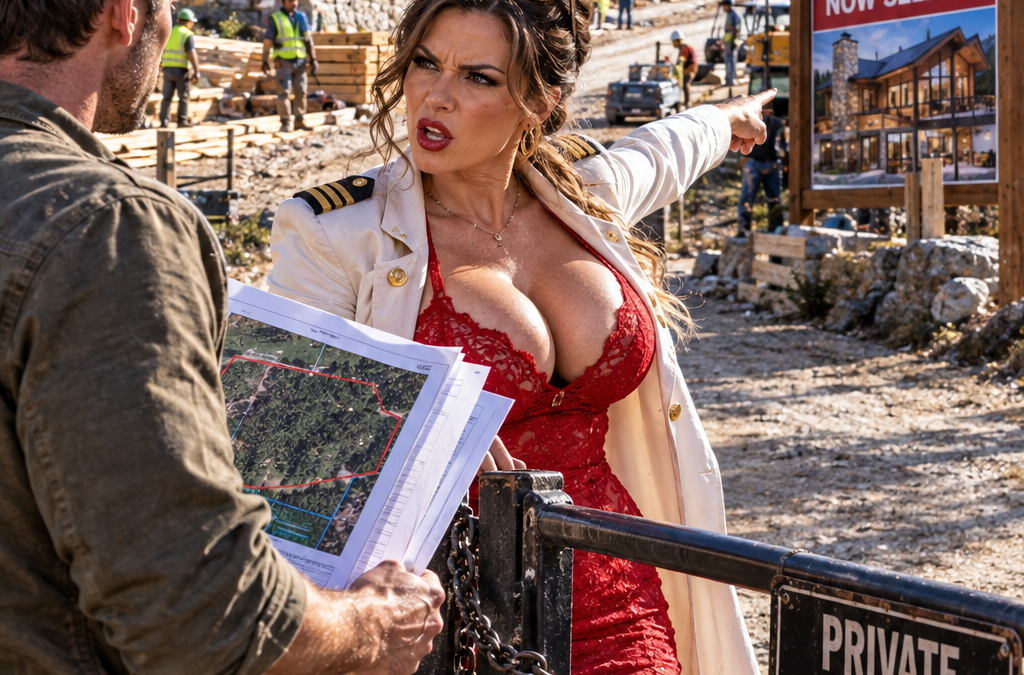
She said it from the other side of my gate as if announcing a law.
Behind her stretched a road that hadn’t existed six months earlier.
Beyond that road were rows of cedar-sided cabins with black metal roofs, stone fireplaces, wraparound decks, and floor-to-ceiling windows aimed toward the mountains.
Fifty of them.
Almost finished.
Built inside a forest my family had owned for decades.
I stared at Karen for a few seconds because I genuinely thought I had misunderstood her.
“The community owns what?”
She adjusted the sunglasses resting over her perfectly styled dark hair.
Karen was around forty and carried herself like she was permanently walking into a room where everyone had already agreed she was the most important person in it. She was beautiful, knew it, and weaponized that confidence constantly. Even standing at the edge of a construction site, she wore a fitted red lace dress beneath a cream-colored coat, the neckline low enough to attract attention and the expression on her face cold enough to make sure nobody confused attention with access.
“The cabins,” she said.
I looked past her again.
Then back at her.
“Those cabins are on my property.”
Karen smiled.
It wasn’t amusement.
It was contempt.
“No.”
“Yes.”
“This land is part of the HOA’s mountain expansion parcel.”
“No, it isn’t.”
She sighed dramatically.
“You’ve owned undeveloped acreage for years and apparently never bothered learning how subdivision boundaries work.”
That almost made me laugh.
I had owned those woods longer than Karen had lived anywhere near them.
My father and I had walked the eastern ridge when I was a teenager, following faded survey markers through pine and oak. I knew where the creek turned north. I knew where the granite outcrop marked the southern corner. I knew which old logging trail belonged to us and which one crossed county land.
I knew the forest.
Karen knew marketing brochures.
Still, she stood at my gate telling me I didn’t understand my own property.
I took one step closer.
“Who owns this land?”
Her smile thinned.
“The HOA controls this development.”
“That wasn’t my question.”
Several construction workers had stopped pretending not to listen.
Karen glanced toward them and raised her voice.
“The Maple Summit Homeowners Association has every legal right to develop community property.”
“Who owns the land?”
Her jaw tightened.
“You’re being deliberately difficult.”
“No. I’m asking a simple question.”
I pointed toward the nearest cabin.
“Whose name is on the deed beneath that building?”
For the first time, Karen didn’t answer immediately.
Then she crossed her arms.
“Our attorneys have reviewed everything.”
“Good.”
I nodded.
“Then you should have an easy answer.”
She stepped toward the gate.
“Let me make something very clear. You do not have authority to interfere with an HOA-approved development.”
There it was.
The tone.
The one every petty tyrant eventually used.
Not explanation.
Command.
“I don’t need HOA authority,” I said. “If that’s my land.”
Karen laughed.
Actually laughed.
“You think because your family owned some forest twenty years ago, you can walk in here and stop a thirty-million-dollar project?”
Thirty million.
That was the first time I heard the number.
It would matter later.
At the time, I just looked at the cabins.
Fifty high-end mountain homes.
Private roads.
Streetlights.
Utilities.
Landscaping.
A sales pavilion.
Someone had spent millions.
And apparently nobody had asked the question I had just asked Karen.
Who owned the dirt?
Karen lowered her voice.
“You should go home before you embarrass yourself.”
I smiled.
“I am home.”
That night, I pulled out the deed.
Not a photocopy.
Not a scanned digital record.
The original.
It had spent most of its life inside a fireproof document box in my study.
The paper was yellowing at the edges.
The legal description was old-fashioned and tedious, written through bearings, distances, landmarks and survey references most people would never bother reading.
I had read it many times.
But that night I read it differently.
Slowly.
Line by line.
Then I spread the old survey beside it.
The boundaries were unmistakable.
North line: the ridge.
West line: county forest.
South boundary: Old Mill Creek.
Eastern corner: iron pin beside the logging road.
I pulled up the modern parcel map.
Then satellite images.
Then photographs I had taken from the ridge.
My stomach tightened.
Every single cabin sat inside my boundary.
Not one or two.
All fifty.
The access road crossed my parcel.
The sales office sat on my parcel.
The model cabin sat on my parcel.
The landscaped entrance with the stone sign proclaiming MAPLE SUMMIT RIDGE sat on my parcel.
I leaned back in my chair.
For almost thirty years, I had left most of that forest untouched.
It wasn’t an investment to me.
It was land.
There is a difference.
My father believed trees needed time more than they needed owners.
We harvested selectively.
Maintained trails.
Kept hunters out unless they had permission.
Protected the creek.
After he died, I kept doing the same.
The HOA development had appeared gradually on the far side of the property, where thick woods and distance made construction difficult to see from my house.
By the time I realized how deep the crews had pushed into the forest, they had already built roads.
Then foundations.
Then frames.
Then fifty near-complete luxury cabins.
I should have been furious.
I was.
But beneath the anger was something colder.
Curiosity.
How does somebody build fifty houses on land they don’t own?
The next morning, I pulled every property record I had.
That was when the old survey showed me something even worse.
There had never been a transfer.
No sale to Maple Summit HOA.
No easement giving them development rights.
No quitclaim deed.
No recorded subdivision amendment.
No land contract.
Nothing.
The HOA had bought property east of mine several years earlier.
Their original development ended at a boundary that ran almost parallel to my forest.
At some point, someone had apparently decided the forest beyond that line was also theirs.
Maybe a map was misread.
Maybe someone made an assumption.
Maybe somebody knew exactly what they were doing and expected the owner of an undeveloped forest never to notice.
Whatever the reason, the result was the same.
They had never bought the building site.
And they were constructing fifty luxury cabins on it anyway.
My first instinct was to call a lawyer immediately and shut everything down.
Then I remembered Karen standing at my gate.
Thirty-million-dollar project.
You have no authority.
Our attorneys reviewed everything.
Go home before you embarrass yourself.
So I did something she would never have expected.
Nothing.
At least publicly.
The construction continued.
I watched.
I photographed.
I dated everything.
Every new roof.
Every utility connection.
Every retaining wall.
Every truck.
Every road crew.
I began driving the perimeter twice a week with a camera.
When I could legally observe from my own property, I did.
When I needed public records, I requested them.
Building permits.
Site plans.
Contractor filings.
Development brochures.
Marketing materials.
The more I collected, the stranger the situation became.
The HOA wasn’t behaving like an organization uncertain about title.
They were behaving like they owned the mountain.
Karen appeared in promotional photographs standing beside the entrance sign.
Maple Summit Ridge was advertised as an exclusive HOA-owned luxury expansion.
PRIVATE MOUNTAIN LIVING.
SECURE COMMUNITY.
PREMIER CABIN OWNERSHIP.
PANORAMIC FOREST VIEWS.
The irony would have been funny if they hadn’t cut down hundreds of my trees to create those views.
Prices started near half a million dollars.
Premium lots cost far more.
Several of the largest cabins were marketed at close to a million.
The HOA hosted a preview weekend.
Cars lined the new road.
Couples walked around holding brochures.
Real-estate agents opened doors.
Music played from speakers outside the sales pavilion.
Karen stood near the model cabin in another red dress, greeting buyers like she had personally created the mountains.
I watched from my side of the woods.
My lawyer would later ask why I didn’t stop them immediately.
The answer wasn’t revenge.
Not exactly.
I needed certainty.
Because once I made the accusation, there would be no going back.
If I was wrong, I would be the old landowner trying to sabotage a legitimate development.
If I was right, every additional document they created would show how recklessly they had proceeded.
So I let the paperwork grow.
Reservation agreements.
Purchase contracts.
Title orders.
Advertising disclosures.
HOA membership packets.
Closing schedules.
The whole machine kept moving.
One afternoon Karen saw me photographing the road.
She drove toward me in a white SUV and stopped so abruptly gravel sprayed toward my boots.
The window lowered.
“What are you doing?”
“Taking pictures.”
“You don’t have permission to photograph HOA property.”
I looked around.
“I’m standing on my land.”
“You’ve been told this area belongs to Maple Summit.”
“You told me that.”
“The board told you.”
“No. You told me.”
Her mouth hardened.
“You are harassing buyers.”
“I haven’t spoken to a single buyer.”
“You’re intimidating contractors.”
“I haven’t spoken to them either.”
“You’re creating a hostile environment.”
I almost smiled.
“By standing quietly with a camera?”
Karen leaned toward the window.
“This development is happening whether you like it or not.”
“I know.”
The answer confused her.
She expected argument.
“You know?”
“I can see that.”
“Then stop interfering.”
“I’m not interfering.”
“You’re documenting.”
“Yes.”
Her eyes narrowed.
“Why?”
I looked directly at her.
“Because someday somebody might want to remember how this happened.”
For a second, her confidence flickered.
Then she recovered.
“If you step onto an HOA construction area, I’ll have you removed for trespassing.”
That was almost too perfect.
“Trespassing?”
“Yes.”
“On whose land?”
Her face changed.
I asked again.
“Whose land, Karen?”
She drove away.
After that, things moved quickly.
The cabins reached completion.
Street numbers went up.
Decorative lanterns were installed.
Fresh mulch covered the scars where forest floor had been scraped away.
The sales campaign intensified.
The HOA announced that early demand had exceeded projections.
Karen posted online about Maple Summit’s “historic expansion.”
The board celebrated.
And buyers arrived.
Young couples.
Retirees.
Investors.
People looking for vacation homes.
People planning rental properties.
Families imagining Christmas in the mountains.
They walked through the cabins without knowing the one fact that mattered most.
The HOA couldn’t sell them the land underneath.
I felt sorry for the buyers.
They weren’t my enemy.
They were trusting paperwork presented by people who claimed to have authority.
That was exactly why I didn’t confront them individually.
I wasn’t going to stand outside a model home shouting that they were buying cabins built on stolen land.
That would have created chaos without resolving anything.
Instead, I recorded.
Dates.
Lot numbers.
Advertised prices.
Closing announcements.
Public sale records.
Every transaction added another layer.
Every signature tied another person to the same central question.
Who owned the property?
The first closing happened on a Thursday.
Then another.
Then four the next week.
One cabin after another changed hands.
The HOA celebrated each sale online.
SOLD.
SOLD.
SOLD.
Karen posed beside buyers holding oversized ceremonial keys.
At the annual meeting, she reportedly called Maple Summit Ridge “the greatest financial success in the association’s history.”
I wasn’t there.
I didn’t need to be.
Someone sent me the video.
Karen stood at the podium, glowing under applause.
“We were told this expansion was too ambitious,” she said. “We were told it couldn’t be done.”
I actually laughed at that part.
She had no idea how right she was.
By the time nearly every cabin had a buyer, I had enough.
I drove to the county records office.
The clerk at the counter was a woman named Ellen who had probably seen every kind of property dispute imaginable.
I handed her my parcel information.
“I need you to verify the current owner.”
She typed.
Waited.
Typed again.
Then looked at the screen.
“You.”
“Can you check the historical transfers?”
She did.
Nothing relevant.
“No conveyance?”
“Not that I’m seeing.”
I unfolded my survey.
She compared the legal description.
Then pulled up the current GIS map.
Her eyebrows drew together.
“What exactly am I looking for?”
I pointed.
“This development.”
She zoomed in.
Cabin outlines appeared.
Roads.
Parcel overlays.
She leaned closer.
Then checked again.
“Hold on.”
She disappeared into the back for several minutes.
When she returned, another employee came with her.
They compared the deed to the old survey.
Then to modern county mapping.
Then to recorded HOA parcels.
Ellen looked at me.
“Have you sold any portion of this?”
“No.”
“Granted a development easement?”
“No.”
“Signed a boundary adjustment?”
“No.”
She turned the monitor slightly.
“Then based on the recorded documents I’m looking at, the development appears to be inside your parcel.”
“Appears?”
“I’m being careful because I’m not your attorney.”
“Fair.”
“But I would strongly suggest you take these records to one.”
I had already called him.
His name was Daniel Price.
He practiced real-estate and land-use law and had handled boundary disputes before.
When I placed the documents across his conference table, he started calmly.
Then he got quieter.
That was what worried me.
Professionals become quiet when something is either very good or very bad.
He traced the survey boundary with his finger.
“All fifty?”
“As far as I can tell.”
He looked at the development map.
“They’ve sold these?”
“Most of them.”
His eyes lifted.
“You’re sure you never signed anything?”
“I’m sure.”
“Inherited encumbrances?”
“No.”
“Access agreement?”
“No.”
“Option contract?”
“No.”
He leaned back.
“This is not a small mistake.”
“I noticed.”
“How long have you known?”
“Long enough to document it.”
I gave him the folder.
He went through photographs.
Advertisements.
Closing dates.
HOA statements.
Emails.
Public permits.
Then he looked at me.
“You let them keep selling.”
“I let them keep making their own decisions.”
Daniel studied me for a second.
“Good distinction.”
He told me not to confront buyers.
Not to threaten anyone.
Not to touch any structures.
Not to block roads physically.
No emotion.
No dramatic stunts.
Just records.
Title.
Notice.
Procedure.
That afternoon, I drove back to Maple Summit Ridge.
Karen was at the sales pavilion.
A banner outside read FINAL HOMES AVAILABLE.
She saw my truck and came outside immediately.
“What now?”
“I need five minutes.”
“You’ve already wasted enough of this board’s time.”
“This won’t take five.”
She glanced toward buyers leaving the model home.
“Not here.”
“Fine.”
We moved toward the side of the building.
Karen crossed her arms.
“What do you want?”
I handed her a certified copy of my deed.
She glanced down.
Then back up.
“What is this?”
“My deed.”
“I know what a deed looks like.”
“Read the legal description.”
“I don’t have time for games.”
“Then look at the attached survey.”
She did.
Her expression barely changed at first.
Then she looked again.
The red drained from her face slowly.
“What is this supposed to prove?”
“That you built fifty cabins inside my property line.”
“No.”
“Yes.”
“No, our survey—”
“Show me.”
She stopped.
“Show you what?”
“The deed transferring this land to the HOA.”
“Our attorney has that.”
“Good. Call him.”
Her voice sharpened.
“You do not come into my development and issue demands.”
“Your development?”
“Yes.”
I pointed at the ground.
“This dirt belongs to me.”
“You are being ridiculous.”
“Then prove me wrong.”
She looked toward the sales pavilion.
For the first time, I noticed uncertainty.
Not guilt.
Not yet.
Fear.
“Where did you get this?”
“My safe.”
“This survey could be outdated.”
“The county confirmed the current record this morning.”
That hit her.
“The county?”
“Yes.”
Her voice dropped.
“You went to the county without notifying us?”
I nearly laughed.
“I didn’t realize I needed HOA permission to verify my own deed.”
“You are intentionally creating a title dispute.”
“No, Karen.”
I stepped closer.
“You created a title dispute when you sold buildings sitting on land you never bought.”
Her eyes flashed.
“You need to leave.”
“Gladly.”
She pointed at me.
“If you contact any buyers, I will sue you for interfering with contractual relationships.”
“I haven’t contacted a single buyer.”
“You’d better not.”
“I don’t need to.”
I tapped the deed.
“The records will.”
I left.
The HOA emergency meeting happened that evening.
I wasn’t invited.
That didn’t stop half the neighborhood from telling me about it afterward.
Karen reportedly arrived furious.
Not frightened.
Furious.
She blamed the developer.
The developer blamed the surveyor.
The surveyor blamed the plans he had been given.
The board blamed its attorney.
The attorney asked for the deed.
Then another deed.
Then the historical parcel maps.
Then the closing records.
Hours passed.
Nobody found what they needed.
Because the document they needed did not exist.
There was no transfer.
No recorded purchase.
No legal conveyance giving Maple Summit ownership of my forest.
At some point, according to one board member who later spoke to my attorney, Karen slammed both palms on the table.
“There has to be something.”
There wasn’t.
“Find it.”
They couldn’t.
“The owner must have signed something.”
I hadn’t.
“Then challenge the survey.”
They did.
It matched.
“Challenge the deed.”
They did.
The chain of title held.
“Claim adverse possession.”
Their lawyer reportedly told them to stop talking.
For eleven years, Karen had apparently run that HOA by turning every problem into an order.
Fine somebody.
Threaten somebody.
Send a notice.
Call a meeting.
Change a rule.
Demand compliance.
Property law didn’t care about her tone.
The following morning, Daniel and I started organizing formal action.
We created a clean timeline.
My original deed.
Historical surveys.
County parcel records.
Building permits.
The development plan.
HOA advertisements.
Sale listings.
Recorded closing documents.
Photographs from construction.
Everything.
Daniel pointed at the stack.
“This is why you don’t argue at gates.”
I smiled.
“What do you do?”
“You let documents argue.”
Formal notices went out.
To the HOA.
The developer.
The management company.
Relevant title companies.
Attorneys.
Every party connected to the project received essentially the same message.
The land beneath Maple Summit Ridge was owned by me.
No conveyance to the HOA could be found.
No ownership transfer existed in the county record.
No sale contract from me existed.
No authorization to construct had been granted by me.
The effect was immediate.
The remaining closings stopped.
Title companies began reviewing files.
Attorneys started calling attorneys.
Buyers started calling everyone.
And for the first time since the project began, Karen lost control of the story.
She tried anyway.
Of course she did.
The HOA sent residents a carefully worded statement describing the situation as “an unexpected historical boundary discrepancy.”
Historical boundary discrepancy.
I had to admire the phrase.
Fifty luxury cabins had been built on somebody else’s land and Karen made it sound like a fence post was two inches out of place.
Then buyers learned the truth.
Not all at once.
But quickly.
A title company requested clarification.
Someone forwarded the notice.
Another buyer checked county records.
Then the calls began.
“What do you mean we don’t own the land?”
“Did the HOA know?”
“Can we live in the cabin?”
“Is the sale valid?”
“Who owns the lot?”
“Why wasn’t this disclosed?”
“Who approved construction?”
Karen couldn’t answer those questions with a clipboard.
The sales pavilion closed temporarily.
The FINAL HOMES AVAILABLE banner disappeared.
The celebratory social-media posts stopped.
The HOA board called another emergency meeting.
This one was packed.
Cabin buyers showed up.
Existing homeowners showed up.
Attorneys showed up.
I attended with Daniel.
When Karen saw me enter, her face tightened.
She took the microphone before the meeting officially began.
“This situation has been intentionally exaggerated by an individual seeking leverage over the association.”
Daniel whispered beside me.
“Don’t respond.”
I didn’t.
Karen continued.
“The board acted in good faith based on professional surveys and development approvals.”
A buyer stood.
“Do you own the land?”
Applause broke out immediately.
Karen raised her voice.
“Please sit down.”
“Do you?”
“This is a complicated title issue.”
“It’s a yes-or-no question.”
“Sit down!”
The room erupted.
Another buyer stood.
“I paid seven hundred thousand dollars for a cabin you told me came with the lot.”
Karen banged her gavel.
“We cannot discuss individual transactions.”
“You discussed my transaction when you took my money!”
More shouting.
Karen’s face turned red.
“This meeting will come to order!”
Nobody cared.
The authority she had relied on suddenly looked very small against fifty frightened buyers and a stack of deeds.
Finally Daniel stood.
He didn’t raise his voice.
“My client is not attempting to seize anyone’s cabin.”
The room quieted slightly.
“He is not responsible for the contracts the HOA entered.”
Karen interrupted.
“You don’t have the floor.”
Daniel looked at her.
“I’m speaking because you have repeatedly mischaracterized my client’s position.”
“I said you don’t have the floor.”
One buyer shouted, “Let him talk!”
Then another.
Within seconds, the room turned against Karen again.
Daniel continued.
“My client has one demand at this stage: recognition of his property rights.”
Simple.
That was always the point.
I didn’t want their cabins.
I didn’t want buyers thrown out onto the street.
I didn’t want the HOA’s money.
I wanted my forest recognized as mine.
The mess created by the buildings and sales belonged to the people who had created it.
Karen tried one final time to frame me as greedy.
“So what does he want?” she snapped. “Thirty million dollars? Forty?”
I stood.
“No.”
She stared at me.
“What, then?”
“My land.”
“You expect us to move fifty cabins?”
“I expect you to stop pretending you own something you never bought.”
Her voice rose.
“This project represents years of work!”
“On my property.”
“Millions of dollars!”
“On my property.”
“Families have purchased homes!”
“From you.”
That stopped her.
The room went silent.
I continued.
“I didn’t sell these people anything.”
Karen’s face tightened.
“I didn’t advertise these cabins.”
She looked away.
“I didn’t sign their contracts.”
Nobody spoke.
“I didn’t tell buyers the HOA owned the land.”
I pointed toward her.
“You did.”
For months, Karen had been waiting for me to become emotional enough that she could call me unreasonable.
Instead, I gave her the one thing she couldn’t argue with.
Responsibility.
The legal review continued.
It wasn’t glamorous.
There were no dramatic midnight demolitions.
Nobody arrived with bulldozers.
No judge handed me fifty houses.
Real property disputes don’t resolve like that.
They resolve through records, notices, negotiations and people discovering that signatures cannot create ownership where none existed.
The title issue froze the HOA’s dream almost overnight.
The project stopped functioning as a normal development.
Remaining sales were halted.
Buyers hired independent counsel.
Insurers reviewed exposure.
Board members distanced themselves from Karen’s decisions.
The developers produced every contract they had been given.
Again and again, everyone came back to the same missing document.
Where was the deed giving Maple Summit the land?
There wasn’t one.
Karen eventually stopped appearing at the sales pavilion.
The red dresses disappeared from promotional photographs.
The HOA removed language describing the forest as association-owned.
Their lawyers became much more careful.
Mine didn’t need to become louder.
The documents were doing enough.
Weeks later, I walked the development with Daniel and a surveyor.
Official markers had been flagged along the old boundary.
The cabins stood exactly where the original deed said they shouldn’t.
A few owners watched from porches.
I felt no satisfaction looking at them.
They had been sold a promise by people who never verified whether they owned the thing they were promising.
One man approached me cautiously.
“Are you the landowner?”
“Yes.”
He looked toward his cabin.
“My wife and I used our retirement savings for this.”
I nodded.
“I’m sorry.”
“You’re not trying to take our house?”
“No.”
“Then what happens?”
“That’s being worked out.”
He looked exhausted.
“Did they really never own this land?”
I looked toward the survey flag.
“They never bought it from me.”
He stared down.
Then he shook his head.
“That’s unbelievable.”
“No.”
I looked toward the rows of cabins.
“That’s the problem.”
“It was believable enough that nobody checked.”
That became the part I thought about most afterward.
The HOA had wanted those fifty cabins to generate around thirty million dollars in sales.
The buildings looked impressive.
The brochures looked professional.
The roads looked permanent.
Everything about the project looked legitimate.
And because it looked legitimate, people assumed the foundation beneath it—legally and literally—must be legitimate too.
Nobody asked the oldest question in property law.
Who owns the land?
Karen had stood at my gate and treated that question like an insult.
In the end, it was the only question that mattered.
The HOA’s attorneys could argue about construction contracts.
Buyers could argue over disclosures.
Title companies could argue over coverage.
The board could argue over who approved what.
But none of those arguments changed my deed.
The forest had never been conveyed.
The legal boundary never moved.
The HOA had built an entire luxury community on the assumption that nobody would check.
Eventually, they did.
And once they did, Karen’s thirty-million-dollar success story became a thirty-million-dollar title problem.
I never signed over the property.
I never agreed that the HOA owned it.
I never accepted their version of events simply because they had already spent millions believing it.
The cabins remained somebody else’s problem to untangle.
The land did not.
The record recognized what had been true all along.
The forest was mine.
Months later, I stood near the ridge where my father had once shown me the survey marker buried beside an old pine.
The marker was still there.
Rusty.
Ugly.
Almost invisible beneath leaves.
I brushed the dirt away with my boot.
Farther down the slope, fifty luxury cabins stood between trees the HOA had somehow convinced itself it owned.
I could hear voices from one of the decks.
A truck moved slowly along the private road.
Nothing about the view looked like it had decades earlier.
Too many trees were gone.
Too much had been built.
I couldn’t undo that.
But for the first time since discovering the development, I didn’t feel as though I was standing inside somebody else’s project.
I was standing on my property.
There is a strange arrogance in believing money can turn an assumption into ownership.
Karen believed that if the HOA built fast enough, sold quickly enough and invested enough money, reality would eventually have to accommodate them.
Fifty cabins.
Millions of dollars.
Contracts.
Advertising.
Buyers.
Celebrations.
She thought all that weight could crush one old deed.
It couldn’t.
Because ownership does not come from confidence.
It doesn’t come from a board vote.
It doesn’t come from a sales brochure.
It doesn’t come from an HOA president declaring, “This belongs to the community.”
It comes from title.
Karen’s biggest mistake wasn’t that her HOA built fifty luxury cabins in my forest.
It wasn’t even that they tried to sell them.
Their biggest mistake happened before the first tree was cleared.
Before the first foundation was poured.
Before the first buyer signed anything.
They never checked who owned the land.
I did.
And in the end, that one piece of paper was stronger than fifty cabins, an entire HOA board and a thirty-million-dollar dream built on property that had never belonged to them.








