The HOA Brought an Excavator to Tear Down My Grandfather’s Shelter—Then the Bucket Unearthed the Boundary Marker They Never Wanted Found
The HOA Brought an Excavator to Tear Down My Grandfather’s Shelter—Then the Bucket Unearthed the Boundary Marker They Never Wanted Found
The excavator bucket was already hanging over my grandfather’s shelter when I realized Linda Carver had brought an entire demolition crew onto my land without my permission.
Not one contractor.
Not a maintenance guy with a clipboard.
A demolition crew.
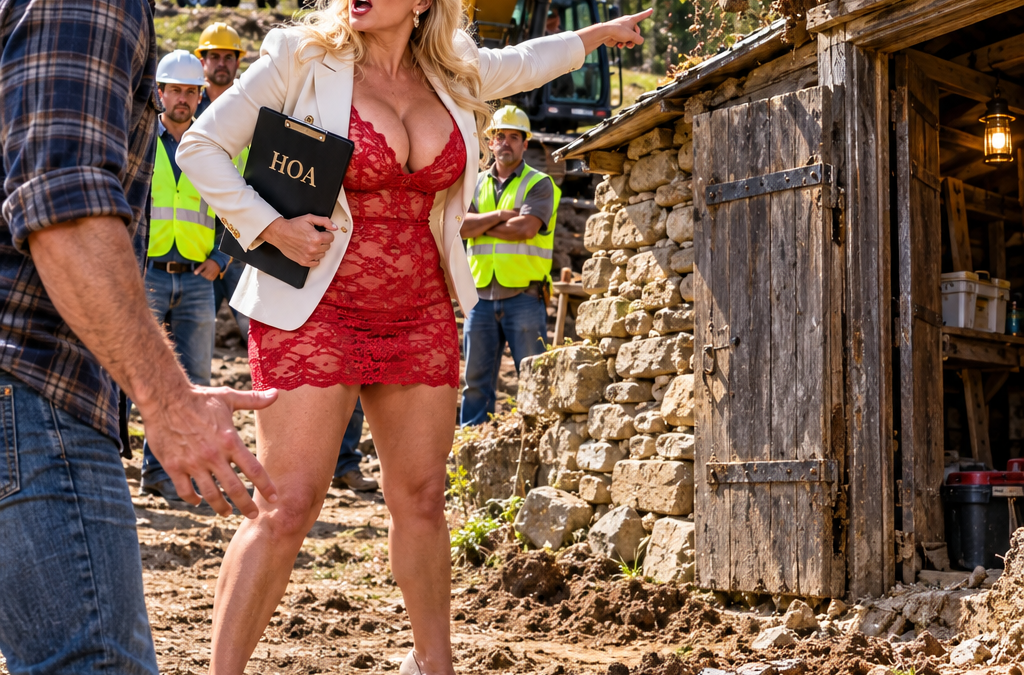
There were two pickup trucks parked along the gravel access road, a flatbed trailer carrying equipment, four workers in reflective vests, and a yellow excavator idling twenty feet from the structure my grandfather had built with his own hands more than fifty years earlier.
And standing beside it all was Linda.
Forty years old.
Blonde.
Perfect makeup.
A fitted red lace dress beneath a cream blazer despite the dirt, mud, and diesel fumes surrounding her.
One hand rested on her hip.
The other held the black HOA clipboard she seemed to carry everywhere.
She looked less like someone about to destroy another family’s property and more like she was supervising the installation of expensive landscaping at a country club.
I stopped my truck in the middle of the drive and stared through the windshield.
For a few seconds, I honestly couldn’t process what I was seeing.
Then the excavator engine revved.
I got out.
“What the hell are you doing?”
Every head turned.
Linda didn’t flinch.
If anything, she smiled.
“Good morning, Ryan.”
That was the first warning.
Linda only used my first name when she wanted everyone nearby to think we were having a reasonable conversation.
I walked toward her.
The shelter sat behind her, half buried into the slope beneath a line of old hardwood trees.
It wasn’t pretty in the modern sense.
Weathered timber.
Fieldstone.
A corrugated roof my father and I had replaced fifteen years earlier.
A heavy wooden door my grandfather had made himself.
But it belonged there.
It had always belonged there.
My grandfather, Samuel Bennett, built it in the early 1970s when the property was still mostly wooded farmland.
He used it first as a storm shelter and storage room.
Later, it became a place where three generations stored tools, canned food, old hunting equipment, family documents, and things nobody had the heart to throw away.
As a kid, I thought it was the most mysterious place in the world.
Granddad kept an old battery lantern hanging beside the door.
There were nails hammered into the wall for shovels.
A wooden bench scarred by decades of work.
His initials were carved into one support beam.
S.B. 1972.
My father never painted over them.
Neither did I.
And now Linda had an excavator pointed at it.
I stopped ten feet from her.
“Why is there heavy equipment on my property?”
Linda gave the smallest sigh.
“Ryan, we’ve already been through this.”
“No, we haven’t.”
“The association notified you.”
“You sent me a violation letter.”
“Correct.”
“A violation letter is not permission to bring a demolition crew onto my land.”
Her smile hardened.
“The board has determined that this structure sits within a community-controlled parcel.”
“No, it doesn’t.”
“Yes, it does.”
I pointed toward the shelter.
“My grandfather built that before your HOA existed.”
“Age does not establish ownership.”
“Neither does your clipboard.”
One of the workers glanced down.
Linda noticed.
Her eyes sharpened.
“You need to calm down.”
I almost laughed.
“You brought an excavator onto my property before eight in the morning.”
“Because you refused voluntary compliance.”
“Voluntary compliance with what?”
“Removal of an unauthorized structure.”
“It’s not unauthorized.”
“Our records say otherwise.”
“My deed says otherwise.”
Linda stepped closer.
“Your grandfather’s paperwork is not necessarily controlling.”
“My grandfather’s deed is recorded.”
“So are HOA plats.”
“Then show me where the HOA owns this hill.”
“I don’t need to stand in the dirt and conduct a title seminar with you.”
I looked toward the excavator operator.
“Shut that machine down.”
Linda turned sharply.
“Do not take instructions from him.”
The operator hesitated.
I stared at her.
“Excuse me?”
She raised her voice so the entire crew could hear.
“The homeowners association has authorized demolition. Continue.”
I stepped between the excavator and the shelter.
“No.”
Linda looked at me as though I’d just insulted her in front of a ballroom full of guests.
“Move.”
“No.”
“You are obstructing authorized work.”
“You’re trespassing.”
“This land belongs to the community.”
“Then call the sheriff and prove it.”
Her jaw tightened.
“Ryan, you’re making this much more difficult than it needs to be.”
“No. You are standing on my family’s land ordering strangers to destroy something my grandfather built.”
“This sentimental performance isn’t going to change the property map.”
“Good.”
I pointed toward my house.
“Then you won’t mind waiting while I get the deed.”
Linda looked at her watch.
“The crew is on a schedule.”
“I don’t care.”
“The HOA is paying by the hour.”
“Not my problem.”
She smiled.
There was no warmth in it.
“You’ve used that phrase before.”
“I learned it from you.”
For the first time, her expression slipped.
That was how things had worked with Linda for the previous year.
Everything was reasonable when she demanded it.
Everything was confrontational when you challenged it.
She had been president of Ridgeview Estates HOA for almost nine years, and somewhere during that time she’d stopped thinking of herself as a board member.
Linda believed she was the neighborhood.
The rules.
The authority.
The final answer.
Most homeowners had learned to avoid becoming interesting to her.
I hadn’t.
My problem started with the shelter three months earlier.
The HOA had announced a “greenway improvement project” along the wooded ridge behind our neighborhood.
New walking path.
Decorative benches.
Drainage work.
A small overlook.
On paper, it sounded harmless.
Then I saw the project map.
The proposed path crossed part of the hillside that had belonged to my family since before Ridgeview Estates was built.
I emailed Linda.
Her response came eleven minutes later.
The project area is HOA common property.
I replied with the parcel number from my deed.
No answer.
Three days later, I received a violation notice.
UNAUTHORIZED STRUCTURE WITHIN COMMON AREA.
My grandfather’s shelter.
According to Linda, the building interfered with the planned greenway and had never been approved by the HOA.
I actually laughed when I read it.
The shelter was older than the association.
Older than most of the houses.
Probably older than Linda.
I emailed photographs showing the structure in family albums from decades earlier.
Linda responded:
Historical existence does not establish continuing authorization.
That sentence told me everything I needed to know.
She wasn’t trying to find the truth.
She was trying to find language that sounded official enough to end the discussion.
I requested the HOA’s survey.
She sent me a simplified development map.
Not a recorded survey.
Not a title plat.
A glossy color map showing landscaping zones, walking trails, and common areas.
The boundary line ran directly through the hillside behind the shelter.
I replied:
This conflicts with my recorded deed description.
Linda answered:
The board recognizes the association map as controlling for community purposes.
I read that twice.
Then a third time.
A community map doesn’t overwrite a deed.
I wasn’t a surveyor, but I knew enough about property to understand that.
I called her.
“Your map doesn’t match the legal description.”
“Ryan, we’re not reopening decades-old boundaries because you dislike a walking path.”
“This isn’t about a walking path.”
“Then what is it about?”
“My land.”
She laughed.
Softly.
Condescendingly.
“Everyone thinks a little piece of grass is sacred when the HOA needs it.”
“My grandfather paid for that land.”
“Your grandfather is not the current board.”
I went quiet.
She must have heard something change in my voice because she added quickly:
“Don’t become emotional.”
That sentence stayed with me.
My grandfather wasn’t the current board.
As though nine years as HOA president gave her more authority over the land than the man who bought it, fenced it, worked it, paid taxes on it, and passed it down through my family.
I stopped calling her.
From then on, I put everything in writing.
That made her angrier.
The violation became a fine.
Then another.
Then a “final compliance demand.”
She claimed I was blocking a community improvement project.
I claimed the HOA was attempting to build on private property.
She called me obstructionist.
I called the county recorder.
The county records supported my parcel.
But there was a complication.
The oldest deeds used boundary descriptions tied to natural landmarks.
A ridge.
A stone marker.
A creek bend that had shifted over the decades.
The modern subdivision map didn’t perfectly overlay those descriptions.
That ambiguity was exactly what Linda exploited.
She acted as though uncertainty belonged to whoever spoke loudest.
And Linda always spoke loudest.
At a board meeting, she projected the greenway map onto a screen.
My shelter appeared as a little square directly in the proposed construction zone.
“Mr. Bennett has refused repeated requests to remove this obsolete structure.”
I stood.
“Because it’s on my property.”
Linda didn’t look at me.
“The board has reviewed the matter.”
“What surveyor reviewed it?”
She paused.
“We have professional planning documents.”
“What surveyor?”
“The association’s development map—”
“That’s not a survey.”
She finally looked at me.
“You are not recognized.”
I stared.
“What?”
“You haven’t been recognized by the chair.”
“You’re talking about my property.”
“This is a formal meeting.”
“So recognize me.”
Several homeowners laughed nervously.
Linda’s face tightened.
“Mr. Bennett, sit down.”
I remained standing.
“Show everyone the recorded boundary.”
She slapped the table.
“Sit down.”
The room went silent.
There it was.
Not discussion.
Control.
I sat because I wanted her outburst remembered more than mine.
Afterward, an older neighbor named Frank stopped me outside.
“She’s coming for that shelter.”
“I know.”
“You think she’d actually tear it down?”
I looked toward Linda’s car.
“Three months ago, I would’ve said no.”
“And now?”
“Now I think she’d bulldoze my garage if she thought everyone would watch.”
The next morning, a demolition authorization notice was taped to my mailbox.
Not my door.
My mailbox.
A public display.
Linda wanted neighbors to see it.
The letter stated that if I failed to remove the shelter within ten days, the HOA would arrange removal and assess the cost against me.
I sent a certified response denying access to my property.
I included the deed.
Parcel information.
Historical photographs.
County tax records.
Everything I had.
Linda responded with two sentences.
The board rejects your claim. Unauthorized access restrictions will not impede lawful HOA operations.
I forwarded that to an attorney.
Her name was Priya Shah.
She read the correspondence.
Then called me.
“Do not let them demolish anything.”
“That’s my plan.”
“Get a survey.”
“I’m trying.”
“How fast?”
“The surveyor I want is booked.”
“Then find another licensed surveyor who understands historical descriptions.”
“I’m working on it.”
Priya paused.
“Ryan, Linda’s behavior worries me.”
“Join the club.”
“I’m serious.”
“So am I.”
“If she believes the HOA map gives her authority, she may act first and force you to fight afterward.”
That prediction came true six days later.
No final warning.
No court order.
No sheriff.
No survey.
Just engines outside my house before breakfast.
I was pouring coffee when I heard diesel machinery.
By the time I drove around the side access lane, Linda’s demolition crew was already there.
And now I stood between her and the shelter while the excavator idled.
“I’ll be right back,” I said.
Linda checked her watch.
“You have five minutes.”
“You don’t control my time.”
“I control this project.”
I looked directly at her.
“No. You think you do.”
Her smile vanished.
I went inside.
The original property documents were in a fireproof box my father had given me years earlier.
Old deeds.
Tax receipts.
Survey notes.
Handwritten descriptions.
My grandfather saved everything.
He distrusted banks, contractors, government offices, and anyone who said, “Don’t worry, we’ll have a copy.”
When I was a teenager, I teased him about it.
He tapped the side of that metal box.
“Paper remembers when people don’t.”
I thought about that sentence while I carried the documents outside.
Linda had moved closer to the excavator.
The operator had started repositioning the bucket.
“Stop.”
He looked at me.
Linda said:
“Proceed.”
I opened the deed.
“Listen to me. The original boundary description runs from the old stone marker north of the creek to the ridge behind the shelter.”
Linda barely glanced at it.
“Obsolete language.”
“It’s recorded language.”
“Natural features change.”
“Stone markers don’t.”
“According to you.”
“According to the deed.”
She turned toward the crew.
“Continue.”
I stepped closer.
“You haven’t even verified the marker.”
“The HOA map has been used for years.”
“That doesn’t make it correct.”
“It makes it relied upon.”
“Reliance doesn’t create ownership.”
She smiled again.
“You’re not an attorney.”
“No.”
I held up my phone.
“But mine is already aware you’re here.”
That made her hesitate.
Only for a second.
Then she recovered.
“If your attorney wants to file something, she can.”
“Stop the work until the boundary is confirmed.”
“No.”
“Linda.”
“No, Ryan.”
She stepped close enough that only I could hear her.
“You’ve embarrassed me for three months over a rotting shack.”
My stomach tightened.
“So that’s what this is.”
Her eyes flashed.
“This is about compliance.”
“You just called my grandfather’s shelter a rotting shack.”
“It is.”
“And you’re tearing it down because I challenged you.”
“I’m tearing it down because you refused to learn who makes decisions here.”
That sentence hit me harder than anything else she’d said.
I looked at the doorbell-style camera I’d mounted on the side of the house weeks earlier.
It was recording.
Linda followed my eyes.
Her face changed.
Then she turned away.
“Start.”
The excavator moved.
I shouted.
“STOP!”
The operator hesitated.
Linda pointed toward the shelter.
“You have written authorization.”
“From the HOA,” I said. “Not the property owner.”
The operator looked uncomfortable.
“I was told this was association land.”
“It isn’t.”
Linda snapped:
“He’s been disputing this for months. The board resolved it.”
The bucket lowered.
My heart began pounding.
I called Priya.
Straight to voicemail.
I left a message.
“They’re here. Excavator is moving. Linda refuses to stop.”
Then I started recording on my phone.
The bucket scraped into the hillside.
Soil rolled away.
The shelter had been built partly into the slope, using the earth itself for insulation.
The crew began clearing around it to access the foundation.
I heard wood crack.
Not loudly.
But enough.
I knew that sound.
One of the old support members had shifted.
“STOP!”
The operator raised the bucket.
I ran closer.
A timber near the exterior frame had split where soil had been removed too aggressively.
I stared at it.
My grandfather had cut that piece.
I remembered tracing the saw marks with my fingers when I was nine.
Linda walked up behind me.
“Structures sometimes sustain incidental damage during removal.”
I turned.
“Removal?”
She folded her arms.
“That’s why we’re here.”
“You’re standing there watching them destroy something that existed before your HOA.”
“It should’ve been removed years ago.”
“Why?”
“Because it interferes with community plans.”
“No.”
I stepped toward her.
“Because I told you no.”
She didn’t answer.
I could see it in her face.
That was exactly why.
The operator called out.
“Hold up.”
Everyone turned.
He climbed down.
“What?”
He pointed toward an exposed section of earth several feet behind the shelter.
“There’s something buried here.”
Linda sighed.
“Debris?”
“No.”
The operator crouched.
He brushed away dirt with a gloved hand.
A pale gray surface appeared.
Stone.
Not random rock.
Cut stone.
Squared edges.
Weathered.
We gathered around.
More dirt came away.
Then I saw a carved marking.
A shallow cross.
Numbers.
My skin went cold.
I opened my grandfather’s deed.
The boundary description mentioned a stone survey marker near the lower ridge.
I read it aloud.
“Beginning at the marked stone below the eastern ridge…”
Linda looked at the stone.
Then at me.
“That could be anything.”
I almost laughed.
“It could be the boundary marker.”
“Or an old landscaping stone.”
“With survey markings?”
“People carved all kinds of things.”
The operator looked at her.
“Ma’am, that doesn’t look decorative.”
Linda snapped:
“Nobody asked you.”
His expression changed.
I took photographs.
Close.
Wide.
Position relative to the shelter.
Position relative to the ridge.
I called the surveyor Priya had recommended.
His name was Michael Grant.
Licensed.
Forty years in the business.
I explained what we’d uncovered.
He asked me to read the deed description.
Then he said:
“Don’t let anybody move that stone.”
I looked at Linda.
“Surveyor’s coming.”
“Work continues.”
“No.”
“We are not paying a crew to stand around because you found a rock.”
“It’s a potential monument.”
“Our map is clear.”
“Then you’ll have nothing to worry about.”
She stepped toward the excavator.
I moved in front of her.
“Nobody touches anything until the surveyor gets here.”
Her voice dropped.
“Move.”
“No.”
“You don’t understand how much trouble you’re creating.”
“You brought a bulldozer to my family property.”
“It’s an excavator.”
“Thank you for the technical correction.”
Her cheeks flushed.
“If you interfere with HOA contractors, I’ll have your legal expenses added to the assessment.”
“Do it.”
“I’ll fine you.”
“Do it.”
“I’ll lien the property.”
“Do it.”
That stopped her.
Because fear only works while the other person is trying to avoid consequences.
At that moment, I was done avoiding them.
“Call whoever you want,” I said. “But that machine doesn’t move until a licensed surveyor looks at that marker.”
Linda stared at me.
Then she turned to the crew.
“Break.”
Michael arrived forty-five minutes later.
Old pickup.
Orange vest.
Survey equipment.
No drama.
No intimidation.
He shook my hand.
Then looked toward Linda.
“Who represents the HOA?”
She stepped forward immediately.
“I do.”
“Property owner?”
I raised my hand.
Michael nodded.
“Nobody gives me conclusions until I ask. Show me the documents.”
I handed him the original deed copies.
Linda produced the HOA map.
Michael looked at hers first.
Then at mine.
Then back at hers.
“This isn’t a boundary survey.”
“It’s the official community construction map.”
“That’s not what I asked.”
Her expression tightened.
“It has been relied upon for years.”
Michael shrugged.
“Doesn’t make it a survey.”
I almost smiled.
Linda noticed.
“Mr. Grant, the association has already approved this project.”
“Congratulations.”
He unfolded my grandfather’s description.
“I’m here to locate a boundary.”
He inspected the stone.
Measured dimensions.
Cleaned one side carefully.
Photographed the marking.
Then started setting up equipment.
Linda followed him.
“How long will this take?”
“As long as it takes.”
“We have contractors waiting.”
“Then you should’ve surveyed before bringing contractors.”
Frank had arrived by then.
He stood beside me.
“I like this guy.”
“So do I.”
Michael began working from the stone.
He checked the ridge.
The surviving fence remnants.
Old reference points.
A second marker near the tree line.
The creek description.
Coordinates from modern records.
He went back and forth repeatedly.
Linda grew increasingly impatient.
“This is ridiculous.”
Michael didn’t look up.
“What is?”
“You’re giving ancient paperwork precedence over the HOA’s established map.”
“Yes.”
She blinked.
“Why?”
“Because recorded boundaries don’t move just because somebody drew a prettier map.”
Frank coughed into his hand to hide a laugh.
Linda glared at him.
“You think this is funny?”
Frank shook his head.
“No, ma’am. I think it’s expensive.”
The surveyor continued.
Then something changed.
I saw it before he spoke.
He stood beside the total station, looked at his notes, then turned toward the HOA’s stakes.
He walked to one.
Then another.
Then back toward the shelter.
His expression wasn’t confused anymore.
It was concerned.
“What?” I asked.
He pointed.
“Who placed those construction stakes?”
Linda answered.
“Our contractor.”
“Based on this map?”
“Yes.”
Michael nodded slowly.
“That’s a problem.”
My heartbeat quickened.
“How big?”
He pointed toward the hillside.
“The actual boundary runs several yards east of where they’re showing it.”
I looked at the shelter.
“Meaning?”
“Meaning this structure is inside your family’s parcel.”
Linda laughed sharply.
“No.”
Michael looked at her.
“Yes.”
“You’ve been here less than an hour.”
“And?”
“The association has used this map for years.”
“I don’t care if you’ve framed it in the clubhouse.”
Her face went red.
“You’re making a serious accusation.”
“I’m making a measurement.”
He walked toward the exposed stone.
“This monument aligns with the deed description.”
Then he pointed toward the ridge.
“That reference fits.”
Another direction.
“Secondary markers fit.”
He tapped his field notebook.
“And the distances reconcile.”
I stared at Linda.
“Stop the demolition.”
She held up one hand.
“We are not accepting preliminary field opinions.”
Michael looked at her.
“Then don’t.”
He turned to the excavator operator.
“I strongly recommend no further disturbance until the boundary is resolved.”
Linda stepped forward.
“You work for him.”
“No.”
“He called you.”
“He will pay the invoice. That doesn’t change where monuments sit.”
“I’ll hire another surveyor.”
“You’re free to.”
“One who understands modern community planning.”
Michael actually laughed.
“Property lines don’t modernize because an HOA doesn’t like them.”
That was when he noticed something else.
He walked farther downslope.
Past the shelter.
Toward the construction area Linda’s crew had already cleared for the greenway extension.
He checked another measurement.
Then another.
“What now?” Linda demanded.
Michael didn’t answer immediately.
He moved one stake.
Looked through the instrument.
Walked toward a large oak.
Then called me.
“Ryan.”
I went over.
He showed me the old deed sketch.
“Your grandfather’s parcel ends here.”
He pointed.
“Okay.”
“But this adjoining historic parcel starts along this line.”
“Whose?”
“According to the older descriptions, it’s separate.”
I looked toward the HOA construction zone.
Several freshly graded yards extended across it.
Michael followed my gaze.
“Exactly.”
The realization came slowly.
“The HOA project crossed another boundary.”
“Looks that way.”
Linda marched over.
“What are you two whispering about?”
Michael faced her.
“Your construction zone appears to cross a second historic property boundary.”
Her expression froze.
“No.”
“Yes.”
“The HOA owns the entire greenway.”
“Not according to these descriptions.”
“That’s impossible.”
“Why?”
“Because we’ve maintained it for years.”
“Maintenance isn’t ownership.”
“We mow it.”
“Congratulations again.”
Frank turned away so Linda wouldn’t see him laughing.
She pointed at Michael.
“You are obviously biased.”
He stared at her.
“Ma’am, I find lines. I don’t care who likes where they land.”
“This development was professionally planned.”
“Then somebody should be able to produce the recorded survey supporting your map.”
Linda looked toward the board member who had arrived with her.
He looked away.
Michael continued.
“Until that happens, nobody should move another shovel of dirt in this area.”
The excavator shut down.
The engine wound down slowly.
Then stopped.
Silence spread across the hillside.
Birds.
Wind in the trees.
No diesel.
No scraping metal.
For the first time that morning, my grandfather’s shelter sat quietly again.
Damaged.
Partially exposed.
But standing.
Linda looked at the crew.
“You’re not leaving.”
The supervisor removed his gloves.
“We’re not touching a disputed property line.”
“The HOA hired you.”
“And your contract says you provide lawful site access.”
Her face hardened.
“I am telling you we have lawful access.”
He pointed toward Michael.
“He’s telling me maybe you don’t.”
“He’s one surveyor.”
“One more than you brought.”
That landed.
Linda’s mouth tightened.
She looked at me.
“This isn’t over.”
“I know.”
“You think finding an old rock gives you ownership?”
“No.”
I held up the deed.
“This does.”
She stepped closer.
“Be very careful, Ryan.”
I smiled.
“You brought an excavator onto my property this morning.”
“I’m done being careful with you.”
Priya arrived that afternoon.
The moment she saw the damaged support timber, her expression changed.
“Did they do that?”
“Yes.”
“Before or after you told them the boundary was disputed?”
“After.”
She looked at Linda.
Linda folded her arms.
“The HOA acted in good faith.”
Priya raised an eyebrow.
“You had a recorded deed dispute.”
“We relied on our map.”
“Not a survey.”
“Our board approved the work.”
“A board vote doesn’t convert private land into common property.”
Linda’s voice sharpened.
“Don’t lecture me.”
Priya smiled very slightly.
“I bill for lectures.”
Frank laughed out loud.
Linda turned.
“Everyone seems to find this amusing.”
Priya looked at the broken shelter.
“I don’t.”
That ended the laughter.
Michael prepared a preliminary report.
But Priya wanted county confirmation.
So the next morning, we took everything to the county records office.
The original deed.
Historical parcel descriptions.
Michael’s measurements.
Photographs of the stone monument.
HOA map.
Construction stakes.
Damage documentation.
The county clerk pulled archival records.
Then older plat books.
Then scanned instruments that had probably not been opened in years.
Linda arrived with the HOA attorney.
She walked in as though she intended to dominate the room.
Red lace dress.
Black blazer.
Clipboard.
But this wasn’t the clubhouse.
Nobody cared who she was.
The clerk compared the deed description.
Then the old survey notation.
Then Michael’s field sketch.
Finally, she turned the monitor slightly.
“This is the recorded parcel information.”
My stomach tightened.
She traced the line.
“The boundary described here aligns with the historic marker location documented by the surveyor.”
I looked at Linda.
She stared at the screen.
The clerk continued.
“The shelter location appears within Mr. Bennett’s family parcel.”
Linda’s attorney leaned closer.
“And the adjacent line?”
The clerk opened another document.
“Separate parcel.”
Michael pointed toward the HOA construction map.
“The project crosses it.”
The clerk nodded.
“The HOA map does not appear to match the recorded parcel descriptions.”
Silence.
Linda finally spoke.
“We’ve relied on that map for years.”
The clerk looked at her.
“I understand.”
“So there must be some doctrine of established use.”
“That would be a legal question for counsel.”
“We maintain the land.”
“That doesn’t change what the recorded documents say.”
“But the map—”
The clerk’s voice remained polite.
“Ma’am, the county does not alter parcel boundaries because a homeowners association uses a different internal drawing.”
Linda went completely still.
That was the moment her attitude finally changed.
Not remorse.
Not yet.
Calculation.
She realized this wasn’t a petty HOA dispute anymore.
Her crew had entered private land.
Damaged a historic structure.
Started excavation across a boundary the association didn’t own.
And possibly crossed into another parcel as part of the same project.
Her attorney whispered to her.
She didn’t answer.
We left with certified copies.
Priya carried them like ammunition.
“Now what?” I asked.
“Now nobody touches your shelter.”
“And the damage?”
“We document every inch.”
We did.
Structural photographs.
Timber dimensions.
Stonework condition.
Excavation disturbance.
Equipment marks.
Before-and-after images from family records.
My grandfather’s old construction photographs became unexpectedly valuable.
One showed the original support frame.
Another showed the shelter entrance before landscaping had grown around it.
We had enough to establish what existed before Linda’s crew arrived.
The HOA board called an emergency meeting.
This time, I didn’t sit in the back.
Linda sat at the center table.
For the first ten minutes, she tried to control the narrative.
“The board acted on longstanding mapping information.”
No mention of the warnings.
No mention of the deed I’d repeatedly provided.
No mention of the survey request she’d refused to wait for.
She called it a “mapping discrepancy.”
Frank leaned toward me.
“Mapping discrepancy?”
I whispered back.
“Sounds nicer than trespass.”
Then Linda said:
“The president acted within the scope of information available at the time.”
I raised my hand.
She ignored me.
I raised it higher.
Finally:
“Ryan.”
“You had my deed before the demolition.”
She stiffened.
“We had conflicting information.”
“I asked you to verify the boundary.”
“The board had already reviewed it.”
“You started excavation after I showed the original description.”
Linda’s eyes narrowed.
“That is your interpretation.”
“No.”
I held up my phone.
“It’s on video.”
The room shifted.
Homeowners murmured.
Linda looked toward the HOA attorney.
He looked unhappy.
I continued.
“You told the excavator operator to proceed after I specifically warned him the boundary was disputed.”
“Ryan—”
“You said the crew shouldn’t take instructions from me.”
“Because the work was authorized.”
“By whom?”
“The board.”
I looked around.
“How many board members saw a recorded survey before approving demolition?”
Nobody raised a hand.
Linda’s face reddened.
“That isn’t how project approvals work.”
“It should be when you’re demolishing somebody else’s property.”
A woman near the front whispered, “My God.”
Linda slammed her palm on the table.
“Enough.”
I stopped.
She pointed at me.
“You have turned a correctable administrative issue into a public spectacle.”
I stared.
“Your excavator cracked my grandfather’s shelter.”
“And the HOA has already indicated it will cooperate with repairs.”
“Because the county proved you were wrong.”
“Because we are responsible neighbors.”
Frank made a sound halfway between a cough and a laugh.
Linda whipped toward him.
“If you have something to say, Frank, say it.”
He stood.
“Fine.”
He looked around the room.
“Ryan told you to stop.”
Linda’s expression tightened.
“Sit down.”
“No.”
“You are out of order.”
“No, Linda.”
He pointed toward me.
“He’s the property owner. You’re out of order.”
A few people clapped.
Linda’s face changed instantly.
“Anyone disrupting this meeting will be removed.”
The HOA attorney leaned toward her.
She ignored him.
Then another homeowner spoke.
“Is the greenway built on someone else’s land too?”
More murmuring.
A board member asked:
“Have we verified the second parcel?”
Linda turned.
“We’re reviewing.”
“You told us the map was verified.”
“It was based on available records.”
“Which records?”
Silence.
The same pattern.
Confidence until somebody asked for documentation.
The board eventually suspended all greenway construction pending a full survey.
Linda hated every word of the motion.
But even her closest allies voted for it.
The demolition crew’s insurer contacted Priya.
So did the HOA’s carrier.
Nobody wanted to accept fault immediately.
But nobody wanted to argue against the county records either.
The shelter repair became the next issue.
I was not going to let them replace it with some prefabricated shed.
Linda suggested exactly that.
“Modern materials would be more practical.”
“No.”
“The HOA is willing to provide a new structure.”
“No.”
“Ryan, the existing shelter has little market value.”
That sentence made me see red.
“This isn’t about market value.”
“It’s deteriorated.”
“Your crew deteriorated part of it.”
“It’s fifty years old.”
“My grandfather built it.”
She sighed.
“Again with your grandfather.”
The room went quiet.
Even she seemed to realize how cruel it sounded.
I leaned toward her.
“Yes.”
My voice was calm.
“Again with my grandfather.”
She looked away.
“Because unlike your HOA map, he was actually here when that property line was established.”
Nobody said anything after that.
The restoration contractor was someone I chose.
A specialist named Caleb Foster who worked on historic farm structures and early rural buildings.
He inspected the damaged timber.
Stone joints.
Roof.
Door.
Ventilation.
He ran his hand over the split support.
“This can be repaired.”
“Not replaced?”
“Partially sistered, reinforced, stabilized.”
I felt relief.
“Can you match the materials?”
“Close enough that you’ll have to know where to look.”
“Good.”
Caleb understood the assignment.
Preserve.
Not modernize.
The HOA paid.
Not happily.
But it paid.
Meanwhile, Michael completed the full boundary survey.
New stakes went into the ground.
Bright caps.
Recorded coordinates.
Monuments referenced.
The line became impossible to pretend away.
I walked the property with him.
He pointed toward one stake.
“Family parcel.”
Then another.
“Second historic parcel.”
Then toward the area the HOA had graded.
“They were well across it.”
“How did nobody catch this?”
He shrugged.
“People trust old maps.”
“Why?”
“Because fixing them costs money.”
He looked toward the shelter.
“Until being wrong costs more.”
The HOA had to redesign the entire greenway project.
Part of the path moved.
Drainage plans changed.
The overlook was relocated.
The adjacent parcel owner, who had barely paid attention to the dispute at first, hired his own attorney once he learned construction had crossed his boundary.
Linda’s “simple improvement project” became a mess of surveys, legal reviews, insurance claims, and contractor delays.
And every piece of it traced back to one decision.
She had been told to verify the boundary.
She refused.
Because waiting would have looked like weakness.
That was Linda’s problem.
The truth wasn’t what scared her.
Losing control was.
For years, Ridgeview residents had learned that Linda’s certainty usually meant the conversation was over.
If she told you your mailbox was wrong, you painted it.
If she said your landscaping was noncompliant, you changed it.
If she denied an appeal, you paid.
If she said the map was correct, most people wouldn’t hire a surveyor to challenge her.
That habit had protected her.
Until she brought an excavator.
The restoration took several weeks.
Every evening, I walked down to check the progress.
Caleb replaced only what couldn’t be saved.
He stabilized the damaged support while preserving the original section bearing my grandfather’s saw marks.
The stone wall was reset.
The disturbed soil was compacted carefully.
Drainage restored.
The old wooden door remained.
We cleaned the hinges.
Repaired one corner.
Kept the faded green paint.
One afternoon, Caleb called me over.
“You want to see something?”
He pointed inside.
The repaired support was back in place.
Near the upper section, still visible:
S.B. 1972.
I ran my fingers over the letters.
For a moment, I was eight years old again.
Standing beside Granddad while he showed me how to sharpen a shovel.
He’d had enormous hands.
Rough palms.
Fingernails permanently dark from soil and grease.
He could fix almost anything.
When I was a kid, I assumed men like him lived forever.
Then age proved otherwise.
The shelter was one of the few places where his presence still felt physical.
Not sentimental.
Physical.
Marks he made.
Boards he cut.
Stones he carried.
A door he hung.
That’s why Linda’s attitude had infuriated me so deeply.
To her, it was an obstacle on a planning map.
To me, it was evidence that my grandfather had been here.
I stood there longer than I intended.
Caleb understood.
He didn’t say anything.
A few days later, Linda appeared.
Alone.
No crew.
No clipboard.
Still wearing the red lace dress beneath a dark blazer, but the performance seemed diminished without an audience.
She stopped near the new survey stakes.
“Looks different.”
“The boundary?”
“The shelter.”
“Caleb did good work.”
She nodded.
For a moment, neither of us spoke.
Then she said:
“The board never intended to damage something important to you.”
I looked at her.
“You intended to demolish it.”
“Because we believed it was on HOA property.”
“I told you it wasn’t.”
“We had conflicting records.”
“I showed you the deed.”
“You were emotionally involved.”
I stared at her.
“That’s your defense?”
She sighed.
“I’m trying to explain.”
“Go ahead.”
“The association has relied on that map for years. Projects were planned around it. Maintenance budgets. Landscaping contracts.”
“And that made you certain.”
“Yes.”
“More certain than the property owner.”
She looked away.
“Apparently that confidence was misplaced.”
That was probably the closest Linda had ever come to admitting she was wrong.
But I wasn’t finished.
“You know what your real mistake was?”
Her eyes narrowed slightly.
“What?”
“The marker wasn’t your mistake.”
“The map wasn’t your mistake.”
“The shelter wasn’t even your mistake.”
She waited.
“You decided that because you had authority inside the HOA, you didn’t need to verify anything outside it.”
Her expression hardened.
“I did what I believed was necessary.”
“No.”
I pointed toward the cracked section that had been repaired.
“You did what was fastest.”
Silence.
“You could’ve waited one hour.”
She said nothing.
“You could’ve called a surveyor.”
Nothing.
“You could’ve asked the county.”
Still nothing.
“You could’ve stopped when I showed you the original deed.”
Her jaw tightened.
“But then everyone standing here would’ve seen you pause because I challenged you.”
I watched the realization move across her face.
That was it.
Not land.
Pride.
“I was protecting the board’s authority,” she said.
I shook my head.
“You were protecting your image.”
She looked toward the new stakes.
Maybe she knew I was right.
Maybe she didn’t.
“Will you drop the remaining complaint against the HOA?”
There it was.
Of course.
This wasn’t an apology visit.
It was negotiation.
“The repairs are being handled.”
“Yes.”
“The boundary is settled.”
“Yes.”
“The project is being redesigned.”
“Yes.”
“So what else do you want?”
I looked at her.
“Nothing.”
She blinked.
“Then withdraw the complaint.”
“I said I don’t want anything from you.”
“Then why continue?”
“Because there should be a record of what happened.”
Her face tightened.
“You’re trying to punish me.”
“No.”
“Then what?”
“Prevent the next person from needing an excavator to uncover proof you’re wrong.”
She stared at me.
Then walked away.
Linda remained president for several more months, but the neighborhood changed after the shelter dispute.
Not dramatically.
No revolution.
No shouting mob.
Something quieter.
People started asking for documentation.
A homeowner challenged a landscaping fine and requested the specific covenant section.
Another asked for recorded votes.
Someone demanded the survey before a fence-line project.
The board attorney started attending more meetings.
Linda hated that.
You could see it.
Her answers became more careful.
Less theatrical.
She could no longer say:
“The board decided.”
Someone would ask:
“When?”
Or:
“Show us the minutes.”
She couldn’t say:
“This is HOA land.”
Someone would ask:
“Where’s the survey?”
Authority hadn’t vanished.
It had become accountable.
That was enough.
The county accepted Michael’s survey information into the appropriate property record process.
I had copies made.
One went into the fireproof box.
One to Priya.
One digital.
One safe-deposit box.
Granddad would’ve approved.
The new survey marker near the shelter was deliberately visible.
Not ugly.
Just clear.
A small capped stake and monument reference.
No ambiguity.
No opportunity for somebody fifty years later to say:
“We assumed.”
The adjacent parcel owner did the same.
The HOA’s project map was revised.
This time, based on an actual survey.
Amazing concept.
Frank came over the day the greenway reopened.
He stood beside the new path.
“Looks almost the same.”
“It moved twelve yards.”
“Nobody walking it will know.”
“No.”
He smiled.
“That’s the funniest part.”
“What?”
“Linda almost destroyed your grandfather’s shelter for a path nobody would’ve noticed being moved.”
I looked toward the restored building.
“That wasn’t the point for her.”
“No.”
Frank nodded.
“The point was winning.”
Exactly.
Weeks after the repairs finished, I opened the shelter one Saturday morning.
It smelled the way it always had.
Cool earth.
Old timber.
Metal tools.
Dust.
History.
Caleb had done such careful work that the damage was hard to see unless you knew where to look.
Sunlight entered through the narrow vent.
The old workbench remained.
Granddad’s lantern still hung from the nail.
I found an old coffee can filled with bolts.
A rusted level.
A folding ruler.
Things nobody would pay ten dollars for at an estate sale.
Things I would never throw away.
I sat on the bench.
For months, the shelter had become a legal argument.
A parcel number.
Evidence.
Photographs.
Measurements.
A dispute.
Sitting there, I remembered what it actually was.
Family.
My grandfather built it because he wanted a safe place during storms.
My father stored tools there.
I hid there as a kid when I didn’t want to help with yard work.
Three generations had used that little building without anyone asking an HOA for permission.
Then one morning, Linda arrived with heavy equipment and decided history would move because her map said it should.
It almost did.
That’s the part people underestimate about property disputes.
Wrong information backed by confidence can do real damage before truth catches up.
The excavator didn’t care who was right.
The bucket moved because someone with apparent authority told the operator to move it.
That’s why records matter.
Surveys matter.
Procedures matter.
Pausing matters.
You don’t get to repair everything after the fact.
If that operator hadn’t stopped when he uncovered the stone marker, the shelter might have been gone before Michael arrived.
A fifty-year-old structure reduced to lumber.
Granddad’s carved initials shattered.
Then what?
A check?
An apology?
A new prefab shed?
Some things don’t have replacement value.
Linda understood money.
She understood fines.
Assessments.
Property values.
Contract bids.
She never understood that.
The HOA eventually reimbursed the restoration costs through its insurance arrangements and internal settlement process.
The board also adopted a new rule requiring licensed boundary verification before any association project approached privately owned parcel lines.
At the meeting where they approved it, Frank leaned toward me.
“Should call it the Linda Rule.”
I whispered:
“She’d probably like that.”
He nodded.
“Good point.”
Linda sat three seats away.
She heard us.
Her expression could’ve cracked concrete.
I smiled.
She couldn’t fine that.
Mrs. Carter, one of the older homeowners, spoke during public comment.
“I think this should’ve been obvious.”
Linda looked toward her.
“What should have?”
“Don’t bulldoze things before checking who owns them.”
Half the room laughed.
Linda didn’t.
But she couldn’t silence them anymore.
That was the real change.
Not the survey.
Not the money.
Not even the shelter.
People had stopped being intimidated by certainty.
They’d seen what happened when Linda’s confidence met an old stone buried beneath the dirt.
Confidence lost.
The records won.
Months later, I received a letter from the HOA.
Formal.
Carefully worded.
Reviewed by counsel, obviously.
It acknowledged that the association’s contractor had entered an area later confirmed to be outside the HOA parcel.
It recognized the resulting damage.
It confirmed the corrected boundary.
It stated that future projects would rely on verified survey information.
Not an apology exactly.
Lawyers rarely enjoy that word.
But close enough.
I put it in the fireproof box.
Right behind Granddad’s deed.
Paper remembers when people don’t.
He’d been right.
One afternoon, I found Frank sitting on the low stone wall near the shelter.
He handed me a beer.
“You think your grandfather would’ve fought her?”
I laughed.
“Granddad?”
“Yeah.”
“He would’ve disconnected the excavator battery before she finished talking.”
Frank laughed so hard he nearly dropped the bottle.
“I’m serious.”
“What would he have said?”
I thought about it.
My grandfather rarely wasted words.
Probably:
“My land. Get off.”
That sounded like him.
Simple.
He didn’t need speeches.
But I lived in a different world.
Maps.
HOAs.
Attorneys.
Insurance.
Survey monuments.
County records.
The modern version of “my land, get off” apparently required a binder.
So I built one.
I still have photographs from that morning.
Linda beside the excavator.
The bucket near the shelter.
Fresh soil.
The split timber.
The moment the stone marker appeared.
One photograph shows Linda staring down at it.
Her arms folded.
Her face tight.
It’s probably my favorite.
Not because she looks defeated.
Because it captures the exact moment assumption met evidence.
Before the marker, she could say anything.
The HOA owns it.
The board approved it.
The map is correct.
The structure is unauthorized.
After the marker, every claim had to answer one question.
Prove it.
That’s what changed the entire story.
Not anger.
Not shouting.
Proof.
The actual boundary ultimately ran several yards away from where Linda believed.
Several yards.
That doesn’t sound like much.
Until someone builds a walking path there.
Or removes a structure.
Or plants drainage pipes.
Or sells property.
Then several yards can become a lawsuit.
A damaged shelter.
A construction shutdown.
A board crisis.
A very expensive lesson.
The second historic boundary mattered too.
If we hadn’t found it, the HOA would’ve continued developing across an adjacent parcel.
That owner later thanked me.
“I wasn’t even paying attention,” he said.
“Neither was I until they came for the shelter.”
He shook his head.
“Crazy that it took an excavator to find the truth.”
I looked toward the old stone.
“The truth was always there.”
Just buried.
That’s how I think about Linda’s authority now.
It wasn’t completely fake.
She was HOA president.
The board could enforce real covenants.
Manage common areas.
Collect dues.
Maintain shared property.
Those powers existed.
The problem was that Linda stopped noticing where they ended.
Every position has a boundary.
Just like land.
And if nobody marks it, some people keep moving the line.
First by inches.
Then feet.
Then entire hillsides.
Linda’s line stopped at my grandfather’s property.
She learned that because an excavator bucket uncovered a stone nobody had seen in decades.
I learned something too.
Never assume a person will respect history simply because it is old.
Never assume a board will verify its own map.
Never assume a contractor will pause unless somebody gives him a reason.
And never throw away original records because someone says everything is digitized now.
Granddad would love that last one.
He’d probably point at his metal box and say:
“Told you.”
He did.
Years before I understood.
The shelter still stands.
The roof is weathered.
The door sticks a little during humid weather.
The support timber bears the repair if you know exactly where to look.
I deliberately left it visible.
Not ugly.
Just honest.
A scar.
Proof something happened.
The survey markers remain.
Bright enough to find.
Recorded well enough that no future Linda should ever need to guess.
Sometimes I walk down there early in the morning.
No crew.
No engines.
No clipboard.
Just birds and wind moving through the ridge.
The new greenway path passes safely beyond the boundary.
Families use it.
Kids ride bicycles.
People walk dogs.
Nobody had to lose the project.
That’s what makes Linda’s aggression so pointless.
The path could exist.
The shelter could exist.
The property line could be respected.
There was never a real conflict between community improvement and my family’s land.
The conflict existed because Linda believed compromise looked like weakness.
If she had stopped the first morning and said:
“Let’s verify the boundary.”
That would’ve been the entire story.
One survey.
One corrected map.
Done.
Instead, she needed to prove she was in charge.
So she ordered the excavator forward.
I think about that every time I see people confuse authority with certainty.
Real authority doesn’t panic when questioned.
If your decision is correct, evidence should strengthen it.
If a map is accurate, a survey should confirm it.
If you own the land, the deed should support you.
Linda feared verification because somewhere inside, I think she understood that her power came partly from people not checking.
The old stone changed that.
It had sat beneath the hillside through storms, winters, construction booms, new houses, HOA elections, presidents, owners, and decades of assumptions.
Quiet.
Patient.
Unimpressed.
Then one morning, the very machine sent to erase my grandfather’s shelter uncovered the evidence that protected it.
There’s some poetry in that.
Not the kind Linda would’ve appreciated.
But my grandfather might have.
He spent his life believing good work should outlast the person who built it.
That shelter did.
So did his deed.
So did his boundary marker.
So did the truth.
Linda had an excavator.
A demolition crew.
A board vote.
An official-looking map.
A clipboard.
A title.
And enough confidence to order everyone else around.
My grandfather had a piece of paper and a stone buried under the dirt.
In the end, his evidence was stronger.
Weeks after the final restoration, I stood outside the shelter at sunset.
The repaired wood glowed warm in the light.
New survey stakes marked the property clearly.
The hillside was quiet.
I placed my hand against the old door.
For a moment, I remembered Granddad standing there.
Older than I am now.
Hammer in his belt.
Sweat on his shirt.
Probably never imagining that half a century later someone would try to declare his shelter unauthorized.
I smiled.
“Still here.”
The structure didn’t answer.
Didn’t need to.
It was still standing.
That was answer enough.
Linda once believed property lines were whatever the HOA map said they were.
She learned otherwise.
Property lines are not determined by confidence.
Not by repeated assumptions.
Not by board votes.
Not by whoever arrives with the largest machine.
They are established by deeds.
Monuments.
Recorded surveys.
Measurements.
And law.
The HOA brought an excavator to erase my grandfather’s shelter.
Instead, the first thing it uncovered was the truth.
And once that stone came out of the ground, Linda couldn’t bury it again.








