𝗙𝗨𝗟𝗟 𝗦𝗧𝗢𝗥𝗬 The HOA Board Member Parked Her Escalade on My Lawn Every Morning Until I Made One Small Change She Couldn’t Ignore
𝗙𝗨𝗟𝗟 𝗦𝗧𝗢𝗥𝗬
It wasn’t worth becoming the kind of neighbor who knocked on a door over one tire mark.
I left for work.
Thursday morning, it happened again.
Same location.
This time, both right-side tires were farther into the grass.
Friday morning, three tires were touching my lawn.
That got my attention.
I walked outside.
The ground was damp from overnight rain.
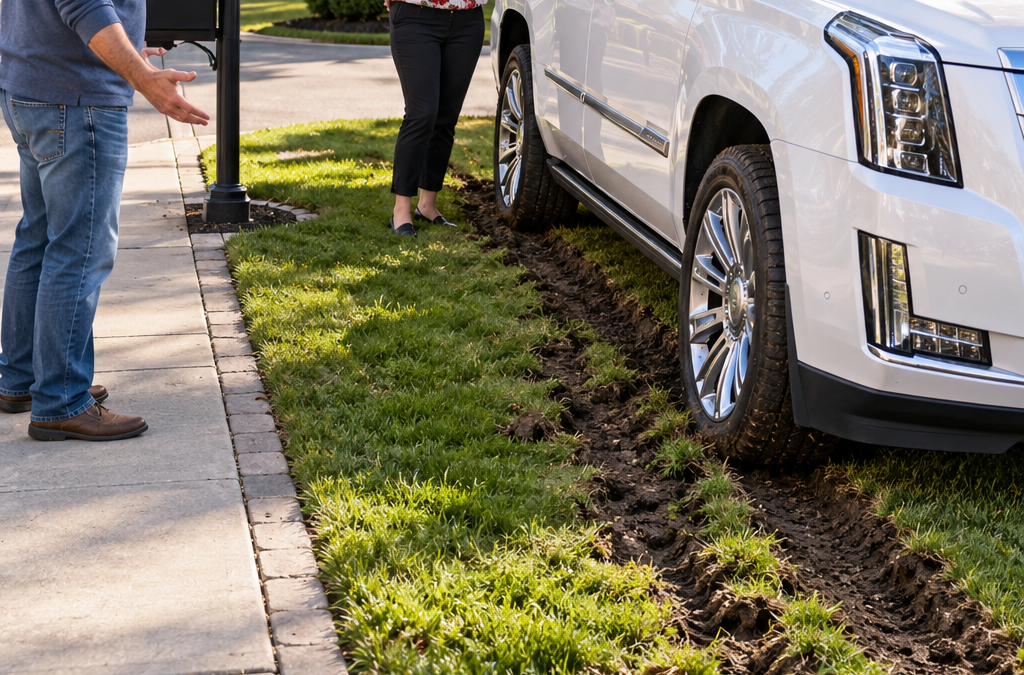
The weight of the Escalade had pressed the turf down into two dark channels.
I could see compressed soil beneath the grass.
The right rear tire had dug a shallow groove.
Diane came outside ten minutes later in athletic clothes carrying a large green smoothie.
I was standing near the mailbox.
“Morning,” I said.
She looked over.
“Morning.”
“Can I ask you something?”
She stopped beside the driver’s door.
“Sure.”
“Your SUV has been coming onto my lawn every morning.”
She looked at the grass.
Then at the Escalade.
Then back at me.
“Oh.”
“I’d appreciate it if you kept it inside your driveway.”
Her face barely changed.
“It’s a big vehicle.”
“I noticed.”
“My driveway’s narrow.”
“So is mine.”
She took a sip of the smoothie.
“Okay.”
I thought that was the end.
The next morning, Saturday, I looked outside.
Her Escalade was sitting in the exact same spot.
Three tires on my grass.
I stood at the window long enough to feel my coffee cooling in my hand.
I waited until she came back from wherever she’d gone.
Then I walked over.
Her front door opened after the second knock.
Diane wore a silk robe.
Same oversized sunglasses, somehow, even though she was indoors.
The smoothie was back too.
I said, “Hey. I mentioned the parking yesterday.”
She blinked.
“What parking?”
“Your Escalade.”
She glanced past me.
“What about it?”
“You keep driving onto my lawn.”
She stepped slightly outside and looked toward the strip of grass.
The tire marks were obvious.
“It’s tearing it up.”
She looked at me again.
Then she smiled.
“It’s just grass.”
That was the whole answer.
Just grass.
I waited, assuming she was going to add something.
She didn’t.
I said, “It’s my grass.”
Her smile disappeared.
“I said I’d try.”
“No. You said okay.”
“Same thing.”
“It’s been happening all week.”
“Ethan, I have a large vehicle. Sometimes I’m going to touch the edge.”
“You’re not touching the edge.”
Her tone changed.
“Are we really doing this?”
“I don’t know. Are we?”
She exhaled.
“You seem like a reasonable guy.”
“I am.”
“Then don’t make a neighborhood issue over grass.”
I looked at her for several seconds.
“Park in your own driveway.”
She rolled her eyes.
Then she closed the door.
Not slammed.
That would have at least acknowledged anger.
She simply closed it.
As though the conversation had ended because she had decided it was over.
I walked home angry.
But still not angry enough to do anything dramatic.
I documented the tire marks.
Three photographs.
Date.
Time.
Then I opened the Maplewood HOA website.
There was a complaint form.
I almost laughed at how formal it looked.
Address of reporting homeowner.
Address of subject property.
Nature of violation.
Supporting photographs.
Dates.
Witnesses.
I filled everything out.
I wrote carefully.
Neighboring resident has repeatedly operated and parked vehicle beyond her driveway and onto my privately maintained lawn despite direct verbal request to stop. Repeated vehicle weight has damaged turf and soil.
I attached the photographs.
Submitted.
And honestly, I felt better.
Not because I wanted Diane punished.
I wanted somebody neutral to say the obvious thing.
Don’t park on your neighbor’s property.
I assumed the HOA would send her one of those polite letters associations are famous for.
Please maintain vehicles within your driveway.
Problem solved.
Two weeks passed.
Diane continued parking on the lawn.
Not every day.
Almost every day.
Sometimes just one tire.
Sometimes two.
Once she parked so far onto my grass that the entire passenger side of the Escalade was outside her driveway.
The tracks deepened.
I took more photos.
Then a letter arrived from Maplewood Estates Homeowners Association.
I opened it standing at the mailbox.
After review, the Board has determined that no enforceable violation occurred.
Please maintain positive neighbor relations and pursue informal resolution where appropriate.
I read it twice.
No violation.
I looked at my lawn.
Two parallel tracks of crushed grass.
No violation.
I called the HOA management office.
A woman named Denise answered.
“Maplewood Community Management.”
“My name’s Ethan Mercer. I’m calling about complaint number M-1884.”
There was typing.
“Yes, Mr. Mercer.”
“I just received a denial.”
“I see that.”
“It says no violation occurred.”
“That was the board’s determination.”
“Was the board shown the photographs?”
“I believe so.”
“Did they understand the vehicle is physically on my property?”
“I can’t speak to board deliberations.”
“Who reviewed it?”
Silence.
Not long.
Just enough to notice.
“Ma’am?”
“I would need to check.”
“Please check.”
More typing.
Then another pause.
“The reviewing board liaison was Diane Holloway.”
I sat down at my kitchen table.
“I’m sorry?”
“Diane Holloway.”
“My neighbor?”
“Yes.”
“The woman I complained about?”
“I… yes.”
“She reviewed the complaint against herself?”
Denise became very careful.
“Board liaisons are assigned to different categories.”
“Which category?”
“Property-use and exterior compliance.”
I laughed once.
Not because anything was funny.
“So Diane Holloway received a formal complaint about Diane Holloway, reviewed it as a board member, and decided Diane Holloway had committed no violation.”
“I understand how that may appear.”
“How it appears?”
“I don’t set assignments.”
“Did the rest of the board vote?”
“I don’t have that information.”
“Who is the board president?”
“Thomas Bell.”
“I’d like to speak with him.”
“I can send a message.”
“Please do.”
Thomas Bell never called.
Instead, I received an email from management three days later.
The decision stands.
No further board action is anticipated.
That was the moment the whole thing changed for me.
Until then, Diane was an irritating neighbor.
Now I understood that she had institutional protection.
Maybe not formal protection.
Maybe not authorized protection.
But she knew how the system worked.
She had access to my complaint.
She could dispose of it.
And nobody inside Maplewood had stopped her.
I felt foolish.
I had gone through the official process because I believed official processes were designed to prevent exactly that kind of conflict.
Instead, I had handed Diane my evidence and asked her whether she thought she had done anything wrong.
Of course she didn’t.
For about a week, I felt defeated.
Not devastated.
This wasn’t life or death.
Nobody had stolen my house.
Nobody had threatened my family.
It was a lawn.
But small invasions become strangely exhausting when they repeat.
Every morning I looked outside to see whether she was there.
Every tire mark felt less accidental.
Every time she smiled from behind the wheel, I wondered whether she knew I had complained.
Then one morning, she answered that question.
I was standing beside my driveway when she backed out.
She stopped the Escalade with the front passenger tire directly on the edge of my grass.
Rolled down the window.
“Everything okay?”
“Fine.”
She smiled.
“Good.”
Then drove away.
That smile told me she knew.
I went inside.
Sat at my kitchen table.
And asked myself a simple question.
If the HOA isn’t going to stop her from using my lawn, how do I make the lawn unusable for parking without breaking any rule?
The answer came faster than I expected.
Landscaping.
Not a fence.
Fences required approval.
Not boulders.
I considered them, but placing large stones near a driveway could raise safety objections, and I didn’t want anything that might damage a vehicle if someone hit it.
Not metal posts.
Too aggressive.
Not spikes.
Obviously illegal and dangerous.
I wanted something ordinary.
Legal.
Visible.
Soft.
Something entirely on my property.
Mulch.
At first, the idea seemed ridiculous.
Then I started measuring.
The area where Diane drove over was a long wedge of lawn between my driveway and the front planting bed.
If I expanded the landscaped border by several feet, her habitual parking path would disappear.
Not because I blocked her driveway.
I wouldn’t.
Her pavement would remain untouched.
I would simply stop maintaining my own property as empty grass.
I called three landscape companies.
Not because I needed three tons of mulch to solve the problem.
I wanted professional opinions about drainage, utility lines, property limits, and practical placement.
One contractor suggested a raised bed.
Another suggested decorative stone.
The third said, “If you like cedar, we can build a broad mulch island and plant it later.”
That was the answer.
Before ordering anything, I hired a surveyor.
Yes.
Over mulch.
Because I knew exactly what would happen if Diane objected.
She would say I had crossed the line.
I wanted that argument dead before it started.
The surveyor located the corners and marked the side boundary.
Diane’s driveway sat entirely within her parcel.
The damaged grass sat entirely within mine.
I asked him to double-check.
He did.
Then I researched whether a mulch installation of the size I wanted required HOA approval.
It didn’t.
Maplewood required architectural approval for permanent hardscape, fences, structural walls, major grading, and trees above certain installation sizes near sightlines.
Mulch beds?
No approval.
Ornamental grasses?
No approval.
Small Japanese maple within setback limits?
No approval.
I documented that too.
Nine days after the HOA rejected my complaint, I placed the order.
Three tons of cedar mulch.
The supplier asked where to dump it.
“Front lawn.”
“You spreading it same day?”
“Eventually.”
“That’s a lot of mulch.”
“I know.”
“What are you covering?”
“About six weeks of tire tracks.”
The dispatcher laughed.
I didn’t explain.
The truck was scheduled for Tuesday at seven in the morning.
I woke at six.
Made coffee.
Pulled on boots.
And sat on my porch.
At 6:58, I heard the truck coming down Maplewood Drive.
Large landscaping dump truck.
Amber lights.
Hydraulic bed.
It stopped in front of my house.
The driver climbed down holding a clipboard.
“Ethan?”
“That’s me.”
“Three tons cedar.”
“Right.”
“Where do you want it?”
I walked him to the marked section.
The area began several feet from the street and extended inward along the side of my driveway.
Exactly where Diane’s tires had been traveling.
“Here.”
He looked at the lawn.
“You sure?”
“Completely.”
“This is going to be a big pile.”
“That’s the idea.”
He shrugged.
“Your mulch.”
He backed carefully into position without crossing the survey line or blocking the sidewalk.
Then the bed started lifting.
The first load slid out with a deep rolling sound.
It didn’t sound like bark.
It sounded like a building collapsing softly.
Cedar poured onto the grass.
Red-brown chips rolled outward.
The smell hit almost immediately.
Fresh cedar.
Sharp.
Clean.
Within four minutes, Harold was standing on his porch across the street.
June came out beside him in slippers.
Susan appeared near her mailbox.
The driver kept dumping.
The pile grew.
Three feet.
Then nearly four.
Wide enough that it consumed the entire section Diane used.
A landscaper with the company arrived behind the truck in a smaller vehicle.
He started raking edges away from the sidewalk.
By eight minutes, six neighbors were outside.
Nobody knew exactly what was happening.
But everybody knew enough to watch.
Then Diane’s front door opened.
She stepped outside in black workout leggings, white running shoes, and a fitted jacket.
Car keys in hand.
She took three steps.
Stopped.
The Escalade was in her driveway.
The mulch pile sat beside it.
Right where she normally swung wide.
She stared.
Ten seconds.
Maybe longer.
Then she looked at me.
I stood on my porch holding coffee.
“You cannot do this.”
I took a sip.
“Do what?”
She pointed.
“That.”
“It’s mulch.”
“I can see that.”
“Good.”
“You blocked my access.”
“No.”
“My vehicle can’t turn properly.”
“Your driveway is completely open.”
“I need more clearance.”
“On my lawn?”
Her face tightened.
“You know exactly what you’re doing.”
“Landscaping.”
“You’re being childish.”
“Three tons of childish.”
Harold coughed across the street.
I think he was trying not to laugh.
Diane pointed toward the pile.
“Move it.”
“No.”
“You need HOA approval.”
“I checked.”
“Any major landscape alteration requires approval.”
“No. Permanent structural changes do.”
“This is obviously targeted.”
“It is on my property.”
She stepped closer.
“You’re creating a safety issue.”
“For whom?”
“My vehicle.”
“If your vehicle stays in your driveway, it should be very safe.”
That was when she said it.
“It’s just mulch.”
I smiled.
“Exactly.”
Her expression changed.
She recognized the phrase.
It’s just grass.
Harold turned away because he was absolutely laughing now.
Diane looked around and realized half the street was watching.
That embarrassed her more than anything I could have said.
She climbed into the Escalade.
Started it.
Backed slowly.
For the first time since moving in, she kept all four tires precisely on her own pavement.
The right mirror passed the mulch pile with several feet to spare.
She wasn’t blocked.
She had simply been forced to steer correctly.
She drove away.
I thought that was the victory.
I was wrong.
The landscaping crew started spreading the outer edge.
One worker named Miguel was raking close to where the rear Escalade tire had repeatedly compressed the soil.
He stopped.
Then pushed the rake handle into the ground.
It sank farther than it should have.
He called to another worker.
They pulled mulch aside.
Miguel waved me over.
“Sir?”
“What’s up?”
“This ground is really soft.”
“I know. Car’s been driving over it.”
He shook his head.
“Not just that.”
He pressed down with his boot.
The soil moved.
Not much.
Enough.
He knelt and dug with a hand trowel.
Six inches.
Eight.
Then he hit something plastic.
Old black irrigation pipe.
Or what I assumed was irrigation.
He exposed more.
A crack ran along the top.
Water slowly seeped through the soil around it.
Miguel looked at me.
“You’ve got a leak.”
“Sprinkler?”
“Probably old main or lateral.”
“How bad?”
He pressed around the pipe.
The ground gave again.
“Been leaking a while.”
I looked toward the tracks.
The pipe ran directly beneath the place Diane’s rear tire had landed repeatedly.
“Could the vehicle have cracked it?”
Miguel shrugged.
“Maybe. Heavy truck, wet ground. Old pipe. Could’ve already been weak.”
That wasn’t enough for me.
I called a plumber who handled irrigation systems.
Then I called the landscaper’s supervisor.
By noon, the mulch pile had become secondary.
They traced the line.
It was an older sprinkler supply lateral installed decades earlier.
Not marked on the current landscape map.
The pipe had split.
Water had been escaping underground.
Not dramatically.
Slowly.
Continuously.
Because the leak sat beneath the soil, the water never sprayed visibly.
It softened the ground instead.
The plumber shut the zone down.
Then he looked toward my house.
“How long’s this been happening?”
“I don’t know.”
“Ground’s saturated deeper than it should be.”
“Is that serious?”
“Potentially.”
The damaged area sloped gently toward my foundation.
He recommended an engineer.
I called one the next day.
His name was Marcus Hale.
Structural engineer.
He inspected the lawn, foundation edge, soil conditions, and drainage.
He took measurements.
Then he asked whether vehicles had been traveling over the leak area.
“One.”
“Regularly?”
“Every morning for six weeks.”
“What kind?”
“Cadillac Escalade.”
He looked at me.
“That’s not a car.”
“I noticed.”
He asked for photographs.
I had dozens.
Timestamps.
Different days.
Same tire path.
He reviewed them.
Then he studied the broken line.
Three days later, I received his report.
The repeated concentrated vehicle loading had likely contributed to failure of the aged pipe or materially worsened an existing weakness.
The leak had saturated surrounding soil.
If allowed to continue, soil settlement could have progressed toward the foundation edge.
He stopped short of claiming the house was about to fall into a sinkhole.
Engineers don’t write like storytellers.
But his conclusion was clear.
The condition created a settlement risk.
Repair.
Excavation.
Pipe replacement.
Soil stabilization.
Drainage correction.
Turf restoration.
Estimated cost: approximately four thousand dollars.
I called my insurance company first.
They wanted the report.
Then they wanted photographs.
Then they wanted dates.
Then they asked the obvious question.
“Do you know whose vehicle caused the loading?”
“Yes.”
“Was it authorized to be on your property?”
“No.”
“Do you have documentation?”
I almost laughed.
“How much do you want?”
Diane had no idea what was coming.
I didn’t walk next door.
I didn’t wave the report in her face.
I didn’t threaten her.
My insurer contacted hers.
That’s when Diane finally understood that “just grass” had become something else.
Her insurance adjuster called me.
I gave him the same evidence.
Photos.
Survey.
HOA complaint.
HOA denial.
Engineer report.
Repair estimates.
Then he asked for the HOA decision.
“Why?”
“Because it indicates the parking issue was reported before discovery of damage.”
I sent it.
Two days later, Thomas Bell called me for the first time.
The HOA president who had never returned my earlier message.
“Mr. Mercer?”
“Yes.”
“This is Thomas Bell from the Maplewood board.”
“I know.”
“I’d like to discuss the complaint involving Ms. Holloway.”
“Which complaint?”
There was a pause.
“The parking matter.”
“The one your board said wasn’t a violation?”
“That’s actually what I wanted to clarify.”
I sat down.
“I’m listening.”
“We’ve learned there may have been a procedural issue in how that complaint was handled.”
“Procedural issue.”
“Yes.”
“Diane reviewed it herself.”
Another pause.
“That appears to have happened.”
“She was the subject of the complaint.”
“I understand.”
“Did you know?”
“No.”
That answer came quickly.
Too quickly for me to distrust it.
“Did the board vote?”
“No.”
“Did anybody besides Diane review the photos before the complaint was closed?”
“I can’t confirm that yet.”
“Then what exactly are we discussing?”
Thomas exhaled.
“We’re conducting an internal review.”
“Good.”
“Would you be willing to provide your documentation?”
“Already sent it to management.”
“We may need it again.”
“Send me a written request.”
He became quiet.
Then said, “That’s fair.”
Two other board members contacted me separately over the next week.
One was Susan Patel.
Not my neighbor Susan.
Another Susan.
The other was Charles Givens.
Both sounded disturbed.
Not by the mulch.
By the conflict.
The more they looked, the worse it became.
Diane hadn’t simply received the complaint automatically and made a mistake.
She had used her position as property-use liaison to classify the matter as a private neighbor dispute.
No board review.
No recusal.
No disclosure that she was the accused homeowner.
Management had processed her conclusion because, from their perspective, a board representative had ruled.
Worse, she had later described the issue during a committee summary as “resolved resident friction.”
Resident friction.
I saved that phrase.
The board called an emergency session.
This time, I didn’t attend.
I didn’t need to.
Thomas told me afterward that Diane was asked directly why she had not recused herself.
She argued that there was no financial interest.
Susan Patel disagreed.
Personal involvement was enough.
Charles reportedly asked whether Diane would have allowed another board member to dismiss a complaint against his own property.
She didn’t answer.
The vote to remove her from the compliance role was immediate.
The vote to remove her from the board followed under the association’s procedures and governing documents.
It wasn’t close.
Three weeks after the mulch arrived, Diane Holloway was no longer a Maplewood board member.
She still lived next door.
That part didn’t change.
The morning after her removal, I watched from my kitchen as she walked to the Escalade.
She didn’t look toward my house.
She got in.
Backed out.
Every tire stayed on her driveway.
Perfectly centered.
I almost applauded.
I didn’t.
The insurance claim took longer.
Four months.
Diane’s insurer did what insurers do.
Asked questions.
Requested more documentation.
Examined whether the pipe’s age contributed.
Sent someone to inspect.
Considered depreciation.
Reviewed the structural engineer’s wording.
My carrier handled much of the negotiation.
Eventually, the claim settled.
The repair costs were covered to the agreed amount.
The damaged pipe was replaced.
Saturated soil removed where necessary.
The area compacted and restored.
Drainage checked.
My lawn reseeded.
The total came in near the four-thousand-dollar estimate.
Diane’s premium reportedly increased afterward.
I didn’t ask how much.
That wasn’t my concern.
I wasn’t interested in punishing her financially.
I wanted my property repaired.
People kept asking about the three tons of mulch.
I didn’t leave it as a giant pile.
That would have looked ridiculous.
Once the pipe repair was complete, the landscape crew returned.
We reshaped the area into a broad curved planting bed.
They spread the cedar properly.
Added ornamental grasses.
Low shrubs.
A small Japanese maple.
Nothing expensive.
Nothing hostile.
No giant boulders.
No fence.
No sign saying KEEP OFF.
The landscaping itself became the boundary.
Soft.
Beautiful.
Completely unparkable.
By spring, it looked intentional.
Not like a defensive measure.
Like it had always belonged there.
June came over one morning.
She stood at the sidewalk studying it.
“I hate to say this.”
“What?”
“Diane improved your yard.”
I laughed.
“Indirectly.”
“Japanese maple is nice.”
“Thanks.”
“Who’s your landscaper?”
I gave her the number.
Within three months, two other houses on the block hired the same company.
That’s how the whole thing became funny again.
What started as six weeks of vehicle trespass became the nicest section of my front yard.
Diane still didn’t speak to me.
Occasionally, we crossed paths near the mailboxes.
She would look at her phone.
Or the street.
Or anywhere else.
I didn’t force conversation.
I had no interest in becoming friends.
But I also wasn’t interested in maintaining a feud.
If she stayed on her property, I stayed on mine.
That arrangement worked beautifully.
The HOA changed too.
That mattered more than I expected.
The board adopted a formal conflict-of-interest policy.
Any board member who was personally involved in a complaint had to disclose the conflict and recuse from review, discussion, and vote.
Complaints could no longer be closed by a single liaison when the issue involved neighboring property rights.
Written decisions required review by at least two uninvolved board members or management under delegated standards.
Homeowners were given an appeal process.
Simple safeguards.
Obvious safeguards.
Safeguards that should have existed already.
The following spring, I received a formal letter.
Maplewood Estates Homeowners Association.
I almost laughed when I saw the envelope.
For a second, I wondered whether they had decided the Japanese maple violated something.
Instead, it was an apology.
Mr. Mercer,
The Board of Directors has completed its review of your prior complaint concerning repeated vehicle encroachment onto your property.
The Board acknowledges that your original complaint was mishandled because a board member with a direct personal interest participated in and effectively controlled its disposition.
This did not meet the association’s standards for impartial review.
Please accept our formal apology.
The letter went on to describe the new conflict procedures.
No grand language.
No confession.
No dramatic admission.
Just accountability.
I appreciated that.
Thomas Bell called a week later.
“You get the letter?”
“I did.”
“Fair?”
“Yes.”
“I’m sorry it took us that long.”
“I would’ve preferred six weeks less tire damage.”
“I know.”
“You knew Diane well?”
He hesitated.
“Thought I did.”
“Nobody noticed she reviewed her own complaint?”
“We trusted the liaison system too much.”
“That’s a polite way to say nobody checked.”
“That’s fair too.”
I liked Thomas more after that.
Not because he defended himself well.
Because he stopped defending himself.
That’s harder than people think.
A few months later, Maplewood held its annual meeting.
I attended.
Partly because I wanted to know who was making decisions now.
Partly because Harold had been bothering me.
“You complained about governance. Now you have to show up.”
“I complained about a Cadillac.”
“Same thing.”
He wasn’t entirely wrong.
The meeting felt different.
Diane sat in the audience.
Back row.
No board seat.
No binder.
She didn’t look at me.
Susan Patel presented the new conflict policy.
Nobody objected.
Then someone raised a landscaping question.
Apparently mulch colors were becoming inconsistent across common areas.
I nearly choked on my water.
Harold leaned over.
“Don’t.”
“I’m not doing anything.”
“Your face is doing something.”
I looked straight ahead.
The motion passed.
Afterward, several neighbors came up to me.
Most wanted to talk about the lawn.
Not the dispute.
One man from the next street said, “Three tons?”
“Three.”
“At once?”
“Yes.”
“My wife showed me the video somebody took.”
“There was a video?”
He laughed.
“Half the neighborhood saw the truck.”
I rubbed my forehead.
“Wonderful.”
“Best part was Diane saying you couldn’t do it.”
“I didn’t know anyone recorded that.”
“Oh, everybody knows.”
I decided I was happier not asking.
Eventually, the story became neighborhood folklore.
Not the insurance.
Not the HOA conflict.
The mulch.
People referred to it as “the mulch incident.”
Someone once introduced me at a block party as “the guy who ordered three tons to solve a parking problem.”
That wasn’t entirely accurate.
But I stopped correcting people.
There are worse reputations.
The truth was more complicated.
Mulch didn’t solve the real problem.
Documentation did.
The photographs mattered.
The complaint records mattered.
The survey mattered.
The HOA letter mattered.
The engineer’s report mattered.
The insurance investigation mattered.
The board’s own files mattered.
Mulch simply forced everything into the open.
If I had screamed at Diane on the first Saturday, maybe nothing would have changed.
If I had put cones on the lawn, she might have moved them.
If I had blocked her driveway, I could have become the problem.
If I had damaged her Escalade, I would have been wrong.
I didn’t need revenge.
I needed control over twelve feet of grass.
That’s all.
One thing I learned through the entire experience is that people misuse the word petty.
Neighbors called my mulch plan petty.
Some still do.
Maybe they’re right.
But there’s a difference between petty retaliation and lawful boundary setting.
I didn’t touch Diane’s driveway.
Didn’t block her vehicle.
Didn’t damage anything.
Didn’t enter her property.
Didn’t threaten her.
Didn’t fabricate a complaint.
I changed my landscaping.
The fact that my landscaping prevented her from continuing to trespass was not a flaw.
It was the purpose.
What bothered Diane was not the mulch.
It was that her convenience suddenly stopped outranking my ownership.
Before the mulch, she could drive over my lawn because nothing physically prevented her.
The HOA process didn’t stop her.
My request didn’t stop her.
My complaint didn’t stop her.
Courtesy didn’t stop her.
The mulch did.
Sometimes boundaries become respected only after they become inconvenient to cross.
A year after everything happened, I was outside trimming the ornamental grasses when Diane walked over.
That surprised me.
We hadn’t spoken in months.
She stopped near the property line.
“Ethan.”
“Diane.”
She looked at the Japanese maple.
“It’s grown.”
“A little.”
She nodded.
Then she said, “I wanted to clear something up.”
I put the shears down.
“Okay.”
“I never intentionally tried to damage your sprinkler line.”
“I never said you did.”
“You filed an insurance claim.”
“Because your vehicle repeatedly drove over the area.”
“The pipe was old.”
“Yes.”
“It could have broken anyway.”
“Maybe.”
She folded her arms.
“You made it look like I destroyed your yard.”
I studied her.
“Diane, you drove onto my yard after I asked you not to.”
“It was a narrow strip.”
“My strip.”
She looked away.
“I didn’t think it mattered.”
“That was the problem.”
She became quiet.
For the first time since I’d known her, there was no board authority behind her.
No denial letter.
No policy.
No position.
Just two neighbors.
She looked at the landscaped bed.
“I probably should’ve parked differently.”
“Yes.”
“You didn’t have to embarrass me.”
That surprised me.
“How did I embarrass you?”
“The mulch. Everyone watching.”
“I ordered landscaping on my property.”
“You knew what people would think.”
“I knew you wouldn’t be able to park there.”
“Same thing.”
“No.”
I stepped closer, not aggressively.
Just enough that she would hear me clearly.
“You embarrassed yourself when you decided a complaint against you didn’t deserve neutral review.”
Her expression hardened.
“I didn’t think it was a violation.”
“Then you should’ve let somebody else decide that.”
She didn’t answer.
I continued.
“If another board member had been accused of driving onto your lawn, would you have let him close his own complaint?”
Silence.
That was answer enough.
After a few seconds, she said, “I was wrong about that.”
I nodded.
“Okay.”
That seemed to surprise her.
“That’s it?”
“What do you want me to say?”
“I don’t know.”
“You admitted it. I’m not looking for anything else.”
She glanced at the grass.
“I still think three tons was excessive.”
I smiled.
“I wanted enough for the flower bed.”
For the first time, she almost smiled back.
Almost.
Then she walked home.
We never became friends.
But after that, the tension changed.
We could exist on the same street without pretending the other person was invisible.
Sometimes she nodded when she saw me.
Sometimes I nodded back.
That’s enough.
The Escalade remained spotless.
Still enormous.
Still white.
Still parked perfectly between the edges of her own driveway.
Every morning.
I noticed for a while.
Then eventually, I stopped looking.
That’s when I knew the problem was truly over.
Because the worst part of a boundary dispute isn’t the damaged grass.
It’s the mental occupation.
You start watching windows.
Listening for engines.
Checking cameras.
Looking for tire tracks.
The other person moves into your thoughts without permission.
That bothered me more than anything.
I had bought Maplewood because I wanted peace.
For six weeks, Diane took a piece of that peace every morning.
The final victory wasn’t that she lost her board seat.
It wasn’t the insurance settlement.
It wasn’t even the mulch.
It was the morning I made coffee, looked through the kitchen window, saw her Escalade in her driveway, and realized I hadn’t thought about where she parked in weeks.
I went back to making breakfast.
That’s peace.
The Japanese maple is taller now.
Every autumn, the leaves turn deep red.
The cedar mulch has faded and been refreshed several times.
The ornamental grasses fill the border so completely that nobody looking at the yard today would know why the bed exists.
New neighbors certainly don’t.
A young couple moved into Harold’s house after he and June downsized.
One afternoon, the husband walked over while I was watering the maple.
“Love this bed.”
“Thanks.”
“Was it here when you bought the house?”
“No.”
“You design it?”
“Sort of.”
“My wife wants something similar because people keep cutting the corner when they park.”
I stopped watering.
“Do they?”
“Delivery drivers mostly.”
I looked at him.
Then at the mulch.
He frowned.
“What?”
“Nothing.”
I gave him my landscaper’s number.
Some lessons shouldn’t require three tons.
The HOA newsletter still arrives every month.
It is still too long.
The board now publishes conflict disclosures annually.
The complaint form has a new section asking whether any board member involved has a personal connection to the issue.
Every time I see it, I think about Diane.
One unchecked box probably would have saved everyone months of trouble.
That’s the strange thing about systems.
They don’t usually fail because the rules are too complicated.
They fail because nobody imagines someone will abuse the simple parts.
A board member shouldn’t review her own complaint.
That shouldn’t need a policy.
Yet now it has one.
A driver shouldn’t repeatedly park on someone else’s lawn after being asked to stop.
That shouldn’t need three tons of cedar mulch.
Yet there it is.
My father used to say you learn the true size of a problem by watching what people refuse to do to solve it.
Diane could have fixed everything in five seconds.
Turn the steering wheel slightly earlier.
That was it.
Instead, she spent six weeks proving that the ability to do something had become, in her mind, the right to do it.
Those aren’t the same.
Power works that way too.
She was on the board.
The complaint came to her.
Nobody stopped her from closing it.
So she closed it.
And because she could, she assumed she should.
That’s how small abuses become habits.
Not through grand corruption.
Through convenience.
One person saves herself a little trouble.
Another person looks away.
Someone says it isn’t worth making a fuss.
Then suddenly the system exists to protect the person causing the problem instead of the person reporting it.
The three tons of mulch did more than stop an Escalade.
They made people look.
Harold looked.
Susan looked.
Charles looked.
Management looked again.
The insurance company looked very carefully.
Once enough people looked at the same facts, Diane’s position became impossible to defend.
That is why I still keep the first HOA denial letter.
It’s in a file drawer in my office.
After review, no violation was found.
Please maintain positive neighbor relations.
Sometimes I pull it out and laugh.
Not because the letter is funny.
Because it captures the entire problem in two sentences.
They asked the person whose lawn was being damaged to maintain positive relations while allowing the person causing the damage to decide no violation existed.
That was backwards.
The new policy turned it around.
That’s the part I’m proudest of.
Not Diane being removed.
Institutions should not depend on whether one difficult person happens to hold a position.
They should make it harder for the next difficult person to misuse that position.
Maplewood is better now.
Not perfect.
A neighborhood with two hundred households will never be perfect.
People still fight about fences.
Dogs.
Parking.
Holiday lights.
Tree removal.
One resident submitted a complaint because another resident’s inflatable snowman leaned too far over.
Human beings remain human beings.
But the board has rules about conflicts now.
Complaints get reviewed.
People can appeal.
No individual member quietly decides her own case.
That is real improvement.
And it started because someone parked a white Escalade on my lawn.
People occasionally ask whether I would do it all again.
The mulch?
Absolutely.
Maybe not three tons.
Two and a half probably would’ve worked.
But where’s the story in that?
I would document everything again.
I would survey the line again.
I would avoid touching her property.
I would let professionals assess the damage.
And I would still refuse to let somebody else’s convenience become a permanent right over something I owned.
The phrase “it’s just grass” has become a joke among my friends.
Whenever somebody complains about anything small, Harold used to say it.
Flat tire?
It’s just rubber.
Broken fence?
It’s just wood.
Phone dropped in water?
It’s just electronics.
He thought it was hilarious.
Diane probably wouldn’t.
But that sentence mattered.
Because it revealed the way she saw the situation.
To her, grass had little value.
Therefore, my objection had little value.
But ownership isn’t measured by replacement cost.
If I stepped into Diane’s house every morning and used one of her dining chairs without asking, it would still be trespassing even if the chair cost twenty dollars.
If I planted flowers on three feet of her property, I wouldn’t get to say, “It’s just dirt.”
The issue was never grass.
It was consent.
My lawn.
My decision.
Once Diane understood that, everything else became simple.
She parks on her property.
I landscape mine.
We both sleep fine.
One October morning, almost exactly two years after the mulch truck arrived, I stood on the porch with coffee.
The Japanese maple was bright red.
Cedar smelled fresh from a new layer I’d spread the previous weekend.
Diane walked outside.
She looked over.
Then at the tree.
“Looks good,” she called.
I nearly dropped the mug.
“Thanks.”
She got into the Escalade.
Backed straight down her driveway.
Perfect.
All four tires on pavement.
I watched her turn onto Maplewood Drive.
Then I looked at the flower bed.
Three tons of mulch had arrived there because I wanted to stop one woman from parking on my lawn.
What remained was better than what had existed before.
The damaged grass was gone.
The broken pipe was repaired.
The soil was stabilized.
The tree was growing.
The HOA had new rules.
The board had learned something.
So had I.
You don’t always need to fight louder.
You don’t always need to threaten.
You don’t need to destroy someone’s property because they disrespected yours.
Sometimes the smartest response is to understand exactly where the boundary is, document it, and change what happens on your side of it.
Diane thought the edge of my lawn was negotiable because nothing stopped her tires from crossing it.
She found out otherwise on a Tuesday morning in October.
The boundary had always been there.
The mulch just made it visible.
𝗧𝗛𝗘 𝗘𝗡𝗗
The HOA Board Member Parked Her Escalade on My Lawn Every Morning Until I Made One Small Change She Couldn’t Ignore
For six straight weeks, Diane Holloway drove two tires of her white Escalade across my property every morning, looked directly at the damage she was causing, and smiled as if my lawn belonged to her more than it belonged to me.
When the HOA dismissed my complaint because Diane had quietly reviewed the case herself, I stopped expecting their system to protect me and started planning something entirely legal that would make my front yard impossible for her to use again.
My name is Ethan Mercer, and I moved into Maplewood Estates because I thought I was buying peace.
That sounds naïve now.
At the time, it seemed reasonable.
Maplewood Estates was the kind of neighborhood real estate agents described with words like established, desirable, and well maintained.
Tree-lined streets.
Trimmed hedges.
Brick mailboxes.
Sidewalks that curved around mature maples.
People walking dogs after dinner.
Neighbors waving while they collected mail.
Nothing flashy.
Nothing that looked particularly wealthy or exclusive.
Just organized.
Quiet.
Predictable.
That was exactly what I wanted.
I had spent the previous decade living in places where nobody knew anybody.
Apartment buildings where people avoided eye contact in elevators.
Townhouses where residents parked six feet apart for three years and never learned one another’s names.
When I bought my house in Maplewood, I actually liked the idea of having neighbors close enough to know.
Not close enough to interfere.
Just enough to feel like a community.
For the first two months, that’s what I got.
The couple across the street introduced themselves the day I moved in.
Their names were Harold and June.
Harold brought over a six-pack.
June brought banana bread.
A retired teacher named Susan lived two houses down and told me which grocery store had the best butcher counter.
Nobody cared that I took a little longer than the previous owner to edge the driveway.
Nobody inspected my trash cans.
Nobody knocked on my door because my porch furniture didn’t match.
I thought I had gotten lucky.
Then Diane Holloway bought the house next door.
The first time I saw her was on a Friday afternoon.
I was pulling weeds beside my mailbox when a white Cadillac Escalade turned onto the street.
Not just white.
Bright white.
Freshly detailed.
Chrome wheels.
Windows dark enough that I couldn’t see the driver until she was almost in her driveway.
The SUV looked enormous beside the modest brick houses.
It pulled in halfway.
Stopped.
Then backed out.
Pulled in again.
Stopped crooked.
She opened the driver’s door and stepped out wearing oversized sunglasses, black leggings, a sleeveless vest, and the expression of a person who expected somebody else to carry whatever came next.
She looked at me.
I waved.
She gave me a quick smile.
Not unfriendly.
Not friendly either.
More acknowledgment than greeting.
Then she opened the rear hatch and stood there staring at two cardboard boxes until a younger man from the moving crew jogged over to take them.
That should have told me something.
But I wasn’t looking for problems.
Her name, I learned later that day, was Diane Holloway.
Mid-fifties.
Recently divorced.
No children living at home.
She had sold a larger house on the other side of town and moved into Maplewood because, according to June, she wanted “something more manageable.”
I minded my own business.
For about five days, we barely interacted.
Then Wednesday morning happened.
I was standing in my kitchen with coffee when I looked through the front window.
Diane’s Escalade was parked partly on my lawn.
Not near my lawn.
On it.
Two passenger-side tires rested in the grass along the strip between my driveway edge and the property line.
Her driveway was directly beside mine, separated by a narrow green section.
She had pulled too wide and let the Escalade climb over the curb cut and onto my side.
I stared for a second.
Then shrugged.
People make mistakes.
Her SUV was large.
Maybe she misjudged the turn.
Maybe she was rushing.
It wasn’t worth becoming the kind of neighbor who knocked on a door over one tire mark.
I left for work.
Thursday morning, it happened again.
Same location.
This time, both right-side tires were farther into the grass.
Friday morning, three tires were touching my lawn.
That got my attention.
I walked outside.
The ground was damp from overnight rain.
The weight of the Escalade had pressed the turf down into two dark channels.
I could see compressed soil beneath the grass.
The right rear tire had dug a shallow groove.
Diane came outside ten minutes later in athletic clothes carrying a large green smoothie.
I was standing near the mailbox.
“Morning,” I said.
She looked over.
“Morning.”
“Can I ask you something?”
She stopped beside the driver’s door.
“Sure.”
“Your SUV has been coming onto my lawn every morning.”
She looked at the grass.
Then at the Escalade.
Then back at me.
“Oh.”
“I’d appreciate it if you kept it inside your driveway.”
Her face barely changed.
“It’s a big vehicle.”
“I noticed.”
“My driveway’s narrow.”
“So is mine.”
She took a sip of the smoothie.
“Okay.”
I thought that was the end.
The next morning, Saturday, I looked outside.
Her Escalade was sitting in the exact same spot.
Three tires on my grass.
I stood at the window long enough to feel my coffee cooling in my hand.
I waited until she came back from wherever she’d gone.
Then I walked over.
Her front door opened after the second knock.
Diane wore a silk robe.
Same oversized sunglasses, somehow, even though she was indoors.
The smoothie was back too.
I said, “Hey. I mentioned the parking yesterday.”
She blinked.
“What parking?”
“Your Escalade.”
She glanced past me.
“What about it?”
“You keep driving onto my lawn.”
She stepped slightly outside and looked toward the strip of grass.
The tire marks were obvious.
“It’s tearing it up.”
She looked at me again.
Then she smiled.
“It’s just grass.”
That was the whole answer.
Just grass.
I waited, assuming she was going to add something.
She didn’t.
I said, “It’s my grass.”
Her smile disappeared.
“I said I’d try.”
“No. You said okay.”
“Same thing.”
“It’s been happening all week.”
“Ethan, I have a large vehicle. Sometimes I’m going to touch the edge.”
“You’re not touching the edge.”
Her tone changed.
“Are we really doing this?”
“I don’t know. Are we?”
She exhaled.
“You seem like a reasonable guy.”
“I am.”
“Then don’t make a neighborhood issue over grass.”
I looked at her for several seconds.
“Park in your own driveway.”
She rolled her eyes.
Then she closed the door.
Not slammed.
That would have at least acknowledged anger.
She simply closed it.
As though the conversation had ended because she had decided it was over.
I walked home angry.
But still not angry enough to do anything dramatic.
I documented the tire marks.
Three photographs.
Date.
Time.
Then I opened the Maplewood HOA website.
There was a complaint form.
I almost laughed at how formal it looked.
Address of reporting homeowner.
Address of subject property.
Nature of violation.
Supporting photographs.
Dates.
Witnesses.
I filled everything out.
I wrote carefully.
Neighboring resident has repeatedly operated and parked vehicle beyond her driveway and onto my privately maintained lawn despite direct verbal request to stop. Repeated vehicle weight has damaged turf and soil.
I attached the photographs.
Submitted.
And honestly, I felt better.
Not because I wanted Diane punished.
I wanted somebody neutral to say the obvious thing.
Don’t park on your neighbor’s property.
I assumed the HOA would send her one of those polite letters associations are famous for.
Please maintain vehicles within your driveway.
Problem solved.
Two weeks passed.
Diane continued parking on the lawn.
Not every day.
Almost every day.
Sometimes just one tire.
Sometimes two.
Once she parked so far onto my grass that the entire passenger side of the Escalade was outside her driveway.
The tracks deepened.
I took more photos.
Then a letter arrived from Maplewood Estates Homeowners Association.
I opened it standing at the mailbox.
After review, the Board has determined that no enforceable violation occurred.
Please maintain positive neighbor relations and pursue informal resolution where appropriate.
I read it twice.
No violation.
I looked at my lawn.
Two parallel tracks of crushed grass.
No violation.
I called the HOA management office.
A woman named Denise answered.
“Maplewood Community Management.”
“My name’s Ethan Mercer. I’m calling about complaint number M-1884.”
There was typing.
“Yes, Mr. Mercer.”
“I just received a denial.”
“I see that.”
“It says no violation occurred.”
“That was the board’s determination.”
“Was the board shown the photographs?”
“I believe so.”
“Did they understand the vehicle is physically on my property?”
“I can’t speak to board deliberations.”
“Who reviewed it?”
Silence.
Not long.
Just enough to notice.
“Ma’am?”
“I would need to check.”
“Please check.”
More typing.
Then another pause.
“The reviewing board liaison was Diane Holloway.”
I sat down at my kitchen table.
“I’m sorry?”
“Diane Holloway.”
“My neighbor?”
“Yes.”
“The woman I complained about?”
“I… yes.”
“She reviewed the complaint against herself?”
Denise became very careful.
“Board liaisons are assigned to different categories.”
“Which category?”
“Property-use and exterior compliance.”
I laughed once.
Not because anything was funny.
“So Diane Holloway received a formal complaint about Diane Holloway, reviewed it as a board member, and decided Diane Holloway had committed no violation.”
“I understand how that may appear.”
“How it appears?”
“I don’t set assignments.”
“Did the rest of the board vote?”
“I don’t have that information.”
“Who is the board president?”
“Thomas Bell.”
“I’d like to speak with him.”
“I can send a message.”
“Please do.”
Thomas Bell never called.
Instead, I received an email from management three days later.
The decision stands.
No further board action is anticipated.
That was the moment the whole thing changed for me.
Until then, Diane was an irritating neighbor.
Now I understood that she had institutional protection.
Maybe not formal protection.
Maybe not authorized protection.
But she knew how the system worked.
She had access to my complaint.
She could dispose of it.
And nobody inside Maplewood had stopped her.
I felt foolish.
I had gone through the official process because I believed official processes were designed to prevent exactly that kind of conflict.
Instead, I had handed Diane my evidence and asked her whether she thought she had done anything wrong.
Of course she didn’t.
For about a week, I felt defeated.
Not devastated.
This wasn’t life or death.
Nobody had stolen my house.
Nobody had threatened my family.
It was a lawn.
But small invasions become strangely exhausting when they repeat.
Every morning I looked outside to see whether she was there.
Every tire mark felt less accidental.
Every time she smiled from behind the wheel, I wondered whether she knew I had complained.
Then one morning, she answered that question.
I was standing beside my driveway when she backed out.
She stopped the Escalade with the front passenger tire directly on the edge of my grass.
Rolled down the window.
“Everything okay?”
“Fine.”
She smiled.
“Good.”
Then drove away.
That smile told me she knew.
I went inside.
Sat at my kitchen table.
And asked myself a simple question.
If the HOA isn’t going to stop her from using my lawn, how do I make the lawn unusable for parking without breaking any rule?
The answer came faster than I expected.
Landscaping.
Not a fence.
Fences required approval.
Not boulders.
I considered them, but placing large stones near a driveway could raise safety objections, and I didn’t want anything that might damage a vehicle if someone hit it.
Not metal posts.
Too aggressive.
Not spikes.
Obviously illegal and dangerous.
I wanted something ordinary.
Legal.
Visible.
Soft.
Something entirely on my property.
Mulch.
At first, the idea seemed ridiculous.
Then I started measuring.
The area where Diane drove over was a long wedge of lawn between my driveway and the front planting bed.
If I expanded the landscaped border by several feet, her habitual parking path would disappear.
Not because I blocked her driveway.
I wouldn’t.
Her pavement would remain untouched.
I would simply stop maintaining my own property as empty grass.
I called three landscape companies.
Not because I needed three tons of mulch to solve the problem.
I wanted professional opinions about drainage, utility lines, property limits, and practical placement.
One contractor suggested a raised bed.
Another suggested decorative stone.
The third said, “If you like cedar, we can build a broad mulch island and plant it later.”
That was the answer.
Before ordering anything, I hired a surveyor.
Yes.
Over mulch.
Because I knew exactly what would happen if Diane objected.
She would say I had crossed the line.
I wanted that argument dead before it started.
The surveyor located the corners and marked the side boundary.
Diane’s driveway sat entirely within her parcel.
The damaged grass sat entirely within mine.
I asked him to double-check.
He did.
Then I researched whether a mulch installation of the size I wanted required HOA approval.
It didn’t.
Maplewood required architectural approval for permanent hardscape, fences, structural walls, major grading, and trees above certain installation sizes near sightlines.
Mulch beds?
No approval.
Ornamental grasses?
No approval.
Small Japanese maple within setback limits?
No approval.
I documented that too.
Nine days after the HOA rejected my complaint, I placed the order.
Three tons of cedar mulch.
The supplier asked where to dump it.
“Front lawn.”
“You spreading it same day?”
“Eventually.”
“That’s a lot of mulch.”
“I know.”
“What are you covering?”
“About six weeks of tire tracks.”
The dispatcher laughed.
I didn’t explain.
The truck was scheduled for Tuesday at seven in the morning.
I woke at six.
Made coffee.
Pulled on boots.
And sat on my porch.
At 6:58, I heard the truck coming down Maplewood Drive.
Large landscaping dump truck.
Amber lights.
Hydraulic bed.
It stopped in front of my house.
The driver climbed down holding a clipboard.
“Ethan?”
“That’s me.”
“Three tons cedar.”
“Right.”
“Where do you want it?”
I walked him to the marked section.
The area began several feet from the street and extended inward along the side of my driveway.
Exactly where Diane’s tires had been traveling.
“Here.”
He looked at the lawn.
“You sure?”
“Completely.”
“This is going to be a big pile.”
“That’s the idea.”
He shrugged.
“Your mulch.”
He backed carefully into position without crossing the survey line or blocking the sidewalk.
Then the bed started lifting.
The first load slid out with a deep rolling sound.
It didn’t sound like bark.
It sounded like a building collapsing softly.
Cedar poured onto the grass.
Red-brown chips rolled outward.
The smell hit almost immediately.
Fresh cedar.
Sharp.
Clean.
Within four minutes, Harold was standing on his porch across the street.
June came out beside him in slippers.
Susan appeared near her mailbox.
The driver kept dumping.
The pile grew.
Three feet.
Then nearly four.
Wide enough that it consumed the entire section Diane used.
A landscaper with the company arrived behind the truck in a smaller vehicle.
He started raking edges away from the sidewalk.
By eight minutes, six neighbors were outside.
Nobody knew exactly what was happening.
But everybody knew enough to watch.
Then Diane’s front door opened.
She stepped outside in black workout leggings, white running shoes, and a fitted jacket.
Car keys in hand.
She took three steps.
Stopped.
The Escalade was in her driveway.
The mulch pile sat beside it.
Right where she normally swung wide.
She stared.
Ten seconds.
Maybe longer.
Then she looked at me.
I stood on my porch holding coffee.
“You cannot do this.”
I took a sip.
“Do what?”
She pointed.
“That.”
“It’s mulch.”
“I can see that.”
“Good.”
“You blocked my access.”
“No.”
“My vehicle can’t turn properly.”
“Your driveway is completely open.”
“I need more clearance.”
“On my lawn?”
Her face tightened.
“You know exactly what you’re doing.”
“Landscaping.”
“You’re being childish.”
“Three tons of childish.”
Harold coughed across the street.
I think he was trying not to laugh.
Diane pointed toward the pile.
“Move it.”
“No.”
“You need HOA approval.”
“I checked.”
“Any major landscape alteration requires approval.”
“No. Permanent structural changes do.”
“This is obviously targeted.”
“It is on my property.”
She stepped closer.
“You’re creating a safety issue.”
“For whom?”
“My vehicle.”
“If your vehicle stays in your driveway, it should be very safe.”
That was when she said it.
“It’s just mulch.”
I smiled.
“Exactly.”
Her expression changed.
She recognized the phrase.
It’s just grass.
Harold turned away because he was absolutely laughing now.
Diane looked around and realized half the street was watching.
That embarrassed her more than anything I could have said.
She climbed into the Escalade.
Started it.
Backed slowly.
For the first time since moving in, she kept all four tires precisely on her own pavement.
The right mirror passed the mulch pile with several feet to spare.
She wasn’t blocked.
She had simply been forced to steer correctly.
She drove away.
I thought that was the victory.
I was wrong.
The landscaping crew started spreading the outer edge.
One worker named Miguel was raking close to where the rear Escalade tire had repeatedly compressed the soil.
He stopped.
Then pushed the rake handle into the ground.
It sank farther than it should have.
He called to another worker.
They pulled mulch aside.
Miguel waved me over.
“Sir?”
“What’s up?”
“This ground is really soft.”
“I know. Car’s been driving over it.”
He shook his head.
“Not just that.”
He pressed down with his boot.
The soil moved.
Not much.
Enough.
He knelt and dug with a hand trowel.
Six inches.
Eight.
Then he hit something plastic.
Old black irrigation pipe.
Or what I assumed was irrigation.
He exposed more.
A crack ran along the top.
Water slowly seeped through the soil around it.
Miguel looked at me.
“You’ve got a leak.”
“Sprinkler?”
“Probably old main or lateral.”
“How bad?”
He pressed around the pipe.
The ground gave again.
“Been leaking a while.”
I looked toward the tracks.
The pipe ran directly beneath the place Diane’s rear tire had landed repeatedly.
“Could the vehicle have cracked it?”
Miguel shrugged.
“Maybe. Heavy truck, wet ground. Old pipe. Could’ve already been weak.”
That wasn’t enough for me.
I called a plumber who handled irrigation systems.
Then I called the landscaper’s supervisor.
By noon, the mulch pile had become secondary.
They traced the line.
It was an older sprinkler supply lateral installed decades earlier.
Not marked on the current landscape map.
The pipe had split.
Water had been escaping underground.
Not dramatically.
Slowly.
Continuously.
Because the leak sat beneath the soil, the water never sprayed visibly.
It softened the ground instead.
The plumber shut the zone down.
Then he looked toward my house.
“How long’s this been happening?”
“I don’t know.”
“Ground’s saturated deeper than it should be.”
“Is that serious?”
“Potentially.”
The damaged area sloped gently toward my foundation.
He recommended an engineer.
I called one the next day.
His name was Marcus Hale.
Structural engineer.
He inspected the lawn, foundation edge, soil conditions, and drainage.
He took measurements.
Then he asked whether vehicles had been traveling over the leak area.
“One.”
“Regularly?”
“Every morning for six weeks.”
“What kind?”
“Cadillac Escalade.”
He looked at me.
“That’s not a car.”
“I noticed.”
He asked for photographs.
I had dozens.
Timestamps.
Different days.
Same tire path.
He reviewed them.
Then he studied the broken line.
Three days later, I received his report.
The repeated concentrated vehicle loading had likely contributed to failure of the aged pipe or materially worsened an existing weakness.
The leak had saturated surrounding soil.
If allowed to continue, soil settlement could have progressed toward the foundation edge.
He stopped short of claiming the house was about to fall into a sinkhole.
Engineers don’t write like storytellers.
But his conclusion was clear.
The condition created a settlement risk.
Repair.
Excavation.
Pipe replacement.
Soil stabilization.
Drainage correction.
Turf restoration.
Estimated cost: approximately four thousand dollars.
I called my insurance company first.
They wanted the report.
Then they wanted photographs.
Then they wanted dates.
Then they asked the obvious question.
“Do you know whose vehicle caused the loading?”
“Yes.”
“Was it authorized to be on your property?”
“No.”
“Do you have documentation?”
I almost laughed.
“How much do you want?”
Diane had no idea what was coming.
I didn’t walk next door.
I didn’t wave the report in her face.
I didn’t threaten her.
My insurer contacted hers.
That’s when Diane finally understood that “just grass” had become something else.
Her insurance adjuster called me.
I gave him the same evidence.
Photos.
Survey.
HOA complaint.
HOA denial.
Engineer report.
Repair estimates.
Then he asked for the HOA decision.
“Why?”
“Because it indicates the parking issue was reported before discovery of damage.”
I sent it.
Two days later, Thomas Bell called me for the first time.
The HOA president who had never returned my earlier message.
“Mr. Mercer?”
“Yes.”
“This is Thomas Bell from the Maplewood board.”
“I know.”
“I’d like to discuss the complaint involving Ms. Holloway.”
“Which complaint?”
There was a pause.
“The parking matter.”
“The one your board said wasn’t a violation?”
“That’s actually what I wanted to clarify.”
I sat down.
“I’m listening.”
“We’ve learned there may have been a procedural issue in how that complaint was handled.”
“Procedural issue.”
“Yes.”
“Diane reviewed it herself.”
Another pause.
“That appears to have happened.”
“She was the subject of the complaint.”
“I understand.”
“Did you know?”
“No.”
That answer came quickly.
Too quickly for me to distrust it.
“Did the board vote?”
“No.”
“Did anybody besides Diane review the photos before the complaint was closed?”
“I can’t confirm that yet.”
“Then what exactly are we discussing?”
Thomas exhaled.
“We’re conducting an internal review.”
“Good.”
“Would you be willing to provide your documentation?”
“Already sent it to management.”
“We may need it again.”
“Send me a written request.”
He became quiet.
Then said, “That’s fair.”
Two other board members contacted me separately over the next week.
One was Susan Patel.
Not my neighbor Susan.
Another Susan.
The other was Charles Givens.
Both sounded disturbed.
Not by the mulch.
By the conflict.
The more they looked, the worse it became.
Diane hadn’t simply received the complaint automatically and made a mistake.
She had used her position as property-use liaison to classify the matter as a private neighbor dispute.
No board review.
No recusal.
No disclosure that she was the accused homeowner.
Management had processed her conclusion because, from their perspective, a board representative had ruled.
Worse, she had later described the issue during a committee summary as “resolved resident friction.”
Resident friction.
I saved that phrase.
The board called an emergency session.
This time, I didn’t attend.
I didn’t need to.
Thomas told me afterward that Diane was asked directly why she had not recused herself.
She argued that there was no financial interest.
Susan Patel disagreed.
Personal involvement was enough.
Charles reportedly asked whether Diane would have allowed another board member to dismiss a complaint against his own property.
She didn’t answer.
The vote to remove her from the compliance role was immediate.
The vote to remove her from the board followed under the association’s procedures and governing documents.
It wasn’t close.
Three weeks after the mulch arrived, Diane Holloway was no longer a Maplewood board member.
She still lived next door.
That part didn’t change.
The morning after her removal, I watched from my kitchen as she walked to the Escalade.
She didn’t look toward my house.
She got in.
Backed out.
Every tire stayed on her driveway.
Perfectly centered.
I almost applauded.
I didn’t.
The insurance claim took longer.
Four months.
Diane’s insurer did what insurers do.
Asked questions.
Requested more documentation.
Examined whether the pipe’s age contributed.
Sent someone to inspect.
Considered depreciation.
Reviewed the structural engineer’s wording.
My carrier handled much of the negotiation.
Eventually, the claim settled.
The repair costs were covered to the agreed amount.
The damaged pipe was replaced.
Saturated soil removed where necessary.
The area compacted and restored.
Drainage checked.
My lawn reseeded.
The total came in near the four-thousand-dollar estimate.
Diane’s premium reportedly increased afterward.
I didn’t ask how much.
That wasn’t my concern.
I wasn’t interested in punishing her financially.
I wanted my property repaired.
People kept asking about the three tons of mulch.
I didn’t leave it as a giant pile.
That would have looked ridiculous.
Once the pipe repair was complete, the landscape crew returned.
We reshaped the area into a broad curved planting bed.
They spread the cedar properly.
Added ornamental grasses.
Low shrubs.
A small Japanese maple.
Nothing expensive.
Nothing hostile.
No giant boulders.
No fence.
No sign saying KEEP OFF.
The landscaping itself became the boundary.
Soft.
Beautiful.
Completely unparkable.
By spring, it looked intentional.
Not like a defensive measure.
Like it had always belonged there.
June came over one morning.
She stood at the sidewalk studying it.
“I hate to say this.”
“What?”
“Diane improved your yard.”
I laughed.
“Indirectly.”
“Japanese maple is nice.”
“Thanks.”
“Who’s your landscaper?”
I gave her the number.
Within three months, two other houses on the block hired the same company.
That’s how the whole thing became funny again.
What started as six weeks of vehicle trespass became the nicest section of my front yard.
Diane still didn’t speak to me.
Occasionally, we crossed paths near the mailboxes.
She would look at her phone.
Or the street.
Or anywhere else.
I didn’t force conversation.
I had no interest in becoming friends.
But I also wasn’t interested in maintaining a feud.
If she stayed on her property, I stayed on mine.
That arrangement worked beautifully.
The HOA changed too.
That mattered more than I expected.
The board adopted a formal conflict-of-interest policy.
Any board member who was personally involved in a complaint had to disclose the conflict and recuse from review, discussion, and vote.
Complaints could no longer be closed by a single liaison when the issue involved neighboring property rights.
Written decisions required review by at least two uninvolved board members or management under delegated standards.
Homeowners were given an appeal process.
Simple safeguards.
Obvious safeguards.
Safeguards that should have existed already.
The following spring, I received a formal letter.
Maplewood Estates Homeowners Association.
I almost laughed when I saw the envelope.
For a second, I wondered whether they had decided the Japanese maple violated something.
Instead, it was an apology.
Mr. Mercer,
The Board of Directors has completed its review of your prior complaint concerning repeated vehicle encroachment onto your property.
The Board acknowledges that your original complaint was mishandled because a board member with a direct personal interest participated in and effectively controlled its disposition.
This did not meet the association’s standards for impartial review.
Please accept our formal apology.
The letter went on to describe the new conflict procedures.
No grand language.
No confession.
No dramatic admission.
Just accountability.
I appreciated that.
Thomas Bell called a week later.
“You get the letter?”
“I did.”
“Fair?”
“Yes.”
“I’m sorry it took us that long.”
“I would’ve preferred six weeks less tire damage.”
“I know.”
“You knew Diane well?”
He hesitated.
“Thought I did.”
“Nobody noticed she reviewed her own complaint?”
“We trusted the liaison system too much.”
“That’s a polite way to say nobody checked.”
“That’s fair too.”
I liked Thomas more after that.
Not because he defended himself well.
Because he stopped defending himself.
That’s harder than people think.
A few months later, Maplewood held its annual meeting.
I attended.
Partly because I wanted to know who was making decisions now.
Partly because Harold had been bothering me.
“You complained about governance. Now you have to show up.”
“I complained about a Cadillac.”
“Same thing.”
He wasn’t entirely wrong.
The meeting felt different.
Diane sat in the audience.
Back row.
No board seat.
No binder.
She didn’t look at me.
Susan Patel presented the new conflict policy.
Nobody objected.
Then someone raised a landscaping question.
Apparently mulch colors were becoming inconsistent across common areas.
I nearly choked on my water.
Harold leaned over.
“Don’t.”
“I’m not doing anything.”
“Your face is doing something.”
I looked straight ahead.
The motion passed.
Afterward, several neighbors came up to me.
Most wanted to talk about the lawn.
Not the dispute.
One man from the next street said, “Three tons?”
“Three.”
“At once?”
“Yes.”
“My wife showed me the video somebody took.”
“There was a video?”
He laughed.
“Half the neighborhood saw the truck.”
I rubbed my forehead.
“Wonderful.”
“Best part was Diane saying you couldn’t do it.”
“I didn’t know anyone recorded that.”
“Oh, everybody knows.”
I decided I was happier not asking.
Eventually, the story became neighborhood folklore.
Not the insurance.
Not the HOA conflict.
The mulch.
People referred to it as “the mulch incident.”
Someone once introduced me at a block party as “the guy who ordered three tons to solve a parking problem.”
That wasn’t entirely accurate.
But I stopped correcting people.
There are worse reputations.
The truth was more complicated.
Mulch didn’t solve the real problem.
Documentation did.
The photographs mattered.
The complaint records mattered.
The survey mattered.
The HOA letter mattered.
The engineer’s report mattered.
The insurance investigation mattered.
The board’s own files mattered.
Mulch simply forced everything into the open.
If I had screamed at Diane on the first Saturday, maybe nothing would have changed.
If I had put cones on the lawn, she might have moved them.
If I had blocked her driveway, I could have become the problem.
If I had damaged her Escalade, I would have been wrong.
I didn’t need revenge.
I needed control over twelve feet of grass.
That’s all.
One thing I learned through the entire experience is that people misuse the word petty.
Neighbors called my mulch plan petty.
Some still do.
Maybe they’re right.
But there’s a difference between petty retaliation and lawful boundary setting.
I didn’t touch Diane’s driveway.
Didn’t block her vehicle.
Didn’t damage anything.
Didn’t enter her property.
Didn’t threaten her.
Didn’t fabricate a complaint.
I changed my landscaping.
The fact that my landscaping prevented her from continuing to trespass was not a flaw.
It was the purpose.
What bothered Diane was not the mulch.
It was that her convenience suddenly stopped outranking my ownership.
Before the mulch, she could drive over my lawn because nothing physically prevented her.
The HOA process didn’t stop her.
My request didn’t stop her.
My complaint didn’t stop her.
Courtesy didn’t stop her.
The mulch did.
Sometimes boundaries become respected only after they become inconvenient to cross.
A year after everything happened, I was outside trimming the ornamental grasses when Diane walked over.
That surprised me.
We hadn’t spoken in months.
She stopped near the property line.
“Ethan.”
“Diane.”
She looked at the Japanese maple.
“It’s grown.”
“A little.”
She nodded.
Then she said, “I wanted to clear something up.”
I put the shears down.
“Okay.”
“I never intentionally tried to damage your sprinkler line.”
“I never said you did.”
“You filed an insurance claim.”
“Because your vehicle repeatedly drove over the area.”
“The pipe was old.”
“Yes.”
“It could have broken anyway.”
“Maybe.”
She folded her arms.
“You made it look like I destroyed your yard.”
I studied her.
“Diane, you drove onto my yard after I asked you not to.”
“It was a narrow strip.”
“My strip.”
She looked away.
“I didn’t think it mattered.”
“That was the problem.”
She became quiet.
For the first time since I’d known her, there was no board authority behind her.
No denial letter.
No policy.
No position.
Just two neighbors.
She looked at the landscaped bed.
“I probably should’ve parked differently.”
“Yes.”
“You didn’t have to embarrass me.”
That surprised me.
“How did I embarrass you?”
“The mulch. Everyone watching.”
“I ordered landscaping on my property.”
“You knew what people would think.”
“I knew you wouldn’t be able to park there.”
“Same thing.”
“No.”
I stepped closer, not aggressively.
Just enough that she would hear me clearly.
“You embarrassed yourself when you decided a complaint against you didn’t deserve neutral review.”
Her expression hardened.
“I didn’t think it was a violation.”
“Then you should’ve let somebody else decide that.”
She didn’t answer.
I continued.
“If another board member had been accused of driving onto your lawn, would you have let him close his own complaint?”
Silence.
That was answer enough.
After a few seconds, she said, “I was wrong about that.”
I nodded.
“Okay.”
That seemed to surprise her.
“That’s it?”
“What do you want me to say?”
“I don’t know.”
“You admitted it. I’m not looking for anything else.”
She glanced at the grass.
“I still think three tons was excessive.”
I smiled.
“I wanted enough for the flower bed.”
For the first time, she almost smiled back.
Almost.
Then she walked home.
We never became friends.
But after that, the tension changed.
We could exist on the same street without pretending the other person was invisible.
Sometimes she nodded when she saw me.
Sometimes I nodded back.
That’s enough.
The Escalade remained spotless.
Still enormous.
Still white.
Still parked perfectly between the edges of her own driveway.
Every morning.
I noticed for a while.
Then eventually, I stopped looking.
That’s when I knew the problem was truly over.
Because the worst part of a boundary dispute isn’t the damaged grass.
It’s the mental occupation.
You start watching windows.
Listening for engines.
Checking cameras.
Looking for tire tracks.
The other person moves into your thoughts without permission.
That bothered me more than anything.
I had bought Maplewood because I wanted peace.
For six weeks, Diane took a piece of that peace every morning.
The final victory wasn’t that she lost her board seat.
It wasn’t the insurance settlement.
It wasn’t even the mulch.
It was the morning I made coffee, looked through the kitchen window, saw her Escalade in her driveway, and realized I hadn’t thought about where she parked in weeks.
I went back to making breakfast.
That’s peace.
The Japanese maple is taller now.
Every autumn, the leaves turn deep red.
The cedar mulch has faded and been refreshed several times.
The ornamental grasses fill the border so completely that nobody looking at the yard today would know why the bed exists.
New neighbors certainly don’t.
A young couple moved into Harold’s house after he and June downsized.
One afternoon, the husband walked over while I was watering the maple.
“Love this bed.”
“Thanks.”
“Was it here when you bought the house?”
“No.”
“You design it?”
“Sort of.”
“My wife wants something similar because people keep cutting the corner when they park.”
I stopped watering.
“Do they?”
“Delivery drivers mostly.”
I looked at him.
Then at the mulch.
He frowned.
“What?”
“Nothing.”
I gave him my landscaper’s number.
Some lessons shouldn’t require three tons.
The HOA newsletter still arrives every month.
It is still too long.
The board now publishes conflict disclosures annually.
The complaint form has a new section asking whether any board member involved has a personal connection to the issue.
Every time I see it, I think about Diane.
One unchecked box probably would have saved everyone months of trouble.
That’s the strange thing about systems.
They don’t usually fail because the rules are too complicated.
They fail because nobody imagines someone will abuse the simple parts.
A board member shouldn’t review her own complaint.
That shouldn’t need a policy.
Yet now it has one.
A driver shouldn’t repeatedly park on someone else’s lawn after being asked to stop.
That shouldn’t need three tons of cedar mulch.
Yet there it is.
My father used to say you learn the true size of a problem by watching what people refuse to do to solve it.
Diane could have fixed everything in five seconds.
Turn the steering wheel slightly earlier.
That was it.
Instead, she spent six weeks proving that the ability to do something had become, in her mind, the right to do it.
Those aren’t the same.
Power works that way too.
She was on the board.
The complaint came to her.
Nobody stopped her from closing it.
So she closed it.
And because she could, she assumed she should.
That’s how small abuses become habits.
Not through grand corruption.
Through convenience.
One person saves herself a little trouble.
Another person looks away.
Someone says it isn’t worth making a fuss.
Then suddenly the system exists to protect the person causing the problem instead of the person reporting it.
The three tons of mulch did more than stop an Escalade.
They made people look.
Harold looked.
Susan looked.
Charles looked.
Management looked again.
The insurance company looked very carefully.
Once enough people looked at the same facts, Diane’s position became impossible to defend.
That is why I still keep the first HOA denial letter.
It’s in a file drawer in my office.
After review, no violation was found.
Please maintain positive neighbor relations.
Sometimes I pull it out and laugh.
Not because the letter is funny.
Because it captures the entire problem in two sentences.
They asked the person whose lawn was being damaged to maintain positive relations while allowing the person causing the damage to decide no violation existed.
That was backwards.
The new policy turned it around.
That’s the part I’m proudest of.
Not Diane being removed.
Institutions should not depend on whether one difficult person happens to hold a position.
They should make it harder for the next difficult person to misuse that position.
Maplewood is better now.
Not perfect.
A neighborhood with two hundred households will never be perfect.
People still fight about fences.
Dogs.
Parking.
Holiday lights.
Tree removal.
One resident submitted a complaint because another resident’s inflatable snowman leaned too far over.
Human beings remain human beings.
But the board has rules about conflicts now.
Complaints get reviewed.
People can appeal.
No individual member quietly decides her own case.
That is real improvement.
And it started because someone parked a white Escalade on my lawn.
People occasionally ask whether I would do it all again.
The mulch?
Absolutely.
Maybe not three tons.
Two and a half probably would’ve worked.
But where’s the story in that?
I would document everything again.
I would survey the line again.
I would avoid touching her property.
I would let professionals assess the damage.
And I would still refuse to let somebody else’s convenience become a permanent right over something I owned.
The phrase “it’s just grass” has become a joke among my friends.
Whenever somebody complains about anything small, Harold used to say it.
Flat tire?
It’s just rubber.
Broken fence?
It’s just wood.
Phone dropped in water?
It’s just electronics.
He thought it was hilarious.
Diane probably wouldn’t.
But that sentence mattered.
Because it revealed the way she saw the situation.
To her, grass had little value.
Therefore, my objection had little value.
But ownership isn’t measured by replacement cost.
If I stepped into Diane’s house every morning and used one of her dining chairs without asking, it would still be trespassing even if the chair cost twenty dollars.
If I planted flowers on three feet of her property, I wouldn’t get to say, “It’s just dirt.”
The issue was never grass.
It was consent.
My lawn.
My decision.
Once Diane understood that, everything else became simple.
She parks on her property.
I landscape mine.
We both sleep fine.
One October morning, almost exactly two years after the mulch truck arrived, I stood on the porch with coffee.
The Japanese maple was bright red.
Cedar smelled fresh from a new layer I’d spread the previous weekend.
Diane walked outside.
She looked over.
Then at the tree.
“Looks good,” she called.
I nearly dropped the mug.
“Thanks.”
She got into the Escalade.
Backed straight down her driveway.
Perfect.
All four tires on pavement.
I watched her turn onto Maplewood Drive.
Then I looked at the flower bed.
Three tons of mulch had arrived there because I wanted to stop one woman from parking on my lawn.
What remained was better than what had existed before.
The damaged grass was gone.
The broken pipe was repaired.
The soil was stabilized.
The tree was growing.
The HOA had new rules.
The board had learned something.
So had I.
You don’t always need to fight louder.
You don’t always need to threaten.
You don’t need to destroy someone’s property because they disrespected yours.
Sometimes the smartest response is to understand exactly where the boundary is, document it, and change what happens on your side of it.
Diane thought the edge of my lawn was negotiable because nothing stopped her tires from crossing it.
She found out otherwise on a Tuesday morning in October.
The boundary had always been there.
The mulch just made it visible.








