𝗙𝗨𝗟𝗟 𝗦𝗧𝗢𝗥𝗬 The HOA Board Member Kept Knocking Over My Trash Can Until I Finally Let Her Reach for It One More Time
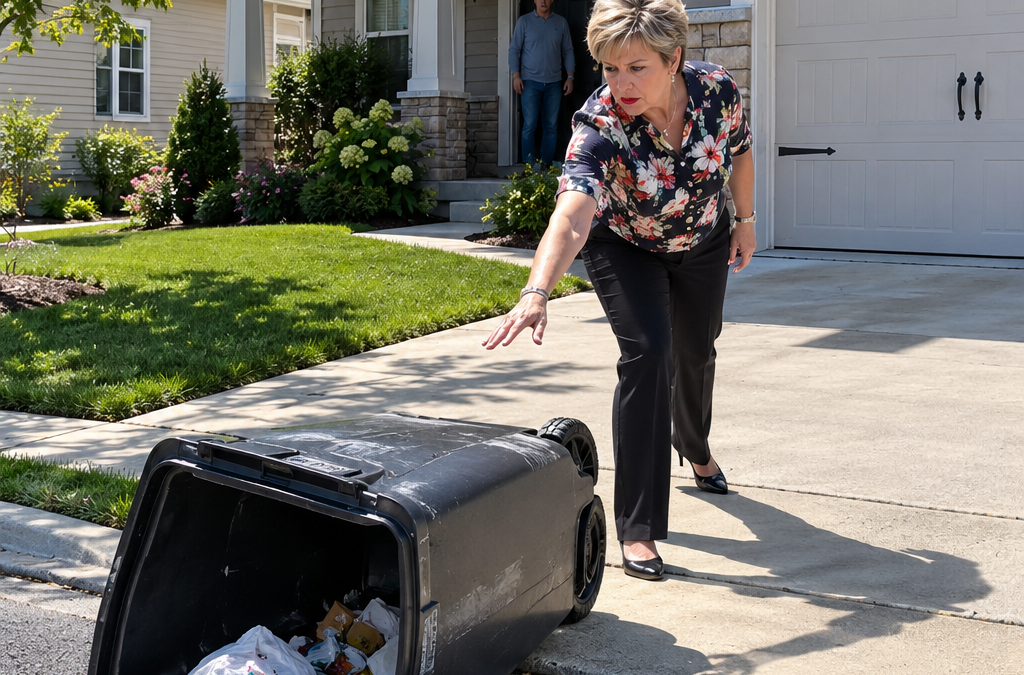
𝗙𝗨𝗟𝗟 𝗦𝗧𝗢𝗥𝗬
She gave me the kind of smile people use when they believe the conversation is already over.
“I would suggest moving it closer to the house.”
“How close?”
“At least three feet farther from the sidewalk.”
“Is that written somewhere?”
“Yes.”
“Can you show me?”
She sighed.
“Everyone received the standards.”
“I’ll check.”
“Good.”
She started walking.
Then turned back.
“And I’d make sure it stays there.”
I looked at her.
“Why?”
Her smile disappeared.
“Because if it isn’t properly placed, you should expect another visit.”
Then she kept walking.
I stood beside the trash can, looking after her.
Another visit.
The phrase bothered me more than it should have.
Not because I was afraid of Karen.
Because she had spoken as though the trash can moving wasn’t something that happened.
It was something that would happen.
I went inside and pulled up the HOA rules.
Trash containers had their own section.
I read it carefully.
Containers could be placed near the curb after six p.m. the evening before collection.
They had to be retrieved by ten p.m. the day of collection.
When not awaiting pickup, they had to be stored somewhere not visible from the street.
Nothing about three feet.
Nothing about driveway aprons.
Nothing about pedestrian corridors.
The sidewalk itself couldn’t be blocked.
Mine wasn’t.
I checked older amendments.
Same.
I printed the page.
Not because I planned to confront Karen.
Because I’d learned something useful over the years.
When somebody begins confidently quoting rules, read the actual rule before arguing.
People often remember what they wish the rule said.
That evening, I rolled the bin to exactly the same position.
Then went inside.
The next morning, it was upright.
I left for work.
When I returned, it was on its side.
Again.
This time I didn’t pick it up immediately.
I stood ten feet away.
Studied the pavement.
No tire marks.
No impact.
The can itself wasn’t scratched like a vehicle had clipped it.
Someone was doing this.
I knew it now.
But knowing and proving are different things.
The obvious suspect was Karen.
That didn’t mean I wanted to accuse her without evidence.
Maybe some teenager thought it was funny.
Maybe a delivery driver kept clipping the handle.
Maybe an animal.
Unlikely.
But possible.
So that evening I drove to an electronics store and bought a small security camera.
Nothing elaborate.
Wide-angle.
Motion activated.
Night vision.
Cloud storage.
I mounted it under the garage eave facing the driveway.
From the street, you’d barely notice it.
I adjusted the frame until I could see the trash can, driveway apron, sidewalk, and part of the curb.
Then I waited.
The next morning, before coffee, I opened the app.
There were seven motion alerts.
Two were cars.
One was a cat.
One was me walking to the mailbox.
Then 6:42 a.m.
I opened the clip.
Karen appeared from the left side of the frame.
Visor.
Water bottle.
Normal walking pace.
She approached my property.
Slowed.
Looked toward my front windows.
Then stepped onto the edge of the driveway.
She didn’t inspect the trash can.
Didn’t measure anything.
Didn’t photograph it.
She placed one hand against the side.
And pushed.
The bin rocked.
She pushed again.
Harder.
It tipped over.
Then Karen kept walking.
No hesitation.
No surprise.
No attempt to fix it.
Nothing.
I watched the clip twice.
Then a third time.
I didn’t feel satisfaction.
I felt insulted.
This wasn’t an argument anymore.
Karen had looked me in the face and pretended to discuss HOA standards while deliberately coming onto my driveway and knocking over my property.
Over a trash can.
Why?
Control.
That was the only explanation that made sense.
She wanted the bin where she wanted it.
I had asked for the written rule.
She couldn’t provide one.
So instead of using the HOA’s actual complaint process, she simply enforced her preference physically.
I saved the clip.
Downloaded a copy.
Then backed it up to cloud storage.
That morning, I stood the can up.
I did nothing else.
I wanted one recording.
Then I wanted a pattern.
That sounds excessive over a trash can.
Maybe it was.
But Karen had already shown me that if confronted, she’d turn the issue into rules.
I didn’t want a debate about memory.
I wanted evidence.
The next day she did it again.
Same approximate time.
Walk.
Look.
Step onto the driveway.
Push.
Keep moving.
Saved.
Two days later, again.
Saved.
One afternoon, she approached from the opposite direction.
This time she actually looked at the placement, walked around it, and then tipped it.
Saved.
Four clips.
Same behavior.
Different dates.
I began noticing something else in the footage.
Karen didn’t do this to anyone else’s bins.
She passed two other cans on the same route.
One was closer to the sidewalk than mine.
She never touched it.
That mattered.
This wasn’t general enforcement.
It was personal.
I wondered whether to email the board immediately.
Then stopped.
Karen was on the board.
If I sent one clip, she might say she moved it for safety.
If I sent four, she might say there had been repeated violations.
If I complained privately, the problem might turn into a quiet argument where everyone tried to preserve Karen’s dignity.
I didn’t want humiliation.
But I did want the behavior stopped clearly.
So I changed something else.
I installed a simple locking system.
Calling it automated sounds more dramatic than it was.
The mechanism secured the bin to a low anchor point beside the driveway while it wasn’t being actively rolled for collection.
It didn’t trap anyone.
Didn’t shock anyone.
Didn’t spray water.
Nothing childish.
It simply prevented the trash can from being tipped or dragged unless the lock was released.
From the street, you couldn’t see much.
The can looked normal.
I tested it.
Pulled the handle.
The bin moved an inch, then stopped.
Good.
The camera remained on.
The following afternoon, I happened to be home.
I was working at my kitchen table when my phone vibrated.
Motion alert.
I opened the feed.
Karen.
Of course.
She walked toward the bin with more confidence than usual.
Maybe because I’d kept putting it back.
Maybe because she had decided I was one of those homeowners who would eventually stop resisting if she repeated herself long enough.
She stepped onto the driveway.
Reached for the handle.
Pulled.
The bin didn’t move.
Karen looked down.
Pulled harder.
Nothing.
She changed position.
Tried the side.
The can rocked slightly but stayed upright.
For the first time since this ridiculous situation began, Karen looked confused.
Not angry.
Not authoritative.
Confused.
Like an object that had always obeyed her had suddenly made a decision.
I stood.
Walked outside.
“Karen.”
She jumped slightly.
Then straightened.
“What are you doing?”
Her expression changed instantly.
Confidence returning.
“I’m checking placement.”
“By pulling on my trash can?”
“It appears to be secured improperly.”
“Improperly according to what?”
“HOA regulations prohibit permanent structures near the curb.”
“It’s not permanent.”
“This could create a hazard.”
“It’s entirely on my property.”
“The board has authority over visible exterior conditions.”
I almost admired the speed.
Karen could generate a rule faster than most people could open the handbook.
I pulled out my phone.
“Do you remember when I asked whether you’d touched the bin?”
Her face tightened.
“Why?”
“Because you never answered.”
“I told you it was improperly placed.”
I opened the first video.
Held the phone where she could see.
Karen watched herself walk onto my driveway.
Push the can.
Walk away.
Her face changed.
Not dramatically.
A tightening around the mouth.
Eyes dropping toward the screen.
I swiped to the second clip.
Another day.
Same thing.
Third.
Fourth.
She stopped watching.
“You’re recording me?”
“My driveway.”
“You can’t just surveil people without consent.”
“The camera records my property.”
“This is a neighborhood.”
“Correct.”
“I walk here.”
“You walked onto my driveway.”
She folded her arms.
“I was correcting a violation.”
“What violation?”
“The container placement.”
“Show me the rule.”
“We’ve been over this.”
“No.”
I opened the actual HOA document on my phone.
“We’ve been over your interpretation.”
I showed her the section.
“No three-foot rule.”
She barely looked.
“The board has discretion.”
“Does discretion include knocking over homeowners’ property?”
Her face reddened.
“I didn’t damage anything.”
“That’s not what I asked.”
“You are blowing this completely out of proportion.”
I almost laughed.
“You’ve knocked over my trash can repeatedly for days.”
“Because you refuse to cooperate.”
“There it is.”
“What?”
“The part where you admit doing it.”
Karen stopped.
I saw the realization.
She had moved too fast.
I wasn’t secretly recording the conversation beyond the visible security camera, but the camera was still capturing us from above.
She looked toward it.
Then back at me.
“I didn’t say that.”
“You just said you did it because I refused to cooperate.”
“Don’t twist my words.”
“I’m not.”
She pulled out her phone.
Called someone.
“Who are you calling?”
“The HOA.”
“Good.”
She turned away.
I could hear fragments.
“Homeowner confrontation.”
“Unauthorized restraint system.”
“Recording residents.”
“Noncompliant trash placement.”
It was almost impressive.
Within sixty seconds, my trash can had become a security device, privacy violation, and confrontation.
I stood there quietly.
A few neighbors had come outside.
The first was my next-door neighbor, Mark Ellis.
He looked from me to Karen.
Then at the bin.
“Everything okay?”
Karen answered before I could.
“This homeowner is refusing a compliance directive.”
Mark looked at me.
“What compliance directive?”
“Trash placement,” Karen said.
Mark frowned.
“His can?”
“Yes.”
Mark looked confused.
“I’ve seen you near his can like four times this week.”
Karen’s face turned toward him.
“What?”
“I thought you were checking something.”
“Exactly.”
Karen grabbed onto that.
“I was checking compliance.”
Mark pointed toward the pavement.
“By knocking it over?”
Silence.
I looked at him.
“You saw that?”
“Once.”
“When?”
“Tuesday morning.”
He shrugged.
“I was leaving early for work. You pushed it and kept walking.”
Karen’s expression hardened.
“I repositioned it.”
Mark stared at the can.
“Onto its side?”
Another neighbor came closer.
Then another.
I didn’t want the driveway becoming a spectacle.
“Karen, let’s handle this through the board.”
“Gladly.”
She turned toward the street.
“You’ll receive formal notice.”
“For what?”
She didn’t answer.
That made the situation almost funny again.
Almost.
Two days later, I received an email from the HOA management company.
Not a violation.
A meeting request.
The board had scheduled a special session to review a homeowner complaint regarding conduct by a board member.
That wording told me something had changed.
Not trash-can placement.
Board-member conduct.
I organized everything.
Dates.
Videos.
Rule section.
Photographs showing placement.
A written statement from Mark.
I didn’t create a dramatic presentation.
No music.
No editing.
No arrows.
Just clips labeled by date.
The meeting took place Monday evening in the clubhouse.
Maybe twenty residents attended.
More than I expected.
Karen sat with the board.
She wore a navy blazer and had a folder in front of her.
Of course she did.
The HOA president, Thomas Reed, opened the meeting.
“This session concerns a dispute between a homeowner and a board member related to property interference and enforcement procedure.”
Karen raised her hand immediately.
“I want the record to reflect that this characterization is prejudicial.”
Thomas looked at her.
“The record reflects your objection.”
She sat back.
I had never liked Thomas much.
That evening, I appreciated him.
He didn’t take sides early.
He laid out the process.
I would speak.
Karen would speak.
Board members could ask questions.
Management would review the governing documents.
Then the board would decide whether any action was appropriate.
Simple.
Fair.
Karen went first.
Naturally.
She described the trash can as a recurring safety and aesthetic issue.
She claimed multiple informal reminders had been ignored.
She said she had attempted to “correct placement.”
She described the new locking mechanism as potentially dangerous and visually inappropriate.
Then she said:
“I never intentionally damaged the homeowner’s property.”
Thomas asked:
“Did you touch it?”
Karen paused.
“Only as necessary to move it into compliance.”
That answer mattered.
“How many times?”
“I don’t remember.”
Thomas looked toward me.
“Your turn.”
I stood.
Connected my laptop to the room screen.
“I don’t need much time.”
Karen looked toward me.
I opened the HOA rules first.
Displayed the trash-container section.
Read it aloud.
Containers couldn’t block sidewalks.
Mine didn’t.
Containers had to be removed from public view after collection hours.
Mine was.
No three-foot rule.
No authority allowing board members to enter private driveways and physically move bins.
Then I opened the first video.
6:42 a.m.
Karen appeared on the screen.
The room went quiet.
She walked.
Looked.
Stepped onto my driveway.
Pushed.
Trash can fell.
Kept walking.
I stopped the clip.
Didn’t say anything.
Opened the second.
Same.
Third.
Same.
Fourth.
Same.
The silence changed.
This was no longer one person’s description against another.
Karen interrupted.
“Those videos lack context.”
Thomas looked at her.
“What context would change what we’re seeing?”
“The bin had been improperly placed repeatedly.”
“Then why knock it over?”
“I was attempting to move it.”
One board member, Susan Caldwell, leaned forward.
“Karen, you pushed from the side.”
Karen looked at her.
“I was trying to rotate it.”
“Onto the pavement?”
“It was unstable.”
Susan looked toward the screen.
“It was upright until you touched it.”
Another board member asked me to replay the second clip.
I did.
Karen walked past another trash can before reaching mine.
That can sat closer to the sidewalk.
The board member pointed.
“Why didn’t you address that one?”
Karen said, “We’re discussing this property.”
“That’s not an answer.”
I almost smiled.
Same words I’d used days earlier.
Then Mark’s statement was read.
He had witnessed Karen pushing the can over.
Not moving it.
Not rotating it.
Pushing it.
Karen’s explanation became more complicated.
She said the homeowner had been confrontational.
I asked which confrontation occurred before the first recording.
She couldn’t answer.
She said I had ignored warnings.
I asked for copies.
None existed.
She said residents had complained.
Management checked.
No formal complaints had been filed.
That was when the issue stopped being silly.
Not because trash cans suddenly became important.
Because the board realized Karen had been using the HOA’s authority informally, outside procedure, to enforce a preference she could not support with the governing documents.
Thomas asked:
“Karen, did the board authorize you to physically move this homeowner’s property?”
“No.”
“Did management?”
“No.”
“Was there an emergency safety concern?”
“The bin was close to the sidewalk.”
“Was it blocking the sidewalk?”
She hesitated.
“No.”
“Did you issue a formal violation?”
“I was trying to resolve it informally.”
Susan said:
“By repeatedly knocking it over.”
Karen turned toward her.
“I didn’t knock it over. I moved it.”
Susan looked at the paused video.
The trash can was lying flat.
Nobody laughed.
That was what made it worse.
The board went into executive discussion for about twenty minutes.
Residents talked quietly.
Karen sat alone at one end of the table.
I didn’t feel triumphant.
That surprised me.
For days, I had imagined the moment she’d be confronted with proof.
I thought I’d enjoy it.
Instead, I mostly felt tired.
All of this over a bin.
Karen could have knocked on my door once.
Shown me a rule if one existed.
Asked me to move it.
We could have had a thirty-second conversation.
Instead, she turned one plastic container into a test of obedience.
That was the part the board needed to understand.
The meeting resumed.
Thomas read the decision.
The HOA found no violation in my trash-can placement as documented.
My locking mechanism could remain so long as it didn’t obstruct collection or pedestrian access.
Karen was formally instructed not to enter homeowners’ property or touch personal belongings while performing board duties unless specifically authorized by governing documents or an actual emergency.
All enforcement would go through management.
No self-directed corrective action.
Any future complaint required documentation and normal notice procedures.
Then Thomas looked at Karen.
“Board members don’t get extra property rights because they’re board members.”
She stared at him.
He continued.
“If something violates a rule, issue the rule through the proper channel.”
Then he looked around the room.
“If you can’t show the rule, don’t invent one.”
That was the strongest thing anyone said all night.
Karen didn’t apologize.
Not then.
She gathered her folder.
Left quickly.
The meeting moved on to irrigation costs.
Pool maintenance.
Tree trimming.
Normal boring HOA business.
I loved every second of it.
When I got home, my trash can stood beside the driveway.
Exactly where I’d left it.
I walked past.
Then stopped.
Looked at it.
A ridiculous object.
Black plastic.
Two wheels.
A scratched lid.
For almost two weeks, I had checked it before I checked the mail.
Now it was just a trash can again.
That’s what peace looked like.
Not victory.
Normality.
The following morning, I was drinking coffee near the front window when Karen appeared on her usual walk.
Same visor.
Same water bottle.
She approached my property.
Slowed.
Her eyes went toward the bin.
Then toward the camera.
Then the house.
For one second, I thought she might stop.
She didn’t.
She kept walking.
No clipboard.
No lecture.
No hand on the handle.
Nothing.
I smiled.
Not because I had defeated her.
Because the routine was over.
Trash pickup returned to what it had been before.
Thursday.
Roll out.
Collection.
Roll back.
Nobody touched it.
Nobody gave me an informal warning.
Nobody invented a three-foot pedestrian-corridor rule.
Life moved on.
But the story didn’t completely disappear.
For weeks, neighbors would mention it.
Mark joked:
“Bin still behaving?”
“Mostly.”
Another neighbor bought a camera.
Then another.
Not because Karen had started attacking everybody’s trash cans.
Because people realized documentation was useful.
That made Karen uncomfortable.
I noticed she stopped carrying the clipboard on her morning walks for a while.
Whether that meant anything, I don’t know.
The board also changed procedure.
Not officially because of me, though everyone knew why.
Board members were reminded in writing that they were volunteers operating under defined authority.
Complaints had to go through the management system.
Photographs could document violations from public areas, but board members could not trespass onto lots simply to “correct” something.
No one could move, remove, alter, or interfere with private property except under narrowly defined safety conditions.
That language should have been obvious.
Apparently obvious things still benefit from being written.
A month later, Thomas stopped me while I was getting mail.
“I owe you an apology.”
“For what?”
“We should’ve had clearer boundaries for board conduct.”
“I didn’t complain before this happened.”
“No.”
He looked toward Karen’s house.
“But we knew she was overenthusiastic.”
That word made me laugh.
“Overenthusiastic.”
“You know what I mean.”
“I do.”
“We kept telling ourselves she’d calm down.”
“Did she?”
“No.”
“Then there you go.”
Thomas nodded.
“Boards like volunteers who do work.”
“I understand.”
“Sometimes that becomes an excuse not to ask how they’re doing it.”
That was probably the real lesson.
Karen hadn’t woken up one morning and decided she owned the neighborhood.
It happened gradually.
She reported something.
People listened.
She told someone to fix something.
They complied.
She moved from reminders to instructions.
Instructions to personal enforcement.
Nobody stopped her because most of the individual incidents were too small to justify a confrontation.
Trash can.
Garden hose.
Flower pot.
Holiday lights.
People paid the emotional tax and moved on.
Then Karen interpreted compliance as authority.
That’s how petty power grows.
Not because anyone officially gives it.
Because everyone decides challenging it is more exhausting than obeying it.
I had almost done the same thing.
When she first told me to move the bin, I could have done it.
Three feet.
Who cares?
Then maybe next month it would be a planter.
Then the car.
Then a fence color.
The issue wasn’t the trash can.
It was whether Karen could invent a rule and physically enforce it because arguing with her was inconvenient.
I don’t believe every HOA disagreement needs resistance.
Sometimes a rule exists.
Sometimes you’re wrong.
Sometimes the easiest answer is also the correct one.
If my bin had blocked the sidewalk, I would have moved it.
If management had shown me a legitimate standard, I would have followed it.
What bothered me was the opposite.
She could not show the rule.
So she substituted confidence.
Then force.
Tiny force.
A push.
But still.
The camera removed the confidence from the equation.
That was what I found interesting afterward.
Before footage, Karen and I had equal stories.
She could say:
“I adjusted an improperly placed bin.”
I could say:
“She knocked it over.”
People would choose based on who they trusted.
After footage, trust became unnecessary.
Watch.
That’s all.
There she is.
There is the bin.
There is the push.
There it goes.
Evidence has a way of shortening arguments.
Months later, I replaced the original security camera with a better one.
Wider view.
Higher resolution.
Not because Karen did anything else.
She didn’t.
But I liked having a record.
Package deliveries.
Driveway incidents.
Stray animals.
Normal security.
The trash-can locking mechanism stayed too.
I modified it so sanitation workers could move the bin normally on pickup mornings.
Nobody complained.
Ironically, the can became more secure and less noticeable than before.
One Saturday, Karen and I ended up in the same aisle at a hardware store.
Trash bags.
Of course.
I saw her before she saw me.
For one petty second, I considered turning around.
Then decided that was ridiculous.
I reached for a box.
She noticed me.
We stood there.
“Hello.”
“Karen.”
She looked toward the bags in my hand.
I looked toward hers.
Neither of us said anything.
Then she surprised me.
“I shouldn’t have touched your property.”
I stared.
She looked uncomfortable.
Not rehearsed.
Not defensive.
A real apology, or at least the beginning of one.
“No.”
“I thought I was helping enforce the standards.”
“I know.”
“I got carried away.”
I considered arguing with the wording.
Carried away made it sound accidental.
But I had learned something too.
Not every final conversation needs perfect language.
“You did.”
She nodded.
“I’m sorry.”
I believed she meant it.
Maybe not for everything.
Maybe because the board had disciplined her.
Maybe because getting caught changed how she saw herself.
Motives are messy.
The apology was enough.
“Thank you.”
She started to walk away.
Then stopped.
“That locking system.”
“What about it?”
“Where did you get it?”
I almost laughed.
“Built it.”
“Of course you did.”
For the first time since the whole thing started, we both smiled.
Small.
Awkward.
Human.
Then she left.
We never became friends.
That would’ve made the story too neat.
But she stopped treating me like a target.
Actually, she stopped treating most people that way.
At the next annual HOA election, Karen didn’t run for another board term.
I don’t know whether she chose not to or knew she wouldn’t win.
Either way, she returned to being what she’d always legally been first.
A neighbor.
That role suited her better.
The board became less dramatic after she left.
Thomas remained president for another year.
Then Susan took over.
She started every meeting with a short reminder:
“Rules are written. Preferences are not.”
Everyone knew where that came from.
Nobody named Karen.
Didn’t need to.
The neighborhood looked the same.
Lawns.
Sidewalks.
Trash cans every Thursday.
The remarkable thing was how little had actually been required to restore peace.
No lawsuit.
No police.
No screaming match.
No revenge.
Camera.
Footage.
Rules.
Meeting.
Decision.
The facts were enough.
I thought about that every time someone asked what I would have done if there hadn’t been a camera.
Honestly?
I don’t know.
Maybe argued.
Maybe complained to the board.
Maybe moved the bin just to make Karen go away.
Without the footage, the story would have depended on personality.
Karen had seniority.
Board status.
Confidence.
I had irritation.
Not a strong position.
Evidence changed the power relationship without requiring me to become more aggressive.
That is probably why the situation stayed under control.
People often imagine standing up for yourself means speaking louder.
Sometimes it does.
Sometimes it means saying almost nothing until you’ve collected enough truth that nobody needs your volume.
The first day I saw Karen on video, I wanted to march to her house immediately.
I imagined knocking.
Showing the clip.
Watching her reaction.
I didn’t.
Waiting gave me a pattern.
The pattern gave the board context.
One clip could have been an isolated lapse.
Four showed behavior.
And the later confrontation, where she admitted she had been acting because I “refused to cooperate,” gave the behavior motive.
Not dramatic motive.
No grand conspiracy.
She wanted compliance.
I wasn’t giving it.
So she created her own enforcement.
That’s all.
Sometimes small motives produce deeply irritating behavior.
The trash can itself became a running joke with friends.
One gave me a miniature plastic bin for Christmas.
Another printed a label:
PROTECTED PROPERTY — APPROACH AT YOUR OWN RISK
I did not put it outside.
I considered it.
Briefly.
Even Mark joined in.
One evening he walked over while I was rolling the actual bin behind the gate.
“Need backup?”
“I’m good.”
“You sure?”
“Very.”
“Want me to secure the perimeter?”
“Go home, Mark.”
He laughed.
Humor helped.
It took an event that had made my own driveway feel watched and reduced it to what it should have been all along.
A stupid conflict over plastic.
But underneath the jokes, I kept the lesson.
Authority needs a source.
I had learned it in other parts of life, but HOA disputes make it especially clear because the authority is so local.
A person can live two houses away and suddenly speak as though they govern your property.
Maybe they do have some authority.
Covenants are contracts.
Boards can enforce legitimate rules.
Assessments are real.
Architectural standards can be binding.
But every power has an edge.
Karen crossed hers when she stopped reporting and started physically enforcing her interpretation.
The HOA could send a notice.
Karen could vote on a board matter.
She could document a possible violation.
She could not walk onto my driveway, tip over my trash can, and call that governance.
That’s the distinction the camera captured.
Once the board saw it, the conversation stopped being about whether I liked HOA rules.
It became whether a volunteer had acted outside them.
Much cleaner question.
Sometimes I think back to that first afternoon.
The can lying beside the curb.
I had picked it up without thinking.
If Karen had only done it once, I probably never would have known.
Maybe she had done similar things elsewhere.
Straightened decorations.
Moved bins.
Shifted planters.
Tiny actions nobody documented.
Maybe she convinced herself she was helping.
That’s the dangerous thing about self-justification.
You can cross boundaries while telling yourself you’re maintaining them.
Karen genuinely believed neighborhood standards made her behavior reasonable.
At least at first.
I think the meeting changed that.
Not because everyone embarrassed her.
Nobody did.
Because she had to watch herself from the outside.
That can be brutal.
She saw a woman walk onto someone else’s driveway.
Look around.
Push over a trash can.
Walk away.
Then do it again.
No context of frustration inside her head.
No explanation about standards.
Just behavior.
Sometimes a camera doesn’t reveal something to the audience.
It reveals it to the person on screen.
I wonder if that happened to her.
I’ll never know.
The important part is that it stopped.
Years later, the neighborhood still follows the same basic trash schedule.
Bins out Wednesday evening.
Collection Thursday.
Bins back by night.
Nobody measures inches.
Nobody patrols with clipboards.
If a can blocks the sidewalk, someone knocks on the door.
Imagine that.
A conversation.
It works remarkably well.
The original bin eventually cracked.
Not from Karen.
Garbage truck arm dropped it badly.
The irony nearly killed me.
I came home one Thursday and found the lid broken and one wheel bent.
I stood in the driveway staring.
Mark walked over.
“Karen?”
I looked at him.
We both started laughing.
“No.”
“Camera?”
“Garbage truck.”
“Got proof?”
“Of course.”
The footage showed the mechanical arm lifting the bin.
Dropping it.
Crack.
The sanitation department replaced it two days later.
No argument.
No mystery.
Just evidence.
That incident felt like the perfect ending to me.
Same trash can problem.
Completely different process.
Something happened.
Camera showed what.
Responsible party acknowledged it.
Problem fixed.
No ego.
No threats.
No board meeting.
That’s what systems look like when nobody needs to dominate them.
I kept the old damaged lid for about a week.
Then realized I had become emotionally attached to garbage equipment.
Threw it away.
Appropriate.
The new bin looks exactly like everybody else’s.
Dark gray.
Black wheels.
City logo.
Nothing special.
It stands where I place it.
No lock most days anymore.
I don’t really need one.
The anchor remains.
The camera remains.
But the fear that someone will interfere with it has disappeared.
That’s what resolution should do.
Not merely stop the action.
Remove the expectation that it will happen again.
For a while, every time I came home, I looked at the curb first.
Before checking mail.
Before opening the garage.
Trash can upright?
Good.
That habit took weeks to fade.
Small harassment creates strange routines.
You become watchful over things you never cared about before.
The bin wasn’t valuable.
But it represented whether someone else believed she could come onto my property and alter things simply because she disliked my choices.
Once the board drew the line clearly, I stopped watching.
The curb became background again.
Peace is often just the return of things you no longer have to notice.
I never wanted Karen punished beyond what happened.
Some neighbors thought the board should have removed her immediately.
Others wanted formal censure.
One suggested calling police for property damage.
There wasn’t meaningful damage.
I didn’t need criminal consequences over a trash can.
What I needed was a boundary.
The board gave me one.
Do not enter homeowners’ property.
Do not touch belongings.
Use proper enforcement channels.
Simple.
Karen followed it afterward.
That mattered more to me than revenge.
Maybe that’s because the entire dispute was small enough to be corrected before it became something worse.
People don’t always get that chance.
The earlier you draw a boundary around bad behavior, the less dramatic the correction has to become.
Wait long enough, and patterns harden.
People start believing silence equals permission.
Karen had already started down that road.
Fortunately, all it took was a camera and a meeting to stop her.
I still see her occasionally.
Walking.
No visor most days now.
Sometimes with a dog.
We wave.
Not warmly.
Not coldly.
Neighbors.
Exactly the right distance.
Once, several years after the incident, she stopped near my driveway while I was washing my car.
I looked at her.
She pointed toward the trash can.
“That’s a new one.”
I stared for one second.
Then realized she was joking.
“Garbage truck killed the old one.”
She laughed.
“Do you have video?”
“Naturally.”
She shook her head.
“I should’ve known.”
Then kept walking.
I watched her go.
No anger.
No tension.
Just memory.
That’s when I realized the story had finally become history instead of conflict.
The thing I remember most isn’t the board meeting.
Not even the first video.
It’s her hand reaching for the trash-can handle after I’d installed the lock.
For days, Karen had acted with complete certainty.
Walk.
Push.
Leave.
No consequences.
Then one afternoon, the object refused to move.
That pause on her face contained the whole story.
Something had changed.
Not the trash can.
The assumption.
She had assumed I would keep picking it up.
She had assumed I wouldn’t know.
She had assumed her board position would outweigh my question.
She had assumed repeating an action would eventually make it legitimate.
The lock told her no before I ever stepped outside.
Then the camera explained why.
I like that.
Not because I wanted to embarrass her.
Because it was the cleanest possible response.
No shouting.
No retaliation.
No pushing her property over in return.
No childish escalation.
I didn’t touch anything she owned.
I didn’t invent a rule.
I simply made my own property harder to interfere with and preserved evidence of the person trying.
That’s the kind of solution I respect now.
Defensive.
Documented.
Proportionate.
If the dispute had been bigger, maybe I would have needed an attorney.
If property had been damaged, perhaps police.
If the board ignored the evidence, maybe further action.
But none of that became necessary because the facts were clear enough early.
The HOA’s job was to resolve it.
They did.
That restored some faith I hadn’t realized I’d lost.
HOAs get criticized for good reasons.
They can overreach.
Boards can become cliques.
Rules can be petty.
But the structure itself wasn’t the villain in my case.
One person abused the position.
Then the board corrected her.
That’s an important distinction.
If I had decided everyone on the board was my enemy, the meeting might have gone differently.
I brought evidence.
Not accusations.
The president listened.
The other directors asked questions.
Management checked the rule.
Then they made a decision.
That is how the process is supposed to work.
Boring.
Documented.
Fair.
Karen hated it because the process stripped away personality.
I liked it for exactly the same reason.
By the end, nobody had to decide whether I sounded more trustworthy than she did.
The video already knew what happened.
That’s why I keep coming back to the same lesson.
When somebody expects an argument, sometimes the strongest answer is preparation.
Not silence forever.
Not passivity.
Preparation.
Know the rule.
Save the email.
Record your property if lawful.
Write down dates.
Ask precise questions.
Don’t exaggerate.
Don’t claim more than you can prove.
The person on the other side may be louder.
More confident.
More experienced in meetings.
Maybe they have a title.
None of that changes what the evidence shows.
Karen expected me to become another homeowner she could pressure into moving a trash can three feet because fighting her wasn’t worth the energy.
Instead, I made the problem measurable.
Was my bin blocking the sidewalk?
No.
Did the rule require the placement she described?
No.
Did Karen touch my property?
Yes.
Did she tip the bin repeatedly?
Yes.
Was she authorized to do that?
No.
Once the questions became that simple, all the drama disappeared.
The answer wasn’t revenge.
It wasn’t humiliation.
It wasn’t even the locking mechanism.
The answer was getting the situation out of the world of confident claims and into the world of facts.
That is where Karen’s authority ended.
And where my peace finally came back.
These days, Thursday morning still looks exactly the way it always did.
Rows of bins along the curb.
A sanitation truck rumbling through the neighborhood.
Neighbors leaving for work.
Dogs behind fences.
Someone forgetting to bring a container in until dinner.
Nobody measuring anything.
Nobody watching from the sidewalk.
I roll my bin out.
I roll it back.
That’s all.
The first time that ordinary routine returned, I realized how much I had missed something so boring.
My trash can stayed upright.
No one touched it.
No one warned me.
No one claimed a rule existed when it didn’t.
I went inside without thinking about the curb again.
And that, more than the meeting, the videos, or Karen’s apology, was how I knew the problem was finally over.
𝗧𝗛𝗘 𝗘𝗡𝗗
The HOA Board Member Kept Knocking Over My Trash Can Until I Finally Let Her Reach for It One More Time
For days, somebody had been tipping my trash can into the street, and the HOA board member who kept lecturing me about “proper placement” always seemed to appear just after it happened.
I didn’t accuse her, argue with her, or threaten her—I simply pointed a camera at my driveway and waited for whoever was doing it to make the mistake again.
My neighborhood looked like the kind of American suburb people use in real estate advertisements.
Trim lawns.
Clean sidewalks.
Two-story houses in neutral colors.
Basketball hoops over driveways.
Maple trees spaced along the curb.
Every Thursday morning, trash cans rolled out in a neat little procession, and by Thursday evening, most of them had disappeared behind fences and garage walls again.
Nothing unusual.
Nothing dramatic.
That was one reason the whole thing irritated me so much.
It was a trash can.
Not a fence line.
Not a property easement.
Not a lake.
Not some complicated legal dispute over ten acres of land.
A trash can.
One plastic bin on two wheels.
And somehow, for nearly two weeks, one woman managed to turn it into the most irritating object in my life.
I had lived in the neighborhood for almost six years.
Long enough to know the unwritten rules.
Everybody waved even if they barely knew each other.
You brought packages inside for the neighbors if rain was coming.
You didn’t mow at seven on Sunday morning.
You didn’t leave your dog outside barking all night.
And if somebody forgot to bring a trash can in immediately after collection, nobody treated it like a moral collapse.
At least most people didn’t.
Then there was Karen Whitlock.
Karen served on the HOA board.
Not president.
Not property manager.
Not law enforcement.
Board member.
That distinction mattered later because Karen had gradually convinced herself it didn’t.
She had lived in the neighborhood longer than almost anyone.
She knew every rule in the HOA handbook.
Or claimed she did.
She walked most mornings carrying a stainless-steel water bottle and wearing the same bright visor regardless of weather.
Sometimes she carried a clipboard.
Sometimes her phone.
Either way, she always appeared to be inspecting something.
Grass.
Mailboxes.
Parking.
Fence stains.
Christmas lights.
One neighbor joked that Karen could identify an unauthorized garden hose from three houses away.
Nobody thought much of it at first.
She was annoying.
That was all.
Every neighborhood has someone like that.
Someone who enjoys rules more than the thing the rules were supposed to protect.
I mostly avoided her.
My lawn stayed reasonably trimmed.
I didn’t park on the street overnight.
My trash cans went behind the side gate after pickup.
No giant decorations.
No loud parties.
I had no reason to be on Karen’s radar.
Then one Tuesday afternoon, I came home from work and found my trash can lying on its side.
Not unusual by itself.
The can was empty.
It sat near the end of the driveway beside the curb.
I assumed wind.
I picked it up.
Rolled it back to where I normally kept it on collection days.
Then went inside.
The weather had been calm.
That occurred to me later.
But at the time, who investigates a fallen trash can?
The next morning, I left for work around seven.
The bin was upright.
When I came home that afternoon, it was on its side again.
Almost the exact same place.
I stood beside my car for several seconds.
There had been no storm.
No strong wind.
No construction.
No reason for it to fall.
I walked over.
The lid was partly open.
The wheels were facing the street.
It looked less like something had blown over and more like something had been pushed.
I lifted it again.
That’s when I saw Karen.
She was walking down the opposite sidewalk.
Visor.
Water bottle.
Phone in one hand.
She slowed when she reached my property.
Her eyes went directly to the trash can.
Not to me.
To the can.
She stopped.
For maybe two seconds.
That was enough.
“Karen.”
She looked up.
“Oh. Hi.”
“Do you know what happened to my bin?”
Her expression changed instantly.
Not surprise.
Defensiveness.
“Your trash can?”
“The one that’s been knocked over two days in a row.”
She adjusted the bottle in her hand.
“Well, it shouldn’t be where it is.”
I looked at the can.
Then back at her.
“That’s not what I asked.”
“The HOA has placement standards.”
“I know.”
“Bins are supposed to remain clear of pedestrian access.”
“It’s not blocking the sidewalk.”
“It is too close.”
“Too close to what?”
“The pedestrian corridor.”
I almost smiled.
“Pedestrian corridor?”
“The sidewalk.”
“The trash can is on my driveway apron.”
“That doesn’t mean it’s properly placed.”
I looked around.
Three other bins were still visible farther down the street.
One sat closer to the sidewalk than mine.
Another was partly on the grass.
I pointed.
“What about those?”
Karen didn’t look.
“We’re discussing your property.”
There was something about the way she said your property that irritated me.
Like ownership itself was the issue.
I asked again.
“Did you touch my trash can?”
Karen’s jaw tightened.
“I’m trying to help you avoid a violation.”
“That’s not an answer.”
She gave me the kind of smile people use when they believe the conversation is already over.
“I would suggest moving it closer to the house.”
“How close?”
“At least three feet farther from the sidewalk.”
“Is that written somewhere?”
“Yes.”
“Can you show me?”
She sighed.
“Everyone received the standards.”
“I’ll check.”
“Good.”
She started walking.
Then turned back.
“And I’d make sure it stays there.”
I looked at her.
“Why?”
Her smile disappeared.
“Because if it isn’t properly placed, you should expect another visit.”
Then she kept walking.
I stood beside the trash can, looking after her.
Another visit.
The phrase bothered me more than it should have.
Not because I was afraid of Karen.
Because she had spoken as though the trash can moving wasn’t something that happened.
It was something that would happen.
I went inside and pulled up the HOA rules.
Trash containers had their own section.
I read it carefully.
Containers could be placed near the curb after six p.m. the evening before collection.
They had to be retrieved by ten p.m. the day of collection.
When not awaiting pickup, they had to be stored somewhere not visible from the street.
Nothing about three feet.
Nothing about driveway aprons.
Nothing about pedestrian corridors.
The sidewalk itself couldn’t be blocked.
Mine wasn’t.
I checked older amendments.
Same.
I printed the page.
Not because I planned to confront Karen.
Because I’d learned something useful over the years.
When somebody begins confidently quoting rules, read the actual rule before arguing.
People often remember what they wish the rule said.
That evening, I rolled the bin to exactly the same position.
Then went inside.
The next morning, it was upright.
I left for work.
When I returned, it was on its side.
Again.
This time I didn’t pick it up immediately.
I stood ten feet away.
Studied the pavement.
No tire marks.
No impact.
The can itself wasn’t scratched like a vehicle had clipped it.
Someone was doing this.
I knew it now.
But knowing and proving are different things.
The obvious suspect was Karen.
That didn’t mean I wanted to accuse her without evidence.
Maybe some teenager thought it was funny.
Maybe a delivery driver kept clipping the handle.
Maybe an animal.
Unlikely.
But possible.
So that evening I drove to an electronics store and bought a small security camera.
Nothing elaborate.
Wide-angle.
Motion activated.
Night vision.
Cloud storage.
I mounted it under the garage eave facing the driveway.
From the street, you’d barely notice it.
I adjusted the frame until I could see the trash can, driveway apron, sidewalk, and part of the curb.
Then I waited.
The next morning, before coffee, I opened the app.
There were seven motion alerts.
Two were cars.
One was a cat.
One was me walking to the mailbox.
Then 6:42 a.m.
I opened the clip.
Karen appeared from the left side of the frame.
Visor.
Water bottle.
Normal walking pace.
She approached my property.
Slowed.
Looked toward my front windows.
Then stepped onto the edge of the driveway.
She didn’t inspect the trash can.
Didn’t measure anything.
Didn’t photograph it.
She placed one hand against the side.
And pushed.
The bin rocked.
She pushed again.
Harder.
It tipped over.
Then Karen kept walking.
No hesitation.
No surprise.
No attempt to fix it.
Nothing.
I watched the clip twice.
Then a third time.
I didn’t feel satisfaction.
I felt insulted.
This wasn’t an argument anymore.
Karen had looked me in the face and pretended to discuss HOA standards while deliberately coming onto my driveway and knocking over my property.
Over a trash can.
Why?
Control.
That was the only explanation that made sense.
She wanted the bin where she wanted it.
I had asked for the written rule.
She couldn’t provide one.
So instead of using the HOA’s actual complaint process, she simply enforced her preference physically.
I saved the clip.
Downloaded a copy.
Then backed it up to cloud storage.
That morning, I stood the can up.
I did nothing else.
I wanted one recording.
Then I wanted a pattern.
That sounds excessive over a trash can.
Maybe it was.
But Karen had already shown me that if confronted, she’d turn the issue into rules.
I didn’t want a debate about memory.
I wanted evidence.
The next day she did it again.
Same approximate time.
Walk.
Look.
Step onto the driveway.
Push.
Keep moving.
Saved.
Two days later, again.
Saved.
One afternoon, she approached from the opposite direction.
This time she actually looked at the placement, walked around it, and then tipped it.
Saved.
Four clips.
Same behavior.
Different dates.
I began noticing something else in the footage.
Karen didn’t do this to anyone else’s bins.
She passed two other cans on the same route.
One was closer to the sidewalk than mine.
She never touched it.
That mattered.
This wasn’t general enforcement.
It was personal.
I wondered whether to email the board immediately.
Then stopped.
Karen was on the board.
If I sent one clip, she might say she moved it for safety.
If I sent four, she might say there had been repeated violations.
If I complained privately, the problem might turn into a quiet argument where everyone tried to preserve Karen’s dignity.
I didn’t want humiliation.
But I did want the behavior stopped clearly.
So I changed something else.
I installed a simple locking system.
Calling it automated sounds more dramatic than it was.
The mechanism secured the bin to a low anchor point beside the driveway while it wasn’t being actively rolled for collection.
It didn’t trap anyone.
Didn’t shock anyone.
Didn’t spray water.
Nothing childish.
It simply prevented the trash can from being tipped or dragged unless the lock was released.
From the street, you couldn’t see much.
The can looked normal.
I tested it.
Pulled the handle.
The bin moved an inch, then stopped.
Good.
The camera remained on.
The following afternoon, I happened to be home.
I was working at my kitchen table when my phone vibrated.
Motion alert.
I opened the feed.
Karen.
Of course.
She walked toward the bin with more confidence than usual.
Maybe because I’d kept putting it back.
Maybe because she had decided I was one of those homeowners who would eventually stop resisting if she repeated herself long enough.
She stepped onto the driveway.
Reached for the handle.
Pulled.
The bin didn’t move.
Karen looked down.
Pulled harder.
Nothing.
She changed position.
Tried the side.
The can rocked slightly but stayed upright.
For the first time since this ridiculous situation began, Karen looked confused.
Not angry.
Not authoritative.
Confused.
Like an object that had always obeyed her had suddenly made a decision.
I stood.
Walked outside.
“Karen.”
She jumped slightly.
Then straightened.
“What are you doing?”
Her expression changed instantly.
Confidence returning.
“I’m checking placement.”
“By pulling on my trash can?”
“It appears to be secured improperly.”
“Improperly according to what?”
“HOA regulations prohibit permanent structures near the curb.”
“It’s not permanent.”
“This could create a hazard.”
“It’s entirely on my property.”
“The board has authority over visible exterior conditions.”
I almost admired the speed.
Karen could generate a rule faster than most people could open the handbook.
I pulled out my phone.
“Do you remember when I asked whether you’d touched the bin?”
Her face tightened.
“Why?”
“Because you never answered.”
“I told you it was improperly placed.”
I opened the first video.
Held the phone where she could see.
Karen watched herself walk onto my driveway.
Push the can.
Walk away.
Her face changed.
Not dramatically.
A tightening around the mouth.
Eyes dropping toward the screen.
I swiped to the second clip.
Another day.
Same thing.
Third.
Fourth.
She stopped watching.
“You’re recording me?”
“My driveway.”
“You can’t just surveil people without consent.”
“The camera records my property.”
“This is a neighborhood.”
“Correct.”
“I walk here.”
“You walked onto my driveway.”
She folded her arms.
“I was correcting a violation.”
“What violation?”
“The container placement.”
“Show me the rule.”
“We’ve been over this.”
“No.”
I opened the actual HOA document on my phone.
“We’ve been over your interpretation.”
I showed her the section.
“No three-foot rule.”
She barely looked.
“The board has discretion.”
“Does discretion include knocking over homeowners’ property?”
Her face reddened.
“I didn’t damage anything.”
“That’s not what I asked.”
“You are blowing this completely out of proportion.”
I almost laughed.
“You’ve knocked over my trash can repeatedly for days.”
“Because you refuse to cooperate.”
“There it is.”
“What?”
“The part where you admit doing it.”
Karen stopped.
I saw the realization.
She had moved too fast.
I wasn’t secretly recording the conversation beyond the visible security camera, but the camera was still capturing us from above.
She looked toward it.
Then back at me.
“I didn’t say that.”
“You just said you did it because I refused to cooperate.”
“Don’t twist my words.”
“I’m not.”
She pulled out her phone.
Called someone.
“Who are you calling?”
“The HOA.”
“Good.”
She turned away.
I could hear fragments.
“Homeowner confrontation.”
“Unauthorized restraint system.”
“Recording residents.”
“Noncompliant trash placement.”
It was almost impressive.
Within sixty seconds, my trash can had become a security device, privacy violation, and confrontation.
I stood there quietly.
A few neighbors had come outside.
The first was my next-door neighbor, Mark Ellis.
He looked from me to Karen.
Then at the bin.
“Everything okay?”
Karen answered before I could.
“This homeowner is refusing a compliance directive.”
Mark looked at me.
“What compliance directive?”
“Trash placement,” Karen said.
Mark frowned.
“His can?”
“Yes.”
Mark looked confused.
“I’ve seen you near his can like four times this week.”
Karen’s face turned toward him.
“What?”
“I thought you were checking something.”
“Exactly.”
Karen grabbed onto that.
“I was checking compliance.”
Mark pointed toward the pavement.
“By knocking it over?”
Silence.
I looked at him.
“You saw that?”
“Once.”
“When?”
“Tuesday morning.”
He shrugged.
“I was leaving early for work. You pushed it and kept walking.”
Karen’s expression hardened.
“I repositioned it.”
Mark stared at the can.
“Onto its side?”
Another neighbor came closer.
Then another.
I didn’t want the driveway becoming a spectacle.
“Karen, let’s handle this through the board.”
“Gladly.”
She turned toward the street.
“You’ll receive formal notice.”
“For what?”
She didn’t answer.
That made the situation almost funny again.
Almost.
Two days later, I received an email from the HOA management company.
Not a violation.
A meeting request.
The board had scheduled a special session to review a homeowner complaint regarding conduct by a board member.
That wording told me something had changed.
Not trash-can placement.
Board-member conduct.
I organized everything.
Dates.
Videos.
Rule section.
Photographs showing placement.
A written statement from Mark.
I didn’t create a dramatic presentation.
No music.
No editing.
No arrows.
Just clips labeled by date.
The meeting took place Monday evening in the clubhouse.
Maybe twenty residents attended.
More than I expected.
Karen sat with the board.
She wore a navy blazer and had a folder in front of her.
Of course she did.
The HOA president, Thomas Reed, opened the meeting.
“This session concerns a dispute between a homeowner and a board member related to property interference and enforcement procedure.”
Karen raised her hand immediately.
“I want the record to reflect that this characterization is prejudicial.”
Thomas looked at her.
“The record reflects your objection.”
She sat back.
I had never liked Thomas much.
That evening, I appreciated him.
He didn’t take sides early.
He laid out the process.
I would speak.
Karen would speak.
Board members could ask questions.
Management would review the governing documents.
Then the board would decide whether any action was appropriate.
Simple.
Fair.
Karen went first.
Naturally.
She described the trash can as a recurring safety and aesthetic issue.
She claimed multiple informal reminders had been ignored.
She said she had attempted to “correct placement.”
She described the new locking mechanism as potentially dangerous and visually inappropriate.
Then she said:
“I never intentionally damaged the homeowner’s property.”
Thomas asked:
“Did you touch it?”
Karen paused.
“Only as necessary to move it into compliance.”
That answer mattered.
“How many times?”
“I don’t remember.”
Thomas looked toward me.
“Your turn.”
I stood.
Connected my laptop to the room screen.
“I don’t need much time.”
Karen looked toward me.
I opened the HOA rules first.
Displayed the trash-container section.
Read it aloud.
Containers couldn’t block sidewalks.
Mine didn’t.
Containers had to be removed from public view after collection hours.
Mine was.
No three-foot rule.
No authority allowing board members to enter private driveways and physically move bins.
Then I opened the first video.
6:42 a.m.
Karen appeared on the screen.
The room went quiet.
She walked.
Looked.
Stepped onto my driveway.
Pushed.
Trash can fell.
Kept walking.
I stopped the clip.
Didn’t say anything.
Opened the second.
Same.
Third.
Same.
Fourth.
Same.
The silence changed.
This was no longer one person’s description against another.
Karen interrupted.
“Those videos lack context.”
Thomas looked at her.
“What context would change what we’re seeing?”
“The bin had been improperly placed repeatedly.”
“Then why knock it over?”
“I was attempting to move it.”
One board member, Susan Caldwell, leaned forward.
“Karen, you pushed from the side.”
Karen looked at her.
“I was trying to rotate it.”
“Onto the pavement?”
“It was unstable.”
Susan looked toward the screen.
“It was upright until you touched it.”
Another board member asked me to replay the second clip.
I did.
Karen walked past another trash can before reaching mine.
That can sat closer to the sidewalk.
The board member pointed.
“Why didn’t you address that one?”
Karen said, “We’re discussing this property.”
“That’s not an answer.”
I almost smiled.
Same words I’d used days earlier.
Then Mark’s statement was read.
He had witnessed Karen pushing the can over.
Not moving it.
Not rotating it.
Pushing it.
Karen’s explanation became more complicated.
She said the homeowner had been confrontational.
I asked which confrontation occurred before the first recording.
She couldn’t answer.
She said I had ignored warnings.
I asked for copies.
None existed.
She said residents had complained.
Management checked.
No formal complaints had been filed.
That was when the issue stopped being silly.
Not because trash cans suddenly became important.
Because the board realized Karen had been using the HOA’s authority informally, outside procedure, to enforce a preference she could not support with the governing documents.
Thomas asked:
“Karen, did the board authorize you to physically move this homeowner’s property?”
“No.”
“Did management?”
“No.”
“Was there an emergency safety concern?”
“The bin was close to the sidewalk.”
“Was it blocking the sidewalk?”
She hesitated.
“No.”
“Did you issue a formal violation?”
“I was trying to resolve it informally.”
Susan said:
“By repeatedly knocking it over.”
Karen turned toward her.
“I didn’t knock it over. I moved it.”
Susan looked at the paused video.
The trash can was lying flat.
Nobody laughed.
That was what made it worse.
The board went into executive discussion for about twenty minutes.
Residents talked quietly.
Karen sat alone at one end of the table.
I didn’t feel triumphant.
That surprised me.
For days, I had imagined the moment she’d be confronted with proof.
I thought I’d enjoy it.
Instead, I mostly felt tired.
All of this over a bin.
Karen could have knocked on my door once.
Shown me a rule if one existed.
Asked me to move it.
We could have had a thirty-second conversation.
Instead, she turned one plastic container into a test of obedience.
That was the part the board needed to understand.
The meeting resumed.
Thomas read the decision.
The HOA found no violation in my trash-can placement as documented.
My locking mechanism could remain so long as it didn’t obstruct collection or pedestrian access.
Karen was formally instructed not to enter homeowners’ property or touch personal belongings while performing board duties unless specifically authorized by governing documents or an actual emergency.
All enforcement would go through management.
No self-directed corrective action.
Any future complaint required documentation and normal notice procedures.
Then Thomas looked at Karen.
“Board members don’t get extra property rights because they’re board members.”
She stared at him.
He continued.
“If something violates a rule, issue the rule through the proper channel.”
Then he looked around the room.
“If you can’t show the rule, don’t invent one.”
That was the strongest thing anyone said all night.
Karen didn’t apologize.
Not then.
She gathered her folder.
Left quickly.
The meeting moved on to irrigation costs.
Pool maintenance.
Tree trimming.
Normal boring HOA business.
I loved every second of it.
When I got home, my trash can stood beside the driveway.
Exactly where I’d left it.
I walked past.
Then stopped.
Looked at it.
A ridiculous object.
Black plastic.
Two wheels.
A scratched lid.
For almost two weeks, I had checked it before I checked the mail.
Now it was just a trash can again.
That’s what peace looked like.
Not victory.
Normality.
The following morning, I was drinking coffee near the front window when Karen appeared on her usual walk.
Same visor.
Same water bottle.
She approached my property.
Slowed.
Her eyes went toward the bin.
Then toward the camera.
Then the house.
For one second, I thought she might stop.
She didn’t.
She kept walking.
No clipboard.
No lecture.
No hand on the handle.
Nothing.
I smiled.
Not because I had defeated her.
Because the routine was over.
Trash pickup returned to what it had been before.
Thursday.
Roll out.
Collection.
Roll back.
Nobody touched it.
Nobody gave me an informal warning.
Nobody invented a three-foot pedestrian-corridor rule.
Life moved on.
But the story didn’t completely disappear.
For weeks, neighbors would mention it.
Mark joked:
“Bin still behaving?”
“Mostly.”
Another neighbor bought a camera.
Then another.
Not because Karen had started attacking everybody’s trash cans.
Because people realized documentation was useful.
That made Karen uncomfortable.
I noticed she stopped carrying the clipboard on her morning walks for a while.
Whether that meant anything, I don’t know.
The board also changed procedure.
Not officially because of me, though everyone knew why.
Board members were reminded in writing that they were volunteers operating under defined authority.
Complaints had to go through the management system.
Photographs could document violations from public areas, but board members could not trespass onto lots simply to “correct” something.
No one could move, remove, alter, or interfere with private property except under narrowly defined safety conditions.
That language should have been obvious.
Apparently obvious things still benefit from being written.
A month later, Thomas stopped me while I was getting mail.
“I owe you an apology.”
“For what?”
“We should’ve had clearer boundaries for board conduct.”
“I didn’t complain before this happened.”
“No.”
He looked toward Karen’s house.
“But we knew she was overenthusiastic.”
That word made me laugh.
“Overenthusiastic.”
“You know what I mean.”
“I do.”
“We kept telling ourselves she’d calm down.”
“Did she?”
“No.”
“Then there you go.”
Thomas nodded.
“Boards like volunteers who do work.”
“I understand.”
“Sometimes that becomes an excuse not to ask how they’re doing it.”
That was probably the real lesson.
Karen hadn’t woken up one morning and decided she owned the neighborhood.
It happened gradually.
She reported something.
People listened.
She told someone to fix something.
They complied.
She moved from reminders to instructions.
Instructions to personal enforcement.
Nobody stopped her because most of the individual incidents were too small to justify a confrontation.
Trash can.
Garden hose.
Flower pot.
Holiday lights.
People paid the emotional tax and moved on.
Then Karen interpreted compliance as authority.
That’s how petty power grows.
Not because anyone officially gives it.
Because everyone decides challenging it is more exhausting than obeying it.
I had almost done the same thing.
When she first told me to move the bin, I could have done it.
Three feet.
Who cares?
Then maybe next month it would be a planter.
Then the car.
Then a fence color.
The issue wasn’t the trash can.
It was whether Karen could invent a rule and physically enforce it because arguing with her was inconvenient.
I don’t believe every HOA disagreement needs resistance.
Sometimes a rule exists.
Sometimes you’re wrong.
Sometimes the easiest answer is also the correct one.
If my bin had blocked the sidewalk, I would have moved it.
If management had shown me a legitimate standard, I would have followed it.
What bothered me was the opposite.
She could not show the rule.
So she substituted confidence.
Then force.
Tiny force.
A push.
But still.
The camera removed the confidence from the equation.
That was what I found interesting afterward.
Before footage, Karen and I had equal stories.
She could say:
“I adjusted an improperly placed bin.”
I could say:
“She knocked it over.”
People would choose based on who they trusted.
After footage, trust became unnecessary.
Watch.
That’s all.
There she is.
There is the bin.
There is the push.
There it goes.
Evidence has a way of shortening arguments.
Months later, I replaced the original security camera with a better one.
Wider view.
Higher resolution.
Not because Karen did anything else.
She didn’t.
But I liked having a record.
Package deliveries.
Driveway incidents.
Stray animals.
Normal security.
The trash-can locking mechanism stayed too.
I modified it so sanitation workers could move the bin normally on pickup mornings.
Nobody complained.
Ironically, the can became more secure and less noticeable than before.
One Saturday, Karen and I ended up in the same aisle at a hardware store.
Trash bags.
Of course.
I saw her before she saw me.
For one petty second, I considered turning around.
Then decided that was ridiculous.
I reached for a box.
She noticed me.
We stood there.
“Hello.”
“Karen.”
She looked toward the bags in my hand.
I looked toward hers.
Neither of us said anything.
Then she surprised me.
“I shouldn’t have touched your property.”
I stared.
She looked uncomfortable.
Not rehearsed.
Not defensive.
A real apology, or at least the beginning of one.
“No.”
“I thought I was helping enforce the standards.”
“I know.”
“I got carried away.”
I considered arguing with the wording.
Carried away made it sound accidental.
But I had learned something too.
Not every final conversation needs perfect language.
“You did.”
She nodded.
“I’m sorry.”
I believed she meant it.
Maybe not for everything.
Maybe because the board had disciplined her.
Maybe because getting caught changed how she saw herself.
Motives are messy.
The apology was enough.
“Thank you.”
She started to walk away.
Then stopped.
“That locking system.”
“What about it?”
“Where did you get it?”
I almost laughed.
“Built it.”
“Of course you did.”
For the first time since the whole thing started, we both smiled.
Small.
Awkward.
Human.
Then she left.
We never became friends.
That would’ve made the story too neat.
But she stopped treating me like a target.
Actually, she stopped treating most people that way.
At the next annual HOA election, Karen didn’t run for another board term.
I don’t know whether she chose not to or knew she wouldn’t win.
Either way, she returned to being what she’d always legally been first.
A neighbor.
That role suited her better.
The board became less dramatic after she left.
Thomas remained president for another year.
Then Susan took over.
She started every meeting with a short reminder:
“Rules are written. Preferences are not.”
Everyone knew where that came from.
Nobody named Karen.
Didn’t need to.
The neighborhood looked the same.
Lawns.
Sidewalks.
Trash cans every Thursday.
The remarkable thing was how little had actually been required to restore peace.
No lawsuit.
No police.
No screaming match.
No revenge.
Camera.
Footage.
Rules.
Meeting.
Decision.
The facts were enough.
I thought about that every time someone asked what I would have done if there hadn’t been a camera.
Honestly?
I don’t know.
Maybe argued.
Maybe complained to the board.
Maybe moved the bin just to make Karen go away.
Without the footage, the story would have depended on personality.
Karen had seniority.
Board status.
Confidence.
I had irritation.
Not a strong position.
Evidence changed the power relationship without requiring me to become more aggressive.
That is probably why the situation stayed under control.
People often imagine standing up for yourself means speaking louder.
Sometimes it does.
Sometimes it means saying almost nothing until you’ve collected enough truth that nobody needs your volume.
The first day I saw Karen on video, I wanted to march to her house immediately.
I imagined knocking.
Showing the clip.
Watching her reaction.
I didn’t.
Waiting gave me a pattern.
The pattern gave the board context.
One clip could have been an isolated lapse.
Four showed behavior.
And the later confrontation, where she admitted she had been acting because I “refused to cooperate,” gave the behavior motive.
Not dramatic motive.
No grand conspiracy.
She wanted compliance.
I wasn’t giving it.
So she created her own enforcement.
That’s all.
Sometimes small motives produce deeply irritating behavior.
The trash can itself became a running joke with friends.
One gave me a miniature plastic bin for Christmas.
Another printed a label:
PROTECTED PROPERTY — APPROACH AT YOUR OWN RISK
I did not put it outside.
I considered it.
Briefly.
Even Mark joined in.
One evening he walked over while I was rolling the actual bin behind the gate.
“Need backup?”
“I’m good.”
“You sure?”
“Very.”
“Want me to secure the perimeter?”
“Go home, Mark.”
He laughed.
Humor helped.
It took an event that had made my own driveway feel watched and reduced it to what it should have been all along.
A stupid conflict over plastic.
But underneath the jokes, I kept the lesson.
Authority needs a source.
I had learned it in other parts of life, but HOA disputes make it especially clear because the authority is so local.
A person can live two houses away and suddenly speak as though they govern your property.
Maybe they do have some authority.
Covenants are contracts.
Boards can enforce legitimate rules.
Assessments are real.
Architectural standards can be binding.
But every power has an edge.
Karen crossed hers when she stopped reporting and started physically enforcing her interpretation.
The HOA could send a notice.
Karen could vote on a board matter.
She could document a possible violation.
She could not walk onto my driveway, tip over my trash can, and call that governance.
That’s the distinction the camera captured.
Once the board saw it, the conversation stopped being about whether I liked HOA rules.
It became whether a volunteer had acted outside them.
Much cleaner question.
Sometimes I think back to that first afternoon.
The can lying beside the curb.
I had picked it up without thinking.
If Karen had only done it once, I probably never would have known.
Maybe she had done similar things elsewhere.
Straightened decorations.
Moved bins.
Shifted planters.
Tiny actions nobody documented.
Maybe she convinced herself she was helping.
That’s the dangerous thing about self-justification.
You can cross boundaries while telling yourself you’re maintaining them.
Karen genuinely believed neighborhood standards made her behavior reasonable.
At least at first.
I think the meeting changed that.
Not because everyone embarrassed her.
Nobody did.
Because she had to watch herself from the outside.
That can be brutal.
She saw a woman walk onto someone else’s driveway.
Look around.
Push over a trash can.
Walk away.
Then do it again.
No context of frustration inside her head.
No explanation about standards.
Just behavior.
Sometimes a camera doesn’t reveal something to the audience.
It reveals it to the person on screen.
I wonder if that happened to her.
I’ll never know.
The important part is that it stopped.
Years later, the neighborhood still follows the same basic trash schedule.
Bins out Wednesday evening.
Collection Thursday.
Bins back by night.
Nobody measures inches.
Nobody patrols with clipboards.
If a can blocks the sidewalk, someone knocks on the door.
Imagine that.
A conversation.
It works remarkably well.
The original bin eventually cracked.
Not from Karen.
Garbage truck arm dropped it badly.
The irony nearly killed me.
I came home one Thursday and found the lid broken and one wheel bent.
I stood in the driveway staring.
Mark walked over.
“Karen?”
I looked at him.
We both started laughing.
“No.”
“Camera?”
“Garbage truck.”
“Got proof?”
“Of course.”
The footage showed the mechanical arm lifting the bin.
Dropping it.
Crack.
The sanitation department replaced it two days later.
No argument.
No mystery.
Just evidence.
That incident felt like the perfect ending to me.
Same trash can problem.
Completely different process.
Something happened.
Camera showed what.
Responsible party acknowledged it.
Problem fixed.
No ego.
No threats.
No board meeting.
That’s what systems look like when nobody needs to dominate them.
I kept the old damaged lid for about a week.
Then realized I had become emotionally attached to garbage equipment.
Threw it away.
Appropriate.
The new bin looks exactly like everybody else’s.
Dark gray.
Black wheels.
City logo.
Nothing special.
It stands where I place it.
No lock most days anymore.
I don’t really need one.
The anchor remains.
The camera remains.
But the fear that someone will interfere with it has disappeared.
That’s what resolution should do.
Not merely stop the action.
Remove the expectation that it will happen again.
For a while, every time I came home, I looked at the curb first.
Before checking mail.
Before opening the garage.
Trash can upright?
Good.
That habit took weeks to fade.
Small harassment creates strange routines.
You become watchful over things you never cared about before.
The bin wasn’t valuable.
But it represented whether someone else believed she could come onto my property and alter things simply because she disliked my choices.
Once the board drew the line clearly, I stopped watching.
The curb became background again.
Peace is often just the return of things you no longer have to notice.
I never wanted Karen punished beyond what happened.
Some neighbors thought the board should have removed her immediately.
Others wanted formal censure.
One suggested calling police for property damage.
There wasn’t meaningful damage.
I didn’t need criminal consequences over a trash can.
What I needed was a boundary.
The board gave me one.
Do not enter homeowners’ property.
Do not touch belongings.
Use proper enforcement channels.
Simple.
Karen followed it afterward.
That mattered more to me than revenge.
Maybe that’s because the entire dispute was small enough to be corrected before it became something worse.
People don’t always get that chance.
The earlier you draw a boundary around bad behavior, the less dramatic the correction has to become.
Wait long enough, and patterns harden.
People start believing silence equals permission.
Karen had already started down that road.
Fortunately, all it took was a camera and a meeting to stop her.
I still see her occasionally.
Walking.
No visor most days now.
Sometimes with a dog.
We wave.
Not warmly.
Not coldly.
Neighbors.
Exactly the right distance.
Once, several years after the incident, she stopped near my driveway while I was washing my car.
I looked at her.
She pointed toward the trash can.
“That’s a new one.”
I stared for one second.
Then realized she was joking.
“Garbage truck killed the old one.”
She laughed.
“Do you have video?”
“Naturally.”
She shook her head.
“I should’ve known.”
Then kept walking.
I watched her go.
No anger.
No tension.
Just memory.
That’s when I realized the story had finally become history instead of conflict.
The thing I remember most isn’t the board meeting.
Not even the first video.
It’s her hand reaching for the trash-can handle after I’d installed the lock.
For days, Karen had acted with complete certainty.
Walk.
Push.
Leave.
No consequences.
Then one afternoon, the object refused to move.
That pause on her face contained the whole story.
Something had changed.
Not the trash can.
The assumption.
She had assumed I would keep picking it up.
She had assumed I wouldn’t know.
She had assumed her board position would outweigh my question.
She had assumed repeating an action would eventually make it legitimate.
The lock told her no before I ever stepped outside.
Then the camera explained why.
I like that.
Not because I wanted to embarrass her.
Because it was the cleanest possible response.
No shouting.
No retaliation.
No pushing her property over in return.
No childish escalation.
I didn’t touch anything she owned.
I didn’t invent a rule.
I simply made my own property harder to interfere with and preserved evidence of the person trying.
That’s the kind of solution I respect now.
Defensive.
Documented.
Proportionate.
If the dispute had been bigger, maybe I would have needed an attorney.
If property had been damaged, perhaps police.
If the board ignored the evidence, maybe further action.
But none of that became necessary because the facts were clear enough early.
The HOA’s job was to resolve it.
They did.
That restored some faith I hadn’t realized I’d lost.
HOAs get criticized for good reasons.
They can overreach.
Boards can become cliques.
Rules can be petty.
But the structure itself wasn’t the villain in my case.
One person abused the position.
Then the board corrected her.
That’s an important distinction.
If I had decided everyone on the board was my enemy, the meeting might have gone differently.
I brought evidence.
Not accusations.
The president listened.
The other directors asked questions.
Management checked the rule.
Then they made a decision.
That is how the process is supposed to work.
Boring.
Documented.
Fair.
Karen hated it because the process stripped away personality.
I liked it for exactly the same reason.
By the end, nobody had to decide whether I sounded more trustworthy than she did.
The video already knew what happened.
That’s why I keep coming back to the same lesson.
When somebody expects an argument, sometimes the strongest answer is preparation.
Not silence forever.
Not passivity.
Preparation.
Know the rule.
Save the email.
Record your property if lawful.
Write down dates.
Ask precise questions.
Don’t exaggerate.
Don’t claim more than you can prove.
The person on the other side may be louder.
More confident.
More experienced in meetings.
Maybe they have a title.
None of that changes what the evidence shows.
Karen expected me to become another homeowner she could pressure into moving a trash can three feet because fighting her wasn’t worth the energy.
Instead, I made the problem measurable.
Was my bin blocking the sidewalk?
No.
Did the rule require the placement she described?
No.
Did Karen touch my property?
Yes.
Did she tip the bin repeatedly?
Yes.
Was she authorized to do that?
No.
Once the questions became that simple, all the drama disappeared.
The answer wasn’t revenge.
It wasn’t humiliation.
It wasn’t even the locking mechanism.
The answer was getting the situation out of the world of confident claims and into the world of facts.
That is where Karen’s authority ended.
And where my peace finally came back.
These days, Thursday morning still looks exactly the way it always did.
Rows of bins along the curb.
A sanitation truck rumbling through the neighborhood.
Neighbors leaving for work.
Dogs behind fences.
Someone forgetting to bring a container in until dinner.
Nobody measuring anything.
Nobody watching from the sidewalk.
I roll my bin out.
I roll it back.
That’s all.
The first time that ordinary routine returned, I realized how much I had missed something so boring.
My trash can stayed upright.
No one touched it.
No one warned me.
No one claimed a rule existed when it didn’t.
I went inside without thinking about the curb again.
And that, more than the meeting, the videos, or Karen’s apology, was how I knew the problem was finally over.








