𝗙𝗨𝗟𝗟 𝗦𝗧𝗢𝗥𝗬 The HOA Board Member Had My Jeep Removed From My Own Driveway Without Asking What Kind of Vehicle She Was Touching
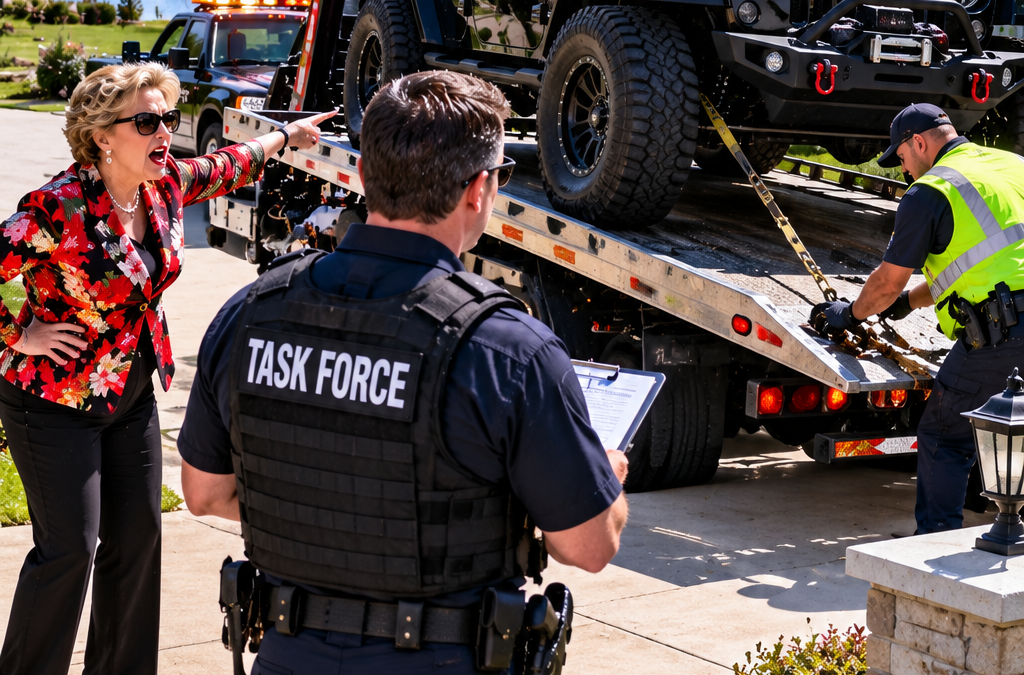
𝗙𝗨𝗟𝗟 𝗦𝗧𝗢𝗥𝗬
Then I went inside.
I pulled up the HOA documents immediately.
Not because I thought Karen was right.
Because I wanted certainty.
Parking restrictions.
Residential vehicles.
Commercial vehicles.
Temporary parking.
Recreational equipment.
Nothing prohibited the Jeep.
There was a rule against vehicles with exposed commercial equipment remaining overnight in front driveways.
The Jeep didn’t qualify.
There was another rule against unregistered or inoperable vehicles.
Also irrelevant.
I emailed the property manager.
Short.
Neutral.
I included a photograph of the Jeep and asked whether any current rule prohibited it from being parked overnight in my driveway.
The answer came that afternoon.
No violation identified based on the information provided.
That should have ended it.
I forwarded the reply to Karen.
No commentary.
No sarcasm.
Just the property manager’s response.
She never replied.
The following morning, I left early.
The Jeep stayed in the driveway because I was using my personal car for an appointment before reporting elsewhere.
It was secured.
One reason was simple vehicle theft prevention.
Another was task-force protocol.
I had installed a heavy locking device as an additional layer of security whenever the Jeep remained unattended for longer periods.
It wasn’t something an ordinary passerby would care about.
It wasn’t blocking anything.
It simply made unauthorized movement significantly more difficult.
I left the house shortly after seven.
As I backed out, I noticed Karen’s SUV parked farther down the street.
She was sitting inside.
I couldn’t tell whether she was looking toward my property.
I remember thinking:
That’s strange.
Then I told myself not to be paranoid.
Karen lived nearby.
People sit in cars.
Neighborhoods are full of coincidences.
I drove away.
Later, my security camera showed what happened after I left.
At 8:17, Karen walked onto my property.
She wasn’t alone.
Another HOA representative named Paul Mercer came with her.
Paul wasn’t a bad guy.
Retired insurance adjuster.
The type of board member who mostly attended meetings because nobody else wanted to.
On the footage, he looked uncomfortable almost immediately.
Karen pointed toward the Jeep.
They spoke for several minutes.
The camera recorded video but not clear enough audio at that distance to capture every word.
Then Karen approached the driver’s side.
She inspected the windshield.
Walked around the rear.
Tried the door.
Locked.
She pointed toward the security device.
Paul shook his head.
Karen gestured again.
More conversation.
Then another vehicle entered the frame.
A towing contractor.
That was the moment the situation stopped being ridiculous.
But I didn’t know any of it yet.
I was twenty minutes away in a conference room discussing something completely unrelated when Karen apparently made the decision that she had authority to remove the Jeep.
Later, Paul would say he told her they should wait.
Karen didn’t.
The tow operator inspected the Jeep.
Found the lock.
Spoke to Karen.
Karen showed him paperwork.
What paperwork, I later learned, was not an authorized tow order.
It was a copy of a generic HOA parking enforcement form with handwritten notes claiming the Jeep violated community restrictions.
No board vote.
No property-management authorization.
No verified rule citation.
Just Karen’s signature.
The tow operator told her the vehicle couldn’t be moved without defeating the security lock.
Karen told him to remove it.
That part was captured clearly.
He cut through the lock.
The pieces fell onto my driveway.
Then the Jeep was moved.
Not impounded through law enforcement.
Not lawfully repossessed.
Not relocated by any government agency.
A task-force-assigned vehicle was taken from the private driveway where it had been secured because one HOA board member had decided it offended a rule that didn’t exist.
When I returned home around eleven, I noticed the empty driveway before I fully stopped my car.
My mind needed a second to process it.
The Jeep should have been there.
It wasn’t.
I parked.
Got out.
Looked toward the garage.
Nothing.
Then I saw metal on the pavement.
The broken lock.
I walked over.
Picked it up.
Fresh cut through the hardened section.
Not mechanical failure.
Not something that had fallen off.
Someone had deliberately defeated it.
That changed my entire posture.
I stopped thinking HOA.
I started thinking unauthorized vehicle removal.
I checked the house.
No sign of forced entry.
Then opened the security-camera app.
I watched the footage once.
Then again.
Karen.
Paul.
Tow truck.
Lock cut.
Jeep removed.
I saved the clips immediately.
Downloaded local copies.
Sent one set to secure storage.
Then I called Karen.
She answered with the kind of tone people use when they expect to be thanked for solving a problem.
“Daniel.”
“Where is my Jeep?”
Pause.
“The HOA had it relocated.”
“Where?”
“It was removed from the property because you refused to comply.”
I felt something cold settle in my chest.
Not anger yet.
Control.
“Who authorized that?”
“The HOA has parking authority.”
“Who specifically authorized that tow?”
“I did.”
“Under what rule?”
“The overnight vehicle restriction.”
“The property manager already told you there was no violation.”
“Management doesn’t always interpret board standards correctly.”
That sentence told me how far this had gone.
“You had someone cut a security lock.”
“The vehicle was obstructing enforcement.”
I almost couldn’t believe the wording.
“Karen.”
“What?”
“Where is the Jeep?”
She gave me the towing company’s storage location.
Then added:
“You should probably retrieve it today before storage charges accumulate.”
I closed my eyes.
“Did you inspect the vehicle identification before you ordered it moved?”
Silence.
Not long.
But enough.
“What do you mean?”
“The identification.”
“It’s a Jeep.”
“That wasn’t my question.”
“What exactly are you implying?”
“Did you verify who owns or controls that vehicle?”
Karen’s voice changed.
Slightly less certain.
“You live there.”
“Did you verify it?”
“The HOA doesn’t need to run ownership searches every time it enforces parking.”
“You might want to this time.”
Another pause.
“Why?”
I looked at the broken lock in my hand.
“Because that Jeep is assigned to a specialized police task force.”
Nothing.
No response.
For maybe three seconds, I thought the call had dropped.
Then:
“That’s not my problem.”
I almost admired the commitment.
“It became your problem when you had the lock cut and the vehicle moved.”
“You never told me it was police property.”
“You never asked.”
“There are no government markings.”
“That doesn’t make it private property.”
She took a breath.
“This sounds like intimidation.”
“No.”
My voice stayed level.
“This is information.”
“I’m going to contact the board attorney.”
“Good.”
I ended the call.
Then I called my supervisor.
Lieutenant Aaron Briggs.
Aaron was not the kind of man who became excited easily.
He had spent too long in law enforcement for that.
I explained the situation.
He interrupted exactly once.
“She had it towed?”
“Yes.”
“From your driveway?”
“Yes.”
“Lock cut?”
“On video.”
“Who has it?”
I gave him the towing company’s name.
There was silence.
Then:
“Do not go get it yourself.”
“I wasn’t planning to.”
“Don’t confront the HOA.”
“Already called Karen.”
“What did you say?”
“Asked where the vehicle was. Told her what it was.”
“Anything else?”
“No.”
“Send me the footage.”
I did.
Aaron called back five minutes later.
His voice was different.
“This is now an official vehicle incident.”
“I assumed.”
“We need to confirm chain of custody and equipment.”
“I know.”
“Was anything sensitive inside?”
“Secured compartments.”
“Any reason to believe accessed?”
“Not yet.”
“Fine.”
Then the sentence I expected:
“Stay there.”
I didn’t like being told to stay in my own driveway while someone else handled a vehicle assigned to me.
But he was right.
I was directly involved.
The cleanest response was to let other officers recover it.
Two task-force officers arrived about twenty minutes later.
Detective Marcus Hale and Officer Luis Ortega.
Both knew the Jeep.
Marcus parked near my driveway.
Got out.
Looked at the cut lock.
“That’s subtle.”
“Karen believes in decisive governance.”
Luis almost smiled.
“Where’s the vehicle?”
I gave them the address.
They watched the footage before leaving.
Marcus paused the image where Karen was beside the tow operator.
“She signed something?”
“Looks like it.”
“HOA form?”
“Probably.”
Luis shook his head.
“Over a Jeep.”
I looked at him.
“Apparently.”
They drove to the towing facility.
I expected the Jeep to be returned within an hour.
Instead, the situation expanded.
The tow company had accepted Karen’s representation that she possessed authority to remove the vehicle.
Once Marcus and Luis arrived and identified themselves, the manager became extremely cooperative.
They checked the VIN.
Task-force assignment confirmed.
Equipment compartments remained sealed.
Nothing appeared missing.
That was the most important fact of the day.
But then they asked for the tow authorization.
The manager produced Karen’s paperwork.
No valid ordinance.
No police order.
No property-manager approval.
Just HOA letterhead and Karen’s assertion.
Marcus called Aaron.
Aaron called the department’s legal liaison.
The Jeep could be returned.
But the unauthorized interference had to be documented.
Meanwhile, Karen apparently heard officers were at the tow yard.
Instead of staying home, she drove there.
That decision gave Marcus a chance to ask the questions directly.
I heard the details later.
Karen walked into the lot demanding to know why the tow company was “releasing a violating vehicle without HOA authorization.”
Marcus introduced himself.
Then asked:
“Are you Karen Whitmore?”
“Yes.”
“Did you authorize removal of this Jeep?”
“I did.”
“Who gave you authority to do that?”
“The HOA.”
“Specific authority.”
“Our parking enforcement provisions.”
“Show me.”
Karen opened her folder.
Of course she had one.
She started flipping.
Commercial vehicles.
Recreational vehicles.
Parking duration.
Street obstruction.
Unregistered vehicles.
The rule she believed existed was nowhere.
Marcus waited.
Luis waited.
The tow manager waited.
Karen turned another page.
Then another.
Her confidence weakened with each one.
Finally Marcus said:
“Is there a section prohibiting this vehicle from being parked in the homeowner’s private driveway?”
Karen closed the binder.
“The board has broad discretionary power.”
“That’s not what I asked.”
“The vehicle was clearly associated with professional activity.”
“Was it blocking a sidewalk?”
“No.”
“Street?”
“No.”
“Neighbor’s driveway?”
“No.”
“Fire lane?”
“No.”
“Was it unregistered?”
“No.”
“Inoperable?”
“No.”
“Abandoned?”
“No.”
“Then what was the violation?”
“It didn’t belong in the neighborhood.”
Marcus later told me that was the exact moment he understood the whole dispute.
Not rule enforcement.
Preference.
Karen didn’t think the Jeep belonged there.
So she had converted preference into authority.
Luis inspected the VIN and task-force identification.
Then showed Karen the confirmation.
“Ma’am, this is an assigned official vehicle.”
Karen looked at the Jeep.
Then him.
Then Marcus.
“But it doesn’t have police markings.”
Marcus answered:
“Not every law-enforcement vehicle does.”
“I had no way of knowing.”
“You could have checked ownership before ordering someone to cut a lock.”
“I didn’t cut anything.”
“You authorized it.”
“The tow company did the physical work.”
“Because you told them to.”
Karen became defensive again.
“I acted in good faith.”
Marcus nodded.
“That will be documented.”
She seemed relieved by the phrase.
Then he continued.
“So will everything else.”
By the time the Jeep returned to my driveway, half the neighborhood seemed to know something was happening.
Marcus drove it back himself.
Luis followed.
Several neighbors stood outside.
A few pretended to be checking mail.
Others made no effort to hide their curiosity.
Karen had apparently been telling people since the previous day that an unauthorized work vehicle was being removed from my property.
Now two task-force officers were returning it.
That changed the optics considerably.
Marcus parked in the original spot.
Got out.
Handed me the keys.
“We checked the secured compartments.”
“Everything?”
“Everything accounted for.”
That was the first moment I relaxed.
I hadn’t realized how much tension I was carrying until it left.
The Jeep could be repaired.
The lock could be replaced.
The HOA could hold ten meetings.
None of that mattered compared with equipment custody.
“What happens now?”
Marcus looked toward the neighbors.
“Official incident report.”
“And Karen?”
“That’s above me.”
“Criminal?”
He gave me the look cops give other cops when the answer depends on people who don’t yet have enough information.
“Report first.”
Fair.
I signed the vehicle back into my custody.
Photographed everything.
Cut lock.
Tow points.
Minor scratches from the relocation.
Mileage.
Fuel.
Interior condition.
Then the task force arranged an inspection.
No sensitive equipment compromised.
No operational material accessed.
That kept the situation from becoming far more serious.
I was grateful.
The HOA sent me an email that afternoon.
NOTICE OF SPECIAL BOARD MEETING
The subject:
Unauthorized Vehicle Enforcement Incident
That wording told me Karen was already losing control of the narrative.
The board meeting happened three evenings later.
The clubhouse was packed.
Some residents came because they’d heard “police vehicle.”
Others because Karen had been unpopular for years and people sensed a reckoning.
I didn’t enjoy that.
The incident involved me, but I had no interest in turning it into a public humiliation.
I wanted three things.
A record.
A correction.
And assurance nobody on the board would ever again believe they could seize or move private property based on personal preference.
Karen sat at the board table.
President Thomas Reed sat beside her.
The property manager attended.
So did the HOA attorney.
Marcus and Luis weren’t there as spectacle.
But the official report and verification documents had been provided through the proper channels.
Thomas opened the meeting.
“We’re here to review an incident involving the removal of a vehicle from a homeowner’s private driveway.”
Karen immediately spoke.
“I object to the framing.”
Thomas looked at her.
“Why?”
“The vehicle was removed as part of normal compliance activity.”
The HOA attorney leaned toward Thomas and whispered something.
Thomas nodded.
“That question is precisely what we’re reviewing.”
Karen sat back.
The property manager went first.
She displayed my original email.
My photograph.
Her response:
No violation identified.
Then the timestamp.
Sent the afternoon before the tow.
Thomas looked at Karen.
“You received this?”
She hesitated.
“Daniel forwarded it.”
“So yes.”
“Management doesn’t supersede board authority.”
The attorney spoke.
“Individual board members also do not independently supersede management procedures.”
That landed hard.
Karen looked toward him.
He continued.
“Unless authorized by board action or the governing documents.”
Thomas asked:
“Was there a board vote authorizing this tow?”
No.
“Written enforcement order?”
No.
“Emergency?”
No.
“Property-manager request?”
No.
The next item was my camera footage.
I connected my laptop.
The room watched.
Karen and Paul entering my driveway.
Karen inspecting the Jeep.
Tow truck arriving.
Security lock cut.
Jeep removed.
No one spoke during the clip.
When it ended, Thomas asked Paul to explain.
Paul looked miserable.
“I told Karen I thought we should wait.”
Karen turned toward him.
“You agreed there was a violation.”
“I said I wasn’t sure.”
“You came with me.”
“Because you said management had approved it.”
The room shifted.
Karen said:
“I said management had been notified.”
Paul shook his head.
“That’s not what I understood.”
The attorney asked:
“Did you see an authorization?”
“No.”
“Did you sign anything?”
“No.”
“Did you authorize the tow?”
“No.”
Karen interrupted.
“I took responsibility for enforcement.”
Thomas looked at her.
“That’s exactly the issue.”
Then he asked me to speak.
I stood.
“I want to make one thing clear.”
The room became quiet.
“I’m not asking this board to treat the Jeep differently because of my job.”
Karen looked surprised.
I continued.
“If it were my personal vehicle, cutting a lock and removing it from my private driveway without a valid rule or authorization would still be a problem.”
Several residents nodded.
“The task-force assignment made the consequences more serious.”
I looked toward the board.
“But it didn’t create the original wrongdoing.”
That mattered to me.
I did not want the lesson becoming:
Don’t touch Daniel’s car because Daniel works with police.
Wrong lesson.
The correct lesson was:
Don’t touch anyone’s car without lawful authority.
I displayed the relevant HOA parking rules.
Nothing prohibited the Jeep.
Then I displayed the property manager’s written response.
Then the still image showing the cut lock on the pavement.
Finally, the task-force verification.
Official assigned vehicle.
Custody requirement.
Recovery incident documented.
I kept it simple.
“I asked Karen to show me the rule.”
I looked toward her.
“She couldn’t.”
No response.
“I asked the property manager.”
I pointed toward the email.
“Management found no violation.”
Still nothing.
“Karen then chose to remove the vehicle anyway.”
I sat.
No speech.
No threat.
No mention of what I could do through my job.
The documents were enough.
The HOA attorney spoke next.
His explanation was clinical.
The board had authority to enforce recorded covenants.
That authority did not allow individual board members to invent restrictions.
Nor did it give unrestricted power to enter private property, disable security devices, or remove vehicles without proper legal and procedural basis.
He emphasized that government ownership or control created additional complications but was not the reason the HOA’s process had failed.
“The process failed before anyone knew what agency the vehicle was associated with.”
Exactly.
Karen tried one final defense.
“I believed the vehicle created a community security concern.”
Thomas looked confused.
“You called it a parking violation.”
“I became concerned by the locking equipment.”
“So you thought it might be important?”
“Potentially.”
“And your solution was to cut the lock?”
Silence.
A few residents shifted in their seats.
Karen realized too late what she’d done to her own argument.
If the heavy security had made the Jeep suspicious, that was a reason to ask questions.
Not defeat the security and move it.
Thomas asked:
“Why didn’t you call Daniel?”
“I had already spoken to him.”
“Why didn’t you call management?”
“I believed immediate enforcement was appropriate.”
“Why immediate?”
No answer.
The Jeep wasn’t blocking anything.
No safety hazard.
No emergency.
No deadline.
Just a board member who wanted compliance because she had been told no.
The board entered executive session.
Thirty minutes.
People whispered.
I stepped outside.
The lake was dark.
Small waves hitting the shoreline.
I remember thinking how absurd the whole thing was.
My work involved people capable of serious harm.
Cases where consequences mattered.
And yet one of the most exhausting incidents of that month had begun because a woman in a lakeside subdivision disliked a Jeep in a driveway.
Maybe that’s why petty authority becomes so dangerous.
The stakes feel too small to demand discipline.
People assume:
What’s the worst that can happen?
Move the car.
Pay the fine.
Ignore the board member.
But small power used badly teaches the person using it that boundaries are flexible.
Karen had gone from complaining about vehicles to believing she could physically remove one.
The board returned.
Thomas read the decision.
No valid HOA parking violation had existed.
The vehicle removal was unauthorized.
Karen had exceeded her authority as an individual board member.
She was immediately removed from all enforcement responsibilities pending further board review.
The HOA would reimburse every cost associated with the lock, vehicle inspection, tow recovery, and documented repair.
All future vehicle enforcement required management verification and written authorization.
No board member could independently order a vehicle removed from private property unless an immediate legally recognized safety condition existed.
Then Thomas added something not written in the decision.
“HOA authority has limits.”
He looked around the room.
“Being elected to this board does not make anyone law enforcement, a court, or the owner of somebody else’s driveway.”
The room was silent.
Karen stared at the table.
For the first time since I’d known her, she looked less angry than embarrassed.
I expected to enjoy that.
I didn’t.
I mostly wanted the meeting finished.
The task-force side closed once the Jeep inspection confirmed nothing sensitive had been compromised.
The unauthorized removal remained documented.
There were consequences for the towing company too.
They changed their internal process.
No future HOA tow from private residential property without verified authority.
That was sensible.
The driver hadn’t known what the Jeep was.
But he had relied on one woman’s signature without checking whether she actually had the power she claimed.
Karen remained on the HOA board briefly, but not for long.
Residents submitted complaints.
Not only about my Jeep.
Other incidents surfaced.
A contractor threatened with removal from a driveway.
A resident’s trailer tagged despite being within allowed hours.
A visitor confronted over parking that turned out to be legal.
None as serious.
Together, they showed a pattern.
At the next regular election, Karen didn’t retain her seat.
Whether she chose not to run or understood the votes weren’t there, I never asked.
The board became quieter after that.
That was good.
HOA boards should be boring.
Budgets.
Landscaping.
Insurance.
Roof approvals.
Drainage.
The moment a board member starts treating neighborhood governance as a personal command structure, something has gone wrong.
My Jeep stayed in the driveway.
Same place.
I replaced the lock.
Stronger model.
Not because I expected Karen to try again.
Because once someone cuts through security equipment, you stop assuming nobody will.
Neighbors started treating the Jeep differently too.
That made me uncomfortable.
One man asked:
“Is that like a secret police vehicle?”
“No.”
“Can you say what it does?”
“It’s transportation.”
He laughed.
“Come on.”
“I’m serious.”
People imagine specialized law-enforcement work is more cinematic than it is.
A vehicle can spend more hours in traffic than pursuit.
It can carry equipment nobody notices.
It can sit in a driveway looking completely ordinary.
That’s partly why Karen made such a serious mistake.
She believed appearance told her everything.
Jeep.
Driveway.
HOA.
Therefore authority.
But visible facts are not always the complete facts.
That doesn’t mean people should fear touching mysterious government property.
It means they should not touch property that isn’t theirs without verifying they have authority.
The same rule protects everybody.
A month after the meeting, Paul Mercer came to my house.
He knocked.
That alone was progress.
I opened the door.
“Daniel.”
“Paul.”
“Can I talk?”
“Sure.”
We sat on the porch.
He looked toward the Jeep.
“I should’ve stopped her.”
“You told her to wait.”
“I still went.”
“Yes.”
He nodded.
“I keep replaying it.”
“Don’t do that forever.”
“I knew something felt wrong.”
I waited.
“She said you were arrogant.”
I almost smiled.
“Maybe I am.”
“No.”
He shook his head.
“She said you’d used your job to intimidate the board.”
“I hadn’t mentioned my job.”
“I know that now.”
“Did you believe her?”
“For a minute.”
“Why?”
Paul looked toward the lake.
“Because she sounded certain.”
That answer was more important than he realized.
Certainty.
Karen didn’t need better evidence.
She needed a more confident voice.
People fill gaps with confidence all the time.
He continued.
“When you asked for the rule, she took that as disrespect.”
“I noticed.”
“She kept saying if she backed down, residents would stop taking the board seriously.”
“There it is.”
“What?”
“It stopped being about the Jeep.”
Paul nodded.
“I think so.”
It became about preserving authority.
Once that happens, facts become inconvenient.
The property manager’s email should have ended the issue.
Instead, Karen treated it like opposition.
My request for a rule should have produced one of two answers.
Here it is.
Or:
You’re right. No violation.
Both are normal.
What she couldn’t tolerate was the second.
A few months later, I saw Karen walking near the lake.
No clipboard.
No board folder.
Just exercise clothes.
We passed.
She stopped.
“Daniel.”
“Karen.”
For several seconds, neither of us said anything.
Then she looked toward my driveway.
“I made a mistake.”
I wasn’t expecting that.
“Yes.”
She gave a small, humorless laugh.
“You don’t soften much.”
“I’m not trying to be cruel.”
“I know.”
She looked uncomfortable.
“I really thought there was a rule.”
“At first?”
“Yes.”
I believed that.
“After management told you there wasn’t?”
She looked away.
That was the harder part.
“I thought they were being too cautious.”
“So you did it anyway.”
“Yes.”
I waited.
Then she said:
“I shouldn’t have.”
“No.”
She nodded.
“I’m sorry.”
I didn’t need a speech.
“Thank you.”
She started walking.
Then turned back.
“I didn’t know it was task-force property.”
“I know.”
“Would you have told me if I’d asked?”
“Probably enough to make you leave it alone.”
She almost smiled.
“I guess that’s the point.”
“Pretty much.”
Then she kept walking.
I watched her go.
No triumph.
Just closure.
The incident changed how I thought about my own job too.
Authority is something law-enforcement officers are trained to think about constantly.
What can I legally do?
Under what statute?
Under what circumstance?
What level of force?
What level of suspicion?
What warrant?
What exception?
Good policing is full of limits.
The limits matter because power without them becomes arbitrary.
Watching Karen behave the way she did showed me how strange it is when people are given even a small amount of local authority without understanding the same principle.
An HOA board member does have power.
Real power.
They can vote on budgets.
Enforce valid covenants.
Approve or deny applications within rules.
Authorize legitimate notices.
That doesn’t make the power unlimited.
A title doesn’t create jurisdiction beyond the document granting it.
In that sense, my Jeep incident was simpler than many police cases I’d worked.
Question:
What rule authorized the tow?
Answer:
None.
What emergency justified entering the property?
None.
Who authorized cutting the lock?
Karen.
Did she possess lawful authority to do that?
No.
Everything else was noise.
That became the lesson I eventually shared when neighbors asked.
Not:
Be careful because your neighbor might be a cop.
I hated that interpretation.
Your rights should not depend on having a badge nearby.
The better lesson was:
Ask people to show the authority they claim.
If they have it, comply or challenge through the proper process.
If they don’t, confidence does not substitute for law.
The Jeep stayed assigned to me for another year.
Eventually, the task force rotated vehicles.
The replacement looked even more ordinary.
When it first appeared in the driveway, my neighbor Mark walked over.
He pointed.
“Karen approve that?”
I stared at him.
He grinned.
“Too soon?”
“Not remotely.”
We laughed.
That humor helped reduce the whole thing back to scale.
Nobody was hurt.
Nothing sensitive was compromised.
The Jeep was recovered.
The board corrected its process.
Karen lost authority she had abused.
The neighborhood learned something.
Compared with incidents I had seen professionally, we were lucky.
Very lucky.
If task-force equipment had been accessed, the consequences could have become far more serious.
If the vehicle had been damaged.
If chain of custody had been compromised.
If it had been used after removal.
If confidential material had been exposed.
All because an HOA board member couldn’t tolerate a parked Jeep.
That’s why the situation never became funny to me until much later.
The potential mattered even though the worst didn’t happen.
The towing company sent me a formal apology.
Short.
Professional.
They admitted the authorization had not been verified adequately.
They paid for the replacement security device before the HOA reimbursement even processed.
I appreciated that.
Mistakes happen.
What matters next is whether people hide them or correct them.
That was the difference between the towing company and Karen.
The company saw the error and changed procedure.
Karen spent days explaining why the error should have been acceptable because she meant well.
Good intentions are useful when choosing flowers for a fundraiser.
They’re less useful as legal authority.
The HOA eventually revised its parking policy.
Not the restrictions themselves.
The process.
Every vehicle violation had to identify the exact governing section.
Notice first unless immediate safety concerns existed.
Management review.
Time to respond.
Formal authorization before towing.
Private driveway removals required stronger justification than common-area parking issues.
That was how it should have been all along.
I kept copies.
Of course I did.
My work already trained me to preserve documentation.
Karen reinforced the habit.
Camera footage.
Emails.
Photos.
Reports.
Dates.
People sometimes mock documentation as obsessive until two versions of the same event collide.
Then everyone wants the record.
Without my security cameras, Karen could have said:
The towing company acted on its own.
The lock was already damaged.
The Jeep had been parked somewhere else.
I misunderstood.
Paul misunderstood.
The camera removed all of that.
There she was.
Walking onto the driveway.
Discussing the lock.
Handing over paperwork.
Standing there while it was defeated.
Watching the Jeep leave.
No anger required.
No interpretation needed.
That’s why the board meeting ended differently from the argument in my driveway.
The first day, Karen had confidence.
I had a question.
At the meeting, I had evidence.
Confidence matters a lot less then.
Several years have passed.
The neighborhood still looks nearly identical.
Same lake.
Same trimmed lawns.
Same rows of houses.
Different board members.
Most people don’t remember the details unless somebody brings up “the Jeep incident.”
I wish it had a less dramatic name.
It sounds like something exploded.
Nothing exploded.
A woman overreached.
A lock got cut.
A vehicle moved.
Then paperwork did its job.
Maybe that’s why I remember it.
Because the consequences could have become dramatic, but the solution wasn’t.
I didn’t arrest Karen.
Didn’t yell.
Didn’t threaten her with my job.
Didn’t stand in the driveway flashing credentials.
I checked the video.
Called my supervisor.
Let the correct people recover the vehicle.
Then used the board process.
That was enough.
Self-control isn’t always heroic.
Sometimes it just prevents a stupid situation from becoming stupider.
The afternoon after everything finally settled, I stood beside the Jeep looking across the lake.
Sun low.
Water almost flat.
You could hear a lawn mower several houses away.
A dog barked.
Somebody’s kids were arguing about a basketball.
Normal suburban noise.
I put the new security lock in place.
Then stepped back.
The Jeep looked exactly the same as it had before.
Nothing about it revealed the week we’d just had.
That’s the strange thing about important objects.
Their meaning often exists entirely in context.
Karen saw a Jeep.
I saw assigned equipment and professional responsibility.
The HOA saw a driveway.
I saw private property.
Karen saw resistance.
I saw a request for documentation.
Two people can look at the same thing and build completely different stories.
Evidence decides which story survives.
That’s why I never forgot her first response when I asked for the rule.
She didn’t show me one.
She told me to move the Jeep anyway.
Everything that followed grew from that moment.
Not because the rule was complicated.
Because there wasn’t one.
If she had said:
You’re right. I misunderstood.
Nothing happens.
No broken lock.
No tow truck.
No task-force officers.
No emergency board meeting.
No official incident report.
No public embarrassment.
Six words could have saved everybody:
I was wrong about the rule.
People underestimate how much courage those words require when someone has built an identity around being the person who knows the rules.
Karen couldn’t say them soon enough.
So reality kept getting more expensive.
I’ve seen the same pattern professionally.
Someone makes a small mistake.
Then lies to protect it.
Then makes a bigger decision to protect the lie.
Then another.
Soon the original mistake barely matters compared with everything done afterward.
Karen’s original error was harmless.
She thought a Jeep violated a neighborhood parking standard.
Fine.
Anyone can misread a rule.
The serious mistake was what happened after I showed her management’s answer.
She chose her authority over the facts.
That was the line.
Once crossed, the rest became predictable.
I keep a piece of the original lock in a drawer.
Not as a trophy.
I’m not sentimental about damaged security hardware.
I kept it because it reminds me of how much meaning can fit inside one cut piece of steel.
Someone had looked at an object designed to say:
Do not move this without authorization.
And decided:
My authority is enough.
It wasn’t.
That’s all.
Simple.
The HOA never touched the replacement Jeep.
Never questioned it.
If a new vehicle appeared, management asked politely whether it complied.
If there was a question, they checked the handbook.
Nothing dramatic.
That’s exactly how systems should work.
One of the newer board members once asked me:
“Do you think Karen was trying to hurt you?”
“No.”
He seemed surprised.
“What was she trying to do?”
“Win.”
That answer bothered him.
It bothers me too.
Because not every harmful action comes from hatred.
Sometimes it comes from someone who has turned a minor disagreement into a contest they cannot tolerate losing.
Once Karen decided the Jeep had to move, every fact became secondary.
My driveway.
The property manager.
The missing rule.
The lock.
Everything stood between her and being proven correct.
So she removed the obstacles one at a time.
Until one of those obstacles turned out to be official task-force property.
That was when the world became larger than her HOA authority.
But it had always been larger.
She simply couldn’t see it.
These days, whenever someone in the neighborhood starts a sentence with:
“The HOA says…”
I sometimes ask:
“Which section?”
Not aggressively.
Just habit.
Most of the time there is a section.
Good.
Sometimes there isn’t.
Also good to know.
People laugh occasionally.
“Still traumatized by the Jeep?”
“No.”
Maybe a little.
But mostly I’ve learned that rights survive better when people know where they’re written.
The lake community stayed peaceful.
More peaceful, really.
Board meetings became shorter.
Enforcement complaints became more precise.
Residents stopped treating individual board members like neighborhood police.
Board members stopped trying to be.
Karen eventually sold her house.
Not immediately.
A couple of years later.
I didn’t connect the sale to the incident.
People move.
On her final week, I saw a moving truck outside.
She was carrying a box toward her car.
I walked past.
She looked up.
“Daniel.”
“Karen.”
She glanced toward my driveway.
The replacement task-force vehicle sat there.
“Still working with them?”
“Yes.”
She nodded.
“Take care of yourself.”
“You too.”
That was it.
No cinematic ending.
No final argument.
No humiliation.
She drove away.
The neighborhood continued.
I’m glad.
Revenge makes for satisfying stories.
Real communities need something different.
Correction.
Boundaries.
Then the ability to live next to one another afterward.
Karen crossed a line.
The board corrected it.
The task force documented it.
Nobody was seriously harmed.
The Jeep came home.
That was enough.
The strongest memory I have from the entire incident isn’t the board meeting.
It’s the moment I turned into my driveway and saw empty pavement.
Before I found the lock.
Before the camera footage.
Before I knew Karen had done it.
For maybe five seconds, I had no idea where an assigned government vehicle under my responsibility had gone.
Those five seconds were worse than all the shouting Karen could have done.
Because responsibility has weight.
When something is entrusted to you, you feel its absence differently.
That is what Karen never understood.
To her, the Jeep was an object violating the appearance she wanted.
To me, it was custody.
Duty.
Accountability.
And when she had it moved without permission, she stepped into a system she knew nothing about.
Fortunately for everyone, the system responded calmly.
No sirens screaming down the street.
No dramatic raid.
Two officers.
Questions.
Documentation.
Verification.
Recovery.
Then the process moved forward.
That is exactly how I wanted it.
People sometimes tell me the funniest part is Karen flipping through the HOA handbook while the officers waited for her to find a rule that wasn’t there.
I admit there is some irony in it.
But the important part came after.
Once she couldn’t find the rule, nobody allowed her confidence to replace it.
Not the task force.
Not the property manager.
Not the board.
That was the real correction.
Titles are useful.
Rules are useful.
Organizations are useful.
But authority has to come from somewhere real.
Written policy.
Law.
Contract.
Recorded governance.
Something stronger than:
I thought I could.
Karen learned that over a Jeep.
The rest of us learned it by watching.
And every morning after that, when I stepped outside and saw the vehicle sitting exactly where it belonged, I didn’t think about winning.
I thought about how close one person’s certainty had come to creating a much bigger problem.
Then I unlocked the Jeep, checked the equipment, and went to work.
Because in the end, the vehicle had never needed an HOA’s permission to be there.
It only needed everyone else to respect the limits of their own authority.
𝗧𝗛𝗘 𝗘𝗡𝗗
The HOA Board Member Had My Jeep Removed From My Own Driveway Without Asking What Kind of Vehicle She Was Touching
Karen stood in my driveway pointing at the Jeep like she had already decided it violated some neighborhood rule, and when I asked her to show me that rule, she couldn’t.
The next morning, while I was away, she cut through the heavy security lock, had the Jeep moved, and unknowingly turned a petty HOA dispute into an incident involving a specialized police task force.
My name is Daniel Carter, and until that week, I thought the biggest problem I would ever have with our HOA was somebody complaining about mailbox paint.
Our neighborhood sat along a quiet lake outside a mid-sized American city.
Nothing fancy.
Comfortable houses.
Trim lawns.
Fishing boats in summer.
Children riding bicycles in the cul-de-sac after dinner.
People waved.
Neighbors borrowed tools.
The HOA collected dues, maintained the entrance landscaping, paid for a small community dock, and occasionally sent letters reminding residents not to leave trailers parked on the street.
For the most part, it was boring.
I liked boring.
My work gave me enough excitement.
I had been in law enforcement for years by then, although most people in the neighborhood didn’t know much about what I actually did.
That was intentional.
I worked with a specialized multi-agency task force that supported investigations requiring coordination between local departments and other law-enforcement units.
Some days were paperwork.
Some days surveillance.
Some days meetings.
Other days involved long hours and situations I did not discuss over backyard fences.
The Jeep parked in my driveway was connected to that work.
It looked ordinary enough.
Dark color.
Four doors.
Nothing about it screamed government vehicle.
That was part of the point.
But it was not simply my personal Jeep.
It had been assigned for task-force use.
Its identification, equipment, and custody records were maintained accordingly.
That meant I treated it differently from my own car.
It was kept secure.
Keys controlled.
Equipment inventoried.
Whenever I was responsible for it, I was responsible for what happened to it.
That last part mattered much more than Karen understood.
Karen Whitmore was one of our HOA board members.
Late fifties.
Always dressed as though she might be asked to chair a meeting at any moment.
She didn’t walk through the neighborhood.
She inspected it.
At least that was the joke among some residents.
Karen noticed everything.
Grass length.
Driveway stains.
Trailers.
Boats.
Trash cans.
Cars parked too close to the curb.
Garage doors left open.
Contractors arriving early.
If she could see it, she believed there was probably a section of the HOA handbook addressing it.
Sometimes she was right.
Often enough that people stopped asking.
That gave her confidence.
And confidence, when nobody challenges it, can slowly become something that feels like authority even when the documents don’t support it.
I had avoided most trouble with Karen.
My yard was maintained.
I paid dues.
I didn’t host loud parties.
I didn’t park commercial equipment on the street.
There was no reason for her to care about me.
Then one Monday morning, she noticed the Jeep.
I was outside carrying a small equipment bag from the garage when I heard:
“Daniel.”
I turned.
Karen stood at the edge of the driveway.
Her eyes weren’t on me.
They were on the Jeep.
“Morning.”
She pointed.
“That vehicle needs to be moved.”
I looked behind me.
“The Jeep?”
“Yes.”
“Why?”
“It can’t remain there overnight.”
I thought I had misunderstood.
“It’s in my driveway.”
“I’m aware.”
“So?”
Karen folded her arms.
“HOA vehicle restrictions.”
“What restriction?”
“Nonstandard vehicles cannot remain visible overnight.”
That sounded strange.
I had read the HOA documents before buying the house.
There were restrictions on recreational vehicles.
Large commercial trucks.
Trailers.
Boats outside approved storage.
Nothing I remembered about ordinary passenger vehicles.
“The Jeep is licensed and registered.”
“That isn’t the issue.”
“What is?”
“It appears to be a work vehicle.”
I glanced toward it.
No large commercial markings.
No ladder rack.
No company logo.
No exposed equipment.
“What makes it a work vehicle?”
Karen looked irritated that I was asking.
“I’ve seen equipment inside.”
“From the sidewalk?”
“That isn’t relevant.”
“It is to me.”
She took one step farther onto the driveway.
“The community has standards.”
“I understand.”
“Then move it into the garage.”
“The garage is occupied.”
“That’s not the board’s problem.”
I set down the bag.
“Karen, I’m not trying to argue. Show me the rule.”
Her expression changed.
Slightly.
“Everyone received the community handbook.”
“I have it.”
“Then read it.”
“I have.”
She stared.
I continued.
“If there’s a section saying this Jeep can’t be parked in my private driveway overnight, send me the section number.”
“It’s not my job to educate residents on every rule.”
“You’re the one telling me I’m violating one.”
Her jaw tightened.
“You can contact the property manager.”
“Fine.”
“Until then, I suggest you move it.”
“I’ll wait for the property manager.”
She looked at the Jeep again.
Longer this time.
Something about that look bothered me.
Not anger exactly.
Calculation.
“Daniel.”
“Yes?”
“Don’t make this harder than it has to be.”
I almost laughed.
“It’s a vehicle in a driveway.”
“It becomes harder when residents refuse to cooperate.”
I picked up the bag.
“Send me the rule.”
Then I went inside.
I pulled up the HOA documents immediately.
Not because I thought Karen was right.
Because I wanted certainty.
Parking restrictions.
Residential vehicles.
Commercial vehicles.
Temporary parking.
Recreational equipment.
Nothing prohibited the Jeep.
There was a rule against vehicles with exposed commercial equipment remaining overnight in front driveways.
The Jeep didn’t qualify.
There was another rule against unregistered or inoperable vehicles.
Also irrelevant.
I emailed the property manager.
Short.
Neutral.
I included a photograph of the Jeep and asked whether any current rule prohibited it from being parked overnight in my driveway.
The answer came that afternoon.
No violation identified based on the information provided.
That should have ended it.
I forwarded the reply to Karen.
No commentary.
No sarcasm.
Just the property manager’s response.
She never replied.
The following morning, I left early.
The Jeep stayed in the driveway because I was using my personal car for an appointment before reporting elsewhere.
It was secured.
One reason was simple vehicle theft prevention.
Another was task-force protocol.
I had installed a heavy locking device as an additional layer of security whenever the Jeep remained unattended for longer periods.
It wasn’t something an ordinary passerby would care about.
It wasn’t blocking anything.
It simply made unauthorized movement significantly more difficult.
I left the house shortly after seven.
As I backed out, I noticed Karen’s SUV parked farther down the street.
She was sitting inside.
I couldn’t tell whether she was looking toward my property.
I remember thinking:
That’s strange.
Then I told myself not to be paranoid.
Karen lived nearby.
People sit in cars.
Neighborhoods are full of coincidences.
I drove away.
Later, my security camera showed what happened after I left.
At 8:17, Karen walked onto my property.
She wasn’t alone.
Another HOA representative named Paul Mercer came with her.
Paul wasn’t a bad guy.
Retired insurance adjuster.
The type of board member who mostly attended meetings because nobody else wanted to.
On the footage, he looked uncomfortable almost immediately.
Karen pointed toward the Jeep.
They spoke for several minutes.
The camera recorded video but not clear enough audio at that distance to capture every word.
Then Karen approached the driver’s side.
She inspected the windshield.
Walked around the rear.
Tried the door.
Locked.
She pointed toward the security device.
Paul shook his head.
Karen gestured again.
More conversation.
Then another vehicle entered the frame.
A towing contractor.
That was the moment the situation stopped being ridiculous.
But I didn’t know any of it yet.
I was twenty minutes away in a conference room discussing something completely unrelated when Karen apparently made the decision that she had authority to remove the Jeep.
Later, Paul would say he told her they should wait.
Karen didn’t.
The tow operator inspected the Jeep.
Found the lock.
Spoke to Karen.
Karen showed him paperwork.
What paperwork, I later learned, was not an authorized tow order.
It was a copy of a generic HOA parking enforcement form with handwritten notes claiming the Jeep violated community restrictions.
No board vote.
No property-management authorization.
No verified rule citation.
Just Karen’s signature.
The tow operator told her the vehicle couldn’t be moved without defeating the security lock.
Karen told him to remove it.
That part was captured clearly.
He cut through the lock.
The pieces fell onto my driveway.
Then the Jeep was moved.
Not impounded through law enforcement.
Not lawfully repossessed.
Not relocated by any government agency.
A task-force-assigned vehicle was taken from the private driveway where it had been secured because one HOA board member had decided it offended a rule that didn’t exist.
When I returned home around eleven, I noticed the empty driveway before I fully stopped my car.
My mind needed a second to process it.
The Jeep should have been there.
It wasn’t.
I parked.
Got out.
Looked toward the garage.
Nothing.
Then I saw metal on the pavement.
The broken lock.
I walked over.
Picked it up.
Fresh cut through the hardened section.
Not mechanical failure.
Not something that had fallen off.
Someone had deliberately defeated it.
That changed my entire posture.
I stopped thinking HOA.
I started thinking unauthorized vehicle removal.
I checked the house.
No sign of forced entry.
Then opened the security-camera app.
I watched the footage once.
Then again.
Karen.
Paul.
Tow truck.
Lock cut.
Jeep removed.
I saved the clips immediately.
Downloaded local copies.
Sent one set to secure storage.
Then I called Karen.
She answered with the kind of tone people use when they expect to be thanked for solving a problem.
“Daniel.”
“Where is my Jeep?”
Pause.
“The HOA had it relocated.”
“Where?”
“It was removed from the property because you refused to comply.”
I felt something cold settle in my chest.
Not anger yet.
Control.
“Who authorized that?”
“The HOA has parking authority.”
“Who specifically authorized that tow?”
“I did.”
“Under what rule?”
“The overnight vehicle restriction.”
“The property manager already told you there was no violation.”
“Management doesn’t always interpret board standards correctly.”
That sentence told me how far this had gone.
“You had someone cut a security lock.”
“The vehicle was obstructing enforcement.”
I almost couldn’t believe the wording.
“Karen.”
“What?”
“Where is the Jeep?”
She gave me the towing company’s storage location.
Then added:
“You should probably retrieve it today before storage charges accumulate.”
I closed my eyes.
“Did you inspect the vehicle identification before you ordered it moved?”
Silence.
Not long.
But enough.
“What do you mean?”
“The identification.”
“It’s a Jeep.”
“That wasn’t my question.”
“What exactly are you implying?”
“Did you verify who owns or controls that vehicle?”
Karen’s voice changed.
Slightly less certain.
“You live there.”
“Did you verify it?”
“The HOA doesn’t need to run ownership searches every time it enforces parking.”
“You might want to this time.”
Another pause.
“Why?”
I looked at the broken lock in my hand.
“Because that Jeep is assigned to a specialized police task force.”
Nothing.
No response.
For maybe three seconds, I thought the call had dropped.
Then:
“That’s not my problem.”
I almost admired the commitment.
“It became your problem when you had the lock cut and the vehicle moved.”
“You never told me it was police property.”
“You never asked.”
“There are no government markings.”
“That doesn’t make it private property.”
She took a breath.
“This sounds like intimidation.”
“No.”
My voice stayed level.
“This is information.”
“I’m going to contact the board attorney.”
“Good.”
I ended the call.
Then I called my supervisor.
Lieutenant Aaron Briggs.
Aaron was not the kind of man who became excited easily.
He had spent too long in law enforcement for that.
I explained the situation.
He interrupted exactly once.
“She had it towed?”
“Yes.”
“From your driveway?”
“Yes.”
“Lock cut?”
“On video.”
“Who has it?”
I gave him the towing company’s name.
There was silence.
Then:
“Do not go get it yourself.”
“I wasn’t planning to.”
“Don’t confront the HOA.”
“Already called Karen.”
“What did you say?”
“Asked where the vehicle was. Told her what it was.”
“Anything else?”
“No.”
“Send me the footage.”
I did.
Aaron called back five minutes later.
His voice was different.
“This is now an official vehicle incident.”
“I assumed.”
“We need to confirm chain of custody and equipment.”
“I know.”
“Was anything sensitive inside?”
“Secured compartments.”
“Any reason to believe accessed?”
“Not yet.”
“Fine.”
Then the sentence I expected:
“Stay there.”
I didn’t like being told to stay in my own driveway while someone else handled a vehicle assigned to me.
But he was right.
I was directly involved.
The cleanest response was to let other officers recover it.
Two task-force officers arrived about twenty minutes later.
Detective Marcus Hale and Officer Luis Ortega.
Both knew the Jeep.
Marcus parked near my driveway.
Got out.
Looked at the cut lock.
“That’s subtle.”
“Karen believes in decisive governance.”
Luis almost smiled.
“Where’s the vehicle?”
I gave them the address.
They watched the footage before leaving.
Marcus paused the image where Karen was beside the tow operator.
“She signed something?”
“Looks like it.”
“HOA form?”
“Probably.”
Luis shook his head.
“Over a Jeep.”
I looked at him.
“Apparently.”
They drove to the towing facility.
I expected the Jeep to be returned within an hour.
Instead, the situation expanded.
The tow company had accepted Karen’s representation that she possessed authority to remove the vehicle.
Once Marcus and Luis arrived and identified themselves, the manager became extremely cooperative.
They checked the VIN.
Task-force assignment confirmed.
Equipment compartments remained sealed.
Nothing appeared missing.
That was the most important fact of the day.
But then they asked for the tow authorization.
The manager produced Karen’s paperwork.
No valid ordinance.
No police order.
No property-manager approval.
Just HOA letterhead and Karen’s assertion.
Marcus called Aaron.
Aaron called the department’s legal liaison.
The Jeep could be returned.
But the unauthorized interference had to be documented.
Meanwhile, Karen apparently heard officers were at the tow yard.
Instead of staying home, she drove there.
That decision gave Marcus a chance to ask the questions directly.
I heard the details later.
Karen walked into the lot demanding to know why the tow company was “releasing a violating vehicle without HOA authorization.”
Marcus introduced himself.
Then asked:
“Are you Karen Whitmore?”
“Yes.”
“Did you authorize removal of this Jeep?”
“I did.”
“Who gave you authority to do that?”
“The HOA.”
“Specific authority.”
“Our parking enforcement provisions.”
“Show me.”
Karen opened her folder.
Of course she had one.
She started flipping.
Commercial vehicles.
Recreational vehicles.
Parking duration.
Street obstruction.
Unregistered vehicles.
The rule she believed existed was nowhere.
Marcus waited.
Luis waited.
The tow manager waited.
Karen turned another page.
Then another.
Her confidence weakened with each one.
Finally Marcus said:
“Is there a section prohibiting this vehicle from being parked in the homeowner’s private driveway?”
Karen closed the binder.
“The board has broad discretionary power.”
“That’s not what I asked.”
“The vehicle was clearly associated with professional activity.”
“Was it blocking a sidewalk?”
“No.”
“Street?”
“No.”
“Neighbor’s driveway?”
“No.”
“Fire lane?”
“No.”
“Was it unregistered?”
“No.”
“Inoperable?”
“No.”
“Abandoned?”
“No.”
“Then what was the violation?”
“It didn’t belong in the neighborhood.”
Marcus later told me that was the exact moment he understood the whole dispute.
Not rule enforcement.
Preference.
Karen didn’t think the Jeep belonged there.
So she had converted preference into authority.
Luis inspected the VIN and task-force identification.
Then showed Karen the confirmation.
“Ma’am, this is an assigned official vehicle.”
Karen looked at the Jeep.
Then him.
Then Marcus.
“But it doesn’t have police markings.”
Marcus answered:
“Not every law-enforcement vehicle does.”
“I had no way of knowing.”
“You could have checked ownership before ordering someone to cut a lock.”
“I didn’t cut anything.”
“You authorized it.”
“The tow company did the physical work.”
“Because you told them to.”
Karen became defensive again.
“I acted in good faith.”
Marcus nodded.
“That will be documented.”
She seemed relieved by the phrase.
Then he continued.
“So will everything else.”
By the time the Jeep returned to my driveway, half the neighborhood seemed to know something was happening.
Marcus drove it back himself.
Luis followed.
Several neighbors stood outside.
A few pretended to be checking mail.
Others made no effort to hide their curiosity.
Karen had apparently been telling people since the previous day that an unauthorized work vehicle was being removed from my property.
Now two task-force officers were returning it.
That changed the optics considerably.
Marcus parked in the original spot.
Got out.
Handed me the keys.
“We checked the secured compartments.”
“Everything?”
“Everything accounted for.”
That was the first moment I relaxed.
I hadn’t realized how much tension I was carrying until it left.
The Jeep could be repaired.
The lock could be replaced.
The HOA could hold ten meetings.
None of that mattered compared with equipment custody.
“What happens now?”
Marcus looked toward the neighbors.
“Official incident report.”
“And Karen?”
“That’s above me.”
“Criminal?”
He gave me the look cops give other cops when the answer depends on people who don’t yet have enough information.
“Report first.”
Fair.
I signed the vehicle back into my custody.
Photographed everything.
Cut lock.
Tow points.
Minor scratches from the relocation.
Mileage.
Fuel.
Interior condition.
Then the task force arranged an inspection.
No sensitive equipment compromised.
No operational material accessed.
That kept the situation from becoming far more serious.
I was grateful.
The HOA sent me an email that afternoon.
NOTICE OF SPECIAL BOARD MEETING
The subject:
Unauthorized Vehicle Enforcement Incident
That wording told me Karen was already losing control of the narrative.
The board meeting happened three evenings later.
The clubhouse was packed.
Some residents came because they’d heard “police vehicle.”
Others because Karen had been unpopular for years and people sensed a reckoning.
I didn’t enjoy that.
The incident involved me, but I had no interest in turning it into a public humiliation.
I wanted three things.
A record.
A correction.
And assurance nobody on the board would ever again believe they could seize or move private property based on personal preference.
Karen sat at the board table.
President Thomas Reed sat beside her.
The property manager attended.
So did the HOA attorney.
Marcus and Luis weren’t there as spectacle.
But the official report and verification documents had been provided through the proper channels.
Thomas opened the meeting.
“We’re here to review an incident involving the removal of a vehicle from a homeowner’s private driveway.”
Karen immediately spoke.
“I object to the framing.”
Thomas looked at her.
“Why?”
“The vehicle was removed as part of normal compliance activity.”
The HOA attorney leaned toward Thomas and whispered something.
Thomas nodded.
“That question is precisely what we’re reviewing.”
Karen sat back.
The property manager went first.
She displayed my original email.
My photograph.
Her response:
No violation identified.
Then the timestamp.
Sent the afternoon before the tow.
Thomas looked at Karen.
“You received this?”
She hesitated.
“Daniel forwarded it.”
“So yes.”
“Management doesn’t supersede board authority.”
The attorney spoke.
“Individual board members also do not independently supersede management procedures.”
That landed hard.
Karen looked toward him.
He continued.
“Unless authorized by board action or the governing documents.”
Thomas asked:
“Was there a board vote authorizing this tow?”
No.
“Written enforcement order?”
No.
“Emergency?”
No.
“Property-manager request?”
No.
The next item was my camera footage.
I connected my laptop.
The room watched.
Karen and Paul entering my driveway.
Karen inspecting the Jeep.
Tow truck arriving.
Security lock cut.
Jeep removed.
No one spoke during the clip.
When it ended, Thomas asked Paul to explain.
Paul looked miserable.
“I told Karen I thought we should wait.”
Karen turned toward him.
“You agreed there was a violation.”
“I said I wasn’t sure.”
“You came with me.”
“Because you said management had approved it.”
The room shifted.
Karen said:
“I said management had been notified.”
Paul shook his head.
“That’s not what I understood.”
The attorney asked:
“Did you see an authorization?”
“No.”
“Did you sign anything?”
“No.”
“Did you authorize the tow?”
“No.”
Karen interrupted.
“I took responsibility for enforcement.”
Thomas looked at her.
“That’s exactly the issue.”
Then he asked me to speak.
I stood.
“I want to make one thing clear.”
The room became quiet.
“I’m not asking this board to treat the Jeep differently because of my job.”
Karen looked surprised.
I continued.
“If it were my personal vehicle, cutting a lock and removing it from my private driveway without a valid rule or authorization would still be a problem.”
Several residents nodded.
“The task-force assignment made the consequences more serious.”
I looked toward the board.
“But it didn’t create the original wrongdoing.”
That mattered to me.
I did not want the lesson becoming:
Don’t touch Daniel’s car because Daniel works with police.
Wrong lesson.
The correct lesson was:
Don’t touch anyone’s car without lawful authority.
I displayed the relevant HOA parking rules.
Nothing prohibited the Jeep.
Then I displayed the property manager’s written response.
Then the still image showing the cut lock on the pavement.
Finally, the task-force verification.
Official assigned vehicle.
Custody requirement.
Recovery incident documented.
I kept it simple.
“I asked Karen to show me the rule.”
I looked toward her.
“She couldn’t.”
No response.
“I asked the property manager.”
I pointed toward the email.
“Management found no violation.”
Still nothing.
“Karen then chose to remove the vehicle anyway.”
I sat.
No speech.
No threat.
No mention of what I could do through my job.
The documents were enough.
The HOA attorney spoke next.
His explanation was clinical.
The board had authority to enforce recorded covenants.
That authority did not allow individual board members to invent restrictions.
Nor did it give unrestricted power to enter private property, disable security devices, or remove vehicles without proper legal and procedural basis.
He emphasized that government ownership or control created additional complications but was not the reason the HOA’s process had failed.
“The process failed before anyone knew what agency the vehicle was associated with.”
Exactly.
Karen tried one final defense.
“I believed the vehicle created a community security concern.”
Thomas looked confused.
“You called it a parking violation.”
“I became concerned by the locking equipment.”
“So you thought it might be important?”
“Potentially.”
“And your solution was to cut the lock?”
Silence.
A few residents shifted in their seats.
Karen realized too late what she’d done to her own argument.
If the heavy security had made the Jeep suspicious, that was a reason to ask questions.
Not defeat the security and move it.
Thomas asked:
“Why didn’t you call Daniel?”
“I had already spoken to him.”
“Why didn’t you call management?”
“I believed immediate enforcement was appropriate.”
“Why immediate?”
No answer.
The Jeep wasn’t blocking anything.
No safety hazard.
No emergency.
No deadline.
Just a board member who wanted compliance because she had been told no.
The board entered executive session.
Thirty minutes.
People whispered.
I stepped outside.
The lake was dark.
Small waves hitting the shoreline.
I remember thinking how absurd the whole thing was.
My work involved people capable of serious harm.
Cases where consequences mattered.
And yet one of the most exhausting incidents of that month had begun because a woman in a lakeside subdivision disliked a Jeep in a driveway.
Maybe that’s why petty authority becomes so dangerous.
The stakes feel too small to demand discipline.
People assume:
What’s the worst that can happen?
Move the car.
Pay the fine.
Ignore the board member.
But small power used badly teaches the person using it that boundaries are flexible.
Karen had gone from complaining about vehicles to believing she could physically remove one.
The board returned.
Thomas read the decision.
No valid HOA parking violation had existed.
The vehicle removal was unauthorized.
Karen had exceeded her authority as an individual board member.
She was immediately removed from all enforcement responsibilities pending further board review.
The HOA would reimburse every cost associated with the lock, vehicle inspection, tow recovery, and documented repair.
All future vehicle enforcement required management verification and written authorization.
No board member could independently order a vehicle removed from private property unless an immediate legally recognized safety condition existed.
Then Thomas added something not written in the decision.
“HOA authority has limits.”
He looked around the room.
“Being elected to this board does not make anyone law enforcement, a court, or the owner of somebody else’s driveway.”
The room was silent.
Karen stared at the table.
For the first time since I’d known her, she looked less angry than embarrassed.
I expected to enjoy that.
I didn’t.
I mostly wanted the meeting finished.
The task-force side closed once the Jeep inspection confirmed nothing sensitive had been compromised.
The unauthorized removal remained documented.
There were consequences for the towing company too.
They changed their internal process.
No future HOA tow from private residential property without verified authority.
That was sensible.
The driver hadn’t known what the Jeep was.
But he had relied on one woman’s signature without checking whether she actually had the power she claimed.
Karen remained on the HOA board briefly, but not for long.
Residents submitted complaints.
Not only about my Jeep.
Other incidents surfaced.
A contractor threatened with removal from a driveway.
A resident’s trailer tagged despite being within allowed hours.
A visitor confronted over parking that turned out to be legal.
None as serious.
Together, they showed a pattern.
At the next regular election, Karen didn’t retain her seat.
Whether she chose not to run or understood the votes weren’t there, I never asked.
The board became quieter after that.
That was good.
HOA boards should be boring.
Budgets.
Landscaping.
Insurance.
Roof approvals.
Drainage.
The moment a board member starts treating neighborhood governance as a personal command structure, something has gone wrong.
My Jeep stayed in the driveway.
Same place.
I replaced the lock.
Stronger model.
Not because I expected Karen to try again.
Because once someone cuts through security equipment, you stop assuming nobody will.
Neighbors started treating the Jeep differently too.
That made me uncomfortable.
One man asked:
“Is that like a secret police vehicle?”
“No.”
“Can you say what it does?”
“It’s transportation.”
He laughed.
“Come on.”
“I’m serious.”
People imagine specialized law-enforcement work is more cinematic than it is.
A vehicle can spend more hours in traffic than pursuit.
It can carry equipment nobody notices.
It can sit in a driveway looking completely ordinary.
That’s partly why Karen made such a serious mistake.
She believed appearance told her everything.
Jeep.
Driveway.
HOA.
Therefore authority.
But visible facts are not always the complete facts.
That doesn’t mean people should fear touching mysterious government property.
It means they should not touch property that isn’t theirs without verifying they have authority.
The same rule protects everybody.
A month after the meeting, Paul Mercer came to my house.
He knocked.
That alone was progress.
I opened the door.
“Daniel.”
“Paul.”
“Can I talk?”
“Sure.”
We sat on the porch.
He looked toward the Jeep.
“I should’ve stopped her.”
“You told her to wait.”
“I still went.”
“Yes.”
He nodded.
“I keep replaying it.”
“Don’t do that forever.”
“I knew something felt wrong.”
I waited.
“She said you were arrogant.”
I almost smiled.
“Maybe I am.”
“No.”
He shook his head.
“She said you’d used your job to intimidate the board.”
“I hadn’t mentioned my job.”
“I know that now.”
“Did you believe her?”
“For a minute.”
“Why?”
Paul looked toward the lake.
“Because she sounded certain.”
That answer was more important than he realized.
Certainty.
Karen didn’t need better evidence.
She needed a more confident voice.
People fill gaps with confidence all the time.
He continued.
“When you asked for the rule, she took that as disrespect.”
“I noticed.”
“She kept saying if she backed down, residents would stop taking the board seriously.”
“There it is.”
“What?”
“It stopped being about the Jeep.”
Paul nodded.
“I think so.”
It became about preserving authority.
Once that happens, facts become inconvenient.
The property manager’s email should have ended the issue.
Instead, Karen treated it like opposition.
My request for a rule should have produced one of two answers.
Here it is.
Or:
You’re right. No violation.
Both are normal.
What she couldn’t tolerate was the second.
A few months later, I saw Karen walking near the lake.
No clipboard.
No board folder.
Just exercise clothes.
We passed.
She stopped.
“Daniel.”
“Karen.”
For several seconds, neither of us said anything.
Then she looked toward my driveway.
“I made a mistake.”
I wasn’t expecting that.
“Yes.”
She gave a small, humorless laugh.
“You don’t soften much.”
“I’m not trying to be cruel.”
“I know.”
She looked uncomfortable.
“I really thought there was a rule.”
“At first?”
“Yes.”
I believed that.
“After management told you there wasn’t?”
She looked away.
That was the harder part.
“I thought they were being too cautious.”
“So you did it anyway.”
“Yes.”
I waited.
Then she said:
“I shouldn’t have.”
“No.”
She nodded.
“I’m sorry.”
I didn’t need a speech.
“Thank you.”
She started walking.
Then turned back.
“I didn’t know it was task-force property.”
“I know.”
“Would you have told me if I’d asked?”
“Probably enough to make you leave it alone.”
She almost smiled.
“I guess that’s the point.”
“Pretty much.”
Then she kept walking.
I watched her go.
No triumph.
Just closure.
The incident changed how I thought about my own job too.
Authority is something law-enforcement officers are trained to think about constantly.
What can I legally do?
Under what statute?
Under what circumstance?
What level of force?
What level of suspicion?
What warrant?
What exception?
Good policing is full of limits.
The limits matter because power without them becomes arbitrary.
Watching Karen behave the way she did showed me how strange it is when people are given even a small amount of local authority without understanding the same principle.
An HOA board member does have power.
Real power.
They can vote on budgets.
Enforce valid covenants.
Approve or deny applications within rules.
Authorize legitimate notices.
That doesn’t make the power unlimited.
A title doesn’t create jurisdiction beyond the document granting it.
In that sense, my Jeep incident was simpler than many police cases I’d worked.
Question:
What rule authorized the tow?
Answer:
None.
What emergency justified entering the property?
None.
Who authorized cutting the lock?
Karen.
Did she possess lawful authority to do that?
No.
Everything else was noise.
That became the lesson I eventually shared when neighbors asked.
Not:
Be careful because your neighbor might be a cop.
I hated that interpretation.
Your rights should not depend on having a badge nearby.
The better lesson was:
Ask people to show the authority they claim.
If they have it, comply or challenge through the proper process.
If they don’t, confidence does not substitute for law.
The Jeep stayed assigned to me for another year.
Eventually, the task force rotated vehicles.
The replacement looked even more ordinary.
When it first appeared in the driveway, my neighbor Mark walked over.
He pointed.
“Karen approve that?”
I stared at him.
He grinned.
“Too soon?”
“Not remotely.”
We laughed.
That humor helped reduce the whole thing back to scale.
Nobody was hurt.
Nothing sensitive was compromised.
The Jeep was recovered.
The board corrected its process.
Karen lost authority she had abused.
The neighborhood learned something.
Compared with incidents I had seen professionally, we were lucky.
Very lucky.
If task-force equipment had been accessed, the consequences could have become far more serious.
If the vehicle had been damaged.
If chain of custody had been compromised.
If it had been used after removal.
If confidential material had been exposed.
All because an HOA board member couldn’t tolerate a parked Jeep.
That’s why the situation never became funny to me until much later.
The potential mattered even though the worst didn’t happen.
The towing company sent me a formal apology.
Short.
Professional.
They admitted the authorization had not been verified adequately.
They paid for the replacement security device before the HOA reimbursement even processed.
I appreciated that.
Mistakes happen.
What matters next is whether people hide them or correct them.
That was the difference between the towing company and Karen.
The company saw the error and changed procedure.
Karen spent days explaining why the error should have been acceptable because she meant well.
Good intentions are useful when choosing flowers for a fundraiser.
They’re less useful as legal authority.
The HOA eventually revised its parking policy.
Not the restrictions themselves.
The process.
Every vehicle violation had to identify the exact governing section.
Notice first unless immediate safety concerns existed.
Management review.
Time to respond.
Formal authorization before towing.
Private driveway removals required stronger justification than common-area parking issues.
That was how it should have been all along.
I kept copies.
Of course I did.
My work already trained me to preserve documentation.
Karen reinforced the habit.
Camera footage.
Emails.
Photos.
Reports.
Dates.
People sometimes mock documentation as obsessive until two versions of the same event collide.
Then everyone wants the record.
Without my security cameras, Karen could have said:
The towing company acted on its own.
The lock was already damaged.
The Jeep had been parked somewhere else.
I misunderstood.
Paul misunderstood.
The camera removed all of that.
There she was.
Walking onto the driveway.
Discussing the lock.
Handing over paperwork.
Standing there while it was defeated.
Watching the Jeep leave.
No anger required.
No interpretation needed.
That’s why the board meeting ended differently from the argument in my driveway.
The first day, Karen had confidence.
I had a question.
At the meeting, I had evidence.
Confidence matters a lot less then.
Several years have passed.
The neighborhood still looks nearly identical.
Same lake.
Same trimmed lawns.
Same rows of houses.
Different board members.
Most people don’t remember the details unless somebody brings up “the Jeep incident.”
I wish it had a less dramatic name.
It sounds like something exploded.
Nothing exploded.
A woman overreached.
A lock got cut.
A vehicle moved.
Then paperwork did its job.
Maybe that’s why I remember it.
Because the consequences could have become dramatic, but the solution wasn’t.
I didn’t arrest Karen.
Didn’t yell.
Didn’t threaten her with my job.
Didn’t stand in the driveway flashing credentials.
I checked the video.
Called my supervisor.
Let the correct people recover the vehicle.
Then used the board process.
That was enough.
Self-control isn’t always heroic.
Sometimes it just prevents a stupid situation from becoming stupider.
The afternoon after everything finally settled, I stood beside the Jeep looking across the lake.
Sun low.
Water almost flat.
You could hear a lawn mower several houses away.
A dog barked.
Somebody’s kids were arguing about a basketball.
Normal suburban noise.
I put the new security lock in place.
Then stepped back.
The Jeep looked exactly the same as it had before.
Nothing about it revealed the week we’d just had.
That’s the strange thing about important objects.
Their meaning often exists entirely in context.
Karen saw a Jeep.
I saw assigned equipment and professional responsibility.
The HOA saw a driveway.
I saw private property.
Karen saw resistance.
I saw a request for documentation.
Two people can look at the same thing and build completely different stories.
Evidence decides which story survives.
That’s why I never forgot her first response when I asked for the rule.
She didn’t show me one.
She told me to move the Jeep anyway.
Everything that followed grew from that moment.
Not because the rule was complicated.
Because there wasn’t one.
If she had said:
You’re right. I misunderstood.
Nothing happens.
No broken lock.
No tow truck.
No task-force officers.
No emergency board meeting.
No official incident report.
No public embarrassment.
Six words could have saved everybody:
I was wrong about the rule.
People underestimate how much courage those words require when someone has built an identity around being the person who knows the rules.
Karen couldn’t say them soon enough.
So reality kept getting more expensive.
I’ve seen the same pattern professionally.
Someone makes a small mistake.
Then lies to protect it.
Then makes a bigger decision to protect the lie.
Then another.
Soon the original mistake barely matters compared with everything done afterward.
Karen’s original error was harmless.
She thought a Jeep violated a neighborhood parking standard.
Fine.
Anyone can misread a rule.
The serious mistake was what happened after I showed her management’s answer.
She chose her authority over the facts.
That was the line.
Once crossed, the rest became predictable.
I keep a piece of the original lock in a drawer.
Not as a trophy.
I’m not sentimental about damaged security hardware.
I kept it because it reminds me of how much meaning can fit inside one cut piece of steel.
Someone had looked at an object designed to say:
Do not move this without authorization.
And decided:
My authority is enough.
It wasn’t.
That’s all.
Simple.
The HOA never touched the replacement Jeep.
Never questioned it.
If a new vehicle appeared, management asked politely whether it complied.
If there was a question, they checked the handbook.
Nothing dramatic.
That’s exactly how systems should work.
One of the newer board members once asked me:
“Do you think Karen was trying to hurt you?”
“No.”
He seemed surprised.
“What was she trying to do?”
“Win.”
That answer bothered him.
It bothers me too.
Because not every harmful action comes from hatred.
Sometimes it comes from someone who has turned a minor disagreement into a contest they cannot tolerate losing.
Once Karen decided the Jeep had to move, every fact became secondary.
My driveway.
The property manager.
The missing rule.
The lock.
Everything stood between her and being proven correct.
So she removed the obstacles one at a time.
Until one of those obstacles turned out to be official task-force property.
That was when the world became larger than her HOA authority.
But it had always been larger.
She simply couldn’t see it.
These days, whenever someone in the neighborhood starts a sentence with:
“The HOA says…”
I sometimes ask:
“Which section?”
Not aggressively.
Just habit.
Most of the time there is a section.
Good.
Sometimes there isn’t.
Also good to know.
People laugh occasionally.
“Still traumatized by the Jeep?”
“No.”
Maybe a little.
But mostly I’ve learned that rights survive better when people know where they’re written.
The lake community stayed peaceful.
More peaceful, really.
Board meetings became shorter.
Enforcement complaints became more precise.
Residents stopped treating individual board members like neighborhood police.
Board members stopped trying to be.
Karen eventually sold her house.
Not immediately.
A couple of years later.
I didn’t connect the sale to the incident.
People move.
On her final week, I saw a moving truck outside.
She was carrying a box toward her car.
I walked past.
She looked up.
“Daniel.”
“Karen.”
She glanced toward my driveway.
The replacement task-force vehicle sat there.
“Still working with them?”
“Yes.”
She nodded.
“Take care of yourself.”
“You too.”
That was it.
No cinematic ending.
No final argument.
No humiliation.
She drove away.
The neighborhood continued.
I’m glad.
Revenge makes for satisfying stories.
Real communities need something different.
Correction.
Boundaries.
Then the ability to live next to one another afterward.
Karen crossed a line.
The board corrected it.
The task force documented it.
Nobody was seriously harmed.
The Jeep came home.
That was enough.
The strongest memory I have from the entire incident isn’t the board meeting.
It’s the moment I turned into my driveway and saw empty pavement.
Before I found the lock.
Before the camera footage.
Before I knew Karen had done it.
For maybe five seconds, I had no idea where an assigned government vehicle under my responsibility had gone.
Those five seconds were worse than all the shouting Karen could have done.
Because responsibility has weight.
When something is entrusted to you, you feel its absence differently.
That is what Karen never understood.
To her, the Jeep was an object violating the appearance she wanted.
To me, it was custody.
Duty.
Accountability.
And when she had it moved without permission, she stepped into a system she knew nothing about.
Fortunately for everyone, the system responded calmly.
No sirens screaming down the street.
No dramatic raid.
Two officers.
Questions.
Documentation.
Verification.
Recovery.
Then the process moved forward.
That is exactly how I wanted it.
People sometimes tell me the funniest part is Karen flipping through the HOA handbook while the officers waited for her to find a rule that wasn’t there.
I admit there is some irony in it.
But the important part came after.
Once she couldn’t find the rule, nobody allowed her confidence to replace it.
Not the task force.
Not the property manager.
Not the board.
That was the real correction.
Titles are useful.
Rules are useful.
Organizations are useful.
But authority has to come from somewhere real.
Written policy.
Law.
Contract.
Recorded governance.
Something stronger than:
I thought I could.
Karen learned that over a Jeep.
The rest of us learned it by watching.
And every morning after that, when I stepped outside and saw the vehicle sitting exactly where it belonged, I didn’t think about winning.
I thought about how close one person’s certainty had come to creating a much bigger problem.
Then I unlocked the Jeep, checked the equipment, and went to work.
Because in the end, the vehicle had never needed an HOA’s permission to be there.
It only needed everyone else to respect the limits of their own authority.








