𝗙𝗨𝗟𝗟 𝗦𝗧𝗢𝗥𝗬 The HOA Blocked My Driveway Over a $79 Fine Before Anyone Bothered to Ask Who They Were Ordering Around
𝗙𝗨𝗟𝗟 𝗦𝗧𝗢𝗥𝗬
She held out the notice.
I took it.
BRIARWOOD GLEN HOMEOWNERS ASSOCIATION.
SPECIAL ADMINISTRATIVE ASSESSMENT.
$79.00.
The document referenced a transfer-processing and exterior registration charge connected to change of ownership.
Due date:
The previous Friday.
Four days before we closed on the house.
I read it again.
Then looked at Cara.
“This was due before I owned the property.”
“The balance attaches to the address.”
“Maybe.”
“It does.”
“I’ll review that.”
“There’s nothing to review.”
I looked toward the vehicles again.
“Why are they blocking my driveway?”
Cara took the paper back.
“Community enforcement.”
“That’s not an answer.”
“The board has authorized security measures for unresolved compliance matters.”
“What measures?”
“Temporary access controls.”
I almost smiled.
Police work teaches you to pay attention when someone uses complicated language to avoid describing something simple.
Temporary access controls.
What I saw were several privately employed security personnel using vehicles to prevent me from driving out of my own home.
“Do you have written authority to block a resident’s driveway over seventy-nine dollars?”
Cara stiffened.
“These officers are acting under HOA authority.”
I looked toward the nearest man.
“You’re law enforcement?”
He shifted.
“No, sir. Community security.”
“Sworn?”
“No.”
“Deputized?”
“No.”
“Do you have statutory authority to detain anyone?”
Cara cut in.
“Daniel, that’s not what we’re doing.”
“It looks exactly like what you’re doing.”
“We’re enforcing payment.”
“By preventing me from using my driveway.”
“Until the matter is resolved.”
Sarah came down one step.
“Cara, we haven’t even been here twenty-four hours.”
Cara turned.
“This notice was provided as part of the transfer packet.”
“No, it wasn’t,” Sarah said.
“We read every page.”
Cara’s expression cooled.
“Then perhaps your closing attorney missed it.”
I looked at the security supervisor.
“Are your drivers going to move?”
He glanced at Cara.
She answered.
“Once the assessment is settled.”
There it was.
A direct condition.
Pay the HOA.
Then we give you access.
I asked:
“Who authorized that?”
“The board has procedures.”
“Show me.”
She opened her folder.
Not quickly.
There were violation policies.
Collection procedures.
Parking rules.
A towing policy.
Security guidelines.
Nothing that obviously authorized turning a private driveway into a checkpoint.
I waited.
Cara flipped another page.
Then another.
“There’s no reason to make this adversarial.”
“I’m not.”
“You clearly are.”
“I asked you to identify your authority.”
“The HOA governs this community.”
“The HOA governs according to its documents and applicable law.”
Her eyes narrowed.
“Are you an attorney?”
“No.”
“Then perhaps you should let the board interpret its own rules.”
That nearly made me laugh.
Instead, I said:
“Give me five minutes.”
“For what?”
“To make a call.”
Cara folded her arms.
“If you’re calling your lawyer, you’re free to do that.”
“Thank you.”
I went inside.
Sarah followed.
As soon as the door closed, she whispered:
“What are you doing?”
“Calling dispatch.”
Her eyebrows rose.
“Your dispatch?”
“County first.”
“Why county?”
“Because this is my house.”
She understood immediately.
My department served Northfield city proper.
Briarwood Glen sat inside municipal limits, but I did not want the first response to look as though I was calling my own subordinates to win a private HOA dispute.
So I contacted the communications center and asked for patrol response through ordinary procedure.
Blocked residential access.
Private security.
Disputed authority.
No threats.
No weapons.
No emergency lights.
No special request.
The dispatcher asked my name.
I gave it.
There was a pause.
“Chief Carter?”
“Yes.”
“Are you requesting your own officers?”
“I’m requesting normal response.”
“Understood.”
When I hung up, Sarah was staring.
“How many officers are going to show up?”
“I asked for normal response.”
“Daniel.”
“Hopefully one.”
She looked toward the window.
“Nothing about our life has ever involved one police car.”
Unfortunately, she was right.
We went back outside.
Cara was standing near her SUV.
Confident.
Almost bored.
She apparently believed my phone call had been to an attorney and expected the seventy-nine dollars to appear shortly afterward.
“You ready to settle this?”
“No.”
Her eyebrows rose.
“Then the vehicles remain.”
I sat on the porch.
That irritated her more than an argument would have.
One security guard shifted his weight.
Another looked toward the street.
Five minutes passed.
Then we heard the first siren.
I frowned.
“I specifically did not ask for lights and sirens.”
Sarah smiled.
“Your people are very enthusiastic.”
Three marked Northfield Police Department vehicles turned onto the street.
Then a supervisor’s SUV.
So much for subtle.
Cara stared.
“What did you do?”
“Requested police.”
“You called police over an HOA assessment?”
“No.”
I nodded toward the vehicles.
“I called police because private security is blocking my driveway and conditioning access on payment.”
Her face changed.
The first patrol unit stopped.
Officer Miguel Santos stepped out.
He had been with the department seven years.
Professional.
Careful.
He saw me.
Stopped.
Then visibly reconsidered whatever he had been about to say.
“Morning, Chief.”
Cara’s head turned toward me.
The security guards did the same.
Sarah looked at the floor, trying not to smile.
I said:
“Morning, Santos.”
A second officer approached.
Then Lieutenant Aaron Bell stepped from the supervisor SUV.
Aaron had served under me since before I became chief.
He walked over.
“Chief Carter.”
“Lieutenant.”
He looked at the blocked driveway.
Then the security vehicles.
Then Cara.
“What’s going on?”
Before I could answer, Cara stepped forward.
“This is an HOA collection matter.”
Aaron held up one hand.
“Ma’am, I’ll get everybody’s account.”
She looked annoyed.
“These officers don’t need to be involved.”
“I agree that’s possible.”
Aaron nodded toward the driveway.
“But your vehicles are involved.”
Cara glanced at me.
The realization was finally settling.
“You’re the police chief?”
I answered:
“Yes.”
She looked almost offended.
“Why didn’t you tell me?”
“Why would it matter?”
Her mouth opened.
Closed.
I continued.
“If blocking the driveway is authorized, it’s authorized whether I’m a police chief or an accountant.”
Nobody said anything.
Santos looked down.
I suspect to hide a reaction.
Aaron turned to me.
“Chief, I’m going to handle this like any other call.”
“That’s exactly what I want.”
“Can you tell me what happened?”
I gave him the short version.
Moved in yesterday.
Assessment notice presented this morning.
Private community security vehicles parked across my driveway.
Access conditioned on payment.
Requested written authority.
None provided.
Aaron nodded.
Then turned toward Cara.
“Ms. Mitchell?”
She raised the assessment notice.
“Mr. Carter owes seventy-nine dollars under the association’s administrative-transfer policy.”
“I’m not deciding that.”
She blinked.
“What?”
“The validity of your HOA assessment isn’t a police issue unless something else makes it one.”
She pointed toward me.
“Exactly.”
Aaron continued.
“I’m asking about the vehicles.”
“They’re community security.”
“I can see that.”
“They were sent to enforce compliance.”
“How?”
“By making clear that the matter needs to be resolved.”
Aaron looked toward the driveway.
“Can Mr. Carter leave his property in a vehicle right now?”
Cara hesitated.
“Once the assessment is paid.”
Aaron’s tone changed slightly.
Not hostile.
More precise.
“Then you’re restricting access.”
“It’s temporary.”
“Under what authority?”
“The HOA board.”
“Can I see the provision?”
Cara opened her folder.
The same search.
Same pages.
Same problem.
Aaron waited.
One of the security guards spoke quietly.
“Ma’am.”
Cara looked at him.
He appeared uncomfortable.
“We were told to position vehicles.”
She gave him a sharp look.
Aaron asked:
“By whom?”
The guard looked between them.
“HOA management.”
“To prevent exit?”
Another pause.
“We were told not to move until the account was resolved.”
Aaron wrote that down.
Cara said:
“Nobody is being detained.”
Aaron looked at her.
“If a resident can’t drive out because your vehicles are intentionally blocking the only driveway and the condition for movement is payment, that’s something we need to address.”
She turned toward me.
“This could have been solved with seventy-nine dollars.”
I answered:
“So could an improper demand for almost any small amount.”
Her face reddened.
“Are you accusing us of extortion?”
“No.”
I remained calm.
“I’m asking you not to substitute dramatic words for the actual question.”
“What question?”
“What gives you the right to block my driveway?”
She did not answer.
Aaron looked at the security supervisor.
“Move the vehicles.”
Cara immediately said:
“Wait.”
Aaron turned.
“Ma’am?”
“This is private community enforcement.”
“Then enforce it through whatever lawful private process applies.”
“We need the payment.”
“That’s between the association and homeowner.”
She crossed her arms.
“You’re interfering.”
Aaron stayed professional.
“We’re preventing a private dispute from turning into an access problem.”
Cara looked toward me.
“Of course.”
There was accusation in her voice now.
“Of course what?”
“You’re the chief.”
I said nothing.
She continued:
“You call your own officers and suddenly the HOA can’t enforce its rules.”
Aaron answered before I did.
“Ms. Mitchell, I didn’t ask what his job was before determining that these vehicles should not be blocking residential access over a disputed civil assessment.”
She stared at him.
He continued.
“If you want a supervisor from another agency to review our response, I can request one.”
That took the air out of the accusation.
Cara did not accept.
But she stopped pushing.
The security supervisor lifted his radio.
“All units, clear driveway.”
One by one, engines started.
The first SUV backed away.
Then the second.
The utility vehicle moved.
Within two minutes, my driveway was open.
No arrests.
No handcuffs.
No shouting.
That mattered to me.
I had no interest in punishing people who were following bad instructions once they understood the limit.
Aaron asked:
“Anybody threatening anybody?”
“No.”
“Property damage?”
“No.”
“Vehicle contact?”
“No.”
He nodded.
“Good.”
Cara stood near the curb with the $79 notice still in her hand.
I looked at her.
“Can I ask you something?”
She seemed exhausted.
“What?”
“Why this?”
“What do you mean?”
“Six vehicles.”
“Security personnel.”
“Fine. Six security vehicles. Over seventy-nine dollars.”
“It wasn’t about the amount.”
“Then what was it about?”
“Rules.”
That answer did not surprise me.
“Rules need procedures.”
“We have procedures.”
“Then use them.”
She looked down.
“We assumed you’d pay.”
That was the most honest thing she had said all morning.
I nodded.
“I know.”
She looked at me.
I continued.
“That’s the problem.”
The officers finished documenting the call.
Before Aaron left, he stepped close enough that only I could hear.
“You okay with how we handled this?”
“Yes.”
“You’re going to hear about four units responding to your house.”
“Almost certainly.”
He smiled.
“Santos recognized your address in dispatch.”
“I’ll deal with him Monday.”
“I’d go easy.”
“No promises.”
Then he left.
Sarah and I stood in the driveway after everyone was gone.
Quiet returned almost instantly.
A sprinkler clicked three houses away.
A bird landed on our mailbox.
Sarah folded her arms.
“Well.”
“Well.”
“We moved here for peace.”
“I remember.”
“First morning.”
“I know.”
“Six fake cop cars.”
“Community security.”
“That is not helping.”
I laughed.
Then she pointed toward the $79 notice Cara had left with me.
“What are you going to do?”
“Read the HOA documents.”
“You’re going to enjoy that, aren’t you?”
“No.”
“You absolutely are.”
She knew me too well.
I spent part of the afternoon unpacking.
The rest reading.
The seventy-nine-dollar fee did exist.
Sort of.
Briarwood had adopted an administrative transfer charge covering database updates, security access registration, and common-property records.
The problem was timing.
The seller was supposed to satisfy the amount before closing.
Our settlement statement showed all known HOA charges had been paid.
Either the seventy-nine dollars had been missed or posted after the estoppel information was issued.
That made the charge a legitimate subject for discussion.
It did not make six security vehicles blocking a driveway reasonable.
Those were separate questions.
That distinction mattered to me.
I could have simply refused the seventy-nine dollars because I disliked Cara.
That would have turned principle into spite.
Instead, I emailed the HOA.
Not as chief.
From my personal account.
I requested:
The original ledger entry.
Board resolution authorizing the charge.
Transfer documents.
Payment history on the address.
And the written policy supposedly permitting driveway obstruction for collection.
I knew the last item probably did not exist.
I still wanted the answer in writing.
Cara replied three hours later.
The board would discuss the matter at its regular meeting the following evening.
Residents could attend.
So Sarah and I went.
Not in a police vehicle.
Not in uniform.
I wore jeans and a button-down shirt.
The same way I would attend any neighborhood meeting.
The clubhouse held maybe thirty residents.
Word had traveled.
Of course it had.
Nothing spreads faster through a subdivision than a story involving police cars and an HOA president.
When Sarah and I entered, conversations changed volume.
Some people nodded.
A few smiled.
One man whispered something to his wife.
I ignored it.
Cara sat at the front with four board members.
She looked tired.
Better than angry.
The board vice president, Thomas Greene, opened the meeting.
Regular business first.
Pool maintenance.
Landscaping contract.
Then:
“Next item is the Carter property assessment and enforcement response.”
The room became very quiet.
Cara spoke first.
She explained the seventy-nine-dollar fee.
Then described the morning as an “overly assertive collection action.”
That wording was charitable.
I said nothing.
Thomas looked toward me.
“Mr. Carter, would you like to speak?”
I stood.
“Yes.”
I placed the notice and correspondence on the conference table.
“My concern is not primarily seventy-nine dollars.”
Several residents nodded.
“My concern is process.”
I looked around the room.
“Yesterday morning, private community-security vehicles deliberately blocked my driveway.”
Cara shifted.
“I asked for written authority.”
“None was produced.”
“The vehicles remained until police arrived.”
One board member, a man named Harold Price, asked:
“Were you prevented from leaving?”
“By vehicle, yes.”
Cara said:
“You could have walked out.”
I looked at her.
“That’s not a meaningful distinction.”
Thomas nodded.
“Agreed.”
I continued.
“If the assessment is valid, send a bill.”
“If it’s delinquent, follow the collection procedure.”
“If there’s an appeal, let me appeal.”
“If the documents permit fines, apply them according to the documents.”
“But community security should not be used to physically pressure somebody into paying a disputed civil amount at his driveway.”
Silence.
Then a woman in the second row said:
“They did that to us last year.”
Everyone turned.
Cara’s face tightened.
The woman continued.
“Not six vehicles.”
She looked toward her husband.
“Two.”
Her husband nodded.
“It was over a parking sticker.”
Another resident raised his hand.
“Security sat behind my son’s truck for an hour over a guest pass.”
Cara said:
“Those circumstances were different.”
The room changed.
That was when I realized my incident was not an isolated overreaction.
It was a more dramatic version of an existing habit.
Briarwood had gradually allowed private security to become a collection tool.
Most residents paid.
Not because every underlying demand was valid.
Because paying fifty dollars was easier than arguing with uniformed people standing outside your house.
I knew that pattern.
Authority does not always expand because someone openly seizes it.
Sometimes everyone around it simply gets tired of resisting.
Thomas asked the property manager:
“What is the written security policy?”
She pulled up the document.
Security could monitor common areas.
Enforce parking rules on HOA-owned property.
Issue notices.
Document violations.
Call police when needed.
Nothing authorized residential confinement.
Nothing authorized blocking a private driveway as leverage for debt collection.
Harold looked at Cara.
“Why were the vehicles sent?”
She folded her hands.
“We were trying to create immediate compliance.”
That phrase landed badly.
Thomas repeated:
“Immediate compliance.”
“Yes.”
“By blocking the driveway.”
“For a short period.”
“Until he paid.”
Cara exhaled.
“Yes.”
Thomas leaned back.
“That was a mistake.”
No dramatic vote.
No shouting.
Just one sentence.
That was all I wanted.
Cara looked toward me.
“I acknowledge the response was excessive.”
I nodded.
“Thank you.”
The board then addressed the $79.
The ledger showed the assessment had been entered during ownership transfer.
But closing records showed it should have been charged to the seller’s account before settlement.
The board’s management company had transferred it automatically to our address after closing.
Thomas looked at me.
“The association will correct the ledger and pursue any outstanding transfer issue with the prior account.”
“Fine.”
“You owe nothing.”
“Okay.”
That resolution was almost anticlimactic.
Good.
Not every disagreement needs a courtroom ending.
Then the board voted on security procedures.
No community-security vehicle could intentionally block access to an occupied residence except in an immediate safety emergency or where law enforcement specifically directed it.
Collection matters would be handled through written notice, hearing, and normal civil remedies.
No doorstep demand for immediate payment.
No vehicular pressure.
The vote was unanimous.
Including Cara.
Afterward, people lingered.
One neighbor approached.
“Chief Carter?”
“Daniel is fine.”
He smiled.
“I’m Mike.”
We shook hands.
“You think they would’ve moved those cars if you weren’t police chief?”
That was the question I had been asking myself.
“I hope so.”
He raised an eyebrow.
“But?”
“I don’t know.”
“That’s not reassuring.”
“No.”
Sarah joined us.
Mike said:
“At least now the policy changes for everybody.”
That was the important part.
If the story ended with:
HOA bothers police chief, police chief gets special treatment,
then nothing useful would have happened.
The point was not that they had chosen the wrong homeowner.
The point was that the tactic itself was wrong regardless of who lived behind the driveway.
That distinction followed me back to work Monday.
I entered headquarters at seven.
Santos was near the front desk.
He saw me.
Immediately became extremely interested in paperwork.
“Santos.”
“Chief.”
“Four cars?”
He looked innocent.
“Wasn’t me.”
“You recognized the address.”
“Possibly.”
“Then told everyone.”
“Operational awareness.”
“Lieutenant Bell?”
“Also operational awareness.”
I stared.
He lasted maybe four seconds.
“Sorry, Chief.”
I smiled.
“You handled the scene correctly.”
His expression changed.
“Thank you.”
“Next time, don’t send a parade.”
“Understood.”
I continued toward my office.
Then stopped.
“Santos.”
“Yes?”
“What would you have done if it had been someone else’s driveway?”
He did not answer immediately.
That mattered.
Finally:
“Same thing, I hope.”
“Make sure.”
He nodded.
“Yes, Chief.”
That conversation stayed with me.
Police officers are human.
Recognition matters.
Rank matters.
Relationships can influence tone even when nobody intends them to influence the decision.
The answer is not pretending those factors don’t exist.
The answer is building procedures strong enough that the outcome does not depend on them.
A blocked driveway over a disputed HOA assessment should receive the same basic response whether the homeowner is the police chief, a schoolteacher, a mechanic, or someone unemployed.
Verify authority.
Separate civil debt from physical restriction.
De-escalate.
Restore access.
Document.
That is all.
Cara kept serving as HOA president.
That surprised Sarah.
“You don’t think she should resign?”
“Why?”
“She sent six security vehicles to our house.”
“She made a bad decision.”
“That’s generous.”
“She acknowledged it.”
Sarah studied me.
“You’re being very chief-like.”
“I’m trying not to be.”
The truth was, I did not want Cara destroyed.
I wanted Briarwood governed better.
Those are different goals.
A month later, she knocked on our door.
Alone.
No folder.
That got my attention.
I opened it.
“Cara.”
“Daniel.”
“Everything okay?”
“Yes.”
She looked toward the driveway.
“I wanted to apologize.”
I waited.
“The meeting apology was official.”
“Okay.”
“This one isn’t.”
Sarah appeared behind me but stayed inside.
Cara continued.
“I got carried away.”
“Why?”
She looked embarrassed.
“We had collections problems.”
“Seventy-nine-dollar collections problems?”
“Not just yours.”
She sighed.
“Several owners had been ignoring notices.”
“And?”
“The board kept complaining management wasn’t getting results.”
“So you wanted results.”
“Yes.”
“Fast.”
“Yes.”
“And security worked.”
She looked at me.
“Usually.”
There was the answer.
Residents saw uniforms.
Vehicles.
Radios.
They paid.
No one asked whether the tactic had a written foundation because resistance cost more emotionally than compliance.
Until it happened to somebody who asked.
“That’s how these things expand,” I said.
Cara nodded.
“I know that now.”
“Good.”
Then she said:
“I also should’ve checked the closing record before coming to your house.”
“Yes.”
“That part was embarrassing.”
“It should’ve been.”
She smiled despite herself.
“I deserved that.”
For the first time, she seemed like a neighbor rather than a president.
Before leaving, she said:
“I didn’t know you were chief.”
“I know.”
“If I had—”
I raised one hand.
She stopped.
“Don’t finish that sentence.”
She understood why.
If knowing my title would have changed the way she treated me, that was exactly the wrong lesson.
She nodded.
“You’re right.”
Then walked back down the sidewalk.
Briarwood became normal after that.
Painfully, beautifully normal.
Garbage pickup arguments.
Pool hours.
Dogs.
Holiday decorations.
One resident painted his front door turquoise and accidentally triggered three weeks of HOA emails.
Sarah joined the landscape committee.
I told her this was a dangerous gateway into politics.
She told me to shut up and carry mulch.
Our house slowly stopped looking like a storage facility.
Boxes disappeared.
Pictures went up.
The dining table emerged.
I fixed the back gate.
Then broke one of the hinges trying to improve it.
Sarah said nothing for almost a minute, which was much worse than criticism.
The driveway remained empty.
No security convoys.
Occasionally a community patrol vehicle passed.
The driver waved.
I waved back.
No resentment.
That mattered.
People sometimes assume that after conflict, somebody has to remain the enemy.
I disagree.
If the boundary is corrected and behavior changes, continuing the war becomes a choice.
I had enough conflict in my professional life.
I did not need to manufacture more at home.
The new HOA security policy worked.
I know because residents told me.
A woman named Denise challenged a landscaping fee.
She received a letter.
Then a hearing date.
No security vehicle.
A family disputed pool-access charges.
Written process.
A resident owed several hundred dollars in assessments.
Normal collection notices.
No one parked across a driveway.
Boring.
Perfect.
About six months after we moved in, Briarwood lost power during a thunderstorm.
Sarah and I sat on the porch watching rain move across the street.
A community-security SUV drove slowly past.
The driver was one of the men from that first morning.
He rolled down his window.
“Evening, Chief.”
“Evening.”
Then he smiled.
“Driveway clear?”
I laughed.
“Very.”
He drove on.
Sarah shook her head.
“We’re never escaping this.”
“No.”
“Could be worse.”
“How?”
“They could still be parked there.”
She smiled.
The first morning in Briarwood had felt like proof we had made a terrible mistake.
Years later, it became one of those stories couples tell at dinner.
Remember when we moved in and the HOA tried to blockade the house over seventy-nine dollars?
The absurdity gets funnier after the consequences disappear.
But I never forgot the serious part.
Cara did not wake that morning planning to abuse anybody.
The security employees were not villains.
The board was not some criminal organization.
They had simply developed a practice that worked because nobody tested it.
That is often how authority goes wrong.
Not through one dramatic decision.
Through small successful overreaches.
A resident pays because arguing is exhausting.
Then another.
Then another.
Soon the tactic becomes normal.
Everyone remembers that it works.
Nobody remembers to ask whether it should exist.
That pattern appears in much bigger institutions than HOAs.
I had seen it in law enforcement too.
A shortcut that produces results.
A procedure nobody questions.
An assumption repeated until it begins sounding like policy.
That is why good organizations need people willing to ask:
Where is that written?
What gives us that authority?
Are we doing this because it is lawful and necessary, or because nobody has stopped us yet?
Cara hated those questions when I asked them in my driveway.
Later, she admitted they probably saved the HOA from a much uglier dispute with somebody else.
I appreciated that.
Years after the incident, I retired.
Fully.
The city gave me a plaque.
Sarah gave me instructions not to turn the garage into a command center.
I obeyed for almost three weeks.
Briarwood was still home.
The maple trees along the street had grown large enough to shade most of the sidewalks.
Cara had long since rotated off the board.
The HOA had different leadership.
New residents had no idea who I was.
That was exactly what I wanted.
One spring morning, I sat on the same front porch with coffee.
A moving truck was parked three houses down.
Young couple.
Boxes.
Children running across the yard.
The husband looked exhausted.
I recognized the expression.
Then one Briarwood community-security vehicle stopped near their driveway.
For a second, old memory surfaced.
I watched.
The security officer got out.
Walked to the front door.
Handed the homeowner a piece of paper.
They spoke.
No blocked driveway.
No second vehicle.
No pressure.
The officer returned to his SUV and drove away.
Sarah came outside.
“What are you staring at?”
“Nothing.”
She followed my eyes.
“HOA?”
“Yeah.”
“Problem?”
“No.”
I smiled.
“Exactly.”
She sat beside me.
The neighborhood was quiet.
The kind of quiet we had bought the house for all those years earlier.
I thought about that first Saturday.
Cara’s folder.
Six vehicles.
A seventy-nine-dollar assessment.
The surprise on her face when Santos called me Chief Carter.
People love that part when they hear the story.
The reveal.
The moment the HOA president realizes she has confronted the police chief.
But that’s not the important part.
My title did not make the blockade wrong.
It was already wrong.
The badge didn’t create my right to use my own driveway.
The responding officers didn’t grant it.
My position simply made everyone suddenly more careful about a question that should have been asked before the first SUV ever parked there.
What authority do you actually have?
I had spent a career asking that question in different forms.
Can we enter?
Can we search?
Can we detain?
Can we arrest?
What facts support it?
What law permits it?
What limit applies?
Authority matters precisely because limits matter.
Without limits, authority is just force wearing a uniform.
Community security had uniforms.
Radios.
Vehicles.
Official-looking patches.
Those things made the demand feel powerful.
They did not make it lawful.
Cara had an HOA title.
That gave her responsibilities.
Not unlimited jurisdiction.
I had a police title.
That gave me responsibilities too.
Not a private weapon for neighborhood disputes.
That is why I attended the board meeting as Daniel Carter, homeowner.
Not Chief Carter.
I did not ask officers to collect my seventy-nine dollars.
Did not threaten investigation.
Did not use city resources to punish Cara.
The dispute belonged where it started.
In the HOA documents.
At the board table.
On paper.
Once the physical obstruction was removed, everything else could be handled calmly.
That is the ending I respect most.
Not that the police chief won.
The homeowner got a hearing.
The HOA checked its records.
The fee was corrected.
The policy changed.
Everybody went home.
The next time a resident challenged something, uniforms did not appear in their driveway.
That is what accountability should accomplish.
Not fear of one powerful person.
Better treatment for the next ordinary one.
Sarah still jokes about the seventy-nine dollars.
Every time an HOA envelope arrives, she brings it to me.
“Daniel.”
“What?”
“We may need backup.”
“How much?”
“Annual pool notice.”
“Call SWAT.”
She rolls her eyes.
Then we laugh.
The house really did become home.
The driveway became something I hardly noticed.
Which is exactly how driveways should feel.
Open.
Ordinary.
Unremarkable.
No dark vehicles.
No security line.
No president waiting for payment.
Just the path from the street to our front door.
The first morning in Briarwood, Cara Mitchell believed authority was whatever could make someone comply.
By the time the board meeting ended, she understood something I had spent almost three decades learning.
Real authority does not become stronger when it crosses its limits.
It becomes weaker.
And sometimes the most important thing anyone can do when faced with a uniform, a title, a demand, or a confident voice is ask one calm question before doing anything else.
Show me where you have the right to do this.
𝗧𝗛𝗘 𝗘𝗡𝗗
The HOA Blocked My Driveway Over a $79 Fine Before Anyone Bothered to Ask Who They Were Ordering Around
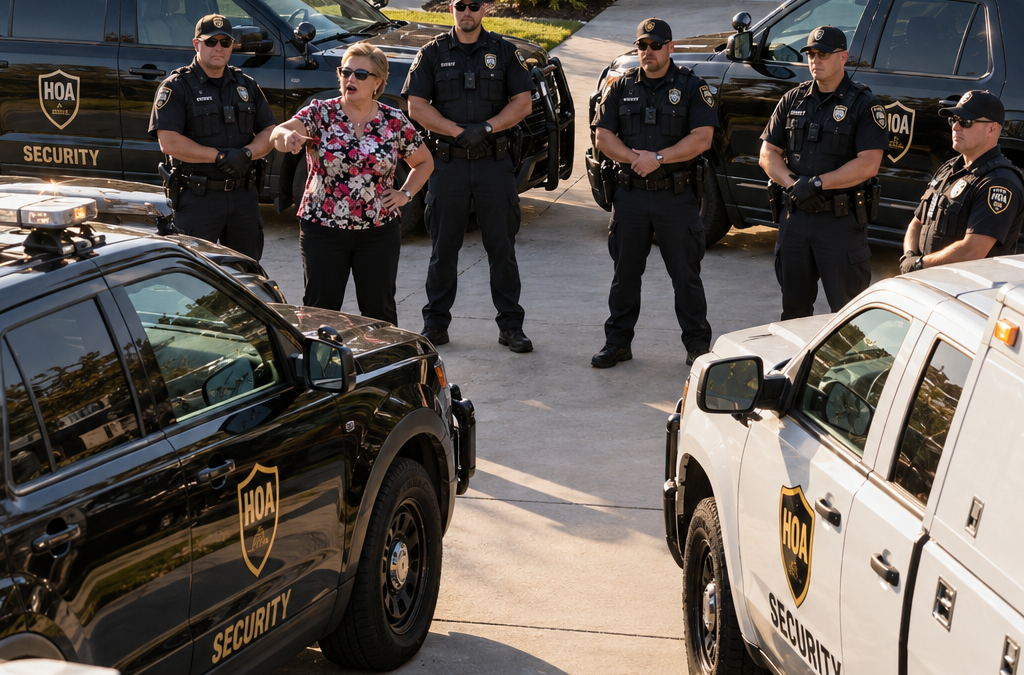
The morning after my wife and I moved into our new house, six HOA security officers parked across my driveway and told me nobody was leaving until I paid a $79 assessment I had never seen before.
They were so certain the uniforms and vehicles would make me surrender that none of them stopped to consider one simple question: what authority did they actually have to keep me inside my own property?
My name is Daniel Carter.
By the time Sarah and I moved into Briarwood Glen, I was forty-eight years old and had spent most of my adult life in law enforcement.
I had been a patrol officer.
A field training officer.
A detective.
A lieutenant.
Then captain.
And three years before this happened, I had been appointed chief of police for the city of Northfield.
But I did not move into Briarwood Glen as Chief Carter.
That distinction mattered to me.
I moved there as Daniel.
Sarah’s husband.
The man who still packed kitchen glasses badly no matter how often my wife explained what bubble wrap was for.
The man who owned three different socket sets but somehow could never find the right screwdriver when assembling furniture.
The man who had spent fourteen years promising Sarah that one day we would leave the townhouse near downtown and buy somewhere quieter.
Briarwood Glen was supposed to be that place.
It sat about fifteen minutes from police headquarters, far enough that I did not feel as though I was living at work but close enough that I could still get to the station quickly when something serious happened.
Tree-lined streets.
Brick houses.
Wide sidewalks.
A small community lake.
A pool.
A clubhouse.
Nothing extravagant.
That appealed to us.
Sarah had spent twenty-three years married to a police officer.
That meant missed dinners.
Canceled trips.
Phone calls at two in the morning.
Years when every family event came with the possibility that I might disappear because somebody else was having the worst day of their life.
She deserved somewhere peaceful.
So did I.
The move itself had been miserable.
Two trucks.
Too many boxes.
One couch that somehow fit perfectly through the door at our old place and apparently expanded by six inches before reaching the new one.
By ten o’clock that first night, Sarah and I were sitting on the living room floor eating takeout because we still had not found the dining-room chairs.
Behind us were forty or fifty boxes labeled with optimistic words like:
KITCHEN.
BEDROOM.
IMPORTANT.
MISC.
Sarah looked around.
“Please tell me we are never moving again.”
“I’ll die here.”
“Good.”
“That’s comforting.”
“You know what I mean.”
I smiled.
She leaned against me.
Through the front windows, the neighborhood was completely quiet.
Porch lights.
Sprinklers.
A dog barking somewhere down the block.
“This was the right choice,” she said.
I believed her.
The next morning, I woke before six.
Twenty-seven years of police work had ruined my ability to sleep late.
Sarah could sleep until nine on a Saturday and feel no guilt whatsoever.
I considered this a character flaw.
I made coffee.
Found a folding chair that had not yet disappeared into a box.
Then carried it onto the front porch.
The street was almost empty.
A jogger passed.
Two cars.
Someone walked a golden retriever.
No radios.
No ringing phones.
No reporters waiting outside city hall.
No officers knocking on my office door to tell me another problem had just developed.
Just coffee.
For maybe twenty minutes, I sat there thinking I had finally bought some distance from the job.
Then I noticed the vehicles.
The first was a black SUV.
Then another.
Then a white utility vehicle.
Then three more.
All had the same emblem on the doors.
BRIARWOOD GLEN COMMUNITY SECURITY.
Not police.
Not sheriff.
Community security.
The convoy turned onto our street.
I watched them approach.
My first thought was that someone nearby had reported a break-in.
Then the first SUV slowed in front of my house.
Turned.
Stopped directly across my driveway.
The second pulled behind it.
A third angled across the curb cut.
Within thirty seconds, my driveway was physically blocked by vehicles.
I set down the coffee.
Behind me, the front door opened.
Sarah stepped onto the porch wearing one of my old academy sweatshirts.
“What is this?”
“I don’t know.”
“You expecting anybody?”
“No.”
Uniformed personnel got out.
Dark gray shirts.
Black tactical-style pants.
Utility belts.
Radios.
Matching patches.
They looked professional enough from a distance.
But when one turned, I could clearly read the shoulder patch.
COMMUNITY SECURITY.
That wording mattered.
There is a major difference between an employee who helps enforce private community rules and a sworn law-enforcement officer exercising government authority.
I went down the porch steps.
Sarah stayed behind me.
One of the security men raised a hand.
“Sir, please remain on the property.”
I stopped.
“I am on the property.”
He looked momentarily confused.
Then a woman appeared from the sidewalk.
Mid-fifties.
Dark hair.
Blue blazer.
Folder tucked beneath one arm.
She walked with the brisk confidence of someone accustomed to entering a conversation after everyone else had already been told what to do.
“Mr. Carter?”
“Yes.”
“I’m Cara Mitchell.”
I waited.
“President of the Briarwood Glen Homeowners Association.”
“Morning.”
She removed a paper from the folder.
“This concerns your outstanding assessment.”
“My what?”
“Seventy-nine dollars.”
I looked at Sarah.
She looked equally confused.
Cara continued.
“The matter needs to be settled immediately.”
I glanced toward the SUVs.
“Is that why you’ve blocked my driveway?”
Her expression suggested she considered the question a distraction.
“The assessment is delinquent.”
“We moved in yesterday.”
“Correct.”
“So when exactly did it become delinquent?”
She held out the notice.
I took it.
BRIARWOOD GLEN HOMEOWNERS ASSOCIATION.
SPECIAL ADMINISTRATIVE ASSESSMENT.
$79.00.
The document referenced a transfer-processing and exterior registration charge connected to change of ownership.
Due date:
The previous Friday.
Four days before we closed on the house.
I read it again.
Then looked at Cara.
“This was due before I owned the property.”
“The balance attaches to the address.”
“Maybe.”
“It does.”
“I’ll review that.”
“There’s nothing to review.”
I looked toward the vehicles again.
“Why are they blocking my driveway?”
Cara took the paper back.
“Community enforcement.”
“That’s not an answer.”
“The board has authorized security measures for unresolved compliance matters.”
“What measures?”
“Temporary access controls.”
I almost smiled.
Police work teaches you to pay attention when someone uses complicated language to avoid describing something simple.
Temporary access controls.
What I saw were several privately employed security personnel using vehicles to prevent me from driving out of my own home.
“Do you have written authority to block a resident’s driveway over seventy-nine dollars?”
Cara stiffened.
“These officers are acting under HOA authority.”
I looked toward the nearest man.
“You’re law enforcement?”
He shifted.
“No, sir. Community security.”
“Sworn?”
“No.”
“Deputized?”
“No.”
“Do you have statutory authority to detain anyone?”
Cara cut in.
“Daniel, that’s not what we’re doing.”
“It looks exactly like what you’re doing.”
“We’re enforcing payment.”
“By preventing me from using my driveway.”
“Until the matter is resolved.”
Sarah came down one step.
“Cara, we haven’t even been here twenty-four hours.”
Cara turned.
“This notice was provided as part of the transfer packet.”
“No, it wasn’t,” Sarah said.
“We read every page.”
Cara’s expression cooled.
“Then perhaps your closing attorney missed it.”
I looked at the security supervisor.
“Are your drivers going to move?”
He glanced at Cara.
She answered.
“Once the assessment is settled.”
There it was.
A direct condition.
Pay the HOA.
Then we give you access.
I asked:
“Who authorized that?”
“The board has procedures.”
“Show me.”
She opened her folder.
Not quickly.
There were violation policies.
Collection procedures.
Parking rules.
A towing policy.
Security guidelines.
Nothing that obviously authorized turning a private driveway into a checkpoint.
I waited.
Cara flipped another page.
Then another.
“There’s no reason to make this adversarial.”
“I’m not.”
“You clearly are.”
“I asked you to identify your authority.”
“The HOA governs this community.”
“The HOA governs according to its documents and applicable law.”
Her eyes narrowed.
“Are you an attorney?”
“No.”
“Then perhaps you should let the board interpret its own rules.”
That nearly made me laugh.
Instead, I said:
“Give me five minutes.”
“For what?”
“To make a call.”
Cara folded her arms.
“If you’re calling your lawyer, you’re free to do that.”
“Thank you.”
I went inside.
Sarah followed.
As soon as the door closed, she whispered:
“What are you doing?”
“Calling dispatch.”
Her eyebrows rose.
“Your dispatch?”
“County first.”
“Why county?”
“Because this is my house.”
She understood immediately.
My department served Northfield city proper.
Briarwood Glen sat inside municipal limits, but I did not want the first response to look as though I was calling my own subordinates to win a private HOA dispute.
So I contacted the communications center and asked for patrol response through ordinary procedure.
Blocked residential access.
Private security.
Disputed authority.
No threats.
No weapons.
No emergency lights.
No special request.
The dispatcher asked my name.
I gave it.
There was a pause.
“Chief Carter?”
“Yes.”
“Are you requesting your own officers?”
“I’m requesting normal response.”
“Understood.”
When I hung up, Sarah was staring.
“How many officers are going to show up?”
“I asked for normal response.”
“Daniel.”
“Hopefully one.”
She looked toward the window.
“Nothing about our life has ever involved one police car.”
Unfortunately, she was right.
We went back outside.
Cara was standing near her SUV.
Confident.
Almost bored.
She apparently believed my phone call had been to an attorney and expected the seventy-nine dollars to appear shortly afterward.
“You ready to settle this?”
“No.”
Her eyebrows rose.
“Then the vehicles remain.”
I sat on the porch.
That irritated her more than an argument would have.
One security guard shifted his weight.
Another looked toward the street.
Five minutes passed.
Then we heard the first siren.
I frowned.
“I specifically did not ask for lights and sirens.”
Sarah smiled.
“Your people are very enthusiastic.”
Three marked Northfield Police Department vehicles turned onto the street.
Then a supervisor’s SUV.
So much for subtle.
Cara stared.
“What did you do?”
“Requested police.”
“You called police over an HOA assessment?”
“No.”
I nodded toward the vehicles.
“I called police because private security is blocking my driveway and conditioning access on payment.”
Her face changed.
The first patrol unit stopped.
Officer Miguel Santos stepped out.
He had been with the department seven years.
Professional.
Careful.
He saw me.
Stopped.
Then visibly reconsidered whatever he had been about to say.
“Morning, Chief.”
Cara’s head turned toward me.
The security guards did the same.
Sarah looked at the floor, trying not to smile.
I said:
“Morning, Santos.”
A second officer approached.
Then Lieutenant Aaron Bell stepped from the supervisor SUV.
Aaron had served under me since before I became chief.
He walked over.
“Chief Carter.”
“Lieutenant.”
He looked at the blocked driveway.
Then the security vehicles.
Then Cara.
“What’s going on?”
Before I could answer, Cara stepped forward.
“This is an HOA collection matter.”
Aaron held up one hand.
“Ma’am, I’ll get everybody’s account.”
She looked annoyed.
“These officers don’t need to be involved.”
“I agree that’s possible.”
Aaron nodded toward the driveway.
“But your vehicles are involved.”
Cara glanced at me.
The realization was finally settling.
“You’re the police chief?”
I answered:
“Yes.”
She looked almost offended.
“Why didn’t you tell me?”
“Why would it matter?”
Her mouth opened.
Closed.
I continued.
“If blocking the driveway is authorized, it’s authorized whether I’m a police chief or an accountant.”
Nobody said anything.
Santos looked down.
I suspect to hide a reaction.
Aaron turned to me.
“Chief, I’m going to handle this like any other call.”
“That’s exactly what I want.”
“Can you tell me what happened?”
I gave him the short version.
Moved in yesterday.
Assessment notice presented this morning.
Private community security vehicles parked across my driveway.
Access conditioned on payment.
Requested written authority.
None provided.
Aaron nodded.
Then turned toward Cara.
“Ms. Mitchell?”
She raised the assessment notice.
“Mr. Carter owes seventy-nine dollars under the association’s administrative-transfer policy.”
“I’m not deciding that.”
She blinked.
“What?”
“The validity of your HOA assessment isn’t a police issue unless something else makes it one.”
She pointed toward me.
“Exactly.”
Aaron continued.
“I’m asking about the vehicles.”
“They’re community security.”
“I can see that.”
“They were sent to enforce compliance.”
“How?”
“By making clear that the matter needs to be resolved.”
Aaron looked toward the driveway.
“Can Mr. Carter leave his property in a vehicle right now?”
Cara hesitated.
“Once the assessment is paid.”
Aaron’s tone changed slightly.
Not hostile.
More precise.
“Then you’re restricting access.”
“It’s temporary.”
“Under what authority?”
“The HOA board.”
“Can I see the provision?”
Cara opened her folder.
The same search.
Same pages.
Same problem.
Aaron waited.
One of the security guards spoke quietly.
“Ma’am.”
Cara looked at him.
He appeared uncomfortable.
“We were told to position vehicles.”
She gave him a sharp look.
Aaron asked:
“By whom?”
The guard looked between them.
“HOA management.”
“To prevent exit?”
Another pause.
“We were told not to move until the account was resolved.”
Aaron wrote that down.
Cara said:
“Nobody is being detained.”
Aaron looked at her.
“If a resident can’t drive out because your vehicles are intentionally blocking the only driveway and the condition for movement is payment, that’s something we need to address.”
She turned toward me.
“This could have been solved with seventy-nine dollars.”
I answered:
“So could an improper demand for almost any small amount.”
Her face reddened.
“Are you accusing us of extortion?”
“No.”
I remained calm.
“I’m asking you not to substitute dramatic words for the actual question.”
“What question?”
“What gives you the right to block my driveway?”
She did not answer.
Aaron looked at the security supervisor.
“Move the vehicles.”
Cara immediately said:
“Wait.”
Aaron turned.
“Ma’am?”
“This is private community enforcement.”
“Then enforce it through whatever lawful private process applies.”
“We need the payment.”
“That’s between the association and homeowner.”
She crossed her arms.
“You’re interfering.”
Aaron stayed professional.
“We’re preventing a private dispute from turning into an access problem.”
Cara looked toward me.
“Of course.”
There was accusation in her voice now.
“Of course what?”
“You’re the chief.”
I said nothing.
She continued:
“You call your own officers and suddenly the HOA can’t enforce its rules.”
Aaron answered before I did.
“Ms. Mitchell, I didn’t ask what his job was before determining that these vehicles should not be blocking residential access over a disputed civil assessment.”
She stared at him.
He continued.
“If you want a supervisor from another agency to review our response, I can request one.”
That took the air out of the accusation.
Cara did not accept.
But she stopped pushing.
The security supervisor lifted his radio.
“All units, clear driveway.”
One by one, engines started.
The first SUV backed away.
Then the second.
The utility vehicle moved.
Within two minutes, my driveway was open.
No arrests.
No handcuffs.
No shouting.
That mattered to me.
I had no interest in punishing people who were following bad instructions once they understood the limit.
Aaron asked:
“Anybody threatening anybody?”
“No.”
“Property damage?”
“No.”
“Vehicle contact?”
“No.”
He nodded.
“Good.”
Cara stood near the curb with the $79 notice still in her hand.
I looked at her.
“Can I ask you something?”
She seemed exhausted.
“What?”
“Why this?”
“What do you mean?”
“Six vehicles.”
“Security personnel.”
“Fine. Six security vehicles. Over seventy-nine dollars.”
“It wasn’t about the amount.”
“Then what was it about?”
“Rules.”
That answer did not surprise me.
“Rules need procedures.”
“We have procedures.”
“Then use them.”
She looked down.
“We assumed you’d pay.”
That was the most honest thing she had said all morning.
I nodded.
“I know.”
She looked at me.
I continued.
“That’s the problem.”
The officers finished documenting the call.
Before Aaron left, he stepped close enough that only I could hear.
“You okay with how we handled this?”
“Yes.”
“You’re going to hear about four units responding to your house.”
“Almost certainly.”
He smiled.
“Santos recognized your address in dispatch.”
“I’ll deal with him Monday.”
“I’d go easy.”
“No promises.”
Then he left.
Sarah and I stood in the driveway after everyone was gone.
Quiet returned almost instantly.
A sprinkler clicked three houses away.
A bird landed on our mailbox.
Sarah folded her arms.
“Well.”
“Well.”
“We moved here for peace.”
“I remember.”
“First morning.”
“I know.”
“Six fake cop cars.”
“Community security.”
“That is not helping.”
I laughed.
Then she pointed toward the $79 notice Cara had left with me.
“What are you going to do?”
“Read the HOA documents.”
“You’re going to enjoy that, aren’t you?”
“No.”
“You absolutely are.”
She knew me too well.
I spent part of the afternoon unpacking.
The rest reading.
The seventy-nine-dollar fee did exist.
Sort of.
Briarwood had adopted an administrative transfer charge covering database updates, security access registration, and common-property records.
The problem was timing.
The seller was supposed to satisfy the amount before closing.
Our settlement statement showed all known HOA charges had been paid.
Either the seventy-nine dollars had been missed or posted after the estoppel information was issued.
That made the charge a legitimate subject for discussion.
It did not make six security vehicles blocking a driveway reasonable.
Those were separate questions.
That distinction mattered to me.
I could have simply refused the seventy-nine dollars because I disliked Cara.
That would have turned principle into spite.
Instead, I emailed the HOA.
Not as chief.
From my personal account.
I requested:
The original ledger entry.
Board resolution authorizing the charge.
Transfer documents.
Payment history on the address.
And the written policy supposedly permitting driveway obstruction for collection.
I knew the last item probably did not exist.
I still wanted the answer in writing.
Cara replied three hours later.
The board would discuss the matter at its regular meeting the following evening.
Residents could attend.
So Sarah and I went.
Not in a police vehicle.
Not in uniform.
I wore jeans and a button-down shirt.
The same way I would attend any neighborhood meeting.
The clubhouse held maybe thirty residents.
Word had traveled.
Of course it had.
Nothing spreads faster through a subdivision than a story involving police cars and an HOA president.
When Sarah and I entered, conversations changed volume.
Some people nodded.
A few smiled.
One man whispered something to his wife.
I ignored it.
Cara sat at the front with four board members.
She looked tired.
Better than angry.
The board vice president, Thomas Greene, opened the meeting.
Regular business first.
Pool maintenance.
Landscaping contract.
Then:
“Next item is the Carter property assessment and enforcement response.”
The room became very quiet.
Cara spoke first.
She explained the seventy-nine-dollar fee.
Then described the morning as an “overly assertive collection action.”
That wording was charitable.
I said nothing.
Thomas looked toward me.
“Mr. Carter, would you like to speak?”
I stood.
“Yes.”
I placed the notice and correspondence on the conference table.
“My concern is not primarily seventy-nine dollars.”
Several residents nodded.
“My concern is process.”
I looked around the room.
“Yesterday morning, private community-security vehicles deliberately blocked my driveway.”
Cara shifted.
“I asked for written authority.”
“None was produced.”
“The vehicles remained until police arrived.”
One board member, a man named Harold Price, asked:
“Were you prevented from leaving?”
“By vehicle, yes.”
Cara said:
“You could have walked out.”
I looked at her.
“That’s not a meaningful distinction.”
Thomas nodded.
“Agreed.”
I continued.
“If the assessment is valid, send a bill.”
“If it’s delinquent, follow the collection procedure.”
“If there’s an appeal, let me appeal.”
“If the documents permit fines, apply them according to the documents.”
“But community security should not be used to physically pressure somebody into paying a disputed civil amount at his driveway.”
Silence.
Then a woman in the second row said:
“They did that to us last year.”
Everyone turned.
Cara’s face tightened.
The woman continued.
“Not six vehicles.”
She looked toward her husband.
“Two.”
Her husband nodded.
“It was over a parking sticker.”
Another resident raised his hand.
“Security sat behind my son’s truck for an hour over a guest pass.”
Cara said:
“Those circumstances were different.”
The room changed.
That was when I realized my incident was not an isolated overreaction.
It was a more dramatic version of an existing habit.
Briarwood had gradually allowed private security to become a collection tool.
Most residents paid.
Not because every underlying demand was valid.
Because paying fifty dollars was easier than arguing with uniformed people standing outside your house.
I knew that pattern.
Authority does not always expand because someone openly seizes it.
Sometimes everyone around it simply gets tired of resisting.
Thomas asked the property manager:
“What is the written security policy?”
She pulled up the document.
Security could monitor common areas.
Enforce parking rules on HOA-owned property.
Issue notices.
Document violations.
Call police when needed.
Nothing authorized residential confinement.
Nothing authorized blocking a private driveway as leverage for debt collection.
Harold looked at Cara.
“Why were the vehicles sent?”
She folded her hands.
“We were trying to create immediate compliance.”
That phrase landed badly.
Thomas repeated:
“Immediate compliance.”
“Yes.”
“By blocking the driveway.”
“For a short period.”
“Until he paid.”
Cara exhaled.
“Yes.”
Thomas leaned back.
“That was a mistake.”
No dramatic vote.
No shouting.
Just one sentence.
That was all I wanted.
Cara looked toward me.
“I acknowledge the response was excessive.”
I nodded.
“Thank you.”
The board then addressed the $79.
The ledger showed the assessment had been entered during ownership transfer.
But closing records showed it should have been charged to the seller’s account before settlement.
The board’s management company had transferred it automatically to our address after closing.
Thomas looked at me.
“The association will correct the ledger and pursue any outstanding transfer issue with the prior account.”
“Fine.”
“You owe nothing.”
“Okay.”
That resolution was almost anticlimactic.
Good.
Not every disagreement needs a courtroom ending.
Then the board voted on security procedures.
No community-security vehicle could intentionally block access to an occupied residence except in an immediate safety emergency or where law enforcement specifically directed it.
Collection matters would be handled through written notice, hearing, and normal civil remedies.
No doorstep demand for immediate payment.
No vehicular pressure.
The vote was unanimous.
Including Cara.
Afterward, people lingered.
One neighbor approached.
“Chief Carter?”
“Daniel is fine.”
He smiled.
“I’m Mike.”
We shook hands.
“You think they would’ve moved those cars if you weren’t police chief?”
That was the question I had been asking myself.
“I hope so.”
He raised an eyebrow.
“But?”
“I don’t know.”
“That’s not reassuring.”
“No.”
Sarah joined us.
Mike said:
“At least now the policy changes for everybody.”
That was the important part.
If the story ended with:
HOA bothers police chief, police chief gets special treatment,
then nothing useful would have happened.
The point was not that they had chosen the wrong homeowner.
The point was that the tactic itself was wrong regardless of who lived behind the driveway.
That distinction followed me back to work Monday.
I entered headquarters at seven.
Santos was near the front desk.
He saw me.
Immediately became extremely interested in paperwork.
“Santos.”
“Chief.”
“Four cars?”
He looked innocent.
“Wasn’t me.”
“You recognized the address.”
“Possibly.”
“Then told everyone.”
“Operational awareness.”
“Lieutenant Bell?”
“Also operational awareness.”
I stared.
He lasted maybe four seconds.
“Sorry, Chief.”
I smiled.
“You handled the scene correctly.”
His expression changed.
“Thank you.”
“Next time, don’t send a parade.”
“Understood.”
I continued toward my office.
Then stopped.
“Santos.”
“Yes?”
“What would you have done if it had been someone else’s driveway?”
He did not answer immediately.
That mattered.
Finally:
“Same thing, I hope.”
“Make sure.”
He nodded.
“Yes, Chief.”
That conversation stayed with me.
Police officers are human.
Recognition matters.
Rank matters.
Relationships can influence tone even when nobody intends them to influence the decision.
The answer is not pretending those factors don’t exist.
The answer is building procedures strong enough that the outcome does not depend on them.
A blocked driveway over a disputed HOA assessment should receive the same basic response whether the homeowner is the police chief, a schoolteacher, a mechanic, or someone unemployed.
Verify authority.
Separate civil debt from physical restriction.
De-escalate.
Restore access.
Document.
That is all.
Cara kept serving as HOA president.
That surprised Sarah.
“You don’t think she should resign?”
“Why?”
“She sent six security vehicles to our house.”
“She made a bad decision.”
“That’s generous.”
“She acknowledged it.”
Sarah studied me.
“You’re being very chief-like.”
“I’m trying not to be.”
The truth was, I did not want Cara destroyed.
I wanted Briarwood governed better.
Those are different goals.
A month later, she knocked on our door.
Alone.
No folder.
That got my attention.
I opened it.
“Cara.”
“Daniel.”
“Everything okay?”
“Yes.”
She looked toward the driveway.
“I wanted to apologize.”
I waited.
“The meeting apology was official.”
“Okay.”
“This one isn’t.”
Sarah appeared behind me but stayed inside.
Cara continued.
“I got carried away.”
“Why?”
She looked embarrassed.
“We had collections problems.”
“Seventy-nine-dollar collections problems?”
“Not just yours.”
She sighed.
“Several owners had been ignoring notices.”
“And?”
“The board kept complaining management wasn’t getting results.”
“So you wanted results.”
“Yes.”
“Fast.”
“Yes.”
“And security worked.”
She looked at me.
“Usually.”
There was the answer.
Residents saw uniforms.
Vehicles.
Radios.
They paid.
No one asked whether the tactic had a written foundation because resistance cost more emotionally than compliance.
Until it happened to somebody who asked.
“That’s how these things expand,” I said.
Cara nodded.
“I know that now.”
“Good.”
Then she said:
“I also should’ve checked the closing record before coming to your house.”
“Yes.”
“That part was embarrassing.”
“It should’ve been.”
She smiled despite herself.
“I deserved that.”
For the first time, she seemed like a neighbor rather than a president.
Before leaving, she said:
“I didn’t know you were chief.”
“I know.”
“If I had—”
I raised one hand.
She stopped.
“Don’t finish that sentence.”
She understood why.
If knowing my title would have changed the way she treated me, that was exactly the wrong lesson.
She nodded.
“You’re right.”
Then walked back down the sidewalk.
Briarwood became normal after that.
Painfully, beautifully normal.
Garbage pickup arguments.
Pool hours.
Dogs.
Holiday decorations.
One resident painted his front door turquoise and accidentally triggered three weeks of HOA emails.
Sarah joined the landscape committee.
I told her this was a dangerous gateway into politics.
She told me to shut up and carry mulch.
Our house slowly stopped looking like a storage facility.
Boxes disappeared.
Pictures went up.
The dining table emerged.
I fixed the back gate.
Then broke one of the hinges trying to improve it.
Sarah said nothing for almost a minute, which was much worse than criticism.
The driveway remained empty.
No security convoys.
Occasionally a community patrol vehicle passed.
The driver waved.
I waved back.
No resentment.
That mattered.
People sometimes assume that after conflict, somebody has to remain the enemy.
I disagree.
If the boundary is corrected and behavior changes, continuing the war becomes a choice.
I had enough conflict in my professional life.
I did not need to manufacture more at home.
The new HOA security policy worked.
I know because residents told me.
A woman named Denise challenged a landscaping fee.
She received a letter.
Then a hearing date.
No security vehicle.
A family disputed pool-access charges.
Written process.
A resident owed several hundred dollars in assessments.
Normal collection notices.
No one parked across a driveway.
Boring.
Perfect.
About six months after we moved in, Briarwood lost power during a thunderstorm.
Sarah and I sat on the porch watching rain move across the street.
A community-security SUV drove slowly past.
The driver was one of the men from that first morning.
He rolled down his window.
“Evening, Chief.”
“Evening.”
Then he smiled.
“Driveway clear?”
I laughed.
“Very.”
He drove on.
Sarah shook her head.
“We’re never escaping this.”
“No.”
“Could be worse.”
“How?”
“They could still be parked there.”
She smiled.
The first morning in Briarwood had felt like proof we had made a terrible mistake.
Years later, it became one of those stories couples tell at dinner.
Remember when we moved in and the HOA tried to blockade the house over seventy-nine dollars?
The absurdity gets funnier after the consequences disappear.
But I never forgot the serious part.
Cara did not wake that morning planning to abuse anybody.
The security employees were not villains.
The board was not some criminal organization.
They had simply developed a practice that worked because nobody tested it.
That is often how authority goes wrong.
Not through one dramatic decision.
Through small successful overreaches.
A resident pays because arguing is exhausting.
Then another.
Then another.
Soon the tactic becomes normal.
Everyone remembers that it works.
Nobody remembers to ask whether it should exist.
That pattern appears in much bigger institutions than HOAs.
I had seen it in law enforcement too.
A shortcut that produces results.
A procedure nobody questions.
An assumption repeated until it begins sounding like policy.
That is why good organizations need people willing to ask:
Where is that written?
What gives us that authority?
Are we doing this because it is lawful and necessary, or because nobody has stopped us yet?
Cara hated those questions when I asked them in my driveway.
Later, she admitted they probably saved the HOA from a much uglier dispute with somebody else.
I appreciated that.
Years after the incident, I retired.
Fully.
The city gave me a plaque.
Sarah gave me instructions not to turn the garage into a command center.
I obeyed for almost three weeks.
Briarwood was still home.
The maple trees along the street had grown large enough to shade most of the sidewalks.
Cara had long since rotated off the board.
The HOA had different leadership.
New residents had no idea who I was.
That was exactly what I wanted.
One spring morning, I sat on the same front porch with coffee.
A moving truck was parked three houses down.
Young couple.
Boxes.
Children running across the yard.
The husband looked exhausted.
I recognized the expression.
Then one Briarwood community-security vehicle stopped near their driveway.
For a second, old memory surfaced.
I watched.
The security officer got out.
Walked to the front door.
Handed the homeowner a piece of paper.
They spoke.
No blocked driveway.
No second vehicle.
No pressure.
The officer returned to his SUV and drove away.
Sarah came outside.
“What are you staring at?”
“Nothing.”
She followed my eyes.
“HOA?”
“Yeah.”
“Problem?”
“No.”
I smiled.
“Exactly.”
She sat beside me.
The neighborhood was quiet.
The kind of quiet we had bought the house for all those years earlier.
I thought about that first Saturday.
Cara’s folder.
Six vehicles.
A seventy-nine-dollar assessment.
The surprise on her face when Santos called me Chief Carter.
People love that part when they hear the story.
The reveal.
The moment the HOA president realizes she has confronted the police chief.
But that’s not the important part.
My title did not make the blockade wrong.
It was already wrong.
The badge didn’t create my right to use my own driveway.
The responding officers didn’t grant it.
My position simply made everyone suddenly more careful about a question that should have been asked before the first SUV ever parked there.
What authority do you actually have?
I had spent a career asking that question in different forms.
Can we enter?
Can we search?
Can we detain?
Can we arrest?
What facts support it?
What law permits it?
What limit applies?
Authority matters precisely because limits matter.
Without limits, authority is just force wearing a uniform.
Community security had uniforms.
Radios.
Vehicles.
Official-looking patches.
Those things made the demand feel powerful.
They did not make it lawful.
Cara had an HOA title.
That gave her responsibilities.
Not unlimited jurisdiction.
I had a police title.
That gave me responsibilities too.
Not a private weapon for neighborhood disputes.
That is why I attended the board meeting as Daniel Carter, homeowner.
Not Chief Carter.
I did not ask officers to collect my seventy-nine dollars.
Did not threaten investigation.
Did not use city resources to punish Cara.
The dispute belonged where it started.
In the HOA documents.
At the board table.
On paper.
Once the physical obstruction was removed, everything else could be handled calmly.
That is the ending I respect most.
Not that the police chief won.
The homeowner got a hearing.
The HOA checked its records.
The fee was corrected.
The policy changed.
Everybody went home.
The next time a resident challenged something, uniforms did not appear in their driveway.
That is what accountability should accomplish.
Not fear of one powerful person.
Better treatment for the next ordinary one.
Sarah still jokes about the seventy-nine dollars.
Every time an HOA envelope arrives, she brings it to me.
“Daniel.”
“What?”
“We may need backup.”
“How much?”
“Annual pool notice.”
“Call SWAT.”
She rolls her eyes.
Then we laugh.
The house really did become home.
The driveway became something I hardly noticed.
Which is exactly how driveways should feel.
Open.
Ordinary.
Unremarkable.
No dark vehicles.
No security line.
No president waiting for payment.
Just the path from the street to our front door.
The first morning in Briarwood, Cara Mitchell believed authority was whatever could make someone comply.
By the time the board meeting ended, she understood something I had spent almost three decades learning.
Real authority does not become stronger when it crosses its limits.
It becomes weaker.
And sometimes the most important thing anyone can do when faced with a uniform, a title, a demand, or a confident voice is ask one calm question before doing anything else.
Show me where you have the right to do this.








