𝗙𝗨𝗟𝗟 𝗦𝗧𝗢𝗥𝗬 The Harvard Professor Called Me a Black Slacker in Front of 300 Students and Handed Me the Chalk He Thought I Could Never Use
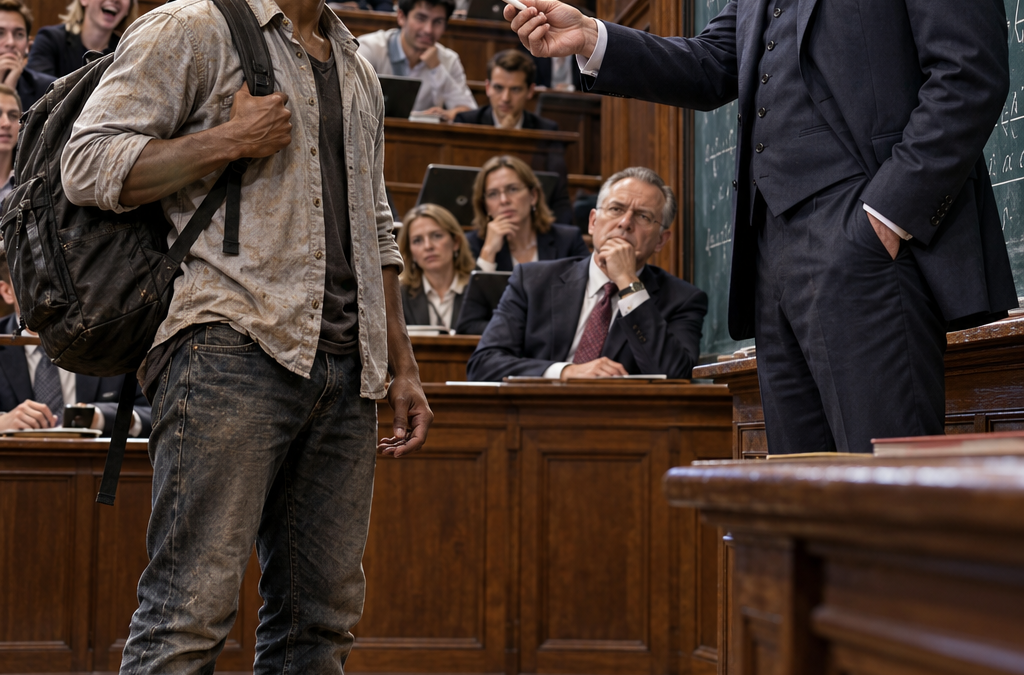
𝗙𝗨𝗟𝗟 𝗦𝗧𝗢𝗥𝗬
The room stirred.
“Since you’ve graced us with your presence, show us what the Black slacker can do.”
Laughter exploded.
Clapping.
Whistling.
The girl with the phone angled it toward the front.
Whitfield extended the chalk.
I looked at it.
Then at him.
Then at the board.
And walked forward.
My name is Blake Underwood.
I was nineteen years old that year.
Second-year student.
Advanced mathematics track.
GPA: 2.4.
If you looked only at my official record, I did not resemble anyone’s idea of a mathematical prodigy.
I missed classes.
Turned in assignments late.
Fell asleep twice during lectures.
Rarely participated.
Never attended office hours.
My clothes were cheap.
My laptop was six years old and missing two keys.
I sat in the back whenever possible.
By the middle of freshman year, students had started calling me Black Slacker.
At first behind my back.
Eventually to my face.
I never explained.
I never told them that when they were sleeping, I was usually working.
My mother, Ruby Underwood, and I shared a studio apartment off North Broad Street.
One main room.
Tiny kitchen.
Bathroom with a door that did not close properly.
My bed was a mattress against one wall.
Hers was behind a curtain we hung from the ceiling.
She had cleaned office buildings for twenty-three years.
Her knees cracked when she bent.
Her hands were rough enough that lotion disappeared into them.
She had asthma that had worsened with age, and she needed an inhaler twice a day.
My warehouse pay helped cover rent, food, tuition and medication.
So I worked from eleven at night until five in the morning.
Then I came home.
And no matter how exhausted she was, my mother usually had coffee waiting.
She always asked the same question.
“What did you learn last night?”
Never:
How many pallets?
How many boxes?
Was your supervisor angry?
She meant mathematics.
Because Ruby knew the part of me Peton did not.
I had been teaching myself mathematics since I was twelve.
It began accidentally.
Franklin Public Library.
Summer afternoon.
Air-conditioning.
Nothing to do.
I found an old copy of Introduction to Number Theory on a return cart.
I opened it because the cover looked serious.
Two weeks later, I finished it.
Then I found another book.
And another.
By fifteen, I was struggling through graduate-level topology texts with a dictionary beside me because I did not understand half the terminology.
By seventeen, I was reading research papers through open-access journals.
Nobody assigned them.
Nobody graded me.
Nobody knew.
I simply wanted to understand.
Mathematics was the only place in my life where status disappeared.
Numbers did not care what neighborhood I came from.
A theorem did not laugh at my shoes.
An equation did not ask whether my mother cleaned buildings.
A proof either held or it did not.
That honesty was addictive.
When Peton announced Whitfield’s residency, I marked every lecture date on the back of a warehouse receipt.
I had read his papers.
Not all two hundred-plus publications people liked attaching to his biography, but every one relevant to analytic number theory.
And especially the papers surrounding the problem that defined his career.
The Whitfield conjecture.
Fifteen years earlier, Gerald Whitfield had proposed that prime distributions above a particular critical threshold followed a predictable oscillatory density pattern.
Elegant claim.
Important if true.
Unproved.
He had spent fifteen years trying to establish it.
Seven major draft approaches.
Three near-publications that were withdrawn before full peer review.
Entire seminars devoted to the problem.
Graduate students had built dissertations around partial results.
Whitfield had publicly said he intended to solve it before retirement.
I had been working on it since I was sixteen.
Three years.
Alone.
At our kitchen table.
In the warehouse break room.
On buses.
At the library.
Sometimes on cardboard when I ran out of paper.
My red spiral notebook contained 214 pages of failed ideas, partial structures, corrections, diagrams and one approach I had never seen in any published literature.
I did not know whether I could finish it.
But I knew Whitfield’s standard framework had a weakness.
That morning, he had reproduced that weakness on the classroom board.
I reached the front.
He placed the chalk in my hand.
His fingers released it slowly.
“Whenever you’re ready.”
Someone slow-clapped.
I turned toward the board.
My heart was pounding.
Not because I did not understand the problem.
Because I did.
That was more frightening.
Five seconds passed.
Ten.
The laughter began again.
Whitfield folded his arms.
Fifteen seconds.
I raised the chalk.
Then I used my left hand to erase his third line.
The room gasped.
Whitfield stepped forward.
“What do you think you’re doing?”
I rewrote the expression.
One symbol changed.
Then the index.
n minus one became n minus two.
I circled his original assumption.
“Your third line contradicts your first.”
No laughter.
Whitfield stared at me.
“What?”
“The boundary condition assumes convergence at n minus one.”
I pointed toward the opening definition.
“But your function diverges at that point.”
He stepped closer.
“That is a notational preference.”
“No, sir.”
His face tightened.
I pointed again.
“You define f of n as a sum over primes up to n.”
“Yes.”
“That sum diverges logarithmically under your current construction.”
Silence.
“You can’t construct the recursive frame on a base you’ve already allowed to diverge.”
A murmur traveled through the room.
Students opened notebooks.
Whitfield looked between the lines.
He knew.
I could see the exact moment he knew.
But admitting it was different.
“This is a pedagogical simplification.”
“The full proof doesn’t repair it.”
His eyes snapped toward me.
I continued before I lost my nerve.
“You used the same condition in your 2019 paper.”
The room exploded into whispers.
Whitfield went very still.
“You’ve read my paper.”
“Yes.”
“And you believe you discovered something my reviewers missed.”
“I’m saying the divergence only appears after the fourth iteration.”
I swallowed.
“Maybe nobody checked that far.”
That silence was different from the earlier one.
Nobody was laughing at me now.
They were waiting to see what Whitfield would do.
I turned back to the board.
I could have stopped.
I had already made my point.
Instead, I finished the problem.
Corrected boundary.
Modular reduction.
Partition identity.
Then the move I had been experimenting with for months.
Invert the recursive function.
Solve backward from the endpoint.
Four minutes.
That was all.
I placed the chalk on the tray.
The board was covered in my handwriting.
Nobody moved.
Whitfield read the work.
Once.
Again.
He raised his hand as though he had found an error.
Then lowered it.
In the back row, Professor Helen Graves was watching me.
I had taken two of her classes.
She rarely spoke to me beyond coursework.
I later learned she had noticed that my submitted proofs sometimes used methods far beyond the assigned material.
She had even checked my student file because my 2.4 GPA made no sense to her.
She found the warehouse schedule.
My financial-aid records.
My mother.
But she had never asked.
That morning, she wrote one sentence in her notebook and underlined it twice.
I did not learn what it said until weeks later.
We have failed to notice him.
Whitfield removed his glasses.
Cleaned them.
Put them back on.
“A lucky observation.”
Some nervous laughter.
“Even a broken clock is correct twice a day.”
There it was.
A door opening just enough to preserve his pride.
I picked up my backpack.
Returned to the last row.
Sat down.
I did not answer.
But the room had changed.
Students who had laughed when I entered were looking at me as though the person they thought they knew had disappeared.
He had not.
I was still the same person.
Their equation had been wrong.
Whitfield finished his lecture.
Badly.
His rhythm kept breaking.
Once, he erased a line and replaced it with the exact correction I had made.
He did not acknowledge it.
After class, I went to work.
That should have been the end.
It wasn’t.
Whitfield remained alone in the lecture hall after most students left.
He stared at my writing.
Then made a phone call.
Two days later, Peton announced it was entering the National Collegiate Mathematics Championship for the first time in university history.
Four students were selected.
Carter Hollis.
Senior.
4.0 GPA.
Graduate fellowship lined up.
Megan Stowe.
Junior.
Already co-authored research.
Derek Voss.
Sophomore.
Former state mathematics Olympiad champion.
And me.
I knew immediately who had put my name forward.
Whitfield.
At first, I wondered whether correcting him had earned respect.
Then Carter said what everybody else was thinking during our first team meeting.
“He wants you to fail.”
I looked up.
Carter did not lower his voice.
“You know that, right?”
Megan looked uncomfortable.
Derek moved his chair farther away.
Carter continued.
“He wants a bigger stage.”
“For what?”
“To prove what happened in the lecture was a fluke.”
I looked at the practice packet.
First problem.
I solved it in ninety seconds.
Second.
Two minutes.
Third.
Three and a half.
I did not show them.
Carter was probably right.
But if Whitfield wanted me on a larger stage, I would go.
The warehouse did not care that I had joined a national competition.
My shift remained eleven to five.
The flight to Boston left Tuesday morning.
I clocked out at 5:15.
Caught the 6:40 bus.
Ran through the airport.
Nearly missed boarding.
When I reached our row, Carter looked at my untucked shirt.
“Unbelievable.”
Megan stared out the window.
“We’re representing Peton.”
I put my backpack under the seat.
“Okay.”
“You look like you slept on a park bench.”
I sat down.
“I slept on a bus.”
That shut him up for about ten seconds.
Boston was gray when we landed.
The convention center felt like a different country.
University banners hung from the ceiling.
MIT.
Stanford.
Princeton.
Caltech.
Chicago.
Names students like me were taught to speak carefully.
Peton’s banner looked small between them.
I walked through registration with my worn backpack and wondered whether anyone could see how badly I wanted to belong there.
Then I realized the thought was familiar.
I was tired of it.
That evening, I met Tyler Bennett.
Defending individual champion.
MIT junior.
Twenty years old.
His father taught mathematics at Yale.
His mother was a physicist at CERN.
He had competition tutors before I had my first library card.
Published paper at sixteen.
Elite summer programs.
Private coaching.
Everything I had read about from the outside.
Tyler looked at my badge.
“Peton.”
It did not sound like a university name when he said it.
It sounded like an assessment.
I nodded.
He looked at my shoes.
My backpack.
My hands.
“Good luck.”
He smiled.
He did not mean it.
Round one began the next morning.
Four problems.
Ninety minutes.
I finished in fifty-one.
The next fastest student in our section took seventy-three.
When the proctor collected my answer sheet, Carter stared at me.
Megan looked at Derek.
Nobody said anything.
Peton advanced.
The individual rankings appeared later.
Tyler Bennett: first.
Blake Underwood: second.
Tyler checked the board twice.
When he saw me in the hallway afterward, he did not say good luck again.
Round two moved from calculation into proof construction.
Five problems.
Two hours.
I finished in one hour and thirty-eight minutes.
Tyler finished three minutes later.
The rankings changed.
Blake Underwood: first.
Tyler Bennett: second.
Suddenly people knew my name.
A Boston reporter stopped Carter in the hallway.
“Your teammate, Blake Underwood. Where did he come from?”
Carter looked toward me.
For perhaps the first time, he seemed embarrassed by how little he knew.
“He’s on our team.”
That was all he could say.
The newspaper story appeared that evening.
It called me a freshman.
I wasn’t.
It got my age wrong too.
I did not see the article until later.
At eleven that night, I was in the hotel laundry room washing my only decent shirt in the sink because the washing machine required two dollars.
I needed that money for breakfast.
I dried the shirt beneath a hand dryer.
Went upstairs.
Derek and I shared the cheapest room available.
He had requested a different roommate.
The request had been denied.
He was asleep facing the wall when I opened my red notebook.
Two hundred fourteen pages.
The Whitfield conjecture.
My real work.
I had discovered the conjecture when I was sixteen in the footnote of a journal article.
At first, I tried Whitfield’s methods.
Every one.
Every draft I could find.
They all failed in roughly the same place.
The density function refused to behave.
Whitfield kept trying to force it into convergence.
I eventually stopped.
Not because I had solved the problem.
Because I began wondering whether the problem was not the function.
Maybe it was the framework.
So I abandoned it.
I borrowed concepts from algebraic geometry.
Mapped analytic behavior geometrically.
Built a structure no professor had taught me because no professor knew I was doing it.
Three years.
Kitchen table.
Library.
Warehouse breaks.
I had reached page 209.
Then stopped.
There was still a bridge missing.
Round three was the semifinal.
Eight universities remained.
The problems were brutal.
One topology problem destroyed half the room.
I solved it in twelve minutes using a visual mapping method I had invented for myself.
Tyler used the standard proof.
Twenty-nine minutes.
Both answers were correct.
Mine was faster.
During a break, I sat alone with a napkin.
I had started sketching part of my conjecture work without thinking.
Shapes.
Arrows.
Prime distribution.
A geometric fold.
I did not notice Tyler watching.
He photographed the napkin.
Later, he would tell me he did not know why.
Maybe curiosity.
Maybe suspicion.
Maybe he was finally trying to understand who I was.
That night, I called my mother.
She answered on the second ring.
“Baby.”
“Hey, Mom.”
“I saw you.”
My stomach tightened.
“What?”
“Somebody at work showed me the rankings.”
I smiled.
“You saw that?”
“I saw your name on a screen.”
Silence.
Then she said it again.
“Your name.”
I could hear the old television behind her.
Its volume knob had broken years earlier, so it had two settings.
Too loud.
Off.
“I’m proud of you.”
“Thanks.”
“But come home safe.”
I laughed softly.
“That’s all?”
“That’s everything.”
The next morning, an envelope had been pushed beneath my hotel-room door.
No name.
No signature.
One sheet.
YOU DON’T BELONG HERE.
GO HOME.
I stared at it.
Two years earlier, I might have thrown it away immediately.
Instead, I folded it.
Put it into my backpack.
Beside the red notebook.
I wanted to remember it.
The semifinal results were posted at noon.
Peton advanced.
Fourth overall.
I remained first individually.
Then the championship committee announced the final round.
One problem.
Two hours.
No partial credit.
The problem would be chosen by the honorary chair.
Dr. Gerald Whitfield.
Carter read the announcement before I did.
His face changed.
“He’s trying to kill the final.”
“What?”
He pointed.
The problem had been named publicly.
The Whitfield conjecture.
Megan swore under her breath.
Derek shook his head.
“Nobody can solve that.”
Carter looked directly at me.
“Not in two hours. Not in two years.”
My hand touched my backpack.
The red notebook rested against my spine.
Three years.
Two hundred fourteen pages.
Whitfield had selected the one problem in the world I had already been preparing to face.
He had designed a trap.
He just did not know I had been living inside it for three years.
That evening, the hotel filled with rumors.
Competitors researched the conjecture.
Seven failed drafts.
Fifteen years.
Partial results.
Abandoned proofs.
Tyler read everything he could find.
Samantha Wells from Caltech called her adviser.
Oliver Crane from Chicago apparently went to bed.
There was no rule prohibiting an unresolved conjecture.
Unusual.
Cruel.
But legal.
If nobody solved it, the championship would end without a winner.
And my run would become a curiosity.
Warehouse kid gets lucky.
Has a good week.
Falls short when real mathematics arrives.
I understood what Whitfield wanted.
I sat on the floor of my room.
Opened the notebook.
Page 209.
The bridge was still missing.
I worked until after two.
Nothing.
Three.
Nothing.
Four.
A few fragments.
At some point Derek woke.
He sat up.
“You still working?”
“Yes.”
“You know nobody expects you to solve it.”
I kept writing.
“That supposed to help?”
He was quiet.
Then he said, “I didn’t want you on the team.”
“I know.”
“I thought Whitfield was right.”
I looked at him.
He rubbed his face.
“I was wrong.”
There was nothing dramatic in the apology.
That made me believe it more.
“Go back to sleep.”
He laughed.
“Okay.”
Saturday morning, the final hall held two thousand people.
Cameras.
Professors.
Students.
Reporters.
The competitors sat at separate desks on a raised stage.
Each station had a board.
Chalk.
Paper.
Sealed envelope.
Whitfield sat in the front row behind a placard labeled HONORARY CHAIR.
Charcoal suit.
Calm face.
He looked like a man attending an outcome he had already purchased.
The timer showed two hours.
The proctor spoke.
“You may open your envelopes.”
Eight envelopes tore.
I removed the page.
Three lines.
The formal statement of the conjecture.
I had written those same three lines hundreds of times.
My heart slowed.
Around me, others reacted differently.
Oliver put down his pencil after less than a minute.
Samantha started immediately.
Tyler read the problem three times.
Then began using Whitfield’s second framework.
I picked up my chalk.
And used mine.
The first three stages came quickly.
Less than four minutes.
Algebraic-geometric mapping.
Prime-density representation.
Oscillatory conversion.
My notation looked strange beside what everyone else was writing.
I knew that.
It had always looked strange.
Then came step four.
The bridge.
My chalk stopped.
One hour and forty-one minutes remained.
I wrote one line.
Wrong.
Erased.
Another.
Contradiction.
Erased.
From the audience, I could see Whitfield leaning forward.
I tried again.
Four lines.
Dead end.
I erased back to step three.
One hour twenty-nine minutes.
Samantha had already stopped.
Tyler continued.
My hand started shaking.
This was the moment I had feared for three years.
Maybe Whitfield was right about the conjecture.
Maybe my framework was clever but incomplete.
Maybe Professor Graves had been impressed by a student who was merely unusual.
Maybe the warehouse had made me romanticize myself.
Maybe library books were not enough.
Maybe the note under my door was right.
You don’t belong here.
Then I closed my eyes.
Not intentionally.
I just needed the room to disappear.
For a second, I was back in our apartment.
Three in the morning.
Kitchen light.
My mother in the other room.
I remembered being fifteen.
A topology book open in front of me.
Half the page incomprehensible.
I had asked her one night:
“Mom, what if I’m not smart enough?”
Ruby had looked at me like I had insulted her cooking.
“Smart enough?”
I shrugged.
“What if I’m just pretending?”
She put down her coffee.
“Baby, you taught yourself things people pay professors ten years to teach.”
“That doesn’t mean—”
“Don’t tell me what it doesn’t mean.”
Then she pointed at the book.
“You understand more today than you did yesterday?”
“Yes.”
“Then keep going.”
That was Ruby’s definition of intelligence.
Not recognition.
Not credentials.
Growth.
Keep going.
I opened my eyes.
Looked at step three.
And understood what I had been doing wrong.
I was still trying to cross the wall.
So was Whitfield.
So was everybody.
What if the bridge was unnecessary?
I erased everything after step three.
Fresh chalk.
Instead of pushing the density function directly through the prime distribution, I folded the analytic structure onto a geometric surface.
A variation of a Riemann-surface mapping I had once sketched on a cafeteria napkin.
Step four changed.
Then five followed.
I stopped breathing.
Six.
Seven.
The proof accelerated.
A professor in the audience leaned toward another.
“What method is that?”
The other shook her head.
“I don’t know.”
Tyler had stopped writing.
I did not notice.
Later, video showed him sitting with his pencil on the desk, watching my board.
Five of the eight competitors had already given up.
The timer passed forty minutes.
Then thirty-eight.
I reached the old failure point.
The density function.
Every known approach tried to prove convergence.
Mine still would not converge.
That was when I saw it.
It did not need to.
I whispered, “Oh.”
Nobody heard.
I built a bounding argument around the oscillation.
Prime-gap estimates formed upper and lower constraints.
A cage.
The function could move forever.
It could oscillate.
It could refuse convergence entirely.
None of that mattered if it could never escape the finite bounds required by the conjecture.
Four lines.
That was the missing piece.
Four lines.
I stood there staring.
Then continued.
Step ten.
Eleven.
Everything collapsed cleanly.
The final implication became shorter than all the work leading to it.
Four symbols.
I wrote them.
Then placed the chalk down.
I did not turn around.
For five seconds, the entire hall was silent.
Two thousand people.
No sound.
My shirt was damp with sweat.
Chalk covered my fingers.
I stared at the board and wondered whether I had made some catastrophic mistake too large for me to see.
Then Dr. Patricia Caldwell, head judge, stood.
She approached my board.
Read from the beginning.
Reached step four.
Stopped.
Read it again.
Continued.
At the bounding argument, she traced one line with her finger.
Another judge came closer.
Then the third.
Nobody spoke.
I could feel Whitfield watching.
Dr. Caldwell turned toward the panel.
One judge nodded.
The other already was.
She walked to the microphone.
“The proof is complete.”
Her voice cracked slightly.
I finally turned.
“And it is correct.”
The room erupted.
I had never heard sound like that.
Two thousand people standing.
Shouting.
Clapping.
Some pounding on tables.
The noise hit the stage.
For one second, I forgot what to do with my hands.
So I looked at them.
Warehouse calluses.
Cracked skin.
Chalk dust.
Same hands everybody had seen.
They had not changed.
The room had.
I found the Peton section.
Carter was standing with both arms above his head.
Megan was crying.
Derek had climbed onto his chair.
I almost laughed.
Then Tyler walked toward me.
Across the stage.
Past his unfinished board.
He stopped.
Extended his hand.
“I’ve trained my whole life.”
His voice was thick.
“Tutors. Camps. Everything.”
I shook his hand.
He glanced toward my proof.
“And I couldn’t do that.”
I did not know what to say.
So I said the truth.
“You got farther than everyone else.”
He laughed once.
“I’m not sure that’s helping.”
“It should.”
He looked at me.
Something changed.
Then he nodded.
Dr. Caldwell returned to the microphone.
“For the formal record, Blake Underwood has won the individual National Collegiate Mathematics Championship.”
Applause again.
She raised one hand.
“And, subject to full peer verification, Mr. Underwood has provided an original proof of the Whitfield conjecture, an open problem in analytic number theory that has remained unresolved for fifteen years.”
The hall erupted a second time.
Then she turned toward the front row.
“Dr. Whitfield.”
Silence returned.
“As the mathematician who proposed the conjecture, would you like to comment?”
Every face turned toward him.
Whitfield sat with both hands flat on the table.
He looked old.
That surprised me.
Not defeated.
Not pathetic.
Just older than he had in the lecture hall.
He looked at my proof.
I knew he understood it.
Probably better than anyone else there.
He also understood what it meant.
A nineteen-year-old student he had mocked for smelling like a warehouse had resolved the problem attached to his name.
The cameras waited.
Whitfield stood.
Buttoned his jacket.
Picked up his briefcase.
Then walked out.
No comment.
No congratulations.
No attack.
Just silence.
I watched him leave.
And felt almost nothing.
That surprised me most.
I had imagined proving him wrong would feel like revenge.
It didn’t.
The equation was too beautiful for that.
The proof belonged to mathematics now.
Whitfield suddenly seemed small beside it.
The video reached the internet before I left the stage.
By Saturday night, hundreds of thousands had watched.
By Sunday, millions.
But the real story broke Monday.
A Boston Globe reporter investigated my background.
Warehouse.
$9.60 an hour.
Studio apartment.
My mother’s inhaler.
Franklin Public Library.
My old student records.
The red notebook.
Three years of independent work.
She called my mother Sunday morning.
Ruby later told me she almost hung up because she thought the woman was selling something.
Then came another surprise.
Professor Helen Graves had been keeping records of my work for nearly two years.
Old assignments.
Unusual methods.
Photocopies.
Notes from lectures.
Examples where I had independently used techniques beyond course requirements.
She had apparently begun collecting them because she suspected two possibilities.
Either I was cheating.
Or Peton had missed something.
Eventually she decided it was the second.
Two hours after the championship, she submitted documentation with my proof for expedited academic review.
That mattered.
Because success creates suspicion as quickly as admiration.
People online claimed I had stolen the proof.
Copied Whitfield.
Received secret coaching.
Found unpublished work.
Professor Graves’s file established a timeline.
My methods existed before the competition.
Before Whitfield had selected the conjecture.
The red notebook contained years of development.
The napkin Tyler photographed during the semifinal showed the geometric framework before the final problem was officially opened.
The evidence was overwhelming.
The championship committee asked Whitfield to sign a formal acknowledgment confirming that the proof was valid, original and complete.
He had until Friday.
The country waited.
He signed Thursday.
No ceremony.
Three lines.
Signature.
Gerald Whitfield.
I saw the document on my phone during a warehouse break.
Yes.
I had returned to work.
My supervisor stared at me when I clocked in.
“Blake.”
“What?”
“What are you doing here?”
“Working.”
“You just solved some famous thing.”
“I’m still scheduled.”
He laughed so hard he had to sit down.
Two weeks later, a reporter caught Whitfield outside a Harvard building.
The clip became famous.
“Dr. Whitfield, do you have anything to say about Blake Underwood?”
Whitfield stopped.
Looked into the camera.
“I was wrong about him.”
The reporter tried another question.
Whitfield added:
“I was wrong about a lot of things.”
Then walked away.
People wanted me to hate him.
I did not.
That does not mean I excused him.
He had humiliated me because of my race, my clothes, my job and his assumptions about what intelligence should look like.
He deserved accountability for that.
But hatred would have tied me to him in a way I did not want.
My life had existed before Gerald Whitfield noticed me.
It would exist after.
The more important conversation came with my mother.
I returned from Boston late Sunday.
Ruby was waiting at the kitchen table.
Same table.
Same coffee mug.
She looked at me for a long time.
Then said:
“What did you learn?”
I laughed.
“Seriously?”
“Every morning.”
I sat across from her.
“I learned I hate cameras.”
She smiled.
“Something useful.”
“I learned Carter isn’t as bad as I thought.”
“Good.”
“I learned I need a new shirt.”
“Very good.”
Then she waited.
I looked at her hands.
Twenty-three years cleaning offices.
“How long did you know?”
“Know what?”
“That I could do this.”
She frowned.
“Do what?”
“The math.”
“Since you were twelve.”
“That quickly?”
“You stopped hearing people when you read that number book.”
I smiled.
She reached across the table.
“You think I needed two thousand people in Boston to tell me who my son was?”
That sentence broke something open in me.
I looked down.
For years, I had assumed nobody saw me.
That was not true.
The person who mattered most had seen me the whole time.
Three months later, I received an offer connected to the Institute for Advanced Study near Princeton.
Not a ceremonial invitation.
Not a media stunt.
A funded research opportunity built around continuing my work under formal academic supervision while completing the education I had nearly exhausted myself trying to pay for.
Full financial support.
Housing assistance.
Research access.
For the first time in my life, mathematics could be my work instead of the thing I squeezed between work.
I read the letter three times.
Then handed it to Ruby.
She adjusted her glasses.
Read slowly.
When she finished, she placed the paper down.
“Well?”
“I don’t know.”
“What don’t you know?”
“Everything changes.”
“Yes.”
“You’d have to move.”
“Fine.”
“You’ve lived here twenty-three years.”
“I’ve cleaned the same office building twenty-three years. That is not a sacred covenant.”
I laughed.
She looked at the letter again.
“Can we afford Princeton?”
“They cover housing.”
“A good apartment?”
“I don’t know.”
“Find out.”
“Mom.”
“What?”
“You’re actually considering this.”
She stared at me.
“Considering?”
Then she pointed toward the kitchen around us.
“Baby, I have spent twenty-three years cleaning offices so you would have a chance to leave rooms like this.”
Her voice cracked.
“You think I’m going to stop you because I’m sentimental about a leaking sink?”
Ruby quit her cleaning job on a Tuesday.
No ceremony.
No cameras.
She turned in her keys.
Took the bus home.
Placed her old work gloves on the kitchen counter.
Then made coffee.
That image stays with me more clearly than the championship.
We moved near Princeton.
Two bedrooms.
Actual dining area.
A kitchen with enough room for a real table.
The first piece of furniture we unpacked was that table.
My red notebook went on top.
Two hundred fourteen pages.
I did not throw it away.
I still have it.
So do I still have the anonymous note from Boston.
YOU DON’T BELONG HERE.
They sit in the same drawer.
One represents three years of work done when nobody was watching.
The other represents three seconds of judgment from someone who knew nothing.
That comparison has always felt useful.
My GPA did not magically become impressive.
My missed classes still happened.
I had been late.
I had failed to communicate with professors.
I had allowed exhaustion to damage parts of my academic record.
Those facts were real.
So were the reasons.
One of the biggest changes after the championship was that people finally asked why.
Professor Graves called me one afternoon.
“I owe you an apology.”
“For what?”
“For noticing and not asking.”
I leaned back.
“You did more than most.”
“That doesn’t make it enough.”
She told me she had seen the quality of my work.
Seen the GPA.
Seen the absences.
She had suspected financial problems.
“But I kept waiting for you to ask for help.”
I said, “I didn’t know help was available.”
That silenced both of us.
Institutions often claim resources exist.
But resources hidden behind the confidence to request them are not equally available to everyone.
I had spent my life assuming that if I admitted I was struggling, people would interpret it as proof that I did not belong.
So I hid the warehouse.
The rent.
My mother’s medication.
The nights without sleep.
Silence protected my dignity.
It also nearly destroyed my education.
Peton changed some policies afterward.
Not because I demanded it.
Because embarrassment is occasionally useful.
Working students received more flexible attendance options.
Emergency financial grants became easier to access.
Faculty advisers were required to intervene when high-level work and poor attendance appeared together instead of assuming laziness.
None of that made headlines.
I cared about it more than the headlines.
Carter apologized too.
Badly.
We were walking outside Aldrich Hall months later.
He said, “I was kind of an ass.”
“Kind of?”
“Okay.”
He sighed.
“I was an ass.”
“Yes.”
“I thought if you cared, you’d show up on time.”
“I cared.”
“I know.”
He kicked at the pavement.
“I never had to choose between sleeping and class.”
“No.”
“I didn’t think about that.”
“I know.”
He looked at me.
“I’m trying now.”
That was enough.
Derek apologized for changing rooms.
Megan admitted she had assumed I was included only because Whitfield wanted publicity.
Tyler and I stayed in contact.
That surprised everybody.
Including us.
He was not a villain.
He had advantages I did not.
That was not a moral failure.
His mistake had been believing advantage and merit were the same thing.
Once he saw they were not, he changed faster than many adults I knew.
We argued about mathematics constantly.
The first time he visited our new apartment, Ruby served him enough food for four people.
He looked terrified.
“Mrs. Underwood, I can’t eat all this.”
She pointed at him.
“You’re skinny.”
He was six feet two.
I laughed.
“Don’t fight it.”
He eventually stopped trying.
Whitfield and I did not become friends.
Real life is not obligated to produce neat reconciliations.
He sent one letter.
Handwritten.
I still have that too.
Blake,
I mistook exhaustion for indifference, poverty for lack of discipline, and appearance for ability.
Worse, I allowed your race to make those assumptions easier for me.
There is no mathematical argument that makes that acceptable.
Your proof is excellent.
My conduct was not.
Gerald Whitfield
I read it once.
Then again.
I never framed it.
But I answered.
Dr. Whitfield,
Thank you for saying it plainly.
The proof mattered to me before you believed in it.
It still does.
Blake Underwood
That was all.
I did not need him destroyed.
I needed the truth named.
That fall, I was invited back to the championship’s annual gala.
This time, I wore a suit.
Not because suits made me respectable.
Because my mother bought it and threatened me when I argued about the price.
“It fits,” she said.
“So?”
“So wear it.”
I stood behind the podium looking at students, professors, journalists and sponsors.
Some expected me to talk about the conjecture.
Others expected me to talk about Whitfield.
I did neither.
I thought about North Broad Street.
My mother’s inhaler.
The warehouse clock at 4:57 a.m.
The girl streaming Whitfield humiliating me.
The laughter.
The board.
The red notebook.
The anonymous note.
And the question Ruby had asked me every morning.
What did you learn?
I gripped the podium.
“I learned that people like simple explanations.”
The room quieted.
“They looked at me and saw a student with a 2.4 GPA.”
I paused.
“That was true.”
“They saw somebody late to class.”
“True.”
“A warehouse worker.”
“True.”
“Wrinkled clothes.”
I smiled.
“Also true.”
A few people laughed.
“The mistake was not seeing those things.”
I looked across the room.
“The mistake was deciding those things were the whole proof.”
Silence.
“I was not secretly better than warehouse work.”
I let that settle.
“I need people to understand that.”
“My mother cleaned offices for twenty-three years.”
I looked toward Ruby in the front row.
She was already crying.
“She was not secretly too brilliant to be a cleaner.”
“She was a cleaner.”
“And she was brilliant.”
The room became very still.
“A job tells you how someone earns money.”
“It does not tell you the limit of their mind.”
“A GPA tells you something about academic performance.”
“It does not tell you whether someone worked until five that morning.”
“Being late tells you when somebody entered a room.”
“It does not tell you what they survived to reach it.”
I thought about Whitfield.
“And credentials can tell you where someone studied.”
I paused.
“They cannot guarantee that person is right.”
A few smiles.
“Mathematics taught me that.”
I looked at the students.
“A proof does not become true because Harvard wrote it.”
“And it does not become false because a warehouse worker did.”
The room was silent.
“Numbers don’t care what color you are.”
I heard someone inhale sharply.
“They don’t care about your last name.”
“Your shoes.”
“Your zip code.”
“Whether your mother cleaned the building where somebody else became important.”
Ruby covered her mouth.
I continued.
“But institutions are made of people.”
“And people do care about those things.”
“That is why talent gets missed.”
I looked at my hands.
No chalk that night.
No warehouse dust.
But I could still see both.
“I used to think the lesson was that I should prove people wrong.”
I shook my head.
“That gets exhausting.”
A few people laughed softly.
“The better lesson is that we should be slower to decide who needs proving.”
I looked across the hall.
“There are students everywhere carrying red notebooks nobody has opened.”
“Maybe not mathematics.”
“Maybe engineering.”
“Music.”
“A business plan.”
“Writing.”
“An idea.”
“Something they have been building quietly because the world already handed them a description of themselves.”
I paused.
“Do not confuse silence with emptiness.”
My throat tightened.
“And if you’re the person carrying the notebook…”
I thought about nineteen-year-old me walking down that aisle while three hundred people laughed.
“…don’t let someone else’s first impression become your final answer.”
I stepped away.
The applause rose.
I found Ruby.
She stood.
Her hands were rough from twenty-three years of cleaning.
She clapped harder than anyone.
That was the person I walked toward.
Not the cameras.
Not the judges.
Not the famous mathematicians.
My mother.
When I reached her, she pulled me into a hug.
Then whispered into my ear.
“You still need to call the pharmacy tomorrow.”
I started laughing against her shoulder.
Some things fame does not change.
Years later, people still ask me about the morning Whitfield called me a slacker.
They usually remember the insult better than I do.
I remember the board.
I remember seeing the contradiction before I reached my seat.
I remember holding that piece of chalk.
For fifteen seconds, I stood there while people laughed because they thought I did not know what to do.
The truth was almost the opposite.
I knew exactly what I wanted to do.
I was deciding whether I was willing to let them see me do it.
That distinction shaped everything afterward.
For years, I had protected mathematics from the rest of my life.
The warehouse had Blake.
Peton got part of Blake.
My mother got all of me.
The red notebook belonged to nobody.
Keeping things separate felt safe.
If professors never saw how much I cared, they could not tell me I was not good enough.
If students never knew how advanced my work was, they could not mock me for trying.
If the academic world never saw my conjecture notes, nobody could reject them.
Silence protects dreams.
But only until the moment protection becomes a cage.
Whitfield believed he was dragging me to the board to expose me.
In a strange way, he did.
Just not the way he intended.
He exposed me to myself.
He forced me to decide whether I was willing to put something I loved where other people could judge it.
The first thing I did was erase his third line.
I still think about that.
I had spent years believing my job was to fit myself into structures other people created.
His framework.
Peton’s expectations.
The timetable.
The idea of what a serious student looked like.
The assumptions attached to my skin.
The assumptions attached to my shoes.
That morning, I looked at an authority figure’s work and understood something simple.
The structure itself could be wrong.
So I erased a line.
Corrected it.
Kept writing.
Months later, my red notebook sat on our new kitchen table near Princeton.
Ruby was making coffee.
Morning sun came through a window larger than the one in our old apartment.
She placed my mug beside the notebook.
“What are you working on now?”
I looked at the closed red cover.
“The next problem.”
She nodded as if that were the only reasonable answer.
“What did you learn last night?”
I smiled.
Then opened to a clean page.
That question had carried me farther than any insult ever could.
𝗧𝗛𝗘 𝗘𝗡𝗗
The Harvard Professor Called Me a Black Slacker in Front of 300 Students and Handed Me the Chalk He Thought I Could Never Use
I had slept ninety minutes after unloading auto parts all night when Professor Gerald Whitfield decided my wrinkled shirt and dirty shoes were proof that I had no business studying mathematics. What he could not see was the red notebook in my backpack—the one I had been filling for three years with work on the problem that had defeated him for fifteen.
I was twenty-two minutes late when I opened the door to Aldrich Hall.
That was enough.
The laughter started before I had even found a seat.
Peton University’s largest mathematics lecture hall held close to three hundred people that morning, and almost every chair was occupied. Students from other departments had come because Dr. Gerald Whitfield was visiting from Harvard for a week-long residency. Local cameras were set up near the back. The dean sat in the front row with the pleased expression of someone who had managed to borrow prestige and wanted everyone to notice.
I stood inside the doorway with my backpack hanging from one shoulder.
My shirt was wrinkled.
My work shoes were dirty.
There was probably grease beneath one thumbnail.
I could still smell the warehouse on myself.
That was what six hours around pallets, cardboard, machine oil, sweat and loading docks did to you.
Someone halfway down the room whispered loudly enough for me to hear.
“There he is.”
Another voice answered.
“The Black slacker.”
A few students laughed.
I kept walking.
I had learned a long time ago that reacting to every insult could consume an entire life.
Then Whitfield looked up from the board.
He was fifty-six, silver at the temples, perfectly tailored, internationally known and completely aware of all three facts.
He had published more papers than most mathematicians would read carefully in a lifetime.
He had lectured at Cambridge, Oxford, MIT and places whose names carried enough weight to silence rooms.
Peton was not one of those places.
He had made that clear his first morning on campus.
According to Professor Helen Graves, he had told the faculty, “I’m not here for your students. My publisher needs footage for a documentary.”
Nobody challenged him.
People tolerate arrogance more easily when it has prestigious credentials.
Whitfield watched me walk down the aisle.
His mouth curved.
“Ah.”
The room quieted.
“Our returning guest.”
I stopped.
“I was beginning to think you’d found a more suitable class.”
A few people chuckled.
“Perhaps remedial arithmetic.”
The laughter grew.
I said nothing.
He studied me.
Then his expression changed.
His nose wrinkled slightly.
“What the hell is that smell?”
Someone behind me snorted.
Whitfield tilted his head.
“Oh.”
He smiled.
“It’s you.”
My grip tightened around my backpack strap.
“You work somewhere before class?”
“Yes, sir.”
“Clearly.”
More laughter.
“Where?”
“A warehouse.”
He nodded slowly, as though a difficult mystery had been solved.
“That explains it.”
He looked at the room.
“Wrinkled clothes. Dirty shoes. Smells like a loading dock.”
I felt heat climb my neck.
I had clocked out at 5:15 that morning after moving boxes of auto parts for six hours.
I earned $9.60 an hour.
I had taken the bus home, showered, checked on my mother, slept for ninety minutes, missed the first bus to Peton because the driver passed my stop, and caught the next one.
That was why I was late.
Whitfield knew none of that.
Nobody in the room did.
They saw the part of my life that was easiest to judge.
“Tell me,” Whitfield said, “what makes you think you belong in the same room as these students?”
I looked toward the board.
That saved me.
There was a problem written across it.
Long.
Dense.
Beautiful.
I recognized the structure immediately.
“I want to learn, sir.”
Whitfield laughed.
“Learn?”
He looked around.
“This young man wants to learn.”
Someone shouted from the upper seats.
“Go back to the warehouse!”
That got the biggest laugh yet.
Phones came out.
A girl near the aisle started streaming.
I should have been humiliated enough to leave.
Part of me wanted to.
Then I looked at the third line on Whitfield’s board.
And everything else became quiet.
The mistake was sitting there.
Visible.
Obvious once you knew where to look.
Whitfield continued talking.
“Apparently a student who cannot even arrive on time believes he is prepared for advanced mathematics.”
I barely heard him.
I was tracing the function.
First line.
Second.
Third.
Boundary condition.
My stomach tightened.
He had done it again.
The same flaw.
The same hidden assumption I had found two years earlier while reading one of his published papers at three in the morning.
Whitfield noticed where I was looking.
His smile sharpened.
“Oh, you’re interested in the problem.”
I met his eyes.
He lifted a piece of chalk.
“Come on, then.”
The room stirred.
“Since you’ve graced us with your presence, show us what the Black slacker can do.”
Laughter exploded.
Clapping.
Whistling.
The girl with the phone angled it toward the front.
Whitfield extended the chalk.
I looked at it.
Then at him.
Then at the board.
And walked forward.
My name is Blake Underwood.
I was nineteen years old that year.
Second-year student.
Advanced mathematics track.
GPA: 2.4.
If you looked only at my official record, I did not resemble anyone’s idea of a mathematical prodigy.
I missed classes.
Turned in assignments late.
Fell asleep twice during lectures.
Rarely participated.
Never attended office hours.
My clothes were cheap.
My laptop was six years old and missing two keys.
I sat in the back whenever possible.
By the middle of freshman year, students had started calling me Black Slacker.
At first behind my back.
Eventually to my face.
I never explained.
I never told them that when they were sleeping, I was usually working.
My mother, Ruby Underwood, and I shared a studio apartment off North Broad Street.
One main room.
Tiny kitchen.
Bathroom with a door that did not close properly.
My bed was a mattress against one wall.
Hers was behind a curtain we hung from the ceiling.
She had cleaned office buildings for twenty-three years.
Her knees cracked when she bent.
Her hands were rough enough that lotion disappeared into them.
She had asthma that had worsened with age, and she needed an inhaler twice a day.
My warehouse pay helped cover rent, food, tuition and medication.
So I worked from eleven at night until five in the morning.
Then I came home.
And no matter how exhausted she was, my mother usually had coffee waiting.
She always asked the same question.
“What did you learn last night?”
Never:
How many pallets?
How many boxes?
Was your supervisor angry?
She meant mathematics.
Because Ruby knew the part of me Peton did not.
I had been teaching myself mathematics since I was twelve.
It began accidentally.
Franklin Public Library.
Summer afternoon.
Air-conditioning.
Nothing to do.
I found an old copy of Introduction to Number Theory on a return cart.
I opened it because the cover looked serious.
Two weeks later, I finished it.
Then I found another book.
And another.
By fifteen, I was struggling through graduate-level topology texts with a dictionary beside me because I did not understand half the terminology.
By seventeen, I was reading research papers through open-access journals.
Nobody assigned them.
Nobody graded me.
Nobody knew.
I simply wanted to understand.
Mathematics was the only place in my life where status disappeared.
Numbers did not care what neighborhood I came from.
A theorem did not laugh at my shoes.
An equation did not ask whether my mother cleaned buildings.
A proof either held or it did not.
That honesty was addictive.
When Peton announced Whitfield’s residency, I marked every lecture date on the back of a warehouse receipt.
I had read his papers.
Not all two hundred-plus publications people liked attaching to his biography, but every one relevant to analytic number theory.
And especially the papers surrounding the problem that defined his career.
The Whitfield conjecture.
Fifteen years earlier, Gerald Whitfield had proposed that prime distributions above a particular critical threshold followed a predictable oscillatory density pattern.
Elegant claim.
Important if true.
Unproved.
He had spent fifteen years trying to establish it.
Seven major draft approaches.
Three near-publications that were withdrawn before full peer review.
Entire seminars devoted to the problem.
Graduate students had built dissertations around partial results.
Whitfield had publicly said he intended to solve it before retirement.
I had been working on it since I was sixteen.
Three years.
Alone.
At our kitchen table.
In the warehouse break room.
On buses.
At the library.
Sometimes on cardboard when I ran out of paper.
My red spiral notebook contained 214 pages of failed ideas, partial structures, corrections, diagrams and one approach I had never seen in any published literature.
I did not know whether I could finish it.
But I knew Whitfield’s standard framework had a weakness.
That morning, he had reproduced that weakness on the classroom board.
I reached the front.
He placed the chalk in my hand.
His fingers released it slowly.
“Whenever you’re ready.”
Someone slow-clapped.
I turned toward the board.
My heart was pounding.
Not because I did not understand the problem.
Because I did.
That was more frightening.
Five seconds passed.
Ten.
The laughter began again.
Whitfield folded his arms.
Fifteen seconds.
I raised the chalk.
Then I used my left hand to erase his third line.
The room gasped.
Whitfield stepped forward.
“What do you think you’re doing?”
I rewrote the expression.
One symbol changed.
Then the index.
n minus one became n minus two.
I circled his original assumption.
“Your third line contradicts your first.”
No laughter.
Whitfield stared at me.
“What?”
“The boundary condition assumes convergence at n minus one.”
I pointed toward the opening definition.
“But your function diverges at that point.”
He stepped closer.
“That is a notational preference.”
“No, sir.”
His face tightened.
I pointed again.
“You define f of n as a sum over primes up to n.”
“Yes.”
“That sum diverges logarithmically under your current construction.”
Silence.
“You can’t construct the recursive frame on a base you’ve already allowed to diverge.”
A murmur traveled through the room.
Students opened notebooks.
Whitfield looked between the lines.
He knew.
I could see the exact moment he knew.
But admitting it was different.
“This is a pedagogical simplification.”
“The full proof doesn’t repair it.”
His eyes snapped toward me.
I continued before I lost my nerve.
“You used the same condition in your 2019 paper.”
The room exploded into whispers.
Whitfield went very still.
“You’ve read my paper.”
“Yes.”
“And you believe you discovered something my reviewers missed.”
“I’m saying the divergence only appears after the fourth iteration.”
I swallowed.
“Maybe nobody checked that far.”
That silence was different from the earlier one.
Nobody was laughing at me now.
They were waiting to see what Whitfield would do.
I turned back to the board.
I could have stopped.
I had already made my point.
Instead, I finished the problem.
Corrected boundary.
Modular reduction.
Partition identity.
Then the move I had been experimenting with for months.
Invert the recursive function.
Solve backward from the endpoint.
Four minutes.
That was all.
I placed the chalk on the tray.
The board was covered in my handwriting.
Nobody moved.
Whitfield read the work.
Once.
Again.
He raised his hand as though he had found an error.
Then lowered it.
In the back row, Professor Helen Graves was watching me.
I had taken two of her classes.
She rarely spoke to me beyond coursework.
I later learned she had noticed that my submitted proofs sometimes used methods far beyond the assigned material.
She had even checked my student file because my 2.4 GPA made no sense to her.
She found the warehouse schedule.
My financial-aid records.
My mother.
But she had never asked.
That morning, she wrote one sentence in her notebook and underlined it twice.
I did not learn what it said until weeks later.
We have failed to notice him.
Whitfield removed his glasses.
Cleaned them.
Put them back on.
“A lucky observation.”
Some nervous laughter.
“Even a broken clock is correct twice a day.”
There it was.
A door opening just enough to preserve his pride.
I picked up my backpack.
Returned to the last row.
Sat down.
I did not answer.
But the room had changed.
Students who had laughed when I entered were looking at me as though the person they thought they knew had disappeared.
He had not.
I was still the same person.
Their equation had been wrong.
Whitfield finished his lecture.
Badly.
His rhythm kept breaking.
Once, he erased a line and replaced it with the exact correction I had made.
He did not acknowledge it.
After class, I went to work.
That should have been the end.
It wasn’t.
Whitfield remained alone in the lecture hall after most students left.
He stared at my writing.
Then made a phone call.
Two days later, Peton announced it was entering the National Collegiate Mathematics Championship for the first time in university history.
Four students were selected.
Carter Hollis.
Senior.
4.0 GPA.
Graduate fellowship lined up.
Megan Stowe.
Junior.
Already co-authored research.
Derek Voss.
Sophomore.
Former state mathematics Olympiad champion.
And me.
I knew immediately who had put my name forward.
Whitfield.
At first, I wondered whether correcting him had earned respect.
Then Carter said what everybody else was thinking during our first team meeting.
“He wants you to fail.”
I looked up.
Carter did not lower his voice.
“You know that, right?”
Megan looked uncomfortable.
Derek moved his chair farther away.
Carter continued.
“He wants a bigger stage.”
“For what?”
“To prove what happened in the lecture was a fluke.”
I looked at the practice packet.
First problem.
I solved it in ninety seconds.
Second.
Two minutes.
Third.
Three and a half.
I did not show them.
Carter was probably right.
But if Whitfield wanted me on a larger stage, I would go.
The warehouse did not care that I had joined a national competition.
My shift remained eleven to five.
The flight to Boston left Tuesday morning.
I clocked out at 5:15.
Caught the 6:40 bus.
Ran through the airport.
Nearly missed boarding.
When I reached our row, Carter looked at my untucked shirt.
“Unbelievable.”
Megan stared out the window.
“We’re representing Peton.”
I put my backpack under the seat.
“Okay.”
“You look like you slept on a park bench.”
I sat down.
“I slept on a bus.”
That shut him up for about ten seconds.
Boston was gray when we landed.
The convention center felt like a different country.
University banners hung from the ceiling.
MIT.
Stanford.
Princeton.
Caltech.
Chicago.
Names students like me were taught to speak carefully.
Peton’s banner looked small between them.
I walked through registration with my worn backpack and wondered whether anyone could see how badly I wanted to belong there.
Then I realized the thought was familiar.
I was tired of it.
That evening, I met Tyler Bennett.
Defending individual champion.
MIT junior.
Twenty years old.
His father taught mathematics at Yale.
His mother was a physicist at CERN.
He had competition tutors before I had my first library card.
Published paper at sixteen.
Elite summer programs.
Private coaching.
Everything I had read about from the outside.
Tyler looked at my badge.
“Peton.”
It did not sound like a university name when he said it.
It sounded like an assessment.
I nodded.
He looked at my shoes.
My backpack.
My hands.
“Good luck.”
He smiled.
He did not mean it.
Round one began the next morning.
Four problems.
Ninety minutes.
I finished in fifty-one.
The next fastest student in our section took seventy-three.
When the proctor collected my answer sheet, Carter stared at me.
Megan looked at Derek.
Nobody said anything.
Peton advanced.
The individual rankings appeared later.
Tyler Bennett: first.
Blake Underwood: second.
Tyler checked the board twice.
When he saw me in the hallway afterward, he did not say good luck again.
Round two moved from calculation into proof construction.
Five problems.
Two hours.
I finished in one hour and thirty-eight minutes.
Tyler finished three minutes later.
The rankings changed.
Blake Underwood: first.
Tyler Bennett: second.
Suddenly people knew my name.
A Boston reporter stopped Carter in the hallway.
“Your teammate, Blake Underwood. Where did he come from?”
Carter looked toward me.
For perhaps the first time, he seemed embarrassed by how little he knew.
“He’s on our team.”
That was all he could say.
The newspaper story appeared that evening.
It called me a freshman.
I wasn’t.
It got my age wrong too.
I did not see the article until later.
At eleven that night, I was in the hotel laundry room washing my only decent shirt in the sink because the washing machine required two dollars.
I needed that money for breakfast.
I dried the shirt beneath a hand dryer.
Went upstairs.
Derek and I shared the cheapest room available.
He had requested a different roommate.
The request had been denied.
He was asleep facing the wall when I opened my red notebook.
Two hundred fourteen pages.
The Whitfield conjecture.
My real work.
I had discovered the conjecture when I was sixteen in the footnote of a journal article.
At first, I tried Whitfield’s methods.
Every one.
Every draft I could find.
They all failed in roughly the same place.
The density function refused to behave.
Whitfield kept trying to force it into convergence.
I eventually stopped.
Not because I had solved the problem.
Because I began wondering whether the problem was not the function.
Maybe it was the framework.
So I abandoned it.
I borrowed concepts from algebraic geometry.
Mapped analytic behavior geometrically.
Built a structure no professor had taught me because no professor knew I was doing it.
Three years.
Kitchen table.
Library.
Warehouse breaks.
I had reached page 209.
Then stopped.
There was still a bridge missing.
Round three was the semifinal.
Eight universities remained.
The problems were brutal.
One topology problem destroyed half the room.
I solved it in twelve minutes using a visual mapping method I had invented for myself.
Tyler used the standard proof.
Twenty-nine minutes.
Both answers were correct.
Mine was faster.
During a break, I sat alone with a napkin.
I had started sketching part of my conjecture work without thinking.
Shapes.
Arrows.
Prime distribution.
A geometric fold.
I did not notice Tyler watching.
He photographed the napkin.
Later, he would tell me he did not know why.
Maybe curiosity.
Maybe suspicion.
Maybe he was finally trying to understand who I was.
That night, I called my mother.
She answered on the second ring.
“Baby.”
“Hey, Mom.”
“I saw you.”
My stomach tightened.
“What?”
“Somebody at work showed me the rankings.”
I smiled.
“You saw that?”
“I saw your name on a screen.”
Silence.
Then she said it again.
“Your name.”
I could hear the old television behind her.
Its volume knob had broken years earlier, so it had two settings.
Too loud.
Off.
“I’m proud of you.”
“Thanks.”
“But come home safe.”
I laughed softly.
“That’s all?”
“That’s everything.”
The next morning, an envelope had been pushed beneath my hotel-room door.
No name.
No signature.
One sheet.
YOU DON’T BELONG HERE.
GO HOME.
I stared at it.
Two years earlier, I might have thrown it away immediately.
Instead, I folded it.
Put it into my backpack.
Beside the red notebook.
I wanted to remember it.
The semifinal results were posted at noon.
Peton advanced.
Fourth overall.
I remained first individually.
Then the championship committee announced the final round.
One problem.
Two hours.
No partial credit.
The problem would be chosen by the honorary chair.
Dr. Gerald Whitfield.
Carter read the announcement before I did.
His face changed.
“He’s trying to kill the final.”
“What?”
He pointed.
The problem had been named publicly.
The Whitfield conjecture.
Megan swore under her breath.
Derek shook his head.
“Nobody can solve that.”
Carter looked directly at me.
“Not in two hours. Not in two years.”
My hand touched my backpack.
The red notebook rested against my spine.
Three years.
Two hundred fourteen pages.
Whitfield had selected the one problem in the world I had already been preparing to face.
He had designed a trap.
He just did not know I had been living inside it for three years.
That evening, the hotel filled with rumors.
Competitors researched the conjecture.
Seven failed drafts.
Fifteen years.
Partial results.
Abandoned proofs.
Tyler read everything he could find.
Samantha Wells from Caltech called her adviser.
Oliver Crane from Chicago apparently went to bed.
There was no rule prohibiting an unresolved conjecture.
Unusual.
Cruel.
But legal.
If nobody solved it, the championship would end without a winner.
And my run would become a curiosity.
Warehouse kid gets lucky.
Has a good week.
Falls short when real mathematics arrives.
I understood what Whitfield wanted.
I sat on the floor of my room.
Opened the notebook.
Page 209.
The bridge was still missing.
I worked until after two.
Nothing.
Three.
Nothing.
Four.
A few fragments.
At some point Derek woke.
He sat up.
“You still working?”
“Yes.”
“You know nobody expects you to solve it.”
I kept writing.
“That supposed to help?”
He was quiet.
Then he said, “I didn’t want you on the team.”
“I know.”
“I thought Whitfield was right.”
I looked at him.
He rubbed his face.
“I was wrong.”
There was nothing dramatic in the apology.
That made me believe it more.
“Go back to sleep.”
He laughed.
“Okay.”
Saturday morning, the final hall held two thousand people.
Cameras.
Professors.
Students.
Reporters.
The competitors sat at separate desks on a raised stage.
Each station had a board.
Chalk.
Paper.
Sealed envelope.
Whitfield sat in the front row behind a placard labeled HONORARY CHAIR.
Charcoal suit.
Calm face.
He looked like a man attending an outcome he had already purchased.
The timer showed two hours.
The proctor spoke.
“You may open your envelopes.”
Eight envelopes tore.
I removed the page.
Three lines.
The formal statement of the conjecture.
I had written those same three lines hundreds of times.
My heart slowed.
Around me, others reacted differently.
Oliver put down his pencil after less than a minute.
Samantha started immediately.
Tyler read the problem three times.
Then began using Whitfield’s second framework.
I picked up my chalk.
And used mine.
The first three stages came quickly.
Less than four minutes.
Algebraic-geometric mapping.
Prime-density representation.
Oscillatory conversion.
My notation looked strange beside what everyone else was writing.
I knew that.
It had always looked strange.
Then came step four.
The bridge.
My chalk stopped.
One hour and forty-one minutes remained.
I wrote one line.
Wrong.
Erased.
Another.
Contradiction.
Erased.
From the audience, I could see Whitfield leaning forward.
I tried again.
Four lines.
Dead end.
I erased back to step three.
One hour twenty-nine minutes.
Samantha had already stopped.
Tyler continued.
My hand started shaking.
This was the moment I had feared for three years.
Maybe Whitfield was right about the conjecture.
Maybe my framework was clever but incomplete.
Maybe Professor Graves had been impressed by a student who was merely unusual.
Maybe the warehouse had made me romanticize myself.
Maybe library books were not enough.
Maybe the note under my door was right.
You don’t belong here.
Then I closed my eyes.
Not intentionally.
I just needed the room to disappear.
For a second, I was back in our apartment.
Three in the morning.
Kitchen light.
My mother in the other room.
I remembered being fifteen.
A topology book open in front of me.
Half the page incomprehensible.
I had asked her one night:
“Mom, what if I’m not smart enough?”
Ruby had looked at me like I had insulted her cooking.
“Smart enough?”
I shrugged.
“What if I’m just pretending?”
She put down her coffee.
“Baby, you taught yourself things people pay professors ten years to teach.”
“That doesn’t mean—”
“Don’t tell me what it doesn’t mean.”
Then she pointed at the book.
“You understand more today than you did yesterday?”
“Yes.”
“Then keep going.”
That was Ruby’s definition of intelligence.
Not recognition.
Not credentials.
Growth.
Keep going.
I opened my eyes.
Looked at step three.
And understood what I had been doing wrong.
I was still trying to cross the wall.
So was Whitfield.
So was everybody.
What if the bridge was unnecessary?
I erased everything after step three.
Fresh chalk.
Instead of pushing the density function directly through the prime distribution, I folded the analytic structure onto a geometric surface.
A variation of a Riemann-surface mapping I had once sketched on a cafeteria napkin.
Step four changed.
Then five followed.
I stopped breathing.
Six.
Seven.
The proof accelerated.
A professor in the audience leaned toward another.
“What method is that?”
The other shook her head.
“I don’t know.”
Tyler had stopped writing.
I did not notice.
Later, video showed him sitting with his pencil on the desk, watching my board.
Five of the eight competitors had already given up.
The timer passed forty minutes.
Then thirty-eight.
I reached the old failure point.
The density function.
Every known approach tried to prove convergence.
Mine still would not converge.
That was when I saw it.
It did not need to.
I whispered, “Oh.”
Nobody heard.
I built a bounding argument around the oscillation.
Prime-gap estimates formed upper and lower constraints.
A cage.
The function could move forever.
It could oscillate.
It could refuse convergence entirely.
None of that mattered if it could never escape the finite bounds required by the conjecture.
Four lines.
That was the missing piece.
Four lines.
I stood there staring.
Then continued.
Step ten.
Eleven.
Everything collapsed cleanly.
The final implication became shorter than all the work leading to it.
Four symbols.
I wrote them.
Then placed the chalk down.
I did not turn around.
For five seconds, the entire hall was silent.
Two thousand people.
No sound.
My shirt was damp with sweat.
Chalk covered my fingers.
I stared at the board and wondered whether I had made some catastrophic mistake too large for me to see.
Then Dr. Patricia Caldwell, head judge, stood.
She approached my board.
Read from the beginning.
Reached step four.
Stopped.
Read it again.
Continued.
At the bounding argument, she traced one line with her finger.
Another judge came closer.
Then the third.
Nobody spoke.
I could feel Whitfield watching.
Dr. Caldwell turned toward the panel.
One judge nodded.
The other already was.
She walked to the microphone.
“The proof is complete.”
Her voice cracked slightly.
I finally turned.
“And it is correct.”
The room erupted.
I had never heard sound like that.
Two thousand people standing.
Shouting.
Clapping.
Some pounding on tables.
The noise hit the stage.
For one second, I forgot what to do with my hands.
So I looked at them.
Warehouse calluses.
Cracked skin.
Chalk dust.
Same hands everybody had seen.
They had not changed.
The room had.
I found the Peton section.
Carter was standing with both arms above his head.
Megan was crying.
Derek had climbed onto his chair.
I almost laughed.
Then Tyler walked toward me.
Across the stage.
Past his unfinished board.
He stopped.
Extended his hand.
“I’ve trained my whole life.”
His voice was thick.
“Tutors. Camps. Everything.”
I shook his hand.
He glanced toward my proof.
“And I couldn’t do that.”
I did not know what to say.
So I said the truth.
“You got farther than everyone else.”
He laughed once.
“I’m not sure that’s helping.”
“It should.”
He looked at me.
Something changed.
Then he nodded.
Dr. Caldwell returned to the microphone.
“For the formal record, Blake Underwood has won the individual National Collegiate Mathematics Championship.”
Applause again.
She raised one hand.
“And, subject to full peer verification, Mr. Underwood has provided an original proof of the Whitfield conjecture, an open problem in analytic number theory that has remained unresolved for fifteen years.”
The hall erupted a second time.
Then she turned toward the front row.
“Dr. Whitfield.”
Silence returned.
“As the mathematician who proposed the conjecture, would you like to comment?”
Every face turned toward him.
Whitfield sat with both hands flat on the table.
He looked old.
That surprised me.
Not defeated.
Not pathetic.
Just older than he had in the lecture hall.
He looked at my proof.
I knew he understood it.
Probably better than anyone else there.
He also understood what it meant.
A nineteen-year-old student he had mocked for smelling like a warehouse had resolved the problem attached to his name.
The cameras waited.
Whitfield stood.
Buttoned his jacket.
Picked up his briefcase.
Then walked out.
No comment.
No congratulations.
No attack.
Just silence.
I watched him leave.
And felt almost nothing.
That surprised me most.
I had imagined proving him wrong would feel like revenge.
It didn’t.
The equation was too beautiful for that.
The proof belonged to mathematics now.
Whitfield suddenly seemed small beside it.
The video reached the internet before I left the stage.
By Saturday night, hundreds of thousands had watched.
By Sunday, millions.
But the real story broke Monday.
A Boston Globe reporter investigated my background.
Warehouse.
$9.60 an hour.
Studio apartment.
My mother’s inhaler.
Franklin Public Library.
My old student records.
The red notebook.
Three years of independent work.
She called my mother Sunday morning.
Ruby later told me she almost hung up because she thought the woman was selling something.
Then came another surprise.
Professor Helen Graves had been keeping records of my work for nearly two years.
Old assignments.
Unusual methods.
Photocopies.
Notes from lectures.
Examples where I had independently used techniques beyond course requirements.
She had apparently begun collecting them because she suspected two possibilities.
Either I was cheating.
Or Peton had missed something.
Eventually she decided it was the second.
Two hours after the championship, she submitted documentation with my proof for expedited academic review.
That mattered.
Because success creates suspicion as quickly as admiration.
People online claimed I had stolen the proof.
Copied Whitfield.
Received secret coaching.
Found unpublished work.
Professor Graves’s file established a timeline.
My methods existed before the competition.
Before Whitfield had selected the conjecture.
The red notebook contained years of development.
The napkin Tyler photographed during the semifinal showed the geometric framework before the final problem was officially opened.
The evidence was overwhelming.
The championship committee asked Whitfield to sign a formal acknowledgment confirming that the proof was valid, original and complete.
He had until Friday.
The country waited.
He signed Thursday.
No ceremony.
Three lines.
Signature.
Gerald Whitfield.
I saw the document on my phone during a warehouse break.
Yes.
I had returned to work.
My supervisor stared at me when I clocked in.
“Blake.”
“What?”
“What are you doing here?”
“Working.”
“You just solved some famous thing.”
“I’m still scheduled.”
He laughed so hard he had to sit down.
Two weeks later, a reporter caught Whitfield outside a Harvard building.
The clip became famous.
“Dr. Whitfield, do you have anything to say about Blake Underwood?”
Whitfield stopped.
Looked into the camera.
“I was wrong about him.”
The reporter tried another question.
Whitfield added:
“I was wrong about a lot of things.”
Then walked away.
People wanted me to hate him.
I did not.
That does not mean I excused him.
He had humiliated me because of my race, my clothes, my job and his assumptions about what intelligence should look like.
He deserved accountability for that.
But hatred would have tied me to him in a way I did not want.
My life had existed before Gerald Whitfield noticed me.
It would exist after.
The more important conversation came with my mother.
I returned from Boston late Sunday.
Ruby was waiting at the kitchen table.
Same table.
Same coffee mug.
She looked at me for a long time.
Then said:
“What did you learn?”
I laughed.
“Seriously?”
“Every morning.”
I sat across from her.
“I learned I hate cameras.”
She smiled.
“Something useful.”
“I learned Carter isn’t as bad as I thought.”
“Good.”
“I learned I need a new shirt.”
“Very good.”
Then she waited.
I looked at her hands.
Twenty-three years cleaning offices.
“How long did you know?”
“Know what?”
“That I could do this.”
She frowned.
“Do what?”
“The math.”
“Since you were twelve.”
“That quickly?”
“You stopped hearing people when you read that number book.”
I smiled.
She reached across the table.
“You think I needed two thousand people in Boston to tell me who my son was?”
That sentence broke something open in me.
I looked down.
For years, I had assumed nobody saw me.
That was not true.
The person who mattered most had seen me the whole time.
Three months later, I received an offer connected to the Institute for Advanced Study near Princeton.
Not a ceremonial invitation.
Not a media stunt.
A funded research opportunity built around continuing my work under formal academic supervision while completing the education I had nearly exhausted myself trying to pay for.
Full financial support.
Housing assistance.
Research access.
For the first time in my life, mathematics could be my work instead of the thing I squeezed between work.
I read the letter three times.
Then handed it to Ruby.
She adjusted her glasses.
Read slowly.
When she finished, she placed the paper down.
“Well?”
“I don’t know.”
“What don’t you know?”
“Everything changes.”
“Yes.”
“You’d have to move.”
“Fine.”
“You’ve lived here twenty-three years.”
“I’ve cleaned the same office building twenty-three years. That is not a sacred covenant.”
I laughed.
She looked at the letter again.
“Can we afford Princeton?”
“They cover housing.”
“A good apartment?”
“I don’t know.”
“Find out.”
“Mom.”
“What?”
“You’re actually considering this.”
She stared at me.
“Considering?”
Then she pointed toward the kitchen around us.
“Baby, I have spent twenty-three years cleaning offices so you would have a chance to leave rooms like this.”
Her voice cracked.
“You think I’m going to stop you because I’m sentimental about a leaking sink?”
Ruby quit her cleaning job on a Tuesday.
No ceremony.
No cameras.
She turned in her keys.
Took the bus home.
Placed her old work gloves on the kitchen counter.
Then made coffee.
That image stays with me more clearly than the championship.
We moved near Princeton.
Two bedrooms.
Actual dining area.
A kitchen with enough room for a real table.
The first piece of furniture we unpacked was that table.
My red notebook went on top.
Two hundred fourteen pages.
I did not throw it away.
I still have it.
So do I still have the anonymous note from Boston.
YOU DON’T BELONG HERE.
They sit in the same drawer.
One represents three years of work done when nobody was watching.
The other represents three seconds of judgment from someone who knew nothing.
That comparison has always felt useful.
My GPA did not magically become impressive.
My missed classes still happened.
I had been late.
I had failed to communicate with professors.
I had allowed exhaustion to damage parts of my academic record.
Those facts were real.
So were the reasons.
One of the biggest changes after the championship was that people finally asked why.
Professor Graves called me one afternoon.
“I owe you an apology.”
“For what?”
“For noticing and not asking.”
I leaned back.
“You did more than most.”
“That doesn’t make it enough.”
She told me she had seen the quality of my work.
Seen the GPA.
Seen the absences.
She had suspected financial problems.
“But I kept waiting for you to ask for help.”
I said, “I didn’t know help was available.”
That silenced both of us.
Institutions often claim resources exist.
But resources hidden behind the confidence to request them are not equally available to everyone.
I had spent my life assuming that if I admitted I was struggling, people would interpret it as proof that I did not belong.
So I hid the warehouse.
The rent.
My mother’s medication.
The nights without sleep.
Silence protected my dignity.
It also nearly destroyed my education.
Peton changed some policies afterward.
Not because I demanded it.
Because embarrassment is occasionally useful.
Working students received more flexible attendance options.
Emergency financial grants became easier to access.
Faculty advisers were required to intervene when high-level work and poor attendance appeared together instead of assuming laziness.
None of that made headlines.
I cared about it more than the headlines.
Carter apologized too.
Badly.
We were walking outside Aldrich Hall months later.
He said, “I was kind of an ass.”
“Kind of?”
“Okay.”
He sighed.
“I was an ass.”
“Yes.”
“I thought if you cared, you’d show up on time.”
“I cared.”
“I know.”
He kicked at the pavement.
“I never had to choose between sleeping and class.”
“No.”
“I didn’t think about that.”
“I know.”
He looked at me.
“I’m trying now.”
That was enough.
Derek apologized for changing rooms.
Megan admitted she had assumed I was included only because Whitfield wanted publicity.
Tyler and I stayed in contact.
That surprised everybody.
Including us.
He was not a villain.
He had advantages I did not.
That was not a moral failure.
His mistake had been believing advantage and merit were the same thing.
Once he saw they were not, he changed faster than many adults I knew.
We argued about mathematics constantly.
The first time he visited our new apartment, Ruby served him enough food for four people.
He looked terrified.
“Mrs. Underwood, I can’t eat all this.”
She pointed at him.
“You’re skinny.”
He was six feet two.
I laughed.
“Don’t fight it.”
He eventually stopped trying.
Whitfield and I did not become friends.
Real life is not obligated to produce neat reconciliations.
He sent one letter.
Handwritten.
I still have that too.
Blake,
I mistook exhaustion for indifference, poverty for lack of discipline, and appearance for ability.
Worse, I allowed your race to make those assumptions easier for me.
There is no mathematical argument that makes that acceptable.
Your proof is excellent.
My conduct was not.
Gerald Whitfield
I read it once.
Then again.
I never framed it.
But I answered.
Dr. Whitfield,
Thank you for saying it plainly.
The proof mattered to me before you believed in it.
It still does.
Blake Underwood
That was all.
I did not need him destroyed.
I needed the truth named.
That fall, I was invited back to the championship’s annual gala.
This time, I wore a suit.
Not because suits made me respectable.
Because my mother bought it and threatened me when I argued about the price.
“It fits,” she said.
“So?”
“So wear it.”
I stood behind the podium looking at students, professors, journalists and sponsors.
Some expected me to talk about the conjecture.
Others expected me to talk about Whitfield.
I did neither.
I thought about North Broad Street.
My mother’s inhaler.
The warehouse clock at 4:57 a.m.
The girl streaming Whitfield humiliating me.
The laughter.
The board.
The red notebook.
The anonymous note.
And the question Ruby had asked me every morning.
What did you learn?
I gripped the podium.
“I learned that people like simple explanations.”
The room quieted.
“They looked at me and saw a student with a 2.4 GPA.”
I paused.
“That was true.”
“They saw somebody late to class.”
“True.”
“A warehouse worker.”
“True.”
“Wrinkled clothes.”
I smiled.
“Also true.”
A few people laughed.
“The mistake was not seeing those things.”
I looked across the room.
“The mistake was deciding those things were the whole proof.”
Silence.
“I was not secretly better than warehouse work.”
I let that settle.
“I need people to understand that.”
“My mother cleaned offices for twenty-three years.”
I looked toward Ruby in the front row.
She was already crying.
“She was not secretly too brilliant to be a cleaner.”
“She was a cleaner.”
“And she was brilliant.”
The room became very still.
“A job tells you how someone earns money.”
“It does not tell you the limit of their mind.”
“A GPA tells you something about academic performance.”
“It does not tell you whether someone worked until five that morning.”
“Being late tells you when somebody entered a room.”
“It does not tell you what they survived to reach it.”
I thought about Whitfield.
“And credentials can tell you where someone studied.”
I paused.
“They cannot guarantee that person is right.”
A few smiles.
“Mathematics taught me that.”
I looked at the students.
“A proof does not become true because Harvard wrote it.”
“And it does not become false because a warehouse worker did.”
The room was silent.
“Numbers don’t care what color you are.”
I heard someone inhale sharply.
“They don’t care about your last name.”
“Your shoes.”
“Your zip code.”
“Whether your mother cleaned the building where somebody else became important.”
Ruby covered her mouth.
I continued.
“But institutions are made of people.”
“And people do care about those things.”
“That is why talent gets missed.”
I looked at my hands.
No chalk that night.
No warehouse dust.
But I could still see both.
“I used to think the lesson was that I should prove people wrong.”
I shook my head.
“That gets exhausting.”
A few people laughed softly.
“The better lesson is that we should be slower to decide who needs proving.”
I looked across the hall.
“There are students everywhere carrying red notebooks nobody has opened.”
“Maybe not mathematics.”
“Maybe engineering.”
“Music.”
“A business plan.”
“Writing.”
“An idea.”
“Something they have been building quietly because the world already handed them a description of themselves.”
I paused.
“Do not confuse silence with emptiness.”
My throat tightened.
“And if you’re the person carrying the notebook…”
I thought about nineteen-year-old me walking down that aisle while three hundred people laughed.
“…don’t let someone else’s first impression become your final answer.”
I stepped away.
The applause rose.
I found Ruby.
She stood.
Her hands were rough from twenty-three years of cleaning.
She clapped harder than anyone.
That was the person I walked toward.
Not the cameras.
Not the judges.
Not the famous mathematicians.
My mother.
When I reached her, she pulled me into a hug.
Then whispered into my ear.
“You still need to call the pharmacy tomorrow.”
I started laughing against her shoulder.
Some things fame does not change.
Years later, people still ask me about the morning Whitfield called me a slacker.
They usually remember the insult better than I do.
I remember the board.
I remember seeing the contradiction before I reached my seat.
I remember holding that piece of chalk.
For fifteen seconds, I stood there while people laughed because they thought I did not know what to do.
The truth was almost the opposite.
I knew exactly what I wanted to do.
I was deciding whether I was willing to let them see me do it.
That distinction shaped everything afterward.
For years, I had protected mathematics from the rest of my life.
The warehouse had Blake.
Peton got part of Blake.
My mother got all of me.
The red notebook belonged to nobody.
Keeping things separate felt safe.
If professors never saw how much I cared, they could not tell me I was not good enough.
If students never knew how advanced my work was, they could not mock me for trying.
If the academic world never saw my conjecture notes, nobody could reject them.
Silence protects dreams.
But only until the moment protection becomes a cage.
Whitfield believed he was dragging me to the board to expose me.
In a strange way, he did.
Just not the way he intended.
He exposed me to myself.
He forced me to decide whether I was willing to put something I loved where other people could judge it.
The first thing I did was erase his third line.
I still think about that.
I had spent years believing my job was to fit myself into structures other people created.
His framework.
Peton’s expectations.
The timetable.
The idea of what a serious student looked like.
The assumptions attached to my skin.
The assumptions attached to my shoes.
That morning, I looked at an authority figure’s work and understood something simple.
The structure itself could be wrong.
So I erased a line.
Corrected it.
Kept writing.
Months later, my red notebook sat on our new kitchen table near Princeton.
Ruby was making coffee.
Morning sun came through a window larger than the one in our old apartment.
She placed my mug beside the notebook.
“What are you working on now?”
I looked at the closed red cover.
“The next problem.”
She nodded as if that were the only reasonable answer.
“What did you learn last night?”
I smiled.
Then opened to a clean page.
That question had carried me farther than any insult ever could.








