𝗙𝗨𝗟𝗟 𝗦𝗧𝗢𝗥𝗬 The Flight Attendant Tore Up My First-Class Boarding Pass and Told Me Where I Belonged, but She Never Asked Why I Wore Silver Wings Around My Neck
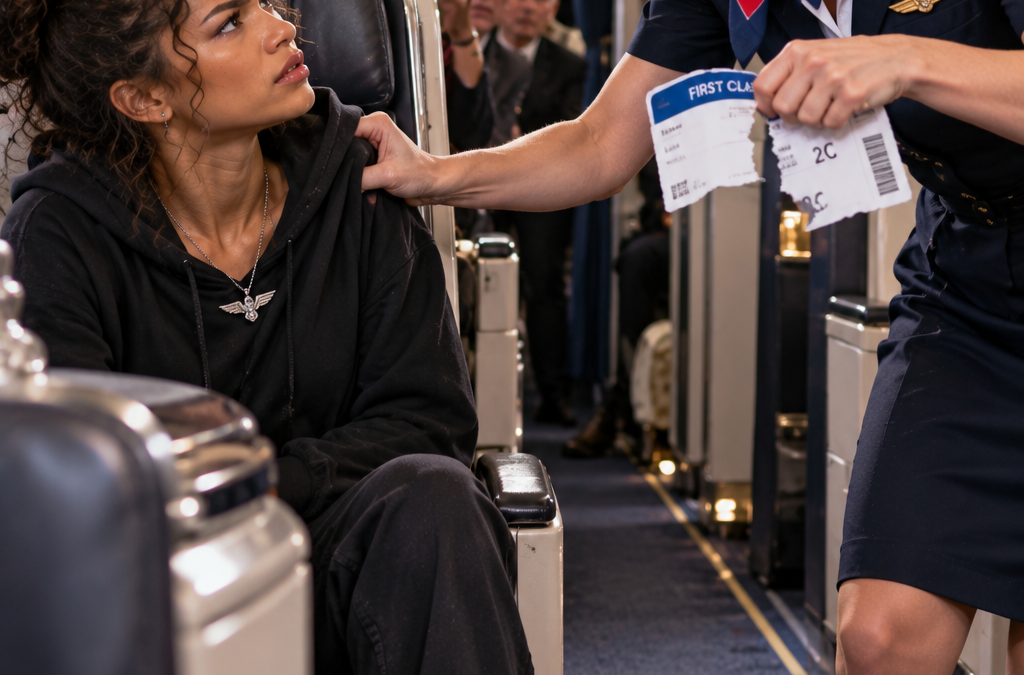
𝗙𝗨𝗟𝗟 𝗦𝗧𝗢𝗥𝗬
Then she added something uglier.
Something about trash.
Something about me being Black.
I had heard versions of it before.
Not usually spoken so openly.
That was the difference.
Most people preferred coded words.
Aggressive.
Suspicious.
Difficult.
Unprofessional.
Out of place.
Karen skipped the disguise.
I looked around the first-class cabin.
There were maybe twenty people close enough to hear every word.
Nobody stood.
Nobody said, “She has a boarding pass.”
Nobody asked Karen to stop touching me.
The man kept recording.
I bent down.
Picked up the first half of my ticket.
Then the second.
My hands were steady.
I wish I could tell you that meant I was strong.
It didn’t.
It meant my father had spent my entire childhood teaching me what happened when Black pilots allowed anger to become visible in places where people were already waiting to call them dangerous.
I stood.
Folded the torn pieces together.
Then walked toward economy.
Behind me, Karen said loudly, “Thank you.”
As if I had finally obeyed a reasonable request.
As if she had restored order.
Row 26.
Middle seat.
A teenage boy sat by the aisle wearing headphones.
An older woman sat by the window.
The teenager had seen what happened.
I knew because his eyes met mine for half a second.
Then he looked away.
I put my bag under the seat.
Sat.
Exhaled.
Only then did I realize my heart was pounding hard enough to hurt.
The older woman beside me smiled nervously.
“Hello, honey.”
“Hi.”
“You all right?”
The easy answer was yes.
Women like me become very skilled at saying yes while swallowing entire rooms.
Instead I said, “I will be.”
She nodded as if she understood exactly what I meant.
The plane pushed back from the gate.
I pressed my fingers against the pendant around my neck.
Silver wings.
Small.
Worn smooth along the edges.
My father had placed them around my neck the day I earned my commercial license.
Captain Raymond Jordan.
Thirty years flying commercial aircraft.
One of the first Black captains at a major American airline.
When I was a child, I thought my father had spent his life in the sky because he loved flying.
That was true.
It just wasn’t the whole truth.
After he died, I found the letters.
Some were official complaints.
Passengers refusing to board after discovering the captain was Black.
Crew members questioning his authority.
A memo describing him as “overly sensitive” after he objected to a racial joke inside the cockpit.
A handwritten letter he had apparently intended to send the airline president.
Three pages.
Never mailed.
He had folded it until the creases turned white.
I sat on the floor of his study reading that letter three weeks after his funeral.
I cried until I couldn’t make sound anymore.
My father had shielded me from the ugliest parts of his career.
He wanted me to love the sky before I learned how complicated the ground could be.
His last weeks were spent at home.
Lung disease.
Oxygen tube.
Wheelchair.
Too weak to climb stairs.
Still strong enough to criticize every aircraft that passed overhead.
One afternoon, we sat on the porch watching a 737 cross the Atlanta sky.
He lifted one finger.
“Southwest.”
I laughed.
“You cannot tell that from here.”
“Winglets.”
“You’re impossible.”
“Experienced.”
Then he looked at me.
“Fly steady, baby girl.”
I stopped smiling.
He had been saying it since my first lesson.
But his voice sounded different that day.
“You hear me?”
“I hear you.”
“The sky doesn’t care what color you are.”
I looked away because I knew he was saying goodbye before either of us wanted to admit it.
He died eleven days later.
Now, sitting in row 26 after being thrown out of a seat I had paid for, I held those wings between my thumb and index finger.
Fly steady.
The aircraft climbed.
Atlanta disappeared beneath the clouds.
Our destination was Chicago.
I had flown the route professionally dozens of times.
That night I was supposed to be nobody responsible for anything.
No flight plan.
No weather brief beyond casual curiosity.
No crew.
No passengers depending on me.
Just Whitney Jordan going to Chicago.
For the first hour, I tried to become exactly that.
The woman beside me wasn’t having much luck with her seat belt.
She had silver hair pulled into a neat bun and wore a navy church dress beneath a heavy coat.
Her hands trembled each time she tried to fit the buckle together.
Finally I leaned toward her.
“Can I help?”
She gave an embarrassed laugh.
“I’m making a fool of myself.”
“No, ma’am.”
“First flight.”
“That explains everything.”
“It does?”
“Everybody fights with the seat belt the first time.”
“That true?”
“No.”
She stared at me.
Then laughed.
I smiled.
“Here.”
I clicked the buckle together.
Adjusted the strap.
“Not too tight.”
“Oh, thank you.”
She covered my hand with hers.
Warm fingers.
“My name’s Ada.”
“Whitney.”
“Where you headed?”
“Chicago.”
She smiled.
“Well, that’s lucky.”
“Why?”
“So am I.”
I laughed again.
Ada told me her grandson was getting married.
She had spent three weeks trying to find an excuse not to fly.
Her daughter finally bought the ticket without asking.
“I told her I could take a train.”
“How long would that take?”
“Too long apparently.”
She leaned closer.
“My daughter is bossy.”
“Sounds useful.”
“She gets that from me.”
The airplane shifted gently.
Ada stiffened.
“That normal?”
“Completely.”
She studied me.
“You know airplanes.”
“Some.”
“No.”
Her eyes narrowed.
“You know airplanes.”
I smiled.
“My father flew.”
“That’s it?”
“That’s enough.”
She looked toward the window.
The wing light flashed in the darkness.
“My husband used to fix elevators.”
“That sounds terrifying.”
“He could listen to one moving and tell you which part was wearing out.”
She looked at me again.
“You do that with this plane.”
“What?”
“You listen.”
I hadn’t realized I was doing it.
The engines.
Airflow.
Flap motors earlier.
Changes in pitch.
Pilots never stop hearing aircraft.
Even when we’re passengers.
“My father taught me.”
Ada nodded.
“Good fathers teach you things nobody else knows how to teach.”
I looked down at the pendant.
“Yes.”
“They stay in your hands afterward.”
That sentence sat inside me.
I didn’t know how important it would become.
Forty-five minutes later, the seat belt sign came on.
The captain made an announcement.
“Ladies and gentlemen, this is Captain Reed. We’re expecting some turbulence ahead. Please return to your seats and remain buckled.”
Calm voice.
Experienced.
Nothing unusual.
Ada reached for my hand.
I let her take it.
The aircraft shook lightly.
Then harder.
A cup rattled somewhere.
Overhead bins creaked.
“Still normal?” Ada asked.
“So far.”
Then the vibration changed.
That is difficult to explain to someone who doesn’t fly.
Turbulence is irregular.
It pushes.
Drops.
Shifts.
This was different.
A sustained vibration moving through the floor.
I felt it through my shoes.
Then the lights flickered.
My eyes moved toward the ceiling.
The teenager beside me noticed.
“You okay?”
“Yes.”
But I wasn’t sure anymore.
Another shudder.
The nose changed attitude.
Slightly downward.
I could feel it in my inner ear.
The PA clicked.
I expected Captain Reed.
Instead, a younger voice came through.
Strained.
“This is First Officer Hayes.”
A pause.
Breathing.
Then:
“We have a medical situation in the cockpit.”
The cabin went silent.
“If any passenger on board has professional aviation experience, please identify yourself to a flight attendant immediately.”
Nobody moved.
My thumb tightened around the wings pendant.
Ada turned.
Her eyes widened.
“Whitney?”
I was already calculating.
Engines sounded normal.
No obvious power loss.
But we were descending.
Too quickly.
I unbuckled.
The teenager stared.
“What are you doing?”
I stood.
Ada grabbed my wrist.
“Honey?”
I looked down at her.
She searched my face.
And I saw the exact second she understood.
“You’re a pilot.”
“Yes.”
Her grip loosened.
“How much of a pilot?”
I almost smiled.
“Enough.”
The plane lurched.
Somebody screamed.
I steadied myself against the seat.
Ada whispered, “Go.”
I stepped into the aisle.
Then she caught my hand again.
I looked back.
“Bring us down.”
There was no dramatic speech inside my head.
No revenge.
No thought of Karen.
Not yet.
Training took over.
Row 25.
Passengers were frightened now.
Some watched me moving forward.
Most had no idea why.
A child cried.
A woman clutched a rosary.
A man prayed with his eyes closed.
I moved quickly but didn’t run.
Running inside a frightened cabin spreads fear.
Row 12.
First class.
Gerald—the man who had filmed me—saw me first.
His phone was in his hand.
But he wasn’t recording anymore.
His face looked gray.
I passed the seat from which I had been removed.
2C.
Empty.
My champagne glass still sat untouched on the tray table.
Karen stood near the forward galley gripping the counter.
Her hair had come loose.
Her face was pale.
She saw me.
For one second, fear disappeared behind irritation.
“What are you doing up here?”
I stopped.
“Where’s the captain?”
“I told you to stay—”
“Where is Captain Reed?”
Something in my voice changed the conversation.
Karen swallowed.
“He collapsed.”
“Conscious?”
“No.”
“First officer?”
“Sick.”
“How sick?”
“He’s vomiting. He can barely—”
The plane dropped.
Hard.
Karen slammed one hand into the wall.
Passengers screamed behind us.
Oxygen masks fell open in several rows.
I stepped toward the cockpit.
Karen grabbed my arm.
Again.
“You can’t go in there.”
I looked at her hand.
Then at her face.
“You’re just a passenger,” she said.
Even then.
That is what I will never forget.
We were potentially minutes from losing control of a commercial jet, and Karen still needed me to be beneath her.
I pulled my arm free.
“My name is Captain Whitney Jordan.”
She stared.
“Twelve years professional flying.”
Her mouth opened.
“ATP certified. Boeing 737 type-rated. More than six thousand flight hours.”
Karen’s face emptied.
I stepped closer.
“Now you can move, or you can explain to two hundred people why your pride mattered more than getting this airplane on the ground.”
Her hand dropped.
Behind her, the younger flight attendant appeared.
Megan.
She had been working first class earlier.
She stared at my pendant.
Then at me.
“I knew it.”
“What?”
“The wings.”
She punched the cockpit access code.
The lock released.
“I knew they were real.”
I nodded once.
“Thank you.”
Megan opened the door.
I entered.
The smell hit first.
Sweat.
Vomit.
Electrical heat.
Captain Reed was slumped behind the left seat, partially on the floor, unconscious.
First Officer Derek Hayes sat at the controls.
Barely.
His face was gray.
One hand gripped the yoke.
The other held a sickness bag.
The windshield was black with cloud and rain.
Lightning flashed beyond it.
Hayes looked at me.
“Who are you?”
“Captain Whitney Jordan.”
His eyes narrowed as if he couldn’t focus.
“I’m taking the left seat.”
He stared.
“Type?”
“737-800 current.”
“How many hours?”
“Six-two total. Twelve years.”
Relief hit his face so hard he almost laughed.
Instead he vomited.
I helped pull Reed farther from the seat.
Megan appeared behind me.
“She’s a pilot?”
“Yes,” Hayes said.
His voice shook.
“She’s flying.”
I sat.
The seat was warm.
Adjusted forward.
Harness.
Pedals.
Display.
Scan.
Airspeed.
Altitude.
Heading.
Engine instruments.
Fuel.
Weather radar.
Thirty-five thousand feet.
Heading west.
Thunderstorm ahead.
Aircraft descending inconsistently.
“Brief me.”
Hayes swallowed.
“Reed got sick first.”
“How long?”
“Twenty minutes.”
“Cause?”
“Don’t know. We ate the same crew meal.”
“You ate it too.”
He nodded.
“Started vomiting about ten minutes ago.”
“Engines?”
“Both good.”
“Hydraulics?”
“Green.”
“Nearest appropriate?”
“Lambert.”
St. Louis.
“Fuel?”
“Two hours.”
“How long can you remain functional?”
He looked at his shaking hands.
“Ten minutes.”
“Give me ten.”
He nodded.
“Your aircraft.”
“My aircraft.”
I keyed the radio.
“St. Louis Approach, Atlantic Airways Flight 2261, declaring emergency.”
Static.
Then:
“Atlantic 2261, go ahead.”
“Both assigned flight crew medically incapacitated. Qualified passenger pilot has assumed command. Request immediate vectors to Lambert.”
Silence.
I imagined people inside the control room staring at each other.
Then:
“Atlantic 2261, confirm qualifications of person operating aircraft.”
“Captain Whitney Jordan. ATP certificate 442618. Boeing 737-800 type rating. Approximately sixty-two hundred hours total, current medical.”
Another pause.
Longer.
I could hear someone speaking away from the microphone.
Then:
“Atlantic 2261, understood. Direct Lambert. Descend flight level two-four-zero.”
“Direct Lambert. Down two-four-zero.”
“Emergency equipment will be standing by. Wind runway two-nine currently two-six-zero at thirty-five, gusting forty-five. Ceiling eight hundred broken.”
I looked at the weather display.
“Copy.”
Forty-five-knot gusts.
Night.
Storm.
Sick first officer.
No active captain beside me.
I touched the pendant once.
Dad.
Not for luck.
For memory.
Fly steady.
Hayes managed another two minutes before leaning sideways and vomiting again.
“I’m sorry.”
“Stop apologizing.”
“I can’t keep—”
“You already kept us alive.”
His breathing became shallow.
“Megan.”
She stepped forward.
“Yes?”
“Get medical help up here.”
A passenger turned out to be a nurse.
She helped move Captain Reed and monitor Hayes.
I was effectively alone.
Karen stood outside the cockpit.
She had followed Megan.
I could see her in the reflection of the dark windshield.
She looked smaller now.
Not physically.
Something had been stripped away.
The plane entered heavier weather.
Rain hammered the windshield.
Lightning flashed.
The yoke kicked.
I corrected.
My father’s voice returned without permission.
Don’t fight the airplane.
Guide it.
Machines don’t like panic any more than people do.
A wind-shear caution sounded.
“Lambert Approach, Atlantic 2261 encountering severe turbulence and wind shear. Request lower.”
“2261, descend and maintain one-zero thousand. Turn right heading one-eight-zero.”
“Down ten thousand, right one-eight-zero.”
I disconnected autopilot.
Manual control felt immediate.
Alive.
The aircraft rolled slightly left.
I corrected.
Feet on rudder.
Eyes outside only when useful.
Mostly instruments.
Attitude.
Speed.
Vertical rate.
Heading.
Trim.
The cockpit narrowed until nothing existed beyond those displays.
Then I saw Karen’s reflection again.
Standing.
Watching.
Terrified.
I needed another set of hands.
Pride is dangerous in a cockpit.
Mine included.
“Karen.”
She flinched.
I didn’t turn.
“There’s an emergency procedures binder behind the first officer seat.”
No response.
“Red cover.”
I heard movement.
“Get it.”
Her hands appeared beside me.
Shaking.
She pulled the binder free.
“What tab?”
“Seven.”
She flipped.
Missed it.
Went back.
Her fingernails clicked against the dividers.
“Seven,” I repeated.
“I’m trying.”
Her voice cracked.
“I know.”
She found it.
“Read.”
“Altimeter setting.”
I keyed the radio.
“Lambert Approach, 2261, current altimeter?”
“Two-niner-eight-two.”
I set it.
“Next.”
Karen swallowed.
“Reduce airspeed to flap maneuvering speed.”
“Two-ten.”
“Flaps one.”
I moved the lever.
The aircraft changed pitch.
Trim.
Correct.
“Next.”
Her voice was still shaking.
But something interesting happened as she continued.
The checklist gave her a role.
And a role gave fear somewhere to go.
For ten minutes, Karen and I worked together.
The woman who had torn my boarding pass read emergency procedures while I flew the aircraft.
Life has a cruel sense of symmetry.
At one point she stumbled over “glideslope.”
Stopped.
Embarrassed.
I simply answered the item.
No correction.
No sarcasm.
We did not have time for revenge.
That seemed to affect her more than anger would have.
She looked at me.
I kept flying.
Behind us, Megan moved through the cabin.
Later, passengers told me what she said.
“We have a qualified pilot at the controls.”
Somebody asked who.
Megan answered:
“The woman from row twenty-six.”
Word moved through the airplane.
The woman Karen had thrown out of first class.
The Black woman in the hoodie.
The passenger.
She’s a captain.
She’s flying.
In row 26, Ada apparently closed her eyes and started praying.
The teenager beside my empty seat took off his headphones.
He told Ada, “I should’ve said something before.”
Ada told him, “Everybody gets another chance.”
I did not hear that conversation until later.
At the time, I was passing through eight thousand feet when the aircraft dropped violently.
Maybe one hundred feet.
Maybe more.
The cabin screamed.
Several overhead bins opened.
Then everything went dark.
Three seconds.
Maybe less.
Cockpit displays flickered.
Emergency power caught.
I remember Karen whispering:
“Oh my God.”
My hands did what they had been trained to do.
Attitude.
Power.
Wings level.
Do not overcorrect.
Aircraft stabilized.
Displays returned.
I breathed.
Once.
No celebration.
“Altitude eight thousand.”
Karen stared at the panel.
I glanced back.
“Checklist.”
She looked down immediately.
Her hands were no longer shaking.
“Landing gear.”
“Not yet.”
“Confirm when directed.”
“Good.”
Fifteen miles.
ILS alive.
Runway 29 waiting somewhere beneath clouds.
Weather updated.
Winds worse.
Thirty-five knots sustained.
Gusting forty-eight.
Ceiling six hundred.
“Atlantic 2261, cleared ILS two-nine.”
“Cleared ILS two-nine.”
I intercepted.
Localizer centered.
Glideslope coming.
I lowered gear.
Three green.
Flaps.
Speed.
The airplane felt heavy now.
Configured.
Committed.
Karen read each item clearly.
When we finished, she didn’t leave.
“Anything else?”
I looked toward the windshield.
“Yes.”
“What?”
“Stay.”
She nodded.
At eight miles, approach control gave me the wind again.
Gusting forty-eight.
At six miles, lightning hit somewhere close enough to turn the entire cockpit white.
My hands stayed on the yoke.
At four miles, we were still inside cloud.
I touched my father’s wings.
Not intentionally.
My thumb simply found them.
Trust the instruments.
He used to say that when I was a student.
The ground doesn’t care whether you’re scared.
Trust what you know.
Three miles.
Two.
Nothing outside.
Then at roughly four hundred feet, the runway appeared.
Two rows of lights through rain.
I had never seen anything more beautiful.
“Runway in sight.”
“Atlantic 2261, cleared to land runway two-nine. Wind two-seven-zero at forty, gusting five-two.”
I froze for half a heartbeat.
Fifty-two.
Then the controller added:
“Good luck.”
Controllers rarely say good luck.
That told me more about the conditions than the numbers did.
I tightened my grip.
“Cleared to land.”
The crosswind pushed hard.
I crabbed into it.
Nose left.
Ground track aligned.
Three hundred feet.
Two hundred.
The runway lights expanded.
Rain streaked sideways.
My father had taught me crosswind landings until I hated him for it.
“Again.”
“Dad, that one was fine.”
“It was survivable.”
“That counts.”
“No.”
He would reset the simulator.
“Again.”
I had cursed his perfection privately.
At one hundred feet, I thanked him.
Fifty.
The wind lifted the right wing.
I corrected.
Aileron into wind.
Opposite rudder.
De-crab.
Twenty.
Ten.
Touchdown.
Hard.
Left gear.
Then right.
Bounce.
Small, but enough to make my stomach drop.
The aircraft pulled sideways.
I held correction.
Spoilers.
Reverse thrust.
Braking.
Wet pavement screamed beneath us.
My arms hurt.
The centerline lights passed faster than I wanted.
Then slower.
Slower.
Slower.
Until finally the airplane stopped.
For three seconds, nobody made a sound.
Not me.
Not Karen.
Not the controller.
Then the cabin exploded.
Applause.
Crying.
Shouting.
Somebody screamed, “Thank God!”
I stayed in the seat.
My hands would not release the yoke.
I looked at them.
Told my fingers to open.
One.
Two.
Three.
Eventually they obeyed.
They began shaking immediately.
Adrenaline.
Delayed fear.
I touched my pendant.
Warm.
“We made it, Dad.”
My voice broke.
Behind me, something hit the floor.
Karen.
She had slid down the cockpit wall.
The emergency binder lay beside her.
She covered her face.
Then started sobbing.
Not elegant tears.
Full-body sobs.
I did not know whether she was crying from fear, relief or shame.
Probably all three.
Megan entered.
“Whitney?”
I stood.
My knees nearly failed.
I caught the seat.
Megan grabbed my arm.
“Easy.”
“I’m fine.”
“You’re not.”
“I will be.”
The same answer I had given Ada.
Paramedics were boarding.
Captain Reed was breathing.
Hayes was conscious again but barely.
The nurse stayed with them.
I stepped into the cabin.
I expected cheers.
There were some.
But mostly I saw faces.
People staring at me differently.
That unsettled me.
Two hours earlier, many of those same people had watched me be humiliated.
Now they looked as if I had transformed.
I hadn’t.
That was important.
I was exactly the same woman who had boarded in Atlanta.
Same qualifications.
Same experience.
Same father.
Same hands.
The only thing that had changed was that they needed me.
Ada was coming up the aisle.
She held seatbacks for balance.
Her hair had come loose.
When she reached me, she took my face between her hands.
“I knew it.”
I almost laughed.
“Knew what?”
“You had wings.”
That did it.
One tear escaped.
I had held myself together through wind shear, darkness, turbulence and a fifty-two-knot gust.
An old woman touching my face broke me.
“You brought us down.”
“We all came down together.”
“No.”
Ada shook her head.
“You brought us.”
Behind her stood the man who had filmed me.
Gerald.
His phone was gone now.
He looked sick.
“I’m sorry.”
I said nothing.
“I filmed you.”
“I know.”
“I laughed.”
“I know.”
His face twisted.
“I’m sorry.”
People expect forgiveness to happen quickly when guilt finally becomes uncomfortable.
It doesn’t.
I looked at him.
I did not say it was okay.
Because it wasn’t.
I also didn’t attack him.
I simply let him stand inside what he had done.
After several seconds, he lowered his eyes.
That was enough.
The aircraft door opened.
Emergency lights flashed outside.
Captain Reed and First Officer Hayes were taken out first.
Both survived.
Food poisoning, we later learned.
Severe enough to incapacitate them rapidly.
I left last.
The terminal was chaos.
Cameras.
Reporters.
Airport personnel.
Phones raised everywhere.
Someone already had the ATC audio.
A reporter yelled:
“Captain Jordan, how does it feel to save more than two hundred lives?”
Another:
“Captain, were you really removed from first class before the emergency?”
Another:
“Did the airline know you were a pilot?”
I walked past them.
Megan carried my bag.
I found an empty metal bench far from the crowd.
Sat.
Bent forward.
Put my head between my hands.
Only then did I begin to feel what had happened.
My legs shook.
My stomach turned.
My shoulders hurt.
For the first time, I understood how close we had been.
Megan sat beside me.
She didn’t speak.
Five minutes.
Maybe ten.
Eventually I looked up.
“You recognized the pendant.”
She nodded.
“Before takeoff?”
“Yes.”
“You knew I was probably flight crew.”
“I thought so.”
“But you didn’t say anything.”
Her face changed.
“No.”
“Why?”
She stared at the floor.
“Karen has been doing things like that for years.”
I waited.
“She targets people.”
“Black passengers?”
“Yes.”
“Anyone else?”
“Anybody she thinks won’t fight back.”
“Why did nobody stop her?”
Megan swallowed.
“Seniority.”
“That’s not an answer.”
“I know.”
She rubbed her palms together.
“She intimidates junior crew. People complain. Supervisors tell us to work it out internally. She knows exactly how far she can go.”
“And you?”
“I kept my head down.”
“Why?”
“I needed the job.”
That answer I understood.
Maybe too well.
Megan’s eyes filled.
“I watched her put her hands on you.”
I said nothing.
“I watched her tear your pass.”
Her voice cracked.
“I knew those wings were real.”
“Why didn’t you say something?”
“Because I was afraid.”
The honesty mattered.
Then she said something even harder.
“That doesn’t make it right.”
I looked at her.
“No.”
“I thought staying quiet meant I wasn’t part of it.”
She shook her head.
“Tonight I realized silence is a choice too.”
For a while, we sat listening to reporters somewhere beyond security.
Then I said:
“You opened the cockpit door.”
She looked at me.
“When it mattered, you opened it.”
“That doesn’t erase before.”
“No.”
“Then why say it?”
“Because both things can be true.”
She wiped her eyes.
I touched the silver wings.
“My father used to tell me people are usually more complicated than the worst thing they did.”
“Was he right?”
“I’m still deciding.”
She laughed quietly.
Within hours, the world had found the videos.
Gerald had sent his recording to several group chats.
Someone shared it.
Then someone else.
My humiliation spread almost as fast as the landing.
The two clips became inseparable.
Karen grabbing my collar.
Me declaring an emergency.
Karen tearing the ticket.
My radio call:
“Two hundred six souls on board.”
Karen pointing toward economy.
Me landing the airplane.
People called it irony.
I didn’t.
Irony is clever.
There was nothing clever about it.
The airline issued a statement.
They were “aware.”
They were “reviewing.”
They were “committed to passenger dignity.”
No direct apology.
No mention of race.
No mention of Karen.
That might have been the end of my involvement if they had stopped there.
Three days later, I received a letter from Atlantic Airways’ legal department.
It questioned my “unauthorized assumption of aircraft controls.”
I read the sentence twice.
Then a third time.
I was sitting on my father’s porch in Atlanta.
Same porch where he had spent his last summer.
A plane crossed overhead.
For several seconds, all I could hear was his oxygen machine in my memory.
Unauthorized.
I had saved their aircraft.
Their passengers.
Their crew.
And the first formal communication they sent me was a threat.
That was when Diane Taylor called.
Civil rights attorney.
I almost refused.
“I don’t want to become a story.”
“You already are.”
“I don’t want money.”
“I didn’t ask whether you wanted money.”
I closed my eyes.
“What do you want?”
“Accountability.”
I nearly laughed.
“That word gets expensive.”
“Yes.”
She paused.
“I’ve received forty-six letters.”
“What letters?”
“Black women who fly.”
My hand stopped moving.
“Forty-six?”
“Captains. First officers. Corporate pilots. Military aviators. Flight instructors.”
I looked toward the sky.
“What do they say?”
“Different details.”
Her voice softened.
“Same story.”
I knew before she finished.
“People deciding they didn’t belong.”
“Yes.”
That was when I agreed to meet.
The investigation widened quickly.
FAA.
Internal records.
Previous complaints.
Security footage.
Crew reports.
The evidence was uglier than I expected.
Karen had been reported before.
Three formal complaints involving racial discrimination.
No meaningful discipline.
Megan had raised concerns.
They were buried.
Other crew members had seen similar behavior.
The airline had chosen convenience.
That was the word Diane used.
Convenience.
I hated it because it sounded so harmless.
A delayed flight is inconvenient.
A lost bag is inconvenient.
Allowing someone to humiliate Black passengers because disciplining a senior employee is uncomfortable is not convenience.
It is a decision.
The hearing took place in Chicago.
The courtroom was packed.
I wore a charcoal blazer.
White blouse.
Silver wings.
Diane sat beside me.
Across the aisle, Karen looked different without the uniform.
Smaller again.
Human.
That made what happened more difficult, not easier.
Monsters are simple.
People aren’t.
Atlantic’s attorney opened by claiming Karen had been performing standard seat verification.
Diane let him finish.
Then she displayed jet bridge security footage.
Passenger after passenger.
White man in a T-shirt.
No ticket check.
White woman in sandals.
Smile.
White teenager in a baseball cap.
Wave through.
Then me.
Black.
Hoodie.
Karen’s entire posture changed.
She stepped into my path.
Diane paused the recording.
“Standard procedure?”
The airline attorney didn’t answer.
Megan testified next.
Her hands shook.
Her voice didn’t.
“Did Ms. Hollis treat passengers differently on the basis of race?”
“Yes.”
“How often?”
“Frequently.”
“Did you report her?”
“Once.”
“What happened?”
“My supervisor told me she had seniority and that I should focus on my own duties.”
Diane paused.
“Why didn’t you report additional incidents?”
Megan looked toward me.
Then toward the gallery.
“I was scared.”
A row of Black women pilots sat together behind us.
Navy blazers.
Silver wings.
Megan’s voice cracked.
“I thought being quiet protected me.”
She swallowed.
“It also protected her.”
The courtroom became silent.
“I know that now.”
FAA investigators presented the flight data.
Every control input.
Every altitude change.
Weather.
Crosswind.
Radio transmissions.
Their conclusion described my performance as exceptional.
I hated hearing that word in court.
Not because I wasn’t proud.
Because competence should not have been required to prove my humanity.
Then Atlantic’s vice president of operations took the stand.
Richard Moore.
Diane asked him about the previous complaints.
Three.
All racial.
No discipline.
“Why?”
He used corporate language.
Review process.
Insufficient corroboration.
Procedural considerations.
Diane cut through it.
“You buried them.”
He shifted.
“We evaluated—”
“You buried them.”
“I wouldn’t characterize—”
“Three complaints.”
She held up the files.
“Then a fourth incident occurs in front of an entire cabin.”
He looked toward the table.
“And after Captain Jordan saves your aircraft, your legal department sends her a letter implying she may face action for operating it.”
“That letter was precautionary.”
“Yes or no?”
His face reddened.
“Yes.”
When my turn came, I walked to the witness stand.
I had written notes.
I didn’t use them.
Diane asked me about my father.
So I told them.
Thirty years.
Passengers refusing to fly with him.
People questioning whether he was qualified after seeing his face.
Crew members calling him a diversity hire.
The letters I found after he died.
Then I told them about his last words.
“Fly steady.”
The courtroom disappeared for a moment.
I saw the porch.
Oxygen tube.
737 in the distance.
Then Diane asked:
“Why are you here, Captain Jordan?”
I looked at Karen.
Then Richard Moore.
Then the row of pilots.
“I did not ask to fly Atlantic 2261.”
My voice was steady.
“I boarded as a passenger.”
I touched the pendant.
“I had paid for a first-class seat.”
No one moved.
“I was grabbed.”
My throat tightened.
“My boarding pass was destroyed.”
I breathed.
“I was told where someone believed a Black woman like me belonged.”
I paused.
“Then the cockpit failed.”
The irony again.
People in the gallery leaned forward.
“I did what I was trained to do.”
I looked toward the airline lawyers.
“I did not save those passengers to prove Karen wrong.”
Then at Karen.
“I did not land that airplane for revenge.”
Her eyes lowered.
“I landed it because two hundred six people deserved to go home.”
My voice became quieter.
“That included people who laughed at me.”
Gerald was in the gallery.
He looked down.
“That included people who stayed silent.”
Megan began crying.
“And it included Karen Hollis.”
Karen’s face tightened.
“I would have landed that airplane exactly the same way if every person behind me hated me.”
I meant it.
“Because that is what a captain does.”
I looked at Diane.
Then back at the judge.
“But I am here because I should not have needed to save an airplane before anybody believed I belonged in seat 2C.”
That was the sentence.
The whole room changed.
“My father spent three decades being told in small and large ways that the sky belonged more naturally to somebody else.”
I touched his wings.
“He kept flying.”
My eyes burned.
“I used to think that was enough.”
I looked toward the row of Black women pilots.
“Now I don’t.”
One of them wiped her eyes.
“There are forty-six letters sitting in my attorney’s office.”
I continued.
“Forty-six women with stories about being mistaken for passengers, gate agents, cleaners, flight attendants—anything except the pilots they actually were.”
I shook my head.
“I am not here because I need everyone to admire me.”
My voice caught.
“I am here because the next woman should not have to land a crippled airplane in a thunderstorm before people decide to see her.”
Nobody spoke.
One pilot in the third row stood.
Then another.
Then all of them.
No applause.
No cheering.
Just women standing.
Silver wings catching the courtroom lights.
I almost lost control of my voice.
I looked down.
Dad would have hated the attention.
He would also have been proud.
The ruling came three days later.
Karen was terminated.
The airline faced millions in penalties and corrective measures.
Independent oversight.
Mandatory anti-discrimination reforms.
Public apology.
Richard Moore resigned.
People called it victory.
I was less certain.
Victory sounded clean.
Nothing about the months afterward felt clean.
Karen asked to see me in the courthouse hallway.
No cameras.
No lawyer.
She looked exhausted.
“I don’t expect forgiveness.”
I said nothing.
“I know I don’t deserve it.”
Still nothing.
Her eyes filled.
“I heard what you said.”
“Good.”
She flinched slightly.
I stepped closer.
“Then do something with it.”
That was all.
I walked away.
I didn’t forgive her that day.
I didn’t need to.
Forgiveness is not a debt owed by the person who was harmed.
But I also didn’t need to spend the rest of my life carrying Karen with me.
My father had carried enough people’s hatred.
I wanted something different.
Six months later, I walked through Hartsfield-Jackson wearing four gold stripes.
Full uniform.
Navy blazer.
White shirt.
Flight bag.
My father’s silver wings below my tie.
People recognized me now.
Some stared.
A TSA officer nodded.
A gate agent smiled.
A little girl near B16 tugged her mother’s sleeve.
“Mama.”
Her mother looked down.
“That’s her.”
The girl pointed.
“The plane lady.”
I smiled.
Then kept walking.
Atlantic had offered me executive positions after the settlement.
Diversity office.
Culture.
Operations advisory roles.
A vice presidency.
The new CEO called personally.
“Name your position.”
“Captain.”
Silence.
“I’m sorry?”
“I want to fly.”
“You could have an office.”
“I’ve seen offices.”
She laughed.
“What do you want?”
“The left seat.”
Another pause.
Then:
“Then fly, Captain Jordan.”
My first requested route was Atlanta to Chicago.
Same route.
Different flight number.
I wanted it.
Maybe I needed it.
Megan stood at the boarding door.
Senior flight attendant now.
When she saw me, her professional expression cracked.
“Welcome aboard, Captain Jordan.”
I stopped.
“Thank you, Megan.”
Her eyes shone.
“It’s good to see you.”
“You too.”
I stepped into the cockpit.
The left seat waited.
I set down my bag.
Hung my blazer.
Then removed two items.
First, a photograph.
Dad beside a 727 in 1981.
Young.
Thin.
Grinning.
He wore his uniform like armor.
I set the photograph above the instrument panel.
Second, a letter.
Ada.
She had written three weeks earlier.
I unfolded it.
Her granddaughter’s wedding had been postponed.
Not because of tragedy.
Because the young woman had changed her mind about the life she wanted.
She was returning to school.
She wanted to learn to fly.
Ada wrote that her granddaughter had seen the news footage and said:
“I want to be like the woman with the wings necklace.”
I had read that sentence so many times the fold in the paper was beginning to tear.
At the bottom, Ada had written:
Fly steady.
I placed the letter beside Dad’s photograph.
Then touched the pendant.
“Still working, old man.”
The first officer entered.
Young guy.
Nervous.
He looked at the photograph.
“Your father?”
“Yes.”
“Captain Jordan?”
“You know him?”
“My instructor used to talk about him.”
I looked at him.
“What did he say?”
“That he was one of the best.”
My throat tightened unexpectedly.
“He was.”
Boarding continued.
Bags.
Seat belts.
Announcements.
Ordinary aviation.
My favorite kind.
Megan called from the cabin.
“Ready when you are, Captain.”
I picked up the PA handset.
“Good evening, ladies and gentlemen. This is Captain Whitney Jordan.”
The words felt different now.
Not bigger.
More settled.
“Welcome aboard our service from Atlanta to Chicago.”
I looked at Dad’s photograph.
“We’re expecting a smooth flight tonight.”
No thunderstorm.
No emergency.
No need for heroism.
Exactly what I wanted.
In first class, a young Black woman sat near the window wearing a college sweatshirt and cheap pilot-wing earrings.
I didn’t know she was there.
Megan told me later.
The girl spent most of the flight staring through the window.
Maybe she loved airplanes.
Maybe it meant nothing more than that.
I hoped so.
Sometimes the best form of progress is ordinary.
A Black girl likes planes.
She becomes a pilot.
Nobody writes an article.
Nobody asks whether she belongs.
Nobody tears anything from her hands.
She just flies.
That was what I wanted.
Not a world full of stories like mine.
A world where stories like mine stopped being necessary.
After the lawsuit, I helped start the Raymond Jordan Memorial Scholarship.
The first year, six young Black women received flight-school funding.
I handed each of them a certificate.
One woman cried before I even reached her name.
Another shook so badly I held the paper until she had both hands around it.
At the ceremony, a reporter asked:
“What do you want your legacy to be?”
I thought about my father.
Ada.
Megan.
The teenager who looked away.
Gerald.
Karen.
A runway hidden by rain.
Then the six women standing behind me.
“I don’t want a legacy.”
The reporter looked confused.
“What do you want?”
I glanced at those women.
“A sky full of pilots who look like me.”
She smiled.
“That sounds like a legacy.”
I shook my head.
“No.”
“What is it?”
“Tuesday.”
She laughed.
I didn’t.
I meant it.
That evening, back in the cockpit, ground control cleared us to taxi.
I released the parking brake.
The airplane began moving.
Taxi lights passed beneath us.
The first officer ran final checks.
Runway ahead.
Clear weather.
Calm winds.
No emergency.
Tower cleared us for takeoff.
I lined up.
White centerline stretching into darkness.
For one second, I was back in row 26.
Torn boarding pass in my pocket.
Ada beside me.
Karen’s voice behind me.
Economy, where you belong.
Then I looked ahead.
I pushed the throttles forward.
Engines rose.
Forty percent.
Stable.
Takeoff power.
Acceleration pressed me into the seat.
“Eighty knots.”
“Checked.”
“V1.”
“Rotate.”
I pulled gently.
The nose lifted.
The runway disappeared.
Atlanta fell beneath us.
The city became light.
Then distance.
I glanced once at my father’s photograph.
His smile caught the instrument glow.
The silver wings rested against my chest.
For most of my career, I thought my father’s greatest lesson was that the sky didn’t care what color I was.
I understand him differently now.
The sky was never the problem.
People were.
People build doors.
People decide who looks qualified before a word is spoken.
People stay silent when someone is humiliated because speaking feels inconvenient.
People tear boarding passes.
People also open cockpit doors.
They testify.
They apologize.
They stand.
They learn.
And sometimes they change.
That is why I stopped wishing to become invisible to prejudice.
Visibility mattered.
Not because I wanted strangers recognizing me in airports.
Because somewhere, another woman was still walking toward a door somebody expected her not to enter.
She needed to see someone already inside.
I became that woman for people I would never meet.
My father had been that man for me.
Captain Raymond Jordan never got a viral video.
Nobody applauded when he landed an ordinary flight after enduring an extraordinary amount of disrespect.
Most of his courage disappeared into paperwork, crew logs and silence.
But he came home.
Sat beside me.
Taught me weather.
Navigation.
Discipline.
He taught me that anger had to be controlled without being denied.
He taught me that dignity did not mean allowing people to mistreat you.
It meant refusing to let mistreatment decide the quality of your work.
Most importantly, he taught me to fly steady.
That night over St. Louis, his hands were not on the controls.
Mine were.
But everything he had put into those hands was there.
Every correction.
Every lesson.
Every time he reset a simulator because my landing was “survivable.”
Every time he made me explain why before touching a switch.
Every time he told me to trust the instruments.
People later called what I did instinct.
It wasn’t.
It was inheritance.
Training.
Thousands of hours.
A father who knew I would have to be better than some people expected in order to be judged merely competent.
That truth angered me.
It still does.
But I refuse to confuse injustice with destiny.
The first-class seat Karen tried to take from me became almost irrelevant after everything that followed.
Almost.
I kept the torn boarding pass.
Both pieces.
They sit inside my flight log.
People have asked why.
Not as a trophy.
Not as evidence.
Not because I enjoy remembering that night.
I keep it because there are two versions of the same woman inside those pages.
The woman Karen thought she saw.
And the woman I knew I was.
The paper did not change between those moments.
Neither did I.
That is the lesson I refuse to lose.
I did not become worthy when the cockpit needed me.
I did not become qualified when air traffic control verified my certificate.
I did not become respectable when investigators praised my landing.
I did not become a captain when strangers finally called me one.
I already was.
That night simply forced everyone else to catch up.
Years later, there are still moments when I board an aircraft in civilian clothes and see the question in somebody’s face.
Pilot?
You?
Sometimes they say it.
Sometimes they don’t.
I no longer rush to prove anything.
I smile.
Answer if I feel like it.
Keep walking if I don’t.
Because I know what my father knew.
A title is useful.
A uniform is useful.
Recognition feels good.
But none of those things create ability.
Work does.
Discipline does.
Knowledge does.
Character does.
When Flight 1042 reached cruising altitude on my first trip back to Chicago, I turned off the seat belt sign.
The cabin settled.
The first officer reviewed weather.
Smooth all the way.
I looked through the windshield.
Black sky.
Stars.
No storm.
For a while, neither of us spoke.
Then he asked:
“Captain?”
“Yes?”
“Were you scared that night?”
I considered lying.
Pilots like confidence.
Passengers like certainty.
Legends require fearlessness.
But I had never wanted to become a legend.
“Yes.”
He looked surprised.
“How scared?”
“Very.”
“But everyone said you sounded calm.”
“I was.”
He frowned.
“How can you be calm and scared?”
I looked at the instruments.
“Calm is what you do.”
Then I touched my chest lightly.
“Fear is what you feel.”
He nodded slowly.
“Training decides which one gets the controls.”
He wrote that down.
I laughed.
“You don’t have to write everything I say.”
“Sorry.”
“My father used to do the same thing.”
“Write things down?”
“No.”
I smiled.
“Say things he knew I would remember forever.”
A few minutes later, I made my rounds through the cabin.
Not necessary.
I just wanted to stretch.
Megan was serving drinks.
When she saw me, she handed me coffee.
“Black.”
“You remembered.”
“I remember trauma.”
I laughed.
Then noticed the young woman wearing pilot-wing earrings.
Window seat.
College sweatshirt.
She looked up.
Her eyes moved to my four stripes.
Then my pendant.
“Are you the captain?”
“Yes.”
Her face lit.
“That is so cool.”
“What are you studying?”
“Aerospace engineering.”
“Good field.”
“I want to fly too.”
“Then fly.”
She smiled.
“You make that sound easy.”
“It isn’t.”
Her smile faded slightly.
I added:
“That doesn’t mean you shouldn’t.”
She nodded.
I continued toward the cockpit.
Halfway there, I realized something.
That conversation lasted maybe twenty seconds.
No cameras.
No thunderstorm.
No courtroom.
No viral moment.
Maybe she forgot it the next week.
Maybe not.
My father had spoken to me like that my whole life.
A sentence here.
A correction there.
Fly steady.
The sky doesn’t care.
Again.
Again.
Again.
Lives are rarely changed by one grand speech.
Usually they are shaped by small sentences repeated at the right moments.
That was what Ada had done for me too.
I told them you had wings.
She saw something when everybody else had been debating whether I belonged.
Maybe that is why I answered her letters for years afterward.
She sent Christmas cards.
Photos of her granddaughter.
Flight school.
First solo.
Private pilot certificate.
Eventually commercial training.
The first time her granddaughter soloed, Ada mailed me a photograph.
A young Black woman standing beside a Cessna.
Big smile.
Hands trembling visibly even in the picture.
On the back, Ada wrote:
Another one has wings.
I cried at my kitchen table.
There was no news story about that either.
Good.
Not everything sacred needs an audience.
Megan and I stayed friends.
She eventually became a training manager.
On her first day teaching new flight attendants, she called me.
“I’m terrified.”
“Of what?”
“Saying the wrong thing.”
“You will.”
“Helpful.”
“You’ll survive.”
She laughed.
Then became quiet.
“I’m teaching intervention protocols.”
I knew what she meant.
Situations involving harassment.
Discrimination.
Passenger mistreatment.
“How’s that feel?”
“Important.”
She paused.
“Late.”
“Late still counts.”
“You really believe that?”
“Some days.”
She exhaled.
“I think about that night all the time.”
“So do I.”
“About before the emergency.”
“Yes.”
“I still hate myself for staying quiet.”
“Megan.”
“I know what you’re going to say.”
“No, you don’t.”
Silence.
“I’m going to say guilt only matters if you use it.”
She didn’t respond.
Then:
“That sounds like something your dad would say.”
“It does.”
“Did he?”
“No.”
I smiled.
“I’m stealing his style.”
Gerald changed too.
Not dramatically.
No public redemption tour.
He donated his airline miles to a scholarship foundation anonymously.
I found out because the foundation director accidentally mentioned his name.
Four hundred thousand miles.
Enough to move students around the country for training opportunities.
I sent him a photograph of a sunset from the cockpit.
On the back I wrote:
A second chance is only useful if you do something with it.
He never replied.
He didn’t need to.
Karen disappeared from aviation.
I heard pieces.
Counseling.
Volunteer work.
Some advocacy training.
I never investigated further.
Her story belonged to her once she was no longer hurting mine.
People sometimes ask whether I ever forgave her.
I still don’t know how to answer.
Forgiveness sounds like a single event.
A door opening.
A sentence spoken.
For me, it was more like putting down a suitcase I had carried long enough.
I stopped needing her punishment to feel whole.
That might be forgiveness.
Or it might simply be freedom.
Either way, I accepted it.
The torn boarding pass remained in my logbook.
One half contained my name.
The other half contained seat 2C.
Sometimes young pilots saw it and asked what happened.
I never gave them the dramatic version first.
I said:
“Someone mistook appearance for information.”
That confused them.
So I explained.
A hoodie did not tell Karen whether I was a pilot.
Skin color did not tell her whether I could afford first class.
Silence did not mean weakness.
And a middle seat in row 26 did not tell anyone what I was capable of doing in the left seat of a Boeing 737.
Assumptions feel like knowledge because they arrive quickly.
That is what makes them dangerous.
Real knowledge takes work.
My father spent thirty years earning his.
I spent twelve years earning mine before Flight 2261.
Nobody on that airplane saw the mornings I woke at four for simulator training.
The failed checkride maneuver I practiced until my wrists hurt.
The birthdays missed.
The weather manuals.
The emergency drills.
The hours.
Thousands and thousands of hours where nothing heroic happened.
That was the part Karen couldn’t see.
But invisible work is still work.
Unrecognized worth is still worth.
That was what I carried with me as Flight 1042 began its descent into Chicago.
Clear skies.
Light winds.
The skyline appeared ahead.
The first officer smiled.
“This one should be easier.”
“Never insult an approach before it’s over.”
“Yes, Captain.”
We configured.
Gear.
Flaps.
Checklist.
Routine.
Beautifully routine.
At five hundred feet, I saw the runway perfectly.
No lightning.
No wind shear.
No terrified flight attendant reading behind me.
Just lights.
I lined up.
Twenty feet.
Ten.
Touchdown.
Soft.
The first officer looked at me.
“Better than St. Louis?”
“Much.”
We taxied to the gate.
Passengers stood too soon, as usual.
Megan made them sit back down, as usual.
I completed shutdown.
Instruments went dark one by one.
Then I looked at Dad’s photograph.
“We’re home.”
I packed it away.
Folded Ada’s letter carefully.
Placed both inside my flight bag.
Before leaving the cockpit, I touched the silver wings around my neck.
They were only metal.
They had never flown anything.
They had no authority.
No license.
No rank.
The meaning came from the hands that gave them to me.
My father had worn his own wings in a world that repeatedly tried to make him feel grateful merely for being allowed in the room.
He stayed.
He flew.
He taught me.
Then I wore mine into a first-class cabin where someone decided they could tell me who I was before asking my name.
I stayed too.
Not in the seat.
Something more important.
I stayed myself.
And when everything went dark at thirty thousand feet, I did what my father had spent a lifetime preparing me to do.
I flew steady.
Not to prove that I belonged.
I already knew that.
I flew because two hundred six people needed a captain.
And for the first time that night, nobody cared what I looked like.
They only needed me to bring them home.








