𝗙𝗨𝗟𝗟 𝗦𝗧𝗢𝗥𝗬 The Ferrari Manager Looked at My Grease-Stained Hands and Told Security to Drag Me Out Before He Ever Checked My Name
𝗙𝗨𝗟𝗟 𝗦𝗧𝗢𝗥𝗬
I kept my 1998 Chevy.
Rust around the rear wheel wells.
Driver’s seat torn near the seam.
Air conditioning worked when it felt respected.
Elliot hated that truck.
I loved it.
The night before my sixty-eighth birthday, my phone rang.
“Dad.”
“What?”
“Tomorrow.”
“What tomorrow?”
“Your birthday.”
“I know when I was born.”
He sighed.
“I want you to come to the Fifth Avenue dealership.”
“Why?”
“Because I’m giving you a car.”
“No.”
“Yes.”
“No.”
“Pick anything.”
“I have a truck.”
“That truck qualifies for historical preservation.”
“It runs.”
“Barely.”
“It runs better than half the men your age.”
“Dad.”
I laughed.
Then he stopped joking.
“You spent your whole life building cars for other people.”
I stayed quiet.
His voice softened.
“Let me do this.”
I looked toward Clara’s photograph.
“What car?”
“Any car.”
“That’s ridiculous.”
“Walk in. Give them your name. I called the branch. They’ll take care of you.”
I should have known then how important it was to him.
Not the car.
The gesture.
So I said, “All right.”
He went silent.
“You serious?”
“I’ll come by around noon.”
“Thank you.”
“You’re thanking me for letting you spend money?”
“Yes.”
“Boy, I raised you wrong.”
He laughed.
I woke the next morning and forgot almost immediately that I was supposed to visit the dealership.
Monique’s Civic came first.
A failing belt does not care about birthdays.
By the time I finished, my shirt had grease on the cuff and dirt across the front.
I went inside.
Washed my hands.
Most of the grease stayed in the cracks around my fingernails.
I considered changing.
Then I thought, Why?
I had no job interview.
No gala.
My son owned the dealership.
He knew exactly what I looked like.
I put on my faded khakis, work boots, and flannel shirt.
Climbed into the Chevy.
It groaned when I turned the key.
“Don’t embarrass me today,” I told it.
The engine caught.
We went.
The Fifth Avenue dealership looked less like a place that sold cars and more like a museum dedicated to money.
Glass front.
Chrome accents.
Italian marble.
Every surface polished enough to reflect your face back at you.
I parked between a Porsche Cayenne and a black Mercedes S-Class.
My Chevy looked tired.
I patted the dashboard.
“Don’t worry about them.”
Inside, the air smelled like leather, espresso and whatever expensive buildings smell like when nobody is allowed to spill anything.
A row of Ferraris sat beneath precision lights.
Red.
Yellow.
Black.
Each one positioned like sculpture.
A receptionist looked up.
Her smile appeared automatically.
Then she saw me.
It disappeared.
A salesman near a desk glanced at my boots.
Another looked toward the parking lot and saw my truck.
I noticed.
I had lived sixty-eight years.
You learn certain looks.
Still, I ignored them.
Because I saw the car.
Crimson Ferrari 296 GTB.
Raised platform.
Slow turntable.
Beautiful lines.
Not practical.
Not sensible.
Not something I would ever have chosen for myself.
Which was probably why Elliot wanted me to drive it.
I walked closer.
Thirty feet away, a man stood from behind a glass desk.
He was around forty.
Maybe younger.
Expensive suit.
Tie straight.
Hair cut close on the sides.
His name, I later learned, was Derek Whitmore.
At that moment, all I knew was that he was walking toward me with a face already set against whatever I intended to say.
“Excuse me.”
I turned.
“Afternoon.”
His eyes moved down my body.
Boots.
Pants.
Shirt.
Hands.
Then back up.
“What are you doing?”
I glanced toward the Ferrari.
“Looking.”
“At that vehicle?”
“Yes.”
“It’s not open for public touching.”
“I haven’t touched it.”
He stared at my right hand.
There was still grease around my fingernails.
“I’m here to test-drive something.”
His mouth tightened.
“Test-drive.”
“My son called yesterday.”
“Your son.”
“Yes.”
“And your son is?”
“Elliot Foster.”
There was a pause.
Tiny.
I saw it.
Then something in Derek hardened.
He folded his arms.
“Elliot Foster.”
“Yes.”
“As in the automotive group.”
I smiled.
“That’s him.”
He looked at my clothes again.
Then toward the rusted Chevy outside.
He did not check a computer.
Did not ask reception.
Did not make a call.
He simply decided.
“Sir, I don’t know what kind of scam this is.”
My smile disappeared.
“Excuse me?”
“Elliot Foster is an important man.”
“I’m aware.”
“And you’re claiming to be his father.”
“I am his father.”
Derek laughed.
Short.
Sharp.
“Sure.”
I stared at him.
“I’m sorry?”
He turned toward a woman standing near the reception desk.
“Brenda.”
A blonde salesperson walked over.
“Yes?”
Derek pointed toward me.
“This gentleman says Elliot Foster is his son.”
Her eyebrows rose.
“He wants to test-drive the 296.”
She looked through the windows at my Chevy.
Then back at me.
Her hand went over her mouth.
She laughed.
I felt something tighten behind my ribs.
“Ma’am,” I said, “I’m not trying to bother anybody.”
“That’s precious.”
Derek smiled at her.
I kept my voice level.
“If one of you checks the name, my son told me he arranged an appointment.”
“There is no appointment.”
“You haven’t checked.”
“There’s nothing to check.”
He raised his voice.
Now other people started looking.
A couple near a Roma.
Two salesmen by the windows.
A man holding an espresso.
Derek continued.
“There’s no son waiting for you.”
I said, “He isn’t waiting. He owns—”
“I know who Elliot Foster is.”
That stopped me.
Derek straightened his cuffs.
“And I know someone like Elliot Foster would not send someone who looks like you in here claiming to be his father.”
Someone like Elliot Foster.
Someone who looks like you.
I had heard sentences built that way before.
Different decades.
Different rooms.
Same architecture.
Brenda disappeared behind the desk and returned holding a flyer.
She extended it toward me using two fingers.
“Here.”
I looked at it.
Used cars.
A lot on Ninth Street.
“We have inventory over there that might be more realistic.”
I didn’t take it.
Derek grinned.
“Maybe an old Corolla.”
Brenda laughed.
“A missing hubcap comes complimentary.”
A few people nearby laughed too.
I looked toward the door.
For half a second, I considered leaving.
Not because I doubted myself.
Because I knew exactly what was happening and had spent a lifetime understanding how exhausting it was to prove your humanity to people committed to misunderstanding you.
Then I remembered Elliot.
Walk in.
Give them your name.
Pick anything.
So I stayed.
“My son told me to come here and choose any car I wanted.”
Derek turned toward the room.
“Any car.”
He said it loudly.
People stopped pretending not to listen.
“This gentleman says he gets to pick any car.”
A younger salesman pulled out his phone.
I saw him angle it toward me.
Derek pointed at my shirt.
“Look at him.”
More laughter.
“Walks in here dressed like he finished mowing somebody’s lawn.”
I felt heat rise in my face.
I kept my hands still at my sides.
Derek stepped closer.
“Let me explain something.”
His voice dropped.
“Cars like these are not for people like you.”
I looked directly at him.
“What kind of people?”
He smiled.
“You know.”
“Say it.”
His eyes narrowed.
“You can’t afford the tires.”
He pointed at my hands.
“You smell like motor oil.”
I said nothing.
“You probably can’t afford the bus fare home.”
Behind him, somebody chuckled.
“This is a showroom for people with money, class and standards.”
He leaned closer.
“And you don’t have any of the three.”
I swallowed.
Not because I was afraid.
Because old memories had come alive.
A plant foreman thirty years earlier telling me Black men did not supervise certain teams.
A bank officer assuming I was applying for janitorial work when I asked about a mortgage.
A restaurant hostess asking whether I was picking up an order while white couples walked past me to tables.
You spend enough years surviving humiliation and people assume you become immune.
You don’t.
You become better at standing still while it burns.
I said, “I spent thirty-one years building engines.”
He rolled his eyes.
“I know these cars.”
“I’m sure.”
“My son made this appointment.”
“Your imaginary son.”
“One call.”
Derek sighed theatrically.
“One call is all I’m asking.”
He leaned in.
“Even if some relative of yours met Elliot Foster once at a gas station, do you honestly believe a man like him sends someone dressed like you into a place like this?”
I stared at him.
There was no anger on his face now.
Only certainty.
That was worse.
“You don’t belong here,” he said.
“You never did.”
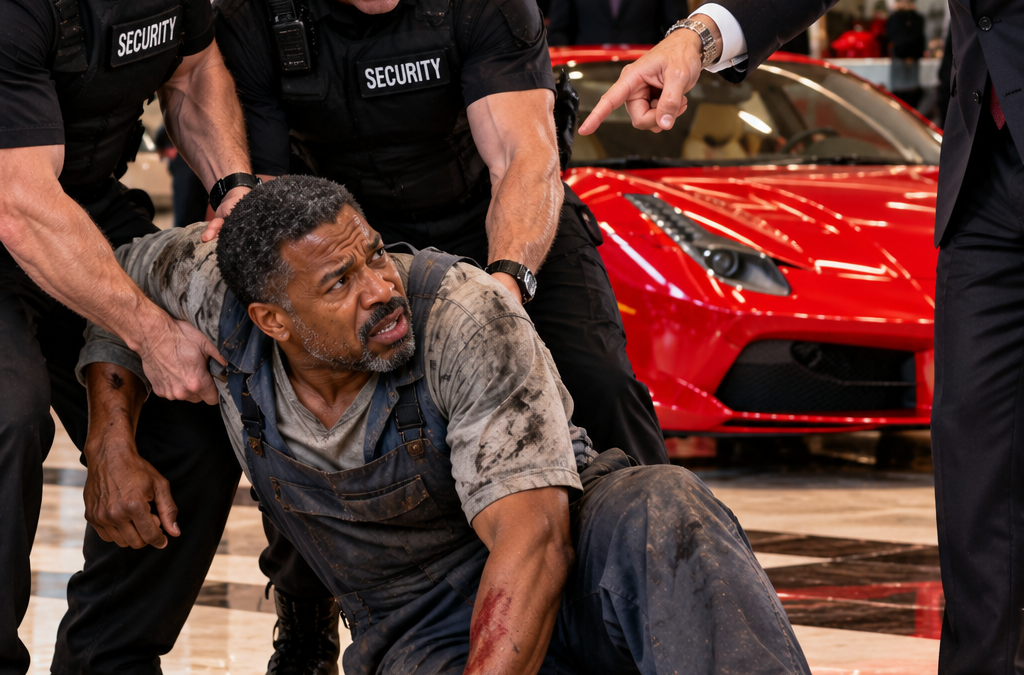
He snapped his fingers.
“Security.”
A large man crossed the showroom.
Broad shoulders.
Black suit.
Badge reading RAY PATTERSON.
He put one hand on my shoulder.
“Sir, time to go.”
“I can walk.”
“Not your call.”
His grip tightened.
I looked at Derek.
“You’re making a mistake.”
He lifted his phone.
“Hold on.”
Ray stopped.
Derek pressed record.
His grin widened.
“Oh, we have to save this.”
I felt my stomach turn.
He aimed the camera at me.
“Everybody, meet our Ferrari customer of the year.”
Brenda laughed.
The younger salesman kept filming too.
Derek moved the camera down toward my boots.
Then my hands.
“Say your name.”
I looked into the lens.
“Theodore Foster.”
He laughed harder.
“Theodore Foster, everybody. Here to pick any Ferrari he wants.”
My face burned.
He swung the camera toward the car.
“Maybe we’ll throw in two.”
More laughter.
I looked around.
Twenty people.
Maybe more.
Not one voice said stop.
One woman near the Portofino looked uncomfortable.
She whispered something to her husband.
He shook his head.
Then smiled.
Derek lowered the phone.
“All right, Ray. Get him out.”
Ray pulled.
I twisted slightly.
“I said I can walk.”
He jerked harder.
My boot slipped on the marble.
I reached for balance.
My left knee struck the floor.
Pain shot up my thigh.
My palm scraped against the edge of the platform.
Someone gasped.
Nobody intervened.
Ray hauled me up by the arm.
My shoulder twisted.
“Easy.”
He dragged me past reception.
The espresso bar.
The couple with the Roma.
The salesman filming.
Then past a woman near the front entrance holding her own phone.
She wasn’t laughing.
Her face was tight.
Later I learned her name was Sandra Hayes.
At the time, she was just one stranger whose eyes met mine for half a second.
The doors opened.
Ray shoved me.
Sunlight hit my face.
I stumbled against the hood of a Porsche parked outside.
Caught myself.
The doors slid shut behind me.
Through the glass, I saw Derek straighten his tie.
He looked at his phone.
Checked the video.
Then turned away.
Just like that, I was no longer worth thinking about.
I stood there for a while.
My knee throbbed.
Blood ran in a thin line from the back of my wrist.
My fingers shook.
Not age.
Not pain.
Humiliation.
There are injuries that bruise where everybody can see.
Others settle somewhere deeper.
I walked toward my Chevy.
Sat on the tailgate.
For several minutes, I did nothing.
Then I thought about Clara.
She had been gone nineteen years.
Some days grief feels ancient.
Other days one thought brings a person back so clearly you could turn around expecting them to be there.
Clara would place her hand at the back of my neck whenever she knew anger was climbing.
“Let them talk, Teddy.”
Then she would say the sentence I missed most.
“We know who you are.”
I took out my phone.
I did not want to call Elliot.
That mattered.
I was embarrassed.
Not by my clothes.
Not by my truck.
By what had happened.
A father spends his life trying to be the strong thing his child can lean against.
Even when the child becomes a man.
Even when that man owns buildings and companies.
Some part of you still wants to protect him from seeing you hurt.
My thumb hovered.
Then I called.
He answered quickly.
“Dad, you there?”
“I’m here.”
“You drive anything?”
“No.”
He heard something.
“What happened?”
“Nothing much.”
“Dad.”
“The manager misunderstood.”
“What kind of misunderstanding?”
I looked at my wrist.
“He didn’t believe I was your father.”
Silence.
“He wouldn’t check the appointment.”
More silence.
“I was going to leave.”
“What happened?”
I closed my eyes.
“They put their hands on me.”
His voice changed.
“Who?”
“Security.”
“What do you mean?”
“They dragged me out.”
“Dragged you?”
“My knee hit the floor.”
“Are you hurt?”
“I’m fine.”
“Dad.”
“A scrape.”
“Are you still there?”
“I was getting ready to go home.”
“Do not leave.”
“I don’t want trouble.”
“Dad.”
The softness disappeared.
“Do. Not. Leave.”
I knew that tone.
Elliot had inherited it from Clara.
He hung up.
I stayed on the tailgate.
Inside, the showroom had already moved on.
I could see Derek at his desk.
Brenda beside him.
Both staring at a phone.
Then laughing.
A minute later, Derek stepped outside carrying a cigarette.
He saw me.
Annoyance crossed his face.
“You’re still here?”
“I’m waiting.”
“For what?”
“My son.”
He laughed.
“Oh, right.”
He lit the cigarette.
“The imaginary billionaire.”
I didn’t answer.
Smoke drifted between us.
“I’ve been in this business eleven years.”
He pointed the cigarette toward me.
“You know how many people pull this?”
I looked at him.
“My cousin knows the owner. My brother’s an executive. I’m related to somebody important.”
He shook his head.
“Always a hustle.”
He flicked ash toward my truck.
A gray speck landed on the hood.
“You people come in, touch cars you’ll never own, waste everyone’s time, then cry discrimination when somebody tells you the truth.”
You people.
There it was.
Not hidden.
Not dressed up.
I said nothing.
He leaned closer.
“So I’ll tell you again.”
His voice softened.
“You do not belong here.”
I looked at him the way I looked at weather.
You cannot argue rain into stopping.
Eventually, he got bored.
He went inside.
A minute later, Brenda opened the door and photographed me sitting on the tailgate.
The showroom laughed again.
I heard it through the glass.
I looked down at my hands.
Same hands that had built engines.
Packed lunches.
Buried my wife.
Fixed neighbors’ cars.
Held Elliot when he was sick.
Same hands Derek had decided were too dirty to touch a Ferrari.
I thought about leaving anyway.
Then a black Rolls-Royce Cullinan turned into the lot.
It stopped directly in front of the dealership.
The driver’s door opened.
Elliot stepped out.
Black suit.
No tie.
Top button open.
He walked toward me fast.
Not running.
Controlled.
That scared me more.
“Son.”
He didn’t answer.
He wrapped both arms around me.
Right there in the parking lot.
I felt his chest rise.
Fall.
For one second he was not thirty-eight years old.
Not a CEO.
Not a millionaire.
He was nine again.
Trying not to cry at his mother’s funeral.
I put my hand on the back of his head.
“I’m all right.”
He pulled away.
“You’re bleeding.”
“Scratch.”
He looked at my knee.
“Can you walk?”
“I walked out.”
His jaw clenched.
“Dad.”
“Take me home.”
“No.”
“Elliot.”
“We’re going inside.”
I knew arguing would be useless.
So I followed.
The glass doors opened.
Elliot entered first.
I came one step behind.
Derek had seen the Rolls-Royce.
His body changed instantly.
Back straight.
Smile on.
Tie adjusted.
He hurried toward Elliot.
“Mr. Foster.”
The warmth in his voice almost made me laugh.
“What a wonderful surprise.”
Elliot stopped.
Derek extended his hand.
“How can I help you today?”
Elliot did not take it.
“Where is he?”
Derek blinked.
“Who?”
“The man you threw out.”
His smile weakened.
“I’m sorry?”
“Theodore Foster.”
Derek’s eyes moved past Elliot.
Found me.
His face changed.
Slowly.
First the smile disappeared.
Then the color.
“That man?”
Elliot stepped closer.
“That man is my father.”
The showroom went silent.
Derek’s mouth opened.
Nothing came.
Elliot turned slightly so everyone could see me.
“This is Theodore Foster.”
His voice carried.
“The man who raised me.”
Derek looked at me again as though my face had physically changed.
It hadn’t.
Same flannel.
Same boots.
Same grease.
Same man.
Only the context had changed.
And suddenly he could see me.
That was the ugliest part.
Elliot continued.
“My father worked thirty-one years at the Dearborn Assembly Plant.”
Every head turned.
“He led engineering teams.”
He pointed toward the Ferrari.
“He helped build systems more complicated than anything you sell.”
Derek tried to interrupt.
“Mr. Foster, I—”
“He raised me alone after my mother died.”
Elliot’s voice stayed controlled.
“He worked double shifts.”
Another step.
“He packed my lunches at four in the morning.”
His eyes were locked on Derek.
“He taught me engines before I could properly read.”
The showroom remained perfectly still.
“Every dealership with my name on it exists because that man taught me what work means.”
Derek swallowed.
“And you looked at his shirt.”
Elliot pointed toward my hands.
“His grease.”
Then toward the doors.
“His truck.”
His voice dropped.
“And decided he was trash.”
Derek shook his head.
“No, sir, I never—”
“I have video.”
That stopped him.
Elliot looked toward reception.
“Security footage. Now.”
The receptionist moved quickly.
He turned to Ray.
“You.”
Ray looked down.
“Did you put your hands on my father?”
“I was following management—”
“Did you?”
Ray swallowed.
“Yes.”
“Sit.”
Ray sat.
“Do not move.”
Then Elliot faced Derek again.
“I called this dealership yesterday.”
Derek’s face collapsed further.
“I gave the name Theodore Foster.”
Silence.
“I gave the time.”
Silence.
“I told management to treat him like a VIP.”
Derek looked toward his desk.
Maybe imagining the computer he had never checked.
“The appointment was in your system.”
Derek whispered, “I didn’t know.”
Elliot laughed once.
No humor.
“You didn’t try to know.”
That sentence landed harder than shouting could have.
“You looked at him and decided.”
Derek’s lips trembled.
“It was a misunderstanding.”
“No.”
Elliot shook his head.
“A misunderstanding happens after someone checks facts and gets something wrong.”
He leaned closer.
“You never checked.”
Derek looked toward me.
“I’m sorry.”
I said nothing.
“If I had known who you were—”
That was when I finally spoke.
“You knew enough.”
He stared.
I kept my voice quiet.
“You knew I was an old man asking for one phone call.”
His face dropped.
“You knew I wasn’t threatening anybody.”
Nobody moved.
“You knew I gave you a name.”
I looked around the room.
“You knew you could check it.”
Then back at him.
“You decided I didn’t deserve the effort.”
Derek lowered his eyes.
Elliot said, “Badge.”
Derek looked up.
“What?”
“Badge. Keys. Company phone.”
“Mr. Foster—”
“You’re fired.”
The words echoed.
Derek went pale.
“Please.”
He looked around.
Three years of authority disappearing in front of the same people who had laughed with him.
“I have a mortgage.”
Elliot pointed toward me.
“So did he.”
Derek swallowed.
“I have a family.”
“So did he.”
His shoulders dropped.
He removed his badge.
Keys.
Phone.
Placed everything on the desk.
The clicks were small.
But everybody heard them.
Then Elliot turned toward Brenda.
Her face had gone white.
“You laughed at him.”
She opened her mouth.
No sound.
“You gave him a used-car flyer.”
Her eyes filled.
“You came outside and photographed him sitting alone after he had been physically removed.”
She whispered, “I’m sorry.”
“Suspended.”
She nodded.
“Full HR review.”
Then Elliot faced the rest of the showroom.
I watched my son become something I had never been.
Not because he was richer.
Because he had power in that room.
And he was deciding what kind of man to be while using it.
“What happened here was not one employee having a bad moment.”
His voice carried.
“It happened because a manager insulted someone while coworkers laughed.”
He looked toward the younger salesman.
“Someone recorded it for entertainment.”
The man’s phone disappeared into his pocket.
“Security used force without asking a single question.”
Ray stared at the floor.
“Customers watched.”
Several guests looked away.
“This is culture.”
Elliot paused.
“And this culture ends today.”
He ordered every employee retrained.
Customer treatment.
Bias.
Professional conduct.
Escalation.
Complaint handling.
Then he turned toward me.
The anger left his face.
“Dad.”
I touched his arm.
“That’s enough.”
He nodded.
Not because he agreed.
Because I asked.
Then he walked me toward the crimson Ferrari.
Same platform.
Same spotlight.
He opened the driver’s door.
“Happy birthday.”
I looked at the car.
Then at him.
“Boy.”
“Please.”
“You know I’m not getting rid of the Chevy.”
“I know.”
“This thing probably costs more to service than my house.”
“I know.”
“I’m serious.”
“I know.”
He smiled slightly.
“Sit down.”
I lowered myself into the seat.
My knee hurt.
The leather was warm.
The steering wheel felt smaller than I expected.
For a few seconds, I didn’t think about Derek.
Or the laughter.
Or the blood on my wrist.
I thought about Clara.
She would have loved the color.
“Red,” I said.
Elliot leaned against the door.
“What?”
“Your mother would have picked red.”
He smiled.
“She told me once.”
I looked at him.
“You talked to her about Ferraris?”
“I was eight.”
“That explains the financial irresponsibility.”
He laughed.
That was the first moment all day I felt like myself.
Outside, the video was spreading.
Sandra Hayes, the woman near the front entrance, had recorded more than four minutes of what happened.
She posted it.
By that evening, millions had seen it.
I didn’t.
Not immediately.
I went home.
Put ice on my knee.
Changed the bandage on my wrist.
The Ferrari sat in my garage next to the Chevy.
I kept looking out the window at them.
One looked like money.
The other looked like work.
I knew which one felt more like mine.
By the next morning, news trucks were outside the dealership.
People identified Derek.
Old customers came forward.
That part surprised me.
A pediatric surgeon named Patricia Coleman said she had entered the same showroom two years earlier after a hospital shift.
Still wearing scrubs.
Derek refused to take her seriously.
Suggested she try a cheaper dealership.
She had left humiliated.
Never complained.
A retired Army colonel named Jerome Watts told reporters he had been ignored for fifteen minutes while trying to ask about a Ferrari Roma.
Another Black couple, both attorneys, described being asked for proof of employment before anyone would discuss a car.
One story became five.
Five became eight.
Then fourteen.
Black customers.
Hispanic customers.
Different dates.
Same manager.
Same behavior.
I watched some of those interviews later.
The detail that stayed with me was not Derek.
It was how many people said the same sentence.
“I thought it was just me.”
That is one of the ways discrimination survives.
It isolates the person experiencing it.
You leave wondering whether you misunderstood.
Whether you were too sensitive.
Whether reporting it would make you look difficult.
So the pattern remains hidden because everybody experiences their piece alone.
The dealership released all security footage on Elliot’s orders.
Unedited.
My arrival.
Derek.
The jokes.
Brenda.
Ray’s hand on my arm.
My knee striking marble.
Me being shoved outside.
I hated that Elliot released it.
We argued.
“Why does everybody need to see me on the floor?”
“Because they need to see what happened.”
“I know what happened.”
“This isn’t about whether we know.”
“I’m your father.”
“I know.”
“Then listen to me.”
He did.
Then he said something I couldn’t argue with.
“Dad, every person who experienced this before you left without proof.”
I went quiet.
He continued.
“You have proof.”
I looked away.
“I don’t want to be anybody’s symbol.”
“You don’t have to be.”
“That’s what this becomes.”
“Then we keep the focus on the system.”
I looked at him.
“Not me.”
“Not you.”
That was the agreement.
A civil-rights complaint followed.
So did an assault case involving Ray.
Investigators obtained the employee group chat.
That one made me sick.
Derek’s video.
Brenda’s photograph of me sitting outside.
Laughing emojis.
Mocking captions.
Comments from people in management who never said stop.
Words live differently when written.
People can claim a spoken insult was misunderstood.
A laughing emoji beside a video of an old man being dragged across a floor is harder to reinterpret.
Derek posted an apology online.
He said he had made an error in judgment.
Said he was not racist.
Said he had friends of many backgrounds.
I read two sentences and stopped.
Not because I was angry.
Because he still didn’t understand.
His mistake was not that I happened to be Elliot Foster’s father.
That was only what made his mistake expensive.
The wrong thing happened before he knew my name.
Before he knew my son.
Before he knew the dealership’s owner.
I had deserved basic dignity even if I had been a mechanic from three streets away with fourteen dollars in my checking account.
That was what he never seemed to understand.
People kept requesting interviews.
Local television.
National television.
Documentaries.
Morning shows.
I declined.
One producer called me repeatedly.
Finally, I answered.
“Mr. Foster, people want to hear your story.”
“I appreciate that.”
“We think your voice could help.”
“Maybe.”
“Then why not sit with us?”
I thought about it.
Then said, “I’m not the story.”
She went quiet.
“What is?”
“What they do about it.”
That line ended up everywhere after someone repeated it.
I found that ironic.
The one sentence I had no intention of publishing became the quote people remembered.
The legal case moved faster than I expected.
Five weeks later, I sat in a courtroom.
Derek sat across from me with an attorney.
He looked smaller.
Not physically.
Something in him had collapsed.
The judge reviewed the video.
When my knee hit the floor, somebody behind me gasped.
I stared straight ahead.
Then came Derek’s voice.
His insults.
His laughter.
I had not realized how much I had forgotten until I heard it played back.
The judge paused the recording.
Removed her glasses.
Looked at Derek.
She didn’t speak for several seconds.
In the end, the court found him liable.
Damages were assessed.
He was barred from management work in the automotive industry for years.
Ray faced assault consequences.
Brenda resigned before her internal investigation finished.
The dealership itself faced penalties and oversight.
People expected me to feel triumphant.
I didn’t.
Justice and joy are not the same emotion.
Mostly I felt tired.
Then Elliot did something I hadn’t expected.
Three months after the incident, he called.
“Dad.”
“What?”
“Wear a clean shirt Saturday.”
“Why?”
“Announcement.”
“No cameras.”
“There will be cameras.”
“Then I’m wearing the flannel.”
“Please don’t.”
I wore the clean shirt.
The announcement happened outside the dealership.
Elliot stood at a podium.
I stood beside him.
Behind us was a sign.
THE THEODORE FOSTER FOUNDATION.
I turned toward him.
He kept speaking because he knew if he looked at me, I might interrupt.
The fund would support young Black men and women studying automotive engineering.
Full tuition.
Tools.
Mentorship.
Internships across Foster Automotive.
Applicants would not need family connections.
They would need talent.
Work ethic.
Curiosity.
The things nobody could see from the clothes they wore.
When Elliot finished, reporters started shouting questions.
One asked how I felt.
I hadn’t prepared anything.
I hate prepared answers anyway.
I looked at Elliot.
Then at the dealership.
Then at the students standing nearby.
“Proud.”
The reporter asked, “Of what happened?”
“No.”
I shook my head.
“Of what came after.”
That became my only interview.
The Fifth Avenue dealership reopened under new management.
Carolyn Reed transferred from Atlanta.
First Black woman to run that branch.
Sharp.
Direct.
Fair.
She removed the little velvet ropes people had used to make the entrance feel like a private club.
The espresso bar stayed, despite Elliot claiming it had become “symbolic of everything wrong.”
Carolyn told him coffee had not discriminated against anyone.
Instead, she built a welcome desk near the entrance.
Her first staff meeting lasted sixteen minutes.
I heard about it from Elliot.
She stood in the showroom and told everybody:
“Every person who walks through those doors is a guest in this house. If you cannot treat them that way, the exit is behind you.”
Nobody misunderstood.
As for the Ferrari, I kept it.
For one week, the neighbors didn’t know.
Then Jamal from across the street walked past my open garage and nearly tripped over the curb.
“Mr. Foster.”
I looked up from under Monique’s Civic.
“Yes?”
“Is that a Ferrari?”
“No.”
He stared.
I stared back.
He pointed.
“That is definitely a Ferrari.”
“Could be anything.”
Within twenty-four hours, the entire block knew.
Sunday afternoon became a neighborhood event.
Children lined up.
I let every one sit in the driver’s seat.
One little boy grabbed the wheel with both hands and whispered, “I’m rich.”
I told him, “No. You’re sitting in somebody else’s car.”
His mother laughed so hard she cried.
My Ferrari sat beside my Chevy.
Three hundred fifty thousand dollars beside something worth maybe eight hundred on a generous appraisal.
I still drove the truck more.
The Ferrari came out on Sunday evenings.
Windows down.
Long way home.
No destination.
Sometimes I drove past the old plant.
Sometimes Clara’s cemetery.
Sometimes through the streets Elliot grew up on.
People waved.
I waved back.
I did not drive it to prove anything.
That would have given Derek too much power over what the car meant.
I drove it because my son had wanted to give his father something beautiful.
And because Clara would have liked red.
Six months after the case, a journalist found Derek working at a car wash.
Someone sent me the article.
I almost deleted it.
Then curiosity won.
The photograph showed Derek in a blue polo.
Standing beside a row of cars.
No suit.
No glass desk.
The journalist asked whether he thought about what happened.
He said every day.
Then asked whether he had ever apologized to me personally.
Derek said no.
“What would I even say?”
I closed the article.
For a while, I sat on my porch.
I realized I wasn’t angry at him anymore.
That surprised me.
Forgiveness is a strange word.
People treat it like a gift you give someone who has earned it.
Mine was more selfish.
I had carried other people’s ugliness before.
A foreman’s contempt.
A bank officer’s suspicion.
Strangers clutching purses.
Clara used to tell me:
“You don’t have to bring everybody’s opinion home with you.”
I finally understood.
Forgiving Derek did not mean what he did was acceptable.
It did not cancel consequences.
It did not make me his friend.
It meant I refused to let one ugly afternoon continue living inside me rent-free.
I had better things to carry.
Saturday mornings returned to normal.
That mattered more to me than every headline.
Monique’s Honda ran well.
Jamal needed brakes.
Mr. Thompson down the street had an old Buick making a noise he described as “kind of like metal bees.”
I fixed all of them.
No charge.
One Saturday, Elliot arrived while I was changing a neighbor’s alternator.
He was wearing loafers.
I looked at his shoes.
“You’re not helping dressed like that.”
“I’m not here to help.”
“Then why are you here?”
He handed me coffee.
“Checking on you.”
“I’m alive.”
“I can see that.”
He leaned against the garage.
His eyes moved toward the Ferrari.
“You’ve put six hundred miles on it.”
“You checking?”
“I own dealerships.”
“I thought you had work.”
“I do.”
“Then go.”
He smiled.
I tightened a bolt.
After a while, he said, “You know what still bothers me?”
“What?”
“That you didn’t call me before they touched you.”
I stopped.
The wrench stayed in my hand.
“I didn’t want to bother you.”
“Dad.”
I looked at him.
“You could never bother me.”
That sentence hit somewhere I wasn’t prepared for.
I put the wrench down.
“When your mother died, I spent so much time trying to make sure you never had to worry about me.”
He listened.
“I thought that was part of being your father.”
“What?”
“Being the person who handles things.”
Elliot looked at the driveway.
“You did handle it.”
“Not that day.”
“You called me.”
I smiled faintly.
“Eventually.”
He nodded toward the car.
“Maybe that’s what family is.”
“What?”
“Knowing when you’re allowed to stop handling everything alone.”
For once, my son taught me something I should have already known.
I went back to work.
He stayed.
Eventually, he ruined his loafers.
I did not apologize.
A year after the dealership incident, the first Foster Foundation scholarship recipients came to visit my garage.
Elliot organized it without telling me.
Six students.
Three young women.
Three young men.
All studying automotive engineering.
They arrived expecting some formal event.
Instead, I handed them tools.
One girl named Maya stared at me.
“You want us to work?”
“Yes.”
“In your driveway?”
“Cars don’t know they’re in driveways.”
One boy laughed.
I pointed toward the hood.
“What’s funny?”
He stopped.
“Nothing, sir.”
“Good. Diagnose that misfire.”
For four hours we worked.
No cameras.
No speeches.
I showed them things no classroom teaches well.
How to listen.
How to touch a component and feel vibration.
How to know the difference between a problem that sounds expensive and one that actually is.
Near the end, Maya looked toward the Ferrari.
“Mr. Foster?”
“What?”
“Can I ask something?”
“Depends.”
“When that manager saw you, did you know immediately what he was doing?”
I wiped my hands.
“Yes.”
“How?”
I thought about answering with some long explanation.
Then I said, “Practice.”
Her face changed.
She understood.
I continued.
“The important thing isn’t that he didn’t know who I was.”
They listened.
“The important thing is he thought it mattered.”
One student frowned.
“What do you mean?”
“He believed respect was something you earn by proving status.”
I pointed toward the Ferrari.
“If I had been broke, he still would’ve been wrong.”
Nobody spoke.
“If Elliot wasn’t my son, he still would’ve been wrong.”
I looked at all six.
“If I had walked in just to look because I loved cars and couldn’t afford one, I still deserved to leave through those doors on my own feet.”
Maya nodded slowly.
That was the lesson I wanted the foundation to carry.
Not revenge.
Not surprise wealth.
Not the fantasy that every cruel person will one day discover the poor-looking stranger secretly owns the building.
Most people treated badly in stores will never have a millionaire son walking through the door fifteen minutes later.
That doesn’t make their humiliation smaller.
It makes the standard more important.
Human dignity cannot depend on a twist ending.
Years later, when people still occasionally recognized my name, they often told the story incorrectly.
They said, “You’re the man who owned the dealership.”
I would correct them.
“My son owned it.”
Sometimes they said, “Same difference.”
It wasn’t.
The distinction mattered to me.
Elliot built Foster Automotive.
I helped build Elliot.
Maybe that’s why he kept insisting the company belonged to both of us in some deeper sense.
I never needed that.
I already had what I wanted.
My tools.
My porch.
My neighbors.
My son.
On my seventieth birthday, Elliot came over early.
He stood in my driveway holding a wrapped box.
“No car.”
He looked offended.
“I learned.”
I opened it.
Inside was my old Ford retirement plaque.
Restored.
New frame.
Underneath it, he had added another small brass plate.
THEODORE FOSTER
ENGINEER. FATHER. TEACHER.
THE FOUNDATION BENEATH EVERYTHING.
I read it.
Then looked at him.
“This is too sentimental.”
“I know.”
“Your mother would’ve loved it.”
“I know.”
We hung it in the garage.
Not the living room.
That was where it belonged.
Between shelves of parts.
Above a workbench scarred by decades of tools.
Beside an old photograph of Elliot holding a socket wrench upside down when he was six.
That afternoon, we took the Ferrari out.
He drove first.
Too fast.
I complained.
He ignored me.
Eventually we switched.
I drove through the old neighborhood.
Passed Monique.
Jamal.
The porch where Clara and I used to sit.
At a red light, Elliot looked at my hands on the steering wheel.
The grease never fully disappeared anymore.
It lived in the skin.
He smiled.
“What?”
“Nothing.”
“Boy, what?”
He shook his head.
“I was thinking about Derek telling you those hands were too dirty for the car.”
I looked at them.
Then at the road.
“People confuse clean hands with clean character.”
Elliot laughed softly.
“You’ve been saving that line?”
“No.”
“Sounds prepared.”
“Maybe I’m getting media training.”
The light turned green.
I accelerated.
The engine answered immediately.
Beautiful machine.
Precise.
Powerful.
But no machine ever impressed me as much as the people who built them.
Hands.
That was always the story for me.
Hands building engines.
Hands packing lunches.
Hands repairing a single mother’s car.
Hands gripping a boy’s shoulder after his mother died.
Hands dragged across marble.
Hands resting on a Ferrari steering wheel later that afternoon.
Same hands.
Nothing about my worth changed when Elliot entered the showroom.
The room changed.
That distinction became the part I carried with me.
Derek had seen an old Black man in work clothes and decided I had no value.
Then he discovered my son owned the dealership and suddenly the same man became important.
That reversal satisfied a lot of people.
It never satisfied me completely.
Because I did not become worthy when Derek learned my last name.
I was worthy when I walked in.
I was worthy when I asked him to check the appointment.
I was worthy when I stood there alone while people laughed.
I was worthy sitting outside bleeding beside a rusted truck.
I was worthy before my son arrived in a Rolls-Royce.
Before the cameras.
Before the lawsuit.
Before anybody cared.
That is why I kept fixing cars on Saturdays.
It reminded me of something money can make easy to forget.
A person pulls into my driveway.
Maybe the car is expensive.
Maybe it barely runs.
Maybe the driver wears a suit.
Maybe she is a single mother counting the days until payday.
The engine does not care.
Neither do I.
I lift the hood.
Listen.
Find the problem.
Then I do what I can.
Some Saturday mornings, the Ferrari sits ten feet away while I work on a car worth less than one of its wheels.
That makes perfect sense to me.
Because value and price were never the same thing.
I learned that long before Derek Whitmore met me.
He simply gave me one more reason never to forget it.
𝗧𝗛𝗘 𝗘𝗡𝗗
The Ferrari Manager Looked at My Grease-Stained Hands and Told Security to Drag Me Out Before He Ever Checked My Name
The manager looked at the grease on my hands, the duct-taped work boots on my feet, and decided I was lying before anyone bothered to check the name I gave him.
Less than an hour later, I was sitting outside with blood drying on my wrist and my knee swelling beneath my pants, wondering how I was going to tell my son that the birthday surprise he had arranged for me had ended with two men dragging his father across a marble floor.
Three hours before that happened, I was kneeling in my neighbor’s driveway with half my right arm inside the engine bay of a 2004 Honda Civic.
That was where most Saturdays found me.
Not in golf clothes.
Not at brunch.
Not sleeping late.
Under somebody’s hood.
The morning sun was already warming the asphalt, and grease had worked its way into the lines of my knuckles the way it had for most of my adult life.
A strip of duct tape held the radiator hose away from my forearm while I tightened a clamp.
My neighbor, Monique, stood behind me with her youngest boy balanced on one hip.
“Mr. Foster, you really don’t have to do this.”
I didn’t look up.
“Hush.”
“I’m serious. I can pay you next Friday.”
“You’re not paying me.”
“The shop said it might be three hundred.”
“The shop also told you the belt was fine.”
I tugged at it.
A crack opened across the rubber.
“See that?”
She leaned closer.
“That bad?”
“You drive another week, it snaps. Then you’re on the shoulder of I-75 with three children asking why Mommy’s car quit.”
She sighed.
“I hate asking you for things.”
“You didn’t ask.”
“You saw me looking under the hood yesterday.”
“Exactly.”
Her boy pointed at the wrench in my hand.
“Can I do it?”
I smiled.
“You can hold it.”
His face lit up.
I handed him the wrench after I was finished with it.
At sixty-eight, I had learned that a child holding a tool feels ten feet tall even when the tool is too heavy for him.
I had spent thirty-one years working at the Dearborn Assembly Plant.
Fifteen of those years, I supervised forty people.
Engines had been my life long enough that I could hear certain problems before most people felt them.
A loose belt.
A bad bearing.
A misfire.
I knew the noises machines made when something was wrong.
People were more complicated.
They could smile while something inside them was failing completely.
When I retired, Ford gave me a plaque, a pension, and a dinner where three executives called me “an institution.”
I took the plaque home, put it in a closet, and went back to doing what I had always done.
Fixing things.
My house was small.
Two bedrooms.
One bathroom.
A porch that leaned slightly left because I had been promising myself for seven years that I would rebuild the support post.
Inside, the walls carried everything I cared about.
A photograph of me in my old factory coveralls.
Another of my late wife, Clara, standing beside our first car with one hand on the roof and the other covering her face because she hated pictures.
And another photograph that mattered more than both.
Me holding our son, Elliot, at the hospital.
I was twenty-eight.
He was two days old.
I looked terrified.
Clara said that picture was the only honest portrait anyone ever took of me.
Next to it hung a framed newspaper clipping from six years earlier.
ELLIOT FOSTER ACQUIRES PRESTIGE MOTORS.
Youngest Black owner of a luxury automotive group in the Southeast.
The headline was already outdated.
Prestige had become Foster Automotive Group.
Fourteen dealerships.
Six states.
Ferrari.
Lamborghini.
Porsche.
Bentley.
A company worth around two hundred million dollars.
People who met Elliot now saw the suits.
The boardrooms.
The interviews.
The photographs beside Italian sports cars.
I saw a seven-year-old boy lying flat on his stomach beneath my Chevy while I pointed at an oil pan and explained why dripping fluid was never “probably nothing.”
Clara died from cancer when Elliot was nine.
That was the year both of us got older too fast.
There is a particular loneliness in raising a boy after his mother dies.
A father can cook.
Pack lunches.
Wash clothes.
Help with homework.
Show up for school meetings.
But there are evenings when a child asks a question and you know the correct person to answer it is gone.
I made mistakes.
Plenty.
I worked too much.
Sometimes I mistook discipline for protection.
Sometimes I thought providing money was the same as providing presence.
But I loved that boy.
And he knew it.
I worked double shifts.
Packed sandwiches at four in the morning.
Came home smelling like oil and hot steel.
On Sundays, Elliot sat with me in the garage.
By thirteen, he could change brakes.
By sixteen, he understood an engine better than men twice his age.
By twenty-five, he knew the business side better than I ever would.
He built something I never could have imagined.
The strange part was that he spent years trying to share it with me.
“Dad, let me buy you a house.”
“I have a house.”
“A better house.”
“What’s wrong with this one?”
“The porch leans.”
“I lean too.”
“Dad.”
“Still standing.”
Then came the cars.
He offered me Mercedes.
Cadillacs.
A Range Rover.
Once, after opening his first Ferrari dealership, he arrived at my house with keys to a new 812.
I looked at the car.
Then at him.
“What am I supposed to do with that?”
“Drive it.”
“To where?”
“Anywhere.”
“Does it carry lumber?”
He stared at me.
“Please don’t put lumber in the Ferrari.”
“Then I don’t need it.”
I kept my 1998 Chevy.
Rust around the rear wheel wells.
Driver’s seat torn near the seam.
Air conditioning worked when it felt respected.
Elliot hated that truck.
I loved it.
The night before my sixty-eighth birthday, my phone rang.
“Dad.”
“What?”
“Tomorrow.”
“What tomorrow?”
“Your birthday.”
“I know when I was born.”
He sighed.
“I want you to come to the Fifth Avenue dealership.”
“Why?”
“Because I’m giving you a car.”
“No.”
“Yes.”
“No.”
“Pick anything.”
“I have a truck.”
“That truck qualifies for historical preservation.”
“It runs.”
“Barely.”
“It runs better than half the men your age.”
“Dad.”
I laughed.
Then he stopped joking.
“You spent your whole life building cars for other people.”
I stayed quiet.
His voice softened.
“Let me do this.”
I looked toward Clara’s photograph.
“What car?”
“Any car.”
“That’s ridiculous.”
“Walk in. Give them your name. I called the branch. They’ll take care of you.”
I should have known then how important it was to him.
Not the car.
The gesture.
So I said, “All right.”
He went silent.
“You serious?”
“I’ll come by around noon.”
“Thank you.”
“You’re thanking me for letting you spend money?”
“Yes.”
“Boy, I raised you wrong.”
He laughed.
I woke the next morning and forgot almost immediately that I was supposed to visit the dealership.
Monique’s Civic came first.
A failing belt does not care about birthdays.
By the time I finished, my shirt had grease on the cuff and dirt across the front.
I went inside.
Washed my hands.
Most of the grease stayed in the cracks around my fingernails.
I considered changing.
Then I thought, Why?
I had no job interview.
No gala.
My son owned the dealership.
He knew exactly what I looked like.
I put on my faded khakis, work boots, and flannel shirt.
Climbed into the Chevy.
It groaned when I turned the key.
“Don’t embarrass me today,” I told it.
The engine caught.
We went.
The Fifth Avenue dealership looked less like a place that sold cars and more like a museum dedicated to money.
Glass front.
Chrome accents.
Italian marble.
Every surface polished enough to reflect your face back at you.
I parked between a Porsche Cayenne and a black Mercedes S-Class.
My Chevy looked tired.
I patted the dashboard.
“Don’t worry about them.”
Inside, the air smelled like leather, espresso and whatever expensive buildings smell like when nobody is allowed to spill anything.
A row of Ferraris sat beneath precision lights.
Red.
Yellow.
Black.
Each one positioned like sculpture.
A receptionist looked up.
Her smile appeared automatically.
Then she saw me.
It disappeared.
A salesman near a desk glanced at my boots.
Another looked toward the parking lot and saw my truck.
I noticed.
I had lived sixty-eight years.
You learn certain looks.
Still, I ignored them.
Because I saw the car.
Crimson Ferrari 296 GTB.
Raised platform.
Slow turntable.
Beautiful lines.
Not practical.
Not sensible.
Not something I would ever have chosen for myself.
Which was probably why Elliot wanted me to drive it.
I walked closer.
Thirty feet away, a man stood from behind a glass desk.
He was around forty.
Maybe younger.
Expensive suit.
Tie straight.
Hair cut close on the sides.
His name, I later learned, was Derek Whitmore.
At that moment, all I knew was that he was walking toward me with a face already set against whatever I intended to say.
“Excuse me.”
I turned.
“Afternoon.”
His eyes moved down my body.
Boots.
Pants.
Shirt.
Hands.
Then back up.
“What are you doing?”
I glanced toward the Ferrari.
“Looking.”
“At that vehicle?”
“Yes.”
“It’s not open for public touching.”
“I haven’t touched it.”
He stared at my right hand.
There was still grease around my fingernails.
“I’m here to test-drive something.”
His mouth tightened.
“Test-drive.”
“My son called yesterday.”
“Your son.”
“Yes.”
“And your son is?”
“Elliot Foster.”
There was a pause.
Tiny.
I saw it.
Then something in Derek hardened.
He folded his arms.
“Elliot Foster.”
“Yes.”
“As in the automotive group.”
I smiled.
“That’s him.”
He looked at my clothes again.
Then toward the rusted Chevy outside.
He did not check a computer.
Did not ask reception.
Did not make a call.
He simply decided.
“Sir, I don’t know what kind of scam this is.”
My smile disappeared.
“Excuse me?”
“Elliot Foster is an important man.”
“I’m aware.”
“And you’re claiming to be his father.”
“I am his father.”
Derek laughed.
Short.
Sharp.
“Sure.”
I stared at him.
“I’m sorry?”
He turned toward a woman standing near the reception desk.
“Brenda.”
A blonde salesperson walked over.
“Yes?”
Derek pointed toward me.
“This gentleman says Elliot Foster is his son.”
Her eyebrows rose.
“He wants to test-drive the 296.”
She looked through the windows at my Chevy.
Then back at me.
Her hand went over her mouth.
She laughed.
I felt something tighten behind my ribs.
“Ma’am,” I said, “I’m not trying to bother anybody.”
“That’s precious.”
Derek smiled at her.
I kept my voice level.
“If one of you checks the name, my son told me he arranged an appointment.”
“There is no appointment.”
“You haven’t checked.”
“There’s nothing to check.”
He raised his voice.
Now other people started looking.
A couple near a Roma.
Two salesmen by the windows.
A man holding an espresso.
Derek continued.
“There’s no son waiting for you.”
I said, “He isn’t waiting. He owns—”
“I know who Elliot Foster is.”
That stopped me.
Derek straightened his cuffs.
“And I know someone like Elliot Foster would not send someone who looks like you in here claiming to be his father.”
Someone like Elliot Foster.
Someone who looks like you.
I had heard sentences built that way before.
Different decades.
Different rooms.
Same architecture.
Brenda disappeared behind the desk and returned holding a flyer.
She extended it toward me using two fingers.
“Here.”
I looked at it.
Used cars.
A lot on Ninth Street.
“We have inventory over there that might be more realistic.”
I didn’t take it.
Derek grinned.
“Maybe an old Corolla.”
Brenda laughed.
“A missing hubcap comes complimentary.”
A few people nearby laughed too.
I looked toward the door.
For half a second, I considered leaving.
Not because I doubted myself.
Because I knew exactly what was happening and had spent a lifetime understanding how exhausting it was to prove your humanity to people committed to misunderstanding you.
Then I remembered Elliot.
Walk in.
Give them your name.
Pick anything.
So I stayed.
“My son told me to come here and choose any car I wanted.”
Derek turned toward the room.
“Any car.”
He said it loudly.
People stopped pretending not to listen.
“This gentleman says he gets to pick any car.”
A younger salesman pulled out his phone.
I saw him angle it toward me.
Derek pointed at my shirt.
“Look at him.”
More laughter.
“Walks in here dressed like he finished mowing somebody’s lawn.”
I felt heat rise in my face.
I kept my hands still at my sides.
Derek stepped closer.
“Let me explain something.”
His voice dropped.
“Cars like these are not for people like you.”
I looked directly at him.
“What kind of people?”
He smiled.
“You know.”
“Say it.”
His eyes narrowed.
“You can’t afford the tires.”
He pointed at my hands.
“You smell like motor oil.”
I said nothing.
“You probably can’t afford the bus fare home.”
Behind him, somebody chuckled.
“This is a showroom for people with money, class and standards.”
He leaned closer.
“And you don’t have any of the three.”
I swallowed.
Not because I was afraid.
Because old memories had come alive.
A plant foreman thirty years earlier telling me Black men did not supervise certain teams.
A bank officer assuming I was applying for janitorial work when I asked about a mortgage.
A restaurant hostess asking whether I was picking up an order while white couples walked past me to tables.
You spend enough years surviving humiliation and people assume you become immune.
You don’t.
You become better at standing still while it burns.
I said, “I spent thirty-one years building engines.”
He rolled his eyes.
“I know these cars.”
“I’m sure.”
“My son made this appointment.”
“Your imaginary son.”
“One call.”
Derek sighed theatrically.
“One call is all I’m asking.”
He leaned in.
“Even if some relative of yours met Elliot Foster once at a gas station, do you honestly believe a man like him sends someone dressed like you into a place like this?”
I stared at him.
There was no anger on his face now.
Only certainty.
That was worse.
“You don’t belong here,” he said.
“You never did.”
He snapped his fingers.
“Security.”
A large man crossed the showroom.
Broad shoulders.
Black suit.
Badge reading RAY PATTERSON.
He put one hand on my shoulder.
“Sir, time to go.”
“I can walk.”
“Not your call.”
His grip tightened.
I looked at Derek.
“You’re making a mistake.”
He lifted his phone.
“Hold on.”
Ray stopped.
Derek pressed record.
His grin widened.
“Oh, we have to save this.”
I felt my stomach turn.
He aimed the camera at me.
“Everybody, meet our Ferrari customer of the year.”
Brenda laughed.
The younger salesman kept filming too.
Derek moved the camera down toward my boots.
Then my hands.
“Say your name.”
I looked into the lens.
“Theodore Foster.”
He laughed harder.
“Theodore Foster, everybody. Here to pick any Ferrari he wants.”
My face burned.
He swung the camera toward the car.
“Maybe we’ll throw in two.”
More laughter.
I looked around.
Twenty people.
Maybe more.
Not one voice said stop.
One woman near the Portofino looked uncomfortable.
She whispered something to her husband.
He shook his head.
Then smiled.
Derek lowered the phone.
“All right, Ray. Get him out.”
Ray pulled.
I twisted slightly.
“I said I can walk.”
He jerked harder.
My boot slipped on the marble.
I reached for balance.
My left knee struck the floor.
Pain shot up my thigh.
My palm scraped against the edge of the platform.
Someone gasped.
Nobody intervened.
Ray hauled me up by the arm.
My shoulder twisted.
“Easy.”
He dragged me past reception.
The espresso bar.
The couple with the Roma.
The salesman filming.
Then past a woman near the front entrance holding her own phone.
She wasn’t laughing.
Her face was tight.
Later I learned her name was Sandra Hayes.
At the time, she was just one stranger whose eyes met mine for half a second.
The doors opened.
Ray shoved me.
Sunlight hit my face.
I stumbled against the hood of a Porsche parked outside.
Caught myself.
The doors slid shut behind me.
Through the glass, I saw Derek straighten his tie.
He looked at his phone.
Checked the video.
Then turned away.
Just like that, I was no longer worth thinking about.
I stood there for a while.
My knee throbbed.
Blood ran in a thin line from the back of my wrist.
My fingers shook.
Not age.
Not pain.
Humiliation.
There are injuries that bruise where everybody can see.
Others settle somewhere deeper.
I walked toward my Chevy.
Sat on the tailgate.
For several minutes, I did nothing.
Then I thought about Clara.
She had been gone nineteen years.
Some days grief feels ancient.
Other days one thought brings a person back so clearly you could turn around expecting them to be there.
Clara would place her hand at the back of my neck whenever she knew anger was climbing.
“Let them talk, Teddy.”
Then she would say the sentence I missed most.
“We know who you are.”
I took out my phone.
I did not want to call Elliot.
That mattered.
I was embarrassed.
Not by my clothes.
Not by my truck.
By what had happened.
A father spends his life trying to be the strong thing his child can lean against.
Even when the child becomes a man.
Even when that man owns buildings and companies.
Some part of you still wants to protect him from seeing you hurt.
My thumb hovered.
Then I called.
He answered quickly.
“Dad, you there?”
“I’m here.”
“You drive anything?”
“No.”
He heard something.
“What happened?”
“Nothing much.”
“Dad.”
“The manager misunderstood.”
“What kind of misunderstanding?”
I looked at my wrist.
“He didn’t believe I was your father.”
Silence.
“He wouldn’t check the appointment.”
More silence.
“I was going to leave.”
“What happened?”
I closed my eyes.
“They put their hands on me.”
His voice changed.
“Who?”
“Security.”
“What do you mean?”
“They dragged me out.”
“Dragged you?”
“My knee hit the floor.”
“Are you hurt?”
“I’m fine.”
“Dad.”
“A scrape.”
“Are you still there?”
“I was getting ready to go home.”
“Do not leave.”
“I don’t want trouble.”
“Dad.”
The softness disappeared.
“Do. Not. Leave.”
I knew that tone.
Elliot had inherited it from Clara.
He hung up.
I stayed on the tailgate.
Inside, the showroom had already moved on.
I could see Derek at his desk.
Brenda beside him.
Both staring at a phone.
Then laughing.
A minute later, Derek stepped outside carrying a cigarette.
He saw me.
Annoyance crossed his face.
“You’re still here?”
“I’m waiting.”
“For what?”
“My son.”
He laughed.
“Oh, right.”
He lit the cigarette.
“The imaginary billionaire.”
I didn’t answer.
Smoke drifted between us.
“I’ve been in this business eleven years.”
He pointed the cigarette toward me.
“You know how many people pull this?”
I looked at him.
“My cousin knows the owner. My brother’s an executive. I’m related to somebody important.”
He shook his head.
“Always a hustle.”
He flicked ash toward my truck.
A gray speck landed on the hood.
“You people come in, touch cars you’ll never own, waste everyone’s time, then cry discrimination when somebody tells you the truth.”
You people.
There it was.
Not hidden.
Not dressed up.
I said nothing.
He leaned closer.
“So I’ll tell you again.”
His voice softened.
“You do not belong here.”
I looked at him the way I looked at weather.
You cannot argue rain into stopping.
Eventually, he got bored.
He went inside.
A minute later, Brenda opened the door and photographed me sitting on the tailgate.
The showroom laughed again.
I heard it through the glass.
I looked down at my hands.
Same hands that had built engines.
Packed lunches.
Buried my wife.
Fixed neighbors’ cars.
Held Elliot when he was sick.
Same hands Derek had decided were too dirty to touch a Ferrari.
I thought about leaving anyway.
Then a black Rolls-Royce Cullinan turned into the lot.
It stopped directly in front of the dealership.
The driver’s door opened.
Elliot stepped out.
Black suit.
No tie.
Top button open.
He walked toward me fast.
Not running.
Controlled.
That scared me more.
“Son.”
He didn’t answer.
He wrapped both arms around me.
Right there in the parking lot.
I felt his chest rise.
Fall.
For one second he was not thirty-eight years old.
Not a CEO.
Not a millionaire.
He was nine again.
Trying not to cry at his mother’s funeral.
I put my hand on the back of his head.
“I’m all right.”
He pulled away.
“You’re bleeding.”
“Scratch.”
He looked at my knee.
“Can you walk?”
“I walked out.”
His jaw clenched.
“Dad.”
“Take me home.”
“No.”
“Elliot.”
“We’re going inside.”
I knew arguing would be useless.
So I followed.
The glass doors opened.
Elliot entered first.
I came one step behind.
Derek had seen the Rolls-Royce.
His body changed instantly.
Back straight.
Smile on.
Tie adjusted.
He hurried toward Elliot.
“Mr. Foster.”
The warmth in his voice almost made me laugh.
“What a wonderful surprise.”
Elliot stopped.
Derek extended his hand.
“How can I help you today?”
Elliot did not take it.
“Where is he?”
Derek blinked.
“Who?”
“The man you threw out.”
His smile weakened.
“I’m sorry?”
“Theodore Foster.”
Derek’s eyes moved past Elliot.
Found me.
His face changed.
Slowly.
First the smile disappeared.
Then the color.
“That man?”
Elliot stepped closer.
“That man is my father.”
The showroom went silent.
Derek’s mouth opened.
Nothing came.
Elliot turned slightly so everyone could see me.
“This is Theodore Foster.”
His voice carried.
“The man who raised me.”
Derek looked at me again as though my face had physically changed.
It hadn’t.
Same flannel.
Same boots.
Same grease.
Same man.
Only the context had changed.
And suddenly he could see me.
That was the ugliest part.
Elliot continued.
“My father worked thirty-one years at the Dearborn Assembly Plant.”
Every head turned.
“He led engineering teams.”
He pointed toward the Ferrari.
“He helped build systems more complicated than anything you sell.”
Derek tried to interrupt.
“Mr. Foster, I—”
“He raised me alone after my mother died.”
Elliot’s voice stayed controlled.
“He worked double shifts.”
Another step.
“He packed my lunches at four in the morning.”
His eyes were locked on Derek.
“He taught me engines before I could properly read.”
The showroom remained perfectly still.
“Every dealership with my name on it exists because that man taught me what work means.”
Derek swallowed.
“And you looked at his shirt.”
Elliot pointed toward my hands.
“His grease.”
Then toward the doors.
“His truck.”
His voice dropped.
“And decided he was trash.”
Derek shook his head.
“No, sir, I never—”
“I have video.”
That stopped him.
Elliot looked toward reception.
“Security footage. Now.”
The receptionist moved quickly.
He turned to Ray.
“You.”
Ray looked down.
“Did you put your hands on my father?”
“I was following management—”
“Did you?”
Ray swallowed.
“Yes.”
“Sit.”
Ray sat.
“Do not move.”
Then Elliot faced Derek again.
“I called this dealership yesterday.”
Derek’s face collapsed further.
“I gave the name Theodore Foster.”
Silence.
“I gave the time.”
Silence.
“I told management to treat him like a VIP.”
Derek looked toward his desk.
Maybe imagining the computer he had never checked.
“The appointment was in your system.”
Derek whispered, “I didn’t know.”
Elliot laughed once.
No humor.
“You didn’t try to know.”
That sentence landed harder than shouting could have.
“You looked at him and decided.”
Derek’s lips trembled.
“It was a misunderstanding.”
“No.”
Elliot shook his head.
“A misunderstanding happens after someone checks facts and gets something wrong.”
He leaned closer.
“You never checked.”
Derek looked toward me.
“I’m sorry.”
I said nothing.
“If I had known who you were—”
That was when I finally spoke.
“You knew enough.”
He stared.
I kept my voice quiet.
“You knew I was an old man asking for one phone call.”
His face dropped.
“You knew I wasn’t threatening anybody.”
Nobody moved.
“You knew I gave you a name.”
I looked around the room.
“You knew you could check it.”
Then back at him.
“You decided I didn’t deserve the effort.”
Derek lowered his eyes.
Elliot said, “Badge.”
Derek looked up.
“What?”
“Badge. Keys. Company phone.”
“Mr. Foster—”
“You’re fired.”
The words echoed.
Derek went pale.
“Please.”
He looked around.
Three years of authority disappearing in front of the same people who had laughed with him.
“I have a mortgage.”
Elliot pointed toward me.
“So did he.”
Derek swallowed.
“I have a family.”
“So did he.”
His shoulders dropped.
He removed his badge.
Keys.
Phone.
Placed everything on the desk.
The clicks were small.
But everybody heard them.
Then Elliot turned toward Brenda.
Her face had gone white.
“You laughed at him.”
She opened her mouth.
No sound.
“You gave him a used-car flyer.”
Her eyes filled.
“You came outside and photographed him sitting alone after he had been physically removed.”
She whispered, “I’m sorry.”
“Suspended.”
She nodded.
“Full HR review.”
Then Elliot faced the rest of the showroom.
I watched my son become something I had never been.
Not because he was richer.
Because he had power in that room.
And he was deciding what kind of man to be while using it.
“What happened here was not one employee having a bad moment.”
His voice carried.
“It happened because a manager insulted someone while coworkers laughed.”
He looked toward the younger salesman.
“Someone recorded it for entertainment.”
The man’s phone disappeared into his pocket.
“Security used force without asking a single question.”
Ray stared at the floor.
“Customers watched.”
Several guests looked away.
“This is culture.”
Elliot paused.
“And this culture ends today.”
He ordered every employee retrained.
Customer treatment.
Bias.
Professional conduct.
Escalation.
Complaint handling.
Then he turned toward me.
The anger left his face.
“Dad.”
I touched his arm.
“That’s enough.”
He nodded.
Not because he agreed.
Because I asked.
Then he walked me toward the crimson Ferrari.
Same platform.
Same spotlight.
He opened the driver’s door.
“Happy birthday.”
I looked at the car.
Then at him.
“Boy.”
“Please.”
“You know I’m not getting rid of the Chevy.”
“I know.”
“This thing probably costs more to service than my house.”
“I know.”
“I’m serious.”
“I know.”
He smiled slightly.
“Sit down.”
I lowered myself into the seat.
My knee hurt.
The leather was warm.
The steering wheel felt smaller than I expected.
For a few seconds, I didn’t think about Derek.
Or the laughter.
Or the blood on my wrist.
I thought about Clara.
She would have loved the color.
“Red,” I said.
Elliot leaned against the door.
“What?”
“Your mother would have picked red.”
He smiled.
“She told me once.”
I looked at him.
“You talked to her about Ferraris?”
“I was eight.”
“That explains the financial irresponsibility.”
He laughed.
That was the first moment all day I felt like myself.
Outside, the video was spreading.
Sandra Hayes, the woman near the front entrance, had recorded more than four minutes of what happened.
She posted it.
By that evening, millions had seen it.
I didn’t.
Not immediately.
I went home.
Put ice on my knee.
Changed the bandage on my wrist.
The Ferrari sat in my garage next to the Chevy.
I kept looking out the window at them.
One looked like money.
The other looked like work.
I knew which one felt more like mine.
By the next morning, news trucks were outside the dealership.
People identified Derek.
Old customers came forward.
That part surprised me.
A pediatric surgeon named Patricia Coleman said she had entered the same showroom two years earlier after a hospital shift.
Still wearing scrubs.
Derek refused to take her seriously.
Suggested she try a cheaper dealership.
She had left humiliated.
Never complained.
A retired Army colonel named Jerome Watts told reporters he had been ignored for fifteen minutes while trying to ask about a Ferrari Roma.
Another Black couple, both attorneys, described being asked for proof of employment before anyone would discuss a car.
One story became five.
Five became eight.
Then fourteen.
Black customers.
Hispanic customers.
Different dates.
Same manager.
Same behavior.
I watched some of those interviews later.
The detail that stayed with me was not Derek.
It was how many people said the same sentence.
“I thought it was just me.”
That is one of the ways discrimination survives.
It isolates the person experiencing it.
You leave wondering whether you misunderstood.
Whether you were too sensitive.
Whether reporting it would make you look difficult.
So the pattern remains hidden because everybody experiences their piece alone.
The dealership released all security footage on Elliot’s orders.
Unedited.
My arrival.
Derek.
The jokes.
Brenda.
Ray’s hand on my arm.
My knee striking marble.
Me being shoved outside.
I hated that Elliot released it.
We argued.
“Why does everybody need to see me on the floor?”
“Because they need to see what happened.”
“I know what happened.”
“This isn’t about whether we know.”
“I’m your father.”
“I know.”
“Then listen to me.”
He did.
Then he said something I couldn’t argue with.
“Dad, every person who experienced this before you left without proof.”
I went quiet.
He continued.
“You have proof.”
I looked away.
“I don’t want to be anybody’s symbol.”
“You don’t have to be.”
“That’s what this becomes.”
“Then we keep the focus on the system.”
I looked at him.
“Not me.”
“Not you.”
That was the agreement.
A civil-rights complaint followed.
So did an assault case involving Ray.
Investigators obtained the employee group chat.
That one made me sick.
Derek’s video.
Brenda’s photograph of me sitting outside.
Laughing emojis.
Mocking captions.
Comments from people in management who never said stop.
Words live differently when written.
People can claim a spoken insult was misunderstood.
A laughing emoji beside a video of an old man being dragged across a floor is harder to reinterpret.
Derek posted an apology online.
He said he had made an error in judgment.
Said he was not racist.
Said he had friends of many backgrounds.
I read two sentences and stopped.
Not because I was angry.
Because he still didn’t understand.
His mistake was not that I happened to be Elliot Foster’s father.
That was only what made his mistake expensive.
The wrong thing happened before he knew my name.
Before he knew my son.
Before he knew the dealership’s owner.
I had deserved basic dignity even if I had been a mechanic from three streets away with fourteen dollars in my checking account.
That was what he never seemed to understand.
People kept requesting interviews.
Local television.
National television.
Documentaries.
Morning shows.
I declined.
One producer called me repeatedly.
Finally, I answered.
“Mr. Foster, people want to hear your story.”
“I appreciate that.”
“We think your voice could help.”
“Maybe.”
“Then why not sit with us?”
I thought about it.
Then said, “I’m not the story.”
She went quiet.
“What is?”
“What they do about it.”
That line ended up everywhere after someone repeated it.
I found that ironic.
The one sentence I had no intention of publishing became the quote people remembered.
The legal case moved faster than I expected.
Five weeks later, I sat in a courtroom.
Derek sat across from me with an attorney.
He looked smaller.
Not physically.
Something in him had collapsed.
The judge reviewed the video.
When my knee hit the floor, somebody behind me gasped.
I stared straight ahead.
Then came Derek’s voice.
His insults.
His laughter.
I had not realized how much I had forgotten until I heard it played back.
The judge paused the recording.
Removed her glasses.
Looked at Derek.
She didn’t speak for several seconds.
In the end, the court found him liable.
Damages were assessed.
He was barred from management work in the automotive industry for years.
Ray faced assault consequences.
Brenda resigned before her internal investigation finished.
The dealership itself faced penalties and oversight.
People expected me to feel triumphant.
I didn’t.
Justice and joy are not the same emotion.
Mostly I felt tired.
Then Elliot did something I hadn’t expected.
Three months after the incident, he called.
“Dad.”
“What?”
“Wear a clean shirt Saturday.”
“Why?”
“Announcement.”
“No cameras.”
“There will be cameras.”
“Then I’m wearing the flannel.”
“Please don’t.”
I wore the clean shirt.
The announcement happened outside the dealership.
Elliot stood at a podium.
I stood beside him.
Behind us was a sign.
THE THEODORE FOSTER FOUNDATION.
I turned toward him.
He kept speaking because he knew if he looked at me, I might interrupt.
The fund would support young Black men and women studying automotive engineering.
Full tuition.
Tools.
Mentorship.
Internships across Foster Automotive.
Applicants would not need family connections.
They would need talent.
Work ethic.
Curiosity.
The things nobody could see from the clothes they wore.
When Elliot finished, reporters started shouting questions.
One asked how I felt.
I hadn’t prepared anything.
I hate prepared answers anyway.
I looked at Elliot.
Then at the dealership.
Then at the students standing nearby.
“Proud.”
The reporter asked, “Of what happened?”
“No.”
I shook my head.
“Of what came after.”
That became my only interview.
The Fifth Avenue dealership reopened under new management.
Carolyn Reed transferred from Atlanta.
First Black woman to run that branch.
Sharp.
Direct.
Fair.
She removed the little velvet ropes people had used to make the entrance feel like a private club.
The espresso bar stayed, despite Elliot claiming it had become “symbolic of everything wrong.”
Carolyn told him coffee had not discriminated against anyone.
Instead, she built a welcome desk near the entrance.
Her first staff meeting lasted sixteen minutes.
I heard about it from Elliot.
She stood in the showroom and told everybody:
“Every person who walks through those doors is a guest in this house. If you cannot treat them that way, the exit is behind you.”
Nobody misunderstood.
As for the Ferrari, I kept it.
For one week, the neighbors didn’t know.
Then Jamal from across the street walked past my open garage and nearly tripped over the curb.
“Mr. Foster.”
I looked up from under Monique’s Civic.
“Yes?”
“Is that a Ferrari?”
“No.”
He stared.
I stared back.
He pointed.
“That is definitely a Ferrari.”
“Could be anything.”
Within twenty-four hours, the entire block knew.
Sunday afternoon became a neighborhood event.
Children lined up.
I let every one sit in the driver’s seat.
One little boy grabbed the wheel with both hands and whispered, “I’m rich.”
I told him, “No. You’re sitting in somebody else’s car.”
His mother laughed so hard she cried.
My Ferrari sat beside my Chevy.
Three hundred fifty thousand dollars beside something worth maybe eight hundred on a generous appraisal.
I still drove the truck more.
The Ferrari came out on Sunday evenings.
Windows down.
Long way home.
No destination.
Sometimes I drove past the old plant.
Sometimes Clara’s cemetery.
Sometimes through the streets Elliot grew up on.
People waved.
I waved back.
I did not drive it to prove anything.
That would have given Derek too much power over what the car meant.
I drove it because my son had wanted to give his father something beautiful.
And because Clara would have liked red.
Six months after the case, a journalist found Derek working at a car wash.
Someone sent me the article.
I almost deleted it.
Then curiosity won.
The photograph showed Derek in a blue polo.
Standing beside a row of cars.
No suit.
No glass desk.
The journalist asked whether he thought about what happened.
He said every day.
Then asked whether he had ever apologized to me personally.
Derek said no.
“What would I even say?”
I closed the article.
For a while, I sat on my porch.
I realized I wasn’t angry at him anymore.
That surprised me.
Forgiveness is a strange word.
People treat it like a gift you give someone who has earned it.
Mine was more selfish.
I had carried other people’s ugliness before.
A foreman’s contempt.
A bank officer’s suspicion.
Strangers clutching purses.
Clara used to tell me:
“You don’t have to bring everybody’s opinion home with you.”
I finally understood.
Forgiving Derek did not mean what he did was acceptable.
It did not cancel consequences.
It did not make me his friend.
It meant I refused to let one ugly afternoon continue living inside me rent-free.
I had better things to carry.
Saturday mornings returned to normal.
That mattered more to me than every headline.
Monique’s Honda ran well.
Jamal needed brakes.
Mr. Thompson down the street had an old Buick making a noise he described as “kind of like metal bees.”
I fixed all of them.
No charge.
One Saturday, Elliot arrived while I was changing a neighbor’s alternator.
He was wearing loafers.
I looked at his shoes.
“You’re not helping dressed like that.”
“I’m not here to help.”
“Then why are you here?”
He handed me coffee.
“Checking on you.”
“I’m alive.”
“I can see that.”
He leaned against the garage.
His eyes moved toward the Ferrari.
“You’ve put six hundred miles on it.”
“You checking?”
“I own dealerships.”
“I thought you had work.”
“I do.”
“Then go.”
He smiled.
I tightened a bolt.
After a while, he said, “You know what still bothers me?”
“What?”
“That you didn’t call me before they touched you.”
I stopped.
The wrench stayed in my hand.
“I didn’t want to bother you.”
“Dad.”
I looked at him.
“You could never bother me.”
That sentence hit somewhere I wasn’t prepared for.
I put the wrench down.
“When your mother died, I spent so much time trying to make sure you never had to worry about me.”
He listened.
“I thought that was part of being your father.”
“What?”
“Being the person who handles things.”
Elliot looked at the driveway.
“You did handle it.”
“Not that day.”
“You called me.”
I smiled faintly.
“Eventually.”
He nodded toward the car.
“Maybe that’s what family is.”
“What?”
“Knowing when you’re allowed to stop handling everything alone.”
For once, my son taught me something I should have already known.
I went back to work.
He stayed.
Eventually, he ruined his loafers.
I did not apologize.
A year after the dealership incident, the first Foster Foundation scholarship recipients came to visit my garage.
Elliot organized it without telling me.
Six students.
Three young women.
Three young men.
All studying automotive engineering.
They arrived expecting some formal event.
Instead, I handed them tools.
One girl named Maya stared at me.
“You want us to work?”
“Yes.”
“In your driveway?”
“Cars don’t know they’re in driveways.”
One boy laughed.
I pointed toward the hood.
“What’s funny?”
He stopped.
“Nothing, sir.”
“Good. Diagnose that misfire.”
For four hours we worked.
No cameras.
No speeches.
I showed them things no classroom teaches well.
How to listen.
How to touch a component and feel vibration.
How to know the difference between a problem that sounds expensive and one that actually is.
Near the end, Maya looked toward the Ferrari.
“Mr. Foster?”
“What?”
“Can I ask something?”
“Depends.”
“When that manager saw you, did you know immediately what he was doing?”
I wiped my hands.
“Yes.”
“How?”
I thought about answering with some long explanation.
Then I said, “Practice.”
Her face changed.
She understood.
I continued.
“The important thing isn’t that he didn’t know who I was.”
They listened.
“The important thing is he thought it mattered.”
One student frowned.
“What do you mean?”
“He believed respect was something you earn by proving status.”
I pointed toward the Ferrari.
“If I had been broke, he still would’ve been wrong.”
Nobody spoke.
“If Elliot wasn’t my son, he still would’ve been wrong.”
I looked at all six.
“If I had walked in just to look because I loved cars and couldn’t afford one, I still deserved to leave through those doors on my own feet.”
Maya nodded slowly.
That was the lesson I wanted the foundation to carry.
Not revenge.
Not surprise wealth.
Not the fantasy that every cruel person will one day discover the poor-looking stranger secretly owns the building.
Most people treated badly in stores will never have a millionaire son walking through the door fifteen minutes later.
That doesn’t make their humiliation smaller.
It makes the standard more important.
Human dignity cannot depend on a twist ending.
Years later, when people still occasionally recognized my name, they often told the story incorrectly.
They said, “You’re the man who owned the dealership.”
I would correct them.
“My son owned it.”
Sometimes they said, “Same difference.”
It wasn’t.
The distinction mattered to me.
Elliot built Foster Automotive.
I helped build Elliot.
Maybe that’s why he kept insisting the company belonged to both of us in some deeper sense.
I never needed that.
I already had what I wanted.
My tools.
My porch.
My neighbors.
My son.
On my seventieth birthday, Elliot came over early.
He stood in my driveway holding a wrapped box.
“No car.”
He looked offended.
“I learned.”
I opened it.
Inside was my old Ford retirement plaque.
Restored.
New frame.
Underneath it, he had added another small brass plate.
THEODORE FOSTER
ENGINEER. FATHER. TEACHER.
THE FOUNDATION BENEATH EVERYTHING.
I read it.
Then looked at him.
“This is too sentimental.”
“I know.”
“Your mother would’ve loved it.”
“I know.”
We hung it in the garage.
Not the living room.
That was where it belonged.
Between shelves of parts.
Above a workbench scarred by decades of tools.
Beside an old photograph of Elliot holding a socket wrench upside down when he was six.
That afternoon, we took the Ferrari out.
He drove first.
Too fast.
I complained.
He ignored me.
Eventually we switched.
I drove through the old neighborhood.
Passed Monique.
Jamal.
The porch where Clara and I used to sit.
At a red light, Elliot looked at my hands on the steering wheel.
The grease never fully disappeared anymore.
It lived in the skin.
He smiled.
“What?”
“Nothing.”
“Boy, what?”
He shook his head.
“I was thinking about Derek telling you those hands were too dirty for the car.”
I looked at them.
Then at the road.
“People confuse clean hands with clean character.”
Elliot laughed softly.
“You’ve been saving that line?”
“No.”
“Sounds prepared.”
“Maybe I’m getting media training.”
The light turned green.
I accelerated.
The engine answered immediately.
Beautiful machine.
Precise.
Powerful.
But no machine ever impressed me as much as the people who built them.
Hands.
That was always the story for me.
Hands building engines.
Hands packing lunches.
Hands repairing a single mother’s car.
Hands gripping a boy’s shoulder after his mother died.
Hands dragged across marble.
Hands resting on a Ferrari steering wheel later that afternoon.
Same hands.
Nothing about my worth changed when Elliot entered the showroom.
The room changed.
That distinction became the part I carried with me.
Derek had seen an old Black man in work clothes and decided I had no value.
Then he discovered my son owned the dealership and suddenly the same man became important.
That reversal satisfied a lot of people.
It never satisfied me completely.
Because I did not become worthy when Derek learned my last name.
I was worthy when I walked in.
I was worthy when I asked him to check the appointment.
I was worthy when I stood there alone while people laughed.
I was worthy sitting outside bleeding beside a rusted truck.
I was worthy before my son arrived in a Rolls-Royce.
Before the cameras.
Before the lawsuit.
Before anybody cared.
That is why I kept fixing cars on Saturdays.
It reminded me of something money can make easy to forget.
A person pulls into my driveway.
Maybe the car is expensive.
Maybe it barely runs.
Maybe the driver wears a suit.
Maybe she is a single mother counting the days until payday.
The engine does not care.
Neither do I.
I lift the hood.
Listen.
Find the problem.
Then I do what I can.
Some Saturday mornings, the Ferrari sits ten feet away while I work on a car worth less than one of its wheels.
That makes perfect sense to me.
Because value and price were never the same thing.
I learned that long before Derek Whitmore met me.
He simply gave me one more reason never to forget it.








