𝗙𝗨𝗟𝗟 𝗦𝗧𝗢𝗥𝗬 The Diner Manager Threw My Birthday Meal in the Trash and Ordered Me Outside—He Had No Idea Who Was Coming to Meet Me
𝗙𝗨𝗟𝗟 𝗦𝗧𝗢𝗥𝗬
I remember those details because later people would argue over what happened.
But there are some things humiliation burns permanently into memory.
The amount.
The sound of coins.
The receipt folded into my purse.
The smell of gravy.
The exact expression on Dale Greer’s face when he first saw me.
He stepped out of the back office carrying a clipboard.
I didn’t know his name yet.
He scanned the room once.
Then his eyes landed on me.
And stopped.
There are looks you spend your whole life learning to recognize.
I had seen versions of that look as a child.
As a young woman.
As a teacher.
As a widow buying a home.
The country likes to imagine certain things disappeared because signs came down and laws changed.
Some things don’t disappear.
They just become more careful about the words they use.
The man with the clipboard leaned toward the cook and said something.
The cook looked at me.
Then quickly looked away.
My stomach tightened.
I told myself not to assume.
That is something people like me learn to do.
You give the world one extra chance not to be what experience has taught you it can be.
He walked toward my booth.
He didn’t smile.
Didn’t introduce himself.
Didn’t say good morning.
He stopped beside the table and crossed his arms.
His body blocked part of the sunlight.
I looked up.
“Can I help you, sir?”
He stared at me as if deciding how much respect I deserved.
Apparently the answer was none.
“Yeah,” he said. “You can tell me how you plan to pay for that.”
For a moment, I thought I had misunderstood.
“Excuse me?”
“The food.”
He pointed toward my plate.
“How are you paying?”
“I already paid.”
His eyes narrowed.
“Did you?”
“Yes, sir. At the register.”
“Card?”
“Cash.”
He gave a small laugh.
It wasn’t amusement.
It was dismissal.
“We have a policy. New customers need a card on file before they eat.”
I looked toward the counter.
Two booths away, a trucker had just finished paying.
Cash.
Coins rolled across the counter.
Nobody asked him for identification.
Nobody demanded a card.
I looked back at the man standing over me.
“That gentleman just paid cash.”
His face changed.
Just a little.
Enough.
“I’m not talking about him.”
His voice became harder.
“I’m talking about you.”
There it was.
Not hidden.
Not subtle.
You.
I heard the coffee continuing to pour behind the counter.
Then silence.
Connie had been filling a cup.
The coffee overflowed the saucer.
She was staring at us.
I placed my napkin carefully beside my plate.
“I understand you may have policies, sir. But I’ve already paid. I’m waiting for my son.”
“Your son.”
He repeated the words as if they were ridiculous.
“Yes.”
“What’s your son going to do? Come in here and beg too?”
Someone’s fork stopped against a plate.
The retired couple looked at each other.
The woman’s face tightened.
Her husband shifted.
Neither spoke.
I felt heat rise into my cheeks.
“My son is meeting me for my birthday.”
“Birthday?”
The man looked around theatrically.
“Lady, I don’t know who told you this was the place for a birthday party, but these are paying customers. Regulars.”
He leaned closer.
“They come here because this is a clean, respectable establishment.”
He paused.
“And I intend to keep it that way.”
I was seventy-two.
I had taught children whose grandparents I once taught.
I had buried my husband.
I had stood in hospital rooms, principal’s offices, church basements, and military auditoriums.
I knew what a threat sounded like.
I also knew what contempt sounded like.
The man wasn’t talking about money anymore.
“I’m a retired schoolteacher,” I said. “I taught forty years in this community. I’ve lived here my whole life. I can afford a plate of food.”
His expression didn’t soften.
If anything, my answer irritated him.
“I didn’t ask for your life story, Grandma.”
Grandma.
There was no kindness in it.
No familiarity.
He used the word the way another man might have said stray.
I thought of Amara calling me Grandma.
The word sounded beautiful when she said it.
From his mouth, it sounded like dirt.
He moved closer.
I smelled cigarettes.
“Let me explain something to you,” he said. “This is my restaurant. Mine. I decide who eats here and who doesn’t.”
I looked down at my plate.
Country-fried steak.
Collard greens.
Cornbread.
The meal Earl and I used to share.
I had already whispered grace over it.
My fork was beside my hand.
Three decades of memory were sitting on that plate.
And suddenly this stranger wanted to decide whether I deserved it.
“I’ve done nothing wrong,” I said.
His jaw tightened.
“I’ve decided you don’t eat here.”
“I’m not leaving.”
That stopped him.
His hand opened and closed at his side.
“What did you say?”
I lifted my eyes.
“I’m not leaving. I’ve paid for my food. I’m waiting for my family.”
The room went silent.
Not quiet.
Silent.
The kind of silence in which every person understands that something wrong is happening but waits to see whether someone else will be brave first.
The man stared at me.
His face reddened.
Then he moved.
Fast.
He reached across the table with both hands.
I barely had time to pull my fingers away.
He seized my plate.
My fork spun.
A knife hit the floor.
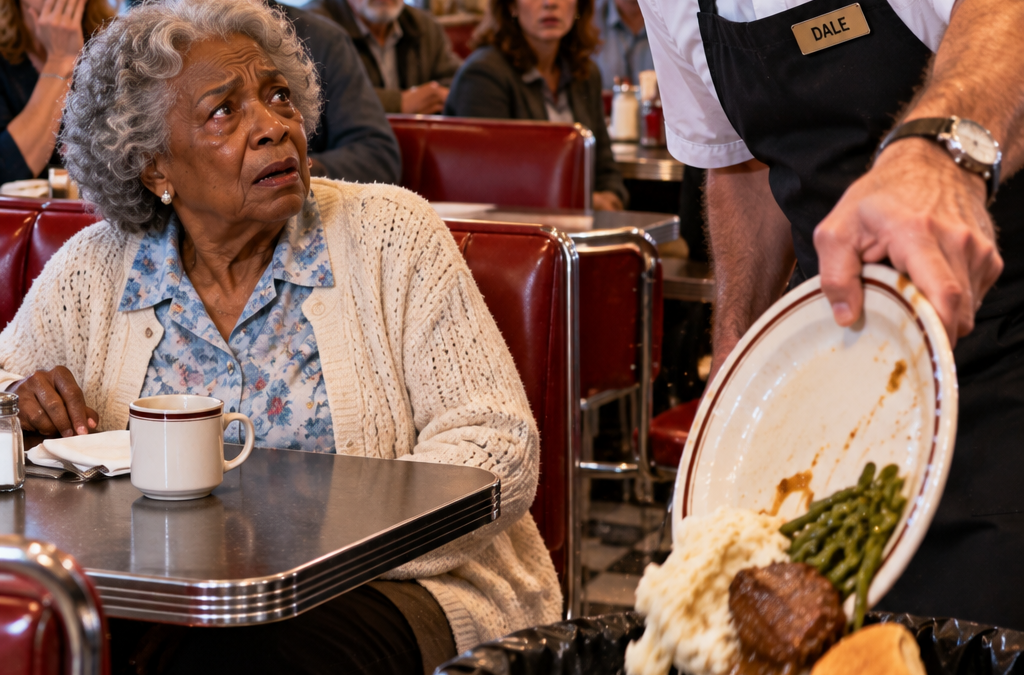
Before I understood what he intended, he marched behind the counter and slammed my plate into the trash can.
Porcelain exploded.
The sound cracked through the room.
Steak struck the side of the bin.
Collard greens slid down the plastic liner.
Cornbread broke apart.
Gravy splattered against the wall.
Nobody spoke.
I stared at the empty place in front of me.
A streak of gravy remained on the table.
That small brown streak is what I remember most.
Not because it mattered.
Because humiliation sometimes attaches itself to meaningless things.
The man walked back.
He was breathing harder now.
“Now pick it up and eat it.”
My chest went cold.
He pointed toward the trash.
“That suits you better.”
Somebody gasped.
Twelve people were close enough to hear him.
Twelve.
I counted later.
At the time, all I saw were faces turning downward.
The retired husband started to rise.
His wife grabbed his wrist.
“Don’t,” she whispered.
He sat back down.
The young mother pulled her toddler closer.
Nobody came to me.
Nobody told Dale to stop.
Nobody said, “That’s enough.”
He leaned over my table.
“Now get your filthy ass out of my restaurant before I throw you out myself.”
My chin trembled.
Once.
I pressed my lips together.
I would not cry.
Not in front of him.
Not because he had earned any shame from me.
Connie stepped from behind the counter.
She looked frightened.
“Dale.”
That was when I learned his name.
“Dale, she paid.”
He spun toward her.
She flinched.
“I was right there,” Connie continued. “Bonnie rang her up. Eight sixty. Cash.”
“Did I ask you?”
“No, but—”
“Then shut your mouth.”
His voice cracked across the diner.
“Or you can follow her out that door. Your choice, sweetheart.”
Connie froze.
For one second I thought she might keep going.
Her eyes filled.
Then she stepped back.
She looked at me.
I understood the apology in her expression.
I also understood something harder.
Feeling sorry for someone is not the same as standing beside them.
I reached into my purse.
My phone was an old flip phone with oversized buttons because my eyesight wasn’t what it had been.
My fingers shook so badly I pressed the wrong number twice.
On the third try, I called Amara.
She answered brightly.
“Grandma!”
I tried to speak normally.
I failed.
“Baby.”
My voice broke.
Everything changed in hers.
“Grandma? What’s wrong?”
“I’m at the restaurant.”
“What happened?”
I looked toward the trash can.
Dale had moved behind the counter.
He was talking to a regular now.
Laughing.
Actually laughing.
He jerked his thumb toward me as if I were some story he planned to tell later.
“That man threw my food away,” I said.
“What?”
“He put it in the garbage. He’s telling me to leave.”
“Grandma, who?”
“The manager.”
“Did he touch you?”
“No.”
“Are you hurt?”
“No.”
“What did he say?”
I swallowed.
“Things I don’t want to repeat.”
Amara’s voice became sharp.
“Stay right there.”
“Baby—”
“Don’t move. I’m calling Daddy.”
She hung up.
I closed the phone.
My hands were still shaking.
I set it next to the gravy streak.
Then I folded my hands.
Straightened my back.
And looked outside.
My old Buick sat in the parking lot under the sun.
For one terrible second, all I wanted was to walk out, get in the car, drive home, lock the door, take off that floral blouse, and never tell another soul what had happened.
Then I heard Earl.
Not literally.
Memory.
Flo, you carry yourself like a queen. Don’t let nobody tell you different.
So I stayed.
I didn’t know what Raymond would do.
I didn’t know Amara had even reached him yet.
I stayed for one reason.
I did not want Dale Greer believing he could throw my dignity away with my lunch.
What I didn’t hear was the phone call he made from behind the counter.
Later, witnesses told us exactly what he said.
He called Sheriff Dwight Kesler.
They knew each other.
Dale described me as an older Black woman who seemed confused.
Disoriented.
Possibly off medication.
He said I was making customers uncomfortable.
He said I refused to leave.
He made me sound unstable before the sheriff ever saw my face.
That frightened me later more than his screaming did.
A lie spoken calmly into the right ear can be more dangerous than a threat shouted across a room.
Seven minutes later, a patrol car pulled into the lot.
Sheriff Kesler entered without lights or sirens.
Mid-fifties.
Pressed tan uniform.
Aviator sunglasses pushed onto his forehead.
Gun belt.
Radio.
Handcuffs.
He walked toward Dale first.
Not me.
Dale hurried over.
They shook hands.
“Dwight, appreciate you coming.”
My stomach sank.
Not Sheriff.
Dwight.
Old familiarity.
Dale nodded toward me.
“She’s right there. Been sitting there. Asked her to leave. Won’t go.”
Then he said the word that changed the atmosphere.
“Trespassing.”
Sheriff Kesler looked at me.
I was sitting with my purse in my lap and my hands folded.
No yelling.
No disturbance.
No broken furniture except the plate Dale himself had destroyed.
He walked over.
“Ma’am. Sheriff Kesler.”
“Good afternoon.”
“Mind if I see some ID?”
I felt anger flash through me.
But I had lived long enough to know the difference between anger and strategy.
I opened my purse.
Took out my license.
Handed it to him.
He looked at it.
“Florence Elaine Turner.”
“Yes.”
He returned it.
“The manager says you’ve been asked to leave and refused.”
“He threw away food I already paid for.”
Kesler didn’t look toward the trash.
Didn’t ask Dale whether that was true.
Didn’t ask Connie.
Didn’t ask Bonnie.
Didn’t ask any customer.
“He took my plate from me,” I continued. “Threw it into that trash can and told me to eat it from there.”
His expression remained flat.
“Ma’am, I understand you’re upset.”
“I’m not telling you I’m upset. I’m telling you what happened.”
Dale appeared behind him.
“She’s trespassing, Dwight.”
Kesler gave him a small nod.
Then looked back at me.
“Business owners have the right to refuse service.”
“After accepting payment?”
“We can sort all that out outside.”
“I’m waiting for my family.”
“I’m going to need you to step outside.”
“I would rather wait here.”
His voice hardened.
“I’m not asking.”
Dale folded his arms.
For the first time since our confrontation began, he looked satisfied.
He had found the authority he needed.
Not justice.
Authority.
I looked around the room.
Twelve witnesses.
Not one met my eyes.
I stood.
Slowly.
I picked up my purse.
Straightened the blouse I had ironed so carefully that morning.
Then I walked toward the door.
As I passed the counter, Dale spoke loudly enough for me to hear.
“Should’ve known better than to walk in here like she owns the place.”
I kept walking.
Then came the words that told me exactly what this had always been about.
“These people. Every damn time.”
My hand stopped on the door.
For half a second, I considered turning around.
I wanted to ask him who “these people” were.
I wanted him to say it plainly.
Instead, I pushed through the door.
Outside, the heat hit my face.
Sheriff Kesler followed.
The parking lot looked impossibly normal.
Cars.
Pine trees.
Blue sky.
A mockingbird sat on the neon sign.
I could hear traffic moving down Route 9.
“Ma’am,” Kesler said, “I’d suggest you find somewhere else to eat.”
I looked at him.
He pointed vaguely down the highway.
“There’s a McDonald’s about two miles up. Might be more your speed.”
More your speed.
I didn’t answer.
There are moments when another person’s ugliness becomes so complete that any response only gives it company.
I walked to the wooden bench beside the entrance.
Sat down.
Placed my purse beside me.
My hands rested in my lap.
I looked down at my blouse.
That ridiculous blouse.
Pressed twice.
Chosen because it reminded me of Earl.
My birthday blouse.
And suddenly I thought about the last time Earl and I had eaten inside.
He had pushed the cornbread toward me without pretending to complain.
“You’re getting lazy,” I had told him.
“Marriage teaches efficiency.”
“You mean surrender.”
“Same thing after twenty years.”
We had laughed until I cried.
Now, outside the same restaurant, thirty years later, I felt one tear slide down my cheek.
I wiped it away quickly.
I had cried publicly twice in my life.
At Earl’s funeral.
At Raymond’s officer-school graduation.
I refused to make Dale Greer number three.
What I didn’t know was that a young woman sitting in a silver Honda across the parking lot had seen enough to understand that something was wrong.
Her name was Brianna Wells.
Twenty years old.
A communications student at UNC Wilmington.
She lifted her phone.
And started recording.
Nineteen miles away, my granddaughter was calling her father.
I learned the details later.
Amara had burst into her housing unit with tears running down her face.
Raymond answered on the first ring.
“Baby girl?”
“Daddy, Grandma called.”
That was enough to change his voice.
“What happened?”
“She’s at Rosy’s on Route 9. The manager threw her food in the garbage. Called her disgusting. Called her a beggar. The police came and made her sit outside.”
Raymond went silent.
Amara told me later she thought the call had dropped.
“Daddy?”
“Is she hurt?”
“I don’t think so.”
“Is she safe?”
“I think so, but she’s alone.”
Then Amara said the sentence that broke whatever restraint remained in him.
“She was crying.”
Raymond knew me.
He knew what that meant.
“Where exactly?”
She told him.
“I’m on my way.”
He hung up.
Walked from his office.
Looked at his aide.
And said, “Get me a bird now.”
Fourteen minutes later, a Black Hawk helicopter was spinning up at Fort Liberty.
Raymond boarded in full dress uniform.
Two stars on his shoulders.
Major Elaine Caldwell, a JAG officer, went with him.
So did his aide.
I knew none of that.
I was sitting on a bench trying to keep my hands from trembling.
Then I heard something.
At first, it was distant.
A soft rhythmic thump.
I looked toward the highway.
Nothing.
The sound grew stronger.
Thump.
Thump.
Thump.
The windows behind me began to vibrate.
I turned.
Inside the diner, customers were looking upward.
The jukebox skipped.
Coffee cups trembled on the counter.
Dale stopped talking.
The sound became a roar.
Dust moved across the far edge of the parking lot.
Napkins blew through the doorway as someone opened it.
Then a helicopter rose above the pine trees.
For a second, my mind refused to understand what I was seeing.
Military green.
Huge rotors.
Descending behind the diner.
The downdraft flattened grass.
Dust exploded outward.
Gravel jumped across the lot.
Every person inside Rosy’s rushed toward the windows.
I stood.
My first thought was not Raymond.
My first thought was that there had been some emergency nearby.
Then the helicopter settled.
The side door opened.
A boot touched the ground.
Another.
And my son stepped out.
Full dress uniform.
Two silver stars shining on his shoulders.
Even from a distance, I knew the way he walked.
A mother’s eyes do not need insignia.
“Raymond.”
I didn’t realize I had said his name aloud.
He saw me.
His face changed.
He walked faster.
Not running.
Raymond never ran when other people were watching unless someone was shooting at him.
But there was urgency in every step.
He reached the bench.
Looked at my face.
Looked at my hands.
Then he knelt.
Right there.
A two-star general on his knees in the dust outside Rosy’s Route 9.
He took both my hands.
“Mama.”
I tried to smile.
“I’m all right.”
His jaw tightened.
“No, you’re not.”
“I’m not hurt.”
“That’s not what I said.”
Something inside me gave way.
All morning I had been holding myself upright.
Against Dale.
Against the sheriff.
Against twelve silent faces.
Against the shame of being treated as though I were dirty.
Raymond squeezed my hands.
“I’m here.”
That was all.
I’m here.
And I broke.
One sob escaped me.
Then another.
I leaned forward.
My son wrapped his arms around me.
For a moment, I wasn’t seventy-two.
He wasn’t fifty-four.
He was eleven again, crying after his father’s funeral while I held him and told him somehow we would survive.
Only now he was holding me.
“I’m sorry,” I whispered.
He pulled back.
“For what?”
“I don’t know.”
“Don’t ever apologize for what somebody else did to you.”
His eyes were wet, but his voice remained steady.
Then he stood.
He looked toward the restaurant.
I knew that expression.
I had seen versions of it when he was young and trying not to fight someone.
Age and rank had made it quieter.
Not softer.
Behind the glass, Dale Greer was staring at us.
His face had drained white.
Raymond walked toward him.
I followed several steps behind with Major Caldwell.
Dale came out into the doorway.
His arms no longer crossed his chest.
His hands hung awkwardly at his sides.
Raymond stopped three feet from him.
“You threw my mother’s food in the trash.”
Dale swallowed.
“Sir, I—”
“You called her disgusting.”
“I didn’t—”
“You called her a beggar.”
Dale looked toward the windows.
Everyone inside was listening.
“You told a seventy-two-year-old woman to pick her food out of a garbage can and eat it.”
“I didn’t know who she was.”
That sentence silenced even Raymond.
He stared at Dale.
Then his voice lowered.
“What does that mean?”
Dale realized his mistake.
“Sir, I mean—”
“What exactly would have been different if you had known?”
“I didn’t know she was your mother.”
Raymond stepped closer.
“She shouldn’t have needed to be.”
Dale said nothing.
“My mother should not need a two-star general for a son before you treat her like a human being.”
Dale’s mouth opened.
Closed.
“I was following policy.”
“What policy?”
His voice was so calm it frightened me more than shouting would have.
“What policy tells you to humiliate a paying customer?”
Dale looked down.
“What policy tells you to seize a woman’s meal after she’s paid?”
No answer.
“What policy tells you to call her filthy?”
Silence.
“What policy tells you to order an elderly woman to eat out of a trash can?”
“I lost my temper.”
Raymond’s expression hardened.
“No. Losing your temper explains volume. It doesn’t explain contempt.”
Dale looked as though he had been struck.
Raymond walked into the diner.
Sheriff Kesler stood near the counter.
I saw recognition hit his face when he noticed the stars.
His posture changed instantly.
“General.”
Raymond stopped.
“Sheriff.”
“I wasn’t aware of the situation.”
“You were standing in it.”
Kesler cleared his throat.
“I responded to a trespassing complaint.”
“And investigated it how?”
“Sir?”
“My mother told you her food had been thrown away.”
Kesler said nothing.
“Did you ask the manager whether that happened?”
“No, sir.”
“Did you ask an employee?”
“No.”
“A customer?”
“No.”
“Did you verify she’d paid?”
Kesler looked toward the floor.
“No.”
“Did you ask why a seventy-two-year-old woman sitting quietly in a booth was supposedly a threat requiring police intervention?”
“I followed standard procedure.”
Raymond’s face changed just enough for me to see his anger.
“You followed the manager.”
Kesler’s hand drifted toward his belt.
Not toward his weapon.
Just an old nervous habit.
Then it dropped.
Raymond turned to Major Caldwell.
“Elaine.”
She opened the leather briefcase she had brought from the helicopter.
Legal pad.
Pen.
Calm eyes.
“I want everything documented.”
She nodded.
Raymond looked around the restaurant.
“Every employee on shift. Full names. The manager’s full name and employee identification. Sheriff, your badge number.”
Kesler hesitated.
Raymond waited.
Kesler gave it.
“Security footage,” Raymond continued. “Interior and exterior. Preserve it now.”
Dale looked up.
“Sir—”
“If a single frame disappears after this moment, my attorney will treat it as destruction of evidence.”
Major Caldwell added without looking up, “And we will document that the preservation instruction was given in front of multiple witnesses.”
Dale’s lips went dry.
He wiped his hands on his pants.
Raymond looked at him.
“What’s the owner’s name?”
“Carl Beckett.”
“Number.”
Dale gave it.
Raymond called.
Put the phone on speaker.
Two rings.
“This is Carl Beckett.”
“Mr. Beckett, this is Major General Raymond Turner, United States Army. I’m standing inside your Route 9 restaurant.”
Silence.
“Yes, General?”
“Your manager threw my seventy-two-year-old mother’s meal into a trash can after she paid for it.”
I watched Dale’s face.
Raymond continued.
“He called her disgusting. A beggar. Told her to remove her food from the garbage and eat it. Then he called law enforcement and falsely described her as disoriented when she refused to leave.”
Another silence.
“It’s her birthday.”
Carl Beckett inhaled.
“General Turner, I—God. I had no idea.”
“I’m not calling for an apology.”
“Of course.”
“I’m informing you what happened under your name. There are witnesses. There is restaurant surveillance. A civilian outside also appears to have recorded part of the incident. My legal counsel is present.”
Dale looked toward the parking lot.
He saw Brianna’s phone.
His face collapsed.
Carl Beckett spoke again.
“Put Dale on.”
Raymond held out the phone.
Dale took it.
His fingers were trembling.
“Carl—”
“Dale, you’re fired.”
His shoulders dropped.
“Effective immediately. Put your keys on the counter. Leave the property. Don’t contact Mrs. Turner. Don’t contact her family. Don’t speak to customers about this.”
“Carl, listen—”
“No.”
“I can explain.”
“I’ve heard enough.”
“It wasn’t—”
“And if any camera footage disappears, I will personally cooperate with every investigation that follows. Are we clear?”
Dale stared at the phone.
“Yes.”
“I asked if we’re clear.”
“Yes, sir.”
The call ended.
Dale placed the phone down.
Then he reached into his pocket.
A ring of keys landed on the counter.
The tiny metallic rattle filled the diner.
No one spoke.
He walked toward the exit.
The same room that had been silent when he humiliated me was silent again.
But it was a different silence.
Before, the silence had protected him.
Now it exposed him.
As he crossed the parking lot, he noticed Brianna recording.
He lifted his hand to hide his face.
Too late.
He got into his car and drove away.
Dust rose behind him.
For a long moment, I watched it settle.
Then Connie stepped toward us.
“Mrs. Turner?”
I turned.
Her eyes were red.
“I need to tell you something.”
She looked at Raymond, then at me.
“You paid. You were kind to me. You didn’t do anything.”
Her voice shook.
“He had no reason. None.”
I said nothing.
She swallowed.
“I should have stood up to him harder.”
Tears ran down her cheeks.
“I wanted to. I was scared he’d fire me. But that’s not an excuse.”
I knew what she expected.
Anger, maybe.
Judgment.
Instead, I walked toward her.
She looked confused.
I hugged her.
Her whole body shook.
“I’m sorry,” she whispered.
“I know.”
“I should’ve stopped him.”
“You tried.”
“Not enough.”
“No,” I said quietly. “Not enough.”
She pulled back.
I held her shoulders.
“But you get to decide what you do next time.”
That made her cry harder.
Sheriff Kesler left through a side door.
No apology.
No explanation.
His body camera kept recording.
At the time, he probably assumed the worst part was over.
It wasn’t.
By evening, Brianna’s video was online.
I didn’t watch it immediately.
I couldn’t.
Amara showed me the caption later.
This man threw a 72-year-old woman’s food in the trash because she was Black. Then a helicopter showed up.
Three minutes and forty-eight seconds.
That was the length of the clip.
Less time than it takes to boil water.
Long enough to change several lives.
The video began with me sitting on the bench wiping my face.
Then the helicopter.
Then Raymond.
Then the moment he knelt in front of me.
People reacted to the spectacle first.
Of course they did.
A Black Hawk landing behind a roadside diner is not subtle.
Raymond had always been dramatic, no matter how much he denied it.
By midnight, millions had watched.
By the next evening, millions more.
My phone rang constantly.
Numbers I didn’t recognize.
News stations.
Old coworkers.
Former students.
Parents of students.
Church members.
People I hadn’t heard from in twenty years.
Some cried.
Some were furious.
Some wanted interviews.
Some simply said, “Mrs. Turner, I’m sorry.”
I appreciated those most.
But the story changed when Patricia Holden arrived.
She was an investigative reporter from Raleigh.
Forty-one.
Direct.
Sharp-eyed.
She didn’t come looking for a viral moment.
She came looking for a pattern.
She interviewed employees.
Customers.
The cook.
Bonnie confirmed I had paid cash before sitting down.
The retired man who had nearly stood when Dale threw my food away agreed to speak on camera.
I watched his interview alone at home.
His voice broke.
“I should have said something.”
He rubbed his face.
“I knew it was wrong. Everybody knew.”
He looked straight into the camera.
“I watched him take that woman’s meal and throw it away. I watched him talk to her like she wasn’t human.”
He stopped.
“I sat there.”
His next words stayed with me.
“I’ll carry that the rest of my life.”
Then Patricia interviewed Connie.
Forty minutes.
Connie described the insults.
The fake card-on-file policy.
The threat against her job.
Dale’s comment about “these people.”
Then she told Patricia something none of us knew.
“This wasn’t the first time.”
Patricia stopped writing.
Connie continued.
The previous summer, a Black family had arrived for their daughter’s birthday.
They had a reservation.
Connie had seen it on the computer.
Dale told them the reservation didn’t exist.
The little girl had been standing there holding a balloon.
He turned them away.
Patricia kept digging.
Three former employees had filed discrimination complaints against Dale.
Three.
All had been dismissed.
Buried.
Ignored.
By the time the twelve-minute investigative report aired four days after my birthday, what happened to me was no longer being described as one man’s terrible afternoon.
It was a documented pattern.
People asked me whether I felt vindicated.
I didn’t.
Vindication is too clean a word.
I felt angry.
Tired.
Embarrassed that millions of people had seen me cry.
Grateful that the truth was visible.
And haunted by one question.
How many people had Dale treated that way when there was no helicopter coming?
How many walked away quietly?
How many convinced themselves it wasn’t worth fighting?
I filed the lawsuit in my own name.
That mattered to me.
Raymond supported me.
His lawyers helped.
His rank drew attention.
But I refused to let the legal case become General Turner’s fight.
Dale hadn’t humiliated a general’s mother.
He had humiliated Florence Turner.
Retired teacher.
Widow.
Taxpayer.
Paying customer.
Citizen.
That had to be enough.
My attorney, Lawrence Caldwell, had handled civil rights cases for two decades.
He sat at my kitchen table the first time we met.
No office.
No cameras.
Just coffee and Earl’s picture watching us.
“Mrs. Turner,” he said, “this could become exhausting.”
“I raised Raymond.”
He smiled.
“I suppose you know exhausting.”
“I taught third grade for forty years. The Army has nothing on third graders.”
He laughed.
Then became serious.
“There will be people who say you’re doing this for money.”
“I know.”
“They’ll say Dale made one mistake.”
“I know.”
“They’ll say your son intimidated everyone by arriving in a military aircraft.”
I looked at him.
“Did my son throw my meal in the garbage?”
“No.”
“Did my son call the sheriff?”
“No.”
“Did my son tell me to eat out of a trash can?”
“No.”
“Then let them talk.”
Lawrence nodded.
“All right.”
The lawsuit cited federal civil rights protections, state public accommodation law, and intentional infliction of emotional distress.
We sought damages.
But we also demanded reform.
Mandatory anti-discrimination training across all six locations owned by the company.
Clear reporting procedures.
Accountability.
I wanted more than a check.
I wanted the next Florence who walked through one of those doors to be treated like she belonged before anyone knew the name of her son.
The criminal case moved separately.
Dale was charged with misdemeanor assault against an elderly person based on the forcible seizure and destruction of my property.
He was also charged with filing a false police report.
His lawyer tried to soften the story.
Misunderstanding.
Confusion.
Escalation.
Dale claimed he’d felt threatened.
Then the prosecution played Brianna’s video.
Three minutes and forty-eight seconds.
The judge watched the entire thing.
I watched Dale while the judge watched the screen.
His face looked smaller than I remembered.
Not physically.
Morally.
He pleaded no contest.
The sentence was one hundred eighty days suspended.
Two hundred hours of community service.
A food bank serving low-income families.
Mandatory racial sensitivity training.
Forty hours.
And a five-year ban from holding a management position in a food-service establishment anywhere in Cumberland County.
People asked whether I thought it was enough.
I never knew how to answer.
What sentence restores one hour of dignity?
What punishment erases the memory of twelve people staring at their plates while someone tells you that you belong beside garbage?
Law doesn’t repair everything.
Sometimes it simply draws a line around what society is willing to call unacceptable.
Four months after the incident, the civil case settled.
The amount remained confidential.
It was substantial.
Enough that reporters kept asking.
I kept refusing to answer.
The number wasn’t what mattered.
The reforms did.
The acknowledgment did.
The fact that the company could no longer pretend nothing had happened did.
Sheriff Dwight Kesler faced his own investigation.
His body-camera footage showed everything.
Me telling him I had paid.
Me telling him Dale threw away my food.
Kesler failing to ask a single question.
His immediate acceptance of Dale’s version.
And outside, his suggestion that McDonald’s might be “more my speed.”
Internal affairs placed him on administrative leave.
Three weeks later, under growing pressure and while another review was beginning, he resigned.
His written statement was four sentences.
There was no apology.
When I read it, I felt nothing.
That surprised me.
I thought I would be angry.
Instead, I simply folded the newspaper.
Some men spend so long protecting themselves from accountability that even when accountability arrives, they still cannot see the person they harmed.
I was finished waiting for Dwight Kesler to see me.
Carl Beckett closed the Route 9 restaurant for two weeks.
Every employee went through retraining.
New management was installed.
A zero-tolerance discrimination policy appeared at every entrance.
Then Carl called me.
“Mrs. Turner?”
“Yes.”
“I have a strange question.”
“Those are usually the interesting ones.”
He hesitated.
“We want to rename the diner.”
I frowned.
“Rename it what?”
There was a pause.
“Miss Florence’s Kitchen.”
I thought he was joking.
He wasn’t.
“Why?”
“Because what happened there should never be forgotten.”
I looked toward Earl’s photograph.
Carl continued.
“And because I don’t want the building to be remembered as a place where you were told you didn’t belong.”
For a long time, I said nothing.
Then I asked, “What would the sign say?”
“Miss Florence’s Kitchen.”
“Anything else?”
“We thought underneath it: Everyone Belongs Here.”
My eyes filled.
I hated that.
At seventy-two, I still hated crying.
“All right,” I said.
The new sign went up on a Saturday.
Red letters.
White background.
MISS FLORENCE’S KITCHEN.
Everyone Belongs Here.
I stood outside wearing the same floral blouse.
Yes.
That blouse.
I had nearly thrown it away after the incident.
For days, seeing it hanging in my closet made my stomach tighten.
Then I became angry at myself.
Dale Greer did not get to own a piece of fabric.
He did not get to contaminate my birthday.
He did not get to turn my memories of Earl into his property.
So I wore it.
The gold cross earrings too.
Amara stood on one side of me.
Raymond stood on the other.
No uniform this time.
Gray suit.
No helicopter either.
I had made that very clear.
“Drive like a normal person,” I told him.
“I usually do.”
“You landed a Black Hawk behind a restaurant.”
“One time.”
“One time too many.”
At the ribbon-cutting, he whispered, “You liked it a little.”
I looked at him.
“I did not.”
He smiled.
“Maybe five percent.”
“Raymond.”
“Three?”
I elbowed him.
Amara laughed.
For the first time since my birthday, standing outside that building didn’t make me feel small.
Carl handed me the scissors.
The crowd counted down.
Three.
Two.
One.
I cut the ribbon.
People applauded.
Then Carl announced the Florence Turner Scholarship Fund.
An annual scholarship for local students of color pursuing degrees in education.
That nearly undid me.
Forty years in a classroom.
Thousands of children.
So many names.
So many little hands raised.
So many papers marked in red.
So many mornings when I wondered whether teaching mattered.
It had mattered.
It still did.
Connie brought me something after the ceremony.
A card.
“What is this?”
“Lifetime meal pass.”
I stared at it.
Then at her.
“Lifetime?”
“Anything you want.”
I held it up.
“Well, I just hope nobody throws this one in the trash.”
For half a second, the room went silent.
Then everyone laughed.
I laughed too.
And somewhere in the middle of the laughter, tears started.
Not only mine.
Three weeks later, I was back home on Maple Drive.
Tuesday morning.
Sunlight through lace curtains.
No cameras.
No helicopters.
No reporters.
Just home.
I stood at the kitchen sink filling my watering can.
The faucet squeaked.
It had squeaked for twenty years.
Earl used to promise he’d repair it.
“This Saturday.”
Every Saturday.
He never did.
After he died, I could have fixed it.
I didn’t.
Some people keep jewelry.
Some keep letters.
I kept a squeaky faucet.
I carried the watering can outside.
Gardenias first.
Earl’s favorite.
Then marigolds.
Then petunias along the porch railing.
I had planted those the spring after he died because grief left me needing something alive to care for.
When I finished, I returned inside.
Stopped at the mantel.
Earl smiled from behind the glass.
“They named it after me, baby.”
I touched the frame.
“Can you believe that?”
I imagined his answer.
Probably something ridiculous.
“Miss Florence’s Kitchen,” I continued. “Big red sign and everything.”
I laughed.
“And your son landed a whole helicopter behind the restaurant.”
I shook my head.
“A helicopter, Earl.”
I pointed at his photograph.
“You raised one dramatic child.”
Then I remembered I had raised him too.
“Fine. We raised one dramatic child.”
My phone rang.
Raymond.
“Happy belated birthday, Mama.”
“Again?”
“Again.”
“You have called every day.”
“I know.”
“I’m fine.”
“I know.”
“Then why do you keep calling?”
There was a pause.
“Because I like hearing you say you’re fine.”
That silenced me.
“Well,” I said softly, “I’m fine.”
“Good.”
Another pause.
“Mama?”
“Yes?”
“I’m sorry about the helicopter.”
I laughed.
That deep kind of laugh I hadn’t heard from myself in months.
“Boy, you always did know how to make an entrance.”
“I may have overreacted.”
“Your daddy was the same way.”
“Really?”
“He walked into every room like he owned it.”
“That sounds familiar.”
“The difference was, your father made everybody else feel like they owned it too.”
Raymond was quiet.
“I learned from both of you.”
“You learned from your father.”
“And you?”
“I made sure you did your homework.”
He laughed.
That afternoon, Amara came over.
We sat on the porch swing.
For years the swing had barely moved.
That day, she pushed us back and forth with one foot.
We drank sweet tea.
Watched the neighbor’s cat cross the yard.
Listened to birds chatter in the trees.
After a while, Amara leaned her head against the wooden backrest.
“Grandma?”
“Hmm?”
“Can I ask you something?”
“You usually do whether I say yes or not.”
She smiled.
Then the smile faded.
“When he was saying those things to you… were you scared?”
I looked toward the road.
A car passed.
The afternoon sunlight flickered through the oak leaves.
“Terrified.”
Her eyes widened.
“Really?”
“My hands shook so badly I could barely use my phone.”
“But you looked so calm.”
“Looking calm and being calm are two different things.”
She thought about that.
“Why didn’t you leave?”
That question stayed between us.
I could have given her a heroic answer.
Something polished.
Something people might put on a poster.
The truth was messier.
“Part of me wanted to.”
She waited.
“I wanted to go home. I wanted to lock my door and never see that place again.”
“But you stayed.”
“Yes.”
“Why?”
I looked down at my hands.
Wrinkled now.
Brown.
Hands that had held Earl’s.
Hands that had carried Raymond as a baby.
Hands that had written thousands of lessons on chalkboards.
Hands that had shaken inside Rosy’s Route 9.
“Because your grandfather taught me something a long time ago.”
“What?”
“You don’t have to stop being afraid before you stand your ground.”
She watched me carefully.
“You can be scared and stay.”
I took a drink of tea.
“You can shake and stay.”
I set the glass down.
“You can have tears in your eyes and still know somebody has no right to make you smaller.”
Amara leaned her head against my shoulder.
I put my arm around her.
Then I thought about the twelve people in that diner.
The retired man who nearly stood.
The woman who pulled him down.
Connie wanting to speak.
Everyone waiting.
Everyone afraid of becoming involved.
“When you see somebody else being made small,” I told her, “that’s when courage becomes expensive.”
She looked up.
“What do you mean?”
“It’s easy to think you’re brave when bravery costs nothing.”
I thought of Connie risking her job.
Brianna raising her phone.
The retired man living with regret.
“When it might cost you comfort, reputation, money, safety, that’s when you find out.”
Amara nodded slowly.
“So you always stand up?”
I smiled sadly.
“I didn’t say I always have.”
That surprised her.
“I’m seventy-two years old, baby. I’ve had moments I wish I could redo too.”
I looked toward the garden.
“The point isn’t to pretend you’ve never been silent.”
“Then what is?”
“Make sure the next time, you’re not.”
She rested against me again.
We sat there for a long time.
No speeches.
No crowd.
No cameras.
Just grandmother and granddaughter on a porch swing.
Eventually, the sun began dropping behind the houses.
The garden turned gold.
I thought again about that birthday morning.
The blouse.
The coffee.
Earl’s photograph.
The nervousness I had felt about walking back into a place filled with memories.
If I could speak to the woman who stood at the ironing board that morning, I wouldn’t warn her.
I wouldn’t tell her not to go.
I wouldn’t tell her what Dale would do.
Because if I stayed home, perhaps Dale would still be managing that diner.
Perhaps the next Black family would still be turned away.
Perhaps Kesler would still be wearing his badge without ever questioning how easily he believed one person’s accusation and dismissed another person’s truth.
Perhaps Connie would still believe silence was the safest choice.
Perhaps Brianna would never have pointed her camera.
Perhaps that scholarship would not exist.
That doesn’t mean I am grateful for what happened.
I am not.
Pain does not become good simply because something good grows after it.
What Dale did was cruel.
What those witnesses failed to do hurt.
What Sheriff Kesler did was wrong.
Nothing that came afterward erased those facts.
But they also did not get the final word.
Dale wanted me to believe I didn’t belong at his table.
In the end, the building carried my name.
He wanted me to believe I was someone people could throw away.
Instead, people were forced to examine why they had watched.
He wanted me gone because he assumed I had no power.
The truth was that my greatest power had nothing to do with Raymond’s stars.
It was the decision to remain Florence Turner when someone was trying to reduce me to something less.
A widow.
A teacher.
A mother.
A grandmother.
A woman who had paid eight dollars and sixty cents for lunch and expected to be treated like a human being.
That should have been enough.
It always should have been enough.
A few months later, Raymond and I went back to Miss Florence’s Kitchen together.
No ceremony.
No reporters.
No crowd.
Just lunch.
We sat in the same window booth.
I hesitated before sliding into my seat.
Raymond noticed.
“We can sit somewhere else.”
“No.”
“Mama, we don’t have to prove anything.”
“I know.”
“Then why this table?”
I ran my fingers along the edge.
“Because it was mine before Dale ever walked into this building.”
Raymond smiled.
A waitress approached.
Not Connie.
A new girl.
Maybe nineteen.
“What can I get you?”
“Country-fried steak.”
Raymond glanced at me.
“Same.”
The waitress started to leave.
I stopped her.
“And extra cornbread.”
Raymond shook his head.
“I knew it.”
“You knew what?”
“You were going to steal mine.”
“I don’t steal.”
“You’ve been admitting it for thirty years.”
“I redistribute.”
He laughed.
When the food came, I looked at the plate longer than I meant to.
Steak.
Greens.
Cornbread.
Gravy.
Ordinary food.
But for a moment, my throat tightened.
Raymond reached across the table.
“Mama?”
“I’m all right.”
He waited.
This time, when I said it, I meant it.
I picked up my fork.
Then I reached across the table, took his cornbread, and put it on my plate.
He stared at me.
“Really?”
“Tradition.”
“That’s theft.”
“Call the sheriff.”
For one stunned second, Raymond simply looked at me.
Then he laughed.
I laughed with him.
Loudly.
The sound filled that old window booth.
And for the first time in more than thirty years, when I looked across the table, I didn’t see Dale Greer.
I didn’t see the trash can.
I didn’t see twelve lowered faces.
I saw Earl.
Not literally.
In the warmth.
In the ridiculous argument over cornbread.
In the way my son smiled.
In the realization that a place could hold pain without belonging to the pain forever.
Outside, cars moved along Route 9.
Inside, plates clattered.
Coffee poured.
People talked.
Nobody stared at me.
Nobody questioned whether I could pay.
Nobody asked why I was there.
I was simply Florence Turner, eating lunch with my son.
And that ordinary thing felt more powerful than the helicopter, the cameras, the lawsuit, the headlines, or the sign outside.
Because Dale Greer had spent one terrible afternoon trying to convince me I did not belong.
And there I was.
Still sitting at the table.








