𝗙𝗨𝗟𝗟 𝗦𝗧𝗢𝗥𝗬 The Deputy Put Me Against My Own SUV and Told Me Nobody Was Coming to Save Me—Then He Heard the Voice on My Speakerphone
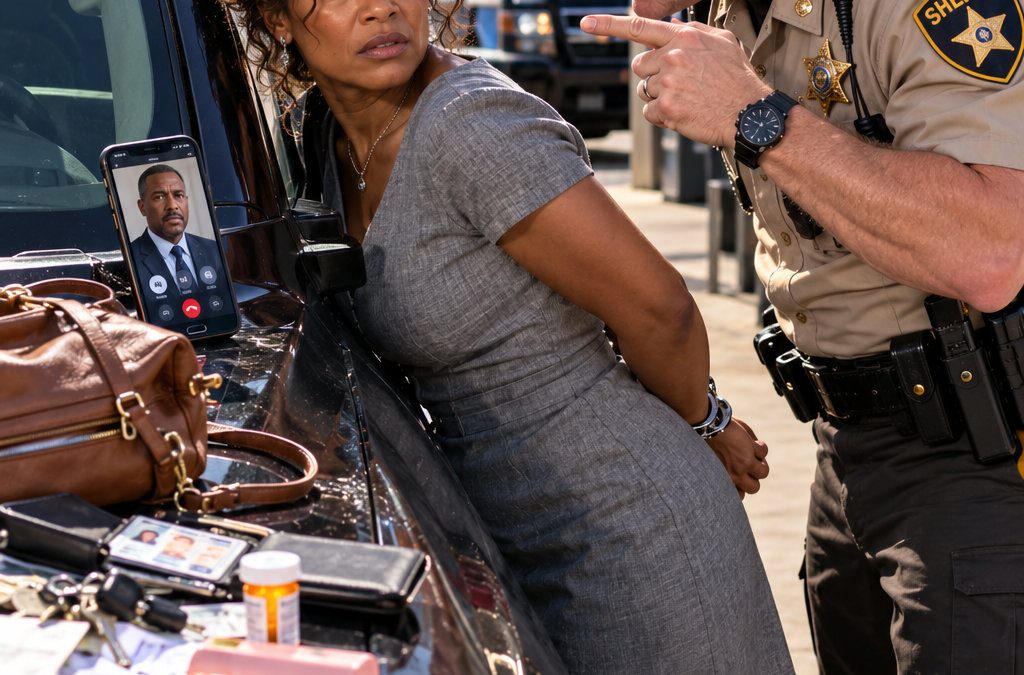
𝗣𝗔𝗥𝗧 𝟮
That should have been the whole story.
Across the road, parked beneath a dead oak, sat a white Dodge Charger with RIDGEFIELD COUNTY SHERIFF along the side.
I noticed it.
Of course I did.
Black Americans notice patrol cars in ways other people often do not understand.
You don’t necessarily panic.
You simply register them.
Location.
Direction.
Movement.
Then continue what you’re doing.
I kept pumping gas.
Inside the patrol car sat Deputy Bryce Harmon.
I learned later he had been with the department eleven years.
Forty-three years old.
Two prior disciplinary warnings.
A reputation locals described with careful language.
Strict.
Intense.
Old-school.
Stay out of his way.
Words communities use when fear has been normalized long enough to acquire polite synonyms.
Inside the store, a nineteen-year-old cashier named Tommy Beckett saw Harmon put down his food.
Saw him look at me.
Saw him open the cruiser door.
Tommy had seen that sequence before.
I hadn’t.
I heard boots on gravel.
Slow.
Deliberate.
I turned.
Harmon approached with mirrored sunglasses and one hand resting near his belt.
“Ma’am.”
Not hello.
Not good afternoon.
A command disguised as a noun.
“Step away from the vehicle.”
I removed the nozzle.
Returned it to the pump.
“Good afternoon, officer.”
His jaw tightened.
“License and registration.”
“Is something wrong?”
“I’ll decide that.”
My grandmother’s voice entered my head.
Slow hands.
I moved carefully.
My wallet was inside the Tahoe.
I told him what I was doing before reaching.
“My wallet is in the center console.”
“Get it.”
I did.
Driver’s license.
Then registration from the glove compartment.
I handed both over.
Harmon barely looked at me.
He studied the license.
Then the registration.
Then the address.
1200 Maple Ridge Drive.
Governor’s Row.
His eyes moved to my Tahoe.
Faded paint.
Dent.
Child seat.
Then to my dress.
Then back to the address.
“This vehicle yours?”
“Yes.”
“You sure?”
I almost smiled because the question was so strange.
“Yes.”
“This registration says Maple Ridge Drive.”
“That’s correct.”
“Governor’s Row.”
“Yes.”
His mouth twisted.
“You telling me you live there?”
“I do.”
He laughed.
Short.
Dry.
“Right.”
I waited.
“And I’m the Pope.”
I looked at him.
He tucked my driver’s license and registration into his shirt pocket.
That bothered me immediately.
“Officer, may I have my documents back?”
He reached for his radio.
“Dispatch, run a plate.”
He read my plate number.
Loudly.
I said, “My registration is in your hand.”
He turned toward me.
“What I see is a vehicle that doesn’t match its driver.”
For a moment, I thought perhaps I had misunderstood.
“What does that mean?”
“It means I see an address you can’t afford.”
My stomach tightened.
“You don’t know what I can afford.”
He removed his sunglasses.
Blue eyes.
Flat.
Cold.
“I know exactly what I’m looking at.”
“No, you don’t.”
“I’ve been doing this eleven years.”
He glanced toward my vehicle.
“I can recognize stolen property.”
“My car is not stolen.”
“Then you’ll have no problem cooperating.”
“I have cooperated.”
“Move to the hood.”
I stayed where I was.
“What?”
“Hands on the hood.”
“Why?”
His voice hardened.
“Because I told you.”
I had spent years around lawyers.
Legislators.
Police commissioners.
Civil rights advocates.
I knew enough law to understand how wrong the interaction had already become.
But knowing the law and surviving the moment are not the same task.
I walked to the front of the Tahoe.
Placed my palms on the hood.
The metal had been baking under the afternoon sun.
Heat bit into my hands.
I didn’t move.
Inside the store, Tommy lifted his phone.
Started recording through the window.
I didn’t know.
A man in a ball cap leaned against his pickup and watched.
Not concerned.
Entertained.
I knew that expression too.
The radio crackled.
“Plate is clear. Registered owner Serena Wallace. No wants. No warrants.”
I turned my head slightly.
“There.”
Harmon lifted the radio.
“Copy.”
Then added, “Continuing investigation.”
I looked back.
“Your dispatch confirmed the vehicle.”
“I heard.”
“So am I free to go?”
“No.”
“Why?”
“Because I’m not finished.”
He walked around the Tahoe.
Opened the passenger door.
Without asking.
“Officer.”
He ignored me.
“You do not have my consent to search my vehicle.”
He leaned inside.
“I don’t need it.”
“What is your probable cause?”
He pulled open the glove box.
“The fact that I have one.”
“That’s not probable cause.”
He glanced toward me.
“You planning to teach me law now?”
“No.”
“Good.”
He opened my center console.
Papers.
Receipts.
Sunglasses.
A road map Daniel teased me for carrying because I did not trust phones to remain charged.
He tossed things onto the passenger seat.
Then found a manila folder.
My policy documents.
He opened it.
State seal.
Meeting notes.
Correspondence.
A draft memo.
He looked over the first page.
“What is this?”
“Work.”
He laughed.
“What kind of work?”
“I’d rather not discuss my employment.”
His face changed.
“I’d rather not.”
He repeated the phrase.
Then slammed the folder shut.
“When I ask you something, you answer.”
He tossed it inside.
Papers spilled across the floor.
“I’m not required to explain my employer.”
“You are when you’re standing in front of me.”
He moved to the rear seat.
Pulled out my overnight bag.
Unzipped it.
“Officer, stop.”
He dumped it across the hood.
Clothing.
Charger.
Reading glasses.
My Bible.
Small leather cover cracked along the spine.
A framed photograph of my daughters at a graduation.
Harmon picked it up.
“Who are these?”
“My daughters.”
“Your daughters.”
He sounded amused by that too.
He dropped the photograph face down.
Then looked at my Tahoe.
“They know their mama is driving stolen property?”
Something in me shifted.
“The vehicle is not stolen.”
He looked at me.
“Registration being clean doesn’t mean you didn’t steal it.”
“Then what would satisfy you?”
That question mattered.
Because he had no answer.
There was nothing I could produce that would satisfy a suspicion that did not come from evidence.
It came from me.
Who I was.
What I looked like.
Where he thought I belonged.
A white-haired woman pulled into the lot.
She got out.
Saw me standing against my SUV.
Saw my belongings on the hood.
Saw Harmon.
“Bryce?”
He looked over.
“Mrs. Henderson, stay back.”
“What is going on?”
“Official business.”
She stared at me.
“That woman looks terrified.”
“I’m not terrified,” I said.
Harmon snapped his head toward me.
“Nobody asked you.”
Mrs. Henderson’s face tightened.
“Bryce.”
“Stay back.”
She did.
But she didn’t leave.
More vehicles came.
Trouble attracts witnesses.
Some people stop because they care.
Some because they’re curious.
Some because somebody else’s humiliation feels like free entertainment.
Phones appeared.
Teenagers.
A delivery driver.
A woman holding a child.
Harmon noticed the crowd.
And changed.
His chest lifted.
Voice louder.
He was no longer simply interacting with me.
He was performing authority.
“Here’s what’s going to happen.”
He spoke so everyone could hear.
“You’re going to tell me where you got this vehicle.”
“I already did.”
“Then you’re going to tell me where you got those government documents.”
“They are mine.”
“And then you’re going to shut your mouth while I figure out what to do with you.”
I closed my eyes.
One second.
I thought of my daughters.
Their photograph face down.
My Bible on hot metal.
My clothes scattered.
My glasses lying near spilled coffee.
Then I opened my eyes.
“Officer.”
“What?”
“Are you finished?”
He smiled.
“Sweetheart, I haven’t started.”
Sweetheart.
Some words become weapons entirely through tone.
He stepped closer.
“You think you’re smart.”
“I think this needs to end.”
“You think standing there quietly makes you look innocent.”
“Remaining quiet is my right.”
That made him angry.
“Your right.”
He spat the word.
“Let me explain something about rights.”
I looked at him.
“Rights are for people who contribute.”
I actually felt my breathing stop.
Not because I feared him.
Because I suddenly understood how deep the problem went.
He believed this.
Not merely prejudice.
Philosophy.
A hierarchy of citizenship.
“You come into my town,” he continued, “driving something you can’t explain—”
“I have explained it.”
“With government documents you won’t explain—”
“I don’t owe you—”
“Shut up.”
The command snapped across the lot.
He pointed toward the growing crowd.
“You know what people like this do?”
People like this.
There it was.
“They take whatever they can get, then when somebody challenges them, they cry racism.”
Nobody answered.
That silence hurt.
More than Harmon’s words in some ways.
I looked at the people.
Some uncomfortable.
Some recording.
The man in the ball cap smiling faintly.
Mrs. Henderson furious.
Tommy behind the store glass with his phone raised.
I knew later that he had begun recording because he’d seen Harmon target people before.
At that moment, he was simply one frightened boy holding a camera.
Harmon turned back.
“Where did you really get the Tahoe?”
“It’s mine.”
“I don’t believe you.”
“Your belief does not alter registration.”
His hands flexed.
Then he looked at my wedding ring.
“Take that off.”
I stared.
“My ring?”
“Take it off.”
“Why?”
“I want to inspect it.”
“It’s my wedding band.”
“Could be stolen.”
I curled my fingers.
“No.”
His eyes widened slightly.
The first direct refusal.
“Excuse me?”
“I’m not removing my wedding ring because you have decided everything I own must belong to somebody else.”
His jaw worked.
“Everything about you looks stolen.”
He said it without raising his voice.
Car.
Documents.
Ring.
Life.
As if my existence itself was evidence.
Inside, Tommy had picked up the store landline while continuing to record with his personal phone.
He called 911.
Quietly.
He told them an officer had detained a woman who had done nothing wrong.
He said the officer was escalating.
He said he had seen Harmon do this before.
That took more courage than I understood at the time.
The last time Tommy had complained about Harmon, his windshield had been smashed overnight.
No witness.
No useful camera angle.
Everyone understood the message.
Still, he called.
Harmon grabbed my wrist.
Fast.
Hard.
He twisted my arm behind my back.
My chest hit the hood.
Heat burned through my dress.
I gasped.
It was involuntary.
He leaned close.
“You’re being detained.”
“For what?”
“Suspicious behavior.”
“What behavior?”
“Failure to comply.”
“I complied with every lawful instruction.”
“You wouldn’t answer.”
“Silence is not obstruction.”
I turned my face enough to speak.
“The Fifth Amendment—”
He laughed.
Loud.
“You hear that?”
He looked toward the crowd.
“Constitutional scholar.”
The man in the ball cap laughed.
Mrs. Henderson stepped closer.
“Bryce Harmon, let go of her.”
He didn’t turn.
“Mrs. Henderson, back up.”
“She has done nothing.”
“One more step and I arrest you too.”
She stopped.
Then pulled out her phone.
“I’m recording.”
“Record whatever you want.”
“I want that statement on record.”
He pulled out his handcuffs.
Metal clicked.
That sound changed something in me.
I had spent years working with legal clinics where people described arrest.
I had heard them explain what a handcuff felt like.
Cold.
Tight.
Humiliating.
I had represented none of them.
I was not a lawyer.
But I had sat beside them.
Listened.
I had believed I understood.
Then steel closed around my wrist.
And I realized understanding something intellectually is not the same as feeling another person control whether your body can move.
Harmon reached for my other hand.
“I want a phone call.”
He laughed.
“This isn’t television.”
“State law gives me the right to contact someone before formal detention.”
He stopped.
I quoted the section.
That made him pause.
Only briefly.
He didn’t know whether I was correct.
That uncertainty bothered him.
Finally he went to my car.
Grabbed my phone.
“Here.”
He held it away.
Then dropped it.
Not handed.
Dropped.
The phone struck gravel.
The screen cracked.
A line ran diagonally across the photograph of my daughters.
Something inside me went very still.
Harmon grinned.
“Make your call.”
He looked around at the audience.
“Call your pastor.”
A few people smirked.
“Call your boyfriend.”
I bent.
Picked up the phone with my free hand.
Dust covered the glass.
I wiped it.
“One call.”
He spread his arms.
“Call the president.”
Laughter.
“Call God.”
More laughter.
“Nobody’s coming.”
I looked at him.
Really looked.
I knew then that I didn’t want to tell him.
I didn’t want to say who my husband was.
Because once I did, everything would change.
His tone.
His posture.
The crowd.
The other officers.
And I wanted him to hear himself before he knew.
I pressed speed dial number one.
Speaker.
One ring.
Two.
Daniel answered.
“Serena?”
Harmon’s smile remained.
“Is everything all right?”
I looked at the cuff.
“No.”
Silence on the line.
Daniel’s voice changed.
“Talk to me.”
I held the phone at chest height.
“I’m at Ridgefield Fuel Stop on Route 34.”
I heard movement on his end.
“An officer stopped me while I was getting gas.”
“Are you in the car?”
“No.”
“Are you safe?”
“I’m being detained.”
The lot became quieter.
Harmon watched.
I continued.
“He searched the Tahoe without consent.”
Harmon’s smile weakened.
“He removed my belongings and placed them on the hood.”
Daniel said nothing.
“My registration came back clean.”
A pause.
“He has put one handcuff on me.”
The voice that came back was no longer my husband’s voice from breakfast.
It was the governor.
“Officer.”
Harmon stared at the phone.
“Are you listening?”
He looked around.
Then at me.
“Who is this?”
Daniel answered.
“This is Governor Daniel Wallace.”
No one moved.
I remember that silence more clearly than anything.
The teenagers lowered their phones slightly.
Mrs. Henderson covered her mouth.
The ball-cap man’s arms dropped.
The backup officer, who had arrived only minutes earlier and done nothing, stepped away from my SUV.
Harmon stared at the speaker.
“That’s…”
His voice failed.
“Anyone can say that.”
Daniel’s tone remained calm.
“Your name and badge number.”
Harmon didn’t answer.
“Now.”
His hand moved automatically toward his badge.
“Bryce Harmon.”
A swallow.
“Badge 2214.”
“Ridgefield County Sheriff’s Department?”
“Yes.”
Daniel repeated the information.
I could hear someone else in the room with him now.
Probably staff.
Writing.
Phones.
Movement.
Then Daniel said, “Deputy Harmon, the woman you searched and handcuffed is my wife.”
Harmon’s face drained.
Not instantly.
Gradually.
Like blood leaving a wound.
He looked at me.
Then at my wedding ring pressed against the cuff.
Then at the state documents scattered in the Tahoe.
Suddenly every fact he had ignored became visible.
The open second cuff slipped from his hand.
It hit gravel.
Small metallic sound.
Daniel continued.
“State police are being dispatched.”
Harmon said nothing.
“You will remain exactly where you are.”
His mouth opened.
“You will not leave.”
A nod.
“You will not touch Mrs. Wallace again.”
Another nod.
“And you will not speak to her.”
Harmon realized Daniel couldn’t see him.
“Yes, sir.”
Broken voice.
Daniel returned to me.
“Serena.”
“I’m here.”
“Are you injured?”
I looked at the red mark around my wrist.
My shoulder.
My belongings.
“Nothing that won’t heal.”
“I’m coming.”
“Daniel—”
“I’m coming.”
His voice softened.
“Don’t let anybody move anything.”
“I won’t.”
“Keep the line open.”
He did not hang up.
The phone became more than a phone.
Witness.
Record.
Protection.
Harmon stood away from me.
The authority had left his body.
His uniform remained.
Badge.
Gun.
Belt.
Everything that had frightened people for years.
But without his certainty, he looked ordinary.
That taught me something.
Power often appears enormous because everyone around it agrees to act as though it is.
Then someone refuses.
And suddenly you can see the person inside.
Tommy came outside holding the landline.
His face was pale.
Mrs. Henderson lowered her phone but kept recording.
I picked up my daughters’ picture.
Wiped dust from the glass.
Turned my Bible over.
Closed my overnight bag as best I could with one cuff still hanging from my wrist.
Fourteen minutes later, state police arrived.
Three vehicles.
Lights.
No sirens.
Captain Elaine Morris stepped from the first cruiser.
Silver hair cut close.
Pressed uniform.
Straight posture.
She took in the entire scene quickly.
Me.
Tahoe.
Belongings.
Handcuff.
Harmon.
Second deputy.
Witnesses.
Phones.
Then she walked directly to Harmon.
“Badge.”
He stared.
“Captain—”
“Badge. Now.”
He fumbled.
Three attempts before the pin came free.
Morris held out an evidence bag.
He dropped the badge inside.
“Weapon.”
Harmon’s hands shook.
He unholstered it.
Removed the magazine.
Cleared the chamber.
A round fell onto the gravel.
Nobody laughed.
“Deputy Bryce Harmon, you are suspended pending an Internal Affairs investigation and concurrent criminal review.”
He stared at the ground.
“You will have no contact with Mrs. Wallace or witnesses.”
“Yes, ma’am.”
Then Morris turned toward the second officer.
“Deputy Caldwell.”
He stiffened.
“Step forward.”
He had arrived while Harmon was holding me against the Tahoe.
He had heard dispatch confirm my registration.
He had questioned Harmon once.
Then Harmon challenged his loyalty.
Caldwell chose silence.
Morris asked, “Did you observe an unauthorized search?”
He swallowed.
“Yes.”
“Did you observe physical restraint?”
“Yes.”
“Did you identify probable cause?”
“No.”
“Did you intervene?”
His eyes fell.
“No.”
Morris waited.
“And why not?”
No answer.
He didn’t need one.
Fear.
Cowardice.
Career loyalty.
Whatever name you gave it, the result had been the same.
Morris held out another evidence bag.
“Badge and weapon.”
Caldwell looked stunned.
“Captain—”
“Now.”
He complied.
Then she came toward me.
Her entire manner changed.
Not because I was the governor’s wife.
At least I hoped not.
Her voice softened.
“Mrs. Wallace, I’m Captain Morris.”
“I know.”
“Do you need an ambulance?”
“No.”
“Your wrist should be checked.”
“I’m fine.”
“That’s not what I asked.”
For the first time that afternoon, I almost smiled.
“I’ll let an EMT look.”
She nodded.
“Do you want to give your statement tonight or later?”
“Now.”
“You’re sure?”
“Every word while it’s fresh.”
She turned.
“Secure everything.”
Then instructions came rapidly.
Photograph my wrist.
Vehicle.
Scattered belongings.
Gas pump.
Cuff.
Collect witness information.
Preserve video.
Separate deputies.
Do not allow witnesses to compare accounts.
Tommy stepped forward holding a USB drive.
“I copied the store cameras.”
Morris looked at him.
He added, “And I have forty-one minutes on my phone.”
His voice shook.
“But it’s all there.”
Morris nodded once.
“Good work.”
Those two words nearly made him cry.
I saw it.
Daniel texted.
Fifteen minutes away.
I love you.
For the first time in over an hour, I sat.
On the Tahoe’s running board.
My body began trembling once it understood it was allowed.
That’s something people rarely show in dramatic stories.
You can be calm during danger.
Perfectly controlled.
Then shake when it’s over.
The nervous system does not care how dignified you looked.
Daniel arrived before sunset.
He got out before the vehicle stopped completely.
Security followed farther back.
He crossed the lot.
I stood.
His eyes went directly to my wrist.
Then to my face.
He hugged me.
Hard.
I whispered, “There are cameras everywhere.”
“I don’t care.”
“I know.”
He held me longer.
Then he stepped back.
Looked toward Harmon.
The deputy looked away.
Daniel started toward him.
I caught his hand.
“No.”
His jaw tightened.
“Serena.”
“No.”
“He put his hands on you.”
“And there is an investigation.”
“He—”
“Daniel.”
He looked at me.
“You are governor right now.”
His expression changed.
“Not husband.”
That hurt him.
I knew.
“But if you go over there angry, every action after this gets reduced to a powerful husband punishing somebody who touched his wife.”
He stared at Harmon.
Then back at me.
“This is bigger.”
I said, “It has to be.”
He exhaled.
Slow.
Then nodded.
We gave statements.
Went home late.
I showered.
The red cuff mark remained around my wrist.
Daniel stood in the bathroom doorway.
Neither of us spoke for a while.
Finally he said, “I keep thinking about what would’ve happened if you weren’t you.”
I looked at him in the mirror.
“That’s exactly what I’m thinking.”
He came closer.
“If you hadn’t called me.”
“Yes.”
“If there hadn’t been cameras.”
“Yes.”
He looked sick.
“How many?”
I didn’t answer.
Neither of us needed to.
The video went online that night.
Tommy posted it.
I wasn’t happy about that initially.
Then I watched it.
Forty-one minutes.
Almost everything.
My discomfort.
Harmon’s language.
The unauthorized search.
The ring.
My belongings.
The cuff.
His laughter when I requested a phone call.
Then Daniel’s voice.
The video spread because of the reveal.
GOVERNOR’S WIFE PROFILED AT GAS STATION.
That was the headline.
I hated it.
Not because it was false.
Because it implied my marriage was the fact that transformed the incident from ordinary to unacceptable.
By sunrise, millions had watched.
By noon, news trucks lined Route 34.
Then people started asking another question.
Who was Bryce Harmon?
That question mattered more.
The State Bureau of Investigation opened his personnel file.
Fourteen complaints.
Eleven years.
Nine from people of color.
Multiple excessive-force allegations.
Vehicle searches.
Questionable arrests.
Two accusations involving planted evidence.
Every major complaint had been marked unsubstantiated or resolved informally.
Same internal affairs reviewer.
Lieutenant Greg Fenton.
Harmon’s academy classmate.
I sat at my kitchen table reading the report.
Daniel stood by the window.
“Fourteen.”
I said it again.
“Fourteen.”
He said nothing.
I looked at him.
“Mine was number fifteen.”
He nodded.
“But mine gets state police.”
“Serena.”
“Mine gets the governor.”
“I know.”
“Mine gets television.”
His face tightened.
“I know.”
I pushed the report away.
“What did numbers one through fourteen get?”
Three people came forward publicly within days.
Andre Beckett.
Twenty-six.
Teacher.
Harmon had pulled him over for a broken taillight.
Except the light wasn’t broken.
Andre was searched.
Arrested.
Held for three days.
Charges dismissed.
But by the time paperwork caught up, the arrest had appeared in a background check.
He lost a substitute teaching position.
His life turned sideways over something that never happened.
Patricia Owens.
Forty-four.
Nurse.
Driving home from an overnight shift.
Harmon said she was weaving.
Searched her vehicle.
Found prescription medication.
Her medication.
Her name on the bottle.
Still arrested her.
Charges dismissed.
But the arrest remained long enough to cost her a hospital transfer she’d worked toward for years.
Then Clarence Hughes.
Sixty-one.
Retired postal worker.
Walking to his mailbox in a bathrobe.
Harmon said he matched a suspect.
Clarence was five-foot-six.
The suspect was reportedly over six feet.
He was detained on his own lawn for forty minutes.
Neighbors watched through curtains.
Afterward, Clarence stopped walking to the mailbox.
He told his daughter his knees hurt.
That wasn’t why.
I met all three before the trial.
Privately.
No cameras.
Andre was polite.
Too polite.
The way people become when they have spent years needing authority figures to believe them.
Patricia was angrier.
I liked her immediately.
Clarence barely spoke.
At one point, he looked at my wedding band.
Then said, “Bet he asked where you stole that too.”
I looked at him.
“Yes.”
He nodded.
“No surprise.”
That’s when I cried.
Not at the gas station.
Not when the cuff closed.
Sitting in a conference room beside a retired postal worker who knew Harmon’s script because he’d lived an earlier version of it.
The case moved quickly because evidence was everywhere.
Tommy’s recording.
Store cameras.
Mrs. Henderson’s video.
911 audio.
Dispatch logs.
Captain Morris’s body camera.
Caldwell’s testimony.
Fourteen prior complaints.
Harmon’s defense argued stress.
High-pressure policing.
Poor judgment.
They did not have much room to argue facts.
We could hear him.
See him.
Watch each decision.
The jury deliberated four hours.
Guilty.
Multiple counts.
Civil-rights violations.
Unlawful search.
Unlawful detention.
Assault.
Obstruction.
Official misconduct.
Judge Ruth Callaway looked at Harmon before sentencing.
She was seventy.
Thirty-two years on the bench.
Her voice was quiet.
“You were given authority to protect.”
She paused.
“You converted it into permission to dominate.”
Harmon looked down.
“The badge was a promise.”
Another pause.
“You treated it like a weapon.”
He received five years in federal prison and a lifetime prohibition on law-enforcement employment.
Caldwell received probation, community service, and mandatory retraining.
Some people thought that was too light.
Others argued he had cooperated.
I thought about those three seconds beside my Tahoe.
He had looked at me.
I had looked at him.
I remember thinking:
You can still choose.
He chose Harmon.
That stayed with him.
Fenton was charged for falsifying records and obstruction.
Other command staff resigned.
Sheriff Ashford called it a failure of oversight.
I disliked the phrase.
A failure of oversight sounds accidental.
Fourteen complaints disappearing under one man’s hand is not a blind spot.
It’s architecture.
Daniel asked me what I wanted to happen next.
We were sitting at the kitchen table.
No staff.
No policy people.
Just us.
“I don’t want a Serena law.”
He smiled tiredly.
“Nobody suggested one.”
“They will.”
“They already have.”
“No.”
He sighed.
“What do you want?”
“Complaint transparency.”
“Statewide?”
“Yes.”
“Body-camera rules.”
“Already being drafted.”
“Independent review.”
“We can propose it.”
“No internal investigator should handle the same officer’s fourth complaint.”
He stopped writing.
“Fourth?”
“Third.”
He looked at me.
“Automatic external audit.”
He nodded slowly.
“That’s strong.”
“It should be.”
I grabbed a legal pad.
Wrote until after midnight.
Daniel fell asleep at the table.
I kept going.
Months later, he signed Executive Order 47R.
The legislature eventually codified much of it.
People started calling it the Wallace Accountability Act.
I tried to stop that.
Lost.
The reforms included mandatory body cameras during civilian interactions.
Independent civilian oversight with subpoena authority.
A statewide officer-complaint database.
Cross-agency visibility so problem officers could not quietly move between departments.
And my provision.
Repeated complaints repeatedly dismissed by the same reviewer triggered external audit.
That language was the part I cared about most.
Because policy should not depend on somebody being married to power.
A year later, I drove back to Ridgefield Fuel Stop.
Alone.
Same Tahoe.
Same dent.
Daniel had offered to fix it again.
I said no.
The gas station looked nearly identical.
Same roof.
Same pumps.
Same flickering sign.
But beside the entrance was a bronze plaque.
DIGNITY IS NOT GIVEN. IT IS OWED.
I stood in front of it.
Not entirely comfortable.
Plaques can make people feel as though a problem has been finished.
Nothing had been finished.
Still, I touched the edge.
Tommy no longer worked there.
He was studying criminal justice at the state university.
I had arranged a scholarship anonymously.
Not because he filmed me.
Because he acted while afraid.
There is a difference.
Courage without fear is often temperament.
Courage while afraid is choice.
Mrs. Henderson received a local award.
She hated that too.
At the ceremony, she told everyone she wasn’t courageous.
“Just old enough not to care who got mad.”
People laughed.
I laughed harder than anyone.
Andre returned to teaching.
Full-time.
His record was corrected.
Patricia finally took the hospital position she’d lost.
Clarence started walking to his mailbox.
That detail moved me most.
Not legislation.
Not headlines.
A man walking thirty yards from his front door without fear.
That is what policy is supposed to protect.
Ordinary life.
The Wallace reforms spread to neighboring states.
Federal lawmakers borrowed portions.
Some measures passed.
Some stalled.
Some became diluted in committees because that is how government works.
Slowly.
Messily.
Sometimes cowardly.
Still, the words were on paper.
Complaints were harder to bury.
Patterns became easier to see.
That mattered.
As for me, I kept driving the Tahoe.
Same dent.
Same wedding ring.
Same habit of entering the capitol through the back.
People began recognizing me more often after the video.
I hated that.
At grocery stores, someone would whisper.
“That’s her.”
At gas stations, clerks became unusually polite.
Sometimes I wondered whether I had lost something.
Not safety.
Anonymity.
The ability to know whether someone was kind because kindness was who they were.
One afternoon, months later, I stopped for gas at another small station.
A young officer pulled in.
My entire body reacted before my mind did.
Heart faster.
Shoulders tight.
Eyes tracking him.
He never looked at me.
Walked inside.
Bought coffee.
Came back out.
I kept pumping gas.
Then realized my hand was shaking.
Trauma does not always announce itself as trauma.
Sometimes it becomes an ordinary motion you can no longer perform ordinarily.
I finished filling the tank.
Sat inside the Tahoe.
Breathed.
Then touched the dent on the bumper before leaving.
I had started doing that without meaning to.
Like touching a scar.
Not because pain deserves worship.
Because scars are evidence that tissue repaired itself around damage.
People often told me afterward that I was brave.
I didn’t feel brave.
I felt prepared.
I felt angry.
I felt tired.
I felt very aware of how differently the afternoon would have ended for somebody whose speed dial did not reach a governor.
That was the part I could not let go.
The phone call became the viral moment.
People loved Harmon’s face when Daniel identified himself.
They replayed it.
Slowed it.
Memed it.
Turned it into justice compressed into fifteen seconds.
I understood the satisfaction.
But I hated the implication.
That phone call did not make me innocent.
I was innocent before dialing.
It did not make my rights real.
They were real before Daniel answered.
It did not transform Harmon’s conduct into misconduct.
His behavior had been wrong when he approached the pump.
Wrong when he decided my address didn’t match my skin.
Wrong when he searched the Tahoe.
Wrong when dispatch cleared me and he continued anyway.
Wrong when he demanded my wedding ring.
Wrong when he cuffed me.
The governor’s voice changed consequences.
It did not change truth.
That distinction became the center of everything I said publicly afterward.
Eventually, I agreed to one interview.
One.
The journalist asked, “What went through your mind when your husband said, ‘That woman is my wife’?”
I thought.
Then answered.
“Relief.”
She nodded.
“And satisfaction?”
“No.”
She seemed surprised.
“Why not?”
“Because I knew there were people watching who had experienced the same thing and never had someone powerful answer their call.”
She was quiet.
I continued.
“The story should make you angry before you know who I am.”
She wrote that down.
That became the headline.
Good.
A year after the incident, Daniel and I drove through Ridgefield together.
He wanted coffee.
I told him the fuel stop made terrible coffee.
He insisted.
We pulled in.
He looked toward the pump.
“You okay?”
“Yes.”
“Sure?”
“No.”
He nodded.
We sat for a minute.
Then got out.
Inside, a new cashier worked the counter.
She didn’t recognize us.
“Coffee’s fresh.”
I looked at Daniel.
“It’s probably not.”
The cashier heard.
“It’s definitely not.”
I laughed.
We bought two anyway.
Outside, I stood beside the Tahoe.
Same place.
Almost.
Daniel leaned against the fender.
“I hate this dent.”
“I know.”
“Can I please fix it?”
“No.”
“Why?”
I ran my fingers along the metal.
For once, I told him.
“Because I like knowing something can be damaged and still take you home.”
He looked at me for a long time.
Then nodded.
No joke.
No argument.
He understood.
I still volunteer at the legal clinic on Tuesdays.
People come in with problems that will never become national stories.
Evictions.
Benefits.
Licensing.
Expungements.
Traffic cases.
Employment disputes.
Sometimes police complaints.
When someone tells me an officer treated them badly, I never ask the first question people used to ask.
What did you do?
I ask:
What happened?
Those questions are not the same.
One begins by looking for guilt.
The other begins by listening.
Tommy visited the clinic during his second year of college.
He looked older.
Not much.
Just enough.
He told me he wanted to become an investigator.
“Police?”
“Maybe.”
“Why?”
He thought.
“Because I know what it looks like when nobody stops somebody.”
I nodded.
“Then remember something.”
“What?”
“Bad systems don’t only need good people.”
He waited.
“They need rules that make it possible for good people to survive being good.”
He wrote that down.
I laughed.
“Don’t quote me.”
“Too late.”
Mrs. Henderson sends Christmas cards.
Andre sends photographs of his classroom.
Patricia once mailed me a picture of her new hospital badge.
Clarence sends nothing.
I like that.
The last thing I wanted was for those people to become supporting characters in my life.
They had their own lives.
That was the whole point.
A person should not need proximity to power before their suffering counts.
I am still introduced as “the governor’s wife” more often than Serena.
I accept it.
Sometimes.
But when I think about Ridgefield, I don’t think of myself as a governor’s wife.
I think of my grandmother.
Lillian.
Cleaning offices at night.
Telling me slow hands save lives.
I think of every Black parent who has given some version of that lesson to a child.
Keep your hands visible.
Don’t reach suddenly.
Speak politely.
Don’t argue.
Come home.
How strange that survival instructions can become family tradition.
I think of Harmon telling me rights were for people who earned them.
That sentence stayed with me more than any slur.
Because it revealed the dangerous belief beneath everything else.
Rights are not rewards.
Dignity is not a prize.
Citizenship is not a membership tier.
Nobody should have to prove usefulness before being protected from abuse.
Not a teacher.
Not a nurse.
Not a governor’s wife.
Not a man walking to his mailbox in a bathrobe.
Not anybody.
Years after the incident, people still occasionally send me clips of the phone call.
I rarely watch them.
I don’t need to.
I remember exactly how the gravel looked.
How hot the hood felt.
How the cuff pressed my ring into my skin.
How my daughter’s picture cracked across my phone screen.
How quickly Harmon’s face changed after hearing Daniel’s title.
That last part is what troubles me most.
Because it proves he understood restraint.
He understood rules.
He understood respect.
He simply had not believed I qualified for them.
Until somebody powerful told him I did.
That is why the law we wrote afterward was not about me.
It was about removing discretion from places where prejudice had learned to hide.
Records.
Cameras.
Independent review.
Patterns.
Consequences.
Systems cannot eliminate hatred.
But they can make hatred more difficult to convert into unreviewed authority.
That afternoon at Ridgefield, I did make one phone call.
It changed everything for me.
But the work that followed was about building a world where the next person would not need one.
I still pump my own gas.
Sometimes people ask why.
I tell them because I’m capable.
The deeper reason is simpler.
I refuse to surrender ordinary life to fear.
So I stand beside that old black Tahoe.
Gray hair now showing more than it did that September.
Wedding band still on my hand.
Dent still in the bumper.
No motorcade.
No announcement.
No special lane.
I insert my card.
Select regular.
Lift the nozzle.
And every time the numbers start turning on the pump, I remember the truth Bryce Harmon failed to understand until it was too late.
I did not become somebody when the governor answered my phone.
I was somebody before he ever walked across that parking lot.
𝗧𝗛𝗘 𝗘𝗡𝗗
The Deputy Put Me Against My Own SUV and Told Me Nobody Was Coming to Save Me—Then He Heard the Voice on My Speakerphone
The deputy had already searched my SUV without permission, dumped my belongings across the hot hood, and locked one handcuff around my wrist when he laughed and told me I could call God himself because nobody was coming to save me.
I looked at the cracked screen of my phone, pressed speed dial number one, and said nothing about who would answer—because by then I needed him to hear the truth from someone whose voice he could not pretend was beneath him.
My name is Serena Wallace.
I was fifty-two years old the afternoon a sheriff’s deputy decided I didn’t belong at a gas station.
Not because I was speeding.
Not because I had threatened anyone.
Not because my registration was expired.
Because I was a Black woman in a ten-year-old Chevrolet Tahoe, wearing a gray cotton dress, standing in a rural gas station with an address on my driver’s license that he did not believe someone who looked like me could afford.
That was enough for him.
Three hours earlier, I had walked out of the state capitol through the back entrance.
I always used the back.
The front had cameras.
Reporters.
Security staff.
People who wanted photographs.
People who wanted quotes.
People who suddenly remembered my name when they wanted access to my husband.
I preferred the delivery corridor behind the administrative offices.
Concrete walls.
Fluorescent lighting.
A security guard named Lewis who usually said, “Afternoon, Mrs. W.”
Then returned to his crossword.
That was closer to normal.
Daniel had become governor four years earlier.
We had been married twenty-six.
Long enough that the title still felt like something attached to him rather than something attached to us.
I attended the inauguration.
Smiled beside him.
Waved.
Stood through every photograph.
Then I made one request.
“Keep me out of the circus.”
He laughed.
“I’ll try.”
“No interviews unless necessary.”
“Fine.”
“No lifestyle profiles.”
“Fine.”
“No magazine spreads about the governor’s marriage.”
“You’re killing communications already.”
“I mean it.”
He reached across the kitchen table and took my hand.
“I know.”
People expected the governor’s wife to move into a particular kind of life.
Drivers.
Assistants.
Security.
Scheduled lunches.
Private entrances.
Designer clothes.
I wanted almost none of it.
I had grown up in East Baltimore in a two-bedroom apartment with my grandmother, Lillian.
She cleaned office buildings at night.
Pressed church clothes before sunrise.
Carried cash inside her bra because she didn’t trust handbags on buses.
She taught me things no finishing school would have.
Keep receipts.
Speak clearly.
Never confuse somebody’s uniform with their character.
Never confuse your own title with your worth.
And one lesson she repeated so often that I still heard her voice whenever a police officer approached me.
Slow hands save lives, baby.
Let them see everything.
That lesson came from experience.
Hers.
Then mine.
Daniel and I built our marriage long before politics.
Before cameras.
Before donors.
Before people stood when he entered rooms.
He was a public defender when I met him.
I volunteered at a neighborhood legal clinic.
We argued within twenty minutes.
He thought I was too suspicious of institutions.
I thought he wasn’t suspicious enough.
Twenty-six years later, we were still having the same argument in more expensive rooms.
I never stopped volunteering at legal clinics.
Even after the election.
Especially after the election.
People assumed being married to a governor would make me love politics.
It mostly made me love anonymity.
That Thursday afternoon, I was driving home from two days of policy meetings.
No driver.
No escort.
No black SUV convoy.
Just me.
My Tahoe had a dent near the rear bumper.
Daniel had offered to repair it.
I told him the dent didn’t affect the engine.
He said that was not how bodywork worked.
I told him that was why he was a lawyer.
There was still a child seat strapped in the back because my granddaughter had visited the previous weekend.
A juice box was probably under one seat.
A coloring book lived permanently in the door pocket.
The car looked ordinary.
That was one reason I liked it.
I wore a gray dress and flat sandals.
No necklace.
No earrings.
Only my wedding band.
My hair was twisted back.
Gospel played quietly through the speakers.
By four o’clock, I was exhausted.
I needed coffee.
Gas.
Five minutes without another policy memo.
Then I saw Ridgefield Fuel Stop.
Two pumps.
Low flat roof.
Gravel around cracked asphalt.
A convenience store with an OPEN sign missing half its glow.
The kind of place that looked as though it had stopped changing in 1989.
I pulled in at 4:17.
A dusty pickup occupied pump one.
A minivan idled near the air machine.
I stopped beside pump two.
Turned off the engine.
Stepped out.
The September heat pressed against everything.
I inserted my card.
Selected regular.
Put the nozzle into the Tahoe.
That should have been the whole story.
Across the road, parked beneath a dead oak, sat a white Dodge Charger with RIDGEFIELD COUNTY SHERIFF along the side.
I noticed it.
Of course I did.
Black Americans notice patrol cars in ways other people often do not understand.
You don’t necessarily panic.
You simply register them.
Location.
Direction.
Movement.
Then continue what you’re doing.
I kept pumping gas.
Inside the patrol car sat Deputy Bryce Harmon.
I learned later he had been with the department eleven years.
Forty-three years old.
Two prior disciplinary warnings.
A reputation locals described with careful language.
Strict.
Intense.
Old-school.
Stay out of his way.
Words communities use when fear has been normalized long enough to acquire polite synonyms.
Inside the store, a nineteen-year-old cashier named Tommy Beckett saw Harmon put down his food.
Saw him look at me.
Saw him open the cruiser door.
Tommy had seen that sequence before.
I hadn’t.
I heard boots on gravel.
Slow.
Deliberate.
I turned.
Harmon approached with mirrored sunglasses and one hand resting near his belt.
“Ma’am.”
Not hello.
Not good afternoon.
A command disguised as a noun.
“Step away from the vehicle.”
I removed the nozzle.
Returned it to the pump.
“Good afternoon, officer.”
His jaw tightened.
“License and registration.”
“Is something wrong?”
“I’ll decide that.”
My grandmother’s voice entered my head.
Slow hands.
I moved carefully.
My wallet was inside the Tahoe.
I told him what I was doing before reaching.
“My wallet is in the center console.”
“Get it.”
I did.
Driver’s license.
Then registration from the glove compartment.
I handed both over.
Harmon barely looked at me.
He studied the license.
Then the registration.
Then the address.
1200 Maple Ridge Drive.
Governor’s Row.
His eyes moved to my Tahoe.
Faded paint.
Dent.
Child seat.
Then to my dress.
Then back to the address.
“This vehicle yours?”
“Yes.”
“You sure?”
I almost smiled because the question was so strange.
“Yes.”
“This registration says Maple Ridge Drive.”
“That’s correct.”
“Governor’s Row.”
“Yes.”
His mouth twisted.
“You telling me you live there?”
“I do.”
He laughed.
Short.
Dry.
“Right.”
I waited.
“And I’m the Pope.”
I looked at him.
He tucked my driver’s license and registration into his shirt pocket.
That bothered me immediately.
“Officer, may I have my documents back?”
He reached for his radio.
“Dispatch, run a plate.”
He read my plate number.
Loudly.
I said, “My registration is in your hand.”
He turned toward me.
“What I see is a vehicle that doesn’t match its driver.”
For a moment, I thought perhaps I had misunderstood.
“What does that mean?”
“It means I see an address you can’t afford.”
My stomach tightened.
“You don’t know what I can afford.”
He removed his sunglasses.
Blue eyes.
Flat.
Cold.
“I know exactly what I’m looking at.”
“No, you don’t.”
“I’ve been doing this eleven years.”
He glanced toward my vehicle.
“I can recognize stolen property.”
“My car is not stolen.”
“Then you’ll have no problem cooperating.”
“I have cooperated.”
“Move to the hood.”
I stayed where I was.
“What?”
“Hands on the hood.”
“Why?”
His voice hardened.
“Because I told you.”
I had spent years around lawyers.
Legislators.
Police commissioners.
Civil rights advocates.
I knew enough law to understand how wrong the interaction had already become.
But knowing the law and surviving the moment are not the same task.
I walked to the front of the Tahoe.
Placed my palms on the hood.
The metal had been baking under the afternoon sun.
Heat bit into my hands.
I didn’t move.
Inside the store, Tommy lifted his phone.
Started recording through the window.
I didn’t know.
A man in a ball cap leaned against his pickup and watched.
Not concerned.
Entertained.
I knew that expression too.
The radio crackled.
“Plate is clear. Registered owner Serena Wallace. No wants. No warrants.”
I turned my head slightly.
“There.”
Harmon lifted the radio.
“Copy.”
Then added, “Continuing investigation.”
I looked back.
“Your dispatch confirmed the vehicle.”
“I heard.”
“So am I free to go?”
“No.”
“Why?”
“Because I’m not finished.”
He walked around the Tahoe.
Opened the passenger door.
Without asking.
“Officer.”
He ignored me.
“You do not have my consent to search my vehicle.”
He leaned inside.
“I don’t need it.”
“What is your probable cause?”
He pulled open the glove box.
“The fact that I have one.”
“That’s not probable cause.”
He glanced toward me.
“You planning to teach me law now?”
“No.”
“Good.”
He opened my center console.
Papers.
Receipts.
Sunglasses.
A road map Daniel teased me for carrying because I did not trust phones to remain charged.
He tossed things onto the passenger seat.
Then found a manila folder.
My policy documents.
He opened it.
State seal.
Meeting notes.
Correspondence.
A draft memo.
He looked over the first page.
“What is this?”
“Work.”
He laughed.
“What kind of work?”
“I’d rather not discuss my employment.”
His face changed.
“I’d rather not.”
He repeated the phrase.
Then slammed the folder shut.
“When I ask you something, you answer.”
He tossed it inside.
Papers spilled across the floor.
“I’m not required to explain my employer.”
“You are when you’re standing in front of me.”
He moved to the rear seat.
Pulled out my overnight bag.
Unzipped it.
“Officer, stop.”
He dumped it across the hood.
Clothing.
Charger.
Reading glasses.
My Bible.
Small leather cover cracked along the spine.
A framed photograph of my daughters at a graduation.
Harmon picked it up.
“Who are these?”
“My daughters.”
“Your daughters.”
He sounded amused by that too.
He dropped the photograph face down.
Then looked at my Tahoe.
“They know their mama is driving stolen property?”
Something in me shifted.
“The vehicle is not stolen.”
He looked at me.
“Registration being clean doesn’t mean you didn’t steal it.”
“Then what would satisfy you?”
That question mattered.
Because he had no answer.
There was nothing I could produce that would satisfy a suspicion that did not come from evidence.
It came from me.
Who I was.
What I looked like.
Where he thought I belonged.
A white-haired woman pulled into the lot.
She got out.
Saw me standing against my SUV.
Saw my belongings on the hood.
Saw Harmon.
“Bryce?”
He looked over.
“Mrs. Henderson, stay back.”
“What is going on?”
“Official business.”
She stared at me.
“That woman looks terrified.”
“I’m not terrified,” I said.
Harmon snapped his head toward me.
“Nobody asked you.”
Mrs. Henderson’s face tightened.
“Bryce.”
“Stay back.”
She did.
But she didn’t leave.
More vehicles came.
Trouble attracts witnesses.
Some people stop because they care.
Some because they’re curious.
Some because somebody else’s humiliation feels like free entertainment.
Phones appeared.
Teenagers.
A delivery driver.
A woman holding a child.
Harmon noticed the crowd.
And changed.
His chest lifted.
Voice louder.
He was no longer simply interacting with me.
He was performing authority.
“Here’s what’s going to happen.”
He spoke so everyone could hear.
“You’re going to tell me where you got this vehicle.”
“I already did.”
“Then you’re going to tell me where you got those government documents.”
“They are mine.”
“And then you’re going to shut your mouth while I figure out what to do with you.”
I closed my eyes.
One second.
I thought of my daughters.
Their photograph face down.
My Bible on hot metal.
My clothes scattered.
My glasses lying near spilled coffee.
Then I opened my eyes.
“Officer.”
“What?”
“Are you finished?”
He smiled.
“Sweetheart, I haven’t started.”
Sweetheart.
Some words become weapons entirely through tone.
He stepped closer.
“You think you’re smart.”
“I think this needs to end.”
“You think standing there quietly makes you look innocent.”
“Remaining quiet is my right.”
That made him angry.
“Your right.”
He spat the word.
“Let me explain something about rights.”
I looked at him.
“Rights are for people who contribute.”
I actually felt my breathing stop.
Not because I feared him.
Because I suddenly understood how deep the problem went.
He believed this.
Not merely prejudice.
Philosophy.
A hierarchy of citizenship.
“You come into my town,” he continued, “driving something you can’t explain—”
“I have explained it.”
“With government documents you won’t explain—”
“I don’t owe you—”
“Shut up.”
The command snapped across the lot.
He pointed toward the growing crowd.
“You know what people like this do?”
People like this.
There it was.
“They take whatever they can get, then when somebody challenges them, they cry racism.”
Nobody answered.
That silence hurt.
More than Harmon’s words in some ways.
I looked at the people.
Some uncomfortable.
Some recording.
The man in the ball cap smiling faintly.
Mrs. Henderson furious.
Tommy behind the store glass with his phone raised.
I knew later that he had begun recording because he’d seen Harmon target people before.
At that moment, he was simply one frightened boy holding a camera.
Harmon turned back.
“Where did you really get the Tahoe?”
“It’s mine.”
“I don’t believe you.”
“Your belief does not alter registration.”
His hands flexed.
Then he looked at my wedding ring.
“Take that off.”
I stared.
“My ring?”
“Take it off.”
“Why?”
“I want to inspect it.”
“It’s my wedding band.”
“Could be stolen.”
I curled my fingers.
“No.”
His eyes widened slightly.
The first direct refusal.
“Excuse me?”
“I’m not removing my wedding ring because you have decided everything I own must belong to somebody else.”
His jaw worked.
“Everything about you looks stolen.”
He said it without raising his voice.
Car.
Documents.
Ring.
Life.
As if my existence itself was evidence.
Inside, Tommy had picked up the store landline while continuing to record with his personal phone.
He called 911.
Quietly.
He told them an officer had detained a woman who had done nothing wrong.
He said the officer was escalating.
He said he had seen Harmon do this before.
That took more courage than I understood at the time.
The last time Tommy had complained about Harmon, his windshield had been smashed overnight.
No witness.
No useful camera angle.
Everyone understood the message.
Still, he called.
Harmon grabbed my wrist.
Fast.
Hard.
He twisted my arm behind my back.
My chest hit the hood.
Heat burned through my dress.
I gasped.
It was involuntary.
He leaned close.
“You’re being detained.”
“For what?”
“Suspicious behavior.”
“What behavior?”
“Failure to comply.”
“I complied with every lawful instruction.”
“You wouldn’t answer.”
“Silence is not obstruction.”
I turned my face enough to speak.
“The Fifth Amendment—”
He laughed.
Loud.
“You hear that?”
He looked toward the crowd.
“Constitutional scholar.”
The man in the ball cap laughed.
Mrs. Henderson stepped closer.
“Bryce Harmon, let go of her.”
He didn’t turn.
“Mrs. Henderson, back up.”
“She has done nothing.”
“One more step and I arrest you too.”
She stopped.
Then pulled out her phone.
“I’m recording.”
“Record whatever you want.”
“I want that statement on record.”
He pulled out his handcuffs.
Metal clicked.
That sound changed something in me.
I had spent years working with legal clinics where people described arrest.
I had heard them explain what a handcuff felt like.
Cold.
Tight.
Humiliating.
I had represented none of them.
I was not a lawyer.
But I had sat beside them.
Listened.
I had believed I understood.
Then steel closed around my wrist.
And I realized understanding something intellectually is not the same as feeling another person control whether your body can move.
Harmon reached for my other hand.
“I want a phone call.”
He laughed.
“This isn’t television.”
“State law gives me the right to contact someone before formal detention.”
He stopped.
I quoted the section.
That made him pause.
Only briefly.
He didn’t know whether I was correct.
That uncertainty bothered him.
Finally he went to my car.
Grabbed my phone.
“Here.”
He held it away.
Then dropped it.
Not handed.
Dropped.
The phone struck gravel.
The screen cracked.
A line ran diagonally across the photograph of my daughters.
Something inside me went very still.
Harmon grinned.
“Make your call.”
He looked around at the audience.
“Call your pastor.”
A few people smirked.
“Call your boyfriend.”
I bent.
Picked up the phone with my free hand.
Dust covered the glass.
I wiped it.
“One call.”
He spread his arms.
“Call the president.”
Laughter.
“Call God.”
More laughter.
“Nobody’s coming.”
I looked at him.
Really looked.
I knew then that I didn’t want to tell him.
I didn’t want to say who my husband was.
Because once I did, everything would change.
His tone.
His posture.
The crowd.
The other officers.
And I wanted him to hear himself before he knew.
I pressed speed dial number one.
Speaker.
One ring.
Two.
Daniel answered.
“Serena?”
Harmon’s smile remained.
“Is everything all right?”
I looked at the cuff.
“No.”
Silence on the line.
Daniel’s voice changed.
“Talk to me.”
I held the phone at chest height.
“I’m at Ridgefield Fuel Stop on Route 34.”
I heard movement on his end.
“An officer stopped me while I was getting gas.”
“Are you in the car?”
“No.”
“Are you safe?”
“I’m being detained.”
The lot became quieter.
Harmon watched.
I continued.
“He searched the Tahoe without consent.”
Harmon’s smile weakened.
“He removed my belongings and placed them on the hood.”
Daniel said nothing.
“My registration came back clean.”
A pause.
“He has put one handcuff on me.”
The voice that came back was no longer my husband’s voice from breakfast.
It was the governor.
“Officer.”
Harmon stared at the phone.
“Are you listening?”
He looked around.
Then at me.
“Who is this?”
Daniel answered.
“This is Governor Daniel Wallace.”
No one moved.
I remember that silence more clearly than anything.
The teenagers lowered their phones slightly.
Mrs. Henderson covered her mouth.
The ball-cap man’s arms dropped.
The backup officer, who had arrived only minutes earlier and done nothing, stepped away from my SUV.
Harmon stared at the speaker.
“That’s…”
His voice failed.
“Anyone can say that.”
Daniel’s tone remained calm.
“Your name and badge number.”
Harmon didn’t answer.
“Now.”
His hand moved automatically toward his badge.
“Bryce Harmon.”
A swallow.
“Badge 2214.”
“Ridgefield County Sheriff’s Department?”
“Yes.”
Daniel repeated the information.
I could hear someone else in the room with him now.
Probably staff.
Writing.
Phones.
Movement.
Then Daniel said, “Deputy Harmon, the woman you searched and handcuffed is my wife.”
Harmon’s face drained.
Not instantly.
Gradually.
Like blood leaving a wound.
He looked at me.
Then at my wedding ring pressed against the cuff.
Then at the state documents scattered in the Tahoe.
Suddenly every fact he had ignored became visible.
The open second cuff slipped from his hand.
It hit gravel.
Small metallic sound.
Daniel continued.
“State police are being dispatched.”
Harmon said nothing.
“You will remain exactly where you are.”
His mouth opened.
“You will not leave.”
A nod.
“You will not touch Mrs. Wallace again.”
Another nod.
“And you will not speak to her.”
Harmon realized Daniel couldn’t see him.
“Yes, sir.”
Broken voice.
Daniel returned to me.
“Serena.”
“I’m here.”
“Are you injured?”
I looked at the red mark around my wrist.
My shoulder.
My belongings.
“Nothing that won’t heal.”
“I’m coming.”
“Daniel—”
“I’m coming.”
His voice softened.
“Don’t let anybody move anything.”
“I won’t.”
“Keep the line open.”
He did not hang up.
The phone became more than a phone.
Witness.
Record.
Protection.
Harmon stood away from me.
The authority had left his body.
His uniform remained.
Badge.
Gun.
Belt.
Everything that had frightened people for years.
But without his certainty, he looked ordinary.
That taught me something.
Power often appears enormous because everyone around it agrees to act as though it is.
Then someone refuses.
And suddenly you can see the person inside.
Tommy came outside holding the landline.
His face was pale.
Mrs. Henderson lowered her phone but kept recording.
I picked up my daughters’ picture.
Wiped dust from the glass.
Turned my Bible over.
Closed my overnight bag as best I could with one cuff still hanging from my wrist.
Fourteen minutes later, state police arrived.
Three vehicles.
Lights.
No sirens.
Captain Elaine Morris stepped from the first cruiser.
Silver hair cut close.
Pressed uniform.
Straight posture.
She took in the entire scene quickly.
Me.
Tahoe.
Belongings.
Handcuff.
Harmon.
Second deputy.
Witnesses.
Phones.
Then she walked directly to Harmon.
“Badge.”
He stared.
“Captain—”
“Badge. Now.”
He fumbled.
Three attempts before the pin came free.
Morris held out an evidence bag.
He dropped the badge inside.
“Weapon.”
Harmon’s hands shook.
He unholstered it.
Removed the magazine.
Cleared the chamber.
A round fell onto the gravel.
Nobody laughed.
“Deputy Bryce Harmon, you are suspended pending an Internal Affairs investigation and concurrent criminal review.”
He stared at the ground.
“You will have no contact with Mrs. Wallace or witnesses.”
“Yes, ma’am.”
Then Morris turned toward the second officer.
“Deputy Caldwell.”
He stiffened.
“Step forward.”
He had arrived while Harmon was holding me against the Tahoe.
He had heard dispatch confirm my registration.
He had questioned Harmon once.
Then Harmon challenged his loyalty.
Caldwell chose silence.
Morris asked, “Did you observe an unauthorized search?”
He swallowed.
“Yes.”
“Did you observe physical restraint?”
“Yes.”
“Did you identify probable cause?”
“No.”
“Did you intervene?”
His eyes fell.
“No.”
Morris waited.
“And why not?”
No answer.
He didn’t need one.
Fear.
Cowardice.
Career loyalty.
Whatever name you gave it, the result had been the same.
Morris held out another evidence bag.
“Badge and weapon.”
Caldwell looked stunned.
“Captain—”
“Now.”
He complied.
Then she came toward me.
Her entire manner changed.
Not because I was the governor’s wife.
At least I hoped not.
Her voice softened.
“Mrs. Wallace, I’m Captain Morris.”
“I know.”
“Do you need an ambulance?”
“No.”
“Your wrist should be checked.”
“I’m fine.”
“That’s not what I asked.”
For the first time that afternoon, I almost smiled.
“I’ll let an EMT look.”
She nodded.
“Do you want to give your statement tonight or later?”
“Now.”
“You’re sure?”
“Every word while it’s fresh.”
She turned.
“Secure everything.”
Then instructions came rapidly.
Photograph my wrist.
Vehicle.
Scattered belongings.
Gas pump.
Cuff.
Collect witness information.
Preserve video.
Separate deputies.
Do not allow witnesses to compare accounts.
Tommy stepped forward holding a USB drive.
“I copied the store cameras.”
Morris looked at him.
He added, “And I have forty-one minutes on my phone.”
His voice shook.
“But it’s all there.”
Morris nodded once.
“Good work.”
Those two words nearly made him cry.
I saw it.
Daniel texted.
Fifteen minutes away.
I love you.
For the first time in over an hour, I sat.
On the Tahoe’s running board.
My body began trembling once it understood it was allowed.
That’s something people rarely show in dramatic stories.
You can be calm during danger.
Perfectly controlled.
Then shake when it’s over.
The nervous system does not care how dignified you looked.
Daniel arrived before sunset.
He got out before the vehicle stopped completely.
Security followed farther back.
He crossed the lot.
I stood.
His eyes went directly to my wrist.
Then to my face.
He hugged me.
Hard.
I whispered, “There are cameras everywhere.”
“I don’t care.”
“I know.”
He held me longer.
Then he stepped back.
Looked toward Harmon.
The deputy looked away.
Daniel started toward him.
I caught his hand.
“No.”
His jaw tightened.
“Serena.”
“No.”
“He put his hands on you.”
“And there is an investigation.”
“He—”
“Daniel.”
He looked at me.
“You are governor right now.”
His expression changed.
“Not husband.”
That hurt him.
I knew.
“But if you go over there angry, every action after this gets reduced to a powerful husband punishing somebody who touched his wife.”
He stared at Harmon.
Then back at me.
“This is bigger.”
I said, “It has to be.”
He exhaled.
Slow.
Then nodded.
We gave statements.
Went home late.
I showered.
The red cuff mark remained around my wrist.
Daniel stood in the bathroom doorway.
Neither of us spoke for a while.
Finally he said, “I keep thinking about what would’ve happened if you weren’t you.”
I looked at him in the mirror.
“That’s exactly what I’m thinking.”
He came closer.
“If you hadn’t called me.”
“Yes.”
“If there hadn’t been cameras.”
“Yes.”
He looked sick.
“How many?”
I didn’t answer.
Neither of us needed to.
The video went online that night.
Tommy posted it.
I wasn’t happy about that initially.
Then I watched it.
Forty-one minutes.
Almost everything.
My discomfort.
Harmon’s language.
The unauthorized search.
The ring.
My belongings.
The cuff.
His laughter when I requested a phone call.
Then Daniel’s voice.
The video spread because of the reveal.
GOVERNOR’S WIFE PROFILED AT GAS STATION.
That was the headline.
I hated it.
Not because it was false.
Because it implied my marriage was the fact that transformed the incident from ordinary to unacceptable.
By sunrise, millions had watched.
By noon, news trucks lined Route 34.
Then people started asking another question.
Who was Bryce Harmon?
That question mattered more.
The State Bureau of Investigation opened his personnel file.
Fourteen complaints.
Eleven years.
Nine from people of color.
Multiple excessive-force allegations.
Vehicle searches.
Questionable arrests.
Two accusations involving planted evidence.
Every major complaint had been marked unsubstantiated or resolved informally.
Same internal affairs reviewer.
Lieutenant Greg Fenton.
Harmon’s academy classmate.
I sat at my kitchen table reading the report.
Daniel stood by the window.
“Fourteen.”
I said it again.
“Fourteen.”
He said nothing.
I looked at him.
“Mine was number fifteen.”
He nodded.
“But mine gets state police.”
“Serena.”
“Mine gets the governor.”
“I know.”
“Mine gets television.”
His face tightened.
“I know.”
I pushed the report away.
“What did numbers one through fourteen get?”
Three people came forward publicly within days.
Andre Beckett.
Twenty-six.
Teacher.
Harmon had pulled him over for a broken taillight.
Except the light wasn’t broken.
Andre was searched.
Arrested.
Held for three days.
Charges dismissed.
But by the time paperwork caught up, the arrest had appeared in a background check.
He lost a substitute teaching position.
His life turned sideways over something that never happened.
Patricia Owens.
Forty-four.
Nurse.
Driving home from an overnight shift.
Harmon said she was weaving.
Searched her vehicle.
Found prescription medication.
Her medication.
Her name on the bottle.
Still arrested her.
Charges dismissed.
But the arrest remained long enough to cost her a hospital transfer she’d worked toward for years.
Then Clarence Hughes.
Sixty-one.
Retired postal worker.
Walking to his mailbox in a bathrobe.
Harmon said he matched a suspect.
Clarence was five-foot-six.
The suspect was reportedly over six feet.
He was detained on his own lawn for forty minutes.
Neighbors watched through curtains.
Afterward, Clarence stopped walking to the mailbox.
He told his daughter his knees hurt.
That wasn’t why.
I met all three before the trial.
Privately.
No cameras.
Andre was polite.
Too polite.
The way people become when they have spent years needing authority figures to believe them.
Patricia was angrier.
I liked her immediately.
Clarence barely spoke.
At one point, he looked at my wedding band.
Then said, “Bet he asked where you stole that too.”
I looked at him.
“Yes.”
He nodded.
“No surprise.”
That’s when I cried.
Not at the gas station.
Not when the cuff closed.
Sitting in a conference room beside a retired postal worker who knew Harmon’s script because he’d lived an earlier version of it.
The case moved quickly because evidence was everywhere.
Tommy’s recording.
Store cameras.
Mrs. Henderson’s video.
911 audio.
Dispatch logs.
Captain Morris’s body camera.
Caldwell’s testimony.
Fourteen prior complaints.
Harmon’s defense argued stress.
High-pressure policing.
Poor judgment.
They did not have much room to argue facts.
We could hear him.
See him.
Watch each decision.
The jury deliberated four hours.
Guilty.
Multiple counts.
Civil-rights violations.
Unlawful search.
Unlawful detention.
Assault.
Obstruction.
Official misconduct.
Judge Ruth Callaway looked at Harmon before sentencing.
She was seventy.
Thirty-two years on the bench.
Her voice was quiet.
“You were given authority to protect.”
She paused.
“You converted it into permission to dominate.”
Harmon looked down.
“The badge was a promise.”
Another pause.
“You treated it like a weapon.”
He received five years in federal prison and a lifetime prohibition on law-enforcement employment.
Caldwell received probation, community service, and mandatory retraining.
Some people thought that was too light.
Others argued he had cooperated.
I thought about those three seconds beside my Tahoe.
He had looked at me.
I had looked at him.
I remember thinking:
You can still choose.
He chose Harmon.
That stayed with him.
Fenton was charged for falsifying records and obstruction.
Other command staff resigned.
Sheriff Ashford called it a failure of oversight.
I disliked the phrase.
A failure of oversight sounds accidental.
Fourteen complaints disappearing under one man’s hand is not a blind spot.
It’s architecture.
Daniel asked me what I wanted to happen next.
We were sitting at the kitchen table.
No staff.
No policy people.
Just us.
“I don’t want a Serena law.”
He smiled tiredly.
“Nobody suggested one.”
“They will.”
“They already have.”
“No.”
He sighed.
“What do you want?”
“Complaint transparency.”
“Statewide?”
“Yes.”
“Body-camera rules.”
“Already being drafted.”
“Independent review.”
“We can propose it.”
“No internal investigator should handle the same officer’s fourth complaint.”
He stopped writing.
“Fourth?”
“Third.”
He looked at me.
“Automatic external audit.”
He nodded slowly.
“That’s strong.”
“It should be.”
I grabbed a legal pad.
Wrote until after midnight.
Daniel fell asleep at the table.
I kept going.
Months later, he signed Executive Order 47R.
The legislature eventually codified much of it.
People started calling it the Wallace Accountability Act.
I tried to stop that.
Lost.
The reforms included mandatory body cameras during civilian interactions.
Independent civilian oversight with subpoena authority.
A statewide officer-complaint database.
Cross-agency visibility so problem officers could not quietly move between departments.
And my provision.
Repeated complaints repeatedly dismissed by the same reviewer triggered external audit.
That language was the part I cared about most.
Because policy should not depend on somebody being married to power.
A year later, I drove back to Ridgefield Fuel Stop.
Alone.
Same Tahoe.
Same dent.
Daniel had offered to fix it again.
I said no.
The gas station looked nearly identical.
Same roof.
Same pumps.
Same flickering sign.
But beside the entrance was a bronze plaque.
DIGNITY IS NOT GIVEN. IT IS OWED.
I stood in front of it.
Not entirely comfortable.
Plaques can make people feel as though a problem has been finished.
Nothing had been finished.
Still, I touched the edge.
Tommy no longer worked there.
He was studying criminal justice at the state university.
I had arranged a scholarship anonymously.
Not because he filmed me.
Because he acted while afraid.
There is a difference.
Courage without fear is often temperament.
Courage while afraid is choice.
Mrs. Henderson received a local award.
She hated that too.
At the ceremony, she told everyone she wasn’t courageous.
“Just old enough not to care who got mad.”
People laughed.
I laughed harder than anyone.
Andre returned to teaching.
Full-time.
His record was corrected.
Patricia finally took the hospital position she’d lost.
Clarence started walking to his mailbox.
That detail moved me most.
Not legislation.
Not headlines.
A man walking thirty yards from his front door without fear.
That is what policy is supposed to protect.
Ordinary life.
The Wallace reforms spread to neighboring states.
Federal lawmakers borrowed portions.
Some measures passed.
Some stalled.
Some became diluted in committees because that is how government works.
Slowly.
Messily.
Sometimes cowardly.
Still, the words were on paper.
Complaints were harder to bury.
Patterns became easier to see.
That mattered.
As for me, I kept driving the Tahoe.
Same dent.
Same wedding ring.
Same habit of entering the capitol through the back.
People began recognizing me more often after the video.
I hated that.
At grocery stores, someone would whisper.
“That’s her.”
At gas stations, clerks became unusually polite.
Sometimes I wondered whether I had lost something.
Not safety.
Anonymity.
The ability to know whether someone was kind because kindness was who they were.
One afternoon, months later, I stopped for gas at another small station.
A young officer pulled in.
My entire body reacted before my mind did.
Heart faster.
Shoulders tight.
Eyes tracking him.
He never looked at me.
Walked inside.
Bought coffee.
Came back out.
I kept pumping gas.
Then realized my hand was shaking.
Trauma does not always announce itself as trauma.
Sometimes it becomes an ordinary motion you can no longer perform ordinarily.
I finished filling the tank.
Sat inside the Tahoe.
Breathed.
Then touched the dent on the bumper before leaving.
I had started doing that without meaning to.
Like touching a scar.
Not because pain deserves worship.
Because scars are evidence that tissue repaired itself around damage.
People often told me afterward that I was brave.
I didn’t feel brave.
I felt prepared.
I felt angry.
I felt tired.
I felt very aware of how differently the afternoon would have ended for somebody whose speed dial did not reach a governor.
That was the part I could not let go.
The phone call became the viral moment.
People loved Harmon’s face when Daniel identified himself.
They replayed it.
Slowed it.
Memed it.
Turned it into justice compressed into fifteen seconds.
I understood the satisfaction.
But I hated the implication.
That phone call did not make me innocent.
I was innocent before dialing.
It did not make my rights real.
They were real before Daniel answered.
It did not transform Harmon’s conduct into misconduct.
His behavior had been wrong when he approached the pump.
Wrong when he decided my address didn’t match my skin.
Wrong when he searched the Tahoe.
Wrong when dispatch cleared me and he continued anyway.
Wrong when he demanded my wedding ring.
Wrong when he cuffed me.
The governor’s voice changed consequences.
It did not change truth.
That distinction became the center of everything I said publicly afterward.
Eventually, I agreed to one interview.
One.
The journalist asked, “What went through your mind when your husband said, ‘That woman is my wife’?”
I thought.
Then answered.
“Relief.”
She nodded.
“And satisfaction?”
“No.”
She seemed surprised.
“Why not?”
“Because I knew there were people watching who had experienced the same thing and never had someone powerful answer their call.”
She was quiet.
I continued.
“The story should make you angry before you know who I am.”
She wrote that down.
That became the headline.
Good.
A year after the incident, Daniel and I drove through Ridgefield together.
He wanted coffee.
I told him the fuel stop made terrible coffee.
He insisted.
We pulled in.
He looked toward the pump.
“You okay?”
“Yes.”
“Sure?”
“No.”
He nodded.
We sat for a minute.
Then got out.
Inside, a new cashier worked the counter.
She didn’t recognize us.
“Coffee’s fresh.”
I looked at Daniel.
“It’s probably not.”
The cashier heard.
“It’s definitely not.”
I laughed.
We bought two anyway.
Outside, I stood beside the Tahoe.
Same place.
Almost.
Daniel leaned against the fender.
“I hate this dent.”
“I know.”
“Can I please fix it?”
“No.”
“Why?”
I ran my fingers along the metal.
For once, I told him.
“Because I like knowing something can be damaged and still take you home.”
He looked at me for a long time.
Then nodded.
No joke.
No argument.
He understood.
I still volunteer at the legal clinic on Tuesdays.
People come in with problems that will never become national stories.
Evictions.
Benefits.
Licensing.
Expungements.
Traffic cases.
Employment disputes.
Sometimes police complaints.
When someone tells me an officer treated them badly, I never ask the first question people used to ask.
What did you do?
I ask:
What happened?
Those questions are not the same.
One begins by looking for guilt.
The other begins by listening.
Tommy visited the clinic during his second year of college.
He looked older.
Not much.
Just enough.
He told me he wanted to become an investigator.
“Police?”
“Maybe.”
“Why?”
He thought.
“Because I know what it looks like when nobody stops somebody.”
I nodded.
“Then remember something.”
“What?”
“Bad systems don’t only need good people.”
He waited.
“They need rules that make it possible for good people to survive being good.”
He wrote that down.
I laughed.
“Don’t quote me.”
“Too late.”
Mrs. Henderson sends Christmas cards.
Andre sends photographs of his classroom.
Patricia once mailed me a picture of her new hospital badge.
Clarence sends nothing.
I like that.
The last thing I wanted was for those people to become supporting characters in my life.
They had their own lives.
That was the whole point.
A person should not need proximity to power before their suffering counts.
I am still introduced as “the governor’s wife” more often than Serena.
I accept it.
Sometimes.
But when I think about Ridgefield, I don’t think of myself as a governor’s wife.
I think of my grandmother.
Lillian.
Cleaning offices at night.
Telling me slow hands save lives.
I think of every Black parent who has given some version of that lesson to a child.
Keep your hands visible.
Don’t reach suddenly.
Speak politely.
Don’t argue.
Come home.
How strange that survival instructions can become family tradition.
I think of Harmon telling me rights were for people who earned them.
That sentence stayed with me more than any slur.
Because it revealed the dangerous belief beneath everything else.
Rights are not rewards.
Dignity is not a prize.
Citizenship is not a membership tier.
Nobody should have to prove usefulness before being protected from abuse.
Not a teacher.
Not a nurse.
Not a governor’s wife.
Not a man walking to his mailbox in a bathrobe.
Not anybody.
Years after the incident, people still occasionally send me clips of the phone call.
I rarely watch them.
I don’t need to.
I remember exactly how the gravel looked.
How hot the hood felt.
How the cuff pressed my ring into my skin.
How my daughter’s picture cracked across my phone screen.
How quickly Harmon’s face changed after hearing Daniel’s title.
That last part is what troubles me most.
Because it proves he understood restraint.
He understood rules.
He understood respect.
He simply had not believed I qualified for them.
Until somebody powerful told him I did.
That is why the law we wrote afterward was not about me.
It was about removing discretion from places where prejudice had learned to hide.
Records.
Cameras.
Independent review.
Patterns.
Consequences.
Systems cannot eliminate hatred.
But they can make hatred more difficult to convert into unreviewed authority.
That afternoon at Ridgefield, I did make one phone call.
It changed everything for me.
But the work that followed was about building a world where the next person would not need one.
I still pump my own gas.
Sometimes people ask why.
I tell them because I’m capable.
The deeper reason is simpler.
I refuse to surrender ordinary life to fear.
So I stand beside that old black Tahoe.
Gray hair now showing more than it did that September.
Wedding band still on my hand.
Dent still in the bumper.
No motorcade.
No announcement.
No special lane.
I insert my card.
Select regular.
Lift the nozzle.
And every time the numbers start turning on the pump, I remember the truth Bryce Harmon failed to understand until it was too late.
I did not become somebody when the governor answered my phone.
I was somebody before he ever walked across that parking lot.








