𝗙𝗨𝗟𝗟 𝗦𝗧𝗢𝗥𝗬 The CEO Ordered Security to Drag Me Out of a Charity Gala in Front of 300 Guests Without Knowing Why My Name Was on the City’s Guest List
𝗙𝗨𝗟𝗟 𝗦𝗧𝗢𝗥𝗬
Then she was gone.
I stood alone in the kitchen.
On the counter lay the invitation.
Heavy cream-colored card stock.
Gold lettering.
ANNUAL RIDGEMONT CITY CHARITY GALA.
WHITMORE GRAND BALLROOM.
My name appeared beneath the city seal.
BLAKE DONOVAN.
TABLE FOUR.
I had read it four times since it arrived.
Not because I doubted its authenticity.
Because I had not attended the gala in years.
I hated those rooms.
Not the fundraising.
The theater around it.
Men talking about generosity while calculating who noticed their donations.
Women posing beside checks larger than the salaries of the people running the programs.
Corporate executives bidding twenty thousand dollars on vacation packages, then calling accountants Monday morning to ask what could be deducted.
Still, Mayor Eleanor Hayes had personally asked me to attend.
“You cannot keep funding half this city and refusing to meet anybody,” she told me over the phone.
“I meet people.”
“You meet construction crews.”
“They’re people.”
“You know exactly what I mean.”
I did.
The gala supported programs my foundation had financed for years.
Community housing.
After-school services.
Scholarships.
Public health initiatives.
I normally wrote checks and stayed home.
Eleanor finally cornered me.
“One night, Blake.”
“I hate galas.”
“I know.”
“One speech?”
“You don’t even have to give one.”
That should have warned me.
I agreed.
Then I drove my twelve-year-old Honda Civic downtown.
The passenger window had not worked properly in six months.
The engine rattled at red lights.
I could have replaced it.
I liked the car.
Nobody believed me when I said that.
I passed the hospital wing on Cedar Avenue.
New glass.
Six floors.
Emergency expansion.
My company had financed most of the construction through a public-private development package after the city’s original lender withdrew.
Two miles later, I passed the Fifth Street Community Center.
Children were still inside.
Basketball court lights glowing through the windows.
Three years earlier, that lot had been abandoned warehouses.
Then came the public library.
Renovated stone facade.
Glass children’s reading room.
Garden behind it.
I slowed at the light.
All three projects had one thing in common.
My name was nowhere visible.
That had been deliberate.
My father used to tell me that if you had to carve your name into everything you gave away, you were buying monuments, not helping people.
So most residents of Ridgemont had no idea who I was.
Donovan Capital Group was well known in financial circles.
Blake Donovan was not.
I preferred it that way.
That night, I almost learned the price of anonymity.
The Whitmore Grand Ballroom glowed from blocks away.
Limousines lined the curb.
Valets opened doors for people in tuxedos and evening gowns.
The chandelier was visible through the entrance.
It looked like frozen rain suspended above marble.
I parked two blocks away.
My Civic sat between a delivery van and a dented pickup.
Perfect.
I walked.
The closer I got, the louder the laughter became.
Inside, a string quartet played Vivaldi.
White linen covered every table.
Crystal glasses reflected gold light.
Silver trays moved between guests.
The air smelled of roses, champagne, and expensive perfume.
Then I stepped through the door.
I felt the change immediately.
Conversations did not stop.
They softened.
People looked.
Then looked away.
Then looked back.
A woman moved her purse closer to her body.
Two women near the bar whispered.
A man in a tuxedo looked at my shoes, then at my face, then deliberately turned his back.
I scanned the room.
Almost three hundred guests.
I was the only Black man there.
That did not surprise me as much as it should have.
I walked to the reception desk.
A woman sat behind it with her hair pulled into a severe bun.
Clipboard in hand.
Name tag:
VICTORIA ASHFORD.
“Good evening,” I said.
She looked up.
Her eyes traveled from my face to my shirt.
Then my shoes.
“Yes?”
“I’m here for the gala.”
She smiled very slightly.
“I can see that.”
I held out the invitation.
She took it with two fingers.
Turned it over.
Held it beneath the light.
Tilted it.
I waited.
“Where did you get this?”
“It was mailed to me.”
Her eyebrows rose.
“Mailed.”
“Yes.”
“To you.”
“Yes.”
Behind me, a white couple walked through.
Victoria’s entire face changed.
“Mr. and Mrs. Caldwell. Welcome back.”
No invitation requested.
No verification.
They smiled.
“Victoria.”
“Your usual table. Enjoy yourselves.”
They entered.
Another couple came.
She waved them through.
Then a man in a charcoal suit.
No questions.
Finally she turned back to me.
“Do you have identification?”
“Yes.”
Before I reached for my wallet, she picked up a phone.
“I need security at reception.”
I looked at her.
“For what?”
She spoke into the receiver.
“Possible forged invitation.”
She did not whisper.
People nearby heard.
A few turned.
One woman stepped farther away from me.
I felt something old and familiar settle in my stomach.
Not fear.
Recognition.
I had been twelve when a store clerk followed my father and me through a hardware store despite my father spending hundreds there every month.
Sixteen when a police officer stopped me walking home from basketball practice because I “matched a description.”
Twenty-seven when a banker assumed the white junior analyst beside me was the executive leading our acquisition meeting.
Thirty-two when a hotel employee handed me another guest’s luggage because he thought I worked there.
I knew the rhythm.
Question.
Doubt.
Suspicion.
Humiliation dressed as procedure.
A security officer approached.
Large man.
Name tag: HENDERSON.
Victoria handed him the invitation.
“Scan this.”
He did.
The tablet beeped.
He looked at the screen.
“It’s valid.”
Victoria blinked.
“Again.”
Henderson scanned it again.
“Valid.”
“Check the master list.”
He typed.
Then read.
“Blake Donovan. Confirmed guest. Table four.”
Victoria’s mouth tightened.
She took the invitation back.
She did not hand it to me.
She placed it on the desk.
“Fine.”
Then she wrote something on her clipboard.
Slowly.
Deliberately.
I picked up my invitation.
Smoothed the corner she had bent.
Victoria spoke to Henderson without looking at me.
“Keep an eye on him.”
Henderson shifted.
“Ma’am—”
“If anything goes missing tonight, we know where to start.”
I looked at her.
For one moment, anger almost won.
I could have told her.
One phone call.
One sentence.
My name is on half the financial documents that paid for this building.
Instead, I remembered my father.
Don’t let people bait you into becoming the thing they already decided you are.
I put the invitation in my pocket.
“Have a good evening.”
Victoria stared.
I entered the ballroom.
My name appeared on the seating chart.
Table four.
Near the center.
I started toward it.
I made eleven steps.
“Excuse me.”
A loud male voice came from behind.
I turned.
Garrett Holloway.
I knew the name.
Most people in Ridgemont did.
CEO of Holloway Industries.
Fifty-two.
Industrial holdings.
Manufacturing.
Real estate.
Government contracts.
A man accustomed to being introduced before entering rooms.
He wore a tuxedo tailored perfectly to his body.
Gold cufflinks.
Large Rolex.
Silver hair slicked back.
Scotch in one hand.
He was already flushed from drinking.
Three men stood around him.
Two women.
All smiling.
Garrett pointed toward me.
“Where exactly do you think you’re going?”
“Table four.”
He laughed.
His friends laughed too.
“Table four?”
“Yes.”
Garrett wiped beneath one eye as if I had made him cry with amusement.
“Table four is for donors.”
“I know.”
“Not staff.”
“I’m not staff.”
He looked at my clothes.
Then my shoes.
The laughter returned.
“What are you, then?”
“A guest.”
“Really.”
“Yes.”
He stepped closer.
His cologne was strong enough to taste.
“Because I look at you and see somebody who walked in off the street.”
I said nothing.
“Cheap shirt.”
His eyes dropped.
“No tie.”
Then my shoes.
“Those things look donated.”
One of the men laughed.
Garrett smiled.
“You’re an embarrassment.”
My thumb brushed my father’s watch.
Tick.
Tick.
Tick.
“I have an invitation.”
“So?”
“My assigned seat is table four.”
His expression changed.
The performance became something uglier.
“Let me explain something.”
He stepped closer.
“People like you don’t sit at table four.”
I stared at him.
“People like me?”
“You heard me.”
“No. I want to hear you explain it.”
One of his friends stopped smiling.
Garrett did not.
“People like you bus those tables.”
His voice lowered.
“People like you mop the floor after we leave.”
I felt heat in my face.
He continued.
“That’s the natural order.”
He pushed one finger against my chest.
“And some piece of paper doesn’t change what you are.”
A waiter nearby stopped moving.
Garrett leaned closer.
“Or what your skin means in a room like this.”
Phones began appearing around us.
One.
Three.
Five.
People recording.
I did not move.
“I’d like to sit down.”
Garrett laughed loudly.
“He’d like to sit down!”
People turned.
“He wants to sit with us.”
More laughter.
Then Garrett’s voice sharpened.
“Listen to me, boy.”
The word landed differently.
Always does.
“The only seat you deserve is outside.”
My jaw tightened.
He saw it.
Enjoyed it.
“The curb.”
He stepped closer.
“The gutter.”
Then, smiling:
“The back of a bus.”
Someone gasped.
Nobody intervened.
Garrett’s spit touched my collar when he spoke next.
“Your skin makes this room dirty.”
I looked at him.
“I’m just here for the gala.”
“Not belonging,” he said slowly, “is something men like you should learn early.”
His wife joined us.
Priscilla Holloway.
Red gown.
Pearls.
Champagne.
She looked at me as if I smelled bad.
“Garrett, darling, why is this creature still here?”
Garrett laughed.
“Excellent question.”
Then he snapped his fingers at a young banquet worker.
“You.”
The boy stopped.
“Move his place setting.”
The worker looked confused.
“To the staff table.”
Garrett pointed toward the kitchen.
“Put him near the dishwashers.”
The boy looked at me.
Then Garrett.
Then went to table four.
I watched him lift my place card.
BLAKE DONOVAN.
Gold lettering.
He carried it across the ballroom.
Set it on a bare table beside the swinging kitchen doors.
No white linen.
No flowers.
No candles.
Just wood.
I could have stopped it.
Instead, I followed my name.
I sat.
Steam escaped every time the kitchen doors opened.
Plates clattered.
Industrial cleaner replaced the scent of flowers.
Waiters moved around me without acknowledgment.
Priscilla walked past.
She stopped.
“This isn’t a soup kitchen, sweetheart.”
Then smiled.
“Don’t get comfortable.”
I watched her leave.
My hands rested on the bare tabletop.
Above us hung the chandelier.
Huge.
Custom built.
Imported crystal.
I knew exactly what it had cost.
I knew because Donovan Capital had paid the invoice.
That almost made me laugh.
Twenty minutes passed.
Nobody brought water.
A couple seated nearby complained about sitting close to me.
They were moved immediately.
The auction began.
Aspen villa.
Vintage Porsche.
Vineyard weekend.
Paddles rose.
Garrett bid loudly.
He loved being watched.
Then came the speeches.
He walked onto the stage.
Adjusted the microphone.
Straightened his cufflinks.
“Ladies and gentlemen.”
Applause.
“Tonight is about community.”
I looked down.
“About people who built this city.”
More applause.
“People who matter.”
That phrase stayed with me.
People who matter.
Garrett smiled.
“Ridgemont is a jewel.”
He gripped the podium.
“And like every jewel, it has to be protected.”
I knew where this was going.
“Protected from people who want what they haven’t earned.”
His eyes found me.
Hundreds of heads turned.
“Protected from people who show up where they are not wanted and pretend they have a right to be there.”
He raised his drink toward me.
“Speaking of which.”
Laughter.
“Somebody let the wrong crowd in tonight.”
I remained seated.
Garrett’s confidence grew with every laugh.
“We spend hundreds of thousands on events like this.”
He gestured around.
“Caterers. Musicians. Wine worth more than some people’s mortgages.”
A man near the stage chuckled.
“And then somebody crawls in from the street smelling like bus exhaust and food stamps.”
The laughter came harder.
I looked around.
Men slapping tables.
Women hiding smiles behind glasses.
Phones recording.
And people who looked uncomfortable but remained silent.
That last group hurt most.
Cruel people are predictable.
Cowards are more dangerous because they convince themselves silence makes them innocent.
Garrett set down his drink.
His smile disappeared.
“I’m serious.”
He pointed at me.
“That man sitting by the kitchen like a stray dog that followed the catering truck inside does not belong here.”
The room quieted.
“He is not a donor.”
I almost smiled.
“He is not a partner.”
Wrong again.
“He is not a colleague.”
True.
“He is nothing.”
That one made my chest tighten.
Not because I believed him.
Because Mia’s photograph was folded inside my wallet.
Because my father’s watch was ticking on my wrist.
Because James Donovan had died believing his son had become something.
Because Garrett’s word was not aimed only at me.
Men like Garrett rarely insult one individual.
They insult entire histories.
“He is taking up space,” Garrett continued, “breathing the same air as people who actually contribute to society.”
Nobody objected.
Three hundred people.
Nobody.
He turned toward security.
“Remove him.”
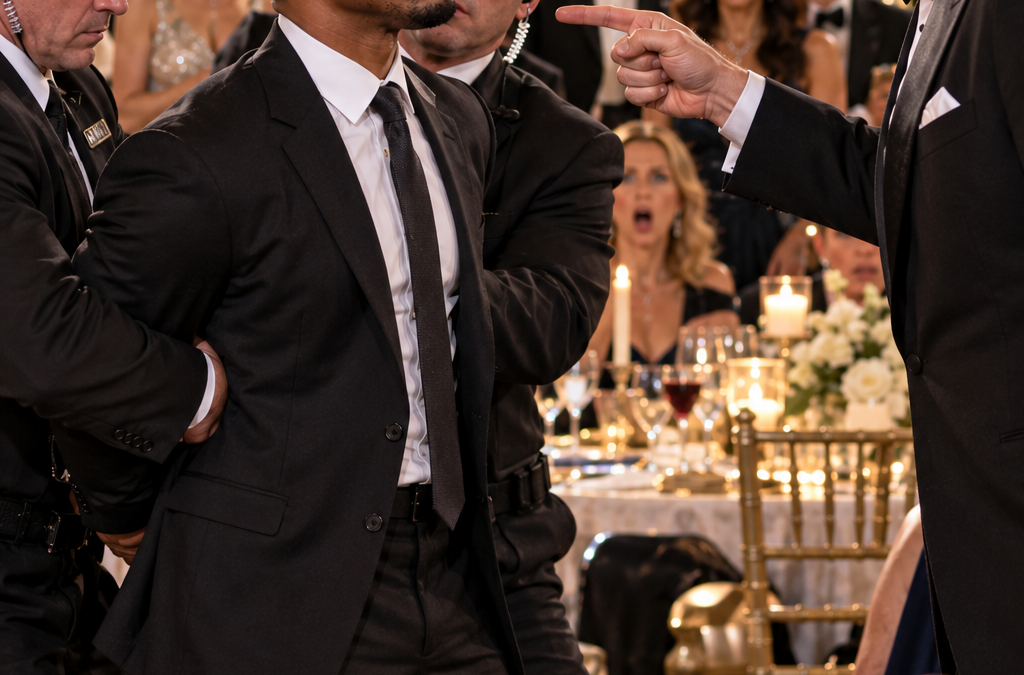
Two guards approached.
Henderson was not one of them.
These were ballroom contractors.
Black suits.
Earpieces.
Large men.
I stood before they reached me.
One said quietly, “Sir, we need you to come with us.”
“I understand.”
I buttoned my collar.
Then started walking.
I could leave.
I had proven nothing by staying.
Maybe enough was enough.
Then Garrett spoke into the microphone.
“No.”
I stopped.
“Don’t let him walk out like a gentleman.”
Laughter.
“Escort him properly.”
One guard took my arm.
Hard.
I kept moving.
“Check his pockets.”
The guard beside me hesitated.
Garrett repeated it.
“Check him.”
I looked at the guard.
“I haven’t taken anything.”
“I’m sorry, sir.”
He meant it.
That somehow made it worse.
“Arms up.”
I raised them.
Three hundred people watched.
He patted my chest.
Waist.
Pockets.
Pulled out my wallet.
Keys.
Then Mia’s photograph.
He looked at it.
A little girl smiling in her school uniform.
One front tooth missing.
Something changed in his face.
He returned it immediately.
“He’s clean.”
Garrett scoffed.
“Shoes.”
The guard looked down at my old polished shoes.
Then back up at me.
“No.”
Garrett blinked.
“What?”
“I said he’s clean.”
That small refusal mattered.
Not enough to erase what had happened.
But enough to remind me there was still a human being inside the uniform.
I lowered my arms.
The guards walked me toward the entrance.
We passed table four.
My original chair was empty.
We passed Priscilla.
She lifted her champagne.
“Bye-bye, sweetheart.”
I looked straight ahead.
The string quartet had stopped playing.
One violinist held her bow in the air.
She looked horrified.
Still, she said nothing.
Twelve steps from the doors.
Then eight.
Five.
The doors opened.
Not because we reached them.
Because someone outside pushed them inward.
Mayor Eleanor Hayes walked into the ballroom.
Silver hair.
Navy suit.
American flag pin.
Two aides behind her.
And a Ridgemont Tribune photographer already raising his camera.
Eleanor took three steps.
Stopped.
Her eyes moved across the room.
Garrett onstage.
The frozen crowd.
Two guards holding my arms.
My wrinkled shirt.
Then she looked directly at me.
Her face changed.
“Take your hands off that man.”
Nobody moved.
Eleanor did not raise her voice.
She never needed to.
“I said take your hands off him.”
The guards released me immediately.
She walked toward us.
Each heel strike echoed against marble.
People moved aside.
The photographer’s shutter began clicking.
Eleanor stopped in front of me.
Her eyes went to the stain on my collar.
The wrinkles where security had grabbed my shirt.
Then my face.
“Mr. Donovan.”
Every person in the room heard her.
“I am so sorry I’m late.”
She extended her hand.
I shook it.
“City Hall?”
“Budget meeting.”
“That sounds worse than this.”
Her eyes hardened.
“I doubt it.”
Then she turned toward the ballroom.
“Your seat is waiting.”
She pointed toward the head table.
Beside her own place card.
City seal.
Microphone.
Garrett stared from the stage.
“Mayor Hayes.”
His voice cracked.
“There’s been a misunderstanding.”
Eleanor turned.
“This man—”
“This man,” she interrupted, “is Blake Donovan.”
A few guests looked confused.
Then she added:
“Founder and chairman of Donovan Capital Group.”
The silence changed.
Some people recognized the company name immediately.
Eleanor let them.
“For anyone here who somehow does not know what that means, allow me to clarify.”
She faced the room.
“The new hospital expansion on Cedar Avenue.”
She pointed slightly toward the windows.
“Mr. Donovan financed it.”
No one moved.
“The Fifth Street Community Center.”
My throat tightened.
“Mr. Donovan funded its construction and three years of operations.”
Several people looked at me.
“The public library renovation.”
Eleanor continued.
“His foundation.”
She looked directly toward Garrett.
“After-school programs in every district.”
Pause.
“His foundation.”
Then she tilted her head toward the ceiling.
Everyone looked up.
The chandelier burned above us.
Eleanor’s voice lowered.
“And this building.”
Garrett’s hand slipped slightly from the podium.
“The Whitmore Grand Ballroom.”
She looked at him.
“The floor beneath your shoes, Mr. Holloway.”
Then the walls.
“The stage from which you just spoke.”
Then the chandelier.
“And every one of those lights.”
She returned her gaze to Garrett.
“Blake Donovan paid for them.”
I heard someone inhale sharply.
Priscilla’s champagne glass froze near her mouth.
Victoria stood at the reception desk with her clipboard hanging at her side.
Garrett looked at me.
Really looked.
For the first time all night.
And that was when I understood something.
He did not regret what he had done.
Not yet.
He regretted doing it to somebody rich.
That distinction mattered.
Eleanor led me to the head table.
I walked through the same crowd that had watched me being searched minutes earlier.
Same shirt.
Same shoes.
Same skin.
Nothing about me had changed.
Only their information had.
I sat.
White linen beneath my palms.
Crystal glass.
Silverware.
Above me, the same chandelier.
Garrett came down from the stage.
Fast.
His confidence had disappeared.
“Mr. Donovan.”
I looked at him.
“Please.”
He held both palms outward.
“This is a terrible misunderstanding.”
“I understood everything.”
“I didn’t know.”
That stopped me.
“You didn’t know.”
“No.”
He looked desperate.
“If I had known who you were—”
I leaned back.
“If you had known what?”
He froze.
“What would you have done differently?”
“Mr. Donovan—”
“You would have treated me like a human being?”
His mouth opened.
Nothing.
“That’s the problem.”
I kept my voice quiet.
“You treated me exactly the way you treat people who look like me.”
Garrett stared.
“The only thing that changed is now you know I’m rich.”
The room heard every word.
Priscilla appeared beside him.
“Mr. Donovan.”
Her smile trembled.
“My husband can be theatrical.”
I looked at her.
“We didn’t mean harm.”
“You called me a creature.”
She swallowed.
“It was in poor taste.”
“You told me this wasn’t a soup kitchen.”
Her smile vanished.
“All in good fun.”
“Was I supposed to laugh?”
She stepped backward.
Her heel caught a chair.
Nobody helped her.
Eleanor moved beside me.
“What happened tonight is not a misunderstanding.”
Her voice became official.
“This appears to be targeted racial discrimination at a civic event conducted in a publicly funded facility.”
Garrett went pale.
“Mayor, we can discuss this privately.”
Eleanor looked almost amused.
“Privately?”
“Please.”
“You stood on a stage and called this man an animal through a microphone.”
Garrett said nothing.
“You ordered security to search him.”
Silence.
“You had him physically escorted across a room containing hundreds of witnesses.”
Her eyes moved toward the phones.
“And apparently dozens of cameras.”
Garrett looked around.
For the first time, he seemed to notice how many people had recorded him.
“And now,” Eleanor said, “you would prefer privacy.”
He looked toward his friends.
The men who had laughed beside him earlier.
One stared at his plate.
Another checked his phone.
A third took a step backward.
Garrett was alone.
Power attracts company.
Consequences reveal it.
Eleanor turned toward security.
“Please escort Mr. and Mrs. Holloway from the building.”
Garrett’s head snapped toward her.
“You can’t.”
“I can.”
“This is my gala.”
“No.”
Eleanor’s voice was cold.
“Mr. Donovan’s foundation funded tonight’s event.”
She looked at the guards.
“Remove them.”
The same two men who had held my arms approached Garrett.
For one second, all four of us understood the irony.
One guard placed a hand at Garrett’s elbow.
Garrett pulled away.
“Don’t touch me.”
Nobody laughed.
The second guard moved behind him.
“Sir.”
Garrett looked at me.
I didn’t smile.
Didn’t gloat.
Priscilla clutched her purse.
They were escorted past the tables.
Past the bar.
Past the kitchen.
Through the same doors.
When they closed, the ballroom remained silent.
Then Eleanor sat beside me.
“You all right?”
“No.”
She nodded.
“Good answer.”
I looked at her.
“What happens now?”
She glanced around.
“Now everybody who stayed silent decides what story they’re going to tell themselves tomorrow.”
She was right.
The first video hit the internet before I left the ballroom.
Garrett pointing at me.
Calling me a stray dog.
Forty-three seconds.
By midnight, millions had watched it.
Then came the security search video.
Someone zoomed in on my face while the guard searched my pockets.
Caption:
THE MAN WHO FUNDED THE EVENT.
A third clip showed Priscilla.
“This isn’t a soup kitchen, sweetheart.”
By morning, Ridgemont was national news.
The Tribune ran a photograph across the front page.
Eleanor entering.
Me between the guards.
Chandelier behind us.
Headline:
THE MAN WHO BUILT THE ROOM THEY TRIED TO DRAG HIM OUT OF.
I hated the headline.
My communications director loved it.
“Blake, this matters.”
“I know.”
“You need to release a statement.”
“No.”
“People want to hear from you.”
“They heard enough.”
The internet moved faster than any investigation.
Within two days, former Holloway Industries employees began speaking publicly.
Black employees.
Former managers.
Warehouse workers.
Assistants.
Denise Turner had worked in marketing.
She described being passed over repeatedly.
Then told privately that certain clients were uncomfortable with a Black woman representing the company.
She complained.
Two weeks later, she was fired.
Jerome Watts had worked in a warehouse eleven years.
He said Black employees were routinely directed toward a side entrance near the loading docks.
Then he described Garrett visiting the facility and making a remark about “running a zoo.”
More people came forward.
Seventeen by the end of the week.
Then more.
The gala had not created Garrett Holloway.
It exposed him.
That mattered.
People kept asking why I had stayed quiet.
Why I didn’t identify myself immediately.
I never had a perfect answer.
Part of me wanted to leave.
Part of me wanted to shout.
Part of me wanted to call Eleanor before security ever touched me.
But another part kept remembering my father.
When I was fourteen, I once came home furious because a teacher accused me of cheating on a test.
I had scored higher than expected.
The teacher said the improvement was “suspicious.”
My father listened.
Then asked:
“Did you cheat?”
“No.”
“Then what do you know?”
“I know I earned it.”
“Good.”
“What am I supposed to do?”
“Tell the truth.”
“I did.”
“Then wait.”
“For what?”
“For the truth to stop needing your anger.”
At fourteen, I hated that answer.
At thirty-eight, I understood.
Holloway Industries removed Garrett as CEO seventy-two hours after the gala.
The board issued the predictable statement.
Values.
Inclusion.
Independent review.
I read it once.
Then asked my team a different question.
“How many people complained before the gala?”
They investigated.
Several.
Some formal.
Some informal.
Most buried.
That told me everything.
The company had discovered its values after the stock price noticed them.
The city opened a civil-rights investigation into the incident.
Thirty-one witnesses were interviewed.
Twenty-eight confirmed the central facts.
Three declined comment.
None disputed what occurred.
Footage did the rest.
Garrett eventually faced civil penalties and court-ordered consequences connected to the harassment and discrimination documented that night.
The most important part to me was not the fine.
It was the requirement that he return to the Whitmore Grand Ballroom and apologize publicly.
He stood on the same stage months later.
No tuxedo.
No cheering circle.
No whiskey.
He read an apology.
I did not attend.
People asked why.
Because the apology wasn’t for me.
A man should learn not to degrade others because degradation is wrong, not because one of the people he humiliated turned out to have money.
Priscilla filed for divorce soon afterward.
Victoria lost her position at the ballroom.
Several guests visible laughing in the videos faced their own professional consequences.
Board resignations.
Committee removals.
Questions from employers.
But the question that followed them most closely was simple:
Why didn’t you say anything?
I thought about that question often.
Three hundred people had been in that room.
Not everybody laughed.
That matters.
Some people looked horrified.
Some stared at their plates.
Some shifted uncomfortably.
Some probably hated everything Garrett said.
But almost none spoke.
Silence has different motives.
Fear.
Self-preservation.
Social pressure.
Shock.
But to the person standing alone, those differences can become invisible.
Silence sounds like agreement when you’re the target.
Six months after the gala, we renovated the Whitmore.
Not because the building needed structural work.
I had overseen enough of its financing to know the building was solid.
We changed something else.
A plaque went beside the entrance.
My staff wanted my photograph.
I refused.
They wanted a long inscription.
I refused that too.
The final plaque read:
THIS BUILDING WAS MADE POSSIBLE THROUGH THE GENEROSITY OF DONOVAN CAPITAL GROUP AND THE VISION OF ITS FOUNDER, BLAKE DONOVAN.
DEDICATED TO THE BELIEF THAT EVERY PERSON WHO WALKS THROUGH THESE DOORS BELONGS.
The word “belongs” was cut slightly deeper.
I never asked whether that was intentional.
I did not attend the unveiling.
Instead, I went to Mia’s school science fair.
She had built a bridge from wooden sticks.
It collapsed during judging.
She cried.
I told her it was the finest collapsed bridge I had ever seen.
She told me that was “not helpful.”
That afternoon meant more to me than the plaque.
The following spring, I launched the James Donovan Scholarship Fund.
Named for my father.
No ballroom.
No champagne.
No press line.
Full tuition for students from low-income minority families in Ridgemont.
Renewable for four years.
The first class had twelve students.
I met them at the Fifth Street Community Center.
I wore the white shirt.
Black trousers.
Same old shoes.
Same watch.
Mia told me it was becoming “a uniform.”
Maybe she was right.
After the ceremony, a seventeen-year-old student named Audrey Wells remained behind.
She held her scholarship letter in both hands.
“Mr. Donovan?”
“Yes?”
“Can I ask you something?”
“Of course.”
“How did you stay calm?”
I knew what she meant.
“At the gala.”
She nodded.
“When they were saying all of that.”
I looked at my watch.
My father’s scratched crystal.
“I wasn’t calm.”
She frowned.
“You looked calm.”
“Those aren’t the same thing.”
I thought carefully before continuing.
“I was angry.”
“Really?”
“Very.”
“Then why didn’t you yell?”
“Because my father taught me not to hand somebody control of my dignity just because they lost control of theirs.”
Audrey listened.
“He used to say the loudest person in the room is often the most afraid.”
“Was Garrett afraid?”
“I think so.”
“Of what?”
“Anybody he couldn’t place beneath himself.”
She looked down.
Then back up.
I touched the watch.
“My father also taught me dignity isn’t something another person gets to award you.”
Audrey nodded.
“You carry it.”
“Yes.”
“And eventually the room makes space?”
I smiled.
“Sometimes.”
“What if it doesn’t?”
“Build another room.”
She laughed.
“That sounds expensive.”
“It can be.”
A year after the incident, the Ridgemont City Charity Gala returned.
New organizers.
New sponsors.
New policies.
The guest list included teachers.
Nonprofit directors.
Small business owners.
Nurses.
Youth mentors.
People who had built things for others instead of simply buying expensive seats near powerful people.
Eleanor called me again.
“You’re attending.”
“I attended last year.”
“You were almost thrown out last year.”
“Exactly.”
“This one will be better.”
“That sounds like a threat.”
She laughed.
“Seven fifteen.”
I wore the same clothes.
Mia stood in the doorway as I dressed.
“You’re wearing those shoes again?”
“They’re good shoes.”
“They’re cracked.”
“They have character.”
“They have holes.”
“Small ones.”
She sighed.
“Rich people are weird.”
I kissed her forehead.
“You have no idea.”
I drove the Civic.
Parked two blocks away.
Walked toward the Whitmore.
The building looked identical.
Same marble.
Same windows.
Same chandelier visible through the entrance.
But when I reached the doors, nobody stopped me.
No suspicion.
No security call.
No clipboard.
I entered.
Three hundred people stood.
For one second, I almost stopped walking.
Then I understood.
They knew now.
That made the gesture complicated.
Respect is easiest when someone’s status has already been announced.
Still, I accepted it.
Not as proof that I had finally earned belonging.
I had belonged the year before.
That was the entire point.
I walked to the head table.
Sat.
Placed my hands on the white linen.
The chandelier burned above me.
Same light.
Same room.
I thought about the bare wooden table near the kitchen.
The smell of bleach.
My name moved like an object nobody wanted.
The security guard holding Mia’s photograph.
Garrett’s voice.
Boy.
Animal.
Nothing.
Then Eleanor walking through the doors.
Take your hands off that man.
I looked around the ballroom.
Some faces were new.
Some were not.
A few people who had been present the year before were there again.
One man approached me during dinner.
I recognized him.
Table six.
He had laughed.
Not loudly.
But enough.
“Mr. Donovan.”
I waited.
“I was here last year.”
“I remember.”
His face tightened.
“I didn’t say anything.”
“No.”
“I’ve thought about that every day.”
I believed him.
“I wish I had.”
“So do I.”
He swallowed.
“I’m sorry.”
I studied him.
Then nodded.
“Thank you.”
That was all.
Forgiveness does not require pretending the wound never happened.
But accountability can begin with naming the moment you failed.
Later that night, Eleanor sat beside me.
“Better?”
I looked around.
“Yes.”
“Good.”
“But not finished.”
She smiled.
“Cities never are.”
Neither are people.
Garrett’s story became something others talked about longer than I did.
His firing.
The investigation.
The divorce.
The legal bills.
His disappearing social circle.
People found satisfaction in watching powerful men fall.
I understood that.
But I never wanted his collapse to become the meaning of what happened.
If my victory required Garrett to suffer, then I had allowed him to remain at the center.
He wasn’t.
My father was.
Mia was.
Audrey.
The twelve scholarship students.
Denise Turner.
Jerome Watts.
Every person who had been told by someone with a louder voice, larger office, more expensive clothes, or lighter skin that they should be grateful merely to stand near the table.
That was what mattered.
Garrett believed belonging was hierarchical.
A private club.
Something wealthy white men like him distributed downward.
You belonged if he recognized you.
If your clothes were right.
If your name was familiar.
If your skin did not make him uncomfortable.
That worldview failed the moment Eleanor spoke my name.
But there was another danger inside that moment.
People suddenly respected me because I was wealthy.
That was not justice either.
I sometimes wondered what would have happened if Mayor Hayes had entered and said:
“His name is Blake Donovan. He works nights at a warehouse.”
Would they have apologized?
What if I had been unemployed?
Homeless?
A dishwasher?
What if the white shirt really had come from a donation bin?
Would Garrett’s words have become acceptable?
Of course not.
That was the lesson I wanted Ridgemont to keep.
The problem was never that Garrett accidentally insulted an important man.
The problem was that he believed some human beings were unimportant enough to insult.
A year after the second gala, Mia and I visited my father’s grave.
She carried flowers.
I brought nothing.
I usually didn’t.
Dad hated flowers.
“Waste of good money,” he used to say.
We sat on the grass.
Mia touched the watch on my wrist.
“Is that really Grandpa’s?”
“Yes.”
“Was he poor?”
I looked at her.
“We didn’t have much.”
“But you’re rich.”
“Now.”
“How?”
“That’s a very long conversation.”
She considered this.
“Did Grandpa know?”
“That I’d be successful?”
She nodded.
I looked at his name carved in stone.
“I think he expected me to work hard.”
“That’s different.”
“Yes.”
She leaned against me.
“Would he have been mad at that gala man?”
I smiled faintly.
“Very.”
“Would he have yelled?”
“No.”
“What would he do?”
I thought about James Donovan.
Hands rough from lumber.
Back bent from decades of work.
The quietest man I ever knew.
“He would’ve looked at Garrett until Garrett got uncomfortable.”
Mia laughed.
“That’s it?”
“That was enough when Grandpa did it.”
She was quiet.
Then asked:
“Why didn’t he own a house if he built houses?”
The question hit harder than she intended.
“Life wasn’t fair to him.”
“That’s dumb.”
“Yes.”
“Did that make him sad?”
“Sometimes.”
I touched the watch.
“But he was proud of what he built.”
I remembered his hands.
Measuring twice.
Cutting once.
Never leaving crooked work behind even when the owner would never know the difference.
My father taught me that your name did not need to be on a building for your work to live inside it.
He would have understood the Whitmore better than anyone.
That ballroom stood because thousands of people had worked on it.
Laborers.
Electricians.
Painters.
Carpenters.
Cleaners.
Servers.
Men and women whose names would never appear on plaques.
Garrett Holloway had spent an entire night talking about who deserved to belong in a room built by people he probably never noticed.
That was the deepest irony.
Not that I funded the building.
That he had mistaken money for ownership.
Nobody owns dignity.
Nobody owns belonging.
Nobody owns the right to decide which human being deserves respect.
The scholarship fund grew.
Twelve students became thirty.
Then sixty.
Audrey went to college.
Engineering.
She sent me a photograph on her first day.
Hard hat.
Safety glasses.
Huge smile.
Her message said:
BUILDING MY OWN ROOM.
I saved it.
Years later, I still sometimes wear that white shirt.
The old shoes finally died.
The left sole separated completely during a community-center visit.
Mia laughed for ten straight minutes.
I had them repaired.
She called that “psychotic.”
Maybe.
The watch still loses four minutes a month.
I still reset it.
And every year when the Ridgemont gala comes around, I walk beneath the chandelier.
Sometimes somebody points to it and tells me the story.
“You know Mr. Donovan paid for that.”
I usually smile.
“Yes.”
Then they tell me about the infamous night Garrett Holloway tried to throw the donor out.
The details change.
Stories do that.
Some versions say I knew exactly what would happen.
I didn’t.
Some say I planned Mayor Hayes’s entrance.
I didn’t.
Some say I sat silently because I wanted to destroy Garrett publicly.
That is not true either.
I sat silently because I was trying not to become as ugly as the room around me.
There is nothing heroic about being humiliated.
I wish people understood that.
Pain does not automatically make you noble.
Sometimes it just hurts.
When Garrett called me nothing, it hurt.
When three hundred people watched me being searched, it hurt.
When that place card was carried away from table four, I felt the old humiliation every Black man recognizes when someone decides your presence itself requires explanation.
What mattered was what happened after.
I did not allow that room to define me.
And later, when I had every opportunity to use my power the way Garrett had used his, I tried to do something different.
Scholarships.
Community centers.
Hospitals.
Libraries.
Rooms with doors that opened wider.
That was the only revenge I ever cared about.
Not making Garrett smaller.
Making the world around me larger.
One evening, years after the gala, Mia asked me why I still kept the original invitation.
I had framed it.
Not publicly.
It sat inside my home office beside one of her childhood drawings.
The corner was still bent where Victoria had handled it.
“Why keep something from a bad night?” she asked.
I looked at the gold letters.
BLAKE DONOVAN.
TABLE FOUR.
“Because it reminds me.”
“Of what?”
I thought for a moment.
“That paper was valid before security scanned it.”
She frowned.
“Okay.”
“My name belonged on the list before Victoria believed me.”
Mia listened.
“My seat belonged at the table before Garrett knew who I was.”
She nodded slowly.
“And?”
“And my dignity belonged to me before Mayor Hayes walked through the door.”
Mia smiled.
“That sounds like something Grandpa would say.”
“Probably.”
She pointed at the framed invitation.
“So you keep it because people are stupid?”
I laughed.
“That too.”
But later, after she left, I sat alone looking at it.
The ballroom had taught me something I thought I already knew.
Recognition and worth are not the same thing.
A room may recognize you late.
A company may recognize you only after public pressure.
A city may put your name on a plaque after watching someone try to erase it.
People may suddenly decide you matter once they learn what you own.
None of those things create your value.
They only reveal whether other people were capable of seeing it.
Garrett Holloway looked at me and saw cheap shoes.
White shirt.
Black skin.
A man who could safely be degraded.
He believed his mistake was not knowing my name.
He was wrong.
His mistake was believing there was any name I could have given him that would justify what he did.
That is why, when people ask me what I remember most about that night, I do not say Mayor Hayes’s entrance.
I do not say Garrett’s face.
I do not say the applause when I returned the following year.
I remember sitting beside the kitchen.
Bare table beneath my hands.
Bleach in the air.
My father’s watch ticking against my wrist.
Three hundred people in the next room.
And one thought running through my head.
I know who I am.
That sentence was enough.
It had to be.
Because there will always be rooms that do not know your name.
There will always be people who look at your clothes, your neighborhood, your job, your skin, your accent, your bank account, your education, and decide they have enough information to calculate your worth.
Sometimes the truth arrives dramatically.
A mayor walks through the doors.
A company name is announced.
A room discovers the man it mocked paid for the chandelier above its head.
Usually it does not.
Usually no mayor arrives.
No crowd gasps.
No powerful title saves you.
That is why dignity has to exist before recognition.
My father knew that.
He built mansions and went home to a rented apartment.
People who lived in those houses probably never remembered his name.
But every wall he framed stood straight.
Every door closed properly.
Every foundation held.
His worth was in the work long before anybody thanked him.
I spent years trying to become successful enough that he would know his sacrifices meant something.
Only later did I understand he never measured me that way.
He wanted me honest.
Useful.
Steady.
He wanted me to build things that lasted.
So that is what I kept doing.
Not because Garrett Holloway once said I didn’t belong.
Because James Donovan spent his life showing me what belonging actually means.
You belong where your work has made life better.
You belong beside the people you have helped.
You belong wherever you stand without surrendering the humanity of anyone standing beside you.
And no invitation, chandelier, fortune, title, or powerful man gets to decide otherwise.
𝗧𝗛𝗘 𝗘𝗡𝗗
The CEO Ordered Security to Drag Me Out of a Charity Gala in Front of 300 Guests Without Knowing Why My Name Was on the City’s Guest List
By the time Garrett Holloway ordered security to search my pockets in front of three hundred people, he had already called me an animal, moved my place card beside the kitchen, and announced through a microphone that men who looked like me did not belong in rooms like his.
I could have told him who I was at any moment, but my father had taught me something more important than proving a cruel man wrong: sometimes dignity means standing still long enough for the truth to enter the room on its own.
Three hours earlier, I stood in front of my bathroom mirror buttoning a white shirt.
The faucet dripped behind me.
Every few seconds, the light over the mirror flickered.
I was thirty-eight years old, raising my daughter alone in a two-bedroom apartment on the east side of Ridgemont, where streetlights worked when they felt like it and somebody had been promising to replace the broken mailboxes since the previous winter.
I owned better clothes.
Technically.
There were suits hanging in a storage closet across town.
There were people who would have delivered one to me if I called.
I did not call.
I wore the white shirt because my father had owned three good shirts in his entire adult life, and two of them had been white.
Black trousers.
Old black shoes.
The leather was cracked near the sole.
I had polished them carefully that morning until the toes caught the light.
Then I put on my father’s watch.
Silver.
Plain.
Scratched crystal.
Worn band.
It lost about four minutes every month.
I had been offered watches worth more than my apartment building.
I never wore them.
My father, James Donovan, built houses for other men for thirty-seven years.
Beautiful houses.
Stone fireplaces.
Wide staircases.
Bedrooms larger than the apartment he rented.
He could frame a wall by eye.
Lay foundations.
Hang doors so precisely they closed without a sound.
He spent his life building places he would never be invited to live in.
When he died, the watch was the only thing I wanted.
I fastened it around my wrist and looked at myself.
“Too plain?”
My daughter Mia stood in the bathroom doorway.
She was eight.
She had inherited my eyes and her mother’s ability to question every decision I made.
“You look like you’re going to work.”
“I am going to work.”
“You said it’s a party.”
“A charity gala.”
“That’s a party with boring speeches.”
I smiled.
“Something like that.”
She crossed her arms.
“Grandma said rich people wear ties.”
“Grandma is trying to get me strangled.”
Mia rolled her eyes.
“Daddy.”
“What?”
“You have ties.”
“I know.”
“Why aren’t you wearing one?”
I adjusted my collar.
“Because I don’t want to.”
She came closer and touched the watch.
“Grandpa’s?”
“Always.”
She nodded as if that made the outfit acceptable.
Her grandmother picked her up ten minutes later.
Before Mia left, she hugged me around the waist.
“You coming home tonight?”
“Late.”
“Promise?”
“I promise.”
She leaned back.
“Don’t work too much.”
“I’ll try.”
“You always say that.”
Then she was gone.
I stood alone in the kitchen.
On the counter lay the invitation.
Heavy cream-colored card stock.
Gold lettering.
ANNUAL RIDGEMONT CITY CHARITY GALA.
WHITMORE GRAND BALLROOM.
My name appeared beneath the city seal.
BLAKE DONOVAN.
TABLE FOUR.
I had read it four times since it arrived.
Not because I doubted its authenticity.
Because I had not attended the gala in years.
I hated those rooms.
Not the fundraising.
The theater around it.
Men talking about generosity while calculating who noticed their donations.
Women posing beside checks larger than the salaries of the people running the programs.
Corporate executives bidding twenty thousand dollars on vacation packages, then calling accountants Monday morning to ask what could be deducted.
Still, Mayor Eleanor Hayes had personally asked me to attend.
“You cannot keep funding half this city and refusing to meet anybody,” she told me over the phone.
“I meet people.”
“You meet construction crews.”
“They’re people.”
“You know exactly what I mean.”
I did.
The gala supported programs my foundation had financed for years.
Community housing.
After-school services.
Scholarships.
Public health initiatives.
I normally wrote checks and stayed home.
Eleanor finally cornered me.
“One night, Blake.”
“I hate galas.”
“I know.”
“One speech?”
“You don’t even have to give one.”
That should have warned me.
I agreed.
Then I drove my twelve-year-old Honda Civic downtown.
The passenger window had not worked properly in six months.
The engine rattled at red lights.
I could have replaced it.
I liked the car.
Nobody believed me when I said that.
I passed the hospital wing on Cedar Avenue.
New glass.
Six floors.
Emergency expansion.
My company had financed most of the construction through a public-private development package after the city’s original lender withdrew.
Two miles later, I passed the Fifth Street Community Center.
Children were still inside.
Basketball court lights glowing through the windows.
Three years earlier, that lot had been abandoned warehouses.
Then came the public library.
Renovated stone facade.
Glass children’s reading room.
Garden behind it.
I slowed at the light.
All three projects had one thing in common.
My name was nowhere visible.
That had been deliberate.
My father used to tell me that if you had to carve your name into everything you gave away, you were buying monuments, not helping people.
So most residents of Ridgemont had no idea who I was.
Donovan Capital Group was well known in financial circles.
Blake Donovan was not.
I preferred it that way.
That night, I almost learned the price of anonymity.
The Whitmore Grand Ballroom glowed from blocks away.
Limousines lined the curb.
Valets opened doors for people in tuxedos and evening gowns.
The chandelier was visible through the entrance.
It looked like frozen rain suspended above marble.
I parked two blocks away.
My Civic sat between a delivery van and a dented pickup.
Perfect.
I walked.
The closer I got, the louder the laughter became.
Inside, a string quartet played Vivaldi.
White linen covered every table.
Crystal glasses reflected gold light.
Silver trays moved between guests.
The air smelled of roses, champagne, and expensive perfume.
Then I stepped through the door.
I felt the change immediately.
Conversations did not stop.
They softened.
People looked.
Then looked away.
Then looked back.
A woman moved her purse closer to her body.
Two women near the bar whispered.
A man in a tuxedo looked at my shoes, then at my face, then deliberately turned his back.
I scanned the room.
Almost three hundred guests.
I was the only Black man there.
That did not surprise me as much as it should have.
I walked to the reception desk.
A woman sat behind it with her hair pulled into a severe bun.
Clipboard in hand.
Name tag:
VICTORIA ASHFORD.
“Good evening,” I said.
She looked up.
Her eyes traveled from my face to my shirt.
Then my shoes.
“Yes?”
“I’m here for the gala.”
She smiled very slightly.
“I can see that.”
I held out the invitation.
She took it with two fingers.
Turned it over.
Held it beneath the light.
Tilted it.
I waited.
“Where did you get this?”
“It was mailed to me.”
Her eyebrows rose.
“Mailed.”
“Yes.”
“To you.”
“Yes.”
Behind me, a white couple walked through.
Victoria’s entire face changed.
“Mr. and Mrs. Caldwell. Welcome back.”
No invitation requested.
No verification.
They smiled.
“Victoria.”
“Your usual table. Enjoy yourselves.”
They entered.
Another couple came.
She waved them through.
Then a man in a charcoal suit.
No questions.
Finally she turned back to me.
“Do you have identification?”
“Yes.”
Before I reached for my wallet, she picked up a phone.
“I need security at reception.”
I looked at her.
“For what?”
She spoke into the receiver.
“Possible forged invitation.”
She did not whisper.
People nearby heard.
A few turned.
One woman stepped farther away from me.
I felt something old and familiar settle in my stomach.
Not fear.
Recognition.
I had been twelve when a store clerk followed my father and me through a hardware store despite my father spending hundreds there every month.
Sixteen when a police officer stopped me walking home from basketball practice because I “matched a description.”
Twenty-seven when a banker assumed the white junior analyst beside me was the executive leading our acquisition meeting.
Thirty-two when a hotel employee handed me another guest’s luggage because he thought I worked there.
I knew the rhythm.
Question.
Doubt.
Suspicion.
Humiliation dressed as procedure.
A security officer approached.
Large man.
Name tag: HENDERSON.
Victoria handed him the invitation.
“Scan this.”
He did.
The tablet beeped.
He looked at the screen.
“It’s valid.”
Victoria blinked.
“Again.”
Henderson scanned it again.
“Valid.”
“Check the master list.”
He typed.
Then read.
“Blake Donovan. Confirmed guest. Table four.”
Victoria’s mouth tightened.
She took the invitation back.
She did not hand it to me.
She placed it on the desk.
“Fine.”
Then she wrote something on her clipboard.
Slowly.
Deliberately.
I picked up my invitation.
Smoothed the corner she had bent.
Victoria spoke to Henderson without looking at me.
“Keep an eye on him.”
Henderson shifted.
“Ma’am—”
“If anything goes missing tonight, we know where to start.”
I looked at her.
For one moment, anger almost won.
I could have told her.
One phone call.
One sentence.
My name is on half the financial documents that paid for this building.
Instead, I remembered my father.
Don’t let people bait you into becoming the thing they already decided you are.
I put the invitation in my pocket.
“Have a good evening.”
Victoria stared.
I entered the ballroom.
My name appeared on the seating chart.
Table four.
Near the center.
I started toward it.
I made eleven steps.
“Excuse me.”
A loud male voice came from behind.
I turned.
Garrett Holloway.
I knew the name.
Most people in Ridgemont did.
CEO of Holloway Industries.
Fifty-two.
Industrial holdings.
Manufacturing.
Real estate.
Government contracts.
A man accustomed to being introduced before entering rooms.
He wore a tuxedo tailored perfectly to his body.
Gold cufflinks.
Large Rolex.
Silver hair slicked back.
Scotch in one hand.
He was already flushed from drinking.
Three men stood around him.
Two women.
All smiling.
Garrett pointed toward me.
“Where exactly do you think you’re going?”
“Table four.”
He laughed.
His friends laughed too.
“Table four?”
“Yes.”
Garrett wiped beneath one eye as if I had made him cry with amusement.
“Table four is for donors.”
“I know.”
“Not staff.”
“I’m not staff.”
He looked at my clothes.
Then my shoes.
The laughter returned.
“What are you, then?”
“A guest.”
“Really.”
“Yes.”
He stepped closer.
His cologne was strong enough to taste.
“Because I look at you and see somebody who walked in off the street.”
I said nothing.
“Cheap shirt.”
His eyes dropped.
“No tie.”
Then my shoes.
“Those things look donated.”
One of the men laughed.
Garrett smiled.
“You’re an embarrassment.”
My thumb brushed my father’s watch.
Tick.
Tick.
Tick.
“I have an invitation.”
“So?”
“My assigned seat is table four.”
His expression changed.
The performance became something uglier.
“Let me explain something.”
He stepped closer.
“People like you don’t sit at table four.”
I stared at him.
“People like me?”
“You heard me.”
“No. I want to hear you explain it.”
One of his friends stopped smiling.
Garrett did not.
“People like you bus those tables.”
His voice lowered.
“People like you mop the floor after we leave.”
I felt heat in my face.
He continued.
“That’s the natural order.”
He pushed one finger against my chest.
“And some piece of paper doesn’t change what you are.”
A waiter nearby stopped moving.
Garrett leaned closer.
“Or what your skin means in a room like this.”
Phones began appearing around us.
One.
Three.
Five.
People recording.
I did not move.
“I’d like to sit down.”
Garrett laughed loudly.
“He’d like to sit down!”
People turned.
“He wants to sit with us.”
More laughter.
Then Garrett’s voice sharpened.
“Listen to me, boy.”
The word landed differently.
Always does.
“The only seat you deserve is outside.”
My jaw tightened.
He saw it.
Enjoyed it.
“The curb.”
He stepped closer.
“The gutter.”
Then, smiling:
“The back of a bus.”
Someone gasped.
Nobody intervened.
Garrett’s spit touched my collar when he spoke next.
“Your skin makes this room dirty.”
I looked at him.
“I’m just here for the gala.”
“Not belonging,” he said slowly, “is something men like you should learn early.”
His wife joined us.
Priscilla Holloway.
Red gown.
Pearls.
Champagne.
She looked at me as if I smelled bad.
“Garrett, darling, why is this creature still here?”
Garrett laughed.
“Excellent question.”
Then he snapped his fingers at a young banquet worker.
“You.”
The boy stopped.
“Move his place setting.”
The worker looked confused.
“To the staff table.”
Garrett pointed toward the kitchen.
“Put him near the dishwashers.”
The boy looked at me.
Then Garrett.
Then went to table four.
I watched him lift my place card.
BLAKE DONOVAN.
Gold lettering.
He carried it across the ballroom.
Set it on a bare table beside the swinging kitchen doors.
No white linen.
No flowers.
No candles.
Just wood.
I could have stopped it.
Instead, I followed my name.
I sat.
Steam escaped every time the kitchen doors opened.
Plates clattered.
Industrial cleaner replaced the scent of flowers.
Waiters moved around me without acknowledgment.
Priscilla walked past.
She stopped.
“This isn’t a soup kitchen, sweetheart.”
Then smiled.
“Don’t get comfortable.”
I watched her leave.
My hands rested on the bare tabletop.
Above us hung the chandelier.
Huge.
Custom built.
Imported crystal.
I knew exactly what it had cost.
I knew because Donovan Capital had paid the invoice.
That almost made me laugh.
Twenty minutes passed.
Nobody brought water.
A couple seated nearby complained about sitting close to me.
They were moved immediately.
The auction began.
Aspen villa.
Vintage Porsche.
Vineyard weekend.
Paddles rose.
Garrett bid loudly.
He loved being watched.
Then came the speeches.
He walked onto the stage.
Adjusted the microphone.
Straightened his cufflinks.
“Ladies and gentlemen.”
Applause.
“Tonight is about community.”
I looked down.
“About people who built this city.”
More applause.
“People who matter.”
That phrase stayed with me.
People who matter.
Garrett smiled.
“Ridgemont is a jewel.”
He gripped the podium.
“And like every jewel, it has to be protected.”
I knew where this was going.
“Protected from people who want what they haven’t earned.”
His eyes found me.
Hundreds of heads turned.
“Protected from people who show up where they are not wanted and pretend they have a right to be there.”
He raised his drink toward me.
“Speaking of which.”
Laughter.
“Somebody let the wrong crowd in tonight.”
I remained seated.
Garrett’s confidence grew with every laugh.
“We spend hundreds of thousands on events like this.”
He gestured around.
“Caterers. Musicians. Wine worth more than some people’s mortgages.”
A man near the stage chuckled.
“And then somebody crawls in from the street smelling like bus exhaust and food stamps.”
The laughter came harder.
I looked around.
Men slapping tables.
Women hiding smiles behind glasses.
Phones recording.
And people who looked uncomfortable but remained silent.
That last group hurt most.
Cruel people are predictable.
Cowards are more dangerous because they convince themselves silence makes them innocent.
Garrett set down his drink.
His smile disappeared.
“I’m serious.”
He pointed at me.
“That man sitting by the kitchen like a stray dog that followed the catering truck inside does not belong here.”
The room quieted.
“He is not a donor.”
I almost smiled.
“He is not a partner.”
Wrong again.
“He is not a colleague.”
True.
“He is nothing.”
That one made my chest tighten.
Not because I believed him.
Because Mia’s photograph was folded inside my wallet.
Because my father’s watch was ticking on my wrist.
Because James Donovan had died believing his son had become something.
Because Garrett’s word was not aimed only at me.
Men like Garrett rarely insult one individual.
They insult entire histories.
“He is taking up space,” Garrett continued, “breathing the same air as people who actually contribute to society.”
Nobody objected.
Three hundred people.
Nobody.
He turned toward security.
“Remove him.”
Two guards approached.
Henderson was not one of them.
These were ballroom contractors.
Black suits.
Earpieces.
Large men.
I stood before they reached me.
One said quietly, “Sir, we need you to come with us.”
“I understand.”
I buttoned my collar.
Then started walking.
I could leave.
I had proven nothing by staying.
Maybe enough was enough.
Then Garrett spoke into the microphone.
“No.”
I stopped.
“Don’t let him walk out like a gentleman.”
Laughter.
“Escort him properly.”
One guard took my arm.
Hard.
I kept moving.
“Check his pockets.”
The guard beside me hesitated.
Garrett repeated it.
“Check him.”
I looked at the guard.
“I haven’t taken anything.”
“I’m sorry, sir.”
He meant it.
That somehow made it worse.
“Arms up.”
I raised them.
Three hundred people watched.
He patted my chest.
Waist.
Pockets.
Pulled out my wallet.
Keys.
Then Mia’s photograph.
He looked at it.
A little girl smiling in her school uniform.
One front tooth missing.
Something changed in his face.
He returned it immediately.
“He’s clean.”
Garrett scoffed.
“Shoes.”
The guard looked down at my old polished shoes.
Then back up at me.
“No.”
Garrett blinked.
“What?”
“I said he’s clean.”
That small refusal mattered.
Not enough to erase what had happened.
But enough to remind me there was still a human being inside the uniform.
I lowered my arms.
The guards walked me toward the entrance.
We passed table four.
My original chair was empty.
We passed Priscilla.
She lifted her champagne.
“Bye-bye, sweetheart.”
I looked straight ahead.
The string quartet had stopped playing.
One violinist held her bow in the air.
She looked horrified.
Still, she said nothing.
Twelve steps from the doors.
Then eight.
Five.
The doors opened.
Not because we reached them.
Because someone outside pushed them inward.
Mayor Eleanor Hayes walked into the ballroom.
Silver hair.
Navy suit.
American flag pin.
Two aides behind her.
And a Ridgemont Tribune photographer already raising his camera.
Eleanor took three steps.
Stopped.
Her eyes moved across the room.
Garrett onstage.
The frozen crowd.
Two guards holding my arms.
My wrinkled shirt.
Then she looked directly at me.
Her face changed.
“Take your hands off that man.”
Nobody moved.
Eleanor did not raise her voice.
She never needed to.
“I said take your hands off him.”
The guards released me immediately.
She walked toward us.
Each heel strike echoed against marble.
People moved aside.
The photographer’s shutter began clicking.
Eleanor stopped in front of me.
Her eyes went to the stain on my collar.
The wrinkles where security had grabbed my shirt.
Then my face.
“Mr. Donovan.”
Every person in the room heard her.
“I am so sorry I’m late.”
She extended her hand.
I shook it.
“City Hall?”
“Budget meeting.”
“That sounds worse than this.”
Her eyes hardened.
“I doubt it.”
Then she turned toward the ballroom.
“Your seat is waiting.”
She pointed toward the head table.
Beside her own place card.
City seal.
Microphone.
Garrett stared from the stage.
“Mayor Hayes.”
His voice cracked.
“There’s been a misunderstanding.”
Eleanor turned.
“This man—”
“This man,” she interrupted, “is Blake Donovan.”
A few guests looked confused.
Then she added:
“Founder and chairman of Donovan Capital Group.”
The silence changed.
Some people recognized the company name immediately.
Eleanor let them.
“For anyone here who somehow does not know what that means, allow me to clarify.”
She faced the room.
“The new hospital expansion on Cedar Avenue.”
She pointed slightly toward the windows.
“Mr. Donovan financed it.”
No one moved.
“The Fifth Street Community Center.”
My throat tightened.
“Mr. Donovan funded its construction and three years of operations.”
Several people looked at me.
“The public library renovation.”
Eleanor continued.
“His foundation.”
She looked directly toward Garrett.
“After-school programs in every district.”
Pause.
“His foundation.”
Then she tilted her head toward the ceiling.
Everyone looked up.
The chandelier burned above us.
Eleanor’s voice lowered.
“And this building.”
Garrett’s hand slipped slightly from the podium.
“The Whitmore Grand Ballroom.”
She looked at him.
“The floor beneath your shoes, Mr. Holloway.”
Then the walls.
“The stage from which you just spoke.”
Then the chandelier.
“And every one of those lights.”
She returned her gaze to Garrett.
“Blake Donovan paid for them.”
I heard someone inhale sharply.
Priscilla’s champagne glass froze near her mouth.
Victoria stood at the reception desk with her clipboard hanging at her side.
Garrett looked at me.
Really looked.
For the first time all night.
And that was when I understood something.
He did not regret what he had done.
Not yet.
He regretted doing it to somebody rich.
That distinction mattered.
Eleanor led me to the head table.
I walked through the same crowd that had watched me being searched minutes earlier.
Same shirt.
Same shoes.
Same skin.
Nothing about me had changed.
Only their information had.
I sat.
White linen beneath my palms.
Crystal glass.
Silverware.
Above me, the same chandelier.
Garrett came down from the stage.
Fast.
His confidence had disappeared.
“Mr. Donovan.”
I looked at him.
“Please.”
He held both palms outward.
“This is a terrible misunderstanding.”
“I understood everything.”
“I didn’t know.”
That stopped me.
“You didn’t know.”
“No.”
He looked desperate.
“If I had known who you were—”
I leaned back.
“If you had known what?”
He froze.
“What would you have done differently?”
“Mr. Donovan—”
“You would have treated me like a human being?”
His mouth opened.
Nothing.
“That’s the problem.”
I kept my voice quiet.
“You treated me exactly the way you treat people who look like me.”
Garrett stared.
“The only thing that changed is now you know I’m rich.”
The room heard every word.
Priscilla appeared beside him.
“Mr. Donovan.”
Her smile trembled.
“My husband can be theatrical.”
I looked at her.
“We didn’t mean harm.”
“You called me a creature.”
She swallowed.
“It was in poor taste.”
“You told me this wasn’t a soup kitchen.”
Her smile vanished.
“All in good fun.”
“Was I supposed to laugh?”
She stepped backward.
Her heel caught a chair.
Nobody helped her.
Eleanor moved beside me.
“What happened tonight is not a misunderstanding.”
Her voice became official.
“This appears to be targeted racial discrimination at a civic event conducted in a publicly funded facility.”
Garrett went pale.
“Mayor, we can discuss this privately.”
Eleanor looked almost amused.
“Privately?”
“Please.”
“You stood on a stage and called this man an animal through a microphone.”
Garrett said nothing.
“You ordered security to search him.”
Silence.
“You had him physically escorted across a room containing hundreds of witnesses.”
Her eyes moved toward the phones.
“And apparently dozens of cameras.”
Garrett looked around.
For the first time, he seemed to notice how many people had recorded him.
“And now,” Eleanor said, “you would prefer privacy.”
He looked toward his friends.
The men who had laughed beside him earlier.
One stared at his plate.
Another checked his phone.
A third took a step backward.
Garrett was alone.
Power attracts company.
Consequences reveal it.
Eleanor turned toward security.
“Please escort Mr. and Mrs. Holloway from the building.”
Garrett’s head snapped toward her.
“You can’t.”
“I can.”
“This is my gala.”
“No.”
Eleanor’s voice was cold.
“Mr. Donovan’s foundation funded tonight’s event.”
She looked at the guards.
“Remove them.”
The same two men who had held my arms approached Garrett.
For one second, all four of us understood the irony.
One guard placed a hand at Garrett’s elbow.
Garrett pulled away.
“Don’t touch me.”
Nobody laughed.
The second guard moved behind him.
“Sir.”
Garrett looked at me.
I didn’t smile.
Didn’t gloat.
Priscilla clutched her purse.
They were escorted past the tables.
Past the bar.
Past the kitchen.
Through the same doors.
When they closed, the ballroom remained silent.
Then Eleanor sat beside me.
“You all right?”
“No.”
She nodded.
“Good answer.”
I looked at her.
“What happens now?”
She glanced around.
“Now everybody who stayed silent decides what story they’re going to tell themselves tomorrow.”
She was right.
The first video hit the internet before I left the ballroom.
Garrett pointing at me.
Calling me a stray dog.
Forty-three seconds.
By midnight, millions had watched it.
Then came the security search video.
Someone zoomed in on my face while the guard searched my pockets.
Caption:
THE MAN WHO FUNDED THE EVENT.
A third clip showed Priscilla.
“This isn’t a soup kitchen, sweetheart.”
By morning, Ridgemont was national news.
The Tribune ran a photograph across the front page.
Eleanor entering.
Me between the guards.
Chandelier behind us.
Headline:
THE MAN WHO BUILT THE ROOM THEY TRIED TO DRAG HIM OUT OF.
I hated the headline.
My communications director loved it.
“Blake, this matters.”
“I know.”
“You need to release a statement.”
“No.”
“People want to hear from you.”
“They heard enough.”
The internet moved faster than any investigation.
Within two days, former Holloway Industries employees began speaking publicly.
Black employees.
Former managers.
Warehouse workers.
Assistants.
Denise Turner had worked in marketing.
She described being passed over repeatedly.
Then told privately that certain clients were uncomfortable with a Black woman representing the company.
She complained.
Two weeks later, she was fired.
Jerome Watts had worked in a warehouse eleven years.
He said Black employees were routinely directed toward a side entrance near the loading docks.
Then he described Garrett visiting the facility and making a remark about “running a zoo.”
More people came forward.
Seventeen by the end of the week.
Then more.
The gala had not created Garrett Holloway.
It exposed him.
That mattered.
People kept asking why I had stayed quiet.
Why I didn’t identify myself immediately.
I never had a perfect answer.
Part of me wanted to leave.
Part of me wanted to shout.
Part of me wanted to call Eleanor before security ever touched me.
But another part kept remembering my father.
When I was fourteen, I once came home furious because a teacher accused me of cheating on a test.
I had scored higher than expected.
The teacher said the improvement was “suspicious.”
My father listened.
Then asked:
“Did you cheat?”
“No.”
“Then what do you know?”
“I know I earned it.”
“Good.”
“What am I supposed to do?”
“Tell the truth.”
“I did.”
“Then wait.”
“For what?”
“For the truth to stop needing your anger.”
At fourteen, I hated that answer.
At thirty-eight, I understood.
Holloway Industries removed Garrett as CEO seventy-two hours after the gala.
The board issued the predictable statement.
Values.
Inclusion.
Independent review.
I read it once.
Then asked my team a different question.
“How many people complained before the gala?”
They investigated.
Several.
Some formal.
Some informal.
Most buried.
That told me everything.
The company had discovered its values after the stock price noticed them.
The city opened a civil-rights investigation into the incident.
Thirty-one witnesses were interviewed.
Twenty-eight confirmed the central facts.
Three declined comment.
None disputed what occurred.
Footage did the rest.
Garrett eventually faced civil penalties and court-ordered consequences connected to the harassment and discrimination documented that night.
The most important part to me was not the fine.
It was the requirement that he return to the Whitmore Grand Ballroom and apologize publicly.
He stood on the same stage months later.
No tuxedo.
No cheering circle.
No whiskey.
He read an apology.
I did not attend.
People asked why.
Because the apology wasn’t for me.
A man should learn not to degrade others because degradation is wrong, not because one of the people he humiliated turned out to have money.
Priscilla filed for divorce soon afterward.
Victoria lost her position at the ballroom.
Several guests visible laughing in the videos faced their own professional consequences.
Board resignations.
Committee removals.
Questions from employers.
But the question that followed them most closely was simple:
Why didn’t you say anything?
I thought about that question often.
Three hundred people had been in that room.
Not everybody laughed.
That matters.
Some people looked horrified.
Some stared at their plates.
Some shifted uncomfortably.
Some probably hated everything Garrett said.
But almost none spoke.
Silence has different motives.
Fear.
Self-preservation.
Social pressure.
Shock.
But to the person standing alone, those differences can become invisible.
Silence sounds like agreement when you’re the target.
Six months after the gala, we renovated the Whitmore.
Not because the building needed structural work.
I had overseen enough of its financing to know the building was solid.
We changed something else.
A plaque went beside the entrance.
My staff wanted my photograph.
I refused.
They wanted a long inscription.
I refused that too.
The final plaque read:
THIS BUILDING WAS MADE POSSIBLE THROUGH THE GENEROSITY OF DONOVAN CAPITAL GROUP AND THE VISION OF ITS FOUNDER, BLAKE DONOVAN.
DEDICATED TO THE BELIEF THAT EVERY PERSON WHO WALKS THROUGH THESE DOORS BELONGS.
The word “belongs” was cut slightly deeper.
I never asked whether that was intentional.
I did not attend the unveiling.
Instead, I went to Mia’s school science fair.
She had built a bridge from wooden sticks.
It collapsed during judging.
She cried.
I told her it was the finest collapsed bridge I had ever seen.
She told me that was “not helpful.”
That afternoon meant more to me than the plaque.
The following spring, I launched the James Donovan Scholarship Fund.
Named for my father.
No ballroom.
No champagne.
No press line.
Full tuition for students from low-income minority families in Ridgemont.
Renewable for four years.
The first class had twelve students.
I met them at the Fifth Street Community Center.
I wore the white shirt.
Black trousers.
Same old shoes.
Same watch.
Mia told me it was becoming “a uniform.”
Maybe she was right.
After the ceremony, a seventeen-year-old student named Audrey Wells remained behind.
She held her scholarship letter in both hands.
“Mr. Donovan?”
“Yes?”
“Can I ask you something?”
“Of course.”
“How did you stay calm?”
I knew what she meant.
“At the gala.”
She nodded.
“When they were saying all of that.”
I looked at my watch.
My father’s scratched crystal.
“I wasn’t calm.”
She frowned.
“You looked calm.”
“Those aren’t the same thing.”
I thought carefully before continuing.
“I was angry.”
“Really?”
“Very.”
“Then why didn’t you yell?”
“Because my father taught me not to hand somebody control of my dignity just because they lost control of theirs.”
Audrey listened.
“He used to say the loudest person in the room is often the most afraid.”
“Was Garrett afraid?”
“I think so.”
“Of what?”
“Anybody he couldn’t place beneath himself.”
She looked down.
Then back up.
I touched the watch.
“My father also taught me dignity isn’t something another person gets to award you.”
Audrey nodded.
“You carry it.”
“Yes.”
“And eventually the room makes space?”
I smiled.
“Sometimes.”
“What if it doesn’t?”
“Build another room.”
She laughed.
“That sounds expensive.”
“It can be.”
A year after the incident, the Ridgemont City Charity Gala returned.
New organizers.
New sponsors.
New policies.
The guest list included teachers.
Nonprofit directors.
Small business owners.
Nurses.
Youth mentors.
People who had built things for others instead of simply buying expensive seats near powerful people.
Eleanor called me again.
“You’re attending.”
“I attended last year.”
“You were almost thrown out last year.”
“Exactly.”
“This one will be better.”
“That sounds like a threat.”
She laughed.
“Seven fifteen.”
I wore the same clothes.
Mia stood in the doorway as I dressed.
“You’re wearing those shoes again?”
“They’re good shoes.”
“They’re cracked.”
“They have character.”
“They have holes.”
“Small ones.”
She sighed.
“Rich people are weird.”
I kissed her forehead.
“You have no idea.”
I drove the Civic.
Parked two blocks away.
Walked toward the Whitmore.
The building looked identical.
Same marble.
Same windows.
Same chandelier visible through the entrance.
But when I reached the doors, nobody stopped me.
No suspicion.
No security call.
No clipboard.
I entered.
Three hundred people stood.
For one second, I almost stopped walking.
Then I understood.
They knew now.
That made the gesture complicated.
Respect is easiest when someone’s status has already been announced.
Still, I accepted it.
Not as proof that I had finally earned belonging.
I had belonged the year before.
That was the entire point.
I walked to the head table.
Sat.
Placed my hands on the white linen.
The chandelier burned above me.
Same light.
Same room.
I thought about the bare wooden table near the kitchen.
The smell of bleach.
My name moved like an object nobody wanted.
The security guard holding Mia’s photograph.
Garrett’s voice.
Boy.
Animal.
Nothing.
Then Eleanor walking through the doors.
Take your hands off that man.
I looked around the ballroom.
Some faces were new.
Some were not.
A few people who had been present the year before were there again.
One man approached me during dinner.
I recognized him.
Table six.
He had laughed.
Not loudly.
But enough.
“Mr. Donovan.”
I waited.
“I was here last year.”
“I remember.”
His face tightened.
“I didn’t say anything.”
“No.”
“I’ve thought about that every day.”
I believed him.
“I wish I had.”
“So do I.”
He swallowed.
“I’m sorry.”
I studied him.
Then nodded.
“Thank you.”
That was all.
Forgiveness does not require pretending the wound never happened.
But accountability can begin with naming the moment you failed.
Later that night, Eleanor sat beside me.
“Better?”
I looked around.
“Yes.”
“Good.”
“But not finished.”
She smiled.
“Cities never are.”
Neither are people.
Garrett’s story became something others talked about longer than I did.
His firing.
The investigation.
The divorce.
The legal bills.
His disappearing social circle.
People found satisfaction in watching powerful men fall.
I understood that.
But I never wanted his collapse to become the meaning of what happened.
If my victory required Garrett to suffer, then I had allowed him to remain at the center.
He wasn’t.
My father was.
Mia was.
Audrey.
The twelve scholarship students.
Denise Turner.
Jerome Watts.
Every person who had been told by someone with a louder voice, larger office, more expensive clothes, or lighter skin that they should be grateful merely to stand near the table.
That was what mattered.
Garrett believed belonging was hierarchical.
A private club.
Something wealthy white men like him distributed downward.
You belonged if he recognized you.
If your clothes were right.
If your name was familiar.
If your skin did not make him uncomfortable.
That worldview failed the moment Eleanor spoke my name.
But there was another danger inside that moment.
People suddenly respected me because I was wealthy.
That was not justice either.
I sometimes wondered what would have happened if Mayor Hayes had entered and said:
“His name is Blake Donovan. He works nights at a warehouse.”
Would they have apologized?
What if I had been unemployed?
Homeless?
A dishwasher?
What if the white shirt really had come from a donation bin?
Would Garrett’s words have become acceptable?
Of course not.
That was the lesson I wanted Ridgemont to keep.
The problem was never that Garrett accidentally insulted an important man.
The problem was that he believed some human beings were unimportant enough to insult.
A year after the second gala, Mia and I visited my father’s grave.
She carried flowers.
I brought nothing.
I usually didn’t.
Dad hated flowers.
“Waste of good money,” he used to say.
We sat on the grass.
Mia touched the watch on my wrist.
“Is that really Grandpa’s?”
“Yes.”
“Was he poor?”
I looked at her.
“We didn’t have much.”
“But you’re rich.”
“Now.”
“How?”
“That’s a very long conversation.”
She considered this.
“Did Grandpa know?”
“That I’d be successful?”
She nodded.
I looked at his name carved in stone.
“I think he expected me to work hard.”
“That’s different.”
“Yes.”
She leaned against me.
“Would he have been mad at that gala man?”
I smiled faintly.
“Very.”
“Would he have yelled?”
“No.”
“What would he do?”
I thought about James Donovan.
Hands rough from lumber.
Back bent from decades of work.
The quietest man I ever knew.
“He would’ve looked at Garrett until Garrett got uncomfortable.”
Mia laughed.
“That’s it?”
“That was enough when Grandpa did it.”
She was quiet.
Then asked:
“Why didn’t he own a house if he built houses?”
The question hit harder than she intended.
“Life wasn’t fair to him.”
“That’s dumb.”
“Yes.”
“Did that make him sad?”
“Sometimes.”
I touched the watch.
“But he was proud of what he built.”
I remembered his hands.
Measuring twice.
Cutting once.
Never leaving crooked work behind even when the owner would never know the difference.
My father taught me that your name did not need to be on a building for your work to live inside it.
He would have understood the Whitmore better than anyone.
That ballroom stood because thousands of people had worked on it.
Laborers.
Electricians.
Painters.
Carpenters.
Cleaners.
Servers.
Men and women whose names would never appear on plaques.
Garrett Holloway had spent an entire night talking about who deserved to belong in a room built by people he probably never noticed.
That was the deepest irony.
Not that I funded the building.
That he had mistaken money for ownership.
Nobody owns dignity.
Nobody owns belonging.
Nobody owns the right to decide which human being deserves respect.
The scholarship fund grew.
Twelve students became thirty.
Then sixty.
Audrey went to college.
Engineering.
She sent me a photograph on her first day.
Hard hat.
Safety glasses.
Huge smile.
Her message said:
BUILDING MY OWN ROOM.
I saved it.
Years later, I still sometimes wear that white shirt.
The old shoes finally died.
The left sole separated completely during a community-center visit.
Mia laughed for ten straight minutes.
I had them repaired.
She called that “psychotic.”
Maybe.
The watch still loses four minutes a month.
I still reset it.
And every year when the Ridgemont gala comes around, I walk beneath the chandelier.
Sometimes somebody points to it and tells me the story.
“You know Mr. Donovan paid for that.”
I usually smile.
“Yes.”
Then they tell me about the infamous night Garrett Holloway tried to throw the donor out.
The details change.
Stories do that.
Some versions say I knew exactly what would happen.
I didn’t.
Some say I planned Mayor Hayes’s entrance.
I didn’t.
Some say I sat silently because I wanted to destroy Garrett publicly.
That is not true either.
I sat silently because I was trying not to become as ugly as the room around me.
There is nothing heroic about being humiliated.
I wish people understood that.
Pain does not automatically make you noble.
Sometimes it just hurts.
When Garrett called me nothing, it hurt.
When three hundred people watched me being searched, it hurt.
When that place card was carried away from table four, I felt the old humiliation every Black man recognizes when someone decides your presence itself requires explanation.
What mattered was what happened after.
I did not allow that room to define me.
And later, when I had every opportunity to use my power the way Garrett had used his, I tried to do something different.
Scholarships.
Community centers.
Hospitals.
Libraries.
Rooms with doors that opened wider.
That was the only revenge I ever cared about.
Not making Garrett smaller.
Making the world around me larger.
One evening, years after the gala, Mia asked me why I still kept the original invitation.
I had framed it.
Not publicly.
It sat inside my home office beside one of her childhood drawings.
The corner was still bent where Victoria had handled it.
“Why keep something from a bad night?” she asked.
I looked at the gold letters.
BLAKE DONOVAN.
TABLE FOUR.
“Because it reminds me.”
“Of what?”
I thought for a moment.
“That paper was valid before security scanned it.”
She frowned.
“Okay.”
“My name belonged on the list before Victoria believed me.”
Mia listened.
“My seat belonged at the table before Garrett knew who I was.”
She nodded slowly.
“And?”
“And my dignity belonged to me before Mayor Hayes walked through the door.”
Mia smiled.
“That sounds like something Grandpa would say.”
“Probably.”
She pointed at the framed invitation.
“So you keep it because people are stupid?”
I laughed.
“That too.”
But later, after she left, I sat alone looking at it.
The ballroom had taught me something I thought I already knew.
Recognition and worth are not the same thing.
A room may recognize you late.
A company may recognize you only after public pressure.
A city may put your name on a plaque after watching someone try to erase it.
People may suddenly decide you matter once they learn what you own.
None of those things create your value.
They only reveal whether other people were capable of seeing it.
Garrett Holloway looked at me and saw cheap shoes.
White shirt.
Black skin.
A man who could safely be degraded.
He believed his mistake was not knowing my name.
He was wrong.
His mistake was believing there was any name I could have given him that would justify what he did.
That is why, when people ask me what I remember most about that night, I do not say Mayor Hayes’s entrance.
I do not say Garrett’s face.
I do not say the applause when I returned the following year.
I remember sitting beside the kitchen.
Bare table beneath my hands.
Bleach in the air.
My father’s watch ticking against my wrist.
Three hundred people in the next room.
And one thought running through my head.
I know who I am.
That sentence was enough.
It had to be.
Because there will always be rooms that do not know your name.
There will always be people who look at your clothes, your neighborhood, your job, your skin, your accent, your bank account, your education, and decide they have enough information to calculate your worth.
Sometimes the truth arrives dramatically.
A mayor walks through the doors.
A company name is announced.
A room discovers the man it mocked paid for the chandelier above its head.
Usually it does not.
Usually no mayor arrives.
No crowd gasps.
No powerful title saves you.
That is why dignity has to exist before recognition.
My father knew that.
He built mansions and went home to a rented apartment.
People who lived in those houses probably never remembered his name.
But every wall he framed stood straight.
Every door closed properly.
Every foundation held.
His worth was in the work long before anybody thanked him.
I spent years trying to become successful enough that he would know his sacrifices meant something.
Only later did I understand he never measured me that way.
He wanted me honest.
Useful.
Steady.
He wanted me to build things that lasted.
So that is what I kept doing.
Not because Garrett Holloway once said I didn’t belong.
Because James Donovan spent his life showing me what belonging actually means.
You belong where your work has made life better.
You belong beside the people you have helped.
You belong wherever you stand without surrendering the humanity of anyone standing beside you.
And no invitation, chandelier, fortune, title, or powerful man gets to decide otherwise.








