𝗙𝗨𝗟𝗟 𝗦𝗧𝗢𝗥𝗬 The CEO Called Me a Cockroach and Bet His Entire Company My Rusted Chevy Couldn’t Beat His Ferrari—He Never Asked What I Had Built Under the Hood
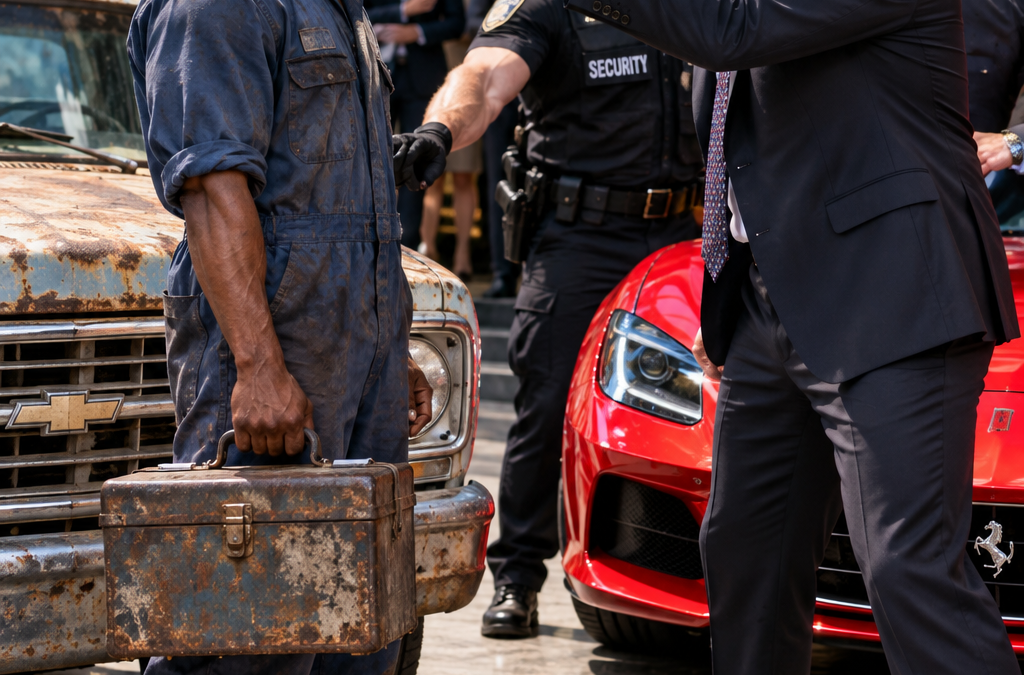
𝗙𝗨𝗟𝗟 𝗦𝗧𝗢𝗥𝗬
Tommy nodded like he’d discovered gravity.
Preston shook his hand.
“This is exactly the kind of initiative that separates leaders from laborers.”
Leaders from laborers.
I stood outside the glass holding a tool case.
Nobody noticed me.
Not even Tommy.
I watched my own work receive applause.
Then I turned around.
Ray Whitfield found me near the tool cage that afternoon.
Ray had worked at Apex fourteen years.
Good technician.
Good man.
The kind of person who saw more than he said.
“I saw it.”
I kept sorting sockets.
“Saw what?”
“Don’t do that.”
I looked at him.
He lowered his voice.
“Your report.”
I turned back to the drawer.
“Yeah.”
“Tommy stole it.”
“Looks that way.”
“I can say something.”
I stopped.
“To who?”
He didn’t answer.
“Preston?”
Silence.
“The same man who just shook his hand?”
Ray looked away.
We both understood.
A company tells you what it values through what it rewards.
Apex rewarded confidence.
Appearance.
Credentials.
Proximity to power.
Good work mattered too.
But mostly after the right person claimed it.
That was the first drop.
The second came during a visit from German investors.
Preston transformed the building for them.
Flowers in the lobby.
Polished floors.
Catering.
A string quartet in the atrium.
Apex usually smelled like coolant and burnt coffee.
That day it smelled like orchids.
I was carrying a diagnostic case toward Line Four when two security guards blocked the main corridor.
“Freight elevator.”
“It’s down.”
“Contractors still use the service route.”
“The service route is the freight elevator.”
One guard shrugged.
“Then stairs.”
The investors stood twenty feet away.
Watching.
Preston came through the lobby with his executive group.
He saw me.
Saw security.
Saw the investors looking.
For one second, I thought he might solve the problem.
Instead he said loudly:
“Rules exist for a reason.”
Then he looked at the investors.
“We can’t have people wandering where they don’t belong.”
People.
Not technicians.
Not staff.
People.
I carried the case up eleven flights.
By the time I reached Line Four, sweat had soaked through the back of my shirt.
Tommy was waiting.
He leaned against a railing.
“Rough commute?”
I set my tools down.
He smiled.
“You know what your problem is?”
I ignored him.
“You don’t know your place.”
I removed a panel.
“Guys like you are useful.”
I reached inside.
“Good with your hands.”
He leaned closer.
“But that’s the ceiling.”
I tightened a connection.
“You’ll never be anything more than a pair of hands.”
I looked at him.
“Hands are enough.”
He laughed.
“Whatever helps you sleep.”
The third drop came on Friday night.
11:47 p.m.
I was alone on the east floor when Line Four screamed.
Machines have different sounds when they fail.
Grinding.
Chatter.
Bearing howl.
Electrical arc.
This was worse.
Cascading servo-controller failure.
Three robotic arms locked midcycle.
Emergency alarms lit the floor red.
If production remained down past midnight, Apex would miss a delivery deadline for its largest automotive client.
$2.3 million.
I called the night supervisor.
Voicemail.
Called controls engineering.
No answer.
Called operations.
One manager said he’d “see who he could find.”
Nobody came.
So I worked.
The main controller had corrupted firmware.
I isolated it.
Bypassed a failed control module.
Rerouted power.
Rebuilt a temporary logic sequence.
Then recalibrated all three arms manually.
A secondary electrical failure killed overhead lighting on the east side.
For nearly an hour, I worked with a flashlight clenched between my teeth.
At 4:02 a.m., Line Four restarted.
First cycle.
Clean.
Second.
Clean.
I ran thirty.
No fault.
Production resumed.
The shipment left on time.
Monday morning, the incident report appeared.
CAUSE: CONTROLLER CASCADE FAILURE.
RESPONSE: OVERNIGHT MAINTENANCE TEAM RESTORED PRODUCTION.
TEAM.
There was no team.
There was me.
No name.
No four hours and thirteen minutes.
No manual calibration.
No mention of the $2.3 million deadline.
Ray found me reading it beside the cracked coffee pot on the manufacturing floor.
“I put your name in my original draft.”
I folded the report.
“I figured.”
“Somebody removed it.”
“I figured that too.”
“Aren’t you going to do anything?”
I slipped it into my back pocket.
“What?”
“Say something.”
I looked at him.
“Ray, they’ve already heard me.”
He frowned.
“When?”
“Every day.”
I nodded toward Line Four.
“They just don’t listen.”
That was the way I lived.
Work.
Fix.
Go home.
I told myself the work would eventually become impossible to ignore.
My grandmother had raised me to believe that.
Eloise Crawford.
Five feet two.
Seamstress.
Hands stronger than most men’s.
She raised me after machines killed both my parents.
I was nine.
My mother worked mornings at a packaging facility outside Baton Rouge.
My father worked evenings at the same plant.
Their shifts overlapped eleven minutes.
Enough time to trade keys in the parking lot.
Enough time for my father to kiss my mother’s cheek.
Enough time for a faulty hydraulic press to kill them both.
The press had a damaged safety interlock.
Management knew.
Two weeks.
No repair.
Production couldn’t stop.
That’s what the investigation found.
Production couldn’t stop.
Two people could.
I went to live with Grandma Eloise.
Shotgun house.
Dirt road.
Sewing machine in the front room.
She hemmed church dresses, repaired uniforms, patched work pants.
People also brought broken appliances.
Fans.
Radios.
Toasters.
Window AC units.
Not because Grandma knew electronics.
Because throwing things away cost more than letting a poor woman try.
She would turn a broken object over in her hands.
Study it.
Then say:
“Everything broken has a logic to its breaking.”
I heard that sentence ten thousand times.
“Find the logic, and you find the fix.”
At ten, I dismantled box fans.
At twelve, lawnmowers.
At fourteen, carburetors.
By sixteen, neighbors started paying me.
Not much.
Five dollars.
Ten.
Sometimes food.
Nobody taught me formally.
I learned through library books.
Service manuals.
Junkyards.
Mistakes.
Mistakes were important.
People talk about natural talent because it makes excellence sound magical.
It isn’t.
Most skill is surviving enough failure to recognize it earlier next time.
College wasn’t possible.
Trade school was.
Even that was difficult.
My high school counselor looked at my grades and said:
“You’re a hands-on kid.”
He meant I wasn’t academic material.
I understood.
I went to work anyway.
Grandma got cancer when I was twenty-one.
By then I had moved to Atlanta for industrial maintenance work.
Every Friday after shift, I drove six hours home.
Sunday night, six back.
For months.
On her last night, she held my hands.
Grease in the cracks.
Scars.
Calluses.
She turned them over beneath the lamp.
“Hands don’t lie.”
I smiled.
“People do.”
“That’s why I’m talking about hands.”
Her breathing was shallow.
“Show them what your hands can do.”
She squeezed.
“And the mouth won’t matter.”
She died the next morning.
For years, I treated those words like scripture.
Don’t argue.
Don’t explain.
Build.
Fix.
Let work answer disrespect.
It was useful.
It was also incomplete.
Because silence has a cost.
If you never correct people who erase you, eventually your erasure becomes documentation.
If you never claim your work, somebody else will.
If you accept a number long enough, people forget you have a name.
I had not understood that yet when Preston Holloway noticed my truck.
1989 Chevrolet C1500.
Rust everywhere.
Dents on both doors.
Primer patch along the rear quarter panel.
Clear coat gone.
Interior stripped.
Bench seat replaced twice.
To most people, it looked dead.
To me, it was autobiography.
I found it in a Baton Rouge scrapyard when I was fifteen.
No engine.
Cracked windshield.
Rusted bed.
Owner wanted four hundred.
I had two hundred.
He laughed.
Then accepted.
I spent three years rebuilding it.
First engine died.
Second lasted six months.
Third became something different.
Years later, I found an LS3 block from a wrecked Camaro.
Bored cylinders.
Forged internals.
Upgraded fuel system.
Hand-fabricated headers.
Custom turbo setup.
Intercooler tucked behind a grille so ugly nobody looked twice.
Six hundred fifty horsepower.
Light frame.
Minimal interior.
No sound insulation.
No luxury.
Nothing unnecessary.
It looked slow because I never cared what speed looked like.
That became important on the day of Apex’s annual technology showcase.
Three hundred people attended.
Employees.
Vendors.
Clients.
Press.
Preston loved showcase day.
It gave him a microphone.
That afternoon, somebody mentioned my Chevy.
I don’t know who.
Maybe Tommy.
Maybe one of the younger engineers.
Preston had just finished showing off his Ferrari 488 Pista.
Beautiful car.
Red.
Seven hundred ten horsepower.
Three hundred fifty thousand dollars.
A machine designed by brilliant people.
I respected it.
Preston assumed I envied it.
He found me standing near the loading bay.
Pointed toward my truck.
“That’s yours?”
“Yes, sir.”
He laughed.
The people around him laughed because he had.
“That pile of scrap metal?”
“It’s special.”
That amused him more.
He took the showcase microphone.
“Everybody.”
People turned.
He pointed at me.
“This is Isaac.”
He paused.
I almost smiled.
First time he’d said my name publicly.
“Maintenance contractor.”
The emphasis corrected whatever dignity my name might have created.
“Isaac thinks his rust bucket is special.”
I said, “I didn’t say it was better than anything.”
Preston grinned.
“Would it beat my Ferrari?”
People laughed.
I looked at the Pista.
Then my truck.
“Probably.”
The laughter stopped.
Preston stared.
“What?”
I should have stayed quiet.
Old habit.
Instead, something in me had become tired.
I repeated:
“Probably.”
That was when he made the bet.
“If that pile of scrap metal can beat my Ferrari—”
He spread one arm toward the building.
“I’ll transfer the entire company to you.”
The crowd roared.
I looked at him.
He walked closer.
Grin turning ugly.
Then his eyes moved over my coveralls.
Grease.
Dark skin.
Barcode badge.
“Look at you.”
He laughed into the microphone.
“Grease-covered face.”
A few people near him shifted.
“Like a cockroach crawling around my display case.”
Some laughed harder.
Others didn’t.
Preston liked the reaction anyway.
I said quietly, “I’m just here to keep your machines running.”
“My machines.”
He emphasized it.
“You can barely keep that truck alive.”
“It’s a special truck.”
“Oh, really?”
He pointed toward the Ferrari.
“A gutter comparing itself to the ocean.”
More laughter.
I looked at him.
Then at my Chevy.
Then back.
“Rust and cockroaches have something in common.”
He raised an eyebrow.
“What?”
“Hard to kill.”
A few people laughed differently that time.
Not at me.
Preston’s smile tightened.
The race didn’t happen that day.
The showcase schedule moved on.
But the bet was recorded.
Hundreds of phones.
Corporate cameras.
Witnesses.
Preston forgot almost immediately.
I didn’t.
Three weeks later, the Pentagon shortlist arrived.
$120 million.
Precision robotic assembly systems for military drone manufacturing.
For Apex, it was transformative.
For Preston, it was immortality.
Trade magazines.
Defense contracts.
Investor confidence.
He turned the building upside down preparing.
Two consultants arrived.
Dr. Alan Marsh from MIT.
Gregory Dunn from Carnegie Mellon.
Combined fee: $280,000.
They wore matching confidence.
I listened to their planning from the calibration lab.
Servo selection.
Load profiles.
Resonance modeling.
Cycle tolerances.
Within twenty minutes, I knew they were building failure.
Preston had approved cheaper servo motors.
Saved eighteen thousand dollars.
The new motors oscillated under load at a frequency dangerously close to the natural resonance of the existing gearbox housings.
142 hertz.
144 hertz.
Two numbers.
Two hertz apart.
Nothing by themselves.
Together?
Destruction.
I knew because I had already written the report.
The one Tommy stole.
I considered saying something.
Then remembered the conference room.
The freight elevator.
The nameless incident report.
Cockroach.
I remained silent.
Two weeks before the Pentagon evaluation, the first prototype failed.
I heard it before I saw it.
High mechanical whine.
Pitch rising.
Then a crack like a gunshot.
The arm tore itself apart.
Gears hit concrete.
Sparks.
People ran.
The consultants stared.
Preston arrived fourteen minutes later.
Tie loose.
Face red.
“What happened?”
Marsh talked about material fatigue.
Dunn mentioned supplier inconsistencies.
They were describing symptoms.
Not cause.
I was thirty feet away replacing cable housing.
I knew the cause.
I also knew nobody had asked me.
One week later, the second prototype failed.
Worse.
The arm seized.
Bent the mounting bracket.
Cracked the steel platform.
Two technicians dove behind a bench.
Metal fragments struck the barrier.
Nobody got hurt.
Luck.
Marsh and Dunn resigned the next morning.
“Insufficient infrastructure.”
“Unforeseen compatibility issues.”
$280,000 gone.
Two prototypes destroyed.
Pentagon visit in two weeks.
Preston called everyone to the manufacturing floor.
Engineers.
Technicians.
Contractors.
Fifty people.
The wreckage lay behind him.
He paced.
“I want solutions.”
Nobody spoke.
“Not theories.”
Silence.
“Solutions.”
He pointed toward the broken arms.
“Whoever fixes this can name their price.”
Still nothing.
I stood in the back.
Where contractors stood.
Rag in my hand.
Then Ray stepped out of line.
His hands were shaking.
His voice wasn’t.
“Isaac already found it.”
Every head turned.
Preston stopped.
“What?”
“Isaac Crawford.”
Ray pointed at me.
“He filed a report three weeks ago.”
Tommy went pale.
“Resonance-frequency mismatch between the new servo motors and the old gearbox housings.”
Ray looked at Preston.
“It was timestamped.”
Silence.
Preston stared at me.
“Explain.”
I set down my rag.
Walked forward.
People moved aside.
I stood beside the first broken arm.
“The new servo motors oscillate at approximately 142 hertz under load.”
A few engineers glanced at each other.
“The gearbox housings have a natural resonance near 144.”
I pointed to the fracture pattern.
“When they’re coupled at operating speed, the vibration amplifies.”
I traced the cracked mounting surface.
“At roughly six thousand cycles, bolt fatigue exceeds tolerance.”
I looked up.
“The housing tears itself apart from inside.”
Nobody spoke.
Tommy stared at the floor.
Preston said, “You’re maintenance.”
Not thank you.
Not how did we miss this?
Maintenance.
“You don’t have credentials for resonance analysis.”
“That’s what happened.”
“How do you know?”
“I listened.”
He laughed once.
“The gearbox told you?”
“Yes.”
More silence.
“And you can fix it?”
“I can.”
That was when he built the trap.
“Seventy-two hours.”
I stared.
“Two arms.”
He pointed.
“No new parts.”
My jaw tightened.
“No team.”
Ray started to speak.
Preston held up his hand.
“You fix both.”
He stepped closer.
“You succeed, I’ll acknowledge you publicly when the Pentagon arrives.”
I knew that promise was cheap.
“You fail—”
He smiled.
“You’re done.”
I didn’t move.
“And I’ll make sure no Apex vendor hires you again.”
There it was.
Not opportunity.
Execution with extra steps.
I almost refused.
Then a voice from behind us said:
“I’d like to witness it.”
Everyone turned.
Vernon Steele.
Sixty-eight.
Gray beard.
Thirty-one years at Cummins Engineering.
Six years consulting for NASA at Stennis.
Apex Technical Advisory Board.
The kind of engineer younger engineers quoted in papers.
He had been sitting near the exit.
I hadn’t noticed.
Vernon walked to the wreckage.
Picked up a fractured bolt.
Studied it.
“I saw this once.”
He looked at me.
“Stennis. 1994.”
Then at Preston.
“Resonance coupling.”
Preston’s jaw tightened.
Vernon continued.
“The engineer who caught it didn’t have a degree either.”
Nobody said anything.
“I will observe the seventy-two hours.”
Preston frowned.
“That’s not necessary.”
“It is now.”
Vernon looked at him.
“Every decision documented.”
Then:
“If Mr. Crawford’s work is sound, my name goes on the technical verification.”
Preston couldn’t say no.
Not with Pentagon evaluators coming.
“Fine.”
He looked at me.
“Clock starts now.”
Then walked away.
Vernon pulled a folding chair beside the wreckage.
Set down a thermos.
Sat.
“Whenever you’re ready.”
I looked at the two broken machines.
Then at my hands.
Grandma’s voice:
Hands don’t lie.
Hour one.
I touched no tools.
That confused everyone.
I studied.
Fractures.
Wear.
Heat marks.
Fastener deformation.
Cable tension.
Oil patterns.
A failed machine is a crime scene.
If you start repairing before understanding the failure, you destroy evidence.
Then I began disassembly.
Every component.
Every bolt.
Every washer.
Every harness.
Sorted on concrete.
System.
Function.
Size.
Three hundred forty pieces from the first arm.
Then the second.
The floor looked like a mechanical autopsy.
Upstairs, engineers watched through security feeds.
Tommy said I was making a mess.
Vernon drank coffee.
Hour four.
I tested the motors.
One at a time.
Full speed.
Against bench surfaces.
Concrete.
Steel.
Then my own chest.
People laughed when they saw that.
I could feel frequency through bone.
Grandma’s backyard had been my laboratory long before Apex owned million-dollar analyzers.
Hour eight.
Chalk.
Floor.
142 Hz.
144 Hz.
Arrow.
COUPLING.
Vernon brought down a frequency analyzer.
Tested.
He looked at me.
Nodded.
Just once.
That nod meant more than every performance review I’d never been allowed to receive.
Diagnosis solved.
Fix remained.
Correct industrial solution?
Replace the servos.
Original specification.
Stuttgart supplier.
Fourteen-day lead time.
I had sixty-four hours.
So I stopped thinking like procurement.
I thought like a kid in a Louisiana backyard with no money and a broken machine.
You don’t ask what part you’re missing.
You ask what physical behavior needs to change.
The problem wasn’t that the motors were bad.
The problem was that the frequencies aligned destructively.
Change one frequency.
Problem gone.
I went to the manual lathe.
Found aerospace-grade aluminum stock.
Designed a damping collar.
Not on CAD.
On paper first.
Dimensions.
Mass.
Placement.
Target resonance shift.
Three hertz.
144 down to approximately 141.
Enough separation from the 142-hertz servo input to prevent coupling under load.
I ran the calculations twice.
Vernon watched.
“You sure?”
“No.”
He smiled.
“Good answer.”
I looked at him.
He tapped the drawing.
“People who are sure before cutting metal worry me.”
Then I machined.
The first collar took almost four hours.
Manual lathe.
Two-thousandths tolerance.
One slip, scrap.
The cutting tool sang.
Metal curled in silver ribbons.
My shoulders burned.
Hour twenty.
Nadine Lawson came down.
Vice President of Operations.
I had seen her many times.
She had never spoken to me longer than thirty seconds.
She watched for forty minutes.
No questions.
Then left.
Hour twenty-eight.
Third collar.
Hour thirty.
Fourth.
I tested them.
Frequency shifted.
Destructive harmonic gone.
Vernon measured each collar with a micrometer.
Twice.
Then set the instrument down.
For several seconds, he simply looked at me.
Craftsmen recognize each other differently than managers recognize workers.
Managers ask credentials.
Craftsmen look at the work.
“Good,” he said.
One word.
I heard more respect in it than Preston had shown me in four years.
Then reassembly.
That’s where the job became bigger.
While disassembling the arms, I found twelve additional defects.
Cable routing that wasted travel.
Excess wrist weight.
Blocked lubrication passage.
Poorly seated connector.
Uneven torque.
None caused the catastrophic failure.
All reduced efficiency or life.
I fixed them.
Vernon asked:
“Part of the assignment?”
“No.”
“Then why?”
I looked at him.
“It’s open.”
He waited.
“So?”
“If the machine is open and I see something wrong, I fix it.”
He smiled.
“That’s an engineer.”
I said, “I’m maintenance.”
He didn’t smile anymore.
“No.”
Then walked back to his chair.
Hour forty.
My hands started shaking.
Small tremor.
Fatigue.
I ignored it.
Vernon didn’t.
“Sleep.”
“No.”
“Four hours.”
“I don’t have four.”
“You don’t have steady hands either.”
I kept working.
He stood.
Walked over.
Put one hand on my shoulder.
“Your hands are the tool.”
I stopped.
“Tools require maintenance.”
That sounded like Grandma.
I hated that it worked.
I lay on cardboard.
Used folded coveralls as a pillow.
Sleep came in ninety seconds.
Three hours fifty minutes later, Vernon kicked the sole of my boot.
“Up.”
I was moving before fully awake.
Cold water.
Coffee.
Back to work.
Hour fifty-eight.
Both arms assembled.
Collars seated.
Wiring corrected.
Lubrication restored.
Weight reduced.
I connected power.
The whole floor had gathered by then.
Not physically.
Through cameras.
Windows.
Screens.
Preston upstairs.
Tommy behind glass.
Nadine.
Engineers.
I pressed activation.
First arm moved.
Smooth.
Second followed.
Synchronized cycle.
Pick.
Place.
Weld simulation.
Return.
No chatter.
No vibration spike.
No resonance.
Cycle time displayed.
1.4 seconds faster than factory specification.
Vernon checked vibration.
Torque.
Position accuracy.
Again.
Again.
Then he turned toward the security camera.
Looked directly into the lens.
“These are the best calibrated assembly arms I have seen in forty years.”
Seven words.
Upstairs, Tommy put down his coffee.
I stood between the machines.
Grease on my face.
Sweat dried into my coveralls.
Bloodshot eyes.
Hands steady again.
For the first time, evidence had my name attached before anyone else could claim it.
Pentagon day arrived Tuesday.
Apex became a theater again.
Polished floors.
Executive presentations.
Preston in his best suit.
Three officers.
Two civilian engineers.
One procurement director who looked like smiling would violate policy.
The delegation came downstairs.
The arms stood center stage.
Preston gave his presentation.
“Our engineering team demonstrated extraordinary resilience.”
I stood in the back.
Barcode badge.
“Through innovative leadership and rapid problem-solving—”
My jaw tightened.
Still no name.
The demonstration began.
Flawless.
Precision.
Speed.
Load.
Repeatability.
The Pentagon engineers leaned closer.
Then one crouched.
Pointed at the custom collar.
“What’s this?”
Preston froze.
“It’s part of our modification package.”
“Not in your documentation.”
Preston looked at Tommy.
Tommy looked down.
Then Vernon cleared his throat.
“Perhaps the person who designed and machined it should answer.”
Every head turned.
Toward me.
I walked forward.
First time in four years I had crossed from the back of an Apex presentation because someone asked me to.
The engineer said:
“You made this?”
“Yes, sir.”
“Explain.”
So I did.
142 hertz.
Coupling.
Fatigue.
Damping collar.
Frequency shift.
Tolerance.
The twelve additional changes.
Cycle improvement.
They asked questions.
Real questions.
Materials.
Thermal expansion.
Long-term wear.
Maintenance interval.
Failure probability.
I answered all of them.
Nobody interrupted to ask whether I had a degree.
The procurement director looked at my badge.
“What is your title?”
I glanced at Preston.
“Contract maintenance technician.”
The director stared.
Then underlined something twice in his notebook.
Vernon said quietly:
“Those are the most capable hands in this building.”
Afterward, Preston stood in front of cameras.
Smiled.
Took credit without technically taking credit.
That’s a corporate skill.
“Visionary leadership means knowing when to trust your team.”
I heard him from the hall.
I almost walked away.
Then Vernon stepped into the lobby.
“Mr. Holloway.”
Preston turned.
Vernon spoke loudly enough for reporters, Pentagon staff, employees and cameras.
“Three weeks ago you made a wager.”
Preston’s smile vanished.
I knew immediately.
“You stated publicly that if Mr. Crawford’s truck could beat your Ferrari, you would transfer ownership of Apex Dynamics to him.”
The lobby went silent.
Preston laughed weakly.
“That was obviously humor.”
“Three hundred witnesses.”
Vernon pointed toward a camera.
“Video.”
The procurement director stopped writing.
Vernon continued.
“Will you honor your word?”
He paused.
“Or should we discuss executive integrity while your prospective federal partners are present?”
I looked at Vernon.
He didn’t look back.
Preston’s face reddened.
He was trapped by the thing he valued most.
Appearance.
He still believed he could win.
That saved him from refusing.
“Fine.”
He loosened his tie.
“Right now.”
Then looked at me.
“Let’s finish it.”
We used the service road behind the Apex campus.
Quarter mile.
Straight.
Employees poured outside.
Pentagon delegation stood near the fence.
Phones everywhere.
Preston climbed into his Ferrari.
488 Pista.
710 horsepower.
Launch control.
Traction management.
Italian engineering.
Beautiful.
I climbed into my Chevy.
Someone laughed.
Not as many this time.
Preston revved.
Ferrari screamed.
My truck idled rough.
Rust vibrating.
Ray walked to my window.
“You sure?”
“No.”
He looked terrified.
I smiled.
“But I built it.”
He stepped away.
Vernon stood near the start.
Green.
Ferrari launched.
Perfect.
For the first two hundred yards, Preston led.
Exactly as expected.
Then boost came in.
Turbo spooled.
The truck changed character.
People heard it.
That rising whistle.
Then the hit.
Six hundred fifty horsepower through a lighter chassis.
My Chevy surged.
The Ferrari stopped gaining.
Then started coming backward relative to me.
I passed him.
Not by inches.
At the line, roughly three car lengths.
For one second, I heard nothing.
Then the world exploded.
People screamed.
Ran.
Phones shook.
Someone started chanting:
“Isaac!”
Then more.
“Isaac!”
I shut down.
Opened the door.
Climbed out.
Vernon reached me first.
He put both hands on my shoulders.
Didn’t speak.
I smiled.
Actually smiled.
Ray stood nearby crying.
I pretended not to see.
Across the road, Preston sat inside the Ferrari.
Hands frozen on the wheel.
His engine still running.
Race finished.
That should have been the end.
It wasn’t.
Because Preston had made the bet publicly.
His lawyers spent the evening trying to find a way around it.
Witnesses.
Recorded statement.
Pentagon observers.
Corporate governance complications.
Eventually they prepared transfer documents.
Not simple.
Not truly as effortless as “here are the keys.”
But enough legal structure was created to honor the public commitment under board supervision.
Preston sat across the conference table.
His hand shook as he signed.
Then the documents came to me.
I read the first page.
Then looked at Preston.
At Nadine.
Vernon.
Ray.
The company.
The glass tower.
All the places I had never been invited.
I pushed the papers back.
“I don’t want it.”
Everyone stared.
Preston looked up.
“What?”
“I don’t want your company.”
He actually looked offended.
Like refusing the prize insulted him more than beating the Ferrari.
“You won.”
“I know.”
“Then take it.”
“No.”
Nadine said, “Isaac, do you understand—”
“I understand.”
I looked toward my badge.
Still hanging there.
Barcode.
“I never wanted the office.”
Silence.
“Never wanted his title.”
I pointed to Preston.
“Never wanted my name on the building.”
Ray covered his mouth.
“I wanted one thing.”
Nobody moved.
“A badge.”
Preston stared.
“With my photograph.”
My throat tightened unexpectedly.
“And my name.”
I touched the barcode.
“Not a shipping label.”
Nobody laughed.
“Full-time employee.”
I looked at Nadine.
“Real benefits.”
Then I added:
“And every contractor gets names too.”
She blinked.
“Every contractor?”
“Photo badges.”
“Isaac—”
“No more barcodes.”
I looked around.
“If they work here, call them by their names.”
Silence.
Then the Pentagon procurement director stepped forward.
He handed Nadine a folded paper.
She opened it.
Read.
Looked at me.
Then read aloud:
“Contract approval recommendation: $120 million, contingent upon Isaac Crawford serving as lead technical engineer for robotic integration.”
My stomach dropped.
“Non-negotiable.”
Everyone stared.
Nadine looked at me.
“Senior Robotics Integration Specialist.”
I almost laughed at how corporate it sounded.
“Full salary.”
Benefits.
Equity.
Technical authority.
Direct access to project leadership.
“And a badge with your name.”
I looked at her.
“Contractors.”
She nodded.
“Done.”
Ray grabbed my hand.
Both of his around mine.
He tried to speak.
Couldn’t.
Vernon sat back.
Small smile.
Like he had expected exactly that answer.
The video went viral that night.
Not the technical work.
Of course not.
The race.
People love simple symbolism.
Rusted Chevy.
Ferrari.
Contract worker.
CEO.
Someone edited Preston calling me a cockroach beside footage of my truck crossing the finish line.
Millions of views.
News.
Trade journals.
Cable panels.
Hashtags.
I avoided most of it.
The Pentagon’s due diligence team did not.
They audited Apex before final contract onboarding.
That audit uncovered everything.
Preston personally approved the cheaper servos.
Eighteen-thousand-dollar savings.
Against engineering recommendation.
That decision nearly cost a $120 million contract.
Then they found my report.
Original.
Timestamped.
My name.
Then Tommy’s.
Same wording.
Same diagrams.
Four days later.
Different author.
Plagiarism was undeniable.
They examined contract labor practices.
Barcode identification.
Separate parking.
Freight elevator rules.
Credit exclusion.
Promotion barriers.
What had been normal inside Apex looked different when outsiders wrote it down.
That’s often how systems survive.
Everyone inside becomes used to them.
An outsider simply asks:
Why?
The board met Thursday.
Unanimous vote.
Preston removed as CEO.
No dramatic confrontation.
No microphone.
No race.
Closed room.
Severance reduced.
Official statement:
Leadership decisions introducing unacceptable risk to a critical defense partnership.
Corporate language.
Clean.
Sterile.
Everyone knew what it meant.
Tommy was removed from client-facing engineering work pending ethics review.
His office cleared Friday.
I saw him once afterward.
Hallway.
He looked at me.
I looked at him.
He said:
“Isaac.”
First time he’d ever used my name without sarcasm.
I stopped.
He opened his mouth.
Nothing came.
I waited.
Finally:
“I shouldn’t have taken the report.”
“No.”
He looked down.
“I thought nobody would believe you wrote it.”
That sentence told me more than an apology could.
“I know.”
He looked up.
“That’s worse.”
“Yes.”
I walked away.
Preston’s last day was quiet.
He carried a cardboard box.
Italian briefcase on top.
His office nameplate inside.
The same security guard who used to scan my barcode held the exit door.
Preston stopped in the lot.
My truck sat in the loading bay.
Still rusted.
Still dented.
He stared at it.
I was watching from a window.
Not celebrating.
Not angry.
Just watching.
Eventually, he got into the Ferrari.
Started it.
Drove away.
Nobody waved.
Six months later, I still arrived at 5:45.
Some habits are structural.
I still drove the Chevy.
I had a parking space now.
A real one.
ISAAC CRAWFORD.
SENIOR ROBOTICS INTEGRATION SPECIALIST.
The first week, I parked in the loading bay anyway.
Nadine found me.
“What are you doing?”
“Parking.”
“You have a space.”
“I know.”
“Use it.”
“The truck likes it here.”
She stared.
“It’s a truck.”
“Don’t say that where it can hear.”
She walked away shaking her head.
I eventually used the employee lot.
Not for me.
For the point.
The badge mattered too.
Photo.
Name.
No barcode as identity.
I kept the old one in my desk.
Not because I was sentimental.
Because forgetting humiliation is how people recreate it when they gain power.
My office stayed beside manufacturing.
I refused the tower.
Glass walls made me nervous.
I wanted to hear machines.
Vernon visited once a month.
Never announced himself.
He’d sit near Line Four with coffee and tell me everything I was doing wrong.
That was his version of affection.
Ray got promoted.
Technical supervisor.
First time his name appeared on an incident report, he printed an extra copy and brought it to me.
“Look.”
I stared.
“Your name?”
“Yeah.”
“Congratulations on literacy.”
He laughed.
Then became serious.
“You know why this matters.”
I did.
Apex changed.
Not overnight.
Companies don’t transform because one bad CEO leaves.
Systems have inertia.
But contractors received names.
Parking access changed.
Review meetings opened to technical staff whose work was being discussed.
Authorship tracking became mandatory.
Credit disputes received formal review.
Nadine created a technical pathway for skilled workers without four-year degrees.
That mattered most.
Not because degrees are useless.
They’re valuable.
But skill arrives through more than one door.
Experience.
Trade training.
Military work.
Community colleges.
Apprenticeships.
Self-study.
Years under machines.
A credential can prove education.
It cannot monopolize intelligence.
The Pentagon project succeeded.
The first production line exceeded the required precision standard.
Our damping design became part of the final assembly architecture.
They offered to patent it under Apex.
I insisted my name be included.
Old Isaac might have said:
Let the work speak.
New Isaac had learned:
Work needs documentation.
My name went on the patent filing.
ISAAC CRAWFORD.
Not 7C-184.
I sent a copy to Louisiana.
Not to anyone.
Just had one printed.
Drove it to Grandma’s cemetery.
Small metal marker.
ELOISE CRAWFORD.
I sat in the red dirt.
Put the paper against my knee.
“Hands did okay.”
Wind moved through the grass.
I could almost hear her.
I stayed until evening.
Before leaving, I said:
“You were wrong about one thing.”
The cemetery was quiet.
“The mouth matters too.”
I smiled.
“You have to tell them whose hands they are.”
A year after the race, a young Black woman started at Apex.
New coveralls.
New boots.
Standing near the loading bay staring at my Chevy.
I walked over.
“Problem?”
She jumped.
“No, sir.”
“Isaac.”
She looked at the rust.
“Is that really the truck?”
I sighed.
“Unfortunately, yes.”
She smiled.
“I’m Maya.”
Her badge had a photograph.
MAYA THOMPSON.
JUNIOR CONTROLS TECHNICIAN.
Seeing the name hit me harder than I expected.
She pointed toward the hood.
“Can I ask what’s under there?”
I looked at her.
“That’s the first intelligent question anybody here ever asked about it.”
She laughed.
I opened the hood.
Her eyes widened.
I started explaining.
And as we stood there in the morning light, I thought about Preston.
Not with hatred.
Mostly with distance.
He had spent years looking at surfaces.
Degrees.
Suits.
Badges.
Paint.
He mistook polish for quality.
Quiet for weakness.
A barcode for identity.
Rust for failure.
He wasn’t unique.
That’s why the story mattered beyond him.
Some people look at a person and ask:
What title do you have?
What school?
What clothes?
What office?
What car?
Those questions can tell you things.
But not enough.
Sometimes the best engineer in the building is carrying a maintenance bag.
Sometimes the person who saved $2.3 million has no name on the report.
Sometimes the man ordered to use the freight elevator knows more about your machine than the consultants upstairs.
Sometimes the truck everyone laughs at has six hundred fifty horsepower under the rust.
The dangerous part is not failing to know those things immediately.
Nobody knows everything.
The dangerous part is deciding you don’t need to ask.
Preston never asked what I knew.
He decided.
Tommy never asked whether I deserved credit.
He assumed I couldn’t defend it.
Security never asked why a technician needed the main corridor.
Policy had already answered.
Apex never asked whether contractors deserved names.
Numbers were easier.
That’s how disrespect becomes structural.
Not always through one dramatic insult.
Often through small conveniences.
A parking lot.
A badge.
A meeting invitation.
A missing credit line.
A rule nobody remembers creating.
A person nobody bothers to see.
For years, I told myself none of it mattered because my hands knew who I was.
That was only partly true.
Self-respect matters.
But institutions run on records.
Names.
Titles.
Access.
Authority.
If you allow somebody to erase you from those systems, eventually your skill benefits everyone except you.
I still believe hands don’t lie.
Grandma was right.
But now I add something.
Hands shouldn’t have to work anonymously.
The Chevy remains ugly.
I’ve been offered absurd money for it.
Collectors.
Influencers.
Car channels.
One man offered enough to buy a small house.
I refused.
The truck isn’t valuable because it beat a Ferrari.
It was valuable before that.
Same way I was.
That’s the part people miss.
The race didn’t make the truck powerful.
It revealed what was already under the hood.
The Pentagon contract didn’t make me capable.
It created a room where people finally had to watch.
The title didn’t make me an engineer.
It changed what others were willing to call me.
That distinction follows me every morning when I clip my badge to my shirt.
Photograph.
Name.
Isaac Crawford.
Sometimes I touch it without thinking.
Not pride exactly.
Memory.
At 5:45, Apex is still quiet.
Lights starting.
Machines warming.
Most of the tower dark.
I walk toward Line Four.
It’s still there.
Old.
No longer scheduled for replacement.
We modernized pieces of it.
Kept others.
Some machines earn the right to survive.
I place my hand against the gearbox.
Feel the vibration.
Listen.
Then somewhere behind me, a new technician usually asks:
“What do you hear?”
I smile.
“Depends.”
“On what?”
“Whether you’re listening for noise.”
I keep my hand against the metal.
“Or the truth.”
Because machines still tell the truth.
People can too.
But sometimes they need to stop being quiet first.
𝗧𝗛𝗘 𝗘𝗡𝗗
The CEO Called Me a Cockroach and Bet His Entire Company My Rusted Chevy Couldn’t Beat His Ferrari—He Never Asked What I Had Built Under the Hood
Three hundred people laughed when Preston Holloway pointed at my rusted Chevy and promised to sign over Apex Dynamics if that “pile of scrap metal” could beat his Ferrari.
I stood there in oil-stained coveralls with a barcode hanging from my neck, listening to the CEO call me a cockroach, and I knew the most dangerous mistake he had made was assuming rust meant broken.
My name is Isaac Crawford.
For almost four years, Apex Dynamics knew me as contractor 7C-184.
Not Isaac.
Not Crawford.
Not the man who kept their oldest production line alive when half the replacement parts no longer existed.
7C-184.
That was what the scanner displayed when I entered the building every morning.
My badge didn’t have a photograph.
Didn’t even have my name.
Just a barcode printed beneath the word CONTRACTOR.
The first time they handed it to me, I stared at it longer than I should have.
The security clerk mistook my silence for confusion.
“You scan it at the gate.”
“I understand.”
“Keep it visible.”
I looked at the barcode.
“Any reason my name isn’t on it?”
He shrugged.
“Contractors get numbers.”
That was that.
At Apex, everything had a hierarchy.
Employees had names.
Engineers had titles.
Executives had offices.
Contractors had numbers.
I arrived every morning at 5:45.
Fifteen minutes before the manufacturing lights fully came on.
Forty-five before most people upstairs started thinking about coffee.
I parked in the loading bay because contractors weren’t permitted in the primary employee lot.
The employee lot had landscaping.
Covered walkways.
Charging stations.
Mine had shipping containers and a dumpster.
I never complained.
Not because it didn’t bother me.
Because I had spent most of my life learning that complaining about the shape of a door rarely changed whether it opened.
So I went through it.
Line Four was mine.
Not officially.
Officially, Line Four belonged to Apex Dynamics.
But machines don’t care who owns them on paper.
They care who listens.
Line Four was the oldest robotic assembly system in the facility.
Some actuators had been discontinued years earlier.
Half the manuals were photocopies of photocopies.
Certain pages had grease stains covering entire diagrams.
Three different engineering teams had recommended replacing the line.
Preston refused because replacement would cost several million dollars.
So they hired contractors to keep it alive.
Most technicians lasted a few months.
I stayed.
Machines made sense to me.
A bearing doesn’t lie.
A voltage drop doesn’t pretend not to know you.
A cracked housing doesn’t smile during a meeting and steal your report three days later.
Metal tells you exactly what happened if you know how to listen.
I could stand beside Line Four and tell whether a gearbox was running dry without touching it.
I could press my palm against a servo casing and feel a frequency change before the sensor flagged it.
People called that instinct.
It wasn’t.
It was practice.
Thousands of hours.
Thousands of failures.
Thousands of things opened, studied, repaired, rebuilt.
Nobody at Apex cared how I knew.
They cared that the line ran.
Then the first report disappeared.
It was a Monday.
A new robotic wrist actuator had begun drifting left.
Only 0.3 degrees.
Almost nothing.
You couldn’t see it.
But 0.3 degrees repeated ten thousand times becomes something else.
Misalignment.
Stress.
Premature bearing wear.
Eventually catastrophic failure.
I ran measurements.
Photographed the mounting surfaces.
Checked torque.
Opened the reduction gear.
Found a manufacturing burr creating asymmetric friction.
I wrote everything up.
Twenty-three pages.
Timestamped.
Diagrams.
Photos.
Recommended correction.
My name was at the top.
ISAAC CRAWFORD.
CONTRACT MAINTENANCE TECHNICIAN.
I submitted it through the internal system.
Thursday morning, I walked past Conference Room B.
Engineering review.
Contract workers weren’t invited.
The glass walls made sure we could still see what we were excluded from.
Tommy Bridges stood at the front.
Twenty-nine.
Blond.
Engineering degree.
Perfect hair.
Preston Holloway’s favorite young man in the building.
Behind him, projected on the wall, was my report.
My diagrams.
My measurements.
My words.
Except the title page had changed.
TOMMY BRIDGES.
SENIOR ASSOCIATE ENGINEER.
Preston sat at the head of the table.
He read one section.
Then smiled.
“Excellent catch, Tommy.”
Tommy nodded like he’d discovered gravity.
Preston shook his hand.
“This is exactly the kind of initiative that separates leaders from laborers.”
Leaders from laborers.
I stood outside the glass holding a tool case.
Nobody noticed me.
Not even Tommy.
I watched my own work receive applause.
Then I turned around.
Ray Whitfield found me near the tool cage that afternoon.
Ray had worked at Apex fourteen years.
Good technician.
Good man.
The kind of person who saw more than he said.
“I saw it.”
I kept sorting sockets.
“Saw what?”
“Don’t do that.”
I looked at him.
He lowered his voice.
“Your report.”
I turned back to the drawer.
“Yeah.”
“Tommy stole it.”
“Looks that way.”
“I can say something.”
I stopped.
“To who?”
He didn’t answer.
“Preston?”
Silence.
“The same man who just shook his hand?”
Ray looked away.
We both understood.
A company tells you what it values through what it rewards.
Apex rewarded confidence.
Appearance.
Credentials.
Proximity to power.
Good work mattered too.
But mostly after the right person claimed it.
That was the first drop.
The second came during a visit from German investors.
Preston transformed the building for them.
Flowers in the lobby.
Polished floors.
Catering.
A string quartet in the atrium.
Apex usually smelled like coolant and burnt coffee.
That day it smelled like orchids.
I was carrying a diagnostic case toward Line Four when two security guards blocked the main corridor.
“Freight elevator.”
“It’s down.”
“Contractors still use the service route.”
“The service route is the freight elevator.”
One guard shrugged.
“Then stairs.”
The investors stood twenty feet away.
Watching.
Preston came through the lobby with his executive group.
He saw me.
Saw security.
Saw the investors looking.
For one second, I thought he might solve the problem.
Instead he said loudly:
“Rules exist for a reason.”
Then he looked at the investors.
“We can’t have people wandering where they don’t belong.”
People.
Not technicians.
Not staff.
People.
I carried the case up eleven flights.
By the time I reached Line Four, sweat had soaked through the back of my shirt.
Tommy was waiting.
He leaned against a railing.
“Rough commute?”
I set my tools down.
He smiled.
“You know what your problem is?”
I ignored him.
“You don’t know your place.”
I removed a panel.
“Guys like you are useful.”
I reached inside.
“Good with your hands.”
He leaned closer.
“But that’s the ceiling.”
I tightened a connection.
“You’ll never be anything more than a pair of hands.”
I looked at him.
“Hands are enough.”
He laughed.
“Whatever helps you sleep.”
The third drop came on Friday night.
11:47 p.m.
I was alone on the east floor when Line Four screamed.
Machines have different sounds when they fail.
Grinding.
Chatter.
Bearing howl.
Electrical arc.
This was worse.
Cascading servo-controller failure.
Three robotic arms locked midcycle.
Emergency alarms lit the floor red.
If production remained down past midnight, Apex would miss a delivery deadline for its largest automotive client.
$2.3 million.
I called the night supervisor.
Voicemail.
Called controls engineering.
No answer.
Called operations.
One manager said he’d “see who he could find.”
Nobody came.
So I worked.
The main controller had corrupted firmware.
I isolated it.
Bypassed a failed control module.
Rerouted power.
Rebuilt a temporary logic sequence.
Then recalibrated all three arms manually.
A secondary electrical failure killed overhead lighting on the east side.
For nearly an hour, I worked with a flashlight clenched between my teeth.
At 4:02 a.m., Line Four restarted.
First cycle.
Clean.
Second.
Clean.
I ran thirty.
No fault.
Production resumed.
The shipment left on time.
Monday morning, the incident report appeared.
CAUSE: CONTROLLER CASCADE FAILURE.
RESPONSE: OVERNIGHT MAINTENANCE TEAM RESTORED PRODUCTION.
TEAM.
There was no team.
There was me.
No name.
No four hours and thirteen minutes.
No manual calibration.
No mention of the $2.3 million deadline.
Ray found me reading it beside the cracked coffee pot on the manufacturing floor.
“I put your name in my original draft.”
I folded the report.
“I figured.”
“Somebody removed it.”
“I figured that too.”
“Aren’t you going to do anything?”
I slipped it into my back pocket.
“What?”
“Say something.”
I looked at him.
“Ray, they’ve already heard me.”
He frowned.
“When?”
“Every day.”
I nodded toward Line Four.
“They just don’t listen.”
That was the way I lived.
Work.
Fix.
Go home.
I told myself the work would eventually become impossible to ignore.
My grandmother had raised me to believe that.
Eloise Crawford.
Five feet two.
Seamstress.
Hands stronger than most men’s.
She raised me after machines killed both my parents.
I was nine.
My mother worked mornings at a packaging facility outside Baton Rouge.
My father worked evenings at the same plant.
Their shifts overlapped eleven minutes.
Enough time to trade keys in the parking lot.
Enough time for my father to kiss my mother’s cheek.
Enough time for a faulty hydraulic press to kill them both.
The press had a damaged safety interlock.
Management knew.
Two weeks.
No repair.
Production couldn’t stop.
That’s what the investigation found.
Production couldn’t stop.
Two people could.
I went to live with Grandma Eloise.
Shotgun house.
Dirt road.
Sewing machine in the front room.
She hemmed church dresses, repaired uniforms, patched work pants.
People also brought broken appliances.
Fans.
Radios.
Toasters.
Window AC units.
Not because Grandma knew electronics.
Because throwing things away cost more than letting a poor woman try.
She would turn a broken object over in her hands.
Study it.
Then say:
“Everything broken has a logic to its breaking.”
I heard that sentence ten thousand times.
“Find the logic, and you find the fix.”
At ten, I dismantled box fans.
At twelve, lawnmowers.
At fourteen, carburetors.
By sixteen, neighbors started paying me.
Not much.
Five dollars.
Ten.
Sometimes food.
Nobody taught me formally.
I learned through library books.
Service manuals.
Junkyards.
Mistakes.
Mistakes were important.
People talk about natural talent because it makes excellence sound magical.
It isn’t.
Most skill is surviving enough failure to recognize it earlier next time.
College wasn’t possible.
Trade school was.
Even that was difficult.
My high school counselor looked at my grades and said:
“You’re a hands-on kid.”
He meant I wasn’t academic material.
I understood.
I went to work anyway.
Grandma got cancer when I was twenty-one.
By then I had moved to Atlanta for industrial maintenance work.
Every Friday after shift, I drove six hours home.
Sunday night, six back.
For months.
On her last night, she held my hands.
Grease in the cracks.
Scars.
Calluses.
She turned them over beneath the lamp.
“Hands don’t lie.”
I smiled.
“People do.”
“That’s why I’m talking about hands.”
Her breathing was shallow.
“Show them what your hands can do.”
She squeezed.
“And the mouth won’t matter.”
She died the next morning.
For years, I treated those words like scripture.
Don’t argue.
Don’t explain.
Build.
Fix.
Let work answer disrespect.
It was useful.
It was also incomplete.
Because silence has a cost.
If you never correct people who erase you, eventually your erasure becomes documentation.
If you never claim your work, somebody else will.
If you accept a number long enough, people forget you have a name.
I had not understood that yet when Preston Holloway noticed my truck.
1989 Chevrolet C1500.
Rust everywhere.
Dents on both doors.
Primer patch along the rear quarter panel.
Clear coat gone.
Interior stripped.
Bench seat replaced twice.
To most people, it looked dead.
To me, it was autobiography.
I found it in a Baton Rouge scrapyard when I was fifteen.
No engine.
Cracked windshield.
Rusted bed.
Owner wanted four hundred.
I had two hundred.
He laughed.
Then accepted.
I spent three years rebuilding it.
First engine died.
Second lasted six months.
Third became something different.
Years later, I found an LS3 block from a wrecked Camaro.
Bored cylinders.
Forged internals.
Upgraded fuel system.
Hand-fabricated headers.
Custom turbo setup.
Intercooler tucked behind a grille so ugly nobody looked twice.
Six hundred fifty horsepower.
Light frame.
Minimal interior.
No sound insulation.
No luxury.
Nothing unnecessary.
It looked slow because I never cared what speed looked like.
That became important on the day of Apex’s annual technology showcase.
Three hundred people attended.
Employees.
Vendors.
Clients.
Press.
Preston loved showcase day.
It gave him a microphone.
That afternoon, somebody mentioned my Chevy.
I don’t know who.
Maybe Tommy.
Maybe one of the younger engineers.
Preston had just finished showing off his Ferrari 488 Pista.
Beautiful car.
Red.
Seven hundred ten horsepower.
Three hundred fifty thousand dollars.
A machine designed by brilliant people.
I respected it.
Preston assumed I envied it.
He found me standing near the loading bay.
Pointed toward my truck.
“That’s yours?”
“Yes, sir.”
He laughed.
The people around him laughed because he had.
“That pile of scrap metal?”
“It’s special.”
That amused him more.
He took the showcase microphone.
“Everybody.”
People turned.
He pointed at me.
“This is Isaac.”
He paused.
I almost smiled.
First time he’d said my name publicly.
“Maintenance contractor.”
The emphasis corrected whatever dignity my name might have created.
“Isaac thinks his rust bucket is special.”
I said, “I didn’t say it was better than anything.”
Preston grinned.
“Would it beat my Ferrari?”
People laughed.
I looked at the Pista.
Then my truck.
“Probably.”
The laughter stopped.
Preston stared.
“What?”
I should have stayed quiet.
Old habit.
Instead, something in me had become tired.
I repeated:
“Probably.”
That was when he made the bet.
“If that pile of scrap metal can beat my Ferrari—”
He spread one arm toward the building.
“I’ll transfer the entire company to you.”
The crowd roared.
I looked at him.
He walked closer.
Grin turning ugly.
Then his eyes moved over my coveralls.
Grease.
Dark skin.
Barcode badge.
“Look at you.”
He laughed into the microphone.
“Grease-covered face.”
A few people near him shifted.
“Like a cockroach crawling around my display case.”
Some laughed harder.
Others didn’t.
Preston liked the reaction anyway.
I said quietly, “I’m just here to keep your machines running.”
“My machines.”
He emphasized it.
“You can barely keep that truck alive.”
“It’s a special truck.”
“Oh, really?”
He pointed toward the Ferrari.
“A gutter comparing itself to the ocean.”
More laughter.
I looked at him.
Then at my Chevy.
Then back.
“Rust and cockroaches have something in common.”
He raised an eyebrow.
“What?”
“Hard to kill.”
A few people laughed differently that time.
Not at me.
Preston’s smile tightened.
The race didn’t happen that day.
The showcase schedule moved on.
But the bet was recorded.
Hundreds of phones.
Corporate cameras.
Witnesses.
Preston forgot almost immediately.
I didn’t.
Three weeks later, the Pentagon shortlist arrived.
$120 million.
Precision robotic assembly systems for military drone manufacturing.
For Apex, it was transformative.
For Preston, it was immortality.
Trade magazines.
Defense contracts.
Investor confidence.
He turned the building upside down preparing.
Two consultants arrived.
Dr. Alan Marsh from MIT.
Gregory Dunn from Carnegie Mellon.
Combined fee: $280,000.
They wore matching confidence.
I listened to their planning from the calibration lab.
Servo selection.
Load profiles.
Resonance modeling.
Cycle tolerances.
Within twenty minutes, I knew they were building failure.
Preston had approved cheaper servo motors.
Saved eighteen thousand dollars.
The new motors oscillated under load at a frequency dangerously close to the natural resonance of the existing gearbox housings.
142 hertz.
144 hertz.
Two numbers.
Two hertz apart.
Nothing by themselves.
Together?
Destruction.
I knew because I had already written the report.
The one Tommy stole.
I considered saying something.
Then remembered the conference room.
The freight elevator.
The nameless incident report.
Cockroach.
I remained silent.
Two weeks before the Pentagon evaluation, the first prototype failed.
I heard it before I saw it.
High mechanical whine.
Pitch rising.
Then a crack like a gunshot.
The arm tore itself apart.
Gears hit concrete.
Sparks.
People ran.
The consultants stared.
Preston arrived fourteen minutes later.
Tie loose.
Face red.
“What happened?”
Marsh talked about material fatigue.
Dunn mentioned supplier inconsistencies.
They were describing symptoms.
Not cause.
I was thirty feet away replacing cable housing.
I knew the cause.
I also knew nobody had asked me.
One week later, the second prototype failed.
Worse.
The arm seized.
Bent the mounting bracket.
Cracked the steel platform.
Two technicians dove behind a bench.
Metal fragments struck the barrier.
Nobody got hurt.
Luck.
Marsh and Dunn resigned the next morning.
“Insufficient infrastructure.”
“Unforeseen compatibility issues.”
$280,000 gone.
Two prototypes destroyed.
Pentagon visit in two weeks.
Preston called everyone to the manufacturing floor.
Engineers.
Technicians.
Contractors.
Fifty people.
The wreckage lay behind him.
He paced.
“I want solutions.”
Nobody spoke.
“Not theories.”
Silence.
“Solutions.”
He pointed toward the broken arms.
“Whoever fixes this can name their price.”
Still nothing.
I stood in the back.
Where contractors stood.
Rag in my hand.
Then Ray stepped out of line.
His hands were shaking.
His voice wasn’t.
“Isaac already found it.”
Every head turned.
Preston stopped.
“What?”
“Isaac Crawford.”
Ray pointed at me.
“He filed a report three weeks ago.”
Tommy went pale.
“Resonance-frequency mismatch between the new servo motors and the old gearbox housings.”
Ray looked at Preston.
“It was timestamped.”
Silence.
Preston stared at me.
“Explain.”
I set down my rag.
Walked forward.
People moved aside.
I stood beside the first broken arm.
“The new servo motors oscillate at approximately 142 hertz under load.”
A few engineers glanced at each other.
“The gearbox housings have a natural resonance near 144.”
I pointed to the fracture pattern.
“When they’re coupled at operating speed, the vibration amplifies.”
I traced the cracked mounting surface.
“At roughly six thousand cycles, bolt fatigue exceeds tolerance.”
I looked up.
“The housing tears itself apart from inside.”
Nobody spoke.
Tommy stared at the floor.
Preston said, “You’re maintenance.”
Not thank you.
Not how did we miss this?
Maintenance.
“You don’t have credentials for resonance analysis.”
“That’s what happened.”
“How do you know?”
“I listened.”
He laughed once.
“The gearbox told you?”
“Yes.”
More silence.
“And you can fix it?”
“I can.”
That was when he built the trap.
“Seventy-two hours.”
I stared.
“Two arms.”
He pointed.
“No new parts.”
My jaw tightened.
“No team.”
Ray started to speak.
Preston held up his hand.
“You fix both.”
He stepped closer.
“You succeed, I’ll acknowledge you publicly when the Pentagon arrives.”
I knew that promise was cheap.
“You fail—”
He smiled.
“You’re done.”
I didn’t move.
“And I’ll make sure no Apex vendor hires you again.”
There it was.
Not opportunity.
Execution with extra steps.
I almost refused.
Then a voice from behind us said:
“I’d like to witness it.”
Everyone turned.
Vernon Steele.
Sixty-eight.
Gray beard.
Thirty-one years at Cummins Engineering.
Six years consulting for NASA at Stennis.
Apex Technical Advisory Board.
The kind of engineer younger engineers quoted in papers.
He had been sitting near the exit.
I hadn’t noticed.
Vernon walked to the wreckage.
Picked up a fractured bolt.
Studied it.
“I saw this once.”
He looked at me.
“Stennis. 1994.”
Then at Preston.
“Resonance coupling.”
Preston’s jaw tightened.
Vernon continued.
“The engineer who caught it didn’t have a degree either.”
Nobody said anything.
“I will observe the seventy-two hours.”
Preston frowned.
“That’s not necessary.”
“It is now.”
Vernon looked at him.
“Every decision documented.”
Then:
“If Mr. Crawford’s work is sound, my name goes on the technical verification.”
Preston couldn’t say no.
Not with Pentagon evaluators coming.
“Fine.”
He looked at me.
“Clock starts now.”
Then walked away.
Vernon pulled a folding chair beside the wreckage.
Set down a thermos.
Sat.
“Whenever you’re ready.”
I looked at the two broken machines.
Then at my hands.
Grandma’s voice:
Hands don’t lie.
Hour one.
I touched no tools.
That confused everyone.
I studied.
Fractures.
Wear.
Heat marks.
Fastener deformation.
Cable tension.
Oil patterns.
A failed machine is a crime scene.
If you start repairing before understanding the failure, you destroy evidence.
Then I began disassembly.
Every component.
Every bolt.
Every washer.
Every harness.
Sorted on concrete.
System.
Function.
Size.
Three hundred forty pieces from the first arm.
Then the second.
The floor looked like a mechanical autopsy.
Upstairs, engineers watched through security feeds.
Tommy said I was making a mess.
Vernon drank coffee.
Hour four.
I tested the motors.
One at a time.
Full speed.
Against bench surfaces.
Concrete.
Steel.
Then my own chest.
People laughed when they saw that.
I could feel frequency through bone.
Grandma’s backyard had been my laboratory long before Apex owned million-dollar analyzers.
Hour eight.
Chalk.
Floor.
142 Hz.
144 Hz.
Arrow.
COUPLING.
Vernon brought down a frequency analyzer.
Tested.
He looked at me.
Nodded.
Just once.
That nod meant more than every performance review I’d never been allowed to receive.
Diagnosis solved.
Fix remained.
Correct industrial solution?
Replace the servos.
Original specification.
Stuttgart supplier.
Fourteen-day lead time.
I had sixty-four hours.
So I stopped thinking like procurement.
I thought like a kid in a Louisiana backyard with no money and a broken machine.
You don’t ask what part you’re missing.
You ask what physical behavior needs to change.
The problem wasn’t that the motors were bad.
The problem was that the frequencies aligned destructively.
Change one frequency.
Problem gone.
I went to the manual lathe.
Found aerospace-grade aluminum stock.
Designed a damping collar.
Not on CAD.
On paper first.
Dimensions.
Mass.
Placement.
Target resonance shift.
Three hertz.
144 down to approximately 141.
Enough separation from the 142-hertz servo input to prevent coupling under load.
I ran the calculations twice.
Vernon watched.
“You sure?”
“No.”
He smiled.
“Good answer.”
I looked at him.
He tapped the drawing.
“People who are sure before cutting metal worry me.”
Then I machined.
The first collar took almost four hours.
Manual lathe.
Two-thousandths tolerance.
One slip, scrap.
The cutting tool sang.
Metal curled in silver ribbons.
My shoulders burned.
Hour twenty.
Nadine Lawson came down.
Vice President of Operations.
I had seen her many times.
She had never spoken to me longer than thirty seconds.
She watched for forty minutes.
No questions.
Then left.
Hour twenty-eight.
Third collar.
Hour thirty.
Fourth.
I tested them.
Frequency shifted.
Destructive harmonic gone.
Vernon measured each collar with a micrometer.
Twice.
Then set the instrument down.
For several seconds, he simply looked at me.
Craftsmen recognize each other differently than managers recognize workers.
Managers ask credentials.
Craftsmen look at the work.
“Good,” he said.
One word.
I heard more respect in it than Preston had shown me in four years.
Then reassembly.
That’s where the job became bigger.
While disassembling the arms, I found twelve additional defects.
Cable routing that wasted travel.
Excess wrist weight.
Blocked lubrication passage.
Poorly seated connector.
Uneven torque.
None caused the catastrophic failure.
All reduced efficiency or life.
I fixed them.
Vernon asked:
“Part of the assignment?”
“No.”
“Then why?”
I looked at him.
“It’s open.”
He waited.
“So?”
“If the machine is open and I see something wrong, I fix it.”
He smiled.
“That’s an engineer.”
I said, “I’m maintenance.”
He didn’t smile anymore.
“No.”
Then walked back to his chair.
Hour forty.
My hands started shaking.
Small tremor.
Fatigue.
I ignored it.
Vernon didn’t.
“Sleep.”
“No.”
“Four hours.”
“I don’t have four.”
“You don’t have steady hands either.”
I kept working.
He stood.
Walked over.
Put one hand on my shoulder.
“Your hands are the tool.”
I stopped.
“Tools require maintenance.”
That sounded like Grandma.
I hated that it worked.
I lay on cardboard.
Used folded coveralls as a pillow.
Sleep came in ninety seconds.
Three hours fifty minutes later, Vernon kicked the sole of my boot.
“Up.”
I was moving before fully awake.
Cold water.
Coffee.
Back to work.
Hour fifty-eight.
Both arms assembled.
Collars seated.
Wiring corrected.
Lubrication restored.
Weight reduced.
I connected power.
The whole floor had gathered by then.
Not physically.
Through cameras.
Windows.
Screens.
Preston upstairs.
Tommy behind glass.
Nadine.
Engineers.
I pressed activation.
First arm moved.
Smooth.
Second followed.
Synchronized cycle.
Pick.
Place.
Weld simulation.
Return.
No chatter.
No vibration spike.
No resonance.
Cycle time displayed.
1.4 seconds faster than factory specification.
Vernon checked vibration.
Torque.
Position accuracy.
Again.
Again.
Then he turned toward the security camera.
Looked directly into the lens.
“These are the best calibrated assembly arms I have seen in forty years.”
Seven words.
Upstairs, Tommy put down his coffee.
I stood between the machines.
Grease on my face.
Sweat dried into my coveralls.
Bloodshot eyes.
Hands steady again.
For the first time, evidence had my name attached before anyone else could claim it.
Pentagon day arrived Tuesday.
Apex became a theater again.
Polished floors.
Executive presentations.
Preston in his best suit.
Three officers.
Two civilian engineers.
One procurement director who looked like smiling would violate policy.
The delegation came downstairs.
The arms stood center stage.
Preston gave his presentation.
“Our engineering team demonstrated extraordinary resilience.”
I stood in the back.
Barcode badge.
“Through innovative leadership and rapid problem-solving—”
My jaw tightened.
Still no name.
The demonstration began.
Flawless.
Precision.
Speed.
Load.
Repeatability.
The Pentagon engineers leaned closer.
Then one crouched.
Pointed at the custom collar.
“What’s this?”
Preston froze.
“It’s part of our modification package.”
“Not in your documentation.”
Preston looked at Tommy.
Tommy looked down.
Then Vernon cleared his throat.
“Perhaps the person who designed and machined it should answer.”
Every head turned.
Toward me.
I walked forward.
First time in four years I had crossed from the back of an Apex presentation because someone asked me to.
The engineer said:
“You made this?”
“Yes, sir.”
“Explain.”
So I did.
142 hertz.
Coupling.
Fatigue.
Damping collar.
Frequency shift.
Tolerance.
The twelve additional changes.
Cycle improvement.
They asked questions.
Real questions.
Materials.
Thermal expansion.
Long-term wear.
Maintenance interval.
Failure probability.
I answered all of them.
Nobody interrupted to ask whether I had a degree.
The procurement director looked at my badge.
“What is your title?”
I glanced at Preston.
“Contract maintenance technician.”
The director stared.
Then underlined something twice in his notebook.
Vernon said quietly:
“Those are the most capable hands in this building.”
Afterward, Preston stood in front of cameras.
Smiled.
Took credit without technically taking credit.
That’s a corporate skill.
“Visionary leadership means knowing when to trust your team.”
I heard him from the hall.
I almost walked away.
Then Vernon stepped into the lobby.
“Mr. Holloway.”
Preston turned.
Vernon spoke loudly enough for reporters, Pentagon staff, employees and cameras.
“Three weeks ago you made a wager.”
Preston’s smile vanished.
I knew immediately.
“You stated publicly that if Mr. Crawford’s truck could beat your Ferrari, you would transfer ownership of Apex Dynamics to him.”
The lobby went silent.
Preston laughed weakly.
“That was obviously humor.”
“Three hundred witnesses.”
Vernon pointed toward a camera.
“Video.”
The procurement director stopped writing.
Vernon continued.
“Will you honor your word?”
He paused.
“Or should we discuss executive integrity while your prospective federal partners are present?”
I looked at Vernon.
He didn’t look back.
Preston’s face reddened.
He was trapped by the thing he valued most.
Appearance.
He still believed he could win.
That saved him from refusing.
“Fine.”
He loosened his tie.
“Right now.”
Then looked at me.
“Let’s finish it.”
We used the service road behind the Apex campus.
Quarter mile.
Straight.
Employees poured outside.
Pentagon delegation stood near the fence.
Phones everywhere.
Preston climbed into his Ferrari.
488 Pista.
710 horsepower.
Launch control.
Traction management.
Italian engineering.
Beautiful.
I climbed into my Chevy.
Someone laughed.
Not as many this time.
Preston revved.
Ferrari screamed.
My truck idled rough.
Rust vibrating.
Ray walked to my window.
“You sure?”
“No.”
He looked terrified.
I smiled.
“But I built it.”
He stepped away.
Vernon stood near the start.
Green.
Ferrari launched.
Perfect.
For the first two hundred yards, Preston led.
Exactly as expected.
Then boost came in.
Turbo spooled.
The truck changed character.
People heard it.
That rising whistle.
Then the hit.
Six hundred fifty horsepower through a lighter chassis.
My Chevy surged.
The Ferrari stopped gaining.
Then started coming backward relative to me.
I passed him.
Not by inches.
At the line, roughly three car lengths.
For one second, I heard nothing.
Then the world exploded.
People screamed.
Ran.
Phones shook.
Someone started chanting:
“Isaac!”
Then more.
“Isaac!”
I shut down.
Opened the door.
Climbed out.
Vernon reached me first.
He put both hands on my shoulders.
Didn’t speak.
I smiled.
Actually smiled.
Ray stood nearby crying.
I pretended not to see.
Across the road, Preston sat inside the Ferrari.
Hands frozen on the wheel.
His engine still running.
Race finished.
That should have been the end.
It wasn’t.
Because Preston had made the bet publicly.
His lawyers spent the evening trying to find a way around it.
Witnesses.
Recorded statement.
Pentagon observers.
Corporate governance complications.
Eventually they prepared transfer documents.
Not simple.
Not truly as effortless as “here are the keys.”
But enough legal structure was created to honor the public commitment under board supervision.
Preston sat across the conference table.
His hand shook as he signed.
Then the documents came to me.
I read the first page.
Then looked at Preston.
At Nadine.
Vernon.
Ray.
The company.
The glass tower.
All the places I had never been invited.
I pushed the papers back.
“I don’t want it.”
Everyone stared.
Preston looked up.
“What?”
“I don’t want your company.”
He actually looked offended.
Like refusing the prize insulted him more than beating the Ferrari.
“You won.”
“I know.”
“Then take it.”
“No.”
Nadine said, “Isaac, do you understand—”
“I understand.”
I looked toward my badge.
Still hanging there.
Barcode.
“I never wanted the office.”
Silence.
“Never wanted his title.”
I pointed to Preston.
“Never wanted my name on the building.”
Ray covered his mouth.
“I wanted one thing.”
Nobody moved.
“A badge.”
Preston stared.
“With my photograph.”
My throat tightened unexpectedly.
“And my name.”
I touched the barcode.
“Not a shipping label.”
Nobody laughed.
“Full-time employee.”
I looked at Nadine.
“Real benefits.”
Then I added:
“And every contractor gets names too.”
She blinked.
“Every contractor?”
“Photo badges.”
“Isaac—”
“No more barcodes.”
I looked around.
“If they work here, call them by their names.”
Silence.
Then the Pentagon procurement director stepped forward.
He handed Nadine a folded paper.
She opened it.
Read.
Looked at me.
Then read aloud:
“Contract approval recommendation: $120 million, contingent upon Isaac Crawford serving as lead technical engineer for robotic integration.”
My stomach dropped.
“Non-negotiable.”
Everyone stared.
Nadine looked at me.
“Senior Robotics Integration Specialist.”
I almost laughed at how corporate it sounded.
“Full salary.”
Benefits.
Equity.
Technical authority.
Direct access to project leadership.
“And a badge with your name.”
I looked at her.
“Contractors.”
She nodded.
“Done.”
Ray grabbed my hand.
Both of his around mine.
He tried to speak.
Couldn’t.
Vernon sat back.
Small smile.
Like he had expected exactly that answer.
The video went viral that night.
Not the technical work.
Of course not.
The race.
People love simple symbolism.
Rusted Chevy.
Ferrari.
Contract worker.
CEO.
Someone edited Preston calling me a cockroach beside footage of my truck crossing the finish line.
Millions of views.
News.
Trade journals.
Cable panels.
Hashtags.
I avoided most of it.
The Pentagon’s due diligence team did not.
They audited Apex before final contract onboarding.
That audit uncovered everything.
Preston personally approved the cheaper servos.
Eighteen-thousand-dollar savings.
Against engineering recommendation.
That decision nearly cost a $120 million contract.
Then they found my report.
Original.
Timestamped.
My name.
Then Tommy’s.
Same wording.
Same diagrams.
Four days later.
Different author.
Plagiarism was undeniable.
They examined contract labor practices.
Barcode identification.
Separate parking.
Freight elevator rules.
Credit exclusion.
Promotion barriers.
What had been normal inside Apex looked different when outsiders wrote it down.
That’s often how systems survive.
Everyone inside becomes used to them.
An outsider simply asks:
Why?
The board met Thursday.
Unanimous vote.
Preston removed as CEO.
No dramatic confrontation.
No microphone.
No race.
Closed room.
Severance reduced.
Official statement:
Leadership decisions introducing unacceptable risk to a critical defense partnership.
Corporate language.
Clean.
Sterile.
Everyone knew what it meant.
Tommy was removed from client-facing engineering work pending ethics review.
His office cleared Friday.
I saw him once afterward.
Hallway.
He looked at me.
I looked at him.
He said:
“Isaac.”
First time he’d ever used my name without sarcasm.
I stopped.
He opened his mouth.
Nothing came.
I waited.
Finally:
“I shouldn’t have taken the report.”
“No.”
He looked down.
“I thought nobody would believe you wrote it.”
That sentence told me more than an apology could.
“I know.”
He looked up.
“That’s worse.”
“Yes.”
I walked away.
Preston’s last day was quiet.
He carried a cardboard box.
Italian briefcase on top.
His office nameplate inside.
The same security guard who used to scan my barcode held the exit door.
Preston stopped in the lot.
My truck sat in the loading bay.
Still rusted.
Still dented.
He stared at it.
I was watching from a window.
Not celebrating.
Not angry.
Just watching.
Eventually, he got into the Ferrari.
Started it.
Drove away.
Nobody waved.
Six months later, I still arrived at 5:45.
Some habits are structural.
I still drove the Chevy.
I had a parking space now.
A real one.
ISAAC CRAWFORD.
SENIOR ROBOTICS INTEGRATION SPECIALIST.
The first week, I parked in the loading bay anyway.
Nadine found me.
“What are you doing?”
“Parking.”
“You have a space.”
“I know.”
“Use it.”
“The truck likes it here.”
She stared.
“It’s a truck.”
“Don’t say that where it can hear.”
She walked away shaking her head.
I eventually used the employee lot.
Not for me.
For the point.
The badge mattered too.
Photo.
Name.
No barcode as identity.
I kept the old one in my desk.
Not because I was sentimental.
Because forgetting humiliation is how people recreate it when they gain power.
My office stayed beside manufacturing.
I refused the tower.
Glass walls made me nervous.
I wanted to hear machines.
Vernon visited once a month.
Never announced himself.
He’d sit near Line Four with coffee and tell me everything I was doing wrong.
That was his version of affection.
Ray got promoted.
Technical supervisor.
First time his name appeared on an incident report, he printed an extra copy and brought it to me.
“Look.”
I stared.
“Your name?”
“Yeah.”
“Congratulations on literacy.”
He laughed.
Then became serious.
“You know why this matters.”
I did.
Apex changed.
Not overnight.
Companies don’t transform because one bad CEO leaves.
Systems have inertia.
But contractors received names.
Parking access changed.
Review meetings opened to technical staff whose work was being discussed.
Authorship tracking became mandatory.
Credit disputes received formal review.
Nadine created a technical pathway for skilled workers without four-year degrees.
That mattered most.
Not because degrees are useless.
They’re valuable.
But skill arrives through more than one door.
Experience.
Trade training.
Military work.
Community colleges.
Apprenticeships.
Self-study.
Years under machines.
A credential can prove education.
It cannot monopolize intelligence.
The Pentagon project succeeded.
The first production line exceeded the required precision standard.
Our damping design became part of the final assembly architecture.
They offered to patent it under Apex.
I insisted my name be included.
Old Isaac might have said:
Let the work speak.
New Isaac had learned:
Work needs documentation.
My name went on the patent filing.
ISAAC CRAWFORD.
Not 7C-184.
I sent a copy to Louisiana.
Not to anyone.
Just had one printed.
Drove it to Grandma’s cemetery.
Small metal marker.
ELOISE CRAWFORD.
I sat in the red dirt.
Put the paper against my knee.
“Hands did okay.”
Wind moved through the grass.
I could almost hear her.
I stayed until evening.
Before leaving, I said:
“You were wrong about one thing.”
The cemetery was quiet.
“The mouth matters too.”
I smiled.
“You have to tell them whose hands they are.”
A year after the race, a young Black woman started at Apex.
New coveralls.
New boots.
Standing near the loading bay staring at my Chevy.
I walked over.
“Problem?”
She jumped.
“No, sir.”
“Isaac.”
She looked at the rust.
“Is that really the truck?”
I sighed.
“Unfortunately, yes.”
She smiled.
“I’m Maya.”
Her badge had a photograph.
MAYA THOMPSON.
JUNIOR CONTROLS TECHNICIAN.
Seeing the name hit me harder than I expected.
She pointed toward the hood.
“Can I ask what’s under there?”
I looked at her.
“That’s the first intelligent question anybody here ever asked about it.”
She laughed.
I opened the hood.
Her eyes widened.
I started explaining.
And as we stood there in the morning light, I thought about Preston.
Not with hatred.
Mostly with distance.
He had spent years looking at surfaces.
Degrees.
Suits.
Badges.
Paint.
He mistook polish for quality.
Quiet for weakness.
A barcode for identity.
Rust for failure.
He wasn’t unique.
That’s why the story mattered beyond him.
Some people look at a person and ask:
What title do you have?
What school?
What clothes?
What office?
What car?
Those questions can tell you things.
But not enough.
Sometimes the best engineer in the building is carrying a maintenance bag.
Sometimes the person who saved $2.3 million has no name on the report.
Sometimes the man ordered to use the freight elevator knows more about your machine than the consultants upstairs.
Sometimes the truck everyone laughs at has six hundred fifty horsepower under the rust.
The dangerous part is not failing to know those things immediately.
Nobody knows everything.
The dangerous part is deciding you don’t need to ask.
Preston never asked what I knew.
He decided.
Tommy never asked whether I deserved credit.
He assumed I couldn’t defend it.
Security never asked why a technician needed the main corridor.
Policy had already answered.
Apex never asked whether contractors deserved names.
Numbers were easier.
That’s how disrespect becomes structural.
Not always through one dramatic insult.
Often through small conveniences.
A parking lot.
A badge.
A meeting invitation.
A missing credit line.
A rule nobody remembers creating.
A person nobody bothers to see.
For years, I told myself none of it mattered because my hands knew who I was.
That was only partly true.
Self-respect matters.
But institutions run on records.
Names.
Titles.
Access.
Authority.
If you allow somebody to erase you from those systems, eventually your skill benefits everyone except you.
I still believe hands don’t lie.
Grandma was right.
But now I add something.
Hands shouldn’t have to work anonymously.
The Chevy remains ugly.
I’ve been offered absurd money for it.
Collectors.
Influencers.
Car channels.
One man offered enough to buy a small house.
I refused.
The truck isn’t valuable because it beat a Ferrari.
It was valuable before that.
Same way I was.
That’s the part people miss.
The race didn’t make the truck powerful.
It revealed what was already under the hood.
The Pentagon contract didn’t make me capable.
It created a room where people finally had to watch.
The title didn’t make me an engineer.
It changed what others were willing to call me.
That distinction follows me every morning when I clip my badge to my shirt.
Photograph.
Name.
Isaac Crawford.
Sometimes I touch it without thinking.
Not pride exactly.
Memory.
At 5:45, Apex is still quiet.
Lights starting.
Machines warming.
Most of the tower dark.
I walk toward Line Four.
It’s still there.
Old.
No longer scheduled for replacement.
We modernized pieces of it.
Kept others.
Some machines earn the right to survive.
I place my hand against the gearbox.
Feel the vibration.
Listen.
Then somewhere behind me, a new technician usually asks:
“What do you hear?”
I smile.
“Depends.”
“On what?”
“Whether you’re listening for noise.”
I keep my hand against the metal.
“Or the truth.”
Because machines still tell the truth.
People can too.
But sometimes they need to stop being quiet first.








