𝗙𝗨𝗟𝗟 𝗦𝗧𝗢𝗥𝗬 The Black Belt Called Me His Punching Bag in Front of 200 People and Told Me to Know My Place—He Never Asked Why I Stayed Calm
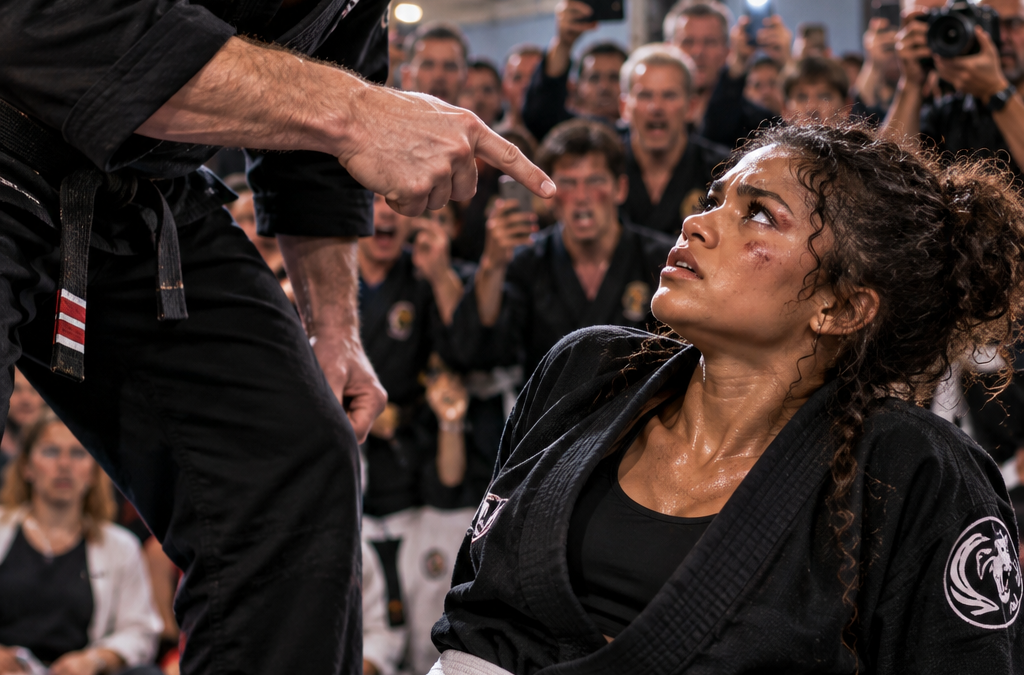
𝗙𝗨𝗟𝗟 𝗦𝗧𝗢𝗥𝗬
The center occupied an old municipal building with peeling paint, unreliable heat, and a gymnasium floor that had been resurfaced so many times the basketball lines seemed to belong to different decades.
I ran a free Thursday-night self-defense program for teenage girls.
Twelve students.
That was all.
Twelve girls from neighborhoods like mine.
Girls who walked home from bus stops after dark.
Girls who had been followed.
Grabbed.
Threatened.
Girls who sometimes showed up with bruises they explained too quickly.
I never forced anybody to tell me anything.
I taught them stance.
Voice.
Distance.
Wrist escapes.
How to fall.
How to get back up.
Most importantly, I tried to teach them that fear was not weakness.
Fear was information.
“Being scared means your body noticed something before your pride did,” I told them.
Kesha, fifteen and incapable of remaining quiet longer than twenty seconds, once asked:
“So we’re supposed to run?”
“If you can.”
“But isn’t that cowardly?”
“No.”
I pointed toward the door.
“The best fight is one you don’t have to finish.”
She frowned.
“That doesn’t sound cool.”
“Staying alive is cool.”
That got an eye roll.
But she remembered it.
The program had almost no money.
I bought pads myself.
Printed flyers at the library.
Used secondhand gloves.
Every quarter I appeared in front of the community center board and explained why twelve girls learning how to defend themselves deserved another three months of electricity.
Then the board changed its insurance requirements.
Any youth combat or self-defense program needed an accredited martial arts partner.
Oscar qualified as an instructor but his little gym wasn’t part of the certification network they recognized.
Without an approved partner, we would lose the program by year’s end.
That’s how Brad Kesler entered my life.
Iron Circle Athletics sat on the opposite end of the martial arts world from Oscar’s gym.
Glass front.
LED lights.
Professional cameras.
Merchandise wall.
Supplement refrigerator.
Gold lettering.
Brad’s name appeared everywhere.
BRAD KESLER.
THIRD-DAN BLACK BELT.
FOUNDER.
HEAD INSTRUCTOR.
His YouTube channel had around two hundred thousand subscribers.
I’d watched enough videos to understand him.
He was talented.
I never denied that.
Fast kicks.
Good flexibility.
Clean taekwondo fundamentals.
He also loved showing people that he was talented.
That mattered.
I had studied his sparring footage before asking for a meeting.
Not because I planned to fight him.
Because studying people was habit.
Brad dropped his left hand after nearly every power kick.
His stance widened as he fatigued.
He had almost no meaningful ground game.
After two hard rounds, his shoulders rose when he breathed.
Useful information.
None of it mattered to why I was visiting.
I wanted his signature.
Iron Circle becomes community partner.
Our program remains accredited.
Twelve girls keep their Thursday nights.
Simple.
Brad was running a public seminar that Saturday.
I emailed twice asking for ten minutes afterward.
No response.
So I attended.
Plain T-shirt.
Jeans.
No fight gear.
No belt.
No entourage.
I stood against the back wall and waited.
Two hundred people filled the gym and bleachers.
Brad finished a demonstration.
Applause.
Phones everywhere.
He spotted me while drinking water.
Our eyes met.
He said something to the man beside him.
They both laughed.
Then Brad pointed.
“You.”
I looked behind me.
He laughed louder.
“Yeah, you.”
Heads turned.
“Come up here.”
I didn’t move.
“I actually just need to speak with you after—”
“Come on.”
He motioned toward the mat.
“Don’t be shy.”
The crowd began watching.
I should have left then.
Instead, I stepped forward because I still believed the conversation could be salvaged.
When I reached the edge of the mat, Brad looked me over.
“What’s your name?”
“Whitney Sullivan.”
“Martial arts experience?”
I hesitated.
“Yes.”
The correct answer would have been twelve years, fourteen sanctioned wins, zero losses.
I didn’t say that.
Brad smiled.
“What, cardio kickboxing?”
A few people laughed.
“No.”
“You train somewhere?”
“Yes.”
“Where?”
“Oscar’s Gym.”
Brad’s sparring partner chuckled.
“Never heard of it.”
“That doesn’t surprise me.”
Brad’s eyebrows lifted.
The crowd made that little sound crowds make when they sense conflict.
He stepped closer.
“Want to spar?”
“No.”
More laughter.
“Scared?”
“No.”
“Then why not?”
“Because I came to discuss a community partnership.”
Brad looked toward the cameras.
Then back at me.
“What kind?”
“I run a free self-defense program for teenage girls. We need an accredited partner organization for insurance compliance.”
He nodded slowly.
“Interesting.”
For one second, I thought he might actually listen.
Then he grinned.
“Tell you what.”
My stomach tightened.
“You give everybody a little demonstration.”
He swept his arm toward the crowd.
“And maybe we talk.”
I looked at him.
“Demonstration?”
“Sparring.”
“I didn’t bring gear.”
“Just for fun.”
His partner laughed.
“Go easy, Brad. She might run home crying to her mother.”
The crowd reacted.
Some laughed.
Some didn’t.
I felt the first hard shift inside my chest.
Brad saw it.
He liked it.
“Hey, little Black girl.”
The room changed.
Not much.
Just enough.
“Come on.”
I looked directly at him.
“I’m not your joke.”
He tilted his head.
“You’re not funny enough to be a joke.”
A few people laughed harder.
“I just need something to warm up with.”
I heard somebody near the wall say:
“Come on, man.”
Brad ignored it.
He pointed toward the mat.
“You’re basically a punching bag.”
I should have left.
Maybe that would have been smarter.
But I saw those twelve girls in my head.
The board.
The accreditation requirement.
The email nobody answered.
I thought maybe enduring two minutes would get the conversation I came for.
So I stepped onto the mat.
No gloves.
No mouthguard.
No expression.
Brad smiled.
“There we go.”
He moved around me.
“You’ll regret it.”
I thought:
No.
You probably will.
But I said nothing.
We started.
Calling it sparring would be generous.
Brad circled.
Bounced.
Performed for the crowd.
He threw a spinning kick that passed close enough to my face that I felt air against my cheek.
People gasped.
I didn’t move.
“Come on.”
He laughed.
“At least try.”
He threw a front kick.
Hard.
Not demonstration pressure.
Not playful.
His heel drove into my midsection.
I let my body absorb it.
Stepped back.
Breathed.
I could have caught the leg.
Swept him.
Taken position before he understood what happened.
I didn’t.
Brad turned toward the crowd.
“See?”
Laughter.
“Nothing.”
Another kick struck my thigh.
That one hurt.
My leg dipped before I corrected.
The room quieted slightly.
Brad came close.
“You can quit.”
I looked into his eyes.
“Nobody’s going to judge you.”
He grinned.
“Well, more than they already do.”
My anger disappeared.
That’s something Oscar had taught me.
The most dangerous point in a fight is not always when anger arrives.
Sometimes it’s when anger leaves.
Because then all that remains is information.
Brad’s left hand dropped after the kick.
Same as the videos.
His feet were too wide.
Breathing heavier than he should have been after barely ninety seconds.
His right hip loaded before the spinning attack.
Predictable.
Sloppy beneath the showmanship.
I could have dismantled him.
Instead, I stepped off the mat.
Brad stared.
“That’s it?”
I picked up my bag.
“That’s it.”
He laughed.
“You came all the way here for that?”
“I came for a conversation.”
“And now?”
“Now I know enough.”
He didn’t understand.
As I walked toward the door, he called after me:
“Tell your little friends they got a free lesson courtesy of Brad Kesler.”
Applause followed.
I kept walking.
The partnership never happened.
By midnight, somebody’s recording had been uploaded.
Four thousand views.
By morning, Brad had created his own version.
Music.
Slow motion.
Replay of the kick folding my leg.
Caption:
WHEN SOMEONE WALKS INTO YOUR GYM THINKING THEY CAN FIGHT.
Know your place.
Laughing emoji.
Within forty-eight hours, people around Durham recognized my face.
Not because I was undefeated.
Not because I coached girls for free.
Not because I’d been training half my life.
Because I was the Black woman Brad Kesler kicked around for entertainment.
He posted again.
Slow-motion version.
Cartoon sound effects.
Then another.
Nature-documentary voice.
“Here we observe the common street wanderer entering the territory of a real fighter…”
I sat alone in my apartment watching it once.
Only once.
Then turned off the phone.
Oscar watched every version.
When I came to train Monday, he was angry.
Not loud.
Oscar got quieter when angry.
“He used your face.”
“I noticed.”
“You consent to that?”
“No.”
“You want me to call him?”
“No.”
“Good, because I’d probably get arrested.”
I smiled faintly.
Then he said:
“Show them.”
“No.”
“Whitney.”
“No.”
“One training clip.”
“No.”
“Your record.”
“No.”
He ripped tape from a pad.
“You know what he’s doing.”
“Yes.”
“He’s building an identity for you.”
“I know.”
“And you’re letting him.”
I looked at Oscar.
“If I put out a video beating somebody up tomorrow, what does the story become?”
His jaw tightened.
“Whitney Sullivan is actually an experienced fighter.”
“No.”
I shook my head.
“Angry Black woman threatens trainer after viral humiliation.”
Oscar didn’t respond.
“You know I’m right.”
He hated that I was.
The damage reached the community center almost immediately.
Whispers first.
Teenagers always know what is online before adults do.
Then parents.
Brenda Davis caught me after Thursday class.
Her daughter Maya was one of the original twelve.
“Can I talk to you?”
“Sure.”
She held up her phone.
Brad’s video.
“Is this you?”
“Yes.”
“You got beaten up.”
“That’s not exactly what happened.”
She crossed her arms.
“It looks pretty exact.”
I inhaled.
“I wasn’t fighting him.”
“Why?”
“Because I didn’t go there to fight.”
“Then why were you on the mat?”
I explained the accreditation issue.
The partnership.
Brad’s challenge.
The decision not to escalate.
She listened.
I could see disbelief forming before I finished.
“So you’re saying you let him kick you?”
“Yes.”
Her face hardened.
“That makes no sense.”
“I understand why it sounds—”
“My daughter trusts you to teach her how to protect herself.”
“I know.”
“And I’m supposed to believe you’re secretly some fighter who just decided not to fight?”
The truth sounded ridiculous.
That was the worst part.
I didn’t blame her.
She pulled Maya from the program.
Two days later, another parent did the same.
Twelve became ten.
Then eight.
I still showed up.
Every Thursday.
Eight girls.
Same room.
Same warm-up.
Kesha noticed the empty spots.
“Are they coming back?”
“I don’t know.”
“Because of that idiot?”
“Kesha.”
“What?”
“You know the rule.”
“No disrespect.”
“Exactly.”
“He disrespected you.”
“And?”
She crossed her arms.
“So why do we have to respect him?”
“You don’t.”
The girls looked confused.
“You respect yourself.”
I pointed around.
“That means you don’t let somebody else decide what kind of person you become.”
Kesha frowned.
“Can we still call him an idiot privately?”
“No.”
She sighed.
“Rules here are terrible.”
Two weeks after the first viral clip, Brad walked into my class.
Three men followed carrying cameras, microphones, portable lights.
I was teaching a wrist release.
Kesha saw him first.
Her face changed.
I turned.
Brad stood in the doorway.
“So this is it.”
I straightened.
“What are you doing here?”
He looked around.
Peeling wall.
Old mat.
Water jug.
“Cute.”
“Leave.”
He smiled at the camera.
“Relax.”
“Turn the cameras off.”
“I’m trying to help.”
One of the girls moved behind me.
Brad stepped into the room.
“I heard you’re teaching self-defense.”
“You heard correctly.”
“After what happened at my gym?”
Kesha stood.
“Miss Whitney knows what she’s doing.”
Brad glanced at her.
“I’m sure she’s good at lots of things.”
Then at me.
“Fighting isn’t one of them.”
I stepped between him and the girls.
“Get out.”
His smile faded.
“Excuse me?”
“My students are minors.”
I looked toward the cameras.
“You don’t have permission to film them.”
That changed things.
His crew hesitated.
Brad raised his hands.
“Fine.”
Mock surrender.
“We’ll go.”
He turned toward the girls.
“You deserve better.”
Then toward me.
“And deep down, you know it.”
They left.
I finished class.
Didn’t miss one exercise.
Didn’t let my voice shake.
Then I sat in my car afterward for forty-five minutes.
Engine off.
Hands on steering wheel.
I wanted to cry.
Instead, I stared through the windshield.
My phone buzzed.
Tamara.
DON’T REACT.
DON’T POST.
CALL ME TOMORROW.
I met Tamara Cole in high school.
She was the kind of friend who considered privacy a temporary obstacle.
By adulthood, she had turned that trait into journalism.
She worked for the Durham Independent.
Tiny budget.
Old computers.
Editors constantly talking about cuts.
She was good.
More importantly, she hated bullies disguised as respected men.
The next morning, she met me for coffee.
“I’ve been looking into Kesler.”
“You shouldn’t.”
“Too late.”
“Tamara.”
“He has a pattern.”
“What kind?”
She opened her laptop.
Reviews.
Deleted posts captured in screenshots.
Reddit threads.
Former students.
“Seventeen-year-old fractured rib.”
I leaned closer.
“Woman got concussed during advanced sparring.”
Another.
“Student left after Brad injured him in a demonstration.”
“Any police reports?”
“Not yet.”
“Then be careful.”
She looked at me.
“You sound like my editor.”
“Your editor is smart.”
“Sometimes.”
Then she showed me a court filing.
Greg Anderson.
Broken orbital bone.
Insurance settlement.
Forty thousand dollars.
Confidentiality clause.
“Brad paid.”
“Insurance paid.”
“Same difference.”
“No.”
I looked at her.
“Not legally.”
Tamara smiled.
“That’s why I keep you around.”
“Don’t publish until you prove it.”
“I know.”
Brad moved faster.
He filed a formal complaint against me with the community center board.
Iron Circle letterhead.
Third-degree black belt.
Licensed instructor.
Concerns regarding Whitney Sullivan’s qualifications.
He cited the viral video as evidence that I couldn’t defend myself.
He called my program dangerous.
Copied city officials.
School district.
Local news.
The board scheduled an emergency meeting.
My entire program came down to one vote.
That Sunday night, I sat on the floor of Oscar’s gym.
Tamara beside me.
Oscar leaned against the heavy bag.
Tamara said:
“We can’t keep reacting.”
“What do you suggest?”
Oscar disappeared into his office.
Returned with a battered folder.
Dropped it in front of me.
I opened it.
Fight records.
Fourteen.
Official paperwork.
Every bout.
Every opponent.
Seven knockouts.
Three submissions.
Four decisions.
Zero losses.
Oscar said:
“This isn’t ego.”
I looked up.
“This is evidence.”
Tamara closed the laptop.
“There is a sanctioned charity event at Durham Civic Center next month.”
I knew it.
Local amateur card.
Insurance.
Officials.
Medical staff.
“Brad’s already scheduled for an exhibition.”
I stared at her.
“You’re suggesting I challenge him.”
“I’m suggesting you let him prove everything he believes.”
Oscar nodded.
“In a controlled environment.”
“No parking lot nonsense.”
“No YouTube gym stunt.”
“Three sanctioned rounds.”
I looked between them.
“You both planned this.”
“Yes,” Tamara said.
“No,” Oscar said.
They looked at each other.
Oscar sighed.
“Mostly her.”
I stared at my record.
If I fought Brad and won, people could still say I had done exactly what he accused me of being.
Angry.
Violent.
Vindictive.
If I did nothing, twelve girls lost their program.
Eight now.
Maybe fewer soon.
I said:
“If I do it, no trash talk.”
Oscar nodded.
“No hype videos.”
“Fine.”
“No threats.”
“Good.”
“Everything official.”
“Yes.”
“I fight clean.”
Oscar finally smiled.
“That is the only way you know how.”
The challenge went public through event organizers.
Brad accepted within hours.
Of course he did.
He thought I wanted revenge.
He thought emotion would make me stupid.
Two weeks later, every seat at Durham Civic Center was full.
Eight hundred people.
Brad arrived with an entourage.
Custom robe.
Gold embroidery.
Cameras.
Diane Prescott, his business partner, followed behind him.
She was always nearby in the videos.
Always managing angles.
Always thinking about audience.
I arrived with Oscar.
That’s all.
Plain black shorts.
Black shirt.
No entrance music.
No sponsors.
Somebody shouted:
“Punching bag girl!”
Laughter.
I climbed through the ropes.
Oscar put his hands on my shoulders.
“You know the plan.”
“Yes.”
“What is it?”
“Let him spend energy performing.”
“Then?”
“Make him fight.”
Oscar smiled.
“That’s my girl.”
The referee called us together.
Brad stood four inches taller.
Around forty pounds heavier.
He leaned close.
“Last chance.”
I said nothing.
“Walk away.”
Nothing.
“Sweetheart.”
The bell rang.
Round one.
Brad attacked immediately.
Spinning back kick.
Head height.
I leaned away.
Three inches.
He missed.
Reset.
Roundhouse.
I rolled with the impact.
Circled.
He looked toward the audience.
Shrugged.
“See?”
Noise.
He launched combinations designed for cameras.
Spinning technique.
Jumping knee.
Wide movement.
Lots of spectacle.
Little damage.
I threw nothing.
Thirty-one strikes from Brad in the first round.
Six meaningful connections.
Zero from me.
Oscar called from the corner:
“Watch.”
That’s exactly what I was doing.
Brad’s left hand still dropped.
His right leg still loaded.
His stance widened with fatigue.
Breathing already heavy.
Nothing had changed.
Except now I had permission to use the information.
Between rounds, Oscar gave me water.
“You got him?”
“Yes.”
“Sure?”
“Yes.”
“Then don’t rush.”
Round two.
Brad came forward slower.
Roundhouse.
I slipped under.
Straight right.
My fist landed clean against his jaw.
The arena changed instantly.
Brad staggered.
His eyes widened.
He had not prepared emotionally for me to hit him.
That matters more than people realize.
I stepped in.
Left hook body.
Right upstairs.
He covered.
Backed toward the ropes.
The crowd stopped laughing.
Brad grabbed for a clinch.
I turned my hips.
Inside trip.
He hit the canvas.
Hard.
The referee separated us.
Brad stood.
His corner screamed.
Diane’s phone was no longer raised.
I waited.
Brad tried a spinning heel kick.
I saw his hip load.
Dropped.
Entered under him.
Double-leg takedown.
He hit the mat again.
I moved to side control.
No striking.
Pressure.
Position.
His breathing became panic.
He scrambled without technique.
The bell saved him.
Walking back to his corner, he looked at Diane.
I couldn’t hear everything.
I heard:
“Who is she?”
Round three answered.
Brad came forward throwing wild.
Overhand right.
I slipped outside.
Pivot.
Left hook.
His legs softened.
He reached for me.
I sprawled.
Moved behind.
Hooks in.
Right arm under the chin.
Rear-naked choke.
Clean.
My forearm settled into position.
I didn’t crank.
Didn’t squeeze before securing control.
Brad pulled at my arm.
Kicked.
I applied pressure.
Three seconds.
Five.
Eight.
His hand slapped the mat.
Once.
Twice.
Three times.
I released before the referee touched me.
Stood.
Walked to my corner.
No fist raise.
No yelling.
No staring him down.
Oscar put a towel around my shoulders.
Then the noise arrived.
Eight hundred people.
Standing.
Chanting my name.
Whitney.
Whitney.
Whitney.
Five minutes earlier, some of them had called me a punching bag.
I sat on the stool.
I didn’t feel triumphant.
I felt tired.
Brad stayed on the mat eleven seconds.
Then left without looking at me.
The clip reached two million views before midnight.
Eleven million by Sunday.
Thirty million by Monday.
People found my fight record.
Fourteen and zero.
They found Oscar.
They found the community program.
Hashtags appeared.
I posted nothing.
Did no interviews.
Thursday came.
I went back to work.
Eight girls waited.
Kesha grinned.
“Miss Whitney.”
“What?”
“You’ve been lying.”
“About what?”
“You’re famous.”
“No.”
“You choked that man on the internet.”
I stared at her.
“Ten push-ups.”
“What?”
“Fifteen.”
She dropped to the mat.
The girls laughed.
For one hour, everything felt normal.
Then a certified letter arrived.
Law Offices of Caldwell and Greer.
Brad Kesler and Iron Circle Athletics.
Excessive force.
Three pages.
Two hundred fifty thousand dollars.
Physical injury.
Emotional distress.
Damage to professional reputation.
I sat at my kitchen table beneath the flickering light and read every word.
Brad couldn’t beat me on the mat.
So he changed the battlefield.
I called Oscar.
Then Tamara.
The next morning Brad held a press conference.
Sling on his arm.
Diane beside him.
Soft voice.
No arrogance.
“I never wanted anybody hurt.”
He called the first encounter a goodwill spar.
Called the sanctioned rematch an attack.
His lawyer emphasized my rear-naked choke.
Tactical language.
Dangerous technique.
The news shifted.
Again.
Some people still supported me.
Others said:
She went too far.
She wanted revenge.
She could have killed him.
Maybe Brad had been right.
I stayed awake until two reading comments.
That was a mistake.
The next morning, I deleted the apps from my phone.
Then the community center suspended my program.
Four-to-one vote.
Risk management.
That’s what the email called it.
Not punishment.
Risk management.
I read it once.
Put on running shoes.
Ran six miles in darkness.
When I called Oscar afterward, I finally said the sentence I’d been avoiding.
“I’m tired.”
“I know.”
“They shut it down.”
“I know.”
“Those girls have nowhere Thursday.”
“I know.”
“What if this isn’t worth it anymore?”
Oscar went silent.
Then:
“They want you to disappear.”
I closed my eyes.
“Brad.”
“Diane.”
“People afraid of liability.”
“All of them.”
He continued.
“If you quit now, he doesn’t beat you in a fight.”
“He beats you where it matters.”
I leaned against the wall.
“Tired isn’t done.”
Oscar said.
“And you aren’t done.”
Tamara called the next morning.
“Come over.”
“What happened?”
“I found something.”
Her apartment looked like a newspaper archive had exploded.
Documents everywhere.
Coffee cups.
Printer pages.
She showed me three signed statements.
Greg Anderson.
Broken orbital bone.
Tyler Brooks.
Fractured rib.
Monica Wells.
Concussion.
Different years.
Same pattern.
Then she rotated her laptop.
Security footage.
Grainy.
Black and white.
Brad standing over a student on the mat.
The student curled on his side.
Brad’s fist clenched.
Timestamp.
Fourteen months earlier.
I watched twice.
“He tried to erase this?”
“Yes.”
“How’d you get it?”
“Source at the security contractor.”
“Reliable?”
“I verified chain of custody.”
I looked at Tamara.
“He sued me for excessive force.”
“Yes.”
She tapped the screen.
“And now he’s going to explain this.”
The mediation hearing was six days later.
Retired Judge Patricia Holloway served as mediator.
Brad brought his attorney.
Victor Caldwell.
Diane sat behind him.
I couldn’t afford a lawyer.
Tamara came with me.
Oscar sat behind us.
Brad wore the sling again.
His lawyer presented medical records.
Rotator cuff.
Cervical strain.
Emotional distress.
Then froze the viral footage on the choke.
“This was punishment.”
He said.
Not competition.
Patricia Holloway turned toward me.
“Ms. Sullivan?”
I stood.
I had spent my whole life learning not to rush.
Fighting.
Talking.
Same principle.
“I have three things.”
Tamara connected her laptop.
“First.”
Raw footage from Iron Circle.
Unedited.
Brad calling me forward.
Little Black girl.
Punching bag.
Wag your tail.
The hard kick.
My refusal to retaliate.
My exit.
Brad bowing.
Nobody in the room laughed.
“Second.”
I placed my fourteen fight records on the table.
“My sanctioned record.”
Fourteen wins.
Zero losses.
Twelve years under Oscar.
I looked at Brad.
“I knew how to fight the first day.”
His face changed slightly.
“I chose not to.”
Then I described the rematch.
Official rules.
Referee.
Three rounds.
Submission.
Eight seconds.
Immediate release.
No strike after stoppage.
No illegal contact.
“The choke was not excessive.”
I kept my voice level.
“It was exactly enough to create a legal submission.”
Then:
“Third.”
Tamara played the security footage.
Brad.
Student down.
Brad standing over him.
Statements followed.
Greg.
Tyler.
Monica.
Medical documentation.
Insurance settlement.
The room changed.
Reporters began writing faster.
Brad’s lawyer leaned toward him.
Diane went very still.
I looked toward the screen.
“Mr. Kesler spent weeks telling people I was dangerous.”
I pointed.
“This is dangerous.”
Silence.
“He told the press I couldn’t control myself.”
Another pause.
“This is what losing control looks like.”
Brad stared at the table.
Patricia Holloway removed her glasses.
“Mr. Caldwell.”
Brad’s lawyer looked up.
“Does your client wish to continue?”
Whispering.
Ten seconds.
Twenty.
Thirty.
Brad’s hands shook.
His attorney stood.
“My client withdraws the complaint.”
That should have felt like the ending.
It wasn’t.
Oscar hugged me in the hallway.
“You did it.”
“No.”
I looked at him.
“Those girls are still off the mat.”
Tamara’s article published that night.
Behind the Belt: Three Students, One Cover-Up, and the Fighter Who Exposed It All.
She included everything she could verify.
Brad’s original videos.
The harassment.
The complaint against my program.
The rematch.
The lawsuit.
The earlier injuries.
The settlement.
Security footage.
Signed statements.
No exaggeration.
No revenge.
Facts.
By midnight, fourteen thousand shares.
By morning, national pickup.
Two million readers before the week ended.
Iron Circle began collapsing.
Athletic board investigation.
Family complaints.
Sponsors gone.
Subscribers disappearing.
Diane resigned.
Brad’s attorney withdrew.
Then Brad posted an apology.
Two minutes.
No lights.
No music.
Empty gym.
He said what he did was wrong.
The insults.
Videos.
Lawsuit.
He admitted he had convinced himself he was building a brand while tearing another person down.
I watched it once.
Didn’t respond.
People asked whether I forgave him.
That wasn’t a question I needed to answer publicly.
Accountability did not require my participation in his redemption.
The community board met again Monday.
Sandra Wells brought a petition.
One hundred twelve signatures.
Parents.
Students.
Neighbors.
The girls had collected many themselves.
The vote was five-zero.
Program restored.
Expanded funding.
Dedicated room.
Sandra found me in the hallway.
“It’s back.”
I closed my eyes.
“What?”
“Your program.”
I leaned against the wall.
“Unanimous.”
For almost a minute, I couldn’t speak.
Then:
“Thank you.”
She shook her head.
“Those girls did it.”
Thursday evening, I returned.
New mat donated by a local business.
Same cracked tiles around it.
Twelve original places filled again.
Plus four new girls.
Sixteen total.
Kesha sat front row.
“Miss Whitney?”
“Yes?”
“We got more people than before.”
“I can count.”
“You famous now.”
I stared at her.
She grinned.
“Push-ups?”
“Ten.”
“I knew it.”
The room dropped together.
For the first time in weeks, I laughed.
The city eventually created a community self-defense initiative modeled on our curriculum.
More neighborhoods.
More girls.
More volunteer instructors.
What I had begged a small board to keep alive became something politicians wanted photographed beside.
I had mixed feelings about that.
Oscar said:
“Take the funding and ignore the speeches.”
Good advice.
Six months later, our program operated in four centers.
Sixty-one girls.
Waiting list.
Three instructors I’d trained.
Oscar received Coach of the Year from a regional association.
He wore a wrinkled polo to the ceremony.
At the microphone, he said:
“I just held the pads.”
Then walked away.
Standing ovation.
Tamara’s reporting triggered wider scrutiny of injury settlements in martial arts gyms.
Other complaints surfaced.
Other facilities faced investigation.
Brad kept his license only under conditions that included anger-management training and oversight.
His gym survived.
Barely.
Most students left.
His channel went dark.
I was glad it survived in one sense.
Collapse is easy.
Change is harder.
Whether Brad changed, I never knew.
He never spoke about me publicly again.
That was enough.
My record stayed fourteen and zero.
I never competed after the charity fight.
People found that strange.
“You could go professional.”
Maybe.
“You could get sponsorships.”
Probably.
“You could build a huge channel.”
Absolutely not.
The mat had already given me what I needed.
I didn’t need to prove I was the strongest person in every room.
I needed girls like Kesha to learn they didn’t have to be.
Strength wasn’t domination.
That was Brad’s version.
Mine was different.
Strength was recognizing danger.
Setting boundaries.
Leaving when you could.
Fighting when you had to.
Stopping when the threat stopped.
One evening, Kesha stayed after class.
She was sixteen by then.
First instructor certification completed.
She helped me stack pads.
“I want to teach.”
“I know.”
“How?”
“Start by showing up early.”
She groaned.
“That’s not inspirational.”
“Reality rarely is.”
She laughed.
Then became serious.
“Why didn’t you hit him the first time?”
Brad.
Nobody had asked me so directly in months.
“I wanted the partnership.”
“You already knew you could beat him?”
“Yes.”
“And you still let him kick you?”
“Yes.”
Her face twisted.
“I don’t know if I could do that.”
“I don’t know if I’d do it again.”
That surprised her.
“You regret it?”
I thought.
“I regret believing his respect was necessary.”
She listened.
“I thought those twelve spots on the mat depended on getting a powerful man to approve us.”
I looked around the room.
“They didn’t.”
“What did they depend on?”
“Us staying.”
She nodded.
Then:
“Would you have fought him if he hurt one of us that first day?”
“Yes.”
Immediate.
She smiled.
“I knew it.”
“That isn’t a compliment.”
“Why?”
“Because I’m trying to teach you not to need people like me.”
She frowned.
“Everybody needs people.”
I stared at her.
Oscar would have liked that answer.
“You’ve been listening.”
“Sometimes.”
“Rarely.”
She laughed.
Years passed differently after that.
The viral clips faded.
New scandals arrived.
New fights.
New people for the internet to love and hate for forty-eight hours.
Sometimes somebody still recognized me at a grocery store.
“Whitney Sullivan?”
“Yes.”
“You’re the woman who choked that black belt.”
I usually answered:
“I teach community self-defense.”
Not because I was ashamed of the fight.
Because I refused to let the least important four minutes of my life become the definition.
The program mattered more.
The girls mattered more.
One of the original twelve joined the military.
Another became a nurse.
Kesha started teaching.
Maya eventually returned after her mother pulled her out during the scandal.
Brenda came with her.
She waited after class.
“I owe you an apology.”
“You don’t.”
“Yes.”
She looked toward Maya.
“I watched that video and decided I knew everything.”
I understood.
“That was the point of the video.”
“I should’ve asked more questions.”
“Maybe.”
She looked embarrassed.
“I was trying to protect my daughter.”
“I know.”
That was true.
“Sometimes protection makes us move too quickly.”
I had done it too.
She smiled.
“Can she come back?”
I looked toward Maya.
“She never stopped having a spot.”
Another Thursday.
Another mat.
Oscar’s gym changed too.
Not much.
He refused a proper remodel.
Someone offered him a website.
He declined.
A local sponsor wanted to replace the cracked mirror.
“No.”
I asked why.
He pointed toward the fracture.
“Still reflects.”
“That is the cheapest thing you’ve ever said.”
“Also true.”
We kept training there.
Not because I planned to fight professionally.
Because training was still where the world made sense.
One morning, years after Brad, Oscar held pads.
“Again.”
I threw the combination.
“Again.”
Another.
“Again.”
I stopped.
“How long are you going to keep saying that?”
“Until one of us dies.”
“Comforting.”
He lowered the pads.
Then looked at me.
“You know what the difference was?”
“Between what?”
“You and Kesler.”
I sighed.
“Oscar.”
“He trained so people would watch him.”
I waited.
“You trained so you’d be ready when nobody was watching.”
I looked away.
“That’s poetic for six in the morning.”
“Don’t get used to it.”
We finished training.
I went to the community center.
Thursday class had expanded.
New faces.
Some girls knew the old story.
Most didn’t.
Good.
I preferred that.
At the beginning of every first session, I asked the same question.
“What is self-defense?”
Hands went up.
“Fighting.”
“No.”
“Punching somebody.”
“No.”
“Getting away.”
“Closer.”
Then Kesha, now helping teach, would grin because she knew my answer.
I said:
“Self-defense is keeping control over what happens to your body.”
That includes leaving.
Speaking.
Running.
Calling for help.
Saying no.
Fighting only when necessary.
I would look around the room.
“Your job is not to win.”
“Your job is to get home.”
That was the lesson Brad had never understood.
He wanted to win every room.
Every camera.
Every comment section.
Every story.
He couldn’t tolerate losing because he’d built an identity that required other people to appear smaller.
I didn’t need him smaller.
Even when I choked him, I didn’t want to humiliate him.
I wanted the truth recorded somewhere he couldn’t edit.
That’s why the sanctioned match mattered.
Referee.
Rules.
Cameras he didn’t control.
He had made a career out of controlling the angle.
For once, the angle belonged to reality.
Tamara understood that too.
Years later, after winning an award for her investigation, she came by the center.
She carried the plaque under one arm.
I looked at it.
“Fancy.”
“Don’t be jealous.”
“Deeply.”
She sat on the edge of the mat.
“You know, Brad was right about one thing.”
I stared.
“Careful.”
“He said you were a gold mine.”
I threw a towel at her.
She laughed.
“I’m serious.”
“You are about to be banned.”
“He thought your humiliation was content.”
Her smile faded.
“But what he actually recorded was himself.”
I sat beside her.
That was true.
Brad’s greatest mistake wasn’t underestimating my fighting.
It was believing cameras only showed what he wanted them to show.
He recorded himself calling me a racial slur.
He recorded himself hurting somebody who wasn’t fighting back.
He recorded himself entering my classroom with cameras.
He documented his own behavior because he thought the audience would always share his perspective.
Then the perspective changed.
Evidence outlived framing.
“Do you ever wish none of it happened?” Tamara asked.
“Yes.”
She seemed surprised.
“Really?”
“Those girls almost lost the program.”
“You ended up with four centers.”
“That doesn’t make the damage necessary.”
I looked toward the empty mat.
“People like stories where pain becomes purpose.”
“Journalist present.”
“I know.”
I continued.
“But sometimes pain is just pain.”
Tamara nodded.
“I’d rather have built this without being publicly humiliated.”
“Fair.”
“I’d rather Greg Anderson never had his face broken.”
“Yes.”
“I’d rather Monica never got concussed.”
“Yes.”
“Good things coming afterward don’t make bad things required.”
She looked at me.
“You should let me quote that.”
“No.”
“Too late.”
“Tamara.”
She laughed.
That became another thing I learned.
People love turning survivors into symbols.
I resisted that too.
I wasn’t a symbol.
I paid late fees.
Burned rice.
Forgot birthdays.
Got impatient.
Sometimes woke angry.
Sometimes didn’t want to teach.
Sometimes resented being the person people expected to say something wise.
I was not fearless.
I was not endlessly composed.
On the morning of the rematch, I threw up twice.
Oscar never told anyone.
Before the mediation, my hands shook so badly in the bathroom that I ran cold water over them for almost a minute.
I knew I could lose.
The match.
The lawsuit.
The program.
Everything.
Courage never felt like confidence to me.
It felt like continuing while your body listed every reason to stop.
That was what I tried to teach.
Not:
Don’t be afraid.
Be afraid.
Then decide.
One winter afternoon, I received an envelope from the state legislature.
Inside was information about proposed funding for community self-defense programs.
The working title included my surname and Oscar’s.
Sullivan-Williams Community Defense Act.
I read the page while mopping the community center floor.
Kesha walked in.
“What is that?”
“Government paperwork.”
“Good?”
“Maybe.”
She took it.
Her eyes widened.
“They named it after you.”
“And Oscar.”
“You’re going to frame this.”
“No.”
“Yes.”
“No.”
She photographed it anyway.
Oscar’s reaction was better.
I handed him a copy.
He read the title.
“This sounds expensive.”
“It funds programs.”
“Government?”
“Yes.”
He frowned.
“They’ll make you fill forms.”
“I already fill forms.”
“More forms.”
He put it down.
“Congratulations.”
“That sounded painful.”
“It was.”
Then:
“Proud of you.”
I stared.
Oscar looked uncomfortable.
“What?”
“Nothing.”
“Don’t make it weird.”
I smiled.
“Too late.”
When the legislation passed its first committee vote, reporters called.
I declined almost all of them.
One local journalist asked me for a short interview about why the program mattered.
I agreed.
Not about Brad.
About the girls.
She arrived at the original East Side room.
Cracked tiles still visible around the newer mat.
She looked down.
“You could have this replaced.”
“Yes.”
“Why don’t you?”
“History.”
She smiled.
“You’re sentimental.”
“Don’t tell Oscar.”
During the interview she asked:
“What do you think people misunderstood most about your story?”
I knew immediately.
“They think the important moment was when I fought back.”
She waited.
“It wasn’t.”
“What was?”
“The first time I walked away.”
Her eyebrows lifted.
“Why?”
“Because I could’ve hurt him that day.”
I folded my hands.
“I didn’t.”
“That wasn’t weakness.”
“No.”
“It was restraint.”
“Yes.”
“And later?”
“Later I fought because there were rules.”
“Witnesses.”
“Consequences.”
“And something bigger than my pride at stake.”
“The program.”
I nodded.
She asked:
“Would you tell people to do what you did?”
“No.”
That surprised her.
“Why not?”
“Because nobody should absorb abuse just to prove they’re disciplined.”
I looked into the camera.
“The lesson isn’t to wait until somebody pushes you too far.”
“The lesson is to value yourself sooner.”
That was the only clip from the whole story I ever willingly shared.
Not the choke.
Not Brad tapping.
That sentence.
Value yourself sooner.
I wish I had.
Maybe I would have walked out of Iron Circle the moment he said little Black girl.
Maybe I would have called the accreditation board and demanded another route.
Maybe I would have saved myself weeks of humiliation.
Experience doesn’t only teach you how to endure more.
Sometimes it teaches you what you should never endure again.
A few years after everything happened, I saw Brad once.
Not online.
In person.
Airport.
Charlotte.
I was walking toward security with a backpack when I noticed him near a coffee shop.
Older.
No entourage.
We saw each other simultaneously.
My body recognized him before my mind finished processing.
He stopped.
So did I.
For one second, both of us stood in the middle of travelers dragging luggage around us.
He approached slowly.
I stayed where I was.
“Whitney.”
“Brad.”
He looked nervous.
That surprised me.
“I didn’t know if I should come over.”
“You already did.”
A faint embarrassed smile.
“Right.”
Silence.
Then:
“I meant the apology.”
I studied his face.
I had no way to know whether that was true.
“Okay.”
“I don’t expect you to forgive me.”
“Good.”
He nodded.
Fair.
“I lost a lot.”
I said nothing.
“My gym almost closed.”
“I heard.”
“Most people left.”
“Yes.”
“I used to think that was your fault.”
There it was.
“Do you still?”
“No.”
I waited.
He looked toward the floor.
“I watched the original video again.”
“Which one?”
“The first day.”
Iron Circle.
“You weren’t doing anything.”
“No.”
“I kept escalating because…”
He stopped.
“Because?”
“You wouldn’t react.”
I understood.
“That bothered you.”
“Yes.”
“Why?”
“I don’t know.”
“Try.”
He looked at me.
“Because I couldn’t control the scene if you didn’t respond the way I wanted.”
That was the most honest thing he had ever said to me.
I nodded.
“That’s probably it.”
He exhaled.
“I teach differently now.”
“Good.”
“You don’t believe me.”
“I don’t know you.”
That hurt him.
I could see it.
But it was true.
“I knew a version of you for about six weeks.”
I shifted my backpack.
“The rest belongs to you.”
He nodded.
“Take care, Whitney.”
“You too.”
We walked opposite directions.
No hug.
No dramatic reconciliation.
No audience.
That felt right.
People often expect forgiveness to produce closeness.
Sometimes forgiveness, if it comes at all, simply means the person no longer occupies much space in your mind.
By then, Brad didn’t.
Thursday still belonged to the girls.
That’s what endured.
Kesha eventually became one of our instructors.
On her first night leading a full beginner class, I stood by the wall.
She was nervous.
Tried to hide it.
I recognized the stiff shoulders.
She clapped.
“Okay, first thing.”
Twelve girls watched.
“Self-defense is not about winning.”
I smiled.
She continued.
“It is about getting home.”
Oscar stood beside me.
“She stole your line.”
“Good.”
“Charge royalties.”
“She volunteers.”
“Then deduct it from nothing.”
I laughed.
Kesha demonstrated stance.
One girl raised her hand.
“What if somebody is way stronger?”
Kesha nodded.
“Then we get smarter.”
Another:
“What if I’m scared?”
“Good.”
The girl looked confused.
Kesha explained.
“Fear is information.”
Oscar looked at me.
“You’ve created another one.”
I folded my arms.
“She listens better.”
“Everybody listens better than you.”
We watched.
That’s when I understood the part of the story that mattered most.
My name had traveled across the internet because of one fight.
Thirty million views.
Headlines.
Hashtags.
Clips.
But none of that was legacy.
Legacy was Kesha repeating a lesson to a girl who had never heard of Brad Kesler.
Legacy was four community centers.
Sixty-one students.
Then more.
Legacy was Oscar still holding pads at an hour no sane person wanted to be awake.
Legacy was Tamara asking questions other people wanted buried.
Legacy was parents returning because they learned being wrong didn’t require staying wrong.
I never needed Brad’s respect.
That was the first mistake I made.
I thought his accreditation, his polished gym, his subscribers, his name could validate what I was building.
He saw my need and mistook it for weakness.
Then I saw his fame and mistook it for authority.
We were both wrong.
The difference was I learned before he did.
On the tenth anniversary of our Thursday program, the center held a small gathering.
I protested.
They ignored me.
Former students came back.
Some brought children.
Maya came in scrubs from the hospital where she worked.
Another wore an Army uniform.
Kesha stood beside her students.
Tamara brought cake.
Oscar complained about everything and ate two pieces.
Sandra Wells handed me a framed photograph.
The original twelve girls.
Me in the center.
Cheap pads.
Old mat.
I stared at it.
Twelve.
Before Brad.
Before videos.
Before thirty million strangers.
Just us.
Kesha leaned over my shoulder.
“You look young.”
“Get away from me.”
She laughed.
Then I noticed myself in the photograph.
No fame.
No fight story.
No reputation.
Still me.
That woman already knew how to fight.
Already had fourteen wins.
Already woke before dawn.
Already taught girls for free.
Brad hadn’t created anything in me.
Neither had the internet.
They had only forced things into public view.
That’s another mistake people make.
Recognition is not the same as becoming.
You can spend years becoming something before anyone recognizes it.
The world noticing doesn’t make it more real.
That night, after everyone left, I stayed to clean.
Habit.
Kesha had tried to stop me.
I ignored her.
I mopped along the edge of the mat.
Cracked tiles still there.
We had replaced almost everything else.
The lights were better.
Pads newer.
Equipment organized.
But those tiles remained.
I liked them.
They reminded me of what existed before anybody approved of it.
Oscar came back through the door.
“Forgot my keys.”
“You drove here.”
“Spare.”
He watched me mop.
“You know staff does that now.”
“I know.”
“Then why are you?”
“Because it needs doing.”
He nodded.
Then:
“You happy?”
I stopped.
That question shouldn’t have been difficult.
It was.
“Yes.”
“Good.”
He turned.
“Oscar.”
He looked back.
“Thank you.”
“For?”
“All of it.”
He shrugged.
“I held the pads.”
Then left.
Of course.
I finished the floor.
Turned off the lights.
Outside, Durham was quiet.
Cold.
Similar to the mornings when I’d run three miles before anybody knew my name.
I stood beneath the streetlight for a moment.
People once told my story like Brad Kesler made one mistake.
He underestimated the wrong woman.
I don’t see it that way.
The problem wasn’t that he happened to choose someone who could beat him.
If I had never trained a day in my life, his cruelty would still have been wrong.
If my record had been zero and fourteen instead of fourteen and zero, I would still have deserved dignity.
If I had frozen when he kicked me, I would still have deserved respect.
My ability to defeat him did not prove my worth.
It only exposed his assumptions.
That mattered to me.
Because I teach girls who may never become fighters.
They shouldn’t have to become dangerous to earn the right not to be degraded.
They shouldn’t need secret talent before somebody believes them.
They shouldn’t have to choke a bully unconscious before the room decides they belonged there all along.
I walked toward my car.
My phone buzzed.
Message from Kesha.
FIRST SOLO CLASS DONE.
Below it, a picture.
Twelve girls smiling on a mat.
I stared at it.
Then typed:
How many push-ups?
Her reply came immediately.
TEN.
I wrote:
Make it fifteen next week.
Three dots appeared.
YOU’RE EVIL.
I smiled.
Put the phone away.
Then drove home.
No cameras.
No applause.
No one waiting to ask about Brad.
Exactly how I liked it.
The next morning, my alarm went off at 4:45.
Same cracked clock.
I had enough money to replace it by then.
I hadn’t.
I reached over.
Shut it off.
Made coffee.
Sugar this time.
Then stepped into the dark streets and started running.
Three miles.
Same route.
Same cold air.
The city still asleep.
People had spent years telling me the moment I defeated Brad Kesler was the moment everything changed.
They were wrong.
The most important moment happened much earlier.
It happened every morning nobody saw me.
Every time Oscar said again.
Every Thursday twelve girls came through that community center door.
Every time I chose patience over performance.
Every time I kept building something without needing the world to clap.
Brad had believed quiet meant empty.
He believed restraint meant helplessness.
He believed an old gym nobody had heard of couldn’t produce anyone worth fearing.
He believed a woman in a plain T-shirt standing at the back of his seminar existed only as material for his next joke.
He was wrong.
But I no longer needed him to know that.
I reached the final block before Oscar’s gym.
The laundromat lights glowed beneath it.
Upstairs, one fluorescent light was already on.
Oscar waiting.
Pads ready.
I climbed the stairs.
Opened the door.
He looked at the clock.
“Late.”
I looked at mine.
5:59.
“You still haven’t fixed that clock.”
“Your legs still work.”
I put down my bag.
Wrapped my hands.
He raised the pads.
“Ready?”
I settled into stance.
Always.
“Again,” he said.
And I began.








