𝗙𝗨𝗟𝗟 𝗦𝗧𝗢𝗥𝗬 The Billionaire’s Fiancée Humiliated Me for Months, but the Night She Announced Her Pregnancy I Knew Exactly Which Sentence Would Stop the Room
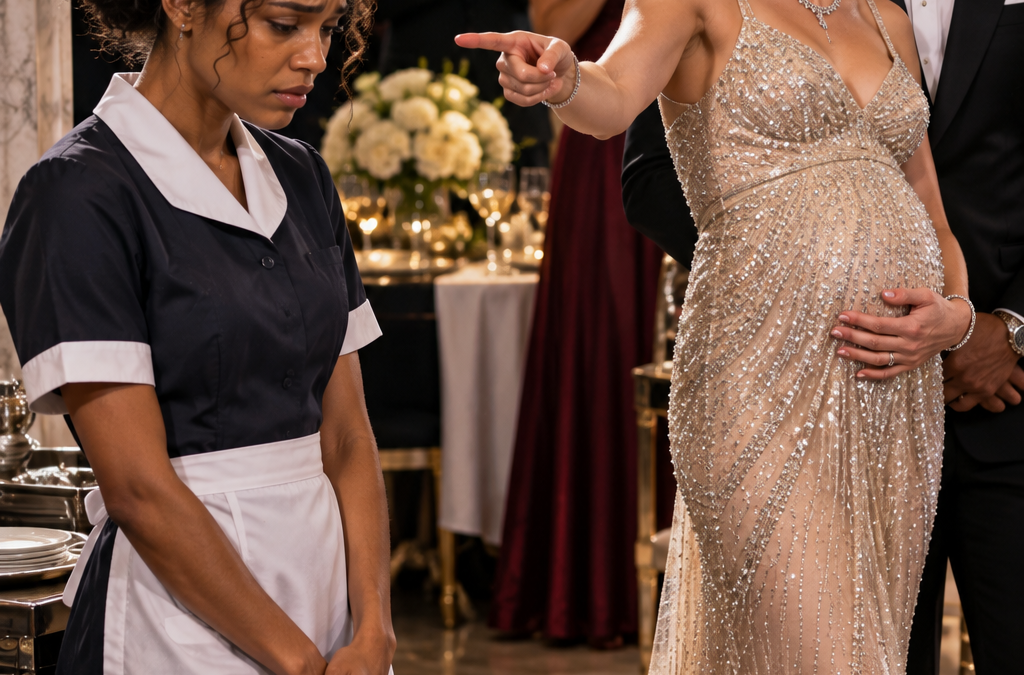
𝗙𝗨𝗟𝗟 𝗦𝗧𝗢𝗥𝗬
I knew which flowers irritated Eleanor Whitmore’s allergies.
I knew the combination to the wine cellar and the location of every emergency shutoff valve.
I knew which drawer in Garrett’s bedroom contained his late wife’s reading glasses because he had never allowed anyone to move them.
I knew which staff member had a peanut allergy.
Which guest required low sodium.
Which security code opened which gate.
Which doctor to call when Eleanor’s blood pressure dropped.
I knew the house better than anyone who lived in it.
That was why I noticed changes quickly.
And Victoria Caldwell was a change that arrived wearing perfume and certainty.
She was twenty-nine.
Blonde.
Beautiful in the expensive, polished way some women become when every detail has been intentionally constructed.
Her hair always fell correctly.
Her lipstick never faded.
Her dresses looked effortless only because someone had spent hours making them appear that way.
The first time I met her was at breakfast.
Garrett had brought her home after a charity auction the previous evening.
She came downstairs at nine wearing one of his shirts over silk sleepwear.
I was replacing flowers in the breakfast room.
She stopped.
Looked at me.
Then at the vase.
“Those roses are too old.”
They had arrived that morning.
“I can replace them, ma’am.”
She smiled.
“Good.”
Then she walked away.
That was Victoria.
She rarely raised her voice in the beginning.
She didn’t need to.
Her cruelty arrived in small corrections.
Move that.
Change this.
Don’t use that china.
Why is she still in the room?
She became engaged to Garrett within six months.
I wasn’t surprised.
Victoria had studied him carefully.
Garrett was fifty.
Tall.
Controlled.
A billionaire real-estate developer whose name appeared on buildings from Boston to Atlanta.
People who met him at business events saw discipline.
What I saw was grief.
Fifteen years earlier, Garrett’s wife had died during childbirth.
Their baby died too.
He never remarried.
He rarely dated seriously.
He built towers.
Bought land.
Acquired companies.
Worked at hours when most people slept.
But in the blue porcelain coffee cup, the untouched reading glasses and the photographs kept in a drawer no guest ever saw, I understood what Garrett was really doing.
He was keeping one room inside himself locked.
Victoria found the key.
A child.
That was what Garrett still wanted.
Not publicly.
He never discussed it at dinner.
But staff notice things.
The way he slowed when friends brought children.
The Christmas gifts he chose personally for employees’ sons and daughters.
The nursery he had never converted after fifteen years.
Victoria learned that faster than I did.
She became exactly what his grief wanted to believe.
By the time she moved into the estate, she was already talking about family.
Legacy.
Second chances.
Eleanor Whitmore did not trust her.
Eleanor was Garrett’s mother.
Seventy-eight.
White hair.
Wheelchair.
Small enough that strangers often underestimated her until she spoke.
She had survived a husband who cheated, two recessions, one hostile corporate takeover and a son who thought wealth protected him from emotional mistakes.
She rarely wasted language.
One afternoon, Victoria left the sunroom after discussing wedding flowers.
Eleanor watched the door close.
Then she looked at me.
“That woman doesn’t eat like she’s pregnant.”
I was arranging tea.
I paused.
“Mrs. Whitmore?”
“She eats like someone performing pregnancy.”
I kept my face neutral.
Eleanor narrowed her eyes.
“You think I’m being cruel.”
“No.”
“Good. I am, but that’s not the point.”
I almost smiled.
She looked toward the window.
“Watch her.”
That evening I opened the small leather journal I kept in my apron pocket.
I wrote the date.
Nothing more.
At the time, I had no evidence.
Only instinct.
Then Victoria began making it personal.
The first incident was a wine stain.
There had been six guests in the drawing room.
I was in the kitchen.
When I entered carrying appetizers, red wine covered one side of a white sofa.
Victoria laughed.
“Fiona must have left the glass on the armrest.”
Every face turned toward me.
I had never touched the glass.
I knew that.
Victoria knew that.
But she said it casually enough that nobody questioned her.
“I’ll take care of it,” I said.
That night, I spent forty minutes on my knees removing the stain.
Victoria stood in the hallway watching.
“You missed a spot.”
I looked.
There was no spot.
She smiled.
“Maybe the light is different from down there.”
Then she walked away.
A month later, she told Garrett she wanted the entire second floor restricted.
“Privacy,” she called it.
I stood in the study while she explained.
“I don’t feel comfortable with Fiona around my personal things.”
Garrett frowned.
“Fiona has worked here eight years.”
Victoria touched her stomach.
By then she had begun saying she might be pregnant, though no announcement had been made.
“She watches me.”
Her voice softened.
“Like she’s studying me.”
That word caught my attention.
Studying.
She had noticed.
Garrett looked at me.
“Can the upstairs staff handle that floor?”
“Yes, sir.”
He nodded.
“Then let’s give Victoria her privacy.”
My master keys were collected.
Eight years of access ended in less than thirty seconds.
I did not protest.
That irritated Victoria.
People who enjoy humiliation often need resistance to complete the experience.
When you give them none, they escalate.
At a formal dinner two weeks later, I served salmon to four of Garrett’s business partners.
Victoria sat beside him.
The conversation turned to service workers after one of the men complained about staffing shortages at a hotel he owned.
Victoria took a sip of wine.
“Some people are simply born to serve.”
The table went quiet.
She smiled.
“I don’t mean that as an insult.”
One man looked at his plate.
“Everyone has a place. Some people are happier when they accept theirs.”
She looked directly at me as I set down her plate.
Nobody challenged her.
That part mattered.
Cruelty rarely survives by itself.
It survives because everyone nearby decides discomfort is worse than intervention.
I finished serving.
Cleared the first course.
Refilled glasses.
My hands never shook.
Only Eleanor noticed my jaw tighten.
Later, alone in the kitchen, I stood with both palms flat against the marble island.
I breathed slowly.
Then I opened my journal.
I wrote Victoria’s sentence exactly.
Some people are simply born to serve.
Underneath it, I wrote the date.
The discovery came two days later.
One junior housekeeper called in sick.
A guest bathroom upstairs needed restocking.
Technically, I was no longer permitted on the floor.
Practically, the house still had to function.
I went upstairs.
I was in Victoria’s bathroom replacing hand towels when I noticed a decorative candle holder turned slightly toward the wall.
I moved it while wiping the vanity.
Something rattled.
The base was hollow.
Inside was a small amber prescription bottle.
I picked it up automatically.
My brain read labels the way some people read street signs.
Name.
Dose.
Prescriber.
Medication.
My hand stopped.
Medroxyprogesterone.
The patient name was not Victoria Caldwell.
Prescriber: Dr. Lance Prescott.
The pharmacy was in New Jersey.
I read it twice.
Then a third time.
My heartbeat changed.
Synthetic progesterone.
Depending on the formulation and dosage, it could regulate menstruation, alter bleeding patterns and produce symptoms that a person could present as hormonal evidence.
But a woman claiming to be well into pregnancy had no logical reason to be secretly taking it under someone else’s name.
I checked the dosage.
My suspicion sharpened.
I put the bottle back exactly as I found it.
Same angle.
Same position.
I did not take it.
I did not photograph it yet.
I simply remembered.
That evening, I went to Garrett’s study.
He looked up from financial reports.
“Fiona?”
“I need to tell you something.”
He leaned back.
I chose my words carefully.
“I saw a medication in Miss Caldwell’s bathroom today that concerns me.”
His expression changed immediately.
“Why were you in her bathroom?”
“The upstairs housekeeper called in sick. I was restocking the guest bath and—”
“You were told not to enter Victoria’s rooms.”
“I understand.”
“Then why were you in her bathroom?”
“Because I found something that could be medically significant.”
He stared at me.
“What?”
“Medroxyprogesterone.”
The word meant nothing to him.
“It’s a hormone medication. The dosage and timing do not make sense for the pregnancy she is describing.”
He sat straighter.
“You think she’s taking something dangerous?”
“I think there is a possibility she may not be pregnant.”
The study door opened.
Victoria stood there.
Her face changed instantly.
“What did you just say?”
Garrett stood.
“Victoria—”
“She was in my bathroom?”
I kept my voice level.
“I was restocking—”
“You went through my medication?”
“I found the bottle—”
“You were snooping.”
Tears appeared almost immediately.
That interested me.
Real tears usually follow emotion.
Victoria could produce them as part of the emotion.
She turned toward Garrett.
“Are you really going to let the help accuse the mother of your child of lying about pregnancy?”
Her hand covered her stomach.
Garrett looked from her to me.
I could see the decision forming before he spoke.
He wanted Victoria’s story to be true.
That was stronger than anything I could say.
“Fiona.”
His voice was quiet.
“I think you’ve overstepped.”
“Mr. Whitmore—”
“Stay in your lane.”
Four words.
I had heard worse in emergency rooms.
Still, those hurt.
Perhaps because they came from a man whose family I had served faithfully for eight years.
A man whose mother I had helped during blood-pressure episodes.
A man whose house I had protected when storms knocked out power.
A man who trusted me to manage medicine, security and guests until the moment truth became inconvenient.
The next morning, my keys were taken.
I was reassigned to the kitchen.
Victoria made sure I knew the reason.
A week later, she hosted five women for lunch.
I was working beyond the doorway.
She lowered her voice just enough to pretend privacy while ensuring I could hear.
“I had to put her in her place.”
One woman laughed.
Victoria continued.
“You know how those people can become when they start getting ideas above their station.”
More laughter.
I kept chopping vegetables.
Carrot.
Celery.
Onion.
Slow.
Exact.
When they left, I opened my journal.
Under the medication name I wrote:
She is not pregnant.
Three days later, Eleanor summoned me.
She was waiting in the sunroom.
“Sit.”
I sat.
She stared at me.
“Tell me what you found.”
I hesitated.
“Fiona.”
I looked up.
“My son has mistaken grief for hope.”
Her voice softened.
“That makes him vulnerable. It does not make him stupid forever.”
So I told her.
Everything.
The drug.
Dose.
False patient name.
Pharmacy.
My concern.
When I finished, Eleanor asked, “Where did you learn pharmacology?”
I realized then that after eight years, she did not know my full history either.
“Howard.”
Her eyebrows lifted.
“Nursing?”
“Forensic nursing.”
“You’re a nurse?”
“I was.”
“How long?”
“Six years at Johns Hopkins Bayview.”
Eleanor stared.
Then she gave one sharp laugh.
“Of course.”
“What?”
“Of course the smartest person in this house has spent eight years changing sheets while idiots discuss intelligence over dinner.”
I almost objected.
She raised one hand.
“Don’t defend us.”
I didn’t.
She reached into her cardigan.
Pulled out a white master key card.
Placed it on the table.
“My override.”
I stared at it.
“It opens every door?”
“Every one.”
“Mrs. Whitmore—”
“My house.”
She pushed the card toward me.
“My keys.”
I picked it up.
“What exactly are you asking me to do?”
“Find out whether I’m wrong.”
“And if you’re not?”
Her eyes hardened.
“Then make sure my son finds out before he signs away his future.”
That night, I became a nurse again.
Not officially.
No hospital badge.
No chart.
No supervisor.
But the discipline returned immediately.
Evidence first.
Assumptions last.
I began with the prescription.
Using Eleanor’s phone, I photographed the bottle from multiple angles.
Medication.
Dose.
Prescriber.
Pharmacy.
Patient name.
Then the ultrasound images.
Victoria displayed four on the kitchen refrigerator.
One supposedly from early pregnancy.
Another later.
Another more recent.
I studied them while the kitchen was empty.
Same timestamp.
Same machine identification.
Same image.
Different frames.
The same scan printed four times.
That alone did not prove she had fabricated an entire pregnancy.
But it was another contradiction.
I documented it.
Then I reviewed what I knew of her appointments.
Victoria refused Garrett’s private physician.
Declined Greenwich Hospital specialists.
Insisted on Dr. Prescott.
Always traveled alone.
Never used the estate driver.
Every appointment lasted almost exactly ninety minutes.
Then I found the prosthetic.
Third shelf in her walk-in closet.
Behind a garment bag.
Flat box.
Medical-grade silicone pregnancy belly.
Multiple sizing pieces.
Designed to simulate different stages.
I stared at it for several seconds.
No triumph.
No satisfaction.
Only a cold certainty.
The lie was real.
I photographed everything.
Returned it exactly.
Then I sat on my bed that night and built a timeline.
Ten days until the engagement gala.
That event mattered because the Whitmore prenuptial agreement contained a clause connected to producing an heir.
Victoria had negotiated it carefully.
If the marriage proceeded under the announced pregnancy and a Whitmore child was born, she would receive protections worth approximately eighty-five million dollars.
The public pregnancy announcement was not merely emotional.
It was leverage.
I needed more.
Then Victoria began to sense something.
People who survive by manipulating rooms develop sensitivity to shifts.
Eleanor stopped acknowledging her.
I had been seen near the staircase twice.
Victoria did not know what I had found.
She knew enough to become dangerous.
Her diamond bracelet disappeared.
Cartier.
Thirty thousand dollars.
She reported it immediately.
That evening I heard her telling Garrett.
“I’m not accusing anyone.”
A pause.
“But Fiona was the only one who had access before I changed the rules.”
Garrett said, “You think she took it?”
Victoria began crying.
“I don’t know what to think anymore.”
He believed her.
Again.
Two days later, she escalated.
Garrett was in the library.
Victoria appeared in the doorway clutching her abdomen.
She folded against the frame.
“Garrett.”
He jumped up.
“What’s wrong?”
“Cramping.”
His face went white.
I was passing the hall and saw what happened.
Victoria noticed me.
Her performance sharpened.
“I think it’s stress.”
She whispered the next part.
“Knowing she’s still here.”
Garrett looked at me.
Then Victoria.
The old trauma was all over his face.
His wife dying.
The baby.
The loss.
“She’s gone.”
He said it to Victoria.
“I’ll handle it.”
At four that afternoon, a termination letter slid beneath my bedroom door.
Eight years reduced to two paragraphs.
Services no longer required.
Vacate by the end of the week.
I read it once.
Folded it.
Placed it beside a photograph of my mother.
Then I packed.
People sometimes imagine dignity means refusing to leave.
Sometimes dignity means understanding when a place has made its choice about you.
Garrett had made his.
I would not beg.
Before leaving, I went to Eleanor.
She already knew.
“He fired you?”
“Yes.”
Her hand tightened around the wheelchair arm.
“You cannot leave.”
“I’m leaving the job.”
I sat across from her.
“Not the truth.”
I showed her the evidence.
Medication.
Ultrasounds.
Prosthetic.
Timeline.
Eleanor scrolled slowly.
Her breathing changed.
“What do you need?”
“Access to the gala.”
“They’ll remove your name.”
“I don’t need the front entrance.”
For the first time that week, I smiled faintly.
“I’ve cleaned the Belmont before.”
Eleanor studied me.
Then nodded.
“I’ll credential you as my medical aide.”
“That is technically true.”
“At my age, everything is technically medical.”
Three days remained.
I used them carefully.
I called the Connecticut State Medical Board from a pay phone.
I asked about Dr. Lance Prescott.
The answer came quickly.
License suspended fourteen months earlier.
Insurance fraud.
Not authorized to practice.
Not authorized to prescribe.
I wrote the confirmation number in my journal.
Then underlined it.
The bracelet was the final detail.
Victoria believed it had been stolen.
I knew it had fallen behind the marble vanity.
I had seen it weeks earlier.
The gap was narrow.
The bracelet had slipped between the counter and wall.
I had photographed it because I intended to retrieve it during scheduled maintenance.
Then Victoria locked me out.
When she accused me, I understood the bracelet had become another weapon.
I left it where it was.
Truth is strongest when it does not need theatrics.
On the day I left the estate, I carried one suitcase.
Eight years earlier, I had arrived with the same amount.
The guard at the gate did not say goodbye.
Neither did the gardener.
I walked through the iron gates.
For the first time, I was no longer employed by the Whitmores.
Three days later, I returned to their world anyway.
The Grand Belmont Hotel took up almost an entire downtown block.
Marble.
Gold mirrors.
Crystal.
Valet attendants wearing gloves.
Cars sliding to the entrance one after another.
I arrived forty minutes early.
Not through the front.
Service entrance.
Past loading docks.
Kitchen corridor.
I changed in a utility room.
Navy dress.
Simple shoes.
No jewelry.
I tucked Eleanor’s phone and my leather journal into a small clutch.
Then I entered the ballroom from behind catering.
Two hundred guests.
Black tie.
Champagne.
A twelve-piece orchestra.
White roses.
A slideshow of Garrett and Victoria.
There they were in Capri.
Paris.
Aspen.
Charity dinners.
Perfect photographs of an imaginary future.
I stayed near the service door.
Nobody questioned me.
A Black woman standing beside catering staff did not register as a threat.
At 9:15, Victoria walked onstage.
White gown.
One hand on her stomach.
Garrett watched from the head table.
Even from across the room, I saw hope in his face.
Real hope.
That made what I had to do harder.
Victoria lifted the microphone.
“Thank you all for coming.”
Applause.
She spoke about love.
Fate.
Second chances.
Then she paused.
Pressed her hand against the prosthetic beneath her gown.
“I’m pregnant with Garrett’s baby.”
The ballroom erupted.
People stood.
Applauded.
Some cried.
Garrett froze.
Then pushed back his chair.
He looked fifteen years younger and fifteen years more vulnerable at the same time.
He walked toward her.
Victoria held out her hand.
He kissed it.
At a side table, Raymond Shaw, the Whitmore attorney, opened a leather folder.
The prenuptial witness documents.
I saw the Montblanc pen.
That was my clock.
Victoria continued speaking.
“Our child will carry the Whitmore name.”
More applause.
Raymond lowered his pen.
I stepped away from the service door.
Nobody noticed at first.
Then I reached the edge of the light.
A waiter recognized me.
His eyes widened.
I spoke.
Not loudly.
Clearly.
“Mr. Shaw.”
The attorney stopped.
Victoria turned.
I continued.
“A woman sixteen weeks pregnant has no legitimate reason to secretly take medroxyprogesterone under a false name while presenting copied ultrasound images as separate prenatal scans.”
The room stopped.
Raymond’s pen hung above the page.
Garrett looked toward me.
Victoria’s smile disappeared.
Three seconds.
That was all.
Then her expression rebuilt itself.
She laughed.
“Who let her in?”
Her voice became louder.
“Garrett, that’s the maid.”
I walked closer.
“The one we fired for theft,” she said.
Murmurs.
Victoria pointed at me.
“She stole my bracelet. This is revenge.”
Security began moving.
I remained still.
“Miss Caldwell—”
“Get her out.”
Two guards approached from opposite sides.
I could feel two hundred people deciding which version of the room they preferred.
Beautiful pregnant fiancée.
Or fired Black housekeeper.
I knew how that vote usually went.
Then a voice cut through everything.
“If either of you touches her, you will answer to me.”
Eleanor’s wheelchair moved from behind the head table.
She operated it herself.
The guards stopped.
Victoria stared.
Eleanor came beside me.
“I invited Ms. Brooks.”
She looked at the security men.
“She is my personal medical aide.”
Then she faced Garrett.
“My son, sit down.”
He did.
That told the room exactly who Eleanor Whitmore was.
Raymond Shaw stood.
“No document will be signed until we hear what Ms. Brooks has to present.”
Victoria’s face hardened.
“This is absurd.”
Raymond adjusted his jacket.
“Eighty-five million dollars makes absurdity worth examining.”
I stepped toward the stage.
My hands were cold.
My voice wasn’t.
“My name is Fiona Brooks.”
Some guests recognized the name from the staff.
Others looked confused.
“I graduated from Howard University and trained in forensic nursing.”
Garrett’s eyes lifted sharply.
“I spent six years in trauma medicine at Johns Hopkins Bayview.”
Victoria laughed once.
“She’s a maid.”
I looked at her.
“Both things can be true.”
That silenced her.
I opened Eleanor’s phone.
“First, the medication.”
I displayed the photograph.
“This bottle contains medroxyprogesterone. It was hidden inside a decorative container in Ms. Caldwell’s bathroom.”
Victoria interrupted.
“You broke into my room.”
“I entered while employed here to replace bathroom supplies.”
I continued.
“The prescription is under a different patient’s name.”
I showed the label.
“The prescribing physician is Lance Prescott.”
Raymond stepped closer.
“Keep going.”
“The dose is inconsistent with the pregnancy Ms. Caldwell claims.”
I avoided overstating.
Years of forensic work had taught me that credibility depends on precision.
“This medication alone does not prove a fabricated pregnancy.”
Victoria seized on that.
“There.”
She looked around.
“She admits it.”
I raised one finger.
“It is one part of the evidence.”
I swiped.
“These are the four ultrasound images displayed at the Whitmore estate.”
The screen showed them side by side.
“They were presented as scans from separate appointments.”
I enlarged the identifiers.
“Same timestamp.”
Another.
“Same equipment serial number.”
Another.
“Same fetal image.”
Raymond leaned toward the screen.
“They are duplicates?”
“Yes.”
Victoria’s breathing changed.
“They’re keepsake copies.”
“Then where are the original scans?”
Silence.
“Where are the reports?”
She looked toward Garrett.
“She can’t interrogate me.”
I swiped again.
Photograph of the silicone prosthetic.
A sound moved through the ballroom.
Not speech.
Recognition.
“This was found in Ms. Caldwell’s walk-in closet.”
Victoria shouted.
“She planted it.”
I looked at her.
“You said I was banned from the second floor.”
Her face froze.
“If I had no access, how did I plant it?”
She opened her mouth.
Nothing came.
Then I presented the final piece.
“Dr. Lance Prescott.”
Raymond’s face tightened.
“I contacted the Connecticut State Medical Board.”
Victoria stepped backward.
“His medical license was suspended fourteen months ago for insurance fraud.”
The room erupted in whispers.
“He is not legally authorized to practice medicine, prescribe medication or issue medical documentation.”
Raymond asked, “Do you have confirmation?”
I opened my journal.
Read the reference number.
“Yes.”
Raymond wrote it down.
Victoria turned toward Garrett.
“This is insane.”
Garrett looked at her.
For the first time that evening, he did not immediately reach for her.
She crossed the distance.
Took his arm.
“Garrett.”
His voice was quiet.
“Is there a baby?”
She stared.
“How can you even ask me that?”
“Is there a baby?”
Tears filled her eyes.
Perfect tears.
“I love you.”
Garrett’s face broke.
“That isn’t what I asked.”
She looked around.
Two hundred people.
No way to control them all.
Raymond spoke.
“Miss Caldwell, this can be resolved immediately.”
She turned.
“How?”
“An independent medical examination.”
Her face changed.
“Tonight.”
She looked at Garrett.
“A licensed physician of your choosing,” Raymond continued.
“No.”
One word.
Garrett’s shoulders dropped.
Victoria realized what she’d done.
“I mean, I’m not submitting to some humiliating—”
Garrett stood.
“Why not?”
“Because I don’t owe your staff—”
“Not Fiona.”
His voice sharpened.
“Me.”
Victoria stared at him.
I saw calculation racing behind her eyes.
Then she reached for anger.
“This is because of her.”
She pointed at me.
“That woman has hated me from the beginning.”
“I barely spoke to you unless you gave me an instruction.”
“You watched me.”
“Yes.”
“Like I was a criminal.”
“Like I was trained to observe.”
Victoria looked toward the exit.
Then back at Garrett.
“I can’t believe you’re doing this.”
Garrett’s eyes were wet.
“Neither can I.”
She released his arm.
Straightened her dress.
Picked up her clutch.
No confession.
No apology.
She simply walked.
At first slowly.
Then faster.
Her heels struck the marble.
The doors opened.
Closed behind her.
Nobody followed.
The silence after she left was harder than any shouting could have been.
The slideshow kept running.
A photograph of Victoria kissing Garrett beside the Mediterranean.
Then another.
Then another.
False memories on a screen.
Garrett sat down.
He looked at the empty doorway for a long time.
Then at me.
“How long?”
“Long enough to become certain.”
He swallowed.
“You tried to tell me.”
“Yes.”
“I fired you.”
“Yes.”
The word hurt him.
Good.
Some pain is instructional.
He looked down at his hands.
“I told you to stay in your lane.”
I said nothing.
“What was your lane, Fiona?”
That question surprised me.
I thought about it.
“For eight years?”
He nodded.
“Whatever kept this house standing.”
His face folded.
Not dramatically.
Quietly.
The way grief changes a man when nobody can repair it for him.
Raymond closed the prenuptial folder.
“There will be no signatures tonight.”
Then he looked at me.
“The bracelet.”
Victoria had made the theft accusation part of her defense.
I answered.
“Behind the marble vanity in her bathroom.”
Garrett looked up.
“What?”
“It fell between the vanity and the wall weeks ago.”
“You knew?”
“I photographed it.”
I showed him.
“Why didn’t you retrieve it?”
“I lost access to the room before maintenance could remove the panel.”
Raymond stared at the photograph.
“So she accused you of stealing an item she never confirmed was missing from the property.”
“Correct.”
He closed his eyes briefly.
“Jesus.”
The gala ended.
No music.
No speeches.
People left in clusters.
Some avoided looking at me.
Especially the women who had laughed with Victoria.
I recognized two from the luncheon.
Neither apologized.
That did not surprise me.
People who enjoy cruelty in groups rarely enjoy accountability individually.
Garrett eventually walked to the microphone.
He stood before his guests.
For several seconds, he could not speak.
Then he did.
“I owe everyone in this room an apology.”
His voice was rough.
“But especially one person.”
He looked at me.
“I was warned.”
The room stayed silent.
“I rejected evidence because I preferred hope.”
He stopped.
“No.”
He shook his head.
“That’s too generous to me.”
He looked at the floor.
“I rejected the person bringing me evidence because it was easier to believe someone I wanted than someone I had decided was beneath the conversation.”
That was closer to the truth.
He faced me.
“Fiona.”
I met his eyes.
“I am sorry.”
I did not say, “It’s okay.”
It wasn’t.
I nodded once.
That was all he received.
Eleanor took my hand.
“You were always the strongest person in that house.”
I looked at her.
“No.”
She frowned.
“I’m tired, Mrs. Whitmore.”
That made her smile.
“So am I.”
The investigation moved quickly.
Victoria was found at a motel in Stamford two days later.
The fraud case involved the prenuptial arrangement, falsified medical documentation and the false theft report.
Dr. Prescott was arrested separately.
Investigators found other records suggesting he had provided questionable medical documentation to additional clients.
The Cartier bracelet was recovered exactly where I said it was.
Behind the vanity.
The estate manager photographed it before removal.
Police documented the location.
The theft allegation against me disappeared.
Victoria gained another legal problem.
The press learned the story within days.
Two hundred wealthy guests are terrible at confidentiality when they have witnessed something spectacular.
Headlines focused on the dramatic version.
MAID EXPOSES FAKE PREGNANCY.
HOUSEKEEPER STOPS $85 MILLION SCHEME.
FORMER NURSE DESTROYS SOCIALITE’S LIE.
I hated the word maid in the headlines at first.
Then I stopped.
There was nothing shameful about the work I had done.
The shame belonged to people who believed the uniform meant I could not possess expertise beneath it.
Garrett refused interviews.
So did Eleanor.
I returned once to the estate.
Only once.
Not for work.
To collect two books and say goodbye to staff.
The house felt different.
Flowers were late.
The breakfast service was disorganized.
Someone had put Garrett’s coffee in the white cup.
He stared at it like he had been personally betrayed.
I almost laughed.
Then he saw me.
“Fiona.”
“Mr. Whitmore.”
He stood.
“I asked Eleanor to contact you.”
“She did.”
“I want you to come back.”
I shook my head immediately.
“Not as housekeeper.”
“No.”
He looked embarrassed.
“I mean… not unless that’s what you want.”
“It isn’t.”
“I understand.”
He paused.
“What do you want?”
For eight years, nobody in that house had asked me that.
Not seriously.
I thought about my mother.
The hospital.
The part of myself I had buried beneath routines because returning felt too difficult.
“I want my nursing license back.”
Garrett frowned.
“Then why haven’t you—”
“Recertification costs money.”
I looked at him.
“And time.”
His answer came immediately.
“I’ll cover it.”
I studied him.
“I don’t want charity.”
“Then don’t call it charity.”
“What do I call it?”
He exhaled.
“Restitution isn’t the right word either.”
“No.”
“Then call it something I should have done without being asked.”
I accepted.
Not forgiveness.
An opportunity.
Those are different things.
Recertification was harder than I expected.
Eight years away had changed medicine.
Protocols.
Electronic systems.
Standards.
I studied at forty-two alongside nurses half my age.
The first week, I went home convinced I had made a mistake.
Then I opened my old journal.
My handwriting.
Dates.
Observations.
Evidence.
Victoria’s medication.
The gala.
I remembered that knowledge had not disappeared just because nobody had requested it.
I continued.
Eighteen months later, I was recertified.
I did not return to a trauma ward.
I became a forensic nursing consultant.
Hospitals called.
Attorneys called.
Victim-advocacy groups called.
My work became the thing I had once loved without the schedule that had burned me out.
Garrett did something else during that period.
He created a scholarship program.
When he told me the proposed name, I refused.
“The Fiona Brooks Foundation sounds ridiculous.”
Eleanor was sitting beside him.
“I like it.”
“Of course you do.”
Garrett almost smiled.
“The purpose is to help women returning to medical careers after caregiving interruptions.”
That stopped me.
Women who had left medicine to raise children.
Care for parents.
Care for spouses.
Women whose knowledge remained but whose licenses had expired.
Women who discovered reentry costs could keep them out longer than the caregiving itself.
“Don’t put my face on anything.”
Garrett nodded.
“No face.”
“And don’t make applicants write trauma essays to prove they deserve help.”
He looked confused.
“Trauma essays?”
“Organizations make people turn suffering into performance.”
I shook my head.
“Don’t.”
“Okay.”
“Need. Qualifications. Career plan. That’s enough.”
He nodded.
“Done.”
Eleanor smiled.
“You realize you’re running it already.”
“I am not.”
“You are.”
She was right.
Eventually I stopped resisting.
The first scholarship went to a fifty-one-year-old respiratory therapist from Bridgeport who had spent nine years caring for her husband after a stroke.
The second went to a nurse from New Haven who had left practice to raise three children after her husband died.
The third was a woman who had cared for her mother through dementia.
I read her application twice.
Then closed my office door and cried.
My mother would have understood.
A year later, I was invited to speak at a national healthcare conference in Washington.
Five hundred physicians, nurses, administrators, attorneys and policy specialists.
The title of my talk was not mine.
The organizers chose it.
What the Help Sees: Observation, Dignity, and the Invisible Workforce.
I almost refused because of the title.
Then I decided it needed to be said.
Eleanor attended.
Front row.
Pearls.
Wheelchair.
Watching me with an expression that made me more nervous than any professional audience.
I wore navy.
Not because of the gala.
Because I liked navy.
That mattered.
For years, clothes had been chosen for me.
Uniform.
Apron.
Service shoes.
At the podium, I looked over the room.
Then I began with the same principle that had stopped Raymond Shaw’s pen.
“Evidence does not become less true because of who notices it.”
The room quieted.
I told them about trauma nursing.
My mother.
Caregiving.
Housekeeping.
The diplomat’s wife I once recognized was hypoglycemic while everyone else thought she had drunk too much.
I told them how the physician arrived later and received credit.
I told them about Victoria.
But not as gossip.
I talked about hierarchy.
How institutions train themselves to ignore information that comes from people without titles.
A nursing assistant notices a change first.
A housekeeper sees medication on the floor.
A receptionist hears a threat.
A janitor notices a safety hazard.
A home-health aide catches confusion before the physician does.
The lowest-paid person in a system can still hold the most important observation.
Ignoring them is not merely disrespectful.
It is dangerous.
I looked toward Eleanor.
She smiled slightly.
Then I said the part I had waited years to understand myself.
“For eight years, people thought I had stopped being a nurse because I wore an apron.”
I paused.
“I thought that too.”
The room was completely still.
“My license expired.”
I touched the podium.
“My knowledge did not.”
I thought of Victoria telling those men some people were born to serve.
Maybe she had accidentally revealed something true.
We do all serve something.
Money.
Status.
Fear.
Love.
Truth.
Ego.
Family.
The question is not whether you serve.
The question is what you choose to serve when it costs you something.
After the talk, the audience stood.
I did not expect that.
For a second, I was back in the Belmont ballroom.
Two hundred people staring.
But this silence felt different.
So did the applause.
Eleanor waited until everyone else had finished congratulating me.
Then I walked toward her.
“What did you think?”
She tilted her head.
“Too long.”
I stared.
She smiled.
“I’ve been waiting eighty years to say that to a speaker.”
I laughed.
Then she took my hand.
“My son is different.”
I didn’t answer.
“He visits his wife’s grave.”
“I know.”
“He talks now.”
“Good.”
“He asked me if forgiveness can be earned.”
I looked at Eleanor.
“What did you tell him?”
“That forgiveness isn’t wages.”
I nodded.
“That’s good.”
“I stole it from you.”
“No, you didn’t.”
“I probably did.”
Garrett and I never became close.
That would have made the story prettier.
Life does not always need pretty.
We became respectful.
He stopped treating staff as extensions of the house.
Schedules improved.
Pay improved.
Staff meetings included people who actually did the daily work.
The first time he asked a housekeeper what she thought about an operational problem, she stared at him for so long that he finally said, “I really am asking.”
That made me smile when I heard about it.
One autumn afternoon, nearly three years after the gala, I visited Eleanor at the estate.
She was weaker.
Still sharp.
Always sharp.
We sat in the sunroom.
The garden was changing color.
She asked, “Do you miss this place?”
“No.”
“Good answer.”
I looked around.
“Sometimes.”
“Bad answer.”
I laughed.
She lifted her tea.
“Do you miss knowing everything?”
“I still know everything.”
“Arrogant.”
“Learned from you.”
We sat quietly.
Then she said, “Victoria hated you because you watched.”
I thought about that.
“Maybe.”
“No.”
Eleanor looked toward the garden.
“People who live by performance fear witnesses more than enemies.”
That sentence stayed with me.
Victoria had never been afraid of Garrett’s money.
She wanted it.
She wasn’t afraid of his attorney until he stopped believing her.
She wasn’t afraid of the guests.
She understood audiences.
She was afraid of observation.
The person who noticed.
The person who wrote dates in a small leather journal.
The person she believed had no power.
I still have that journal.
It’s in my desk.
The cover is worn now.
Inside are eight years of ordinary details.
Menus.
Medication schedules.
Staffing problems.
Guest allergies.
Repairs.
Dates.
And then Victoria.
Wine stain.
Second-floor restrictions.
Born to serve.
Medroxyprogesterone.
Fake ultrasound.
Prosthetic.
Bracelet.
Gala.
Sometimes I open it to the page where I wrote:
She is not pregnant.
The handwriting is calm.
That surprises me.
I remember being furious.
Humiliated.
Afraid.
But the sentence is clean.
No anger.
Just observation.
That was what ultimately mattered.
Victoria had beauty.
Money.
Access.
Garrett’s love.
A room willing to applaud her.
I had a notebook.
Training nobody knew about.
And enough patience to make sure that when I spoke, I would not need anybody to trust me blindly.
They could verify every word.
I learned something from that.
Truth is not always powerful immediately.
Sometimes lies enter the room first.
They wear better clothes.
They have better timing.
They know people’s weaknesses.
They receive applause.
Truth can arrive late.
In a plain navy dress.
Through a service entrance.
Without an invitation anyone respects.
But if it has been observed carefully, documented properly and spoken at the moment when silence becomes complicity, it does not need to scream.
Years after the gala, people still sometimes recognized me.
Usually they said, “You’re the woman who exposed the fake pregnancy.”
I would smile.
“Yes.”
Some said, “You destroyed her.”
That part I corrected.
“No.”
Victoria destroyed herself.
I simply stopped protecting her from the truth.
There is a difference.
On the anniversary of my recertification, I visited my mother’s grave.
I brought no flowers.
She had hated cut flowers.
Said they were beautiful corpses pretending to be gifts.
I sat beside the stone.
For a while, I said nothing.
Then I told her everything I had done.
The foundation.
The hospital consulting.
The conference.
The women returning to medicine.
I told her about the gala too, even though I had told the story a hundred times publicly by then.
This version was different.
“Remember when you used to tell me not to waste my education?”
The cemetery was quiet.
“I thought I did.”
Wind moved through the trees.
“I didn’t.”
I smiled.
“I just put it somewhere strange for eight years.”
I sat there until the sun began dropping.
Then I returned to my car.
Before I left, I looked back at her headstone.
I thought about every room I had entered through a service door.
Every person who had spoken around me as though I were furniture.
Every moment I had swallowed something because keeping the job mattered more than answering the insult.
I did not regret those years.
I regretted some of the silence.
There is a difference.
Silence can be discipline.
It can also become permission.
The hardest thing is knowing when it changes from one into the other.
At the Whitmore estate, I spent years observing.
With Victoria, there came a moment when observation was no longer enough.
Raymond’s pen was touching the paper.
Garrett was believing the lie.
Two hundred people were applauding.
And I understood that if I remained near the service door, the evidence in my journal would become nothing more than proof that I had watched something terrible happen and chosen not to interfere.
So I stepped forward.
I did not become valuable when the ballroom finally looked at me.
I had been valuable in the kitchen.
In the trauma ward.
Beside my mother’s bed.
On my knees cleaning Victoria’s wine stain.
Standing alone with vegetables while women laughed about my place in the world.
The difference was not my value.
The difference was visibility.
That distinction matters to me now.
Because somewhere tonight, someone is doing work nobody applauds.
A nurse’s aide sees something a physician missed.
A cleaner hears something a board member should know.
A caregiver whose career has been interrupted still carries decades of knowledge.
A woman who has been told to stay in her lane knows exactly where the road is broken.
They do not become intelligent when someone finally listens.
They were intelligent before.
They do not become worthy when a title appears beside their name.
They were worthy before.
I was a forensic nurse while wearing an apron.
I was a housekeeper while holding medical expertise.
I was a caregiver while grieving.
I was all of those women at the same time.
Victoria could only understand hierarchy.
One person above.
Another below.
Someone serving.
Someone being served.
The truth that destroyed her plan was something she could never understand.
A uniform tells you what job a person is doing.
It tells you almost nothing about who that person is.
I know that now better than I knew it on the night of the gala.
Sometimes I still dream about the ballroom.
In the dream, Raymond’s pen is lowering.
Victoria is smiling.
Garrett is standing beside her.
I am back near the service entrance.
And for a moment, I cannot speak.
Then I hear my own voice.
Steady.
Clinical.
Certain.
The pen stops.
Two hundred heads turn.
And I wake before anyone applauds.
I prefer it that way.
Because applause was never the important part.
The important part was that, after eight years of being treated as though I had nothing worth hearing, I finally trusted myself enough to speak before anyone gave me permission.
𝗧𝗛𝗘 𝗘𝗡𝗗
The Billionaire’s Fiancée Humiliated Me for Months, but the Night She Announced Her Pregnancy I Knew Exactly Which Sentence Would Stop the Room
Two hundred people were applauding when Victoria Caldwell placed one hand over her stomach and announced that she was carrying Garrett Whitmore’s child.
I stood near the service entrance in a plain navy dress, watching the family attorney lower his pen toward an eighty-five-million-dollar agreement, and I knew I had only seconds to decide whether the truth was worth losing whatever dignity I had left.
For eight years, I had been invisible inside the Whitmore house.
That was not an exaggeration.
I could enter a dining room carrying six plates, refill four wine glasses, replace a dropped fork and remove a stained napkin without interrupting a single conversation.
Guests looked through me.
Businessmen handed me empty glasses without making eye contact.
Women wearing bracelets worth more than my annual salary sometimes called me “Frances” or “Flora” or simply snapped their fingers.
My name was Fiona Brooks.
Very few of them ever bothered to learn it.
By the time Victoria Caldwell entered the Whitmore estate, I had already learned that invisibility could hurt you, but it could also teach you things.
People reveal themselves around someone they do not consider important.
They complain freely.
They lie carelessly.
They leave doors open.
They assume the person pouring coffee is not listening.
I always listened.
That was not a habit I learned from housekeeping.
It came from another life.
Before I wore a gray uniform and white apron, I graduated with honors from Howard University’s nursing program and specialized in forensic nursing.
I spent six years in trauma care at Johns Hopkins Bayview Medical Center in Baltimore.
Gunshot wounds.
Assaults.
Overdoses.
Domestic violence.
Children with injuries that did not match the explanation.
Adults insisting they had fallen down stairs when the bruising told a different story.
My job taught me to pay attention to what people said.
It taught me to pay even more attention to what their bodies said when the story was false.
I learned to document everything.
Dates.
Measurements.
Medication.
Timing.
Contradictions.
A person’s memory could fail.
A photograph did not.
A laboratory value did not care who had money.
A prescription bottle did not care how beautiful the person holding it was.
Then my mother was diagnosed with early-onset Alzheimer’s.
I left medicine almost overnight.
There was no noble plan.
No career transition.
No dramatic farewell.
My mother needed someone.
I was her only daughter.
So I went home.
For four years I watched the woman who had raised me gradually forget the shape of her own life.
At first she misplaced keys.
Then names.
Then rooms.
Near the end, she sometimes looked at me and asked whether Fiona would be visiting soon.
I would say, “I’m Fiona, Mama.”
She would smile politely.
“Of course you are.”
Then forget again.
When she died, I was thirty-four and exhausted in a way sleep could not fix.
My nursing certification had lapsed.
I did not want another hospital.
I did not want night shifts.
I did not want blood.
I wanted quiet.
The Whitmore estate offered a live-in housekeeping position with stable hours and good pay.
I took it.
That was supposed to be temporary.
Eight years later, I still knew how Garrett Whitmore liked his coffee.
Black.
Two sugars.
Blue porcelain cup.
Never the white one.
I knew which flowers irritated Eleanor Whitmore’s allergies.
I knew the combination to the wine cellar and the location of every emergency shutoff valve.
I knew which drawer in Garrett’s bedroom contained his late wife’s reading glasses because he had never allowed anyone to move them.
I knew which staff member had a peanut allergy.
Which guest required low sodium.
Which security code opened which gate.
Which doctor to call when Eleanor’s blood pressure dropped.
I knew the house better than anyone who lived in it.
That was why I noticed changes quickly.
And Victoria Caldwell was a change that arrived wearing perfume and certainty.
She was twenty-nine.
Blonde.
Beautiful in the expensive, polished way some women become when every detail has been intentionally constructed.
Her hair always fell correctly.
Her lipstick never faded.
Her dresses looked effortless only because someone had spent hours making them appear that way.
The first time I met her was at breakfast.
Garrett had brought her home after a charity auction the previous evening.
She came downstairs at nine wearing one of his shirts over silk sleepwear.
I was replacing flowers in the breakfast room.
She stopped.
Looked at me.
Then at the vase.
“Those roses are too old.”
They had arrived that morning.
“I can replace them, ma’am.”
She smiled.
“Good.”
Then she walked away.
That was Victoria.
She rarely raised her voice in the beginning.
She didn’t need to.
Her cruelty arrived in small corrections.
Move that.
Change this.
Don’t use that china.
Why is she still in the room?
She became engaged to Garrett within six months.
I wasn’t surprised.
Victoria had studied him carefully.
Garrett was fifty.
Tall.
Controlled.
A billionaire real-estate developer whose name appeared on buildings from Boston to Atlanta.
People who met him at business events saw discipline.
What I saw was grief.
Fifteen years earlier, Garrett’s wife had died during childbirth.
Their baby died too.
He never remarried.
He rarely dated seriously.
He built towers.
Bought land.
Acquired companies.
Worked at hours when most people slept.
But in the blue porcelain coffee cup, the untouched reading glasses and the photographs kept in a drawer no guest ever saw, I understood what Garrett was really doing.
He was keeping one room inside himself locked.
Victoria found the key.
A child.
That was what Garrett still wanted.
Not publicly.
He never discussed it at dinner.
But staff notice things.
The way he slowed when friends brought children.
The Christmas gifts he chose personally for employees’ sons and daughters.
The nursery he had never converted after fifteen years.
Victoria learned that faster than I did.
She became exactly what his grief wanted to believe.
By the time she moved into the estate, she was already talking about family.
Legacy.
Second chances.
Eleanor Whitmore did not trust her.
Eleanor was Garrett’s mother.
Seventy-eight.
White hair.
Wheelchair.
Small enough that strangers often underestimated her until she spoke.
She had survived a husband who cheated, two recessions, one hostile corporate takeover and a son who thought wealth protected him from emotional mistakes.
She rarely wasted language.
One afternoon, Victoria left the sunroom after discussing wedding flowers.
Eleanor watched the door close.
Then she looked at me.
“That woman doesn’t eat like she’s pregnant.”
I was arranging tea.
I paused.
“Mrs. Whitmore?”
“She eats like someone performing pregnancy.”
I kept my face neutral.
Eleanor narrowed her eyes.
“You think I’m being cruel.”
“No.”
“Good. I am, but that’s not the point.”
I almost smiled.
She looked toward the window.
“Watch her.”
That evening I opened the small leather journal I kept in my apron pocket.
I wrote the date.
Nothing more.
At the time, I had no evidence.
Only instinct.
Then Victoria began making it personal.
The first incident was a wine stain.
There had been six guests in the drawing room.
I was in the kitchen.
When I entered carrying appetizers, red wine covered one side of a white sofa.
Victoria laughed.
“Fiona must have left the glass on the armrest.”
Every face turned toward me.
I had never touched the glass.
I knew that.
Victoria knew that.
But she said it casually enough that nobody questioned her.
“I’ll take care of it,” I said.
That night, I spent forty minutes on my knees removing the stain.
Victoria stood in the hallway watching.
“You missed a spot.”
I looked.
There was no spot.
She smiled.
“Maybe the light is different from down there.”
Then she walked away.
A month later, she told Garrett she wanted the entire second floor restricted.
“Privacy,” she called it.
I stood in the study while she explained.
“I don’t feel comfortable with Fiona around my personal things.”
Garrett frowned.
“Fiona has worked here eight years.”
Victoria touched her stomach.
By then she had begun saying she might be pregnant, though no announcement had been made.
“She watches me.”
Her voice softened.
“Like she’s studying me.”
That word caught my attention.
Studying.
She had noticed.
Garrett looked at me.
“Can the upstairs staff handle that floor?”
“Yes, sir.”
He nodded.
“Then let’s give Victoria her privacy.”
My master keys were collected.
Eight years of access ended in less than thirty seconds.
I did not protest.
That irritated Victoria.
People who enjoy humiliation often need resistance to complete the experience.
When you give them none, they escalate.
At a formal dinner two weeks later, I served salmon to four of Garrett’s business partners.
Victoria sat beside him.
The conversation turned to service workers after one of the men complained about staffing shortages at a hotel he owned.
Victoria took a sip of wine.
“Some people are simply born to serve.”
The table went quiet.
She smiled.
“I don’t mean that as an insult.”
One man looked at his plate.
“Everyone has a place. Some people are happier when they accept theirs.”
She looked directly at me as I set down her plate.
Nobody challenged her.
That part mattered.
Cruelty rarely survives by itself.
It survives because everyone nearby decides discomfort is worse than intervention.
I finished serving.
Cleared the first course.
Refilled glasses.
My hands never shook.
Only Eleanor noticed my jaw tighten.
Later, alone in the kitchen, I stood with both palms flat against the marble island.
I breathed slowly.
Then I opened my journal.
I wrote Victoria’s sentence exactly.
Some people are simply born to serve.
Underneath it, I wrote the date.
The discovery came two days later.
One junior housekeeper called in sick.
A guest bathroom upstairs needed restocking.
Technically, I was no longer permitted on the floor.
Practically, the house still had to function.
I went upstairs.
I was in Victoria’s bathroom replacing hand towels when I noticed a decorative candle holder turned slightly toward the wall.
I moved it while wiping the vanity.
Something rattled.
The base was hollow.
Inside was a small amber prescription bottle.
I picked it up automatically.
My brain read labels the way some people read street signs.
Name.
Dose.
Prescriber.
Medication.
My hand stopped.
Medroxyprogesterone.
The patient name was not Victoria Caldwell.
Prescriber: Dr. Lance Prescott.
The pharmacy was in New Jersey.
I read it twice.
Then a third time.
My heartbeat changed.
Synthetic progesterone.
Depending on the formulation and dosage, it could regulate menstruation, alter bleeding patterns and produce symptoms that a person could present as hormonal evidence.
But a woman claiming to be well into pregnancy had no logical reason to be secretly taking it under someone else’s name.
I checked the dosage.
My suspicion sharpened.
I put the bottle back exactly as I found it.
Same angle.
Same position.
I did not take it.
I did not photograph it yet.
I simply remembered.
That evening, I went to Garrett’s study.
He looked up from financial reports.
“Fiona?”
“I need to tell you something.”
He leaned back.
I chose my words carefully.
“I saw a medication in Miss Caldwell’s bathroom today that concerns me.”
His expression changed immediately.
“Why were you in her bathroom?”
“The upstairs housekeeper called in sick. I was restocking the guest bath and—”
“You were told not to enter Victoria’s rooms.”
“I understand.”
“Then why were you in her bathroom?”
“Because I found something that could be medically significant.”
He stared at me.
“What?”
“Medroxyprogesterone.”
The word meant nothing to him.
“It’s a hormone medication. The dosage and timing do not make sense for the pregnancy she is describing.”
He sat straighter.
“You think she’s taking something dangerous?”
“I think there is a possibility she may not be pregnant.”
The study door opened.
Victoria stood there.
Her face changed instantly.
“What did you just say?”
Garrett stood.
“Victoria—”
“She was in my bathroom?”
I kept my voice level.
“I was restocking—”
“You went through my medication?”
“I found the bottle—”
“You were snooping.”
Tears appeared almost immediately.
That interested me.
Real tears usually follow emotion.
Victoria could produce them as part of the emotion.
She turned toward Garrett.
“Are you really going to let the help accuse the mother of your child of lying about pregnancy?”
Her hand covered her stomach.
Garrett looked from her to me.
I could see the decision forming before he spoke.
He wanted Victoria’s story to be true.
That was stronger than anything I could say.
“Fiona.”
His voice was quiet.
“I think you’ve overstepped.”
“Mr. Whitmore—”
“Stay in your lane.”
Four words.
I had heard worse in emergency rooms.
Still, those hurt.
Perhaps because they came from a man whose family I had served faithfully for eight years.
A man whose mother I had helped during blood-pressure episodes.
A man whose house I had protected when storms knocked out power.
A man who trusted me to manage medicine, security and guests until the moment truth became inconvenient.
The next morning, my keys were taken.
I was reassigned to the kitchen.
Victoria made sure I knew the reason.
A week later, she hosted five women for lunch.
I was working beyond the doorway.
She lowered her voice just enough to pretend privacy while ensuring I could hear.
“I had to put her in her place.”
One woman laughed.
Victoria continued.
“You know how those people can become when they start getting ideas above their station.”
More laughter.
I kept chopping vegetables.
Carrot.
Celery.
Onion.
Slow.
Exact.
When they left, I opened my journal.
Under the medication name I wrote:
She is not pregnant.
Three days later, Eleanor summoned me.
She was waiting in the sunroom.
“Sit.”
I sat.
She stared at me.
“Tell me what you found.”
I hesitated.
“Fiona.”
I looked up.
“My son has mistaken grief for hope.”
Her voice softened.
“That makes him vulnerable. It does not make him stupid forever.”
So I told her.
Everything.
The drug.
Dose.
False patient name.
Pharmacy.
My concern.
When I finished, Eleanor asked, “Where did you learn pharmacology?”
I realized then that after eight years, she did not know my full history either.
“Howard.”
Her eyebrows lifted.
“Nursing?”
“Forensic nursing.”
“You’re a nurse?”
“I was.”
“How long?”
“Six years at Johns Hopkins Bayview.”
Eleanor stared.
Then she gave one sharp laugh.
“Of course.”
“What?”
“Of course the smartest person in this house has spent eight years changing sheets while idiots discuss intelligence over dinner.”
I almost objected.
She raised one hand.
“Don’t defend us.”
I didn’t.
She reached into her cardigan.
Pulled out a white master key card.
Placed it on the table.
“My override.”
I stared at it.
“It opens every door?”
“Every one.”
“Mrs. Whitmore—”
“My house.”
She pushed the card toward me.
“My keys.”
I picked it up.
“What exactly are you asking me to do?”
“Find out whether I’m wrong.”
“And if you’re not?”
Her eyes hardened.
“Then make sure my son finds out before he signs away his future.”
That night, I became a nurse again.
Not officially.
No hospital badge.
No chart.
No supervisor.
But the discipline returned immediately.
Evidence first.
Assumptions last.
I began with the prescription.
Using Eleanor’s phone, I photographed the bottle from multiple angles.
Medication.
Dose.
Prescriber.
Pharmacy.
Patient name.
Then the ultrasound images.
Victoria displayed four on the kitchen refrigerator.
One supposedly from early pregnancy.
Another later.
Another more recent.
I studied them while the kitchen was empty.
Same timestamp.
Same machine identification.
Same image.
Different frames.
The same scan printed four times.
That alone did not prove she had fabricated an entire pregnancy.
But it was another contradiction.
I documented it.
Then I reviewed what I knew of her appointments.
Victoria refused Garrett’s private physician.
Declined Greenwich Hospital specialists.
Insisted on Dr. Prescott.
Always traveled alone.
Never used the estate driver.
Every appointment lasted almost exactly ninety minutes.
Then I found the prosthetic.
Third shelf in her walk-in closet.
Behind a garment bag.
Flat box.
Medical-grade silicone pregnancy belly.
Multiple sizing pieces.
Designed to simulate different stages.
I stared at it for several seconds.
No triumph.
No satisfaction.
Only a cold certainty.
The lie was real.
I photographed everything.
Returned it exactly.
Then I sat on my bed that night and built a timeline.
Ten days until the engagement gala.
That event mattered because the Whitmore prenuptial agreement contained a clause connected to producing an heir.
Victoria had negotiated it carefully.
If the marriage proceeded under the announced pregnancy and a Whitmore child was born, she would receive protections worth approximately eighty-five million dollars.
The public pregnancy announcement was not merely emotional.
It was leverage.
I needed more.
Then Victoria began to sense something.
People who survive by manipulating rooms develop sensitivity to shifts.
Eleanor stopped acknowledging her.
I had been seen near the staircase twice.
Victoria did not know what I had found.
She knew enough to become dangerous.
Her diamond bracelet disappeared.
Cartier.
Thirty thousand dollars.
She reported it immediately.
That evening I heard her telling Garrett.
“I’m not accusing anyone.”
A pause.
“But Fiona was the only one who had access before I changed the rules.”
Garrett said, “You think she took it?”
Victoria began crying.
“I don’t know what to think anymore.”
He believed her.
Again.
Two days later, she escalated.
Garrett was in the library.
Victoria appeared in the doorway clutching her abdomen.
She folded against the frame.
“Garrett.”
He jumped up.
“What’s wrong?”
“Cramping.”
His face went white.
I was passing the hall and saw what happened.
Victoria noticed me.
Her performance sharpened.
“I think it’s stress.”
She whispered the next part.
“Knowing she’s still here.”
Garrett looked at me.
Then Victoria.
The old trauma was all over his face.
His wife dying.
The baby.
The loss.
“She’s gone.”
He said it to Victoria.
“I’ll handle it.”
At four that afternoon, a termination letter slid beneath my bedroom door.
Eight years reduced to two paragraphs.
Services no longer required.
Vacate by the end of the week.
I read it once.
Folded it.
Placed it beside a photograph of my mother.
Then I packed.
People sometimes imagine dignity means refusing to leave.
Sometimes dignity means understanding when a place has made its choice about you.
Garrett had made his.
I would not beg.
Before leaving, I went to Eleanor.
She already knew.
“He fired you?”
“Yes.”
Her hand tightened around the wheelchair arm.
“You cannot leave.”
“I’m leaving the job.”
I sat across from her.
“Not the truth.”
I showed her the evidence.
Medication.
Ultrasounds.
Prosthetic.
Timeline.
Eleanor scrolled slowly.
Her breathing changed.
“What do you need?”
“Access to the gala.”
“They’ll remove your name.”
“I don’t need the front entrance.”
For the first time that week, I smiled faintly.
“I’ve cleaned the Belmont before.”
Eleanor studied me.
Then nodded.
“I’ll credential you as my medical aide.”
“That is technically true.”
“At my age, everything is technically medical.”
Three days remained.
I used them carefully.
I called the Connecticut State Medical Board from a pay phone.
I asked about Dr. Lance Prescott.
The answer came quickly.
License suspended fourteen months earlier.
Insurance fraud.
Not authorized to practice.
Not authorized to prescribe.
I wrote the confirmation number in my journal.
Then underlined it.
The bracelet was the final detail.
Victoria believed it had been stolen.
I knew it had fallen behind the marble vanity.
I had seen it weeks earlier.
The gap was narrow.
The bracelet had slipped between the counter and wall.
I had photographed it because I intended to retrieve it during scheduled maintenance.
Then Victoria locked me out.
When she accused me, I understood the bracelet had become another weapon.
I left it where it was.
Truth is strongest when it does not need theatrics.
On the day I left the estate, I carried one suitcase.
Eight years earlier, I had arrived with the same amount.
The guard at the gate did not say goodbye.
Neither did the gardener.
I walked through the iron gates.
For the first time, I was no longer employed by the Whitmores.
Three days later, I returned to their world anyway.
The Grand Belmont Hotel took up almost an entire downtown block.
Marble.
Gold mirrors.
Crystal.
Valet attendants wearing gloves.
Cars sliding to the entrance one after another.
I arrived forty minutes early.
Not through the front.
Service entrance.
Past loading docks.
Kitchen corridor.
I changed in a utility room.
Navy dress.
Simple shoes.
No jewelry.
I tucked Eleanor’s phone and my leather journal into a small clutch.
Then I entered the ballroom from behind catering.
Two hundred guests.
Black tie.
Champagne.
A twelve-piece orchestra.
White roses.
A slideshow of Garrett and Victoria.
There they were in Capri.
Paris.
Aspen.
Charity dinners.
Perfect photographs of an imaginary future.
I stayed near the service door.
Nobody questioned me.
A Black woman standing beside catering staff did not register as a threat.
At 9:15, Victoria walked onstage.
White gown.
One hand on her stomach.
Garrett watched from the head table.
Even from across the room, I saw hope in his face.
Real hope.
That made what I had to do harder.
Victoria lifted the microphone.
“Thank you all for coming.”
Applause.
She spoke about love.
Fate.
Second chances.
Then she paused.
Pressed her hand against the prosthetic beneath her gown.
“I’m pregnant with Garrett’s baby.”
The ballroom erupted.
People stood.
Applauded.
Some cried.
Garrett froze.
Then pushed back his chair.
He looked fifteen years younger and fifteen years more vulnerable at the same time.
He walked toward her.
Victoria held out her hand.
He kissed it.
At a side table, Raymond Shaw, the Whitmore attorney, opened a leather folder.
The prenuptial witness documents.
I saw the Montblanc pen.
That was my clock.
Victoria continued speaking.
“Our child will carry the Whitmore name.”
More applause.
Raymond lowered his pen.
I stepped away from the service door.
Nobody noticed at first.
Then I reached the edge of the light.
A waiter recognized me.
His eyes widened.
I spoke.
Not loudly.
Clearly.
“Mr. Shaw.”
The attorney stopped.
Victoria turned.
I continued.
“A woman sixteen weeks pregnant has no legitimate reason to secretly take medroxyprogesterone under a false name while presenting copied ultrasound images as separate prenatal scans.”
The room stopped.
Raymond’s pen hung above the page.
Garrett looked toward me.
Victoria’s smile disappeared.
Three seconds.
That was all.
Then her expression rebuilt itself.
She laughed.
“Who let her in?”
Her voice became louder.
“Garrett, that’s the maid.”
I walked closer.
“The one we fired for theft,” she said.
Murmurs.
Victoria pointed at me.
“She stole my bracelet. This is revenge.”
Security began moving.
I remained still.
“Miss Caldwell—”
“Get her out.”
Two guards approached from opposite sides.
I could feel two hundred people deciding which version of the room they preferred.
Beautiful pregnant fiancée.
Or fired Black housekeeper.
I knew how that vote usually went.
Then a voice cut through everything.
“If either of you touches her, you will answer to me.”
Eleanor’s wheelchair moved from behind the head table.
She operated it herself.
The guards stopped.
Victoria stared.
Eleanor came beside me.
“I invited Ms. Brooks.”
She looked at the security men.
“She is my personal medical aide.”
Then she faced Garrett.
“My son, sit down.”
He did.
That told the room exactly who Eleanor Whitmore was.
Raymond Shaw stood.
“No document will be signed until we hear what Ms. Brooks has to present.”
Victoria’s face hardened.
“This is absurd.”
Raymond adjusted his jacket.
“Eighty-five million dollars makes absurdity worth examining.”
I stepped toward the stage.
My hands were cold.
My voice wasn’t.
“My name is Fiona Brooks.”
Some guests recognized the name from the staff.
Others looked confused.
“I graduated from Howard University and trained in forensic nursing.”
Garrett’s eyes lifted sharply.
“I spent six years in trauma medicine at Johns Hopkins Bayview.”
Victoria laughed once.
“She’s a maid.”
I looked at her.
“Both things can be true.”
That silenced her.
I opened Eleanor’s phone.
“First, the medication.”
I displayed the photograph.
“This bottle contains medroxyprogesterone. It was hidden inside a decorative container in Ms. Caldwell’s bathroom.”
Victoria interrupted.
“You broke into my room.”
“I entered while employed here to replace bathroom supplies.”
I continued.
“The prescription is under a different patient’s name.”
I showed the label.
“The prescribing physician is Lance Prescott.”
Raymond stepped closer.
“Keep going.”
“The dose is inconsistent with the pregnancy Ms. Caldwell claims.”
I avoided overstating.
Years of forensic work had taught me that credibility depends on precision.
“This medication alone does not prove a fabricated pregnancy.”
Victoria seized on that.
“There.”
She looked around.
“She admits it.”
I raised one finger.
“It is one part of the evidence.”
I swiped.
“These are the four ultrasound images displayed at the Whitmore estate.”
The screen showed them side by side.
“They were presented as scans from separate appointments.”
I enlarged the identifiers.
“Same timestamp.”
Another.
“Same equipment serial number.”
Another.
“Same fetal image.”
Raymond leaned toward the screen.
“They are duplicates?”
“Yes.”
Victoria’s breathing changed.
“They’re keepsake copies.”
“Then where are the original scans?”
Silence.
“Where are the reports?”
She looked toward Garrett.
“She can’t interrogate me.”
I swiped again.
Photograph of the silicone prosthetic.
A sound moved through the ballroom.
Not speech.
Recognition.
“This was found in Ms. Caldwell’s walk-in closet.”
Victoria shouted.
“She planted it.”
I looked at her.
“You said I was banned from the second floor.”
Her face froze.
“If I had no access, how did I plant it?”
She opened her mouth.
Nothing came.
Then I presented the final piece.
“Dr. Lance Prescott.”
Raymond’s face tightened.
“I contacted the Connecticut State Medical Board.”
Victoria stepped backward.
“His medical license was suspended fourteen months ago for insurance fraud.”
The room erupted in whispers.
“He is not legally authorized to practice medicine, prescribe medication or issue medical documentation.”
Raymond asked, “Do you have confirmation?”
I opened my journal.
Read the reference number.
“Yes.”
Raymond wrote it down.
Victoria turned toward Garrett.
“This is insane.”
Garrett looked at her.
For the first time that evening, he did not immediately reach for her.
She crossed the distance.
Took his arm.
“Garrett.”
His voice was quiet.
“Is there a baby?”
She stared.
“How can you even ask me that?”
“Is there a baby?”
Tears filled her eyes.
Perfect tears.
“I love you.”
Garrett’s face broke.
“That isn’t what I asked.”
She looked around.
Two hundred people.
No way to control them all.
Raymond spoke.
“Miss Caldwell, this can be resolved immediately.”
She turned.
“How?”
“An independent medical examination.”
Her face changed.
“Tonight.”
She looked at Garrett.
“A licensed physician of your choosing,” Raymond continued.
“No.”
One word.
Garrett’s shoulders dropped.
Victoria realized what she’d done.
“I mean, I’m not submitting to some humiliating—”
Garrett stood.
“Why not?”
“Because I don’t owe your staff—”
“Not Fiona.”
His voice sharpened.
“Me.”
Victoria stared at him.
I saw calculation racing behind her eyes.
Then she reached for anger.
“This is because of her.”
She pointed at me.
“That woman has hated me from the beginning.”
“I barely spoke to you unless you gave me an instruction.”
“You watched me.”
“Yes.”
“Like I was a criminal.”
“Like I was trained to observe.”
Victoria looked toward the exit.
Then back at Garrett.
“I can’t believe you’re doing this.”
Garrett’s eyes were wet.
“Neither can I.”
She released his arm.
Straightened her dress.
Picked up her clutch.
No confession.
No apology.
She simply walked.
At first slowly.
Then faster.
Her heels struck the marble.
The doors opened.
Closed behind her.
Nobody followed.
The silence after she left was harder than any shouting could have been.
The slideshow kept running.
A photograph of Victoria kissing Garrett beside the Mediterranean.
Then another.
Then another.
False memories on a screen.
Garrett sat down.
He looked at the empty doorway for a long time.
Then at me.
“How long?”
“Long enough to become certain.”
He swallowed.
“You tried to tell me.”
“Yes.”
“I fired you.”
“Yes.”
The word hurt him.
Good.
Some pain is instructional.
He looked down at his hands.
“I told you to stay in your lane.”
I said nothing.
“What was your lane, Fiona?”
That question surprised me.
I thought about it.
“For eight years?”
He nodded.
“Whatever kept this house standing.”
His face folded.
Not dramatically.
Quietly.
The way grief changes a man when nobody can repair it for him.
Raymond closed the prenuptial folder.
“There will be no signatures tonight.”
Then he looked at me.
“The bracelet.”
Victoria had made the theft accusation part of her defense.
I answered.
“Behind the marble vanity in her bathroom.”
Garrett looked up.
“What?”
“It fell between the vanity and the wall weeks ago.”
“You knew?”
“I photographed it.”
I showed him.
“Why didn’t you retrieve it?”
“I lost access to the room before maintenance could remove the panel.”
Raymond stared at the photograph.
“So she accused you of stealing an item she never confirmed was missing from the property.”
“Correct.”
He closed his eyes briefly.
“Jesus.”
The gala ended.
No music.
No speeches.
People left in clusters.
Some avoided looking at me.
Especially the women who had laughed with Victoria.
I recognized two from the luncheon.
Neither apologized.
That did not surprise me.
People who enjoy cruelty in groups rarely enjoy accountability individually.
Garrett eventually walked to the microphone.
He stood before his guests.
For several seconds, he could not speak.
Then he did.
“I owe everyone in this room an apology.”
His voice was rough.
“But especially one person.”
He looked at me.
“I was warned.”
The room stayed silent.
“I rejected evidence because I preferred hope.”
He stopped.
“No.”
He shook his head.
“That’s too generous to me.”
He looked at the floor.
“I rejected the person bringing me evidence because it was easier to believe someone I wanted than someone I had decided was beneath the conversation.”
That was closer to the truth.
He faced me.
“Fiona.”
I met his eyes.
“I am sorry.”
I did not say, “It’s okay.”
It wasn’t.
I nodded once.
That was all he received.
Eleanor took my hand.
“You were always the strongest person in that house.”
I looked at her.
“No.”
She frowned.
“I’m tired, Mrs. Whitmore.”
That made her smile.
“So am I.”
The investigation moved quickly.
Victoria was found at a motel in Stamford two days later.
The fraud case involved the prenuptial arrangement, falsified medical documentation and the false theft report.
Dr. Prescott was arrested separately.
Investigators found other records suggesting he had provided questionable medical documentation to additional clients.
The Cartier bracelet was recovered exactly where I said it was.
Behind the vanity.
The estate manager photographed it before removal.
Police documented the location.
The theft allegation against me disappeared.
Victoria gained another legal problem.
The press learned the story within days.
Two hundred wealthy guests are terrible at confidentiality when they have witnessed something spectacular.
Headlines focused on the dramatic version.
MAID EXPOSES FAKE PREGNANCY.
HOUSEKEEPER STOPS $85 MILLION SCHEME.
FORMER NURSE DESTROYS SOCIALITE’S LIE.
I hated the word maid in the headlines at first.
Then I stopped.
There was nothing shameful about the work I had done.
The shame belonged to people who believed the uniform meant I could not possess expertise beneath it.
Garrett refused interviews.
So did Eleanor.
I returned once to the estate.
Only once.
Not for work.
To collect two books and say goodbye to staff.
The house felt different.
Flowers were late.
The breakfast service was disorganized.
Someone had put Garrett’s coffee in the white cup.
He stared at it like he had been personally betrayed.
I almost laughed.
Then he saw me.
“Fiona.”
“Mr. Whitmore.”
He stood.
“I asked Eleanor to contact you.”
“She did.”
“I want you to come back.”
I shook my head immediately.
“Not as housekeeper.”
“No.”
He looked embarrassed.
“I mean… not unless that’s what you want.”
“It isn’t.”
“I understand.”
He paused.
“What do you want?”
For eight years, nobody in that house had asked me that.
Not seriously.
I thought about my mother.
The hospital.
The part of myself I had buried beneath routines because returning felt too difficult.
“I want my nursing license back.”
Garrett frowned.
“Then why haven’t you—”
“Recertification costs money.”
I looked at him.
“And time.”
His answer came immediately.
“I’ll cover it.”
I studied him.
“I don’t want charity.”
“Then don’t call it charity.”
“What do I call it?”
He exhaled.
“Restitution isn’t the right word either.”
“No.”
“Then call it something I should have done without being asked.”
I accepted.
Not forgiveness.
An opportunity.
Those are different things.
Recertification was harder than I expected.
Eight years away had changed medicine.
Protocols.
Electronic systems.
Standards.
I studied at forty-two alongside nurses half my age.
The first week, I went home convinced I had made a mistake.
Then I opened my old journal.
My handwriting.
Dates.
Observations.
Evidence.
Victoria’s medication.
The gala.
I remembered that knowledge had not disappeared just because nobody had requested it.
I continued.
Eighteen months later, I was recertified.
I did not return to a trauma ward.
I became a forensic nursing consultant.
Hospitals called.
Attorneys called.
Victim-advocacy groups called.
My work became the thing I had once loved without the schedule that had burned me out.
Garrett did something else during that period.
He created a scholarship program.
When he told me the proposed name, I refused.
“The Fiona Brooks Foundation sounds ridiculous.”
Eleanor was sitting beside him.
“I like it.”
“Of course you do.”
Garrett almost smiled.
“The purpose is to help women returning to medical careers after caregiving interruptions.”
That stopped me.
Women who had left medicine to raise children.
Care for parents.
Care for spouses.
Women whose knowledge remained but whose licenses had expired.
Women who discovered reentry costs could keep them out longer than the caregiving itself.
“Don’t put my face on anything.”
Garrett nodded.
“No face.”
“And don’t make applicants write trauma essays to prove they deserve help.”
He looked confused.
“Trauma essays?”
“Organizations make people turn suffering into performance.”
I shook my head.
“Don’t.”
“Okay.”
“Need. Qualifications. Career plan. That’s enough.”
He nodded.
“Done.”
Eleanor smiled.
“You realize you’re running it already.”
“I am not.”
“You are.”
She was right.
Eventually I stopped resisting.
The first scholarship went to a fifty-one-year-old respiratory therapist from Bridgeport who had spent nine years caring for her husband after a stroke.
The second went to a nurse from New Haven who had left practice to raise three children after her husband died.
The third was a woman who had cared for her mother through dementia.
I read her application twice.
Then closed my office door and cried.
My mother would have understood.
A year later, I was invited to speak at a national healthcare conference in Washington.
Five hundred physicians, nurses, administrators, attorneys and policy specialists.
The title of my talk was not mine.
The organizers chose it.
What the Help Sees: Observation, Dignity, and the Invisible Workforce.
I almost refused because of the title.
Then I decided it needed to be said.
Eleanor attended.
Front row.
Pearls.
Wheelchair.
Watching me with an expression that made me more nervous than any professional audience.
I wore navy.
Not because of the gala.
Because I liked navy.
That mattered.
For years, clothes had been chosen for me.
Uniform.
Apron.
Service shoes.
At the podium, I looked over the room.
Then I began with the same principle that had stopped Raymond Shaw’s pen.
“Evidence does not become less true because of who notices it.”
The room quieted.
I told them about trauma nursing.
My mother.
Caregiving.
Housekeeping.
The diplomat’s wife I once recognized was hypoglycemic while everyone else thought she had drunk too much.
I told them how the physician arrived later and received credit.
I told them about Victoria.
But not as gossip.
I talked about hierarchy.
How institutions train themselves to ignore information that comes from people without titles.
A nursing assistant notices a change first.
A housekeeper sees medication on the floor.
A receptionist hears a threat.
A janitor notices a safety hazard.
A home-health aide catches confusion before the physician does.
The lowest-paid person in a system can still hold the most important observation.
Ignoring them is not merely disrespectful.
It is dangerous.
I looked toward Eleanor.
She smiled slightly.
Then I said the part I had waited years to understand myself.
“For eight years, people thought I had stopped being a nurse because I wore an apron.”
I paused.
“I thought that too.”
The room was completely still.
“My license expired.”
I touched the podium.
“My knowledge did not.”
I thought of Victoria telling those men some people were born to serve.
Maybe she had accidentally revealed something true.
We do all serve something.
Money.
Status.
Fear.
Love.
Truth.
Ego.
Family.
The question is not whether you serve.
The question is what you choose to serve when it costs you something.
After the talk, the audience stood.
I did not expect that.
For a second, I was back in the Belmont ballroom.
Two hundred people staring.
But this silence felt different.
So did the applause.
Eleanor waited until everyone else had finished congratulating me.
Then I walked toward her.
“What did you think?”
She tilted her head.
“Too long.”
I stared.
She smiled.
“I’ve been waiting eighty years to say that to a speaker.”
I laughed.
Then she took my hand.
“My son is different.”
I didn’t answer.
“He visits his wife’s grave.”
“I know.”
“He talks now.”
“Good.”
“He asked me if forgiveness can be earned.”
I looked at Eleanor.
“What did you tell him?”
“That forgiveness isn’t wages.”
I nodded.
“That’s good.”
“I stole it from you.”
“No, you didn’t.”
“I probably did.”
Garrett and I never became close.
That would have made the story prettier.
Life does not always need pretty.
We became respectful.
He stopped treating staff as extensions of the house.
Schedules improved.
Pay improved.
Staff meetings included people who actually did the daily work.
The first time he asked a housekeeper what she thought about an operational problem, she stared at him for so long that he finally said, “I really am asking.”
That made me smile when I heard about it.
One autumn afternoon, nearly three years after the gala, I visited Eleanor at the estate.
She was weaker.
Still sharp.
Always sharp.
We sat in the sunroom.
The garden was changing color.
She asked, “Do you miss this place?”
“No.”
“Good answer.”
I looked around.
“Sometimes.”
“Bad answer.”
I laughed.
She lifted her tea.
“Do you miss knowing everything?”
“I still know everything.”
“Arrogant.”
“Learned from you.”
We sat quietly.
Then she said, “Victoria hated you because you watched.”
I thought about that.
“Maybe.”
“No.”
Eleanor looked toward the garden.
“People who live by performance fear witnesses more than enemies.”
That sentence stayed with me.
Victoria had never been afraid of Garrett’s money.
She wanted it.
She wasn’t afraid of his attorney until he stopped believing her.
She wasn’t afraid of the guests.
She understood audiences.
She was afraid of observation.
The person who noticed.
The person who wrote dates in a small leather journal.
The person she believed had no power.
I still have that journal.
It’s in my desk.
The cover is worn now.
Inside are eight years of ordinary details.
Menus.
Medication schedules.
Staffing problems.
Guest allergies.
Repairs.
Dates.
And then Victoria.
Wine stain.
Second-floor restrictions.
Born to serve.
Medroxyprogesterone.
Fake ultrasound.
Prosthetic.
Bracelet.
Gala.
Sometimes I open it to the page where I wrote:
She is not pregnant.
The handwriting is calm.
That surprises me.
I remember being furious.
Humiliated.
Afraid.
But the sentence is clean.
No anger.
Just observation.
That was what ultimately mattered.
Victoria had beauty.
Money.
Access.
Garrett’s love.
A room willing to applaud her.
I had a notebook.
Training nobody knew about.
And enough patience to make sure that when I spoke, I would not need anybody to trust me blindly.
They could verify every word.
I learned something from that.
Truth is not always powerful immediately.
Sometimes lies enter the room first.
They wear better clothes.
They have better timing.
They know people’s weaknesses.
They receive applause.
Truth can arrive late.
In a plain navy dress.
Through a service entrance.
Without an invitation anyone respects.
But if it has been observed carefully, documented properly and spoken at the moment when silence becomes complicity, it does not need to scream.
Years after the gala, people still sometimes recognized me.
Usually they said, “You’re the woman who exposed the fake pregnancy.”
I would smile.
“Yes.”
Some said, “You destroyed her.”
That part I corrected.
“No.”
Victoria destroyed herself.
I simply stopped protecting her from the truth.
There is a difference.
On the anniversary of my recertification, I visited my mother’s grave.
I brought no flowers.
She had hated cut flowers.
Said they were beautiful corpses pretending to be gifts.
I sat beside the stone.
For a while, I said nothing.
Then I told her everything I had done.
The foundation.
The hospital consulting.
The conference.
The women returning to medicine.
I told her about the gala too, even though I had told the story a hundred times publicly by then.
This version was different.
“Remember when you used to tell me not to waste my education?”
The cemetery was quiet.
“I thought I did.”
Wind moved through the trees.
“I didn’t.”
I smiled.
“I just put it somewhere strange for eight years.”
I sat there until the sun began dropping.
Then I returned to my car.
Before I left, I looked back at her headstone.
I thought about every room I had entered through a service door.
Every person who had spoken around me as though I were furniture.
Every moment I had swallowed something because keeping the job mattered more than answering the insult.
I did not regret those years.
I regretted some of the silence.
There is a difference.
Silence can be discipline.
It can also become permission.
The hardest thing is knowing when it changes from one into the other.
At the Whitmore estate, I spent years observing.
With Victoria, there came a moment when observation was no longer enough.
Raymond’s pen was touching the paper.
Garrett was believing the lie.
Two hundred people were applauding.
And I understood that if I remained near the service door, the evidence in my journal would become nothing more than proof that I had watched something terrible happen and chosen not to interfere.
So I stepped forward.
I did not become valuable when the ballroom finally looked at me.
I had been valuable in the kitchen.
In the trauma ward.
Beside my mother’s bed.
On my knees cleaning Victoria’s wine stain.
Standing alone with vegetables while women laughed about my place in the world.
The difference was not my value.
The difference was visibility.
That distinction matters to me now.
Because somewhere tonight, someone is doing work nobody applauds.
A nurse’s aide sees something a physician missed.
A cleaner hears something a board member should know.
A caregiver whose career has been interrupted still carries decades of knowledge.
A woman who has been told to stay in her lane knows exactly where the road is broken.
They do not become intelligent when someone finally listens.
They were intelligent before.
They do not become worthy when a title appears beside their name.
They were worthy before.
I was a forensic nurse while wearing an apron.
I was a housekeeper while holding medical expertise.
I was a caregiver while grieving.
I was all of those women at the same time.
Victoria could only understand hierarchy.
One person above.
Another below.
Someone serving.
Someone being served.
The truth that destroyed her plan was something she could never understand.
A uniform tells you what job a person is doing.
It tells you almost nothing about who that person is.
I know that now better than I knew it on the night of the gala.
Sometimes I still dream about the ballroom.
In the dream, Raymond’s pen is lowering.
Victoria is smiling.
Garrett is standing beside her.
I am back near the service entrance.
And for a moment, I cannot speak.
Then I hear my own voice.
Steady.
Clinical.
Certain.
The pen stops.
Two hundred heads turn.
And I wake before anyone applauds.
I prefer it that way.
Because applause was never the important part.
The important part was that, after eight years of being treated as though I had nothing worth hearing, I finally trusted myself enough to speak before anyone gave me permission.








