𝗙𝗨𝗟𝗟 𝗦𝗧𝗢𝗥𝗬 The Billionaire Refused to Shake My Hand in Front of 300 Guests and Never Asked Why I Had Been Invited
𝗙𝗨𝗟𝗟 𝗦𝗧𝗢𝗥𝗬
That settled it.
The Sterling Grand Hotel on Fifth Avenue looked like the kind of place where even the marble had a résumé.
The gala occupied the forty-second floor.
When the elevator doors opened, I almost stayed inside.
Crystal chandeliers.
White tablecloths.
A string quartet.
Hundreds of people dressed in clothes that probably cost more than I earned in months.
Diamonds catching light.
Champagne everywhere.
Men discussing markets.
Women discussing foundations and museums.
Everybody moved like they belonged.
I stepped out alone.
The first thing that happened was small.
The coat-check attendant looked at me, then at my dress, then at the invitation in my hand.
There was a pause before she accepted my coat.
Not long enough to complain about.
Long enough to feel.
The second thing was even smaller.
A waiter approached me carrying an empty tray.
“Service entrance is through the corridor on the left.”
I stared at him.
“I’m a guest.”
His face changed.
“Of course. My apologies.”
He moved away quickly.
Ten minutes later, a woman standing beside a cocktail table shifted her designer clutch to the opposite side of her body when I walked past.
No words.
No confrontation.
Just instinct.
She saw me and protected her purse.
I had known that feeling since childhood.
Sometimes racism announces itself.
Sometimes it whispers.
The whisper can be worse because you’re forced to decide whether you imagined it.
I found a place near the bar.
Someone handed me a glass of water.
I wasn’t sure whether they thought I wanted it or thought I worked there.
I held it anyway.
Across the ballroom stood Preston Whitmore.
I recognized him from business magazines.
Forty years old.
CEO of Whitmore Capital.
Son of the company’s founder.
He was surrounded by men in dark suits who laughed whenever he did.
Everything about him suggested ownership.
The building.
The party.
The people around him.
Even the air.
I knew almost nothing about his company.
I knew even less about him.
I had no idea that Whitmore Capital was struggling.
No idea that Preston desperately needed new capital.
No idea that his executives had spent weeks trying to contact something called the Crawford Legacy Trust.
I didn’t even know the trust existed.
I only knew Raymond Peton had written four strange words.
This is your right.
I stood beside that bar for nearly forty minutes.
Nobody spoke to me except staff.
I kept thinking about leaving.
I didn’t belong there.
Every face seemed to confirm it.
Then another thought came.
Grandma had raised me to pay rent on time.
Return shopping carts.
Write thank-you notes.
Look people in the eye.
She had never taught me to leave a room because somebody else decided I didn’t fit the furniture.
I set down the water.
Smoothed the front of my dress.
And walked toward Preston Whitmore.
People noticed.
Not because they knew me.
Because they didn’t.
Who was this Black woman crossing the center of the room directly toward the most important man at the party?
The circle around Preston began to open.
I stopped three feet from him.
He was talking about something when he finally noticed me.
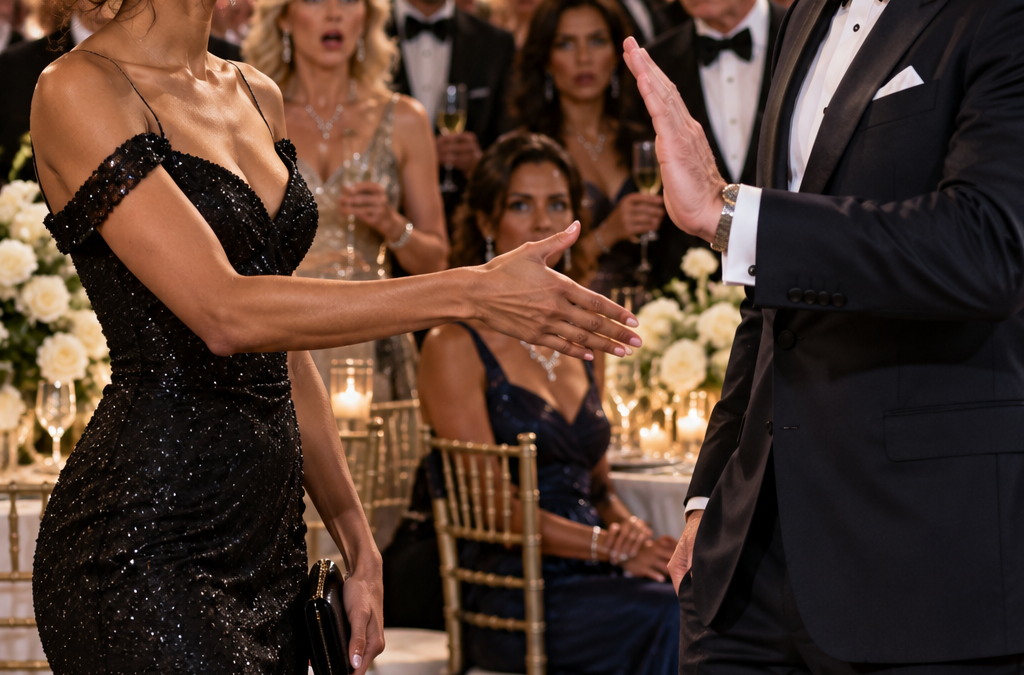
I extended my hand.
“It’s an honor to meet you, Mr. Whitmore.”
He looked at my face.
Then my hand.
His expression changed.
Not confusion.
Not surprise.
Disgust.
“Get that filthy hand away from me.”
For a second, I thought I had heard him wrong.
The room nearest us went silent.
His lip curled.
“I don’t touch dirty things.”
I kept my hand extended.
Not because I was brave.
Because I was stunned.
My mind had not caught up with my body.
“Excuse me?”
“You heard me.”
He stepped back.
“You think someone like you gets to walk up and put your hands on me?”
Something in my stomach dropped.
Around us, conversations were dying.
More people were turning.
Watching.
“Sir,” I said, “I was invited.”
He laughed.
“Invited?”
“Yes.”
“To this event?”
“Yes.”
He looked around as if I had delivered a joke for the entire room.
“Who exactly do you think would invite you here?”
My arm was beginning to ache.
I still hadn’t lowered my hand.
Preston gestured around the ballroom.
“Look around.”
I did.
Three hundred guests.
Almost all white.
“Do you see anyone here who looks like you?”
My fingers began trembling.
I curled them slightly to hide it.
A few people looked down.
Nobody intervened.
Preston saw that silence.
I watched confidence rise in him because of it.
He stepped closer.
“Let me guess. You wandered in from the street.”
A few people laughed nervously.
“You saw the elevators open, figured you’d sneak upstairs, maybe get free champagne.”
“I have an invitation.”
“You have nerve.”
“I have an invitation with my name on it.”
A woman nearby whispered to her husband.
“Someone should say something.”
Her husband shook his head.
Neither of them said anything.
That moment never left me.
Not because they were cruel.
Because they weren’t.
They knew what was happening was wrong.
They simply decided knowing was enough.
Preston pointed his champagne glass toward me.
“This is what happens when nobody checks credentials properly.”
More uncomfortable laughter.
I finally lowered my hand.
It felt heavier than it should have.
A man stepped toward Preston.
Later I learned he was Dennis Archer, the company’s CFO.
“Preston.”
“Not now.”
“Maybe we should—”
“This is my party, Dennis.”
Preston’s voice rose.
“My building. My guest list.”
Then he turned back to me.
“You want to know the rules?”
I didn’t answer.
“People like you don’t get to walk into rooms like this just because you bought a cheap dress.”
My face burned.
“You don’t get to drink from my glasses.”
Someone inhaled sharply.
“You don’t get to stand on my floors.”
I could smell champagne on his breath.
“And nothing you put on will ever make you one of us.”
I reached into my clutch.
My hands were shaking now.
I pulled out the gold invitation.
“My name is printed here.”
I held it in front of him.
“Read it.”
He grabbed it.
For one second, I thought maybe this was where the mistake would be corrected.
He didn’t read it.
He ripped it in half.
The sound was tiny.
But the ballroom had become so silent that the paper tearing seemed impossibly loud.
The two pieces fluttered toward the marble floor.
Gold lettering caught the chandelier light.
My name split between them.
HARPER.
CRAWFORD.
“There,” Preston said.
“Now you don’t.”
He looked at his fingers.
Then reached for a cloth cocktail napkin.
He wiped his hands.
Finger by finger.
Like touching my invitation had contaminated him.
That was when the humiliation changed.
Until then, I had been embarrassed.
Then I became angry.
Not wild anger.
Not the kind that makes you scream.
A colder kind.
The kind that makes every detail become permanent.
The cufflinks he wore.
The shape of the chandelier above him.
The smell of perfume and alcohol.
The fact that a waiter three feet away was staring at the floor.
The sound of somebody behind me whispering:
“Oh my God.”
Preston dropped the napkin at my feet.
“Security.”
Two guards approached.
They had seen everything.
One took my arm.
“Ma’am.”
I didn’t resist.
I looked at Preston.
He had already begun turning away.
“Get this trash out before she embarrasses herself any further.”
Something broke inside me then.
Not my dignity.
Something softer.
Some final belief that powerful rooms were filled with powerful people.
They weren’t.
They were filled with frightened people wearing expensive clothes.
The guard guided me toward the elevator.
I could feel hundreds of eyes following.
Not one voice stopped us.
Not one.
Near the window stood a young man I later learned was Tyler Bennett.
He looked directly at me.
His mouth opened.
For one second, I thought he was going to speak.
Then he dropped his eyes.
That hurt.
The elevator arrived.
I stepped inside.
Before the doors closed, I turned.
Preston was shaking hands with a white man in a navy suit.
Warm grip.
Big smile.
Thirty seconds earlier, my hand had been filthy.
His wasn’t.
The doors slid shut.
The security guard beside me stared ahead.
The other cleared his throat.
“Ma’am, I’m sorry about—”
“Don’t.”
He went quiet.
Forty-two floors.
I watched the numbers descend.
My chin remained level until the lobby doors opened.
Then I walked outside.
Cold air hit my bare shoulders.
Taxis moved.
Sirens passed.
A bus hissed at the curb.
New York continued existing.
That felt almost insulting.
Something inside me had just been torn open in front of hundreds of people, and strangers still needed to cross streets and answer phones and buy dinner.
I took the subway home.
On the platform, Nenah called.
I stared at her name.
I couldn’t answer.
What would I say?
A billionaire called me filthy?
Three hundred people watched?
Nobody helped?
The train arrived.
I sat in the corner.
There was something gold on my fingertips.
I rubbed them together.
Glitter from the invitation.
The pieces were still upstairs on the ballroom floor.
At least I thought they were.
I later learned someone picked them up.
That night, I didn’t sleep.
I sat on the edge of my bed wearing the same dress.
My shoes were by the door.
The radiator clicked.
A neighbor’s television thumped through the wall.
Every time I closed my eyes, I saw Preston wiping his fingers.
Filthy.
Dirty things.
People like you.
I had heard racism before.
Not always directed at me.
Sometimes whispers.
Sometimes jokes.
Sometimes strangers assuming I worked somewhere because I was Black.
This was different.
He had wanted me to feel beneath him.
And for a few hours, I did.
That truth is hard to admit.
I wanted to be stronger than his words.
I wasn’t.
They hurt.
Around two in the morning, I opened the kitchen drawer.
Peton and Associates.
Certain assets.
Crawford Legacy Trust.
I read the letter again.
Then again.
The line at the bottom suddenly felt different.
Please contact our office at your earliest convenience.
I set my alarm for seven.
At five, I stood at the kitchen window.
Streetlights glowed over Atlantic Avenue.
I pressed my forehead against the glass.
“Tell me what to do, Grandma.”
Nothing answered.
I looked at the letter.
Maybe something had.
At nine the next morning, I walked into Peton and Associates on Park Avenue.
Thirty-eighth floor.
Central Park visible through the conference-room windows.
Raymond Peton came out to meet me himself.
He was in his sixties.
Silver hair.
Dark suit.
Kind eyes.
He extended his hand.
I froze.
Only for a fraction of a second.
Then I shook it.
He took my hand in both of his.
“Ms. Crawford. Thank you for coming.”
The warmth of that handshake almost made me cry.
He led me into a conference room.
Two associates waited with laptops.
A stack of documents sat on the table.
Three inches thick.
I sat.
“Mr. Peton, I don’t understand any of this.”
“That’s why we’re here.”
“My grandmother didn’t have money.”
His expression changed.
“She never told you?”
“Told me what?”
He opened a folder.
“Your grandmother was one of the most disciplined investors our firm has ever represented.”
I almost laughed.
“Grandma Lorraine?”
“Yes.”
“She clipped coupons.”
“I know.”
“She rode the bus.”
“I know.”
“She owned the same winter coat for twenty years.”
Raymond smiled slightly.
“I know that too.”
Then he began explaining.
In 1984, Lorraine inherited eleven thousand dollars from her mother.
Eleven thousand.
Not millions.
Not hundreds of thousands.
She took that money to Raymond’s father, who had recently started practicing law and advising small investors.
Grandma gave him rules.
No gambling.
No fashionable investments she didn’t understand.
No unnecessary withdrawals.
Reinvest everything.
Tell nobody.
For forty years, she saved.
Reinvested.
Bought stakes in businesses.
Bought property.
Sold almost nothing.
She lived on what she earned from sewing and later from a modest pension.
The fortune grew separately.
Silently.
Raymond pushed a page across the table.
There was one number printed near the bottom.
I counted the zeros.
Then counted them again.
“Twelve billion?”
“Yes.”
I laughed.
I couldn’t help it.
Not because anything was funny.
My brain had rejected the number.
“That isn’t possible.”
“It is.”
“Twelve billion dollars?”
“Yes.”
“My grandmother?”
“Yes.”
I pushed the page away.
Then pulled it back.
“She had twelve billion dollars and took the bus?”
Raymond’s smile became sad.
“She didn’t need anyone to know what she had.”
My eyes burned.
I thought of every rainstorm when Grandma came home with wet shoes.
Every coupon.
Every time she said something was too expensive.
Every Sunday dress.
Every jar where she saved loose change.
“She could have had anything.”
“Yes.”
“Why didn’t she?”
“That may be a question only she could answer.”
I knew the answer.
Because enough had always been enough for her.
My shoulders started shaking.
I covered my face.
For the first time since the gala, I cried.
Not because I was rich.
Because I missed her.
All that money existed.
And I would still have traded every dollar for ten more minutes at her kitchen table.
Eventually, I wiped my eyes.
“Show me everything.”
Raymond opened another folder.
Real estate.
Technology.
Biotech.
Investment funds.
Then one line highlighted in yellow.
WHITMORE CAPITAL — 38%.
I stared at it.
“Whitmore?”
“Yes.”
“Preston Whitmore?”
“Yes.”
I looked up.
Raymond studied my face.
“Were you at the gala last night?”
“You know?”
“Everyone knows.”
I looked back at the paper.
“What does thirty-eight percent mean?”
“In this case?”
He folded his hands.
“It means the Crawford Legacy Trust is Whitmore Capital’s largest shareholder.”
I stopped breathing.
“Largest?”
“Yes.”
“Does Preston know?”
“He knows the trust exists. He does not know who the beneficiary is.”
My fingers pressed into the edge of the table.
“He’s been trying to contact you?”
“For several weeks.”
“Why?”
“Whitmore Capital is facing a liquidity problem. They need a major capital injection to stabilize the company.”
“And the trust can provide it?”
“Yes.”
I looked through the window at Manhattan.
Thousands of buildings.
Millions of people.
Somewhere in the city Preston Whitmore was probably having breakfast.
Maybe laughing about the woman he had thrown out.
“He called me trash.”
Raymond said nothing.
“He said I wasn’t worthy of standing on his floor.”
Still nothing.
I looked down at the ownership document.
“I own part of the floor.”
“More than part.”
For a moment, anger rushed through me so hard that I wanted to call Preston immediately.
I wanted to hear his voice change.
Wanted him to learn exactly who he had humiliated.
Wanted revenge delivered fast enough that I could still feel last night’s wound when it landed.
Grandma’s voice came back to me.
Nothing useful grows because you kick the dirt harder.
She used to say that whenever I got impatient.
So I asked the only question that mattered.
“What are my options?”
For three days, I learned.
I didn’t call Preston.
Didn’t post online.
Didn’t issue a statement.
The internet did enough without me.
Someone had recorded the confrontation.
The video spread overnight.
Millions of views.
News anchors replayed Preston refusing my hand.
Commentators replayed him ripping the invitation.
People froze the frame of him wiping his fingers.
The company stock began falling.
Boycotts started.
Clients asked questions.
Nenah came to my apartment and wrapped her arms around me so hard I could barely breathe.
“You didn’t tell me.”
“I didn’t know.”
“You own twelve billion dollars?”
“Apparently.”
She pulled back.
“You took the subway here.”
“So did you.”
“Harper.”
“What was I supposed to do, buy a helicopter overnight?”
She laughed and cried at the same time.
Then she became serious.
“What are you going to do to him?”
“I don’t know yet.”
“You could destroy him.”
“I know.”
That frightened me.
Power is easy to admire when you don’t have any.
The first time you actually hold it, you realize how dangerous emotion can become.
I didn’t want to become Preston with better manners.
I spent hours with Raymond and the attorneys.
Voting rights.
Corporate governance.
Board structure.
Fiduciary obligations.
Executive removal.
Financial exposure.
I asked questions.
They answered.
I asked more.
On the third day, I called Victoria Sloan, chairwoman of the Whitmore Capital board.
“My name is Harper Crawford.”
Silence.
Then:
“Ms. Crawford.”
“You know who I am?”
“Yes.”
“I’d like to call an emergency board meeting.”
The meeting was scheduled for ten the next morning.
I arrived early.
The boardroom was on the same forty-second floor where the gala had been held.
Different room.
Same building.
When I stepped out of the elevator, my body remembered before my mind did.
My stomach tightened.
The marble.
The smell.
Even the quiet.
Raymond walked beside me.
“You don’t have to do this personally.”
“Yes, I do.”
The board members arrived one by one.
Some shook my hand immediately.
A few held mine slightly longer than necessary.
Guilt has its own etiquette.
At 9:58, the door opened.
Preston walked in carrying coffee.
He was looking at his phone.
He made it halfway toward the head of the table before noticing someone already occupied the chair.
Me.
He stopped.
Coffee tilted.
A drop landed on his shoe.
He stared.
“What is she doing here?”
Nobody answered immediately.
He looked at Victoria.
“I had this woman removed from my event.”
Victoria’s voice was calm.
“Sit down, Preston.”
“Who authorized her to—”
“I did.”
His eyes returned to me.
Victoria continued.
“Harper Crawford is the sole beneficiary of the Crawford Legacy Trust.”
His face changed slightly.
“She what?”
“The trust holds thirty-eight percent of Whitmore Capital.”
Silence.
“Ms. Crawford is our largest shareholder.”
I watched comprehension move across Preston’s face.
It was almost physical.
Gala.
Invitation.
My hand.
His company.
My name.
Crawford.
Crawford Legacy Trust.
He looked at me again.
This time there was no disgust.
Only fear.
“We’ve met,” I said.
His coffee cup shook.
I kept my voice calm.
“Although I believe you made it clear I wasn’t worth remembering.”
He placed the cup down.
“Listen, about Saturday—”
I turned toward the board.
“I am requesting an independent investigation into Mr. Whitmore’s leadership.”
Preston stopped.
“Harper—”
“Ms. Crawford.”
He stared at me.
I continued.
“That investigation should include his conduct at the gala, workplace culture, employee complaints, hiring practices, financial management, and any allegations of discriminatory conduct during his tenure.”
“This is insane.”
Nobody looked at him.
“I further move that Preston Whitmore be placed on administrative leave immediately pending that investigation.”
Victoria nodded.
“All in favor?”
Hands rose.
One.
Two.
Three.
Eventually eight.
Two remained down.
The motion passed.
Preston stood.
“You can’t do this.”
Nobody answered.
“This is my company.”
Raymond spoke for the first time.
“Your father built the company with outside capital.”
Preston turned.
“My father built Whitmore from nothing.”
Raymond opened a folder.
“In 1984, Lorraine Crawford invested eleven thousand dollars when your father was working from a rented office in Queens.”
Preston’s face drained.
“She became one of his earliest outside investors and never sold her stake.”
He looked at me.
My grandmother.
A Black seamstress who rode the bus.
Who wore the same church dress for fifteen years.
Who he would probably have walked past without seeing.
Her money had helped build the empire he believed proved his superiority.
I reached into my bag.
Placed something on the table.
Two pieces of gold paper taped together.
The invitation.
Raymond’s office had obtained it from a gala employee who picked it up after I was removed.
Preston stared at it.
“You dropped this.”
His eyes moved from the invitation to me.
Security appeared at the door.
Same uniforms.
Different order.
Preston’s shoulders changed.
For the first time, he looked smaller than the room.
“Mr. Whitmore,” the guard said, “we need to escort you out.”
Preston looked at me.
I expected satisfaction.
I had imagined that moment for three days.
It didn’t feel the way I expected.
I saw a man terrified of losing what he had mistaken for himself.
He walked out.
The doors closed.
Nobody applauded.
I was glad.
This wasn’t entertainment.
It was accountability.
The investigation lasted six weeks.
The first discoveries were bad.
The later ones were worse.
Former employees came forward.
Black employees who had been denied promotions.
Employees ordered to use service entrances when clients were present.
Women who reported racist comments and watched their complaints disappear.
Eleven internal complaints had been filed during Preston’s leadership.
Not one had been properly investigated.
Dennis Archer had received many of them.
He buried them.
When the board asked why, he eventually gave the most ordinary explanation imaginable.
He was afraid.
Afraid of Preston.
Afraid of losing his job.
Afraid of disrupting the company.
That fear had protected abuse for years.
Then auditors found personal spending.
Millions in company funds used for private travel.
Vacations.
Property renovations.
Corporate expenses that had almost nothing to do with business.
The gala had not created Preston’s problem.
It had exposed it.
That distinction mattered.
The video also changed something outside the company.
People began telling their stories.
Former employees.
Former applicants.
People who had been humiliated in smaller ways.
The kind that never become viral videos.
Tyler Bennett contacted me through Raymond.
He wanted to apologize.
I agreed to meet him.
He came to the office wearing a plain navy suit.
He looked younger than I remembered.
“I was there.”
“I remember.”
His face tightened.
“I almost said something.”
“I know.”
His eyes widened.
“You saw me?”
“Yes.”
“I opened my mouth.”
“Yes.”
“And then I didn’t.”
“No.”
He looked down.
“I’ve thought about that every day.”
I let the silence sit.
Finally he said:
“I was afraid he’d fire me.”
“I understand.”
“That doesn’t excuse it.”
“No.”
He looked up.
“I resigned.”
I didn’t know what to say.
“I don’t want praise,” he continued. “I just needed you to know.”
“Why?”
“Because watching that video afterward was worse than being there.”
“How?”
“At the party I could tell myself everything happened too fast. The video took that excuse away.”
His eyes filled.
“I watched myself in the background.”
He swallowed.
“I watched myself decide not to help you.”
That sentence stayed with me.
Not because I wanted Tyler to punish himself forever.
Because he understood something most people didn’t.
Cowardice often looks reasonable while you’re doing it.
A mortgage.
A career.
A boss.
A social circle.
There is always a reason to stay silent.
The reason doesn’t erase the choice.
The lawsuits followed.
Five former employees sued Preston personally and Whitmore Capital institutionally for discrimination and racial hostility.
I did not attend the trial.
That surprised people.
I had no desire to sit in a courtroom watching Preston fall apart.
My work was at the company.
The board replaced seven directors.
I supported Diane Foster as the new CEO.
She had spent two decades in finance and had the kind of calm authority Preston had always tried to imitate through aggression.
During our first private meeting, Diane asked:
“What do you want Whitmore Capital to become?”
I considered that.
“A place where nobody has to become indispensable before they’re treated like they’re human.”
She nodded.
“That’s a good start.”
We established anonymous reporting systems.
Independent review.
External oversight.
Promotion audits.
Hiring transparency.
None of that could undo the past.
Policies cannot apologize.
But they can make repetition harder.
The trial became national news.
Tyler testified.
Raymond later gave me a transcript.
I read it alone.
Tyler described the gala.
My hand.
The invitation.
Security.
Then he told the jury:
“I watched it happen. I knew it was wrong. I said nothing.”
He described other moments too.
Comments.
Discrimination.
How employees laughed because Preston laughed.
How managers looked away.
Then he said:
“He made cowardice normal, but we chose to participate. That’s on us.”
I had to stop reading.
I walked to the window.
For months, I had struggled with the question of what hurt most about that night.
Preston’s words?
The invitation?
Security?
Eventually I understood.
It was the room.
Three hundred people.
People with influence.
Money.
Education.
Power.
Many of them probably considered themselves decent.
Yet almost none were willing to spend even a sentence of courage on me.
“Stop.”
“That isn’t acceptable.”
“She was invited.”
“Leave her alone.”
Four words could have changed the emotional shape of that night.
Nobody gave them.
The jury eventually found Preston personally liable for discriminatory conduct and sustained racial hostility.
Damages exceeded twenty million dollars.
Other investigations continued into financial misconduct.
Dennis cooperated with investigators.
He was permanently barred from serving as an officer or director of a public company.
I watched one interview with him.
Only one.
The reporter asked what he regretted.
Dennis stared at his hands.
“I knew.”
He paused.
“I knew what was happening, and I protected my career instead of the people being hurt.”
Then the reporter asked about me.
Dennis’s eyes closed briefly.
“I should have shaken her hand.”
I turned off the television.
That sentence hit differently than he probably intended.
He meant he should have stood with me.
But for me, the handshake had become something larger.
Preston had decided touching me would lower him.
He had been wrong about nearly everything.
Six months after the trial, I launched the Lorraine Crawford Foundation.
One hundred million dollars initial funding.
Education.
Job training.
Small-business development.
Scholarships.
Community investment.
We located the headquarters in Brooklyn.
Four blocks from the apartment where Grandma raised me.
People advised Manhattan.
Better address.
Better donors.
Better visibility.
I refused.
Grandma built twelve billion dollars from Brooklyn buses and sewing needles.
Her name belonged there.
At the launch, I spoke publicly for the first time since the gala.
The room was smaller.
No crystal ballroom.
No billionaires arranged for photographs.
Students.
Teachers.
Local business owners.
Families.
I stood behind a simple podium.
For a moment, I saw Grandma sitting somewhere in the back.
Of course she wasn’t there.
But grief does that.
It places people inside rooms they never got to see.
“My grandmother never wanted attention,” I said.
“She never wanted people impressed by her.”
I looked toward the foundation sign.
“She believed patience mattered more than noise. Discipline mattered more than appearance. And she believed money was useful only if it helped somebody live with more dignity.”
My throat tightened.
“She spent forty years building something almost nobody knew existed.”
I paused.
“I intend to spend the rest of my life making sure what she built becomes visible through the people it helps.”
Afterward, I went to the cemetery.
The new headstone had been installed.
White marble.
Simple lettering.
LORRAINE CRAWFORD
1944–2024
SHE BUILT IT QUIETLY.
SHE CHANGED EVERYTHING.
I placed flowers beside it.
Then sat on the grass.
“You could have told me,” I whispered.
Wind moved through the trees.
“You really could have mentioned the twelve billion dollars.”
I laughed.
Then cried.
“I hope I’m doing this right.”
For a while, I sat there without speaking.
Eventually I touched the stone.
“I understand now.”
I did.
Grandma had never confused wealth with worth.
That was why she could possess so much without needing anybody to know.
Preston needed every room to recognize his power.
Grandma had enough power not to care.
Whitmore Capital survived.
Not unchanged.
It shouldn’t have.
Diane rebuilt leadership.
Tyler eventually returned to the company in a compliance role after spending time elsewhere.
His first major project created an independent reporting channel employees could use without going through their managers.
During the first quarter, dozens of complaints came in.
Every one was investigated.
Some were misunderstandings.
Some were serious.
The point wasn’t that the company suddenly became perfect.
The point was that silence stopped being the default operating system.
Preston’s life became smaller.
I knew only what newspapers reported.
Assets frozen.
Hampton property seized during financial proceedings.
Country club membership gone.
The name Whitmore remained on the company, though there were debates about changing it.
I didn’t care whether his apartment was large or small.
I didn’t care what car he drove.
That wasn’t justice to me.
Justice was the employees who could walk into meetings without wondering whether their skin had already decided their ceiling.
Justice was complaints reaching someone who had to answer them.
Justice was interns hearing a racist joke and knowing the safest choice wasn’t laughter.
Justice was boring.
Procedures.
Audits.
Policies.
Accountability.
That’s why it lasts longer than revenge.
I still lived in Brooklyn.
Not the same apartment.
I moved eventually.
The new place was bigger and quieter.
Nothing enormous.
People found that confusing.
A woman with twelve billion dollars was apparently supposed to buy a penthouse.
Maybe several.
I didn’t want one.
I still took the subway sometimes.
Not because I had to.
Because I liked knowing where I was.
Underground.
People reading.
Children sleeping against parents.
Nurses going to work.
Teenagers arguing.
Life without velvet ropes.
On the first day of every month, I still brought flowers to Grandma.
That ritual mattered more now.
Not less.
One afternoon, almost two years after the gala, I was sitting in my foundation office when Nenah walked in carrying coffee.
She looked at the frame on my desk.
I knew what she was looking at.
The invitation.
Two gold pieces taped together.
The tear still visible.
“You still keep that?”
“Yes.”
“Why?”
I leaned back.
At first I had kept it because I was angry.
Then because it reminded me what happened.
Eventually the meaning changed.
“I think because I don’t want to forget who I was before I knew.”
“Before you knew you were rich?”
“Before I knew I had power.”
Nenah sat across from me.
“You were still you.”
“I know.”
“That night didn’t change because you owned the company.”
“No.”
She pointed at the invitation.
“He was wrong before you knew.”
I stared at her.
That sentence reached somewhere deep.
For a long time, the story had been told as irony.
Preston insulted the woman who secretly controlled his company.
People loved that version.
It was satisfying.
Clean.
Cruel billionaire humiliates mysterious heiress.
Then loses everything.
But there was something about that framing I had gradually come to dislike.
Because it suggested Preston’s real mistake was choosing the wrong Black woman to humiliate.
As if his behavior would have been less disgusting if I had truly been a hotel receptionist with forty dollars until payday.
As if my twelve billion dollars were what made my hand worthy of touching.
They weren’t.
Nenah was right.
He had been wrong before I knew.
Wrong when I thought my inheritance was furniture.
Wrong when I was taking the subway to a front-desk shift.
Wrong when I stood in a secondhand dress holding a glass of water.
Wrong before the trust.
Before the boardroom.
Before the lawsuits.
Before the foundation.
My money did not transform me into someone who deserved respect.
It only gave me the leverage to force a powerful institution to confront the fact that respect should never have depended on leverage.
That realization changed how I told the story to myself.
I stopped thinking of the gala as the night Preston humiliated an heiress.
It was the night a powerful man humiliated a woman because he thought there could be no consequence.
He was wrong about the consequence.
But more importantly, he was wrong about the woman.
A few months later, I returned to the Sterling Grand Hotel for the first time.
Not for a gala.
The Lorraine Crawford Foundation was hosting a scholarship dinner.
I had resisted the venue at first.
Diane suggested it.
“You sure?”
“No.”
“Then why do it?”
I thought about that.
“Because I don’t want one bad night to own an entire floor of Manhattan.”
So we booked it.
Forty-second floor.
Same ballroom.
When the elevator doors opened, my chest tightened.
The chandeliers were unchanged.
Marble floor.
Tall windows.
For a second, the room was full of ghosts.
Preston.
Dennis.
The security guards.
Three hundred silent faces.
My hand suspended in the air.
I closed my eyes.
Then I heard laughter.
Not the laughter from that night.
Students.
Families.
One of our scholarship recipients was chasing his younger sister around a table while their mother pretended to scold them.
A group from an HBCU stood near the stage taking photographs.
Two teenage girls in formal dresses were helping each other fix their hair.
The room looked different because the people inside it were different.
Nenah appeared beside me.
“You okay?”
“Yes.”
“You don’t look okay.”
“I will be.”
A young server approached.
Black.
Maybe nineteen.
“Ms. Crawford?”
“Yes?”
He held out his hand.
“It really is an honor to meet you.”
For half a second, I couldn’t move.
Then I took his hand.
“What’s your name?”
“Malik.”
“Nice to meet you, Malik.”
He smiled.
“I got one of the foundation scholarships.”
“You did?”
“Yes, ma’am. Engineering.”
“Where?”
“Howard University.”
“Congratulations.”
“Thank you.”
He hurried away because someone called him.
I stood there looking at my hand.
Nenah had gone quiet.
“You planned that?” I asked.
“No.”
“Really?”
“I swear.”
I laughed.
Then wiped at my eyes.
The dinner began at seven.
I had prepared remarks.
Pages of them.
I didn’t use most of them.
I stood at the same approximate place where Preston had rejected my hand years earlier.
Hundreds of people watched.
This time I knew many of their names.
I looked around the ballroom.
“When I first stood in this room,” I began, “I thought the worst thing that could happen to a person was being told they didn’t belong.”
Silence.
“I was wrong.”
I glanced toward the elevators.
“The worst thing is believing it.”
A woman in the front row nodded.
“For a few hours that night, I believed what someone else saw when he looked at me. I believed I was small because he had enough power to make a room treat me like I was small.”
I paused.
“My grandmother taught me something different. It just took me too long to understand it.”
I looked toward a photograph of Lorraine displayed beside the stage.
“She lived most of her life with access to extraordinary wealth and never used it to convince herself she was more human than anyone else.”
I let the words settle.
“So I don’t think the lesson of her life is that money makes people powerful.”
Another pause.
“I think the lesson is that knowing who you are makes other people’s measurements less dangerous.”
Afterward, people came forward.
Students.
Parents.
Employees.
One elderly woman waited until almost everyone had left.
She was Black.
Probably in her seventies.
She took my hand.
“I watched that video.”
I nodded.
“My daughter worked corporate for thirty years.”
Her fingers tightened around mine.
“She came home crying more times than I could count.”
“I’m sorry.”
“She always said the same thing. Mama, if I say anything, they’ll call me difficult.”
I knew that sentence.
“So she stayed quiet.”
The woman looked around the ballroom.
“She died before any of this happened.”
Her voice shook.
“I wish she could see this room.”
I didn’t know what to say.
So I held her hand.
Eventually she smiled.
“Your grandmother raised you right.”
That nearly broke me.
“Thank you.”
When everyone left, I stayed.
Staff cleared tables.
The quartet packed up.
Chairs were stacked.
The ballroom slowly became just a room again.
I walked toward the place where I remembered the invitation falling.
Nothing marked the spot.
Of course not.
Marble doesn’t remember.
People do.
I stood there for a while.
Then Diane joined me.
“You ready?”
“In a minute.”
She waited.
I looked around.
“You know what I used to imagine?”
“What?”
“Coming back here after everything happened.”
“And?”
“In my head, it always felt triumphant.”
“Does it?”
“No.”
“What does it feel like?”
I considered that.
“Finished.”
She nodded.
That was exactly it.
Not victory.
Completion.
I didn’t need Preston in the room.
Didn’t need an apology.
Didn’t need him to see me sitting at the head of a table.
Didn’t need to watch him lose anything else.
The night no longer belonged to him.
That was enough.
I took the subway home.
Yes.
The subway.
I had a driver available.
Security.
Cars.
All the things wealth could provide.
That night, I wanted the train.
I sat beside a woman reading a paperback novel.
Across from me, a father held a sleeping little boy against his chest.
A teenager played a game on his phone.
Nobody recognized me.
Nobody cared who owned thirty-eight percent of what.
I liked that.
When I reached Brooklyn, I walked the last few blocks.
The foundation building was dark when I passed it.
Lorraine Crawford Foundation.
Her name in simple letters above the entrance.
I stopped.
Grandma had spent forty years building wealth without allowing wealth to build her identity.
I had inherited the money.
That part had required nothing from me.
What I did with it would be mine.
The next morning, I arrived at the foundation early.
Before staff.
Before meetings.
I made coffee and sat behind my desk.
The repaired invitation was still in its frame.
Gold letters.
Visible tear.
I picked it up.
For years, I had thought the rip was what mattered.
Now I saw something else.
My name was still readable.
HARPER CRAWFORD.
He had torn the paper.
Not the name.
Not me.
I put the frame back.
Outside my office, people began arriving.
Phones ringing.
Doors opening.
A scholarship coordinator laughing with someone down the hall.
An employment-program director carrying too many folders.
Ordinary work.
Useful work.
I touched Grandma’s photograph beside my computer.
Then I looked once more at the invitation.
Preston Whitmore had believed power meant deciding who belonged in a room.
My grandmother had understood something he never learned.
Real power is being able to open the door for someone else.
I stood.
Walked out of my office.
And left the door open.
𝗧𝗛𝗘 𝗘𝗡𝗗
The Billionaire Refused to Shake My Hand in Front of 300 Guests and Never Asked Why I Had Been Invited
I held my hand out to Preston Whitmore in a ballroom filled with three hundred people, and he looked at it as if I had offered him something diseased.
What he said next humiliated me in front of everyone, but the silence of the people watching would stay with me far longer than his voice ever did.
Six months before that night, I buried my grandmother.
Lorraine Crawford was the only real family I had left.
She died on a Tuesday morning in the same Brooklyn apartment where she had raised me since I was four years old.
There was nothing dramatic about the way she left.
No final speech.
No cinematic goodbye.
Just a quiet hospital room, weak October light pushing through the blinds, and her hand in mine becoming colder than I was prepared for.
I was twenty-eight years old.
Old enough to know death was part of life.
Not old enough to know what to do when the person who had built your entire understanding of home stopped breathing.
Grandma Lorraine had never been wealthy.
At least I didn’t think she was.
She worked as a seamstress most of her life.
She took the bus.
She clipped coupons.
She reused aluminum foil.
She owned three church dresses and rotated them so carefully that people probably thought she owned ten.
When I was little, she used to tell me that wanting less made it harder for the world to control you.
I didn’t understand that then.
I thought she was simply practical.
After she died, I went through her belongings slowly.
Old dresses.
A Bible with pressed flowers tucked between the pages.
Receipts she had folded into envelopes by year.
Photographs.
A wooden sewing box that still smelled faintly like lavender.
There was no insurance policy I could find.
No envelope full of money.
No secret jewelry.
Just a handwritten note inside the Bible.
Everything I have is yours, baby girl.
I sat on the edge of her bed reading that line over and over.
I thought she meant the furniture.
Maybe the dishes.
The old Singer sewing machine.
I didn’t care.
I would have traded everything in that apartment just to hear her complain one more time that I wasn’t eating enough.
I worked at the front desk of a small hotel in Bedford-Stuyvesant.
The kind of place where guests complained about weak Wi-Fi, thin towels, and street noise as if I had personally designed Brooklyn.
I smiled.
I apologized.
I solved what I could.
I took the subway every day.
Bought most of my clothes secondhand.
Skipped lunch when money got tight near the end of the month.
Every first day of the month, I brought flowers to Grandma’s grave.
Nothing expensive.
Whatever I could afford.
I still hadn’t been able to buy the headstone I wanted.
That bothered me more than it probably should have.
I kept telling myself I would save enough.
Eventually.
Three weeks before the Whitmore Capital Autumn Gala, I received an envelope from a law firm called Peton and Associates.
Heavy cream paper.
My full name typed across the front.
Inside was a formal letter telling me that my grandmother had left certain assets requiring my attention.
I read it twice.
Certain assets.
The phrase sounded bigger than anything Grandma Lorraine could possibly have owned.
Maybe an old savings bond.
Maybe some retirement account she had forgotten to tell me about.
I was exhausted from grieving.
I folded the letter and put it in my kitchen drawer.
There was something else inside the envelope.
A thick invitation with gold embossing.
THE WHITMORE CAPITAL AUTUMN GALA.
My name was printed across it.
Harper Crawford.
A handwritten note from the attorney had been clipped to the corner.
Ms. Crawford,
You should attend.
This is your right.
—Raymond Peton
I almost threw it away.
Then my best friend, Nenah Wallace, came over.
She found the invitation on my counter while searching for sugar.
“What is this?”
“Nothing.”
She held it up.
“This is not nothing.”
“I don’t know why they sent it.”
“Whitmore Capital?”
“I guess.”
“The Whitmore Capital?”
“I don’t know how many there are.”
“Harper.”
I looked at her.
She looked at the invitation.
Then back at me.
“You got invited to a billionaire finance gala and you’re planning to stay home?”
“I don’t own anything I can wear to a billionaire finance gala.”
“That’s a solvable problem.”
“I don’t know anyone there.”
“That has never stopped rich people.”
“Nenah.”
She grabbed her coat.
“Come on.”
“Where?”
“We’re finding you a dress.”
I laughed.
“No.”
“Yes.”
“I have forty dollars until payday.”
“I didn’t say we’re buying it on Fifth Avenue.”
Two hours later, we found a black dress at a consignment shop.
Simple.
Fitted.
Nothing expensive.
Nenah made me try on six others before admitting the first one looked best.
Standing under the fluorescent lights in that little dressing room, I barely recognized myself.
I had spent months dressing for work, funerals, grocery runs, and cemetery visits.
I had forgotten what it felt like to look in a mirror and see a young woman instead of somebody’s grieving granddaughter.
Nenah stood behind me.
“Your grandmother would tell you to go.”
I looked at her reflection.
“You don’t know that.”
“I absolutely know that.”
“How?”
“Because Lorraine Crawford didn’t raise you to hide.”
That settled it.
The Sterling Grand Hotel on Fifth Avenue looked like the kind of place where even the marble had a résumé.
The gala occupied the forty-second floor.
When the elevator doors opened, I almost stayed inside.
Crystal chandeliers.
White tablecloths.
A string quartet.
Hundreds of people dressed in clothes that probably cost more than I earned in months.
Diamonds catching light.
Champagne everywhere.
Men discussing markets.
Women discussing foundations and museums.
Everybody moved like they belonged.
I stepped out alone.
The first thing that happened was small.
The coat-check attendant looked at me, then at my dress, then at the invitation in my hand.
There was a pause before she accepted my coat.
Not long enough to complain about.
Long enough to feel.
The second thing was even smaller.
A waiter approached me carrying an empty tray.
“Service entrance is through the corridor on the left.”
I stared at him.
“I’m a guest.”
His face changed.
“Of course. My apologies.”
He moved away quickly.
Ten minutes later, a woman standing beside a cocktail table shifted her designer clutch to the opposite side of her body when I walked past.
No words.
No confrontation.
Just instinct.
She saw me and protected her purse.
I had known that feeling since childhood.
Sometimes racism announces itself.
Sometimes it whispers.
The whisper can be worse because you’re forced to decide whether you imagined it.
I found a place near the bar.
Someone handed me a glass of water.
I wasn’t sure whether they thought I wanted it or thought I worked there.
I held it anyway.
Across the ballroom stood Preston Whitmore.
I recognized him from business magazines.
Forty years old.
CEO of Whitmore Capital.
Son of the company’s founder.
He was surrounded by men in dark suits who laughed whenever he did.
Everything about him suggested ownership.
The building.
The party.
The people around him.
Even the air.
I knew almost nothing about his company.
I knew even less about him.
I had no idea that Whitmore Capital was struggling.
No idea that Preston desperately needed new capital.
No idea that his executives had spent weeks trying to contact something called the Crawford Legacy Trust.
I didn’t even know the trust existed.
I only knew Raymond Peton had written four strange words.
This is your right.
I stood beside that bar for nearly forty minutes.
Nobody spoke to me except staff.
I kept thinking about leaving.
I didn’t belong there.
Every face seemed to confirm it.
Then another thought came.
Grandma had raised me to pay rent on time.
Return shopping carts.
Write thank-you notes.
Look people in the eye.
She had never taught me to leave a room because somebody else decided I didn’t fit the furniture.
I set down the water.
Smoothed the front of my dress.
And walked toward Preston Whitmore.
People noticed.
Not because they knew me.
Because they didn’t.
Who was this Black woman crossing the center of the room directly toward the most important man at the party?
The circle around Preston began to open.
I stopped three feet from him.
He was talking about something when he finally noticed me.
I extended my hand.
“It’s an honor to meet you, Mr. Whitmore.”
He looked at my face.
Then my hand.
His expression changed.
Not confusion.
Not surprise.
Disgust.
“Get that filthy hand away from me.”
For a second, I thought I had heard him wrong.
The room nearest us went silent.
His lip curled.
“I don’t touch dirty things.”
I kept my hand extended.
Not because I was brave.
Because I was stunned.
My mind had not caught up with my body.
“Excuse me?”
“You heard me.”
He stepped back.
“You think someone like you gets to walk up and put your hands on me?”
Something in my stomach dropped.
Around us, conversations were dying.
More people were turning.
Watching.
“Sir,” I said, “I was invited.”
He laughed.
“Invited?”
“Yes.”
“To this event?”
“Yes.”
He looked around as if I had delivered a joke for the entire room.
“Who exactly do you think would invite you here?”
My arm was beginning to ache.
I still hadn’t lowered my hand.
Preston gestured around the ballroom.
“Look around.”
I did.
Three hundred guests.
Almost all white.
“Do you see anyone here who looks like you?”
My fingers began trembling.
I curled them slightly to hide it.
A few people looked down.
Nobody intervened.
Preston saw that silence.
I watched confidence rise in him because of it.
He stepped closer.
“Let me guess. You wandered in from the street.”
A few people laughed nervously.
“You saw the elevators open, figured you’d sneak upstairs, maybe get free champagne.”
“I have an invitation.”
“You have nerve.”
“I have an invitation with my name on it.”
A woman nearby whispered to her husband.
“Someone should say something.”
Her husband shook his head.
Neither of them said anything.
That moment never left me.
Not because they were cruel.
Because they weren’t.
They knew what was happening was wrong.
They simply decided knowing was enough.
Preston pointed his champagne glass toward me.
“This is what happens when nobody checks credentials properly.”
More uncomfortable laughter.
I finally lowered my hand.
It felt heavier than it should have.
A man stepped toward Preston.
Later I learned he was Dennis Archer, the company’s CFO.
“Preston.”
“Not now.”
“Maybe we should—”
“This is my party, Dennis.”
Preston’s voice rose.
“My building. My guest list.”
Then he turned back to me.
“You want to know the rules?”
I didn’t answer.
“People like you don’t get to walk into rooms like this just because you bought a cheap dress.”
My face burned.
“You don’t get to drink from my glasses.”
Someone inhaled sharply.
“You don’t get to stand on my floors.”
I could smell champagne on his breath.
“And nothing you put on will ever make you one of us.”
I reached into my clutch.
My hands were shaking now.
I pulled out the gold invitation.
“My name is printed here.”
I held it in front of him.
“Read it.”
He grabbed it.
For one second, I thought maybe this was where the mistake would be corrected.
He didn’t read it.
He ripped it in half.
The sound was tiny.
But the ballroom had become so silent that the paper tearing seemed impossibly loud.
The two pieces fluttered toward the marble floor.
Gold lettering caught the chandelier light.
My name split between them.
HARPER.
CRAWFORD.
“There,” Preston said.
“Now you don’t.”
He looked at his fingers.
Then reached for a cloth cocktail napkin.
He wiped his hands.
Finger by finger.
Like touching my invitation had contaminated him.
That was when the humiliation changed.
Until then, I had been embarrassed.
Then I became angry.
Not wild anger.
Not the kind that makes you scream.
A colder kind.
The kind that makes every detail become permanent.
The cufflinks he wore.
The shape of the chandelier above him.
The smell of perfume and alcohol.
The fact that a waiter three feet away was staring at the floor.
The sound of somebody behind me whispering:
“Oh my God.”
Preston dropped the napkin at my feet.
“Security.”
Two guards approached.
They had seen everything.
One took my arm.
“Ma’am.”
I didn’t resist.
I looked at Preston.
He had already begun turning away.
“Get this trash out before she embarrasses herself any further.”
Something broke inside me then.
Not my dignity.
Something softer.
Some final belief that powerful rooms were filled with powerful people.
They weren’t.
They were filled with frightened people wearing expensive clothes.
The guard guided me toward the elevator.
I could feel hundreds of eyes following.
Not one voice stopped us.
Not one.
Near the window stood a young man I later learned was Tyler Bennett.
He looked directly at me.
His mouth opened.
For one second, I thought he was going to speak.
Then he dropped his eyes.
That hurt.
The elevator arrived.
I stepped inside.
Before the doors closed, I turned.
Preston was shaking hands with a white man in a navy suit.
Warm grip.
Big smile.
Thirty seconds earlier, my hand had been filthy.
His wasn’t.
The doors slid shut.
The security guard beside me stared ahead.
The other cleared his throat.
“Ma’am, I’m sorry about—”
“Don’t.”
He went quiet.
Forty-two floors.
I watched the numbers descend.
My chin remained level until the lobby doors opened.
Then I walked outside.
Cold air hit my bare shoulders.
Taxis moved.
Sirens passed.
A bus hissed at the curb.
New York continued existing.
That felt almost insulting.
Something inside me had just been torn open in front of hundreds of people, and strangers still needed to cross streets and answer phones and buy dinner.
I took the subway home.
On the platform, Nenah called.
I stared at her name.
I couldn’t answer.
What would I say?
A billionaire called me filthy?
Three hundred people watched?
Nobody helped?
The train arrived.
I sat in the corner.
There was something gold on my fingertips.
I rubbed them together.
Glitter from the invitation.
The pieces were still upstairs on the ballroom floor.
At least I thought they were.
I later learned someone picked them up.
That night, I didn’t sleep.
I sat on the edge of my bed wearing the same dress.
My shoes were by the door.
The radiator clicked.
A neighbor’s television thumped through the wall.
Every time I closed my eyes, I saw Preston wiping his fingers.
Filthy.
Dirty things.
People like you.
I had heard racism before.
Not always directed at me.
Sometimes whispers.
Sometimes jokes.
Sometimes strangers assuming I worked somewhere because I was Black.
This was different.
He had wanted me to feel beneath him.
And for a few hours, I did.
That truth is hard to admit.
I wanted to be stronger than his words.
I wasn’t.
They hurt.
Around two in the morning, I opened the kitchen drawer.
Peton and Associates.
Certain assets.
Crawford Legacy Trust.
I read the letter again.
Then again.
The line at the bottom suddenly felt different.
Please contact our office at your earliest convenience.
I set my alarm for seven.
At five, I stood at the kitchen window.
Streetlights glowed over Atlantic Avenue.
I pressed my forehead against the glass.
“Tell me what to do, Grandma.”
Nothing answered.
I looked at the letter.
Maybe something had.
At nine the next morning, I walked into Peton and Associates on Park Avenue.
Thirty-eighth floor.
Central Park visible through the conference-room windows.
Raymond Peton came out to meet me himself.
He was in his sixties.
Silver hair.
Dark suit.
Kind eyes.
He extended his hand.
I froze.
Only for a fraction of a second.
Then I shook it.
He took my hand in both of his.
“Ms. Crawford. Thank you for coming.”
The warmth of that handshake almost made me cry.
He led me into a conference room.
Two associates waited with laptops.
A stack of documents sat on the table.
Three inches thick.
I sat.
“Mr. Peton, I don’t understand any of this.”
“That’s why we’re here.”
“My grandmother didn’t have money.”
His expression changed.
“She never told you?”
“Told me what?”
He opened a folder.
“Your grandmother was one of the most disciplined investors our firm has ever represented.”
I almost laughed.
“Grandma Lorraine?”
“Yes.”
“She clipped coupons.”
“I know.”
“She rode the bus.”
“I know.”
“She owned the same winter coat for twenty years.”
Raymond smiled slightly.
“I know that too.”
Then he began explaining.
In 1984, Lorraine inherited eleven thousand dollars from her mother.
Eleven thousand.
Not millions.
Not hundreds of thousands.
She took that money to Raymond’s father, who had recently started practicing law and advising small investors.
Grandma gave him rules.
No gambling.
No fashionable investments she didn’t understand.
No unnecessary withdrawals.
Reinvest everything.
Tell nobody.
For forty years, she saved.
Reinvested.
Bought stakes in businesses.
Bought property.
Sold almost nothing.
She lived on what she earned from sewing and later from a modest pension.
The fortune grew separately.
Silently.
Raymond pushed a page across the table.
There was one number printed near the bottom.
I counted the zeros.
Then counted them again.
“Twelve billion?”
“Yes.”
I laughed.
I couldn’t help it.
Not because anything was funny.
My brain had rejected the number.
“That isn’t possible.”
“It is.”
“Twelve billion dollars?”
“Yes.”
“My grandmother?”
“Yes.”
I pushed the page away.
Then pulled it back.
“She had twelve billion dollars and took the bus?”
Raymond’s smile became sad.
“She didn’t need anyone to know what she had.”
My eyes burned.
I thought of every rainstorm when Grandma came home with wet shoes.
Every coupon.
Every time she said something was too expensive.
Every Sunday dress.
Every jar where she saved loose change.
“She could have had anything.”
“Yes.”
“Why didn’t she?”
“That may be a question only she could answer.”
I knew the answer.
Because enough had always been enough for her.
My shoulders started shaking.
I covered my face.
For the first time since the gala, I cried.
Not because I was rich.
Because I missed her.
All that money existed.
And I would still have traded every dollar for ten more minutes at her kitchen table.
Eventually, I wiped my eyes.
“Show me everything.”
Raymond opened another folder.
Real estate.
Technology.
Biotech.
Investment funds.
Then one line highlighted in yellow.
WHITMORE CAPITAL — 38%.
I stared at it.
“Whitmore?”
“Yes.”
“Preston Whitmore?”
“Yes.”
I looked up.
Raymond studied my face.
“Were you at the gala last night?”
“You know?”
“Everyone knows.”
I looked back at the paper.
“What does thirty-eight percent mean?”
“In this case?”
He folded his hands.
“It means the Crawford Legacy Trust is Whitmore Capital’s largest shareholder.”
I stopped breathing.
“Largest?”
“Yes.”
“Does Preston know?”
“He knows the trust exists. He does not know who the beneficiary is.”
My fingers pressed into the edge of the table.
“He’s been trying to contact you?”
“For several weeks.”
“Why?”
“Whitmore Capital is facing a liquidity problem. They need a major capital injection to stabilize the company.”
“And the trust can provide it?”
“Yes.”
I looked through the window at Manhattan.
Thousands of buildings.
Millions of people.
Somewhere in the city Preston Whitmore was probably having breakfast.
Maybe laughing about the woman he had thrown out.
“He called me trash.”
Raymond said nothing.
“He said I wasn’t worthy of standing on his floor.”
Still nothing.
I looked down at the ownership document.
“I own part of the floor.”
“More than part.”
For a moment, anger rushed through me so hard that I wanted to call Preston immediately.
I wanted to hear his voice change.
Wanted him to learn exactly who he had humiliated.
Wanted revenge delivered fast enough that I could still feel last night’s wound when it landed.
Grandma’s voice came back to me.
Nothing useful grows because you kick the dirt harder.
She used to say that whenever I got impatient.
So I asked the only question that mattered.
“What are my options?”
For three days, I learned.
I didn’t call Preston.
Didn’t post online.
Didn’t issue a statement.
The internet did enough without me.
Someone had recorded the confrontation.
The video spread overnight.
Millions of views.
News anchors replayed Preston refusing my hand.
Commentators replayed him ripping the invitation.
People froze the frame of him wiping his fingers.
The company stock began falling.
Boycotts started.
Clients asked questions.
Nenah came to my apartment and wrapped her arms around me so hard I could barely breathe.
“You didn’t tell me.”
“I didn’t know.”
“You own twelve billion dollars?”
“Apparently.”
She pulled back.
“You took the subway here.”
“So did you.”
“Harper.”
“What was I supposed to do, buy a helicopter overnight?”
She laughed and cried at the same time.
Then she became serious.
“What are you going to do to him?”
“I don’t know yet.”
“You could destroy him.”
“I know.”
That frightened me.
Power is easy to admire when you don’t have any.
The first time you actually hold it, you realize how dangerous emotion can become.
I didn’t want to become Preston with better manners.
I spent hours with Raymond and the attorneys.
Voting rights.
Corporate governance.
Board structure.
Fiduciary obligations.
Executive removal.
Financial exposure.
I asked questions.
They answered.
I asked more.
On the third day, I called Victoria Sloan, chairwoman of the Whitmore Capital board.
“My name is Harper Crawford.”
Silence.
Then:
“Ms. Crawford.”
“You know who I am?”
“Yes.”
“I’d like to call an emergency board meeting.”
The meeting was scheduled for ten the next morning.
I arrived early.
The boardroom was on the same forty-second floor where the gala had been held.
Different room.
Same building.
When I stepped out of the elevator, my body remembered before my mind did.
My stomach tightened.
The marble.
The smell.
Even the quiet.
Raymond walked beside me.
“You don’t have to do this personally.”
“Yes, I do.”
The board members arrived one by one.
Some shook my hand immediately.
A few held mine slightly longer than necessary.
Guilt has its own etiquette.
At 9:58, the door opened.
Preston walked in carrying coffee.
He was looking at his phone.
He made it halfway toward the head of the table before noticing someone already occupied the chair.
Me.
He stopped.
Coffee tilted.
A drop landed on his shoe.
He stared.
“What is she doing here?”
Nobody answered immediately.
He looked at Victoria.
“I had this woman removed from my event.”
Victoria’s voice was calm.
“Sit down, Preston.”
“Who authorized her to—”
“I did.”
His eyes returned to me.
Victoria continued.
“Harper Crawford is the sole beneficiary of the Crawford Legacy Trust.”
His face changed slightly.
“She what?”
“The trust holds thirty-eight percent of Whitmore Capital.”
Silence.
“Ms. Crawford is our largest shareholder.”
I watched comprehension move across Preston’s face.
It was almost physical.
Gala.
Invitation.
My hand.
His company.
My name.
Crawford.
Crawford Legacy Trust.
He looked at me again.
This time there was no disgust.
Only fear.
“We’ve met,” I said.
His coffee cup shook.
I kept my voice calm.
“Although I believe you made it clear I wasn’t worth remembering.”
He placed the cup down.
“Listen, about Saturday—”
I turned toward the board.
“I am requesting an independent investigation into Mr. Whitmore’s leadership.”
Preston stopped.
“Harper—”
“Ms. Crawford.”
He stared at me.
I continued.
“That investigation should include his conduct at the gala, workplace culture, employee complaints, hiring practices, financial management, and any allegations of discriminatory conduct during his tenure.”
“This is insane.”
Nobody looked at him.
“I further move that Preston Whitmore be placed on administrative leave immediately pending that investigation.”
Victoria nodded.
“All in favor?”
Hands rose.
One.
Two.
Three.
Eventually eight.
Two remained down.
The motion passed.
Preston stood.
“You can’t do this.”
Nobody answered.
“This is my company.”
Raymond spoke for the first time.
“Your father built the company with outside capital.”
Preston turned.
“My father built Whitmore from nothing.”
Raymond opened a folder.
“In 1984, Lorraine Crawford invested eleven thousand dollars when your father was working from a rented office in Queens.”
Preston’s face drained.
“She became one of his earliest outside investors and never sold her stake.”
He looked at me.
My grandmother.
A Black seamstress who rode the bus.
Who wore the same church dress for fifteen years.
Who he would probably have walked past without seeing.
Her money had helped build the empire he believed proved his superiority.
I reached into my bag.
Placed something on the table.
Two pieces of gold paper taped together.
The invitation.
Raymond’s office had obtained it from a gala employee who picked it up after I was removed.
Preston stared at it.
“You dropped this.”
His eyes moved from the invitation to me.
Security appeared at the door.
Same uniforms.
Different order.
Preston’s shoulders changed.
For the first time, he looked smaller than the room.
“Mr. Whitmore,” the guard said, “we need to escort you out.”
Preston looked at me.
I expected satisfaction.
I had imagined that moment for three days.
It didn’t feel the way I expected.
I saw a man terrified of losing what he had mistaken for himself.
He walked out.
The doors closed.
Nobody applauded.
I was glad.
This wasn’t entertainment.
It was accountability.
The investigation lasted six weeks.
The first discoveries were bad.
The later ones were worse.
Former employees came forward.
Black employees who had been denied promotions.
Employees ordered to use service entrances when clients were present.
Women who reported racist comments and watched their complaints disappear.
Eleven internal complaints had been filed during Preston’s leadership.
Not one had been properly investigated.
Dennis Archer had received many of them.
He buried them.
When the board asked why, he eventually gave the most ordinary explanation imaginable.
He was afraid.
Afraid of Preston.
Afraid of losing his job.
Afraid of disrupting the company.
That fear had protected abuse for years.
Then auditors found personal spending.
Millions in company funds used for private travel.
Vacations.
Property renovations.
Corporate expenses that had almost nothing to do with business.
The gala had not created Preston’s problem.
It had exposed it.
That distinction mattered.
The video also changed something outside the company.
People began telling their stories.
Former employees.
Former applicants.
People who had been humiliated in smaller ways.
The kind that never become viral videos.
Tyler Bennett contacted me through Raymond.
He wanted to apologize.
I agreed to meet him.
He came to the office wearing a plain navy suit.
He looked younger than I remembered.
“I was there.”
“I remember.”
His face tightened.
“I almost said something.”
“I know.”
His eyes widened.
“You saw me?”
“Yes.”
“I opened my mouth.”
“Yes.”
“And then I didn’t.”
“No.”
He looked down.
“I’ve thought about that every day.”
I let the silence sit.
Finally he said:
“I was afraid he’d fire me.”
“I understand.”
“That doesn’t excuse it.”
“No.”
He looked up.
“I resigned.”
I didn’t know what to say.
“I don’t want praise,” he continued. “I just needed you to know.”
“Why?”
“Because watching that video afterward was worse than being there.”
“How?”
“At the party I could tell myself everything happened too fast. The video took that excuse away.”
His eyes filled.
“I watched myself in the background.”
He swallowed.
“I watched myself decide not to help you.”
That sentence stayed with me.
Not because I wanted Tyler to punish himself forever.
Because he understood something most people didn’t.
Cowardice often looks reasonable while you’re doing it.
A mortgage.
A career.
A boss.
A social circle.
There is always a reason to stay silent.
The reason doesn’t erase the choice.
The lawsuits followed.
Five former employees sued Preston personally and Whitmore Capital institutionally for discrimination and racial hostility.
I did not attend the trial.
That surprised people.
I had no desire to sit in a courtroom watching Preston fall apart.
My work was at the company.
The board replaced seven directors.
I supported Diane Foster as the new CEO.
She had spent two decades in finance and had the kind of calm authority Preston had always tried to imitate through aggression.
During our first private meeting, Diane asked:
“What do you want Whitmore Capital to become?”
I considered that.
“A place where nobody has to become indispensable before they’re treated like they’re human.”
She nodded.
“That’s a good start.”
We established anonymous reporting systems.
Independent review.
External oversight.
Promotion audits.
Hiring transparency.
None of that could undo the past.
Policies cannot apologize.
But they can make repetition harder.
The trial became national news.
Tyler testified.
Raymond later gave me a transcript.
I read it alone.
Tyler described the gala.
My hand.
The invitation.
Security.
Then he told the jury:
“I watched it happen. I knew it was wrong. I said nothing.”
He described other moments too.
Comments.
Discrimination.
How employees laughed because Preston laughed.
How managers looked away.
Then he said:
“He made cowardice normal, but we chose to participate. That’s on us.”
I had to stop reading.
I walked to the window.
For months, I had struggled with the question of what hurt most about that night.
Preston’s words?
The invitation?
Security?
Eventually I understood.
It was the room.
Three hundred people.
People with influence.
Money.
Education.
Power.
Many of them probably considered themselves decent.
Yet almost none were willing to spend even a sentence of courage on me.
“Stop.”
“That isn’t acceptable.”
“She was invited.”
“Leave her alone.”
Four words could have changed the emotional shape of that night.
Nobody gave them.
The jury eventually found Preston personally liable for discriminatory conduct and sustained racial hostility.
Damages exceeded twenty million dollars.
Other investigations continued into financial misconduct.
Dennis cooperated with investigators.
He was permanently barred from serving as an officer or director of a public company.
I watched one interview with him.
Only one.
The reporter asked what he regretted.
Dennis stared at his hands.
“I knew.”
He paused.
“I knew what was happening, and I protected my career instead of the people being hurt.”
Then the reporter asked about me.
Dennis’s eyes closed briefly.
“I should have shaken her hand.”
I turned off the television.
That sentence hit differently than he probably intended.
He meant he should have stood with me.
But for me, the handshake had become something larger.
Preston had decided touching me would lower him.
He had been wrong about nearly everything.
Six months after the trial, I launched the Lorraine Crawford Foundation.
One hundred million dollars initial funding.
Education.
Job training.
Small-business development.
Scholarships.
Community investment.
We located the headquarters in Brooklyn.
Four blocks from the apartment where Grandma raised me.
People advised Manhattan.
Better address.
Better donors.
Better visibility.
I refused.
Grandma built twelve billion dollars from Brooklyn buses and sewing needles.
Her name belonged there.
At the launch, I spoke publicly for the first time since the gala.
The room was smaller.
No crystal ballroom.
No billionaires arranged for photographs.
Students.
Teachers.
Local business owners.
Families.
I stood behind a simple podium.
For a moment, I saw Grandma sitting somewhere in the back.
Of course she wasn’t there.
But grief does that.
It places people inside rooms they never got to see.
“My grandmother never wanted attention,” I said.
“She never wanted people impressed by her.”
I looked toward the foundation sign.
“She believed patience mattered more than noise. Discipline mattered more than appearance. And she believed money was useful only if it helped somebody live with more dignity.”
My throat tightened.
“She spent forty years building something almost nobody knew existed.”
I paused.
“I intend to spend the rest of my life making sure what she built becomes visible through the people it helps.”
Afterward, I went to the cemetery.
The new headstone had been installed.
White marble.
Simple lettering.
LORRAINE CRAWFORD
1944–2024
SHE BUILT IT QUIETLY.
SHE CHANGED EVERYTHING.
I placed flowers beside it.
Then sat on the grass.
“You could have told me,” I whispered.
Wind moved through the trees.
“You really could have mentioned the twelve billion dollars.”
I laughed.
Then cried.
“I hope I’m doing this right.”
For a while, I sat there without speaking.
Eventually I touched the stone.
“I understand now.”
I did.
Grandma had never confused wealth with worth.
That was why she could possess so much without needing anybody to know.
Preston needed every room to recognize his power.
Grandma had enough power not to care.
Whitmore Capital survived.
Not unchanged.
It shouldn’t have.
Diane rebuilt leadership.
Tyler eventually returned to the company in a compliance role after spending time elsewhere.
His first major project created an independent reporting channel employees could use without going through their managers.
During the first quarter, dozens of complaints came in.
Every one was investigated.
Some were misunderstandings.
Some were serious.
The point wasn’t that the company suddenly became perfect.
The point was that silence stopped being the default operating system.
Preston’s life became smaller.
I knew only what newspapers reported.
Assets frozen.
Hampton property seized during financial proceedings.
Country club membership gone.
The name Whitmore remained on the company, though there were debates about changing it.
I didn’t care whether his apartment was large or small.
I didn’t care what car he drove.
That wasn’t justice to me.
Justice was the employees who could walk into meetings without wondering whether their skin had already decided their ceiling.
Justice was complaints reaching someone who had to answer them.
Justice was interns hearing a racist joke and knowing the safest choice wasn’t laughter.
Justice was boring.
Procedures.
Audits.
Policies.
Accountability.
That’s why it lasts longer than revenge.
I still lived in Brooklyn.
Not the same apartment.
I moved eventually.
The new place was bigger and quieter.
Nothing enormous.
People found that confusing.
A woman with twelve billion dollars was apparently supposed to buy a penthouse.
Maybe several.
I didn’t want one.
I still took the subway sometimes.
Not because I had to.
Because I liked knowing where I was.
Underground.
People reading.
Children sleeping against parents.
Nurses going to work.
Teenagers arguing.
Life without velvet ropes.
On the first day of every month, I still brought flowers to Grandma.
That ritual mattered more now.
Not less.
One afternoon, almost two years after the gala, I was sitting in my foundation office when Nenah walked in carrying coffee.
She looked at the frame on my desk.
I knew what she was looking at.
The invitation.
Two gold pieces taped together.
The tear still visible.
“You still keep that?”
“Yes.”
“Why?”
I leaned back.
At first I had kept it because I was angry.
Then because it reminded me what happened.
Eventually the meaning changed.
“I think because I don’t want to forget who I was before I knew.”
“Before you knew you were rich?”
“Before I knew I had power.”
Nenah sat across from me.
“You were still you.”
“I know.”
“That night didn’t change because you owned the company.”
“No.”
She pointed at the invitation.
“He was wrong before you knew.”
I stared at her.
That sentence reached somewhere deep.
For a long time, the story had been told as irony.
Preston insulted the woman who secretly controlled his company.
People loved that version.
It was satisfying.
Clean.
Cruel billionaire humiliates mysterious heiress.
Then loses everything.
But there was something about that framing I had gradually come to dislike.
Because it suggested Preston’s real mistake was choosing the wrong Black woman to humiliate.
As if his behavior would have been less disgusting if I had truly been a hotel receptionist with forty dollars until payday.
As if my twelve billion dollars were what made my hand worthy of touching.
They weren’t.
Nenah was right.
He had been wrong before I knew.
Wrong when I thought my inheritance was furniture.
Wrong when I was taking the subway to a front-desk shift.
Wrong when I stood in a secondhand dress holding a glass of water.
Wrong before the trust.
Before the boardroom.
Before the lawsuits.
Before the foundation.
My money did not transform me into someone who deserved respect.
It only gave me the leverage to force a powerful institution to confront the fact that respect should never have depended on leverage.
That realization changed how I told the story to myself.
I stopped thinking of the gala as the night Preston humiliated an heiress.
It was the night a powerful man humiliated a woman because he thought there could be no consequence.
He was wrong about the consequence.
But more importantly, he was wrong about the woman.
A few months later, I returned to the Sterling Grand Hotel for the first time.
Not for a gala.
The Lorraine Crawford Foundation was hosting a scholarship dinner.
I had resisted the venue at first.
Diane suggested it.
“You sure?”
“No.”
“Then why do it?”
I thought about that.
“Because I don’t want one bad night to own an entire floor of Manhattan.”
So we booked it.
Forty-second floor.
Same ballroom.
When the elevator doors opened, my chest tightened.
The chandeliers were unchanged.
Marble floor.
Tall windows.
For a second, the room was full of ghosts.
Preston.
Dennis.
The security guards.
Three hundred silent faces.
My hand suspended in the air.
I closed my eyes.
Then I heard laughter.
Not the laughter from that night.
Students.
Families.
One of our scholarship recipients was chasing his younger sister around a table while their mother pretended to scold them.
A group from an HBCU stood near the stage taking photographs.
Two teenage girls in formal dresses were helping each other fix their hair.
The room looked different because the people inside it were different.
Nenah appeared beside me.
“You okay?”
“Yes.”
“You don’t look okay.”
“I will be.”
A young server approached.
Black.
Maybe nineteen.
“Ms. Crawford?”
“Yes?”
He held out his hand.
“It really is an honor to meet you.”
For half a second, I couldn’t move.
Then I took his hand.
“What’s your name?”
“Malik.”
“Nice to meet you, Malik.”
He smiled.
“I got one of the foundation scholarships.”
“You did?”
“Yes, ma’am. Engineering.”
“Where?”
“Howard University.”
“Congratulations.”
“Thank you.”
He hurried away because someone called him.
I stood there looking at my hand.
Nenah had gone quiet.
“You planned that?” I asked.
“No.”
“Really?”
“I swear.”
I laughed.
Then wiped at my eyes.
The dinner began at seven.
I had prepared remarks.
Pages of them.
I didn’t use most of them.
I stood at the same approximate place where Preston had rejected my hand years earlier.
Hundreds of people watched.
This time I knew many of their names.
I looked around the ballroom.
“When I first stood in this room,” I began, “I thought the worst thing that could happen to a person was being told they didn’t belong.”
Silence.
“I was wrong.”
I glanced toward the elevators.
“The worst thing is believing it.”
A woman in the front row nodded.
“For a few hours that night, I believed what someone else saw when he looked at me. I believed I was small because he had enough power to make a room treat me like I was small.”
I paused.
“My grandmother taught me something different. It just took me too long to understand it.”
I looked toward a photograph of Lorraine displayed beside the stage.
“She lived most of her life with access to extraordinary wealth and never used it to convince herself she was more human than anyone else.”
I let the words settle.
“So I don’t think the lesson of her life is that money makes people powerful.”
Another pause.
“I think the lesson is that knowing who you are makes other people’s measurements less dangerous.”
Afterward, people came forward.
Students.
Parents.
Employees.
One elderly woman waited until almost everyone had left.
She was Black.
Probably in her seventies.
She took my hand.
“I watched that video.”
I nodded.
“My daughter worked corporate for thirty years.”
Her fingers tightened around mine.
“She came home crying more times than I could count.”
“I’m sorry.”
“She always said the same thing. Mama, if I say anything, they’ll call me difficult.”
I knew that sentence.
“So she stayed quiet.”
The woman looked around the ballroom.
“She died before any of this happened.”
Her voice shook.
“I wish she could see this room.”
I didn’t know what to say.
So I held her hand.
Eventually she smiled.
“Your grandmother raised you right.”
That nearly broke me.
“Thank you.”
When everyone left, I stayed.
Staff cleared tables.
The quartet packed up.
Chairs were stacked.
The ballroom slowly became just a room again.
I walked toward the place where I remembered the invitation falling.
Nothing marked the spot.
Of course not.
Marble doesn’t remember.
People do.
I stood there for a while.
Then Diane joined me.
“You ready?”
“In a minute.”
She waited.
I looked around.
“You know what I used to imagine?”
“What?”
“Coming back here after everything happened.”
“And?”
“In my head, it always felt triumphant.”
“Does it?”
“No.”
“What does it feel like?”
I considered that.
“Finished.”
She nodded.
That was exactly it.
Not victory.
Completion.
I didn’t need Preston in the room.
Didn’t need an apology.
Didn’t need him to see me sitting at the head of a table.
Didn’t need to watch him lose anything else.
The night no longer belonged to him.
That was enough.
I took the subway home.
Yes.
The subway.
I had a driver available.
Security.
Cars.
All the things wealth could provide.
That night, I wanted the train.
I sat beside a woman reading a paperback novel.
Across from me, a father held a sleeping little boy against his chest.
A teenager played a game on his phone.
Nobody recognized me.
Nobody cared who owned thirty-eight percent of what.
I liked that.
When I reached Brooklyn, I walked the last few blocks.
The foundation building was dark when I passed it.
Lorraine Crawford Foundation.
Her name in simple letters above the entrance.
I stopped.
Grandma had spent forty years building wealth without allowing wealth to build her identity.
I had inherited the money.
That part had required nothing from me.
What I did with it would be mine.
The next morning, I arrived at the foundation early.
Before staff.
Before meetings.
I made coffee and sat behind my desk.
The repaired invitation was still in its frame.
Gold letters.
Visible tear.
I picked it up.
For years, I had thought the rip was what mattered.
Now I saw something else.
My name was still readable.
HARPER CRAWFORD.
He had torn the paper.
Not the name.
Not me.
I put the frame back.
Outside my office, people began arriving.
Phones ringing.
Doors opening.
A scholarship coordinator laughing with someone down the hall.
An employment-program director carrying too many folders.
Ordinary work.
Useful work.
I touched Grandma’s photograph beside my computer.
Then I looked once more at the invitation.
Preston Whitmore had believed power meant deciding who belonged in a room.
My grandmother had understood something he never learned.
Real power is being able to open the door for someone else.
I stood.
Walked out of my office.
And left the door open.








