The Biker Threatened My Hands Before I Touched His Impossible Engine
The Biker Threatened My Hands Before I Touched His Impossible Engine
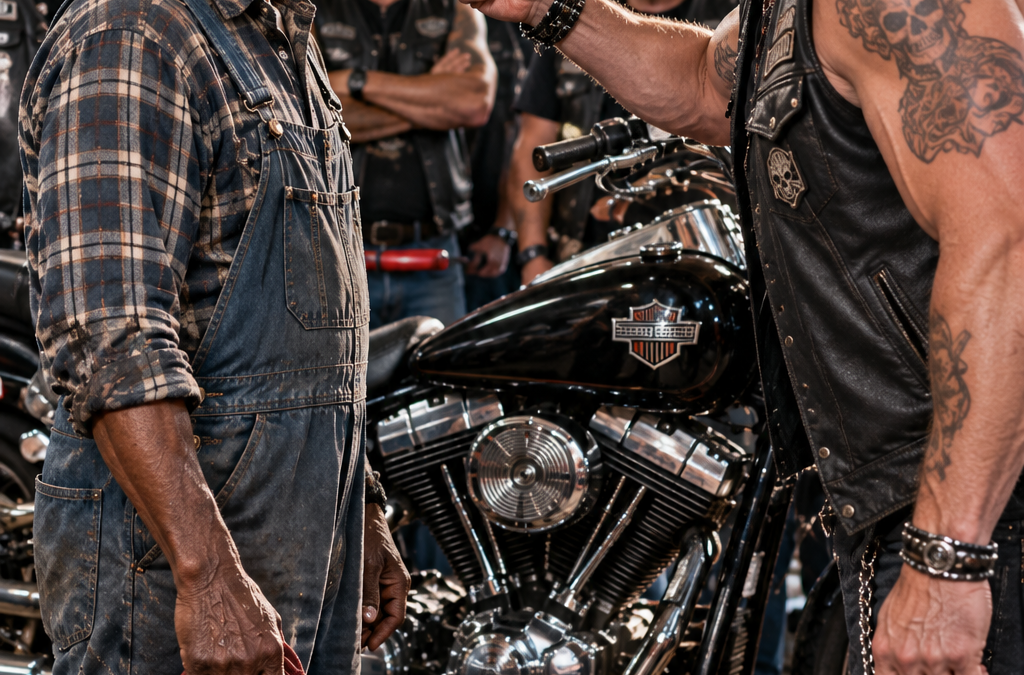
Garrett Sullivan shoved a finger toward my face and told me he would break every finger on my “dirty Black hands” if I touched the motorcycle sitting behind him.
I looked past his anger, past the men laughing around him, and stared at an engine I had not seen in forty years—because before any of them knew my name, I had helped build it.
I was seventy years old when I walked into Sullivan’s Custom Cycles on the eastern edge of Tucson.
By then, I had learned that age changes the way people look at a man.
Some see experience.
Most see decline.
They see the slower step before they notice the steadier hand.
The gray beard before the eyes.
The old flannel shirt before the knowledge living underneath it.
And when you’re an old Black man walking into a room filled mostly with younger white men who believe the room belongs to them, they sometimes decide who you are before you’ve opened your mouth.
I’d lived with that longer than some of those men had been alive.
That Thursday morning, I hadn’t gone to Sullivan’s looking to prove anything.
I hadn’t gone there because I wanted respect.
I had already lived enough life to understand the danger of depending on strangers for that.
I went because I heard a Shovelhead trying to breathe.
The sound came through the open garage doors before I saw the bike.
A dry turnover.
A faint mechanical cough.
Then nothing.
Three seconds, maybe less.
But that was enough.
There are sounds a man never forgets.
A baby’s first cry.
A wife’s voice after a long day.
The last breath of someone you love.
And the particular rhythm of a Harley-Davidson Shovelhead from the early 1980s when the timing is wrong in more than one place at once.
I stopped outside the shop.
The Arizona sun had been pressing down on the pavement since morning, and heat shimmered over the parking lot.
Motorcycles filled nearly every space.
Inside, maybe thirty men had gathered around one lift.
Some wore leather cuts.
Some had gray in their beards.
Some were young enough to think thirty was old.
At the center of all that attention sat the machine.
1983 Harley-Davidson Shovelhead.
Black paint dulled by age.
Chrome scratched.
Oil-darkened engine cases.
Old-style hand stamping on the serial number.
I knew that production run.
Not generally.
Personally.
I took two steps inside.
Nobody noticed me.
Garrett Sullivan was talking.
He was the kind of man who knew how to turn failure into a speech.
I’d seen his type before.
A man whose voice grew larger whenever his ability ran out.
He stood beside the bike with one hand on the tank.
“I brought in the best,” he said.
His audience listened.
“Phoenix. Albuquerque. Vegas. Factory-certified guys. Specialists. Men with decades of experience.”
He paused for effect.
“None of them could fix it.”
Someone behind me muttered, “Damn shame.”
Garrett nodded solemnly.
“This motor is history. Parts don’t exist. Knowledge doesn’t exist. Sometimes you have to know when to let something go.”
I moved closer.
That’s when the first mechanic saw me.
Later I learned his name was Craig Nolan.
He had thick arms, a shaved head, and the look of a man who enjoyed being second-in-command because it let him imitate the first.
“Hey.”
I stopped.
“This is private.”
I looked at him.
“I heard the engine.”
He frowned.
“What?”
“The bike.”
“We’re closed.”
“I know what’s wrong with it.”
The nearest men turned.
That sentence travels quickly in a garage.
Garrett looked over.
His eyes moved from my boots to my jeans, then my flannel shirt, then my face.
His expression told me what category he had put me in.
Old.
Poor.
Black.
Irrelevant.
“And who exactly are you?”
“Albert Hayes.”
That meant nothing to him.
It wasn’t supposed to.
“And Albert Hayes does what?”
“Fixes engines.”
The men around him laughed.
Not everyone.
Enough.
Craig smiled.
“Lawnmowers?”
I looked at the motorcycle.
“No.”
Garrett folded his arms.
“You understand three professional Harley mechanics already gave up on this bike?”
“I heard you.”
“Factory trained.”
“I heard that too.”
“One has twenty years’ experience.”
“Good for him.”
Garrett’s smile thinned.
“And you think you’re going to walk in off the street and solve it?”
I looked at him.
“Yes.”
That quieted a few men.
Confidence sounds different when a man isn’t performing it.
I wasn’t challenging Garrett.
I was telling him what I believed to be true.
The difference bothered him.
He stepped toward me.
“We don’t need some old Black man wandering into my shop pretending he knows engines.”
Nobody laughed that time.
A few faces changed.
Garrett kept going.
“This is my shop.”
“I can see that.”
“My reputation.”
I looked again at the dead Shovelhead.
“That I can’t see.”
Someone behind him made a choking sound, halfway between a laugh and an attempt not to laugh.
Garrett’s neck reddened.
He came closer.
“You think you’re funny?”
“No.”
“Then get out.”
I didn’t move.
My eyes were on the engine.
There was something familiar about the casting.
A small ridge along the timing case.
The shape of the original numbers.
A machine tells you where it comes from if you know where to look.
That engine came from Milwaukee.
Early 1983.
Before the supplier change.
Before automation swallowed more of the work.
I had put my hands on engines like that every day for years.
Garrett stepped into my line of sight.
“I’m talking to you.”
“I heard you.”
“Then look at me.”
I did.
“I’ll fix it.”
His face hardened.
He grabbed the front of my flannel shirt.
The room changed.
Not loudly.
Bodies shift differently when things may turn physical.
Garrett pulled me toward him.
“You deaf?”
His fist twisted the fabric near my collar.
“Touch that bike and I’ll break every finger on your dirty Black hands.”
I looked down at his hand.
Then back at his face.
I wasn’t angry.
Not yet.
At seventy, you learn that anger is often a young man’s attempt to borrow control.
I had nothing to borrow.
My voice stayed level.
“Take your hand off me.”
Craig laughed.
Garrett tightened his grip.
Then a voice came from the corner.
“Take your hand off him.”
Everything stopped.
Garrett looked over.
The man sitting against the far wall had been quiet since I arrived.
Leather vest.
Black denim.
Heavy boots.
Gray beard.
He had the posture of someone who had spent a lifetime making men listen without asking twice.
Wade Pearson.
I didn’t know his name yet.
Only that everyone else did.
Garrett released my shirt.
“Wade, come on.”
The older biker unfolded his arms.
“Let him work.”
Garrett stared at him.
“This guy walked in off the street.”
“I heard him.”
“He’s full of—”
“I said let him work.”
No shouting.
No threat.
He didn’t need either.
Garrett’s jaw moved.
Then he stepped away.
“Fine.”
He pointed at me.
“You want to embarrass yourself?”
I turned toward the bike.
“Not particularly.”
A few men laughed again.
Different laughter.
Garrett pulled out his phone.
“Oh, we’re filming this.”
He started a livestream.
“This should be good.”
I ignored him.
He moved beside the bike and aimed the camera at me.
“Four hours.”
I looked over.
“What?”
“You get four hours.”
“To do what?”
“Fix the impossible engine.”
I looked at the Shovelhead.
“That won’t take four hours.”
More laughter.
Garrett loved that.
His confidence came back.
“And when you fail, you leave and never come back.”
“Fine.”
“And Wade pays double for the time you’ve wasted.”
The biker in the corner didn’t react.
I said, “Deal.”
Garrett turned the phone toward himself.
“Ladies and gentlemen, you heard him.”
I stopped listening.
Forty-eight years earlier, I had been standing in another garage.
Birmingham, Alabama.
Tin roof.
Dirt floor.
One bare light bulb.
My father, Clarence Hayes, never owned enough tools for what he knew.
He fixed lawnmowers.
Generators.
Church vans.
Old Fords.
Anything with a motor.
The neighborhood came because he charged whatever people could afford.
Sometimes cash.
Sometimes vegetables.
Sometimes nothing.
I was eight the first time he let me tear down a small engine.
A Briggs & Stratton mower someone had abandoned behind the church.
I put each bolt on cardboard.
Each spring.
Each washer.
Every part in exact order.
Three hours later, I put it back together.
Dad watched from a chair.
I pulled the starter.
The engine caught on the first try.
I turned to him expecting praise.
He only nodded.
“Now do it again.”
“Why?”
“Because one success teaches your ego more than your hands.”
I frowned.
He stood.
“Take it apart.”
I did.
By twelve, I could hear a misfire before most grown men noticed the engine wasn’t right.
By sixteen, neighbors called me “the boy with the golden hands.”
Dad hated that.
“Nothing golden about them,” he’d say.
“They’re patient.”
Then he’d point at me.
“Patience is worth more.”
The summer I was sixteen, a thunderstorm knocked out half the neighborhood.
Around midnight, someone pounded on the garage door.
Ruth Caldwell.
Pregnant.
Contracting.
Her husband’s Ford wouldn’t start.
The ambulance was almost an hour away.
Ruth looked terrified.
I still remember that.
Fear makes a person’s eyes look younger.
I went into the rain.
Popped the hood.
Corroded relay.
Cracked distributor cap.
I used a spare relay from Dad’s scrap bin and sealed the cap with electrical tape.
Second try, the engine caught.
They reached the hospital.
Their daughter was born twenty-two minutes later.
Ruth named her Grace.
I didn’t save anybody.
Doctors did that.
But the engine had been a bridge between danger and help.
That night, I began understanding machines differently.
Fix the machine.
Change the moment.
Change the moment.
Maybe change a life.
At twenty-two, I left Alabama for Milwaukee.
Harley-Davidson was hiring.
I passed the skills test.
They put me on the Shovelhead line.
I stayed thirty-five years.
That’s where I learned engines had personalities.
Not literally.
I’m not foolish.
But machines have history.
Casting differences.
Supplier tolerances.
Temperature scars.
Wear patterns.
Hands leave memory in metal.
I watched supervisors come and go.
Engineers rotate through.
Automation arrive.
I trained men who eventually became my bosses.
I watched younger white mechanics move into offices while I stayed on the floor.
Sometimes they’d ask me how to solve a problem, then present the solution upstairs as their own.
Everyone understood.
Nobody said much.
Factories can teach a man many kinds of silence.
Then there was Dorothy.
I met her at a community clinic.
She laughed when I told her I built motorcycle engines.
“You look too calm for motorcycles.”
“What should a motorcycle man look like?”
“Louder.”
Our second date ended with me repairing a stranger’s stalled car in a restaurant parking lot.
Dorothy stood under a streetlight watching.
When I finished, she said:
“Hands that fix things also fix people.”
I carried that sentence for the rest of my life.
We married in 1981.
She died in 2021.
Tuesday morning.
I held her hand until I couldn’t anymore.
After Dorothy, Milwaukee felt empty.
Too many streets had her on them.
Too many restaurants.
Too many grocery aisles.
I moved to Tucson.
Opened a small workspace behind the house I rented.
No business license at first.
No sign.
Just a carport and my tools.
Neighbors started bringing broken things.
I usually didn’t charge.
Above the bench I hung a piece of wood carved with Dorothy’s words.
HANDS THAT FIX THINGS ALSO FIX PEOPLE.
That’s what I was thinking about when I stepped toward the Shovelhead at Sullivan’s.
Not Garrett.
Not his livestream.
Not the men laughing.
The engine.
I placed my hands against the metal.
Somebody snickered.
Craig said, “Is he praying?”
Garrett laughed into his phone.
“Maybe God has the missing parts.”
I closed my eyes.
My fingertips moved across the case.
Cold iron.
Old gasket surfaces.
Tiny imperfections.
I knew the family of engines.
I knew what shouldn’t be there.
“Start it.”
Craig laughed.
“Start it?”
“Three seconds.”
Wade nodded.
One of his men hit the starter.
The engine turned.
Groaned.
Coughed.
Stopped.
I listened.
Then I stood.
“Three problems.”
Garrett barked a laugh.
“Three?”
“Yes.”
“Of course.”
I pointed toward the cam chest.
“Timing is off roughly two degrees.”
Craig shook his head.
“Diagnostics would’ve found that.”
“No.”
I looked at him.
“Not this one.”
“How do you know?”
“Mid-1983 production variation. Certain cam batches came through outside nominal tolerance before the supplier change.”
The room grew quieter.
I continued.
“Second, intake valve seat fractures.”
Garrett rolled his eyes.
“Our Vegas guy already found that.”
“He stopped too soon.”
His expression tightened.
“There’s a seal leak behind the fracture.”
“How the hell can you know that?”
“I can hear it.”
Craig laughed.
“You can hear a seal crack?”
“Yes.”
I pointed toward the primary assembly.
“Third, uneven chain stretch.”
“This motor uses gear-driven cam timing.”
“I know.”
“Then what chain are you talking about?”
“The primary chain.”
He stopped.
“Three links.”
Garrett said, “You counting links by sound too?”
“No.”
I looked at the bike.
“By rhythm.”
Nobody laughed.
I went to the workbench.
Picked up a ratchet.
Torque adapter.
Valve spring compressor.
Feeler gauge.
Some of the tools were newer than mine.
Some worse.
I laid them on a clean rag.
Always in order.
Dad’s cardboard had become cloth over the years.
Garrett kept narrating.
“Old man’s picking tools now.”
I loosened the primary cover.
“Very exciting stuff.”
I placed each bolt beside the bike in sequence.
Left lower.
Right upper.
Center last.
Patterns matter.
Not always because the manual says so.
Because hands remember tension.
When the cover came free, the room quieted further.
I reached inside.
Rotated the gear.
Stopped.
Back.
Stopped.
“Two degrees.”
I checked with the gauge.
Two.
A gray-bearded biker leaned forward.
“How’d he feel that?”
His friend said nothing.
Garrett lowered the phone slightly.
Then raised it again.
“Okay. One thing.”
I walked to the scrap bin.
Garrett called it garbage.
Most modern shops do.
Old mechanics know better.
Scrap bins are libraries.
I found a thin steel shim.
Wrong size.
Right material.
I took a file.
Seven minutes.
Metal scraped against metal.
Slow strokes.
Test.
File.
Test.
File.
When the shim reached the tolerance I wanted, I inserted it.
Rotated the assembly again.
True.
I moved to the intake.
Penlight.
Dental mirror.
The microfractures appeared under the light.
Craig stepped closer.
“The Vegas guy found those.”
“I know.”
I angled the mirror.
“Look here.”
“What?”
“Behind the seat.”
I removed the old seal.
Held it up.
The crack was barely visible.
Craig took it.
Moved under the fluorescent light.
He found the line.
His expression changed.
Not dramatically.
But his hand trembled once.
“That tiny thing?”
“That tiny thing bleeds compression every cycle.”
He gave it back.
“So replace it.”
“With what?”
His mouth closed.
That was the problem the others had encountered.
No correct replacement.
No catalog match.
No factory inventory.
I returned to the scrap bin.
Found an old Panhead seal.
Craig laughed weakly.
“Wrong model.”
“Yes.”
“Won’t fit.”
“Not yet.”
I sat on the floor.
Razor.
File.
Steel plate.
Trim.
Test.
Trim.
Test.
My knees hurt.
My back reminded me I wasn’t thirty.
But my hands didn’t care how old I was.
Fourteen minutes later, the donor seal fit.
Airtight.
Craig moved closer.
“How?”
“Material compatibility.”
He waited.
I pointed at the seal.
“Same thermal behavior. Similar lip design. Enough excess diameter to machine by hand.”
“You just knew that?”
“I’ve done it before.”
“When?”
I looked at him.
“Before you were born.”
A few men smiled.
Not at me.
With me.
That was different.
Garrett stopped talking into the phone.
The livestream kept running.
I moved to the primary chain.
Ran it through my hands.
Link.
Link.
Link.
Then resistance.
Barely.
Most men wouldn’t notice.
I marked it.
Continued.
Second.
Then third.
I removed all three.
From another discarded chain, I matched gauge, pin diameter, and tensile characteristics.
Pressed the replacement links into place.
Set tension.
Ran the chain again.
Smooth.
I checked everything twice.
Then a third time.
Three hours and forty-five minutes after I touched the motorcycle, I folded the rag.
Wiped my hands.
Turned toward Wade.
“Start it.”
Nobody spoke.
Wade stood.
Walked slowly to the bike.
Something about him had changed during those hours.
Until then he had watched like a chapter president.
Now he approached like a brother.
I had learned the story while working.
The bike had belonged to Ray Pearson.
Wade’s older brother.
Founder of their chapter.
Dead eleven years.
Highway accident.
Afterward, Wade stored the motorcycle rather than ride it.
At some point the engine seized.
Oil lines corroded.
The bike became a relic.
A machine can become a grave when the person who rode it is gone.
I understood that.
I still had Dorothy’s old coffee mug.
Chipped handle.
Worth nothing.
Untouchable.
Wade sat on the seat.
His hands closed around the handlebars.
He looked down once.
Then hit the starter.
One revolution.
Two.
The engine caught.
The sound hit the room like thunder.
Deep.
Heavy.
Alive.
A Harley V-twin doesn’t simply run.
It occupies space.
The pipes shook the air.
Chrome tools rattled against hooks.
Men stepped closer without realizing it.
Wade rolled the throttle.
The engine answered instantly.
No hesitation.
No choke.
No uneven knock.
He revved again.
Then let it idle.
Steady.
That beautiful irregular Harley rhythm people describe as potato-potato-potato, though that never quite captures it.
Wade’s head lowered.
Nobody spoke.
His shoulders moved.
Once.
Then again.
When he looked up, his eyes were red.
“That’s his sound.”
His voice cracked.
Nobody pretended not to understand.
“That’s Ray’s bike.”
I looked away.
Some grief deserves privacy even in a crowded room.
Wade shut the engine down.
Ticking metal filled the quiet.
Cooling.
Settling.
I stood beside the lift.
My hands still smelled like old oil.
Garrett was no longer filming me as a joke.
His phone remained raised because he didn’t know what else to do with it.
Then the garage door opened.
An older man walked in.
Mid-seventies.
Straight-backed.
Faded Harley-Davidson polo.
Old logo.
Steel-toed boots.
Canvas tool roll.
Garrett moved immediately.
“Sorry, we’re—”
“I know what this is.”
The man didn’t stop.
“I watched the livestream.”
He walked directly to the Shovelhead.
“I drove from Phoenix.”
He placed the tool roll on the bench.
Opened it.
Magnifier.
Precision gauge.
Inspection light.
I knew the hands before I knew the face.
Emmett Cole.
Time had thinned him.
Gray hair.
Deeper lines.
But he still opened his tools in the same order.
He inspected my cam correction.
Valve seal.
Chain work.
Nobody spoke.
Twelve minutes.
Then he stood.
“My name is Emmett Cole.”
Some heads turned.
“I was chief engineer at Harley-Davidson’s Milwaukee facility.”
Garrett’s face changed.
“Forty-three years in the business.”
Emmett looked toward the engine.
“I supervised production when that Shovelhead was built.”
He paused.
“I’ve inspected restorations from some of the best Harley specialists in North America.”
Then he pointed at my work.
“What this man did today with scrap metal, hand tools, and no diagnostic system is better than most factory restoration work I have seen.”
A murmur moved through the garage.
Garrett looked like he’d swallowed something sharp.
Emmett continued.
“Cam correction is within half a thousandth.”
He pointed toward the intake.
“The modified seal is tighter than the original specification.”
Then the chain.
“Excellent work.”
He looked at me.
His face softened.
“Albert Hayes.”
I nodded.
“Emmett.”
Garrett glanced between us.
“You know him?”
Emmett almost smiled.
“Know him?”
He turned toward the crowd.
“We worked together.”
His voice changed.
Not louder.
Heavier.
“Milwaukee. Late seventies through the early nineties.”
He pointed at me.
“This man built Shovelheads when half the mechanics in this room were still children.”
No laughter now.
“He could hear a bad casting before quality control measured it.”
He looked toward Garrett.
“I once watched Albert diagnose a crank problem from across a production bay.”
Garrett opened his mouth.
Emmett kept going.
“When layoffs came, I told management not to let him go.”
That wasn’t a memory I expected to hear.
I looked at Emmett.
“You wrote that?”
“Yes.”
“I never knew.”
“They ignored it.”
He looked toward the room again.
“Albert trained men who became supervisors above him.”
My chest tightened.
“He corrected engineering errors quietly because he cared more about the motor leaving the factory right than whose name went on the report.”
He paused.
“The company benefited from him for decades.”
Then his eyes returned to Garrett.
“And men like you still look at him and see an old Black man who doesn’t belong in a shop.”
Nobody moved.
Garrett looked at the floor.
For the first time that day, I almost felt sorry for him.
Almost.
Emmett’s voice hardened.
“You called his hands dirty.”
Garrett said nothing.
“Those hands built some of the machines your reputation depends on.”
Still nothing.
“Think about that.”
Emmett turned toward me.
“You deserved better from the industry.”
I didn’t answer.
What could I say?
At seventy, receiving recognition for injuries from forty years earlier feels strange.
Part comfort.
Part grief.
You appreciate the truth.
You also mourn the years it arrived too late to change.
Wade came toward me.
He stopped close.
Neither of us spoke.
Then he extended his hand.
I took it.
His grip was firm.
Not competitive.
Respectful.
It lasted longer than normal.
Finally he said:
“Thank you.”
“You’re welcome.”
“No.”
He shook his head.
“Not for fixing a motorcycle.”
I understood.
He looked back at the Shovelhead.
“For giving me my brother’s voice back.”
That sentence nearly broke me.
Dorothy had been gone three years.
I would have given anything to hear her laugh clearly one more time.
Engines cannot resurrect people.
But memory has strange doors.
Sometimes sound opens one.
Wade turned toward the bikers.
“Listen up.”
Everyone did.
“Albert Hayes is honorary mechanic for the Desert Reapers.”
A few men looked surprised.
Wade continued.
“Permanent.”
Then:
“If you’re with this chapter and you’ve got a motor nobody can solve, you call him before anybody else.”
Several men tapped their fists to their chests.
A chapter gesture.
I didn’t know what to do with that much public respect.
So I nodded.
“Appreciate it.”
Emmett walked over.
Handed me a business card.
“I consult for collectors.”
“I don’t really take private restoration contracts.”
“You do now.”
I smiled.
He closed my fingers around the card.
“Museum bikes. Rare motors. Old machines people have given up on.”
“I charge almost nothing.”
“That needs to change.”
“I have enough.”
“Then charge people who have enough and keep fixing poor people’s bikes free.”
I looked at him.
He shrugged.
“Seems fair.”
That sounded like something Dorothy would have liked.
Around us, men began asking for my number.
A young rider came over.
Maybe twenty-five.
He had been one of the men laughing early.
He couldn’t quite meet my eyes.
“Mr. Hayes?”
“Albert.”
“Albert.”
He swallowed.
“I laughed.”
“I heard you.”
His face reddened.
“I’m sorry.”
I waited.
“I don’t have an excuse.”
“Good.”
He looked surprised.
“Good?”
“Excuses waste time.”
I held out my hand.
He took it.
“Do better next time.”
“I will.”
Craig approached later.
He had stayed near the back since the valve seal.
His confidence was gone.
“Albert.”
I looked at him.
“What I said earlier…”
“About lawnmowers?”
He winced.
“Yeah.”
“My father fixed lawnmowers.”
He looked confused.
“Best mechanic I ever knew.”
Craig dropped his eyes.
“I meant it as an insult.”
“I know.”
“I’m sorry.”
I studied him.
“Did you learn anything?”
He glanced toward the Shovelhead.
“A lot.”
“Then don’t waste it.”
Garrett never apologized.
Not that day.
He stood near his counter while men who had spent years treating him like the authority walked past him to ask me questions.
His phone was still in his hand.
The livestream had never stopped.
He had started it because he wanted an audience for my humiliation.
Instead, he documented his own character.
By the time he finally ended the stream, copies were everywhere.
Motorcycle groups.
Facebook pages.
Forums.
Clips spread faster than I understood.
I didn’t have social media.
A neighbor showed me the next morning.
Thousands of comments.
By noon, more.
By evening, hundreds of thousands of people had seen Garrett grab my shirt.
Heard the word dirty.
Watched men laugh.
Then watched the engine start.
People wrote things about me that embarrassed me.
Legend.
Master.
Wizard.
None of that felt right.
I had simply done my job.
The comments about Garrett were less generous.
His business began losing customers almost immediately.
The Desert Reapers pulled all work from Sullivan’s.
Another chapter followed.
Then independents.
Then riders who didn’t belong to any club but didn’t want their money associated with what they’d watched.
Craig resigned.
I heard he left his key on the bench.
Suppliers distanced themselves.
Within six weeks, Sullivan’s Custom Cycles was nearly empty.
Someone drove me past once.
The neon sign still said NUMBER ONE IN THE WEST.
The parking lot had three vehicles in it.
I felt no satisfaction.
People expected me to.
Maybe because revenge makes a cleaner story.
But I never wanted Garrett destroyed.
I wanted him to understand.
Whether he ever did, I don’t know.
A man can lose everything and still blame everyone but himself.
What happened to his business wasn’t my doing.
I didn’t sue him.
Didn’t call for a boycott.
Didn’t make interviews.
He showed the world who he was.
People made their own decision.
That’s different.
My own life changed in quieter ways.
Emmett kept his promise.
Collectors called.
One from California.
Then Colorado.
Then Texas.
A museum asked whether I would consult on restoring an early Shovelhead.
A man from Oregon shipped a Panhead engine that hadn’t run since 1976.
I started charging people who could afford me.
That was harder than rebuilding engines.
I had spent a lifetime undervaluing my labor because people like Garrett had taught men like me to be grateful for access instead of asking what our knowledge was worth.
Emmett corrected me.
“You told him three hundred dollars?”
“Yes.”
“Albert.”
“What?”
“That’s a twelve-thousand-dollar restoration.”
“Seems excessive.”
“He owns six motorcycles and a vineyard.”
“Oh.”
“Charge twelve.”
I charged eight.
Emmett called me stubborn.
He wasn’t wrong.
Wade brought the Shovelhead to my house one Saturday.
Ray’s bike.
He parked it in front of the little garage and handed me the keys.
“Ride it.”
“No.”
“Why?”
“That’s your brother’s bike.”
“Exactly.”
He held the keys closer.
“He’d hate a motorcycle being treated like furniture.”
I took them.
The first time I rode that 1983 Shovelhead through the Arizona desert, I understood why Wade had kept it.
The engine felt alive beneath me.
Not because I had fixed it.
Because forty years of people were contained in that machine.
Factory workers.
Riders.
Ray.
Wade.
Me.
Hands and roads and mistakes and repairs.
When I returned, Wade was sitting outside.
“Well?”
I shut it down.
“He had good taste.”
Wade smiled.
“Yeah.”
That was the first time I saw him smile.
Six months later, I turned the carport behind my house into a proper workshop.
Still small.
Two lifts.
Workbench.
Old radio.
No neon.
No receptionist.
Above the bench remained Dorothy’s wooden sign.
HANDS THAT FIX THINGS ALSO FIX PEOPLE.
On Saturdays, I began teaching.
Free.
Teenagers mostly.
Some younger.
Kids from neighborhoods where vocational training cost more than families could pay.
Kids who had been told they weren’t college material as though that meant they weren’t intelligent.
Kids who had learned to expect disappointment from adults.
The first Saturday, seven showed up.
I put a broken lawnmower engine on the bench.
One boy looked disappointed.
“Thought we’d work on Harleys.”
“You don’t know how to work on a lawnmower.”
He shrugged.
“I can figure it out.”
I smiled.
“That confidence is going to cost you three hours.”
The class laughed.
I handed him a wrench.
“Take it apart.”
“Where do I put the bolts?”
I slid a piece of cardboard across the bench.
“In order.”
He began.
Three hours later, the engine ran.
He looked at me with the same expression I must have worn at eight years old in Birmingham.
Pride.
Shock.
Possibility.
“You hear that?” I asked.
He nodded.
“Now do it again.”
He stared at me.
“Seriously?”
“Seriously.”
I could almost hear my father’s laugh.
The classes grew.
Seven kids became twelve.
Then twenty.
Wade’s chapter donated tools.
Emmett shipped manuals and old factory gauges.
Collectors whose bikes I restored began donating money.
I used it for equipment.
Safety gear.
Scholarships at trade programs.
One afternoon, a girl named Maya arrived with her mother.
Sixteen years old.
Quiet.
She stood at the entrance like she expected somebody to tell her she didn’t belong.
“You here for class?”
She nodded.
“You know anything about engines?”
“No.”
“Good.”
She looked confused.
“Good?”
“Means nobody has had time to teach you bad habits.”
She smiled.
By the third week, she could tear down a carburetor faster than half the boys.
By the eighth, she was correcting them.
One Saturday, a boy complained:
“She only knows because you help her.”
Maya looked ready to explode.
I stopped them.
“Pull two engines.”
We set identical small motors on opposite benches.
“Same fault.”
I looked at the boy.
“You take one.”
Then Maya.
“You take the other.”
She finished eighteen minutes before him.
I said nothing.
Neither did she.
She simply wiped her hands.
That was better.
After class, she stayed.
“Mr. Hayes?”
“Albert.”
“My mom says I shouldn’t get too excited about this.”
“Why?”
“She thinks shops won’t hire me.”
“She may be right.”
Her face fell.
I continued.
“That doesn’t mean you stop.”
“What if nobody gives me a chance?”
I thought about Milwaukee.
Supervisors.
Promotions.
Men I’d trained signing papers above me.
“Then you become good enough that refusing you costs them.”
She looked at me.
“That sounds hard.”
“It is.”
“Did you do that?”
I looked at Dorothy’s sign.
“Eventually.”
Years had taught me something I wished I’d understood earlier.
Being exceptional doesn’t always protect you from prejudice.
Sometimes it simply means people exploit your ability while denying your dignity.
Skill alone isn’t justice.
But skill can become freedom if you learn to own it.
That was what I tried to teach.
Months after the day at Sullivan’s, a journalist came to the shop.
I almost turned her away.
I had avoided interviews.
She said she didn’t want to ask about Garrett.
That got my attention.
“What do you want?”
“The factory.”
I leaned against my bench.
“What about it?”
“You worked there thirty-five years.”
“Yes.”
“Emmett Cole said you were one of the finest engine builders he’d ever seen.”
“Emmett exaggerates.”
“He showed me records.”
I looked at him in my mind.
Of course he had.
She continued.
“Training logs. Quality reports. Your name appears repeatedly.”
I said nothing.
“But almost no promotions.”
“That’s true.”
“Why?”
I looked around the workshop.
Kids would arrive in an hour.
Tools were arranged.
Sunlight crossed the floor.
“You know why.”
“I’d like to hear you say it.”
I shook my head.
“No.”
She waited.
Then lowered her notebook.
“Why not?”
“Because I’ve spent enough years proving things other people already knew.”
That ended the interview.
She wrote the article anyway.
It focused less on Garrett than I expected.
More on invisible expertise.
Older tradespeople.
Black workers passed over in skilled industries.
Knowledge disappearing when companies confuse credentials with competence.
That part I appreciated.
One photograph showed my hands.
Scarred knuckles.
Dark nails.
Oil in the creases.
The same hands Garrett had called dirty.
Under the photograph, the caption read:
Albert Hayes spent decades building engines other men received credit for.
I stared at that sentence for a long time.
Then I cut out the picture and hung it near Dorothy’s sign.
Not because of the praise.
Because those hands had lived through everything.
Birmingham.
Milwaukee.
Dorothy.
Loss.
Tucson.
Garrett.
Ray’s Shovelhead.
Young people learning.
They were dirty.
Of course they were.
Good work often is.
A year after I first walked into Sullivan’s, Wade invited me to a memorial ride for Ray.
I almost declined.
Large crowds still didn’t suit me.
He said:
“Bring the Shovelhead knowledge.”
I said, “What does that mean?”
“It means come.”
So I did.
Hundreds of bikes gathered outside Tucson before sunrise.
Wade rode Ray’s restored 1983.
I rode another bike from the chapter.
At one point we stopped at an overlook where the desert stretched out forever.
Engines shut down one by one.
Silence replaced thunder.
Wade came beside me.
“You know what Ray used to say?”
“No.”
“Anybody can make noise.”
I smiled.
“Sounds wise.”
“He wasn’t.”
I laughed.
Wade looked toward the motorcycles.
“He said the trick was knowing which sound mattered.”
That stayed with me.
Maybe because it explained more than engines.
Garrett had made noise.
My father made none.
Dorothy made little.
Factories promoted noise.
Boardrooms reward it.
Men who don’t know sometimes speak loudest because certainty can imitate expertise for a while.
But eventually the machine has to start.
Eventually the work must hold.
Eventually noise meets reality.
I spent much of my life thinking recognition would come if I simply worked well enough.
It often didn’t.
That’s another truth.
People like clean lessons.
Work hard and you’ll be noticed.
Be patient and you’ll be rewarded.
Treat people well and they will treat you well.
Sometimes they won’t.
Sometimes the best engine builder stays on the floor while lesser men become supervisors.
Sometimes a mechanic with thirty-five years of experience walks into a shop and gets called trash before anyone asks his name.
Sometimes justice arrives forty years late.
When it does, you have a choice.
You can spend whatever remains of your life demanding repayment for what was taken.
Or you can use what remains to make sure somebody behind you loses less.
I chose the second.
One Saturday afternoon, after class, I found Maya still in the workshop.
Everyone else had left.
She was rebuilding an old carburetor.
“You planning to sleep here?”
“No.”
“Could’ve fooled me.”
She tightened a fitting.
“I got an apprenticeship.”
I stopped.
“Where?”
“Phoenix.”
“Harley restoration place.”
I smiled.
“When do you start?”
“June.”
“Paid?”
“Yes.”
“Properly?”
She named the wage.
I nodded.
“Acceptable.”
She laughed.
“That’s all I get?”
“What do you want, balloons?”
“I thought you’d be proud.”
I looked at her.
“I am.”
Her smile disappeared slightly.
She looked down at the carburetor.
“My mom cried.”
“Good cry?”
“Mostly.”
She hesitated.
“I told them about you during the interview.”
“That was your first mistake.”
She laughed.
Then she said:
“They asked who taught me.”
“What’d you say?”
“That you taught me how to listen before I touch anything.”
My throat tightened.
“That sounds like something my father would’ve said.”
“Was he a mechanic?”
“The best.”
She nodded toward the article on the wall.
“Better than you?”
“Much.”
She smiled like she didn’t believe me.
I let her.
After she left, I shut down the lights.
Only the small lamp over the workbench remained.
Dorothy’s sign hung above it.
HANDS THAT FIX THINGS ALSO FIX PEOPLE.
Beside it was the photograph of my hands.
I looked down at them.
Wrinkled now.
Old scars.
A burn mark near the thumb from 1986.
A crooked knuckle from dropping an engine casing in Milwaukee.
Grease under the nails.
Dirty Black hands.
Garrett’s words came back.
They didn’t hurt anymore.
Maybe because I finally understood the difference between dirt and shame.
Dirt washes off.
Shame belongs to whoever put it there.
I turned off the final light.
Outside, several motorcycles waited behind the fence for repairs.
Shovelheads.
Panheads.
One Knucklehead that hadn’t run since 1969.
Work for tomorrow.
I locked the door.
Then paused under the wooden sign.
For most of my life, people saw my hands before they saw me.
Some saw Black.
Some saw labor.
Some saw age.
A few saw skill.
My father saw patience.
Dorothy saw healing.
I think they were both right.
The day Garrett threatened to break my fingers, he thought he was protecting his shop from a man who didn’t belong there.
He never understood the truth.
I had spent my whole life in places like that.
Factories.
Garages.
Roadside repairs.
Hot engines.
Cold concrete.
Machines other people had abandoned.
I belonged wherever something needed fixing.
And long after the laughter stopped, after Garrett’s cameras went dark and his shop emptied, that was what remained.
Not revenge.
Not humiliation.
Not the thousands of people who watched the livestream.
A dead engine running again.
A grieving brother hearing a familiar sound.
Young hands learning what mine had learned.
Patience.
Attention.
Respect for the work.
That was enough.
It had always been enough.
𝗧𝗛𝗘 𝗘𝗡𝗗
The Biker Threatened My Hands Before I Touched His Impossible Engine
Garrett Sullivan shoved a finger toward my face and told me he would break every finger on my “dirty Black hands” if I touched the motorcycle sitting behind him.
I looked past his anger, past the men laughing around him, and stared at an engine I had not seen in forty years—because before any of them knew my name, I had helped build it.
I was seventy years old when I walked into Sullivan’s Custom Cycles on the eastern edge of Tucson.
By then, I had learned that age changes the way people look at a man.
Some see experience.
Most see decline.
They see the slower step before they notice the steadier hand.
The gray beard before the eyes.
The old flannel shirt before the knowledge living underneath it.
And when you’re an old Black man walking into a room filled mostly with younger white men who believe the room belongs to them, they sometimes decide who you are before you’ve opened your mouth.
I’d lived with that longer than some of those men had been alive.
That Thursday morning, I hadn’t gone to Sullivan’s looking to prove anything.
I hadn’t gone there because I wanted respect.
I had already lived enough life to understand the danger of depending on strangers for that.
I went because I heard a Shovelhead trying to breathe.
The sound came through the open garage doors before I saw the bike.
A dry turnover.
A faint mechanical cough.
Then nothing.
Three seconds, maybe less.
But that was enough.
There are sounds a man never forgets.
A baby’s first cry.
A wife’s voice after a long day.
The last breath of someone you love.
And the particular rhythm of a Harley-Davidson Shovelhead from the early 1980s when the timing is wrong in more than one place at once.
I stopped outside the shop.
The Arizona sun had been pressing down on the pavement since morning, and heat shimmered over the parking lot.
Motorcycles filled nearly every space.
Inside, maybe thirty men had gathered around one lift.
Some wore leather cuts.
Some had gray in their beards.
Some were young enough to think thirty was old.
At the center of all that attention sat the machine.
1983 Harley-Davidson Shovelhead.
Black paint dulled by age.
Chrome scratched.
Oil-darkened engine cases.
Old-style hand stamping on the serial number.
I knew that production run.
Not generally.
Personally.
I took two steps inside.
Nobody noticed me.
Garrett Sullivan was talking.
He was the kind of man who knew how to turn failure into a speech.
I’d seen his type before.
A man whose voice grew larger whenever his ability ran out.
He stood beside the bike with one hand on the tank.
“I brought in the best,” he said.
His audience listened.
“Phoenix. Albuquerque. Vegas. Factory-certified guys. Specialists. Men with decades of experience.”
He paused for effect.
“None of them could fix it.”
Someone behind me muttered, “Damn shame.”
Garrett nodded solemnly.
“This motor is history. Parts don’t exist. Knowledge doesn’t exist. Sometimes you have to know when to let something go.”
I moved closer.
That’s when the first mechanic saw me.
Later I learned his name was Craig Nolan.
He had thick arms, a shaved head, and the look of a man who enjoyed being second-in-command because it let him imitate the first.
“Hey.”
I stopped.
“This is private.”
I looked at him.
“I heard the engine.”
He frowned.
“What?”
“The bike.”
“We’re closed.”
“I know what’s wrong with it.”
The nearest men turned.
That sentence travels quickly in a garage.
Garrett looked over.
His eyes moved from my boots to my jeans, then my flannel shirt, then my face.
His expression told me what category he had put me in.
Old.
Poor.
Black.
Irrelevant.
“And who exactly are you?”
“Albert Hayes.”
That meant nothing to him.
It wasn’t supposed to.
“And Albert Hayes does what?”
“Fixes engines.”
The men around him laughed.
Not everyone.
Enough.
Craig smiled.
“Lawnmowers?”
I looked at the motorcycle.
“No.”
Garrett folded his arms.
“You understand three professional Harley mechanics already gave up on this bike?”
“I heard you.”
“Factory trained.”
“I heard that too.”
“One has twenty years’ experience.”
“Good for him.”
Garrett’s smile thinned.
“And you think you’re going to walk in off the street and solve it?”
I looked at him.
“Yes.”
That quieted a few men.
Confidence sounds different when a man isn’t performing it.
I wasn’t challenging Garrett.
I was telling him what I believed to be true.
The difference bothered him.
He stepped toward me.
“We don’t need some old Black man wandering into my shop pretending he knows engines.”
Nobody laughed that time.
A few faces changed.
Garrett kept going.
“This is my shop.”
“I can see that.”
“My reputation.”
I looked again at the dead Shovelhead.
“That I can’t see.”
Someone behind him made a choking sound, halfway between a laugh and an attempt not to laugh.
Garrett’s neck reddened.
He came closer.
“You think you’re funny?”
“No.”
“Then get out.”
I didn’t move.
My eyes were on the engine.
There was something familiar about the casting.
A small ridge along the timing case.
The shape of the original numbers.
A machine tells you where it comes from if you know where to look.
That engine came from Milwaukee.
Early 1983.
Before the supplier change.
Before automation swallowed more of the work.
I had put my hands on engines like that every day for years.
Garrett stepped into my line of sight.
“I’m talking to you.”
“I heard you.”
“Then look at me.”
I did.
“I’ll fix it.”
His face hardened.
He grabbed the front of my flannel shirt.
The room changed.
Not loudly.
Bodies shift differently when things may turn physical.
Garrett pulled me toward him.
“You deaf?”
His fist twisted the fabric near my collar.
“Touch that bike and I’ll break every finger on your dirty Black hands.”
I looked down at his hand.
Then back at his face.
I wasn’t angry.
Not yet.
At seventy, you learn that anger is often a young man’s attempt to borrow control.
I had nothing to borrow.
My voice stayed level.
“Take your hand off me.”
Craig laughed.
Garrett tightened his grip.
Then a voice came from the corner.
“Take your hand off him.”
Everything stopped.
Garrett looked over.
The man sitting against the far wall had been quiet since I arrived.
Leather vest.
Black denim.
Heavy boots.
Gray beard.
He had the posture of someone who had spent a lifetime making men listen without asking twice.
Wade Pearson.
I didn’t know his name yet.
Only that everyone else did.
Garrett released my shirt.
“Wade, come on.”
The older biker unfolded his arms.
“Let him work.”
Garrett stared at him.
“This guy walked in off the street.”
“I heard him.”
“He’s full of—”
“I said let him work.”
No shouting.
No threat.
He didn’t need either.
Garrett’s jaw moved.
Then he stepped away.
“Fine.”
He pointed at me.
“You want to embarrass yourself?”
I turned toward the bike.
“Not particularly.”
A few men laughed again.
Different laughter.
Garrett pulled out his phone.
“Oh, we’re filming this.”
He started a livestream.
“This should be good.”
I ignored him.
He moved beside the bike and aimed the camera at me.
“Four hours.”
I looked over.
“What?”
“You get four hours.”
“To do what?”
“Fix the impossible engine.”
I looked at the Shovelhead.
“That won’t take four hours.”
More laughter.
Garrett loved that.
His confidence came back.
“And when you fail, you leave and never come back.”
“Fine.”
“And Wade pays double for the time you’ve wasted.”
The biker in the corner didn’t react.
I said, “Deal.”
Garrett turned the phone toward himself.
“Ladies and gentlemen, you heard him.”
I stopped listening.
Forty-eight years earlier, I had been standing in another garage.
Birmingham, Alabama.
Tin roof.
Dirt floor.
One bare light bulb.
My father, Clarence Hayes, never owned enough tools for what he knew.
He fixed lawnmowers.
Generators.
Church vans.
Old Fords.
Anything with a motor.
The neighborhood came because he charged whatever people could afford.
Sometimes cash.
Sometimes vegetables.
Sometimes nothing.
I was eight the first time he let me tear down a small engine.
A Briggs & Stratton mower someone had abandoned behind the church.
I put each bolt on cardboard.
Each spring.
Each washer.
Every part in exact order.
Three hours later, I put it back together.
Dad watched from a chair.
I pulled the starter.
The engine caught on the first try.
I turned to him expecting praise.
He only nodded.
“Now do it again.”
“Why?”
“Because one success teaches your ego more than your hands.”
I frowned.
He stood.
“Take it apart.”
I did.
By twelve, I could hear a misfire before most grown men noticed the engine wasn’t right.
By sixteen, neighbors called me “the boy with the golden hands.”
Dad hated that.
“Nothing golden about them,” he’d say.
“They’re patient.”
Then he’d point at me.
“Patience is worth more.”
The summer I was sixteen, a thunderstorm knocked out half the neighborhood.
Around midnight, someone pounded on the garage door.
Ruth Caldwell.
Pregnant.
Contracting.
Her husband’s Ford wouldn’t start.
The ambulance was almost an hour away.
Ruth looked terrified.
I still remember that.
Fear makes a person’s eyes look younger.
I went into the rain.
Popped the hood.
Corroded relay.
Cracked distributor cap.
I used a spare relay from Dad’s scrap bin and sealed the cap with electrical tape.
Second try, the engine caught.
They reached the hospital.
Their daughter was born twenty-two minutes later.
Ruth named her Grace.
I didn’t save anybody.
Doctors did that.
But the engine had been a bridge between danger and help.
That night, I began understanding machines differently.
Fix the machine.
Change the moment.
Change the moment.
Maybe change a life.
At twenty-two, I left Alabama for Milwaukee.
Harley-Davidson was hiring.
I passed the skills test.
They put me on the Shovelhead line.
I stayed thirty-five years.
That’s where I learned engines had personalities.
Not literally.
I’m not foolish.
But machines have history.
Casting differences.
Supplier tolerances.
Temperature scars.
Wear patterns.
Hands leave memory in metal.
I watched supervisors come and go.
Engineers rotate through.
Automation arrive.
I trained men who eventually became my bosses.
I watched younger white mechanics move into offices while I stayed on the floor.
Sometimes they’d ask me how to solve a problem, then present the solution upstairs as their own.
Everyone understood.
Nobody said much.
Factories can teach a man many kinds of silence.
Then there was Dorothy.
I met her at a community clinic.
She laughed when I told her I built motorcycle engines.
“You look too calm for motorcycles.”
“What should a motorcycle man look like?”
“Louder.”
Our second date ended with me repairing a stranger’s stalled car in a restaurant parking lot.
Dorothy stood under a streetlight watching.
When I finished, she said:
“Hands that fix things also fix people.”
I carried that sentence for the rest of my life.
We married in 1981.
She died in 2021.
Tuesday morning.
I held her hand until I couldn’t anymore.
After Dorothy, Milwaukee felt empty.
Too many streets had her on them.
Too many restaurants.
Too many grocery aisles.
I moved to Tucson.
Opened a small workspace behind the house I rented.
No business license at first.
No sign.
Just a carport and my tools.
Neighbors started bringing broken things.
I usually didn’t charge.
Above the bench I hung a piece of wood carved with Dorothy’s words.
HANDS THAT FIX THINGS ALSO FIX PEOPLE.
That’s what I was thinking about when I stepped toward the Shovelhead at Sullivan’s.
Not Garrett.
Not his livestream.
Not the men laughing.
The engine.
I placed my hands against the metal.
Somebody snickered.
Craig said, “Is he praying?”
Garrett laughed into his phone.
“Maybe God has the missing parts.”
I closed my eyes.
My fingertips moved across the case.
Cold iron.
Old gasket surfaces.
Tiny imperfections.
I knew the family of engines.
I knew what shouldn’t be there.
“Start it.”
Craig laughed.
“Start it?”
“Three seconds.”
Wade nodded.
One of his men hit the starter.
The engine turned.
Groaned.
Coughed.
Stopped.
I listened.
Then I stood.
“Three problems.”
Garrett barked a laugh.
“Three?”
“Yes.”
“Of course.”
I pointed toward the cam chest.
“Timing is off roughly two degrees.”
Craig shook his head.
“Diagnostics would’ve found that.”
“No.”
I looked at him.
“Not this one.”
“How do you know?”
“Mid-1983 production variation. Certain cam batches came through outside nominal tolerance before the supplier change.”
The room grew quieter.
I continued.
“Second, intake valve seat fractures.”
Garrett rolled his eyes.
“Our Vegas guy already found that.”
“He stopped too soon.”
His expression tightened.
“There’s a seal leak behind the fracture.”
“How the hell can you know that?”
“I can hear it.”
Craig laughed.
“You can hear a seal crack?”
“Yes.”
I pointed toward the primary assembly.
“Third, uneven chain stretch.”
“This motor uses gear-driven cam timing.”
“I know.”
“Then what chain are you talking about?”
“The primary chain.”
He stopped.
“Three links.”
Garrett said, “You counting links by sound too?”
“No.”
I looked at the bike.
“By rhythm.”
Nobody laughed.
I went to the workbench.
Picked up a ratchet.
Torque adapter.
Valve spring compressor.
Feeler gauge.
Some of the tools were newer than mine.
Some worse.
I laid them on a clean rag.
Always in order.
Dad’s cardboard had become cloth over the years.
Garrett kept narrating.
“Old man’s picking tools now.”
I loosened the primary cover.
“Very exciting stuff.”
I placed each bolt beside the bike in sequence.
Left lower.
Right upper.
Center last.
Patterns matter.
Not always because the manual says so.
Because hands remember tension.
When the cover came free, the room quieted further.
I reached inside.
Rotated the gear.
Stopped.
Back.
Stopped.
“Two degrees.”
I checked with the gauge.
Two.
A gray-bearded biker leaned forward.
“How’d he feel that?”
His friend said nothing.
Garrett lowered the phone slightly.
Then raised it again.
“Okay. One thing.”
I walked to the scrap bin.
Garrett called it garbage.
Most modern shops do.
Old mechanics know better.
Scrap bins are libraries.
I found a thin steel shim.
Wrong size.
Right material.
I took a file.
Seven minutes.
Metal scraped against metal.
Slow strokes.
Test.
File.
Test.
File.
When the shim reached the tolerance I wanted, I inserted it.
Rotated the assembly again.
True.
I moved to the intake.
Penlight.
Dental mirror.
The microfractures appeared under the light.
Craig stepped closer.
“The Vegas guy found those.”
“I know.”
I angled the mirror.
“Look here.”
“What?”
“Behind the seat.”
I removed the old seal.
Held it up.
The crack was barely visible.
Craig took it.
Moved under the fluorescent light.
He found the line.
His expression changed.
Not dramatically.
But his hand trembled once.
“That tiny thing?”
“That tiny thing bleeds compression every cycle.”
He gave it back.
“So replace it.”
“With what?”
His mouth closed.
That was the problem the others had encountered.
No correct replacement.
No catalog match.
No factory inventory.
I returned to the scrap bin.
Found an old Panhead seal.
Craig laughed weakly.
“Wrong model.”
“Yes.”
“Won’t fit.”
“Not yet.”
I sat on the floor.
Razor.
File.
Steel plate.
Trim.
Test.
Trim.
Test.
My knees hurt.
My back reminded me I wasn’t thirty.
But my hands didn’t care how old I was.
Fourteen minutes later, the donor seal fit.
Airtight.
Craig moved closer.
“How?”
“Material compatibility.”
He waited.
I pointed at the seal.
“Same thermal behavior. Similar lip design. Enough excess diameter to machine by hand.”
“You just knew that?”
“I’ve done it before.”
“When?”
I looked at him.
“Before you were born.”
A few men smiled.
Not at me.
With me.
That was different.
Garrett stopped talking into the phone.
The livestream kept running.
I moved to the primary chain.
Ran it through my hands.
Link.
Link.
Link.
Then resistance.
Barely.
Most men wouldn’t notice.
I marked it.
Continued.
Second.
Then third.
I removed all three.
From another discarded chain, I matched gauge, pin diameter, and tensile characteristics.
Pressed the replacement links into place.
Set tension.
Ran the chain again.
Smooth.
I checked everything twice.
Then a third time.
Three hours and forty-five minutes after I touched the motorcycle, I folded the rag.
Wiped my hands.
Turned toward Wade.
“Start it.”
Nobody spoke.
Wade stood.
Walked slowly to the bike.
Something about him had changed during those hours.
Until then he had watched like a chapter president.
Now he approached like a brother.
I had learned the story while working.
The bike had belonged to Ray Pearson.
Wade’s older brother.
Founder of their chapter.
Dead eleven years.
Highway accident.
Afterward, Wade stored the motorcycle rather than ride it.
At some point the engine seized.
Oil lines corroded.
The bike became a relic.
A machine can become a grave when the person who rode it is gone.
I understood that.
I still had Dorothy’s old coffee mug.
Chipped handle.
Worth nothing.
Untouchable.
Wade sat on the seat.
His hands closed around the handlebars.
He looked down once.
Then hit the starter.
One revolution.
Two.
The engine caught.
The sound hit the room like thunder.
Deep.
Heavy.
Alive.
A Harley V-twin doesn’t simply run.
It occupies space.
The pipes shook the air.
Chrome tools rattled against hooks.
Men stepped closer without realizing it.
Wade rolled the throttle.
The engine answered instantly.
No hesitation.
No choke.
No uneven knock.
He revved again.
Then let it idle.
Steady.
That beautiful irregular Harley rhythm people describe as potato-potato-potato, though that never quite captures it.
Wade’s head lowered.
Nobody spoke.
His shoulders moved.
Once.
Then again.
When he looked up, his eyes were red.
“That’s his sound.”
His voice cracked.
Nobody pretended not to understand.
“That’s Ray’s bike.”
I looked away.
Some grief deserves privacy even in a crowded room.
Wade shut the engine down.
Ticking metal filled the quiet.
Cooling.
Settling.
I stood beside the lift.
My hands still smelled like old oil.
Garrett was no longer filming me as a joke.
His phone remained raised because he didn’t know what else to do with it.
Then the garage door opened.
An older man walked in.
Mid-seventies.
Straight-backed.
Faded Harley-Davidson polo.
Old logo.
Steel-toed boots.
Canvas tool roll.
Garrett moved immediately.
“Sorry, we’re—”
“I know what this is.”
The man didn’t stop.
“I watched the livestream.”
He walked directly to the Shovelhead.
“I drove from Phoenix.”
He placed the tool roll on the bench.
Opened it.
Magnifier.
Precision gauge.
Inspection light.
I knew the hands before I knew the face.
Emmett Cole.
Time had thinned him.
Gray hair.
Deeper lines.
But he still opened his tools in the same order.
He inspected my cam correction.
Valve seal.
Chain work.
Nobody spoke.
Twelve minutes.
Then he stood.
“My name is Emmett Cole.”
Some heads turned.
“I was chief engineer at Harley-Davidson’s Milwaukee facility.”
Garrett’s face changed.
“Forty-three years in the business.”
Emmett looked toward the engine.
“I supervised production when that Shovelhead was built.”
He paused.
“I’ve inspected restorations from some of the best Harley specialists in North America.”
Then he pointed at my work.
“What this man did today with scrap metal, hand tools, and no diagnostic system is better than most factory restoration work I have seen.”
A murmur moved through the garage.
Garrett looked like he’d swallowed something sharp.
Emmett continued.
“Cam correction is within half a thousandth.”
He pointed toward the intake.
“The modified seal is tighter than the original specification.”
Then the chain.
“Excellent work.”
He looked at me.
His face softened.
“Albert Hayes.”
I nodded.
“Emmett.”
Garrett glanced between us.
“You know him?”
Emmett almost smiled.
“Know him?”
He turned toward the crowd.
“We worked together.”
His voice changed.
Not louder.
Heavier.
“Milwaukee. Late seventies through the early nineties.”
He pointed at me.
“This man built Shovelheads when half the mechanics in this room were still children.”
No laughter now.
“He could hear a bad casting before quality control measured it.”
He looked toward Garrett.
“I once watched Albert diagnose a crank problem from across a production bay.”
Garrett opened his mouth.
Emmett kept going.
“When layoffs came, I told management not to let him go.”
That wasn’t a memory I expected to hear.
I looked at Emmett.
“You wrote that?”
“Yes.”
“I never knew.”
“They ignored it.”
He looked toward the room again.
“Albert trained men who became supervisors above him.”
My chest tightened.
“He corrected engineering errors quietly because he cared more about the motor leaving the factory right than whose name went on the report.”
He paused.
“The company benefited from him for decades.”
Then his eyes returned to Garrett.
“And men like you still look at him and see an old Black man who doesn’t belong in a shop.”
Nobody moved.
Garrett looked at the floor.
For the first time that day, I almost felt sorry for him.
Almost.
Emmett’s voice hardened.
“You called his hands dirty.”
Garrett said nothing.
“Those hands built some of the machines your reputation depends on.”
Still nothing.
“Think about that.”
Emmett turned toward me.
“You deserved better from the industry.”
I didn’t answer.
What could I say?
At seventy, receiving recognition for injuries from forty years earlier feels strange.
Part comfort.
Part grief.
You appreciate the truth.
You also mourn the years it arrived too late to change.
Wade came toward me.
He stopped close.
Neither of us spoke.
Then he extended his hand.
I took it.
His grip was firm.
Not competitive.
Respectful.
It lasted longer than normal.
Finally he said:
“Thank you.”
“You’re welcome.”
“No.”
He shook his head.
“Not for fixing a motorcycle.”
I understood.
He looked back at the Shovelhead.
“For giving me my brother’s voice back.”
That sentence nearly broke me.
Dorothy had been gone three years.
I would have given anything to hear her laugh clearly one more time.
Engines cannot resurrect people.
But memory has strange doors.
Sometimes sound opens one.
Wade turned toward the bikers.
“Listen up.”
Everyone did.
“Albert Hayes is honorary mechanic for the Desert Reapers.”
A few men looked surprised.
Wade continued.
“Permanent.”
Then:
“If you’re with this chapter and you’ve got a motor nobody can solve, you call him before anybody else.”
Several men tapped their fists to their chests.
A chapter gesture.
I didn’t know what to do with that much public respect.
So I nodded.
“Appreciate it.”
Emmett walked over.
Handed me a business card.
“I consult for collectors.”
“I don’t really take private restoration contracts.”
“You do now.”
I smiled.
He closed my fingers around the card.
“Museum bikes. Rare motors. Old machines people have given up on.”
“I charge almost nothing.”
“That needs to change.”
“I have enough.”
“Then charge people who have enough and keep fixing poor people’s bikes free.”
I looked at him.
He shrugged.
“Seems fair.”
That sounded like something Dorothy would have liked.
Around us, men began asking for my number.
A young rider came over.
Maybe twenty-five.
He had been one of the men laughing early.
He couldn’t quite meet my eyes.
“Mr. Hayes?”
“Albert.”
“Albert.”
He swallowed.
“I laughed.”
“I heard you.”
His face reddened.
“I’m sorry.”
I waited.
“I don’t have an excuse.”
“Good.”
He looked surprised.
“Good?”
“Excuses waste time.”
I held out my hand.
He took it.
“Do better next time.”
“I will.”
Craig approached later.
He had stayed near the back since the valve seal.
His confidence was gone.
“Albert.”
I looked at him.
“What I said earlier…”
“About lawnmowers?”
He winced.
“Yeah.”
“My father fixed lawnmowers.”
He looked confused.
“Best mechanic I ever knew.”
Craig dropped his eyes.
“I meant it as an insult.”
“I know.”
“I’m sorry.”
I studied him.
“Did you learn anything?”
He glanced toward the Shovelhead.
“A lot.”
“Then don’t waste it.”
Garrett never apologized.
Not that day.
He stood near his counter while men who had spent years treating him like the authority walked past him to ask me questions.
His phone was still in his hand.
The livestream had never stopped.
He had started it because he wanted an audience for my humiliation.
Instead, he documented his own character.
By the time he finally ended the stream, copies were everywhere.
Motorcycle groups.
Facebook pages.
Forums.
Clips spread faster than I understood.
I didn’t have social media.
A neighbor showed me the next morning.
Thousands of comments.
By noon, more.
By evening, hundreds of thousands of people had seen Garrett grab my shirt.
Heard the word dirty.
Watched men laugh.
Then watched the engine start.
People wrote things about me that embarrassed me.
Legend.
Master.
Wizard.
None of that felt right.
I had simply done my job.
The comments about Garrett were less generous.
His business began losing customers almost immediately.
The Desert Reapers pulled all work from Sullivan’s.
Another chapter followed.
Then independents.
Then riders who didn’t belong to any club but didn’t want their money associated with what they’d watched.
Craig resigned.
I heard he left his key on the bench.
Suppliers distanced themselves.
Within six weeks, Sullivan’s Custom Cycles was nearly empty.
Someone drove me past once.
The neon sign still said NUMBER ONE IN THE WEST.
The parking lot had three vehicles in it.
I felt no satisfaction.
People expected me to.
Maybe because revenge makes a cleaner story.
But I never wanted Garrett destroyed.
I wanted him to understand.
Whether he ever did, I don’t know.
A man can lose everything and still blame everyone but himself.
What happened to his business wasn’t my doing.
I didn’t sue him.
Didn’t call for a boycott.
Didn’t make interviews.
He showed the world who he was.
People made their own decision.
That’s different.
My own life changed in quieter ways.
Emmett kept his promise.
Collectors called.
One from California.
Then Colorado.
Then Texas.
A museum asked whether I would consult on restoring an early Shovelhead.
A man from Oregon shipped a Panhead engine that hadn’t run since 1976.
I started charging people who could afford me.
That was harder than rebuilding engines.
I had spent a lifetime undervaluing my labor because people like Garrett had taught men like me to be grateful for access instead of asking what our knowledge was worth.
Emmett corrected me.
“You told him three hundred dollars?”
“Yes.”
“Albert.”
“What?”
“That’s a twelve-thousand-dollar restoration.”
“Seems excessive.”
“He owns six motorcycles and a vineyard.”
“Oh.”
“Charge twelve.”
I charged eight.
Emmett called me stubborn.
He wasn’t wrong.
Wade brought the Shovelhead to my house one Saturday.
Ray’s bike.
He parked it in front of the little garage and handed me the keys.
“Ride it.”
“No.”
“Why?”
“That’s your brother’s bike.”
“Exactly.”
He held the keys closer.
“He’d hate a motorcycle being treated like furniture.”
I took them.
The first time I rode that 1983 Shovelhead through the Arizona desert, I understood why Wade had kept it.
The engine felt alive beneath me.
Not because I had fixed it.
Because forty years of people were contained in that machine.
Factory workers.
Riders.
Ray.
Wade.
Me.
Hands and roads and mistakes and repairs.
When I returned, Wade was sitting outside.
“Well?”
I shut it down.
“He had good taste.”
Wade smiled.
“Yeah.”
That was the first time I saw him smile.
Six months later, I turned the carport behind my house into a proper workshop.
Still small.
Two lifts.
Workbench.
Old radio.
No neon.
No receptionist.
Above the bench remained Dorothy’s wooden sign.
HANDS THAT FIX THINGS ALSO FIX PEOPLE.
On Saturdays, I began teaching.
Free.
Teenagers mostly.
Some younger.
Kids from neighborhoods where vocational training cost more than families could pay.
Kids who had been told they weren’t college material as though that meant they weren’t intelligent.
Kids who had learned to expect disappointment from adults.
The first Saturday, seven showed up.
I put a broken lawnmower engine on the bench.
One boy looked disappointed.
“Thought we’d work on Harleys.”
“You don’t know how to work on a lawnmower.”
He shrugged.
“I can figure it out.”
I smiled.
“That confidence is going to cost you three hours.”
The class laughed.
I handed him a wrench.
“Take it apart.”
“Where do I put the bolts?”
I slid a piece of cardboard across the bench.
“In order.”
He began.
Three hours later, the engine ran.
He looked at me with the same expression I must have worn at eight years old in Birmingham.
Pride.
Shock.
Possibility.
“You hear that?” I asked.
He nodded.
“Now do it again.”
He stared at me.
“Seriously?”
“Seriously.”
I could almost hear my father’s laugh.
The classes grew.
Seven kids became twelve.
Then twenty.
Wade’s chapter donated tools.
Emmett shipped manuals and old factory gauges.
Collectors whose bikes I restored began donating money.
I used it for equipment.
Safety gear.
Scholarships at trade programs.
One afternoon, a girl named Maya arrived with her mother.
Sixteen years old.
Quiet.
She stood at the entrance like she expected somebody to tell her she didn’t belong.
“You here for class?”
She nodded.
“You know anything about engines?”
“No.”
“Good.”
She looked confused.
“Good?”
“Means nobody has had time to teach you bad habits.”
She smiled.
By the third week, she could tear down a carburetor faster than half the boys.
By the eighth, she was correcting them.
One Saturday, a boy complained:
“She only knows because you help her.”
Maya looked ready to explode.
I stopped them.
“Pull two engines.”
We set identical small motors on opposite benches.
“Same fault.”
I looked at the boy.
“You take one.”
Then Maya.
“You take the other.”
She finished eighteen minutes before him.
I said nothing.
Neither did she.
She simply wiped her hands.
That was better.
After class, she stayed.
“Mr. Hayes?”
“Albert.”
“My mom says I shouldn’t get too excited about this.”
“Why?”
“She thinks shops won’t hire me.”
“She may be right.”
Her face fell.
I continued.
“That doesn’t mean you stop.”
“What if nobody gives me a chance?”
I thought about Milwaukee.
Supervisors.
Promotions.
Men I’d trained signing papers above me.
“Then you become good enough that refusing you costs them.”
She looked at me.
“That sounds hard.”
“It is.”
“Did you do that?”
I looked at Dorothy’s sign.
“Eventually.”
Years had taught me something I wished I’d understood earlier.
Being exceptional doesn’t always protect you from prejudice.
Sometimes it simply means people exploit your ability while denying your dignity.
Skill alone isn’t justice.
But skill can become freedom if you learn to own it.
That was what I tried to teach.
Months after the day at Sullivan’s, a journalist came to the shop.
I almost turned her away.
I had avoided interviews.
She said she didn’t want to ask about Garrett.
That got my attention.
“What do you want?”
“The factory.”
I leaned against my bench.
“What about it?”
“You worked there thirty-five years.”
“Yes.”
“Emmett Cole said you were one of the finest engine builders he’d ever seen.”
“Emmett exaggerates.”
“He showed me records.”
I looked at him in my mind.
Of course he had.
She continued.
“Training logs. Quality reports. Your name appears repeatedly.”
I said nothing.
“But almost no promotions.”
“That’s true.”
“Why?”
I looked around the workshop.
Kids would arrive in an hour.
Tools were arranged.
Sunlight crossed the floor.
“You know why.”
“I’d like to hear you say it.”
I shook my head.
“No.”
She waited.
Then lowered her notebook.
“Why not?”
“Because I’ve spent enough years proving things other people already knew.”
That ended the interview.
She wrote the article anyway.
It focused less on Garrett than I expected.
More on invisible expertise.
Older tradespeople.
Black workers passed over in skilled industries.
Knowledge disappearing when companies confuse credentials with competence.
That part I appreciated.
One photograph showed my hands.
Scarred knuckles.
Dark nails.
Oil in the creases.
The same hands Garrett had called dirty.
Under the photograph, the caption read:
Albert Hayes spent decades building engines other men received credit for.
I stared at that sentence for a long time.
Then I cut out the picture and hung it near Dorothy’s sign.
Not because of the praise.
Because those hands had lived through everything.
Birmingham.
Milwaukee.
Dorothy.
Loss.
Tucson.
Garrett.
Ray’s Shovelhead.
Young people learning.
They were dirty.
Of course they were.
Good work often is.
A year after I first walked into Sullivan’s, Wade invited me to a memorial ride for Ray.
I almost declined.
Large crowds still didn’t suit me.
He said:
“Bring the Shovelhead knowledge.”
I said, “What does that mean?”
“It means come.”
So I did.
Hundreds of bikes gathered outside Tucson before sunrise.
Wade rode Ray’s restored 1983.
I rode another bike from the chapter.
At one point we stopped at an overlook where the desert stretched out forever.
Engines shut down one by one.
Silence replaced thunder.
Wade came beside me.
“You know what Ray used to say?”
“No.”
“Anybody can make noise.”
I smiled.
“Sounds wise.”
“He wasn’t.”
I laughed.
Wade looked toward the motorcycles.
“He said the trick was knowing which sound mattered.”
That stayed with me.
Maybe because it explained more than engines.
Garrett had made noise.
My father made none.
Dorothy made little.
Factories promoted noise.
Boardrooms reward it.
Men who don’t know sometimes speak loudest because certainty can imitate expertise for a while.
But eventually the machine has to start.
Eventually the work must hold.
Eventually noise meets reality.
I spent much of my life thinking recognition would come if I simply worked well enough.
It often didn’t.
That’s another truth.
People like clean lessons.
Work hard and you’ll be noticed.
Be patient and you’ll be rewarded.
Treat people well and they will treat you well.
Sometimes they won’t.
Sometimes the best engine builder stays on the floor while lesser men become supervisors.
Sometimes a mechanic with thirty-five years of experience walks into a shop and gets called trash before anyone asks his name.
Sometimes justice arrives forty years late.
When it does, you have a choice.
You can spend whatever remains of your life demanding repayment for what was taken.
Or you can use what remains to make sure somebody behind you loses less.
I chose the second.
One Saturday afternoon, after class, I found Maya still in the workshop.
Everyone else had left.
She was rebuilding an old carburetor.
“You planning to sleep here?”
“No.”
“Could’ve fooled me.”
She tightened a fitting.
“I got an apprenticeship.”
I stopped.
“Where?”
“Phoenix.”
“Harley restoration place.”
I smiled.
“When do you start?”
“June.”
“Paid?”
“Yes.”
“Properly?”
She named the wage.
I nodded.
“Acceptable.”
She laughed.
“That’s all I get?”
“What do you want, balloons?”
“I thought you’d be proud.”
I looked at her.
“I am.”
Her smile disappeared slightly.
She looked down at the carburetor.
“My mom cried.”
“Good cry?”
“Mostly.”
She hesitated.
“I told them about you during the interview.”
“That was your first mistake.”
She laughed.
Then she said:
“They asked who taught me.”
“What’d you say?”
“That you taught me how to listen before I touch anything.”
My throat tightened.
“That sounds like something my father would’ve said.”
“Was he a mechanic?”
“The best.”
She nodded toward the article on the wall.
“Better than you?”
“Much.”
She smiled like she didn’t believe me.
I let her.
After she left, I shut down the lights.
Only the small lamp over the workbench remained.
Dorothy’s sign hung above it.
HANDS THAT FIX THINGS ALSO FIX PEOPLE.
Beside it was the photograph of my hands.
I looked down at them.
Wrinkled now.
Old scars.
A burn mark near the thumb from 1986.
A crooked knuckle from dropping an engine casing in Milwaukee.
Grease under the nails.
Dirty Black hands.
Garrett’s words came back.
They didn’t hurt anymore.
Maybe because I finally understood the difference between dirt and shame.
Dirt washes off.
Shame belongs to whoever put it there.
I turned off the final light.
Outside, several motorcycles waited behind the fence for repairs.
Shovelheads.
Panheads.
One Knucklehead that hadn’t run since 1969.
Work for tomorrow.
I locked the door.
Then paused under the wooden sign.
For most of my life, people saw my hands before they saw me.
Some saw Black.
Some saw labor.
Some saw age.
A few saw skill.
My father saw patience.
Dorothy saw healing.
I think they were both right.
The day Garrett threatened to break my fingers, he thought he was protecting his shop from a man who didn’t belong there.
He never understood the truth.
I had spent my whole life in places like that.
Factories.
Garages.
Roadside repairs.
Hot engines.
Cold concrete.
Machines other people had abandoned.
I belonged wherever something needed fixing.
And long after the laughter stopped, after Garrett’s cameras went dark and his shop emptied, that was what remained.
Not revenge.
Not humiliation.
Not the thousands of people who watched the livestream.
A dead engine running again.
A grieving brother hearing a familiar sound.
Young hands learning what mine had learned.
Patience.
Attention.
Respect for the work.
That was enough.
It had always been enough.








