𝗙𝗨𝗟𝗟 𝗦𝗧𝗢𝗥𝗬 The Biker President Bet $5,000 I Couldn’t Fix His Dead Harley and Made Me Promise to Crawl Away When I Failed
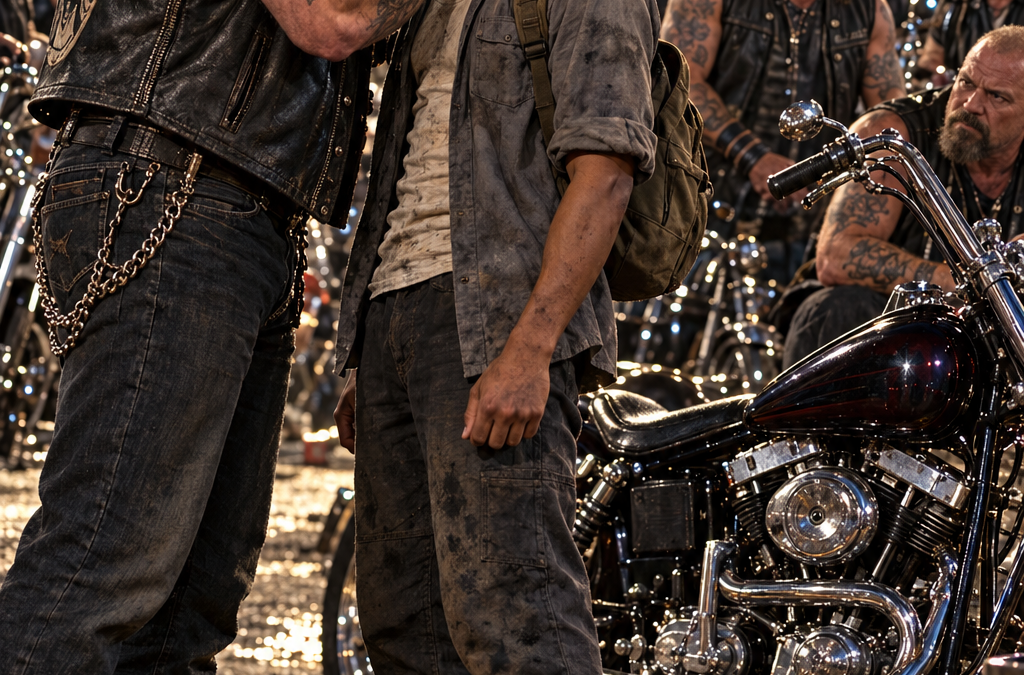
𝗣𝗔𝗥𝗧 𝟮
He looked around.
“This little piece of garbage thinks he knows what’s wrong with Black Fury.”
The crowd reacted exactly as he wanted.
Laughter.
Somebody shouted:
“Go home, kid.”
Another:
“Wrong parking lot.”
A huge biker with tattoos running up his neck walked toward me.
He flicked my ear hard.
“You lost?”
I didn’t answer.
Another man grabbed my backpack.
Before I could react, he ripped it off my shoulders.
“Let’s see what the genius is carrying.”
He unzipped it.
Dumped everything onto the asphalt.
Water bottle.
Crushed sandwich.
Notebook.
Library book.
Fundamentals of Internal Combustion Engines.
He picked it up.
Held it high.
Then read the title in a mocking professor voice.
The crowd laughed harder.
He dropped the book into a patch of oil.
Then stepped on it.
“That’s where your education belongs.”
I looked at the cover beneath his boot.
For a second, all I could see was my father.
Thomas Fletcher had never gone to engineering school.
He barely finished high school.
But he read everything.
Manuals.
Service bulletins.
Old textbooks.
Technical journals discarded by community colleges.
When he died, I inherited that habit.
Books were not decorations to me.
They were expensive when you made minimum wage.
Even library books mattered because somebody else needed them after you.
The biker lifted his boot.
I bent down.
Picked up the book.
Wiped oil away with my sleeve.
Put everything back inside my bag.
Garrett watched.
“You finished?”
I zipped the backpack.
Then looked at Black Fury.
“I can fix it.”
His smile disappeared.
He moved closer.
He smelled like whiskey, tobacco, and engine oil.
“You see these hands?”
He raised them between us.
Scarred knuckles.
“These hands have cracked skulls.”
I looked at them.
He gestured toward the bikers.
“You see these brothers?”
I did.
“They’ve done worse.”
I stayed quiet.
“And you.”
His eyes moved over me.
“Ripped shoes.”
Then my shirt.
“Car-wash stink.”
His face came closer.
“And you’re standing here telling me you can fix my father’s motorcycle.”
“Yes.”
He shoved me.
Hard.
I stumbled several steps.
My backpack hit the ground again.
“Nothing.”
Garrett pointed at me.
“You’re nothing.”
Phones were already out.
People recording.
Livestreams.
I could hear laughter behind screens.
“You wash cars.”
He stepped toward me.
“You stock shelves.”
Another step.
“You are never going to be anything more than the dirty broke nobody standing in front of me right now.”
Nobody stopped him.
That part stayed with me longer than his words.
Sixty people.
Some laughing.
Some recording.
Some uncomfortable.
Nobody saying enough.
I picked up the backpack again.
My hands were steady.
“Five minutes.”
Garrett frowned.
“What?”
“Give me five minutes.”
The crowd quieted.
“If I can’t fix it, I’ll wash every bike here for free.”
Somebody whistled.
“All of them.”
Garrett smiled.
I continued.
“If I fix it, I get the five thousand.”
“That was already the deal.”
“And you apologize.”
That changed everything.
A roar went through the parking lot.
Men slapped tables.
Someone threw a beer bottle.
It shattered near my feet.
Garrett stared as if he couldn’t believe what he had heard.
“You want me to apologize?”
“Yes.”
“To you?”
“Yes.”
He smiled slowly.
Then extended his hand.
“When you fail, you don’t walk away.”
I waited.
“You crawl.”
The crowd got louder.
Garrett pointed toward the gate.
“Hands and knees. Past every person here.”
I looked at him.
“Deal.”
He spit into his palm.
Held it out.
I shook it.
People screamed.
Garrett thought I had gambled my dignity for five thousand dollars.
He didn’t understand that my dignity had nothing to do with whether I crawled.
It had everything to do with why I was still standing.
I had been working around engines since I was nine.
My father’s garage stood on the east side of Detroit near Gratiot and Concord.
Cinderblock walls.
Corrugated roof.
Chain-link fence.
No sign except a hand-painted board inside.
FLETCHER REPAIR.
WE FIX WHAT OTHERS WON’T.
Dad owned almost nothing new.
Every tool was used.
Every workbench scarred.
Every stool repaired at least twice.
He used to say he didn’t trust equipment that had never suffered.
I was nine when he first put a wrench in my hand.
“Don’t grab it like that.”
I loosened my fingers.
“Like what?”
“Like you’re trying to win an argument.”
He repositioned my hand.
“Feel the bolt.”
“It’s a bolt.”
“Everything talks.”
I rolled my eyes.
He laughed.
“You think I’m crazy.”
“A little.”
“Good.”
He tapped my forehead.
“Means you’re paying attention.”
Dad could read machines in ways that looked almost supernatural.
He wasn’t guessing.
He understood patterns.
Heat.
Wear.
Sound.
Resistance.
By ten, he could hand me parts behind his back and I could identify them by touch.
Connecting rod.
Valve spring.
Piston ring.
Rocker arm.
By eleven, I started hearing what he heard.
Most people listen to an engine and hear one sound.
Noise.
I heard layers.
Intake had a pitch.
Exhaust had rhythm.
Timing chain had tempo.
Bearings had texture.
A failing cylinder didn’t sound “bad.”
It sounded specific.
Dad noticed.
One afternoon, he loosened a rocker arm without telling me.
Started the engine.
“How long?”
I listened.
“Cylinder three.”
He checked his watch.
“Eight seconds.”
Another day he gave me an exhaust manifold with a hairline crack.
I found the cylinder.
He smiled.
“You got the ear.”
I liked hearing that more than any report card.
“No school gives you that.”
Then he grew serious.
“But talent doesn’t matter if you’re lazy.”
He pointed at the engine.
“So learn the books too.”
That was why I read.
Why a teenager working two jobs carried an internal-combustion textbook in his backpack.
Dad’s rule was simple.
Listen before you touch.
The engine tells you everything.
Then, when I was fourteen, he died.
Tuesday in November.
Routine brake job on a delivery truck.
Jack failed.
Seven thousand pounds came down.
The ambulance needed eleven minutes.
Dad had four.
I didn’t cry at the funeral.
Everybody thought I was in shock.
Maybe I was.
The next morning, I walked to the garage.
Unlocked the door.
Sat on my overturned bucket.
His tools still hung on the pegboard.
Exactly where he left them.
I took down his favorite wrench.
Half-inch Craftsman.
Chip in the jaw.
Held it.
That was when I cried.
For hours.
My grandmother Ruth took me in fully after that.
She was Dad’s mother.
Retired cafeteria worker.
Fixed income.
Too proud to admit when she couldn’t pay something.
The garage survived two more years.
Then property taxes caught up.
County seized it.
I stood on the sidewalk at sixteen while someone padlocked my father’s door.
I was allowed to take one toolbox.
That was it.
I packed his tools into an old bedsheet.
Carried them home.
Afterward, I learned however I could.
Public-library videos.
Old manuals.
Used textbooks.
Junkyard engines.
I bought dead motors for almost nothing.
Rebuilt them on apartment concrete.
Sold them for fifty dollars.
Sometimes a hundred.
By seventeen, I was working eleven-hour days six days a week.
Car wash.
Gas station.
Every paycheck went toward rent, food, and keeping Ruth’s house out of trouble.
I still listened to machines.
At night on the fire escape, I could hear cars on the street.
There was a Buick three floors below our apartment that idled rough.
Cylinder two.
Ignition coil.
I told the owner.
He laughed.
Paid a shop four hundred dollars two weeks later.
Bad coil.
Cylinder two.
He never apologized.
I got used to that.
People rarely apologize when the person they underestimated turns out to be right.
Which was why I made Garrett put it in the bet.
The timer started at 7:47 p.m.
A kid in a backward cap held up his phone.
“Five minutes!”
The stopwatch appeared.
“GO!”
I set my backpack down.
Opened Dad’s toolbox.
Dented olive-green steel.
T. FLETCHER scratched into the lid.
Inside:
Half-inch wrench.
Small socket set.
Flathead.
Phillips.
Flashlight wrapped with electrical tape.
Emery cloth.
Not much.
Garrett burst out laughing.
“That’s it?”
I arranged the tools beside me.
“My kid’s toy box has more tools.”
One biker kicked a socket across the pavement.
“Oops.”
Laughter.
I retrieved it.
Put it back.
A man named Vince stepped over me.
Six-four.
Maybe two-sixty.
Skull tattoo on his neck.
“Four minutes thirty.”
He leaned close.
“Start crawling now.”
I ignored him.
Placed both palms against Black Fury’s engine.
Closed my eyes.
The crowd started again.
“He’s praying!”
“Kid’s asking the Harley gods for help!”
A beer can bounced near my knee.
Garrett shouted:
“Clock’s running, circus boy.”
I listened.
Cooling fins beneath my palms.
Chain tension through the case.
Fuel smell stronger than it should have been.
Electrical vibration too weak.
Three things.
Timing.
Flooding.
Ground.
I leaned closer.
Pressed my ear near the rocker cover.
Tapped three times.
Lightly.
Dad used to call it knocking on the door.
“You don’t beat information out of metal,” he once told me.
“You ask.”
I opened my eyes.
Flashlight.
Primary chain cover.
Carburetor bowl.
Frame-ground junction.
Three places.
I stood.
“Three problems.”
The laughter stopped briefly.
Garrett stared.
“What?”
“Not one.”
I pointed.
“Timing chain.”
Then carburetor.
“Fuel-control problem.”
Then lower frame.
“Ground fault.”
Garrett barked out a laugh.
“Three problems in forty seconds?”
“Yes.”
“Dale couldn’t find one.”
“He was looking differently.”
Garrett’s face darkened.
“And you?”
“I listened.”
He grabbed the back of my neck.
Turned me toward the crowd.
“You hear that?”
Laughter restarted.
“The engine whisperer.”
He pushed me away.
“Somebody get him a Grammy.”
Vince mimed touching an imaginary motorcycle with his eyes closed.
People screamed with laughter.
I noticed one person who wasn’t laughing.
Older woman.
Gray hair.
Reading glasses hanging from a chain.
Navy windbreaker.
Standing behind the crowd.
I didn’t know her.
She was watching my hands.
Not my clothes.
Not my face.
My hands.
I went back to work.
The timer showed three minutes forty-eight.
“Timing first.”
Garrett walked over and grabbed my shirt.
Lifted me.
“You break anything.”
His face was inches from mine.
“One bolt.”
He tightened his fists.
“One wire.”
His voice lowered.
“One scratch on the chrome.”
I could feel my shirt stretching.
“I will break every finger on your hands.”
I looked at him.
“I understand.”
He dropped me.
My knees hit asphalt.
Pain shot upward.
I didn’t make a sound.
The crowd moved closer.
I picked up Dad’s half-inch wrench.
My breathing changed.
Everything outside the motorcycle disappeared.
This happened whenever I worked.
It always had.
Noise flattened.
People vanished.
Only systems remained.
The first bolt came free.
Then the next.
Cam cover lifted.
Timing chain exposed.
There.
Two teeth off.
Almost nothing.
Enough to kill compression.
I aimed the flashlight.
“Timing chain slipped two teeth.”
Dale Prescott stood somewhere in the crowd.
I could feel his attention.
I loosened the cam sprocket.
Rotated it backward.
One click.
Two.
Chain seated.
Tension.
Thumb pressure.
Correct.
Tightened.
Twelve seconds.
“That’s one.”
Garrett sneered.
“Lucky guess.”
I moved to the carburetor.
Removed the bowl.
Nolan Briggs pushed closer.
Inside, the brass float looked normal.
That was why he missed it.
I touched the pivot.
Changed the angle.
Fifteen degrees.
A tiny flake of gasket debris became visible.
Smaller than rice.
Wedged where it only interfered under load.
I pressed gently.
The debris released.
Float dropped.
Needle valve clicked.
I held up the flake.
“Float stuck open.”
Nolan’s face changed.
“I checked that.”
I looked at him.
“You checked it assembled.”
His jaw tightened.
“The failure only shows off-axis.”
He stepped closer.
“You telling me I don’t know a Keihin?”
“No.”
I put the float back.
“I’m telling you this one had a known issue.”
He stared.
“Technical bulletin HD-78-041.”
Silence.
Even Garrett stopped talking.
The older woman in the back suddenly moved slightly.
Her eyes sharpened.
I didn’t know why.
Nolan did.
Maybe he remembered the bulletin.
Maybe he didn’t.
I continued.
“That’s two.”
Garrett jabbed my chest.
“You memorized a number.”
I stayed focused.
“Two minutes.”
Someone called the time.
Garrett grabbed my shirt again.
“Don’t get proud.”
“I’m not.”
“You think two lucky guesses make you special?”
“No.”
“You think you’re an engineer?”
I looked at him.
“No.”
That answer surprised him.
“I think the bike has three faults.”
I pointed beneath the frame.
“And I still have one left.”
He shoved me down again.
Someone kicked my toolbox.
Tools scattered.
A minute earlier, people would have laughed harder.
This time the laughter was thinner.
Somebody whispered:
“How does he know that bulletin?”
I gathered the tools.
Slowly.
Garrett shouted:
“Tick-tock!”
I lay flat on the asphalt.
Heat pressed through my shirt.
Gravel bit into my shoulders.
Flashlight beneath the frame.
Ground strap.
Wire intact.
Bolt tight.
Perfect visually.
That was exactly the problem.
People trust what looks perfect.
I scraped my thumbnail against the contact edge.
Green.
Copper carbonate.
Oxidation under the strap.
Enough resistance to weaken spark.
Not enough for Curtis’s battery-side meter reading to identify.
I smiled before I realized it.
Dad always said the simplest connections are the most dangerous because nobody respects them.
I pulled the emery cloth from my back pocket.
Dad carried one every day.
Twenty-three years.
I started cleaning.
Short strokes.
Green disappeared.
Brown.
Then copper.
Bright.
Clean.
I reset the ground strap.
Tightened the bolt.
Firm.
Quarter turn.
Done.
I slid out.
Stood.
“Ground junction.”
Nobody said anything.
“Corroded contact surface.”
I wiped my hands.
“It’s been weakening spark for months.”
I put the tools away.
Exactly where Dad kept them.
Closed the box.
“That’s three.”
Silence.
Not the silence before another joke.
The kind that happens when a crowd realizes it has been participating in something shameful and doesn’t yet know how to reposition itself.
The gray-haired woman walked forward.
People moved for her.
She crouched beside the Harley.
Checked the timing chain.
Then the carburetor.
Then the ground.
I watched.
She stood.
Looked at me.
“Perfect.”
Her voice was quiet.
Garrett heard it.
“So?”
He looked irritated.
She ignored him.
“I’ve trained engineers for thirty-one years.”
That got people’s attention.
“My name is Eleanor Graves.”
A few mechanics recognized it immediately.
Dale did.
His face changed.
Nolan did too.
She continued.
“Former chief engineer, Harley-Davidson powertrain division.”
Nobody laughed.
“I wrote HD-78-041.”
I stared.
She looked at me.
“Page fourteen of the Shovelhead supplemental diagnostic guide.”
I almost forgot the timer.
“You wrote that?”
“Yes.”
She smiled slightly.
“How old are you?”
“Eighteen.”
She shook her head.
“I’ve seen engineers with twenty years of experience miss what you found.”
Garrett stepped between us.
“Doesn’t matter until the bike starts.”
He was right.
Diagnosis is theory until the machine proves it.
I stepped back.
“Try it.”
Garrett stared at Black Fury.
For the first time all night, he looked uncertain.
Not afraid of me.
Afraid of the bike.
Three days earlier it had died beneath him.
His father’s engine.
The last mechanical thing his old man had built with his own hands.
I understood that more than he knew.
Garrett’s father lived inside Black Fury the way mine lived inside my toolbox.
Maybe that was why his anger had been so large.
Grief often dresses itself as rage when a man has never learned another language.
He swung his leg over.
Hands on the grips.
Foot above the kick starter.
“If it doesn’t start…”
I said nothing.
He kicked.
The engine turned.
Nothing.
A sound moved through the crowd.
I didn’t flinch.
Garrett looked at me.
Kicked again.
Cylinder fired.
Then another.
And Black Fury came alive.
The engine exploded into a deep Shovelhead roar that hit my chest before my ears.
Windows rattled.
People jumped.
Garrett twisted the throttle.
The response was immediate.
Crisp.
Steady.
No hesitation.
The idle settled.
Healthy.
Deep.
Alive.
I looked at the timer.
4:51.
Nine seconds left.
For several seconds, nobody spoke.
Only the Harley.
Then someone clapped.
Not mocking.
Real.
Another joined.
Then another.
The entire parking lot changed.
People shouted.
Phones lifted higher.
Someone near the fence started crying.
The kid holding the timer dropped his phone face-first onto the asphalt and didn’t even pick it up.
I stood beside Dad’s toolbox.
Garrett remained on the motorcycle.
Hands locked around the grips.
His eyes were wet.
He revved Black Fury once more.
Then shut it down.
The silence afterward felt enormous.
Garrett climbed off.
Walked toward me.
Nobody moved.
He stopped inches away.
Looked at my face.
For the first time since I entered that parking lot, he wasn’t looking through me.
He reached into his vest.
Pulled out the five thousand.
Held it toward me.
His hand trembled.
I looked at the money.
Then at him.
“You owe me something else.”
The lot went dead quiet.
Garrett’s jaw tightened.
For a moment, I thought he would hit me.
Vince took one step closer.
Garrett raised a hand.
Vince stopped.
Garrett looked around.
Every phone pointed toward him.
Then back at me.
The word seemed physically difficult for him.
“Sorry.”
Low.
Rough.
Barely above the evening traffic.
I didn’t move.
He looked at me.
“I said I’m sorry.”
That was enough.
I took the money.
Didn’t count it.
Put it in my pocket beside Dad’s strip of emery cloth.
Garrett stepped aside.
Vince wouldn’t look at me.
Neither would the man who stomped my library book.
The crowd had become suddenly interested in the ground.
Eleanor Graves approached.
“My name really is Eleanor.”
I smiled.
“I figured.”
She handed me a business card.
HARLEY-DAVIDSON ADVANCED APPRENTICESHIP PROGRAM.
I looked at it.
Then her.
“What’s this?”
“A recommendation.”
“For what?”
“Full apprenticeship.”
She pointed at the card.
“Tuition covered.”
I stared.
“Housing.”
I kept staring.
“Salary from day one.”
My mouth went dry.
“I don’t have a diploma from technical school.”
“I know.”
“I don’t have certifications.”
“I know.”
“I’m eighteen.”
“I noticed.”
She looked toward the dead-silent crowd.
“None of them found three faults in under five minutes either.”
I held the card carefully.
Eleanor’s voice softened.
“You have instinct.”
Then she pointed toward my backpack.
“And you study.”
That mattered to her.
“Instinct without discipline is luck.”
I nodded.
“You don’t look lucky to me.”
I thought of Dad.
“You remind me of someone.”
“Your father?”
I looked at her.
“How’d you know?”
“The wrench.”
I stared down.
Eleanor smiled.
“People don’t carry tools like that unless they belonged to somebody important.”
My throat tightened.
“Thomas Fletcher.”
“Mechanic?”
“The best.”
She nodded.
“Then he did good work twice.”
I couldn’t answer that.
The video went online before I got home.
By morning, it had more than a million views.
By the second day, two million.
Headlines called me things I didn’t recognize.
Teenage prodigy.
Engine whisperer.
Detroit wonder kid.
I hated most of them.
Ruth loved every one.
She was sitting at our kitchen table when I came home that night.
Tea.
Of course.
She looked at my shirt.
Buttons missing.
Oil.
Dust.
“What happened?”
“Long story.”
She looked at the roll of money when I placed it on the table.
Then at me.
“Owen.”
“I fixed a motorcycle.”
“For five thousand dollars?”
“It was complicated.”
She crossed her arms.
I told her everything.
Not all the insults.
Enough.
When I finished, she was silent.
Then:
“You shook a Hells Angel’s spit hand?”
I blinked.
“That’s what you got from the story?”
“That’s disgusting.”
I laughed.
She did too.
Then I showed her Eleanor’s card.
Ruth stopped smiling.
She read every line.
Twice.
“Your daddy would have lost his mind.”
I looked down.
“Yeah.”
“No.”
She shook her head.
“He would have pretended it was nothing.”
I smiled.
“That sounds right.”
“Then he would have gone into the garage and cried where nobody could see him.”
That sounded right too.
The first thing I did with the five thousand was pay Ruth’s overdue property taxes.
She protested.
Of course.
“That money is yours.”
“So is this house.”
“It’s my problem.”
“You raised me.”
“That wasn’t a loan.”
“Neither is this.”
We argued for twenty minutes.
I paid them anyway.
The apprenticeship offer remained on the kitchen table for three days.
I was afraid to accept.
That surprised me.
I had spent years wanting exactly that kind of chance.
Then it arrived and suddenly I could see every reason it might fail.
What if I wasn’t good enough?
What if five minutes with Black Fury had been luck?
What if people at Harley looked at me the way Garrett had?
What if I left Ruth and something happened?
I called Eleanor.
She answered on the second ring.
“You’re overthinking.”
I frowned.
“How do you know what I was going to say?”
“Eighteen-year-olds always overthink opportunity and underthink danger.”
“That sounds unfair.”
“It’s extremely fair.”
I sat on the fire escape.
“What if I’m not ready?”
“You aren’t.”
That startled me.
“Excuse me?”
“No apprentice is ready.”
She continued.
“If you were ready, we’d call you an engineer.”
I smiled.
“Then why choose me?”
“Because you listened before you touched.”
My father’s words.
Exactly.
I said yes.
The first weeks at Harley humbled me.
People online imagined I walked into Milwaukee and immediately became the smartest person in the building.
I didn’t.
I was surrounded by people who knew things I had never encountered.
Metallurgy.
Thermodynamics.
Advanced vibration analysis.
Manufacturing tolerances measured smaller than anything I had worked with.
I struggled with computer-aided design software.
Made mistakes.
Asked embarrassing questions.
That was good for me.
Natural skill can become another kind of arrogance if nobody challenges it.
Eleanor challenged everything.
One afternoon she put a failed valve train assembly in front of me.
“What’s wrong?”
I touched it.
She slapped my hand away.
“Not yet.”
I stared.
“What?”
“Tell me what you know before touching.”
I listened.
Looked.
Thought.
Then answered.
She smiled.
“Good.”
“What?”
“You were about to rely on instinct.”
“I thought instinct was why you hired me.”
“No.”
She leaned against the workbench.
“I hired you because instinct got you through the door.”
Then she tapped a manual.
“Knowledge keeps you inside.”
Dad would have loved her.
I told her that once.
She said:
“Your father sounds like he knew more than half the consultants I used to fire.”
That was probably the highest compliment she could give.
The video had consequences back in Detroit.
Not all of them made me comfortable.
Dale Prescott lost customers.
People mocked him for missing the timing issue.
Nolan Briggs became a meme.
“I checked it twice.”
Those words followed him online for months.
Curtis Wade’s eight-thousand-dollar engine-replacement recommendation became an even bigger joke.
People edited his clip beside mine.
Full engine replacement.
Then me fixing Black Fury with a wrench and emery cloth.
I didn’t enjoy that.
They had been wrong.
That didn’t mean they were stupid.
Dale used modern diagnostic habits on a machine that didn’t support them.
Nolan made one mistake because the float fault only appeared at an unusual angle.
Curtis relied too heavily on measurements taken at the wrong point.
Those were errors.
Not proof they deserved to lose everything.
A reporter asked me:
“How does it feel knowing you embarrassed three of Michigan’s top mechanics?”
“I didn’t.”
She looked surprised.
“They embarrassed themselves?”
“No.”
I shook my head.
“They missed things.”
“But you found them.”
“That happens.”
She looked disappointed.
She wanted arrogance.
I didn’t have it.
“You’re saying you’re not better?”
“I’m saying one repair doesn’t decide who is better.”
I thought about Dad.
“A real mechanic should know that.”
Some people online liked that answer.
Others said I was being fake humble.
The internet always needs a villain and a hero.
Real life is messier.
Garrett surprised me most.
Three weeks after the bet, a rider from another chapter needed help with a vintage Knucklehead.
Garrett gave him my name.
No story.
No apology.
Just:
“Call Owen Fletcher. He’s the best I’ve ever seen.”
I didn’t hear it from Garrett.
The rider told me.
That sentence meant more than the five thousand.
Not because I needed Garrett’s approval.
Because it proved something in him had moved.
A little.
People do not always become good after being wrong.
Sometimes they simply become less certain.
That can be a start.
Months into the apprenticeship, I returned to Detroit on a weekend.
Ruth met me at the bus station.
“You got thinner.”
“I did not.”
“You’re not eating.”
“I’m literally bigger.”
“Your face.”
“What about my face?”
“Too thin.”
We had that conversation every visit.
The next morning, we drove past Dad’s old garage.
Still padlocked.
Taxes and county liens had kept it out of reach.
I stopped the car.
Sat looking through the windshield.
Ruth knew what I was thinking.
“No.”
I looked at her.
“What?”
“You are not spending your apprenticeship money on that building.”
“I didn’t say anything.”
“You have your father’s face when you’re planning something stupid.”
I smiled.
The five-thousand-dollar bet had solved her immediate tax problem, but not enough to recover the garage outright.
So I saved.
Apprenticeship salary.
Small repair jobs on weekends.
Nothing flashy.
I studied.
Worked.
Saved.
Two years later, I had enough.
Not alone.
Harley offered a small equipment grant through a community technical program after Eleanor helped me submit the proposal.
Ruth contributed money she had secretly been saving.
I was angry.
She told me to mind my business.
Together, we cleared the liens.
The county removed the padlock.
I walked into Dad’s garage on a Tuesday morning.
Dust everywhere.
The workbenches remained.
Pegboard empty.
Oil stains still embedded in the concrete.
Same place I had sat after his funeral.
For a long time, I stood in the doorway.
Then opened Dad’s toolbox.
Hung the half-inch Craftsman wrench on the center hook.
Exactly where he kept it.
Ruth stood behind me.
She was crying.
“You okay?”
“No.”
She smiled.
“You?”
“No.”
We laughed.
That was the reopening of Fletcher Repair.
I didn’t leave Harley immediately.
That mattered to me.
The apprenticeship gave me formal training Dad never had access to.
I completed it.
Then continued into engineering coursework.
Eventually, Harley helped me enroll in a mechanical-engineering program while I worked.
I wanted both worlds.
Dad’s ear.
Eleanor’s discipline.
Old mechanical intuition.
Modern engineering.
One without the other had limitations.
Black Fury taught me that.
The bike failed because three talented men each saw only one language.
The scanner.
The carburetor.
The computer.
Dad taught me to listen to the entire machine.
Years later, I returned to the Iron Rail.
Not for a bet.
Garrett called.
Black Fury needed routine service.
That amused me.
“You trust me near it now?”
There was silence.
Then:
“Don’t get smart.”
I laughed.
He didn’t.
But I heard something like one hiding underneath.
When I arrived, fewer people were around.
Vince was there.
He avoided my eyes at first.
Then eventually came over.
“You remember me?”
“Yes.”
He looked at Dad’s wrench.
“I was an asshole.”
I nodded.
He blinked.
“That’s it?”
“What do you want me to say?”
He laughed despite himself.
“Fair.”
Then he held out his hand.
I shook it.
No spit.
Progress.
Garrett stood beside Black Fury.
Older.
Still intimidating.
He watched me work.
Quietly.
At one point he asked:
“How’d you hear it that night?”
I kept adjusting the bike.
“Which problem?”
“All of them.”
I thought.
“Timing had a different mechanical echo.”
He nodded as if he understood.
“Fuel smell told me flooding.”
“And ground?”
“Spark rhythm.”
He frowned.
“You heard weak spark?”
“Not exactly.”
I looked at him.
“I heard everything else working harder because spark wasn’t right.”
He stared.
“That makes no damn sense.”
“It does to me.”
He shook his head.
Then asked:
“Your father teach you that?”
“Yes.”
He looked at the motorcycle.
“My old man built this motor.”
“I know.”
“He wasn’t much for talking.”
“Mine talked too much.”
Garrett smiled for maybe half a second.
That was the closest we ever got to friendship.
I didn’t need more.
The first customer at the reopened Fletcher Repair was a woman with a 1957 Chevrolet that had been sitting in her garage for eight years.
Her husband had died before he could restore it.
Three shops told her to sell.
She refused.
“Can you make it run?”
I looked at the car.
Then the photograph taped to the dashboard.
Her husband leaning against the same Chevy when they were young.
“I can try.”
She nodded.
“That’s all I’m asking.”
I sat on Dad’s old overturned bucket.
Listened.
For a moment, I was nine again.
He was behind me.
Handing me the wrench.
Listen before you touch.
The engine tells you everything.
Three days later, the Chevrolet started.
The woman cried.
I understood Garrett better in that moment.
Machines are rarely only machines.
A motorcycle can be a father.
A car can be a husband.
A chipped wrench can be a childhood.
People bring dead things to mechanics because sometimes they aren’t ready to lose what the machine represents.
Dad understood that.
I finally did too.
Fletcher Repair grew slowly.
I refused to build it around the viral video.
No giant posters.
No “five-minute miracle” marketing.
Ruth wanted at least one framed newspaper clipping.
I said no.
She framed one anyway and hung it behind the office door where she thought I wouldn’t notice.
I noticed.
I left it.
Young mechanics started showing up.
Some wanted jobs.
Some wanted to watch.
Some wanted to learn what they called “engine whispering.”
I hated that phrase.
“There’s no magic.”
They looked disappointed.
“There’s observation.”
Less exciting.
“Knowledge.”
Even less exciting.
“Repetition.”
Now they looked miserable.
“And listening.”
One kid asked:
“How long until I can diagnose by sound?”
“Years.”
He frowned.
“But you did it at eighteen.”
“I started at nine.”
He stopped complaining.
I made them study.
Old service bulletins.
Modern diagnostics.
Fuel systems.
Electrical theory.
Metal fatigue.
Failure analysis.
And every apprentice learned one rule before touching a customer’s engine.
Listen first.
Not because machines literally speak.
Because arrogance makes noise.
Assumptions make noise.
Technology can make noise when people trust it more than reality.
Listening forces you to slow down long enough to notice what does not fit your first theory.
That lesson reached beyond engines.
I began noticing how often people diagnosed human beings the same lazy way.
Shoes.
Skin.
Job.
Neighborhood.
Age.
Accent.
One glance.
One conclusion.
Garrett looked at me and saw a car-wash kid.
Dale’s customers later looked at one mistake and decided forty years of experience meant nothing.
Both judgments came from the same bad habit.
Reducing a whole person to the easiest visible fact.
I did not want to become the kind of man who enjoyed what had been done to me simply because now somebody else was underneath it.
That mattered more as I got older.
At twenty-four, I spoke at a technical-school graduation in Detroit.
I almost refused the invitation.
Eleanor told me I was going.
“You retired.”
“I still outrank you.”
“That isn’t how retirement works.”
“It is today.”
So I went.
Hundreds of students.
Families.
People taking pictures.
I stood behind a podium wearing a suit Ruth said finally fit properly.
I told them about Dad.
Not Garrett.
Not the five thousand.
Dad.
I told them there are things classrooms teach that garages cannot.
Mathematics.
Modeling.
Materials science.
And things garages teach that classrooms struggle to.
Touch.
Sound.
Judgment.
Patience.
Then I said:
“Credentials matter.”
I could see some students surprised.
“My father had none.”
I paused.
“That was not proof credentials are useless.”
“It was proof talent exists in places institutions sometimes fail to see.”
Then:
“Your job is not to choose between knowledge and instinct.”
“Build both.”
That was Eleanor’s lesson.
Afterward, a kid waited near the stage.
Maybe seventeen.
Black.
Work shirt.
Oil beneath his nails.
“My grades aren’t good.”
I listened.
“I work nights.”
I nodded.
“My dad says college probably isn’t for me.”
“What do you want?”
“Engines.”
“That isn’t specific.”
He smiled slightly.
“Design.”
“Then improve the grades.”
His expression fell.
“I thought you’d tell me grades don’t matter.”
“They matter.”
“But you—”
“I read every technical book I could find while working two jobs.”
I looked at him.
“Don’t turn my hardship into permission to avoid work.”
That surprised him.
Then I smiled.
“You may have to take a longer road.”
His eyes lifted.
“Long roads still get somewhere.”
Years after the Iron Rail, Black Fury eventually came into my shop for a full rebuild.
Garrett rode it until the old engine finally needed major work.
This time he did not call fifteen mechanics.
He called me.
He stood in the garage while I opened the motor.
“You think my father built it right?”
I looked at him.
“It lasted more than fifty years.”
He nodded.
“Fair point.”
Inside the engine, I found tool marks.
Old ones.
Hand fitting.
Small modifications.
His father had adjusted things the way mechanics did before modern parts tolerances became standardized.
Garrett watched me examining them.
“What?”
“Your father knew engines.”
He stared.
“Yeah?”
“Yeah.”
That seemed to matter more than anything I had told him before.
I understood why.
I had spent half my own life wanting people to understand Thomas Fletcher through the quality of what he left behind.
Garrett wanted the same.
When the rebuild finished, Black Fury sounded different.
Not changed.
Restored.
Garrett listened.
Then said:
“He’d like that.”
I wiped my hands.
“I think so.”
Garrett looked at Dad’s chipped wrench hanging above my bench.
“Thomas?”
“Yes.”
He nodded.
Then, almost quietly:
“Good hands.”
Coming from Garrett, that was practically a eulogy.
My grandmother lived long enough to see Fletcher Repair become stable.
Not rich.
Stable.
That was enough for us.
She had one demand.
A proper sign.
The old one had disappeared after the seizure.
So I made a new one.
FLETCHER REPAIR
WE FIX WHAT OTHERS WON’T
Ruth stood across the street while we installed it.
When it was level, she looked at me.
“Your daddy would complain.”
“About what?”
“Font.”
I laughed.
“He had terrible handwriting.”
“Exactly. He’d say this looks too fancy.”
She was probably right.
Ruth died when I was twenty-eight.
Peacefully.
At home.
No emergency.
No hospital machines.
Her tea was still beside the chair.
After the funeral, I went to the garage.
Sat on the bucket.
Same thing I had done after Dad died.
But this time, I knew grief would not end me.
I had learned that from surviving him.
The next morning, I opened the shop.
That shocked some people.
“You should take time.”
I did.
Work was part of the time.
There are people who run from grief.
I learned to let mine stand beside me while I used my hands.
That was one of the reasons the five-minute repair mattered less over time.
At eighteen, I thought it was the moment I proved everyone wrong.
At twenty-eight, I understood something different.
The parking lot didn’t make me talented.
Garrett’s apology didn’t make me worthy.
Eleanor’s business card didn’t make Dad’s lessons real.
All those things existed before anyone recognized them.
Recognition is late more often than people admit.
The work happens first.
Years first, sometimes.
Nobody had watched me at eleven reading used manuals.
Nobody saw me rebuild junkyard engines on concrete.
Nobody applauded when I gave Ruth almost every paycheck.
Nobody streamed the nights I studied until two and woke at six.
Then one night, sixty phones appeared and people called me gifted.
They saw five minutes.
I lived the nine years before it.
That distinction became the central lesson of my life.
People love breakthrough moments because they are easy to film.
The difficult part is becoming the person who can use the moment when it finally comes.
Dad had given me thousands of quiet hours.
By the time Garrett offered five thousand dollars, the work was already done.
I just had to listen.
I still own the library book the biker stomped into oil.
Technically, I paid for it.
The library said it was too damaged to return.
Ruth was furious.
“You’re spending money because some fool stepped on a book?”
“It was my responsibility.”
“It was his boot.”
“My account.”
She muttered about stupid principles for twenty minutes.
I kept the book.
Oil stain across the cover.
Boot print faded but visible.
It sits in my office now.
Beside Dad’s photograph.
Not as a trophy.
A reminder.
People can step on what you are learning.
That does not erase what you learned.
They can kick your tools.
The tools still work.
They can call you stupid.
Knowledge remains.
They can call you nothing.
That word has no power unless you begin using it about yourself.
Garrett tried.
For a few seconds, standing in that lot while everyone laughed, I almost felt exactly as small as he wanted me to.
That was the dangerous part.
Not his fists.
Believing him.
Then I heard Dad.
Listen.
So I did.
Not to Garrett.
To the engine.
And the machine told me the truth.
Years later, a television producer offered me a show.
Vintage restorations.
Competition format.
Big money.
They wanted conflict.
Mechanics arguing.
Customers crying.
Timed challenges.
One executive said:
“We could recreate the five-minute bet every episode.”
I said no.
He seemed shocked.
“That’s your story.”
“No.”
“It made you famous.”
“It made me visible.”
“Same thing.”
“No.”
I stood.
“My story is a garage my father lost and I got back.”
He blinked.
“That’s not television.”
“Exactly.”
I left.
Fame had never been the goal.
Repair was.
I wanted people to bring me things they thought were gone and watch them come back.
Sometimes engines.
Sometimes confidence.
One apprentice named Malik came to me at twenty.
Had been fired from two dealerships.
He was brilliant.
Also angry.
Quick to argue.
Quick to assume disrespect.
One afternoon, a customer questioned his diagnosis.
Malik slammed a wrench down.
“You don’t trust me, do it yourself.”
I called him into my office.
“He was disrespectful.”
“I heard.”
“So?”
“So you still don’t throw tools.”
“You let Garrett spit on you.”
I stared at him.
He realized immediately he had crossed a line.
But I wasn’t angry.
“That is exactly why.”
He looked confused.
“You think I wanted to stand there?”
“No.”
“You think restraint felt good?”
“No.”
“Control is work.”
I leaned forward.
“Anybody can lose control.”
Malik looked down.
“The harder skill is deciding when somebody else gets to change your behavior.”
He nodded.
Years later, Malik ran the shop whenever I traveled.
That made me proud.
Not because I had discovered him.
Because I had not repeated what others did to me.
I listened.
That became the deepest meaning of Dad’s rule.
Listen before you touch.
Not just engines.
People.
Situations.
Your own anger.
The first answer in your head is often the loudest, not the truest.
Garrett’s first answer when he saw me was:
Nothing.
He was wrong.
The crowd’s first answer was:
Clown.
Wrong.
The experts’ first answer about Black Fury was:
Dead engine.
Wrong.
My first answer after Dad died was:
I’m alone.
Wrong.
Ruth was there.
Dad’s tools were there.
His knowledge was inside me.
My first answer when the garage was seized was:
It’s over.
Wrong again.
Some things end.
Others wait.
The garage waited.
I returned.
On quiet evenings, I sometimes close the shop after everyone leaves and start one of the old engines.
Not because it needs testing.
Just because I like the sound.
The rhythm fills the building.
Tools hang on the walls.
Dad’s wrench still on the center hook.
I’ll sit on the overturned bucket.
Close my eyes.
Listen.
I can remember exactly how his hands looked.
Scar near the thumb.
Oil under the nails.
That tiny burn mark near his wrist.
People told me later the Iron Rail video was inspiring because a poor kid proved experts wrong.
I never liked that version.
It was too simple.
I wasn’t better because I was poor.
They weren’t foolish because they had credentials.
Garrett was not wrong to love his father’s motorcycle.
What was wrong was deciding a human being’s value before hearing what he knew.
That is the part worth remembering.
The same crowd that laughed at my split shoes applauded after the engine started.
Nothing about me changed in those four minutes and fifty-one seconds.
Same shirt.
Same skin.
Same eleven dollars in my pocket.
Same education.
Same father.
Same hands.
Only their information changed.
I had been capable before they believed it.
And that matters because most people will never get a Black Fury moment.
No crowd.
No perfect test.
No five-thousand-dollar bet.
No legendary engineer appearing from the back of the parking lot to confirm they were right.
They still deserve dignity.
A person should not have to perform a miracle before you stop treating them like garbage.
That took me years to put into words.
Dad probably would have said it simpler.
Listen first.
He usually did.
When Black Fury returned to the shop for its fiftieth-anniversary service, Garrett came early.
We rolled it onto the lift.
He watched quietly.
Then placed something on my workbench.
A photograph.
His father beside Black Fury in 1972.
Young.
Long hair.
Cigarette.
Huge grin.
I looked at it.
“He looks like you.”
Garrett laughed.
“Poor bastard.”
I smiled.
Then Garrett looked at the wall where Dad’s photo hung.
Thomas in front of Fletcher Repair.
Same age maybe.
Different man.
Different life.
Two fathers.
Two sons.
Two machines carrying things neither of us knew how to say.
Garrett tapped the workbench.
“You know something?”
“What?”
“If I’d broken your fingers that night…”
I looked at him.
He didn’t finish.
“You didn’t.”
“I came close.”
“I know.”
He stared at the motorcycle.
“Sorry.”
Second time.
Years later.
No crowd.
No cameras.
That apology mattered more.
“Thank you.”
He nodded.
Then changed the subject immediately.
Of course he did.
Men like Garrett only stay emotionally exposed for about six seconds before survival instincts return.
I understood.
When the service was done, he started Black Fury.
The engine settled into its deep idle.
Garrett listened.
I did too.
“You hear anything?”
he asked.
I smiled.
“Yeah.”
His face tightened.
“What?”
“She’s good.”
He relaxed.
“That’s all?”
“That’s enough.”
He rode away.
The exhaust faded down Michigan Avenue.
I stayed in the doorway until I couldn’t hear it anymore.
Then went back inside.
There was another engine waiting.
Always is.
That is my life now.
Not the viral clip.
Not Garrett Steel.
Not five thousand dollars.
Work.
Listening.
Teaching.
Repair.
And every once in a while, a teenager walks through my door with dirty hands and no confidence because somebody told him he wasn’t built for more.
I recognize that look.
I never tell them they are secretly geniuses.
That would be cruel in another way.
I give them a broom.
Then a manual.
Then a simple repair.
I watch.
If they listen, I teach.
If they care, I invest.
Because talent matters.
But character matters longer.
Dad knew that.
Eleanor taught me the professional version.
Ruth taught me the stubborn version.
Garrett accidentally taught me what happens when people forget it.
I still have the five-thousand-dollar roll band.
The money is long gone.
Taxes.
Food.
Bills.
Life.
But the paper band that held the bills together sits inside Dad’s toolbox.
Next to the emery cloth.
Sometimes an apprentice asks what it is.
I tell them:
“A reminder.”
“Of the bet?”
“No.”
“Then what?”
I look toward Dad’s wrench.
“That five minutes is never just five minutes.”
They usually don’t understand.
Not yet.
Five minutes can contain years.
Years of learning.
Failure.
Grief.
Practice nobody sees.
Books read after work.
Hands guided by someone who is no longer alive.
That night at the Iron Rail, Garrett saw five minutes.
The crowd saw five minutes.
The internet saw five minutes.
What they didn’t see was Thomas Fletcher putting a wrench into a nine-year-old boy’s hand.
They didn’t see a fourteen-year-old sitting alone in a garage the morning after his father died.
They didn’t see the county padlock go onto our door.
They didn’t see me hauling his tools home in a bedsheet.
They didn’t see the fire escape.
The library.
The junkyard motors.
The double shifts.
The nights when I studied after my feet hurt too badly to stand.
Those were the real repair.
Black Fury was just the machine waiting at the end of it.
And if my father had been there that evening, I know exactly what he would have done.
He would have listened to the engine.
Watched my hands.
Waited until the bike started.
Then, while everybody else cheered, he would have probably said:
“You took too long.”
I would have laughed.
He would have smiled.
Then he would have handed me the wrench for the next job.
Because that was Thomas Fletcher.
And that is the man I spent my life trying to become.
Not somebody who wins bets.
Not somebody who humiliates the people who laughed first.
A man who listens before he touches.
A man who respects the work.
A man who understands that broken does not always mean finished.
Sometimes it only means nobody has listened closely enough yet.








