𝗙𝗨𝗟𝗟 𝗦𝗧𝗢𝗥𝗬 The Bank Manager Looked at My Dusty Boots, Called Me a Stray, and Never Checked the Name on the $900 Million Sitting in His Branch
𝗙𝗨𝗟𝗟 𝗦𝗧𝗢𝗥𝗬
The glass doors opened automatically.
Cool air hit me.
Vanilla.
Leather.
Fresh orchids.
A woman near the entrance glanced at my boots.
Then at the floor.
Then pulled her handbag closer.
That was the first signal.
Not the first time in my life.
Just the first that morning.
I walked toward the counter.
A young teller looked up.
Black woman.
Mid-twenties.
Name tag:
NAVEEN ELLIS.
Her smile was immediate.
Not forced.
“Good morning, sir.”
“Morning.”
“How can I help you?”
“I need to arrange a wire transfer.”
“Absolutely.”
She began reaching toward her keyboard.
“Let me get the branch manager because of the amount.”
I had not told her the amount yet.
She must have seen the account name when I gave my ID.
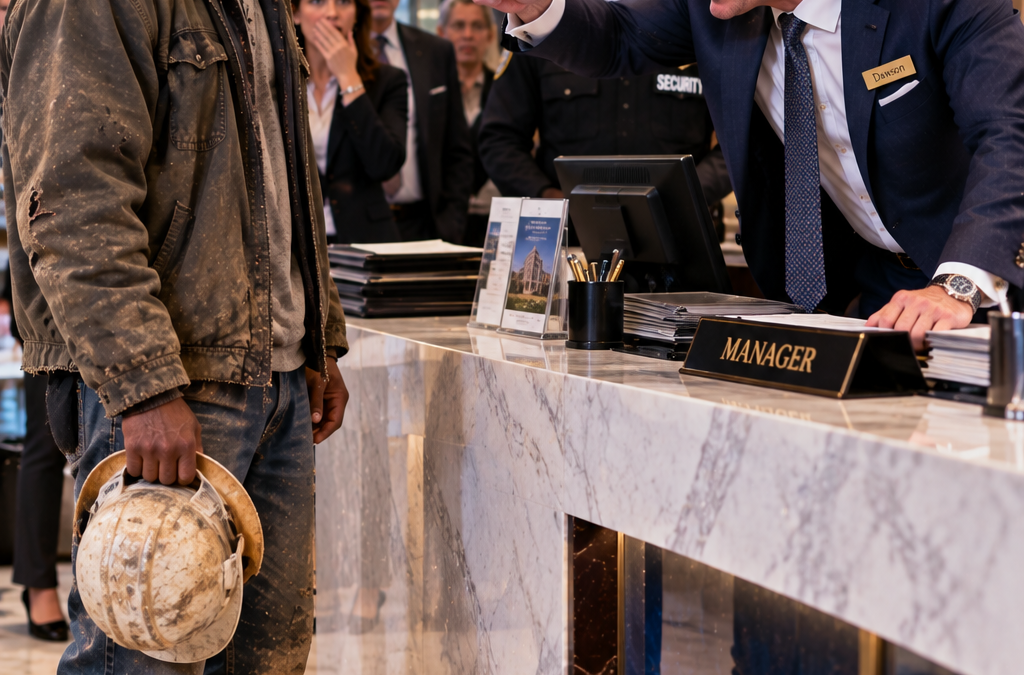
Before she could continue, a man stepped away from a conversation near the entrance.
Gregory Dawson.
Branch manager.
White.
Mid-forties.
Perfect navy suit.
Silver cuff links.
Hair cut every two weeks, if I had to guess.
He had been smiling at a woman in cashmere.
The smile disappeared when he saw me.
I watched it happen.
Not gradually.
Instantly.
He walked toward the counter.
Slow.
Measured.
He stopped three feet away.
Did not offer his hand.
Did not say good morning.
His eyes moved from my boots to my jeans.
Then my hands.
Then my face.
His nose tightened.
“What do you need?”
“I need to arrange a wire transfer.”
His eyebrow rose.
“From this bank?”
“Yes.”
“You have an account here?”
“Yes.”
He gave a short laugh.
Not enough for anyone to accuse him of laughing.
Enough for me to understand.
“Name?”
“Malcolm Foster.”
He repeated it.
“Malcolm Foster.”
“Yes.”
No recognition.
I was not surprised.
I avoided publicity.
My name appeared in financial press occasionally.
My face almost never did.
He held out his hand.
“Identification.”
I gave him my license.
He pinched it between two fingers.
I noticed that.
Held it to the light.
Looked at the hologram.
Looked at me.
Back to the photograph.
“This doesn’t look current.”
“Expiration is next year.”
He turned it sideways.
“Hmm.”
Then slid it across the counter with one finger.
Not handed.
Slid.
“Take a seat.”
I looked toward Naveen.
She looked uncomfortable.
“I thought we were starting the wire.”
“I said take a seat.”
He pointed toward a row of plastic chairs near the hallway leading to the restrooms.
Not the leather seating near the coffee station.
The plastic chairs.
The kind intended for overflow.
Or people management preferred not to display.
“I’ll get to you.”
I picked up my license.
Walked over.
Sat.
Ten minutes passed.
Then fifteen.
I watched Dawson greet three customers who entered after me.
All white.
First-name greetings.
Handshakes.
Coffee offered.
One older man walked through the door in a navy blazer.
Dawson almost hurried toward him.
“Mr. Whitfield.”
Warm smile.
“Great to see you.”
Thirty seconds later, Mr. Whitfield was inside an office.
I sat.
Hands folded.
No reaction.
People often mistake silence for weakness.
It is not.
Sometimes silence is observation.
I had spent my entire career learning who people were when they believed I had no leverage.
At twenty-two minutes, I stood.
Walked back.
“Excuse me.”
Dawson turned.
His face showed annoyance before I said another word.
“I’ve been waiting quite a while.”
“Yes.”
“I just need help with the transfer.”
He leaned both hands against the counter.
Then raised his voice.
“Sir, I’m going to be honest with you.”
The lobby quieted slightly.
“Several customers have complained about a smell.”
I looked around.
Nobody looked at me directly.
Dawson continued.
“I don’t know where you slept last night.”
I said nothing.
“I don’t know what ditch you crawled out of this morning.”
Naveen’s eyes widened.
“But you smell like wet garbage and body odor.”
The room went completely quiet.
There are moments when humiliation becomes so public that it stops feeling like an interaction and starts feeling like theater.
Dawson was performing.
He wanted witnesses.
I looked at him.
“I’ve been doing volunteer construction.”
He cut me off.
“That explains the appearance.”
“I apologize if I’m dusty.”
“Dusty?”
He laughed.
“I have customers trying not to breathe around you.”
Nobody had complained.
I knew that.
He knew that.
The room probably knew it.
But once an authority figure supplies an accusation, silence begins to make it sound true.
“I need fifteen minutes.”
“Fifteen?”
His palm hit the counter.
Crack.
“I already gave you twenty-two minutes.”
“You made me wait twenty-two minutes.”
His eyes hardened.
“Do not get smart with me.”
I took a breath.
“I have a right to access my accounts.”
“You have nothing.”
He said it softly.
That made it worse.
“You are nothing.”
Something inside my chest went still.
Not anger.
Recognition.
I had heard versions before.
In business.
College.
Real estate.
Country clubs.
Construction sites.
Most people learn to hide prejudice behind sophistication.
Dawson had stopped hiding.
“You are going to turn around,” he said, “walk out that door, and never set foot in this bank again.”
I stared at him.
“Because if I have to tell you twice, I’m calling police.”
He snapped his fingers.
“Devon.”
A young security guard approached.
Black.
Early twenties.
Broad shoulders.
Face tense.
His eyes met mine.
“Sir.”
His voice was low.
“I’m really sorry.”
Dawson barked:
“Remove him.”
Devon swallowed.
“He’s asking you to leave.”
“I understand.”
“You don’t have to apologize.”
His expression tightened.
“He does.”
“Maybe.”
I turned.
The lobby stayed silent.
Fifteen people.
Maybe more.
A woman stared at her phone.
An older couple moved away from me as I passed.
A man crossed his arms as though Dawson had done him a favor.
A teenager giggled.
His father did not correct him.
Naveen gripped the counter.
Her knuckles were white.
Nobody said:
Stop.
Nobody said:
Check his account.
Nobody said:
This is wrong.
I reached the doors.
Dawson called after me.
“Hey.”
I stopped.
Did not turn.
“If you need food and a shower, there’s a homeless shelter on Broad Street.”
Someone laughed.
“Tell them Greg sent you.”
Another laugh.
“Maybe they can hose you off in the parking lot first.”
My hand rested against the door.
For one second, I considered turning around.
Not to fight.
To ask him whether humiliating strangers made him feel taller.
I did not.
Lorraine taught me something when I was young.
“Never argue with a person who needs an audience more than he needs truth.”
I walked outside.
The sun had risen.
Warm.
Bright.
Indifferent.
I crossed the parking lot.
Got into the truck.
Closed the door.
Then sat.
Both hands on the steering wheel.
For a long time, I did not start the engine.
I looked through the glass front of the bank.
People moving.
Returning to normal.
Gregory Dawson walking back toward his office.
My chest hurt.
Not from the insult itself.
I had been insulted before.
What hurt was how practiced it felt.
He had done this before.
Maybe not those exact words.
But he had categorized people.
Decided who belonged.
Decided who deserved delay.
Extra identification.
Suspicion.
Removal.
I knew men like Dawson.
Their worst behavior rarely begins on the day someone catches them.
I looked at Lorraine’s wooden cross.
Faded.
Frayed string.
Still hanging.
Then I called Terrence.
He answered immediately.
“Finally.”
“Pull everything from Heritage.”
Silence.
“What?”
“Every Foster Capital account.”
Another pause.
“The foundation too?”
“All of it.”
“Malcolm.”
“Yes.”
“That is around nine hundred million dollars.”
“I know.”
“You want diversification maintained?”
“Move it to Cornerstone.”
He exhaled.
“May I ask what happened?”
“No.”
“That answer tells me something happened.”
“Move the money.”
“By when?”
“Friday.”
“You’re sure?”
I looked through the windshield at Heritage National.
“Every cent.”
Terrence knew me well enough not to keep arguing.
“I’ll start today.”
I ended the call.
Then drove back east.
Not home.
Elm Street.
A wall needed framing.
When I arrived, Curtis, one of the volunteers, looked at me.
“You get lost?”
“Bank took longer.”
“You hungry?”
“Always.”
He handed me half a breakfast sandwich.
I almost laughed.
Then picked up my hammer.
For the rest of Monday, I worked.
I did not tell anyone what happened.
I did not call media.
Did not post online.
Did not threaten the bank.
Money is information.
Moving it would say enough.
Later, I learned what happened after I left.
Naveen waited until the lobby cleared.
Then walked into Dawson’s office.
She did not knock.
“That man had an account.”
Dawson looked up.
“So?”
“You never checked.”
“I checked enough.”
“No.”
Her hands were shaking.
“You looked at him and decided.”
He leaned back.
“Let me explain something to you.”
“Don’t call me sweetheart.”
Apparently he had been about to.
That detail made me like her immediately when she told me months later.
Dawson’s voice changed.
“That man was a vagrant.”
“He gave you ID.”
“Fake for all I know.”
“You didn’t verify it.”
“Because I didn’t need to.”
Naveen stared.
“He told you his name.”
“Naen—”
“Naveen.”
He smiled thinly.
“If you want to keep your job, go back to your counter.”
She did.
But first he threatened to write her up for insubordination if she mentioned the incident again.
She returned to her station.
Opened email.
Started documenting.
Date.
Time.
Words.
Witnesses.
My face.
The silence.
She did not yet know where she would send it.
She just knew somebody needed a record.
That mattered later.
Because institutions depend on records.
And bad people depend on nobody making them.
Tuesday morning, Terrence began moving funds.
Foster Capital had roughly nine hundred million dollars distributed across twelve accounts at Heritage National.
Operating cash.
Trusts.
Reserves.
Foundation endowment.
Investment liquidity.
Most of it had been placed there gradually over years.
I had never thought about how much power one financial relationship represented until I decided to end it.
Terrence called around noon.
“First wires initiated.”
“Any problems?”
“Compliance questions.”
“Expected.”
“They want explanation.”
“What did you say?”
“Client-directed reallocation.”
I smiled.
“You enjoy this.”
“I enjoy accurate language.”
By Wednesday, four hundred million had reached Cornerstone Trust.
Cornerstone’s president, Calvin Moore, called me personally.
“Malcolm.”
“Calvin.”
“Terrence says more is coming.”
“Yes.”
“How much more?”
“About five hundred.”
Silence.
“You moving the whole relationship?”
“Yes.”
“Should I be nervous?”
“No.”
“Did somebody at Heritage commit fraud?”
“Not against the accounts.”
“That answer is disturbing.”
“It should be.”
He waited.
I said nothing.
“Fine.”
Calvin understood boundaries.
“We’ll handle it.”
By Thursday evening, six hundred eighty million was gone.
Heritage’s systems finally noticed.
Not Gregory Dawson.
The systems.
An automated compliance alert triggered after cumulative withdrawals crossed half a billion dollars.
That tells you something about modern institutions.
Sometimes software recognizes catastrophe before management recognizes a customer.
At 6:15 Friday morning, Patricia Coleman opened the alert.
Regional vice president.
Mid-Atlantic Division.
She read:
$900,000,000.
Single client relationship.
West End branch.
Full withdrawal.
She tried calling the branch.
Too early.
No answer.
Then she got in her car.
Gregory Dawson woke at 7:30.
Suit already pressed.
Coffee routine.
Same life.
At 8:41, he entered the branch.
Smiled at staff.
Nodded at Devon.
Walked into his office.
He did not notice the black Audi outside.
Patricia entered behind him.
No knock.
“Sit down, Gregory.”
He smiled automatically.
“Patricia. I wasn’t expecting—”
“Sit.”
He sat.
She put her laptop on the desk.
“Do you know who Malcolm Foster is?”
He frowned.
“No.”
She waited.
“Should I?”
Patricia later told Terrence that was the moment she understood the problem was worse than the withdrawal.
“Malcolm Foster,” she said, “owns Foster Capital Group.”
Nothing.
“Estimated personal net worth: 2.1 billion.”
His face changed.
“Accounts held through this branch totaled approximately nine hundred million dollars.”
Dawson stopped moving.
“Forty percent of managed assets tied to this location.”
He stared.
“As of eight o’clock this morning, it is gone.”
“That’s impossible.”
“No.”
“I would know.”
“You should have.”
“I’ve never met this Foster.”
Patricia looked at him.
“Yes, you have.”
Then she played security footage.
There I was.
Dusty.
Calm.
Waiting.
Dawson watched himself pick up my license.
Inspect it.
Send me to the plastic chairs.
Help white customers.
Ignore me.
Then the audio.
“Wet garbage.”
“Nothing.”
“You are nothing.”
“Stray dog.”
Homeless shelter.
Hose him down.
Dawson’s own face on screen looked pleased.
That is what Patricia told me later.
Not angry.
Pleased.
When the video ended, he said the sentence everyone in his position eventually says.
“I didn’t know.”
Patricia asked:
“Know what?”
“Who he was.”
“That’s your defense?”
“No, I mean—”
“What did you think he was?”
Dawson hesitated.
Patricia waited.
He looked at the paused image.
My flannel.
Boots.
Concrete.
“He looked…”
“Poor?”
Silence.
“Homeless?”
Silence.
“Black?”
He looked up.
“I didn’t say that.”
“No.”
Patricia leaned closer.
“You didn’t have to.”
Then she told him why I looked the way I did.
Habitat build.
Elm Street.
Volunteer work.
Sleeping on-site.
“Gregory, that man spends weeks building houses for families who cannot afford one.”
Dawson’s hands began shaking.
“He wasn’t homeless.”
Silence.
“He was building homes.”
That line would eventually make the news.
Dawson tried to recover.
“I can fix this.”
“No.”
“I’ll call him.”
“No.”
“I’ll apologize.”
“He did not ask for an apology.”
“What does he want?”
Patricia answered:
“Accountability.”
By then, the story had already started leaking.
Naveen’s documentation reached internal ethics.
Someone pulled video.
Someone else contacted a reporter.
I never found out exactly who gave the first clip to media.
I did not need to.
At 9:32 Friday morning, Dawson left Heritage National carrying a cardboard box.
Devon held the door.
The symmetry was not lost on anyone.
Inside the box:
family photograph.
Coffee mug.
Desk calendar.
Branch Manager of the Quarter plaque.
Naveen watched from behind the counter.
Later she told me she felt no joy.
Only relief.
That made sense.
By noon, local news had the story.
Bank manager ejects Black customer over appearance.
Customer withdraws $900 million.
The footage spread quickly.
People were fascinated by the money.
That irritated me.
Headlines wanted:
BILLIONAIRE HUMILIATED.
$900 MILLION REVENGE.
BANKER DESTROYED.
The number was dramatic.
It was also the least important part.
If I had held nine dollars instead of nine hundred million, Dawson would still have been wrong.
Money only forced the institution to notice.
That bothered me.
Terrence handled every press request with one sentence.
“Mr. Foster expects the same dignity extended to any customer.”
Reporters wanted anger.
He gave them principle.
I stayed on Elm Street.
Hammer.
Nails.
Framing.
Curtis ran over with his phone.
“Mr. Foster, you’re famous.”
“I was famous before.”
“No, you weren’t.”
“Fair.”
He showed me the clip.
Dawson.
My back.
The lobby.
Millions of views.
“You gonna sue?”
“No.”
“Go on TV?”
“No.”
“Buy the bank?”
I laughed.
“No.”
He looked disappointed.
“What are you going to do?”
I picked up a nail.
“Finish this wall.”
He stared.
“That’s it?”
“No.”
I drove the nail.
“But it’s what I’m doing right now.”
The story grew through the weekend.
Then Janet Simmons called Terrence.
Investigative journalist.
Washington.
Reputation for finding patterns behind incidents.
She asked for comment.
Terrence gave her the same line.
Then she went digging.
Three days.
Records.
Former customers.
Complaint logs.
Interviews.
Her article published Thursday.
Fourteen formal complaints.
Three years.
Every complainant Black or Latino.
Excessive ID verification.
Service refused.
Customers redirected to other branches.
Accounts delayed.
People asked to leave.
Security called.
All fourteen closed without meaningful investigation.
Resolved.
No action required.
The words felt familiar.
Dawson was not the whole problem.
He was simply the part with a face.
That mattered to me.
Institutions love firing one person because it creates the appearance of repair without the inconvenience of structural change.
The Virginia attorney general announced a formal investigation.
Federal civil rights issues followed.
Customer access.
Contract rights.
Discrimination.
Heritage National’s internal complaint process came under scrutiny.
Compliance officers who had closed the fourteen complaints were questioned.
Board members resigned.
The bank eventually entered a consent decree.
Independent review.
Bias training.
Complaint oversight.
A twelve-million-dollar compensation fund.
Three former customers filed individual lawsuits.
One man had been a physician.
Another owned a small construction company.
One Latina woman had banked there seventeen years.
All had been treated like problems before anyone bothered to understand who they were.
Again, journalists focused on success.
Doctor.
Business owner.
Longtime customer.
I kept thinking:
Why does it matter?
Why do we need impressive biographies before mistreatment becomes scandalous?
A homeless man deserved the same service.
A person with ten dollars deserved the same greeting.
A man who actually smelled bad deserved the same basic dignity.
That became the question I could not escape.
Heritage National asked for a meeting.
Corporate executives.
Lawyers.
Patricia Coleman.
Terrence advised me to attend.
I did.
Conference room in Richmond.
Long table.
Water bottles lined neatly.
CEO opened with apology.
“We failed you.”
I listened.
“We failed other customers as well.”
Better.
“We are committed to change.”
Expected.
I asked one question.
“What happens when the next person does not have nine hundred million dollars?”
Silence.
The CEO started talking about complaint channels.
I stopped him.
“No.”
He paused.
“I mean in the moment.”
Nobody answered.
“When a man walks into one of your branches wearing dirty clothes, what protects him before he has to file a complaint?”
Patricia looked down.
I continued.
“When a woman speaks with an accent.”
“When a teenager comes in with twenty-five dollars.”
“When somebody looks homeless.”
“When somebody actually is homeless.”
I leaned back.
“If the system only repairs harm after somebody powerful gets embarrassed, it is not a system of fairness.”
The CEO nodded.
I was not interested in nodding.
“Train for the first five minutes.”
That became one of the reforms.
Customer service evaluation based on equal treatment.
Mystery shoppers.
Independent complaint escalation.
Security intervention review.
No branch manager could close discrimination complaints alone.
Heritage eventually did real work.
Too late for many.
But real.
Dawson was terminated for cause.
No severance.
No reference.
He tried giving one interview.
Said he followed standard protocol.
Said any manager would have made the same judgment.
The reporter asked:
“Based on what information?”
He had no answer.
That was the problem.
He made the judgment before information.
Three weeks later, somebody photographed him sitting across the street from his old branch.
The new branch manager was a Black woman.
Navy blazer.
Warm smile.
Greeting everyone who entered.
Dawson watched.
Then drove away.
I felt no satisfaction hearing that.
I had no interest in his humiliation becoming my entertainment.
That would have made me too much like him.
What interested me more was Naveen.
I asked Patricia for her name.
Then called.
“Ms. Ellis?”
“Yes?”
“Malcolm Foster.”
Silence.
“Oh.”
I smiled.
“That bad?”
“No, sir.”
“You can call me Malcolm.”
Another pause.
“Okay.”
“I wanted to thank you.”
“For what?”
“For documenting what happened.”
“I didn’t stop it.”
“No.”
She went quiet.
“I should have.”
“Yes.”
I did not soften that either.
Silence deserves honesty.
“I was scared.”
“I know.”
“He threatened my job.”
“I know.”
“I have student loans. My mother lives with me.”
“I understand.”
Her voice tightened.
“That doesn’t make it okay.”
“No.”
Then I said:
“But you did something afterward.”
“I wish I had done it during.”
“So do I.”
We sat with that.
Finally I told her:
“Courage after the moment still matters.”
She cried.
I did not offer her a job.
People expected me to.
I thought that would cheapen what she did.
She stayed at Heritage.
Eventually moved into compliance.
That felt right.
Devon called me too.
The security guard.
“Mr. Foster.”
“Malcolm.”
“I wanted to apologize.”
“You already did.”
“Not enough.”
He told me he had been afraid of losing his job.
I believed him.
He had a baby on the way.
I told him what I told Naveen.
Fear explains.
It does not erase.
He understood.
The incident also changed what I wanted to do with Lorraine’s foundation.
For years, our giving had been broad.
Housing.
Education.
Food security.
After Heritage, I added financial access.
Because banking is not just banking.
A bank account becomes rent.
Credit.
Home ownership.
Business capital.
Emergency survival.
Being treated as suspicious at a counter can become exclusion from an entire system.
So we established the Lorraine Foster Foundation with a fifty-million-dollar endowment.
Financial literacy.
First-time homebuyer grants.
Scholarships.
Small-business counseling.
Emergency legal support for discriminatory financial practices.
Cornerstone Trust partnered with us.
No-minimum-balance accounts.
Transparent fees.
Small-dollar savings programs.
Community branches.
Calvin Moore hated when reporters praised him for treating me well.
One afternoon he told me:
“I did nothing extraordinary.”
“Correct.”
“I mean it.”
“So do I.”
He sighed.
“This whole thing makes banking look terrible.”
“Parts of banking are terrible.”
“Helpful.”
“You’re welcome.”
Then he said something that ended up in the press.
“You didn’t come here because we’re better.”
I waited.
“You came here because we treated you like a human being.”
He shook his head.
“That should be the minimum.”
“Yes.”
“So let’s make it the minimum.”
That became Cornerstone’s slogan internally.
Not publicly.
Probably for the best.
The first Lorraine Foster Community Center opened on Elm Street.
Same block where she raised me.
New brick building.
Financial counseling.
Computer lab.
Mortgage assistance.
Classrooms.
Legal-aid office.
Childcare during evening workshops.
Ribbon-cutting ceremony.
Reporters expected a speech.
I wore flannel.
Same boots.
Same wallet.
Terrence looked at me.
“Could you pretend to be a billionaire for one morning?”
“No.”
“There are cameras.”
“Tragic.”
He shook his head.
At the podium, I looked down the block.
The Habitat house was finished.
Family had moved in.
Curtains in the windows.
Children’s bicycles against the porch.
Behind me hung a banner bearing Lorraine’s name.
I thought about her hands.
Laundry chemicals.
Office-cleaning gloves.
Garden dirt.
She never had much money.
But she understood wealth.
I said one sentence.
“This one’s for you, Grandma.”
Then cut the ribbon.
Afterward, I crossed the street.
Another house was being framed.
Curtis handed me a hammer.
“You late.”
“Banking problem.”
He laughed.
Life continued.
Three weeks later, I walked into Cornerstone Trust wearing the exact same kind of clothes I wore the morning Heritage threw me out.
Old boots.
Dusty jeans.
Flannel.
Concrete on one sleeve.
The receptionist looked up.
“Morning, Mr. Foster.”
“Morning.”
“Coffee?”
“Black. Two sugars.”
“I know.”
No hesitation.
No scan.
No judgment.
I sat in the lobby.
A few minutes later, a woman entered holding her son’s hand.
Black family.
Boy maybe ten.
Backpack almost as large as his torso.
Untied shoes.
Nervous.
They approached a teller.
“We’d like to open a savings account.”
“Absolutely.”
The teller smiled at the boy.
“What’s your name?”
“Elijah.”
“Nice to meet you, Elijah.”
His mother filled out paperwork.
Deposit amount:
$25.
The teller treated the transaction like it mattered.
Because it did.
Elijah held his first bank statement with both hands.
He looked across the lobby.
Caught me watching.
I winked.
He smiled.
That moment mattered more to me than Dawson losing his job.
More than headlines.
More than the withdrawal.
Because twenty-five dollars treated with dignity can become something.
Savings habit.
College.
Business.
Emergency cushion.
Confidence.
Belonging.
I finished my coffee.
Walked outside.
Lorraine’s truck waited at the curb.
Across the street, the community center banner moved slightly in the wind.
I stood there longer than necessary.
Then climbed into the truck.
Before starting the engine, I pulled out her wallet.
Looked at the photograph.
“You would’ve caused a scene in that bank.”
I could almost hear her answer.
Damn right.
I laughed.
Then drove east.
There was another house waiting.
Months passed.
The public eventually moved on.
News always does.
Heritage National survived.
Large institutions usually do.
Its stock dipped.
Executives changed.
Policies changed.
Some employees changed.
Dawson disappeared from financial services.
People occasionally recognized me.
Construction sites mostly did not.
That was good.
I did not want my worst experience with a bank to become my identity.
What stayed was the question.
Who are you when you do not know who matters?
Gregory Dawson failed because he believed worth announced itself.
Suit.
Watch.
Car.
Speech.
Skin.
Status.
He thought respect was something you distributed after evaluating a customer.
A reward.
That is not respect.
That is pricing.
He placed a price tag on dignity.
Then discovered mine had more zeros than he expected.
People called that irony.
I found it disturbing.
Because if I had been exactly what he assumed—a homeless Black man with no money—his behavior would have disappeared into the day.
No compliance alert.
No regional vice president driving across town.
No news.
No attorney general.
No consent decree.
Just another man humiliated and removed.
That is why I refused to frame the story as revenge.
Revenge would have made it about me and Dawson.
It was larger.
Fourteen complaints told me that.
Naveen’s fear told me that.
Devon’s apology told me that.
The customers who left Heritage told me that.
Institutions do not become discriminatory only because one racist person works inside them.
They become discriminatory when bias produces results and the system rewards, ignores, or hides those results.
Dawson had strong quarterly numbers.
That protected him.
Customer complaints were closed.
That protected him.
Security followed management.
That protected him.
Staff stayed quiet.
That protected him.
Until money moved.
Then everybody paid attention.
I hated that.
So the Lorraine Foundation funded an independent program with community banks to track access complaints before they became lawsuits.
Small accounts.
First-time customers.
People without polished financial histories.
We focused on what large institutions often miss.
The first human interaction.
Was the customer greeted?
Was identification verification consistent?
Were fees explained?
Was service denied?
Was security called?
Was the person given a reason?
Patterns emerge quickly if somebody actually looks.
Within the first year, two partner institutions discovered branch-level disparities before regulators did.
One fired a manager.
The other retrained an entire region.
No viral video.
No scandal.
Good.
Prevention should be boring.
I met Patricia Coleman again about a year later.
Coffee shop.
No lawyers.
She had stayed at Heritage.
I respected that.
Walking away would have been easier.
She ordered tea.
I had coffee.
She said:
“We found more.”
I waited.
“Not fourteen.”
“How many?”
“Thirty-one.”
I looked at her.
“Across the region?”
“Yes.”
“Race?”
“Mostly.”
She looked exhausted.
“Some appearance-based complaints too.”
I stared into my cup.
“What are you doing?”
“Reopening all of them.”
“Good.”
“I keep thinking about what you asked.”
“What happens to the next person?”
She nodded.
“We’re trying.”
“That is all you can do.”
She looked surprised.
“You’re not angry?”
“I’m still angry.”
“Then why say that?”
“Because anger is not a strategy.”
Lorraine taught me that too.
Anger identifies fire.
Then you need water.
Systems.
Policy.
People willing to speak.
That mattered.
One afternoon, years later, a reporter asked whether I ever regretted withdrawing the nine hundred million.
“No.”
“Did it damage the bank?”
“Yes.”
“Did employees lose jobs?”
“Some.”
“Does that bother you?”
“Yes.”
He seemed surprised.
“Then why no regret?”
“Because keeping money somewhere is not charity.”
I leaned forward.
“A financial institution earns trust every day.”
He nodded.
“They lost mine.”
That was it.
I did not withdraw the funds to punish.
I withdrew because I no longer trusted an organization that could treat a customer that way without anybody intervening.
The later investigation proved the concern was rational.
The reporter asked:
“What if Dawson had apologized immediately?”
I thought.
“I still would have moved the money.”
“Why?”
“Because one apology doesn’t explain fourteen buried complaints.”
He looked down at his notes.
“Would you ever go back?”
“To Heritage?”
“Yes.”
“Maybe.”
He looked up.
“What would it take?”
“Time.”
“Anything else?”
“Evidence.”
“Of what?”
“That the man with twenty-five dollars receives the same dignity as the man with nine hundred million.”
He stopped writing.
That answer never made the headline.
The nine hundred million always did.
Numbers attract attention.
Dignity is quieter.
I learned that from Lorraine.
When I was twelve, she took me downtown to open my first savings account.
I had thirty-eight dollars.
Birthday money.
Yard work.
Coins.
The teller treated her impatiently.
Asked her to repeat herself twice.
Then turned to the white man behind us and said:
“I’ll be with you shortly, sir.”
Lorraine noticed.
She noticed everything.
She did not yell.
She completed the deposit.
Outside, I asked:
“Why didn’t you say something?”
She looked at me.
“Because today I needed the account more than I needed the argument.”
I never forgot that.
Years later, sitting in Heritage’s parking lot, I finally understood the sentence fully.
Poor people calculate dignity differently.
Sometimes you swallow humiliation because rent is due.
Because you need the loan.
Because your paycheck deposits there.
Because your children are waiting.
Power means having the option not to swallow.
That morning, I had the option.
Millions of people do not.
That became the real responsibility created by what happened.
Not proving Gregory Dawson wrong.
Using my leverage where others did not have any.
Lorraine’s foundation eventually opened three community centers.
Then five.
The homeownership program funded hundreds of down payments.
Scholarships sent students from Richmond public schools to colleges across Virginia and beyond.
Some came back.
Some did not.
Both were fine.
A neighborhood should raise children strong enough to leave and make home good enough to return to.
That was Lorraine’s philosophy.
Her old house was gone.
But her name ended up on walls she never imagined.
I sometimes wondered how she would react.
Probably complain about the lettering.
Too expensive.
Then ask whether the bathrooms were clean.
That was Lorraine.
Near the tenth anniversary of her death, I returned alone to Heritage National’s West End branch.
No announcement.
No cameras.
Different manager.
Different staff.
Same marble.
Same orchids.
I wore work clothes.
Not intentionally.
I had come from a build.
A young teller looked up.
“Good afternoon, sir.”
No recognition.
“Afternoon.”
“How can I help you?”
“I’d like to ask about opening an account.”
“Absolutely.”
She smiled.
“Personal or business?”
“Personal.”
“Have a seat wherever you’re comfortable.”
I looked toward the plastic chairs by the restroom.
Then the leather seats.
“Here is fine.”
She walked me through the options.
No extra ID.
No scan of my boots.
No security.
No delay.
Just banking.
At the end, I thanked her.
The manager approached.
Black woman.
Maybe forty.
She introduced herself.
I recognized her from the branch leadership announcement years earlier.
She did not recognize me at first.
Then she saw the name.
Her expression changed.
“Mr. Foster.”
I smiled.
“Malcolm.”
She looked suddenly nervous.
“How was your experience?”
“Boring.”
She blinked.
I stood.
“That is a compliment.”
Her shoulders relaxed.
I walked outside.
I did not open the account.
That was not the point.
The point was that someone who looked exactly like the man Gregory Dawson had thrown out could now walk in and remain unremarkable.
Systems can learn.
Slowly.
Usually expensively.
But they can.
I climbed into Lorraine’s truck.
Yes, I still had it.
Terrence hated that.
The engine took three tries.
I started laughing.
The wooden cross swung from the mirror.
I looked back at the bank.
Then toward Church Hill.
The older I got, the less I thought about Gregory Dawson.
People expected me to remember his face.
I remember his voice.
But even that faded.
What remains clearest is the lobby.
The silence.
Naveen wanting to speak.
Devon apologizing.
The father letting his son laugh.
The people looking away.
Because one cruel man is easy to understand.
A room is harder.
We all like to imagine we would have spoken.
Maybe.
Fear is real.
Jobs matter.
Social pressure works.
But silence accumulates.
One person looks away.
Then another.
Then the wrong person begins believing everybody agrees.
That is how a bad moment becomes culture.
I told that story once at a foundation event.
Not the version about money.
The version about the room.
A student asked me:
“What should Naveen have done?”
I thought carefully.
“Depends.”
“On what?”
“Safety.”
I did not want to teach young people that courage means recklessness.
“If speaking puts you in danger, document.”
I looked around the room.
“If you can safely speak, speak.”
“Even if it costs your job?”
“That is not a decision I can make for someone else.”
The student frowned.
“Then how do we change anything?”
“By building institutions where telling the truth doesn’t require heroism.”
That is the harder work.
Not asking every Naveen to sacrifice her paycheck.
Creating systems where Gregory cannot threaten it.
Not asking Devon to risk supporting a child.
Making procedures that protect him when he refuses an improper order.
Not waiting for Malcolm Foster to walk through the door with nine hundred million dollars.
Treating the first complaint as if nine hundred million were already at stake.
Because something more valuable is.
Trust.
Years later, I still volunteer on Habitat builds.
I still sleep on-site sometimes.
Terrence calls it unnecessary.
He is right.
I do it anyway.
I still carry Lorraine’s wallet.
Still drive the truck.
Still wear boots until they nearly disintegrate.
People occasionally say:
“You don’t look like a billionaire.”
I usually answer:
“What does one look like?”
They laugh.
I do not always.
That question is how the whole thing started.
A man decided wealth had a costume.
Then decided humanity did too.
He was wrong about both.
Money did not make me worthy of respect.
Neither did Howard.
Wharton.
Foster Capital.
Forbes.
The foundation.
The houses.
None of it.
I was the same person in the plastic chair before Dawson knew my balance.
Same hands.
Same name.
Same grandmother.
Same values.
Only the number on his screen changed.
And suddenly everybody understood I mattered.
That is the part I refuse to celebrate.
The goal is not a world where people hesitate before humiliating someone because they might secretly be rich.
The goal is a world where they do not need to know.
One Saturday morning, I was back on Elm Street.
Another house.
Another family.
A boy around ten stood nearby watching volunteers work.
His mother was inside signing paperwork.
He stared at my hammer.
“You build houses?”
“Sometimes.”
“Is this your job?”
“Sometimes.”
He pointed toward Lorraine’s community center across the street.
“You work there too?”
“Sometimes.”
He frowned.
“What do you actually do?”
I smiled.
“That’s a complicated question.”
He looked at my boots.
Then my truck.
“You look like construction.”
I laughed.
“Today I am.”
He seemed satisfied.
Then he asked:
“Are you rich?”
Children are efficient.
“Depends who you ask.”
“My mom says rich people drive Teslas.”
I looked at the Ford.
“Your mom has evidence.”
He laughed.
Then helped me carry a board.
For the next hour, I was not Malcolm Foster, billionaire.
Not Heritage National’s former client.
Not a headline.
Just a man building a wall with a kid who asked too many questions.
That felt right.
At noon, his mother called him.
He ran toward the new house.
I watched him go.
Then looked down at my hands.
Sawdust.
Concrete.
Same as that Monday morning years earlier.
If I walked into a bank that moment, I would look nearly identical.
That thought no longer made me angry.
It made me hopeful.
Because somewhere, a teller might look up and simply say:
“Good afternoon, sir. How can I help you?”
No suspicion.
No insult.
No need to discover who I am first.
Just service.
Just dignity.
Just normal.
Gregory Dawson once looked at me and saw something he wanted removed from his floor.
Four days later, the bank saw nine hundred million dollars disappear and suddenly wanted to understand me.
I spent years afterward trying to build things that worked in the opposite order.
Understand the person first.
The numbers can come later.
Lorraine would have liked that.
She used to say:
“Money tells you what somebody can buy.”
Then she would tap my chest.
“This tells you what they’re worth.”
I did not understand the sentence when I was young.
I do now.
The morning I left Heritage National, I thought I was moving money.
I was.
But the money was never the real withdrawal.
Trust was.
And unlike nine hundred million dollars, trust cannot be restored by reversing a wire.
𝗧𝗛𝗘 𝗘𝗡𝗗
The Bank Manager Looked at My Dusty Boots, Called Me a Stray, and Never Checked the Name on the $900 Million Sitting in His Branch
Gregory Dawson looked at the concrete on my jeans, the sawdust in my beard, and the color of my skin, then decided I was too worthless to deserve fifteen minutes at his counter. Four days later, every dollar my companies held at Heritage National would be gone, but the number was never the part that stayed with me—it was how easily an entire room watched him decide I was nothing.
At 5:45 on Monday morning, I woke on a sleeping bag laid over a plywood floor.
No mattress.
No pillow.
Just a rolled sweatshirt under my neck, a thermos of cold coffee beside me, and the sound of somebody two houses over dropping lumber into a dumpster.
The sun had not come up yet.
Fog sat low over Church Hill.
The house around me was half built.
Stud walls.
Open doorframes.
No drywall.
No finished floors.
The smell of cut pine and concrete dust settled over everything.
I had been sleeping there for twelve nights.
Not because I had nowhere else to go.
That distinction would matter later.
I slept there because I wanted to.
The house stood on Elm Street, less than two blocks from where my grandmother Lorraine raised me.
Her house had been a narrow two-bedroom place with a roof that leaked every April and a backyard garden she treated like sacred ground.
Tomatoes.
Collard greens.
Mint.
Peppers.
A peach tree that never produced more than six good peaches in a season.
That house was gone.
Lorraine was gone.
But the block remained.
So when Habitat for Humanity approved a new build there for a mother and her two children, I volunteered.
Most volunteers came for a Saturday.
Maybe two.
I stayed.
I framed walls.
Mixed concrete.
Carried lumber.
Swept sawdust.
Learned new profanity from retired electricians.
Nobody on the crew treated me differently because most of them did not know who I was.
That was how I preferred it.
My phone buzzed on the floor.
Terrence Brooks.
Four missed calls.
I stared at the screen.
Terrence was my attorney, financial adviser, closest friend, and the only man alive who could call me at five in the morning and still reasonably expect me to answer.
I silenced the phone.
He would survive.
I poured the last cold coffee into a tin cup.
It tasted terrible.
I drank it anyway.
Then I dressed.
Flannel.
Old jeans.
Cracked work boots.
The same boots I had worn for years.
There were people in my life who believed a man with my net worth should replace shoes before the soles separated.
Those people had clearly never met Lorraine Foster.
She used to say:
“If something still does its job, don’t throw it away because somebody richer than you thinks it looks tired.”
I still carried her wallet too.
Brown leather.
Soft at the corners.
One side split slightly along the stitching.
Inside was her photograph.
Gray hair.
Church hat.
Serious expression.
Behind the photograph sat a black American Express Centurion card.
That contrast always amused Terrence.
“Malcolm,” he once said, “you keep a card that can buy a house inside a wallet that looks like it survived Reconstruction.”
“It has character.”
“It has tetanus.”
That morning, I needed the wallet because I had bank business.
The Lorraine Foster Memorial Foundation was finalizing a large grant package.
Community housing.
School repairs.
Legal aid.
Several payments needed to move.
Simple wire authorization.
Fifteen minutes.
Heritage National had handled our family office and investment accounts for years.
Foster Capital held hundreds of millions there.
Operating reserves.
Foundation funds.
Real-estate accounts.
Trust allocations.
I rarely visited branches personally.
Most transfers went through Terrence or our finance team.
That Monday, however, I was already in Richmond.
The branch was less than fifteen minutes away.
I decided to handle it myself.
That choice should have been ordinary.
I climbed into Lorraine’s truck.
A dented 2004 Ford F-150.
Faded blue.
Passenger window that sometimes refused to close.
Wooden cross hanging from the rearview mirror.
The engine coughed twice.
Then started.
I drove west.
Richmond was waking.
Delivery trucks.
Coffee shops opening.
People jogging in expensive clothes before going to offices where they would sit all day.
Church Hill slowly gave way to the cleaner, wealthier part of the city.
Wider roads.
Newer storefronts.
Landscaped medians.
By the time I reached Heritage National’s West End branch, the fog had lifted.
The building looked exactly the way banks want wealth to look.
Glass.
Marble.
Brass.
Polished enough to suggest nobody inside had ever worried about overdraft fees.
I parked the truck.
Looked at myself in the mirror.
Concrete dust on my jeans.
Paint around one knuckle.
Gray beginning in my beard.
I considered brushing off the shirt.
Then decided against it.
I was going to a bank.
Not a wedding.
I had money there.
That should have been enough.
The glass doors opened automatically.
Cool air hit me.
Vanilla.
Leather.
Fresh orchids.
A woman near the entrance glanced at my boots.
Then at the floor.
Then pulled her handbag closer.
That was the first signal.
Not the first time in my life.
Just the first that morning.
I walked toward the counter.
A young teller looked up.
Black woman.
Mid-twenties.
Name tag:
NAVEEN ELLIS.
Her smile was immediate.
Not forced.
“Good morning, sir.”
“Morning.”
“How can I help you?”
“I need to arrange a wire transfer.”
“Absolutely.”
She began reaching toward her keyboard.
“Let me get the branch manager because of the amount.”
I had not told her the amount yet.
She must have seen the account name when I gave my ID.
Before she could continue, a man stepped away from a conversation near the entrance.
Gregory Dawson.
Branch manager.
White.
Mid-forties.
Perfect navy suit.
Silver cuff links.
Hair cut every two weeks, if I had to guess.
He had been smiling at a woman in cashmere.
The smile disappeared when he saw me.
I watched it happen.
Not gradually.
Instantly.
He walked toward the counter.
Slow.
Measured.
He stopped three feet away.
Did not offer his hand.
Did not say good morning.
His eyes moved from my boots to my jeans.
Then my hands.
Then my face.
His nose tightened.
“What do you need?”
“I need to arrange a wire transfer.”
His eyebrow rose.
“From this bank?”
“Yes.”
“You have an account here?”
“Yes.”
He gave a short laugh.
Not enough for anyone to accuse him of laughing.
Enough for me to understand.
“Name?”
“Malcolm Foster.”
He repeated it.
“Malcolm Foster.”
“Yes.”
No recognition.
I was not surprised.
I avoided publicity.
My name appeared in financial press occasionally.
My face almost never did.
He held out his hand.
“Identification.”
I gave him my license.
He pinched it between two fingers.
I noticed that.
Held it to the light.
Looked at the hologram.
Looked at me.
Back to the photograph.
“This doesn’t look current.”
“Expiration is next year.”
He turned it sideways.
“Hmm.”
Then slid it across the counter with one finger.
Not handed.
Slid.
“Take a seat.”
I looked toward Naveen.
She looked uncomfortable.
“I thought we were starting the wire.”
“I said take a seat.”
He pointed toward a row of plastic chairs near the hallway leading to the restrooms.
Not the leather seating near the coffee station.
The plastic chairs.
The kind intended for overflow.
Or people management preferred not to display.
“I’ll get to you.”
I picked up my license.
Walked over.
Sat.
Ten minutes passed.
Then fifteen.
I watched Dawson greet three customers who entered after me.
All white.
First-name greetings.
Handshakes.
Coffee offered.
One older man walked through the door in a navy blazer.
Dawson almost hurried toward him.
“Mr. Whitfield.”
Warm smile.
“Great to see you.”
Thirty seconds later, Mr. Whitfield was inside an office.
I sat.
Hands folded.
No reaction.
People often mistake silence for weakness.
It is not.
Sometimes silence is observation.
I had spent my entire career learning who people were when they believed I had no leverage.
At twenty-two minutes, I stood.
Walked back.
“Excuse me.”
Dawson turned.
His face showed annoyance before I said another word.
“I’ve been waiting quite a while.”
“Yes.”
“I just need help with the transfer.”
He leaned both hands against the counter.
Then raised his voice.
“Sir, I’m going to be honest with you.”
The lobby quieted slightly.
“Several customers have complained about a smell.”
I looked around.
Nobody looked at me directly.
Dawson continued.
“I don’t know where you slept last night.”
I said nothing.
“I don’t know what ditch you crawled out of this morning.”
Naveen’s eyes widened.
“But you smell like wet garbage and body odor.”
The room went completely quiet.
There are moments when humiliation becomes so public that it stops feeling like an interaction and starts feeling like theater.
Dawson was performing.
He wanted witnesses.
I looked at him.
“I’ve been doing volunteer construction.”
He cut me off.
“That explains the appearance.”
“I apologize if I’m dusty.”
“Dusty?”
He laughed.
“I have customers trying not to breathe around you.”
Nobody had complained.
I knew that.
He knew that.
The room probably knew it.
But once an authority figure supplies an accusation, silence begins to make it sound true.
“I need fifteen minutes.”
“Fifteen?”
His palm hit the counter.
Crack.
“I already gave you twenty-two minutes.”
“You made me wait twenty-two minutes.”
His eyes hardened.
“Do not get smart with me.”
I took a breath.
“I have a right to access my accounts.”
“You have nothing.”
He said it softly.
That made it worse.
“You are nothing.”
Something inside my chest went still.
Not anger.
Recognition.
I had heard versions before.
In business.
College.
Real estate.
Country clubs.
Construction sites.
Most people learn to hide prejudice behind sophistication.
Dawson had stopped hiding.
“You are going to turn around,” he said, “walk out that door, and never set foot in this bank again.”
I stared at him.
“Because if I have to tell you twice, I’m calling police.”
He snapped his fingers.
“Devon.”
A young security guard approached.
Black.
Early twenties.
Broad shoulders.
Face tense.
His eyes met mine.
“Sir.”
His voice was low.
“I’m really sorry.”
Dawson barked:
“Remove him.”
Devon swallowed.
“He’s asking you to leave.”
“I understand.”
“You don’t have to apologize.”
His expression tightened.
“He does.”
“Maybe.”
I turned.
The lobby stayed silent.
Fifteen people.
Maybe more.
A woman stared at her phone.
An older couple moved away from me as I passed.
A man crossed his arms as though Dawson had done him a favor.
A teenager giggled.
His father did not correct him.
Naveen gripped the counter.
Her knuckles were white.
Nobody said:
Stop.
Nobody said:
Check his account.
Nobody said:
This is wrong.
I reached the doors.
Dawson called after me.
“Hey.”
I stopped.
Did not turn.
“If you need food and a shower, there’s a homeless shelter on Broad Street.”
Someone laughed.
“Tell them Greg sent you.”
Another laugh.
“Maybe they can hose you off in the parking lot first.”
My hand rested against the door.
For one second, I considered turning around.
Not to fight.
To ask him whether humiliating strangers made him feel taller.
I did not.
Lorraine taught me something when I was young.
“Never argue with a person who needs an audience more than he needs truth.”
I walked outside.
The sun had risen.
Warm.
Bright.
Indifferent.
I crossed the parking lot.
Got into the truck.
Closed the door.
Then sat.
Both hands on the steering wheel.
For a long time, I did not start the engine.
I looked through the glass front of the bank.
People moving.
Returning to normal.
Gregory Dawson walking back toward his office.
My chest hurt.
Not from the insult itself.
I had been insulted before.
What hurt was how practiced it felt.
He had done this before.
Maybe not those exact words.
But he had categorized people.
Decided who belonged.
Decided who deserved delay.
Extra identification.
Suspicion.
Removal.
I knew men like Dawson.
Their worst behavior rarely begins on the day someone catches them.
I looked at Lorraine’s wooden cross.
Faded.
Frayed string.
Still hanging.
Then I called Terrence.
He answered immediately.
“Finally.”
“Pull everything from Heritage.”
Silence.
“What?”
“Every Foster Capital account.”
Another pause.
“The foundation too?”
“All of it.”
“Malcolm.”
“Yes.”
“That is around nine hundred million dollars.”
“I know.”
“You want diversification maintained?”
“Move it to Cornerstone.”
He exhaled.
“May I ask what happened?”
“No.”
“That answer tells me something happened.”
“Move the money.”
“By when?”
“Friday.”
“You’re sure?”
I looked through the windshield at Heritage National.
“Every cent.”
Terrence knew me well enough not to keep arguing.
“I’ll start today.”
I ended the call.
Then drove back east.
Not home.
Elm Street.
A wall needed framing.
When I arrived, Curtis, one of the volunteers, looked at me.
“You get lost?”
“Bank took longer.”
“You hungry?”
“Always.”
He handed me half a breakfast sandwich.
I almost laughed.
Then picked up my hammer.
For the rest of Monday, I worked.
I did not tell anyone what happened.
I did not call media.
Did not post online.
Did not threaten the bank.
Money is information.
Moving it would say enough.
Later, I learned what happened after I left.
Naveen waited until the lobby cleared.
Then walked into Dawson’s office.
She did not knock.
“That man had an account.”
Dawson looked up.
“So?”
“You never checked.”
“I checked enough.”
“No.”
Her hands were shaking.
“You looked at him and decided.”
He leaned back.
“Let me explain something to you.”
“Don’t call me sweetheart.”
Apparently he had been about to.
That detail made me like her immediately when she told me months later.
Dawson’s voice changed.
“That man was a vagrant.”
“He gave you ID.”
“Fake for all I know.”
“You didn’t verify it.”
“Because I didn’t need to.”
Naveen stared.
“He told you his name.”
“Naen—”
“Naveen.”
He smiled thinly.
“If you want to keep your job, go back to your counter.”
She did.
But first he threatened to write her up for insubordination if she mentioned the incident again.
She returned to her station.
Opened email.
Started documenting.
Date.
Time.
Words.
Witnesses.
My face.
The silence.
She did not yet know where she would send it.
She just knew somebody needed a record.
That mattered later.
Because institutions depend on records.
And bad people depend on nobody making them.
Tuesday morning, Terrence began moving funds.
Foster Capital had roughly nine hundred million dollars distributed across twelve accounts at Heritage National.
Operating cash.
Trusts.
Reserves.
Foundation endowment.
Investment liquidity.
Most of it had been placed there gradually over years.
I had never thought about how much power one financial relationship represented until I decided to end it.
Terrence called around noon.
“First wires initiated.”
“Any problems?”
“Compliance questions.”
“Expected.”
“They want explanation.”
“What did you say?”
“Client-directed reallocation.”
I smiled.
“You enjoy this.”
“I enjoy accurate language.”
By Wednesday, four hundred million had reached Cornerstone Trust.
Cornerstone’s president, Calvin Moore, called me personally.
“Malcolm.”
“Calvin.”
“Terrence says more is coming.”
“Yes.”
“How much more?”
“About five hundred.”
Silence.
“You moving the whole relationship?”
“Yes.”
“Should I be nervous?”
“No.”
“Did somebody at Heritage commit fraud?”
“Not against the accounts.”
“That answer is disturbing.”
“It should be.”
He waited.
I said nothing.
“Fine.”
Calvin understood boundaries.
“We’ll handle it.”
By Thursday evening, six hundred eighty million was gone.
Heritage’s systems finally noticed.
Not Gregory Dawson.
The systems.
An automated compliance alert triggered after cumulative withdrawals crossed half a billion dollars.
That tells you something about modern institutions.
Sometimes software recognizes catastrophe before management recognizes a customer.
At 6:15 Friday morning, Patricia Coleman opened the alert.
Regional vice president.
Mid-Atlantic Division.
She read:
$900,000,000.
Single client relationship.
West End branch.
Full withdrawal.
She tried calling the branch.
Too early.
No answer.
Then she got in her car.
Gregory Dawson woke at 7:30.
Suit already pressed.
Coffee routine.
Same life.
At 8:41, he entered the branch.
Smiled at staff.
Nodded at Devon.
Walked into his office.
He did not notice the black Audi outside.
Patricia entered behind him.
No knock.
“Sit down, Gregory.”
He smiled automatically.
“Patricia. I wasn’t expecting—”
“Sit.”
He sat.
She put her laptop on the desk.
“Do you know who Malcolm Foster is?”
He frowned.
“No.”
She waited.
“Should I?”
Patricia later told Terrence that was the moment she understood the problem was worse than the withdrawal.
“Malcolm Foster,” she said, “owns Foster Capital Group.”
Nothing.
“Estimated personal net worth: 2.1 billion.”
His face changed.
“Accounts held through this branch totaled approximately nine hundred million dollars.”
Dawson stopped moving.
“Forty percent of managed assets tied to this location.”
He stared.
“As of eight o’clock this morning, it is gone.”
“That’s impossible.”
“No.”
“I would know.”
“You should have.”
“I’ve never met this Foster.”
Patricia looked at him.
“Yes, you have.”
Then she played security footage.
There I was.
Dusty.
Calm.
Waiting.
Dawson watched himself pick up my license.
Inspect it.
Send me to the plastic chairs.
Help white customers.
Ignore me.
Then the audio.
“Wet garbage.”
“Nothing.”
“You are nothing.”
“Stray dog.”
Homeless shelter.
Hose him down.
Dawson’s own face on screen looked pleased.
That is what Patricia told me later.
Not angry.
Pleased.
When the video ended, he said the sentence everyone in his position eventually says.
“I didn’t know.”
Patricia asked:
“Know what?”
“Who he was.”
“That’s your defense?”
“No, I mean—”
“What did you think he was?”
Dawson hesitated.
Patricia waited.
He looked at the paused image.
My flannel.
Boots.
Concrete.
“He looked…”
“Poor?”
Silence.
“Homeless?”
Silence.
“Black?”
He looked up.
“I didn’t say that.”
“No.”
Patricia leaned closer.
“You didn’t have to.”
Then she told him why I looked the way I did.
Habitat build.
Elm Street.
Volunteer work.
Sleeping on-site.
“Gregory, that man spends weeks building houses for families who cannot afford one.”
Dawson’s hands began shaking.
“He wasn’t homeless.”
Silence.
“He was building homes.”
That line would eventually make the news.
Dawson tried to recover.
“I can fix this.”
“No.”
“I’ll call him.”
“No.”
“I’ll apologize.”
“He did not ask for an apology.”
“What does he want?”
Patricia answered:
“Accountability.”
By then, the story had already started leaking.
Naveen’s documentation reached internal ethics.
Someone pulled video.
Someone else contacted a reporter.
I never found out exactly who gave the first clip to media.
I did not need to.
At 9:32 Friday morning, Dawson left Heritage National carrying a cardboard box.
Devon held the door.
The symmetry was not lost on anyone.
Inside the box:
family photograph.
Coffee mug.
Desk calendar.
Branch Manager of the Quarter plaque.
Naveen watched from behind the counter.
Later she told me she felt no joy.
Only relief.
That made sense.
By noon, local news had the story.
Bank manager ejects Black customer over appearance.
Customer withdraws $900 million.
The footage spread quickly.
People were fascinated by the money.
That irritated me.
Headlines wanted:
BILLIONAIRE HUMILIATED.
$900 MILLION REVENGE.
BANKER DESTROYED.
The number was dramatic.
It was also the least important part.
If I had held nine dollars instead of nine hundred million, Dawson would still have been wrong.
Money only forced the institution to notice.
That bothered me.
Terrence handled every press request with one sentence.
“Mr. Foster expects the same dignity extended to any customer.”
Reporters wanted anger.
He gave them principle.
I stayed on Elm Street.
Hammer.
Nails.
Framing.
Curtis ran over with his phone.
“Mr. Foster, you’re famous.”
“I was famous before.”
“No, you weren’t.”
“Fair.”
He showed me the clip.
Dawson.
My back.
The lobby.
Millions of views.
“You gonna sue?”
“No.”
“Go on TV?”
“No.”
“Buy the bank?”
I laughed.
“No.”
He looked disappointed.
“What are you going to do?”
I picked up a nail.
“Finish this wall.”
He stared.
“That’s it?”
“No.”
I drove the nail.
“But it’s what I’m doing right now.”
The story grew through the weekend.
Then Janet Simmons called Terrence.
Investigative journalist.
Washington.
Reputation for finding patterns behind incidents.
She asked for comment.
Terrence gave her the same line.
Then she went digging.
Three days.
Records.
Former customers.
Complaint logs.
Interviews.
Her article published Thursday.
Fourteen formal complaints.
Three years.
Every complainant Black or Latino.
Excessive ID verification.
Service refused.
Customers redirected to other branches.
Accounts delayed.
People asked to leave.
Security called.
All fourteen closed without meaningful investigation.
Resolved.
No action required.
The words felt familiar.
Dawson was not the whole problem.
He was simply the part with a face.
That mattered to me.
Institutions love firing one person because it creates the appearance of repair without the inconvenience of structural change.
The Virginia attorney general announced a formal investigation.
Federal civil rights issues followed.
Customer access.
Contract rights.
Discrimination.
Heritage National’s internal complaint process came under scrutiny.
Compliance officers who had closed the fourteen complaints were questioned.
Board members resigned.
The bank eventually entered a consent decree.
Independent review.
Bias training.
Complaint oversight.
A twelve-million-dollar compensation fund.
Three former customers filed individual lawsuits.
One man had been a physician.
Another owned a small construction company.
One Latina woman had banked there seventeen years.
All had been treated like problems before anyone bothered to understand who they were.
Again, journalists focused on success.
Doctor.
Business owner.
Longtime customer.
I kept thinking:
Why does it matter?
Why do we need impressive biographies before mistreatment becomes scandalous?
A homeless man deserved the same service.
A person with ten dollars deserved the same greeting.
A man who actually smelled bad deserved the same basic dignity.
That became the question I could not escape.
Heritage National asked for a meeting.
Corporate executives.
Lawyers.
Patricia Coleman.
Terrence advised me to attend.
I did.
Conference room in Richmond.
Long table.
Water bottles lined neatly.
CEO opened with apology.
“We failed you.”
I listened.
“We failed other customers as well.”
Better.
“We are committed to change.”
Expected.
I asked one question.
“What happens when the next person does not have nine hundred million dollars?”
Silence.
The CEO started talking about complaint channels.
I stopped him.
“No.”
He paused.
“I mean in the moment.”
Nobody answered.
“When a man walks into one of your branches wearing dirty clothes, what protects him before he has to file a complaint?”
Patricia looked down.
I continued.
“When a woman speaks with an accent.”
“When a teenager comes in with twenty-five dollars.”
“When somebody looks homeless.”
“When somebody actually is homeless.”
I leaned back.
“If the system only repairs harm after somebody powerful gets embarrassed, it is not a system of fairness.”
The CEO nodded.
I was not interested in nodding.
“Train for the first five minutes.”
That became one of the reforms.
Customer service evaluation based on equal treatment.
Mystery shoppers.
Independent complaint escalation.
Security intervention review.
No branch manager could close discrimination complaints alone.
Heritage eventually did real work.
Too late for many.
But real.
Dawson was terminated for cause.
No severance.
No reference.
He tried giving one interview.
Said he followed standard protocol.
Said any manager would have made the same judgment.
The reporter asked:
“Based on what information?”
He had no answer.
That was the problem.
He made the judgment before information.
Three weeks later, somebody photographed him sitting across the street from his old branch.
The new branch manager was a Black woman.
Navy blazer.
Warm smile.
Greeting everyone who entered.
Dawson watched.
Then drove away.
I felt no satisfaction hearing that.
I had no interest in his humiliation becoming my entertainment.
That would have made me too much like him.
What interested me more was Naveen.
I asked Patricia for her name.
Then called.
“Ms. Ellis?”
“Yes?”
“Malcolm Foster.”
Silence.
“Oh.”
I smiled.
“That bad?”
“No, sir.”
“You can call me Malcolm.”
Another pause.
“Okay.”
“I wanted to thank you.”
“For what?”
“For documenting what happened.”
“I didn’t stop it.”
“No.”
She went quiet.
“I should have.”
“Yes.”
I did not soften that either.
Silence deserves honesty.
“I was scared.”
“I know.”
“He threatened my job.”
“I know.”
“I have student loans. My mother lives with me.”
“I understand.”
Her voice tightened.
“That doesn’t make it okay.”
“No.”
Then I said:
“But you did something afterward.”
“I wish I had done it during.”
“So do I.”
We sat with that.
Finally I told her:
“Courage after the moment still matters.”
She cried.
I did not offer her a job.
People expected me to.
I thought that would cheapen what she did.
She stayed at Heritage.
Eventually moved into compliance.
That felt right.
Devon called me too.
The security guard.
“Mr. Foster.”
“Malcolm.”
“I wanted to apologize.”
“You already did.”
“Not enough.”
He told me he had been afraid of losing his job.
I believed him.
He had a baby on the way.
I told him what I told Naveen.
Fear explains.
It does not erase.
He understood.
The incident also changed what I wanted to do with Lorraine’s foundation.
For years, our giving had been broad.
Housing.
Education.
Food security.
After Heritage, I added financial access.
Because banking is not just banking.
A bank account becomes rent.
Credit.
Home ownership.
Business capital.
Emergency survival.
Being treated as suspicious at a counter can become exclusion from an entire system.
So we established the Lorraine Foster Foundation with a fifty-million-dollar endowment.
Financial literacy.
First-time homebuyer grants.
Scholarships.
Small-business counseling.
Emergency legal support for discriminatory financial practices.
Cornerstone Trust partnered with us.
No-minimum-balance accounts.
Transparent fees.
Small-dollar savings programs.
Community branches.
Calvin Moore hated when reporters praised him for treating me well.
One afternoon he told me:
“I did nothing extraordinary.”
“Correct.”
“I mean it.”
“So do I.”
He sighed.
“This whole thing makes banking look terrible.”
“Parts of banking are terrible.”
“Helpful.”
“You’re welcome.”
Then he said something that ended up in the press.
“You didn’t come here because we’re better.”
I waited.
“You came here because we treated you like a human being.”
He shook his head.
“That should be the minimum.”
“Yes.”
“So let’s make it the minimum.”
That became Cornerstone’s slogan internally.
Not publicly.
Probably for the best.
The first Lorraine Foster Community Center opened on Elm Street.
Same block where she raised me.
New brick building.
Financial counseling.
Computer lab.
Mortgage assistance.
Classrooms.
Legal-aid office.
Childcare during evening workshops.
Ribbon-cutting ceremony.
Reporters expected a speech.
I wore flannel.
Same boots.
Same wallet.
Terrence looked at me.
“Could you pretend to be a billionaire for one morning?”
“No.”
“There are cameras.”
“Tragic.”
He shook his head.
At the podium, I looked down the block.
The Habitat house was finished.
Family had moved in.
Curtains in the windows.
Children’s bicycles against the porch.
Behind me hung a banner bearing Lorraine’s name.
I thought about her hands.
Laundry chemicals.
Office-cleaning gloves.
Garden dirt.
She never had much money.
But she understood wealth.
I said one sentence.
“This one’s for you, Grandma.”
Then cut the ribbon.
Afterward, I crossed the street.
Another house was being framed.
Curtis handed me a hammer.
“You late.”
“Banking problem.”
He laughed.
Life continued.
Three weeks later, I walked into Cornerstone Trust wearing the exact same kind of clothes I wore the morning Heritage threw me out.
Old boots.
Dusty jeans.
Flannel.
Concrete on one sleeve.
The receptionist looked up.
“Morning, Mr. Foster.”
“Morning.”
“Coffee?”
“Black. Two sugars.”
“I know.”
No hesitation.
No scan.
No judgment.
I sat in the lobby.
A few minutes later, a woman entered holding her son’s hand.
Black family.
Boy maybe ten.
Backpack almost as large as his torso.
Untied shoes.
Nervous.
They approached a teller.
“We’d like to open a savings account.”
“Absolutely.”
The teller smiled at the boy.
“What’s your name?”
“Elijah.”
“Nice to meet you, Elijah.”
His mother filled out paperwork.
Deposit amount:
$25.
The teller treated the transaction like it mattered.
Because it did.
Elijah held his first bank statement with both hands.
He looked across the lobby.
Caught me watching.
I winked.
He smiled.
That moment mattered more to me than Dawson losing his job.
More than headlines.
More than the withdrawal.
Because twenty-five dollars treated with dignity can become something.
Savings habit.
College.
Business.
Emergency cushion.
Confidence.
Belonging.
I finished my coffee.
Walked outside.
Lorraine’s truck waited at the curb.
Across the street, the community center banner moved slightly in the wind.
I stood there longer than necessary.
Then climbed into the truck.
Before starting the engine, I pulled out her wallet.
Looked at the photograph.
“You would’ve caused a scene in that bank.”
I could almost hear her answer.
Damn right.
I laughed.
Then drove east.
There was another house waiting.
Months passed.
The public eventually moved on.
News always does.
Heritage National survived.
Large institutions usually do.
Its stock dipped.
Executives changed.
Policies changed.
Some employees changed.
Dawson disappeared from financial services.
People occasionally recognized me.
Construction sites mostly did not.
That was good.
I did not want my worst experience with a bank to become my identity.
What stayed was the question.
Who are you when you do not know who matters?
Gregory Dawson failed because he believed worth announced itself.
Suit.
Watch.
Car.
Speech.
Skin.
Status.
He thought respect was something you distributed after evaluating a customer.
A reward.
That is not respect.
That is pricing.
He placed a price tag on dignity.
Then discovered mine had more zeros than he expected.
People called that irony.
I found it disturbing.
Because if I had been exactly what he assumed—a homeless Black man with no money—his behavior would have disappeared into the day.
No compliance alert.
No regional vice president driving across town.
No news.
No attorney general.
No consent decree.
Just another man humiliated and removed.
That is why I refused to frame the story as revenge.
Revenge would have made it about me and Dawson.
It was larger.
Fourteen complaints told me that.
Naveen’s fear told me that.
Devon’s apology told me that.
The customers who left Heritage told me that.
Institutions do not become discriminatory only because one racist person works inside them.
They become discriminatory when bias produces results and the system rewards, ignores, or hides those results.
Dawson had strong quarterly numbers.
That protected him.
Customer complaints were closed.
That protected him.
Security followed management.
That protected him.
Staff stayed quiet.
That protected him.
Until money moved.
Then everybody paid attention.
I hated that.
So the Lorraine Foundation funded an independent program with community banks to track access complaints before they became lawsuits.
Small accounts.
First-time customers.
People without polished financial histories.
We focused on what large institutions often miss.
The first human interaction.
Was the customer greeted?
Was identification verification consistent?
Were fees explained?
Was service denied?
Was security called?
Was the person given a reason?
Patterns emerge quickly if somebody actually looks.
Within the first year, two partner institutions discovered branch-level disparities before regulators did.
One fired a manager.
The other retrained an entire region.
No viral video.
No scandal.
Good.
Prevention should be boring.
I met Patricia Coleman again about a year later.
Coffee shop.
No lawyers.
She had stayed at Heritage.
I respected that.
Walking away would have been easier.
She ordered tea.
I had coffee.
She said:
“We found more.”
I waited.
“Not fourteen.”
“How many?”
“Thirty-one.”
I looked at her.
“Across the region?”
“Yes.”
“Race?”
“Mostly.”
She looked exhausted.
“Some appearance-based complaints too.”
I stared into my cup.
“What are you doing?”
“Reopening all of them.”
“Good.”
“I keep thinking about what you asked.”
“What happens to the next person?”
She nodded.
“We’re trying.”
“That is all you can do.”
She looked surprised.
“You’re not angry?”
“I’m still angry.”
“Then why say that?”
“Because anger is not a strategy.”
Lorraine taught me that too.
Anger identifies fire.
Then you need water.
Systems.
Policy.
People willing to speak.
That mattered.
One afternoon, years later, a reporter asked whether I ever regretted withdrawing the nine hundred million.
“No.”
“Did it damage the bank?”
“Yes.”
“Did employees lose jobs?”
“Some.”
“Does that bother you?”
“Yes.”
He seemed surprised.
“Then why no regret?”
“Because keeping money somewhere is not charity.”
I leaned forward.
“A financial institution earns trust every day.”
He nodded.
“They lost mine.”
That was it.
I did not withdraw the funds to punish.
I withdrew because I no longer trusted an organization that could treat a customer that way without anybody intervening.
The later investigation proved the concern was rational.
The reporter asked:
“What if Dawson had apologized immediately?”
I thought.
“I still would have moved the money.”
“Why?”
“Because one apology doesn’t explain fourteen buried complaints.”
He looked down at his notes.
“Would you ever go back?”
“To Heritage?”
“Yes.”
“Maybe.”
He looked up.
“What would it take?”
“Time.”
“Anything else?”
“Evidence.”
“Of what?”
“That the man with twenty-five dollars receives the same dignity as the man with nine hundred million.”
He stopped writing.
That answer never made the headline.
The nine hundred million always did.
Numbers attract attention.
Dignity is quieter.
I learned that from Lorraine.
When I was twelve, she took me downtown to open my first savings account.
I had thirty-eight dollars.
Birthday money.
Yard work.
Coins.
The teller treated her impatiently.
Asked her to repeat herself twice.
Then turned to the white man behind us and said:
“I’ll be with you shortly, sir.”
Lorraine noticed.
She noticed everything.
She did not yell.
She completed the deposit.
Outside, I asked:
“Why didn’t you say something?”
She looked at me.
“Because today I needed the account more than I needed the argument.”
I never forgot that.
Years later, sitting in Heritage’s parking lot, I finally understood the sentence fully.
Poor people calculate dignity differently.
Sometimes you swallow humiliation because rent is due.
Because you need the loan.
Because your paycheck deposits there.
Because your children are waiting.
Power means having the option not to swallow.
That morning, I had the option.
Millions of people do not.
That became the real responsibility created by what happened.
Not proving Gregory Dawson wrong.
Using my leverage where others did not have any.
Lorraine’s foundation eventually opened three community centers.
Then five.
The homeownership program funded hundreds of down payments.
Scholarships sent students from Richmond public schools to colleges across Virginia and beyond.
Some came back.
Some did not.
Both were fine.
A neighborhood should raise children strong enough to leave and make home good enough to return to.
That was Lorraine’s philosophy.
Her old house was gone.
But her name ended up on walls she never imagined.
I sometimes wondered how she would react.
Probably complain about the lettering.
Too expensive.
Then ask whether the bathrooms were clean.
That was Lorraine.
Near the tenth anniversary of her death, I returned alone to Heritage National’s West End branch.
No announcement.
No cameras.
Different manager.
Different staff.
Same marble.
Same orchids.
I wore work clothes.
Not intentionally.
I had come from a build.
A young teller looked up.
“Good afternoon, sir.”
No recognition.
“Afternoon.”
“How can I help you?”
“I’d like to ask about opening an account.”
“Absolutely.”
She smiled.
“Personal or business?”
“Personal.”
“Have a seat wherever you’re comfortable.”
I looked toward the plastic chairs by the restroom.
Then the leather seats.
“Here is fine.”
She walked me through the options.
No extra ID.
No scan of my boots.
No security.
No delay.
Just banking.
At the end, I thanked her.
The manager approached.
Black woman.
Maybe forty.
She introduced herself.
I recognized her from the branch leadership announcement years earlier.
She did not recognize me at first.
Then she saw the name.
Her expression changed.
“Mr. Foster.”
I smiled.
“Malcolm.”
She looked suddenly nervous.
“How was your experience?”
“Boring.”
She blinked.
I stood.
“That is a compliment.”
Her shoulders relaxed.
I walked outside.
I did not open the account.
That was not the point.
The point was that someone who looked exactly like the man Gregory Dawson had thrown out could now walk in and remain unremarkable.
Systems can learn.
Slowly.
Usually expensively.
But they can.
I climbed into Lorraine’s truck.
Yes, I still had it.
Terrence hated that.
The engine took three tries.
I started laughing.
The wooden cross swung from the mirror.
I looked back at the bank.
Then toward Church Hill.
The older I got, the less I thought about Gregory Dawson.
People expected me to remember his face.
I remember his voice.
But even that faded.
What remains clearest is the lobby.
The silence.
Naveen wanting to speak.
Devon apologizing.
The father letting his son laugh.
The people looking away.
Because one cruel man is easy to understand.
A room is harder.
We all like to imagine we would have spoken.
Maybe.
Fear is real.
Jobs matter.
Social pressure works.
But silence accumulates.
One person looks away.
Then another.
Then the wrong person begins believing everybody agrees.
That is how a bad moment becomes culture.
I told that story once at a foundation event.
Not the version about money.
The version about the room.
A student asked me:
“What should Naveen have done?”
I thought carefully.
“Depends.”
“On what?”
“Safety.”
I did not want to teach young people that courage means recklessness.
“If speaking puts you in danger, document.”
I looked around the room.
“If you can safely speak, speak.”
“Even if it costs your job?”
“That is not a decision I can make for someone else.”
The student frowned.
“Then how do we change anything?”
“By building institutions where telling the truth doesn’t require heroism.”
That is the harder work.
Not asking every Naveen to sacrifice her paycheck.
Creating systems where Gregory cannot threaten it.
Not asking Devon to risk supporting a child.
Making procedures that protect him when he refuses an improper order.
Not waiting for Malcolm Foster to walk through the door with nine hundred million dollars.
Treating the first complaint as if nine hundred million were already at stake.
Because something more valuable is.
Trust.
Years later, I still volunteer on Habitat builds.
I still sleep on-site sometimes.
Terrence calls it unnecessary.
He is right.
I do it anyway.
I still carry Lorraine’s wallet.
Still drive the truck.
Still wear boots until they nearly disintegrate.
People occasionally say:
“You don’t look like a billionaire.”
I usually answer:
“What does one look like?”
They laugh.
I do not always.
That question is how the whole thing started.
A man decided wealth had a costume.
Then decided humanity did too.
He was wrong about both.
Money did not make me worthy of respect.
Neither did Howard.
Wharton.
Foster Capital.
Forbes.
The foundation.
The houses.
None of it.
I was the same person in the plastic chair before Dawson knew my balance.
Same hands.
Same name.
Same grandmother.
Same values.
Only the number on his screen changed.
And suddenly everybody understood I mattered.
That is the part I refuse to celebrate.
The goal is not a world where people hesitate before humiliating someone because they might secretly be rich.
The goal is a world where they do not need to know.
One Saturday morning, I was back on Elm Street.
Another house.
Another family.
A boy around ten stood nearby watching volunteers work.
His mother was inside signing paperwork.
He stared at my hammer.
“You build houses?”
“Sometimes.”
“Is this your job?”
“Sometimes.”
He pointed toward Lorraine’s community center across the street.
“You work there too?”
“Sometimes.”
He frowned.
“What do you actually do?”
I smiled.
“That’s a complicated question.”
He looked at my boots.
Then my truck.
“You look like construction.”
I laughed.
“Today I am.”
He seemed satisfied.
Then he asked:
“Are you rich?”
Children are efficient.
“Depends who you ask.”
“My mom says rich people drive Teslas.”
I looked at the Ford.
“Your mom has evidence.”
He laughed.
Then helped me carry a board.
For the next hour, I was not Malcolm Foster, billionaire.
Not Heritage National’s former client.
Not a headline.
Just a man building a wall with a kid who asked too many questions.
That felt right.
At noon, his mother called him.
He ran toward the new house.
I watched him go.
Then looked down at my hands.
Sawdust.
Concrete.
Same as that Monday morning years earlier.
If I walked into a bank that moment, I would look nearly identical.
That thought no longer made me angry.
It made me hopeful.
Because somewhere, a teller might look up and simply say:
“Good afternoon, sir. How can I help you?”
No suspicion.
No insult.
No need to discover who I am first.
Just service.
Just dignity.
Just normal.
Gregory Dawson once looked at me and saw something he wanted removed from his floor.
Four days later, the bank saw nine hundred million dollars disappear and suddenly wanted to understand me.
I spent years afterward trying to build things that worked in the opposite order.
Understand the person first.
The numbers can come later.
Lorraine would have liked that.
She used to say:
“Money tells you what somebody can buy.”
Then she would tap my chest.
“This tells you what they’re worth.”
I did not understand the sentence when I was young.
I do now.
The morning I left Heritage National, I thought I was moving money.
I was.
But the money was never the real withdrawal.
Trust was.
And unlike nine hundred million dollars, trust cannot be restored by reversing a wire.








