𝗙𝗨𝗟𝗟 𝗦𝗧𝗢𝗥𝗬 The $32,000 Letter After the Storm Was Never Really About My Yard
𝗙𝗨𝗟𝗟 𝗦𝗧𝗢𝗥𝗬
She made a note.
“That will be included in the file.”
“The file?”
She lowered the clipboard slightly.
“Emily, I advise you to take this seriously.”
I should have known then.
Not that she was annoying.
I already knew that.
Not that she enjoyed power.
Everyone in Maplewood knew that.
I should have known she had already decided where this was going.
Maplewood Estates used to be a decent suburb.
Good schools.
Block parties.
Friendly neighbors.
People borrowed tools and returned them.
Kids sold lemonade near the pool in summer.
Nobody measured grass with the emotional intensity of a federal inspector.
Then Sandra got elected HOA president four years earlier, and everything shifted.
At first, it was small.
A fine for a wind chime.
The Robinsons cited for a non-approved mailbox.
Marcus fined for his son’s portable basketball hoop.
A warning to the Thompsons because their Christmas lights stayed up five days past the deadline after Mrs. Thompson had surgery.
Most people paid.
Twenty-five dollars here.
Two hundred fifty there.
A little fee to avoid a fight.
I had done it too.
I told myself it was easier.
Community standards.
Part of living in an HOA.
The price of keeping the neighborhood nice.
But standing in my driveway with Sandra’s $32,000 letter in my hand, I finally understood what those little fines had really been.
Conditioning.
She had been training us to comply.
A small fine teaches you that fighting costs more energy than paying.
Another fine teaches you that the rules are whatever Sandra says they are.
A third fine teaches you not to ask questions unless you want a fourth.
Then one morning, a certified letter arrives with a number that can threaten your house, and the ground is already prepared under you.
Buried in the letter was something worse than the amount.
A lien notice.
If I missed the deadline, Sandra’s HOA could initiate foreclosure proceedings on my home.
My hands shook.
Then my mind went cold and sharp.
I bent down, picked up the three pieces of broken mug, and set them on the porch rail.
Then I went inside, grabbed my phone, and started documenting.
Every page of the letter.
Every stamp.
Every attachment.
Every line of Sandra’s so-called updated Appendix D.
Then I walked the entire property.
I photographed the tarped roof from six angles.
The debris pile.
The damaged fence.
The contractor estimate taped inside my kitchen cabinet.
The email confirmations from roofers saying they were scheduling three to six weeks out.
The county emergency notice.
The insurance claim.
I turned on timestamping.
I saved GPS data.
I uploaded everything to a cloud folder before I even finished my coffee.
If Sandra wanted a file, I would build one better than hers.
Then I called Marcus.
He lived two doors down, in a gray house with black shutters and a garage full of tools he always claimed were “organized by memory.”
Last spring, Sandra had fined him $4,000 over his son’s basketball hoop.
A portable hoop.
On wheels.
In his own driveway.
She claimed it violated the visual harmony standards and obstructed emergency visibility.
The fine had started at $300, then grew through late fees, administrative charges, and repeat penalties until Marcus paid just to end the stress.
He answered on the second ring.
“Emily?”
“Sandra sent me a lien notice.”
Silence.
“How much?”
“Thirty-two thousand.”
He cursed under his breath.
“Over the storm debris?”
“And the roof tarp. And the fence. And newly updated Appendix D, apparently.”
Another silence.
Then he said, “She picks people she thinks won’t fight back.”
I looked at the broken coffee mug on the porch rail.
“She picked wrong.”
That night, I spread every HOA document I owned across my kitchen table.
Bylaws.
CC&Rs.
Fine schedules.
Meeting minutes.
Portal printouts.
Email notices.
Old newsletters.
Four years of board announcements.
I made fresh coffee.
Then I started reading.
The house was quiet except for paper sliding against paper and the hum of the refrigerator.
Outside, my blue roof tarp snapped occasionally in the wind like someone cracking a whip.
I read until my eyes burned.
Most of the bylaws were dense, repetitive, and written in that strange language where ordinary things become architectural conditions and neighborhood preferences become enforceable provisions.
But I had worked in medical billing for nineteen years.
Dense paperwork did not scare me.
If anything, it gave me somewhere to put my anger.
At 2:00 a.m., I found it.
Section 4-C had a footnote.
Small print.
Easy to miss.
Exceptions apply during declared county emergencies, including but not limited to natural disaster recovery, storm debris removal, structural repair delays, roof tarping, and temporary exterior mitigation measures.
I read it twice.
Then a third time.
The county had declared an emergency three days before Sandra mailed my letter.
Three days.
She had to have known.
The announcement had run on the county website, local news, the emergency alert system, and the HOA Facebook group.
I opened the group on my laptop and scrolled.
There it was.
Sandra Puit herself.
A post made forty-eight hours before she fined me.
Stay safe, Maplewood families. Please document all storm damage and follow county guidance during this emergency recovery period.
I stared at the screen.
Then I laughed once.
Not because anything was funny.
Because the alternative was screaming.
Sandra had publicly acknowledged the emergency.
Then she mailed me a $32,000 violation package as though the exception did not exist.
I did not sleep.
I made a list.
Not of complaints.
Evidence.
County emergency declaration.
Sandra’s Facebook post.
Section 4-C emergency exception.
Contractor backlog emails.
Insurance claim.
Photographs.
Certified letter.
Appendix D.
Fine schedule.
Lien language.
I wasn’t going to argue with Sandra Puit.
I was going to bury her in her own paperwork.
The next morning, I called David Chin.
David was a real estate attorney my coworker had used during a boundary dispute the year before.
He had a reputation for being calm, precise, and allergic to bullies.
His office was on the second floor of a brick building downtown, above a title company and across from a coffee shop that smelled like burnt espresso.
I arrived with two binders, a thumb drive, and the certified letter sealed in a plastic sleeve.
David reviewed the letter in twenty minutes.
He read silently, expression unreadable, occasionally underlining something with a mechanical pencil.
Then he leaned back.
“This isn’t aggressive enforcement.”
I waited.
He looked at me.
“This is fraud.”
The word landed hard.
I had expected him to say excessive.
Improper.
Challengeable.
Not fraud.
He turned the pages around and pointed.
“The fine schedule she used here is not the version your members voted on.”
I leaned forward.
“What?”
He opened the HOA portal on his laptop and compared the online schedule with the printed version from my closing packet and the minutes from the last annual meeting.
The numbers were different.
Not slightly.
Substantially.
The old schedule capped emergency-related exterior condition fines and allowed extended cure periods during declared emergencies.
Sandra’s online version removed those protections and added daily compounding penalties for “uncorrected visual deterioration.”
“That harsher version appeared online after the last annual meeting,” David said.
“How do you know?”
He clicked into the downloaded file properties.
“The metadata shows it was re-uploaded eleven months ago.”
My mouth went dry.
“By who?”
He turned the screen toward me.
Sandra’s personal HOA login.
There it was.
Uploaded by: spuit_admin
Eleven months ago.
Long before the storm.
Long before my tarp.
Long before the debris pile.
David tapped the screen.
“She rewrote the enforcement schedule and assumed nobody would check the timestamps.”
A chill ran through me.
This was not a bad judgment call after a storm.
This had been waiting before any storm existed.
“Why me?” I asked.
David looked at the file.
“That’s what we need to find out.”
He filed an emergency motion to lift the lien threat and prevent any foreclosure action while the court reviewed the validity of the fines.
He also sent a formal preservation demand to the HOA requiring them not to alter or delete records, portal files, board communications, fine schedules, or meeting minutes.
Sandra responded that same week.
Not through apology.
Not through correction.
A second notice appeared in my HOA account.
Five hundred dollars for non-compliant exterior paint fading.
My house had been painted two years earlier.
Not only that, Sandra herself had signed the color approval form.
I had the contractor receipt.
The paint code.
The approval email.
The county permit photos.
I uploaded copies to David that same afternoon.
His reply came ten minutes later.
Good. Keep letting her create evidence.
Later that day, Marcus knocked on my door holding a manila folder.
He looked tired.
Angry.
Determined.
“I should have brought this sooner,” he said.
“What is it?”
“My HOA file.”
He set it on my kitchen table.
Inside were four years of his own notices.
Basketball hoop.
Driveway oil stain.
Mailbox trim.
Unauthorized landscape border.
Pool access suspension.
Late fees.
Appeal denials.
The pattern almost made me laugh, if I hadn’t been so angry.
Every time Marcus asked for documentation, Sandra issued another fine.
Every time he challenged a rule, she added fees.
Every notice carried the same formal tone.
The same careful wording.
The same signature.
Then he showed me a community forum screenshot from the previous election.
Marcus had publicly supported Sandra’s opponent.
Two weeks later, the basketball hoop citation arrived.
I called David and told him.
He asked if Marcus would speak with him.
Marcus agreed immediately.
That conversation changed the case.
David requested a broader review of Sandra’s enforcement history.
Fine records.
Appeal outcomes.
Homeowner demographics.
Election posts.
Meeting comments.
Public disputes.
By the time the first spreadsheet came together, the pattern was impossible to ignore.
Every major fine Sandra had issued in four years hit one of eight households.
Eight.
All either single women, immigrants, or people who had publicly voted against her in the last HOA election.
Selective enforcement.
Targeted retaliation.
Possibly discrimination.
David stared at the spreadsheet in his office and his expression changed in a way I can only describe as professional delight.
“She just handed us a federal fair housing claim,” he said.
We reached out to the other seven households.
Six still had their documents.
Two had lawyers who had suspected Sandra for years but lacked the full pattern alone.
Within a week, we had eight homeowners, three attorneys, and one shared Google Drive that grew to more than eight hundred pages.
We called ourselves, completely seriously, the Maplewood Eight.
There was me.
Emily Hartman, single woman, storm damage lien.
Marcus Bell, Black father, basketball hoop retaliation after an election post.
Priya and Naveen Patel, fined repeatedly after questioning pool invoices.
Linda Alvarez, widow, cited for “unapproved exterior clutter” when her grandchildren’s bikes were on the porch during a visit.
The Robinsons, immigrants from Trinidad, fined over a mailbox Sandra claimed violated an appendix no one could find.
Janet Moore, single retired nurse, hit with landscaping penalties after refusing to vote for Sandra’s dues increase.
And the Chens, who had been warned repeatedly after speaking against Sandra’s rule changes.
Different houses.
Different fines.
Same signature.
Same fear.
David sent a formal demand for a full financial audit.
Sandra called an emergency board meeting two days later.
She tried to table the audit.
The board had five members.
Three voted yes to proceed with an independent audit.
Sandra voted no.
One member abstained.
Somehow, Sandra announced that her single no vote overruled the three yes votes under “executive procedural authority.”
David pulled the bylaws.
No such power existed.
The meeting also violated quorum requirements because one board member had not received proper notice.
Every action taken that evening was procedurally void.
When David explained it, I almost laughed again.
Sandra had become so used to people accepting her interpretation of the rules that she had started inventing rules in real time.
And then Twist Two walked through my front door wearing a county auditor’s badge.
Her name was Renee Caldwell.
She was in her early forties, direct, composed, and carrying a slim black folder that immediately made my kitchen feel like an interview room.
Marcus had filed a complaint with the county housing authority six months earlier and never told me.
He said later he didn’t want to raise my hopes.
The investigation had been running quietly the whole time.
Renee sat at my kitchen table, accepted coffee, and said, “We have reason to believe your HOA’s financial irregularities extend beyond enforcement abuse.”
I looked at Marcus.
He looked at the floor.
Renee opened her folder.
“We’ve identified approximately $140,000 in HOA reserve funds collected over three years with insufficient documentation showing where the money went.”
I stopped breathing for a second.
“One hundred forty thousand?”
“Yes.”
“No receipts?”
“Not adequate ones. No complete landscaping bids. No supporting invoices for certain pool-related projects. No clear board approval trail for several payments.”
She slid a page toward me.
“Several payments went to an LLC called Puit Property Solutions.”
Puit.
Sandra’s last name.
I opened my laptop and searched the state business registry.
It took less than four minutes.
Registered agent: Sandra L. Puit.
Business address: her home.
I turned the laptop toward Renee.
She nodded once, as if she had expected exactly that.
Sandra had been billing the HOA for work performed by her own company.
No competitive bid.
No board approval.
No conflict-of-interest disclosure.
No honest explanation to residents who were paying rising dues and storm recovery charges.
That was not mismanagement.
That was embezzlement.
David filed in federal court.
Fair housing violations.
Fraudulent lien.
Procedural misconduct.
Financial fraud.
Eight plaintiffs.
One central defendant.
Sandra L. Puit.
The complaint was long, careful, and devastating.
It laid out the storm.
The emergency exception.
The altered fine schedule.
The re-upload metadata.
The selective enforcement pattern.
The financial irregularities.
The LLC.
The void board meeting.
The $140,000.
Sandra’s attorney sent a letter calling our claims baseless, retaliatory, and defamatory.
That was Thursday.
By Friday, he had withdrawn from the case.
Even her own lawyer bailed.
Local news picked up the story two days later.
A reporter named Jess called me at 7:00 a.m.
I gave her fifteen minutes and a link to the public evidence folder David had approved for release.
By that evening, the headline was everywhere locally.
Maplewood HOA President Faces Federal Suit, Fraud Investigation.
The comment section was a masterpiece of American suburban rage.
People came out of nowhere.
One neighbor had been fined for unapproved sunflowers.
Another for a child’s chalk drawing.
Someone else for a birdbath that was allegedly “too reflective.”
I wanted that on a T-shirt.
Too Reflective.
But under the absurdity was real harm.
People were angry because they recognized the pattern.
The remaining board members, afraid of Sandra for years, suspended her from the presidency and called an emergency membership meeting she had not authorized.
Sandra showed up anyway.
Of course she did.
The clubhouse was packed beyond capacity.
People stood along the walls, in the hallway, even outside the open doors.
I sat near the front with David on one side and Marcus on the other.
Renee, the county auditor, stood at the back with two other officials.
Sandra walked in wearing a navy suit and pearls.
Her expression was calm.
Too calm.
She stepped to the podium before the temporary board chair could begin.
“I have done nothing,” she said, “but protect the standards of this community.”
The room went still.
Then she pointed directly at me.
“Some people cannot accept excellence.”
For one stunned second, nobody moved.
Then Marcus started slowly clapping.
Once.
Twice.
Three times.
One person joined.
Then ten.
Then half the room.
Not for Sandra.
For the sheer nerve of what she had just said out loud while under investigation for financial fraud.
The applause grew louder until Sandra’s face flushed and the temporary chair had to bang the gavel.
That meeting ended Sandra’s grip on Maplewood.
Not legally.
That came later.
But emotionally, it ended there.
People stopped fearing her.
And once that happened, her power collapsed faster than anyone expected.
The federal judge granted summary judgment on the lien issue.
My lien was declared invalid and removed from my property within seventy-two hours.
The $32,000 fine was erased.
All eight targeted fines were voided.
The emergency exception was recognized.
The altered fine schedule was declared unenforceable against us.
When David called with the news, I was standing in my yard near the debris pile that had started everything.
Most of it was gone by then.
The roof repairs were scheduled.
The fence was still damaged, but stable.
I had spent weeks looking at that yard as though it were evidence against me.
Now it was just a yard again.
“Emily,” David said, “it’s over as to the lien.”
I closed my eyes.
“She can’t take my house?”
“No. Not through that notice. Not through that fine.”
The relief hit so hard I had to sit on the grass.
For the first time since the certified letter arrived, I cried.
Not because I was weak.
Because I had been strong too long.
The county fraud investigation concluded four months later.
Sandra was charged with three counts of financial fraud, breach of fiduciary duty, and fair housing violations tied to the selective enforcement findings.
She eventually pleaded no contest.
The court ordered her to personally repay $140,000 to the HOA reserve fund.
She was permanently barred from serving on any HOA board in the state.
The civil settlement paid each of us up to $47,000, depending on documented damages, legal expenses, and refunded penalties.
No amount of money could give back the sleep we lost.
The stress.
The fear of opening mail.
The humiliation of being treated like bad homeowners when all we had done was ask questions.
But the settlement mattered.
Accountability mattered.
The written record mattered.
Sandra had tried to use paperwork to threaten us.
Paperwork became the thing that ended her.
The Maplewood Eight held a block party after the judgment.
Not a formal one.
No HOA approval request.
No sanctioned committee.
Just neighbors bringing food into the cul-de-sac and daring anyone to object.
Someone brought folding tables.
Someone set up a speaker.
Marcus grilled burgers.
Linda Alvarez made a tray of empanadas.
Priya brought sunflowers and planted them in a row near the clubhouse sign.
The Robinsons brought rum cake so strong that David took one bite and said, “I am no longer giving legal advice tonight.”
Someone brought a piñata shaped like a certified mail envelope.
Red stamp and everything.
We all took turns.
When it was my turn, Marcus handed me the stick.
I looked at the envelope piñata swinging from a tree branch, absurd and perfect.
Then I thought about the real certified letter.
The broken coffee cup.
The $32,000.
The way my hands had shaken in the driveway.
I swung hard.
The piñata burst open on the second hit.
Candy flew across the grass.
Everyone cheered.
For the first time in months, Maplewood sounded like a neighborhood again.
My name is Emily Hartman.
I still live in the house Sandra tried to take.
The roof is fixed now.
The fence repaired.
The debris gone.
The yard green again.
I planted sunflowers near the side gate, partly because they’re beautiful and partly because I remain petty in very specific ways.
The HOA still exists.
But it is different now.
Meetings are recorded.
Financial records are posted quarterly.
Contracts require competitive bids.
Conflict-of-interest disclosures are mandatory.
Emergency exceptions are printed in bold in the new handbook.
No single board member can upload new fine schedules without a vote, a timestamp, and notice to all homeowners.
And if anyone tries, eight households know exactly where the records are kept.
Sometimes people ask whether I regret fighting.
I think about that Tuesday morning in my bathrobe.
The red stamp.
The number.
The broken coffee mug on the driveway.
Then I look at my house.
At the porch I repainted myself.
At the roof I fought to repair.
At the neighbors who stopped whispering and started showing up.
No.
I do not regret it.
Sandra Puit thought a disaster made us vulnerable.
She thought a storm had given her cover.
She thought I would see $32,000 and panic quietly.
Instead, the storm exposed every rotten thing she had been hiding.
And when the wind finally passed, it wasn’t my house that collapsed.
It was hers.
𝗧𝗛𝗘 𝗘𝗡𝗗
The $32,000 Letter After the Storm Was Never Really About My Yard
The certified letter arrived three weeks after the storm, but the damage Sandra Puit intended to cause had nothing to do with wind or rain. She thought I would panic, pay, and disappear before anyone checked the rules she had rewritten in the dark.
The letter arrived on a Tuesday morning.
Certified mail.
Red stamp.
Official Maplewood Estates Homeowners Association letterhead.
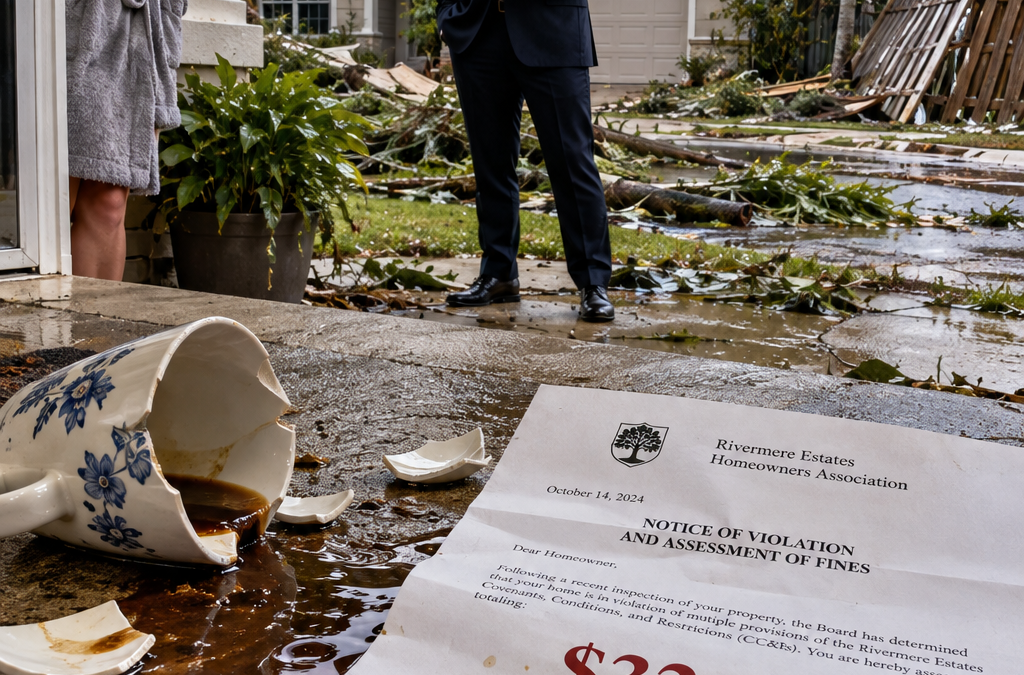
And a number that made my coffee cup slip straight out of my hand.
$32,000.
The mug hit the driveway and broke into three pieces beside my slipper.
Coffee spread across the concrete in a dark, ugly splash.
For a moment, I didn’t bend down to clean it.
I didn’t move at all.
I stood there in my bathrobe, hair still damp from a shower I had barely finished, staring at a bill that could cost me the home I had spent eleven years paying for.
My name is Emily Hartman, and until that morning, I still believed there were limits to what one vindictive HOA president could do.
I was wrong.
Three weeks earlier, hurricane-force winds had torn through Maplewood Estates just before dawn.
The storm came in fast and violent, the kind that turns familiar streets into something unrecognizable before the sun comes up.
I woke to the sound of something slamming against the side of my house.
At first, in that confused half-second between sleep and panic, I thought someone was trying to break in.
Then the lights flickered.
The whole house groaned.
Rain hit the windows sideways.
A crash came from the backyard, deep and wooden, followed by the shriek of branches scraping across the roof.
I ran downstairs barefoot, phone in hand, robe pulled tight around me.
Through the kitchen window I could see nothing but gray rain and leaves spinning through the air.
The old oak behind the Harrises’ house had split down the center, one massive limb hanging like a broken arm over their fence.
Across the street, someone’s patio umbrella was rolling end over end through the cul-de-sac like a cartoon prop in a nightmare.
My roof was leaking near the hallway vent.
Water was dripping into a mixing bowl I shoved underneath it with shaking hands.
By noon, the worst of the storm had passed, but Maplewood Estates looked like a war zone.
Fences down.
Shingles stripped.
Oak trees snapped in half.
Gutters hanging loose.
Branches everywhere.
A section of my backyard fence had bowed inward where a neighbor’s tree limb had slammed into it.
Half the shingles along the back slope of my roof were missing or lifted.
Debris covered the side yard.
Every house on my street had some kind of damage.
Every yard looked wrong.
It was not neglect.
It was a disaster.
The county declared an emergency three days later.
Contractors were backed up for weeks.
Insurance adjusters were overwhelmed.
Tree crews were charging desperate prices and still scheduling people twelve to eighteen days out.
So I did what any reasonable homeowner would do.
I tarped the roof.
I stacked debris neatly along the fence line.
I photographed every damaged area for insurance.
I called three contractors and got on waiting lists.
I kept receipts.
I helped my neighbor Linda drag broken branches away from her driveway.
Marcus two doors down helped me secure a loose section of siding before it tore off completely.
No one on Maplewood Court had a perfect yard after that storm.
Perfection was impossible.
Survival was the standard.
That was when Sandra Puit marched across my lawn like she owned it.
In her mind, she absolutely did.
It was six days after the storm.
I was standing near the side yard, tying down the edge of a blue roof tarp that kept lifting in the wind, when I heard her voice behind me.
“Emily.”
She said my name like a verdict.
I turned.
Sandra Puit stood near my driveway, not a hair out of place, wearing white capris, a pale yellow blouse, and gold sandals that had no business touching storm debris.
She was in her late fifties, small and neat and polished in the way certain suburban women become when they realize presentation can be used as a weapon.
Her silver-blond bob curved perfectly under her chin.
Her sunglasses sat high on her nose.
A clipboard rested against her hip.
I had seen that clipboard make grown adults apologize for bird feeders.
“Sandra,” I said, already tired.
Her eyes moved over my yard.
The stacked limbs.
The tarp.
The bent fence rail.
The contractor stakes I had placed near the damaged section to keep people from stepping into a loose board.
“This property is in violation of Section 4-C-7B and the newly updated Appendix D.”
I stared at her.
“Appendix D?”
“Yes.”
“I didn’t know we had one.”
Her smile was thin.
“You received notice through the homeowner portal.”
“I’ve been dealing with a damaged roof.”
“Storm damage does not suspend community standards.”
I looked around the street.
At Linda’s missing shutters.
At Marcus’s collapsed pergola.
At the Robinsons’ tree still lying partly across their driveway.
“Sandra, the county declared an emergency.”
“That does not give residents permission to let their properties deteriorate.”
My hands tightened around the tarp rope.
“My property didn’t deteriorate. A storm damaged it.”
“The board expects homeowners to take prompt corrective action.”
“I have. I tarped the roof. I called contractors. Everyone is booked.”
She made a note.
“That will be included in the file.”
“The file?”
She lowered the clipboard slightly.
“Emily, I advise you to take this seriously.”
I should have known then.
Not that she was annoying.
I already knew that.
Not that she enjoyed power.
Everyone in Maplewood knew that.
I should have known she had already decided where this was going.
Maplewood Estates used to be a decent suburb.
Good schools.
Block parties.
Friendly neighbors.
People borrowed tools and returned them.
Kids sold lemonade near the pool in summer.
Nobody measured grass with the emotional intensity of a federal inspector.
Then Sandra got elected HOA president four years earlier, and everything shifted.
At first, it was small.
A fine for a wind chime.
The Robinsons cited for a non-approved mailbox.
Marcus fined for his son’s portable basketball hoop.
A warning to the Thompsons because their Christmas lights stayed up five days past the deadline after Mrs. Thompson had surgery.
Most people paid.
Twenty-five dollars here.
Two hundred fifty there.
A little fee to avoid a fight.
I had done it too.
I told myself it was easier.
Community standards.
Part of living in an HOA.
The price of keeping the neighborhood nice.
But standing in my driveway with Sandra’s $32,000 letter in my hand, I finally understood what those little fines had really been.
Conditioning.
She had been training us to comply.
A small fine teaches you that fighting costs more energy than paying.
Another fine teaches you that the rules are whatever Sandra says they are.
A third fine teaches you not to ask questions unless you want a fourth.
Then one morning, a certified letter arrives with a number that can threaten your house, and the ground is already prepared under you.
Buried in the letter was something worse than the amount.
A lien notice.
If I missed the deadline, Sandra’s HOA could initiate foreclosure proceedings on my home.
My hands shook.
Then my mind went cold and sharp.
I bent down, picked up the three pieces of broken mug, and set them on the porch rail.
Then I went inside, grabbed my phone, and started documenting.
Every page of the letter.
Every stamp.
Every attachment.
Every line of Sandra’s so-called updated Appendix D.
Then I walked the entire property.
I photographed the tarped roof from six angles.
The debris pile.
The damaged fence.
The contractor estimate taped inside my kitchen cabinet.
The email confirmations from roofers saying they were scheduling three to six weeks out.
The county emergency notice.
The insurance claim.
I turned on timestamping.
I saved GPS data.
I uploaded everything to a cloud folder before I even finished my coffee.
If Sandra wanted a file, I would build one better than hers.
Then I called Marcus.
He lived two doors down, in a gray house with black shutters and a garage full of tools he always claimed were “organized by memory.”
Last spring, Sandra had fined him $4,000 over his son’s basketball hoop.
A portable hoop.
On wheels.
In his own driveway.
She claimed it violated the visual harmony standards and obstructed emergency visibility.
The fine had started at $300, then grew through late fees, administrative charges, and repeat penalties until Marcus paid just to end the stress.
He answered on the second ring.
“Emily?”
“Sandra sent me a lien notice.”
Silence.
“How much?”
“Thirty-two thousand.”
He cursed under his breath.
“Over the storm debris?”
“And the roof tarp. And the fence. And newly updated Appendix D, apparently.”
Another silence.
Then he said, “She picks people she thinks won’t fight back.”
I looked at the broken coffee mug on the porch rail.
“She picked wrong.”
That night, I spread every HOA document I owned across my kitchen table.
Bylaws.
CC&Rs.
Fine schedules.
Meeting minutes.
Portal printouts.
Email notices.
Old newsletters.
Four years of board announcements.
I made fresh coffee.
Then I started reading.
The house was quiet except for paper sliding against paper and the hum of the refrigerator.
Outside, my blue roof tarp snapped occasionally in the wind like someone cracking a whip.
I read until my eyes burned.
Most of the bylaws were dense, repetitive, and written in that strange language where ordinary things become architectural conditions and neighborhood preferences become enforceable provisions.
But I had worked in medical billing for nineteen years.
Dense paperwork did not scare me.
If anything, it gave me somewhere to put my anger.
At 2:00 a.m., I found it.
Section 4-C had a footnote.
Small print.
Easy to miss.
Exceptions apply during declared county emergencies, including but not limited to natural disaster recovery, storm debris removal, structural repair delays, roof tarping, and temporary exterior mitigation measures.
I read it twice.
Then a third time.
The county had declared an emergency three days before Sandra mailed my letter.
Three days.
She had to have known.
The announcement had run on the county website, local news, the emergency alert system, and the HOA Facebook group.
I opened the group on my laptop and scrolled.
There it was.
Sandra Puit herself.
A post made forty-eight hours before she fined me.
Stay safe, Maplewood families. Please document all storm damage and follow county guidance during this emergency recovery period.
I stared at the screen.
Then I laughed once.
Not because anything was funny.
Because the alternative was screaming.
Sandra had publicly acknowledged the emergency.
Then she mailed me a $32,000 violation package as though the exception did not exist.
I did not sleep.
I made a list.
Not of complaints.
Evidence.
County emergency declaration.
Sandra’s Facebook post.
Section 4-C emergency exception.
Contractor backlog emails.
Insurance claim.
Photographs.
Certified letter.
Appendix D.
Fine schedule.
Lien language.
I wasn’t going to argue with Sandra Puit.
I was going to bury her in her own paperwork.
The next morning, I called David Chin.
David was a real estate attorney my coworker had used during a boundary dispute the year before.
He had a reputation for being calm, precise, and allergic to bullies.
His office was on the second floor of a brick building downtown, above a title company and across from a coffee shop that smelled like burnt espresso.
I arrived with two binders, a thumb drive, and the certified letter sealed in a plastic sleeve.
David reviewed the letter in twenty minutes.
He read silently, expression unreadable, occasionally underlining something with a mechanical pencil.
Then he leaned back.
“This isn’t aggressive enforcement.”
I waited.
He looked at me.
“This is fraud.”
The word landed hard.
I had expected him to say excessive.
Improper.
Challengeable.
Not fraud.
He turned the pages around and pointed.
“The fine schedule she used here is not the version your members voted on.”
I leaned forward.
“What?”
He opened the HOA portal on his laptop and compared the online schedule with the printed version from my closing packet and the minutes from the last annual meeting.
The numbers were different.
Not slightly.
Substantially.
The old schedule capped emergency-related exterior condition fines and allowed extended cure periods during declared emergencies.
Sandra’s online version removed those protections and added daily compounding penalties for “uncorrected visual deterioration.”
“That harsher version appeared online after the last annual meeting,” David said.
“How do you know?”
He clicked into the downloaded file properties.
“The metadata shows it was re-uploaded eleven months ago.”
My mouth went dry.
“By who?”
He turned the screen toward me.
Sandra’s personal HOA login.
There it was.
Uploaded by: spuit_admin
Eleven months ago.
Long before the storm.
Long before my tarp.
Long before the debris pile.
David tapped the screen.
“She rewrote the enforcement schedule and assumed nobody would check the timestamps.”
A chill ran through me.
This was not a bad judgment call after a storm.
This had been waiting before any storm existed.
“Why me?” I asked.
David looked at the file.
“That’s what we need to find out.”
He filed an emergency motion to lift the lien threat and prevent any foreclosure action while the court reviewed the validity of the fines.
He also sent a formal preservation demand to the HOA requiring them not to alter or delete records, portal files, board communications, fine schedules, or meeting minutes.
Sandra responded that same week.
Not through apology.
Not through correction.
A second notice appeared in my HOA account.
Five hundred dollars for non-compliant exterior paint fading.
My house had been painted two years earlier.
Not only that, Sandra herself had signed the color approval form.
I had the contractor receipt.
The paint code.
The approval email.
The county permit photos.
I uploaded copies to David that same afternoon.
His reply came ten minutes later.
Good. Keep letting her create evidence.
Later that day, Marcus knocked on my door holding a manila folder.
He looked tired.
Angry.
Determined.
“I should have brought this sooner,” he said.
“What is it?”
“My HOA file.”
He set it on my kitchen table.
Inside were four years of his own notices.
Basketball hoop.
Driveway oil stain.
Mailbox trim.
Unauthorized landscape border.
Pool access suspension.
Late fees.
Appeal denials.
The pattern almost made me laugh, if I hadn’t been so angry.
Every time Marcus asked for documentation, Sandra issued another fine.
Every time he challenged a rule, she added fees.
Every notice carried the same formal tone.
The same careful wording.
The same signature.
Then he showed me a community forum screenshot from the previous election.
Marcus had publicly supported Sandra’s opponent.
Two weeks later, the basketball hoop citation arrived.
I called David and told him.
He asked if Marcus would speak with him.
Marcus agreed immediately.
That conversation changed the case.
David requested a broader review of Sandra’s enforcement history.
Fine records.
Appeal outcomes.
Homeowner demographics.
Election posts.
Meeting comments.
Public disputes.
By the time the first spreadsheet came together, the pattern was impossible to ignore.
Every major fine Sandra had issued in four years hit one of eight households.
Eight.
All either single women, immigrants, or people who had publicly voted against her in the last HOA election.
Selective enforcement.
Targeted retaliation.
Possibly discrimination.
David stared at the spreadsheet in his office and his expression changed in a way I can only describe as professional delight.
“She just handed us a federal fair housing claim,” he said.
We reached out to the other seven households.
Six still had their documents.
Two had lawyers who had suspected Sandra for years but lacked the full pattern alone.
Within a week, we had eight homeowners, three attorneys, and one shared Google Drive that grew to more than eight hundred pages.
We called ourselves, completely seriously, the Maplewood Eight.
There was me.
Emily Hartman, single woman, storm damage lien.
Marcus Bell, Black father, basketball hoop retaliation after an election post.
Priya and Naveen Patel, fined repeatedly after questioning pool invoices.
Linda Alvarez, widow, cited for “unapproved exterior clutter” when her grandchildren’s bikes were on the porch during a visit.
The Robinsons, immigrants from Trinidad, fined over a mailbox Sandra claimed violated an appendix no one could find.
Janet Moore, single retired nurse, hit with landscaping penalties after refusing to vote for Sandra’s dues increase.
And the Chens, who had been warned repeatedly after speaking against Sandra’s rule changes.
Different houses.
Different fines.
Same signature.
Same fear.
David sent a formal demand for a full financial audit.
Sandra called an emergency board meeting two days later.
She tried to table the audit.
The board had five members.
Three voted yes to proceed with an independent audit.
Sandra voted no.
One member abstained.
Somehow, Sandra announced that her single no vote overruled the three yes votes under “executive procedural authority.”
David pulled the bylaws.
No such power existed.
The meeting also violated quorum requirements because one board member had not received proper notice.
Every action taken that evening was procedurally void.
When David explained it, I almost laughed again.
Sandra had become so used to people accepting her interpretation of the rules that she had started inventing rules in real time.
And then Twist Two walked through my front door wearing a county auditor’s badge.
Her name was Renee Caldwell.
She was in her early forties, direct, composed, and carrying a slim black folder that immediately made my kitchen feel like an interview room.
Marcus had filed a complaint with the county housing authority six months earlier and never told me.
He said later he didn’t want to raise my hopes.
The investigation had been running quietly the whole time.
Renee sat at my kitchen table, accepted coffee, and said, “We have reason to believe your HOA’s financial irregularities extend beyond enforcement abuse.”
I looked at Marcus.
He looked at the floor.
Renee opened her folder.
“We’ve identified approximately $140,000 in HOA reserve funds collected over three years with insufficient documentation showing where the money went.”
I stopped breathing for a second.
“One hundred forty thousand?”
“Yes.”
“No receipts?”
“Not adequate ones. No complete landscaping bids. No supporting invoices for certain pool-related projects. No clear board approval trail for several payments.”
She slid a page toward me.
“Several payments went to an LLC called Puit Property Solutions.”
Puit.
Sandra’s last name.
I opened my laptop and searched the state business registry.
It took less than four minutes.
Registered agent: Sandra L. Puit.
Business address: her home.
I turned the laptop toward Renee.
She nodded once, as if she had expected exactly that.
Sandra had been billing the HOA for work performed by her own company.
No competitive bid.
No board approval.
No conflict-of-interest disclosure.
No honest explanation to residents who were paying rising dues and storm recovery charges.
That was not mismanagement.
That was embezzlement.
David filed in federal court.
Fair housing violations.
Fraudulent lien.
Procedural misconduct.
Financial fraud.
Eight plaintiffs.
One central defendant.
Sandra L. Puit.
The complaint was long, careful, and devastating.
It laid out the storm.
The emergency exception.
The altered fine schedule.
The re-upload metadata.
The selective enforcement pattern.
The financial irregularities.
The LLC.
The void board meeting.
The $140,000.
Sandra’s attorney sent a letter calling our claims baseless, retaliatory, and defamatory.
That was Thursday.
By Friday, he had withdrawn from the case.
Even her own lawyer bailed.
Local news picked up the story two days later.
A reporter named Jess called me at 7:00 a.m.
I gave her fifteen minutes and a link to the public evidence folder David had approved for release.
By that evening, the headline was everywhere locally.
Maplewood HOA President Faces Federal Suit, Fraud Investigation.
The comment section was a masterpiece of American suburban rage.
People came out of nowhere.
One neighbor had been fined for unapproved sunflowers.
Another for a child’s chalk drawing.
Someone else for a birdbath that was allegedly “too reflective.”
I wanted that on a T-shirt.
Too Reflective.
But under the absurdity was real harm.
People were angry because they recognized the pattern.
The remaining board members, afraid of Sandra for years, suspended her from the presidency and called an emergency membership meeting she had not authorized.
Sandra showed up anyway.
Of course she did.
The clubhouse was packed beyond capacity.
People stood along the walls, in the hallway, even outside the open doors.
I sat near the front with David on one side and Marcus on the other.
Renee, the county auditor, stood at the back with two other officials.
Sandra walked in wearing a navy suit and pearls.
Her expression was calm.
Too calm.
She stepped to the podium before the temporary board chair could begin.
“I have done nothing,” she said, “but protect the standards of this community.”
The room went still.
Then she pointed directly at me.
“Some people cannot accept excellence.”
For one stunned second, nobody moved.
Then Marcus started slowly clapping.
Once.
Twice.
Three times.
One person joined.
Then ten.
Then half the room.
Not for Sandra.
For the sheer nerve of what she had just said out loud while under investigation for financial fraud.
The applause grew louder until Sandra’s face flushed and the temporary chair had to bang the gavel.
That meeting ended Sandra’s grip on Maplewood.
Not legally.
That came later.
But emotionally, it ended there.
People stopped fearing her.
And once that happened, her power collapsed faster than anyone expected.
The federal judge granted summary judgment on the lien issue.
My lien was declared invalid and removed from my property within seventy-two hours.
The $32,000 fine was erased.
All eight targeted fines were voided.
The emergency exception was recognized.
The altered fine schedule was declared unenforceable against us.
When David called with the news, I was standing in my yard near the debris pile that had started everything.
Most of it was gone by then.
The roof repairs were scheduled.
The fence was still damaged, but stable.
I had spent weeks looking at that yard as though it were evidence against me.
Now it was just a yard again.
“Emily,” David said, “it’s over as to the lien.”
I closed my eyes.
“She can’t take my house?”
“No. Not through that notice. Not through that fine.”
The relief hit so hard I had to sit on the grass.
For the first time since the certified letter arrived, I cried.
Not because I was weak.
Because I had been strong too long.
The county fraud investigation concluded four months later.
Sandra was charged with three counts of financial fraud, breach of fiduciary duty, and fair housing violations tied to the selective enforcement findings.
She eventually pleaded no contest.
The court ordered her to personally repay $140,000 to the HOA reserve fund.
She was permanently barred from serving on any HOA board in the state.
The civil settlement paid each of us up to $47,000, depending on documented damages, legal expenses, and refunded penalties.
No amount of money could give back the sleep we lost.
The stress.
The fear of opening mail.
The humiliation of being treated like bad homeowners when all we had done was ask questions.
But the settlement mattered.
Accountability mattered.
The written record mattered.
Sandra had tried to use paperwork to threaten us.
Paperwork became the thing that ended her.
The Maplewood Eight held a block party after the judgment.
Not a formal one.
No HOA approval request.
No sanctioned committee.
Just neighbors bringing food into the cul-de-sac and daring anyone to object.
Someone brought folding tables.
Someone set up a speaker.
Marcus grilled burgers.
Linda Alvarez made a tray of empanadas.
Priya brought sunflowers and planted them in a row near the clubhouse sign.
The Robinsons brought rum cake so strong that David took one bite and said, “I am no longer giving legal advice tonight.”
Someone brought a piñata shaped like a certified mail envelope.
Red stamp and everything.
We all took turns.
When it was my turn, Marcus handed me the stick.
I looked at the envelope piñata swinging from a tree branch, absurd and perfect.
Then I thought about the real certified letter.
The broken coffee cup.
The $32,000.
The way my hands had shaken in the driveway.
I swung hard.
The piñata burst open on the second hit.
Candy flew across the grass.
Everyone cheered.
For the first time in months, Maplewood sounded like a neighborhood again.
My name is Emily Hartman.
I still live in the house Sandra tried to take.
The roof is fixed now.
The fence repaired.
The debris gone.
The yard green again.
I planted sunflowers near the side gate, partly because they’re beautiful and partly because I remain petty in very specific ways.
The HOA still exists.
But it is different now.
Meetings are recorded.
Financial records are posted quarterly.
Contracts require competitive bids.
Conflict-of-interest disclosures are mandatory.
Emergency exceptions are printed in bold in the new handbook.
No single board member can upload new fine schedules without a vote, a timestamp, and notice to all homeowners.
And if anyone tries, eight households know exactly where the records are kept.
Sometimes people ask whether I regret fighting.
I think about that Tuesday morning in my bathrobe.
The red stamp.
The number.
The broken coffee mug on the driveway.
Then I look at my house.
At the porch I repainted myself.
At the roof I fought to repair.
At the neighbors who stopped whispering and started showing up.
No.
I do not regret it.
Sandra Puit thought a disaster made us vulnerable.
She thought a storm had given her cover.
She thought I would see $32,000 and panic quietly.
Instead, the storm exposed every rotten thing she had been hiding.
And when the wind finally passed, it wasn’t my house that collapsed.
It was hers.








