𝗙𝗨𝗟𝗟 𝗦𝗧𝗢𝗥𝗬 My Retired K9 Stopped Eating, but Every Night He Fought to Reach My Bedroom Door
𝗙𝗨𝗟𝗟 𝗦𝗧𝗢𝗥𝗬
My voice came out sharper than I intended.
Rook froze.
His ears lowered.
He walked away and lay beside the hallway.
The ball remained on the floor between us.
I watched it for a long time.
Then I turned my chair toward the bedroom.
I didn’t apologize.
That was the kind of man I had become.
Not cruel exactly.
Just so consumed by what I had lost that I couldn’t see what was still standing beside me.
At night, the warehouse returned.
Sometimes I dreamed about the falling steel.
Sometimes I heard Eli calling for help.
But the worst dreams always ended the same way.
I was lying beneath the beam, unable to move, and Rook was barking somewhere I couldn’t reach.
I would wake gasping, my shirt soaked with sweat, my hands gripping the sheets.
And every time, Rook came.
At first, I barely noticed.
I’d hear his nails clicking across the hallway, followed by the soft thump of his body settling against my bed.
He would push his nose beneath my hanging hand.
Sometimes he licked my fingers.
Other times he simply stayed there until my breathing slowed.
It became our routine.
I had a nightmare.
Rook came.
I put my hand against his head.
Eventually, I fell asleep again.
I didn’t question how he knew.
For years, he had recognized changes in my voice, posture, breathing, and heart rate before I understood them myself.
I assumed he was doing what he had always done.
Looking after his partner.
What I failed to notice was how much it was beginning to cost him.
Three weeks after I came home, Claire found me sitting in the kitchen at eleven in the morning, still wearing the clothes I had slept in.
The curtains were closed.
There were unwashed dishes in the sink, mail scattered across the counter, and a collection of physical therapy exercises on my refrigerator that I had stopped doing.
Rook was lying beneath the kitchen table.
Claire looked around without saying anything.
Then she started opening the curtains.
“Don’t,” I said.
She opened another.
“Claire.”
“Your house smells like a cave.”
“I like caves.”
“Apparently.”
She turned toward me.
My sister was four years younger than me, a high school science teacher, and one of the few people on earth who had never been impressed by my badge.
She folded her arms.
“When was the last time you went outside?”
“I went to the mailbox yesterday.”
“The mailbox is six feet from your ramp.”
“Seven, actually.”
She didn’t smile.
“Daniel, this isn’t working.”
I looked down at my hands.
“What do you want me to do? Go for a run?”
The words landed between us like broken glass.
Claire’s expression changed.
I regretted them immediately, but pride kept my mouth shut.
“I want you to live,” she said quietly.
“I’m alive.”
“That’s not the same thing.”
I turned toward the window.
She stood there another moment, then walked to the refrigerator.
“Has Rook eaten?”
“Not yet.”
She looked at his bowl.
“Daniel, it’s almost noon.”
“He’s been picky lately.”
“Rook? Picky?”
“Dogs get old.”
Claire crouched beside him.
“Hey, sweetheart.”
Rook lifted his head, allowing her to scratch behind his ears.
She smiled faintly.
Then her hand moved along his side.
Her smile disappeared.
“Daniel, he’s thin.”
“He’s eleven.”
“I know how old he is.”
“He’s slowing down. That’s what happens.”
She looked over her shoulder.
“Have you taken him to the vet?”
I didn’t answer.
“Daniel.”
“I’ve been a little busy learning how to use my own bathroom.”
Her eyes flashed.
“Don’t do that.”
“Do what?”
“Use what happened to you as a reason nobody is allowed to ask questions.”
I gripped the wheels of my chair.
“You have no idea what my days are like.”
“No,” she said. “I don’t. But I can see what you’re doing to yourself.”
She stood, pulling her phone from her pocket.
“And I’m worried you’re doing it to him, too.”
I should have listened.
Instead, I told her to leave.
She went home with tears in her eyes.
I watched her car disappear down the street, furious at her for making me feel guilty.
Then I looked at Rook.
He was still lying beneath the table.
His breathing was steady. His eyes were open.
“Don’t look at me like that,” I muttered.
His tail moved once.
I reached down as far as I could and touched his ear.
“She’s making a big deal out of nothing.”
I wanted him to agree.
That night, the nightmare was worse than usual.
In the dream, I was standing inside the warehouse while rain poured through the damaged roof.
Eli was screaming behind the maintenance door.
I tried to run toward him, but my legs wouldn’t move.
Then the floor began to tilt.
I heard metal breaking overhead.
Somewhere behind me, Rook started barking.
I turned.
He was trapped beneath a fallen beam.
His eyes were fixed on mine.
I tried to reach him.
But every time I moved, the distance grew.
I woke with a strangled shout.
My clock read 2:17 a.m.
For a few seconds, I didn’t know where I was.
My heart hammered against my ribs. I could smell wet concrete, though there was nothing in the bedroom except stale air and the faint scent of laundry detergent.
Then I heard something in the hallway.
Scrape.
Silence.
Scrape.
I held my breath.
“Rook?”
Another scraping sound.
Then a low whine.
I reached for the lamp.
Light spilled across the floor.
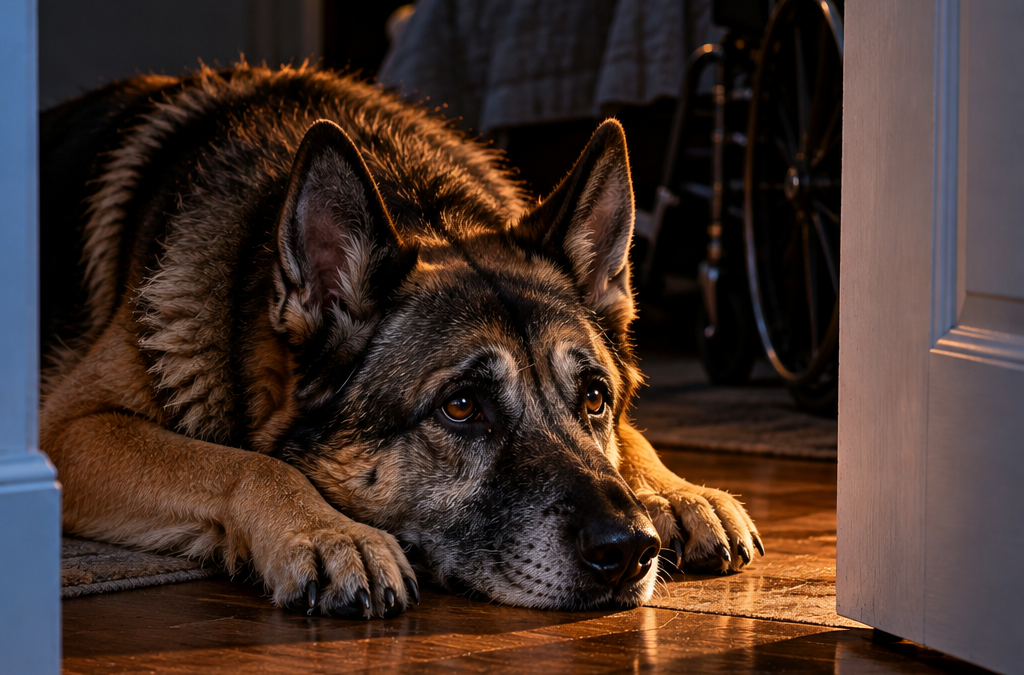
Rook was standing in the doorway, but something about his posture was wrong.
His hindquarters were low. His back was hunched. One rear paw rested at an awkward angle, and his front legs trembled beneath his weight.
He looked as though he had climbed a mountain just to reach me.
“Hey, buddy.”
He took a step.
His back leg slipped.
He caught himself against the doorframe.
I sat upright.
“Rook?”
He approached my bed slowly.
When he reached it, he pressed his nose against my hand.
Then he sank to the floor.
Not the comfortable, heavy collapse of a tired dog.
He went down carefully, as if lowering his body hurt.
I stared at him.
“What’s going on with you?”
He looked up and wagged his tail.
I reached over the side of the bed, running my fingers along his shoulder and back.
His muscles tightened when I touched his lower spine.
He turned his head.
Just slightly.
But I knew that movement.
I had seen it hundreds of times in injured working dogs.
A warning.
Not aggression.
Pain.
My stomach went cold.
I touched the same area again, more gently.
He flinched.
“Oh, God.”
Rook lowered his head onto my foot.
And suddenly I remembered every small thing I had ignored.
The way he hesitated before standing.
The food left untouched.
The fact that he no longer followed me into every room.
The nights when he remained in the hallway instead of coming all the way to my bed.
His weight loss.
The strained breathing after crossing the kitchen.
For weeks, I had been watching my dog suffer and explaining it away because admitting he was sick meant admitting there was something else in my life I couldn’t control.
“I’m sorry,” I whispered.
He licked my fingers.
I bent forward, trying to examine him more closely, but my balance shifted.
My hand slipped from the mattress.
For one terrifying second, I thought I would fall.
I caught myself against the bedframe.
Rook tried to rise.
He gave a small cry.
That sound went through me harder than any scream I had heard at the warehouse.
“Stay down,” I said immediately. “Buddy, please. Stay down.”
He lowered himself again.
I sat trembling in the dark.
My phone was on the nightstand.
I picked it up and called Rosa.
She answered on the fourth ring.
“Daniel?”
“Something’s wrong with Rook.”
Her voice sharpened.
“What happened?”
“He’s not walking right.”
A pause.
“How long?”
I stared at him.
“I don’t know.”
“Is he breathing normally?”
“I think so.”
“Did he fall?”
“He almost did. Rosa, he’s been losing weight. He’s not eating, and he keeps coming into my bedroom, but I think it hurts him to walk.”
The silence on the other end was worse than anger.
Then she said, “I’m coming over.”
“You don’t have to—”
“Daniel. I’m coming.”
She arrived twenty-five minutes later wearing sweatpants and an old sheriff’s department sweatshirt.
Rook lifted his head when she entered.
Normally, he would have struggled to greet her.
This time he remained still.
Rosa knelt beside him.
She examined his gums, watched his breathing, and gently felt along his hips.
When she touched the left side of his pelvis, his body stiffened.
Her eyes met mine.
“We’re getting him checked.”
“Right now?”
“There’s an emergency veterinary clinic in Westfield.”
I looked at the clock.
“It’s almost three.”
“I know what time it is.”
“Maybe we should wait until morning.”
She stood.
“Why?”
I didn’t have an answer.
Rosa walked over to my wheelchair and positioned it beside the bed.
“You’ve spent months telling everybody not to help you,” she said. “I’m not having that argument tonight.”
I looked at Rook.
His eyes were still on me.
“You think it’s serious?”
“I think he’s in pain. That’s serious enough.”
She helped him onto a thick blanket, then carried him to her SUV with my assistance guiding his front end.
Rook weighed nearly eighty pounds.
Watching Rosa struggle under his weight made me hate the way my body failed to help.
I wanted to lift him myself.
I wanted to carry him the way I had carried him into the veterinary office after his first training injury, years earlier.
Instead, I followed in my wheelchair while Rosa did the lifting.
When we reached the vehicle, Rook raised his head and looked back at me.
For one terrible moment, I thought he was afraid we were taking him away again.
“I’m coming,” I promised.
I rolled closer.
“I’m not leaving you this time.”
At the emergency clinic, a veterinarian examined Rook and ordered bloodwork and radiographs.
I sat beside the examination table, holding his head while the technician prepared to take him for imaging.
His fur felt different.
Not softer, exactly.
Just less full beneath my fingers.
I could feel bones I had never noticed before.
A little after five in the morning, the veterinarian returned.
Her name was Dr. Miriam Kline.
She was in her late fifties, with tired eyes and a calm way of speaking that made me think she had delivered difficult news many times.
She pulled a chair in front of me.
“Mr. Mercer, I want to show you what we found.”
She turned a monitor toward us.
An X-ray of Rook’s pelvis filled the screen.
I recognized the outlines of bone immediately. Years working around police dogs had taught me enough to know what a healthy joint should look like.
One area near his left hip looked badly distorted.
Dr. Kline pointed to it.
“Rook has significant degenerative changes in his lower back and hips. But this area concerns me more.”
“What is it?”
“There’s an aggressive-looking lesion in the pelvic bone. We’re very concerned about bone cancer.”
I stared at the screen.
“Cancer?”
“Yes.”
“Are you sure?”
“The imaging is highly suspicious. We’d need additional testing to identify exactly what kind of tumor this is. But given his condition, the pain, and the extent of the bone damage, we’re worried that this is advanced.”
I looked toward Rook.
He was lying on a blanket beside the examination table.
His eyes were half closed.
“Can you operate?”
“We need to talk about what surgery would involve and whether it could help him. A tumor in this location can be very difficult to remove. With his overall health and mobility, I’m concerned the burden of aggressive treatment could outweigh the benefit.”
“What about chemotherapy?”
“That may be an option for some cancers. But we don’t yet have a confirmed diagnosis, and even with treatment, I can’t promise meaningful recovery.”
I rubbed my hands together.
There had to be something else.
Another specialist.
Another hospital.
A treatment somebody hadn’t mentioned.
I had spent my career believing that every crisis could be approached through action.
Find the problem.
Contain the danger.
Get help.
Do something.
“Tell me where to take him,” I said. “Money isn’t the issue.”
Dr. Kline leaned forward.
“I understand. And we can discuss referrals. But first, I need you to understand how much discomfort Rook is experiencing right now.”
I looked at her.
“He’s in that much pain?”
“Yes.”
“But he doesn’t cry.”
“Many dogs don’t. Especially working dogs that have spent their lives pushing through physical discomfort.”
I swallowed.
“He still comes to my room every night.”
She waited.
“I have nightmares. Bad ones. Every time I wake up, he’s there. Even when he can barely walk.”
Dr. Kline looked down at Rook.
Then she said something that changed the way I understood everything.
“Sometimes animals keep doing what matters to them long after doing it becomes painful.”
I stared at the floor.
For weeks, I had assumed Rook was simply performing a familiar routine.
Now I pictured him lying in the hallway, listening to me cry out in my sleep.
His hips aching.
His muscles weakening.
His body begging him to stay still.
And then the sound of my voice reaching him through the darkness.
So he got up.
Again.
And again.
He dragged himself across the hardwood because somewhere in that aging, hurting body lived the same promise he had made every time we stepped out of a patrol vehicle.
Stay with your partner.
I covered my face.
“I didn’t know.”
Dr. Kline said nothing.
“I should’ve known. I worked with dogs for years. I should’ve seen it.”
Rosa rested a hand on my shoulder.
I shook my head.
“No. Don’t tell me it’s okay.”
“Daniel—”
“He was right in front of me.”
My voice broke.
“He was right in front of me, and I didn’t see him.”
I turned toward Rook.
His eyes opened at the sound of my voice.
Even then, lying on that blanket, he tried to lift his head.
Dr. Kline moved closer.
“Mr. Mercer, what matters now is deciding how to make him comfortable. We can start medication and develop a palliative care plan. We can also consult oncology if you want more information.”
“How much time does he have?”
She hesitated.
“I can’t give you an exact number. It may be weeks. Depending on how the disease progresses, it could be less.”
I looked at Rook.
Eleven years.
Thousands of mornings.
Countless patrols.
Every holiday, every ordinary afternoon, every lonely evening after a shift.
And now someone was telling me I might have only weeks.
“Please,” I whispered. “There has to be more.”
Dr. Kline’s expression softened.
“I wish I could give you better news.”
Rook lifted his head.
I reached down and touched his cheek.
He pressed into my palm.
That familiar movement nearly destroyed me.
I had spent the last several months mourning the life I thought I was supposed to have.
Meanwhile, Rook had been living with a body that was failing him, too.
And somehow, he had never stopped choosing me.
I lowered my forehead against his.
“I’m here,” I whispered. “I’ve got you.”
For the first time since the warehouse, I meant those words without wishing I could be somewhere else.
We brought Rook home with pain medication, instructions for monitoring his comfort, and a follow-up appointment.
Dr. Kline had explained that the goal was not to make him endure as much time as possible.
It was to protect the quality of whatever time remained.
She gave me a simple way to evaluate his days.
Could he rest comfortably?
Did he show interest in food or familiar activities?
Could he move without overwhelming distress?
Was he still able to enjoy the things that made him Rook?
And were the good days outnumbering the bad?
I listened carefully.
Then I wrote every question down.
Back home, Rosa helped arrange thick rugs through the hallway so Rook wouldn’t slip on the hardwood. She moved his water bowl closer to his bed and showed me how to support his hips with a wide lifting harness.
I ordered a raised feeding station that I could reach from my chair.
Claire came over with soft blankets and a washable orthopedic dog bed.
Nobody mentioned our argument.
She walked into the kitchen, saw me sitting beside Rook, and placed a bag of groceries on the counter.
“How is he?” she asked.
I shook my head.
Her eyes filled.
“Oh, Danny.”
I hadn’t heard her call me that in years.
She knelt beside my wheelchair and wrapped her arms around me.
For a moment, I held myself rigid.
Then I broke.
“I missed it,” I whispered against her shoulder.
“You were struggling.”
“He needed me.”
“I know.”
“I should’ve taken him sooner.”
She held me tighter.
I didn’t need her to tell me I was innocent.
I needed her to stay while I faced what I had failed to notice.
She did.
Over the next few days, my house changed.
Not physically, at first.
The same furniture stood in the same rooms. The same wheelchair ramp led to the same driveway.
But I stopped measuring my life entirely by what I couldn’t do.
I had to learn how to care for Rook from a chair.
I learned to maneuver close enough to help him eat.
I learned to fit the support harness beneath his hips without pulling against the painful area.
I learned how to recognize the small changes in his breathing that meant he needed to rest.
I set alarms for his medication and appointments.
I kept a notebook on the kitchen counter.
Every morning, I recorded whether he had eaten, how comfortably he had slept, and whether he seemed interested in the world around him.
Rosa teased me about the notebook.
“You’re writing incident reports for a retired dog.”
I looked at her.
“He was the best deputy this county ever had. He deserves accurate paperwork.”
She smiled.
Then she looked away quickly.
Rook had some better days after his pain medication was adjusted.
One morning, he ate almost an entire serving of food while I watched from beside him.
I celebrated like a fool.
“That’s my boy!”
His tail thumped against the rug.
I held out a small piece of cooked chicken.
He took it.
For the first time in weeks, his eyes had a little brightness in them.
I wanted to believe that meant he was getting better.
Dr. Kline gently reminded me that comfort wasn’t the same as recovery.
I understood.
But I still let myself enjoy the moment.
One afternoon, I wheeled him out onto the back patio.
I had avoided the backyard since coming home.
Before the accident, it had been our place.
There was a narrow strip of grass behind the house, a maple tree near the fence, and a wooden bench I had built years earlier.
Rook used to race across the yard chasing tennis balls, stopping just before the fence and turning so sharply that dirt flew from his paws.
I had spent more summer evenings there than I could count.
Now the grass was overgrown, and leaves had collected along the edge of the patio.
I felt a familiar ache as I looked around.
Rook stood beside me with his hips supported by the harness.
He sniffed the air.
A breeze moved through the maple leaves.
For several seconds, he seemed to forget his discomfort.
His ears lifted.
He took two careful steps toward a patch of sunlight.
I followed.
He lowered himself into the grass and rested his head on his front paws.
I sat beside him.
We stayed there for almost an hour.
No television.
No phone.
No hospital memories.
Just wind moving through the leaves and the distant sound of traffic.
At one point, Rook lifted his head and looked at me.
“What?” I asked.
His tail moved.
I smiled.
“You’re right. It is a pretty good day.”
He laid his head down again.
I thought about how many good days I had refused to recognize because they didn’t look like the life I had expected.
Rook wasn’t measuring the afternoon against all the afternoons he could no longer have.
He was lying in the grass.
Feeling the sun.
Listening to birds.
And he was content.
I wished I knew how to do that.
A week after his diagnosis, Rosa called with an idea.
“There’s a veterinary rehabilitation specialist who works with mobility carts,” she said.
I looked at Rook sleeping beside the couch.
“Wheelchairs for dogs?”
“Support carts. They can take pressure off the hindquarters.”
“His pelvis is injured. Wouldn’t that hurt?”
“Maybe. That’s why we need the specialist to assess him.”
I was skeptical.
I had seen dogs use rear-wheel carts before, but I couldn’t imagine Rook accepting one.
He had always been fiercely independent.
He didn’t even like wearing his protective boots during winter searches.
And the thought of putting him in a wheelchair struck something raw inside me.
I knew how it felt when people looked at the chair before they looked at the person sitting in it.
I didn’t want that for him.
But Rosa was patient.
“Daniel, it’s not about making him walk farther. It’s about whether he can enjoy moving without hurting himself.”
I looked down at my own wheels.
For months, I had regarded them as proof of everything I had lost.
Without them, I couldn’t reach my kitchen.
I couldn’t go into the yard.
I couldn’t get out of bed and move through my own house.
I had hated the chair so much that I had refused to see what it gave back to me.
Maybe I was doing the same thing to Rook.
“Okay,” I said. “Let’s have him assessed.”
The specialist was careful.
She reviewed his medical records, checked where the support straps would rest, and watched how he moved.
She explained that the cart would only be appropriate if it supported his weight without pressing on the painful pelvic area.
It wasn’t a cure.
It wasn’t a way to force him to keep going.
It was simply something we could try on days when he wanted to move.
She fitted him with a lightweight frame and two rear wheels.
For several minutes, Rook stood perfectly still.
He looked back at the cart.
Then he looked at me.
His expression was one of deep personal offense.
Rosa burst out laughing.
“He thinks you’ve lost your mind.”
“Get used to it, partner,” I told him. “I’ve been hearing that a lot lately.”
The specialist encouraged him forward with a small treat.
He took one step.
The wheels rolled.
He stopped.
He turned his head again.
Then he took another step.
And another.
Suddenly, his ears rose.
He moved across the training room in a slow, determined line.
The cart followed him.
Rosa covered her mouth.
I watched him turn toward me.
For one beautiful second, I saw the dog who used to jump out of my patrol vehicle, eager for whatever waited ahead.
Not because he was fast.
Not because he was strong.
Because his eyes were alive with interest.
He reached my wheelchair and placed his head in my lap.
I scratched behind his ears.
“Look at us,” I whispered.
His tail wagged.
“Two guys with wheels.”
Rosa laughed through her tears.
I did, too.
It was the first time I had laughed at my own wheelchair without bitterness.
And I knew exactly whom I had to thank.
The cart gave Rook a few afternoons I never thought we would have again.
We didn’t go far.
Sometimes we only made it from the back door to the maple tree.
Other days, when he seemed comfortable and eager, we followed the sidewalk to the corner and back.
I learned to watch his body instead of my hopes.
If he hesitated, we stopped.
If his breathing changed, we went home.
If he wanted to lie in the grass, I sat beside him and let the rest of the world continue without us.
There had been a time when I measured a good day by how much I accomplished.
Now I measured it by whether Rook could eat breakfast without discomfort, whether he could sleep peacefully, and whether he still showed interest when a squirrel crossed our yard.
It was a smaller life than either of us had known.
But it was still a life.
One Saturday afternoon, Rosa asked whether I would bring Rook to the K9 training facility.
“Just for a little while,” she said. “Some of the guys want to see him.”
I immediately refused.
“I don’t want a retirement ceremony.”
“That’s not what this is.”
“No speeches. No photographs of everybody looking sad.”
“Daniel, nobody’s planning a funeral.”
I looked at Rook.
He was lying beside my wheelchair, chewing lazily on an old tennis ball.
“Then what are they planning?”
“Nothing. A few friends. Some fresh air. Maybe somebody will finally give that dog the chicken he deserves.”
I hesitated.
I hadn’t returned to the sheriff’s department since the accident.
The thought of rolling through those doors while everybody else stood over me made my stomach tighten.
“What if he gets tired?”
“We leave.”
“What if I get tired?”
Rosa was quiet for a moment.
“Then we leave for that reason, too.”
I agreed.
When we arrived, I almost asked her to turn around.
The building looked exactly as it had before.
The same concrete training yard. The same chain-link fence. The same rows of patrol vehicles parked beneath the awning.
I could practically hear my old boots hitting the pavement.
Then I looked down.
My wheelchair was strapped securely inside Rosa’s accessible van, and Rook was lying on a blanket behind us.
Neither of us had arrived the way we used to.
But we had arrived.
Rosa helped unload his mobility cart while I rolled down the lift.
Three deputies were waiting near the training area.
My old captain stood beside them.
For a second, nobody spoke.
Then Captain Harris looked at Rook and shook his head.
“Well, would you look at that.”
Rook’s ears rose.
“Rook,” Harris called. “You remember me, old man?”
Rook moved toward him, his rear wheels humming softly across the concrete.
Harris knelt and rubbed the thick fur along his neck.
“There’s my boy.”
His voice cracked on the last word.
I looked away.
Within minutes, Rook was surrounded by people who had known him when he was young and unstoppable.
They scratched his ears, offered approved treats, and laughed about the time he had stolen Harris’s sandwich directly from his desk.
One deputy produced a bag of tennis balls.
Rook’s head shot up.
“Oh, now you’ve done it,” I said.
The deputy rolled a ball gently across the concrete.
Rook followed it at a slow pace, caught it between his front paws, and picked it up.
Everyone cheered.
Rook stood a little taller.
He looked from one face to another, the ball hanging from his mouth.
For a moment, I could almost imagine him wondering why it had taken us so long to organize a party worthy of his reputation.
Then a woman approached with a young boy standing beside her.
I recognized her from photographs.
Ana Alvarez.
Eli’s mother.
My hands tightened around my wheelchair rims.
Rosa came closer.
“I hope you don’t mind,” she whispered. “She asked whether she could come.”
I stared at the boy.
He had grown since the night in the warehouse.
He wore a blue sweatshirt and held a folded sheet of paper in one hand.
Ana approached carefully.
“Deputy Mercer?”
I tried to smile.
“It’s Daniel now.”
Her eyes shone.
“We’ve wanted to see you for a long time.”
I looked down.
“I’m sorry I didn’t return your calls.”
“You don’t have to explain.”
“I think I do.”
She shook her head.
“Not today.”
Eli stepped forward.
“Is that Rook?”
I nodded.
“That’s him.”
He crouched beside my dog.
Rook sniffed his outstretched hand.
Then, with the unhurried dignity of a very old German shepherd, he placed the tennis ball against the boy’s knee.
Eli laughed.
“He remembers me.”
I smiled.
“Maybe he does.”
The boy looked at the wheels beneath Rook’s hips.
“What happened to him?”
I hesitated.
“He’s sick. The wheels help him move around when he feels up to it.”
Eli’s face changed.
“Is he going to get better?”
Children can ask questions adults spend entire conversations avoiding.
I looked at Rook.
“No, buddy. I don’t think he is.”
Eli’s eyes filled.
He stroked Rook’s head gently.
“He saved me.”
The training yard became very quiet.
“He helped find you,” I said.
Eli shook his head.
“He saved me.”
I swallowed.
“Okay.”
The boy looked up at me.
“And you did, too.”
I couldn’t speak.
For months, whenever I remembered the warehouse, I had seen only the falling steel.
My useless legs.
The hospital bed.
The wheelchair.
The end of everything I believed made me valuable.
But standing in front of me was a child who had gone home.
A child who had celebrated another birthday.
A child whose mother still got to kiss him goodnight.
Eli unfolded the paper.
“I made this for you.”
It was a drawing.
A police officer stood beside a German shepherd beneath a bright blue sky. The dog wore a silver badge. Above them, in uneven letters, the boy had written:
THANK YOU FOR COMING BACK FOR ME.
My vision blurred.
“I don’t know what to say.”
Eli shrugged.
“My mom says thank you is enough.”
I laughed weakly.
“Your mom sounds pretty smart.”
“She is.”
Ana knelt beside her son.
“There isn’t a day we don’t remember what you both did.”
I looked at her.
“For a long time, all I could think about was what happened afterward.”
“I know.”
“I didn’t know how to be anything else.”
She rested a hand on Eli’s shoulder.
“You don’t have to be the same man you were before that night for what you did to matter.”
I looked back at the drawing.
The officer in the picture was standing.
At first, that hurt.
Then I noticed the boy had drawn Rook with an enormous smile and a tennis ball almost as big as his head.
I laughed again.
And for once, the laughter didn’t disappear immediately.
We stayed for another twenty minutes.
Rook accepted a few more gentle scratches and settled beneath the shade of a tree.
The deputies gathered around him for a photograph.
He sat in his mobility cart with the tennis ball in his mouth, looking thoroughly pleased with himself.
Nobody called it a farewell.
Nobody needed to.
On the drive home, I held Eli’s drawing against my lap.
Rook slept behind me.
Rosa glanced at me in the mirror.
“You okay?”
I watched the trees passing outside.
“No,” I said.
Then, after a moment, I added, “But I think I might be someday.”
She nodded.
“That sounds like a start.”
It was.
And it came just in time.
Because Rook’s good days were becoming fewer.
At first, the changes were small.
He slept longer.
He lost interest in certain foods.
The cart that had made him so excited began to sit untouched beside the back door.
Some mornings, he seemed content to lie outside and watch the birds.
On others, even adjusting his position on the bed made him wince.
Dr. Kline changed his medication and examined him again.
She explained that the disease was progressing.
We discussed additional treatment, but after reviewing his condition and the likely burden of further procedures, I chose to focus on keeping him comfortable.
It was the hardest decision I had made since the warehouse.
I wanted more time.
More afternoons.
More mornings.
Another chance to watch him carry a tennis ball across the yard.
But wanting those things didn’t mean they were good for him.
One evening, Claire found me sitting beside Rook’s bed, looking at the notebook.
I had drawn a small mark beside each good day.
There were more bad marks than good ones now.
She sat on the floor next to us.
“How are you doing?”
I stared at the page.
“I’m scared.”
She waited.
“Not just about losing him.”
“What else?”
I looked toward the hallway.
“For months, he’s been the only reason I got out of bed.”
Claire nodded slowly.
“I know.”
“What happens when he’s gone?”
She didn’t answer right away.
Then she took my hand.
“You’ll be heartbroken.”
I laughed bitterly.
“That’s encouraging.”
“You asked me what happens. I’m not going to lie to you.”
She squeezed my fingers.
“You’ll miss him. You’ll have days when you don’t want to talk to anybody. You’ll probably reach for him without thinking.”
Tears gathered in my eyes.
“But you won’t have to face those days alone.”
I shook my head.
“I don’t know how to do this.”
“You don’t have to figure out the rest of your life tonight.”
Rook lifted his head and rested his chin against my wheel.
Claire looked at him.
“Maybe you just have to figure out how to give him a peaceful evening.”
I wiped my face.
“That I can do.”
We moved his bed into the living room.
Claire warmed a small portion of food he could tolerate.
I sat beside him while he ate a few bites.
Then we watched the sunset through the open patio door.
That became our evening.
Not a celebration.
Not a miracle.
Just three creatures in a quiet house, trying to love one another through something none of us could prevent.
A few nights later, I woke from another nightmare.
The warehouse again.
The breaking metal.
Rook barking somewhere beyond the darkness.
I sat upright, gasping.
The clock read 2:17.
I waited for the familiar sound of his nails on the hallway floor.
Nothing.
“Rook?”
Silence.
I turned on the lamp.
His bed beside the dresser was empty.
My stomach tightened.
I reached for my wheelchair, transferred into it, and rolled toward the doorway.
There was a sound from the hall.
A low, strained whimper.
I hurried out.
Rook was lying halfway between the living room and my bedroom.
His front legs were stretched forward.
His hindquarters rested awkwardly behind him.
He had apparently tried to get up when he heard me crying out.
But this time, his body had refused.
He was still trying to pull himself toward my room.
When he saw me, his tail moved weakly.
Then he tried to rise again.
“Don’t.”
I rolled toward him.
“Rook, stop. Please.”
He made another effort.
A small cry escaped him.
I had heard dogs scream from injuries before. This wasn’t that.
It was quieter.
A sound of exhaustion and pain from an animal who no longer had the strength to do what his heart insisted upon.
I reached him and locked my wheelchair brakes.
For a moment, I simply stared.
Eleven years of memories crowded into that narrow hallway.
Rook as a trembling eight-week-old puppy, falling asleep on my boot.
Rook on his first successful search, dancing in circles because he knew he had done something right.
Rook lying beneath my desk after a night shift.
Rook pulling me toward the sound of a frightened child.
Rook standing in the rain outside the ambulance.
Rook waiting months for me to come home.
And now Rook, lying on the floor, still trying to reach me because he had heard me calling in my sleep.
I slid carefully from my wheelchair onto the rug beside him.
It took more effort than I expected.
My arms trembled as I lowered myself.
But I made it.
Rook lifted his head.
I put both hands around his face.
“I’m here.”
He licked my wrist.
“I know, buddy.”
His eyes were cloudy with exhaustion.
“You heard me again, didn’t you?”
He rested his head against my chest.
I held him.
There was no dramatic moment when he suddenly seemed better.
No burst of energy.
No miraculous recovery.
There was only the weight of his head against my body and the soft sound of his breathing.
I pressed my face into the fur between his ears.
“You’ve been doing this every night.”
My voice shook.
“Even when it hurt.”
He sighed.
I thought about all the times he had come to me, asking for nothing.
And all the times I had mistaken his devotion for proof that he was fine.
I wanted to apologize until he somehow understood the depth of it.
But he didn’t need a speech.
He needed me to stop asking his failing body to carry my pain.
I kissed the top of his head.
“You don’t have to come anymore.”
His ear twitched.
“You hear me? You don’t have to get up when I have a bad dream.”
Tears fell into his fur.
“I can come to you.”
I stayed on the hallway rug for nearly an hour.
Eventually, I called Claire.
She arrived with Rosa just before dawn.
They found us together.
Nobody asked why I was on the floor.
Rosa helped me back into my wheelchair while Claire sat beside Rook.
He made no attempt to stand.
His eyes followed me until I rolled close again.
Dr. Kline came to the house that morning.
She examined him gently and listened while I described the night.
When she finished, she sat beside me.
“Daniel, I think we’re reaching the point we talked about.”
I looked at Rook.
He was resting on his favorite blanket, his breathing shallow but peaceful after receiving medication.
“How long?”
“I can’t tell you exactly. But his pain and loss of mobility are increasing. We may not be able to keep him comfortable much longer.”
I swallowed.
“He still wants to be near me.”
“I know.”
“He still wags his tail.”
“I can see that.”
I looked directly at her.
“Then how am I supposed to know?”
Dr. Kline moved her chair closer.
“Because you’re looking at his whole day, not just the moments when he’s happy to see you.”
The words settled heavily in my chest.
I thought about his notebook.
The uneaten meals.
The long nights.
The effort it took him simply to change positions.
The way he had tried to reach me even when his body could no longer support him.
I wanted to hold on to the tail wags.
To the moments when he recognized my voice.
To every tiny sign that the dog I loved was still there.
But I understood what she was asking.
“Would it be selfish to keep waiting?”
She answered carefully.
“It’s natural to want more time. But if waiting means more suffering without a realistic chance of recovery, we need to consider whether that’s fair to him.”
I closed my eyes.
All my life, I had believed protecting someone meant fighting harder.
Holding the line.
Refusing to quit.
But there was no suspect to arrest here.
No door to break down.
No rescue team waiting for orders.
There was only my best friend, growing weaker by the hour.
And a choice I had been avoiding because I knew how much it would hurt.
I looked at Rook.
He opened his eyes.
His tail moved against the blanket.
I began to cry.
“I think he’s tired.”
Dr. Kline nodded.
“I think so, too.”
We arranged for her to return the next afternoon if his condition remained as it was.
She explained the process carefully and assured me that he could stay in his own home, surrounded by familiar things.
That day, I canceled every appointment.
Rosa stayed to help me care for him.
Claire brought clean blankets and opened the patio doors so he could smell the afternoon air.
I asked them not to invite anyone else.
I didn’t want a crowd.
Rook had spent his life around radios, sirens, commands, and people demanding something from him.
His last full day belonged to him.
When he seemed comfortable, we helped him onto a thick blanket near the patio.
The cart remained beside the door.
I didn’t put him in it.
He no longer wanted to walk.
So we sat together.
I told him stories.
I reminded him about the day he stole Harris’s sandwich.
About the time he jumped into a lake after a tennis ball and came out looking so pleased with himself that I couldn’t even be angry.
About his first snowfall, when he tried to catch every snowflake before it touched the ground.
I told him about the warehouse.
About how scared I had been.
About how I remembered his face beside mine when I was trapped.
And about how sorry I was that I had spent so many months refusing the life he had tried to bring me back to.
He listened with his eyes half closed.
Sometimes I stopped talking and simply rubbed his ears.
Toward evening, Eli’s drawing caught my eye.
It was still taped to the refrigerator.
I asked Claire to bring it to me.
I held it in front of Rook.
“Remember him?”
Rook sniffed the paper.
I laughed softly.
“You did good, partner.”
Then I looked at the drawing for a long time.
Eli had drawn both of us standing beneath a bright sky.
For weeks, I had thought the picture represented a life I could never return to.
But sitting beside Rook, I finally understood something.
The boy had not drawn the accident.
He hadn’t drawn the warehouse or the steel beam.
He had drawn the people who came when he needed help.
That was what he remembered.
Not what happened to me afterward.
What I had done while I still had the chance.
For the first time, I allowed myself to believe that my life could contain more than its worst moment.
That night, Rook slept beside my bed.
I moved his blanket close enough that I could reach him without asking him to move.
He didn’t come looking for me.
He didn’t have to.
I kept my hand resting against his shoulder until I fell asleep.
And for the first time in months, I didn’t dream about the warehouse.
The next afternoon was clear and warm.
Sunlight poured through the living room windows.
Claire had washed Rook’s favorite blanket.
Rosa brought his collar and the worn tennis ball he had carried for years.
Dr. Kline arrived shortly after two.
She explained everything again.
She gave me time to ask questions.
I asked whether Rook would be frightened.
She told me the medication would help him relax and that she would make sure he was comfortable.
I asked whether I could hold him.
“Of course,” she said.
We moved his bed into the patch of sunlight near the patio doors.
He lay on his side.
His breathing was slow.
Claire sat close enough to touch his front paw.
Rosa stood behind my wheelchair, one hand resting on my shoulder.
I leaned forward and placed the old tennis ball beside Rook’s head.
He sniffed it.
His tail moved once.
A tiny movement.
Almost nothing.
But it was him.
I smiled through my tears.
“There you are.”
I rubbed his ears.
“You remember this old thing?”
He closed his eyes.
I thought I had prepared myself.
I had spent hours talking to Dr. Kline.
I had read the instructions.
I had told Claire and Rosa I understood what we were doing.
But when the moment arrived, my entire body wanted to pull him back.
Just one more day.
One more morning.
One more chance to hear his nails against the floor.
I looked at Dr. Kline.
“Can I have a minute?”
She nodded and stepped back.
I leaned closer to Rook.
“Hey, partner.”
His ear shifted toward my voice.
I swallowed hard.
“You know, I spent a long time being angry.”
My hand moved slowly through the fur along his neck.
“I was angry that I couldn’t walk. Angry that everybody kept trying to help. Angry that I survived something I didn’t know how to survive.”
My voice broke.
“And you had to live with that angry man.”
A tear slipped down my cheek.
“But you never stopped loving me.”
I pressed my forehead gently against his.
“I wish I’d been better for you.”
He exhaled softly.
“I wish I’d noticed sooner.”
Claire was crying beside us.
I closed my eyes.
“I don’t know what happens after this, buddy. I don’t know how I’m going to wake up tomorrow and not look for you.”
I paused.
“But I promise I’m going to try.”
Rook’s breathing remained calm.
“I’m going to go outside again. I’m going to see Claire. I’m going to answer Rosa’s calls.”
A weak laugh escaped me.
“And maybe I’ll even stop being such a stubborn pain in the ass.”
Rosa made a small sound somewhere between a laugh and a sob.
I stroked Rook’s cheek.
“You spent your whole life bringing me home.”
I took a shaky breath.
“Now it’s my turn to let you rest.”
I looked toward Dr. Kline.
I nodded.
She moved gently.
Rook relaxed as the sedative took effect, his head growing heavier beneath my hand.
I kept talking to him.
Telling him he was a good boy.
Telling him he was safe.
Telling him how much I loved him.
When Dr. Kline gave the final medication, I was holding his face between my hands.
There was no struggle.
No sudden movement.
Just one last quiet breath.
And then my partner was gone.
For a long time, nobody moved.
I waited for his chest to rise again.
It didn’t.
I touched the fur behind his ear.
Still warm.
Still familiar.
Everything about him looked the same.
Except that the life which had filled my house for eleven years had slipped away.
I bent forward and cried in a way I had not cried even when the surgeon told me I would never walk again.
Claire wrapped her arms around me.
Rosa knelt beside Rook and rested her forehead against his shoulder.
Dr. Kline waited without rushing us.
Eventually, I whispered the words that had ended every shift we had ever worked together.
“End of watch, partner.”
Then I kissed his head.
“Good boy.”
After Rook died, the house became unbearably quiet.
I hadn’t understood how much noise one dog could make until there was none.
No nails clicking across the floor.
No collar tags ringing when he shook himself.
No impatient breathing beside the kitchen counter.
No heavy sigh from beneath the couch.
The first morning, I woke and reached toward the place where his bed had been.
My hand found empty air.
I lay there staring at the floor.
The second morning, I poured water into his bowl before remembering.
I sat in front of the sink and cried.
On the third day, I found his tennis ball beneath the couch.
I held it for almost an hour.
Grief didn’t arrive as one terrible moment.
It came in pieces.
In ordinary habits.
In spaces where he was supposed to be.
For a while, I was afraid I would fall back into the darkness that had swallowed me after the accident.
There were mornings when getting dressed felt pointless.
Afternoons when the empty corner of the living room seemed impossible to look at.
Nights when I woke from nightmares and instinctively listened for Rook.
But something was different.
This time, I didn’t close the curtains.
When Claire called, I answered.
When Rosa offered to visit, I said yes.
I kept my rehabilitation appointments, including the ones I wanted to cancel.
I began seeing a therapist who worked with injured first responders.
At our first appointment, I told her I was having trouble understanding why I had survived the warehouse when so much of my life had been taken away.
She listened.
Then she asked what Rook had meant to me.
I talked for nearly the entire session.
At the end, she said, “It sounds like he helped you stay connected to the part of yourself you thought you’d lost.”
I thought about that for days.
I had believed being a deputy meant being strong enough to carry other people.
But after the accident, strength had looked different.
It had looked like allowing someone to help me transfer into a wheelchair.
Like admitting I needed therapy.
Like recognizing Rook’s pain when I finally stopped looking only at my own.
Like making the decision to let him go when every selfish part of me wanted him to stay.
I was still learning those lessons.
Some days, I failed.
But I kept learning.
Six weeks after Rook died, Captain Harris called.
“I’ve got a question for you.”
I was sitting on my patio, looking at the maple tree.
“That’s usually how trouble starts.”
He chuckled.
“We’ve got a new group of K9 handlers coming through next month.”
“Good for them.”
“I wondered whether you’d consider talking to them.”
“About what?”
“Working with a partner. Reading behavior. Knowing when a dog needs help. You’ve got more experience than half the instructors on the roster.”
I looked down at my wheelchair.
“Captain, I’m not exactly the picture of an active-duty handler anymore.”
“I didn’t ask you to run an obstacle course.”
I was quiet.
He continued.
“Daniel, those young deputies need somebody who knows what the job costs. They need somebody who understands that taking care of a working dog means paying attention when the dog can’t tell you something is wrong.”
The words caught me off guard.
I looked toward the empty space where Rook used to sleep.
“I don’t know if I’m ready.”
“That’s fair.”
Harris paused.
“Think about it.”
I nearly refused.
The old shame was still there.
I imagined entering the training room in my wheelchair while everyone watched.
I imagined questions about the accident.
I imagined looking at young German shepherds and feeling the absence of the one who should have been beside me.
Then I remembered Rook moving through the training facility on his rear wheels.
How proud he had looked carrying that tennis ball.
How little he cared that his body had changed.
He had been delighted simply to be there.
I closed my eyes.
“Captain?”
“Yeah?”
“Can we make sure the room is accessible?”
There was a pause.
Then Harris said, “Absolutely.”
“Okay.”
“You’ll do it?”
I looked out at the backyard.
“Yeah. I’ll do it.”
The night before the training session, I barely slept.
I kept imagining Rook.
His head against my knee.
The sound of his breathing.
The way he used to glance back at me when he was waiting for a command.
I took his old collar from the drawer.
The metal nameplate was scratched.
K9 ROOK — CLAY COUNTY SHERIFF’S OFFICE
I ran my thumb over the letters.
Then I placed it inside my bag.
The next morning, Rosa picked me up.
When we arrived at the training facility, I felt the same tightness in my chest that I had felt on Rook’s last visit.
But this time, I didn’t ask to leave.
I rolled through the doors.
Twelve new handlers were waiting with their dogs.
Some looked nervous.
Some looked eager.
One young deputy was struggling to keep his German shepherd from sniffing every inch of the room.
I recognized that look.
Rook had been exactly the same as a young dog.
Captain Harris introduced me.
I told them about training routines.
About consistency.
About the importance of trust.
I talked about reading small changes in posture and behavior.
I explained how working dogs often kept trying to perform even when they were uncomfortable, and how it was the handler’s responsibility to notice.
Then I stopped.
The room was quiet.
I looked at the young faces in front of me.
“I want to tell you something I learned too late.”
I reached into my bag and took out Rook’s collar.
For a moment, I couldn’t speak.
Then I held it up.
“This belonged to my partner.”
I told them about the warehouse.
About Rook’s injuries.
About his retirement.
And about the months when I was so wrapped up in my own suffering that I missed what was happening to him.
I didn’t make myself the hero of the story.
I told them the truth.
I had failed to notice.
I had waited too long.
And I had learned that loving a dog wasn’t just about training him to obey commands.
It meant listening when his body said something he couldn’t explain.
When I finished, nobody spoke.
Then the young deputy with the restless shepherd raised his hand.
“Sir?”
“Yeah?”
“Do you regret working with him?”
The question surprised me.
I looked at Rook’s collar.
I remembered the rain.
The hospital.
The sleepless nights.
The pain of saying goodbye.
Then I remembered a puppy falling asleep on my boot.
A dog chasing tennis balls under summer skies.
A warm head resting against my knee.
And the sound of his tail hitting the floor every time I came home.
“No,” I said.
My voice was steady.
“Not for a second.”
The deputy nodded.
I looked around the room.
“Just don’t make the mistake of thinking your partner has to be invincible.”
I placed the collar on the table.
“He doesn’t.”
After the session, one of the handlers approached me.
He was young, maybe twenty-five, with a nervous German shepherd standing beside him.
“Deputy Mercer?”
“Daniel is fine.”
He shifted his weight.
“My dog gets anxious around loud noises. I’ve been worried he won’t make it through certification.”
I studied the shepherd.
His ears were slightly back, and he kept checking his handler’s face.
“What’s his name?”
“Finn.”
I held out my hand for Finn to investigate.
He sniffed my fingers cautiously.
I smiled.
“Tell me what happens when he hears something loud.”
The young deputy began explaining.
For the next twenty minutes, we talked about training, patience, and building confidence without forcing a dog beyond what he could handle.
I was so absorbed in the conversation that I forgot about my wheelchair.
Not because it had disappeared.
But because it wasn’t the most important thing about me in that moment.
I was helping someone.
I was useful.
And for the first time since the accident, that realization didn’t depend on whether I could stand.
Months passed.
I continued working with the K9 unit as a volunteer instructor and advisor.
I had good days and difficult ones.
The nightmares didn’t vanish overnight.
Neither did the grief.
But I learned how to live with both.
I started having dinner with Claire every Sunday.
I went to my niece’s school concert, even though I had to sit near the back where there was space for my chair.
I returned to the rehabilitation gym and worked on strengthening my shoulders.
Some afternoons, I sat outside with coffee and listened to the neighborhood.
Children riding bicycles.
Dogs barking behind fences.
Cars pulling into driveways.
The small ordinary sounds of people living their lives.
I had once resented those sounds.
Now I was grateful to hear them.
On what would have been Rook’s twelfth birthday, Rosa came over with a small wooden box.
Inside was his collar, his badge, a photograph from our first year together, and the picture the deputies had taken of him in his mobility cart.
In the photograph, Rook stood proudly on the concrete floor of the training facility.
His rear wheels gleamed beneath him.
A tennis ball hung from his mouth.
Several deputies stood behind him, smiling.
I stared at it for a long time.
Rosa sat beside me.
“He looked happy that day,” she said.
“He was.”
“You both did.”
I looked more closely.
I was sitting just outside the center of the photograph, one hand resting on Rook’s shoulder.
I was smiling.
Not forcing it.
Not pretending.
Actually smiling.
I touched the edge of the frame.
“He gave me that day.”
Rosa shook her head gently.
“You gave it to each other.”
After she left, I placed the photograph on the bookshelf beside Eli’s drawing.
Then I wheeled myself into the backyard.
The maple tree had begun losing its leaves.
Autumn was coming again.
Almost a year since the warehouse.
Almost a year since the world I knew had changed.
I sat beneath the tree and looked toward the grass where Rook used to lie.
I missed him so much that the ache still surprised me.
Sometimes grief felt like reaching for a familiar hand in the dark and discovering nobody was there.
But it no longer felt like the end of my story.
I looked at the wheelchair beneath me.
At the ramp leading back into my house.
At the trees beyond the fence.
At the evening sky turning gold.
Then I thought about the last night Rook had tried to reach my bedroom.
He had been hurting.
He had barely been able to move.
Yet the moment he heard me call out, he had tried to come.
For weeks afterward, I tortured myself wondering whether I had deserved that kind of love.
Eventually, I understood I was asking the wrong question.
Rook had never loved me because I was strong.
He hadn’t loved my badge, my uniform, or the fact that I could run beside him.
He had loved me when I was frightened.
When I was bitter.
When I couldn’t stand.
When I needed help.
He had never confused my injuries with my worth.
That was the lesson he left me.
Not that I should spend the rest of my life trying to earn the love he had given.
But that I should finally learn to accept it.
I stayed outside until the first evening breeze moved through the maple branches.
Then I reached down and touched the worn tennis ball resting in the pocket of my wheelchair.
I had carried it with me that day without really thinking about why.
I turned it in my hand.
Its yellow-green felt was almost gone.
One seam had begun to split.
It was worthless to anybody else.
To me, it held eleven years of loyalty, laughter, fear, forgiveness, and love.
I smiled.
“Hey, partner.”
The yard was quiet.
“I went outside today.”
I looked toward the patch of grass where he used to sleep.
“I helped somebody, too.”
My throat tightened.
“You would’ve liked that.”
The wind shifted.
A few leaves tumbled across the patio.
I sat there a little longer, allowing myself to miss him without wishing I could disappear into that grief.
Then I tucked the ball back into my pocket and turned toward the house.
Tomorrow, I had a training session.
Claire was coming for dinner.
There were people expecting me.
There were things I still wanted to do.
I knew there would be difficult mornings ahead. There would be nights when I called Rook’s name before remembering he was gone.
But there would also be sunlight through the kitchen window.
Laughter over dinner.
New dogs learning to trust their handlers.
And perhaps, someday, another frightened animal who needed a safe place to rest.
I wasn’t ready for that yet.
I didn’t have to be.
I finally understood that healing didn’t mean forgetting Rook or leaving him behind.
It meant carrying everything he had taught me into the life I still had.
I rolled up the ramp and stopped at the doorway.
For eleven years, Rook had waited for me to come home.
During the darkest months of my life, he had crossed that hallway night after night because he couldn’t bear to leave me alone.
Now the hallway was empty.
But I wasn’t.
I switched on the living room light.
On the bookshelf, his photograph caught the warm glow.
There he was, my old partner, standing on two good front legs and two small wheels, a tennis ball in his mouth and that unmistakable spark still shining in his eyes.
I looked at him and smiled through my tears.
“I’m home, buddy.”
And this time, instead of sitting in the darkness waiting for my life to be over, I moved forward.
Because Rook had spent his final days showing me something I should have understood long before.
A life doesn’t lose its value because the body carrying it has changed.
And love doesn’t end when the one who gave it is gone.
Sometimes it becomes the reason we finally find the courage to keep living.








