FULL ENDING Six Broken Motorcycles Rolled Into My Dying Garage in the Rain, and I Had Eleven Dollars Left to My Name
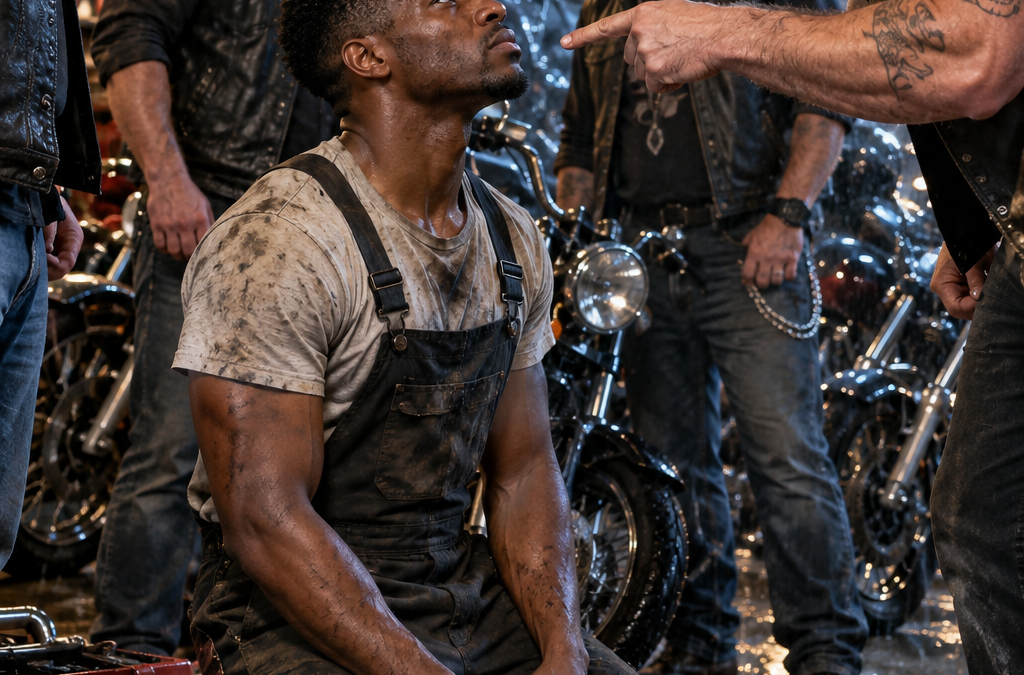
𝗣𝗔𝗥𝗧 𝟮
Bike one: spark plug.
Bike two: spark plug.
Bike three: fuel leak.
Bike four: clogged carburetor.
Bike five: wiring short.
Bike six: manifold gasket.
Dale stood beside me.
“How bad?”
“The first five are annoying.”
“And mine?”
“Yours is rude.”
He laughed.
“How long?”
I looked at the clock.
9:32.
“All night.”
Dale nodded.
“We’ll pay.”
I didn’t answer.
Truth was, I already knew I wasn’t going to charge them.
Maybe that sounds foolish.
Maybe it was.
But my father had a rule.
A stranded person wasn’t a customer yet.
They were stranded.
You got them moving first.
Money came later.
Or didn’t.
Bike one took fifteen minutes.
I reached into the parts cabinet.
One set of plugs left.
I had been saving them for a paying repair.
I used one.
Engine came alive smooth.
A younger rider named Tommy Garrett watched from a stool.
“Damn.”
I glanced over.
“What?”
“Nothing, sir.”
Dale laughed.
“He means you’re fast.”
“I’ve had practice.”
Bike two needed the second plug.
Eight minutes.
The engine fired.
Tommy pulled out his phone.
“You mind if I record?”
“Why?”
“Back home, guys won’t believe me.”
“As long as you don’t make me dance.”
He grinned.
“No promises.”
Bike three had a leaking line.
I checked the parts shelf.
Nothing.
I had ordered replacements two weeks earlier but hadn’t paid the distributor balance.
Shipment held.
I stood there looking at the broken line.
Then at the utility sink.
Copper tubing underneath.
I got my hacksaw.
Dale watched me cut a six-inch section from my own water line.
“You’re cutting your building apart?”
“Pipe’s pipe.”
I bent it.
Fitted it.
Clamped it.
Sealed it.
Tested twice.
No leak.
Tommy lowered his phone.
“You seriously just used your sink?”
“Sink won’t complain.”
Around eleven-thirty, I heard coughing.
Not normal coughing.
Deep.
Wet.
I looked across the garage.
The young woman was sitting in the corner with her knees pulled to her chest.
She looked maybe twenty-two.
Her skin was pale from cold.
Hair wet.
Clothes dirty.
There was a fading bruise around one wrist.
I had been too busy with the bikes to really see her.
Now I did.
Thin.
Not fashion thin.
Hungry thin.
I walked over.
“When did you last eat?”
She looked embarrassed.
“I’m fine.”
“That wasn’t the question.”
Her eyes dropped.
“Two days.”
Dale looked over sharply.
“Ellie.”
She shrugged.
“You never told us that.”
“You didn’t ask.”
I went to the back room.
There was a small cot where I sometimes slept when repairs ran late.
One wool blanket.
I brought it out.
Wrapped it around her shoulders.
Then I opened the cabinet.
One packet of instant noodles.
I put water in the kettle.
Made them.
My coffee pot held enough for one cup.
I poured it.
Set both in her hands.
She stared.
“Sir, no.”
“Eat.”
“You haven’t eaten.”
“I ate.”
She looked at me the way Naomi did.
Apparently my lies weren’t improving.
I turned away before she could argue.
Back to bike four.
Behind me, I heard a sound.
Quiet crying.
No dramatic sobbing.
Just the sound someone makes when kindness reaches a place anger has been protecting.
Dale saw me look.
He gave me a slow nod.
No words.
Around one in the morning, everyone except Ellie and me had fallen asleep.
Riders stretched across chairs.
One on the office floor.
Dale sitting upright against the wall.
Bike four’s carburetor was spread across my bench.
Jets.
Float.
Needle.
Gaskets.
I cleaned each piece with solvent and an old toothbrush.
Ellie sat on an overturned bucket wearing my blanket.
“You always stay open this late?”
“No.”
“So we’re special.”
“You’re inconvenient.”
She smiled for the first time.
A few minutes passed.
Then she said:
“My dad’s rich.”
I kept working.
“Congratulations to him.”
She laughed softly.
“No. I mean really rich.”
I nodded.
“He owns a development company.”
“Then why haven’t you eaten in two days?”
Silence.
I looked over.
She stared into her paper cup.
“We don’t talk.”
“How long?”
“Three years.”
I returned to the carburetor.
“What happened?”
“He had my life planned.”
“Parents do that sometimes.”
“He wanted me in his company.”
“You didn’t.”
“No.”
“So?”
“So I told him I hated him.”
I tightened a screw.
“He told me if I walked out, don’t come back until I was ready to act like an adult.”
“You walked.”
“Yes.”
“He let you.”
“Yes.”
“What happened after?”
She laughed without humor.
“I learned pride doesn’t pay rent.”
I looked at her.
She continued.
“Friends let me stay for a while.”
Then shelters.
A boyfriend who stole from her.
Park benches.
Gas station bathrooms.
She’d been robbed twice.
Hospitalized once.
Malnutrition.
Exhaustion.
She said it all in a flat voice.
People who have suffered a long time often stop decorating the facts.
“And your father?”
“Never called.”
“You?”
“Never called him.”
“So both of you are stubborn.”
She looked up.
“You don’t know him.”
“No.”
“You don’t know me.”
“No.”
“How can you say that?”
“Because you’ve spent three years sleeping in shelters to avoid dialing a number.”
That silenced her.
I reassembled the carburetor.
Then said:
“Sounds like both of you lost something you didn’t have to.”
At three, I moved to bike five.
Electrical problems.
I hated invisible problems.
A broken belt shows itself.
A cracked hose leaks.
Electricity hides.
I traced wires by hand.
My fingers had stiffened.
Cold.
Age.
Too many years holding tools.
I stopped twice to warm them with my breath.
Found the break.
Stripped insulation.
Spliced.
Heat shrink.
Tape.
Test.
The bike started.
I stepped outside afterward.
Rain had slowed.
My back felt locked.
I leaned against the wall.
My knees hurt deep enough to feel like the bones themselves were tired.
I pulled the county notice from my shirt pocket.
Thirty days.
$14,200.
I had earned eighty-five dollars that day.
And I had just given away parts I could not replace.
The smart thing would have been to charge Dale.
A lot.
Emergency service.
Overnight labor.
Six bikes.
Could have asked two thousand.
Maybe more.
I thought about it.
Then looked through the window.
Ellie sleeping upright beneath my blanket.
Men who had probably slept in worse places than a garage during service overseas.
My father’s photograph on the wall.
I folded the notice.
Put it away.
At four, I started Dale’s Harley.
Cracked manifold gasket.
Three-hour job even when your body wasn’t asking you to stop.
Ellie woke while I was working.
She sat beside me.
“My dad would’ve charged them double.”
“Your daddy’s not a mechanic.”
“No.”
“What is he?”
“Howard Dawson.”
My wrench stopped.
Just for a fraction of a second.
“Dawson Holdings?”
She looked surprised.
“You know it?”
“I know the signs.”
She pulled the blanket tighter.
“That’s him.”
I continued working.
Interesting.
The company buying half my street belonged to the father of the hungry girl wearing my only blanket.
Life has strange timing.
I said nothing.
Not then.
At four-thirty, Ellie asked:
“Did you have kids?”
“One daughter.”
“Where is she?”
I didn’t answer immediately.
“Gone.”
Her face changed.
“I’m sorry.”
“Cancer.”
“How old?”
“Thirty-eight.”
“Oh.”
“My granddaughter lives with me.”
Ellie stared at the floor.
After a while, I said:
“My old man used to tell me something.”
“What?”
“If somebody pulls up broke down, fix what’s broken.”
She smiled faintly.
“That’s obvious for a mechanic.”
“He wasn’t talking about engines.”
I tightened the final bolt.
“Call your father.”
Her face closed.
“No.”
“Fine.”
“You don’t understand.”
“Nope.”
“He told me not to come home.”
“Three years ago.”
“He meant it.”
“Maybe.”
She looked angry now.
“Why are you defending him?”
“I’m not.”
I put down the wrench.
“I’m defending time.”
She frowned.
“Time doesn’t care which one of you was right.”
I sat up slowly.
“My daughter died before we finished half the arguments we thought we had time to finish.”
Ellie’s eyes filled.
“I’d trade every dollar I ever made for one more stupid argument with her.”
I looked directly at her.
“Don’t waste years just because both of you are waiting for the other person to move first.”
She said nothing.
But something in her face shifted.
At 5:30, I started Dale’s Harley.
The engine settled into a clean idle.
All six bikes were running.
Morning light entered gray through the bay windows.
My body felt ten years older than it had the evening before.
Dale woke.
Then everyone else.
One after another, they listened to the engines.
Tommy walked around them like he had witnessed surgery.
Dale took out his wallet.
“All right.”
He counted bills.
“Name it.”
“No.”
He looked at me.
“What?”
“No charge.”
“Ben.”
“Finish your ride.”
“Six motorcycles.”
“Yep.”
“All night.”
“Also yep.”
“You used parts.”
“I noticed.”
Dale stared at me.
“Why?”
I shrugged.
“You needed help.”
His jaw tightened.
He put the wallet away.
Then he gripped my hand with both of his.
Not a normal handshake.
“You ever need something.”
“I’ll be fine.”
“I mean anything.”
He pulled a card from his vest.
IRON ROADS VETERANS RIDING CLUB
DALE COOPER
REGIONAL PRESIDENT
He placed it on my workbench.
“You call.”
Tommy shook my hand.
“You’re the best wrench I’ve ever watched.”
“You served with mechanics?”
“Army.”
“Then you need better mechanics.”
He laughed.
Ellie was last.
She gave me my blanket.
I pushed it back.
“Keep it.”
“No.”
“You’re colder than I am.”
“Sir—”
“Take it.”
She hugged me.
Carefully.
“Thank you.”
“Call him.”
Her face pressed against my shoulder for one second.
Then she stepped back.
Six engines started.
One after another.
They rode out into the wet morning.
I stood in the doorway until the taillights disappeared.
Then I went inside.
Sat beside my father’s toolbox.
Closed my eyes.
I woke almost five hours later.
Naomi stood over me.
“Grandpa.”
I opened one eye.
“You look terrible.”
“Thank you.”
“What happened?”
I looked at the empty parts shelf.
“Busy night.”
She noticed the missing blanket.
The sink pipe.
The motorcycles’ wet tracks.
“You gave things away again.”
“Maybe.”
She shook her head.
“You’re going to generosity yourself into bankruptcy.”
I almost told her we were already close.
Instead:
“Could be worse ways to go.”
That afternoon, the riders reached Richmond.
I didn’t know Dale told my story to two hundred people.
I didn’t know Tommy posted his video online.
I didn’t know the caption was only six words:
64 YEARS OLD. ZERO DOLLARS CHARGED.
The clip spread.
Veterans groups.
Motorcycle forums.
Facebook pages.
Group chats.
People watched my hands repairing engines at two in the morning.
I didn’t know any of that.
I was asleep.
Ellie was somewhere else writing a letter.
Four days later, a black SUV entered my lot.
A man stepped out wearing a suit that probably cost more than everything inside my parts cabinet.
Victor Crane.
I learned the name when he handed me his card.
DAWSON HOLDINGS
DIRECTOR, ACQUISITIONS
He carried a leather folder.
“Mr. Foster.”
“Yes?”
“I’ll be direct.”
“Appreciate it.”
He opened the folder.
“Our company is assembling parcels along Elm Street for a redevelopment project.”
“I noticed.”
“We’d like your property.”
“Not for sale.”
He smiled.
“You haven’t heard the offer.”
“Doesn’t change the answer.”
“Fifty thousand dollars.”
I laughed once.
Not because it was funny.
Because sometimes insult surprises you.
“My father built this place.”
“Mr. Foster, I understand emotional attachment.”
“No, you don’t.”
His smile tightened.
“You’re facing delinquent taxes.”
I looked at him.
That information wasn’t public in the ordinary sense.
But companies like Dawson knew how to find things.
“The auction will not be kind.”
“Are you threatening me?”
“I’m explaining economics.”
He put the offer on my bench.
“Take fifty thousand while there’s something left to take.”
I picked up the document.
Dropped it in the trash.
Then his card.
Victor watched.
“Everything has a price.”
“Then you haven’t met everything.”
He left.
The next morning, I went to the assessor’s office.
Clean Sunday shirt.
Tax notice.
Sandra Wells sat behind a computer.
“Mr. Foster.”
“I need somebody to explain this.”
I placed the bill down.
“Fourteen thousand two hundred.”
She typed.
Scrolled.
Her face changed slightly.
“My taxes weren’t close to this last year.”
“No.”
“What happened?”
She removed her glasses.
“Your block was reclassified.”
“When?”
“Six months ago.”
“By whom?”
“A rezoning request was approved by the county board.”
“Requested by?”
She hesitated.
I already knew.
“Dawson Holdings?”
“Yes.”
I sat back.
“What does that change?”
“The new industrial-commercial classification changes assessed value and tax treatment.”
“Triples it?”
“In your case, approximately.”
I stared.
“So they request a zoning change.”
“Yes.”
“My taxes jump.”
“Yes.”
“If I can’t pay, my property goes to auction.”
She said nothing.
“And Dawson buys it.”
“I can’t speculate on bidders.”
“You don’t have to.”
Sandra looked uncomfortable.
“I apply the assessment, Mr. Foster. I don’t set zoning policy.”
“Who does?”
She didn’t answer.
I stood.
Folded the notice.
Outside, Naomi was waiting in the truck.
She took one look at me.
“How bad?”
“It’s not an accident.”
“What isn’t?”
“The taxes.”
I told her.
She listened.
Then pulled out her phone.
“We fight.”
“With what?”
“The internet.”
I laughed.
“Put that thing away.”
“No.”
“Naomi.”
“They’re counting on you being tired.”
“I am tired.”
“Then I’ll be loud.”
That same week, Dale called.
His voice sounded furious before hello.
“I heard.”
“Heard what?”
“Tax thing.”
“Who told you?”
“People talk.”
“Dale—”
“They’re trying to take your shop?”
“It’s complicated.”
“No.”
“What?”
“Don’t give me complicated.”
He paused.
“You fixed six motorcycles for strangers while your own place was dying?”
I looked at the workbench.
“How did you know about that?”
“Tommy’s video.”
I sighed.
“Dale.”
“I don’t sit still when things aren’t right.”
“This isn’t your fight.”
“That’s not your decision.”
He hung up.
Within ninety minutes, he had called twelve people.
Veterans advocates.
Regional chapter presidents.
Friends.
A retired civil-rights attorney named Katherine Brooks saw Tommy’s video.
Then she pulled property records.
That changed everything.
Katherine called Dale.
He later repeated her exact words to me.
“This is not one garage.”
Dawson Holdings had used similar redevelopment strategies across three counties.
Fourteen communities.
Rezoning.
Assessment increases.
Tax distress.
Acquisition.
Not always illegal.
But the pattern was too consistent.
Mostly older neighborhoods.
Mostly small businesses.
Mostly people without lawyers.
Katherine started building a file.
Meanwhile, Naomi called a local television station three times.
A young reporter finally answered.
When Naomi told me, I said:
“No.”
“Grandpa.”
“I am not going on television begging.”
“You won’t beg.”
“That’s what it looks like.”
“Tell the truth.”
I looked at my father’s photograph.
For almost an hour.
Finally, I agreed.
The reporter came to the garage.
One camera.
One microphone.
No makeup.
I wore coveralls.
Willie’s toolbox was beside me.
His photograph behind my shoulder.
The reporter asked:
“What does this shop mean to you?”
I looked around.
“My daddy opened it in 1983.”
I paused.
“With eight hundred dollars.”
The reporter waited.
“I’ve been here since.”
“What are you asking the community for?”
“Nothing.”
She looked surprised.
“Nothing?”
“I don’t want pity.”
“Then why do this interview?”
I looked into the camera.
“I want people to know what’s happening.”
I touched the workbench.
“I’ve fixed cars for people who paid me.”
“People who couldn’t.”
“People who paid later.”
“People who never paid.”
I shrugged.
“I don’t care.”
My throat tightened.
“I just want to keep the door open.”
The segment aired Thursday.
Friday morning, three cars waited outside before I arrived.
Saturday, there were eight.
People drove past chain repair shops to come to me.
One woman handed Naomi a hundred dollars for a forty-dollar oil change.
Naomi tried to return it.
The woman refused.
“Keep his door open.”
The GoFundMe Dale’s people had started climbed.
Six thousand.
Then eight.
Then more.
For one week, I worked fourteen-hour days.
For the first time in months, the register had money.
Naomi ran appointments between classes.
She was good at it.
Better than I had ever been.
By Sunday night, we counted everything.
“Ten thousand five hundred,” she said.
I stared.
“Seriously?”
“Yes.”
We added more from repairs during the next week.
Thirteen thousand.
Only $1,200 short of the original tax bill.
For the first time, I believed.
I bought real groceries.
Chicken.
Collard greens.
Sweet potatoes.
Flour.
I cooked Dorothy’s Sunday dinner.
Naomi sat across from me.
No phones.
No calculator.
Just food.
At one point she smiled.
“What?”
“Nothing.”
“You’re staring.”
“It’s good seeing you eat.”
“Don’t get sentimental.”
“I’ll try.”
She made a new sign for the garage.
Hand-painted.
FOSTER’S FIX IT
HONEST WORK. FAIR PRICE. SINCE 1983.
I hung it.
That night I sat beneath Pop’s picture.
“I think we’re going to make it.”
I meant it.
Across town, Victor Crane was watching the television segment.
He made a phone call.
County fire marshal.
The inspector arrived Tuesday.
White truck.
Clipboard.
He checked exits.
Extinguishers.
Panel.
Storage.
Then taped a red notice to the door.
OPERATIONS SUSPENDED.
I stared.
“What’s this?”
“Fire-safety certification expired eleven months ago.”
“I’ve passed every inspection.”
“Certification is separate.”
“When can I renew?”
“Three to four weeks.”
“I don’t have three weeks.”
“Backlog.”
“How much?”
“Eighteen hundred.”
The man looked genuinely sorry.
It didn’t help.
The red tag fluttered on the door.
No customers.
No income.
I knew who had called.
I drove straight to Dawson Holdings.
Glass office.
River view.
Victor sat behind a desk.
He looked up.
“Mr. Foster.”
“You filed the fire complaint.”
“I reported a public-safety concern.”
“You’ve been inside my shop.”
“Yes.”
“You know it isn’t dangerous.”
“What I know personally and what your paperwork says are different.”
He leaned back.
“That’s how systems work.”
I stared at him.
“Systems.”
“Rules.”
He smiled.
“You play by them or eventually they play you.”
My hands curled.
I kept them at my sides.
“My father built those walls.”
Victor said nothing.
“My wife hung curtains in that office when we got married.”
He glanced toward the door.
“My granddaughter did homework at that bench.”
I stepped closer.
“You see parcels.”
He met my eyes.
“I see my life.”
Victor opened a drawer.
Pulled out another copy of the offer.
“Take fifty thousand.”
“No.”
“If this goes to auction, you’ll get less.”
“No.”
“You’re making an emotional decision.”
“Yes.”
That seemed to surprise him.
“Some things are emotional.”
He slid the paper toward me.
“Walk away with something.”
I turned.
Behind me, he said:
“You can’t fight the whole system.”
I stopped.
Looked back.
“Maybe.”
Then left.
Three days later, another notice came.
Auction accelerated.
Fourteen days.
Back taxes:
$14,200.
Inspection and reinstatement fees:
$1,800.
Total:
$16,000.
We had about thirteen thousand saved.
The garage was closed.
No way to earn the rest.
That evening Naomi found me sitting at the kitchen table.
Papers everywhere.
Calculator.
Same numbers.
Again.
Again.
Again.
No solution.
“Grandpa.”
I looked up.
Her face changed.
I realized my eyes were wet.
I wiped them.
“I’m sorry.”
“For what?”
“I promised your mama.”
She sat.
“I promised I’d take care of you.”
“You did.”
“And Pop.”
“What?”
“I promised him I’d keep the shop.”
She reached across.
Took my hand.
“You did that too.”
“Looks like I’m about to lose it.”
“We aren’t done.”
“Baby—”
“We are not done.”
I held her hand.
For once, I let her be the strong one.
Two more businesses sold that week.
The barber.
The laundromat Dorothy once used.
Dawson signs went up.
Windows boarded.
Elm Street looked like a mouth losing teeth.
Then a second news story aired.
Different reporter.
Different angle.
STUBBORN SHOP OWNER BLOCKS NEIGHBORHOOD REDEVELOPMENT.
They showed the fifty-thousand-dollar offer.
They showed boarded buildings.
They interviewed someone who said progress required sacrifice.
Online comments turned ugly.
TAKE THE MONEY.
OLD MAN IS HOLDING EVERYONE HOSTAGE.
STOP PLAYING VICTIM.
Naomi read them until she slammed her laptop shut.
The hinge cracked.
“They don’t know you.”
I washed the same coffee cup three times.
“They don’t have to.”
“They’re lying.”
“They’re talking.”
“Same thing.”
“No.”
I dried the cup.
“People talk loudest about things they understand least.”
“Doesn’t that bother you?”
“Yes.”
She waited.
“That doesn’t mean I have to answer everybody.”
That night, I sat alone in the dark garage.
Red tag on the door.
No lights.
Willie’s photograph barely visible.
My phone rang.
Dale.
“Don’t give up.”
“I’m not.”
“Yes, you are.”
I almost laughed.
“I’m tired.”
“Different thing.”
“The auction’s coming.”
“I know.”
“I don’t have enough.”
Silence.
Then I said:
“I’m running out of road.”
Dale’s voice changed.
Lower.
“Then we’ll build you some more.”
He hung up.
I didn’t know what that meant.
Dale did.
He started calling every Iron Roads chapter he knew.
Not fundraising.
Mobilizing.
Virginia.
North Carolina.
Maryland.
Pennsylvania.
West Virginia.
Tennessee.
Veterans.
Riders.
People who had watched Tommy’s video.
Katherine Brooks filed documents with the state attorney general.
Her evidence mapped fourteen communities targeted through the same strategy.
“We may not stop the auction in time,” she told Dale.
“But we can make sure people see it.”
Tommy planned routes like a military movement.
Staging areas.
Arrival windows.
Communication channels.
Almost three hundred riders committed.
I knew none of this.
Something else was happening in an office I had never entered.
Howard Dawson received a handwritten letter.
From Ellie.
His daughter.
She told him about the garage.
The storm.
My blanket.
The noodles.
The coffee.
Six motorcycles.
She told him what I had said.
Call your father.
She wrote:
A stranger with almost nothing gave me everything he had without asking who I was.
Then:
I’m not ready to come home.
But I’m ready to talk.
Howard read the letter twice.
Then looked at an old photograph of Ellie at twelve.
Bicycle helmet crooked.
Laughing.
He called an assistant.
“Find everything on Foster’s Fix It.”
The file reached his desk.
Property records.
Tax history.
Rezoning.
Acquisition proposal.
He saw Dawson Holdings letterhead.
Then Victor Crane’s name.
Howard called him.
“Foster property.”
“Standard acquisition.”
“The mechanic?”
“Last holdout.”
Howard became quiet.
“He took care of my daughter.”
Victor said nothing.
“He gave her food.”
Silence.
“His blanket.”
Longer silence.
“He told her to call me.”
“Sir, I wasn’t aware—”
“She hadn’t spoken to me in three years.”
Howard’s voice broke slightly.
“Cancel the acquisition.”
“We’ve invested—”
“Cancel it.”
Auction morning.
I woke at five.
Didn’t need an alarm.
The house was quiet.
I shaved.
Slow.
Put on the white shirt I had worn to Dorothy’s funeral.
Pressed pants.
Polished shoes.
If I was losing the shop, I wanted my father to recognize me.
I packed a cardboard box.
Willie’s photograph.
His toolbox.
Naomi’s childhood drawings.
A crayon picture of me under a car.
Another of the garage.
Dorothy’s curtains.
Naomi appeared in the hallway.
Foster’s Fix It T-shirt.
Red eyes.
“You don’t have to come.”
“Stop saying things you know won’t happen.”
We drove in silence.
No radio.
At the shop, I unlocked the door.
Walked inside.
Ran one hand across the workbench.
Forty-three years of scratches.
Oil.
Burn marks.
Tool dents.
A map of time.
I lifted the box.
Then heard something.
Low.
Distant.
Rumble.
I stopped.
Naomi looked at me.
“Thunder?”
“No.”
The sound grew.
Not one engine.
Many.
We stepped outside.
Motorcycles appeared at the far end of Elm Street.
Ten.
Twenty.
Then more.
Chrome.
Leather.
Flags.
Iron Roads patches.
They kept coming.
Fifty.
One hundred.
Two hundred.
More.
Both sides of the street filled.
The sound vibrated through the garage walls.
Naomi grabbed my arm.
“Grandpa.”
I couldn’t speak.
Almost three hundred riders.
Men.
Women.
Old veterans with gray beards.
Younger riders.
People from six states.
At the front:
Dale.
On the Harley I had repaired.
He killed the engine.
Removed his helmet.
Walked toward me.
I still held the cardboard box.
“You fixed six, old man.”
His eyes were wet.
“We brought three hundred.”
Behind them, television vans.
Cameras.
Katherine Brooks holding a thick leather folder.
Neighbors standing on porches.
Naomi started crying.
Then laughing.
I looked at Dale.
“I didn’t ask for this.”
He put one hand on my shoulder.
“You didn’t have to.”
He looked toward the motorcycles.
“That’s the point.”
Then the riders parted.
A black town car came slowly through the center.
Stopped.
Howard Dawson stepped out.
Gray suit.
No tie.
Leather folder.
Three hundred riders stared at him.
He walked toward me alone.
“Mr. Foster?”
“Yes.”
“My name is Howard Dawson.”
“I know the name.”
His face tightened.
“My company is the reason you’re standing here holding that box.”
I put it down.
Waited.
“My daughter wrote me.”
Ellie.
I said nothing.
“She told me what happened.”
His voice trembled.
“Blanket.”
He swallowed.
“Food.”
“Coffee.”
He looked at me.
“You told her to call me.”
“She needed her father.”
“I needed my daughter.”
His eyes shone.
“I just didn’t know how to say it anymore.”
Howard opened the folder.
First document.
Tax clearance.
PAID IN FULL.
I stared.
Second.
Withdrawal of Dawson Holdings’ acquisition claim.
Third.
A property-protection agreement restricting future company-backed rezoning and reassessment actions affecting 412 Elm Street for twenty-five years, subject to county approval and recorded covenants.
Katherine stepped closer.
Her eyes told me she had already reviewed it.
Howard said:
“The tax bill is paid.”
I looked up.
“No.”
He frowned.
“What?”
“I can’t take your money.”
“You saved my daughter.”
“I gave her noodles.”
“You gave her more than that.”
“No.”
I shook my head.
“You don’t owe me sixteen thousand dollars because I acted like a decent human being.”
Howard closed his eyes briefly.
Then said:
“Then let me say this differently.”
I waited.
“My company caused the condition that created that bill.”
That stopped me.
“We initiated the rezoning.”
He looked toward the cameras.
“The tax escalation followed.”
His jaw tightened.
“I benefited from a system I didn’t look at closely enough.”
He handed me the clearance.
“This isn’t repayment for kindness.”
Pause.
“It’s restitution for damage done under my name.”
That I could accept.
My hands shook when I took the folder.
No one cheered.
Three hundred people were silent.
Howard looked at the shop.
Then at me.
“I thought wealth was being able to buy anything.”
His voice lowered.
“My daughter taught me what it looks like when someone with nothing gives without asking.”
I looked at him.
“Your daughter’s a good woman.”
His face broke.
Not dramatic.
One blink too long.
Jaw tightening.
Then a nod.
“You should be proud of her.”
A black SUV entered the far side of the lot.
Victor Crane.
He stepped out.
Saw the motorcycles.
Cameras.
Howard.
Me.
He stopped.
Howard turned.
“Victor.”
“Sir.”
“Acquisition division is being restructured.”
Victor’s face changed.
“Sir, I was following established protocol.”
“That’s the problem.”
Katherine stepped forward.
She held up her folder.
“Howard.”
He nodded.
She turned toward the reporters.
“My office has submitted a formal request for state investigation into Dawson Holdings’ rezoning and acquisition practices across three counties.”
Victor stared.
“Fourteen communities show a substantially similar sequence.”
Rezoning.
Assessment increase.
Tax distress.
Acquisition.
Howard looked at Victor.
“People aren’t parcels.”
Victor’s jaw tightened.
He walked back to his vehicle.
Nobody booed.
Nobody threw anything.
Dale’s riders simply watched him leave.
That felt stronger.
Naomi leaned toward me.
“What do you think Great-Grandpa Willie would say?”
I looked down.
His photograph sat on top of the box.
That big grin.
Wrench in hand.
I smiled.
“He’d tell everybody to get out of the way.”
“Why?”
“Those bikes aren’t going to fix themselves.”
Three hundred people laughed.
I did too.
Then another car entered the lot.
Smaller.
Older.
Dusty.
Ellie stepped out.
Jeans.
Borrowed jacket.
She looked terrified.
Howard turned.
Father and daughter stood maybe twenty feet apart.
Every engine had stopped.
The whole street became quiet.
Ellie took one step.
Then another.
Howard didn’t move.
Maybe he was afraid moving first would send her away.
She kept walking.
Then suddenly she was running.
Howard opened his arms.
She collapsed into him.
He held her.
Three years.
One embrace.
People looked away.
Not because they didn’t want to see.
Because some moments belong to the people inside them.
Naomi held my hand.
“You did that.”
“No.”
“Yes.”
“I fixed motorcycles.”
She smiled through tears.
“Sure, Grandpa.”
By afternoon, my parking lot had turned into a cookout.
Nobody planned it.
Somebody produced a grill.
Then another.
Coolers.
Burgers.
Ribs.
Potato salad.
Music from a Bluetooth speaker sitting on my workbench.
Almost three hundred riders.
Neighbors.
Reporters eventually leaving.
Howard and Ellie.
Dale.
Katherine.
Tommy was showing Naomi how to adjust a carburetor.
She figured it out in two minutes.
Tommy looked over.
“She’s got your hands.”
“No.”
I watched her.
“Better.”
Dale sat near the bay door with Howard.
Two men who probably would never have spoken under normal circumstances.
Dale said:
“Your girl rode a hundred miles to get here.”
Howard looked toward Ellie.
“She always was stubborn.”
Dale shook his head.
“That isn’t stubbornness.”
“What is it?”
“Guts.”
Howard smiled.
I watched from inside.
My father used to say a garage wasn’t really about cars.
I never fully understood him.
That afternoon, I did.
Engines were the excuse.
People came through the door broken down.
Sometimes the problem was mechanical.
Sometimes it wasn’t.
By evening, everybody was gone.
Paper plates in garbage bags.
Grill cold.
Fireflies appearing over the grass.
I stood alone inside the garage.
I took my father’s photograph from the box.
Hung it back on the wall.
Straightened it.
Then Dorothy’s curtains.
Then the toolbox returned beneath Pop’s picture.
Naomi’s sign went back on the door.
FOSTER’S FIX IT
HONEST WORK. FAIR PRICE. SINCE 1983.
I stared.
Then took a black marker.
At the bottom, I added one word.
STILL.
Naomi read it.
“That’s it?”
“That’s enough.”
That night, for the first time in months, I slept without waking to calculate money.
Six months later, Foster’s Fix It remained on Elm Street.
But it had changed.
Business was steady.
The state opened an investigation into the rezoning practices Katherine documented.
Several counties paused similar redevelopment actions.
Dawson Holdings created a mandatory community-impact review before acquisitions affecting long-standing residential or small-business districts.
Howard ordered it himself.
He did more than issue press statements.
He fired people.
Changed incentives.
Required independent review.
He told me once:
“I thought Victor was aggressive.”
“He was.”
“I thought that was why I hired him.”
“Probably.”
Howard looked ashamed.
“That’s the problem.”
I nodded.
Sometimes people don’t need comfort.
They need truth.
Victor was moved out of acquisitions while internal and state reviews continued.
Months later, an anonymous donation arrived at the garage.
Large enough to purchase tools for the training program I had started.
No name.
Naomi suspected Victor.
I never asked.
Maybe it was.
Maybe not.
I launched the training program because of Tommy.
He kept saying young people needed somewhere to learn trades without spending twenty thousand dollars.
So every Saturday, teenagers from the neighborhood came to the garage.
Oil changes.
Brake systems.
Electrical basics.
Diagnostics.
Tool safety.
I charged nothing.
Howard’s foundation funded equipment.
I argued with him over that.
He said:
“This one isn’t restitution.”
“What is it?”
“Investment.”
“In what?”
He pointed toward six teenagers surrounding an engine block.
“That.”
I accepted.
Naomi received a scholarship to Virginia State University.
Business administration.
When the letter arrived, she screamed so loudly I thought someone had been injured.
She ran into the garage waving it.
“I got it.”
“Got what?”
“Grandpa!”
I wiped my hands.
She shoved the paper against my chest.
Full academic scholarship.
I read it twice.
Then hugged her.
She whispered:
“I’m opening location number two.”
“You haven’t finished your first semester.”
“Planning matters.”
“Make sure the sign looks right.”
She pulled back.
“I already designed it.”
“Of course you did.”
Ellie stayed nearby.
She and Howard didn’t repair three years in a week.
Real life doesn’t work that way.
They argued.
Stopped talking for days.
Tried again.
Went to counseling.
Howard apologized for things that had happened before she left.
Ellie apologized too.
Neither pretended money had been the real problem.
Control.
Pride.
Fear.
Expectations.
Those had been the problem.
Eventually, Ellie began working with a veterans transition shelter connected to Iron Roads.
She understood homelessness in ways training manuals never could.
A year later, she became program director.
Every spring, she rode with Dale’s club.
Dale made the Foster’s Fix It stop an annual Iron Roads tradition.
The first year after the auction, 340 motorcycles came.
The second year, more than four hundred.
I complained every time.
Dale ignored me every time.
One afternoon Howard came by alone.
No driver.
No suit.
Jeans.
Button-down shirt.
He sat on an overturned bucket while I rebuilt a carburetor.
“You ever think about retiring?”
“No.”
“You’re sixty-five.”
“So?”
“My doctor tells me sixty-five is when you start respecting your knees.”
“Your doctor doesn’t know anything.”
Howard laughed.
Then we drank coffee.
He came monthly after that.
We rarely talked about business.
Mostly engines.
Ellie.
Naomi.
Parents.
Regret.
One day he asked:
“Why did you help her?”
“Who?”
“Ellie.”
“She was hungry.”
“I mean beyond that.”
I put down the wrench.
“There isn’t beyond that.”
He frowned.
“You didn’t know her.”
“No.”
“You didn’t know she could help you.”
“No.”
“You didn’t know who I was.”
“Didn’t care.”
Howard looked around the garage.
“That’s hard for me to understand.”
“Why?”
“My whole life, every transaction had a reason.”
“That sounds exhausting.”
He laughed.
“Maybe.”
Then I said:
“Your daughter wasn’t a transaction.”
He looked down at his coffee.
“I know that now.”
Years before, my father had told me something else.
I had forgotten until the night of the motorcycles.
I was twenty-five and complaining because a customer owed us forty dollars.
Pop said:
“Ben, don’t confuse what something costs with what it’s worth.”
I thought he was talking about repairs.
He wasn’t.
That rainy night cost me plenty.
Spark plugs.
Pipe.
Food.
Blanket.
Labor.
Pain.
Sleep.
What was it worth?
I couldn’t calculate it.
Six repaired motorcycles became a story.
The story reached Dale.
Dale reached hundreds of riders.
The riders reached reporters.
Katherine found a pattern.
Ellie wrote a letter.
The letter reached Howard.
Howard confronted his own company.
A garage survived.
A father and daughter spoke again.
A neighborhood’s redevelopment practices came under investigation.
Young people learned trades.
Naomi went to college.
None of that was visible when I handed Ellie my last packet of noodles.
That’s the part people misunderstood when reporters came back months later.
They wanted me to say kindness always comes back.
I wouldn’t.
Because that’s not true in the simple way people want it to be.
I’ve helped people who never came back.
Loaned money I never saw again.
Fixed cars for customers who disappeared.
Given time to people who forgot my name.
Dorothy was kind and still died.
Angela was generous and still got cancer.
Goodness is not a vending machine.
You don’t insert kindness and wait for reward.
If I had known the motorcycles would lead to saving my garage, the act would have been different.
A bargain.
I didn’t know.
That’s why it mattered.
I helped because they were stranded.
I fed Ellie because she was hungry.
I told her to call her father because I knew what it was like to lose time you cannot recover.
Everything else came later.
That distinction became important to me.
One Saturday, a boy in our mechanic program asked:
“Mr. Foster, is it true you fixed six bikes for free and then three hundred bikers saved your shop?”
“Something like that.”
“So you got lucky.”
“Yes.”
He seemed disappointed.
“That’s it?”
“What did you want?”
“A lesson.”
I laughed.
“You’re seventeen. Everybody wants lessons when they’re seventeen.”
He waited.
I thought.
Then pointed toward an old engine on the stand.
“See that bolt?”
“Yes.”
“Take it out.”
He tried.
Struggled.
“Stuck.”
“What do you do?”
“More force?”
“No.”
I handed him penetrating oil.
“Sometimes.”
I sprayed it.
“Sometimes you wait.”
He frowned.
“This is the lesson?”
“No.”
I smiled.
“I’m distracting you because I don’t have one.”
He laughed.
Then I said:
“Do good work.”
He looked at me.
“That’s it?”
“Do good work. Treat people right. Don’t assume either guarantees anything.”
He thought about it.
“That sounds depressing.”
“It isn’t.”
“Why?”
“Because then you’re doing those things because of who you are, not what you expect to get.”
He nodded slowly.
“Now take out the bolt.”
That was the closest I ever came to giving a speech.
The neighborhood changed too.
Not everything stopped.
Development continued.
Some empty buildings needed new investment.
Some owners wanted to sell.
Change itself wasn’t evil.
What mattered was whether people already there had a voice.
The county created new notice requirements for major rezoning.
Public hearings had to occur before reassessment in several categories.
Katherine pushed for stronger protections.
She never stopped being difficult.
I liked her immediately.
She once told me:
“Don’t make Howard Dawson a hero.”
“I don’t.”
“Good.”
“He fixed what he could.”
“After benefiting from the damage.”
“Yes.”
She nodded.
“That’s more accurate.”
Life isn’t cleaner when we force people into villain and hero boxes.
Howard’s company caused harm.
Victor exploited a system.
Howard ignored things he should have known.
Then he changed.
That didn’t erase what happened.
It mattered anyway.
Victor did wrong.
Maybe later he sent money anonymously.
If he did, that didn’t erase anything either.
It mattered anyway.
People are complicated.
Engines are easier.
Naomi graduated four years later.
I sat in the audience wearing a suit that didn’t fit quite right.
Howard and Ellie sat two rows behind me.
Dale came wearing a tie over a shirt that still had motorcycle grease under one cuff.
When Naomi crossed the stage, she looked toward me.
I stood.
Probably wasn’t supposed to.
Didn’t care.
She laughed.
Afterward, she handed me the diploma.
“Hold this.”
“Why?”
“Because you’re crying.”
“I am not.”
“Grandpa.”
“Dust.”
“We’re outside.”
“Outdoor dust.”
She hugged me.
A year later, she opened the second Foster’s Fix It.
Different neighborhood.
Same sign.
HONEST WORK. FAIR PRICE.
She added another line:
PEOPLE FIRST.
I pretended to dislike it.
She ignored me.
The original garage stayed mine.
Not because I couldn’t let go.
Because I didn’t want to.
Some mornings, I still arrive before seven.
Unlock.
Touch my father’s toolbox.
Coffee.
Lift the bay door.
Same ritual.
One winter morning, I found an envelope pushed under the door.
Inside was a photograph.
Six motorcycles outside a veterans shelter.
Ellie stood in the center.
Dale beside her.
Behind them was a sign:
FOSTER GARAGE SKILLS SCHOLARSHIP.
I called Ellie immediately.
“What is this?”
She laughed.
“You like it?”
“You used my name.”
“That’s how naming works.”
“I didn’t approve.”
“Dale did.”
“Dale doesn’t own my name.”
“He thinks he does.”
I sighed.
“What is it?”
“Training grants for homeless veterans who want mechanic certification.”
I sat down.
“Ellie.”
“You told me fixing something starts with asking what’s broken.”
I was quiet.
“We’re helping people fix what’s next.”
My throat tightened.
“That’s good work.”
“I learned from somebody.”
“Don’t get sentimental.”
“Too late.”
After the call, I looked at Pop’s picture.
“See what you started?”
He kept grinning.
The old man had been dead a long time.
Still causing trouble.
Years later, people sometimes came into the shop because they had heard the story.
They expected a philosopher.
They got me.
One man drove from Ohio just to shake my hand.
I told him he could have saved gas.
Another woman brought her motorcycle and refused to let me charge her.
I refused to accept free money.
We argued twenty minutes.
Finally I charged her.
She tipped Naomi online anyway.
The story became larger than the truth in places.
Online versions said I had only eleven dollars and somehow gave away thousands in parts.
Not quite.
Some said Howard Dawson personally tried to steal my garage.
He didn’t.
His company did things he failed to supervise.
Some said three hundred bikers paid my taxes.
They didn’t.
They showed up.
Sometimes showing up is the bigger thing.
The truth was enough.
A sixty-four-year-old mechanic was close to losing a garage.
Six strangers arrived in the rain.
One hungry young woman needed food.
I had very little.
I gave what I could.
Later, people did the same for me.
Not because the universe keeps accounts.
Because people do.
People remember who showed up.
Dale remembered.
Ellie remembered.
Naomi remembered.
Even Howard learned.
That’s enough.
On the tenth anniversary of the night those motorcycles arrived, Iron Roads held the biggest ride yet.
Almost six hundred bikes.
I complained.
Naturally.
They ignored me.
Naturally.
Ellie arrived on her own motorcycle.
Howard came separately.
Older now.
Slower.
He and I sat near the bay door.
Naomi was inside arguing with a teenager about spark-plug gaps.
Dale walked over.
“You know what day it is?”
“Saturday.”
He shook his head.
“Ten years.”
“Since what?”
“You’re impossible.”
“Age.”
He pointed at the spot where Ellie had once sat under my blanket.
“You remember.”
Of course I remembered.
Every detail.
Rain.
Cold.
Empty shelf.
The county notice in my pocket.
My back hurting.
Ellie’s shaking hands.
Dale’s Harley.
The sound of six engines coming alive before sunrise.
I looked around.
Kids in mechanic shirts.
Veterans laughing.
Neighbors eating.
Naomi running a business.
Ellie healthy.
Howard talking to people he once might have known only as parcel numbers.
Then I looked at my father’s toolbox.
Still there.
Leather cracked.
Handles worn.
Three generations of hands now.
Dale asked:
“You ever think what would’ve happened if we’d found another garage?”
I smiled.
“Some other poor fool would’ve been up all night.”
“No.”
He became serious.
“I mean all of this.”
I looked around again.
“No.”
“You don’t?”
“No point.”
“Why?”
“Because you didn’t.”
He waited.
“You came here.”
I tapped the workbench.
“This happened.”
I never liked living inside alternate lives.
Enough trouble managing the real one.
That evening, after the final motorcycle left, I closed the bay door.
Naomi had gone home.
The street was quiet.
I stood beneath Willie’s photograph.
The hand-painted sign outside had been repainted several times over the years.
But we kept the same words.
FOSTER’S FIX IT.
HONEST WORK. FAIR PRICE. SINCE 1983.
STILL.
I touched the toolbox.
Same prayer without sound.
Then I turned off the lights.
At sixty-four, I thought I was thirty days from losing everything my father had built.
What I couldn’t see was how much of that place had already traveled into other people.
Into Naomi.
Into the customers my father helped.
Into riders I had met once.
Into a hungry girl wrapped in a wool blanket.
A building can be auctioned.
A sign can be removed.
Tools can be sold.
But what a place means is harder to repossess.
That was what Dawson Holdings had never understood when they looked at Elm Street.
They saw acreage.
Assessed value.
Development potential.
I saw Pop’s hands.
Dorothy’s curtains.
Angela doing homework.
Naomi growing up.
Dale saw a man who stayed awake all night.
Ellie saw warmth when she had nowhere safe to sleep.
And once enough people can see what something truly is, it becomes much harder for anyone to reduce it back to a number.
I locked the front door.
The sign moved slightly in the evening wind.
Still.
That one word had started as defiance.
Over the years, it became something quieter.
Gratitude.
Still standing.
Still fixing.
Still giving when I could.
Still missing the people who weren’t there anymore.
Still watching Naomi build something of her own.
Still opening the same door my father opened in 1983.
And every morning when I walk inside, I rest my hand on his old toolbox for one second.
I don’t ask him for anything.
I don’t promise anything either.
I just tell him the truth.
We’re still here.








